Roberto M Diaz-Rodriguez, Diogo A Gálico, Daniel Chartrand, Muralee Murugesu
{"title":"配体对分子Eu(II)发光温度计发射特性的影响。","authors":"Roberto M Diaz-Rodriguez, Diogo A Gálico, Daniel Chartrand, Muralee Murugesu","doi":"10.1021/jacs.4c13805","DOIUrl":null,"url":null,"abstract":"<p><p>Discrete molecular organometallic europium(II) complexes are promising functional materials due to their ability to behave as highly sensitive band-shift luminescence thermometers. Furthering our understanding of the design principles salient to the emission behavior of such systems is important for developing them in this emerging application. To this end, a series of pseudo-<i>C</i><sub>4<i>v</i></sub>-symmetric organometallic europium(II) complexes bearing systematically varying ligand sets were synthesized and characterized to probe the influence of subtle structural modification on their optical properties. Opto-structural correlation analyses via variable-temperature single-crystal X-ray diffraction and photoluminescence spectroscopy reveal a remarkable variability in properties among structurally similar complexes and a convoluted dependence of the emission characteristics on the stereoelectronic properties of the ligands. A few factors of particular influence are nevertheless identified, including the distance between the europium(II) ion and the basal plane of the square-pyramidal coordination polyhedron, the presence of pendant electron density that might further interact with the excited-state 5d orbitals, and, qualitatively, the metal-ligand flexibility of the construct. These results help to elucidate principles that govern the luminescence properties of organometallic europium(II) complexes with an eye to enabling the rational design of high-performance luminescence thermometers of this genre.</p>","PeriodicalId":49,"journal":{"name":"Journal of the American Chemical Society","volume":" ","pages":"34118-34129"},"PeriodicalIF":15.6000,"publicationDate":"2024-12-11","publicationTypes":"Journal Article","fieldsOfStudy":null,"isOpenAccess":false,"openAccessPdf":"","citationCount":"0","resultStr":"{\"title\":\"Ligand Effects on the Emission Characteristics of Molecular Eu(II) Luminescence Thermometers.\",\"authors\":\"Roberto M Diaz-Rodriguez, Diogo A Gálico, Daniel Chartrand, Muralee Murugesu\",\"doi\":\"10.1021/jacs.4c13805\",\"DOIUrl\":null,\"url\":null,\"abstract\":\"<p><p>Discrete molecular organometallic europium(II) complexes are promising functional materials due to their ability to behave as highly sensitive band-shift luminescence thermometers. Furthering our understanding of the design principles salient to the emission behavior of such systems is important for developing them in this emerging application. To this end, a series of pseudo-<i>C</i><sub>4<i>v</i></sub>-symmetric organometallic europium(II) complexes bearing systematically varying ligand sets were synthesized and characterized to probe the influence of subtle structural modification on their optical properties. Opto-structural correlation analyses via variable-temperature single-crystal X-ray diffraction and photoluminescence spectroscopy reveal a remarkable variability in properties among structurally similar complexes and a convoluted dependence of the emission characteristics on the stereoelectronic properties of the ligands. A few factors of particular influence are nevertheless identified, including the distance between the europium(II) ion and the basal plane of the square-pyramidal coordination polyhedron, the presence of pendant electron density that might further interact with the excited-state 5d orbitals, and, qualitatively, the metal-ligand flexibility of the construct. These results help to elucidate principles that govern the luminescence properties of organometallic europium(II) complexes with an eye to enabling the rational design of high-performance luminescence thermometers of this genre.</p>\",\"PeriodicalId\":49,\"journal\":{\"name\":\"Journal of the American Chemical Society\",\"volume\":\" \",\"pages\":\"34118-34129\"},\"PeriodicalIF\":15.6000,\"publicationDate\":\"2024-12-11\",\"publicationTypes\":\"Journal Article\",\"fieldsOfStudy\":null,\"isOpenAccess\":false,\"openAccessPdf\":\"\",\"citationCount\":\"0\",\"resultStr\":null,\"platform\":\"Semanticscholar\",\"paperid\":null,\"PeriodicalName\":\"Journal of the American Chemical Society\",\"FirstCategoryId\":\"92\",\"ListUrlMain\":\"https://doi.org/10.1021/jacs.4c13805\",\"RegionNum\":1,\"RegionCategory\":\"化学\",\"ArticlePicture\":[],\"TitleCN\":null,\"AbstractTextCN\":null,\"PMCID\":null,\"EPubDate\":\"2024/11/29 0:00:00\",\"PubModel\":\"Epub\",\"JCR\":\"Q1\",\"JCRName\":\"CHEMISTRY, MULTIDISCIPLINARY\",\"Score\":null,\"Total\":0}","platform":"Semanticscholar","paperid":null,"PeriodicalName":"Journal of the American Chemical Society","FirstCategoryId":"92","ListUrlMain":"https://doi.org/10.1021/jacs.4c13805","RegionNum":1,"RegionCategory":"化学","ArticlePicture":[],"TitleCN":null,"AbstractTextCN":null,"PMCID":null,"EPubDate":"2024/11/29 0:00:00","PubModel":"Epub","JCR":"Q1","JCRName":"CHEMISTRY, MULTIDISCIPLINARY","Score":null,"Total":0}
Ligand Effects on the Emission Characteristics of Molecular Eu(II) Luminescence Thermometers.
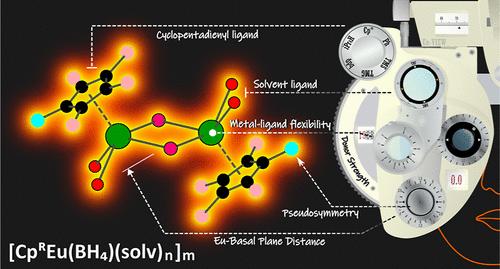
Discrete molecular organometallic europium(II) complexes are promising functional materials due to their ability to behave as highly sensitive band-shift luminescence thermometers. Furthering our understanding of the design principles salient to the emission behavior of such systems is important for developing them in this emerging application. To this end, a series of pseudo-C4v-symmetric organometallic europium(II) complexes bearing systematically varying ligand sets were synthesized and characterized to probe the influence of subtle structural modification on their optical properties. Opto-structural correlation analyses via variable-temperature single-crystal X-ray diffraction and photoluminescence spectroscopy reveal a remarkable variability in properties among structurally similar complexes and a convoluted dependence of the emission characteristics on the stereoelectronic properties of the ligands. A few factors of particular influence are nevertheless identified, including the distance between the europium(II) ion and the basal plane of the square-pyramidal coordination polyhedron, the presence of pendant electron density that might further interact with the excited-state 5d orbitals, and, qualitatively, the metal-ligand flexibility of the construct. These results help to elucidate principles that govern the luminescence properties of organometallic europium(II) complexes with an eye to enabling the rational design of high-performance luminescence thermometers of this genre.
期刊介绍:
The flagship journal of the American Chemical Society, known as the Journal of the American Chemical Society (JACS), has been a prestigious publication since its establishment in 1879. It holds a preeminent position in the field of chemistry and related interdisciplinary sciences. JACS is committed to disseminating cutting-edge research papers, covering a wide range of topics, and encompasses approximately 19,000 pages of Articles, Communications, and Perspectives annually. With a weekly publication frequency, JACS plays a vital role in advancing the field of chemistry by providing essential research.




 京公网安备 11010802042870号
京ICP备2023020795号-1
京公网安备 11010802042870号
京ICP备2023020795号-1

 分享
分享
 求助内容:
求助内容: 应助结果提醒方式:
 扫码关注我们
