Dr. Haoyue Zhang, Dr. Shengyang Li, Prof. Jing Xu, Changzhou Ru, Jiacheng Yu, Prof. Jun Luo, LiXuan Mu, Prof. Wensheng Shi, Prof. Guangwei She
{"title":"表面重构Ni0.95Pt0.05/Si光电极,用于无偏置析氢耦合5-羟甲基糠醛氧化。","authors":"Dr. Haoyue Zhang, Dr. Shengyang Li, Prof. Jing Xu, Changzhou Ru, Jiacheng Yu, Prof. Jun Luo, LiXuan Mu, Prof. Wensheng Shi, Prof. Guangwei She","doi":"10.1002/asia.202401284","DOIUrl":null,"url":null,"abstract":"<p>Coupling hydrogen evolution reaction (HER) with biomass valorization using a photoelectrochemical (PEC) system presents a promising approach for effectively converting solar energy to chemical energy. A crucial biomass valorization reaction is the production of value-added 2,5-furandicarboxylic acid (FDCA) via 5-Hydroxymethylfurfural (HMF) oxidation reaction (HMFOR). To achieve efficient FDCA production, we demonstrate an effective photoanode strategy that combines metal silicidation, dopant segregation, and surface reconstruction to create a bimetallic silicide Ni<sub>0.95</sub>Pt<sub>0.05</sub>Si/n-Si photoanode. The oxide-free Ni<sub>0.95</sub>Pt<sub>0.05</sub>Si/n-Si interface prepared by the metal-silicidation process ensures efficient interfacial charge transport, while dopant segregation enhances the Schottky barrier height and photovoltage, and surface reconstruction dramatically improves the catalytic activity of the photoanode surface. The as-prepared Ni<sub>0.95</sub>Pt<sub>0.05</sub>Si/n-Si photoanode exhibited excellent PEC performance for HMFOR with high conversion of HMF (97.2 %) and yield of FDCA (80.3 %) under illumination. Furthermore, by integrating a surface reconstructed Ni<sub>0.95</sub>Pt<sub>0.05</sub>Si/n-Si photoanode with a Ni<sub>0.95</sub>Pt<sub>0.05</sub>Si/p-Si photocathode, a dual-photoelectrode system was constructed capable of simultaneous production of FDCA and H<sub>2</sub>, which achieves high photocurrent density of 5 mA cm<sup>−2</sup> at zero bias under illumination. This study offers an auspicious prospect for high cost-effectiveness conversion from solar energy to industrial monomers.</p>","PeriodicalId":145,"journal":{"name":"Chemistry - An Asian Journal","volume":"20 3","pages":""},"PeriodicalIF":3.3000,"publicationDate":"2024-11-29","publicationTypes":"Journal Article","fieldsOfStudy":null,"isOpenAccess":false,"openAccessPdf":"","citationCount":"0","resultStr":"{\"title\":\"Surface Reconstructed Ni0.95Pt0.05/Si Photoelectrodes for Bias-free Hydrogen Evolution Coupled with 5-hydroxymethylfurfural Oxidation\",\"authors\":\"Dr. Haoyue Zhang, Dr. Shengyang Li, Prof. Jing Xu, Changzhou Ru, Jiacheng Yu, Prof. Jun Luo, LiXuan Mu, Prof. Wensheng Shi, Prof. Guangwei She\",\"doi\":\"10.1002/asia.202401284\",\"DOIUrl\":null,\"url\":null,\"abstract\":\"<p>Coupling hydrogen evolution reaction (HER) with biomass valorization using a photoelectrochemical (PEC) system presents a promising approach for effectively converting solar energy to chemical energy. A crucial biomass valorization reaction is the production of value-added 2,5-furandicarboxylic acid (FDCA) via 5-Hydroxymethylfurfural (HMF) oxidation reaction (HMFOR). To achieve efficient FDCA production, we demonstrate an effective photoanode strategy that combines metal silicidation, dopant segregation, and surface reconstruction to create a bimetallic silicide Ni<sub>0.95</sub>Pt<sub>0.05</sub>Si/n-Si photoanode. The oxide-free Ni<sub>0.95</sub>Pt<sub>0.05</sub>Si/n-Si interface prepared by the metal-silicidation process ensures efficient interfacial charge transport, while dopant segregation enhances the Schottky barrier height and photovoltage, and surface reconstruction dramatically improves the catalytic activity of the photoanode surface. The as-prepared Ni<sub>0.95</sub>Pt<sub>0.05</sub>Si/n-Si photoanode exhibited excellent PEC performance for HMFOR with high conversion of HMF (97.2 %) and yield of FDCA (80.3 %) under illumination. Furthermore, by integrating a surface reconstructed Ni<sub>0.95</sub>Pt<sub>0.05</sub>Si/n-Si photoanode with a Ni<sub>0.95</sub>Pt<sub>0.05</sub>Si/p-Si photocathode, a dual-photoelectrode system was constructed capable of simultaneous production of FDCA and H<sub>2</sub>, which achieves high photocurrent density of 5 mA cm<sup>−2</sup> at zero bias under illumination. This study offers an auspicious prospect for high cost-effectiveness conversion from solar energy to industrial monomers.</p>\",\"PeriodicalId\":145,\"journal\":{\"name\":\"Chemistry - An Asian Journal\",\"volume\":\"20 3\",\"pages\":\"\"},\"PeriodicalIF\":3.3000,\"publicationDate\":\"2024-11-29\",\"publicationTypes\":\"Journal Article\",\"fieldsOfStudy\":null,\"isOpenAccess\":false,\"openAccessPdf\":\"\",\"citationCount\":\"0\",\"resultStr\":null,\"platform\":\"Semanticscholar\",\"paperid\":null,\"PeriodicalName\":\"Chemistry - An Asian Journal\",\"FirstCategoryId\":\"1\",\"ListUrlMain\":\"https://aces.onlinelibrary.wiley.com/doi/10.1002/asia.202401284\",\"RegionNum\":3,\"RegionCategory\":\"化学\",\"ArticlePicture\":[],\"TitleCN\":null,\"AbstractTextCN\":null,\"PMCID\":null,\"EPubDate\":\"\",\"PubModel\":\"\",\"JCR\":\"Q2\",\"JCRName\":\"CHEMISTRY, MULTIDISCIPLINARY\",\"Score\":null,\"Total\":0}","platform":"Semanticscholar","paperid":null,"PeriodicalName":"Chemistry - An Asian Journal","FirstCategoryId":"1","ListUrlMain":"https://aces.onlinelibrary.wiley.com/doi/10.1002/asia.202401284","RegionNum":3,"RegionCategory":"化学","ArticlePicture":[],"TitleCN":null,"AbstractTextCN":null,"PMCID":null,"EPubDate":"","PubModel":"","JCR":"Q2","JCRName":"CHEMISTRY, MULTIDISCIPLINARY","Score":null,"Total":0}
引用次数: 0
摘要
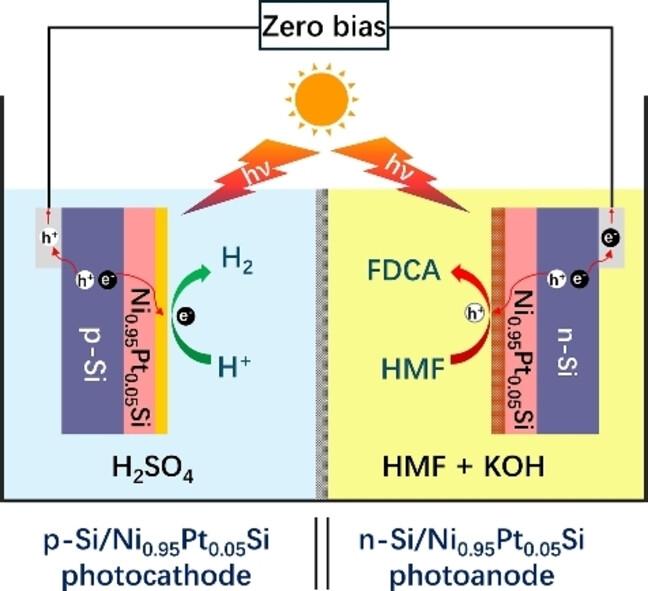
利用光电化学(PEC)系统耦合析氢反应(HER)和生物质增值是一种有效地将太阳能转化为化学能的有前途的方法。一个重要的生物质增值反应是通过5-羟甲基糠醛(HMF)氧化反应(HMFOR)生产增值的2,5-呋喃二甲酸(FDCA)。为了实现高效的FDCA生产,我们展示了一种高效的光阳极策略,该策略结合了金属硅化,掺杂剂偏析和表面重建,以创建双金属硅化物Ni0.95Pt0.05Si/n-Si光阳极。通过金属硅化工艺制备的无氧化物Ni0.95Pt0.05Si/n-Si界面保证了高效的界面电荷输运,而掺杂剂偏析提高了肖特基势垒高度和光电压,表面重构显著提高了光阳极表面的催化活性。制备的Ni0.95Pt0.05Si/n-Si光阳极在光照下具有高HMF转化率(97.2%)和FDCA收率(80.3%)的优异PEC性能。此外,通过将Ni0.95Pt0.05Si/n-Si光阳极与Ni0.95Pt0.05Si/p-Si光阴极集成,构建了能够同时生产FDCA和H2的双光电极系统,该系统在照明下实现了零偏置下5 mA cm-2的高光电流密度。这项研究为从太阳能到工业单体的高成本效益转化提供了一个良好的前景。
Surface Reconstructed Ni0.95Pt0.05/Si Photoelectrodes for Bias-free Hydrogen Evolution Coupled with 5-hydroxymethylfurfural Oxidation
Coupling hydrogen evolution reaction (HER) with biomass valorization using a photoelectrochemical (PEC) system presents a promising approach for effectively converting solar energy to chemical energy. A crucial biomass valorization reaction is the production of value-added 2,5-furandicarboxylic acid (FDCA) via 5-Hydroxymethylfurfural (HMF) oxidation reaction (HMFOR). To achieve efficient FDCA production, we demonstrate an effective photoanode strategy that combines metal silicidation, dopant segregation, and surface reconstruction to create a bimetallic silicide Ni0.95Pt0.05Si/n-Si photoanode. The oxide-free Ni0.95Pt0.05Si/n-Si interface prepared by the metal-silicidation process ensures efficient interfacial charge transport, while dopant segregation enhances the Schottky barrier height and photovoltage, and surface reconstruction dramatically improves the catalytic activity of the photoanode surface. The as-prepared Ni0.95Pt0.05Si/n-Si photoanode exhibited excellent PEC performance for HMFOR with high conversion of HMF (97.2 %) and yield of FDCA (80.3 %) under illumination. Furthermore, by integrating a surface reconstructed Ni0.95Pt0.05Si/n-Si photoanode with a Ni0.95Pt0.05Si/p-Si photocathode, a dual-photoelectrode system was constructed capable of simultaneous production of FDCA and H2, which achieves high photocurrent density of 5 mA cm−2 at zero bias under illumination. This study offers an auspicious prospect for high cost-effectiveness conversion from solar energy to industrial monomers.
期刊介绍:
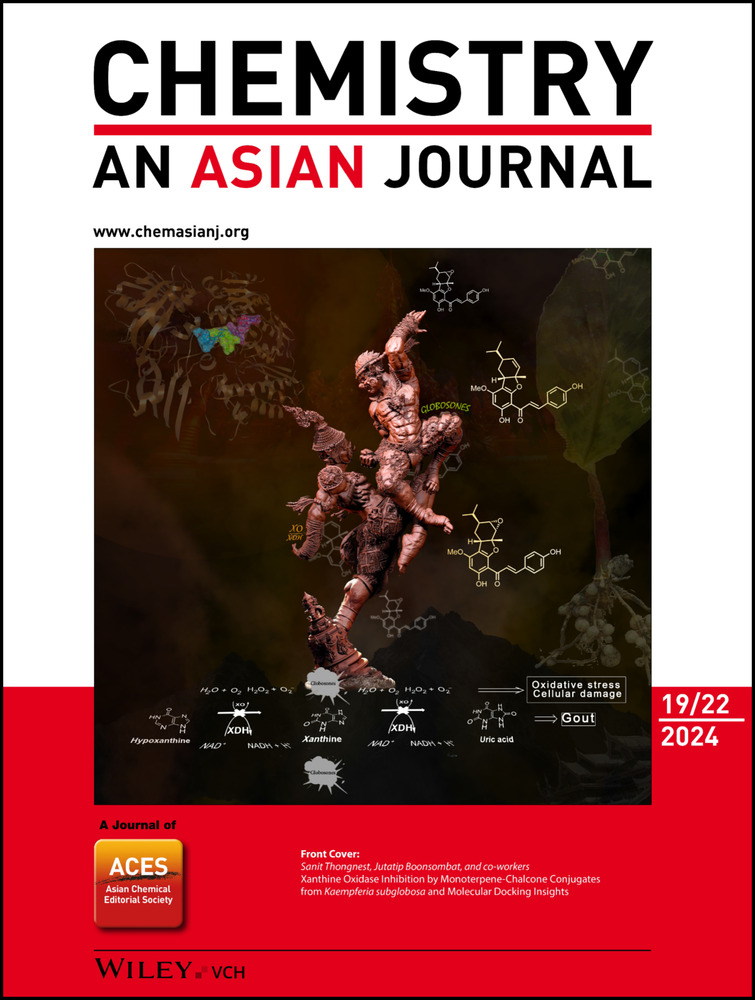
Chemistry—An Asian Journal is an international high-impact journal for chemistry in its broadest sense. The journal covers all aspects of chemistry from biochemistry through organic and inorganic chemistry to physical chemistry, including interdisciplinary topics.
Chemistry—An Asian Journal publishes Full Papers, Communications, and Focus Reviews.
A professional editorial team headed by Dr. Theresa Kueckmann and an Editorial Board (headed by Professor Susumu Kitagawa) ensure the highest quality of the peer-review process, the contents and the production of the journal.
Chemistry—An Asian Journal is published on behalf of the Asian Chemical Editorial Society (ACES), an association of numerous Asian chemical societies, and supported by the Gesellschaft Deutscher Chemiker (GDCh, German Chemical Society), ChemPubSoc Europe, and the Federation of Asian Chemical Societies (FACS).






 京公网安备 11010802042870号
京ICP备2023020795号-1
京公网安备 11010802042870号
京ICP备2023020795号-1

 分享
分享
 求助内容:
求助内容: 应助结果提醒方式:
 扫码关注我们
