{"title":"皮肤学cAMP磷酸二酯酶iv抑制剂的化学、生化和结构异同。","authors":"Jimin Wang , Minh Ho , Christopher G. Bunick","doi":"10.1016/j.jid.2024.10.597","DOIUrl":null,"url":null,"abstract":"<div><div>Roflumilast, the third phosphodiesterase-IV (PDE4) inhibitor approved for use in dermatology, is indicated for topical treatment of psoriasis, seborrheic dermatitis, and atopic dermatitis, whereas its 2 predecessors, apremilast and crisaborole, are indicated for oral treatment of psoriasis and topical treatment of atopic dermatitis, respectively. All 3 are rationally designed PDE4 inhibitors, but roflumilast is the most potent and effective among the 3, with in vitro inhibitory constant half-maximal inhibitory concentration value of 0.7 nM (roflumilast), 0.14 μM (apremilast), and 0.24 μM (crisaborole), representing differences of over 3 orders of magnitude. PDE4 is a cAMP (an intracellular secondary messenger) hydrolase consisting of at least 4 subtypes of exon-spliced isoforms, which are primarily expressed in immune cells for inflammatory response. PDE4 inhibition lengthens the duration of cAMP signals and increases cellular cAMP concentrations, generating anti-inflammatory effects. We examined the physicochemical principles that make PDE4 inhibitors effective and propose chemical modifications to improve them. Sequence alignment of the catalytic domains of all phosphodiesterases identified many previously unreported invariant residues. These residues bind 1 Zn and 1 Mg ion plus 5 structural water molecules for orienting an attacking μ-hydroxyl/μ-oxo anion and for stabilizing 2 nonbridging phosphate oxygen atoms. The arrangement of the 2 divalent metal ions in phosphodiesterases is not related to that of the classic mechanism for general phosphoryl transfer.</div></div>","PeriodicalId":16311,"journal":{"name":"Journal of Investigative Dermatology","volume":"145 6","pages":"Pages 1471-1488.e1"},"PeriodicalIF":7.0000,"publicationDate":"2025-06-01","publicationTypes":"Journal Article","fieldsOfStudy":null,"isOpenAccess":false,"openAccessPdf":"","citationCount":"0","resultStr":"{\"title\":\"Chemical, Biochemical, and Structural Similarities and Differences of Dermatological cAMP Phosphodiesterase-IV Inhibitors\",\"authors\":\"Jimin Wang , Minh Ho , Christopher G. Bunick\",\"doi\":\"10.1016/j.jid.2024.10.597\",\"DOIUrl\":null,\"url\":null,\"abstract\":\"<div><div>Roflumilast, the third phosphodiesterase-IV (PDE4) inhibitor approved for use in dermatology, is indicated for topical treatment of psoriasis, seborrheic dermatitis, and atopic dermatitis, whereas its 2 predecessors, apremilast and crisaborole, are indicated for oral treatment of psoriasis and topical treatment of atopic dermatitis, respectively. All 3 are rationally designed PDE4 inhibitors, but roflumilast is the most potent and effective among the 3, with in vitro inhibitory constant half-maximal inhibitory concentration value of 0.7 nM (roflumilast), 0.14 μM (apremilast), and 0.24 μM (crisaborole), representing differences of over 3 orders of magnitude. PDE4 is a cAMP (an intracellular secondary messenger) hydrolase consisting of at least 4 subtypes of exon-spliced isoforms, which are primarily expressed in immune cells for inflammatory response. PDE4 inhibition lengthens the duration of cAMP signals and increases cellular cAMP concentrations, generating anti-inflammatory effects. We examined the physicochemical principles that make PDE4 inhibitors effective and propose chemical modifications to improve them. Sequence alignment of the catalytic domains of all phosphodiesterases identified many previously unreported invariant residues. These residues bind 1 Zn and 1 Mg ion plus 5 structural water molecules for orienting an attacking μ-hydroxyl/μ-oxo anion and for stabilizing 2 nonbridging phosphate oxygen atoms. The arrangement of the 2 divalent metal ions in phosphodiesterases is not related to that of the classic mechanism for general phosphoryl transfer.</div></div>\",\"PeriodicalId\":16311,\"journal\":{\"name\":\"Journal of Investigative Dermatology\",\"volume\":\"145 6\",\"pages\":\"Pages 1471-1488.e1\"},\"PeriodicalIF\":7.0000,\"publicationDate\":\"2025-06-01\",\"publicationTypes\":\"Journal Article\",\"fieldsOfStudy\":null,\"isOpenAccess\":false,\"openAccessPdf\":\"\",\"citationCount\":\"0\",\"resultStr\":null,\"platform\":\"Semanticscholar\",\"paperid\":null,\"PeriodicalName\":\"Journal of Investigative Dermatology\",\"FirstCategoryId\":\"3\",\"ListUrlMain\":\"https://www.sciencedirect.com/science/article/pii/S0022202X24028859\",\"RegionNum\":2,\"RegionCategory\":\"医学\",\"ArticlePicture\":[],\"TitleCN\":null,\"AbstractTextCN\":null,\"PMCID\":null,\"EPubDate\":\"2024/11/27 0:00:00\",\"PubModel\":\"Epub\",\"JCR\":\"Q1\",\"JCRName\":\"DERMATOLOGY\",\"Score\":null,\"Total\":0}","platform":"Semanticscholar","paperid":null,"PeriodicalName":"Journal of Investigative Dermatology","FirstCategoryId":"3","ListUrlMain":"https://www.sciencedirect.com/science/article/pii/S0022202X24028859","RegionNum":2,"RegionCategory":"医学","ArticlePicture":[],"TitleCN":null,"AbstractTextCN":null,"PMCID":null,"EPubDate":"2024/11/27 0:00:00","PubModel":"Epub","JCR":"Q1","JCRName":"DERMATOLOGY","Score":null,"Total":0}
Chemical, Biochemical, and Structural Similarities and Differences of Dermatological cAMP Phosphodiesterase-IV Inhibitors
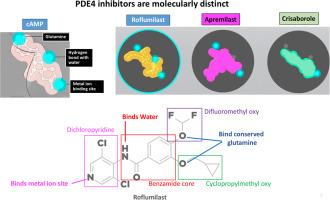
Roflumilast, the third phosphodiesterase-IV (PDE4) inhibitor approved for use in dermatology, is indicated for topical treatment of psoriasis, seborrheic dermatitis, and atopic dermatitis, whereas its 2 predecessors, apremilast and crisaborole, are indicated for oral treatment of psoriasis and topical treatment of atopic dermatitis, respectively. All 3 are rationally designed PDE4 inhibitors, but roflumilast is the most potent and effective among the 3, with in vitro inhibitory constant half-maximal inhibitory concentration value of 0.7 nM (roflumilast), 0.14 μM (apremilast), and 0.24 μM (crisaborole), representing differences of over 3 orders of magnitude. PDE4 is a cAMP (an intracellular secondary messenger) hydrolase consisting of at least 4 subtypes of exon-spliced isoforms, which are primarily expressed in immune cells for inflammatory response. PDE4 inhibition lengthens the duration of cAMP signals and increases cellular cAMP concentrations, generating anti-inflammatory effects. We examined the physicochemical principles that make PDE4 inhibitors effective and propose chemical modifications to improve them. Sequence alignment of the catalytic domains of all phosphodiesterases identified many previously unreported invariant residues. These residues bind 1 Zn and 1 Mg ion plus 5 structural water molecules for orienting an attacking μ-hydroxyl/μ-oxo anion and for stabilizing 2 nonbridging phosphate oxygen atoms. The arrangement of the 2 divalent metal ions in phosphodiesterases is not related to that of the classic mechanism for general phosphoryl transfer.
期刊介绍:
Journal of Investigative Dermatology (JID) publishes reports describing original research on all aspects of cutaneous biology and skin disease. Topics include biochemistry, biophysics, carcinogenesis, cell regulation, clinical research, development, embryology, epidemiology and other population-based research, extracellular matrix, genetics, immunology, melanocyte biology, microbiology, molecular and cell biology, pathology, percutaneous absorption, pharmacology, photobiology, physiology, skin structure, and wound healing




 京公网安备 11010802042870号
京ICP备2023020795号-1
京公网安备 11010802042870号
京ICP备2023020795号-1

 分享
分享
 求助内容:
求助内容: 应助结果提醒方式:
 扫码关注我们
