Isidora Reyes-González, Isabel Carrillo-Varela, Andre Mazega, Quim Tarrés, Marc Delgado-Aguilar, Regis Teixeira Mendonҫa
{"title":"桉树硫酸盐浆的化学酶预处理用于磷酸化纳米纤维素的生产","authors":"Isidora Reyes-González, Isabel Carrillo-Varela, Andre Mazega, Quim Tarrés, Marc Delgado-Aguilar, Regis Teixeira Mendonҫa","doi":"10.1007/s10570-024-06257-1","DOIUrl":null,"url":null,"abstract":"<div><p>Chemical, enzymatic and mechanical pretreatments are needed to disrupt cellulose fibre structure and mechanically process them to produce cellulose nanofibres (CNF). The combination of sequence of chemical and enzymatic pretreatment for CNF production had been poorly investigated, especially complementing them with cellulose functionalisation, such as phosphorylation. In this study CNF were obtained by a three-stage pre-treatment carried out on bleached eucalyptus kraft pulp (BEKP) as follows: a) cold caustic extraction with 15% NaOH (CCE15), b) enzymatic treatment with 50 U <i>Trichoderma reesei</i> endoglucanase (EG) and c) functionalisation by chemical phosphorylation (P) with urea and di-ammonium hydrogen phosphate. Pulps obtained from the different combinations were characterised for properties such as crystallinity, viscosity, S18 solubility, fibre morphology, FTIR, SEM and SEM–EDX to determine differences between samples and treatments. CNF of selected samples were prepared by homogenisation and characterisations were performed on drop cast films prepared from them. The main results showed that the opacity of the films varied between 14%–67%, the water vapour permeability varied between 163–322 g/m<sup>2</sup>.day, the burst index was in the range of 2.0–3.3 kPa.m<sup>2</sup>/g, the tensile strength was between 6–120 MPa and the films made from phosphorylated CNF were air-impermeable. In conclusion, the combination of chemical-enzymatic pretreatments did not lead to a facilitation in CNF production compared to just performing phosphorylation or enzymatic treatment. Though, different CNF material properties can be obtained varying the pretreatments combination stages, which can be beneficial to implement if the goal is to produce CNF materials with special properties depending on the purpose.</p><h3>Graphical Abstract</h3><div><figure><div><div><picture><source><img></source></picture></div></div></figure></div></div>","PeriodicalId":511,"journal":{"name":"Cellulose","volume":"31 18","pages":"10931 - 10949"},"PeriodicalIF":4.6000,"publicationDate":"2024-11-11","publicationTypes":"Journal Article","fieldsOfStudy":null,"isOpenAccess":false,"openAccessPdf":"","citationCount":"0","resultStr":"{\"title\":\"Chemo-enzymatic pre-treatment of eucalyptus kraft pulp for phosphorylated nanocellulose production\",\"authors\":\"Isidora Reyes-González, Isabel Carrillo-Varela, Andre Mazega, Quim Tarrés, Marc Delgado-Aguilar, Regis Teixeira Mendonҫa\",\"doi\":\"10.1007/s10570-024-06257-1\",\"DOIUrl\":null,\"url\":null,\"abstract\":\"<div><p>Chemical, enzymatic and mechanical pretreatments are needed to disrupt cellulose fibre structure and mechanically process them to produce cellulose nanofibres (CNF). The combination of sequence of chemical and enzymatic pretreatment for CNF production had been poorly investigated, especially complementing them with cellulose functionalisation, such as phosphorylation. In this study CNF were obtained by a three-stage pre-treatment carried out on bleached eucalyptus kraft pulp (BEKP) as follows: a) cold caustic extraction with 15% NaOH (CCE15), b) enzymatic treatment with 50 U <i>Trichoderma reesei</i> endoglucanase (EG) and c) functionalisation by chemical phosphorylation (P) with urea and di-ammonium hydrogen phosphate. Pulps obtained from the different combinations were characterised for properties such as crystallinity, viscosity, S18 solubility, fibre morphology, FTIR, SEM and SEM–EDX to determine differences between samples and treatments. CNF of selected samples were prepared by homogenisation and characterisations were performed on drop cast films prepared from them. The main results showed that the opacity of the films varied between 14%–67%, the water vapour permeability varied between 163–322 g/m<sup>2</sup>.day, the burst index was in the range of 2.0–3.3 kPa.m<sup>2</sup>/g, the tensile strength was between 6–120 MPa and the films made from phosphorylated CNF were air-impermeable. In conclusion, the combination of chemical-enzymatic pretreatments did not lead to a facilitation in CNF production compared to just performing phosphorylation or enzymatic treatment. Though, different CNF material properties can be obtained varying the pretreatments combination stages, which can be beneficial to implement if the goal is to produce CNF materials with special properties depending on the purpose.</p><h3>Graphical Abstract</h3><div><figure><div><div><picture><source><img></source></picture></div></div></figure></div></div>\",\"PeriodicalId\":511,\"journal\":{\"name\":\"Cellulose\",\"volume\":\"31 18\",\"pages\":\"10931 - 10949\"},\"PeriodicalIF\":4.6000,\"publicationDate\":\"2024-11-11\",\"publicationTypes\":\"Journal Article\",\"fieldsOfStudy\":null,\"isOpenAccess\":false,\"openAccessPdf\":\"\",\"citationCount\":\"0\",\"resultStr\":null,\"platform\":\"Semanticscholar\",\"paperid\":null,\"PeriodicalName\":\"Cellulose\",\"FirstCategoryId\":\"88\",\"ListUrlMain\":\"https://link.springer.com/article/10.1007/s10570-024-06257-1\",\"RegionNum\":2,\"RegionCategory\":\"工程技术\",\"ArticlePicture\":[],\"TitleCN\":null,\"AbstractTextCN\":null,\"PMCID\":null,\"EPubDate\":\"\",\"PubModel\":\"\",\"JCR\":\"Q1\",\"JCRName\":\"MATERIALS SCIENCE, PAPER & WOOD\",\"Score\":null,\"Total\":0}","platform":"Semanticscholar","paperid":null,"PeriodicalName":"Cellulose","FirstCategoryId":"88","ListUrlMain":"https://link.springer.com/article/10.1007/s10570-024-06257-1","RegionNum":2,"RegionCategory":"工程技术","ArticlePicture":[],"TitleCN":null,"AbstractTextCN":null,"PMCID":null,"EPubDate":"","PubModel":"","JCR":"Q1","JCRName":"MATERIALS SCIENCE, PAPER & WOOD","Score":null,"Total":0}
引用次数: 0
摘要
需要化学、酶和机械预处理来破坏纤维素纤维结构并对其进行机械加工以生产纤维素纳米纤维(CNF)。化学和酶预处理序列的组合用于CNF生产的研究很少,特别是与纤维素功能化(如磷酸化)互补。在这项研究中,CNF是通过对漂白的桉树硫酸盐浆(BEKP)进行三个阶段的预处理来获得的:a) 15% NaOH的冷碱萃取(CCE15), b) 50 U reesei木霉内切葡聚糖酶(EG)的酶处理,c)尿素和磷酸氢二铵的化学磷酸化(P)。从不同组合获得的纸浆进行了结晶度、粘度、S18溶解度、纤维形态、FTIR、SEM和SEM - edx等特性的表征,以确定样品和处理之间的差异。所选样品的CNF通过均质化制备,并对其制备的滴铸膜进行表征。主要结果表明,膜的不透明度在14% ~ 67%之间,水蒸气渗透率在163 ~ 322 g/m2之间。d时,破裂指数在2.0 ~ 3.3 kPa范围内。m2/g,拉伸强度在6 - 120mpa之间,磷酸化CNF制成的膜具有不透气性。综上所述,与仅进行磷酸化或酶处理相比,化学-酶预处理组合并不会促进CNF的产生。然而,不同的预处理组合阶段可以获得不同的CNF材料性能,如果目标是根据不同的目的生产具有特殊性能的CNF材料,这将有利于实现。图形抽象
Chemo-enzymatic pre-treatment of eucalyptus kraft pulp for phosphorylated nanocellulose production
Chemical, enzymatic and mechanical pretreatments are needed to disrupt cellulose fibre structure and mechanically process them to produce cellulose nanofibres (CNF). The combination of sequence of chemical and enzymatic pretreatment for CNF production had been poorly investigated, especially complementing them with cellulose functionalisation, such as phosphorylation. In this study CNF were obtained by a three-stage pre-treatment carried out on bleached eucalyptus kraft pulp (BEKP) as follows: a) cold caustic extraction with 15% NaOH (CCE15), b) enzymatic treatment with 50 U Trichoderma reesei endoglucanase (EG) and c) functionalisation by chemical phosphorylation (P) with urea and di-ammonium hydrogen phosphate. Pulps obtained from the different combinations were characterised for properties such as crystallinity, viscosity, S18 solubility, fibre morphology, FTIR, SEM and SEM–EDX to determine differences between samples and treatments. CNF of selected samples were prepared by homogenisation and characterisations were performed on drop cast films prepared from them. The main results showed that the opacity of the films varied between 14%–67%, the water vapour permeability varied between 163–322 g/m2.day, the burst index was in the range of 2.0–3.3 kPa.m2/g, the tensile strength was between 6–120 MPa and the films made from phosphorylated CNF were air-impermeable. In conclusion, the combination of chemical-enzymatic pretreatments did not lead to a facilitation in CNF production compared to just performing phosphorylation or enzymatic treatment. Though, different CNF material properties can be obtained varying the pretreatments combination stages, which can be beneficial to implement if the goal is to produce CNF materials with special properties depending on the purpose.
期刊介绍:
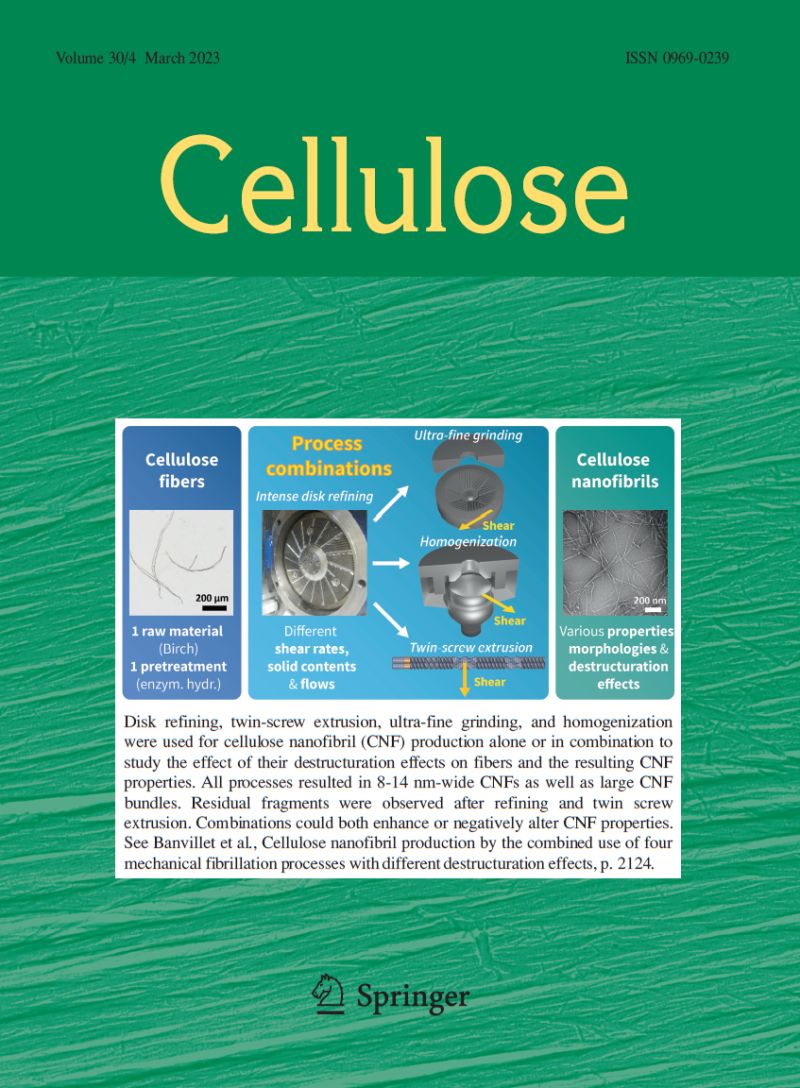
Cellulose is an international journal devoted to the dissemination of research and scientific and technological progress in the field of cellulose and related naturally occurring polymers. The journal is concerned with the pure and applied science of cellulose and related materials, and also with the development of relevant new technologies. This includes the chemistry, biochemistry, physics and materials science of cellulose and its sources, including wood and other biomass resources, and their derivatives. Coverage extends to the conversion of these polymers and resources into manufactured goods, such as pulp, paper, textiles, and manufactured as well natural fibers, and to the chemistry of materials used in their processing. Cellulose publishes review articles, research papers, and technical notes.




 京公网安备 11010802042870号
京ICP备2023020795号-1
京公网安备 11010802042870号
京ICP备2023020795号-1

 分享
分享
 求助内容:
求助内容: 应助结果提醒方式:
 扫码关注我们
