Niccolò Lusiani, Dr. Ewa Pavlova, Prof. Richard Hoogenboom, Dr. Ondrej Sedlacek
{"title":"阳离子开环聚合诱导2-恶唑啉的自组装(CROPISA):从嵌段共聚物到一步梯度共聚物纳米颗粒。","authors":"Niccolò Lusiani, Dr. Ewa Pavlova, Prof. Richard Hoogenboom, Dr. Ondrej Sedlacek","doi":"10.1002/anie.202416106","DOIUrl":null,"url":null,"abstract":"<p>In recent years, polymerization-induced self-assembly (PISA) has emerged as a powerful method for the straightforward synthesis of polymer nanoparticles at high concentration. In this study, we describe for the first time the synthesis of poly(2-oxazoline) nanoparticles by dispersion cationic ring-opening polymerization-induced self-assembly (CROPISA) in <i>n</i>-dodecane. Specifically, a <i>n</i>-dodecane-soluble aliphatic poly(2-(3-ethylheptyl)-2-oxazoline) (PEHOx) block was chain-extended with poly(2-phenyl-2-oxazoline) (PPhOx). While the PhOx monomer is soluble in <i>n</i>-dodecane, its polymerization leads to <i>n</i>-dodecane-insoluble PPhOx, which leads to in situ self-assembly of the formed PEHOx-<i>b</i>-PPhOx copolymers. The polymerization kinetics and micellization upon second block formation were studied, and diverse nanoparticle dispersions were prepared, featuring varying block lengths and polymer concentrations, leading to dispersions with distinctive morphologies and physical properties. Finally, we developed a single-step protocol for the synthesis of polymer nanoparticles directly from monomers via gradient copolymerization CROPISA, which exploits the significantly greater reactivity of EHOx compared to that of PhOx during the statistical copolymerization of both monomers. Notably, this approach provides access to formulations with monomer compositions otherwise unattainable through the block copolymerization method. Given the synthetic versatility and application potential of poly(2-oxazolines), the developed CROPISA method can pave the way for advanced nanomaterials with favorable properties as demonstrated by using the obtained nanoparticles for stabilization of Pickering emulsions.</p>","PeriodicalId":125,"journal":{"name":"Angewandte Chemie International Edition","volume":"64 4","pages":""},"PeriodicalIF":17.6000,"publicationDate":"2024-11-29","publicationTypes":"Journal Article","fieldsOfStudy":null,"isOpenAccess":false,"openAccessPdf":"https://www.ncbi.nlm.nih.gov/pmc/articles/PMC11753605/pdf/","citationCount":"0","resultStr":"{\"title\":\"Cationic Ring-Opening Polymerization-Induced Self-Assembly (CROPISA) of 2-Oxazolines: From Block Copolymers to One-Step Gradient Copolymer Nanoparticles\",\"authors\":\"Niccolò Lusiani, Dr. Ewa Pavlova, Prof. Richard Hoogenboom, Dr. Ondrej Sedlacek\",\"doi\":\"10.1002/anie.202416106\",\"DOIUrl\":null,\"url\":null,\"abstract\":\"<p>In recent years, polymerization-induced self-assembly (PISA) has emerged as a powerful method for the straightforward synthesis of polymer nanoparticles at high concentration. In this study, we describe for the first time the synthesis of poly(2-oxazoline) nanoparticles by dispersion cationic ring-opening polymerization-induced self-assembly (CROPISA) in <i>n</i>-dodecane. Specifically, a <i>n</i>-dodecane-soluble aliphatic poly(2-(3-ethylheptyl)-2-oxazoline) (PEHOx) block was chain-extended with poly(2-phenyl-2-oxazoline) (PPhOx). While the PhOx monomer is soluble in <i>n</i>-dodecane, its polymerization leads to <i>n</i>-dodecane-insoluble PPhOx, which leads to in situ self-assembly of the formed PEHOx-<i>b</i>-PPhOx copolymers. The polymerization kinetics and micellization upon second block formation were studied, and diverse nanoparticle dispersions were prepared, featuring varying block lengths and polymer concentrations, leading to dispersions with distinctive morphologies and physical properties. Finally, we developed a single-step protocol for the synthesis of polymer nanoparticles directly from monomers via gradient copolymerization CROPISA, which exploits the significantly greater reactivity of EHOx compared to that of PhOx during the statistical copolymerization of both monomers. Notably, this approach provides access to formulations with monomer compositions otherwise unattainable through the block copolymerization method. Given the synthetic versatility and application potential of poly(2-oxazolines), the developed CROPISA method can pave the way for advanced nanomaterials with favorable properties as demonstrated by using the obtained nanoparticles for stabilization of Pickering emulsions.</p>\",\"PeriodicalId\":125,\"journal\":{\"name\":\"Angewandte Chemie International Edition\",\"volume\":\"64 4\",\"pages\":\"\"},\"PeriodicalIF\":17.6000,\"publicationDate\":\"2024-11-29\",\"publicationTypes\":\"Journal Article\",\"fieldsOfStudy\":null,\"isOpenAccess\":false,\"openAccessPdf\":\"https://www.ncbi.nlm.nih.gov/pmc/articles/PMC11753605/pdf/\",\"citationCount\":\"0\",\"resultStr\":null,\"platform\":\"Semanticscholar\",\"paperid\":null,\"PeriodicalName\":\"Angewandte Chemie International Edition\",\"FirstCategoryId\":\"92\",\"ListUrlMain\":\"https://onlinelibrary.wiley.com/doi/10.1002/anie.202416106\",\"RegionNum\":1,\"RegionCategory\":\"化学\",\"ArticlePicture\":[],\"TitleCN\":null,\"AbstractTextCN\":null,\"PMCID\":null,\"EPubDate\":\"\",\"PubModel\":\"\",\"JCR\":\"Q1\",\"JCRName\":\"CHEMISTRY, MULTIDISCIPLINARY\",\"Score\":null,\"Total\":0}","platform":"Semanticscholar","paperid":null,"PeriodicalName":"Angewandte Chemie International Edition","FirstCategoryId":"92","ListUrlMain":"https://onlinelibrary.wiley.com/doi/10.1002/anie.202416106","RegionNum":1,"RegionCategory":"化学","ArticlePicture":[],"TitleCN":null,"AbstractTextCN":null,"PMCID":null,"EPubDate":"","PubModel":"","JCR":"Q1","JCRName":"CHEMISTRY, MULTIDISCIPLINARY","Score":null,"Total":0}
Cationic Ring-Opening Polymerization-Induced Self-Assembly (CROPISA) of 2-Oxazolines: From Block Copolymers to One-Step Gradient Copolymer Nanoparticles
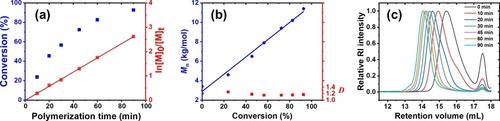
In recent years, polymerization-induced self-assembly (PISA) has emerged as a powerful method for the straightforward synthesis of polymer nanoparticles at high concentration. In this study, we describe for the first time the synthesis of poly(2-oxazoline) nanoparticles by dispersion cationic ring-opening polymerization-induced self-assembly (CROPISA) in n-dodecane. Specifically, a n-dodecane-soluble aliphatic poly(2-(3-ethylheptyl)-2-oxazoline) (PEHOx) block was chain-extended with poly(2-phenyl-2-oxazoline) (PPhOx). While the PhOx monomer is soluble in n-dodecane, its polymerization leads to n-dodecane-insoluble PPhOx, which leads to in situ self-assembly of the formed PEHOx-b-PPhOx copolymers. The polymerization kinetics and micellization upon second block formation were studied, and diverse nanoparticle dispersions were prepared, featuring varying block lengths and polymer concentrations, leading to dispersions with distinctive morphologies and physical properties. Finally, we developed a single-step protocol for the synthesis of polymer nanoparticles directly from monomers via gradient copolymerization CROPISA, which exploits the significantly greater reactivity of EHOx compared to that of PhOx during the statistical copolymerization of both monomers. Notably, this approach provides access to formulations with monomer compositions otherwise unattainable through the block copolymerization method. Given the synthetic versatility and application potential of poly(2-oxazolines), the developed CROPISA method can pave the way for advanced nanomaterials with favorable properties as demonstrated by using the obtained nanoparticles for stabilization of Pickering emulsions.
期刊介绍:
Angewandte Chemie, a journal of the German Chemical Society (GDCh), maintains a leading position among scholarly journals in general chemistry with an impressive Impact Factor of 16.6 (2022 Journal Citation Reports, Clarivate, 2023). Published weekly in a reader-friendly format, it features new articles almost every day. Established in 1887, Angewandte Chemie is a prominent chemistry journal, offering a dynamic blend of Review-type articles, Highlights, Communications, and Research Articles on a weekly basis, making it unique in the field.




 京公网安备 11010802042870号
京ICP备2023020795号-1
京公网安备 11010802042870号
京ICP备2023020795号-1

 分享
分享
 求助内容:
求助内容: 应助结果提醒方式:
 扫码关注我们
