Lucas Gunkel, Amelie A. Ehrhard, Carola S. Krevert, Bogdan A. Marekha, Mischa Bonn, Maksim Grechko, Johannes Hunger
{"title":"水氢键的动态反相关","authors":"Lucas Gunkel, Amelie A. Ehrhard, Carola S. Krevert, Bogdan A. Marekha, Mischa Bonn, Maksim Grechko, Johannes Hunger","doi":"10.1038/s41467-024-54804-y","DOIUrl":null,"url":null,"abstract":"<p>Water is characterized by strong intermolecular hydrogen bonds (H-bonds) between molecules. The two hydrogen atoms in one water molecule can form H-bonds of dissimilar length. Although intimately connected to water’s anomalous properties, the details and the origins of the asymmetry have remained elusive. We study water’s H-bonds using the O-D stretching vibrations as sensitive reporters of H-bonding of D<sub>2</sub>O and HOD in dimethylformamide. Broader inhomogeneous linewidths of the OD band of HOD compared to the symmetric and asymmetric OD stretching modes of D<sub>2</sub>O together with density functional theory calculations provide evidence for markedly anti-correlated H-bonds: water preferentially forms one weak and one strong H-bond. Coupling peaks in the spectra for D<sub>2</sub>O directly demonstrate anti-correlated H-bonds and these anti-correlations are modulated by thermal motions of water on a sub-picosecond timescale. Experimentally inferred H-bond distributions suggest that the anti-correlations are a direct consequence of the H-bonding potential of XH<sub>2</sub> groups, which we confirm for the ND<sub>2</sub> group of urea. These structural and dynamic insights into H-bonding are essential for understanding the relationship between the H-bonded structure and phase behavior of water.</p>","PeriodicalId":19066,"journal":{"name":"Nature Communications","volume":"9 1","pages":""},"PeriodicalIF":18.1000,"publicationDate":"2024-12-01","publicationTypes":"Journal Article","fieldsOfStudy":null,"isOpenAccess":false,"openAccessPdf":"","citationCount":"0","resultStr":"{\"title\":\"Dynamic anti-correlations of water hydrogen bonds\",\"authors\":\"Lucas Gunkel, Amelie A. Ehrhard, Carola S. Krevert, Bogdan A. Marekha, Mischa Bonn, Maksim Grechko, Johannes Hunger\",\"doi\":\"10.1038/s41467-024-54804-y\",\"DOIUrl\":null,\"url\":null,\"abstract\":\"<p>Water is characterized by strong intermolecular hydrogen bonds (H-bonds) between molecules. The two hydrogen atoms in one water molecule can form H-bonds of dissimilar length. Although intimately connected to water’s anomalous properties, the details and the origins of the asymmetry have remained elusive. We study water’s H-bonds using the O-D stretching vibrations as sensitive reporters of H-bonding of D<sub>2</sub>O and HOD in dimethylformamide. Broader inhomogeneous linewidths of the OD band of HOD compared to the symmetric and asymmetric OD stretching modes of D<sub>2</sub>O together with density functional theory calculations provide evidence for markedly anti-correlated H-bonds: water preferentially forms one weak and one strong H-bond. Coupling peaks in the spectra for D<sub>2</sub>O directly demonstrate anti-correlated H-bonds and these anti-correlations are modulated by thermal motions of water on a sub-picosecond timescale. Experimentally inferred H-bond distributions suggest that the anti-correlations are a direct consequence of the H-bonding potential of XH<sub>2</sub> groups, which we confirm for the ND<sub>2</sub> group of urea. These structural and dynamic insights into H-bonding are essential for understanding the relationship between the H-bonded structure and phase behavior of water.</p>\",\"PeriodicalId\":19066,\"journal\":{\"name\":\"Nature Communications\",\"volume\":\"9 1\",\"pages\":\"\"},\"PeriodicalIF\":18.1000,\"publicationDate\":\"2024-12-01\",\"publicationTypes\":\"Journal Article\",\"fieldsOfStudy\":null,\"isOpenAccess\":false,\"openAccessPdf\":\"\",\"citationCount\":\"0\",\"resultStr\":null,\"platform\":\"Semanticscholar\",\"paperid\":null,\"PeriodicalName\":\"Nature Communications\",\"FirstCategoryId\":\"103\",\"ListUrlMain\":\"https://doi.org/10.1038/s41467-024-54804-y\",\"RegionNum\":1,\"RegionCategory\":\"综合性期刊\",\"ArticlePicture\":[],\"TitleCN\":null,\"AbstractTextCN\":null,\"PMCID\":null,\"EPubDate\":\"\",\"PubModel\":\"\",\"JCR\":\"Q1\",\"JCRName\":\"MULTIDISCIPLINARY SCIENCES\",\"Score\":null,\"Total\":0}","platform":"Semanticscholar","paperid":null,"PeriodicalName":"Nature Communications","FirstCategoryId":"103","ListUrlMain":"https://doi.org/10.1038/s41467-024-54804-y","RegionNum":1,"RegionCategory":"综合性期刊","ArticlePicture":[],"TitleCN":null,"AbstractTextCN":null,"PMCID":null,"EPubDate":"","PubModel":"","JCR":"Q1","JCRName":"MULTIDISCIPLINARY SCIENCES","Score":null,"Total":0}
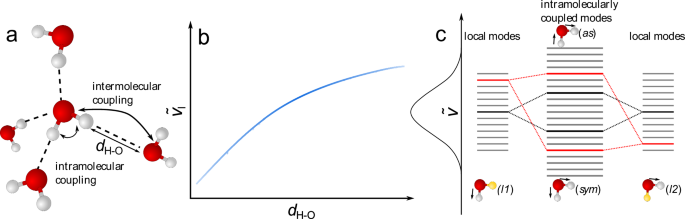
Water is characterized by strong intermolecular hydrogen bonds (H-bonds) between molecules. The two hydrogen atoms in one water molecule can form H-bonds of dissimilar length. Although intimately connected to water’s anomalous properties, the details and the origins of the asymmetry have remained elusive. We study water’s H-bonds using the O-D stretching vibrations as sensitive reporters of H-bonding of D2O and HOD in dimethylformamide. Broader inhomogeneous linewidths of the OD band of HOD compared to the symmetric and asymmetric OD stretching modes of D2O together with density functional theory calculations provide evidence for markedly anti-correlated H-bonds: water preferentially forms one weak and one strong H-bond. Coupling peaks in the spectra for D2O directly demonstrate anti-correlated H-bonds and these anti-correlations are modulated by thermal motions of water on a sub-picosecond timescale. Experimentally inferred H-bond distributions suggest that the anti-correlations are a direct consequence of the H-bonding potential of XH2 groups, which we confirm for the ND2 group of urea. These structural and dynamic insights into H-bonding are essential for understanding the relationship between the H-bonded structure and phase behavior of water.
期刊介绍:
Nature Communications, an open-access journal, publishes high-quality research spanning all areas of the natural sciences. Papers featured in the journal showcase significant advances relevant to specialists in each respective field. With a 2-year impact factor of 16.6 (2022) and a median time of 8 days from submission to the first editorial decision, Nature Communications is committed to rapid dissemination of research findings. As a multidisciplinary journal, it welcomes contributions from biological, health, physical, chemical, Earth, social, mathematical, applied, and engineering sciences, aiming to highlight important breakthroughs within each domain.




 京公网安备 11010802042870号
京ICP备2023020795号-1
京公网安备 11010802042870号
京ICP备2023020795号-1

 分享
分享
 求助内容:
求助内容: 应助结果提醒方式:
 扫码关注我们
