Jua Kim , Jeremy L. Gilbert , William W. Lv , Ping Du , Haobo Pan
{"title":"还原反应主导着镁合金与细胞之间的相互作用:机理的理解","authors":"Jua Kim , Jeremy L. Gilbert , William W. Lv , Ping Du , Haobo Pan","doi":"10.1016/j.bioactmat.2024.11.020","DOIUrl":null,"url":null,"abstract":"<div><div>Magnesium (Mg) alloys are popular biodegradable metals studied for orthopedic and cardiovascular applications, mainly because Mg ions are essential trace elements known to promote angiogenesis and osteogenesis. However, Mg corrosion consists of oxidation and reduction reactions that produce by-products, such as hydrogen gas, reactive oxygen species, and hydroxides. It is still unclear how all these by-products and Mg ions concomitantly alter the microenvironment and cell behaviors spatially and temporally. This study shows that Mg corrosion can enhance cell proliferation by reducing intracellular ROS. However, Mg cannot decrease ROS and promote cell proliferation in simulated inflammatory conditions, meaning the microenvironment is critical. Furthermore, cells may respond to Mg ions differently in chronic or acute alkaline pH or oxidative stress. Depending on the corrosion rate, Mg modulates HIF1α and many signaling pathways like PI3K/AKT/mTOR, mitophagy, cell cycle, and oxidative phosphorylation. Therefore, this study provides a fundamental insight into the importance of reduction reactions in Mg alloys.</div></div>","PeriodicalId":8762,"journal":{"name":"Bioactive Materials","volume":"45 ","pages":"Pages 363-387"},"PeriodicalIF":18.0000,"publicationDate":"2025-03-01","publicationTypes":"Journal Article","fieldsOfStudy":null,"isOpenAccess":false,"openAccessPdf":"","citationCount":"0","resultStr":"{\"title\":\"Reduction reactions dominate the interactions between Mg alloys and cells: Understanding the mechanisms\",\"authors\":\"Jua Kim , Jeremy L. Gilbert , William W. Lv , Ping Du , Haobo Pan\",\"doi\":\"10.1016/j.bioactmat.2024.11.020\",\"DOIUrl\":null,\"url\":null,\"abstract\":\"<div><div>Magnesium (Mg) alloys are popular biodegradable metals studied for orthopedic and cardiovascular applications, mainly because Mg ions are essential trace elements known to promote angiogenesis and osteogenesis. However, Mg corrosion consists of oxidation and reduction reactions that produce by-products, such as hydrogen gas, reactive oxygen species, and hydroxides. It is still unclear how all these by-products and Mg ions concomitantly alter the microenvironment and cell behaviors spatially and temporally. This study shows that Mg corrosion can enhance cell proliferation by reducing intracellular ROS. However, Mg cannot decrease ROS and promote cell proliferation in simulated inflammatory conditions, meaning the microenvironment is critical. Furthermore, cells may respond to Mg ions differently in chronic or acute alkaline pH or oxidative stress. Depending on the corrosion rate, Mg modulates HIF1α and many signaling pathways like PI3K/AKT/mTOR, mitophagy, cell cycle, and oxidative phosphorylation. Therefore, this study provides a fundamental insight into the importance of reduction reactions in Mg alloys.</div></div>\",\"PeriodicalId\":8762,\"journal\":{\"name\":\"Bioactive Materials\",\"volume\":\"45 \",\"pages\":\"Pages 363-387\"},\"PeriodicalIF\":18.0000,\"publicationDate\":\"2025-03-01\",\"publicationTypes\":\"Journal Article\",\"fieldsOfStudy\":null,\"isOpenAccess\":false,\"openAccessPdf\":\"\",\"citationCount\":\"0\",\"resultStr\":null,\"platform\":\"Semanticscholar\",\"paperid\":null,\"PeriodicalName\":\"Bioactive Materials\",\"FirstCategoryId\":\"5\",\"ListUrlMain\":\"https://www.sciencedirect.com/science/article/pii/S2452199X24005048\",\"RegionNum\":1,\"RegionCategory\":\"医学\",\"ArticlePicture\":[],\"TitleCN\":null,\"AbstractTextCN\":null,\"PMCID\":null,\"EPubDate\":\"2024/11/30 0:00:00\",\"PubModel\":\"Epub\",\"JCR\":\"Q1\",\"JCRName\":\"ENGINEERING, BIOMEDICAL\",\"Score\":null,\"Total\":0}","platform":"Semanticscholar","paperid":null,"PeriodicalName":"Bioactive Materials","FirstCategoryId":"5","ListUrlMain":"https://www.sciencedirect.com/science/article/pii/S2452199X24005048","RegionNum":1,"RegionCategory":"医学","ArticlePicture":[],"TitleCN":null,"AbstractTextCN":null,"PMCID":null,"EPubDate":"2024/11/30 0:00:00","PubModel":"Epub","JCR":"Q1","JCRName":"ENGINEERING, BIOMEDICAL","Score":null,"Total":0}
Reduction reactions dominate the interactions between Mg alloys and cells: Understanding the mechanisms
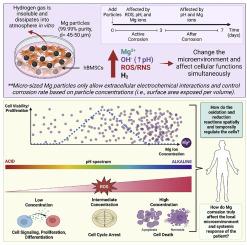
Magnesium (Mg) alloys are popular biodegradable metals studied for orthopedic and cardiovascular applications, mainly because Mg ions are essential trace elements known to promote angiogenesis and osteogenesis. However, Mg corrosion consists of oxidation and reduction reactions that produce by-products, such as hydrogen gas, reactive oxygen species, and hydroxides. It is still unclear how all these by-products and Mg ions concomitantly alter the microenvironment and cell behaviors spatially and temporally. This study shows that Mg corrosion can enhance cell proliferation by reducing intracellular ROS. However, Mg cannot decrease ROS and promote cell proliferation in simulated inflammatory conditions, meaning the microenvironment is critical. Furthermore, cells may respond to Mg ions differently in chronic or acute alkaline pH or oxidative stress. Depending on the corrosion rate, Mg modulates HIF1α and many signaling pathways like PI3K/AKT/mTOR, mitophagy, cell cycle, and oxidative phosphorylation. Therefore, this study provides a fundamental insight into the importance of reduction reactions in Mg alloys.
Bioactive MaterialsBiochemistry, Genetics and Molecular Biology-Biotechnology
CiteScore
28.00
自引率
6.30%
发文量
436
审稿时长
20 days
期刊介绍:
Bioactive Materials is a peer-reviewed research publication that focuses on advancements in bioactive materials. The journal accepts research papers, reviews, and rapid communications in the field of next-generation biomaterials that interact with cells, tissues, and organs in various living organisms.
The primary goal of Bioactive Materials is to promote the science and engineering of biomaterials that exhibit adaptiveness to the biological environment. These materials are specifically designed to stimulate or direct appropriate cell and tissue responses or regulate interactions with microorganisms.
The journal covers a wide range of bioactive materials, including those that are engineered or designed in terms of their physical form (e.g. particulate, fiber), topology (e.g. porosity, surface roughness), or dimensions (ranging from macro to nano-scales). Contributions are sought from the following categories of bioactive materials:
Bioactive metals and alloys
Bioactive inorganics: ceramics, glasses, and carbon-based materials
Bioactive polymers and gels
Bioactive materials derived from natural sources
Bioactive composites
These materials find applications in human and veterinary medicine, such as implants, tissue engineering scaffolds, cell/drug/gene carriers, as well as imaging and sensing devices.





 京公网安备 11010802042870号
京ICP备2023020795号-1
京公网安备 11010802042870号
京ICP备2023020795号-1

 分享
分享
 求助内容:
求助内容: 应助结果提醒方式:
 扫码关注我们
