Imke Maack, Kevin Oldenburg and Katharina Al-Shamery
{"title":"通过铂生长模式控制Au/Pt核壳纳米立方结构","authors":"Imke Maack, Kevin Oldenburg and Katharina Al-Shamery","doi":"10.1039/D4CE00823E","DOIUrl":null,"url":null,"abstract":"<p >In order to overcome the often large activation barriers in heterogeneous catalytic reactions, photocatalysis is a promising path to activate specific molecules with light at moderate temperatures. In particular, bimetallic nanoparticles combining the plasmonic properties of one metal with the high catalytic activity of another are promising antenna–reactor systems. As the nanocrystal surface structure is a major factor in steering surface electronic properties and accompanying activity and selectivity, it is of interest to control the metal nanoparticle growth and composition. The subject of this work is the synthesis of gold–platinum nanoparticles with varying architectures by controlling the growth mechanism. The selection of the reducing agent allows the regulation of the reduction rate of the platinum metal salt, which in turn affects the final morphology of the resulting bimetallic nanoparticles. This allows the synthesis of either core–shell nanocrystals with decorated nanocube corners or dendritic particles under otherwise identical reaction conditions. A dendritic structure requires the rapid deposition of platinum monomers on the surface of the gold particles. This process hinders the diffusion of platinum monomers to energetically preferred sites on the particle surface, which is possible during the formation of core–shell nanocrystals.</p>","PeriodicalId":70,"journal":{"name":"CrystEngComm","volume":" 47","pages":" 6748-6756"},"PeriodicalIF":2.4000,"publicationDate":"2024-11-20","publicationTypes":"Journal Article","fieldsOfStudy":null,"isOpenAccess":false,"openAccessPdf":"https://pubs.rsc.org/en/content/articlepdf/2024/ce/d4ce00823e?page=search","citationCount":"0","resultStr":"{\"title\":\"Controlling the architecture of Au/Pt core–shell nanocubes via platinum growth mode†\",\"authors\":\"Imke Maack, Kevin Oldenburg and Katharina Al-Shamery\",\"doi\":\"10.1039/D4CE00823E\",\"DOIUrl\":null,\"url\":null,\"abstract\":\"<p >In order to overcome the often large activation barriers in heterogeneous catalytic reactions, photocatalysis is a promising path to activate specific molecules with light at moderate temperatures. In particular, bimetallic nanoparticles combining the plasmonic properties of one metal with the high catalytic activity of another are promising antenna–reactor systems. As the nanocrystal surface structure is a major factor in steering surface electronic properties and accompanying activity and selectivity, it is of interest to control the metal nanoparticle growth and composition. The subject of this work is the synthesis of gold–platinum nanoparticles with varying architectures by controlling the growth mechanism. The selection of the reducing agent allows the regulation of the reduction rate of the platinum metal salt, which in turn affects the final morphology of the resulting bimetallic nanoparticles. This allows the synthesis of either core–shell nanocrystals with decorated nanocube corners or dendritic particles under otherwise identical reaction conditions. A dendritic structure requires the rapid deposition of platinum monomers on the surface of the gold particles. This process hinders the diffusion of platinum monomers to energetically preferred sites on the particle surface, which is possible during the formation of core–shell nanocrystals.</p>\",\"PeriodicalId\":70,\"journal\":{\"name\":\"CrystEngComm\",\"volume\":\" 47\",\"pages\":\" 6748-6756\"},\"PeriodicalIF\":2.4000,\"publicationDate\":\"2024-11-20\",\"publicationTypes\":\"Journal Article\",\"fieldsOfStudy\":null,\"isOpenAccess\":false,\"openAccessPdf\":\"https://pubs.rsc.org/en/content/articlepdf/2024/ce/d4ce00823e?page=search\",\"citationCount\":\"0\",\"resultStr\":null,\"platform\":\"Semanticscholar\",\"paperid\":null,\"PeriodicalName\":\"CrystEngComm\",\"FirstCategoryId\":\"92\",\"ListUrlMain\":\"https://pubs.rsc.org/en/content/articlelanding/2024/ce/d4ce00823e\",\"RegionNum\":3,\"RegionCategory\":\"化学\",\"ArticlePicture\":[],\"TitleCN\":null,\"AbstractTextCN\":null,\"PMCID\":null,\"EPubDate\":\"\",\"PubModel\":\"\",\"JCR\":\"Q2\",\"JCRName\":\"CHEMISTRY, MULTIDISCIPLINARY\",\"Score\":null,\"Total\":0}","platform":"Semanticscholar","paperid":null,"PeriodicalName":"CrystEngComm","FirstCategoryId":"92","ListUrlMain":"https://pubs.rsc.org/en/content/articlelanding/2024/ce/d4ce00823e","RegionNum":3,"RegionCategory":"化学","ArticlePicture":[],"TitleCN":null,"AbstractTextCN":null,"PMCID":null,"EPubDate":"","PubModel":"","JCR":"Q2","JCRName":"CHEMISTRY, MULTIDISCIPLINARY","Score":null,"Total":0}
Controlling the architecture of Au/Pt core–shell nanocubes via platinum growth mode†
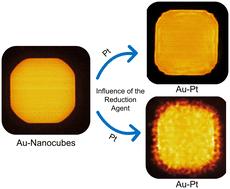
In order to overcome the often large activation barriers in heterogeneous catalytic reactions, photocatalysis is a promising path to activate specific molecules with light at moderate temperatures. In particular, bimetallic nanoparticles combining the plasmonic properties of one metal with the high catalytic activity of another are promising antenna–reactor systems. As the nanocrystal surface structure is a major factor in steering surface electronic properties and accompanying activity and selectivity, it is of interest to control the metal nanoparticle growth and composition. The subject of this work is the synthesis of gold–platinum nanoparticles with varying architectures by controlling the growth mechanism. The selection of the reducing agent allows the regulation of the reduction rate of the platinum metal salt, which in turn affects the final morphology of the resulting bimetallic nanoparticles. This allows the synthesis of either core–shell nanocrystals with decorated nanocube corners or dendritic particles under otherwise identical reaction conditions. A dendritic structure requires the rapid deposition of platinum monomers on the surface of the gold particles. This process hinders the diffusion of platinum monomers to energetically preferred sites on the particle surface, which is possible during the formation of core–shell nanocrystals.




 京公网安备 11010802042870号
京ICP备2023020795号-1
京公网安备 11010802042870号
京ICP备2023020795号-1

 分享
分享
 求助内容:
求助内容: 应助结果提醒方式:
 扫码关注我们
