Laura Razquin-Bobillo, Jose Angel García, Ricardo Hernández, Antonio Rodríguez-Diéguez and Javier Cepeda
{"title":"一类基于镧系(iii)离子和6-甲基-2-氧烟酸盐的发光异金属配位聚合物:近红外/可见光发射器和颜色微调†","authors":"Laura Razquin-Bobillo, Jose Angel García, Ricardo Hernández, Antonio Rodríguez-Diéguez and Javier Cepeda","doi":"10.1039/D4CE00881B","DOIUrl":null,"url":null,"abstract":"<p >The work presented herein reports on the synthesis, structural and physicochemical characterization and luminescence properties of a family of isostructural coordination polymers (CPs) with a general formula {[Ln(6m2onic)<small><sub>4</sub></small>Na(H<small><sub>2</sub></small>O)<small><sub>3</sub></small>]·8H<small><sub>2</sub></small>O}<small><sub><em>n</em></sub></small> (where Ln(<small>III</small>) = Nd (<strong>1</strong><small><sub><strong>Nd</strong></sub></small>), Sm (<strong>2</strong><small><sub><strong>Sm</strong></sub></small>), Dy (<strong>3</strong><small><sub><strong>Dy</strong></sub></small>), Er (<strong>4</strong><small><sub><strong>Er</strong></sub></small>), Tm (<strong>5</strong><small><sub><strong>Tm</strong></sub></small>), Yb (<strong>6</strong><small><sub><strong>Yb</strong></sub></small>) and Dy<small><sub>0.77</sub></small>Eu<small><sub>0.12</sub></small>Y<small><sub>0.11</sub></small> for the multi-metal compound (<strong>7</strong><small><sub><strong>DyEuY</strong></sub></small>) and 6m2onic = 6-methyl-2-oxonicotinate). The crystal structures consist of one-dimensional heterometallic arrays where octacoordinated lanthanide and hexacoordinated sodium centres are sequentially linked and which are held together into a 3D architecture by an extensive hydrogen bonding network formed by the crystallisation water molecules. Photoluminescence measurements in the solid state at variable temperature reveal good properties based on the capacity of the 6m2onic ligand to provide ligand-centred excitation, as suggested by time-dependent density functional theory (TDDFT), and promote efficient energy transfers to the lanthanide(<small>III</small>) ions, to eventually present intense emissions in both the visible and near-infrared (NIR) regions. On the one hand, compound <strong>4</strong><small><sub><strong>Er</strong></sub></small> displays characteristic lanthanide-centred bands in the NIR region even at room temperature, meaning that the framework is able to isolate the excitons from the vibrational quenching component. On the other hand, regarding the compounds emitting in the visible region, the almost white light emitted by compound <strong>3</strong><small><sub><strong>Dy</strong></sub></small> with a quantum yield (QY) of 6.2% should be noted. Both a purer white emission and an improved QY (up to 15.8%) may be achieved by means of a doping strategy of europium and yttrium ions into the Dy counterpart. Finally, taking advantage of white light emitted by compound <strong>3</strong><small><sub><strong>Dy</strong></sub></small>, the chemical and optical stabilities in water have been confirmed by the photophysical study performed in solution.</p>","PeriodicalId":70,"journal":{"name":"CrystEngComm","volume":" 47","pages":" 6707-6718"},"PeriodicalIF":2.6000,"publicationDate":"2024-11-15","publicationTypes":"Journal Article","fieldsOfStudy":null,"isOpenAccess":false,"openAccessPdf":"","citationCount":"0","resultStr":"{\"title\":\"A family of luminescent heterometallic coordination polymers based on lanthanide(iii) ions and 6-methyl-2-oxonicotinate: near-infrared/visible emitters and colour fine-tuning†\",\"authors\":\"Laura Razquin-Bobillo, Jose Angel García, Ricardo Hernández, Antonio Rodríguez-Diéguez and Javier Cepeda\",\"doi\":\"10.1039/D4CE00881B\",\"DOIUrl\":null,\"url\":null,\"abstract\":\"<p >The work presented herein reports on the synthesis, structural and physicochemical characterization and luminescence properties of a family of isostructural coordination polymers (CPs) with a general formula {[Ln(6m2onic)<small><sub>4</sub></small>Na(H<small><sub>2</sub></small>O)<small><sub>3</sub></small>]·8H<small><sub>2</sub></small>O}<small><sub><em>n</em></sub></small> (where Ln(<small>III</small>) = Nd (<strong>1</strong><small><sub><strong>Nd</strong></sub></small>), Sm (<strong>2</strong><small><sub><strong>Sm</strong></sub></small>), Dy (<strong>3</strong><small><sub><strong>Dy</strong></sub></small>), Er (<strong>4</strong><small><sub><strong>Er</strong></sub></small>), Tm (<strong>5</strong><small><sub><strong>Tm</strong></sub></small>), Yb (<strong>6</strong><small><sub><strong>Yb</strong></sub></small>) and Dy<small><sub>0.77</sub></small>Eu<small><sub>0.12</sub></small>Y<small><sub>0.11</sub></small> for the multi-metal compound (<strong>7</strong><small><sub><strong>DyEuY</strong></sub></small>) and 6m2onic = 6-methyl-2-oxonicotinate). The crystal structures consist of one-dimensional heterometallic arrays where octacoordinated lanthanide and hexacoordinated sodium centres are sequentially linked and which are held together into a 3D architecture by an extensive hydrogen bonding network formed by the crystallisation water molecules. Photoluminescence measurements in the solid state at variable temperature reveal good properties based on the capacity of the 6m2onic ligand to provide ligand-centred excitation, as suggested by time-dependent density functional theory (TDDFT), and promote efficient energy transfers to the lanthanide(<small>III</small>) ions, to eventually present intense emissions in both the visible and near-infrared (NIR) regions. On the one hand, compound <strong>4</strong><small><sub><strong>Er</strong></sub></small> displays characteristic lanthanide-centred bands in the NIR region even at room temperature, meaning that the framework is able to isolate the excitons from the vibrational quenching component. On the other hand, regarding the compounds emitting in the visible region, the almost white light emitted by compound <strong>3</strong><small><sub><strong>Dy</strong></sub></small> with a quantum yield (QY) of 6.2% should be noted. Both a purer white emission and an improved QY (up to 15.8%) may be achieved by means of a doping strategy of europium and yttrium ions into the Dy counterpart. Finally, taking advantage of white light emitted by compound <strong>3</strong><small><sub><strong>Dy</strong></sub></small>, the chemical and optical stabilities in water have been confirmed by the photophysical study performed in solution.</p>\",\"PeriodicalId\":70,\"journal\":{\"name\":\"CrystEngComm\",\"volume\":\" 47\",\"pages\":\" 6707-6718\"},\"PeriodicalIF\":2.6000,\"publicationDate\":\"2024-11-15\",\"publicationTypes\":\"Journal Article\",\"fieldsOfStudy\":null,\"isOpenAccess\":false,\"openAccessPdf\":\"\",\"citationCount\":\"0\",\"resultStr\":null,\"platform\":\"Semanticscholar\",\"paperid\":null,\"PeriodicalName\":\"CrystEngComm\",\"FirstCategoryId\":\"92\",\"ListUrlMain\":\"https://pubs.rsc.org/en/content/articlelanding/2024/ce/d4ce00881b\",\"RegionNum\":3,\"RegionCategory\":\"化学\",\"ArticlePicture\":[],\"TitleCN\":null,\"AbstractTextCN\":null,\"PMCID\":null,\"EPubDate\":\"\",\"PubModel\":\"\",\"JCR\":\"Q2\",\"JCRName\":\"CHEMISTRY, MULTIDISCIPLINARY\",\"Score\":null,\"Total\":0}","platform":"Semanticscholar","paperid":null,"PeriodicalName":"CrystEngComm","FirstCategoryId":"92","ListUrlMain":"https://pubs.rsc.org/en/content/articlelanding/2024/ce/d4ce00881b","RegionNum":3,"RegionCategory":"化学","ArticlePicture":[],"TitleCN":null,"AbstractTextCN":null,"PMCID":null,"EPubDate":"","PubModel":"","JCR":"Q2","JCRName":"CHEMISTRY, MULTIDISCIPLINARY","Score":null,"Total":0}
引用次数: 0
摘要
本文报道了一类具有通式{[Ln(6m2onic)4Na(H2O)3]·8H2O}n(其中Ln(III) = Nd (1Nd), Sm (2Sm), Dy (3Dy), Er (4Er), Tm (5Tm), Yb (6Yb)和Dy0.77Eu0.12Y0.11为多金属化合物(7dyuy)和6m2onic = 6-甲基-2-氧烟酸盐)的同结构配位聚合物(CPs)的合成,结构,物理化学表征和发光性质)。晶体结构由一维异质金属阵列组成,其中八配位镧系元素和六配位钠中心依次连接,并通过由结晶水分子形成的广泛氢键网络结合在一起形成三维结构。根据时间依赖密度泛函理论(TDDFT),固态变温度下的光致发光测量揭示了基于6m2电子配体提供配体中心激发的能力的良好性能,并促进了向镧系(III)离子的有效能量转移,最终在可见光和近红外(NIR)区域呈现强烈的发射。一方面,即使在室温下,化合物4Er在近红外区也显示出特征的镧系中心带,这意味着该框架能够将激子与振动猝灭成分隔离开来。另一方面,在可见光区发光的化合物中,值得注意的是,量子产率(QY)为6.2%的化合物3Dy发出的几乎是白光。通过将铕和钇离子掺杂到Dy中,可以获得更纯的白色发射和更高的QY(高达15.8%)。最后,利用化合物3Dy发出的白光,在溶液中进行光物理研究,证实了化合物3Dy在水中的化学和光学稳定性。
A family of luminescent heterometallic coordination polymers based on lanthanide(iii) ions and 6-methyl-2-oxonicotinate: near-infrared/visible emitters and colour fine-tuning†
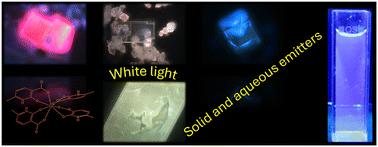
The work presented herein reports on the synthesis, structural and physicochemical characterization and luminescence properties of a family of isostructural coordination polymers (CPs) with a general formula {[Ln(6m2onic)4Na(H2O)3]·8H2O}n (where Ln(III) = Nd (1Nd), Sm (2Sm), Dy (3Dy), Er (4Er), Tm (5Tm), Yb (6Yb) and Dy0.77Eu0.12Y0.11 for the multi-metal compound (7DyEuY) and 6m2onic = 6-methyl-2-oxonicotinate). The crystal structures consist of one-dimensional heterometallic arrays where octacoordinated lanthanide and hexacoordinated sodium centres are sequentially linked and which are held together into a 3D architecture by an extensive hydrogen bonding network formed by the crystallisation water molecules. Photoluminescence measurements in the solid state at variable temperature reveal good properties based on the capacity of the 6m2onic ligand to provide ligand-centred excitation, as suggested by time-dependent density functional theory (TDDFT), and promote efficient energy transfers to the lanthanide(III) ions, to eventually present intense emissions in both the visible and near-infrared (NIR) regions. On the one hand, compound 4Er displays characteristic lanthanide-centred bands in the NIR region even at room temperature, meaning that the framework is able to isolate the excitons from the vibrational quenching component. On the other hand, regarding the compounds emitting in the visible region, the almost white light emitted by compound 3Dy with a quantum yield (QY) of 6.2% should be noted. Both a purer white emission and an improved QY (up to 15.8%) may be achieved by means of a doping strategy of europium and yttrium ions into the Dy counterpart. Finally, taking advantage of white light emitted by compound 3Dy, the chemical and optical stabilities in water have been confirmed by the photophysical study performed in solution.




 京公网安备 11010802042870号
京ICP备2023020795号-1
京公网安备 11010802042870号
京ICP备2023020795号-1

 分享
分享
 求助内容:
求助内容: 应助结果提醒方式:
 扫码关注我们
