Lorenzo Michelini, Tanya Slaney, Seerat Virk, Estefanía Rafic, L. Charlie Qie, Klara Corejova, Mathieu L. Lepage, Stefania F. Musolino, Allen G. Oliver, Roberto Etchenique, W. David Hong, Gino A. DiLabio and Jeremy E. Wulff
{"title":"重氮嘧啶的中心碳是sp2杂化的,有利于与染料分子结合","authors":"Lorenzo Michelini, Tanya Slaney, Seerat Virk, Estefanía Rafic, L. Charlie Qie, Klara Corejova, Mathieu L. Lepage, Stefania F. Musolino, Allen G. Oliver, Roberto Etchenique, W. David Hong, Gino A. DiLabio and Jeremy E. Wulff","doi":"10.1039/D4SC06427E","DOIUrl":null,"url":null,"abstract":"<p >Diazirines are versatile carbene precursors that are extensively used in biological target identification experiments. However, their photo-activation wavelength (<em>ca.</em> 365 nm) precludes their use in living organisms. Here we show that a reconceptualization of the diazirine hybridization state leads to conjugation of the diazirine motif to longer-wavelength chromophores. In a model diazirine–fluorene conjugate, we are able to achieve direct activation (and subsequent C–H insertion) with >450 nm light for the first time. Two-photon activation using near-IR light is also achieved, suggesting the possibility to prepare new diazirine probes for conducting target identification experiments in deep tissue.</p>","PeriodicalId":9909,"journal":{"name":"Chemical Science","volume":" 2","pages":" 970-979"},"PeriodicalIF":8.1000,"publicationDate":"2024-12-02","publicationTypes":"Journal Article","fieldsOfStudy":null,"isOpenAccess":false,"openAccessPdf":"https://pubs.rsc.org/en/content/articlepdf/2025/sc/d4sc06427e?page=search","citationCount":"0","resultStr":"{\"title\":\"A diazirine's central carbon is sp2-hybridized, facilitating conjugation to dye molecules†\",\"authors\":\"Lorenzo Michelini, Tanya Slaney, Seerat Virk, Estefanía Rafic, L. Charlie Qie, Klara Corejova, Mathieu L. Lepage, Stefania F. Musolino, Allen G. Oliver, Roberto Etchenique, W. David Hong, Gino A. DiLabio and Jeremy E. Wulff\",\"doi\":\"10.1039/D4SC06427E\",\"DOIUrl\":null,\"url\":null,\"abstract\":\"<p >Diazirines are versatile carbene precursors that are extensively used in biological target identification experiments. However, their photo-activation wavelength (<em>ca.</em> 365 nm) precludes their use in living organisms. Here we show that a reconceptualization of the diazirine hybridization state leads to conjugation of the diazirine motif to longer-wavelength chromophores. In a model diazirine–fluorene conjugate, we are able to achieve direct activation (and subsequent C–H insertion) with >450 nm light for the first time. Two-photon activation using near-IR light is also achieved, suggesting the possibility to prepare new diazirine probes for conducting target identification experiments in deep tissue.</p>\",\"PeriodicalId\":9909,\"journal\":{\"name\":\"Chemical Science\",\"volume\":\" 2\",\"pages\":\" 970-979\"},\"PeriodicalIF\":8.1000,\"publicationDate\":\"2024-12-02\",\"publicationTypes\":\"Journal Article\",\"fieldsOfStudy\":null,\"isOpenAccess\":false,\"openAccessPdf\":\"https://pubs.rsc.org/en/content/articlepdf/2025/sc/d4sc06427e?page=search\",\"citationCount\":\"0\",\"resultStr\":null,\"platform\":\"Semanticscholar\",\"paperid\":null,\"PeriodicalName\":\"Chemical Science\",\"FirstCategoryId\":\"92\",\"ListUrlMain\":\"https://pubs.rsc.org/en/content/articlelanding/2025/sc/d4sc06427e\",\"RegionNum\":1,\"RegionCategory\":\"化学\",\"ArticlePicture\":[],\"TitleCN\":null,\"AbstractTextCN\":null,\"PMCID\":null,\"EPubDate\":\"\",\"PubModel\":\"\",\"JCR\":\"Q1\",\"JCRName\":\"CHEMISTRY, MULTIDISCIPLINARY\",\"Score\":null,\"Total\":0}","platform":"Semanticscholar","paperid":null,"PeriodicalName":"Chemical Science","FirstCategoryId":"92","ListUrlMain":"https://pubs.rsc.org/en/content/articlelanding/2025/sc/d4sc06427e","RegionNum":1,"RegionCategory":"化学","ArticlePicture":[],"TitleCN":null,"AbstractTextCN":null,"PMCID":null,"EPubDate":"","PubModel":"","JCR":"Q1","JCRName":"CHEMISTRY, MULTIDISCIPLINARY","Score":null,"Total":0}
A diazirine's central carbon is sp2-hybridized, facilitating conjugation to dye molecules†
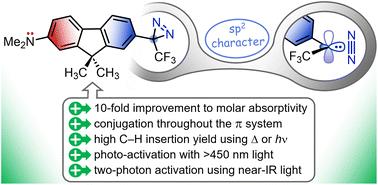
Diazirines are versatile carbene precursors that are extensively used in biological target identification experiments. However, their photo-activation wavelength (ca. 365 nm) precludes their use in living organisms. Here we show that a reconceptualization of the diazirine hybridization state leads to conjugation of the diazirine motif to longer-wavelength chromophores. In a model diazirine–fluorene conjugate, we are able to achieve direct activation (and subsequent C–H insertion) with >450 nm light for the first time. Two-photon activation using near-IR light is also achieved, suggesting the possibility to prepare new diazirine probes for conducting target identification experiments in deep tissue.
期刊介绍:
Chemical Science is a journal that encompasses various disciplines within the chemical sciences. Its scope includes publishing ground-breaking research with significant implications for its respective field, as well as appealing to a wider audience in related areas. To be considered for publication, articles must showcase innovative and original advances in their field of study and be presented in a manner that is understandable to scientists from diverse backgrounds. However, the journal generally does not publish highly specialized research.





 京公网安备 11010802042870号
京ICP备2023020795号-1
京公网安备 11010802042870号
京ICP备2023020795号-1

 分享
分享
 求助内容:
求助内容: 应助结果提醒方式:
 扫码关注我们
