Wenda Zhou , Mingyue Chen , Xingfang Luo , Cailei Yuan , Shoujie Liu , Wen Lei , Shouguo Wang
{"title":"二维cu -苯丙氨酸纳米片用于高效和稳健的CO2电还原到C2+产品","authors":"Wenda Zhou , Mingyue Chen , Xingfang Luo , Cailei Yuan , Shoujie Liu , Wen Lei , Shouguo Wang","doi":"10.1039/d4cc05749j","DOIUrl":null,"url":null,"abstract":"<div><div>The electrocatalytic reduction of CO<sub>2</sub> to multicarbon (C<sub>2+</sub>) products is of great importance but still faces challenges. The moderate oxidation state of Cu (Cu<sup><em>δ</em>+</sup>) plays a critical role in promoting the C–C coupling, thereby enhancing the Faraday efficiency (FE) for C<sub>2+</sub> products. However, Cu<sup><em>δ</em>+</sup> active species are unstable during the reaction. In this work, two-dimensional (2D) Cu-phenylalanine (Cu-phe) nanoflakes by assembling Cu ions and phenylalanine are prepared. X-ray absorption spectroscopy (XAS) is performed to confirm the moderate oxidation state and Cu–O/N coordination of Cu-phe nanoflakes. Owing to the carboxylic ligand and more stable Cu–N coordination, Cu-phe nanoflakes maintain a moderate oxidation state and exhibit high FE for C<sub>2+</sub> products (88.1% at −0.8 V) in a flow cell, along with excellent stability. This work offers valuable insights for designing stable and efficient catalysts for the electro-conversion of CO<sub>2</sub> into high-value chemical stocks.</div></div>","PeriodicalId":67,"journal":{"name":"Chemical Communications","volume":"61 3","pages":"Pages 524-527"},"PeriodicalIF":4.2000,"publicationDate":"2024-11-26","publicationTypes":"Journal Article","fieldsOfStudy":null,"isOpenAccess":false,"openAccessPdf":"","citationCount":"0","resultStr":"{\"title\":\"Two-dimensional Cu-phenylalanine nanoflakes for efficient and robust CO2 electroreduction to C2+ products†\",\"authors\":\"Wenda Zhou , Mingyue Chen , Xingfang Luo , Cailei Yuan , Shoujie Liu , Wen Lei , Shouguo Wang\",\"doi\":\"10.1039/d4cc05749j\",\"DOIUrl\":null,\"url\":null,\"abstract\":\"<div><div>The electrocatalytic reduction of CO<sub>2</sub> to multicarbon (C<sub>2+</sub>) products is of great importance but still faces challenges. The moderate oxidation state of Cu (Cu<sup><em>δ</em>+</sup>) plays a critical role in promoting the C–C coupling, thereby enhancing the Faraday efficiency (FE) for C<sub>2+</sub> products. However, Cu<sup><em>δ</em>+</sup> active species are unstable during the reaction. In this work, two-dimensional (2D) Cu-phenylalanine (Cu-phe) nanoflakes by assembling Cu ions and phenylalanine are prepared. X-ray absorption spectroscopy (XAS) is performed to confirm the moderate oxidation state and Cu–O/N coordination of Cu-phe nanoflakes. Owing to the carboxylic ligand and more stable Cu–N coordination, Cu-phe nanoflakes maintain a moderate oxidation state and exhibit high FE for C<sub>2+</sub> products (88.1% at −0.8 V) in a flow cell, along with excellent stability. This work offers valuable insights for designing stable and efficient catalysts for the electro-conversion of CO<sub>2</sub> into high-value chemical stocks.</div></div>\",\"PeriodicalId\":67,\"journal\":{\"name\":\"Chemical Communications\",\"volume\":\"61 3\",\"pages\":\"Pages 524-527\"},\"PeriodicalIF\":4.2000,\"publicationDate\":\"2024-11-26\",\"publicationTypes\":\"Journal Article\",\"fieldsOfStudy\":null,\"isOpenAccess\":false,\"openAccessPdf\":\"\",\"citationCount\":\"0\",\"resultStr\":null,\"platform\":\"Semanticscholar\",\"paperid\":null,\"PeriodicalName\":\"Chemical Communications\",\"FirstCategoryId\":\"92\",\"ListUrlMain\":\"https://www.sciencedirect.com/org/science/article/pii/S1359734524026090\",\"RegionNum\":2,\"RegionCategory\":\"化学\",\"ArticlePicture\":[],\"TitleCN\":null,\"AbstractTextCN\":null,\"PMCID\":null,\"EPubDate\":\"2024/12/2 0:00:00\",\"PubModel\":\"Epub\",\"JCR\":\"Q2\",\"JCRName\":\"CHEMISTRY, MULTIDISCIPLINARY\",\"Score\":null,\"Total\":0}","platform":"Semanticscholar","paperid":null,"PeriodicalName":"Chemical Communications","FirstCategoryId":"92","ListUrlMain":"https://www.sciencedirect.com/org/science/article/pii/S1359734524026090","RegionNum":2,"RegionCategory":"化学","ArticlePicture":[],"TitleCN":null,"AbstractTextCN":null,"PMCID":null,"EPubDate":"2024/12/2 0:00:00","PubModel":"Epub","JCR":"Q2","JCRName":"CHEMISTRY, MULTIDISCIPLINARY","Score":null,"Total":0}
Two-dimensional Cu-phenylalanine nanoflakes for efficient and robust CO2 electroreduction to C2+ products†
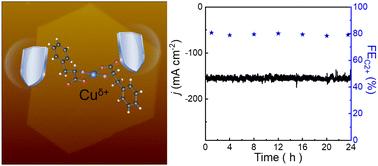
The electrocatalytic reduction of CO2 to multicarbon (C2+) products is of great importance but still faces challenges. The moderate oxidation state of Cu (Cuδ+) plays a critical role in promoting the C–C coupling, thereby enhancing the Faraday efficiency (FE) for C2+ products. However, Cuδ+ active species are unstable during the reaction. In this work, two-dimensional (2D) Cu-phenylalanine (Cu-phe) nanoflakes by assembling Cu ions and phenylalanine are prepared. X-ray absorption spectroscopy (XAS) is performed to confirm the moderate oxidation state and Cu–O/N coordination of Cu-phe nanoflakes. Owing to the carboxylic ligand and more stable Cu–N coordination, Cu-phe nanoflakes maintain a moderate oxidation state and exhibit high FE for C2+ products (88.1% at −0.8 V) in a flow cell, along with excellent stability. This work offers valuable insights for designing stable and efficient catalysts for the electro-conversion of CO2 into high-value chemical stocks.
期刊介绍:
ChemComm (Chemical Communications) is renowned as the fastest publisher of articles providing information on new avenues of research, drawn from all the world''s major areas of chemical research.




 京公网安备 11010802042870号
京ICP备2023020795号-1
京公网安备 11010802042870号
京ICP备2023020795号-1

 分享
分享
 求助内容:
求助内容: 应助结果提醒方式:
 扫码关注我们
