Pengli Guo, Chentong Xu, Xuan Zhang, Jinqiu Feng, Yaxin Lou, Shufang Ye, Ping Lv, Bin Zhu, Yingyu Chen
{"title":"ELMOD3的缺失通过破坏β-catenin信号和F-actin细胞骨架来抑制胃癌细胞的生长和迁移","authors":"Pengli Guo, Chentong Xu, Xuan Zhang, Jinqiu Feng, Yaxin Lou, Shufang Ye, Ping Lv, Bin Zhu, Yingyu Chen","doi":"10.1096/fj.202400833RRR","DOIUrl":null,"url":null,"abstract":"<p><i>ELMOD3</i> (encoding ELMO domain containing 3) is a causative gene associated with human autosomal dominant nonsyndromic and progressive hearing loss. However, the role of ELMOD3 in the occurrence and development of tumors remains unknown. Herein, we observed that inactivation of <i>ELMOD3</i> in gastric cancer cells significantly inhibited their proliferation, migration, and invasion, and altered cell cycle progression. A xenograft tumor model showed that knockout of <i>ELMOD3</i> suppressed the tumorigenicity of BGC823 gastric cancer cells in nude mice. Further investigation demonstrated that the ELMO domain of ELMOD3 interacts with β-catenin, which increases the levels of β-catenin, promoting downstream target gene expression. Deletion of <i>ELMOD3</i> in gastric cells decreased the β-catenin signaling, elevated E-cadherin levels, suppressed RAF/MEK/ERK signal pathway, and disrupted the formation of F-actin cytoskeleton. These results led us to propose that ELMOD3 may participate in multiple biological processes in promoting the tumorigenesis of gastric cancer. It exerts a positive role in the regulation of gastric cancer cell proliferation and progression. Thus, ELMOD3 was identified as a potential tumor target, which deserves further investigation.</p>","PeriodicalId":50455,"journal":{"name":"The FASEB Journal","volume":"38 23","pages":""},"PeriodicalIF":4.2000,"publicationDate":"2024-12-02","publicationTypes":"Journal Article","fieldsOfStudy":null,"isOpenAccess":false,"openAccessPdf":"","citationCount":"0","resultStr":"{\"title\":\"Depletion of ELMOD3 inhibits the growth and migration of gastric cancer cells by disrupting the β-catenin signaling and the F-actin cytoskeleton\",\"authors\":\"Pengli Guo, Chentong Xu, Xuan Zhang, Jinqiu Feng, Yaxin Lou, Shufang Ye, Ping Lv, Bin Zhu, Yingyu Chen\",\"doi\":\"10.1096/fj.202400833RRR\",\"DOIUrl\":null,\"url\":null,\"abstract\":\"<p><i>ELMOD3</i> (encoding ELMO domain containing 3) is a causative gene associated with human autosomal dominant nonsyndromic and progressive hearing loss. However, the role of ELMOD3 in the occurrence and development of tumors remains unknown. Herein, we observed that inactivation of <i>ELMOD3</i> in gastric cancer cells significantly inhibited their proliferation, migration, and invasion, and altered cell cycle progression. A xenograft tumor model showed that knockout of <i>ELMOD3</i> suppressed the tumorigenicity of BGC823 gastric cancer cells in nude mice. Further investigation demonstrated that the ELMO domain of ELMOD3 interacts with β-catenin, which increases the levels of β-catenin, promoting downstream target gene expression. Deletion of <i>ELMOD3</i> in gastric cells decreased the β-catenin signaling, elevated E-cadherin levels, suppressed RAF/MEK/ERK signal pathway, and disrupted the formation of F-actin cytoskeleton. These results led us to propose that ELMOD3 may participate in multiple biological processes in promoting the tumorigenesis of gastric cancer. It exerts a positive role in the regulation of gastric cancer cell proliferation and progression. Thus, ELMOD3 was identified as a potential tumor target, which deserves further investigation.</p>\",\"PeriodicalId\":50455,\"journal\":{\"name\":\"The FASEB Journal\",\"volume\":\"38 23\",\"pages\":\"\"},\"PeriodicalIF\":4.2000,\"publicationDate\":\"2024-12-02\",\"publicationTypes\":\"Journal Article\",\"fieldsOfStudy\":null,\"isOpenAccess\":false,\"openAccessPdf\":\"\",\"citationCount\":\"0\",\"resultStr\":null,\"platform\":\"Semanticscholar\",\"paperid\":null,\"PeriodicalName\":\"The FASEB Journal\",\"FirstCategoryId\":\"99\",\"ListUrlMain\":\"https://faseb.onlinelibrary.wiley.com/doi/10.1096/fj.202400833RRR\",\"RegionNum\":2,\"RegionCategory\":\"生物学\",\"ArticlePicture\":[],\"TitleCN\":null,\"AbstractTextCN\":null,\"PMCID\":null,\"EPubDate\":\"\",\"PubModel\":\"\",\"JCR\":\"Q2\",\"JCRName\":\"BIOCHEMISTRY & MOLECULAR BIOLOGY\",\"Score\":null,\"Total\":0}","platform":"Semanticscholar","paperid":null,"PeriodicalName":"The FASEB Journal","FirstCategoryId":"99","ListUrlMain":"https://faseb.onlinelibrary.wiley.com/doi/10.1096/fj.202400833RRR","RegionNum":2,"RegionCategory":"生物学","ArticlePicture":[],"TitleCN":null,"AbstractTextCN":null,"PMCID":null,"EPubDate":"","PubModel":"","JCR":"Q2","JCRName":"BIOCHEMISTRY & MOLECULAR BIOLOGY","Score":null,"Total":0}
Depletion of ELMOD3 inhibits the growth and migration of gastric cancer cells by disrupting the β-catenin signaling and the F-actin cytoskeleton
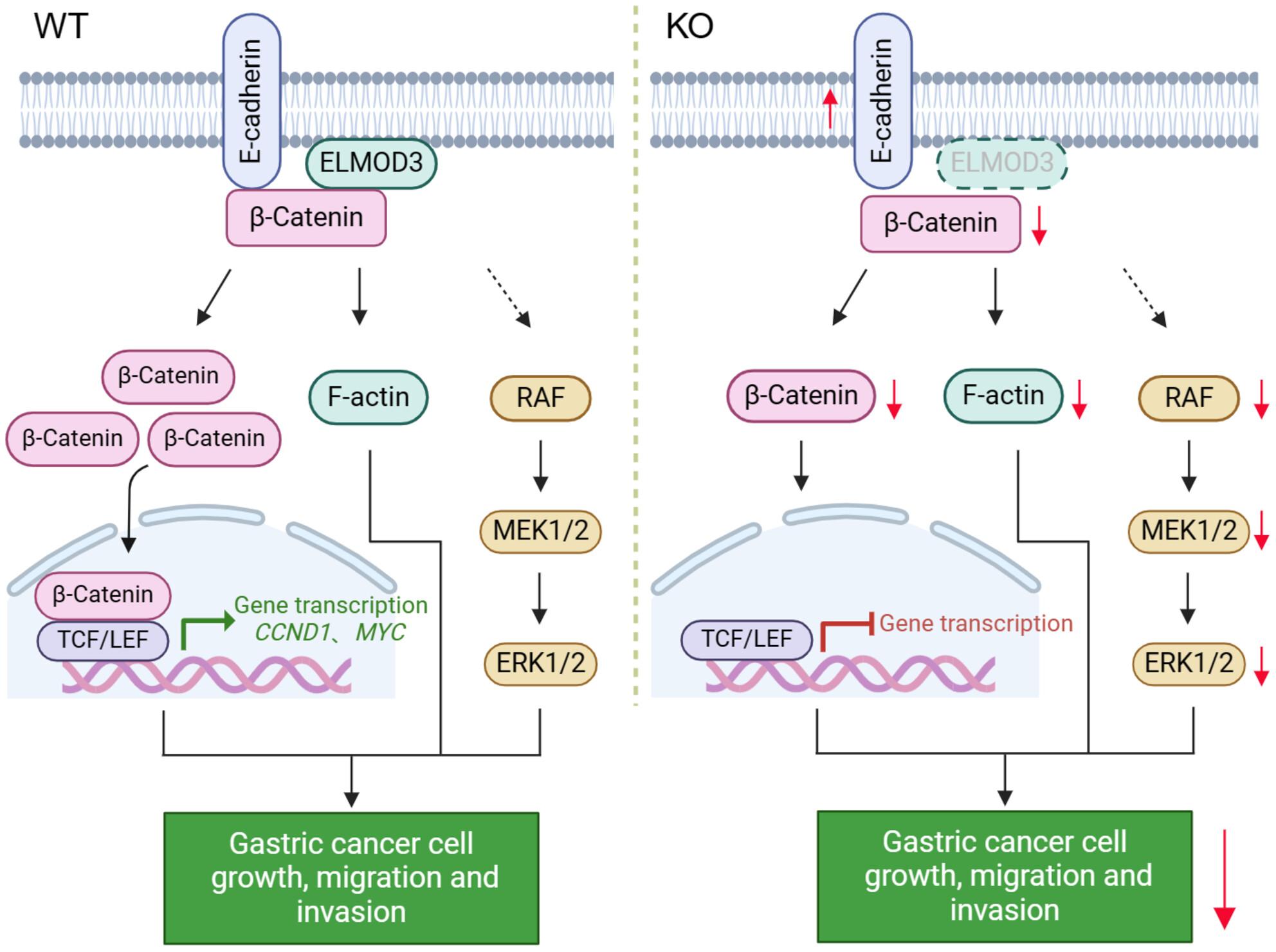
ELMOD3 (encoding ELMO domain containing 3) is a causative gene associated with human autosomal dominant nonsyndromic and progressive hearing loss. However, the role of ELMOD3 in the occurrence and development of tumors remains unknown. Herein, we observed that inactivation of ELMOD3 in gastric cancer cells significantly inhibited their proliferation, migration, and invasion, and altered cell cycle progression. A xenograft tumor model showed that knockout of ELMOD3 suppressed the tumorigenicity of BGC823 gastric cancer cells in nude mice. Further investigation demonstrated that the ELMO domain of ELMOD3 interacts with β-catenin, which increases the levels of β-catenin, promoting downstream target gene expression. Deletion of ELMOD3 in gastric cells decreased the β-catenin signaling, elevated E-cadherin levels, suppressed RAF/MEK/ERK signal pathway, and disrupted the formation of F-actin cytoskeleton. These results led us to propose that ELMOD3 may participate in multiple biological processes in promoting the tumorigenesis of gastric cancer. It exerts a positive role in the regulation of gastric cancer cell proliferation and progression. Thus, ELMOD3 was identified as a potential tumor target, which deserves further investigation.
期刊介绍:
The FASEB Journal publishes international, transdisciplinary research covering all fields of biology at every level of organization: atomic, molecular, cell, tissue, organ, organismic and population. While the journal strives to include research that cuts across the biological sciences, it also considers submissions that lie within one field, but may have implications for other fields as well. The journal seeks to publish basic and translational research, but also welcomes reports of pre-clinical and early clinical research. In addition to research, review, and hypothesis submissions, The FASEB Journal also seeks perspectives, commentaries, book reviews, and similar content related to the life sciences in its Up Front section.





 京公网安备 11010802042870号
京ICP备2023020795号-1
京公网安备 11010802042870号
京ICP备2023020795号-1

 分享
分享
 求助内容:
求助内容: 应助结果提醒方式:
 扫码关注我们
