Joshua Osowicki, Hannah R. Frost, Kristy I. Azzopardi, Alana L. Whitcombe, Reuben McGregor, Lauren H. Carlton, Ciara Baker, Loraine Fabri, Manisha Pandey, Michael F. Good, Jonathan R. Carapetis, Mark J. Walker, Pierre R. Smeesters, Paul V. Licciardi, Nicole J. Moreland, Danika L. Hill, Andrew C. Steer
{"title":"化脓性链球菌咽炎引起对关键疫苗抗原的多种抗体反应,受过去感染的影响","authors":"Joshua Osowicki, Hannah R. Frost, Kristy I. Azzopardi, Alana L. Whitcombe, Reuben McGregor, Lauren H. Carlton, Ciara Baker, Loraine Fabri, Manisha Pandey, Michael F. Good, Jonathan R. Carapetis, Mark J. Walker, Pierre R. Smeesters, Paul V. Licciardi, Nicole J. Moreland, Danika L. Hill, Andrew C. Steer","doi":"10.1038/s41467-024-54665-5","DOIUrl":null,"url":null,"abstract":"<p>Knowledge gaps regarding human immunity to <i>Streptococcus pyogenes</i> have impeded vaccine development. To address these gaps and evaluate vaccine candidates, we established a human challenge model of <i>S. pyogenes</i> pharyngitis. Here, we analyse antibody responses in serum and saliva against 19 antigens to identify characteristics distinguishing 19 participants who developed pharyngitis and 6 who did not. We show that pharyngitis elicits serum IgG responses to key vaccine antigens and a muted mucosal IgA response, whereas IgG responses are minimal and IgA responses more pronounced in participants without pharyngitis. Serum IgG responses to pharyngitis in adult participants resemble those in children and are inversely correlated with the magnitude of pre-existing responses. While a straightforward correlate of protection is not evident, baseline antibody signatures distinguish clinical and immunological outcomes following experimental challenge. This highlights the influence of a complex humoral imprint from previous exposure, relevant for interpreting immunogenicity in forthcoming vaccine trials.</p>","PeriodicalId":19066,"journal":{"name":"Nature Communications","volume":"13 1","pages":""},"PeriodicalIF":15.7000,"publicationDate":"2024-12-03","publicationTypes":"Journal Article","fieldsOfStudy":null,"isOpenAccess":false,"openAccessPdf":"","citationCount":"0","resultStr":"{\"title\":\"Streptococcus pyogenes pharyngitis elicits diverse antibody responses to key vaccine antigens influenced by the imprint of past infections\",\"authors\":\"Joshua Osowicki, Hannah R. Frost, Kristy I. Azzopardi, Alana L. Whitcombe, Reuben McGregor, Lauren H. Carlton, Ciara Baker, Loraine Fabri, Manisha Pandey, Michael F. Good, Jonathan R. Carapetis, Mark J. Walker, Pierre R. Smeesters, Paul V. Licciardi, Nicole J. Moreland, Danika L. Hill, Andrew C. Steer\",\"doi\":\"10.1038/s41467-024-54665-5\",\"DOIUrl\":null,\"url\":null,\"abstract\":\"<p>Knowledge gaps regarding human immunity to <i>Streptococcus pyogenes</i> have impeded vaccine development. To address these gaps and evaluate vaccine candidates, we established a human challenge model of <i>S. pyogenes</i> pharyngitis. Here, we analyse antibody responses in serum and saliva against 19 antigens to identify characteristics distinguishing 19 participants who developed pharyngitis and 6 who did not. We show that pharyngitis elicits serum IgG responses to key vaccine antigens and a muted mucosal IgA response, whereas IgG responses are minimal and IgA responses more pronounced in participants without pharyngitis. Serum IgG responses to pharyngitis in adult participants resemble those in children and are inversely correlated with the magnitude of pre-existing responses. While a straightforward correlate of protection is not evident, baseline antibody signatures distinguish clinical and immunological outcomes following experimental challenge. This highlights the influence of a complex humoral imprint from previous exposure, relevant for interpreting immunogenicity in forthcoming vaccine trials.</p>\",\"PeriodicalId\":19066,\"journal\":{\"name\":\"Nature Communications\",\"volume\":\"13 1\",\"pages\":\"\"},\"PeriodicalIF\":15.7000,\"publicationDate\":\"2024-12-03\",\"publicationTypes\":\"Journal Article\",\"fieldsOfStudy\":null,\"isOpenAccess\":false,\"openAccessPdf\":\"\",\"citationCount\":\"0\",\"resultStr\":null,\"platform\":\"Semanticscholar\",\"paperid\":null,\"PeriodicalName\":\"Nature Communications\",\"FirstCategoryId\":\"103\",\"ListUrlMain\":\"https://doi.org/10.1038/s41467-024-54665-5\",\"RegionNum\":1,\"RegionCategory\":\"综合性期刊\",\"ArticlePicture\":[],\"TitleCN\":null,\"AbstractTextCN\":null,\"PMCID\":null,\"EPubDate\":\"\",\"PubModel\":\"\",\"JCR\":\"Q1\",\"JCRName\":\"MULTIDISCIPLINARY SCIENCES\",\"Score\":null,\"Total\":0}","platform":"Semanticscholar","paperid":null,"PeriodicalName":"Nature Communications","FirstCategoryId":"103","ListUrlMain":"https://doi.org/10.1038/s41467-024-54665-5","RegionNum":1,"RegionCategory":"综合性期刊","ArticlePicture":[],"TitleCN":null,"AbstractTextCN":null,"PMCID":null,"EPubDate":"","PubModel":"","JCR":"Q1","JCRName":"MULTIDISCIPLINARY SCIENCES","Score":null,"Total":0}
Streptococcus pyogenes pharyngitis elicits diverse antibody responses to key vaccine antigens influenced by the imprint of past infections
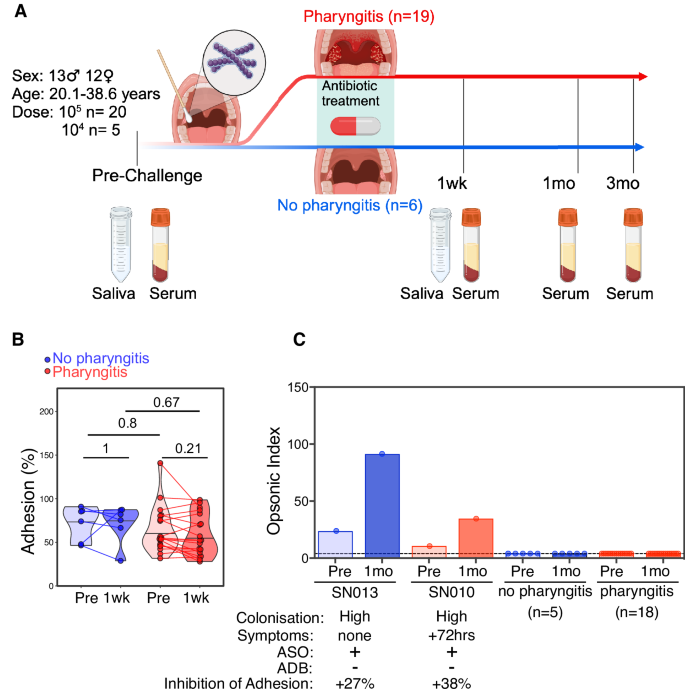
Knowledge gaps regarding human immunity to Streptococcus pyogenes have impeded vaccine development. To address these gaps and evaluate vaccine candidates, we established a human challenge model of S. pyogenes pharyngitis. Here, we analyse antibody responses in serum and saliva against 19 antigens to identify characteristics distinguishing 19 participants who developed pharyngitis and 6 who did not. We show that pharyngitis elicits serum IgG responses to key vaccine antigens and a muted mucosal IgA response, whereas IgG responses are minimal and IgA responses more pronounced in participants without pharyngitis. Serum IgG responses to pharyngitis in adult participants resemble those in children and are inversely correlated with the magnitude of pre-existing responses. While a straightforward correlate of protection is not evident, baseline antibody signatures distinguish clinical and immunological outcomes following experimental challenge. This highlights the influence of a complex humoral imprint from previous exposure, relevant for interpreting immunogenicity in forthcoming vaccine trials.
期刊介绍:
Nature Communications, an open-access journal, publishes high-quality research spanning all areas of the natural sciences. Papers featured in the journal showcase significant advances relevant to specialists in each respective field. With a 2-year impact factor of 16.6 (2022) and a median time of 8 days from submission to the first editorial decision, Nature Communications is committed to rapid dissemination of research findings. As a multidisciplinary journal, it welcomes contributions from biological, health, physical, chemical, Earth, social, mathematical, applied, and engineering sciences, aiming to highlight important breakthroughs within each domain.




 京公网安备 11010802042870号
京ICP备2023020795号-1
京公网安备 11010802042870号
京ICP备2023020795号-1

 分享
分享
 求助内容:
求助内容: 应助结果提醒方式:
 扫码关注我们
