Malak H. Al-Anati, Abdussalam K. Qaroush, Ala’a F. Eftaiha, Suhad B. Hammad, Feda’a M. Al-Qaisi and Khaleel I. Assaf
{"title":"阴离子屏蔽对CO2固定成环碳酸盐催化活性的影响","authors":"Malak H. Al-Anati, Abdussalam K. Qaroush, Ala’a F. Eftaiha, Suhad B. Hammad, Feda’a M. Al-Qaisi and Khaleel I. Assaf","doi":"10.1039/D4NJ04290E","DOIUrl":null,"url":null,"abstract":"<p >A multi-active site 1,1′,1′′-(2-hydroxybenzene-1,3,5-triyl)tris(<em>N</em>-benzyl-<em>N</em>,<em>N</em>-dimethylmethanammonium)bromide (<strong>3</strong>) and hierarchical ionic polymers <strong>9</strong>, <strong>11</strong>, <strong>13</strong>, and <strong>16</strong> have been synthesized. Compound <strong>3</strong> showed the best catalytic activity under co-catalyst free and mild reaction conditions, namely, 1 mL of substrate (epoxide), 2 mol% catalyst loading at 90 °C for 24 h under atmospheric pressure, as compared to its polymeric equivalents (<strong>9</strong>, <strong>11</strong>, <strong>13</strong>, and <strong>16</strong>). Interestingly, an increase in the number of active sites within the backbone of <strong>3</strong> showed an inverse relationship with the halide nucleophilicity associated with it, <em>viz.</em>, Cl<small><sup>−</sup></small> > Br<small><sup>−</sup></small>. This phenomenon arises from the large size of the bromide anion, leading to a ‘<em>congested active site</em>’ effect, as demonstrated by both experimental and theoretical studies. This was evident as the benzylic ammonium catalyst with bromide ions achieved higher epoxide conversion than its chloride counterpart, whereas the opposite was observed for catalyst <strong>3</strong>, likely due to a less congested catalyst structure with chlorides. Unexpectedly, during a five-run recyclability experiment, a modified and less active form of the organocatalyst <strong>3′</strong> was isolated. The overall reaction mechanism was elucidated and further supported by DFT calculations.</p>","PeriodicalId":95,"journal":{"name":"New Journal of Chemistry","volume":" 47","pages":" 19750-19762"},"PeriodicalIF":2.5000,"publicationDate":"2024-10-31","publicationTypes":"Journal Article","fieldsOfStudy":null,"isOpenAccess":false,"openAccessPdf":"","citationCount":"0","resultStr":"{\"title\":\"The impact of anion shielding on the catalytic activity of CO2 fixation into cyclic carbonates†\",\"authors\":\"Malak H. Al-Anati, Abdussalam K. Qaroush, Ala’a F. Eftaiha, Suhad B. Hammad, Feda’a M. Al-Qaisi and Khaleel I. Assaf\",\"doi\":\"10.1039/D4NJ04290E\",\"DOIUrl\":null,\"url\":null,\"abstract\":\"<p >A multi-active site 1,1′,1′′-(2-hydroxybenzene-1,3,5-triyl)tris(<em>N</em>-benzyl-<em>N</em>,<em>N</em>-dimethylmethanammonium)bromide (<strong>3</strong>) and hierarchical ionic polymers <strong>9</strong>, <strong>11</strong>, <strong>13</strong>, and <strong>16</strong> have been synthesized. Compound <strong>3</strong> showed the best catalytic activity under co-catalyst free and mild reaction conditions, namely, 1 mL of substrate (epoxide), 2 mol% catalyst loading at 90 °C for 24 h under atmospheric pressure, as compared to its polymeric equivalents (<strong>9</strong>, <strong>11</strong>, <strong>13</strong>, and <strong>16</strong>). Interestingly, an increase in the number of active sites within the backbone of <strong>3</strong> showed an inverse relationship with the halide nucleophilicity associated with it, <em>viz.</em>, Cl<small><sup>−</sup></small> > Br<small><sup>−</sup></small>. This phenomenon arises from the large size of the bromide anion, leading to a ‘<em>congested active site</em>’ effect, as demonstrated by both experimental and theoretical studies. This was evident as the benzylic ammonium catalyst with bromide ions achieved higher epoxide conversion than its chloride counterpart, whereas the opposite was observed for catalyst <strong>3</strong>, likely due to a less congested catalyst structure with chlorides. Unexpectedly, during a five-run recyclability experiment, a modified and less active form of the organocatalyst <strong>3′</strong> was isolated. The overall reaction mechanism was elucidated and further supported by DFT calculations.</p>\",\"PeriodicalId\":95,\"journal\":{\"name\":\"New Journal of Chemistry\",\"volume\":\" 47\",\"pages\":\" 19750-19762\"},\"PeriodicalIF\":2.5000,\"publicationDate\":\"2024-10-31\",\"publicationTypes\":\"Journal Article\",\"fieldsOfStudy\":null,\"isOpenAccess\":false,\"openAccessPdf\":\"\",\"citationCount\":\"0\",\"resultStr\":null,\"platform\":\"Semanticscholar\",\"paperid\":null,\"PeriodicalName\":\"New Journal of Chemistry\",\"FirstCategoryId\":\"92\",\"ListUrlMain\":\"https://pubs.rsc.org/en/content/articlelanding/2024/nj/d4nj04290e\",\"RegionNum\":3,\"RegionCategory\":\"化学\",\"ArticlePicture\":[],\"TitleCN\":null,\"AbstractTextCN\":null,\"PMCID\":null,\"EPubDate\":\"\",\"PubModel\":\"\",\"JCR\":\"Q2\",\"JCRName\":\"CHEMISTRY, MULTIDISCIPLINARY\",\"Score\":null,\"Total\":0}","platform":"Semanticscholar","paperid":null,"PeriodicalName":"New Journal of Chemistry","FirstCategoryId":"92","ListUrlMain":"https://pubs.rsc.org/en/content/articlelanding/2024/nj/d4nj04290e","RegionNum":3,"RegionCategory":"化学","ArticlePicture":[],"TitleCN":null,"AbstractTextCN":null,"PMCID":null,"EPubDate":"","PubModel":"","JCR":"Q2","JCRName":"CHEMISTRY, MULTIDISCIPLINARY","Score":null,"Total":0}
引用次数: 0
摘要
合成了多活性位点1,1′,1”-(2-羟基苯-1,3,5-三基)三(n -苄基- n, n -二甲基甲烷铵)溴化(3)和分级离子聚合物9,11,13和16。化合物3在无助催化剂和温和的反应条件下表现出最好的催化活性,即1 mL底物(环氧化物),2 mol%催化剂负载,90°C,常压下24 h,与其聚合物当量(9,11,13和16)相比。有趣的是,3主链中活性位点数量的增加与与之相关的卤化物亲核性呈反比关系,即Cl−>;Br−。实验和理论研究都证明,这种现象是由溴离子的大尺寸引起的,导致“拥挤的活性位点”效应。这一点很明显,因为含有溴离子的苯铵催化剂比氯离子催化剂具有更高的环氧化物转化率,而催化剂3的情况正好相反,可能是由于含有氯化物的催化剂结构不那么拥挤。出乎意料的是,在五次循环的可回收性实验中,分离出了一种改性的活性较低的有机催化剂3 '。DFT计算进一步阐明了反应的总体机理。
The impact of anion shielding on the catalytic activity of CO2 fixation into cyclic carbonates†
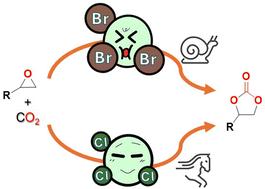
A multi-active site 1,1′,1′′-(2-hydroxybenzene-1,3,5-triyl)tris(N-benzyl-N,N-dimethylmethanammonium)bromide (3) and hierarchical ionic polymers 9, 11, 13, and 16 have been synthesized. Compound 3 showed the best catalytic activity under co-catalyst free and mild reaction conditions, namely, 1 mL of substrate (epoxide), 2 mol% catalyst loading at 90 °C for 24 h under atmospheric pressure, as compared to its polymeric equivalents (9, 11, 13, and 16). Interestingly, an increase in the number of active sites within the backbone of 3 showed an inverse relationship with the halide nucleophilicity associated with it, viz., Cl− > Br−. This phenomenon arises from the large size of the bromide anion, leading to a ‘congested active site’ effect, as demonstrated by both experimental and theoretical studies. This was evident as the benzylic ammonium catalyst with bromide ions achieved higher epoxide conversion than its chloride counterpart, whereas the opposite was observed for catalyst 3, likely due to a less congested catalyst structure with chlorides. Unexpectedly, during a five-run recyclability experiment, a modified and less active form of the organocatalyst 3′ was isolated. The overall reaction mechanism was elucidated and further supported by DFT calculations.




 京公网安备 11010802042870号
京ICP备2023020795号-1
京公网安备 11010802042870号
京ICP备2023020795号-1

 分享
分享
 求助内容:
求助内容: 应助结果提醒方式:
 扫码关注我们
