Mingyue Yuan, Alan H. Weible, Fatemeh Azadi, Bangxin Li, Jiacheng Cui, Hualiang Lv, Renchao Che and Xiaoguang Wang
{"title":"电磁波吸收高熵材料的研究进展。","authors":"Mingyue Yuan, Alan H. Weible, Fatemeh Azadi, Bangxin Li, Jiacheng Cui, Hualiang Lv, Renchao Che and Xiaoguang Wang","doi":"10.1039/D4MH01168F","DOIUrl":null,"url":null,"abstract":"<p >Widespread electromagnetic (EM) interference and pollution have become major issues due to the rapid advancement of fifth-generation (5G) wireless communication technology and devices. Recent advances in high-entropy (HE) materials have opened new opportunities for exploring EM wave absorption abilities to address the issues. The lattice distortion effect of structures, the synergistic effect of multi-element components, and multiple dielectric/magnetic loss mechanisms can offer extensive possibilities for optimizing the balance between impedance matching and attenuation ability, resulting in superior EM wave absorption performance. This review gives a comprehensive review on the recent progress of HE materials for EM wave absorption. We begin with the fundamentals of EM wave absorption materials and the superiority of HE absorbers. Discussions of advanced synthetic methods, in-depth characterization techniques, and electronic properties, especially with regard to regulatable electronic structures through band engineering of HE materials are highlighted. This review also covers current research advancements in a wide variety of HE materials for EM wave absorption, including HE alloys, HE ceramics (mainly HE oxides, carbides, and borides), and other novel HE systems. Finally, insights into future directions for the further development of high-performance HE EM wave absorbers are provided.</p>","PeriodicalId":87,"journal":{"name":"Materials Horizons","volume":" 4","pages":" 1033-1057"},"PeriodicalIF":10.7000,"publicationDate":"2024-11-19","publicationTypes":"Journal Article","fieldsOfStudy":null,"isOpenAccess":false,"openAccessPdf":"https://pubs.rsc.org/en/content/articlepdf/2025/mh/d4mh01168f?page=search","citationCount":"0","resultStr":"{\"title\":\"Advancements in high-entropy materials for electromagnetic wave absorption\",\"authors\":\"Mingyue Yuan, Alan H. Weible, Fatemeh Azadi, Bangxin Li, Jiacheng Cui, Hualiang Lv, Renchao Che and Xiaoguang Wang\",\"doi\":\"10.1039/D4MH01168F\",\"DOIUrl\":null,\"url\":null,\"abstract\":\"<p >Widespread electromagnetic (EM) interference and pollution have become major issues due to the rapid advancement of fifth-generation (5G) wireless communication technology and devices. Recent advances in high-entropy (HE) materials have opened new opportunities for exploring EM wave absorption abilities to address the issues. The lattice distortion effect of structures, the synergistic effect of multi-element components, and multiple dielectric/magnetic loss mechanisms can offer extensive possibilities for optimizing the balance between impedance matching and attenuation ability, resulting in superior EM wave absorption performance. This review gives a comprehensive review on the recent progress of HE materials for EM wave absorption. We begin with the fundamentals of EM wave absorption materials and the superiority of HE absorbers. Discussions of advanced synthetic methods, in-depth characterization techniques, and electronic properties, especially with regard to regulatable electronic structures through band engineering of HE materials are highlighted. This review also covers current research advancements in a wide variety of HE materials for EM wave absorption, including HE alloys, HE ceramics (mainly HE oxides, carbides, and borides), and other novel HE systems. Finally, insights into future directions for the further development of high-performance HE EM wave absorbers are provided.</p>\",\"PeriodicalId\":87,\"journal\":{\"name\":\"Materials Horizons\",\"volume\":\" 4\",\"pages\":\" 1033-1057\"},\"PeriodicalIF\":10.7000,\"publicationDate\":\"2024-11-19\",\"publicationTypes\":\"Journal Article\",\"fieldsOfStudy\":null,\"isOpenAccess\":false,\"openAccessPdf\":\"https://pubs.rsc.org/en/content/articlepdf/2025/mh/d4mh01168f?page=search\",\"citationCount\":\"0\",\"resultStr\":null,\"platform\":\"Semanticscholar\",\"paperid\":null,\"PeriodicalName\":\"Materials Horizons\",\"FirstCategoryId\":\"88\",\"ListUrlMain\":\"https://pubs.rsc.org/en/content/articlelanding/2025/mh/d4mh01168f\",\"RegionNum\":2,\"RegionCategory\":\"材料科学\",\"ArticlePicture\":[],\"TitleCN\":null,\"AbstractTextCN\":null,\"PMCID\":null,\"EPubDate\":\"\",\"PubModel\":\"\",\"JCR\":\"Q1\",\"JCRName\":\"CHEMISTRY, MULTIDISCIPLINARY\",\"Score\":null,\"Total\":0}","platform":"Semanticscholar","paperid":null,"PeriodicalName":"Materials Horizons","FirstCategoryId":"88","ListUrlMain":"https://pubs.rsc.org/en/content/articlelanding/2025/mh/d4mh01168f","RegionNum":2,"RegionCategory":"材料科学","ArticlePicture":[],"TitleCN":null,"AbstractTextCN":null,"PMCID":null,"EPubDate":"","PubModel":"","JCR":"Q1","JCRName":"CHEMISTRY, MULTIDISCIPLINARY","Score":null,"Total":0}
Advancements in high-entropy materials for electromagnetic wave absorption
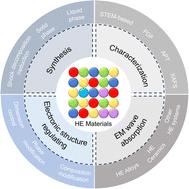
Widespread electromagnetic (EM) interference and pollution have become major issues due to the rapid advancement of fifth-generation (5G) wireless communication technology and devices. Recent advances in high-entropy (HE) materials have opened new opportunities for exploring EM wave absorption abilities to address the issues. The lattice distortion effect of structures, the synergistic effect of multi-element components, and multiple dielectric/magnetic loss mechanisms can offer extensive possibilities for optimizing the balance between impedance matching and attenuation ability, resulting in superior EM wave absorption performance. This review gives a comprehensive review on the recent progress of HE materials for EM wave absorption. We begin with the fundamentals of EM wave absorption materials and the superiority of HE absorbers. Discussions of advanced synthetic methods, in-depth characterization techniques, and electronic properties, especially with regard to regulatable electronic structures through band engineering of HE materials are highlighted. This review also covers current research advancements in a wide variety of HE materials for EM wave absorption, including HE alloys, HE ceramics (mainly HE oxides, carbides, and borides), and other novel HE systems. Finally, insights into future directions for the further development of high-performance HE EM wave absorbers are provided.




 京公网安备 11010802042870号
京ICP备2023020795号-1
京公网安备 11010802042870号
京ICP备2023020795号-1

 分享
分享
 求助内容:
求助内容: 应助结果提醒方式:
 扫码关注我们
