Zikun Yao , Pan Li , Fei Chen , Jiuwei Nie , Hui Wang , Lei Tang , Yuanyong Yang
{"title":"卤素键合加速制备4-氨基喹啉的好氧脱氢芳构化。","authors":"Zikun Yao , Pan Li , Fei Chen , Jiuwei Nie , Hui Wang , Lei Tang , Yuanyong Yang","doi":"10.1039/d4ob01700e","DOIUrl":null,"url":null,"abstract":"<div><div>This study presents a highly efficient method for 4-aminoquinoline derivative preparation under transition metal-free conditions. The process involves an aerobic oxidative dehydrative coupling of 2,3-dihydroquinolin-4(1<em>H</em>)-ones with various amines, including ammonia, resulting in high yields of the desired products. The method is also applicable to substituted 4-aminoquinoline derivative construction through a cyclization/dehydrative coupling cascade process starting from 2′-amino chalcones. Mechanistic studies reveal that iodine (I<sub>2</sub>) is consumed to produce 3-iodoquinolin-4-ol, which acts as a true catalyst with high catalytic efficacy (as low as 0.5 mol%). The presence of halogen bonding is critical in the inter-molecular transfer hydrogenation process to generate inactive quinolin-4-ol. Subsequently, using air/oxygen as the terminal oxidant, the iodine anion was oxidized to I<sub>2</sub> to regenerate the 3-iodoquinolin-4-ol from quinolin-4-ol in the catalytic cycle. Key benefits of this methodology include its simplicity, transition metal-free conditions, environmentally-benign oxidant, and high atom economy, making it a valuable approach for synthesizing medicinally significant 4-aminoquinoline derivatives.</div></div>","PeriodicalId":96,"journal":{"name":"Organic & Biomolecular Chemistry","volume":"23 3","pages":"Pages 728-733"},"PeriodicalIF":2.7000,"publicationDate":"2024-11-04","publicationTypes":"Journal Article","fieldsOfStudy":null,"isOpenAccess":false,"openAccessPdf":"","citationCount":"0","resultStr":"{\"title\":\"Halogen bonding accelerated aerobic dehydrogenative aromatization for 4-aminoquinoline preparation†\",\"authors\":\"Zikun Yao , Pan Li , Fei Chen , Jiuwei Nie , Hui Wang , Lei Tang , Yuanyong Yang\",\"doi\":\"10.1039/d4ob01700e\",\"DOIUrl\":null,\"url\":null,\"abstract\":\"<div><div>This study presents a highly efficient method for 4-aminoquinoline derivative preparation under transition metal-free conditions. The process involves an aerobic oxidative dehydrative coupling of 2,3-dihydroquinolin-4(1<em>H</em>)-ones with various amines, including ammonia, resulting in high yields of the desired products. The method is also applicable to substituted 4-aminoquinoline derivative construction through a cyclization/dehydrative coupling cascade process starting from 2′-amino chalcones. Mechanistic studies reveal that iodine (I<sub>2</sub>) is consumed to produce 3-iodoquinolin-4-ol, which acts as a true catalyst with high catalytic efficacy (as low as 0.5 mol%). The presence of halogen bonding is critical in the inter-molecular transfer hydrogenation process to generate inactive quinolin-4-ol. Subsequently, using air/oxygen as the terminal oxidant, the iodine anion was oxidized to I<sub>2</sub> to regenerate the 3-iodoquinolin-4-ol from quinolin-4-ol in the catalytic cycle. Key benefits of this methodology include its simplicity, transition metal-free conditions, environmentally-benign oxidant, and high atom economy, making it a valuable approach for synthesizing medicinally significant 4-aminoquinoline derivatives.</div></div>\",\"PeriodicalId\":96,\"journal\":{\"name\":\"Organic & Biomolecular Chemistry\",\"volume\":\"23 3\",\"pages\":\"Pages 728-733\"},\"PeriodicalIF\":2.7000,\"publicationDate\":\"2024-11-04\",\"publicationTypes\":\"Journal Article\",\"fieldsOfStudy\":null,\"isOpenAccess\":false,\"openAccessPdf\":\"\",\"citationCount\":\"0\",\"resultStr\":null,\"platform\":\"Semanticscholar\",\"paperid\":null,\"PeriodicalName\":\"Organic & Biomolecular Chemistry\",\"FirstCategoryId\":\"92\",\"ListUrlMain\":\"https://www.sciencedirect.com/org/science/article/pii/S1477052024010425\",\"RegionNum\":3,\"RegionCategory\":\"化学\",\"ArticlePicture\":[],\"TitleCN\":null,\"AbstractTextCN\":null,\"PMCID\":null,\"EPubDate\":\"2024/11/25 0:00:00\",\"PubModel\":\"Epub\",\"JCR\":\"Q1\",\"JCRName\":\"CHEMISTRY, ORGANIC\",\"Score\":null,\"Total\":0}","platform":"Semanticscholar","paperid":null,"PeriodicalName":"Organic & Biomolecular Chemistry","FirstCategoryId":"92","ListUrlMain":"https://www.sciencedirect.com/org/science/article/pii/S1477052024010425","RegionNum":3,"RegionCategory":"化学","ArticlePicture":[],"TitleCN":null,"AbstractTextCN":null,"PMCID":null,"EPubDate":"2024/11/25 0:00:00","PubModel":"Epub","JCR":"Q1","JCRName":"CHEMISTRY, ORGANIC","Score":null,"Total":0}
Halogen bonding accelerated aerobic dehydrogenative aromatization for 4-aminoquinoline preparation†
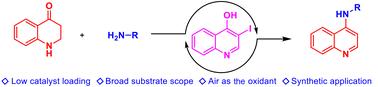
This study presents a highly efficient method for 4-aminoquinoline derivative preparation under transition metal-free conditions. The process involves an aerobic oxidative dehydrative coupling of 2,3-dihydroquinolin-4(1H)-ones with various amines, including ammonia, resulting in high yields of the desired products. The method is also applicable to substituted 4-aminoquinoline derivative construction through a cyclization/dehydrative coupling cascade process starting from 2′-amino chalcones. Mechanistic studies reveal that iodine (I2) is consumed to produce 3-iodoquinolin-4-ol, which acts as a true catalyst with high catalytic efficacy (as low as 0.5 mol%). The presence of halogen bonding is critical in the inter-molecular transfer hydrogenation process to generate inactive quinolin-4-ol. Subsequently, using air/oxygen as the terminal oxidant, the iodine anion was oxidized to I2 to regenerate the 3-iodoquinolin-4-ol from quinolin-4-ol in the catalytic cycle. Key benefits of this methodology include its simplicity, transition metal-free conditions, environmentally-benign oxidant, and high atom economy, making it a valuable approach for synthesizing medicinally significant 4-aminoquinoline derivatives.
期刊介绍:
Organic & Biomolecular Chemistry is an international journal using integrated research in chemistry-organic chemistry. Founded in 2003 by the Royal Society of Chemistry, the journal is published in Semimonthly issues and has been indexed by SCIE, a leading international database. The journal focuses on the key research and cutting-edge progress in the field of chemistry-organic chemistry, publishes and reports the research results in this field in a timely manner, and is committed to becoming a window and platform for rapid academic exchanges among peers in this field. The journal's impact factor in 2023 is 2.9, and its CiteScore is 5.5.




 京公网安备 11010802042870号
京ICP备2023020795号-1
京公网安备 11010802042870号
京ICP备2023020795号-1

 分享
分享
 求助内容:
求助内容: 应助结果提醒方式:
 扫码关注我们
