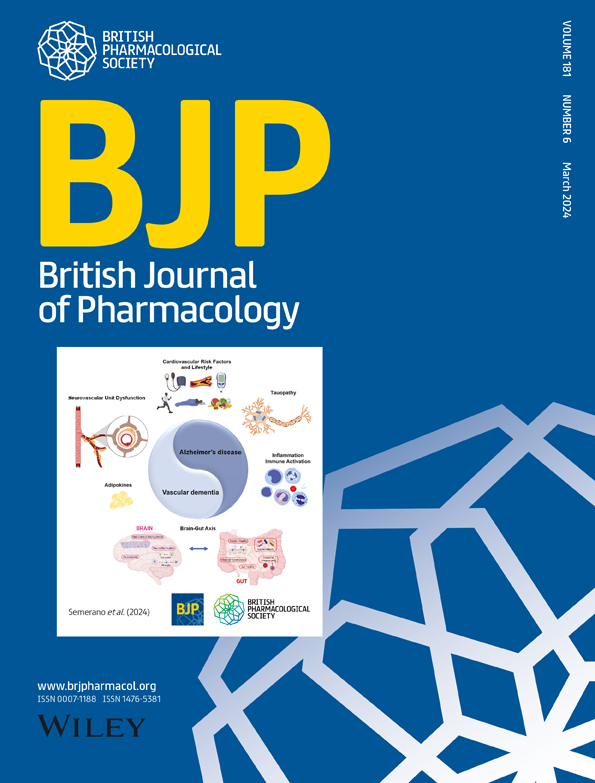
《药理学文摘》2024。

IF 7.7 2区 医学 Q1 PHARMACOLOGY & PHARMACY British Journal of Pharmacology Pub Date : 2024-12-02 DOI:10.1111/bph.17399
{"title":"《药理学文摘》2024。","authors":"","doi":"10.1111/bph.17399","DOIUrl":null,"url":null,"abstract":"<p><b>16</b></p><p><b>The effect of fluoxetine on diffused intrinsic pontine glioma (DIPG), ICR-B169 cells and HSJD-DIPG-007 cells</b></p><p><span>F. Javid</span></p><p><i>Department of Pharmacy, University of Huddersfield</i></p><p><b>Introduction</b></p><p>Diffuse intrinsic pontine glioma (DIPG) is an aggressive glial tumour with a median survival of 9–12 (Malbari, 2021; Van Genechten et al., 2024). Our previous studies have shown that fluoxetine (Prozac), the well-known antidepressant which is a selective serotonin uptake inhibitor (SSRI), induced cytotoxicity in human colon carcinoma cells (Marcinkute et al., 2019). The aim of the present study was to explore if fluoxetine could also induce cytotoxicity in patient-derived ICR-B169 2D and HSJD-DIPG-007 cells. These cells represent a type of diffuse intrinsic pontine glioma (DIPG). The cells were kindly donated by ICR.</p><p><b>Method</b></p><p>The ICR-B169 and HSJD-DIPG-007 cells were maintained and subcultured as per recommended guidelines. When cells reached 70% confluence, they were seeded in 96-well plates and treated with fluoxetine and temozolomide at different concentrations (1 nM–100 μM) or vehicle control. After 96 h contact time, cell viability was assessed using Cell-Titre Glo-2D assay. Experiments were repeated independently four times. Cell viability at each concentration was recorded and half maximal inhibitory concentration (IC50) was calculated. Results were expressed as the mean ± s.e. mean of N = 5.</p><p><b>Results</b></p><p>Pre-treatment with fluoxetine (1 nM–100 μM) induced cytotoxicity in a concentration dependent manner in both cell lines. The cell viability was reduced when compared to control. The cytotoxicity was induced at micromolar range. The IC50s were 16.1 ± 1.9 and 11.3 ± 3.3 μM, compared with IC50s induced by temozolomide, 37.8 ± 2.4 and 55.61 ± 11.4, in ICR-B169 and HSJD-DIPG-007 cells, respectively.</p><p><b>Conclusions</b></p><p>Fluoxetine induced significant cytotoxicity at micromolar concentrations in brain cancer cells. Further studies should be carried out to investigate the mechanisms of action that underpin the observed in vitro cytotoxic effect.</p><p><b>References</b></p><p>1. Malbari F. (2021). Pediatric Neuro-Oncology. 39(3):829-845.</p><p>2. Marcinkute M., et al. (2019). Fluoxetine selectively induces p53-independent apoptosis in human colorectal cancer cells. Eur J. Pharm., 857: 172441-172450.</p><p>3. Van Genechten T. et al., (2024). Adjuvant Wilms' tumour1-specific dendritic cell immunotherapy complementing conventional therapy for paediatric patients with high -grade glioma and diffused intrinsic pontin glioma: protocol of a monocentric phase I/II clinical trial Belgium. BMJ Open. 14(3):e077613.</p><p><b>64</b></p><p><b>Modifying tumour blood vessels to improve cancer immunotherapy</b></p><p><span>M. Hillgaertner</span><sup>1</sup>, A. Gallimore<sup>1</sup>, R. Andrews<sup>1</sup>, A. Godkin<sup>1</sup>, S. Milutinovic<sup>1</sup>, S. Lauder<sup>1</sup>, K. Smart<sup>1</sup>, C. Von Ruhland<sup>2</sup> and M. Somerville<sup>1</sup></p><p><sup>1</sup><i>Systems Immunity Research Institute, School of Medicine, Cardiff University;</i> <sup>2</sup><i>Central Biotechnology Services, School of Medicine, Cardiff University</i></p><p><b>Introduction/Aims</b></p><p>High endothelial venules (HEV) are specialised blood vessels found in secondary lymphoid organs and involved in lymphocyte trafficking. HEV can develop in human solid tumours (TA-HEV), where they are associated with high numbers of infiltrating T-cells and improved immunotherapy effectiveness [1]. Our lab uses a mouse model (C57BL/6) of carcinogen-induced tumours where depletion of immunosuppressive regulatory T-cells results in two groups: ‘Regressors’, characterised by TA-HEV development and tumour growth control, and ‘Non-regressors’ lacking both TA-HEV and tumour control. The aim of this project is to determine the role of TA-HEV and how they can be harnessed to improve immunotherapy success.</p><p><b>Methods</b></p><p>TA-HEV, basal tumour blood vessels (TA-BV) and lymph node HEV (LN-HEV) were compared using a variety of methods. Transmission electron microscopy (TEM) was conducted to examine vessel morphology. Two tumours and three LN were imaged. Bioinformatic analyses of RNA sequencing data (RStudio) were performed to identify differentially expressed genes and select candidate genes of interest. Immunofluorescence staining was done to quantify expression of candidate proteins. Staining was carried out on five tumours and three LN. Qupath was used to generate pixel classifiers to quantify protein expression.</p><p><b>Results</b></p><p>TEM revealed that TA-HEV differed from LN-HEV in that they were smaller and contained fewer cells than LN-HEV (Figure 1A + B) and had fewer lymphocytes crossing the HEV endothelium (Figure 1C + D). Bioinformatic analysis revealed differential expression of genes related to lymphocyte adhesion and trafficking (Emcn, Lgals3, Selp, Ednrb, Cxcl9 and Cxcl12) between TA-HEV and TA-BV. Immunostaining of endomucin, encoded by Emcn, revealed that endomucin expression was significantly lower on TA-HEV compared to TA-BV but higher on TA-HEV compared to LN-HEV (Figure 2).</p><p><b>Conclusions</b></p><p>The results obtained in this study indicate that whilst TA-HEV are associated with higher frequencies of tumour infiltrating lymphocytes, they may not support lymphocyte migration as effectively as LN-HEV. Preliminary data demonstrate that TA-HEV but not LN-HEV express endomucin, an adhesion molecule previously shown to negatively affect T-cell trafficking. Endomucin may therefore represent a target whereby lymphocyte trafficking via TA-HEV can be improved.</p><p><b>Reference</b></p><p>1. Milutinovic S &amp; Gallimore A (2023) The link between T cell activation and development of functionally useful tumour-associated high endothelial venules. Discov Immunol. 2, (1), kyad006. https://doi.org/10.1093/discim/kyad006.</p><p><b>118</b></p><p><b>Determining which β-blocker may have the best molecular pharmacology properties as an anti-cancer agent</b></p><p><span>J. Baker</span></p><p><i>University of Nottingham</i></p><p><b>Introduction/ Background and Aims</b></p><p>Many cancers express β2-ARs (adrenoceptors) and some express β1-ARs. β-agonists increase cancer growth and metastasis and β-antagonists (β-blockers) reduce these. β-blockers (particularly propranolol) are being investigated as potential adjuvant cancer therapy [1]. To minimise both tumour growth and metastatic potential, theoretically, the ideal anti-cancer β-blocker may be one with high affinity, no partial agonism, and long duration of action at β2 and ideally β1-AR. This study assessed clinically available β-blockers for these properties.</p><p><b>Method/Summary of Work</b></p><p>CHO cell lines stably expressing the human β1 or β2-AR and a CRE-SPAP reporter gene were used. Ligands affinity was assessed by 3H-CGP12177 competition binding in whole cells where competing ligand and 3H-CGP12177 were are incubated together for 2 h [2]. Duration of binding was assessed by washout: competing ligand was incubated for 2 h, washed out, then radioligand incubated alone for 2 h [2]. The degree of rightward shift relates to the duration of binding (shorter duration ligands washed out giving larger shift). Function was determined using CRE-SPAP reporter assay.</p><p><b>Results</b></p><p>Antagonist KD values are given in Table 1. Some ligands were readily washed out (e.g., nadolol, Figure 1, Table 1). Other ligands inhibited 3H-CGP12177 even after washout demonstrating their residual presence (long duration, e.g., carvedilol, Figure 1). For a few ligands, the washout curve was biphasic (e.g., timolol, Figure 1). The reason for this is unknown. The more promising ligands were assessed for agonist responses (Table 2).</p><p><b>Conclusions</b></p><p>Propranolol, bupranolol and nadolol had high affinity and little agonist action, but a short duration of action. Bucindolol and cyanopindolol had high affinity and long duration however their substantial partial agonist activity may risk stimulating cancer growth. Carvedilol, whose low level of partial agonism appears not clinically relevant in cardiovascular systems [3] and is in widespread clinical use, may have better overall balance of these properties as an anti-cancer agent than propranolol.</p><p><b>References</b></p><p>1. Carnet Le Provost K, Kepp O, Kroemer G, Bezu L (2023) Trial watch: Beta-blockers in cancer therapy. Oncoimmunology. 12(1):2284486.</p><p>2. Baker JG, Proudman RGW, Hill SJ (2015) Salmeterol's extreme β2-selectivity is due to residues in both extracellular loops and transmembrane domains. Mol Pharmacol. 87: 103-120.</p><p>3. Baker JG, Kemp P, March J, Fretwell L, Hill SJ, Gardiner SM (2011) Predicting in vivo cardiovascular properties of β-blockers from cellular assays: A quantitative comparison of cellular and cardiovascular pharmacological responses. FASEB J 25: 4486-4497.</p><p><b>128</b></p><p><b>Evaluation of an adenovirus-10 precision virus directed enzyme prodrug therapy (VDEPT) system for use in breast cancer</b></p><p><span>T. Hepburn</span><sup>1,2</sup>, E. Bates<sup>1</sup> and A. Parker<sup>1</sup></p><p><sup>1</sup><i>Cardiff University;</i> <sup>2</sup><i>St James University Hospital</i></p><p><b>Introduction</b></p><p>Cancer is a cause of death worldwide. Current cancer adenoviral therapies use Human adenoviruses (HAdV) as biological vectors. These DNA viruses have a capsid with fibre proteins which bind, and aid internalisation of the virus to a target cell. An amino acid sequence (A20) can be genetically inserted into the fibre protein so it will target avβ6-expressing cells, such as breast cancer cells. Upon replication, it will transcribe genes to produce proteins. The transgene FCU1, a cytodeaminase fusion protein from yeast, can be genetically inserted to transcribe a specific pro-drug activating enzyme. When these transduced cells are treated with the pro-drug, 5-Flurouracil (5-FC), FCU1 mediates the conversion into its toxic metabolites which kills the cell.</p><p>Currently, therapy is limited due to a naturally high pre-existing immunity to the common HAdV5 vector. We aimed to evaluate the effect of a novel precision virus, HAdV10.A20.FCU1, in combination with 5-FC, on breast cancer cell viability and evaluate the effect of human serum on the virus, compared to HAdV5.</p><p><b>Methods</b></p><p>The vector was created by replacing the E1 region with the transgene FCU1 under control of the CMV promoter, and the A20 peptide was inserted into the DG loop of the fibre knob. This virus was added to breast (BT20) and lung (A549) cells and incubated with 5-FC. The CellTitreGlo cell viability assay was then used to measure cell killing. Controls used were HAdV10.GFP (contained the GFP fluorescence transgene) and HAdV10.FCU1 (contained FCU1 but not specific to avβ6 expressing cells), and lung cancer cells (did not express avβ6 for HAdv10.A20 to enter).</p><p><b>Results</b></p><p>IC50 values identified the concentration (mM) of 5-FC required to reduce cell viability to 50%. A lower IC50 value meant the virus worked better to kill cells. In breast cancer cells, HAdV10.A20.FCU1 had the lowest IC50 (0.06 mM) compared to HAdV10.FCU1 (0.54 mM), HAdV10.GFP (cell viability &gt; 50%) and HAdV5.FCU1 (4.5 mM). HAdV10.A20.FCU1 and HAdV5.FCU1 were neutralised by human serum (with cell viability &gt; 50%). HAdV10.A20.FCU1 also killed lung cancer cells (IC50: 0.04 mM), showing it was not exclusively selective to breast cancer cells.</p><p><b>Conclusions</b></p><p>This study has shown promising data that HAdV10.A20.FCU1 can reduce breast cancer cell viability. The neutralising serum experiments should be repeated with serum from multiple donors to better represent HAdV10 pre-existing immunity in the population. To improve the vectors, they could be made more specific to breast cancer cells by ablating CAR binding.</p><p><b>156</b></p><p><b>Modelling the relationship between erlotinib and transforming growth factor beta: An important cytokine for interstitial lung disease</b></p><p><span>L. Wanika</span>, N. Evans and M. Chappell</p><p><i>University of Warwick</i></p><p><b>Introduction</b></p><p>Approximately 1% of patients who are diagnosed with non-small cell lung cancer (NSCLC) and are treated with tyrosine kinase inhibitors (TKIs), such as erlotinib, may develop interstitial lung disease (ILD). Unfortunately, the mechanism for TKI induced ILD is not fully understood [1]. A potential pathway for erlotinib induced ILD can be simulated through increased expression of transforming growth factor beta (TGFβ). TGFβ has been shown to promote pulmonary fibrosis [2]. The aim of study is to model erlotinib induced increased TGFβ expression using in vitro data and mixed effects modelling within Monolix.</p><p><b>Method</b></p><p>Published phosphorylation assays and gene expression analyses from multiple NSCLC cell lines were used to build the erlotinib dataset. An in vitro PK/PD model was developed to simulate the following postulated pathway:</p><p>Erlotinib inhibits the phosphorylation of epidermal growth factor receptor (EGFR) and subsequently protein kinase B (AKT). A decrease in phosphorylated AKT decreases the expression of the mouse double minute 2 homolog gene (MDM2) which increases the expression of tumour protein P53. The increased expression of P53 leads to an increased expression of thrombospodin-1 (TSP1) and TGFβ.</p><p><b>Results</b></p><p>The model predicted higher production rates of phosphorylated EGFR and AKT compared to their respective degradation rates.</p><p>Table 1. Summary of the estimated population parameter values.</p><p><b>Conclusion</b></p><p>The mixed effects model was able to estimate population parameter values with RSE values less than 50% for the erlotinib induced increased TGFβ expression pathway. Further work will explore the incorporation of other growth factor receptors as well as other cytokines which may play a key role in ILD.</p><p><b>References</b></p><p>1. Higenbottam T, Kuwano K, Nemery B, Fujita Y. Understanding the mechanisms of drug-associated interstitial lung disease. British Journal of Cancer. 2004;91(2):S31-S37</p><p>2. Penn JW, Grobbelaar AO, Rolfe KJ. The role of the TGF-β family in wound healing, burns and scarring: A review. Int J Burns Trauma. 2012;2(1):18-28.</p><p><b>191</b></p><p><b>Antiproliferative effect of <i>Alpinia galanga</i> against human non-small-cell lung cancer cell lines (A549)</b></p><p><span>P. Katanyutanon</span></p><p><i>School of Medicine, University of St Andrews</i></p><p><b>Introduction and aim</b></p><p>Cancer is the type of disease that results from cells mutating—most cancer is diagnosed when the disease gets out of control. Pulmonary cancer is the type of cancer that causes the most deaths worldwide. There are currently many chemotherapeutic drugs used for cancer treatment; however, cancer cells can become resistant to these drugs. Therefore, an effort to explore novel drugs to fight against cancer is still required. With this in mind, along with the rapid progress in the phytochemical studies of plants, many functional foods are becoming popular due to their anticancer effects. This study aims to determine anticancer activity of <i>Alpinia galangal</i> (<i>A. galangal</i>) extract against non-small-cell lung cancer cell lines (NCI-H460).</p><p><b>Methods</b></p><p>In this study, <i>A. galanga</i> extract was extracted using 90% ethanol. This extract was then studied to see the cytotoxic activity by using 3-(4,5-dimethylthiazol-2-yl)-2,5-diphenyl-2H-tetrazolium bromide (MTT) assay. The <i>A. galanga</i> extract was incubated at increasing concentration (0–320 μg·ml<sup>−1</sup>) for 24, 48 and 72 h, respectively, against pulmonary cancer cells. 5-Fluorouracil was used as a positive control in this study.</p><p><b>Results</b></p><p>The result showed that the half-maximal inhibitory concentration (IC50) of <i>A. galangal</i> extract at 24, 48 and 72 h were 39.56 ± 0.361, 25.87 ± 0.204 and 11.25 ± 0.104 μg·ml<sup>−1</sup>, respectively.</p><p><b>Conclusions</b></p><p>The findings suggested that <i>A. galanga</i> possessed potent anticancer activity against pulmonary cancer. Further studies regarding the mechanism of action would be required to ensure the safety of using this extract as a novel drug, especially with people who may have other underlying diseases or are on a steady prescription.</p><p><b>Keywords</b></p><p><i>Alpinia galanga</i>; anticancer activity; antiproliferative activity; MTT assay; pulmonary cancer</p><p><b>References</b></p><p>1. Siegel RL, Giaquinto AN, Jemal A. Cancer statistics, 2024. CA: a cancer journal for clinicians. 2024 1;74(1).</p><p>2. Bray F, Ferlay J, Soerjomataram I, Siegel RL, Torre LA, Jemal A. Global cancer statistics 2018: GLOBOCAN estimates of incidence and mortality worldwide for 36 cancers in 185 countries. CA Cancer J Clin. 2018;68(6):394-424. https://doi.org/10.3322/caac.21492. PMID: 30207593.</p><p>3. Herbst RS, Morgensztern D, Boshoff C. The biology and management of non-small cell lung cancer. Nature. 2018;553(7689):446-454. https://doi.org/10.1038/nature25183. PMID: 29364287.</p><p>4. Planchard D, Besse B. Lung cancer in 2015: Lung cancer in 2015: Progress, but still a lot more to do! Nat Rev Clin Oncol. 2016;13(2):71-2. https://doi.org/10.1038/nrclinonc.2015.229. PMID: 26750815.</p><p>5. Holohan C, Van Schaeybroeck S, Longley DB, Johnston PG. Cancer drug resistance: An evolving paradigm. Nat Rev Cancer. 2013;13(10):714-26. https://doi.org/10.1038/nrc3599. PMID: 24060863.</p><p>6. Gottesman MM. Mechanisms of cancer drug resistance. Annu Rev Med. 2002;53:615-27. https://doi.org/10.1146/annurev.med.53.082901.103929. PMID: 11818492.</p><p><b>211</b></p><p><b>Farnesoid X receptor: A potential modulator of Treg polarization and immune metabolic rewiring in hepatocellular carcinoma</b></p><p><span>Y. Attia</span><sup>1</sup>, A. Ali<sup>2</sup>, R. Tawfiq<sup>1</sup>, O. Hammam<sup>3</sup> and M. Elmazar<sup>1</sup></p><p><sup>1</sup><i>Pharmacology Department, Faculty of Pharmacy, The British University in Egypt;</i> <sup>2</sup><i>Health Research Center of Excellence, Drug Research and Development Group, Faculty of Pharmacy, The British University in Egypt;</i> <sup>3</sup><i>Pathology Department, Theodor Bilharz Research Institute</i></p><p><b>Introduction</b></p><p>The liver, once considered ‘immune-privileged’, harbours a dynamic immune landscape. In hepatocellular carcinoma (HCC), the tumour microenvironment is often immunologically ‘cold’, due to T regulatory cells (Tregs) that subdue antitumor immune responses by promoting a tolerogenic milieu via immunosuppressive cytokines, particularly, IL-10 and TGF-β. While the farnesoid X receptor (FXR) has gained attention for its ‘metabolic’ and ‘immunomodulatory’ roles in various settings, how it might impact Tregs in HCC remains unresolved. This study, therefore, aims to decipher whether FXR modulation, by obeticholic acid (OCA), can influence Treg polarization in experimental HCC.</p><p><b>Method</b></p><p>HCC was induced in 3-week-old Swiss albino male mice using diethylnitrosamine (DEN; single i.p. dose of 1 mg·kg<sup>−1</sup>) and carbon tetrachloride (CCl4; twice/week i.p. injections of 0.2 ml·kg<sup>−1</sup>). After 20 weeks, mice received OCA (10 mg·kg<sup>−1</sup>·day<sup>−1</sup>, p.o., for 84 days). Histopathological examination besides alpha-fetoprotein (AFP) immunohistochemical analysis were performed. To assess FXR activation, hepatic CYP7A1, an FXR target gene, was measured using ELISA. The impact of FXR activation on Treg polarization was explored by measuring hepatic gene expression of Treg markers, Foxp3 and IL-2RA. Hepatic levels of TGF-β1 and its signalling activity, p-SMAD2/3, along with IL-10, were measured using ELISA. Data are presented as mean ± SD (n = 5–6). Statistical significance (<i>P</i> &lt; 0.05) was determined using one-way ANOVA followed by Tukey's post hoc test.</p><p><b>Results</b></p><p>Histopathological examination demonstrated OCA's potential to alleviate HCC in DEN + CCl4-treated mice. Moreover, AFP immunoreactivity was curbed in the OCA-treated group (14 ± 4.18 versus 43 ± 5.7% in DEN + CCl4 control group). OCA also curbed hepatic CYP7A1 levels (2 ± 0.27 versus 6.74 ± 1.43 ng·mg<sup>−1</sup> protein in control), confirming FXR activation. Consistent with an immunosuppressive tumour microenvironment, the DEN + CCl4 group depicted increased hepatic expression of the Treg markers, Foxp3 (4.82 ± 0.57-fold change from normal) and IL-2RA (6.1 ± 0.56-fold change from normal), implying Treg enrichment. Furthermore, OCA down-regulated the gene expression of Foxp3 (2.39 ± 0.41-fold change) and IL-2RA (2.58 ± 0.8-fold change), suggesting a mitigation of Treg polarization (Figure 1). Additionally, OCA treatment reduced the hepatic levels of TGF-β1 (145.5 ± 5.52 versus 438.2 ± 9.7 pg·mg<sup>−1</sup> protein in control), p-SMAD2/3 (3.89 ± 0.44 versus 10.36 ± 0.13 pg·mg<sup>−1</sup> protein in control) and IL-10 (23.44 ± 3.45 versus 244.5 ± 6.54 pg·mg<sup>−1</sup> protein in control), alluding to a shift away from an immunosuppressive milieu.</p><p><b>Conclusion</b></p><p><b>223</b></p><p><b>Identification of potential clinical drug candidates for repurposing against prostate cancer: In vitro and in vivo efficacy in zebrafish xenografts</b></p><p>G. Brokalakis, S. Stavrou, C. Assiotis, G. Zinonos, T. Balabanidou, G. Koumourou, M. Phiniotou and <span>N. Dietis</span></p><p><i>University of Cyprus Medical School</i></p><p><b>Introduction</b></p><p>Despite the growing interest in drug repurposing as a strategy to expedite therapeutic development, its application in prostate cancer remains underexplored. In this proof-of-concept study, we leveraged drug informatics databases and generative AI tools to identify clinically approved compounds with structural and pharmacodynamic similarities to standard prostate cancer treatments, evaluating their in vitro potential as anticancer agents.</p><p><b>Method</b></p><p>We combined data from the NIH Inxight Drugs database and ChatGPT-4 analysis module with appropriate prompting to identify clinical drugs with structural similarities with known anticancer agents. Thirteen clinical drugs were identified in silico as potential anticancer agents. We assessed their cytotoxic, antimigratory and antiproliferative efficacy in vitro against PC3 cells using the AlamarBlueHS, the scratch and the clonogenic assays, respectively, at different concentrations. The top-3 ranking drugs (lowest IC50 values or the lowest area under the curve from dose-response inhibitory graphs) were selected for in vivo drug screening against 2-day old zebrafish larvae xenografts injected with fluorescent-labelled PC3 cells (100 cells/animal). Animal viability at 5 days and metastatic index were assessed after treatment compared to vehicle control. Statistical significance was determined using one-way ANOVA with Tukey's post hoc test, against appropriate controls (<i>P</i> &lt; 0.05 significance).</p><p><b>Results</b></p><p>Paroxetine, piperidolate and prednisone demonstrated a dose-response inhibitory effect against PC3 cells and presented the highest cytotoxic efficacy compared to control (IC50 36.5, 48.7 and 152 μM, respectively; <i>P</i> &lt; 0.01). The same drugs exhibited the highest inhibitory effect in cell migration compare to control (gap filled reduced by 72%, 65% and 55%, respectively; <i>P</i> &lt; 0.01). Healthy 2-day-old zebrafish larvae treated by immersion with 300 μM of each drug showed no apparent behavioural and morphological toxicity, while none of them affected their overall viability (15-day cut-off). When drugs were administered at 30, 100 and 200 μM to 2-day-old zebrafish xenografts injected with PC3 cells, they showed a variable moderate inhibition against metastasis (20%–40% reduction in metastatic index; <i>P</i> &lt; 0.05) but a significant increase in animal viability at cut-off (45%–60% increase in overall survival; <i>P</i> &lt; 0.01). Paroxetine and piperidolate showed the highest anticancer effects both in vitro and in vivo in every assessed metric.</p><p><b>Conclusion</b></p><p>While paroxetine's in vitro anticancer effects have been previously demonstrated, this is the first pilot study to report its in vivo efficacy in zebrafish cancer xenografts. Additionally, we present novel evidence of piperidolate's antitumor potential both in vitro and in vivo against prostate cancer.</p><p><b>225</b></p><p><b>NRAS mutational status impacts FLT3-ITD mutant AML</b></p><p><span>F. Healy</span>, V. Marensi, A. Turner, J. Woolley and D. MacEwan</p><p><i>University of Liverpool</i></p><p><b>Introduction</b></p><p>Acute myeloid leukaemia (AML) presents a significant clinical problem, with considerable heterogeneity and a lack of targeted therapeutic strategies contributing to poor prognosis and high mortality. Mutations in the myeloid-specific receptor tyrosine kinase FLT3 are most common, occurring in ~28% patients. Therefore, FLT3 presents a good therapeutic target, and small molecule inhibitors of FLT3 are now FDA-approved. However, resistance is emerging and has been attributed to the presence of NRAS mutations (McMahon et al., 2019). Here, we discuss the differences in phenotypic impacts conveyed by key clinical NRAS mutations in FLT3-ITD+ AML and assess potential risk to patients.</p><p><b>Methods</b></p><p>NRAS wild-type (WT), G12C, G12D and Q61K over-expressing MOLM-13 cells were generated using lentiviral transduction and selected using puromycin. Cytotoxicity assays were performed using 0.01–10 μM quizartinib (FLT3 inhibitor), cytarabine (AML chemotherapeutic) or sotorasib (KRAS G12C inhibitor), assessed by Annexin V-FITC/propidium iodide staining after 48 h. Western blotting was used to assess signalling alterations. RNASeq was performed to assess transcriptional alterations, with Fragments per Kilobase per Million counts used to represent gene expression level and calculate differences between cell lines. Colony forming assays were performed in 2.1% methylcellulose/RPMI-1640 + 10% FBS and counted 10 days post-plating.</p><p><b>Results</b></p><p>NRAS G12C, G12D and Q61K over-expression conferred increased proliferation 3-fold and increased colony forming capacity ~2.5-fold, compared to MOLM-13 cells or NRAS-WT over-expressing MOLM-13 cells. Transcriptomic profiling revealed distinct differences between mutational hotspot sites, with mutations occurring at G12 causing alterations to cellular redox activity, as opposed to mutations at Q61 affecting cytokine and receptor expression, stimulation and secretion. This included down-regulation of FLT3 in MOLM-13-NRAS-Q61K cells, verified by RNASeq and Western blotting, which was accompanied by resistance to quizartinib (MOLM-13 IC50 &lt; 0.01 μM, MOLM-13-NRAS-Q61K IC50 &gt; 10 μM). MOLM-13-NRAS-G12C cells exclusively exhibited sensitivity to sotorasib, which is known to act on multiple Ras isoforms, despite its initial designation as KRAS-only. Sensitivity to cytarabine was not significantly affected by NRAS over-expression. MAPK signalling (measured by phosphorylated ERK) increased in MOLM-13-NRAS-WT, MOLM-13-NRAS-G12C and MOLM-13-NRAS-Q61K, and PI3K-AKT (AKT) signalling increased in NRAS-WT over-expressing cells only, all compared to control.</p><p><b>Conclusions</b></p><p>Overall, NRAS-mutated AML confers a significantly increased proliferative capacity compared to NRAS-WT AML. This can be considered due to increased MAPK pathway signalling. Presence of NRAS-Q61K reduces FLT3 expression in FLT3-ITD+ AML, thereby decreasing sensitivity to FLT3 inhibitors and potentially rendering FLT3-ITD/NRAS-Q61K patients unsuitable for FLT3 inhibitor therapy.</p><p><b>Reference</b></p><p>1. McMahon. et al., Cancer Discov. 2019;9(8):1050-1063. https://doi.org/10.1158/2159-8290.CD-18-1453.</p><p><b>228</b></p><p><b>Bad to the bone: An RNA-sequencing study identifying a role for IKK alpha in osteosarcoma cell division and progression</b></p><p><span>K. Tinto</span>, M. Bonfanti, M. Cunningham and R. Plevin</p><p><i>University of Strathclyde</i></p><p><b>Introduction</b></p><p>Osteosarcoma (OS) is the most prevalent primary malignant bone tumour generally made up of osteoblasts and is diagnosed in one to three individuals per million people every year [1]. Despite research efforts, there has been little improvement to OS treatment and prognosis in the last 30 years [2]. Given these marginal improvements, research at a molecular level is imperative to enable discovery of therapeutic drug targets for OS.</p><p><b>Methods</b></p><p>Our present study utilises short-read RNA-sequencing techniques (Illumina) to a human OS cell line, U2OS, with and without IKKα deletion by CRISPR-Cas9 knockdown, and in the absence or presence of IL-1β (10 ng·ml<sup>−1</sup>) stimulation for 8 or 24 h (n = 3). Following RNA-sequencing analysis, we further validated gene expression of genes of interest by RT-qPCR and at protein level by utilising immunofluorescence techniques and SDS-PAGE and western blotting.</p><p><b>Results</b></p><p>Our findings highlight that IKKα knockdown significantly decreases expression of cell division genes associated with OS progression, including AURKA, AURKB, TPX2, BIRC5, GTSE1, E2F2, FOXM1 and SPC24 (****<i>P</i> &lt; 0.0001). Interestingly, IKKα knockdown increased osteoclast-associated receptor (OSCAR) gene expression (****<i>P</i> &lt; 0.0001), which is a central receptor in bone degradation processes. Osteoclast activity is associated with decreased OS-derived metastasis, and hence this implies a role for IKKα in promoting metastasis. Additionally, with IL-1β (10 ng·ml<sup>−1</sup>) stimulation for 8 h, we identified that there are several IL-1β-dependent, IKKα-dependent genes associated with OS tumour progression including CXCL5 and GAS7 [3]. These results were validated in the laboratory by RT-qPCR. This reveals an important role for IKKα in osteogenesis mediated by the CXCR2 axis and GAS7 (Figure 1).</p><p><b>Conclusions</b></p><p><b>References</b></p><p>1. Huang X, Wang L, Guo H, Zhang W. Single-cell RNA sequencing reveals SERPINE1-expressing CAFs remodelling tumour microenvironment in recurrent osteosarcoma. Clin Transl Med. 2024;14(1):e1527.</p><p>2. Gianferante DM, Mirabello L, Savage SA. Germline and somatic genetics of osteosarcoma—Connecting aetiology, biology and therapy. Nature Reviews Endocrinology. 2017;13(8):480-91.</p><p>3. Chen H, Wang J, Xie J, Li J, Wang F, Liu S. GAS7 expression and its significance in human osteosarcoma. The Chinese-German Journal of Clinical Oncology. 2008;7(2):118-20.</p><p><b>234</b></p><p><b>Patient-derived zebrafish xenografts: A translational splash in personalized oncology</b></p><p><span>N. Dietis</span></p><p><i>University of Cyprus Medical School</i></p><p><b>Introduction</b></p><p>The zebrafish (<i>Danio rerio</i>) model has emerged as a pivotal tool in translational cancer research, offering several advantages over traditional in vivo models due to its rapid development, optical transparency and genetic similarity to humans. Zebrafish patient-derived xenografts (zPDX) have gained particular attention as a co-clinical trial platform, where patient-derived cancer cells are xenografted into zebrafish larvae, providing a fast-track avenue for personalized medicine. The aim of this talk is to showcase how zebrafish zPDX models can serve as valuable translational asset for clinicians and scientists in making informed, patient-specific treatment decisions.</p><p><b>Discussion</b></p><p>Zebrafish models present a unique combination of advantages for cancer research, particularly in the use of patient-derived xenografts. With 70% of human genes having a zebrafish orthologue and 84% of human disease-related genes mirrored in zebrafish, these models offer significant genetic and physiological parallels critical for translational research. zPDX systems allow for rapid tumour growth assessment, metastasis tracking and vascularization analysis using real-time imaging techniques that are non-invasive and cost-effective. Key endpoints such as tumour size, drug response and metastasis can be evaluated within days. The high-throughput capability of zebrafish models further enhances their efficiency, allowing simultaneous testing of multiple therapeutic regimens.</p><p>Co-clinical trials, where zebrafish models are run in parallel with human clinical trials, provide a cutting-edge approach for optimizing cancer treatments. These trials involve transplanting patient-derived cancer cells into zebrafish embryos, which are then subjected to the current or experimental therapeutic regimens. The zPDX models are evaluated for tumour response, drug sensitivity and toxicity, providing an early indication of how the patient might respond to treatment. These models work on the principle of rapid, real-time feedback, allowing for continuous adjustments in the patient's treatment plan as new data from zebrafish trials emerge. The integration of zPDX models into clinical trial designs offers a practical, scalable method for precision oncology, especially in cancers where the window for treatment decisions is narrow, thus increasing the likelihood of better patient outcomes.</p><p><b>Conclusion</b></p><p>Zebrafish patient-derived xenografts are rapidly becoming a cornerstone in the field of precision oncology, bridging the gap between preclinical drug testing and patient-specific treatment. The ability to generate quick, reliable data on drug efficacy and toxicity in a cost-effective manner positions zebrafish models as a valuable asset in co-clinical trials.</p><p><b>241</b></p><p><b>Repurposing of atovaqoune for treatment of FLT3-ITD quizartinib sensitive and resistant acute myeloid leukaemia</b></p><p><span>F. Rabia</span>, F. Healy, A. Chadwick, M. Bosakhar, V. Marensi and D. MacEwan</p><p><i>University of Liverpool</i></p><p><b>Introduction</b></p><p>FLT3-ITD is the most common somatic mutation in acute myeloid leukaemia, affecting 28% of patients. Clinically. It is highly correlated with high recurrence rate and poor survival. Despite availability of targeted FLT3 inhibitors, including the recently FDA-approved quizartinib, patient outcomes are poor due to therapy resistance. Therefore, new therapeutic approaches are urgently required to improve the therapeutic outcome in FLT3-ITD. Atovaquone is an FDA-approved, anti-malarial drug, shown to also have anti-cancer properties [1]. It acts mainly by inhibiting oxidative phosphorylation and cell metabolism. Here, we explore the effect of Atovaquone on FLT3-ITD quizartinib sensitive and resistant cells.</p><p><b>Methods</b></p><p>MOLM-13 quizartinib sensitive and resistant cell lines were treated with 1, 3, 10 and 30 μM atovaqoune for up to 96 h. Apoptosis was measured using annexin v and 7-AAD staining, quantified by flowcytometry. Microscope images were taken. 24 h post-treatment, caspase 3 activity was measured by Caspase-3 assay kit (Abcam). ROS quantified by CelloRox green kit (Thermofischer). Mitochondrial respiration was measured by Seahorse XF96 Cell Mito Stress Test. Total RNA was extracted using Monarch total RNA miniprep kit (Biolabs). Samples was sequenced by Novogene (Cambridge Cancer Res Centre, UK). Data were analysed by GraphPad Prism software, using one-way ANOVA followed by Tukey test. N &gt; 3. Values presented as mean ± SEM. Data showed a normal distribution (<i>P</i> &gt; 0.05).</p><p><b>Results</b></p><p>96 h post-treatment, 30 μM atovaquone significantly induced apoptosis by &gt;80% in both cell lines. Differences were observed in cellular appearance and morphology. Caspase 3 activity increased by &gt;100% in both cell lines. However, this was not statistically significant. Atovaquone induced a dose-dependent reduction in the oxygen consumption rate (OCR) accompanied by reduction in basal respiration, maximal mitochondrial respiration and ATP production (Table 1). ROS elevated by 50-fold on MOLM-13 sensitive (<i>P</i> &lt; 0.0001) and 29-fold in MOLM-13 resistant (<i>P</i> &lt; 0.001). Genetic analysis shows cell cycle and oxidative phosphorylation as the main down-regulated pathways in both cell lines, respectively.</p><p><b>Conclusions</b></p><p>Results demonstrated that at a clinically relevant concentration, atovaquone exerts its antileukemic effect in FLT3-ITD quizartinib sensitive and resistant cells by inhibiting cell cycle and mitochondrial oxidative phosphorylation, respectively, thus increasing oxidative stress leading to cell death.</p><p><b>Reference</b></p><p>1. James Coates, et al. Potent inhibition of tumour cell proliferation and immunoregulatory function by mitochondria-targeted atovaquone. Cell Death Discovery. (2020) 6:110.</p><p><b>261</b></p><p><b>Differential effects of CA3-mediated hippo pathway modulation on AIF expression in luminal A versus triple-negative breast cancer cells</b></p><p>M. Bal Albayrak<sup>1</sup>, T. Korak<sup>1</sup>, S. Yanar<sup>2</sup> and <span>N. Kayır</span><sup>3,4</sup></p><p><sup>1</sup><i>Faculty of Medicine, Department of Medical Biology, Kocaeli University;</i> <sup>2</sup><i>Faculty of Medicine, Department of Histology and Embryology, Sakarya University;</i> <sup>3</sup><i>Faculty of Medicine, Department of Medical Pharmacology, Medipol University;</i> <sup>4</sup><i>Department of Medical Oncology, Derince Education and Training Hospital</i></p><p><b>Background</b></p><p>Apoptosis-inducing factor (AIF) is a key regulator of caspase-independent apoptosis, impacting cancer cell survival and proliferation. The Hippo signalling pathway, which controls cell proliferation and apoptosis, is involved in the development of cancers like breast cancer. This study examines the effect of Hippo pathway modulation on AIF expression in breast cancer cells using the Hippo modulator CA3.</p><p><b>Methods</b></p><p>MCF7 cells (luminal A subtype, ER+) and MDA-MB-231 cells (triple-negative breast cancer-TNBC) were treated with 2 and 4 μM of CA3 for 24 h, respectively, based on IC50 values from previous studies. AIF expression levels were quantified by Western blot, with β-actin as the reference protein. Statistical analyses were performed using one-way ANOVA, with a <i>P</i>-value of &lt;0.05 considered significant.</p><p><b>Results</b></p><p>CA3 treatment significantly decreased AIF expression in both cell lines. In MCF7 cells, a 2.25-fold decrease was observed (<i>P</i> &lt; 0.05), while in MDA-MB-231 cells, AIF expression was almost entirely suppressed (91.5-fold decrease, <i>P</i> &lt; 0.001). This indicates a differential response to Hippo pathway modulation by CA3 between these breast cancer subtypes.</p><p><b>Discussion</b></p><p>The differential impact of CA3 on AIF expression suggests that oestrogen receptor status may modulate the response to Hippo pathway modulation. While CA3 effectively reduces AIF in Luminal A subtype cells, its near-complete suppression in TNBC cells positions CA3 as a promising candidate for targeted therapy in aggressive cancers. Future studies should explore combination therapies to enhance apoptotic responses and overcome resistance in difficult-to-treat breast cancer subtypes.</p><p><b>Keywords</b></p><p>AIF, apoptosis, breast cancer, CA3, Hippo pathway, Luminal A, TNBC</p><p><b>272</b></p><p><b>Investigating acquired resistance in non-small cell lung cancer</b></p><p><span>J. Bugeja Wettinger</span></p><p><i>University of Malta</i></p><p><b>Introduction</b></p><p>Lung cancer is one of the leading causes of death in Malta, while 80% of all lung cancer cases are NSCLC [1]. The EGFR is a crucial target in NSCLC as it signals several pathways of cell growth and proliferation. Third generation EGFR-TKI osimertinib inhibits the EGFR and in turn, inhibiting the growth of cancerous cells.</p><p><b>Aim</b></p><p>To sensitize two adenocarcinoma cell lines, namely, A549 (EGFR wild-type) and HCC827 (EGFR-mutant) by using osimertinib, a third generation EGFR-TKI.</p><p><b>Methods</b></p><p>PrestoBlue<sup>TM</sup> cell viability assays were carried out to evaluate the optimum concentrations of osimertinib on each cell line. Then, wound healing assays were carried out to assess the metastatic potential of each cell line treated with different concentrations of the third generation EGFR-TKI osimertinib.</p><p><b>Results</b></p><p>A concentration-dependent decrease in percentage cell viability was observed in the A549 cell line. The one-way ANOVA test was done and the 25 and 50 μM concentrations were significant at all time points (<i>P</i> &lt; 0.05). However, this was not the case with the EGFR-mutated HCC827 cell line; hence, this cell line is not sensitive to osimertinib. The one-way ANOVA test was done and the 10 and 25 μM concentrations were significant at 48 h (<i>P</i> &lt; 0.05). The wound healing assays showed that osimertinib decreased the metastatic potential of the A549 cells. An independent samples T-test was done, and all the concentrations were significant at each time point (<i>P</i> &lt; 0.05) with the exception of the 1 μM concentration at 48 h (<i>P</i> &gt; 0.05).</p><p><b>Conclusions</b></p><p>Osimertinib reduces proliferation and migration potential in the A549 adenocarcinoma cells but not in the HCC827 cell line, which reflects adenocarcinoma with an EGFR mutation. This research is a preliminary step to studying the effect of novel combinatory treatment with two ASOs for TCTP and HSP27. A combination which may possibly overcome the non-sensitivity seen by HCC827 to osimertinib, which may suggest resistance. Additionally, it can increase the effectiveness of osimertinib seen in A549 cells.</p><p><b>References</b></p><p>1. Zappa C, Mousa SA. Non-small cell lung cancer: Current treatment and future advances. Translational lung cancer research. 2016;5(3):288–300. https://www.ncbi.nlm.nih.gov/pubmed/27413711. https://doi.org/10.21037/tlcr.2016.06.07.</p><p><b>282</b></p><p><b>Investigating the effectiveness and possible toxicity of novel lung cancer treatment</b></p><p><span>E. Farrugia</span><sup>1</sup>, R. Kelly-laubscher<sup>2</sup>, N. Vella<sup>1</sup>, V. Petroni Magri<sup>1</sup> and A. Fenech<sup>1</sup></p><p><sup>1</sup><i>Department of Clinical Pharmacology and Therapeutics, Faculty of Medicine &amp; Surgery, University of Malta;</i> <sup>2</sup><i>Department of Pharmacology and Therapeutics, University College Cork</i></p><p><b>Introduction</b></p><p>Globally, lung cancer persists as the leading cause of cancer-related deaths with non-small cell lung cancer (NSCLC) exhibiting a 5-year survival rate of only 15%. The dysregulation and aberrant signalling of the PI3k/Akt/mTOR pathway, together with VEGF/VEGFR signalling interplay, commonly leads to NSCLC initiation and progression, potentiating an attractive therapeutic approach through the inhibition of this cascade.</p><p>This research aims to analyse the anticancer efficacy of INK128, a dual mTOR inhibitor, and ramucirumab, an anti-VEGFR2 monoclonal antibody, independently and in combination, in A549 NSCLC adenocarcinoma cells. The modes of action of INK128 and ramucirumab target the dysregulated, malignant PI3k/Akt/mTOR pathway at different levels; hence, their combination poses a possible therapeutic advantage over limitations of monotherapies. The rationale behind this combination is therefore aiming towards augmenting anticancer efficacy of treatment through the simultaneous inhibition of VEGFR-2 and mTOR. Additionally, we aim to investigate possible cardiotoxic effects of both mono- and combination therapies in vitro, moving towards holistic translational medicine research, in light of cardiovascular disease persisting as the leading cause of long-term morbidity and non-cancer related mortality in cancer survivors.</p><p><b>Methods</b></p><p>Changes in cell viability were assessed via rezasurin-based assays on A549 cells and H9C2 cardiomyocytes following INK128 (0.01, 0.1, 0.3, 0.5, 1, 2, 3 and 5 μM solubilized in DMSO) and ramucirumab (1, 5, 10, 15 and 20 nM solubilized in PBS) treatment, both separately and in combination at 24, 48 and 72 h post-treatment. Moreover, wound healing assays were used to study effects of the combinatory treatment approach (using increasing concentration of ramucirumab with 0.01 μM INK128 pre-treatment) on cellular proliferation over a period of 72 h.</p><p><b>Results</b></p><p>Both INK128 and ramucirumab monotherapies caused a concentration-dependent decrease in the viability of A549 cells, exhibiting the highest efficacy at 72 h (45% viability) and at 24 h (47% viability), respectively. Results of the combinatory treatment exhibit similar trends to INK128 monotherapy, with A549 dose-response curves exhibiting an overall lower viability at all time-points, when compared to individual treatments. Treatments did not cause a significant decrease in cardiomyocyte viability, pointing towards the treatments' safety in terms of cardiotoxicity. Of interest, variability in both H9C2 cell viability and proliferation was observed with INK128 treatment at the 48-h time-point (<i>P</i> &lt; 0.05), suggesting the need for further investigation.</p><p><b>Conclusions</b></p><p>This study therefore serves foundational to translational medicine research, evaluating novel combinational oncopharmacology and possible toxicities, holistically sustaining hope in better clinical outcomes and disease-free survival thereafter.</p><p><b>284</b></p><p><b>Role of FXR activation in modulating stemness in oestrogen-dependent breast cancer: Impact on the PI3K/AKT/mTOR signalling axis</b></p><p><span>A. Ali</span><sup>1</sup>, O. Hammam<sup>2</sup>, M. Galal<sup>3</sup> and Y. Attia<sup>4</sup></p><p><sup>1</sup><i>Health Research Center of Excellence; Drug Research and Development Group, Faculty of Pharmacy, The British University in Egypt;</i> <sup>2</sup><i>Pathology Department, Theodor Bilharz Research Institute;</i> <sup>3</sup><i>Pharmacology &amp; Toxicology Department, Faculty of Pharmacy, Cairo University;</i> <sup>4</sup><i>Pharmacology Department, Faculty of Pharmacy, The British University in Egypt</i></p><p><b>Introduction</b></p><p>Breast cancer stem cells (BCSCs) are pivotal to breast cancer initiation and progression owing to their self-renewal, differentiation and metastasis, hence tumour aggressiveness. Farnesoid X receptor (FXR) is a nuclear receptor that represents a significant target for metabolic reprogramming yet its role in breast cancer has always been an area of intense debate. This study, therefore, is spurred to investigate the possible therapeutic mechanisms behind FXR activation by obeticholic acid (OCA), in breast cancer mechanistic insights into its effects on BCSCs and the underlying molecular pathways.</p><p><b>Methods</b></p><p>MCF7 cells were treated with OCA and the FXR antagonist Guggulsterone (GUGG). OCA-treated MCF-7 cells were preincubated with GUGG for IC₅₀ calculation. Gene expression of BAX, BCL2, PI3K, AKT and mTOR was assessed by qRT-PCR. A scratch wound assay was conducted, with wound areas measured at 24 and 48 h. Mammosphere formation assays were performed and respective volumes were recorded. An in vivo model of dimethylbenz[a]-anthracene/medroxyprogesterone acetate-induced breast cancer in rats was employed, with daily administration of 5 mg·kg<sup>−1</sup> OCA starting 6 months post-induction for 8 weeks.</p><p><b>Results</b></p><p>Our findings showed that FXR agonism rather than antagonism can suppress MCF-7 cell viability and proliferation, where the IC₅₀ of OCA and GUGG were 26.18 ± 5.27 and 1178 ± 14.85 μM, respectively. Preincubation with GUGG significantly mitigated OCA's cytotoxicity, raising the IC₅₀ by 86% (<i>P</i> = 0.009, n = 3). This highlights the critical role of FXR activation in the observed anticancer effects. OCA increased the BAX/BCL2 ratio by 7.3-fold compared to control MCF-7, and disrupted the key players in the PI3K/AKT/mTOR pathway (Figure 1). This was mirrored by a reduced wound closure percentage of up to 48 h, (72.35% ± 3.4, n = 3), compared to (100% ± 0.05, n = 3) of control MCF-7 (Figure 2). OCA also induced 64% reduction in mammospheres volume (42 ± 38. n = 3) compared to untreated MCF-7 (115.5 ± 53.2, n = 3) (Figure 3). In vivo, OCA-treated rats showed less pronounced alterations in mammary glandular tissue architecture compared to untreated counterparts (Figure 4).</p><p><b>Conclusions</b></p><p>These results suggest that FXR activators could serve as a promising therapeutic strategy in oestrogen-dependent cancer by inhibiting both tumour growth and metastasis via interfering with the PI3K/AKT/mTOR pathway.</p><p><b>292</b></p><p><b>Simvastatin disrupts cholesterol-driven mitochondrial biogenesis and cancer stemness in vitro and impedes tumour growth in breast cancer model in vivo</b></p><p><span>Y. Amin</span><sup>1,2</sup>, O. Hammam<sup>3</sup>, M. Khattab<sup>4</sup> and Y. Attia<sup>1,2</sup></p><p><sup>1</sup><i>Pharmacology Department, Faculty of Pharmacy, The British University in Egypt;</i> <sup>2</sup><i>Health Research Center of Excellence, Drug Research and Development Group, Faculty of Pharmacy, The British University in Egypt;</i> <sup>3</sup><i>Pathology department, Theodor Bilharz Research Institute;</i> <sup>4</sup><i>Pharmacology Department, Faculty of Pharmacy, Cairo University in Egypt</i></p><p><b>Introduction</b></p><p>Emerging evidence suggests a significant role of cholesterol in breast cancer pathogenesis. The peroxisome proliferator-activated receptor-γ co-activator-1 (PGC-1) and the orphan nuclear oestrogen-related receptor alpha (ERR-α) axis has been implicated in breast cancer development and progression, primarily through regulating mitochondrial biogenesis, a crucial orchestrator of cellular energy and carcinogenesis. Cancer stem cells (CSCs) enhance cancer aggressiveness by maintaining metabolic homeostasis through mitochondrial biogenesis. Cholesterol, identified as a potential ligand for ERR-α, suggests statins as a therapeutic target for this pathway. This study investigates the potential of simvastatin (SIM) to target breast CSCs via mitochondrial biogenesis and the PGC-1/ERR-α axis in vitro along with an in vivo breast cancer model.</p><p><b>Methods</b></p><p>The effects of SIM on cell viability were assessed by calculating IC50 values in MCF-7 and MDA-MB-231 breast cancer cell lines, with and without cholesterol enrichment, following MTT assays. Mitochondrial biogenesis was assessed by measuring PGC1-α and NRF-1 protein levels along with TFAM gene expression. The impact of SIM on CSCs was determined using mammosphere formation assays and by measuring ALDH-1 and SOX-2 protein levels as markers of stemness. An in vivo rat model of breast cancer induced by dimethylbenz(a)anthracene/medroxyprogesterone acetate was implemented, with a daily oral dose of 40 mg·kg<sup>−1</sup> SIM starting 6 months post-induction for 8 weeks.</p><p><b>Results</b></p><p>Cholesterol-treated MCF-7 and MDA-MB-231 cells displayed enhanced viability than their untreated counterparts with <i>P</i>-values of 0.0216 (n = 6) and &lt;0.0001 (n = 6), respectively. SIM significantly suppressed cell proliferation in both cell lines regardless of cholesterol status. Cholesterol increased ERR-α expression (2.19 ± 0.19, n = 3) and (3.001 ± 0.09, n = 3) as compared to control cells (1.002 ± 0.07, n = 3) and (1.001 ± 0.03, n = 3), whereas SIM significantly reduced it in MCF-7 and MDA-MB-231 cells, respectively. Similarly, cholesterol up-regulated PGC1-α (2473 ± 19.59) and (2852 ± 29.72), NRF-1 (636.1 ± 24.38) and (492.1 ± 12.17) and TFAM (1.62 ± 0.3) and (1.99 ± 0.1), respectively, relative to their untreated counterparts. Whereas, SIM decreased these markers in both cell lines. Cholesterol also enhanced ALDH-1 and SOX-2 levels, whereas SIM significantly reduced them alongside mammosphere diameters (Figure 1). Regarding the in vivo model, histopathological evaluation exhibited tumour regression in SIM-treated rats compared to their untreated counterparts (Figure 2). Additionally, the incidence was 1.7 folds higher in the positive control group compared to the SIM-treated group.</p><p><b>Conclusions</b></p><p>SIM might impede cholesterol-driven mitochondrial biogenesis, curb stemness and proliferative capacity in breast cancer.</p><p><b>32</b></p><p><b>MARCKS-PIP2: A potential novel pathway for understanding pulmonary artery hypertension</b></p><p>Ali Alattar<sup>1</sup>, Mahya Shenasa<sup>1</sup>, Dalal Zainal<sup>1</sup>, <span>Hamad Alobaidli</span><sup>1</sup>, Aidan Conway<sup>3</sup>, Luca McDonald<sup>4</sup>, Anthony Albert<sup>2</sup> and Yousif Shamsaldeen<sup>1</sup></p><p><sup>1</sup><i>University of Brighton;</i> <sup>2</sup><i>St. George's University of London;</i> <sup>3</sup><i>Exeter University;</i> <sup>4</sup><i>University of Manchester</i></p><p><b>Introduction</b></p><p>Pulmonary arterial hypertension (PAH) is a progressive, fatal disorder marked by increased pulmonary arterial pressure and vascular resistance which leads to right ventricular failure. Current treatments fall short due to their diverse side effects and lack of optimal symptoms control. This has caused a move towards costly combination therapies with increased side effects, thus prompting a need for novel treatment strategies with improved efficacy and tolerability 1. L-type voltage-gated calcium channels (CaV1.2) play a crucial role in the regulation of pulmonary artery vascular tone 2. Recent studies suggest that the release of phosphatidylinositol 4,5-bisphosphate (PIP2) from myristoylated alanine-rich C kinase substrate (MARCKS) influences CaV1.2 activity 3. This study aims to explore the expression and function of MARCKS, PIP2 and CaV1.2 in the context of PAH.</p><p><b>Method</b></p><p>Guinea pigs (females and males) weighing between 300 and 400 g at weaning age 3–4 weeks were euthanised schedule 1 (AWERB approval: 2023-12489). Freshly dissected guinea pig pulmonary artery for myography. Moreover, pulmonary artery segments were lysed using liquid nitrogen and RIPA buffer for Western blotting. Additionally, vascular smooth muscle cells were enzymatically dispersed for immunocytochemistry and proximity ligation assay (PLA).</p><p><b>Results</b></p><p>Western blot has shown the expression of three cellular components: MARCKS, PIP2 and CaV1.2. Furthermore, myography experiments showed MARCKS inhibitor (MANS peptide)-induced vasoconstriction was significantly inhibited (<i>P</i> &lt; 0.0001) by 70% when pulmonary artery rings were pre-incubated with CaV1.2 blocker (nifedipine 100 μM). PLA showed significant (<i>P</i> &lt; 0.01) reduction by approximately 50% in colocalization of MARCKS and PIP2 when cells were stimulated with MANS peptide (100 μM). Moreover, MANS peptide (100 μM) showed significant (<i>P</i> &lt; 0.05) increase in PIP2 and CaV1.2 colocalization by approximately 70%. Additionally, immunocytochemistry showed MANS peptide treatment (100 μM) significantly reduces MARCKS intensity (<i>P</i> &lt; 0.01) by approximately 55%.</p><p><b>Conclusions</b></p><p>Our findings support the proposal that MARCKS, as a PIP2 buffer may play major roles in VSMCs contraction and Cav1.2 channels activity in PAH, which sets a foundation for further research for further investigation to understand the molecular pathophysiology of PAH through MARCKS-PIP2 pathway.</p><p><b>References</b></p><p>1. Lan NS, Massam BD, Kulkarni SS, Lang CC. Pulmonary arterial hypertension: Pathophysiology and treatment. Diseases. 2018;6(2):38.</p><p>2. Gamper N, Shapiro MS. Target-specific PIP2 signalling: How might it work? The Journal of physiology. 2007;582(3):967-975.</p><p>3. Jahan KS, Shi J, Greenberg HZ, et al. MARCKS mediates vascular contractility through regulating interactions between voltage-gated Ca2+ channels and PIP2. Vascular Pharmacology. 2020;132:106776.</p><p><b>65</b></p><p><b>Effect of 3-mercaptopyruvate sulfotransferase (3-MST) inhibitors on contraction of porcine coronary arteries</b></p><p>Richard Roberts and Sahar Alharthi</p><p><i>University Of Nottingham</i></p><p><b>Introduction</b></p><p>Hydrogen sulphide (H₂S) is synthesised from L-cysteine through cystathionine γ lyase, cystationine β synthase, and 3-mercaptosulfurtransferase (3-MST). Although studies have indicated that H₂S is a vasorelaxant, the majority of studies have investigated the effects of exogenously applied H2S on vascular tone [1]. The aim of this study was to determine the effect of 3-MST inhibitors on contractile responses in porcine coronary artery.</p><p><b>Method</b></p><p>Hearts from pigs of both sexes were obtained from a local abattoir and coronary arteries (PCAs) set up for isometric tension recording in Krebs-Henseleit buffer gassed with carbogen. PCAs were exposed to 3-MST inhibitors I3MT-3 (50 μM; [2]) or 1-(3,4-dihydroxyphenyl)-2-[(4-hydroxy-6-methyl-2-pyrimidinyl) sulfanyl] ethanone (DPHE) (100 μM) or 0.1% v/v DMSO for 1 h. Cumulative concentration–response curves to the thromboxane receptor agonist U46619 (1 to 300 nM) or the acetylcholine receptor agonist carbachol (1 nM to 3 μM) were then carried out. In some experiments the endothelium was removed by rubbing the lumen with forceps. Contractile responses were expressed as a percentage of the response to 60 mM KCl.</p><p><b>Results</b></p><p>I3MT-3 and DPHE significantly reduced U46619-induced contractions (contraction to 100 nM U46619 117.0 ± 16.2% in control compared to 31.9 ± 8.1% with DPHE and 50.0 ± 17.9% with I3MT-3 [mean ± SEM, n = 6–8, <i>P</i> &lt; 0.05 vs. control, ANOVA followed by Tukey's multiple comparisons test]). A similar effect was seen on carbachol-induced contractions. In the absence of the endothelium, both DPHE and I3MT-3 still inhibited the contraction to U46619. In the absence of extracellular calcium, contractions to U46619 were reduced (8.3 ± 1.1% in control, n = 6). I3MT-3 inhibited the contraction to U46619 in the absence of extracellular calcium (1.0 ± 0.1%, <i>P</i> &lt; 0.05 Tukey's multiple comparison's test).</p><p><b>Conclusion</b></p><p>3-MST inhibitors inhibit contractile responses in the porcine coronary artery through an endothelium-independent pathway. DPHE appears to inhibit a calcium-dependent pathway, whereas I3MT-3 may inhibit both a calcium-dependent and calcium-independent pathway. The data suggest that 3-MST may be involved in vascular contraction.</p><p><b>References</b></p><p>1. Dunn W. R., Alexander S. P. H., Ralevic V., et al. Effects of hydrogen sulphide in smooth muscle. Pharmacology and Therapeutics. 2016; 158, 101-113.</p><p>2. Hanoaka K., Sasakura K., Suwanai Y., et al. Discovery and mechanistic characterization of selective inhibitors of H2S-producing enzyme: 3-Mercaptopyruvate sulfurtransferase (3MST) targeting active-site cysteine persulfide. Scientific Reports. 2017; 7: 40227.</p><p><b>78</b></p><p><b>Dapagliflozin mitigates doxorubicin-induced cardiac and vascular toxicity in zebrafish</b></p><p><span>Amira Mohamed</span>, Hevna Dhulkifle, Abdulla Alyafei, Safer Al-Hajri, Faisal Al-Hammadi, Abdulaziz Al-Zaraa and Zaid H. Almaayah</p><p><i>Department of Pharmaceutical Sciences, College of Pharmacy, QU Health, Qatar University, Doha, Qatar</i></p><p><b>Introduction</b></p><p>Doxorubicin (DOX) is a potent chemotherapeutic agent used for various cancers. However, its clinical use is limited due to its potential toxic impact on the cardiovascular system. Therefore, it is vital to combat DOX's detrimental cardiovascular impacts to improve the long-term health of cancer patients. Recent evidence shows that SGLT2 inhibitors like dapagliflozin (DAPA) have demonstrated protective effects in several models of cardiovascular disease. While some studies have shown that DAPA protects against DOX-induced cardiotoxicity [1], the effect of DAPA on DOX-induced vascular toxicity has yet to be investigated. Thus, given the beneficial impact of DAPA on the cardiovascular system [1], we aimed to examine the effect of DAPA on DOX-induced cardiac and vascular toxicity in zebrafish.</p><p><b>Method</b></p><p>We used a zebrafish model of DOX-induced cardiotoxicity, as described previously [2]. Briefly, at 24 h post-fertilization (24 hpf), the fish embryos were randomly segregated into four groups that were incubated with either vehicle (n = 10), 100 μM of DOX (n = 10), 50 μM of DAPA (n = 10) or a combination of 100 μM of DOX and 50 μM of DAPA (n = 10) for 72 h. The cardiovascular parameters, such as blood flow velocity and vessel diameter, were measured in the dorsal aorta and the posterior cardinal vein using the Viewpoints MicroZebralab version 3.6 software. We used quantitative real-time PCR to measure the mRNA expression level of cardiotoxicity, inflammatory and oxidative stress markers. GraphPad Prism (version 7.04) was used to conduct a one-way analysis of variance (ANOVA) followed by Tukey Kramer's post hoc test.</p><p><b>Results</b></p><p>Our results showed that DAPA significantly improved cardiac oedema and reduced the expression of the cardiotoxicity marker myh7 by about 50% and 80%, respectively, compared to DOX alone. Furthermore, DAPA significantly improved cardiac output, blood flow velocity, and blood vessel diameter by approximately 70%, 40% and 30%, respectively, compared to DOX alone. Mechanistically, DAPA significantly normalized DOX-induced mRNA expression of the inflammatory marker, interleukin 1b, and oxidative stress marker, glutathione peroxidase, in our zebrafish model.</p><p><b>Conclusions</b></p><p>Our data indicate that DAPA reduces inflammatory and oxidative stress markers and improves DOX-induced cardiac and vascular toxicity in zebrafish.</p><p><b>References</b></p><p>1. Dabour, M.S., et al., The cardioprotective and anticancer effects of SGLT2 inhibitors: <i>JACC: CardioOncology</i> state-of-the-art review. JACC CardioOncol, 2024. 6(2): p. 159-182.</p><p>2. Liu, Y., et al., Visnagin protects against doxorubicin-induced cardiomyopathy through modulation of mitochondrial malate dehydrogenase. Sci Transl Med, 2014. 6(266): 266ra170.</p><p><b>116</b></p><p><b>β-Phenylethylamine-induced-vasodilator responses are mediated by an intracellular receptor</b></p><p><span>Harrison Broadley</span><sup>1</sup>, William Ford<sup>2</sup> and Alexander Voisey<sup>3</sup></p><p><sup>1</sup><i>Cardiff School of Pharmacy and Pharmaceutical Sciences;</i> <sup>2</sup><i>RCSI Bahrain;</i> <sup>3</sup><i>Cardiff School of Medicine</i></p><p><b>Introduction</b></p><p>β-Phenylethylamine (β-PEA), a trace amine, classically induces vasoconstriction. However, in pre-constricted-isolated blood vessels causes vasodilatation [1]. Studies have suggested this is caused by inhibition of α₁-adrenoceptors [2]. However, β-PEA is also an agonist of trace amine-associated receptor 1 (TAAR1), found intracellularly [3]. Outside the vasculature, organic cation transporters (OCT1–3) have been demonstrated to facilitate uptake of trace amines [3]. In this study, we aim to demonstrate that dilation is mediated by an intracellular receptor and not via inhibition of α1-adrenoceptors.</p><p><b>Method</b></p><p>Aortic rings (0.5 cm) from adult male Sprague–Dawley rats were mounted onto fixed and mobile hangers and were immersed in Kreb's bicarbonate solution gassed with CO₂/O₂ (5%/95%) at 37°C, under 1.5 g of resting tension. Isometric tension was measured using Power Lab (ADInstruments, Oxfordshire, UK). After the equilibration period, 60 mM KCl in Krebs was added to the organ bath causing maximum contraction to confirm tissue viability. At the peak of contraction, the presence of endothelium was confirmed by relaxation to acetylcholine (1 mM).</p><p>Cumulative-concentration response curves (CRC's) for vasodilator responses to β-PEA were obtained in aortic rings pre-constricted with phenylephrine (0.3–1 μM) or 60 mM KCl. CRC's were also obtained in the presence of the OCT1–3 transporter inhibitor decynium-22 (1 μM).</p><p><b>Results</b></p><p>Decynium-22 (1 μM) abolished β-PEA-induced-vasodilation of pre-constricted tissues, with 1 mM β-PEA instead inducing a significant vasoconstriction (124 ± 29%, n = 4). In the absence of decynium-22, β-PEA (1 mM) induced a statistically significant dilation (34 ± 12%, n = 4).</p><p>In tissues pre-constricted with 60 mM KCl, β-PEA caused dose-dependent vasodilation of rat aortic rings. The maximum relaxation reached was 61 ± 4% (n = 6) of the KCl-induced vasoconstriction.</p><p><b>Conclusions</b></p><p>β-PEA moves into intracellular compartments via a decynium-22-sensitive transporter to cause vasodilation. As β-PEA induces vasodilation in tissues pre-constricted with KCl, vasodilatation is clearly independent of α₁-adrenoceptor antagonism, possibly via TAAR1.</p><p><b>References</b></p><p>1. Anwar et al. 2012. Vasoconstrictor and vasodilator responses to tryptamine of rat-isolated perfused mesentery: Comparison with tyramine and β-phenylethylamine. Br. J. Pharmacol. 165(7), pp. 2191–2202. Available at: https://doi.org/10.1111/j.1476-5381.2011.01706.x.</p><p>2. Narang et al. Modulation of resistance artery tone by the trace amine β-phenylethylamine: Dual indirect sympathomimetic and α₁-adrenoceptor blocking actions. J. Pharmacol. Exp. Ther. 2014, 351 (1) 164-171. https://doi.org/10.1124/jpet.114.216523</p><p>3. Berry et al. 2016. Pharmacological characterization of a high-affinity p-tyramine transporter in rat brain synaptosomes. Scientific Reports. 6(1), 38006. Available at: https://doi.org/10.1038/srep38006.</p><p><b>142</b></p><p><b>Determining the kinetics of GPVI and CLEC-2 ligand-induced clustering</b></p><p><span>Joanne Clark</span></p><p><i>University Of Birmingham</i></p><p><b>Introduction</b></p><p>The platelet receptors, glycoprotein VI (GPVI) and C-type lectin-like receptor 2 (CLEC-2) are promising targets in treating thrombosis. Using fluorescence correlation spectroscopy (FCS), we have shown that GPVI and CLEC-2 are present on the membrane as a mixture of monomers and dimers in HEK cells when expressed at a similar level to that in platelets. Receptor activation is mediated by clustering but its regulation and how it influences activation and signalling is not fully understood. The aims were to measure the kinetics of GPVI and CLEC-2 clustering, including cluster lifetime in the membrane using single particle tracking.</p><p><b>Methods</b></p><p>We used two-colour single particle tracking (SPT) [1] using total internal reflection fluorescence (TIRF) microscopy to image Snaptag and Halotag versions of GPVI and CLEC-2 in resting and stimulated transfected live CHO cells. Advanced computational analyses were performed to generate receptor trajectories and determine kinetic outputs such as diffusion coefficients, mobile/immobile fractions, cluster lifetime, association and dissociation rates.</p><p><b>Results</b></p><p>SPT experiments were performed on cells expressing low levels (0.06–1.08 receptors μm<sup>−2</sup>) of GPVI or CLEC-2 to visualise individual receptors (n = 6). Under basal conditions, productive interactions for GPVI and CLEC-2 were not observed suggesting the receptors are monomers at this level of expression. A proportion of GPVI (42.2%) and CLEC-2 (46.9%) receptors showed Brownian (free) diffusion at basal level with similar rates of movement of 0.12 + 0.09 and 0.14 + 0.09 μm² s<sup>−</sup>ª, respectively. The remaining GPVI and CLEC-2 receptors had immobile motion (26.9%; 18.9%), confined motion (24.8%; 27.3%) or directional motion (6.1%; 7.0%), respectively. Upon addition of activating trivalent nanobodies to the two receptors (100 nM), productive interactions (clustering) were detected for GPVI and CLEC-2 (n = 6). The receptors became immobile with an increase in the immobile fraction of GPVI and CLEC-2 from 26.9% to 41.9% and 18.9% to 40.7%, respectively. The cluster lifetime for GPVI and CLEC-2 ligand-induced clustering was determined to be 0.6 (dissociation rate koff = 1.57 s<sup>−1</sup>; confidence interval: 1.47–1.66) and 6.8 (koff = 0.15 s<sup>−1</sup>; confidence interval: 0.07–0.22) seconds, respectively.</p><p><b>Conclusions</b></p><p>We have monitored single receptor movement in the membrane to measure interactions and their associated kinetic information. The results show that GPVI and CLEC-2 are monomeric at low receptor levels. Ligand addition causes receptors to cluster and become immobile. GPVI ligand-induced clusters are short-lived compared to CLEC-2 clusters, and therefore, targeting clustering may be more effective for CLEC-2 than GPVI.</p><p><b>Reference</b></p><p>1. Sungkaworn T, Jobin ML, Burnecki K, Weron A, Lohse MJ, Calebiro D. Single-molecule imaging reveals receptor-G protein interactions at cell surface hot spots. Nature. 2017;550(7677):543-7. https://doi.org/10.1038/nature24264</p><p><b>165</b></p><p><b>Endothelial cell proliferation, migration and nitric oxide (NO) production induced by AP39, a mitochondria-targeted hydrogen sulfide (H2S) donor</b></p><p>Leonardo da Costa Marques<sup>1</sup>, Sophia Machado da Veiga<sup>1</sup>, Luisa Silva<sup>2</sup>, Niels Camara<sup>2</sup>, Soraia Costa<sup>1</sup> and <span>Marcelo Muscara</span><sup>1</sup></p><p><sup>1</sup><i>Department of Pharmacology-Institute of Biomedical Sciences, University of Sao Paulo;</i> <sup>2</sup><i>Department of Immunology-Institute of Biomedical Sciences, University of Sao Paulo</i></p><p><b>Introduction</b></p><p>H2S signalling affects angiogenesis, and the main enzyme source of the endogenous production of H2S in the cardiovascular system is cystathionine beta-synthase (CSE). Different types of H2S-donors are currently under development in order to circumvent the low bioavailability of H2S and NO observed in microvascular dysfunction conditions (such as ageing, abnormal vasa vasorum, etc.), as the crosstalk between NO and H2S signalling is involved in vascular control mechanisms. Considering that impaired mitochondrial function of endothelial cells contributes to microvascular dysfunctions, targeting this organelle may represent a new therapeutic strategy. Compound AP39 has been described as a mitochondria-targeted H2S-donor with beneficial antioxidant and vascular effects, both in vivo and in vitro. Since, to the best of our knowledge, no evidences of its effects on NO-production or angiogenesis are available to date, we aimed to study the effects of AP39 on human umbilical vein endothelial cells (HUVECs) in culture.</p><p><b>Methods</b></p><p>HUVECs were treated with either AP39 (10, 30 and 100 nM) or the control moieties (ADT-OH and AP219, at equimolar concentrations) for 48 h; for all the procedures, the number of replicates were 4–6 for each experimental group. Cell viability was evaluated by MTT reduction, and cellular proliferation and migration were assessed by wound closure (WC) in the scratch wound assay. After 1 h exposure of the cells to the agents, NO production was assessed using the fluorescent probe DAF-DA, and O<sub>2</sub> consumption rate was measured using the Agilent® Seahorse XFp96 system. Differences among the groups were analysed by one-way ANOVA followed by the Bonferroni's test. Significant differences were expressed as *<i>P</i> &lt; 0.05, **<i>P</i> &lt; 0.01 or ***<i>P</i> &lt; 0.001.</p><p><b>Results</b></p><p>After 48 h incubation, 100 nM AP39, but not ADT-OH or AP219, significantly increased MTT reduction (129 ± 7.4%** relative to vehicle-treated cells). VEGF-induced proliferation (at 1 μg·mL<sup>−1</sup>: WC = 77.5 ± 6.9%**) was significantly attenuated in the presence of 100 μM L-NAME (WC = 40 ± 3.35%***) or 1 mM of the selective CSE inhibitor PGly (WC = 46.1 ± 2.85%***). Furthermore, AP39 (at both 10 and 30 nM) induced HUVEC proliferation (WC = 25.35 ± 3.5%* and 33.8 ± 8.6%**, respectively) whereas no significant effect was elicited by ADT-OH or AP219. However, in the presence of the cell proliferation inhibitor mitomycin (M; at 5 ng·mL<sup>−1</sup>), both AP39 and ADT-OH (at 100 nM) induced significant HUVEC migration after 48 h (AP39 + M = 41.8 ± 3.9%***, ADT + M = 38 ± 4.5%***). After 1 h incubation with AP39, but not with ADT-OH or AP219, significant NO production was measured in a concentration-dependent manner (i.e., 100 nM AP39 = 124.5 ± 4.5%*** of the basal response). After 1 h incubation, AP39 (at 30 or 100 nM) significantly increased the maximal respiration rate, spare capacity and non-mitochondrial O<sub>2</sub> consumption rate.</p><p><b>Conclusions</b></p><p>These results highlight the interaction between H2S signalling and NO production in HUVECs. However, the link between the mitochondrial and angiogenic effects of AP39-derived H2S is still unclear, thus deserving further investigation, considering the potential use of this type of compounds in the treatment of vascular dysfunctions.</p><p><b>180</b></p><p><b>Effect of metformin on platelet interaction with healthy and diabetic blood outgrowth endothelial cells under hyperglycaemic conditions in vitro</b></p><p><span>Kareem Imad Fanous</span><sup>1</sup>, Yazan Emad Kaddorah<sup>1</sup>, Aimen Javed<sup>1</sup>, Hong Ding<sup>1</sup>, Chris R. Triggle<sup>1</sup> and Isra Marei<sup>1,2</sup></p><p><sup>1</sup><i>Weill Cornell Medicine Qatar;</i> <sup>2</sup><i>Imperial College London</i></p><p><b>Introduction</b></p><p>Type 2 diabetes mellitus (T2D) is a major risk factor of thrombosis and cardiovascular complications. This risk is correlated with hyperglycaemia-induced endothelial dysfunction, which impairs endothelium's ability to regulate platelets functions. Endothelial progenitor cells (EPCs) are a crucial component of the mechanism of vascular repair [1]. Recent studies showed positive benefits for metformin in reducing stroke risk in diabetic patients [2]. This project aimed to investigate (i) the interaction of platelets with the EPCs subtype and blood outgrowth endothelial cells (BOECs) in diabetic milieu in an in vitro co-culture model and (ii) the effect of metformin on this interaction and its implications on the control of thrombotic events.</p><p><b>Methods</b></p><p>BOECs were isolated form healthy and T2D patients using selective plating [1]. Platelets' concentrates were purchased from Human Cells Biosciences. Co-culture of BOECs and platelets were conducted using Transwells (0.4 μm pores size) with normal (5.5 mM) or high glucose (25 mM) endothelial growth media-2 in the presence or absence of metformin (50 μm, solvent: H<sub>2</sub>O), with or without activation using collagen type I (10 μg·mL<sup>−1</sup>). Media supernatants and cell lysates were collected and used for ELISA to detect the release of platelet granules content (platelet factor 4, PF4) and expression of adhesion molecules (VCAM-1 and p-selectin). Data were analysed using ANOVA followed by Bonferroni corrections, n = 3.</p><p><b>Results</b></p><p>ELISA revealed a reduction of induced PF4 release in healthy BOECs when treated with metformin (50 μm) for 24 h, under both normal and hyperglycaemic conditions. Treatment of T2D cells with high glucose media alone induced PF4 release, which was reduced when treating with PF4. Similar effects were observed in high glucose treated cells in presence of collagen activation. Expression of VCAM-1 and p-selectin was significantly induced in T2D cells in all treatments when compared to healthy cells. Treatment of co-cultures with metformin significantly reduced the expression of VCAM-1 in T2D BOECs under high glucose conditions and in presence of collagen activation. Treatments with metformin significantly reduced p-selectin expression under high glucose conditions both in presence and absence of platelets (Figure 1).</p><p><b>Conclusion</b></p><p>Our findings indicate that BOECs adhesion molecules expression is altered in T2D in BOECs/platelets co-culture systems. Furthermore, our findings indicate some positive effects of metformin on platelets activation and interaction with BOECs.</p><p><b>References</b></p><p>1. Ahmetaj-Shala B, Kawai R, Marei I, et al. A bioassay system of autologous human endothelial, smooth muscle cells, and leukocytes for use in drug discovery, phenotyping, and tissue engineering. FASEB J. 2020;34(1):1745-1754.</p><p>2. Triggle CR, et al. Metformin: Is it a drug for all reasons and diseases? Metabolism. 2022;133:155223.</p><p><b>189</b></p><p><b>The cardiac glycoside ouabain differentially modulates relaxations to arachidonic acid in rat aortae with intact and suppressed endothelial function</b></p><p>Chunrong He and <span>Susan W. S. Leung</span></p><p><i>Department of Pharmacology and Pharmacy, University of Hong Kong</i></p><p><b>Introduction</b></p><p>In hypertensive patients, an increase in plasma level of ouabain (or ouabain-like substances) is detected [1]. Ouabain belongs to the family of cardiac glycosides, which are inhibitors of sodium/potassium-ATPase (Na/K-ATPase) [2]. In view of the multiple downstream signalling of Na/K-ATPase and its presence in vascular cells, the present study aims to determine how ouabain modulates vascular responses, particularly during endothelial dysfunction, which is a characteristic of cardiovascular diseases such as hypertension.</p><p><b>Methods</b></p><p>All the animal care and experimental procedures were approved by the committee on the Use of Live Animals in Teaching and Research of the University of Hong Kong. Male Sprague Dawley rats, at 10 to 12 weeks old, were anaesthetized with an overdose of pentobarbital sodium, and their aortae were isolated for the measurement of isometric tension in the classical organ chamber setups.</p><p><b>Results</b></p><p>In rat aortae, with endothelium and contracted with phenylephrine, acetylcholine (muscarinic receptor agonist), UK14304 (α₂-adrenergic receptor agonist) and arachidonic acid (a vasoactive fatty acid) induced concentration-dependent relaxations which were abolished by the nitric oxide synthase inhibitor L-NAME or the soluble guanylyl cyclase inhibitor ODQ. While intermediate-conductance calcium-activated potassium channel blocker, TRAM-34, had minimal effect on relaxations to acetylcholine or UK14304, it abolished relaxations to arachidonic acid. Ouabain (200 μM) slightly inhibited relaxations to acetylcholine and UK14304 (Table 1) and abolished arachidonic acid-induced relaxation. Aortic relaxations to arachidonic acid were inhibited by the cyclooxygenase inhibitor indomethacin but were not affected by the cytochrome P450 epoxygenases and ω-hydrolases inhibitor 17-ODYA or the 12-/15-lipoxygenase inhibitor CDC. In the presence of L-NAME and TRAM-34 plus the small-conductance calcium-activated potassium channel blocker UCL1684 [to inhibit endothelium-dependent hyperpolarization], ouabain potentiated arachidonic acid-induced relaxations; the potentiation was inhibited by CDC, but not by indomethacin or 17-ODYA.</p><p><b>Conclusion</b></p><p><b>References</b></p><p>1. Hauck C, Frishman WH. Systemic hypertension: the roles of salt, vascular Na+/K+ ATPase and the endogenous glycosides, ouabain and marinobufagenin. Cardiol Rev 2012;20:130-8.</p><p>2. Liu J, Xie ZJ. The sodium pump and cardiotonic steroids-induced signal transduction protein kinases and calcium-signaling microdomain in regulation of transporter trafficking. Biochim Biophys Acta 2010;1802:1237-45.</p><p><b>192</b></p><p><b>The role of HMGB1 in experimental myocardial infarction</b></p><p><span>Martina Cebova</span><sup>1,2</sup>, Andrej Barta<sup>1</sup> and Olga Pechanova<sup>1,2</sup></p><p><sup>1</sup><i>Centre of Experimental Medicine Slovak Academy of Sciences;</i> <sup>2</sup><i>Institute of Pathophysiology, Faculty of Medicine, Comenius University</i></p><p><b>Introduction</b></p><p>Myocardial infarction (MI) followed by reperfusion triggers a complex sequence of pathophysiological responses. High mobility group box 1 (HMGB1) is a multifunctional DNA-binding protein which plays a crucial role in various cellular processes. It is also released into the extracellular space during heart ischaemia, where it exerts potent pro-inflammatory effects. The aim of the study was to evaluate the effects of anti-HMGB1 protein on biochemical and morphological parameters after myocardial infarction in 12-week-old male WKY rats.</p><p><b>Methods</b></p><p>MI was induced by ligation of the left descending coronary artery. Prior to reperfusion, anti-HMGB1 protein was administrated i.v. Ligation was released twenty minutes after MI was induced. 7 days after MI, nitric oxide synthase (NOS) activity was determined by conversion of 3[H] arginine to 3[H] citrulline in the aorta and in the ischaemic, border and non-ischaemic region of the heart. HMGB1, nuclear factor kappa B (NFκB), inducible NOS (iNOS) and endothelial NOS (eNOS) expression were determined by Western blot. TTC-staining procedure was used for morphological analyses. Cytokine levels were investigated using the Bio-Plex Pro Cytokine kit in the plasma.</p><p><b>Results</b></p><p>The expression of HMGB1 after MI was significantly up-regulated in both tissues. Anti-HMGB1 protein increased NOS activity in both ischaemic and border heart zone, as well as in the aorta. The same pattern was found in eNOS expression level. Anti-HMGB 1 protein administration decreased iNOS and NFκB expression in the ischaemic zone as well as TNF-alpha and IL-6 level in plasma. Simultaneously, anti-HMGB1 protein decreased area of ischaemic part as well as border region of the heart. The concentration of conjugated dienes as a marker of oxidative damage was significantly decreased after the administration of anti-HMGB1 protein in heart, kidney, and liver tissue compared to both the control group and the group with experimental MI.</p><p><b>Conclusion</b></p><p>HMGB1 was up-regulated after myocardial infarction. Administration of anti-HMGB1 antibodies attenuated the inflammatory response in rats with MI by suppressing the NFκB pathway. This resulted in a reduction of infarct size. These findings suggest that targeting HMGB1 could be a promising therapeutic strategy for mitigating the adverse effects of myocardial infarction.</p><p>Supported by: APVV-22-0271; VEGA 2/0131/24</p><p><b>194</b></p><p><b>Cardiomyocyte-specific overexpression of GTP cyclohydrolase 1 rescues ageing-associated adverse cardiac remodelling</b></p><p><span>Chang Liu</span><sup>1</sup>, Wen Sheng Qi<sup>1</sup> and Yin Cai<sup>1</sup></p><p><sup>1</sup><i>The Hong Kong Polytechnic University;</i> <sup>2</sup><i>Department of Anesthesiology, The First Hospital of Jilin University</i></p><p><b>Introduction</b></p><p>Cardiac ageing involves adverse remodelling, leading to increased incidence of heart failure and cardiovascular disease in the elderly. A significant factor is the increase in oxidative stress, causing cellular damage and impaired cardiac function. GTP cyclohydrolase 1 (GCH1), the rate-limiting enzyme in tetrahydrobiopterin biosynthesis, mitigates oxidative stress by elevating tetrahydrobiopterin levels. Despite its protective role in different cardiac pathological models, the impact of GCH1 on cardiac ageing remains underexplored. This study investigates whether cardiomyocyte-specific overexpression of GCH1 (GCH1-tg) can alleviate cardiac ageing and explores the involvement of oxidative stress in the underlying mechanisms.</p><p><b>Methods</b></p><p>Male wildtype (WT, 8 weeks old) and age-matched GCH1-tg mice were administered D-galactose (150 mg·kg<sup>−1</sup>·day<sup>−1</sup>, intraperitoneally) for 8 weeks to induce ageing. Cardiac function was assessed using echocardiography. Blood pressure was measured using tail-cuff technique. Protein expression levels of myocardial p21 and p53 (cellular ageing biomarkers), MMP9 and collagen III (markers of cardiac fibrosis) and catalase were detected by Western blotting. Reactive oxygen species (ROS) levels were measured using dihydroethidium (DHE) staining. Additionally, to evaluate the impact of GCH1 on age-related physiological decline, we compared cardiac function via echocardiography between male WT and age-matched GCH1-tg mice at 6, 12, and 18 months of age.</p><p><b>Results</b></p><p>We successfully established a cardiac ageing model using D-galactose, characterized by cardiac senescence, fibrosis and impaired cardiac function. GCH1-tg significantly mitigated D-galactose-induced ageing-associated adverse cardiac remodelling. This was evidenced by reduced protein expression of myocardial p21, p53, MMP9 and collagen III, reduced blood pressure, as well as improved cardiac function. Specifically, GCH1-tg led to increased ejection fraction (EF) and fraction shortening (FS), a reduced E/E′ ratio and decreased global longitudinal strain (GLS) compared to WT mice (<i>P</i> &lt; 0.05, n = 5–7). These improvements were accompanied by reduced cardiac ROS generation and catalase expression, a key component of the cellular antioxidant defence system. To further substantiate the cardioprotective role of GCH1 on cardiac ageing, we employed a physiological ageing murine model. While no differences were observed between GCH1 and WT mice at 6 and 12 months of age, GCH1-tg mice exhibited significantly superior systolic and diastolic function compared to WT mice at 18 months of age (<i>P</i> &lt; 0.05, n = 7).</p><p><b>Conclusion</b></p><p>GCH1-tg alleviates ageing-associated adverse cardiac remodelling in both physiological and D-galactose-induced ageing models. The protective effect may be attributed to the anti-oxidative properties of GCH1. Taken together, these findings suggest that GCH1 may be a potential target for prevention and treatment of cardiac ageing-related disease.</p><p><b>197</b></p><p><b>Control of the TMEM16A channel by GPCR pathways and its implication for the control of artery tone</b></p><p><span>Catherine Choi</span>, Paolo Tammaro and Rumaitha Al Hosni</p><p><i>Department of Pharmacology, University of Oxford, Oxford, UK</i></p><p><b>Introduction/Background and Aims</b></p><p>Vascular TMEM16A Ca2+-activated Cl- channels (CaCCs) open in response to 3-phosphate (IP3)-mediated Ca2+ release during Gq protein-coupled receptor (GqPCR) activation [1]. TMEM16A opening promotes smooth muscle cell (SMC) depolarisation and contraction. TMEM16A is a proposed drug target for hypertension and stroke [2]. Whether G-protein βγ (Gβγ) subunits control TMEM16A activity is unestablished. Here, we explore the possible contribution of Gβγ subunits to the modulation of TMEM16A channel function.</p><p><b>Method/Summary of Work</b></p><p>Heterologous TMEM16A currents in human embryonic kidney 293T (HEK-293T) cells were recorded during whole-cell patch-clamp. HEK-293T cells were co-transfected with TMEM16A and either the α1 (α1R) or the β2 (β2R) adrenoreceptors to study the effects of GPCR activation on TMEM16A channel activity in the absence or presence of gallein, a Gβγ inhibitor. Isometric tension (wire myography) of rat aortae was used to investigate the vessel response to phenylephrine (PE), a contractile agonist acting on α1R, in the absence or presence of gallein and specific TMEM16A inhibitors. Statistical significance was determined with paired or unpaired <i>t</i> tests or One-Way ANOVA with appropriate post-test.</p><p><b>Results/Discussion</b></p><p>Co-expression of TMEM16A with the α1 adrenoreceptor (α1R) gave rise to currents of 140 ± 31 pA/pF (n = 30) at +100 mV, in response to PE. Acute application of gallein (50 μM) did not alter the TMEM16A current in both the absence or presence of unstimulated α1R. When α1R was stimulated with PE, gallein dampened TMEM16A currents by 1.7 ± 1.6 fold (n = 27) at +100 mV. Inclusion of Gβγ subunits in the pipette solution potentiated TMEM16A currents by 3.6 ± 0.2 fold (n = 22). In contrast, TMEM16A currents measured in cells co-transfected with the β2R were not affected by gallein implying that the channel is specifically activated by Gβγ subunits released by the GqPCR, but not GsPCR. Treatment of isolated rat aortic rings with gallein did not alter the aortic response to PE.</p><p><b>Conclusions</b></p><p>Gβγ subunits modulate the TMEM16A channel in response to α1R activation. Inhibition of Gβγ subunits did not alter the response of isolated aortae to PE, possibly because multiple membrane currents are modulated by Gβγ subunits counteracting their contribution to vessel tone.</p><p><b>References</b></p><p>1. Arreola J, et al. Insights into the function and regulation of the calcium-activated chloride channel TMEM16A. Cell Calcium. 2024 121:102891.</p><p>2. Al-Hosni R, Kaye R, Choi CS, Tammaro P. The TMEM16A channel as a potential therapeutic target in vascular disease. Curr Opin Nephrol Hypertens. 2023 33(2):161-169.</p><p><b>200</b></p><p><b>Sodium glucose cotransporter 2 inhibitors as a novel therapeutic for pulmonary arterial hypertension</b></p><p><span>Kate Sloan</span>, Kathryn Wilson and David Welsh</p><p><i>Glasgow Caledonian University</i></p><p><b>Introduction/ Background and Aims</b></p><p>Pulmonary arterial hypertension (PAH) is a disease with an unmet need for effective novel therapies. Current approved treatments target the narrowing pulmonary vasculature, but patients continue to die of right heart failure caused by maladaptive right ventricular remodelling. Sodium glucose cotransporter 2 inhibitors (SGLT2i) are a class of oral antidiabetic drug which regulate glycaemic parameters. SGLT2i have shown promising off target cardioprotective effects, confirmed by numerous cardiovascular outcome trials in left heart failure [1]. I hypothesise that SGLT2i could also be effective at attenuating right ventricular dysfunction in PAH. An in vitro hypoxic cell culture model of PAH was used to test this hypothesis, determining the effects of SGLT2i on the proliferative and migratory responses which contribute to detrimental vascular and cardiac remodelling in PAH.</p><p><b>Methods</b></p><p>Proliferation assays were used to determine the effects of SGLT2 inhibition (Canagliflozin, 0.1, 1 and 100 μM) in a hypoxic cell culture model (5% O<sub>2</sub>, 5% CO<sub>2</sub>) of PAH using primary rat pulmonary artery fibroblasts (RPAF) isolated from healthy Sprague–Dawley rats. Cell proliferation was quantified using a Countess 3 Automated Cell Counter. Scratch assays were used to determine the migratory responses of RPAF to SGLT2 inhibition (Canagliflozin, 100 μM).</p><p><b>Results/Discussion</b></p><p>RPAF exposed to hypoxic conditions resulted in increased proliferation (<i>P</i> &lt; 0.01) (Figure 1) and increased migration (<i>P</i> &lt; 0.0001) (Figure 2) compared to those maintained in normoxia. Canagliflozin was able to inhibit proliferation of RPAF in hypoxia at both 1 and 100 μM (<i>P</i> &lt; 0.01) (Figure 1). Migration of RPAF in hypoxia was inhibited by canagliflozin at 100 μM (<i>P</i> &lt; 0.0001) (Figure 2).</p><p><b>Conclusions</b></p><p><b>Reference</b></p><p>1. Wiviott SD, Raz I, Bonaca MP, et al; DECLARE–TIMI 58 investigators. Dapagliflozin and cardiovascular outcomes in type 2 diabetes. N Engl J Med. 2019;380(4):347-357. https://doi.org/10.1056/NEJMoa1812389</p><p><b>207</b></p><p><b>H2S is a key mediator in the vascular protective effects of osthole against oxidative stress</b></p><p><span>Elif Alan Albayrak</span>, Ozan Mert and Gulnur Sevin</p><p><i>Faculty of Pharmacy, Department of Pharmacology, Ege University</i></p><p><b>Introduction</b></p><p>Oxidative stress impairs endothelium/NO-mediated relaxations and causes vascular dysfunction. H₂S produced from L-cysteine plays a compensatory role in NO deficiency and exhibits antioxidant effects [1]. Osthole, a natural coumarin, has potent relaxant and antioxidant effects [2]. It has been observed that the pharmacological effects of osthole occur through common mechanisms with H₂S. However, the osthole-H₂S relationship has not been previously studied. Our study investigated the role of H₂S in the protective effects of osthole on oxidative stress-induced vascular dysfunction.</p><p><b>Method</b></p><p>Swiss albino mouse (male and female, 8–9 weeks old) aorta segments (MAs) were mounted on a ring myograph. Osthole/vehicle (1–300 μM)-induced relaxations were obtained in the presence/absence of aminooxyacetic acid (AOAA, H₂S synthesis inhibitor, 10 mM, 30 min) and Nω-nitro-L-arginine methyl ester (L-NAME, NO synthesis inhibitor, 300 μM, 30 min). L-Cysteine (300 μM-100 mM)-induced relaxations were investigated in the presence/absence of pyrogallol (induces oxidative stress, 100 μM, 5 min), osthole/vehicle (10 μM, 15 min) and AOAA. Basal and L-cysteine-induced H₂S productions were investigated by measuring real-time H₂S synthesis using an H₂S microsensor in the presence/absence of pyrogallol, osthole/vehicle and AOAA in MA homogenates. We measured reactive oxygen species (ROS) using chemiluminescence assays (luminol/lucigenin) in the presence/absence of pyrogallol, osthole/vehicle and AOAA in MA. Statistical significance was determined using ANOVA followed by a Bonferroni post hoc test. Ethical approval was obtained from the Ege University Local Ethics Committee of Animal Experiments (Approval number: 2021-052).</p><p><b>Results</b></p><p>AOAA and L-NAME inhibited osthole-induced relaxations in healthy MA (<i>P</i> &lt; 0.001) (Table 1). Osthole augmented the relaxation response to L-cysteine in healthy MA (<i>P</i> &lt; 0.05) (Table 1). Osthole protected from pyrogallol-induced decrease in L-cysteine-induced relaxations and AOAA inhibited this effect of osthole (<i>P</i> &lt; 0.001) (Table 1). Osthole augmented L-cysteine-induced H₂S production in healthy MA (<i>P</i> &lt; 0.01) and inhibited the pyrogallol-induced reduction in H₂S production (<i>P</i> &lt; 0.05) (Table 2). Osthole decreased the pyrogallol-induced increase in ROS levels (<i>P</i> &lt; 0.05) (Figure 1). These effects of osthole were inhibited by AOAA (<i>P</i> &lt; 0.05).</p><p><b>Conclusion</b></p><p>In conclusion, our study demonstrated that osthole protects vascular function from oxidative stress by inducing endogenous H₂S production. Further studies are required to determine whether osthole could be a potential drug for oxidative stress-induced endothelial dysfunction-related diseases.</p><p><b>Acknowledgements</b></p><p><b>References</b></p><p>1. Citi V, Martelli A, Gorica E, Brogi S, Testai L, Calderone V. Role of hydrogen sulfide in endothelial dysfunction: Pathophysiology and therapeutic approaches. J Adv Res.2021;27:99-113.</p><p>2. Zhang ZR, Leung WN, Cheung HY, Chan CW. Osthole: A review on its bioactivities, pharmacological properties, and potential as alternative medicine. Evidence-based Complement Altern Med. 2015;2015:919616.</p><p><b>209</b></p><p><b>Neurokinin 1 receptor inhibition is protective against pulmonary arterial hypertension and pulmonary fibrosis</b></p><p>Kara Hetherington<sup>1,2</sup>, Himanshu Chuglani<sup>1</sup>, Jordyn Nelson<sup>1</sup>, Giannie Barsha<sup>1,2</sup>, Jordyn Thomas<sup>1,2</sup>, Barbara Kemp-Harper<sup>1</sup>, Stephen Nicholls<sup>2</sup> and <span>Kristen Bubb</span><sup>1,2</sup></p><p><sup>1</sup><i>Biomedicine Discovery Institute, Monash University;</i> <sup>2</sup><i>Victorian Heart Institute, Monash University</i></p><p><b>Introduction</b></p><p>Pulmonary hypertension (PH) can develop spontaneously, or in response to chronic lung fibrosis, heart or thromboembolic disease, connective tissue disorders, or after exposure to certain substances/drugs. Ultimately, PH leads to increased right ventricular (RV) pressure, hypertrophy and eventually RV failure. Substance P promotes vasoconstriction and inflammation in the lungs and has been associated with PH. Some evidence shows that inhibition of neurokinin 1 (NK1) receptor-mediated effects of substance P can lower pulmonary pressure and organ (cardiac/liver) fibrosis. However, little is known about whether NK1 receptor blockade can alter pulmonary vascular structure, fibrosis or RV function in PH. We hypothesized that by blocking NK1 receptors, pulmonary vascular remodelling and interstitial fibrosis would be attenuated in mouse models of PH and pulmonary fibrosis. We aimed to examine PH parameters and the effects of NK1 receptor deficiency using either a selective antagonist or by assessing mice with global knockout of the NK1 receptor (Tacr1<sup>−/−</sup>).</p><p><b>Methods</b></p><p>C57BL6/J or Tacr1<sup>−/−</sup> mice (n = 7–9) were treated with bleomycin sulphate by oropharyngeal inhalation to trigger pulmonary fibrosis over 2 weeks. PH was also induced in C57BL6/J or Tacr1<sup>−/−</sup> mice with injections of vascular endothelial growth factor inhibitor, SU5416 (20 mg·kg<sup>−1</sup>·week<sup>−1</sup> 3×, s.c.) and exposure to chronic hypoxia (10% oxygen) for 5 weeks. C57BL6/J mice were treated with NK1 receptor antagonist, aprepitant (1.2 mg·kg<sup>−1</sup>·day<sup>−1</sup>, oral) or vehicle (1.5% DMSO in saline) for 2 weeks (prevention) or for the last 3 weeks of hypoxia (intervention). RV systolic pressure (RVSP, indwelling catheter) and RV function (echocardiography-tricuspid annular plane systolic excursion [TAPSE]) were measured in anaesthetized mice (isoflurane 1–3%). Lung sections were prepared post-mortem and stained with Masson's trichrome (pulmonary vascular remodelling) and picrosirius red (lung interstitial fibrosis). Data are presented as mean ± SEM and were analysed by one-way ANOVA.</p><p><b>Results</b></p><p>RVSP was elevated in Tacr1<sup>+/+</sup> hypoxic mice (46.8 ± 1.7 mmHg) vs. normoxic controls (24.7 ± 0.9 mmHg) and this was attenuated in Tacr1<sup>−/−</sup> mice (39.9 ± 1.0 mmHg; n = 7; <i>P</i> &lt; 0.001). Treatment of hypoxic mice with aprepitant led to a lowering of RVSP (mmHg: vehicle 44.3 ± 1.8 vs. aprepitant 37.8 ± 1.9, n = 8–9, <i>P</i> &lt; 0.05). Pulmonary vascular remodelling measured by media:lumen ratio was attenuated after aprepitant (%: normoxia vehicle 1.94 ± 0.06, hypoxia vehicle 4.13 ± 0.31, hypoxia aprepitant 2.46 ± 0.13; n = 7–8; <i>P</i> &lt; 0.001, Figure 1). In turn, RV function, was improved with aprepitant treatment (TAPSE (mm): normoxia vehicle 0.99 ± 0.02, hypoxia vehicle 0.68 ± 0.02, hypoxia aprepitant 0.92 ± 0.02; n = 5; <i>P</i> &lt; 0.001).</p><p><b>Conclusion</b></p><p>NK1 receptor inhibition offers a potential new treatment target to improve pulmonary hypertension and fibrosis.</p><p><b>210</b></p><p><b>Exploring the role of osthole in preventing vascular dysfunction in high-glucose environments</b></p><p>Tugba Hilal Kilic, <span>Elif Alan Albayrak</span>, Erenay Altunsayar, Gulcan Demir and Gulnur Sevin</p><p><i>Department of Pharmacology, Faculty of Pharmacy, Ege University</i></p><p><b>Introduction</b></p><p>One of the most significant chronic diseases that compromise vascular function is diabetes. High glucose (HG) levels lead to vascular dysfunction by disrupting NO production/bioavailability through oxidative stress [1]. Developing agents that protect against HG-induced vascular endothelial dysfunction and oxidative stress is crucial for preventing diabetic microvascular/macrovascular complications. Although osthole has been reported as antioxidant and antidiabetic, its role in diabetes-induced vascular dysfunction has not yet been investigated [2]. We investigated the protective effects of osthole against HG-induced vascular dysfunction in this study.</p><p><b>Method</b></p><p>In the literature, vascular tissues have been incubated with HG under ex vivo conditions to mimic diabetes. We cultured aorta segments isolated from Sprague-Dawley rats (male and female, 10–12 weeks old) for 24 h in the presence/absence of osthole/vehicle (30 μM) and high glucose (HG, 30 mM). The incubation period of osthole was started 2 h before HG. At the end of the incubation period, the segments were mounted on PanLab organ baths; KCl (20 mM-120 mM)- and Phenylephrine (Phe, 0.01–100 μM)-induced contractions and Acetylcholine (ACh, 0.03–100 μM) and sodium nitroprusside (SNP, 0.001–100 μM)-induced relaxations were recorded. Additionally, by measuring luminol and lucigenin chemiluminescence reactive oxygen species (ROS) in the aorta segments were determined. Data were analysed using Bonferroni post-hoc test, two-way ANOVA and Student's <i>t</i>-test (unpaired) as applicable. N is the number of animals. Ethical approval was obtained from the Ege University Local Ethics Committee of Animal Experiments (approval number: 2023-085).</p><p><b>Results</b></p><p>Aorta segments incubated with HG showed increased contraction responses to KCl (<i>P</i> &lt; 0.05, N = 5) and Phe (<i>P</i> &lt; 0.05, N = 4) and decreased relaxation responses to ACh (<i>P</i> &lt; 0.05, N = 5) and SNP (<i>P</i> &lt; 0.05, N = 5) compared to the control/vehicle. Osthole protected vascular tissue from HG-induced increase in KCl- (<i>P</i> &lt; 0.05, N = 4) and Phe-induced (<i>P</i> &lt; 0.05, N = 4) contractions. Additionally, osthole inhibited HG-induced decrease in relaxations to ACh (<i>P</i> &lt; 0.01, N = 5) and SNP (<i>P</i> &lt; 0.001, N = 5) (Table 1). Moreover, osthole reduced the increased ROS production in the presence of HG (Figure 1).</p><p><b>Conclusion</b></p><p>Osthole exhibited a protective effect against HG-induced vascular endothelial and smooth muscle dysfunction and oxidative stress. The vascular protective effect of osthole, a promising multi-target drug, should be further evaluated in vivo diabetes models.</p><p><b>Acknowledgements</b></p><p>This study is supported by the Scientific and Technological Research Council of Türkiye (TUBITAK-2209, 1919B012302025).</p><p><b>References</b></p><p>1. Yang DR, Wang MY, Zhang CL, Wang Y. Endothelial dysfunction in vascular complications of diabetes: A comprehensive review of mechanisms and implications. Front Endocrinol (Lausanne) 2024;15:1359255.</p><p>2. Zafar S, Sarfraz I, Rasul A, et al. Osthole: A multifunctional natural compound with potential anticancer, antioxidant and anti-inflammatory activities. Mini Rev Med Chem.2021;21(18):2747-2763.</p><p><b>212</b></p><p><b>Therapeutic potential of abatacept in rat model of cardiac hypertrophy via CTLA-4: A exploration of signalling pathways</b></p><p><span>Vaishali Prajapati</span>, Vipin Kumar Verma, Jagriti Bhatia and D. Sarya</p><p><i>All India Institute of Medical Sciences</i></p><p><b>Introduction</b></p><p>Abatacept (a synthetic CTLA4 analogue) inhibits the co-stimulation of T-cells during their activation and minimize inflammation through infiltration of immune cell at the site of injury. The drug is mainly used in psoriatic diseases and Rheumatoid arthritis [1]. Because of its mechanism of action, we have investigated its role in the isoproterenol-induced cardiac hypertrophy model of rat which is caused by increased cardiac workload [2]. This study hypothesized that Abatacept may reduce cardiac T-cells and further macrophage entry into the myocardium, which can prevent cardiac hypertrophy in male albino Wistar rat model of isoproterenol (ISO)-induced cardiac hypertrophy was assessed after abatacept administration through haemodynamic, structural, biochemical and molecular investigations.</p><p><b>Methods</b></p><p>In this study male Wistar albino rats were divided into six groups (n = 6): Group 1 Control (PBS administration); Group 2 disease control (ISO at 3 mg/kg s.c. was induced to induce hypertrophy); Groups 3, 4 and 5 are experimental groups. Abatacept at doses of 2.5, 5 and 10 mg·kg<sup>−1</sup> were administered daily along with the dose of ISO at 3 mg·kg<sup>−1</sup> s.c. to induce hypertrophy. In Group 6 only abatacept was injected s.c. at 10 mg/kg dose each day. The experimental drug administration duration was 42 days to investigate the effect of abatacept in pathological Cardiac Hypertrophy. On day 43rd, all the rats were weighed and anaesthetized with sodium pentobarbital (60 mg·kg<sup>−1</sup>, i.p.). After haemodynamic assessments, the blood was collected and the heart was excised to investigate physiological parameters, cardiac injury markers, oxidant-antioxidant assessments, inflammation, immune cell infiltration and apoptosis.</p><p><b>Results</b></p><p>Abatacept effectively reduced cardiac hypertrophy by stabilizing heart function. It showed positive effects on antioxidants, minimizing cardiac injury markers (CK-MB, LDH), histopathological evidence (H&amp;E and MT staining), along with decreased inflammatory cytokines and inflammation formation. Immunofluorescence staining of T-cell sub-populations was also assessed using co-staining and showed a dose-dependent reduction in activation of T cells. The analysis of anti-apoptotic, apoptotic, necrosis, autophagy and inflammatory (MAPK/Nrf-2-HO1/Smad-Tgf-beta) supports hypothesis of abatacept cardio-protective action.</p><p><b>Conclusions</b></p><p>Abatacept diminishes ISO-induced cardiac hypertrophy by inhibiting oxidative stress, inflammation and infiltration, however, enhancing cardiac function and myocardium architecture. It could be a potential preventive drug for cardiac hypertrophy or for individuals at risk of developing it.</p><p><b>References</b></p><p>1. Blair HA, Deeks ED. Abatacept: A review in rheumatoid arthritis. Drugs. 2017;77(11):1221-1233. https://doi.org/10.1007/s40265-017-0775-4</p><p>2. Weisman MH, Durez P, Hallegua D, et al. Reduction of inflammatory biomarker response by abatacept in treatment of rheumatoid arthritis. J Rheumatol. 2006;33(11):2162-2166.</p><p><b>233</b></p><p><b>Novel NLRP3 inflammasome inhibitor in a mouse model of isoproterenol-induced heart failure</b></p><p><span>Magalì Giordano</span><sup>1</sup>, Claudia Penna<sup>1</sup>, Pasquale Pagliaro<sup>1</sup>, Massimo Bertinaria<sup>2</sup> and Stefano Toldo<sup>3</sup></p><p><sup>1</sup><i>Department of Clinical and Biological Sciences, University of Turin;</i> <sup>2</sup><i>Department of Drug Science and Technology, University of Turin;</i> <sup>3</sup><i>Robert M. Berne Cardiovascular Research Center, Department of Medicine, Division of Cardiovascular Medicine, University of Virginia</i></p><p><b>Introduction</b></p><p>Heart failure (HF) is a clinical syndrome characterized by low cardiac output or increased left ventricular (LV) filling pressures. Increased sympathetic nerve activation and β-adrenergic stimulation promote the development of HF [1]. Chronic administration of isoproterenol (ISO), a non-selective β-adrenergic receptor agonist, can induce HF in mice. This model is useful for studying the role of β-adrenergic signalling and testing cardioprotective drugs. An inflammatory response, particularly through the NLRP3 inflammasome, is activated under chronic β-adrenergic stimulation, contributing to LV remodelling and HF [2]. We hypothesize that INF195, a novel NLRP3 inhibitor that stabilizes the self-inhibited form of its NACHT domain and effective in an ischaemia/reperfusion injury model [3], protects mice from ISO-induced HF.</p><p><b>Methods</b></p><p>Eight-week-old male C57BL/6 mice (N = 6/group) were intraperitoneally injected with ISO (5 mg·kg<sup>−1</sup>·day<sup>−1</sup>) for 21 days. INF195 (30 mg·kg<sup>−1</sup>), or an equal volume of vehicle (100 μL, 25% ethanol-25% chemophor, 50% injectable saline) were injected once daily. We used trans-thoracic echocardiography to measure LV ejection fraction (LVEF) and size, pulse-wave Doppler echocardiography to assess diastolic function, and LV catheterization to evaluate LV end-diastolic pressure (LVEDP). Cardiomyocyte cross-sectional area was measured in tissue sections stained with wheat germ agglutinin (WGA). p-AKT/AKT and p-ERK/ERK were evaluated using western blot. Statistical analysis was performed using one-way ANOVA followed by Tukey's and Dunn's tests.</p><p><b>Results</b></p><p>Isoproterenol decreased the LVEF and increased the LV mass and heart weight. In addition, Isoproterenol increased E/E′ and isovolumetric relaxation time (IRT) and LVEDP, signs of diastolic dysfunction and HF. INF195 preserved the LVEF, the LV mass, E/E′, IRT, and LVEDP (Table 1). INF195 also reduced Isoproterenol-induced cardiomyocyte hypertrophy (Table 2). IFN195 also reduced the changes in p-AKT/AKT and p-ERK/ERK induced by isoproterenol (Table 3).</p><p><b>Conclusions</b></p><p>INF195 protects mice from isoproterenol-induced HF. Additional studies are needed to define the pathophysiological mechanisms mediated by NLRP3 and how INF195 protects the heart from LV remodelling and dysfunction.</p><p><b>References</b></p><p>1. McDonagh TA, Metra M, Adamo M, et al. 2021 ESC guidelines for the diagnosis and treatment of acute and chronic heart failure. Eur Heart J. 2021;42(36):3599-3726. https://doi.org/10.1093/eurheartj/ehab368.</p><p>2. Mezzaroma E, Toldo S, Farkas D, et al. The inflammasome promotes adverse cardiac remodeling following acute myocardial infarction in the mouse. Proc Natl Acad Sci U S A. 2011;108(49):19725-30. https://doi.org/10.1073/pnas.1108586108.</p><p>3. Gastaldi S, Giordano M, Blua F, et al. Novel NLRP3 inhibitor INF195: Low doses provide effective protection against myocardial ischemia/reperfusion injury. Vascul Pharmacol. 2024;156:107397. https://doi.org/10.1016/j.vph.2024.107397.</p><p><b>236</b></p><p><b>Ethanolamine as a cardioprotective agent for doxorubicin-induced cardiotoxicity</b></p><p><span>Réalta Victory</span><sup>1</sup>, Ellena O'Keeffe<sup>1,2</sup>, Emily Farrugia<sup>3</sup>, Eli O'Driscoll<sup>1</sup>, Orla Barry<sup>1</sup> and Róisín Kelly-Laubscher<sup>1</sup></p><p><sup>1</sup><i>Department of Pharmacology and Therapeutics, School of Medicine, College of Medicine and Health, University College Cork, Department of Oncology;</i> <sup>2</sup><i>Department of Clinical Pharmacology and Therapeutics, University of Oxford;</i> <sup>3</sup><i>University of Malta</i></p><p><b>Introduction</b></p><p>Doxorubicin, an anthracycline chemotherapeutic drug, is associated with significant cardiotoxicity. Ethanolamine has been shown to protect the isolated heart against ischaemia-reperfusion injury; however, its use as a cardioprotective agent against doxorubicin-induced cardiotoxicity has not been assessed [1]. Therefore, this study investigates the effects of ethanolamine on doxorubicin-induced cardiotoxicity.</p><p><b>Methods</b></p><p>The dose-dependent effects of ethanolamine (3 μM-300 mM) on doxorubicin (5 or 10 μM)-induced cytotoxicity were determined in H9c2 cardiomyoblasts, NIH3T3 fibroblasts, isolated murine cardiomyocytes and H9c2/fibroblast coculture. Cell viability was determined using MTT and LDH assays for H9c2, fibroblasts and coculture experiments, and trypan blue exclusion and LDH assays in murine cardiomyocytes. Coculture experiments tested whether ethanolamine protected cardiac cells by causing release of factors from fibroblasts, using H9c2 cocultured with H9c2s as a negative control. Statistical significance was determined using one-way ANOVA followed by Dunnett's post hoc test for individual cell culture experiments and two-way ANOVA followed by Tukey's post hoc test for coculture experiments.</p><p><b>Results</b></p><p>A significant increase in metabolic activity was observed for NIH3T3 cells pretreated for 24 h with 30 μM (94.80 ± 18.68%), 300 μM (89.45 ± 29.56%), and 3 mM (100.40 ± 16.52%) ethanolamine compared to 5 μM doxorubicin alone (14.96 ± 14.37% <i>P</i> &lt; 0.05; Figure 1a); no significant changes in LDH release were seen. No significant effects of ethanolamine on cell viability were seen in H9c2 or primary cardiomyocytes when treated 24 h before, during, or 24 h after doxorubicin treatment. Co-culturing of NIH3T3 and H9c2 cells pretreated for 24 h with 3 μM ethanolamine increased metabolic activity of cells (546.10 ± 299.83%) compared to doxorubicin (5 μM) alone (69.18 ± 7.53%, <i>P</i> ≤ 0.001; Figure 1b); no significant changes in LDH release were observed. Unfortunately, this protection was also seen in H9c2 cells cocultured with H9c2 cells (Dox; 69.72 ± 10.99% vs. ethanolamine; 782.20 ± 432.08% <i>P</i> &lt; 0.0001).</p><p><b>Conclusion</b></p><p>The results from this study are mixed, with ethanolamine protecting fibroblasts but not cardiomyocytes. However, coculture with H9c2 or 3 T3 cells confers protection of H9c2 at low concentrations, suggesting that additional cells may absorb and release ethanolamine slowly into the culture The data from these experiments will inform the development of treatment strategies for subsequent in vivo studies.</p><p><b>Funding</b></p><p><b>Reference</b></p><p>1. Kelly RF, Lamont KT, Somers S, et al. Ethanolamine is a novel STAT-3 dependent cardioprotective agent. Basic Res Cardiol. 2010;105(6):763-770.https://doi.org/10.1007/s00395-010-0125-0</p><p><b>267</b></p><p><b>A role for endothelial PKGIα in pulmonary artery</b></p><p><span>Hala Alhabashneh</span><sup>1</sup>, Alison Gurney<sup>2</sup> and Adam Greenstien<sup>2</sup></p><p><sup>1</sup><i>Amman Arab University;</i> <sup>2</sup><i>University of Manchester</i></p><p><b>Introduction</b></p><p>Protein kinase G (PKG) is the end effector kinase in vasodilation mediated by the NO/cGMP pathway. PKG is also activated by oxidation of cysteine residues in the PKGIα subunit, which in smooth muscle induces relaxation [1]. PKG is also present in endothelium where its function is poorly understood. This study investigated the role of oxidant-activated, endothelial PKG in regulating pulmonary arterial tone.</p><p><b>Method</b></p><p>Endothelium-dependent relaxation evoked by carbachol or theTRPV4 agonist, GSK1016709A, was compared in intra-pulmonary arteries from wild type (WT) mice and PKG[C42S]KI mice lacking the cysteine-based oxidant sensor [1], using wire myography. Endothelial Ca<sup>2+</sup> signalling was compared in fluo4-loaded en-face preparations using spinning-disc confocal microscopy. All procedures met the requirements of the Animals (Scientific Procedures) Act 1986/Amendment Regulations 2012. Data are given as mean ± SEM and compared using two-tailed unpaired <i>t</i>-tests</p><p><b>Results</b></p><p>U46619 (30 nM)-contracted arteries from WT and PKG[C42S]KI mice relaxed equally to carbachol, with pEC50 values of 5.9 ± 0.1 (n = 9) and 5.8 ± 0.1 (n = 7), respectively, and maxima of 38 ± 9% and 40 ± 9%. Arteries from PKG[C42S]KI mice were less sensitive to GSK1016790A (pEC50 = 7.48 ± 0.08, n = 10) than WT arteries (pEC50 = 8.0 ± 0.1, n = 8; <i>P</i> = 0.0005), but reached a similar maximum relaxation (WT = 91 ± 2%; PKG[C42S]KI = 86 ± 3%). Endothelium removal suppressed relaxation to carbachol in both tissues, but inhibited responses to GSK1016790A only in WT arteries. Carbachol (10 μM) increased the frequency of Ca<sup>2+</sup> pulsars from 0.6 ± 0.2 Hz to 1.5 ± 0.3 Hz (n = 11, <i>P</i> = 0.016) in WT endothelium, indicating enhanced Ca<sup>2+</sup> release from the endoplasmic reticulum (ER). Pulsar frequency in PKG[C42S]KI endothelium reached a similar level (1.3 ± 0.4 Hz, n = 7) after adding carbachol, from a baseline of 0.8 ± 0.2 Hz. Endothelial Ca<sup>2+</sup> influx via TRPV4 channels (sparklets) was recorded in the presence of cyclopiazonic acid (1 μM) to block ER Ca<sup>2+</sup> storage. The number of sites and frequency of sparklets recorded in the presence of 10 nM GSK1016790A was lower in the endothelium of PKG[C42S]KI arteries (15 ± 2 sites/5 μm<sup>2</sup>, 0.24 ± 0.02 Hz, n = 5) compared with WT arteries (92 ± 27 sites/5 μm<sup>2</sup>, 1.5 ± 0,4 Hz, n = 5, <i>P</i> = 0.02).</p><p><b>Conclusion</b></p><p>The loss of GSK1016790A-induced Ca<sup>2+</sup> sparklets and endothelium-dependent relaxation in PKG[C42S]KI arteries indicates that oxidative activation of PKGIα facilitates TRPV4-mediated vasodilation. As carbachol retained its ability to stimulate Ca<sup>2+</sup> pulsars and relaxation in PKG[C42S]KI arteries, muscarinic vasodilation did not employ TRPV4 channels.</p><p><b>Reference</b></p><p>1. Burgoyne, J. R., Madhani, M., Cuello, F., Charles, R. L., Brennan, J. P., Schröder, E, Browning, D. D., &amp; Eaton, P. (2007). Cysteine redox sensor in PKGIa enables oxidant-induced activation. Science, 317(5843), 1393–1397. https://doi.org/10.1126/science.1144318</p><p><b>281</b></p><p><b>The effect of α1-adrenoceptor antagonists on the positive chronotropic effect induced by catecholamines in the rat isolated atrium</b></p><p><span>Bruna Lourenconi Alves</span><sup>1</sup>, Jose Britto-Junior<sup>1,2</sup>, Denis Oliveira Lima<sup>1</sup>, Antonio Tiago Lima<sup>1</sup>, Edson Antunes<sup>1</sup> and Gilberto De Nucci<sup>1,3</sup></p><p><sup>1</sup><i>University of Campinas;</i> <sup>2</sup><i>King's College;</i> <sup>3</sup><i>University of São Paulo</i></p><p><b>Introduction</b></p><p>Alpha-adrenoceptor antagonists are known to exhibit the ‘first-dose phenomenon’, by which following oral administration there is a sudden and severe fall in blood pressure, especially during postural change [1]. Endothelium-derived 6-nitrodopamine has a potent positive chronotropic effect on the rat-isolated right atrium, and it presents remarkable synergism with the classical catecholamines dopamine, noradrenaline, and adrenaline [2]. Here, we evaluated the effect of selective α1-adrenoceptor antagonist tamsulosin, doxasozin, and alfuzosin on the positive chronotropic effect induced by 6-ND.</p><p><b>Method</b></p><p>Adult male Wistar rats (280–320 g) were euthanized by isoflurane overdose (&gt;5%) until one minute after breathing ceased. The heart was removed and the right atrium was isolated and mounted between two metal hooks in 10 mL glass chambers filled with Krebs-Henseleit solution heated (37°C) and gassed (95%O₂:5%CO₂). The α1-adrenergic receptor antagonists alfuzosin, doxazosin, and tamsulosin (100 nM) were added to the organ bath after a 30 min equilibration period, and changes in atrial rate were monitored for 30 min. The increase in atrial rate induced by 6-ND (1 pM) was evaluated with and without the antagonists (100 nM). Cumulative concentration-response curves for noradrenaline (0.1 nM-100 μM), adrenaline (0.1 nM–100 μM), and dopamine (1 nM–1 mM) were performed in the absence and presence (30 min) of each antagonist. Curves were analysed using sigmoidal concentration-response model to determine EC50 and maximum response (Emax). Statistical significance was determined using student t test.</p><p><b>Results</b></p><p>Alfuzosin at 100 nM (30 min; Figure 1A) caused significant fall in the atrial frequency. It also reduced the atrial rate of D-NAME (100 μM) pretreated atria (Figure 1B), but it had no effect on L-NAME (100 μM) pretreated atria (Figure 1C), or in atria harvested from animals chronically treated with L-NAME (Figure 1D). Alfuzosin significantly reduced the increase in atrial rate induced by 6-ND (1pM; Figure 1E). Pre-incubation with Alfusozin followed by concentration-response curves to noradrenaline, adrenaline, and dopamine did not affect the increases in atrial rate induced by these catecholamines in a concentration-dependent manner (Figure 1F–H). Similar results were obtained with doxazosin (100 nM; Figure 2) and tamsulosin (100 nM; Figure 3).</p><p><b>Conclusion</b></p><p>Together the results indicate that the fall in atrial rate induced by α1-adrenoceptor antagonists may be due to blockade of 6-ND positive chronotropic action.</p><p><b>References</b></p><p>1. Elliott HL, McLean K, Sumner DJ, Meredith PA, Reid JL. Immediate cardiovascular responses to oral prazosin-Effects of concurrent β-blockers. Clin Pharmacol Ther. 1981;29(3):303-309. https://doi.org/10.1038/clpt.1981.40</p><p>2. Britto-Júnior J, Lima AT, Fuguhara V, Monica FZ, Antunes E, De Nucci G. Investigation on the positive chronotropic action of 6-nitrodopamine in the rat isolated atria. Naunyn Schmiedebergs Arch Pharmacol. 2023;396(6):1279-1290. https://doi.org/10.1007/s00210-023-02394-9</p><p><b>299</b></p><p><b>Chronic L-NAME hypertension model abolishes 6-nitrodopamine and dopamine positive chronotropic effect in anaesthetized rats</b></p><p><span>Vivian Fuguhara</span><sup>1</sup>, Mariana Gonçalves de Oliveira<sup>2</sup>, Carlos Alberto Aguiar da Silva<sup>3</sup>, Pedro Renato Guazzelli<sup>1</sup> and Gilberto De Nucci<sup>1</sup></p><p><sup>1</sup><i>State University of Campinas;</i> <sup>2</sup><i>São Francisco University;</i> <sup>3</sup><i>University of São Paulo</i></p><p><b>Introduction</b></p><p>In vitro studies showed that 6-nitrodopamine (6-ND) has a potent positive chronotropic effect, surpassing that of classical catecholamines, adrenaline (ADR), noradrenaline (NA) and dopamine (DA) [1]. This study compares the potency of 6-ND and classical catecholamines in the heart rate (HR) of control and hypertensive rats.</p><p><b>Methods</b></p><p>Adult male Wistar rats were divided in two groups: Control (n = 109) and L-NAME (n = 56). The L-NAME group was treated with Nω-nitro-L-arginine methyl ester (L-NAME; 20 mg per rat·day<sup>−1</sup>), a nitric oxide synthase inhibitor, dissolved in the drinking water for 4 weeks [2]. Subsequently, the animals were initially sedated with isoflurane (5% for 1 min) and anaesthetized with sodium thiopental (40 mg·kg<sup>−1</sup>, i.p.) and ketamine (70 mg·kg<sup>−1</sup>, i.p.). The right femoral vessels were cannulated with a polyethylene PE10 catheter and heparin (600 UI/kg, s.c.) was administered. The artery catheter was coupled to a pressure transducer (MLT0699 Disposable BP Transducer) connected to a data acquisition device, PowerLab, with the LabChart software (ADInstruments). 6-ND, ADR, NA, DA, and the vehicle (saline, Sodium Chloride 0.9%) were injected through intravenous bolus (15 to 25 μL) and monitored for 30 min, the doses used for each drug are presented in the graphics (Figures 1 and 2).</p><p><b>Results</b></p><p>In control rats, all drugs induced positive chronotropic effect. 6-ND increased HR at doses starting from 0.3 pmol·kg<sup>−1</sup>, ADR at 30 pmol·kg<sup>−1</sup>, NA at 3 nmol·kg<sup>−1</sup> and DA at 300 nmol·kg<sup>−1</sup> (Figure 1). However, in L-NAME chronically treated rats, 6-ND and DA did not show any significant effect in HR; in contrast, ADR and NA maintained their effect (Figure 1). Saline did not induce any alterations in both groups Control (n = 9) and L-NAME (n = 6).</p><p><b>Conclusions</b></p><p><b>References</b></p><p>1. Britto-Júnior J, deOliveira MG, dosReis Gati C, et al. 6-Nitrodopamine is an endogenous modulator of rat heart chronotropism. Life Sci. 2022;307. https://doi.org/10.1016/j.lfs.2022.120879</p><p>2. Ribeiro MO, Antunes E, deNucci G, Lovisolo SM, Zatz R. Chronic inhibition of nitric oxide synthesis. A new model of arterial hypertension. Hypertension. 1992;20(3):298-303. https://doi.org/10.1161/01.HYP.20.3.298</p><p><b>307</b></p><p><b>A comparative analysis of Kv1.5 Markov models: Ellinwood vs. Almquist for atrial fibrillation drug targets</b></p><p><span>Katie Abraham</span>, Hilary Hunt, Michael Clerx and Gary Mirams</p><p><i>University of Nottingham</i></p><p><b>Introduction</b></p><p>As drug development becomes increasingly resource-intensive, researchers are looking towards computational modelling to predict drug-protein interactions prior to commencing in vitro experiments, saving resources. Mathematical models of ionic currents can streamline testing and save time. We compare two such models of Kv1.5, an atrial-specific potassium channel responsible for the ultrarapid repolarization of the atria. The absence of Kv1.5 expression in the ventricles makes it a favourable target for treating atrial fibrillation due to the reduced risk of ventricular proarrhythmic side effects such as Torsade de points. We compared the Ellinwood (1) and Almquist (2) models (Figure 1), both are Markov chain-derived models. The critical difference is the number of different states and drug-binding mechanisms; the Almquist model is a 6-state model with the drug binding to the blocked state, and the Ellinwood model allows more flexibility for drugs binding to open, closed, inactive states or to a combination.</p><p><b>Methods</b></p><p>Data from Lagrutta et al. (3) was used, collected via voltage-clamp protocols on CHO cells stably transfected with human Kv1.5 channels (Figure 2). Simulations were performed in Myokit (4) using the calculated Kon and Koff values from Lagrutta to compare the normalized voltage-current relationship of each model. Optimization protocols were run on SciPy fmin optimizer (1.14.0) and data was plotted with Python (3.12.4).</p><p><b>Results</b></p><p>We compared the Kon and Koff values produced after fitting each model to the data of Kv1.5 current with 0.03 and 0.1 μM concentrations of DPO-1 applied, respectively. After comparing the outputs from both to work out the optimized Kon and Koff values (Table 1), our results demonstrate that the model allowing drug binding to both the open and inactive states provides the most accurate fit to the experimental data. Due to the conclusions by Lagrutta et al. that the closed state block plays little to no role in channel kinetics, we didn't include this in our simulations.</p><p><b>Conclusions</b></p><p><b>References</b></p><p>1. Ellinwood N, Dobrev D, Morotti S, Grandi E. Revealing kinetics and state-dependent binding properties of IKur-targeting drugs that maximize atrial fibrillation selectivity. Chaos: An Interdisciplinary Journal of Nonlinear Science. 2017;27(9).</p><p>2. Almquist J, Wallman M, Jacobson I, Jirstrand M. Modeling the effect of Kv1.5 block on the canine action potential. Biophysical Journal. 2010;99(9):2726-36.</p><p>3. Lagrutta A, Wang J, Fermini B, Salata J. Novel, potent inhibitors of human Kv1.5 K+ channels and ultrarapidly activating delayed rectifier potassium current. The Journal of pharmacology and experimental therapeutics. 2006;317:1054-63.</p><p>4. Clerx M, Collins P, deLange E, Volders PGA. Myokit: A simple interface to cardiac cellular electrophysiology. Progress in Biophysics and Molecular Biology. 2016;120(1-3):100-14.</p><p><b>22</b></p><p><b>Molecular docking analysis of kaempferol and quercetin from <i>Moringa oleifera</i> with diabetic wound healing-associated vascular endothelial growth factor (VEGF) protein: An in silico approach</b></p><p><span>Abubakar Muhammad Amali</span>, Amina Yusuf Jega and Sharida Fakurazi</p><p><i>Usmanu Danfodiyo University, Sokoto</i></p><p><b>Background</b></p><p>Diabetic foot disease has become a global concern. People with diabetes have a significant percentage lifetime risk of developing foot ulcer. High prevalence rates of diabetes in many countries of the world make foot ulcers a major and increasing public health problem. Foot ulcers are known to cause substantial morbidity, impair quality of life, endangering high treatment costs. The unavailability of cost-effective therapeutic agents for diabetic wound healing is of great concern. The aim of this study is to perform in silico molecular docking and ADMET analysis of some bioactive compounds identified from <i>Moringa oleifera</i> against one of the important targets of wound healing protein the vascular endothelial growth factor (VEGF) towards enhancement of wound healing in diabetes.</p><p><b>Methods</b></p><p>The two bioactive compounds from <i>M. oleifera</i> (kaempferol and quercetin) earlier identified and reported in our previous study were screened against VEGF proteins using AutoDock Vina, while the ADMET analysis was performed using swissADME and admetSAR.</p><p><b>Results</b></p><p>The in silico computational studies revealed that the compounds (kaempferol and quercetin) from <i>M. oleifera</i> can effectively bind with high affinity and lower energy values to the VEGF, which may be a target for enhancing wound healing in diabetes. ADMET analysis revealed that the compounds possess wound healing activity.</p><p><b>Conclusion</b></p><p>The findings of this study have shown that the plant <i>M. oleifera</i> contains effective ligands for VEGF and may therefore be considered effective in enhancing wound healing in diabetes.</p><p><b>29</b></p><p><b>ModuMelt™: Allosteric modulator hit confirmation and characterization</b></p><p><span>Owen Underwood</span>, David A. Sykes and Dmitry B. Veprintsev</p><p><i>Z7 Biotech Ltd</i></p><p>Sensitive protein stability assays are crucial to structural and biophysical studies. Conventionally high quantities of purified protein are required.</p><p>Here, we describe novel high-throughput 384-well BRET-based thermostability assay allowing for the ultrasensitive determination of GPCR stability without any requirement for protein purification or a receptor specific tracer, for example, radioligand.</p><p>HEK293 membranes expressing cannabinoid receptors (CB1R, CB2R) with N-terminal Sluc fusions were solubilized in different detergent conditions and centrifuged to remove insoluble membranes. Sulfo-Cy3 maleimide dye was added to solubilized receptors alongside test ligands and subjected to a temperature gradient for 30 min. Samples were treated with furimazine and read on the BMG Labtech PHERAstar FSX. Melt curves were fit to a Boltzmann sigmoidal equation to obtain Tm values.</p><p>Melt curves were generated using the CB1-Sluc receptor with the agonists CP55940 and 2-AG, as well as the inverse agonist rimonabant. All compounds exhibited Tm shifts versus a DMSO control (4.79, 2.56, and 5.06°C, respectively). Similarly, when added in the presence of a known PAM, Org27569, these shifts were further increased, despite Org27569 exhibiting no stabilizing effect alone.</p><p>A further selection of reported cannabinoid PAMs were assessed in a similar manner, each showing varied shifts in Tm when compared to CP55940 alone (see below).\n\n </p><p>Compounds exhibiting PAM activity in the CB1 assay described were used to treat CB2 receptors in an identical manner. No compounds exhibited differences in Tm versus CP55940 alone; however, fenofibrate did exhibit a Tm shift of approximately 2°C alone, indicating orthosteric binding.</p><p>ModuMelt™ can identify allostery in compounds and determine selectivity and probe dependency using previously described ThermoBRET1 techniques. This method is ideal for hit conformation and the identification of orphan or allosteric ligands, two areas where receptor specific probes are lacking.</p><p><b>Reference</b></p><p>1. Hoare BL, Tippett DN, Kaur A, et al. ThermoBRET: a ligand-engagement nanoscale thermostability assay applied to GPCRs. ChemBioChem 2023;25(2). doi: https://doi.org/10.1002/cbic.202300459</p><p><b>52</b></p><p><b>Development of C5aR1 negative allosteric modulators with potential benefits for neuroinflammation</b></p><p><span>Ian Winfield</span><sup>1</sup>, Alison Holiday<sup>1</sup>, Kamini Magon<sup>1</sup>, Jonathan Powell<sup>1</sup>, Iwona Ziomkiewicz<sup>2</sup>, David Dexter<sup>2</sup> and Janusz Kulagowski<sup>2</sup></p><p><sup>1</sup><i>Domainex;</i> <sup>2</sup><i>Parkinson's UK</i></p><p><b>Introduction</b></p><p>Complement 5a receptor 1 (C5aR1) is a GPCR activated via binding C5a and is expressed on microglia [1]. C5a is an inflammatory peptide produced upon complement activation, and elevated levels initiate a feedforward loop of inflammation via recruitment of microglia to sites of injury, leading to neuronal damage and death [2]. Preventing C5aR1 activation may reduce neuroinflammation resulting in disease-modifying effects. Here, we present a drug discovery programme (Figure 1), utilizing medicinal and computational chemistry, in vitro pharmacology and ADME/PK, which successfully identified and characterized lead-like negative allosteric modulators (NAMs) of the C5aR1.</p><p><b>Method</b></p><p>HTRF and β-galactosidase complementation assays measured cAMP and β-arrestin activity in CHO-K1–C5aR1 cells, stimulated with EC₈₀ C5a and 10-point CRCs of compounds. Allostery was confirmed using curve shift assays, 10-point CRCs of C5a in the presence of increasing concentrations of compounds, fitted with the operational model of allostery [3] to calculate α and β values. Live cell imaging measured chemotaxis of iPSC microglia towards C5a (EC₈₀) in the presence of 8-point CRCs of compounds, over 24 h. Functional effects of NAMs were validated using whole blood from humanized C5aR1 C57/Bl6 mice. Using flow cytometry, CD11b activation, in CD45+ cells, was measured in response to EC₈₀ C5a and 7-point compound CRCs. Physicochemical and ADME properties were assessed in a variety of assays (Figure 1). Select compounds were also profiled in mouse PK experiments to determine Kpuu.</p><p><b>Results</b></p><p>Using our screening cascade (Figure 1), we identified compounds with inhibitory activity in cAMP and β-arrestin recruitment assays, in iPSC microglia chemotaxis and in CD11b activation assays. The allosteric nature of these compounds was confirmed using cAMP and β-arrestin assays. Select compounds were advanced to in vivo PK experiments in which initial Kpuu values of &gt;0.3 were observed. The profile of our lead candidate is identified in Table 1.</p><p><b>Conclusions</b></p><p>We have presented a fully integrated drug discovery programme that identified brain-penetrant novel NAMs of the C5aR1. Further work will focus on the refinement of compound drug-like properties along with subsequent testing in in vivo models of neuroinflammation.</p><p><b>References</b></p><p>1. Schartz ND, Liang HY, Carvalho K, Chu SH, Mendoza-Arvilla A, Petrisko TJ, Gomez-Arboledas A, Mortazavi A, Tenner AJ. C5aR1 antagonism suppresses inflammatory glial responses and alters cellular signaling in an Alzheimer's disease mouse model. Nat Commun 2024;15:7028.</p><p>2. Carvalho K, Schartz ND, Balderrama-Gutierrez G, Liang HY, Chu SH, Selvan P, Gomez-Arboledas A, Petrisko TJ, Fonseca MI, Mortazavi A, Tenner AJ. Modulation of C5a-C5aR1 signaling alters the dynamics of AD progression. J Neuroinflammation 2022;19(1):178.</p><p>3. Jakubík J, Randáková A, Chetverikov N, El-Fakahany EE, Doležal V. The operation model of allosteric modulation of pharmacological agonism. Sci Rep 2020;10:14421.</p><p><b>57</b></p><p><b>The state of the art in secondary pharmacology and its impact on the safety of new medicines</b></p><p><span>Andrew Brown</span></p><p><i>Ikherma Consulting Ltd</i></p><p><b>Introduction</b></p><p>Secondary pharmacology screening of investigational small-molecule drugs for potentially adverse off-target activities has become standard practice in pharmaceutical research and development, and regulatory agencies are increasingly requesting data on activity against targets with recognized adverse effect relationships. However, the screening strategies and target panels used by pharmaceutical companies may vary substantially.</p><p><b>Method</b></p><p>To help identify commonalities and differences, as well as to highlight opportunities for further optimization of secondary pharmacology assessment, we conducted a broad-ranging survey across 18 companies under the auspices of the DruSafe Leadership Group of the International Consortium for Innovation and Quality in Pharmaceutical Development.</p><p><b>Results</b></p><p>Based on our analysis of this survey and discussions and additional research within the group, we present here an overview of the current state of the art in secondary pharmacology screening. We discuss best practices, including additional safety-associated targets not covered by most current screening panels, and present approaches for interpreting and reporting off-target activities. We also provide an assessment of the safety impact of secondary pharmacology screening and a perspective on opportunities and challenges in this rapidly developing field [1].</p><p><b>Conclusion</b></p><p>In vitro secondary pharmacology profiling can affect the clinical safety of drugs, as indicated by a marked decline in drug off-target promiscuity over the past decade, which correlated with a reduction in serious AEs for drugs on the market. Most companies apply secondary pharmacology screening against targets associated with clinically proven side effects, with a high coverage of aminergic GPCRs and highly translatable cardiac ion channels. About one-third of the companies surveyed apply their core testing during drug lead optimization, and over 90% of the tests are conducted before drug candidate selection. The addition of further targets beyond a core panel may now be justified, and the data from the survey support the inclusion of a safety-oriented kinase panel.</p><p><b>Reference</b></p><p>1. Brennan RJ, Jenkinson S, Brown AJ, Delaunois A, Dumotier B, Pannirselvam M, Rao M, Rosenbrier Ribeiro L, Schmidt F, Sibony A, Timsit Y, Toledo Sales V, Armstrong D, Lagrutta A, Mittlestadt SW, Naven R, Peri R, Roberts S, Vergis JM, Valentin J-P. Nat Rev Drug Discov 2024; 23: 525-545.</p><p><b>62</b></p><p><b>Antiplasmodial efficacy of ethanol leaf extract of <i>Lecaniodiscus cupanioides</i> in <i>Plasmodium berghei</i>-infected mice</b></p><p><span>Adeyinka Aderinola</span><sup>1</sup>, Jane Ejiofor<sup>2</sup>, Luqman Ogunjimi<sup>1</sup> and Akanji Murtala<sup>1</sup></p><p><sup>1</sup><i>Olabisi Onabanjo University;</i> <sup>2</sup><i>Ahmadu Bello University</i></p><p><b>Introduction</b></p><p>Malaria, a tropical disease resulting from the bite of an infected female anopheline mosquito, has been a predominant cause of hospitalization and mortality in numerous tropical and subtropical African regions due to the emergence of drug-resistant strains of <i>Plasmodium falciparum</i> (1). According to the WHO report in 2023, more than 249 million cases of malaria with about 608,000 deaths were recorded globally, with Nigeria accounting for 27% of cases and 182,400 deaths (2). For many years, vector control and anti-malarial drug treatment have been the primary approaches to malaria control and prevention. Unfortunately, the effectiveness of these strategies has been compromised by mosquitoes' resistance to insecticides and <i>Plasmodium</i>'s resistance to most available anti-malarial medications. The development of two anti-malarial drugs (quinine and artemisinin) from natural products has prompted the need to search for more drugs from plant sources. Thus, this study aimed to explore the anti-plasmodial efficacy of ethanol leaf extract of <i>Lecaniodiscus cupanioides</i> in murine models.</p><p><b>Method</b></p><p>Acute toxicity study (oral median lethal dose [LD50]) of the ethanol leaf extract of <i>L. cupanioides</i> was determined in mice using Lorke's method. The in vivo anti-malarial activity of the leaf extract against the <i>Plasmodium berghei</i> (NK65) strain was assessed through the 4-day suppressive test, prophylactic test and curative test at doses of 200, 500 and 800 mg/kg (3).</p><p>Following a 7-day treatment period, five mice were sacrificed from the curative group under light ether, and their serum was utilized to evaluate liver enzymes, haematological parameters and inflammatory biomarkers associated with the severity of malaria. All animal experimentation was conducted in accordance with the EU Directive 2010/EU/23.</p><p><b>Results</b></p><p>No deaths were observed up to a 5000 mg/kg dose of the extract; this suggests that the extract is relatively safe. A significant (P &lt; 0.05) dose-dependent suppression of parasitaemia levels, with a more pronounced effect at the highest dose, was observed in all three mouse models compared to the untreated <i>P. berghei</i>-infected control group. The group treated with chloroquine exhibited superior chemosuppression compared to the group treated with the extract. At all administered doses, the extract successfully normalized aberrations in haematological parameters, reduced elevated liver enzymes and mitigated inflammatory biomarkers induced by <i>P. berghei</i> infection in the mice.</p><p><b>Conclusion</b></p><p><b>References</b></p><p>1. Saba N, Balwan WK, Mushtaq F. Burden of malaria-a journey revisited. Sch J App Med Sci 2022;6:934-939.</p><p>2. WHO. World malaria report 2023. Geneva, World Health Organization; 2022. [cited 2024 Feb 7]. https://www.who.int/teams/global-malaria-programme/reports/world-malaria-report-2023.</p><p>3. Ryley JF, Peters W. The antimalarial activity of some quinolone esters. Ann Trop Med Parasitol 1970;64(2):209-222.</p><p><b>68</b></p><p><b>Investigating the in vivo effects of the synthetic cannabinoid, O-1918, using <i>Lumbriculus variegatus</i></b></p><p><span>Megan Flanagan</span>, Grace Hawkes, James McRobbie-Aston, Benjamin Williams, Georgeena Jomy, Nia Davies, Lisa Wallace and Aidan Seeley</p><p><i>Swansea Worm Integrative Research Laboratory (SWIRL), Swansea University</i></p><p><b>Introduction</b></p><p>Compounds from <i>Cannabis sativa</i> and their derivatives have seen increasing interest due to their therapeutic potential. <i>Lumbriculus variegatus</i> is a species of aquatic, asexual, regenerative worm found in shallow ponds, lakes and marshes and has been utilized in previous pharmacological studies [1]. As invertebrates, <i>L. variegatus</i> are not subject to regulation by the Animal (Scientific Procedures) Act 1986. Here, we examine the effects of the synthetic cannabinoid, O-1918, in <i>L. variegatus</i>.</p><p><b>Methods</b></p><p>O-1918 was dissolved in 100% DMSO before dilution in artificial pond water [1] for a final DMSO concentration of 0.5%. O-1918 toxicity was determined by exposure of <i>L. variegatus</i> to 0–50 μM O-1918 for 24 h with tissue pallor and/or tissue decomposition used as identifier of toxicity. The effect of 24-h exposure to 0–5 μM O-1918 on locomotor activity and the effect of tactile stimulation to elicit stereotypical behaviours was conducted as previously described [1]. The effect of 0–5 μM O-1918 on the regenerative capacity of <i>L. variegatus</i> determined by bisection of <i>L. variegatus</i> and quantification of tissue growth, using a Nikon SMZ1270i stereomicroscope, up to 72-h post-amputation (HPA).</p><p><b>Results</b></p><p>O-1918 displayed toxicity in 50% of the test population at 15.84 μM (95% CI: 12.88–19.22 μM, n = 6), with a lowest observed adverse effect level observed at 5 μM. Exposure to 0–5 μM O-1918 for 24 h had no effect on locomotor activity of <i>L. variegatus</i> (P &gt; 0.05, n = 8), but ≥2.5–μM O-1918 resulted in a significant decrease in <i>L. variegatus</i> response to tactile stimulating stereotypical behaviours of body reversal and helical swimming (P &lt; 0.05, n = 8). Response to tactile stimulation remained decreased following removal of 5 μM O-1918 and incubation in artificial pond water only (P &lt; 0.05, n = 8) but tactile response recovered in <i>L. variegatus</i> exposed to 2.5 μM O-1918 after 24 h in artificial pond water only (P &gt; 0.05, n = 8). Regeneration of <i>L. variegatus</i> was not affected by O-1918 exposure (P &gt; 0.05, n = 15), but <i>L. variegatus</i> displayed significant regeneration 72 HPA (P &lt; 0.0001, n = 15).</p><p><b>Conclusion</b></p><p>We demonstrate that the synthetic cannabinoid, O-1918, is toxic to <i>L. variegatus</i> at &gt;5 μM and that exposure to O-1918 does not affect locomotory activity, or regenerative capacity, of this organism. However, O-1918 does reduce the response following tactile stimulation suggesting the potential role of endocannabinoid-like system in sensing stimuli within this model organism.</p><p><b>Reference</b></p><p>1. Seeley A, Bellamy C, Davies NA, Wallace MJ. <i>Lumbriculus variegatus</i>: a novel organism for in vivo pharmacology education. Pharmacol Res Perspect 2021;9:e00853. https://doi.org/10.1002/prp2.853</p><p><b>80</b></p><p><b>Optimizing binding kinetics to develop insurmountable MC2 receptor antagonists for the treatment of congenital adrenal hyperplasia</b></p><p><span>Mark Soave</span><sup>1</sup>, Kathy Sengmany<sup>1</sup>, Rose Wilcox<sup>1</sup>, Karolina Gherbi<sup>1</sup>, Ali Jazayeri<sup>1</sup>, Laia Malet-Sanz<sup>1</sup> and Steven J. Charlton<sup>1,2</sup></p><p><sup>1</sup><i>OMass Therapeutics;</i> <sup>2</sup><i>School of Life Sciences, University of Nottingham</i></p><p><b>Introduction</b></p><p>Congenital adrenal hyperplasia (CAH) is a collection of genetic disorders characterized by an inability to synthesize cortisol. The resulting loss of cortisol-driven negative feedback causes excess diurnal adrenocorticotropic hormone (ACTH) secretion by the pituitary gland (especially in the morning), causing adrenal hyperplasia and androgen accumulation, leading to virilization and early-onset puberty. ACTH is selective for the melanocortin type 2 receptor (MC2R) [1]; therefore, an MC2R antagonist represents a promising CAH therapeutic agent. The morning surge of ACTH in CAH could outcompete a rapidly equilibrating MC2R antagonist, such as atumelnant [2]. We have optimized binding kinetics to develop an insurmountable MC2R antagonist with a long residence time (Compound1) to treat the pathophysiological actions of excess ACTH in CAH.</p><p><b>Methods</b></p><p>HEK293 membranes expressing human MC2R tagged at the N-terminus with SNAP-tag (SNAP-MC2R) were used in kinetic binding experiments as previously described [3]. For functional antagonism CHO-K1 cells stably expressing SNAP-MC2R (CHO-MC2R) were used with the PerkinElmer cAMP HiRange kit following manufacturer's instructions. For in vivo pharmacodynamic studies, Sprague–Dawley rats (9–11 weeks, n = 4 animals/group) were treated with Compound1 or atumelnant (0.2–100 mg/kg) 6 h p.o. prior to 10μg/kg ACTH 1–24 i.v. Whole blood was collected for 2 h after ACTH 1–24 infusion for plasma corticosterone measurements. In vitro data are mean ± SEM from n separate experiments performed in duplicate.</p><p><b>Results</b></p><p>Compound1 and atumelnant showed specific binding to human SNAP-MC2R, and using competitive kinetic analysis, the residence times (TR) of these ligands were determined (Table 1). The longer TR of Compound1 resulted in insurmountability following acute challenge of MC2R with ACTH 1–24 in vitro, with significant reductions in E<sub>max</sub> with Compound1 (Table 1), whereas atumelnant was a surmountable MC2R antagonist. In an acute rodent pharmacodynamic model, MC2R antagonism caused a significant reduction in corticosterone produced by 10 μg/kg ACTH 1–24 infusion with rank efficacy in line with compound TR in vitro (Table 1). Efficacy differences between compounds were most pronounced at the early timepoints (Table 1). Combining multiple studies concentration–response relationships were constructed to obtain IC<sub>50</sub> values for corticosterone inhibition (Table 1).</p><p><b>Conclusions</b></p><p>These data show a clear association between the residence time of compounds tested and their efficacy inhibiting acute agonist challenge in vitro and in vivo. These data strongly support the development of long residence time antagonists to inhibit MC2R during the ACTH surge seen in CAH.</p><p><b>References</b></p><p>1. Novoselova TV, King PJ, Guasti L, Metherell LA, Clark AJL, Chan LF. Endocr Connect 2019; 8: R122-R130.</p><p>2. Kim et al. ACS Med Chem Lett 2024; 15(4): 478-85.</p><p>3. Sykes et al. Mol Pharmacol 2019; 96: 378-92.</p><p><b>97</b></p><p><b>Anti-breast cancer potentials of <i>Monodora myristica</i> and <i>Xylopia aethiopica</i> aqueous extracts in 7,12-dimethylbenz[a]anthracene-induced female Wistar rats</b></p><p><span>Moses Aziakpono</span><sup>1</sup>, Udom Godswill<sup>2</sup>, Joseph Oyepata<sup>1</sup> and Theophilus Adegbuyi<sup>1</sup></p><p><sup>1</sup><i>Federal University of Oye-Ekiti;</i> <sup>2</sup><i>Kampala international University</i></p><p><b>Background</b></p><p>Cancer is a collection of illnesses that can affect any part of the body. Metastasis is the primary cause of death from cancer. Various parts of the body that can be affected by cancer include breast, colon, prostate gland, ovary, stomach, skin, pancreas and lung, among others. Some limitations of orthodox anticancer drugs are not being readily available, costly and having lots of serious adverse effects.</p><p><b>Objective/Aim</b></p><p>This study therefore evaluated the anti-breast cancer potentials of <i>Monodora myristica</i> (MM) and <i>Xylopia aethiopica</i> (XA) aqueous extracts administered separately and in combination in 7,12-dimethylbenz[a]anthracene (DMBA)-induced female Wistar rats.</p><p><b>Method</b></p><p>After extraction, acute toxicity and phytochemical analysis of MM and XA aqueous extracts were performed separately. Evaluation of the anti-breast cancer potency in DMBA-induced female rats. Cancer potency testing involved inducing cancer in female albino Wistar rats and testing for breast cancer marker, notably CA-15.</p><p><b>Results</b></p><p>Group 8, which was treated with MM and XA aqueous in the ratio of 6:4 (318:212 mg/kg body weight), exhibited the most antioxidant, anti-inflammatory and anti-breast cancer effects.</p><p><b>Conclusion</b></p><p>The herbs MM and XA aqueous exhibited the best anti-breast cancer activities when given in a proportion of MM:XA = 6:4; this implied 318:212 mg/kg body weight of the extracts. The combination MM:XA = 6:4 had the best antioxidative and anti-inflammatory effects. The herbs MM and XA aqueous extracts exhibited a remarkable anti-breast cancer activity. This potential was paramount when the two herbs were given in combination in a proportion of MM:XA = 6:4; this implied 318:212 mg/kg body weight of the extracts. This combination had anti-breast cancer effect that was similar to that of the standard drug doxorubicin.</p><p><b>129</b></p><p><b>Development of a cellular PPI assay enables profiling of molecular glues as a novel approach to targeting pathways implicated in cancer.</b></p><p><span>Afshan Ahmed</span>, Taiaina Maia De Oliveira and Lori Chan</p><p><i>AstraZeneca</i></p><p>A number of established kinase signalling pathways are mutated in cancer, and conserved members of core components are considered important therapeutic targets. The clinical progress of such targets however is limited due to lack of specificity and by the redundant pathways that drive cell proliferation in aggressive settings. 14-3-3 proteins are universal chaperone proteins, and the majority of 14-3-3 isoforms have been reported to be elevated in cancers. Here, we describe a novel therapeutic strategy to target an important protein-14-3-3 interaction that is tightly regulated by phosphorylation. Binding of 14-3-3 to our protein target of interest at the N-terminal inhibitory phosphorylation site inhibits protein dimerization and consequent activity. By developing a cellular protein–protein interaction assay using NanoBRET™ technology, we have successfully profiled cell active molecular glues that stabilize the protein-14-3-3 inhibitory monomeric complex, thus inhibiting the oncogenic activity of this key signalling pathway.</p><p><b>149</b></p><p><b>Punicalagin: A novel PAR2 antagonist with therapeutic potential for atopic dermatitis</b></p><p><span>Hyejin Jeon</span> and Wan Namkung</p><p><i>College of Pharmacy and Yonsei Institute of Pharmaceutical Sciences, Yonsei University</i></p><p><b>Introduction</b></p><p>Atopic dermatitis is a common chronic inflammatory skin disease worldwide. Currently available therapies have limited efficacy and significant side effects, necessitating novel therapeutic approaches [1]. Protease-activated receptor 2 (PAR2) plays an important role in atopic dermatitis pathophysiology [2]. This study evaluated the mechanism of action of punicalagin, a selective PAR2 antagonist [3], and its potential as a treatment for atopic dermatitis.</p><p><b>Methods</b></p><p>Punicalagin (≥98% purity, pomegranate extract, Sigma-Aldrich) was evaluated for PAR2 inhibitory effect by intracellular calcium measurement in human dermal fibroblasts (HDF) and HaCaT cells (n = 5). PAR2 selectivity was confirmed by receptor internalization observation in HT29 cells expressing EGFP-tagged PAR2 or PAR1 (n = 3). ERK and NF-κB signalling pathways were analysed by western blot (n = 3). In vivo efficacy was verified through PAR2-AP-induced itch model (ICR mice, 1, 3 and 10 mg/kg, n = 3) and DNFB-induced atopic dermatitis model (C57BL/6 mice, 3 mg/kg IP, daily for 10 days). Punicalagin's therapeutic effect was analysed by evaluating skin lesions, pruritus, skin barrier thickness, serum TSLP levels and calcium responses in DRG neurons. Statistical analysis used GraphPad Prism with one-way ANOVA followed by Tukey's post hoc test (P &lt; 0.05 considered significant).</p><p><b>Results</b></p><p>Punicalagin demonstrated remarkable selectivity and potent inhibitory activity against PAR2. Notably, this study uncovered a novel mechanism whereby punicalagin induces selective internalization of PAR2, a unique feature distinguishing it from existing PAR2 antagonists (Figure 1).</p><p>In vivo studies corroborated these findings, showing punicalagin's effectiveness in attenuating PAR2-mediated pruritus and eliciting broad therapeutic effects in the atopic dermatitis model, including enhanced skin barrier function, mitigated inflammation and alleviated pruritus.</p><p><b>Conclusion</b></p><p>We identified a novel mechanism by which punicalagin acts as a potent and selective PAR2 antagonist, prominently featuring its ability to induce selective PAR2 internalization. This unique action, combined with punicalagin's superior therapeutic effect in atopic dermatitis, distinguishes it from existing therapies. These results suggest punicalagin's potential as a novel, potent and highly selective treatment for atopic dermatitis targeting PAR2, potentially providing an innovative approach to PAR2-related diseases.</p><p><b>References</b></p><p>1. Lee SE, Jeong SK, Lee SH. Protease and protease-activated receptor-2 signaling in the pathogenesis of atopic dermatitis. Yonsei Med J 2010;51(6):808.</p><p>2. Bieber T. Atopic dermatitis: an expanding therapeutic pipeline for a complex disease. Nat Rev Drug Discov 2022;21(1):21-40.</p><p>3. Seo Y, Mun CH, Park SH, Jeon D, Kim SJ, Yoon T, Ko E, Jo S, Park YB, Namkung W, Lee SW. Punicalagin ameliorates lupus nephritis via inhibition of PAR2. Int J Mol Sci 2020;21(14):4975.</p><p><b>186</b></p><p><b>Prediction of Bruton's tyrosine kinase structures: Frequent mutations and key post-translational modifications</b></p><p><span>Brandyn Lotter</span></p><p><i>University of Chester</i></p><p><b>Introduction</b></p><p>We have identified frequent Bruton's tyrosine kinase (BTK) mutations and key post-translational modifications (PTMs), as well as experimental BTK structures. Using a deep learning structural prediction programme, this study will compare experimental structures to a predicted BTK structure and investigate the effects of PTMs and mutations on the predicted BTK structure.</p><p><b>Methods</b></p><p>Pathogenic BTK mutations were identified using ClinVar, a genetic variation database [1], and the most frequent was determined through appearance in literature. Relevant PTMs of BTK were identified using UniProt [2], a protein annotation database, and those with an associated publication were selected. The sequences with the highest resolution for each BTK region were identified using PDB, a database of experimental protein structures [3], and AlphaFold Server (BETA) was used to access AlphaFold 3 for the generation of the predicted BTK structure (Q06187-1) [4], as well as the predicted structures of frequent BTK mutations and key PTMs. PDB Pairwise Structure Alignment was used to compare the experimental structures to the predicted BTK structure (Q06187-1) [3], as well as the predicted BTK structure (Q06187-1) to the predicted mutation and PTM structures.</p><p><b>Results</b></p><p>The predicted template modelling (pTM) score of each aligned structure (pTM &gt; 0.50) indicates the predicted structures are likely similar to the ‘true’ structures (Table 1), while the TM score of each residue (TM &gt; 0.5) indicates the predicted structures are similar to the predicted Q06187-1 structure. The root mean square deviation (RMSD) varies across the predicted structures (Table 1)—with PTM structures (RMSD = 2.1) deviate less on average than the mutation structures (RMSD = 4.0) and therefore more accurate to the predicted Q06187-1 structure. pSer21, pSer180 and pTyr617 + pSer623 are the most similar to the Q06187-1 predicted structure (RMSD &lt; 2 Å), while the rest of the structures show differences in protein folding (RMSD &gt; 3 Å). The predicted mutation structures have higher average aligned residues (~496, 75.3%) than the predicted PTM structures (~464, 70.5%) (Table 1).</p><p><b>Conclusions</b></p><p><b>References</b></p><p>1. Landrum MJ, Chitipiralla S, Brown GR, et al. ClinVar: improvements to accessing data. Nucleic Acids Res 2019;48(D1):D835-D844. https://doi.org/10.1093/nar/gkz972</p><p>2. Bateman A, Martin MJ, Orchard S, et al. UniProt: the universal protein knowledgebase in 2021. Nucleic Acids Res 2020;49(D1):D480-D489. https://doi.org/10.1093/nar/gkaa1100</p><p>3. Bittrich S, Segura J, Duarte JM, Burley SK, Rose Y. RCSB protein data bank: exploring protein 3D similarities via comprehensive structural alignments. Bioinformatics 2024;40(6). doi:https://doi.org/10.1093/bioinformatics/btae370</p><p>4. Abramson J, Adler J, Dunger J, et al. Accurate structure prediction of biomolecular interactions with AlphaFold 3. Nature 2024;630:1-3. https://doi.org/10.1038/s41586-024-07487-w</p><p><b>193</b></p><p><b>Machine learning-based drug repositioning of novel human aromatase inhibitors utilizing ADMET screening, molecular docking and molecular dynamic simulation</b></p><p>Samuel Bodun Damilola<sup>1</sup>, <span>Ayinde Adeniyi</span><sup>2</sup>, Ibukunoluwa Temitope Adegbenro<sup>3</sup>, Olayinka Chidinma Emidun<sup>4</sup>, Samuel Aduramurewa Osunnaya<sup>5</sup>, Oluwatominsin Alonge Mary<sup>1</sup>, Olaide Diyaolu Zainab<sup>6</sup> and Muhammad Temitope Abdulazeez<sup>7</sup></p><p><sup>1</sup><i>Department of Biochemistry, Adekunle Ajasin University;</i> <sup>2</sup><i>Bayero University, Kano;</i> <sup>3</sup><i>Faculty of Pharmacy, College of Medicine, University of Lagos;</i> <sup>4</sup><i>Department of Chemistry, Adekunle Ajasin University;</i> <sup>5</sup><i>Nigerian Institute of Medical Research;</i> <sup>6</sup><i>Department of Zoology, Lagos State University;</i> <sup>7</sup><i>Department of Physics and Electronics, Adekunle Ajasin University</i></p><p><b>Introduction</b></p><p>Breast cancer has become a major public health challenge. In 2022, this disease caused 670,000 global mortality in 157 countries out of 185 [1]. Current medication approaches including chemotherapy, hormonal therapies and targeted biological therapies still present some significant challenges such as cancer recurrence and side effects. Repurposed compounds from ChEMBL database offer a novel and promising approach for the inhibition of human aromatase involved in breast cancer, yet underexplored. This study aims to develop an in silico technique for the repurposing of small molecules to find an alternative and effective therapy against the aromatase enzyme.</p><p><b>Method</b></p><p>ML-based model training with reference human aromatase inhibitors was performed using scikit-learn library (Figure 1). This was followed by screening over 1.5 million compounds contained in a large small-molecule ChEMBL library to identify candidate human aromatase inhibitors. Top-ranked compounds totalling 148 from the target library with a predicted pIC<sub>50</sub> value above 8.5 nM were exported to a .CSV file and later converted into .SDF format using the DataWarrior software before importing them into the Maestro Schrödinger Software for molecular docking (Figure 2). The top 5 analogues from molecular docking as well as the co-crystallized ligand (androstenedione) were analysed for their absorption, distribution, metabolism, excretion and toxicity (ADMET) properties using the admetSAR webserver (Figure 3). Lastly, molecular dynamics (MD) simulation was performed to analyse the root mean square fluctuations (RMSF), root mean square deviation (RMSD) and protein–ligand contacts using the Desmond-Schrödinger suite.</p><p><b>Results</b></p><p>Out of the 1.5 million compounds screened, CHEMBL502014, CHEMBL1672975, CHEMBL1392432, CHEMBL1429417 and CHEMBL1410750 showed high potential for human aromatase enzyme inhibition with good XP binding energies ranging from −5.925 to −9.51 kcal/mol (Table 1). The ADMET parameters and drug-likeness properties of the compounds were also found to be favourable. The RMSF (Figure 4), RMSD (Figure 5) and protein–ligand contact (Figure 6) results obtained following a 100 ns MD simulation confirmed better stability of CHEMBL502014 compared to the co-crystallized ligand in the defined active site of aromatase.</p><p><b>Conclusions</b></p><p>We employed a machine learning model, followed by detailed structure-based screening, for the repurposing of CHEMBL compounds, among which CHEMBL502014, a current inhibitor of the SHP1/SHP2 genes overexpressed in breast cancer, showed the most promising prediction. We propose further in vitro and in vivo experimental tests to validate the potential of this compound and the other top 4 compounds reported in this study.</p><p><b>Reference</b></p><p>1. World Health Organizations. Breast cancer. https://www.who.int/news-room/fact-sheets/detail/breast-cancer. Accessed September 9, 2024.</p><p><b>243</b></p><p><b>Beneficial effects of elafibranor, a PPAR agonist exerting effects on PPAR-α and PPAR-δ, in primary biliary cholangitis: Mechanistic insights from literature evidence and preclinical data analysis</b></p><p><span>Jacquie Maignel</span><sup>1</sup>, Aurélie Martin<sup>1</sup>, Lesley Millatt<sup>2</sup> and Bart Staels<sup>3</sup></p><p><sup>1</sup><i>Ipsen, 5 Avenue du Canada;</i> <sup>2</sup><i>Genfit SA, Parc Eurasanté, 885 Avenue Eugène Avinée, 59120;</i> <sup>3</sup><i>Univ. Lille, Inserm, CHU Lille, Institut Pasteur de Lille, U1011-EGID, F-59000</i></p><p><b>Introduction</b></p><p>Elafibranor is a PPAR (peroxisome proliferator-activated receptor) agonist exerting effects on PPAR-α and PPAR-δ, approved by the FDA in June 2024 for the treatment of primary biliary cholangitis (PBC). This work aims to illustrate how, by activating PPAR-α and PPAR-δ elafibranor impacts bile acid homeostasis, inflammation, and fibrosis, the hallmarks of PBC.</p><p><b>Method</b></p><p>Evidence was collected from the literature showing that the activation of multiple cellular pathways by PPAR-α and PPAR-δ agonists is beneficial to pathophysiological events observed in PBC. Then, histological and transcriptomic data were extracted from 25 preclinical studies evaluating elafibranor, where PPAR-α and PPAR-δ activation was evidenced at the functional and gene expression level.</p><p><b>Results</b></p><p>A large amount of literature evidence was identified, supporting the fact that complementary activation of PPAR-α and PPAR-δ improves bile acid homeostasis, inflammation and fibrosis. The preclinical data show that chronic (6 months) treatment with elafibranor induces a dose-dependent and reversible increased expression of several PPAR-α target genes in rats, such as ACOX (acyl-CoA oxidase), EHHADH (enoyl-CoA hydratase/3-hydroxyacyl CoA dehydrogenase), ACAA2 (acetyl-CoA acyltransferase 2) and CPT1 (carnitine palmitoyltransferase 1). In another set of experiments, the anti-inflammatory and anti-fibrotic properties of chronic elafibranor treatment in PPAR-α-KO mice were not as marked as in wild-type C57Bl/6J mice, underlining the involvement of PPAR-α as well as PPAR-δ activation in elafibranor's therapeutic effects. Although the in vitro pharmacology studies detected PPAR-γ activation by elafibranor, toxicology studies in rats and monkeys showed none of the adverse effects that are usually associated with PPAR-γ activation.</p><p>Pathway analysis of mouse liver gene expression profiles after elafibranor treatment showed the up-regulation of 15 genes and the down-regulation of 28 genes. Among these 43 genes, 20 are known to be target genes for PPARs, mainly PPAR-α and PPAR-δ. Additionally, interspecies consistency was found in the regulation of pathophysiological pathways when comparing human, rat and mouse data, highlighting the translational value of the preclinical data (with the exception of the expected PPAR-α-associated effects on peroxisome proliferation genes occurring only in rodents).</p><p><b>Conclusion</b></p><p>The literature provides broad evidence for the strong therapeutic value of dual PPAR-α/δ activation in PBC, while experimental data support elafibranor's agonism for PPAR-α and PPAR-δ. In conclusion, the properties of elafibranor present the advantages of targeting more than one PPAR isoform, providing a cumulative effect in treating PBC by decreasing cholestasis, inflammation and fibrosis.</p><p><b>253</b></p><p><b>A novel gene treatment approach for non-small cell lung cancer</b></p><p><span>Nathan Vella</span><sup>1</sup>, Anthony G. Fenech<sup>1</sup>, Palma Rocchi<sup>2</sup> and Vanessa Petroni Magri<sup>1</sup></p><p><sup>1</sup><i>Department of Clinical Pharmacology and Therapeutics, Faculty of Medicine and Surgery, University of Malta;</i> <sup>2</sup><i>Cancer Research Centre of Marseille (CRCM)</i></p><p>The PI3K/Akt/mTOR pathway is highly deregulated in several cancers including lung cancer. AZD2014 (vistusertib), a dual mTOR inhibitor, targets both mTORC1 and mTORC2 complexes within this pathway. Translationally controlled tumour protein (TCTP) is an anti-apoptotic protein involved in various oncogenic processes and known to be overexpressed in various cancers including lung cancer. Heat shock protein 27 (Hsp27) also plays a crucial role in cancer progression, promoting cell survival and enhancing drug resistance. Both TCTP and Hsp27 interplay with the PI3K/Akt/mTOR pathway, leading to eIF4E hyperactivity, causing enhanced cell growth and proliferation. Our rationale is conceptualized in the fact that by targeting several proteins on a common pathway, treatment dosages can be reduced while potentially enhancing efficacy and minimizing adverse effects in prospective in vivo studies. We aimed to study and explore the therapeutic potential of the small-molecule AZD2014 in conjunction with antisense oligonucleotides (ASO) designed to target the mRNA of TCTP and HSP27 (apatorsen; OGX-427) cancer-related proteins in non-small cell lung cancer (NSCLC) cells. Cell viability analysis was carried out using a range of AZD2014 concentrations (0–30 μM) on A549, H460 and H520 NSCLC cell lines at 24-, 48- and 72-h post-treatment. Magnetofection was used as the mode of ASO transfection. Cellular uptake of different concentrations of these ASOs into NSCLC cells was investigated using flow cytometry and confirmed by fluorescence imaging. Real-time PCR (qPCR) was performed to analyse TCTP and HSP27 gene expression, achieving a knockdown of at least 50% with each respective ASO. Western blots were carried out at selected ASO concentrations and pre-determined timepoints to confirm inhibition of protein expression. These data were used to identify the minimum concentration of both TCTP and Hsp27 ASOs required to achieve a therapeutic response. Additionally, combining AZD2014 (10 μM) with TCTP ASO (50 nM), resulted in synergistic effects on cell viability following 24-, 48-, 72- and 96-h treatments. Currently, the addition of Hsp27 ASO to the combination is being explored to study both the anti-cancer effects and determine the safety profiles of this novel NSCLC treatment, with the aim of translating this research to 3D lung cancer spheroids. Therefore, these promising results are indicative of the effectiveness of this novel combinatory treatment, which is known to act on separate targets all converging on a common -point (eIF4E). Upon translating this research to an in vivo scenario, the results may potentially include enhanced therapeutic outcomes with improved safety profiles.</p><p><b>257</b></p><p><b>Exploiting minable connectivity from the IUPHAR/BPS Guide to PHARMACOLOGY to an expanding range of ligands, targets, publications and patents</b></p><p><span>Christopher Southan</span>, Simon Harding, Elena Faccenda, Jamie Davies, Antony Davenport, Jane Armstrong, Stephen Alexander and Michael Spedding</p><p><i>University of Edinburgh</i></p><p><b>Introduction</b></p><p>The IUPHAR/BPS Guide to PHARMACOLOGY (GtoPdb; www.guidetopharmacology.org) (1) is an open-access, expert-curated, FAIR-compliant (Findable, Accessible, Interoperable, Reusable) online database of pharmacological targets and the substances that act on them. Its reputation for quality is recognized by a Hidden REF award and selection as both an ELIXIR-UK and Global Core Biodata Resource. We continue to expand connectivity of our curated entities to external resources in other quality databases. These consequently offer an expanding range of powerful navigation and data mining options across chemical structures, sequences and documents that users may not be aware of but will be outlined here.</p><p><b>Methods</b></p><p>GtoPdb regularly submits ligand substances (SIDs) to PubChem, the majority of which have defined chemical structures (CIDs) and a range of useful mappings to many PubChem resources. We have introduced SID tagging for uniquely specific ligand sets that can be used for further analyses. For targets, we maintain a UniProt cross-reference set. For journal publications, we have enabled the NCBI to provide LinkOuts to all our curated references and also submitted a subset of these that document quantitative interaction data to European PubMed Central (EPMC).</p><p><b>Results</b></p><p>Of the 12,744 GtoPdb substances 10565 form CIDs that are connected by identity, extensive annotations and similarity neighbours within the vast PubChem system. Useful intersects include 86% BioAssay results, 83% to patent documents, 23% to PDB entries and 82% vendor offerings. Our expanding SID tags retrieve 1995 approved drugs, 393 clinical antibodies, 136 entries to the Guide to Malaria Pharmacology (GtoMPdb), 1477 from Guide to Immunopharmacology (GtoImmuPdb), 561 antibacterials and 355 natural products. For literature connectivity, NCBI LinkOut includes 33,093 GtoPdb-indexed PubMed IDs. Of these 8418 are indexed in EPMC. The GtoPdb chemistry-to-target cross-references in UniProt are up to 2272 sequences including human (1647), rat (323) and mouse (278).</p><p><b>Conclusions</b></p><p>GtoPdb provides users with expanding connectivity out to the pharmacology informatics ecosystem. While querying and navigating between ligands, documents and targets is complex, the ability to ‘slice-dice-and-compare’ across these key entities is powerful and provides unique insights. We are now documenting how to exploit this connectivity in GtoPdb.</p><p><b>Reference</b></p><p>1. Harding SD, Armstrong JF, Faccenda E, Southan C, Alexander SPH, Davenport AP, Spedding M, Davies JA. The IUPHAR/BPS guide to PHARMACOLOGY in 2024. Nucleic Acids Res 2024;52(D1):D1438-D1449.</p><p><b>266</b></p><p><b>Evaluation of preclinical antipsychotic models used to support first-in-human clinical trials</b></p><p><span>John Kelly</span>, Ha Thi-Viet Nguyen and Declan McKernan</p><p><i>University of Galway</i></p><p><b>Introduction</b></p><p>Schizophrenia is a heterogeneous psychiatric disorder that is inadequately treated with current antipsychotic drugs due to insufficient effectiveness and/or side effects, representing a need for novel antipsychotics.<sup>1</sup> Preclinical testing plays a pivotal role in evaluating novel antipsychotics, and a range of models have been developed to mimic certain features of schizophrenia.<sup>2</sup> Thus, the aim of this study was to appraise animal models used to assess antipsychotic efficacy in new drug applications (NDAs) submitted to the US Food and Drug Administration (FDA) for approval, as well as those used for novel investigational agents in support first-in-human clinical trials.</p><p><b>Method</b></p><p>We identified preclinical (i.e. rodent) tests used to evaluate the efficacy of all marketed antipsychotics from the past 30 years by consulting the NDAs that were reviewed by the Centre for Drug Evaluation and Research (CDER) of the FDA. Likewise, we investigated novel drugs that have undergone premarketing clinical development by consultation of the Clinical Trials repository, from which comparable preclinical data were obtained from the published literature.</p><p><b>Results</b></p><p>We identified 11 antipsychotic drugs that have been marketed over the last 30 years. These drugs primarily target dopaminergic and/or serotonergic receptors, and the preclinical rodent models used reflect this by employing dopaminergic and serotonergic agonist challenges (for 11 and 6 drugs, respectively; see Table 1). Additionally, we identified 20 other drugs that have at least reached phase 2/3 clinical trials for which preclinical data were available. These drugs have various mechanisms of action, including dopamine and/or serotonin, glutamate, acetylcholine and histamine receptors and phosphodiesterase inhibition. Despite these varied targets, tests have focused on dopaminergic (13 drugs) and serotonergic (two drugs) agonist challenges, respectively, with additional use of glutamatergic receptor challenge (17 drugs). However, many of these novel investigational agents have failed in subsequent clinical phases of development due to lack of efficacy. The conditioned avoidance response (CAR) model was the only behavioural animal model that does not involve any pharmacological challenge (used in eight marketed drugs and six investigational drugs).</p><p><b>Conclusions</b></p><p>Preclinical evaluation of antipsychotic activity has to date focused on a limited number of tests that challenge dopaminergic, serotonergic and glutamatergic receptors. Greater diversity in the preclinical models may improve the detection rate of novel antipsychotics that might be more likely to be effective clinically.</p><p><b>References</b></p><p>1. Jauhar S, Johnstone M, McKenna PJ. Schizophrenia. Lancet 2022;399(10323):473-486. https://doi.org/10.1016/S0140-6736(21)01730-X</p><p>2. Spark DL, Fornito A, Langmead CJ, Stewart GD. Transl Psychiatry 2022;12(1):147. https://doi.org/10.1038/s41398-022-01904-2</p><p><b>271</b></p><p><b>Luteolin modulates the TGFB1/PI3K/PTEN axis in hormone-induced uterine leiomyomas: Insights from a rat model</b></p><p><span>Lenah Binmahfouz</span>, Amina Bagher and Abdullah Al Otaibi</p><p><i>Department of Pharmacology and Toxicology, Faculty of Pharmacy, King Abdulaziz University</i></p><p><b>Introduction</b></p><p>Uterine leiomyomas (UL), or fibroids, are non-cancerous smooth muscle tumours of the uterus, affecting approximately 70% of women of childbearing age. They are the most prevalent solid tumours in the gynaecological tract and a major indication for hysterectomy [1]. The pathogenesis of UL involves uterine inflammation, uncontrolled cell division and inhibited apoptosis. This study investigated the protective effects of luteolin, a flavonoid known for its anti-inflammatory and antioxidant properties, against hormone-induced UL in female rats.</p><p><b>Methods</b></p><p>Twenty-four female Wistar rats were divided into four groups (n = 6): (1) control, (2) luteolin (10 mg/kg), (3) UL induced with ß-oestradiol (1.35 mg/kg) and progesterone (1 mg/kg, thrice weekly) [2] and (4) UL + luteolin (10 mg/kg). After 28 days of treatment, assessments included body and uterus weight measurements, visual inspection, histological and immunohistochemical examinations and RT-PCR analysis. Data are presented as the mean ± standard deviation (SD). Statistical analysis was conducted using a one-way ANOVA parametric test followed by Tukey's post hoc test for multiple comparisons. A P-value of less than 0.05 was considered statistically significant.</p><p><b>Results</b></p><p>The UL group experienced a significant uterine weight increase, with 525% over controls and 414% over the luteolin group. Luteolin administration reduced this increase by approximately 45% (P &lt; 0.05). Histologically, the control and luteolin groups maintained normal uterine structure, whereas the UL group showed notable neoplastic cell growth and fibrosis, which luteolin significantly reduced. Luteolin decreased α-SMA expression by 2.5% compared to the UL group, signifying its effectiveness in inhibiting fibrotic pathways (P &lt; 0.05). It also lowered MDA levels by 37% and increased SOD and CAT activities by 44% and 46%, respectively, in the UL group (P &lt; 0.05). Additionally, inflammatory markers in the UL group were elevated but decreased by 15% for IL-6, 11% for TNF-α and 17% for NF-κB with luteolin treatment (P &lt; 0.05). Apoptosis analysis showed a 108% increase in Bax and a 28% decrease in Bcl-2 in the luteolin + UL group, enhancing the Bax/Bcl-2 ratio by 150% compared to the UL group (P &lt; 0.05).</p><p><b>Conclusion</b></p><p>Luteolin effectively mitigates the pathological changes in hormone-induced UL in rats, demonstrating its potential as a therapeutic agent through modulating fibrotic pathways, reducing oxidative stress and regulating inflammatory and apoptotic processes.</p><p><b>References</b></p><p>1. Lewis TD, Malik M, Britten J, San Pablo AM, Catherino WH. A comprehensive review of the pharmacologic management of uterine leiomyoma. Biomed Res Int 2018;2018:e2414609.</p><p>2. Zhao H, Li Y, Xu Q, et al. Establishment of a rat model for uterine leiomyomas based on western and traditional Chinese medicine theories. Braz J Med Biol Res 2018;51:e7627.</p><p><b>306</b></p><p><b>Multiple dosing long-term toxicity study of a new compound for Alzheimer's disease treatment</b></p><p><span>Henrique Atalaia-barbacena</span>, Mafalda Ferreira-Manso, Sara Inteiro-Oliveira, Leonor Rodrigues, Tiago Coelho, Rui Pinto and Maria José Diógenes</p><p><i>Faculdade De Medicina Da Universidade De Lisboa</i></p><p><b>Introduction</b></p><p>In Alzheimer's disease (AD), the accumulation of amyloid-beta (Ab) plaques disrupts brain-derived neurotrophic factor (BDNF) signalling, involved in neuronal survival, differentiation and synaptic plasticity [1–3], by promoting a calpain-mediated TrkB receptor cleavage, which is a pathological basis for disease progression [4–6]. We designed a new compound (TAT-TrkB; Figure 1) able to compete for calpain cleavage, re-establishing BDNF signalling [7]. In vivo studies in AD models show promising results in reversing cognitive deficits [7]. Toxicity studies are mandatory to further evaluate compound's viability. Therefore, to evaluate the potential of prolonged exposed toxicity of this compound, a multiple dosing toxicity assay was performed.</p><p><b>Methods</b></p><p>TAT-TrkB (25 mg/kg/day, 5 days per week) was intraperitoneally (IP) administered to the AD mice model 5xFAD from week 16 to week 25 of age. Animals were then euthanized by anaesthetic overdose, a comprehensive necropsy was made, and blood, liver and kidneys were collected. Organs were immersed in formaldehyde 10% for 24 h and processed for paraffin embedding, sectioned at 3 μm, stained with haematoxylin and eosin and evaluated by a pathologist for toxicity findings. Blood was processed, and liver transaminases, creatinine kinase, serum creatinine, blood urea, red blood cells, haemoglobin, haematocrit, mean corpuscular volume (MCV), mean corpuscular haemoglobin (MCH) and leukocyte and platelet count were measured.</p><p><b>Results</b></p><p>No histological differences were encountered in livers and kidneys between the different groups evaluated, and all organs were normal (Figure 2A–G). These results were in accordance with measurements of liver transaminases (Figure 2H,I) and serum creatinine and urea (Figure 2J,K), with no differences between groups. As for haematological toxicity, a statistically relevant decrease in red blood cells and haematocrit were encountered in the groups exposed to the drug (Figure 2L,M). Although no differences in haemoglobin levels were seen (Figure 2N), MCV and MCH were also significantly higher in the groups exposed to the drug (Figure 2O,P). No differences in leukocyte and platelet counts were seen in the different groups (Figure 2Q,R).</p><p><b>Conclusions</b></p><p>TAT-TrkB does not have liver or kidney toxicities. However, it caused a significant decrease in red blood cells, together with an increase in MCV and MCH, therefore suggesting a compromised effect in haematopoiesis, although without differences encountered in haemoglobin levels. Further studies are necessary to discern the specific effect the drug has in red blood cells maturation and survival.</p><p><b>Financial Disclosures</b></p><p><b>References</b></p><p>1. Huang EJ, Reichardt LF. Neurotrophins: roles in neuronal development and function. Annu Rev Neurosci 2001;24:677-736.</p><p>2. Minichiello L. TrkB signalling pathways in LTP and learning. Nat Rev Neurosci 2009;10:850-860.</p><p>3. Minichiello L, Korte M, Wolfer D, Kühn R, Unsicker K, Cestari V, Rossi-Arnaud C, Lipp HP, Bonhoeffer T, Klein R. Essential role for TrkB receptors in hippocampus-mediated learning. Neuron 1999;24:401-414.</p><p>4. Fonseca-Gomes J, Jerónimo-Santos A, Lesnikova A, Casarotto P, Castrén E, Sebastião AM, Diógenes MJ. TrkB-ICD fragment, originating from BDNF receptor cleavage, is translocated to cell nucleus and phosphorylates nuclear and axonal proteins. Front Mol Neurosci 2019;7:12-22.</p><p>5. Connor B, Young D, Yan Q, Faull RL, Synek B, Dragunow M. Brain-derived neurotrophic factor is reduced in Alzheimer's disease. Brain Res Mol Brain Res 1997;49:71-81.</p><p>6. Ferrer I, Marín C, Rey MJ, Ribalta T, Goutan E, Blanco R, Tolosa E, Martí E. BDNF and full-length and truncated TrkB expression in Alzheimer disease. Implications in therapeutic strategies. J Neuropathol Exp Neurol 1999;58:729-39.</p><p>7. Fonseca-Gomes J, Costa-Coelho T, Ferreira-Manso M, et al. A small TAT-TrkB peptide prevents BDNF receptor cleavage and restores synaptic physiology in Alzheimer's disease, Mol Ther 2024.</p><p><b>314</b></p><p><b>Measuring drug-P2X7 ion channel interactions on live cells with saturation transfer difference NMR spectroscopy</b></p><p><span>Leanne Stokes</span><sup>1</sup>, Serena Monaco<sup>1</sup>, Jacob Browne<sup>1</sup>, Jesus Angulo<sup>2</sup>, Matthew Wallace<sup>1</sup> and Elizabeth Allum<sup>1</sup></p><p><sup>1</sup><i>University of East Anglia;</i> <sup>2</sup><i>CSIC-University of Seville</i></p><p><b>Introduction</b></p><p>Pharmacological measurements involve assessment of ligand affinity/efficacy through indirect binding or functional assays. When designing novel pharmacological tools, structure–activity relationships are used to modify the ligand to impact potency and/or efficacy. Computational docking and receptor mutagenesis are often used to deduce binding sites. X-ray crystallography or cryo-EM delivers the most information on drug–receptor complexes, but can be challenging with ion channels. Saturation-transfer difference (STD) NMR spectroscopy is a powerful method for gaining structural information on protein–ligand interactions. STD NMR on living cells (on-cell) allows structural information to be gathered when in the receptor's native environment. This study is the first demonstration of on-cell STD NMR to define a ligand binding epitope on an ion channel.</p><p><b>Methods</b></p><p>HEK-293 cells overexpressing human P2X7 and mutant P2X7 were used in this study plus non-transfected HEK-293 cells. AZ10606120 and JNJ-47966567 and one positive allosteric modulator of P2X7, ginsenoside F2, were used at a concentration of 300 μM for STD NMR experiments (800 MHz). Antagonist concentration–response curves were generated using a fura-2 calcium influx assay and IC<sub>50</sub> values calculated using GraphPad Prism v6.0.</p><p><b>Results</b></p><p>On-cell STD NMR allowed a reproducible binding epitope to be identified for two antagonists, AZ10606120 and JNJ-47965567, at hP2X7 by subtracting non-specific signals (non-transfected cells). The central moiety of AZ10606120 and key aromatic groups in JNJ-47065567 are important for P2X7 antagonism. We confirmed that mutations around this binding pocket affected the potency of both antagonists [1]. IC<sub>50</sub> values for AZ10606120 were significantly altered in mutant hP2X7 (WT hP2X7 −7.9 nM, F88 &gt; A 392 nM, M105 &gt; A 266 nM and F103 &gt; A 6170 nM) as were IC<sub>50</sub> values for JNJ47965567 (WT hP2X7 11.7 nM, F88 &gt; A 125 nM, M105 &gt; A 45 nM and F103 &gt; A 161 nM; n = 3). We show that ligand binding epitopes for AZ10606120 and JNJ-47965567 are altered across species (human compared to rodent—ratP2X7 and mouseP2X7). We explored a binding pocket for positive allosteric modulators at hP2X7 [2] and determined a binding epitope for ginsenoside F2. STD signals were enhanced by adding the P2X7 agonist ATP, suggesting this PAM site is more accessible in the open channel state. Mutations of P2X7 in the central vestibule altered the F2 ligand binding epitope.</p><p><b>Conclusions</b></p><p>On-cell STD NMR provides new insights into chemical groups important for pharmacological activity in combination with computational docking and is an important new rapid and cost-effective tool for knowledge-based drug design.</p><p><b>References</b></p><p>1. Karasawa A &amp; Kawate T. elife 2016 5:e22153.</p><p>2. Bidula SM et al. Sci Rep 2019 9:3231.</p><p><b>318</b></p><p><b>Grb2-FAK interaction as a drug target for cancer and proliferative heart disease</b></p><p><span>Vasundhara Singh</span><sup>1</sup>, Pallavi Patanik<sup>2</sup>, Yatender Kumar<sup>1</sup> and Sonika Bhatnagar<sup>1</sup></p><p><sup>1</sup><i>Netaji Subhas University of Technology;</i> <sup>2</sup><i>Netaji Subhas Institute of Technology</i></p><p>Growth factor receptor-bound protein 2 (Grb2) is an adaptor protein that plays a crucial role in cellular processes such as proliferation, differentiation, angiogenesis and survival. Due to its role in proliferation, Grb2-SH2 domain is a target for proliferative diseases like various malignancies and stress-induced cardiac hypertrophy. It specifically binds to the phosphopeptide motif pYXNX found in the intermediate conformation of the FAT domain of focal adhesion kinase (FAK) that facilitates phosphorylation by Src kinases and interaction with the Grb2-SH2 domain. A comprehensive binding site analysis of Grb2-SH2 was conducted. The intermediate conformation of the FAT peptide, identified using targeted molecular dynamics (MD), was used as a pharmacophore to discover small-molecule inhibitors of FAK by virtual screening of a library of 140,000 synthesizable lead-like analogues. Following this, the top five compounds, which featured novel scaffolds and favourable AutoDock binding affinities, were selected based on their absorption, distribution, metabolism, excretion and toxicity (ADMET) properties. MD simulations (100 ns), molecular mechanics Poisson–Boltzmann surface area (MM-PBSA) analysis, dynamic cross-correlation matrix (DCCM) and principal component analysis (PCA) further confirmed the stability of these compounds' interactions with the Grb2-SH2 domain. In vitro testing of the selected compounds using surface plasmon resonance (SPR) and enzyme-linked immunosorbent assay (ELISA) showed promising results. SPR analysis revealed that all compounds had dissociation constants (Kd) in the nanomolar range, lower than those of the tyrosine phosphopeptide substrate. All compounds exhibited concentration-dependent binding to the Grb2-SH2 domain. The results from multiple analytical techniques validate the potential of these novel scaffold compounds to selectively target the Grb2-SH2 domain, positioning them as promising anti-proliferative therapeutic candidates.</p><p><b>70</b></p><p><b>Embedding equity, diversity and inclusion in curriculum design: A case study from Kaduna State University</b></p><p><span>Kenneth Bitrus David</span><sup>1,2</sup>, Saheed Ekundayo Sanyaolu<sup>2</sup>, Zichat Blessing Kuyet<sup>1,2</sup>, David Adelekan Dada<sup>1,2</sup>, Zigwai Gloria Kuyet<sup>2</sup>, Cynthia Agmada Yusuf<sup>2</sup>, Caleb Kehinde Okegbemi<sup>2</sup>, Ahmed Danbala Ahmed<sup>1</sup>, Naomi Bitrus-David<sup>2</sup> and Basira Kankia Lawal<sup>1</sup></p><p><sup>1</sup><i>Kaduna State University;</i> <sup>2</sup><i>Pharmafluence Education Advancement Network (PEAN)</i></p><p><b>Background and Aims</b></p><p>Equity, diversity and inclusion (EDI) are critical factors that influence knowledge acquisition and learning outcomes, particularly in higher education. Despite the global emphasis on EDI, there is a scarcity of scientific evidence regarding its implementation in Nigerian universities [1]. This study aims to assess the current state of EDI compliance within Kaduna State University (KASU) by exploring the perceptions and experiences of undergraduate students. The goal is to inform curriculum design and enhance teaching practices in the field of pharmacology by embedding EDI principles.</p><p><b>Summary of Work and Outcomes</b></p><p>This study employed a validated questionnaire comprising 18 questions, distributed to eligible undergraduate students (aged 18 and above, enrolled in science-based courses for the 2023/2024 academic session) via online platforms, primarily WhatsApp. The data collected from 551 respondents were analysed using IBM® SPSS V24. Descriptive statistics were utilized for quantitative data, while thematic analysis was conducted for qualitative data. The findings revealed that 39.4% of respondents had experienced some form of discrimination on campus, including religious discrimination, tribalism, nepotism, victimization, institutional disparities and gender bias. Also, the study identified significant barriers to EDI implementation, such as the lack of diversity among decision-makers, limited financial resources, inadequate external support and the perceived complexity of EDI initiatives.</p><p><b>Discussion</b></p><p>The study highlights the challenges and obstacles to achieving EDI at KASU, which are reflective of broader issues within the Nigerian higher education system. The findings suggest that discrimination and bias negatively impact student experiences and learning outcomes, particularly in science-based disciplines like pharmacology. Addressing these issues requires a comprehensive approach to curriculum design that integrates EDI principles, fostering a more inclusive and supportive learning environment.</p><p><b>Conclusion</b></p><p>The moderate level of EDI compliance at KASU underscores the need for coordinated strategies and policy implementation to combat discrimination and bias. By embedding EDI in curriculum design, especially in pharmacology, educators can improve student engagement, enhance learning outcomes and contribute to the development of a more equitable educational landscape. Further research is needed to develop and evaluate specific EDI interventions within the curriculum.</p><p><b>Reference</b></p><p>1. Wolbring G, Nguyen A. Equity/equality, diversity and inclusion, and other EDI phrases and EDI policy frameworks: a scoping review. Trends High Educ 2023;2:168-237. https://doi.org/10.3390/higheredu2010011.</p><p><b>3.2 General perceptions of respondents to the university's commitment to EDI</b></p><p>\n \n </p><p><b>3.3 Personal experience of discrimination or bias at the university</b></p><p>Based on the 59 responses received to the open-ended question regarding the nature of discrimination or bias experiences, six themes were deduced. Sample responses are provided to highlight the identified themes. Some have been slightly revised for grammar and clarity (Figure 1)</p><p><b>3.4 Barriers to establishing EDI initiatives in the institution</b></p><p><b>3.5 Challenges faced by underrepresented/minority groups at the university</b></p><p><b>74</b></p><p><b>Student and staff perceptions of pharmacology teaching in the first 2 years of an MBBS course</b></p><p>Eleanor Renee Smith<sup>2</sup>, Maximilian Paley<sup>3</sup> and <span>John Broad</span><sup>1</sup></p><p><sup>1</sup><i>King's College London;</i> <sup>2</sup><i>Maidstone Hospital, Maidstone and Tunbridge Wells NHS Trust;</i> <sup>3</sup><i>Tunbridge Wells Hospital, Maidstone and Tunbridge Wells NHS Trust</i></p><p><b>Introduction</b></p><p>‘Tomorrow's Doctors’ [1] stated that ‘factual information must be kept to the essential minimum that students need at this stage of their medical education’. However, we previously demonstrated [2] that students are introduced to over 1000 individual drugs or drug classes in the first 2 years of the Bachelor of Medicine, Bachelor of Surgery (MBBS) course at Queen Mary University of London (QMUL). 13.6% of these drugs were not found in the British National Formulary. In this study, we wanted to explore the QMUL MBBS student and staff perspectives of pharmacology teaching.</p><p><b>Methods</b></p><p>Students were invited to join focus groups. Senior tutors on the MBBS course were invited to attend semi-structured interviews. The audio recordings of these sessions were transcribed and underwent thematic analysis [2] to allow a deep understanding of the perceptions of students and staff to the teaching of pharmacology in the first 2 years of the MBBS programme.</p><p><b>Results</b></p><p>From three focus groups each containing four students, after coding and thematic analysis, three main themes were identified from seven subthemes: ‘the integrated curriculum’, ‘depth or breadth of teaching’ and ‘what do students value?’. Four senior tutor interviews were completed, and four main themes were developed from 11 sub-themes: ‘current pharmacology teaching’, ‘improving pharmacology teaching’, ‘identifying struggling students’ and ‘the senior tutor programme’. The number of drugs and drug names was a common issue with pharmacology identified by both students and staff, alongside a lack of focus on important drugs and/or pharmacological concepts. Another common issue raised by both groups was the lack of identity of pharmacology in the integrated curriculum, although one tutor saw this as a positive aspect.</p><p><b>Conclusions</b></p><p>When considering early year pharmacology education for medical students, a greater focus of important, clinically relevant drugs and concepts would be appreciated by students and staff. Most students and staff would prefer pharmacology to regain an identity within the curriculum. Limitations of this study include the relatively low sampling depth of students and that this study has only been performed in one institution.</p><p><b>Ethics Statement</b></p><p>This study was approved by the Institute of Health Sciences Education Research Ethics Committee at Queen Mary University of London (IPRCDec2021; QMERC22.117 and IPREC221111.SMI).</p><p><b>References</b></p><p>1. General Medical Council. <i>Tomorrow's Doctors</i>. London: General Medical Council;1993.</p><p>2. Smith ER et al. Curriculum analysis - the what, where, how and why of pharmacology teaching in phase 1 of the MBBS at QMUL. Br J Pharmacol 2023;180:554.</p><p>3. Braun V, Clarke V. Using thematic analysis in psychology. Qual Res Psychol 2006;3(2):77-101.</p><p><b>76</b></p><p><b>Structured support for undergraduate laboratory report writing skills.</b></p><p><span>Christine Edmead</span>, Gwen Scott and Paul Mitchell</p><p><i>Department of Life Sciences, University of Bath</i></p><p><b>Background and Aims</b></p><p>Concise, accurate reporting of laboratory data is an essential skill for all undergraduate STEM students [1]. Prior to curriculum transformation (CT), our first-year pharmacology practical skills unit focused on robust experimental design/data analysis, since it was assumed (incorrectly) that students had developed basic reporting skills during pre-university studies. Consequently, only one 2-h workshop (semester 1, year 1) was dedicated to laboratory report writing before submission of a full laboratory report. However, the quality of reports was severely lacking in structure and content despite timely feedback before and during semester 2. Consequently, the revised undergraduate programme took a more structured, streamlined approach to supporting the development of laboratory reports.</p><p><b>Summary of Work and Outcomes</b></p><p>Following CT, students were exposed to identical practical sessions as in previous years (see Table 1). However, the first semester experimental sessions were followed by two workshops focused solely on data handling and summary figures. Students were given 1 week to prepare figures based on their data before a follow-up workshop where their figures were self- and peer-assessed with tutor guidance. The second semester practical sessions were followed by six workshops (summarized in Table 1) focused on different sections of a full laboratory report, thereby giving students the opportunity to practise writing each section and receiving guided feedback from the tutor and their peers.</p><p>After the final workshop, students submitted a full laboratory report summarizing all their practical data. The impact of this pilot study was assessed through comparative statistical analysis of report marks and also by anonymous qualitative feedback from the students.</p><p><b>Discussion and Conclusion</b></p><p>In 2022/2023, there was a small, significant improvement in marks over the year. However, the low marks were demotivating with poor report writing skills evident. Additionally, the assessment load for staff and students was considerable. Data gained post CT demonstrated that providing iterative learning opportunities and practice, incorporating the benefits of peer-assessment [2], resulted in significant increases in summative report marks while also considerably decreasing staff and student workload. These data are only from single-year groups, but this structured approach appears beneficial in supporting skill development and will be continued and further developed in future years.</p><p><b>References</b></p><p>1. Scientific enhancement programme STEM learning skill 5: scientific writing. 2000. Accessed 8/23/24. https://www.stem.org.uk/resources/collection/3713/skill-5-scientific-writing.</p><p>2. Topping K. Peer assessment between students in colleges and universities Rev Educ Res, 1998;68 (3);249-276.</p><p><b>92</b></p><p><b>Design and delivery of a pharmacology capstone course: A New Zealand case study</b></p><p><span>Rachel Cameron</span>, Leslie Schwarcz and Malcolm Tingle</p><p><i>University of Auckland</i></p><p><b>Background and Aims</b></p><p>Undergraduate students may struggle to connect concepts learned across their degree and consequently cannot articulate their knowledge and skills to potential employers. To address these challenges, the University of Auckland introduced a compulsory student-led capstone course, requiring the integration and application of discipline-specific knowledge, skills and attitudes to real-world problems. In 2020, we used the British Pharmacological Society's undergraduate curriculum to design and deliver the University of Auckland's first pharmacology capstone course. Four years later, we outline our design and implementation process.</p><p><b>Summary of Work and Outcomes</b></p><p>The course was first run as a pilot, with two students, and three offerings since (including during the COVID-19 pandemic) with 27–40 students per year. Course learning outcomes were defined by combining the British Pharmacological Society's undergraduate curriculum and the University of Auckland's graduate profile. Mastery was determined using two authentic assessments: completion of an ethics application for a student-designed clinical trial and an employability task requiring completion of a CV plus a 1-min video showcasing their skills to an employer. To prepare for these assessments, we used a social-constructivist approach [1] to design team-based learning activities and demonstrate real-world applications of their learning, for example, connections with clinical trial employers, opportunities to act as University of Auckland Open Day ambassadors and pathways to post-graduate research.</p><p><b>Discussion</b></p><p>Assessment performance demonstrated that capstone students can integrate and apply their pharmacology knowledge and skills, and students consistently surpassed grade predictions based on more traditional assessment methods. Additionally, while we have understood progression into post-graduate study at our university, the capstone course clarified the pathways taken to study at other universities as well as the places our graduates gain employment. This has allowed us to refine our other pharmacology courses, provide better career advice to prospective students and enable connections with relevant employers.</p><p><b>Conclusion</b></p><p>A thoughtfully designed capstone course can connect current students to their learning and improve the delivery and content of pre-capstone pharmacology courses to produce confident, competent graduates.</p><p><b>Reference</b></p><p>1. Vygotsky LS. <i>Mind in Society</i>. Cambridge, MA: Harvard University Press; 1978.</p><p><b>133</b></p><p><b>Active learning to consolidate skills in experimental design and statistical analysis</b></p><p><span>Paul Mitchell</span><sup>1</sup> and John Kelly<sup>2</sup></p><p><sup>1</sup><i>University of Bath;</i> <sup>2</sup><i>Department of Pharmacology and Therapeutics, University of Galway</i></p><p><b>Background and Aims</b></p><p>Knowledge of experimental design and statistical analysis is essential in pharmacology in order to ensure that experimental results and conclusions are confidently reported. Unfortunately, both undergraduate and post-graduate students often fail to see the relevance of such knowledge leading to a limited ability to apply data analysis in an appropriate fashion. We have developed an educational programme in experimental design and statistical analysis that uses the principles of active learning to promote retention and enhance engagement [1].</p><p><b>Summary of Work and Outcomes</b></p><p>This work describes a further extension of our programme to 14 international PhD students who received a wholly on-line version, consisting of pre-recorded lectures followed by post-lecture workshops and exercises (see Table 1), and undertook a 32-item MCQ baseline assessment. The lectures linked factual knowledge of experimental design and statistics with data analysis [2], while statistical strategies were taught by directed study hands-on data analysis workshops. Subsequent exercises encouraged the application of analysis skills to further consolidate their working knowledge. Post-programme student performance was assessed by a final 72-item MCQ paper.</p><p>Comparison of the MCQ scores showed that prior to the programme student performance was poor (mean ± SEM correct scores = 52.78‰ ± 4.51), but performance significantly improved in the final assessment (mean ± SEM correct scores = 82.11‰ ± 2.32; paired t(12) = 6.138, P &lt; 0.0001), demonstrating the programme's effectiveness.</p><p><b>Discussion and Conclusion</b></p><p>The data presented here demonstrate how a well-constructed programme of study may successfully deliver a range of skills related to an understanding of robust experimental design and rigorous statistical analysis, resulting in consolidated working knowledge essential for today's research environment. Perhaps most importantly the study showcases how on-line asynchronous learning may be turned into active learning with successful engagement by coupling lecture material with application-based workshops and exercises.</p><p><b>References</b></p><p>1. Khan A, Egbue O, Palkie B, Madden J. Active learning: engaging students to maximize learning in an online course. Electron J e-Learn 2017;15:107-115.</p><p>2. Mitchell PJ. <i>Experimental Design and Statistical Analysis for Pharmacology and the Biomedical Sciences</i>. John Wiley and Sons Ltd; 2022.</p><p><b>190</b></p><p><b>The ‘Drug Index Visual Map’: Creating an open, digital, customizable visual mapping tool for pharmacology teaching and Learning</b></p><p><span>Nikolas Dietis</span>, Michael Temvriotis and Andriana Hadjiyianni</p><p><i>University of Cyprus Medical School</i></p><p><b>Background and Aims</b></p><p>Students express a positive attitude towards the integration of digital technologies in their learning activities [1]. ‘Visual mapping’ is a visualization technique that displays complex information by graphical organization [2]. Students believe visual maps can be an effective pedagogical tool in pharmacology teaching and learning [3]. However, an open resource that utilizes visual mapping in pharmacology is missing. To address this, we created the first ever visual drug map in pharmacology as an open, digital, customizable educational tool.</p><p><b>Summary of Work and Outcomes</b></p><p>We used a platform that incorporates intelligent non-linear note management and powerful animated visual network, called TheBrain™. We created a network of drug categories using the Anatomical Therapeutic Chemical (ATC) index (‘therapeutic category’) and their stated mechanism of action in the FDA Pharmacological Classification (FPC) index (‘activity category’). For the nomenclature of targets and ligands, we applied the ‘IUPHAR/BPS Guide to Pharmacology’ terminology. Categories and drugs that share commonalities, either in terms of mechanism of action or therapeutics, were visually linked together in the map. For each drug class and individual drug, we created a corresponding landing ‘page’ with drug informatics from different resources (i.e. PubChem, DrugBank, DrugCentral and TDD) and a variety of online educational material (i.e. tables, website links and videos).</p><p><b>Discussion</b></p><p>Visual maps are graphical tools that present organized information in a way that can enhance retention and learning. We created a unique visual map of drug classification using a platform that allows the construction of animated visual maps that change conformation with every user interaction, thus creating a sense of a centred navigation within a concept pharmacology map. The incorporation of drug informatic resources and educational material within this navigation-based knowledge map formed a unique educational tool that can be used in pharmacology learning and teaching.</p><p><b>Conclusion</b></p><p>We created the first digital visual map in pharmacology as an open resource for learning and teaching.</p><p><b>References</b></p><p>1. Plch L. Perception of technology-enhanced learning by medical students: an integrative review. Med Sci Educ 2020;30(4):1707-1720.</p><p>2. Davies M. Concept mapping, mind mapping and argument mapping: what are the differences and do they matter? High Educ 2011;62(3):279–301.</p><p>3. Qadir F, Zehra T, Khan I. Use of concept mapping as a facilitative tool to promote learning in pharmacology. J Coll Physicians Surg Pak 2011, 21(8):476–81.</p><p><b>208</b></p><p><b>Creating changemakers: The impact and value of portfolios of capstone projects on learners and educators</b></p><p><span>David Lewis</span></p><p><i>University of Leeds</i></p><p>Capstone projects combine the UK undergraduate research project with the US capstone experience—their purpose to equip learners with the workplace experiences and competencies they need to succeed in their careers. The School of Biomedical Sciences has progressively developed a portfolio of 19 different research, workplace or social justice opportunities. Recognizing their potential, educators globally are increasingly implementing capstone projects into programmes. The aim of this study was to investigate the impact of capstones on learners and the challenges faced by educators in their implementation.</p><p>Data were obtained through thematic analysis of learner reflective blogs (n = 81, 31% cohort) and quantitative analysis of historical assessment data (n = 699, 93% cohort) and from surveys of alumni (n = 113) and non-Leeds educators (n = 67).</p><p>Capstone projects far exceeded learner expectations, in particular, their impact on personal and professional development (62% vs. 22%, post vs. pre). They promote inclusive academic learning gain (6.4× vs. Lv 5), with no difference between genders, ethnicity or socio-economic background. Learners also developed a broad portfolio of workplace competencies including planning and organization (n = 60%), time/deadline management (n = 58%) and confidence (n = 46%), all of which are required by alumni in their current roles. Only 15% of alumni had entered careers in research, the majority undertaking non-research-related science (43%) or non-science (27%) graduate roles. During the pandemic, bioscience educators (n = 67) reported they switched to offering alternative opportunities, with only 8% able to offer laboratory-based capstones. Post-pandemic, the majority (87%) have retained their expanded portfolios of capstone projects. This broadening of portfolios of capstone opportunities has brought challenges for educators including culture, learner experience, scaffolding and support, quality assurance, resourcing and organizational processes.</p><p>This study has evidenced the inclusive, transformative and translational potential of capstones. To better support learners in transitioning into the diversity of careers/roles they go onto, educators need to provide more workplace and social justice opportunities. The comparative analysis of competencies with alumni highlighted the need to create opportunities which develop leadership and teamworking competencies and to further enhance communication competencies. The solutions to many challenges faced by educators include changing mindsets or cultures, new ways of working, providing appropriate scaffolding and support and ensuring a high-quality academically robust learner experience.</p><p>Capstone projects have huge benefits, impact and value for all stakeholder irrespective of discipline, the potential to create changemakers. However, we are very much at the start of a global journey, with HE yet to fully realize their transformative and translational potential.</p><p><b>214</b></p><p><b>Design of skills and a virtual practical session for higher education students to learn of inflammatory oedema formation: Reducing mouse use via an unconventional methodology</b></p><p><span>Dibesh Thapa</span><sup>1</sup>, Ria Fisher<sup>2</sup>, Julie Keeble<sup>3</sup> and Susan Brain<sup>1</sup></p><p><sup>1</sup><i>Department of Pharmacology &amp; Therapeutics, King's College London;</i> <sup>2</sup><i>Faculty of Life Sciences and Medicine, King's College London;</i> <sup>3</sup><i>Biological Services, King's College London</i></p><p><b>Introduction</b></p><p>Oedema formation is a key component of inflammation and an important topic taught in immuno-pharmacology, as utilized in research [1]. With the health and safety concern of animal allergies and challenges caused by COVID, there is a need to rethink on how we deliver laboratory teaching in universities. To meet this challenge and practice the principles of 3Rs, we designed a new educational experience for level 6/7 immuno-pharmacology students that would meet the UK Professional Standard Frameworks. The aim was to design a new practical that provides students with learnings on oedema formation but without the use of live mice as in the traditional practical.</p><p><b>Summary of Work and Outcomes</b></p><p>The practical consisted of a skills session and a virtual practical session. In the skills sessions, students pinned the dorsal skin over a dummy mouse (Figure 1A) and performed intradermal injections(0.05 ml/site) with various concentrations of dye(Evans Blue) and recorded qualitative and quantitative ‘responses’. This was followed by a virtual practical session where students discussed the results and watched a video of the traditional practical involving the anaesthetized mouse and strategic differences discussed. They were then given results from a real experiment that formed part of an experimental practical write-up. The students were surveyed to determine skills and learnings from the practical. The results showed students achieved similar learning to the traditional practical where they learnt key skills and increased their learning on oedema formation (Figure 1B).</p><p><b>Discussion</b></p><p>The new practical significantly reduced the number of mice, reduced the allergy concerns associated with the traditional practical and enabled students to practise the 3Rs while achieving the primary educational objective. The practical also promotes inclusive education as students are not restricted by the home office (HO) licence, meaning more students can participate. Additionally, our simple design of dummy mouse model can be transferred to other teaching/research activities such as preclinical practices like suturing, mini-surgeries, which could have a huge financial benefit to educational/research institutes.</p><p><b>Conclusion</b></p><p>The newly designed practical is a simple but effective pedagogical endeavour. It provides an effective alternative educational experience without live animals, and its benefit is not restricted to pharmacology education as the model can be applied to all fields of bioscience, both in education and research.</p><p><b>Reference</b></p><p>1. Zarban AA, Chaudhry H, Sousa Valente J, Argunhan F, Ghanim H, Brain SD. Elucidating the ability of CGRP to modulate microvascular events in mouse skin. Int J Mol Sci2022;23(20):12246.https://doi.org/10.3390/ijms232012246</p><p><b>60</b></p><p><b>Gαq coupled AT1R is indispensable for MAPK activation in arterial smooth muscle cell</b></p><p><span>Saad Alqahtani</span><sup>1,2</sup> and Jonathon Willets<sup>1</sup></p><p><sup>1</sup><i>Department of Molecular and Cell Biology, Henry Wellcome Building, University of Leicester, Lancaster Road, Leicester, LE1 7RH, UK;</i> <sup>2</sup><i>Department of biochemistry, College of Science, King Saud University</i></p><p>Mitogen-activated protein kinases (MAPK) including ERK1/2 have been linked to cardiovascular diseases including hypertension when challenged with mitogens such as angiotensin II [1]. We have previously elucidated the mechanisms underpinning angiotensin II type 1 receptor-mediated cell proliferation in rat arterial smooth muscle cells [2]. Moreover, the majority of early ERK phosphorylation (≤2 min) has been shown to be induced via the G protein-dependent pathway, while sustained activity (&gt;5 min) is regulated by arrestin-dependent pathway in overexpressed model cell systems [3]. However, the spatiotemporal control of MAPKs including ERK1/2 phosphorylation remains undeciphered at endogenously expressed AT1 receptor in the vasculature. Therefore, we sought to identify the cut-off time point between G protein-dependent and arrestin-dependent pathways in rat aortic smooth muscle cells (RASM) via the inhibition of Gαq using YM-254890 (selective Gαq inhibitor). Agonist-driven ERK phosphorylation was determined via standard western blotting techniques using a specific anti-phospho-p44/42 MAPK (ERK1/2) (Thr202/Tyr204) antibody. To ensure that all samples contained the same levels of protein, membranes were washed and re-probed for total ERK immunoreactivity using an anti-ERK antibody. Protein expression was quantified by densitometry with the use of ImageJ (version 1.51, National Institutes of Health, Bethesda, MD). Stimulation of RASM with 100 nM Ang II induced rapid increases in ERK phosphorylation peaking at 5 min, followed by a sustained phase of signalling over the 30 min experimental time course (basal 1022 ± 477, 5 min 10404 ± 730, P &lt; 0.001, 30 min 6398 ± 1224, P &lt; 0.01, one-way ANOVA, Dunnett's post hoc test, mean ± SEM, n = 5). Pre-incubation with YM-254890 (1 μM, 15 min) virtually abolished peak 5 min (from 10404 ± 730 to 937 ± 384, P &lt; 0.001, two-way ANOVA, Sidak's post hoc test; mean ± SEM, n = 4–5) and the sustained phase of AngII-stimulated ERK phosphorylation (from 7206 ± 1300 to 475 ± 201, P &lt; 0.001, two-way ANOVA, Sidak's post hoc test; mean ± SEM, n = 5). Similarly, stimulation of RASM cells with TRV055 caused time-dependent increases in pERK immunoreactivity, which peaked between 2 and 5 min, and gradually declined between 15 and 30 min (basal 2208 ± 499, 5 min 9660 ± 1908, P &lt; 0.05, 30 min 3159 ± 1072, one-way ANOVA, Dunnett's post hoc test; mean ± SEM, n = 4). Peak (5 min) TRV055-stimulated ERK phosphorylation (from 9660 ± 1908 to 891 ± 518, two-way ANOVA, Sidak's post hoc test; mean ± SEM, n = 4), and sustained phase &gt;5 min was completely suppressed following pre-incubation with YM-254890. Application of TRV027 triggered slow peak increases in ERK phosphorylation at 5 min and returned to the basal after 15 min (basal 2133 ± 843, 5 min 7410 ± 656, P &lt; 0.001, 30 min 1964 ± 604, one-way ANOVA, Dunnett's post hoc test; mean ± SEM, n = 4). YM-254890 pre-treatment attenuated the peak (5 min) TRV027 stimulated pERK activation (from 7410 ± 656 to 3701 ± 404, P &lt; 0.001, two-way ANOVA, Sidak's post hoc test; mean ± SEM, n = 4). Together, these results suggest that TRV027 is a partial agonist in comparison to AngII and TRV055. Furthermore, it seems that arrestin recruitment likely requires Gq activation in RASM as ERK phosphorylation was completely abolished when RASM were pre-incubated with YM-254890 and stimulated by either full or biased G protein agonists. Hence, our next step is to deplete arrestin2/3 to determine the divergent point between G protein and arrestin signalling as such signalling pathway outcomes are crucial in health and disease.</p><p><b>References</b></p><p>1. Molnar P, Perrault R, Louis S, Zahradka P. The cyclic AMP response element-binding protein (CREB) mediates smooth muscle cell proliferation in response to angiotensin II. J Cell Commun Signal 2014;8(1):29-37.</p><p>2. Alonazi A, Nash CA, Wang C-H, Christofidou E, Challiss RAJ, Willets JM. GRK2 expression and catalytic activity are essential for vasoconstrictor/ERK-stimulated arterial smooth muscle proliferation. Biochem Pharmacol 2023;216:115795.</p><p>3. Kim J, Ahn S, Rajagopal K, Lefkowitz RJ. Independent β-arrestin2 and Gq-protein kinase Cζ pathways for ERK stimulated by angiotensin type 1A receptors in vascular smooth muscle cells converge on transactivation of the epidermal growth factor receptor. J Biol Chem 2009;284(18):11953-62.</p><p><b>75</b></p><p><b>A 3D adipocyte spheroid model to investigate the role of metabolite-sensing GPCRs in metabolic disorders</b></p><p><span>Elaine Duncan</span><sup>1</sup>, Catherine Berry<sup>2</sup>, Matthew Dalby<sup>2</sup> and Brian Hudson<sup>1</sup></p><p><sup>1</sup><i>Centre for Translational Pharmacology, University of Glasgow;</i> <sup>2</sup><i>Centre for the Cellular Microenvironment, University of Glasgow</i></p><p><b>Introduction</b></p><p>Metabolic disorders such as obesity and type 2 diabetes are a global healthcare and economic challenge affecting millions of individuals worldwide. However, much remains unknown about their underlying biology. Chronic low-level inflammation of adipose tissue is an important hallmark of these disorders, and there is growing evidence that a group of metabolite-sensing G protein-coupled receptors (GPCRs) play a role in metabolic-immune interactions [1]. However, it has been challenging to dissect these complex signalling pathways using traditional 2D cell culture or in vivo experimental models. Here, we describe a novel 3D adipocyte spheroid model, which can be used to investigate the role of metabolite-sensing GPCRs in a physiologically relevant in vitro system</p><p><b>Methods</b></p><p>Adipocyte spheroids are generated by seeding human-derived SGBS pre-adipocytes [2] into ultra-low adhesion plates and differentiating them into adipocytes. Whole or sectioned spheroids were imaged using various techniques. Gene and protein expression of adipogenic markers and metabolite-sensing GPCRs were determined by RT-qPCR and immunocytochemistry. Lipolysis was measured as glycerol release using Glycerol-Glo™ reagent, and glucose uptake was measured using a Glucose Uptake-Glo™ kit (Promega). Statistical comparisons were made using unpaired <i>t</i>-tests or one-way ANOVA with Tukey's multiple comparisons.</p><p><b>Results</b></p><p>Imaging of differentiated SGBS spheroids shows accumulation of characteristic lipid droplets, confirmed using a fluorescent lipid dye. Compared to undifferentiated spheroids, expression of key adipogenic markers PPARG, GLUT4, adiponectin and FABP1 were significantly upregulated in differentiated spheroids (Table 1; n = 3–5, P &lt; 0.05). Furthermore, expression of several metabolite-sensing GPCRs including SUCNR1, FFA4 and HCA2 were also significantly increased compared to day 0 (Table 2; n = 3–4, P &lt; 0.001).</p><p>Critically, the differentiated spheroids show characteristic adipocyte functions. Lipolysis was increased in response to treatment with isoprenaline, a β-adrenoceptor agonist, with 13.8-fold increase over baseline at 1 μM concentration and pEC50 of 9.14 ± 0.17 (n = 5–6). A significant increase in glucose uptake of 73.5% was observed following stimulation with 1 μM insulin (n = 4, P &lt; 0.01).</p><p><b>Conclusions</b></p><p>This SGBS adipocyte spheroid model therefore provides a 3D in vitro platform that can be used to investigate how metabolite-sensing GPCRs control adipogenesis and adipocyte function in a more physiologically relevant microenvironment than traditional 2D cell culture. This platform will help to further dissect the complex GPCR signalling networks within adipocytes and better understand how these receptors can be targeted to treat metabolic disease.</p><p><b>References</b></p><p>1. Duncan EM, Vita L, Dibnah B, Hudson BD. Front Endocrinol 2023;14:1197102.</p><p>2. Wabitsch M, Brenner RE, Melzner I, Braun M, Möller P, Heinze E, Debatin KM, Hauner H. Int J Obes 2001;25(1):8-15.</p><p><b>94</b></p><p><b>Antibody tethering of ligands induces selective and logic-gated GPCR signalling</b></p><p><span>Shivani Sachdev</span><sup>1</sup>, Swarnali Roy<sup>1</sup>, Brendan Creemer<sup>1</sup>, Thomas J. Gardella<sup>2</sup> and Ross Cheloha<sup>1</sup></p><p><sup>1</sup><i>National Institutes of Diabetes, Digestive, and Kidney Diseases; National Institutes of Health;</i> <sup>2</sup><i>Massachusetts General Hospital and Harvard Medical School</i></p><p><b>Introduction</b></p><p>G protein-coupled receptors (GPCRs) are the targets of 35% of approved drugs and control many important physiological processes. Studying GPCR function relies on the use of ligands that selectively activate or block receptor activity. However, ligands derived from nature often show promiscuity, activating multiple GPCRs and GPCR-coupled pathways, complicating their application in mechanistic studies and for therapeutic development. These challenges are further accentuated by the expression of individual GPCRs in different tissues. Antibodies (Abs) are excellent tools for targeting cell surface proteins; however, developing GPCR-targeted Abs that induce activation remains challenging. Camelid single-domain antibodies (or nanobodies [Nbs]) offer some advantages over conventional antibodies, although identifying Nb agonists of GPCRs remains extremely challenging.</p><p><b>Experimental Approach</b></p><p>We have developed methodology to link GPCR (PTHR1)-binding Nbs with synthetic agonist ligands to provide semi-synthetic conjugates that directly modulate GPCR function1. Conjugates were prepared through a combination of enzymatic protein labelling, solid-phase peptide (ligand) synthesis and chemoselective conjugation chemistry.<sup>1</sup> The activity of Nb–ligand conjugates were assessed in a series of pharmacological assay, including second messenger (cAMP) production, G-protein dissociation and β-arrestin translocation assays.</p><p><b>Results</b></p><p>Linking a weakly active PTHR1 ligand fragment (PTH1-11) to a Nb that binds to the same receptor resulted in a substantial enhancement in potency for signalling through the Gαs pathway (EC<sub>50</sub> = 3 nM). In contrast, these conjugates displayed a drastically impaired capacity to induce recruitment of β-arrestin to activated receptor (EC<sub>50</sub> = nd). This is in stark contrast to conventional PTHR1 ligands, which non-selectively activate all PTHR1-engaged pathways (EC<sub>50</sub> = 62 nM). Mechanistic studies revealed that the Nb-PTH1-11 conjugates induce signalling through a mode that involves two receptor protomers (‘activation in trans’). We further elaborated on this platform to assess whether Nb–ligand conjugates could target receptor heteromeric complexes. By linking PTH1-11 to a Nb that targets a GPCR distinct from that bound by ligand (such as A2AR), we produce conjugates that exhibit activity only when both targets are co-expressed in a single-cell population. Such conjugates do not show activity when either the ligand or Nb targets are expressed individually, thus demonstrating logic-gated behaviour.</p><p><b>Conclusions</b></p><p>The platform described here has the potential to advance our understanding of diseases associated with GPCR by enabling selective modulation of individual signalling pathways. This approach also offers a path towards tissue-specific pharmacology, with implications for therapies with reduced side effects.</p><p><b>Reference</b></p><p>1. Sachdev S, Creemer BA, Gardella TJ, et al. Highly biased agonism for GPCR ligands via nanobody tethering. Nat Commun 2024;15:4687.</p><p><b>153</b></p><p><b>A new reverse-engineered kinetic operational model of agonism</b></p><p><span>Lloyd Bridge</span></p><p><i>University of the West of England</i></p><p><b>Introduction</b></p><p>The operational model of agonism (OMA) [1] has become a ubiquitous tool throughout quantitative pharmacology in analysing steady functional response E as a function of ligand concentration A. Equilibrium assumptions underlying the OMA limit its applicability. Given the acknowledged importance of kinetics in modern therapeutic development, an updated kinetic operational model of agonism (KOMA) is sought.</p><p>Recently presented ordinary differential equation (ODE)-based KOMAs have yielded powerful pharma-analysis tools [2,3], but none of these agree exactly with the original OMA at equilibrium.</p><p>We present a new KOMA that is an exact kinetic counterpart of the original OMA.</p><p><b>Methods</b></p><p>We derive an ODE model for ligand binding and signalling dynamics by ‘reverse-engineering’; the signalling rate is chosen as a quantity, which is zero according to the OMA. We show that the resulting system is a plausible bio-model for signal transduction and interpret new model parameters.</p><p>Solutions are developed using:</p><p>•asymptotic analysis to find analytical solutions E(t) in terms of elementary functions, under limiting conditions on transduction and binding parameters;</p><p>•computational ODE solvers;</p><p>•partial symbolic computation to solve the full model to give a uniformly valid E(t) expression.</p><p>Simulations are implemented in MATLAB.</p><p><b>Results</b></p><p>Our KOMA models ligand binding and signal transduction kinetics, via a single ODE for E(t). This ODE admits a closed-form expression for E(t), which may be implemented in MATLAB (Figure 1a) and GraphPad Prism (Figure 1c). Sensitivity analysis revealed response features' dependence on transduction ratio and kinetic parameters (Figure 1a). Agreement is shown between numerical solutions, closed-form solutions and approximate solutions. We observe good fits to experimental data, and kinetic parameters are successfully estimated using pseudo-experimental data (Figure 1b).</p><p><b>Conclusions</b></p><p>Our KOMA yields an exact solution that agrees with numerical simulations, which may be implemented in both MATLAB and GraphPad Prism. Since the KOMA is an exact kinetic counterpart of the original equilibrium OMA, we propose its use as an extension of the modern analytical pharmacology toolkit.</p><p><b>References</b></p><p>1. Black JW, Leff P. Operational models of pharmacological agonism. Proc R Soc Lond B Biol Sci 1983;220(1219):141-62.</p><p>2. Hoare SR, Pierre N, Moya AG, Larson B. Kinetic operational models of agonism for G-protein-coupled receptors. J Theor Biol 2018;446:168-204.</p><p>3. Hoare SR, Tewson PH, Quinn AM, Hughes TE, Bridge LJ. Analyzing kinetic signaling data for G-protein-coupled receptors. Sci Rep 2020;10(1):12263.</p><p><b>231</b></p><p><b>Investigating mouse FFA4 expression and localization in ex vivo lung tissue</b></p><p><span>Dominic Crossley</span><sup>1</sup>, Natasja Barki<sup>1</sup>, Bethany Strellis<sup>1</sup>, Hannah K. Bayes<sup>2</sup>, Andrew B. Tobin<sup>1</sup> and Graeme Milligan<sup>1</sup></p><p><sup>1</sup><i>University of Glasgow;</i> <sup>2</sup><i>Glasgow Royal Infirmary</i></p><p><b>Introduction</b></p><p>Free fatty acid receptor 4 (FFA4) has been shown to have a uniquely high expression in the lungs in both mice and humans [1]. FFA4 has been seen to have an anti-inflammatory role [2], and further investigation could allow targeting the receptor for therapies of inflammatory lung diseases. It has not been fully explored as to whether FFA4 expression is different between the lung lobes, and the precise subcellular location of the receptor in lung tissue has yet to be elucidated. To investigate this, we aimed to analyse receptor expression and localization in ex vivo lung tissue.</p><p><b>Methods</b></p><p>Here, we use FFA4-HA transgenic animals, expressing a C-terminal HA epitope tag to facilitate detection, and an FFA4-KO animal where receptor has been genetically replaced with β-galactosidase [3].</p><p>To probe for possible receptor expression difference between lobes, RNA was extracted from individual lobes and trachea of the mice. qPCR for the receptor was performed using Fast Sybr with triplicate conditions and a total of four independent runs performed.</p><p>Exploring receptor localization in the lungs begun with tissue being fixed prior and embedded in optimal cutting temperature compound (OCT) prior to sectioning using a cryostat. Sections were incubated in antibodies against HA epitope (receptor marker), CC10 (epithelial marker) and α-actin (smooth muscle marker). Sections were mounted on slides and imaged using LSM 880 upright microscope.</p><p><b>Results</b></p><p>qPCR analysis revealed that the expression of mFFA4 mRNA was not significantly different throughout the lobes of the lung and the trachea (P &gt; 0.05, two-way ANOVA). A significant difference was seen between the FFA4-KO and the FFA4-HA animals in their receptor expression (P &lt; 0.0001, two-way ANOVA). Further analysis by immunohistochemistry using the FFA4-HA animals and probing for the HA epitope tag indicates that the receptor is expressed around the airway epithelium, as evidenced by colocalization with the CC10 epithelial cell marker.</p><p><b>Conclusions</b></p><p>Mouse FFA4 seems to be uniformly expressed throughout the different lobes of the lung and trachea and seems to be exclusively expressed in the airways of the lungs rather than the surrounding parenchyma or airway smooth muscle. Localizing this receptor to the airways in the lungs could allow for therapeutic targeting of the receptor for inflammatory lung diseases.</p><p><b>References</b></p><p>1. Hirasawa A, Tsumaya K, Awaji T, Katsuma S, Adachi T, Yamada M, Sugimoto Y, Miyazaki S, Tsujimoto G. (2005) Nat Med 11(1): 90-94.</p><p>2. Son SE, Park SJ, Koh JM, Im DS. (2020) Acta Pharmacol Sin 41(10): 1337-1347.</p><p>3. Bjursell M, Xu X, Admyre T, Böttcher G, Lundin S, Nilsson R, Stone VM, Morgan NG, Lam YY, Storlien LH, Lindén D, Smith DM, Bohlooly-Y M, Oscarsson J. (2014) PLoS ONE 9(12): e114942.</p><p><b>296</b></p><p><b>Development of a conformational biosensor to measure FFA4 receptor activation in 3D cultured adipocytes</b></p><p><span>Luca Vita</span><sup>1</sup>, Beth Dibnah<sup>1</sup>, Emily Russell<sup>2</sup> and Brian Hudson<sup>1</sup></p><p><sup>1</sup><i>University of Glasgow;</i> <sup>2</sup><i>BioAscent Drug Discovery</i></p><p><b>Introduction</b></p><p>Since deorphanization in 2005, the free fatty acid receptor 4 (FFA4) has generated interest as a target for various metabolic diseases.<sup>1</sup> Some of its beneficial effects are believed to be related to the function of FFA4 in adipocytes; however, better research tools are needed to fully appreciate how FFA4 functions in adipose tissue. Here, we develop a novel bioluminescence resonance energy transfer (BRET) biosensor to assess FFA4 activation in adipocytes. The biosensor is then combined with 3D cultured adipocytes to interrogate FFA4 function in an adipose tissue-like microenvironment. Finally, we will use this combined FFA4 biosensor-3D model to investigate the pharmacology of a range of fatty acids.</p><p><b>Methods</b></p><p>An intermolecular FFA4 BRET biosensor was developed by tagging the hFFA4 receptors' third intracellular loop with NanoLuc-luciferase and an enhanced yellow fluorescent protein on the c-terminus. To study this sensor's function in adipocytes, 3T3-L1 cells stably overexpressing the sensor were differentiated over 14-day period, and BRET was used to assess FFA4 activation. 3D, 3T3-L1 spheroids were cultured using 96-well, U-bottom, ultra-low-adhesive plates. Differentiation of 3T3-L1s was confirmed via lipid staining, expression of adipogenic markers and, when cultured in 3D, an increase in spheroid size.</p><p><b>Results</b></p><p>The biosensor was validated in a Flp-In™ T-REx™ cell line, where TUG-891, a selective FFA4 agonist, potently activated the receptor (pEC50 = 6.64 ± 0.13, n = 4) producing a 15.48% BRET reduction, while the fatty acid ligand, α-linolenic-acid (aLA), produced a 30.67% BRET reduction (pEC50 4.34 ± 0.1, n = 4).</p><p>In the stably expressing 3T3-L1, 2D cell model, the potency of both TUG-891 and aLA decrease as cells transition from an undifferentiated to a differentiated state. For TUG-891, the potency shifts from pEC50 = 6.37 ± 0.1 (n = 3) to pEC50 = 5.93 ± 0.2 (n = 3), while for aLA, it shifts from pEC50 = 4.95 ± 0.1 (n = 3) to pEC50 = 4.27 ± 0.1 (n = 3).</p><p>A similar trend is observed in the 3D cell model; however, the reduction in potency from undifferentiated to the differentiated cells is exaggerated. This has led to currently undetermined pEC50 values in the differentiated cells as the E<sub>max</sub> has not been reached at the tested concentrations; however, there is an obvious shift in potency for both ligands.</p><p><b>Conclusion</b></p><p>This novel biosensor, combined with 3D cell culture, is a valuable tool to investigate FFA4 activation in an adipose tissue-like microenvironment, highlighting differences in cell models and aiding to understand FFA4 function in metabolic disease.</p><p><b>Reference</b></p><p>1. Duncan EM, Vita L, Dibnah B, Hudson BD. Metabolite-sensing GPCRs controlling interactions between adipose tissue and inflammation. Front Endocrinol (Lausanne) 2023;14:1197102. https://doi.org/10.3389/FENDO.2023.1197102/BIBTEX</p><p><b>15</b></p><p><b>Gas chromatography–mass spectrometry analysis, toxicological and anti-inflammatory potential of <i>Citrus medica</i> L.</b></p><p><span>Oyepata Simeon Joseph</span></p><p><i>Federal University Oye Ekiti</i></p><p><b>Introduction</b></p><p>Inflammation is a common, complex and distressing biological condition that has a profound impact on individuals [1]. However, long-term administration of NSAID may induce severe effects. Conventional anti-inflammatory drugs possesses mild to severe side-effects. <i>Citrus medica</i> L is a plant use for many folkloric purposes. The present study was undertaken to carryout gas chromatography–mass spectrometry analysis, acute toxicity and to assess traditional claim of inflammatory effect of <i>Citrus medica</i> L .juice on rats using carrageenan-induced and egg albumin-induced inflammation on albino rats.</p><p><b>Method</b></p><p>Mass spectra of the individual Gas chromatography peaks were identified by a computer search of the commercial libraries. The median lethal dose (LD50) for <i>Citrus medica</i>l fruit juice was determined using modified Lorke’s method (1983). Sixteen (16) ,mice were used for the determination of the median lethal dose. Four groups of three rats each were used for the first phase and received 10, 100, 200 and 400 mL·kg<sup>−1</sup>, respectively. Subsequently, four groups of one rat each were used for the second phase and given 500, 1000, 1500 and 2000 mL·kg<sup>−1</sup>. The animals were monitored for changes in behaviour and mortality within 24 hrs. For each antiinflammatory study, 30 male Wistar rats were divided into six (6) groups. Group 1 and 2 received normal saline and 0.1 mL of 1% w/v suspension of carrageenan/egg albumin. Group 3 received diclofenac 50 mg·kg<sup>−1</sup> while group 4, 5 and 6 received 250, 500 and 1000 mL/kg <i>Citrus medica</i> L. juice, respectively.</p><p><b>Results</b></p><p>Significant metabolites were identified in Gas chromatography–mass spectrometry profile. No deaths were recorded after 24 h of administration of various doses of the extract. <i>Citrus medica</i> L. fruit exerted a significant (<i>P</i> &lt; 0.05, <i>P</i> &lt; 0.01, <i>P</i> &lt; 0.001) anti-inflammatory effect in a dose dependent manner when compared to the control and carrageenan group. <i>Citrus medica</i> L. fruit also caused significant anti-inflammatory (<i>P</i> &lt; 0.05, <i>P</i> &lt; 0.01, <i>P</i> &lt; 0.001) effect in dose dependent manner when compared to the group that received egg albumin alone. The result obtained in both models were comparable to the standard drug, diclofenac, at 50 mg·kg<sup>−1</sup> dose.</p><p><b>Conclusion</b></p><p>The study shows that is safe <i>Citrus medica</i> L. fruit juice is safe. <i>Citrus medica</i> L. fruit juice bears significant anti-inflammatory activities in both models, which agrees with it traditional claim for management of inflammation.</p><p><b>Reference</b></p><p>1. Benyamin, R., Trescot, A.M., Datta, S., Buenaventura, R., Adlaka, R., Sehgal, N., Glaser, S.E., Vallejo, R., 2008 Opioid complications and side effects. Pain Physician Journal. 22: S105-S120.</p><p><b>90</b></p><p><b>Effect of carbachol (CCh) on pro-inflammatory gene expression changes in BEAS-2B bronchial epithelial cells: Interactions with the long-acting, β2-adrenoceptor agonist (LABA), indacaterol (Ind)</b></p><p><span>Varuna Jayasinghe</span><sup>1</sup>, Radhika Joshi<sup>1</sup>, Taruna Joshi<sup>1</sup>, Tamkeen Paracha<sup>1</sup>, Cora Kooi<sup>1</sup>, Mahmoud Mostafa<sup>1</sup>, Carla Bauer<sup>2</sup>, Steven Charlton<sup>3</sup>, Oleg Iartchouk<sup>2</sup>, Ashley Maillet<sup>2</sup>, Melody Morris<sup>2</sup>, Vera Ruda<sup>2</sup>, David Sandham<sup>2</sup>, Yanqun Wang<sup>2</sup>, Robert Newton<sup>1</sup> and Mark Giembycz<sup>1</sup></p><p><sup>1</sup><i>Department of Physiology &amp; Pharmacology, University Of Calgary;</i> <sup>2</sup><i>Novartis Biomedical Research;</i> <sup>3</sup><i>University of Nottingham</i></p><p><b>Introduction</b></p><p>Muscarinic receptor antagonists protect against COPD exacerbations, suggesting that endogenous ACh up-regulates pro-inflammatory genes in the airways [1]. Similarly, Gram-negative bacterial infections may increase exacerbation risk by stimulating pro-inflammatory catecholamines release from infiltrating phagocytes [2]. The appearance of catecholamines in the lungs is informative because they may initiate detrimental genomic responses to respiratory health. ACh and catecholamines activate the transcription factor cAMP response element (CRE)-binding protein, which may represent a node of signal integration that fine-tunes genomic responses. Herein, we explored the pro-inflammatory potential of CCh in BEAS-2B human bronchial epithelial cells and its interaction with the LABA, Ind. This is important because LABAs are recommended for COPD treatment, but could mimic the adverse, β2-adrenoceptor-mediated effects of catecholamines derived from pulmonary phagocytes.</p><p><b>Methods</b></p><p>An 8×6-point concentration-response checkerboard assay was performed with CCh and Ind in BEAS-2B cells expressing a CRE-luciferase reporter, generating a 3D-landscape plot and isobologram. Cells were cultured (1–18 h) with Ind (100 nM) and CCh (10 μM) alone and in combination and processed for mRNA-seq. Immunoblotting was used to determine if gene expression changes were replicated at the protein level.</p><p><b>Results</b></p><p>CCh and Ind produced a concentration-dependent increase in BEAS-2B CRE reporter activity ([A]50 = 263 nM; Emax: 2.0-fold and [A]50 = 0.41 nM; Emax: 8.17-fold, respectively). When combined, these stimuli interacted supra-additively (Figure 1). mRNA-seq determined that CCh was a weak stimulus, affecting only 20 genes. Conversely, Ind regulated (q ≤ 0.05) 880 mRNAs (624 induced [≥1.5 fold]; 256 repressed [≤0.67-fold]), which increased to 1043 (691 induced; 352 repressed) in the presence of CCh. Thus, CCh enhanced the transcriptional signature of Ind (Figure 2). Of the 624 Ind-induced genes, 39 behaved similarly to the CRE reporter, which was reproduced at the protein level (Figure 3). On remaining genes, CCh and Ind behaved additively or infra-additively, implicating multiple mechanisms of gene regulation. Functional annotation highlighted transcription and signalling as dominant themes, which were populated with gene ontology terms associated with inflammatory and immune processes (Figure 4).</p><p><b>Conclusion</b></p><p>If a genomic interaction between a LABA and endogenous ACh occurs in vivo then, paradoxically, this could maintain facets of airway pathology in COPD.</p><p><b>References</b></p><p>1. Kistemaker LE, Bos I S, Hylkema MN, et al. Muscarinic receptor subtype-specific effects on cigarette smoke-induced inflammation in mice. Eur Respir J. 2013; 42:1677-1688.</p><p>2. Dickson RP, Erb-Downward JR, Prescott HC, et al. Intraalveolar catecholamines and the human lung microbiome. Am J Respir Crit Care Med. 2015; 192:257-259.</p><p><b>100</b></p><p><b>Development of a novel macrophage cell line to investigate the importance of formyl peptide receptor 2 regulation for immune cell function</b></p><p><span>Emily Cope</span>, James Hislop and Dawn Thompson</p><p><i>University of Aberdeen</i></p><p><b>Introduction</b></p><p>Formyl peptide receptor 2 (FPR2), a GPCR expressed on immune cells, is critical for regulating the switch between pro-inflammatory and pro-resolution signalling, and thus is an attractive therapeutic target [1]. Here, we sought to advance our understanding of FPR2 signalling and trafficking by generating novel macrophage cell lines expressing wildtype FPR2 or GPCR kinase-phosphorylation deficient mutant (ΔABC), to probe the effect of impaired desensitization on immune cell function.</p><p><b>Method</b></p><p>FLAG-tagged FPR2 or ΔABC were expressed in either RAW 264.7 or HEK cells. Cells were stimulated with 100 nM WKYMVm and p-ERK measured by Western blot. Receptor internalization and colocalization with transferrin was observed using confocal microscopy, and expression of inflammatory and cholesterol transport regulators analysed by RT-qPCR. Data were analysed using GraphPad Prism and presented as mean ± SEM (n = 3–4 independent experiments). Statistical significance was analysed by one-way ANOVA or unpaired Student’s two-tailed <i>t</i>-test.</p><p><b>Results</b></p><p>FPR2 expressing RAW cells exhibited robust p-ERK signalling at 5 min WKYMVm treatment, returning to baseline 30 min post-treatment (<i>P</i> &lt; 0.05, 5 min vs. 0 min). This correlated with receptor internalization after 30 min WKYMVm treatment. RAW-ΔABC cells exhibited prolonged and enhanced p-ERK levels even after 30 min stimulation (<i>P</i> &lt; 0.05 vs. 0 min), and, indeed, reduced internalization compared to wildtype receptor. Following internalization, FPR2 strongly colocalized with transferrin. RAW-FPR2 cells had elevated Il6 levels, whilst RAW-ΔABC had higher Il10 expression; both had elevated Cd163, a marker of pro-resolution M2 macrophages, and anti-inflammatory Ppara and Pparg (<i>P</i> &lt; 0.05 vs. RAW). RAW-FPR2 cells had lower levels of ATP-binding cassette transporter Abca1, a regulator of cholesterol efflux, than RAW and RAW-ΔABC cells, while both cell lines exhibited altered expression of mediators of cholesterol uptake, with reduced macrophage scavenger receptor 1 and elevated oxidized low density lipoprotein receptor 1 (<i>P</i> &lt; 0.05 vs. RAW).</p><p><b>Conclusions</b></p><p>Here, we describe impaired FPR2 desensitization in RAW cells results in altered signalling, trafficking and immune response. In addition, overexpression of wildtype or mutant receptors results in alteration to inflammatory markers and cholesterol trafficking regulators, and thus may have implications for efferocytosis. An improved understanding of FPR2 regulation and its role in efferocytosis may yield more targeted therapeutics for atherosclerosis.</p><p><b>Reference</b></p><p>1. Cooray SN, Gobbetti T, Montero-Melendez T, et al. Ligand-specific conformational change of the G-protein–coupled receptor ALX/FPR2 determines proresolving functional responses. Proc Natl Acad Sci U S A. 2013;110(45):18232-18237. https://doi.org/10.1073/pnas.1308253110</p><p><b>126</b></p><p><b>Immunogenic response to tetanus from intradermal delivery of standard and reduced pentavalent vaccine doses using novel microneedles in mice</b></p><p><span>Ishumeet Kaur Bajwa</span>, Joseph L. Mathew, Yashwant Kumar, Naresh Sachdeva, Smita Pattanaik and Monica Anand</p><p><i>Post Graduation Institute Of Medical Education And Research (pgimer) Chandigarh</i></p><p><b>Introduction</b></p><p>Microneedles facilitate vaccine delivery into the dermis layer of skin with minimal pain. However, their safety and efficacy need to be confirmed. Objective. We evaluated the safety and effectiveness of indigenously developed microneedles by administering standard and reduced doses of the vaccine through intramuscular (IM), intradermal (ID), and microneedle (MN) method and tetanus immune cell response, antibody kinetics and anamnestic responses were compared.</p><p><b>Method</b></p><p>We utilized 750 μm long, 200 μm bore microneedles to assess the immunogenic response to tetanus in BALB/c mice. Eighty-four female BALB/c mice (aged 6–8 weeks, 20–25 g) were randomly assigned to three groups (n = 28 per group) and received a 0.2 mL dose of standard pentavalent vaccine containing 60 IU of tetanus toxoid. The vaccine was administered intramuscularly (IM) via a 23G needle, intradermally (ID) via a 26G needle, or through microneedles (MN) [1]. Blood samples were collected at days 0, 7, 14, and 28 to analyse antibody kinetics. A booster dose was administered on day 84, followed by additional blood sampling on day 112 to assess the anamnestic response. For immune cell analysis, 28 mice (n = 7 per group for IM, ID, and MN) were sacrificed on day 7. Spleens were harvested, and single-cell suspensions were prepared using RBC lysis. T and B cell populations were analysed using flow cytometry, with markers including CD45, CD3, CD4, CD8, CD69, CD19, and CD38 [2]. In a separate cohort of 56 mice, a reduced vaccine dose (0.1 mL) was administered either intradermally (ID) or via microneedles (MN) (n = 28 per group). Blood samples were collected at the same time points as the original cohort for antibody kinetic analysis. Fourteen mice (n = 7 per group) were sacrificed on day 7 for immune cell analysis, and spleens were processed similarly for T and B cell enumeration using flow cytometry. All antibody titers were quantified using the ELISA method.</p><p><b>Results</b></p><p>Microneedle (MN) injections were well-tolerated, with no adverse effects such as bleeding, erythema, swelling, or pain, demonstrating a favourable safety profile. Across days 0, 7, and 14, no statistically significant differences in total IgG titers against tetanus were observed among the MN, intradermal (ID), and intramuscular (IM) groups. However, by day 28, anti-tetanus IgG titers in the MN group (56.30 ± 9.36 ng mL) remained statistically comparable to IM (68.21 ± 10.24 ng mL) (<i>P</i> = 0.5046), while ID titers were significantly lower (32.63 ± 17.96 ng mL) (<i>P</i> = 0.0034 for IM vs. ID; <i>P</i> = 0.0740 for MN vs. ID). Following the booster dose, no significant differences in IgG titers were noted at day 84 across the groups. By day 112, however, both MN (226.99 ± 29.44 ng mL) and IM (251.80 ± 44.58 ng mL) showed significantly higher IgG titers compared to ID (176.62 ± 59.85 ng mL) (<i>P</i> &lt; 0.0001 for IM vs. ID; <i>P</i> = 0.0558 for IM vs. MN; <i>P</i> &lt; 0.0001 for MN vs. ID). In terms of immune cell response, while the MN group exhibited a higher percentage of T and B cell populations than both the IM and ID groups, no statistically significant differences were detected between IM, ID, and MN. In the reduced dose cohort, total IgG titers showed no significant differences between MN and ID groups at days 0, 7, and 14. By day 28, titers were comparable between MN (29.99 ± 18.18 ng mL) and ID (16.15 ± 10.73 ng mL) (<i>P</i> = 0.6687). For the anamnestic response at day 112, MN (129 ± 42 ng mL) demonstrated significantly higher IgG titers than ID (85.27 ± 42 ng mL) (<i>P</i> = 0.0002). For immune cell response in this cohort, the MN group also showed a higher percentage of T and B cells compared to the ID group, although no statistically significant difference was observed (ID vs. MN).</p><p><b>Conclusion</b></p><p>These data confirm that intradermal injection through microneedles is safe and efficacious, paving the way for clinical studies in human subjects.</p><p><b>References</b></p><p>1. Waghchaure M, Govardhane S, Shende P. Enhancement of immunopotentiation using tetanus toxoid-based nanoparticulate dissolvable microneedles. Biomedical Microdevices. 2021;23:1-9.</p><p>2. Hiraishi Y, Nakagawa T, Quan YS, Kamiyama F, Hirobe S, Okada N, Nakagawa S. Performance and characteristics evaluation of a sodium hyaluronate-based microneedle patch for a transcutaneous drug delivery system. International journal of pharmaceutics. 2013;441(1-2):570-9.</p><p><b>143</b></p><p><b>Raloxifene ameliorates SARS-CoV-1 spike protein-induced inflammation in BEAS-2B human lung epithelial cells</b></p><p><span>Misturah Adana</span><sup>1,2</sup> and Olumayokun Olajide<sup>1</sup></p><p><sup>1</sup><i>University of Huddersfield;</i> <sup>2</sup><i>University of Ilorin</i></p><p><b>Introduction</b></p><p>Studies have suggested that the protective roles of oestrogens in severe COVID-19 [1] may be linked to their anti-inflammatory activity in COVID-19 cytokine storm [2]. In this study, we investigated the effects of raloxifene on inflammation induced by SARS-CoV-2 spike protein (S1) in human lung (BEAS-2B) epithelial cells.</p><p><b>Methods</b></p><p>Cultured BEAS-2B cells were treated with raloxifene (1, 10 and 100 nM) prior to stimulation with S1 (1 μg·mL<sup>−1</sup>) for 24 h. Cell supernatants were analysed for levels of tumour necrosis factor-alpha (TNF-α), interleukins-6, -1β and -8 (IL-6, IL-1β and IL-8), using ELISA. Cells were also incubated with S1 for 15 min and lysates analysed for protein levels of phospho-p65 and phospho-IkBα. Reporter gene assays were carried out following transfection of BEAS-2B cells with NF-kB-bearing luciferase plasmid, and then treated with raloxifene (1, 10 and 100 nM) followed by stimulation with S1 for 4 h. Data were analysed with one-way ANOVA. Mean ± SEM values with <i>P</i> &lt; .05, in comparison with S1 stimulation were statistically significant.</p><p><b>Results</b></p><p>Analysis of supernatants revealed that stimulation of BEAS-2B cells with S1 (1 μg·mL<sup>−1</sup>) resulted in significant (<i>P</i> &lt; .001) elevation in the production of TNF-α, IL-6, IL-1β and IL-8. Pretreatment with raloxifene (1 nM) did not cause significant (<i>P</i> &lt; .05) reduction in the release of mediators. However, on increasing the concentration of raloxifene to 10 nM, there were ~1.6-, ~1.5-, ~1.5-, and ~1.7-fold reduction in S1-induced increased production of TNF-α, IL-6, IL-1β and IL-8, respectively. In the presence of raloxifene (100 nM), there were ~1.9-, ~2.4-, ~2.5-, and ~2.6-fold decrease, respectively. Similarly, significant and concentration-dependent reductions in phospho-p65 and phospho-IkBα protein levels were observed with 10 and 100 nM of raloxifene. Results of reporter gene assays showed a significant (<i>P</i> &lt; 0.05) reduction in NF-kB luciferase activities in the presence of 10 and 100 nM of raloxifene but not with 1 nM.</p><p><b>Conclusion</b></p><p>Raloxifene produced anti-inflammatory activity in S1-induced elevated secretion of pro-inflammatory mediators in BEAS-2B cells through NF-kB-dependent mechanisms. We propose that this drug could be repurposed for treating cytokine storms in COVID-19 and related respiratory virus infections.</p><p><b>References</b></p><p>1. Costa AJ, Lemes RMR, Bartolomeo CS, et al. Overexpression of estrogen receptor GPER1 and G1 treatment reduces SARS-CoV-2 infection in BEAS-2B bronchial cells. Mol Cell Endocrinol. 2022; 558:111775.</p><p>2. Al-Kuraishy HM, Al-Gareeb AI, Faidah H, Al-Maiahy TJ, Cruz-Martins N, Batiha GE. The looming effects of estrogen in Covid-19: A rocky rollout. Front Nutr. 2021; 8:649128.</p><p><b>148</b></p><p><b>Targeting mucus to improve antiviral activity of therapeutic proteins in the nasal cavity</b></p><p><span>Joelton Rocha Gomes</span>, Nathalie Lejal, Audrey Saint-Albin-Deliot, Amélie Donchet, Sophie Le-Poder, Bernard Klonjkowski, Bernard Delmas and Nicolas Meunier</p><p><i>Inrae</i></p><p>Viral respiratory infections are major contributors to mortality worldwide in young and elderly people. The primary entry and reservoir for the dissemination of respiratory virus such as SARS-CoV-2 is the nasal cavity where respiratory viruses infect epithelial cells through specific receptor interaction. SARS-CoV-2 spike protein interacts with host cells receptors through its receptor binding domain (RBD). In order to develop drugs to block infection in the upper airways, our team has validated proteins against the RBD for intranasal administration, called αReps [1]. They showed excellent inhibitory effect in the nM range in vitro. However, in a hamster model, it was rapidly absorbed by the nasal epithelium, causing a low intranasal residence time and partial protection against infection. Therefore, the aim of this study was to improve the efficacy of αReps to block infection in the nasal cavity. For that, we fused the αRep C2 to a mucin-binding domain to form a mucoadhesive protein. This could help to retain αReps in the mucus at the surface of the epithelium, avoiding absorption and retaining the proteins in the lumen of the nasal cavity. The fused mucoadhesive protein conserved the neutralization activity on pseudo viruses expressing SARS-CoV-2 spikes of different variants and on SARS-CoV-2 wild-type. In mice (n = 4), the intranasal residence time of the was increased significantly 1 h and 6 h after nasal instillation thanks to the addition of the mucin binding domain. The mucoadhesive antiviral protein almost fully protected healthy hamsters (n = 6) co-housed for 12 h with infected SARS-CoV-2 hamsters with twice-a-day treatment (0.05 μg of antiviral protein). These results demonstrate the efficiency of targeting mucus to improve antiviral treatments of respiratory viruses in the nasal cavity.</p><p><b>Reference</b></p><p>1. Thébault S, Lejal N, Dogliani A, Donchet A, Urvoas A, Valerio-Lepiniec M, Lavie M, Baronti C, Touret F, Da Costa B, Bourgon C. Biosynthetic proteins targeting the SARS-CoV-2 spike as anti-virals. PLoS Pathogens. 2022;18(9):e1010799. https://doi.org/10.1371/journal.ppat.1010799.</p><p><b>160</b></p><p><b>Assessment of the biological activity and phenolic composition of ethanol extracts of Ardisia polycephala leaves</b></p><p><span>Pawanpat Katanyutanon</span></p><p><i>Cheltenham Ladies’ College</i></p><p><b>Introduction</b></p><p>The increasing interest in the pharmacological potential of medicinal plants has prompted further investigation into their bioactive properties. This study aimed to explore the antioxidant and anti-inflammatory activities of Ardisia polycephala, alongside its total phenolic and flavonoid content.</p><p><b>Method</b></p><p>The plant's dried powder was extracted using 90% ethanol, and its antioxidant activity was assessed through DPPH and ABTS assays, while anti-inflammatory effects were evaluated using the nitric oxide (NO) inhibition assay via the Griess reaction. Additionally, cytotoxic activity was measured through the MTT assay.</p><p><b>Results</b></p><p>Results demonstrated that A. polycephala exhibited significant anti-inflammatory effects, with an IC50 value of 31.05 ± 0.314 μg·mL<sup>−1</sup>, and potent antioxidant activity, with IC50 values of 25.549 ± 0.364 mg·mL<sup>−1</sup> in the DPPH assay and 19.412 ± 0.258 mg·mL<sup>−1</sup> in the ABTS assay. Furthermore, A. polycephala showed the highest inhibition of NO production at 40 μg·mL<sup>−1</sup>.</p><p><b>Conclusion</b></p><p>In conclusion, A. polycephala displays both strong antioxidant and anti-inflammatory activities, offering valuable insights into its potential therapeutic applications. These findings contribute to the expanding body of research within pharmacology, and serve as a foundation for further studies to elucidate its mechanisms of action.</p><p><b>References</b></p><p>1. Kobayashi H, deMejía EG. The genus Ardisia: A novel source of health-promoting compounds and phytopharmaceuticals. J Ethnopharmacol. 2005;96(3):347-54. https://doi.org/10.1016/j.jep.2004.09.037.</p><p>2. deMejía EG, Ramírez-Mares MV. Ardisia: Health-promoting properties and toxicity of phytochemicals and extracts. Toxicol Mech Methods. 2011;21(9):667-74. https://doi.org/10.3109/15376516.2011.601355.</p><p>3. Chatatikun M, Chiabchalard A. Comparative evaluation of antioxidant and anti-inflammatory activity of active compounds identified in Ardisia elliptica extracts. BMC Complement Altern Med. 2017;17(1):487. https://doi.org/10.1186/s12906-017-1994-7.</p><p>4. Sen S, De B, Devanna N, Chakraborty R. Total phenolic, total flavonoid content, and antioxidant capacity of the leaves of <i>Meyna spinosa</i> Roxb., an Indian medicinal plant Chin J Nat Med. 2013;11(2):149-57. https://doi.org/10.1016/S1875-5364(13)60042-4.</p><p>5. Buraphaka H, Puttha W, Putalun W. Comparative evaluation of antioxidant and anti-inflammatory activity of active compounds identified in Ardisia elliptica extracts from different plant parts. Chemistry &amp; Biodiversity. 2022;19(2):e202100796.</p><p>6. De Mejía EG, Ramírez-Mares MV. Ardisia: Health-promoting properties and toxicity of phytochemicals and extracts. Toxicology Mechanisms and Methods. 2011;21(9):667-74.</p><p><b>164</b></p><p><b>Roles of the interleukin-1 receptor-associated kinases (IRAKs), IRAK1 and IRAK4, in the context of interleukin (IL)-1β signalling to nuclear factor (NF)-κB</b></p><p><span>Keerthana Kalyanaraman</span>, Mahmoud Mostafa and Robert Newton</p><p><i>Lung Health Research Group, Snyder Institute for Chronic Diseases and Department of Physiology &amp; Pharmacology</i></p><p><b>Background and Aims</b></p><p>IRAK4 and IRAK1 are thought to play coordinated roles in IL1/ toll-like-receptor (TLR) signalling. Upon IL-1β binding to IL1-receptor-1 and IL1-receptor-accessory-protein, IRAK4 and IRAK1 oligomerize with MYD88 at the cytokine-receptor complex. This assembly activates transforming growth factor-β-activated kinase 1 (TAK1) and the IκB kinases (IKKs) to promote NF-κB dependent inflammatory gene expression [1]. However, roles for IRAK4 and IRAK1 in IL-1β-mediated NF-κB activation remain unclear. Since IL-1β expression is upregulated in inflammatory diseases, including asthma, this study aims to address this key knowledge gap.</p><p><b>Methods</b></p><p>A549 cells were used to model signalling and gene expression in epithelial cells. RNA-sequencing and immunoblotting were employed to investigate IRAK mRNA and protein expression, respectively, at various times post IL-1β (1 ng mL) treatment. NF-κB-dependent transcription was assessed in cells harbouring an NF-κB luciferase reporter. Cells were transfected with IRAK4 and IRAK1-targeting siRNAs or pretreated with IRAK1 and IRAK4-selective inhibitors (solubilized in DMSO). Cells were harvested 6 h following stimulation with IL-1β (1 ng mL) or tumour necrosis factor α (TNFα) (10 ng mL) for luciferase assay.</p><p><b>Results and Discussion</b></p><p>IL-1β had minimal impact on mRNA expression for both IRAKs, but IRAK1 protein was lost 0.5–24 h post-IL-1β treatment (n ≥ 6). Respective targeting siRNAs achieved &gt;90% knockdown of IRAK4 and IRAK1, while control siRNAs had no effect (n ≥ 6). A subtle (~20–30%) reduction in IL-1β-induced NF-κB reporter activity was observed with IRAK4-targeting siRNAs (1–10 nM) (n = 6). IRAK1-targeting siRNAs (1–10 nM) also showed significant (~25–50%) losses in reporter activity, but this did not correlate with protein knockdown (n = 8). IRAK1/4-inhibitor-1 (selectivity: IRAK1, IRAK4), AS2444697, and PF6650833 (selectivity: IRAK4), revealed partial repression (~30%) of IL-1β-induced reporter activity (pEC50 = 5.6, 5.8 and 7.1, respectively), while JHX-119-01 (selectivity: IRAK1) pretreatment had no effect. However, as IRAKs are not involved in TNFα signalling, changes observed in TNFα-induced reporter activity suggest off-target effects for many of these compounds (n ≥ 8).</p><p><b>Conclusion</b></p><p>These results suggest a partial role for IRAK4 in activating NF-κB by IL-1β. With possible off-target effects of siRNAs and a lack of validation of JHX-119-01 in these cells, roles for IRAK1 remain unclear. However, IRAK1 may not be a major contributor to IL-1β-induced NF-κB activation in these cells. Confirmation of these findings would suggest key roles for kinases other than IRAK1 and IRAK4 in the activation NF-κB by IL-1β.</p><p><b>Reference</b></p><p>1. Vollmer S, Strickson S, Zhang T, et al. The mechanism of activation of IRAK1 and IRAK4 by interleukin-1 and Toll-like receptor agonists. Biochemical Journal. 2017;474(12):2027-2038. https://doi.org/10.1042/bcj20170097</p><p><b>226</b></p><p><b>The Nrf2 activator, oltipraz inhibits the release of pro-inflammatory mediators in LPS-activated BV-2 microglia</b></p><p><span>Marvellous Adewale</span> and Olumayokun Olajide</p><p><i>University of Huddersfield</i></p><p><b>Introduction</b></p><p>The nuclear factor erythroid 2- related factor (Nrf2) regulates neuroinflammation in response to microglia activation through transcriptional control of cytoprotective antioxidant genes [1]. This potential crosstalk between neuroinflammation and Nrf2 activation has prompted investigations of compounds which can activate Nrf2 to inhibit excessive release of pro-inflammatory mediators. Oltipraz is a synthetic dithiolethione which has been reported to activate Nrf2 [2]. This study evaluated the effects of oltipraz on the release of pro-inflammatory mediators in lipopolysaccharide (LPS)-stimulated BV-2 microglia.</p><p><b>Method</b></p><p>BV-2 microglia cells were treated with oltipraz (5, 10, and 20 μM) prior to stimulation with LPS (100 ng·mL<sup>−1</sup>) for 24 h. Culture supernatants were analysed for levels Tumour Necrosis Factor- alpha (TNF-α) and interleukin-6 (IL-6) using ELISA, while the Griess assay was used to detect nitrite production. Prostaglandin E2 (PGE2) levels in were determined using enzyme immunoassay. Cell lysates were analysed for protein levels of inducible nitric oxide synthase (iNOS) and cyclooxygenase (COX-2) using mouse ELISA.</p><p><b>Results</b></p><p>Stimulation of BV-2 cells with LPS (100 ng·mL<sup>−1</sup>) produced significant (<i>P</i> &lt; 0.0001) increase in the levels of TNF-α and IL-6 when compared with unstimulated cells. However, pretreatment with oltipraz (5, 10, and 20 μM) prior to LPS stimulation significantly (<i>P</i> &lt; 0.01) reduced TNF-α and IL-6 levels. Similarly, treatment with oltipraz (5, 10, and 20 μM) significantly (<i>P</i> &lt; 0.01) reduced levels of nitrite in LPS-stimulated BV-2 microglia. Levels of PGE2 in supernatants were reduced to 59.1%, 48% and 33.9% when cells were pretreated with 5, 10 and 20 μM, respectively in comparison with LPS stimulation alone. Analyses of cell lysates revealed that pretreatment with oltipraz (5, 10, and 20 μM) resulted in a significant (<i>P</i> &lt; 0.001) reduction in LPS-induced increase in iNOS protein levels. Similarly, oltipraz (5, 10, and 20 μM) reduced LPS-stimulated increased COX-2 protein expression by 32.2%, 46.8% and 59.7%, respectively.</p><p><b>Conclusion</b></p><p>This study suggests that oltipraz inhibits neuroinflammation in LPS-activated BV-2 microglia, possibly due to Nrf2 activation in the microglia.</p><p><b>References</b></p><p>1. Park YJ, Yang HJ, Li W, Oh YC, Go Y. Menthae herba attenuates neuroinflammation by regulating CREB/NRF2/HO-1 pathway in BV2 microglial cells. Antioxidants. 2022;11(4):649.</p><p>2. Sun Q, Shen X, Ma J, Lou H, Zhang Q. Activation of Nrf2 signaling by oltipraz inhibits death of human macrophages with mycobacterium tuberculosis infection. Biochemical and Biophysical Research Communications. 2020;531(3):312-319.</p><p><b>237</b></p><p><b>Use of the unified information devices (UID) matrix system for non-invasive monitoring of thermoregulation and activity in plasmodium-infected C57BL/6 mice to refine model endpoints</b></p><p><span>Oluwaseun Abigail Adenigbagbe</span><sup>2</sup>, Jyothsna Ramesh Kumar<sup>1</sup>, Fabrizio Scorrano<sup>1</sup> and Colin Osborne<sup>1</sup></p><p><sup>1</sup><i>Novartis;</i> <sup>2</sup><i>University of York</i></p><p><b>Introduction</b></p><p>Malaria, caused by Plasmodium parasites, is an infectious disease causing 240 million cases globally each year and animal models are an important tool for understanding the pathogenesis of malaria and the exploration of possible treatments (1,2, 3). This study investigates the effects of Plasmodium chabaudi and Plasmodium berghei infection on the thermoregulation and activity of C57BL/6 mice with the aim of optimizing animal study endpoints for profiling of antimalarial compounds.</p><p><b>Method</b></p><p>All animal procedures were carried out under protocols approved by the Institutional Animal Care and Use Committee, BioMedical Research. Animals were implanted with a subcutaneous transponder and maintained in the Unified Information Devices (UID) matrix system, an RFID-enabled set-up that allows real-time recording and monitoring of location, movement and temperature for animals in their home-cage environment. Mice (C57BL/6, male and female, n = 6/group) were then infected with 200 μL of 5 × 10⁶ infected erythrocytes or Dulbecco’s phosphate buffer saline (control) via intraperitoneal injection. Body weights, clinical observations and peripheral blood parasitemia (% infected erythrocytes) were measured periodically in addition to the UID monitoring. Results were plotted as mean +/- SEM and data analysed using a one-way ANOVA and a mixed two-way ANOVA with post-hoc comparisons via Tukey's test to determine any significance between the values of the infected and control groups.</p><p><b>Results</b></p><p>As parasitemia increased, there was a strong correlation with reduction in body temperature (<i>P</i> = 0.003) and activity (<i>P</i> = 0.0008) and to a lesser degree with body weight (<i>P</i> = 0.02) but not with clinical observations, e.g., a drop of approximately 6 °C from day 4 to day 7 corresponded to an increase in parasitemia from 10 to 20% in P. berghei-infected male mice (Figure 1).</p><p><b>Conclusions</b></p><p><b>References</b></p><p>1. Abdalal, S.A., Yukich, J., Andrinopoulos, K. et al. Livelihood activities, human mobility, and risk of malaria infection in elimination settings: A case–control study. Malar J 22, 53 (2023).</p><p>2. Savi MK. An overview of malaria transmission mechanisms, control, and modeling. Med Sci (Basel). 2022;11(1):3</p><p>3 Simwela NV, Waters AP. Current status of experimental models for the study of malaria. Parasitology. 2022;149(6):1-22.</p><p><b>249</b></p><p><b>Sex-dependent behavioural and inflammatory effects of neonatal lypopolysaccharide exposure in rats</b></p><p><span>Nicola Opallo</span><sup>1</sup>, Adriano Lama<sup>1</sup>, Claudio Pirozzi<sup>1</sup>, Federica Comella<sup>1</sup>, Filomena Del Piano<sup>2</sup>, Stefania Melini<sup>1</sup>, Nicole Pia Navatti<sup>1</sup>, Rosaria Meli<sup>1</sup> and Giuseppina Mattace Raso<sup>1</sup></p><p><sup>1</sup><i>Department Of Pharmacy, School Of Medicine, University Of Naples Federico II;</i> <sup>2</sup><i>Department of Veterinary Medicine and Animals Production, University of Naples Federico II</i></p><p><b>Introduction</b></p><p>Early-life immune activation resulting from perinatal exposure to various endotoxins has been implicated in the development of numerous neuropsychiatric disorders, collectively known as Pediatric Acute-onset Neuropsychiatric Syndrome (PANS) [1]. While PANS has traditionally been linked to streptococcal infections, a range of pathogens are now associated with neuropsychiatric symptoms [2]. These disorders exhibit a broad spectrum of complex and heterogeneous symptoms, characteristic of obsessive-compulsive disorder, autism spectrum disorder, ADHD, and schizophrenia. Patients diagnosed with PANS between the ages of 6 and 14 years display mild cognitive impairments along with mood disturbances, hyperactivity, and stereotyped behaviours.</p><p><b>Aims</b></p><p>This study aims to confirm that postnatal lipopolysaccharide (LPS) administration induces stereotyped behaviours and hyperactivity in young adult rats while investigating sex-related mechanisms.</p><p><b>Method</b></p><p>Male and female Wistar rats were injected with LPS (1 mg·kg<sup>−1</sup>) on postnatal day (PND) 3 and underwent behavioural assessments (marble burying, self-grooming, and open field tests) on PND42-44. Rats were sacrificed on PND45, and serum and brain tissues were collected for analysis.</p><p><b>Results</b></p><p>Female rats exposed to LPS demonstrated a pronounced increase in both the number of buried marbles and the time spent in self-grooming. Conversely, the OFT revealed that LPS-challenged rats of both sexes exhibited hyperactivity, characterized by increased total distance traveled, absence of freezing and reduced time spent in the centre of the arena. Serum cytokine analysis performed with Bio-Plex assay revealed elevated levels of GM-CSF, Gro-KC, IL-1b, IL-7, MIP-1a, and MCP-1 in female rats, while male rats showed higher Gro-KC and M-CSF levels. Furthermore, LPS administration led to significant alterations in mRNA expression of markers related to inflammation within the prefrontal cortex (PFC) and striatum. IIn the PFC, male-LPS Wistar rats exhibited an upregulation of Tnf compared to control males. Additionally, Il1b transcription was significantly enhanced only in the LPS-treated females rats compared to female controls. In the striatum, the LPS challenge induced the same inflammatory profile for Il1b and Tnf already observed in PFC. In summary, these results indicate that neonatal exposure to LPS triggers sex-specific behavioural and molecular changes aligned with PANS, along with related systemic and neuroinflammatory reactions.</p><p><b>References</b></p><p>1. Endres D, Pollak TA, Bechter K, et al. Immunological causes of obsessive-compulsive disorder: Is it time for the concept of an “autoimmune OCD” subtype?. Transl Psychiatry. 2022;12(1):5. https://doi.org/10.1038/s41398-021-01700-4</p><p>2. Efe A. SARS-CoV-2/COVID-19 associated pediatric acute-onset neuropsychiatric syndrome a case report of female twin adolescents. Psychiatry Res Case Rep. 2022;1(2):100074. https://doi.org/10.1016/j.psycr.2022.100074</p><p><b>289</b></p><p><b>Valorization of agricultural biomass for pharmaceutical applications</b></p><p><span>Ashitha Preman Karayil</span></p><p><i>University Of Huddersfield</i></p><p>Helianthus tuberosus L. commonly known as Jerusalem Artichoke (JA), which is also called sunchoke belongs to Helianthus genus from Asteraceae family. It is a perennial plant which has strong medicinal properties. However, the effects of Jerusalem Artichoke on human HaCaT keratinocytes and against UVB induced skin damage is not reported yet. UV radiation increases the long-term damages to skin such as photoaging, photo-immunosuppression, carcinogenesis, inflammatory dermatoses (including atopic dermatitis).5- 10% of children and 2- 10% of adults worldwide suffer from atopic dermatitis (AD), which is an inflammatory and itchy skin disorder that are caused by the exposure of solar radiation. The aim of the study is to evaluate the effects of extracts of JA leaves in human HaCaT keratinocytes and the effects of extracts on UVB induced damage HaCaT keratinocytes. Anti-inflammatory activity will be evaluated by measuring the levels of pro-inflammatory mediators TNF-alpha, IL-1α, IL-1β, IL-6 using Enzyme Linked Immuno-Sorbent Assay (ELISA), Polymerase Chain Reaction (PCR) and Western Blotting. Effects of extracts on UVB damage will be assessed by evaluating effects on the generation of reactive oxygen species (ROS) and cell viability.</p><p><b>293</b></p><p>The role of spinal oxytocin receptor in the lipopolysaccharide-induced mechanical hypersensitivity in male and female rats Abimael Gonzalez-Hernandez, Antonio Espinosa de los Monteros-Zúñiga, Guadalupe Martínez-Lorenzana and Miguel Condes-Lara</p><p><i>INb - UNAM</i></p><p><b>Introduction</b></p><p>The administration of lipopolysaccharide (LPS) at the spinal level promotes neuroinflammation and subsequent sensitization to tactile stimuli, owing to the release of proinflammatory mediators by glia. Activating oxytocin receptors (OTR) at the spinal cord level promotes antinociception, probably in a biased signalling fashion. Hence, the spinal effects of oxytocin and biased OTR agonists (carbetocin or atosiban) on LPS-induced sensitization were analysed in male and female rats.</p><p><b>Methods</b></p><p>In Wistar rats (250–300 g) behavioural (flinches induced by formalin and mechanical hyperalgesia using von Frey filaments), in vivo electrophysiological recordings (extracellular unitary recordings of spinal dorsal horn wide dynamic range [WDR] cells) and immunofluorescence (against OTR and microglia) assays were performed. Behavioural dose-response curves were constructed for LPS and oxytocin in males and females. Furthermore, the effect of LPS on spinal WDR activity was performed. Carbetocin and atosiban were used to reveal the potential intracellular mechanisms induced by OTR activation. The different treatments were administered 15 min after LPS intrathecal injection. Nocifensive behaviour induced by LPS administration was analysed using von Frey filaments to quantify the paw withdrawal threshold within 6 h after LPS administration.</p><p><b>Results</b></p><p>The administration of LPS increased sensitivity to tactile stimuli in a dose-dependent manner, with females (0.01 ng; ED75) being more sensitive than males (≈10 ng; ED75). The ED75 dose of males or females inhibited the neuronal discharge of spinal WDR. While oxytocin administration decreased LPS-induced inflammation in a dose-dependent manner (1–10 nmol), females were less sensitive to oxytocin (10 nmol) than males (1 nmol); in both cases, the effect was reversed by L-368,899 (10 nmol). Interestingly, although atosiban (1 nmol; biased OTR-Gi ligand) inhibited LPS-induced nociception in both sexes, carbetocin (1 nmol; biased OTR-Gq ligand) had no effect. Atosiban-induced antinociception was prevented by intrathecal pretreatment with pertussis toxin (an inhibitor of the Gi pathway).</p><p><b>Conclusions</b></p><p>These data suggest that OTR activation decreases LPS-induced hypersensitivity via the OTR-Gi pathway.</p><p><b>315</b></p><p><b>Decoding the anti-inflammatory potential of Aspergillus unguis SP51-EGY: A novel TLR4 inhibitor with therapeutic promise</b></p><p><span>Anwar Abdelnaser</span></p><p><i>Institute of Global Health and Human Ecology, School of Sciences and Engineering, The American University in Cairo (AUC), Cairo, 11835, Egypt</i></p><p><b>Introduction</b></p><p>Chronic inflammation is linked to various diseases such as cancer, autoimmune disorders, and sepsis. Targeting inflammatory pathways like TLR4 holds therapeutic potential. This study examines the anti-inflammatory properties of Aspergillus unguis isolate SP51-EGY, hypothesizing that it modulates key inflammatory pathways through TLR4 inhibition.</p><p><b>Method</b></p><p>RAW 264.7 macrophages were cultured and stimulated with LPS (10 ng·mL<sup>−1</sup>) and treated with fungal extracts (10 μg·mL<sup>−1</sup>). Nitric oxide (NO) production was measured using the Griess method, and mRNA levels of iNOS, COX-2, TNF-α, and IL-6 were quantified via qPCR. Q-TOF LC-HRMS was used for chemical profiling. Statistical analysis was performed using one-way ANOVA (n = 3, <i>P</i> &lt; 0.05).</p><p><b>Results</b></p><p>Through real-time qPCR, we assessed the expression levels of pivotal inflammatory genes, including iNOS, COX-2, TNF-α, and IL-6. Remarkably, our fungal extracts significantly diminished NO production and showed noteworthy reductions in the mRNA expression levels of the genes mentioned above. Furthermore, while Nrf2 is typically associated with modulating inflammatory responses, our findings indicate that the anti-inflammatory effects of our extracts are not Nrf2-dependent. Moreover, the chemical diversity of the potent extract (B Sh F) was elucidated using Q-TOF LC-HRMS, identifying 54 compounds, some of which played vital roles in suppressing inflammation. Most notably, compounds like granisetron, fenofibrate, and umbelliprenin were found to downregulate TNF-α, IL-1β, and IL-6 through the NF-κB signalling pathway.</p><p><b>Conclusion</b></p><p>Aspergillus unguis isolate SP51-EGY”, isolated from the Red Sea, Egypt, has been unveiled as a promising TLR4 inhibitor with significant anti-inflammatory potentials, presenting novel insights for their potential therapeutic use in inflammation.</p><p><b>References</b></p><p>1. Chen L, Deng H, Zhu X, et al. Inflammatory responses and diseases. Oncotarget. 2017;9(6):7204-7218.</p><p>2. Saleh HA, Yousef MH, Abdelnaser A. The anti-inflammatory properties of phytochemicals. Front Immunol. 2021;12:606069.</p><p>3. Newton K, Dixit VM. Signaling in innate immunity. Cold Spring Harb Perspect Biol. 2012;4(3).</p><p><b>316</b></p><p><b>The specialized pro-resolvin mediators protectin D1 and maresin 1 dampen airway hyperreactivity induced by IL-13 in isolated human airways</b></p><p><span>Willem Abma</span><sup>1,2</sup>, Jesper Säfholm<sup>1</sup>, Craig Wheelock<sup>1</sup>, Henric Olsson<sup>2</sup>, Mikael Adner<sup>1</sup> and Sven-Erik Dahlén<sup>1</sup></p><p><sup>1</sup><i>Karolinksa Institutet;</i> <sup>2</sup><i>AstraZeneca</i></p><p><b>Introduction</b></p><p>Inflammation and airway hyperreactivity are key, interrelated processes in allergic asthma, with IL-13 serving as a pivotal mediator. No treatment to date can completely reverse airway hyperreactivity. Specialized pro-resolving mediators (SPMs) are lipid mediators with anti-hyperreactive potential. Our previous research demonstrated that the docosahexaenoic acid (DHA) derived SPM MCTR3 can attenuate IL-13 induced hyperreactivity (1), however it remains unclear if this is a general effect for DHA-derived SPMs. We therefore tested maresin 1 (Mar1) and protectin D1 (PD1) for their potential anti-hyperreactive effect in our IL-13 driven translational model of airway hyperreactivity in isolated human bronchi (2).</p><p><b>Method</b></p><p>Human bronchi were isolated from lung tissue obtained from patients undergoing lobectomy and divided into segments. These segments were incubated in DMEM/F12 for 48 h in presence or absence of IL-13 (100 ng·mL<sup>−1</sup>) and SPMs (100 nM). Following incubation, concentration-response curves for histamine (1 nM–0.1 μM) and LTD4 (10 pM–30 nM) were obtained using myography. Responses were normalized to 60 mM KCl.</p><p><b>Results</b></p><p>Compared to controls, incubation for 48 h with IL-13 caused an increased maximal contraction (Emax) of LTD4 (108.2 ± 4.9% vs. 89.0 ± 4.2%, <i>P</i> &lt; 0.05). Treatment with PD1 reduced the Emax to 88.2 ± 4.0%, <i>P</i> &lt; 0.05 vs. IL-13 (figure 1A). The potency (pEC50) of LTD4 was also altered in PD1 treated segments compared to IL-13 treated segments (8.7 ± 0.1 vs. 9.2 ± 0.1, <i>P</i> &lt; 0.05). IL-13 induced a left shift of the pEC50 of histamine compared to controls (7.5 ± 0.2 vs. 6.6 ± 0.2, <i>P</i> &lt; 0.05) and while PD1 partially reversed this shift (6.9 ± 0.2), the change did not reach statistical significance (<i>P</i> = 0.13, figure 1B). In experiments with MaR1, MaR1 reverted IL-13-induced hyperreactivity of LTD4 (114.6 ± 4.7% vs. 82.1 ± 6.1%, <i>P</i> &lt; 0.05, figure 1C). For histamine, the Emax of MaR1 treated segments was lower compared to IL-13 approaching statistical significance (100.9 ± 10.4% vs. 123.6 ± 5.9%, <i>P</i> = 0.07, figure 1D).</p><p><b>Conclusions</b></p><p><b>References</b></p><p>1. Safholm J, Abma W, Bankova LG, Boyce JA, Al-Ameri M, Orre AC, et al. Cysteinyl-maresin 3 inhibits IL-13 induced airway hyperresponsiveness through alternative activation of the CysLT(1) receptor. Eur J Pharmacol. 2022;934:175257.</p><p>2. Manson ML, Safholm J, James A, Johnsson AK, Bergman P, Al-Ameri M, et al. IL-13 and IL-4, but not IL-5 nor IL-17A, induce hyperresponsiveness in isolated human small airways. J Allergy Clin Immunol. 2020;145(3):808-17 e2.</p><p><b>24</b></p><p><b>Tirzepatide, GIP(1–42) and GIP(1–30) display unique signalling profiles at two common GIP receptor variants, E354 and Q354</b></p><p><span>Tayla Rees</span><sup>1,2,3</sup>, Benjamin Buttle<sup>2</sup>, Zoe Tasma<sup>2,3</sup>, Paul Harris<sup>2,3</sup> and Christopher Walker<sup>2,3</sup></p><p><sup>1</sup><i>King's College London;</i> <sup>2</sup><i>The University of Auckland;</i> <sup>3</sup><i>Maurice Wilkins Centre for Molecular Biodiscovery</i></p><p><b>Introduction</b></p><p>Type 2 diabetes (T2D) and obesity are widespread metabolic disorders affecting millions globally. Tirzepatide, a dual agonist of the gastric inhibitory polypeptide (GIP) and glucagon-like peptide 1 (GLP-1) receptors, shows greater clinical efficacy than GLP-1 receptor agonists. The potent activity of tirzepatide at the GIP receptor appears to account for this increased efficacy. However, the underlying mechanisms are not fully understood. The GIP receptor is activated by two endogenous forms of GI: GIP(1–42) and GIP(1–30). Furthermore, signalling at the E354 and Q354 GIP receptor variants is poorly characterized. This is particularly important as the Q354 variant is linked to higher T2D risk and lower body mass index. This study aimed to characterize and compare the pharmacological profiles of GIP(1–42), GIP(1–30) and tirzepatide at both GIP receptor variants to better understand GIP receptor signalling.</p><p><b>Methods</b></p><p>The signalling profiles of the human E354 or Q354 GIP receptor variants were examined in transiently transfected Cos7 cells. Intracellular signalling responses to GIP(1–42), GIP(1–30) or tirzepatide were measured for cAMP and IP1 accumulation (n = 5) and AKT, ERK1/2 and CREB phosphorylation (n = 3). Concentration–response curves were fitted using the four-parameter logistic equation. Data are expressed as a percentage of the curve fitted maximum (Emax) and minimum (Emin) responses produced by GIP(1–42). Emax values were derived from raw, non-normalized values (cAMP and IP1) or were normalized and expressed as a percentage of the control GIP(1–42) E<sub>max</sub> (pAKT, pERK1/2 and pCREB). Biased signalling was then quantified using the operational model of agonism and compared between the two variants. All data were plotted and analysed using Prism GraphPad 10.0. Data are mean ± standard error of mean combined from three or five independent experiments. Comparisons of the pEC<sub>50</sub>, E<sub>max</sub>, Δlog(τ/KA) or ΔΔlog(τ/KA) of peptides or pathways at a receptor variant were analysed by ratio paired one-way ANOVA with post hoc Dunnett's test. Comparisons of the pEC<sub>50</sub>, E<sub>max</sub>, Δlog(τ/KA) or ΔΔlog(τ/KA) of the peptide or pathway between the receptor variants were analysed by unpaired Student's <i>t</i>-test, with the exception of the raw E<sub>max</sub> values compared by ratio paired <i>t</i>-test.</p><p><b>Results</b></p><p>GIP(1–42) and GIP(1–30) displayed equipotent induction for the majority of signalling pathways at both receptor variants, excluding CREB phosphorylation where GIP(1–30) was more potent than GIP(1–42) at the Q354 variant (pEC<sub>50</sub>; 10.6 ± 0.30 GIP(1–42) vs. 11.5 ± 0.37 GIP(1–30)). Tirzepatide had a lower pEC<sub>50</sub> than GIP(1–42) for all pathways at both receptor variants and a reduced E<sub>max</sub> for IP1 accumulation (P &lt; 0.05 by one-way ANOVA with Dunnett's post hoc test). At the E354 variant, cAMP signalling was favoured for all three agonists. At the Q354 variant, cAMP signalling was favoured for GIP(1–42) and tirzepatide, whereas CREB was sevenfold more efficacious than cAMP and was favoured for GIP(1–30). When the signalling of the two GIP receptor variants was compared, significantly greater pEC<sub>50</sub> were observed for GIP(1–42) (E354 8.62 ± 0.09 vs. Q354 9.53 ± 0.17) and GIP(1–30) (E354 8.79 ± 0.10 vs. Q354 9.28 ± 0.10) for IP1 accumulation and GIP(1–30) for CREB phosphorylation (E354 10.2 ± 0.12 vs. Q354 11.5 ± 0.37) at the Q354 variant, subsequently translating to a small but significant increase in efficacy (log(τ/KA)). No differences in receptor pharmacology or efficacy were observed for tirzepatide between the two GIP receptor variants.</p><p><b>Conclusions</b></p><p>This study demonstrates that tirzepatide is a biased agonist towards Gαs signalling and equally activates the E354 and Q354 GIP receptor variants. Differences in GIP receptor pharmacology with endogenous peptides may explain phenotypic variations. This research enhances understanding of GIP receptor signalling and supports developing therapies for T2D and obesity.</p><p><b>44</b></p><p><b>The controversial role of roxadustat in gentamicin-induced acute kidney Injury: Worsening renal function via hypoxia-inducible factor stabilization</b></p><p><span>Rania Salama</span><sup>1</sup>, Omar Ashraf<sup>1</sup>, Sara Ghobish<sup>2</sup> and Mona Abd-Elgalil<sup>3</sup></p><p><sup>1</sup><i>Faculty of Pharmacy, Misr International University;</i> <sup>2</sup><i>College of Science and Engineering, James Cook University;</i> <sup>3</sup><i>Faculty of Medicine (Girls), Al Azhar University</i></p><p><b>Introduction</b></p><p>Gentamicin (GEN) is known for its nephrotoxic properties, contributing significantly to acute kidney injury (AKI), a condition with serious clinical implications. The involvement of hypoxia-inducible factor-1α (HIF-1α) in AKI is debated, with conflicting evidence on whether it exacerbates renal damage or offers protection [1]. Roxadustat (RXD) works by stabilizing HIF and preventing its degradation. Given the uncertainties surrounding HIF-1α's role in AKI, the study aimed to evaluate the effects of RXD in GEN-induced AKI.</p><p><b>Methods</b></p><p>Twenty-four Wistar rats were divided into four groups (n = 6): a control group (receiving RXD's vehicle; 1 ml/kg of 0.5% DMSO, i.p., every other day), an AKI group (receiving GEN at 100 mg/kg/day, i.p., for 7 days) and two treatment groups receiving RXD (10 and 20 mg/kg, i.p., every other day for 14 days) [2], with concurrent daily GEN administration from day 8 to day 14. After the last dose, rats were placed in metabolic cages to collect 24-h urine samples and estimate urine volume and flow rate. Lastly, after anaesthesia with ketamine/xylazine cocktail (87/13 mg/kg; at the dose of 1 ml/kg, i.p.), rats were sacrificed by decapitation, and then the kidneys were dissected and weighed to calculate the kidney/body weight ratio (renal somatic index). Histopathological analysis was also performed using haematoxylin and eosin (H&amp;E) staining. Molecular docking studies using Discovery Studio V4.5 software were conducted on two enzymes, PHD (PDB:6BZN) and E3 ubiquitin ligase (PDB:8QNH), and protocols were validated using self-docking of crystallized inhibitors and RMSD calculations.</p><p><b>Results</b></p><p>RXD treatment at both doses failed to improve urine output and flow rate (Table 1). Moreover, histopathological examination revealed significant glomerular and tubular damage (Figure 1). The docking studies of RXD on two regulatory enzymes, PHD and E3 ubiquitin ligase, showed high affinity and good binding to the active sites according to cDocker energy scores and multiple hydrogen and hydrophobic interactions (Figures 2 and 3).</p><p><b>Conclusions</b></p><p>Our study demonstrated that RXD exacerbated GEN-induced renal injury in rats rather than offering protection. Ongoing biochemical investigations aim to elucidate the role of HIF-1α stabilization and the mechanisms underlying RXD's adverse effects.</p><p><b>References</b></p><p>1. Zhang H, Xu R, Wang Z. Contribution of oxidative stress to HIF-1-mediated profibrotic changes during the kidney damage. Oxidative Med Cell Longev 2021;2021:6114132. https://doi.org/10.1155/2021/6114132</p><p>2. Lan Q, Wang K, Meng Z, et al. Roxadustat promotes hypoxia-inducible factor-1alpha/vascular endothelial growth factor signalling to enhance random skin flap survival in rats. Int Wound J 2023;20(9):3586-3598. https://doi.org/10.1111/iwj.14235</p><p><b>53</b></p><p><b>Investigating the agonistic and antagonistic effects of guaifenesin, flurbiprofen and dextromethorphan on TRP channels in cough receptors</b></p><p><span>Kenneth Bitrus David</span><sup>1</sup>, Laura Sadofsky<sup>2</sup> and Oluwajoba Adegoke<sup>3</sup></p><p><sup>1</sup><i>Kaduna State University;</i> <sup>2</sup><i>University of Hull;</i> <sup>3</sup><i>Reckitt</i></p><p><b>Introduction</b></p><p>Transient receptor potential (TRP) ion channels, including hTRPA1, hTRPM8, hTRPV1 and hTRPV4, are known to be involved in the mechanisms of cough reflexes [1]. These channels are activated by various stimuli, such as cold temperatures, chemicals and mechanical forces, making them potential targets for cough treatments. Despite their widespread use in over-the-counter cough medications, the precise mechanisms by which active pharmaceutical ingredients (APIs) like dextromethorphan, flurbiprofen and guaifenesin modulate these TRP channels remain unclear [2]. This study aims to elucidate the effects of these APIs on TRP channels to better understand their roles in cough suppression.</p><p><b>Methods</b></p><p>The study employed calcium signalling assays using FlexStation molecular devices to evaluate the effects of the APIs on hTRPA1, hTRPM8, hTRPV1 and hTRPV4 channels expressed in HEK293 cells. Changes in receptor-mediated calcium influx were measured following exposure to standard agonists (GSK1016790A, capsaicin, WS5, cinnamaldehyde) and varying concentrations of the APIs. Dose–response curves were plotted to determine the extent of modulation, with a focus on both agonistic and antagonistic effects.</p><p><b>Results</b></p><p>Dextromethorphan exhibited significant antagonistic effects across all TRP channels studied, inhibiting receptor activity by over 30%, with further inhibition observed at higher concentrations. For TRPM8, dextromethorphan reduced agonist-induced responses by up to 20% at 100 μM, with receptor desensitization occurring at concentrations between 300 μM and 1 mM. Flurbiprofen and guaifenesin also demonstrated antagonistic effects on most TRP channels but showed a slight augmentation (approximately 10%) of agonist effects on TRPM8.</p><p><b>Conclusion</b></p><p>The findings indicate that dextromethorphan, flurbiprofen and guaifenesin modulate TRP channels involved in cough mechanisms, with dextromethorphan showing the strongest antagonistic action. These results provide new insights into how these APIs contribute to the effectiveness of over-the-counter cough medicines, potentially influencing their therapeutic efficacy. Further research is necessary to explore the clinical implications of these interactions and their role in cough suppression.</p><p><b>References</b></p><p>1. Millqvist E. TRPV1 and TRPM8 in treatment of chronic cough. Pharmaceuticals (Basel) 2016;9(3):45. https://doi.org/10.3390/ph9030045.</p><p>2. Smith SM, Schroeder K, Fahey T. Over-the-counter (OTC) medications for acute cough in children and adults in community settings. Cochrane Database Syst Rev 2014;2014(11):CD001831. https://doi.org/10.1002/14651858.CD001831.pub5.</p><p><b>55</b></p><p><b>Adriamycin resistance observed in monocytic-like cells derived from AML-M5-iPSC upon integration of reprogramming transgenes</b></p><p><span>Amy Saik</span>, Kit Li Kim, Pooi Pooi Leong and Soon Keng Cheong</p><p><i>Universiti Tunku Abdul Rahman (UTAR)</i></p><p><b>Introduction</b></p><p>We had previously generated AML-M5-specific-induced pluripotent stem cells (AML-M5-iPSCs) using THP-1 cells obtained from a patient [1]. These AML-M5-iPSCs were induced with specific growth supplements to enter haematopoietic differentiation, generating monocytic-like cells. We noticed that reprogramming transgenes Oct3/4, Sox2 and c-Myc were unintentionally integrated into the genome of AML-M5-iPSC during reprogramming. Out of scientific interest, the effects of reprogramming transgenes integration on drug responses to adriamycin in differentiated monocytic-like cells were investigated.</p><p><b>Method</b></p><p>AML-M5-iPSCs were differentiated as described in [1]. Phagocytotic activities of cells were quantified across 5-, 10-, 15-, 20- and 25-day post-differentiation. Carboxylate-modified red fluorescent latex beads were added at the ratio of 1:400 for 2 h followed by fluorescent quantification at 575 nm. Cytotoxicity of adriamycin on both cells were investigated with CCK-SK viability assay. Cells were seeded at 5000 cells/well and treated with 0.5, 1, 2 or 4 μM Adriamycin for 24 h. Semi-log growth–response curve was plotted to determine the IC<sub>50</sub> value. For cell apoptosis assay, after treatment with adriamycin for 24 h, cells were washed with ice-cold PBS before being incubated with Annexin-FITC and propidium iodide. The DNA contents were measured by flow cytometry. All assays were conducted in triplicate and n = 3. Statistical significance was determined using an ANOVA followed by a Tukey's post hoc test.</p><p><b>Results</b></p><p>The phagocytotic activity was similar between THP-1 and monocytic-like cells from day 5 to 25 post-differentiation, with no significant difference (P &gt; 0.05) observed, suggesting that both cells were comparable functionally (Figure 1). However, the IC50 value determined for THP-1 cells after adriamycin treatment for 24 h was 0.59 μM, but the IC<sub>50</sub> value for monocytic-like cells could not be determined (Figure 2), suggesting that the monocytic-like cells were significantly (P &lt; 0.05) more resistant to Adriamycin than the THP-1 cells. Upon similar treatment conditions, 92.5±3.9% of THP-1 cells entered late apoptosis stage. However, for monocytic-like cells, only 0.3% ± 0.2% entered late apoptosis stage, 37.2% ± 1.5% entered necrosis stage, and 62.5% ± 1.6% remained in viable stage (Figure 3).</p><p><b>Conclusion</b></p><p><b>Reference</b></p><p>1. Chiew MY, Boo NY, Voon K, Cheong SK and Leong PP. Generation of a MLL-AF9-specific stem cell model of acute monocytic leukemia. Leuk Lymphoma 2017;58(1):162-170.</p><p><b>71</b></p><p><b>Differences in uptake kinetics of clozapine, clozapine-N-oxide and N-desmethylclozapine into H9C2 rat cardiomyocytes</b></p><p><span>Ellen Kingston</span><sup>1</sup>, Kathryn Burns<sup>1</sup>, Nuala Helsby<sup>2</sup> and Malcolm Tingle<sup>1</sup></p><p><sup>1</sup><i>Department of Pharmacology and Clinical Pharmacology, The University Of Auckland;</i> <sup>2</sup><i>Department of Molecular Medicine and Pathology, The University of Auckland</i></p><p><b>Introduction</b></p><p>Clozapine is an atypical antipsychotic medication under-prescribed due to a high risk of serious adverse effects, including myocarditis, which is considered to be rare. However, a retrospective analysis in the United Kingdom identified an 11.9% incidence of confirmed antipsychotic-related myocarditis, with the majority on clozapine [1]. Our work identified that the ratio of the clozapine-N-oxide/N-desmethylclozapine metabolites is elevated in patients who develop clozapine-induced myocarditis and that cardio-selective CYP isoforms catalyse cycling of clozapine and clozapine-N-oxide [2]. This implicates clozapine metabolites in cardiotoxicity. Clozapine likely accumulates in cardiac tissue, although the transport of clozapine or its metabolites into cardiomyocytes is unknown. We aimed to elucidate the kinetics of clozapine, N-desmethylclozapine and clozapine-N-oxide transport into H9C2 rat cardiomyocytes.</p><p><b>Method</b></p><p>The time course (0–60 min) and kinetics of transport of clozapine, clozapine-N-oxide and N-desmethylclozapine into H9C2 cardiomyocytes were assessed at substrate concentrations (0–30 μM) at 37°C. Efflux was assessed following a 60-min uptake period followed by replacement with drug-free media and then further incubation up to 60 min. Passive diffusion into and out of cells at 4°C was also assessed. Intracellular concentrations were quantified with LCMS. Michaelis–Menten non-linear regression was used to estimate V<sub>max</sub> and K<sub>m</sub>. Assays were conducted in triplicate, and experiments were repeated (n ≥ 6).</p><p><b>Results</b></p><p>N-desmethylclozapine accumulated in H9C2 cardiomyocytes with threefold greater uptake than clozapine, with classical features of active transport kinetics at 37°C. In contrast, clozapine-N-oxide uptake was minimal and was linear (Figure 1A).</p><p>However, at 4°C, the intracellular concentration, particularly for N-desmethylclozapine, was increased compared with uptake at 37°C (Figure 1B). V<sub>max</sub> increased to 23.4 (95% CI: 15.4–52.27) compared with 4.11 (95% CI: 3.35–5.63) pmol/10<sup>6</sup> viable cells/min at 37°C (Table 1).</p><p>Upon drug withdrawal, the half-time to maximum efflux was N-desmethylclozapine (3 min) &gt; clozapine (12 min) &gt; clozapine-N-oxide (&gt;60 min and linear). During the incubations, metabolic reduction of clozapine-N-oxide into clozapine was observed.</p><p><b>Conclusions</b></p><p>These combined data suggest that N-desmethylclozapine, in particular, is subject to a mixture of active uptake and efflux from H9C2 cardiomyocytes. In contrast, clozapine-N-oxide appears to undertake passive diffusion.</p><p><b>References</b></p><p>1. Segev A, Iqbal E, McDonagh TA, et al. Clozapine-induced myocarditis: electronic health register analysis of incidence, timing, clinical markers and diagnostic accuracy. Br J Psychiatry 2021;219(6):644-651. https://doi.org/10.1192/bjp.2021.58</p><p>2. Kingston E, Tingle M, Bellissima BL, Helsby N, Burns K. CYP-catalysed cycling of clozapine and clozapine-N-oxide promotes the generation of reactive oxygen species in vitro. Xenobiotica 2023;1-12. https://doi.org/10.1080/00498254.2023.2294473</p><p><b>73</b></p><p><b>Native and polyubiquitinated forms of dihydroceramide desaturase are differentially linked to human embryonic kidney cell survival</b></p><p><span>Mariam Alsanafi</span><sup>1,2</sup>, Samuel Kelly<sup>3,4</sup>, Karawan Jubair<sup>2</sup>, Melissa McNaughton<sup>2</sup>, Rothwelle Tate<sup>2</sup>, Alfred Merrill<sup>3,4</sup>, Susan Pyne<sup>2</sup> and Nijel Pyne<sup>2</sup></p><p><sup>1</sup><i>Department of Pharmacy Practice, College of Pharmacy, Kuwait University;</i> <sup>2</sup><i>Strathclyde Institute of Pharmacy and Biomedical Sciences, University of Strathclyde;</i> <sup>3</sup><i>School of Biological Sciences, Georgia Institute of Technology;</i> <sup>4</sup><i>Petit Institute for Bioengineering and Bioscience, Georgia Institute of Technology</i></p><p>There is controversy concerning the role of dihydroceramide desaturase (Degs1) in regulating cell survival, with studies showing that it can both promote and protect against apoptosis. We have therefore investigated the molecular basis for these opposing roles of Degs1. Treatment of HEK293T cells with the sphingosine kinase inhibitor SKi [2-(p-hydroxyanilino)-4-(p-chlorophenyl)thiazole] or fenretinide, but not the Degs1 inhibitor GT11 {N-[(1R,2S)-2-hydroxy-1-hydroxymethyl-2-(2-tridecyl-1-cyclopropenyl)ethyl]octanamide}, induced the polyubiquitination of Degs1 (Mr 40–140 kDa) via a mechanism involving oxidative stress, p38 mitogen-activated protein kinase (MAPK) and Mdm2 (E3 ligase). The polyubiquitinated forms of Degs1 exhibit ‘gain of function’ and activate prosurvival pathways, p38 MAPK, c-Jun N-terminal kinase (JNK) and X-box protein 1s (XBP-1s). In contrast, another sphingosine kinase inhibitor, ABC294640 [3-(4 chlorophenyl)-adamantane-1-carboxylic acid (pyridin-4-ylmethyl)amide], at concentrations of 25–50 μM failed to induce formation of the polyubiquitinated forms of Degs1. In contrast to SKi, ABC294640 (25 μM) promotes apoptosis of HEK293T cells via a Degs1-dependent mechanism that is associated with increased de novo synthesis of ceramide. These findings are the first to demonstrate that the polyubiquitination of Degs1 appears to change its function from proapoptotic to prosurvival. Thus, polyubiquitination of Degs1 might provide an explanation for the reported opposing functions of this enzyme in cell survival/apoptosis.</p><p><b>82</b></p><p><b>The novel catecholamine 6-nitrodopamine potently induces release of intracellular calcium (Ca2+i) from human aortic smooth muscle cells: Comparison with dopamine, noradrenaline and adrenaline</b></p><p><span>José Britto-Júnior</span><sup>1</sup>, Shuaihua Qiao<sup>1</sup>, Ron Jacob<sup>1</sup>, Gilberto De Nucci<sup>2</sup> and Albert Ferro<sup>1</sup></p><p><sup>1</sup><i>King's College London;</i> <sup>2</sup><i>University of São Paulo</i></p><p><b>Introduction</b></p><p>Mammalian and reptilian vascular tissues exhibit basal release of 6-nitrodopamine, which is reduced when the tissues are pre-incubated with the nitric oxide synthase inhibitor NG-nitro-L-arginine methyl ester or when the endothelium is mechanically removed (1). The recently described endogenous catecholamine 6-nitrodopamine induces vasorelaxation in pre-contracted vascular rings by antagonizing the dopaminergic D2-like receptor. In the rat isolated heart, 6-nitrodopamine is significantly more potent as both a positive chronotropic and inotropic agent than noradrenaline, adrenaline and dopamine (2). Here, we compared the effect of 6-nitrodopamine on intracellular calcium (Ca2+i) levels in human aortic smooth muscle cells with that induced by the classical catecholamines.</p><p><b>Methods</b></p><p>Human aortic smooth muscle cells (HASMCs) at passage 3 or 5 were cultured in smooth muscle cell medium, supplemented with smooth muscle cell growth supplement, 5% fetal bovine serum and 20 units/ml penicillin/streptomycin, and were seeded at a density of &gt;5 × 10<sup>5</sup> cells/ml, followed by incubation for 48 h at 37°C in a 95% air/5% CO<sub>2</sub> atmosphere before live cell Ca2+i assay. For these experiments, HASMCs were loaded with 1 μM fura-2 AM for 45 min at 37°C, followed by washing, addition of 100 μl Hank's Balanced Salt Solution and excitation at 340 and 380 nm in a plate reader, all at 37°C (3).</p><p><b>Results</b></p><p>Incubation with 6-nitrodopamine (0.1 nM, Panel A), dopamine (100 nM, Panel D), noradrenaline (1 nM, Panel G) and adrenaline (100 nM, Panel J) did not alter intracellular calcium levels (Ca<sup>2+</sup>i) in HASMCs. However, incubation with concentrations of 6-nitrodopamine (0.3–1 nM, Panels B and C), dopamine (0.3–1 μM, Panels E and F), noradrenaline (3–10 nM, Panels H and I), and adrenaline (0.3–1 μM, Panels K and L) resulted in significant increases in Ca<sup>2+</sup>i in HASMCs.</p><p><b>Conclusion</b></p><p><b>References</b></p><p>1. Zatz R, De Nucci G. Endothelium-derived dopamine and 6-nitrodopamine in the cardiovascular system. Physiology 2024;39:44-59.</p><p>2. Britto-Júnior J, deOliveira MG, dosReis Gati C, et al. 6-Nitrodopamine is an endogenous modulator of rat heart chronotropism. Life Sci2022;307:120879.</p><p>3. Morgan AJ, Jacob R. Differential modulation of the phases of a Ca2+ spike by the store Ca2+-ATPase in human umbilical vein endothelial cells. J Physiol 1998;15:83-101.</p><p><b>89</b></p><p><b>Regulation of β2-adrenoceptor-mediated gene expression changes and wound healing in human bronchial epithelial Cells by cAMP-dependent protein kinase</b></p><p><span>Tamkeen Paracha</span><sup>1</sup>, Omar Hamed<sup>2</sup>, Varuna Jayasinghe<sup>1</sup> and Mark Giembycz<sup>1</sup></p><p><sup>1</sup><i>Department of Physiology &amp; Pharmacology, University of Calgary;</i> <sup>2</sup><i>Ted Rogers Centre for Heart Research, Translational Biology and Engineering Program, University of Toronto</i></p><p><b>Introduction</b></p><p>β₂-Adrenoceptor-mediated cAMP signalling is extensively studied. However, current information regarding the functional roles of the various catalytic (C) subunits of cAMP-dependent protein kinase (PKA) is largely restricted to the α-isoform, Cα [1]. Indeed, another major variant, Cβ, is often neglected even though it is highly expressed in many tissues including airway epithelial cells [2]. Herein, we tested the hypothesis that Cα and Cβ play distinct functional roles in β₂-adrenoceptor-mediated gene expression changes and wound healing in human airway epithelial cells.</p><p><b>Methods</b></p><p>The human BEAS-2B airway epithelial cell line was used in all experiments. siRNA-mediated gene knockdown (KD) and CRISPR/Cas9-mediated gene knockout (KO) technologies were employed to explore the roles PKA-Cα and PKA-Cβ in formoterol-induced genomic responses in native cells and those harbouring a cAMP-response element (CRE) luciferase reporter gene. The impact of formoterol (1 nM) in a tissue repair model of mechanical injury was assessed in wild-type and KO mutants with the IncuCyte live cell imaging system using epidermal growth factor (EGF; 10 ng/ml) as a positive control.</p><p><b>Results</b></p><p>In CRE BEAS-2B cells, KD of PKA-Cα reduced reporter activation induced by high (&gt;100 pM) but not low (&lt;30 pM) concentrations of formoterol, whereas KD of PKA-Cβ had little effect. Simultaneous KD of both C subunits reduced reporter drive to a greater degree than either subunit alone (Figure 1A). Similar data were obtained in cells deficient in PKA-Cα and PKA-Cβ (Figure 1B,C). Formoterol-induced genomic responses were also inhibited in cells deficient in PKA-Cα. Indeed, a continuum of activity was observed across induced and repressed mRNAs alike, with changes in the expression of some transcripts being markedly inhibited by the deletion and others considerably less affected (Figure 2). In contrast, cells lacking PKA-Cβ had no impact on formoterol-induced gene expression changes. In the mechanical injury model, formoterol retarded constitutive wound closure, which was lost in clones lacking PKA-Cα but not PKA-Cβ (Figure 3).</p><p><b>Conclusion</b></p><p><b>References</b></p><p>1. Taylor SS, Søberg K, Kobori E, et al. The tails of protein kinase A. Mol Pharmacol 2022;101:219-225.</p><p>2. Hamed O, Joshi R, Mostafa MM, Giembycz MA. α and β catalytic subunits of cAMP-dependent protein kinase regulate formoterol-induced inflammatory gene expression changes in human bronchial epithelial cells. Br J Pharmacol 2022;179:4593-4614.</p><p><b>99</b></p><p><b>Constitutive internalization of the formyl peptide receptor 3 (FPR3) is mediated by the third transmembrane domain and GRK phosphorylation of and the C-terminal region</b></p><p><span>Christina Thomson</span>, Dawn Thompson and James Hislop</p><p><i>University of Aberdeen</i></p><p><b>Introduction</b></p><p>The formyl peptide receptor family (FPR1-3) remain at the forefront of ‘resolution pharmacology’. FPR1 and FPR2 have been extensively studied and have well-defined roles in the inflammatory response and multiple diseases; however, little is known about FPR3. Thus, uncovering the molecular mechanisms that govern FPR3 behaviour may provide key insights into its function and therapeutic potential.</p><p><b>Methods</b></p><p>Experiments were performed in either HEK293 cells or those CRISPR/Cas9 edited to remove GPCR-regulated kinases (GRKs) or β-arrestins and transiently or stably expressing FPR2/FPR3 or mutant constructs. Internalization and ligand binding samples were assessed using confocal microscopy and flow cytometry. Interaction with either β-arrestin 1/2 or G-protein was determined by BRET [1] using luciferase-tagged FPR3 and signalling by bystander BRET [2]. Downstream signalling was measured by Western Blotting. Data are presented as the mean ± SEM (n = 3–4 independent experiments) and analysed by either one-way or two-way ANOVA followed by multiple comparisons <i>t</i>-tests or unpaired two-tailed <i>t</i>-tests using GraphPad 8.0 software.</p><p><b>Results</b></p><p>FPR3 was constitutively internalized in the absence of agonist unlike either FPR1 or FPR2 that reside on the surface. This constitutive internalization was accompanied with β-arrestin 2 recruitment, but not Gi coupling and dependent on GPCR-regulated kinases (GRKs). Importantly, although β-arrestins were associated with FPR3 in the absence of agonist, internalization was not inhibited in CRISPR/Cas9 edited cells. Mutation of putative C-tail phosphorylation sites (ΔABCD) attenuated constitutive internalization (** where P ≤ 0.01 vs. WT FPR3) and blunted β-arrestin recruitment (P ≤ 0.0001 vs WT FPR3) but did not enhance basal Gi coupling. However, after exposure to the endogenous peptide F2L, ΔABCD internalized coupled to Gi. Finally, mutation of residues in the third transmembrane domain of FPR3 (DAC), consistent with the previously reported ‘ionic lock’ region of GPCRs, prevented β-arrestin recruitment (P ≤ 0.05 vs. WT FPR3) but did not facilitate enhanced Gi coupling.</p><p><b>Conclusion</b></p><p>Taken together, these data have uncovered several unknown molecular mechanisms governing the molecular pharmacology of FPR3 that reveal critical information regarding regulation that could be harnessed for future therapeutics.</p><p><b>References</b></p><p>1. Wan Q, Okashah N, Inoue A, et al. Mini G protein probes for active G protein–coupled receptors (GPCRs) in live cells. J Biol Chem 2018;293(19):7466-7473. https://doi.org/10.1074/jbc.RA118.001975</p><p>2. Avet C, Mancini A, Breton B, et al. Effector membrane translocation biosensors reveal G protein and βarrestin coupling profiles of 100 therapeutically relevant GPCRs. elife. 2022;11:e74101. https://doi.org/10.7554/eLife.74101</p><p><b>122</b></p><p><b>Affinity and selectivity of caffeine at the four human adenosine receptors: Potential impact for bronchopulmonary dysplasia</b></p><p><span>Emily Cash</span> and Jillian Baker</p><p><i>University Of Nottingham</i></p><p><b>Introduction/Background and Aims</b></p><p>Bronchopulmonary dysplasia (BPD), the most common respiratory condition of prematurity, affects 45% of infants born at 29 weeks or earlier. High-dose caffeine (an adenosine receptor antagonist and phosphodiesterase inhibitor) is administered intravenously to neonates to reduce this risk [1]; however, its mechanism of action is unknown. Here, the affinity of caffeine was determined and compared with known adenosine receptor antagonists at the four human adenosine receptors (non-selective XAC, DPCPX for A1, SCH58261 for A2A, PSB603 for A2B, MRS1220 for A3) and its closely related compound theophylline.</p><p><b>Method/Summary of Work</b></p><p>CHO cell lines, each stably transfected with a CRE-SPAP reporter gene and one subtype of human adenosine receptor, were used [2]. NECA was the agonist throughout and K<sub>d</sub> values calculated from parallel shifts of the NECA response as in [2].</p><p><b>Results</b></p><p>NECA stimulated an agonist response in all four adenosine receptor cell lines with stimulatory Gs-coupled responses at A2A (log EC<sub>50</sub> −7.30 ± 0.14, n = 43 and A2B −5.58 ± 0.09, n = 32) and Gi-coupled inhibition of forskolin-stimulated responses at adenosine A1 (log IC50 −8.65 ± 0.13, n = 23 and A3 −8.43 ± 0.10, n = 31). These NECA responses were inhibited by subtype-selective antagonists, shown in the table. XAC has a non-selective relatively high affinity at all receptor subtypes. Caffeine and theophylline were found to have non-selective, very low affinity for all four receptors (see following table). No response was seen to NECA in the parent CHO cell line stably expressing the CRE-SPAP reporter gene but no transfected receptor.</p><p><b>Conclusion</b></p><p>Caffeine is a non-selective low-affinity antagonist of all four human adenosine receptors. The therapeutic serum concentration of caffeine used in neonates is 5–20 mg/L (= 25–100 μM) [3]. Thus, adenosine receptor antagonism could be the potential mechanism of action of caffeine action in BPD although there is potential to develop higher affinity and/or selective antagonists that may have less side effects or developmental risks than current very high-dose caffeine.</p><p><b>References</b></p><p>1. Schmidt B, Roberts RS, Davis P, Doyle LW, Barrington KJ, Ohlsson A, Solimano A, Tin W. Caffeine therapy for apnea of prematurity. N Engl J Med 2006;354(20):2112-2121.</p><p>2. Baker JG, Hill SJ. A comparison of the antagonist affinities for the Gi- and Gs-coupled states of the human adenosine A1-receptor. J Pharmacol Exp Ther 2007;320(1): 218-228.</p><p>3. Natarajan G, Botica ML, Thomas R, Aranda JV. Therapeutic drug monitoring for caffeine in preterm neonates: an unnecessary exercise? Pediatrics 2007;119(5): 936-940.</p><p><b>145</b></p><p><b>FXR activation modulates Treg polarization and immune metabolism in hepatocellular carcinoma</b></p><p><span>Yasmeen Attia</span><sup>1</sup>, Rasha Darwish<sup>1</sup>, Aya Ali<sup>1</sup>, Olfat Hammam<sup>2</sup> and Mohamed Elmazar<sup>1</sup></p><p><sup>1</sup><i>Department of Pharmacology, Faculty of Pharmacy, The British University in Egypt;</i> <sup>2</sup><i>Theodor Bilharz Research Institute</i></p><p><b>Introduction</b></p><p>The liver, once considered ‘immune-privileged’, harbours a dynamic immune landscape. In hepatocellular carcinoma (HCC), the tumour microenvironment is often immunologically ‘cold’, due to T regulatory cells (Tregs) that subdue antitumour immune responses. While the farnesoid X receptor (FXR) has gained attention for its ‘metabolic’ and ‘immunomodulatory’ roles in various settings, how it might impact Tregs in HCC remains unresolved. This study, therefore, aims to decipher whether FXR modulation, by obeticholic acid (OCA), can influence Treg polarization in a diethylnitrosamine (DEN)-induced HCC mouse model.</p><p><b>Method</b></p><p>Induction of HCC was performed in mice using DEN and carbon tetrachloride (CCl4). After 20 weeks, mice received 10 mg/kg/day of OCA for 84 days. Liver sections underwent histopathological examination besides alpha-fetoprotein (AFP) immunohistochemical analysis. To assess FXR activation, hepatic protein levels of CYP7A1, an FXR target gene, were measured. The impact of FXR activation on Treg polarization was explored by measuring hepatic gene expression of Treg markers, Foxp3 and IL-2RA. Additionally, hepatic levels of TGF-β1 and its signalling activity, p-SMAD2/3, along with IL-10 were measured by ELISA.</p><p><b>Results</b></p><p>AFP immunoreactivity and histopathological examination demonstrated OCA's potential to alleviate HCC in DEN-treated mice. OCA also curbed hepatic CYP7A1 levels confirming FXR activation. Consistent with an immunosuppressive tumour microenvironment, the DEN + CCl4 group demonstrated increased hepatic expression of the Treg markers, Foxp3 and IL-2RA, indicating Treg enrichment. Notably, OCA significantly reduced Foxp3 and IL-2RA expression, suggesting a decrease in the Treg population. Additionally, OCA treatment significantly reduced the levels of TGF-β1, p-SMAD2/3 and IL-10 in the liver, indicating a shift away from an immunosuppressive milieu.</p><p><b>Conclusion</b></p><p>Overall, FXR can likely orchestrate the metabolic fitness and function of Tregs within the tumour microenvironment. Targeting FXR represents a promising approach for interfering with the immunosuppressive environment in HCC and enhancing antitumour immunity.</p><p><b>147</b></p><p><b>Development of a chloride-sensitive BRET biosensor to measure the activity of KCC2 modulators in living cells in real time</b></p><p><span>Charles Lay</span> and Steven Charlton</p><p><i>Omass Therapeutics</i></p><p><b>Introduction</b></p><p>In Rett syndrome, lower expression of the chloride exporter KCC2 leads to higher neuronal chloride concentrations and disruption of signalling. The development of KCC2 agonists has therefore been suggested as a treatment for this disease. While there have been advances in chloride imaging using FRET biosensors [1], there is no methodology amenable to high-throughput screening for drug discovery. In this study, a novel BRET-based biosensor was developed by fusing nanoluciferase to a chloride sensitive GFP mutant. The resulting biosensor termed glorider (glowing chloride biosensor) was then used to measure the activity of chloride modulators in living cells in real time.</p><p><b>Method</b></p><p>HEK jump in cells inducibly expressing KCC2 and stably expressing the glorider biosensor were plated in a white 384-well microplate with 0.08 ng/μl doxycycline and incubated for 24 h at 37°C and 5% CO<sub>2</sub>. Media was removed from the plates and replaced with 20 μl HBSS with 1 in 250 diluted furimazine and 30 μM extracellular NanoLuc inhibitor. After a 20-min equilibration, an additional 20 μl of HBSS was added to the plate containing titrations of compounds of interest. The BRET signal was then measured at 440+/−30 and 535+/−30 nm for 80 min. The BRET ratio was then converted to intracellular chloride concentration using a standard curve generated in lysed cells.</p><p><b>Results</b></p><p>A range of chloride modulators were tested in the glorider system and were found to modulate cellular chloride levels (Figure 1 and Table 1). When KCC2 antagonist VU0463271 was applied to cells, the chloride levels were observed to increase as export of chloride was blocked; when a reported KCC2 agonist compound 12 [2] was applied to cells, the chloride level was reduced.</p><p><b>Conclusions</b></p><p>The glorider assay is capable of measuring changes in cellular chloride levels in real time in response to pharmacological modulation of chloride transporters. This assay is therefore amenable to screening for novel KCC2 agonists and other chloride-modulating compounds.</p><p><b>References</b></p><p>1. Sulis Sato S, Artoni P, Landi S, et al. Simultaneous two-photon imaging of intracellular chloride concentration and pH in mouse pyramidal neurons in vivo. PNAS 2017;114(41):E8770-E8779.</p><p>2. Jarvis R, Bürli RW. Fused pyrimidines as KCC2. International Patent WO2021180952. 2021.</p><p><b>158</b></p><p><b>Multi-coloured sequential resonance energy transfer for simultaneous ligand binding at G protein-coupled receptors</b></p><p><span>Brian Hudson</span><sup>1</sup>, Alice Valentini<sup>2</sup>, Bethany Dibnah<sup>1</sup>, Marjia Ciba<sup>2</sup>, Trond Ulven<sup>2</sup> and Elisabeth Rexen Ulven<sup>2</sup></p><p><sup>1</sup><i>University of Glasgow;</i> <sup>2</sup><i>University of Copenhagen</i></p><p><b>Background</b></p><p>G protein-coupled receptors (GPCR) are the largest family of signalling proteins and most successful drug targets. Most GPCR drugs were produce effects through the orthosteric binding site; however, advances in structural biology have identified additional allosteric sites. Allosteric GPCR ligands modulate binding to the orthosteric site. There is a need for methods that measure how ligands binding to these different sites interact. We developed a novel approach to measure multiple ligand binding to the same receptor. We use this approach to gain insight into allosteric ligand interactions at the clinically relevant FFA1 free fatty acid receptor.</p><p><b>Methods</b></p><p>Flp-In T-REx 293 cells expressing the FFA1 receptor were used in all experiments. Calcium assays were employed to identify two novel FFA1 fluorescent tracer agonists binding to two distinct sites: (1) a red SulfoCy5 tracer binding to one site and (2) a green NBD tracer binding to a second site. Independent binding of these tracers to FFA1 was confirmed using NanoBRET, measuring energy transfer from a nanoluciferase (Nluc) fused to the receptor. To measure simultaneous binding of both tracers, sequential energy transfer from Nluc to the green tracer then on to the red ligand was measured. For all binding experiments, luminescent emissions for the Nluc, green and red tracers were measured using a CLARIOStar reader (BMG Labtech).</p><p><b>Results</b></p><p>In calcium assays, the red (pEC<sub>50</sub> = 6.47 ± 0.16; n = 3) and green (pEC<sub>50</sub> = 7.27 ± 0.15; n = 3) tracers were potent FFA1 agonists. Although the green tracer was more potent, when measuring affinity using NanoBRET, the red tracer (K<sub>d</sub> = 200 nM; n = 3) had higher affinity than the green tracer (K<sub>d</sub> = 390 nM; n = 3). When both ligands were added together, energy transfer from the Nluc to the green and ultimately the red tracer was observed. Red tracer emission was confirmed through luminescent emission consistent with the emission of SulfoCy5 (~690 nm). Data were fit to a saturation binding model to establish red ligand affinity for receptors with green ligand co-bound, indicating a K<sub>d</sub> of 100 nM (n = 4). Kinetic analysis of binding indicated on and off rates for the red tracer decreased when the green tracer was bound (K<sub>on</sub> = 92000 M<sup>−1</sup> min<sup>−1</sup>, K<sub>off</sub> = 0.11 min<sup>−1</sup>; n = 3), compared to when the red tracer bound to receptors without the green tracer bound (K<sub>on</sub> = 1,900,000 M<sup>−1</sup> min<sup>−1</sup>, K<sub>off</sub> = 0.24 min<sup>−1</sup>; n = 3).</p><p><b>Conclusion</b></p><p>We have developed a novel approach using sequential energy transfer to measure simultaneous binding of ligands to two distinct sites on a GPCR. This has provided new insights into FFA1 ligand binding and will help to understand GPCR allosteric ligands.</p><p><b>163</b></p><p><b>Regulation and roles for cAMP-response element-binding (CREB)-regulated transcription coactivators (CRTCs) in β2-adrenoreceptor-mediated signalling and gene expression in airway epithelial cells</b></p><p><span>Priyanka Chandramohan</span>, Mark A. Giembycz and Robert Newton</p><p><i>Department of Physiology and Pharmacology, and Lung Health Research Group, Snyder Institute of Chronic Diseases, Cumming School of Medicine, University of Calgary</i></p><p><b>Introduction</b></p><p>β₂-Adrenoceptor agonists (β₂A) bind β₂-adrenoceptors and lead to activation of cAMP-response element-binding (CREB)-regulated transcription coactivators (CRTCs) 1–3. CRTCs are suggested to interact with CREB and other basic leucine zipper (bZIP) transcription factors that bind to cAMP response elements (CRE) in gene promoters to drive β₂A-responsive gene transcription [1]. Despite their sequence homology, CRTC1–3 are believed to have distinct effects on gene expression through mechanisms that remain unclear. This study explores the roles and mechanisms by which CRTCs regulate β₂A signalling and transcription in airway epithelial cells.</p><p><b>Methods</b></p><p>Human BEAS-2B airway epithelial cells were treated for 1, 2, 6, 18 and 24 h with maximally effective concentrations of the long-acting β₂As, formoterol (10 mM) and indacaterol (100 nM), each solubilized in DMSO. Cells were harvested for western blotting and RNA-sequencing to characterize CRTC expression. siRNA-mediated silencing was used to assess the impact of the CRTCs on CRE-dependent transcription using CRE luciferase reporter cells. Nuclear translocation was assessed by sub-cellular fractionation and western blotting. All data are from ≥4 independent experiments, and significance was assessed with ANOVA. P ≤ 0.05 was taken as significant.</p><p><b>Results</b></p><p>mRNA (n = 4) and total protein expression (n ≥ 7) data showed that indacaterol and formoterol had minimal impact on CRTC1-3 expression in BEAS-2B cells for up to 18 and 24 h, respectively. Despite little change in total protein, formoterol caused a mobility shift to a lower molecular mass for the upper band of CRTC1 and CRTC2, as well as the single band of CRTC3 (n ≥ 4). Formoterol also induced nuclear translocation of CRTC1-3 within 10 min, with significant nuclear presence at 30 min for CRTC1 and CRTC3, and by 1 h for CRTC2 (n ≥ 4). Silencing of CRTC2 and CRTC3 each reduced formoterol-induced CRE-reporter activity by &gt;70% (n ≥ 5), with combined knockdown having a more pronounced effect. CRTC1 silencing had minimal impact on CRE-reporter activity in preliminary experiments.</p><p><b>Conclusion</b></p><p>These findings indicate that CRTC2 and CRTC3, but likely not CRTC1, play significant, non-redundant roles in β₂A-induced CRE-dependent transcriptional activity. This raises the possibility that each CRTC could interact with distinct transcription factors and/or may contribute to gene-specific transcriptional responses. Since β₂A are key bronchodilators used in asthma treatments, an improved understand of their genomics effects may provide insights to improve therapeutic efficacy.</p><p><b>Reference</b></p><p>1. Altarejos JY, Montminy M. CREB and the CRTC co-activators: sensors for hormonal and metabolic signals. Nat Rev Mol Cell Biol 2011;12(3):141–151. https://doi.org/10.1038/nrm3072</p><p><b>173</b></p><p><b>Comparison of the affinity, duration of action and intrinsic efficacy of short-acting, long-acting and ultra-long-acting β2-agonists in clinical use</b></p><p>Richard Proudman and <span>Jillian Baker</span></p><p><i>University of Nottingham</i></p><p><b>Introduction/Background and Aims</b></p><p>β-Agonists are widely used treatments for asthma and COPD. After the 1960s' development of short-acting β-agonists (SABAs) salbutamol and terbutaline, long-acting β-agonists (LABAs) were developed in the 1980s to allow better overnight symptom control and reduce frequency to twice-daily administration [1]. Recently, ultra-long-acting β-agonists (uLABAs) were developed that require once daily administration [1]. This study directly compared the molecular pharmacological properties of these compounds.</p><p><b>Method/Summary of Work</b></p><p>CHO cell lines stably expressing the human β2, β1 or β2-adrenoceptor with two point mutations (β2-H296K-K305D, the known salmeterol exocite [2]) and a CRE-SPAP reporter gene were used. Ligand affinity was assessed by 3H-CGP12177 whole-cell binding and duration via washout whereby short-acting ligand are readily washed out, giving a larger shift of the binding curve [2]. Carvedilol (with very little washout/shift) was used as a long-acting control. Function was determined using CRE-SPAP reporter assay.</p><p><b>Results</b></p><p>The affinity of 3H-CGP12177 was β2 0.16 ± 0.2 nM (157 ± 25 fmol/mg protein, n = 12), β1 0.42 nM (1146 fmol/mg protein [3]) and β2-H296K-K305D 0.13 ± 0.2 nM (332 ± 62 fmol/mg protein). As expected SABAs had low affinity and a short duration of binding (large log shift during washout; Table 1). LABAs and uLABAs had higher affinity and a longer duration, but not as long carvedilol. Agonist responses (Table 2) and efficacy ratios (K<sub>D</sub>/EC<sub>50</sub>; [3]) demonstrated a range of intrinsic efficacy. At the β2-H296K-K305D receptor (Table 3), the β2-affinity of vilanterol was reduced by 676-fold (salmeterol by 616-fold) with little change for any other compound.</p><p><b>Conclusion</b></p><p>There is considerable variation in the binding affinity, selectivity and intrinsic efficacy of current clinical β2-agonists. Indacaterol is highly efficacious but with only 35-fold β2-selectivity, while vilanterol and salmeterol have lower efficacy but are highly β2-selective (&gt;1000-fold). No β2-agonist has as long a duration as carvedilol in this assay. Salmeterol and structurally related vilanterol use the same exocite for very high β2-selectivity, while the ligand–receptor interactions important for the β2-selectivity of other ligands (e.g. formoterol and olodaterol) remain unknown.</p><p><b>References</b></p><p>1. Baker JG, Shaw DE. Asthma and COPD: a focus on β-agonists – past, present and future, Handb Exp Pharmacol 2024;285:369-451.</p><p>2. Baker JG, Proudman RGW, Hill SJ. Salmeterol's extreme β2-selectivity is due to residues in both extracellular loops and transmembrane domains. Mol Pharmacol 2015;87:103-120.</p><p>3. Baker JG. The selectivity of β-adrenoceptor agonists at the human β1, β2 and β3 adrenoceptors. Br J Pharmacol 2010;160:148-161.</p><p><b>224</b></p><p><b>Unpicking the idiopathic pulmonary fibrosis (IPF) puzzle: Steroids and senescence</b></p><p><span>Rebecca Stinson</span>, Laura Sadofsky and Simon Hart</p><p><i>Hull York Medical School, University of Hull</i></p><p>Idiopathic pulmonary fibrosis (IPF) is a chronic, progressive lung disease with an unknown aetiology, complex clinical needs and poor prognosis, typically affecting individuals aged over 65. With limited treatment options, median survival time after diagnosis is 2–5 years. Cellular senescence is linked to the natural ageing process; however, in IPF, senescence may be accelerated [1]. Interestingly, the PANTHER-IPF trial showed conventionally used corticosteroid treatments negatively impacted patient outcomes. Suggesting, corticosteroid treatments in IPF may accelerate fibrosis development through increased cellular senescence [2]. Thus, there exists a clinical need to identify the mechanisms involved in IPF and potential drug targets. Here, we focus on the extent of cellular senescence in response to corticosteroid treatments.</p><p>To investigate corticosteroid treatment effects on lung epithelial cells, A549 cells were treated with various concentrations of corticosteroids for 48 h. Cell area measurements determined dose dependent effect and optimum working concentrations. Subsequently, cells were treated for 48 h with either dexamethasone (DEX) (10 μM), aldosterone (100 μM), methylprednisolone (100 μM), etoposide, vehicle or DMEM. Additionally, to determine if corticosteroid treatment effects were reversible, widely used corticosteroid inhibitors were tested. Cells were treated with DEX ± RU486 or spironolactone (all 10 μM), inhibitors alone or vehicle for 48 h. Effects were measured by staining for senescence associated β-galactosidase (β-gal) expression.</p><p>Treatment of A549 cells with all corticosteroids resulted in a dose-dependent increase in cell size compared to control (n = 3). Similarly, all corticosteroid treatments caused an increased in β-gal expression compared to control, significantly methylprednisolone with a 4.27-fold increase (P = 0.0043) (n = 6). Introduction of corticosteroids inhibitors resulted in a reduction of β-gal expression compared to DEX alone, the mineralocorticoid inhibitor spironolactone resulted in a 25% reduction (P = 0.0086), while the glucocorticoid inhibitor RU486 resulted in a 59% reduction (P &lt; 0.0001) (n = 6).</p><p>Cells treated with corticosteroids showed characteristic morphological changes and increased β-gal expression, which could be partially reversed through inhibitor treatment, particularly the glucocorticoid inhibitor. Our findings suggest that susceptible epithelial cells can be induced into a senescent state when treated with corticosteroids; however, this can be limited through inhibitor addition. Future work will aim to further develop this characterization of cellular senescence, considering potential profibrotic and pro-inflammatory effects of corticosteroids in lung fibrosis.</p><p><b>References</b></p><p>1. Han S, Lu Q, Liu X. Advances in cellular senescence in idiopathic pulmonary fibrosis (review). Exp Ther Med 2023:25(4):145. https://doi.org/10.3892/etm.2023.11844.</p><p>2. Idiopathic Pulmonary Fibrosis Clinical Research Network. Raghu G, Anstrom KJ, King TE Jr, Lasky JA, Martinez FJ. Prednisone, azathioprine, and N-acetylcysteine for pulmonary fibrosis. N Engl J Med 2012;366(21):1968-77. https://doi.org/10.1056/NEJMoa1113354.</p><p><b>232</b></p><p><b>Inhibition of neuroinflammation by artemisinin in BV-2 microglia activated with polyinosinic:polycytidylic acid.</b></p><p><span>Victoria Iwuanyanwu</span> and Olumayokun Olajide</p><p><i>University of Huddersfield</i></p><p><b>Introduction</b></p><p>During neuroinflammation, microglia tend to produce excess amounts of pro-inflammatory mediators. This may result in neuronal apoptosis. Studies have established a link between neuroinflammation and the pathogenesis of some viral infections, thus providing reliable targets for treating this CNS condition [1]. Research suggests that the antimalarial drug artemisinin has anti-inflammatory properties [2]. This study aimed to evaluate the modulatory effects of artemisinin in polyinosinic:polycytidylic acid [poly (I:C)]-activated BV-2 microglia.</p><p><b>Method</b></p><p>Cultured BV-2 microglia cells were pre-treated with artemisinin (1.25, 2.5, 5 and 10 μM) followed by a 24-h stimulation with 20 μg/ml of poly (I:C). Levels of nitrite in culture supernatants were measured using Griess assay. Levels of pro-inflammatory cytokines (IL-6 and TNF-α) were analysed using mouse ELISA (Invitrogen). Protein expressions of phosphorylated IκB and NF-κB-p65 were also determined using ELISA (Cell Signaling). Protein levels of iNOS and phospho-p38 MAPK were determined using western blotting. NF-κB-mediated gene expression was determined using transient transfection and luciferase reporter gene assay (Promega). Data were analysed using ANOVA with Tukey's post hoc test for multiple comparisons.</p><p><b>Results</b></p><p>Results showed that IL-6 and TNF-α production was significantly increased (P &lt; 0.001) when cells were stimulated with 20 μg/ml of poly (I:C) compared to negative control cells. However, artemisinin (1.25, 2.5, 5 and 10 μM) significantly (P &lt; 0.01) inhibited TNF-α and IL-6 secretion by ~ 0.18-fold, ~0.3-fold, ~ 0.6-fold and ~ 0.8-fold reduction and ~10%, ~15%, ~20% and ~35%, respectively. Poly (I:C)-induced an increase in iNOS protein expression (P &lt; 0.001). Pre-treatment with artemisinin (1.25, 2.5, 5 and 10 μM) decreased iNOS by ~70%, ~65%, ~60% and ~55%.</p><p>Furthermore, poly (I:C) significantly (P &lt; 0.001) up-regulated phospho-IκB expression. However, artemisinin (1.25, 2.5, 5 and 10 μM) markedly (P &lt; 0.01) produced 55 %, 60 %, 50 % and 40 % reduction. Artemisinin produced 1.25 μM ~0.6-fold, 2.5 μM ~0.4-fold, 5 μM ~1.0-fold and 10 μM ~1.1-fold reduction of p65 phosphorylation. Also, DNA binding results showed a ~1.0-fold, ~1.8-fold, ~2.3-fold and ~3.5-fold reduction. Transactivation of NF-κB showed a 1.25 μM ~1.5-fold, 2.5 μM, ~1.6-fold, 5 μM ~3.0-fold and 10 μM ~3.5-fold reduction. Pre-treatment with artemisinin produced a marked reduction (P &lt; 0.05) in p-p38 protein level by 1.25 μM ~0.4-fold decrease, 2.5 μM ~0.8-fold decrease, 5 μM ~1.0-fold decrease and 10 μM ~1.2-fold decrease, respectively.</p><p><b>Conclusion</b></p><p>Results of this study suggests that reduction in polyinosinic:polycytidylic acid-induced inflammatory responses by artemisinin may have the potential to be re-purposed as adjuncts in the treatment of viral infections.</p><p><b>References</b></p><p>1. Cheng Y, Sun F, Wang L, et al. Virus-induced p38 MAPK activation facilitates viral infection. Theranostics 2020;10(26):12223-12240.</p><p>2. Xie K, Li Z, Zhang Y, Wu H, Zhang T, Wang W. Artemisinin and its derivatives as promising therapies for autoimmune diseases. Heliyon. 2024;10(7):e27972.</p><p><b>246</b></p><p><b>Novel insights into the effect of SGLT-2 inhibitor empagliflozin on hepatic damage in diabetic obese Zucker rats</b></p><p><span>Stefania Melini</span><sup>1</sup>, Claudio Pirozzi<sup>1</sup>, Federica Comella<sup>1</sup>, Filomena Del Piano<sup>2</sup>, Nicola Opallo<sup>1</sup>, Alana Aragon Herrera<sup>3</sup>, Nicole Pia Navatti<sup>1</sup>, Giuseppina Mattace Raso<sup>1</sup>, Oreste Gualillo<sup>4</sup>, Francisca Lago Paz<sup>3</sup> and Rosaria Meli<sup>1</sup></p><p><sup>1</sup><i>Department of Pharmacy, University of Naples Federico II;</i> <sup>2</sup><i>Department of Veterinary Medicine and Animal Productions, University of Naples Federico II;</i> <sup>3</sup><i>Cellular and Molecular Cardiology Unit and Department of Cardiology, Institute of Biomedical Research of Santiago de Compostela (IDIS-SERGAS);</i> <sup>4</sup><i>SERGAS (Servizo Galego de Saude) and NEIRID Lab (Neuroendocrine Interactions in Rheumatology and Inflammatory Diseases), Research Laboratory 9, IDIS (Instituto de Investigación Sanitaria de Santiago)</i></p><p><b>Introduction</b></p><p>The sodium-glucose cotransporter 2 inhibitor empagliflozin (EMPA) is a hypoglycaemic drug, considered a useful pharmacological tool for patients with type 2 diabetes mellitus (T2D), cardiovascular disease and other metabolic disorders [1]. Several evidence have demonstrated the efficacy of EMPA in improving liver disease in patients with T2D [2,3]. However, its effects in counteracting metabolic-associated fatty liver disease are poorly understood.</p><p><b>Method</b></p><p>Our study aimed to evaluate the impact of a 6-week EMPA treatment on hepatic dysfunction observed in diabetic obese Zucker diabetic fatty (ZDF) rats. Glucose, lipid metabolism and inflammatory and pro-fibrotic markers were evaluated in the liver of ZDF mice by real-time PCR and western blot analysis. Histological and serological evaluations were also performed. Statistical <i>t</i>-test analysis was performed for all obtained results (at least n = 6 each group).</p><p><b>Results</b></p><p>We found that EMPA induced the activation of hepatic insulin signalling and contextually counteracted gluconeogenesis process (Figure 1). Consistently, EMPA-treated animals showed a lower degree of steatosis accompanied by a trend of increased glycogen content, confirming gluconeogenesis reduction and a greater hepatic storage of glycogen (Figure 2). Therefore, EMPA improved hepatic lipid metabolism altered in ZDF rats, increasing the phosphorylation of AMPK and differently modulating key mediators of fatty acid metabolism and catabolism (Figure 1). EMPA also increased the expression of the uncoupling protein (UCP)2 and the mitochondrial transporter ATP-binding cassette (ABCG)1, suggesting an improvement of hepatic mitochondrial functions compromised in diabetic rats (Figure 3). Then, we demonstrated EMPA effect against hepatic inflammation and fibrosis associated with insulin resistance (Figure 4). In this context, a fascinating scenario opens up on the potential effect of EMPA as a pro-resolving agent, since the increased immune cell recruitment combined with the induction of resolvins including annexin A1 (Figure 4), an important factor involved in inflammatory resolution in different pathologies including diabetes and obesity. Finally, in the liver of EMPA-treated mice, we found a different transcriptional and protein expression of SGLT-2, suggesting the involvement of other converging mechanisms beyond the pharmacologically established one (Figure 5).</p><p><b>Conclusions</b></p><p><b>References</b></p><p>1. Frampton JE. Empagliflozin: a review in type 2 diabetes. Drugs 2018;78(10):1037-1048. https://doi.org/10.1007/s40265-018-0937-z</p><p>2. Abdelgani S, Khattab A, Adams J, et al. Empagliflozin reduces liver fat in individuals with and without diabetes. Diabetes Care 2024;47(4):668-675. https://doi.org/10.2337/dc23-1646</p><p>3. Aragón-Herrera A, Feijóo-Bandín S, Otero Santiago M, et al. Empagliflozin reduces the levels of CD36 and cardiotoxic lipids while improving autophagy in the hearts of Zucker diabetic fatty rats. Biochem Pharmacol 2019;170:113677. https://doi.org/10.1016/j.bcp.2019.113677</p><p><b>248</b></p><p><b>Oleoylethanolamide attenuates cardio-renal damage secondary to obesity in mice: Translational perspectives for cardiovascular–kidney–metabolic (CKM) syndrome</b></p><p>Federica Comella<sup>1</sup>, Alana Aragon Herrera<sup>2</sup>, Nicola Opallo<sup>1</sup>, Stefania Melini<sup>1</sup>, Adriano Lama<sup>1</sup>, Filomena Del Piano<sup>3</sup>, Nicole Pia Navatti<sup>1</sup>, Evaristo Di Napoli<sup>3</sup>, Rosaria Meli<sup>1</sup>, Francisca Lago Paz<sup>2</sup>, Giuseppina Mattace Raso<sup>1</sup> and <span>Claudio Pirozzi</span><sup>1</sup></p><p><sup>1</sup><i>Department of Pharmacy, University of Naples Federico II;</i> <sup>2</sup><i>Cellular and Molecular Cardiology Unit and Department of Cardiology, Institute of Biomedical Research of Santiago de Compostela (IDIS-SERGAS);</i> <sup>3</sup><i>Department of Veterinary Medicine and Animal Productions, University of Naples Federico II</i></p><p><b>Introduction and Method</b></p><p>The pathophysiological interrelationship between obesity and diabetes with chronic kidney disease and cardiovascular disorders has been conceptualized as cardiovascular–kidney–metabolic (CKM) syndrome [1]. Metabolic alterations, particularly obesity, cause derangements of the heart and kidney, including insulin resistance (IR), lipotoxicity, inflammation and fibrosis [2]. Oleoylethanolamide (OEA), a noncanonical endocannabinoid and peroxisome proliferator-activating receptor (PPAR)-α agonist, has been extensively studied for its metabolic properties [3]. This study aimed to investigate the beneficial effects of OEA (2.5 mg/kg i.p. daily for 8 weeks) on high-fat diet (HFD)-induced cardio-renal damage secondary to obesity and metabolic syndrome in C57Bl6/J male mice. One- or two-way ANOVA analyses of variance were performed for all obtained results (at least n = 5–6 animals each group).</p><p><b>Results</b></p><p>In obese animals, OEA treatment improved the metabolic pattern, limiting weight gain compared to untreated mice and reducing IR, as shown by in vivo oral glucose tolerance test (Figure 1). OEA treatment restored serum creatinine and BUN, markers of tubular function, which were altered by HFD feeding. OEA also reduced heart weight and serum creatine kinase-myocardial band, a marker of cardiac damage (Figure 2). As known, obesity-driven release of cytokines, chemokines and pro-fibrotic mediators contributes to tissue damage progression in both heart and kidney. OEA exerted a marked anti-inflammatory and antifibrotic effect as showed by haematoxylin and eosin and Masson's trichrome histological staining of cardiac and renal tissues, further confirmed by the reduced transcription of pro-inflammatory and pro-fibrotic markers in both tissues (Figures 3–5). Furthermore, OEA modified cardiac lipid profile of obese animals as demonstrated by metabolomic analysis of different lipids including triglycerides, glycerophospholipids and sphingomyelins; consistently, OEA normalized cardiac metabolic factors reducing the expression of fatty acid translocase CD36 and regulating glucose homeostasis by activating AMPK/AKT/AS160 pathway (Figure 6), which converges in GLUT4 increased transcription. Likewise, OEA improves renal lipid metabolism, reducing the diacylglycerol O-acyltransferase (DGAT)1, which regulates triglycerides' trafficking. Finally, in heart and kidney, OEA significantly increased PPAR-α transcription altered by HFD, suggesting its possible direct involvement in OEA cardio-renal protective effects.</p><p><b>Conclusions</b></p><p>These results indicate that OEA may be a promising molecule for restraining CKM alterations associated with obesity and following metabolic disorders.</p><p><b>References</b></p><p>1. Ndumele CE, Neeland IJ, Tuttle KR, et al. A synopsis of the evidence for the science and clinical management of cardiovascular-kidney-metabolic (CKM) syndrome: a scientific statement from the American Heart Association. Circulation 2023;148(20):1636-1664. https://doi.org/10.1161/CIR.0000000000001186.</p><p>2. Al-Chalabi S, Syed AA, Kalra PA, Sinha S. Mechanistic links between central obesity and cardiorenal metabolic diseases. Cardiorenal Med 2024;14(1):12-22. https://doi.org/10.1159/000535772.</p><p>3. Bowen KJ, Kris-Etherton PM, Shearer GC, West SG, Reddivari L, Jones PJH. Oleic acid-derived oleoylethanolamide: a nutritional science perspective. Prog Lipid Res 2017;67:1-15. https://doi.org/10.1016/j.plipres.2017.04.001.</p><p><b>270</b></p><p><b>Characterization of differential Shh-mediated activation of SMO receptor variants implicated in basal cell carcinoma and their inhibition by SMO receptor antagonists</b></p><p><span>Elvira Diamantopoulou</span>, Giles Brown, Steven Charlton, Ali Jazayeri and Karolina Gherbi</p><p><i>OMass Therapeutics</i></p><p><b>Introduction</b></p><p>The Smoothened (SMO) receptor plays a central role in the highly conserved Hedgehog (HH) signalling pathway. Abnormal activation of the HH pathway can lead to a number of pathological conditions, and SMO antagonists have been approved for the treatment of basal cell carcinoma (BCC) (vismodegib, sonidegib) and acute myeloid leukaemia (glasdegib) [1]. However, observed resistance to these first-generation SMO inhibitors has been linked to various SMO receptor mutations in BCC, with mutations either affecting the ligand binding pocket or causing constitutive receptor activation, and has instigated the development of second-generation SMO inhibitors [2]. SMO receptor activation is repressed by Patched 1 (PTCH1) and its endogenous ligand Sonic Hedgehog (Shh) with Shh binding causing PTCH1 repression of SMO to be lifted to activate SMO. Here, we have determined the Shh-driven SMO receptor drive for eight SMO variants and have further profiled the inhibitory effects of first- and second-generation SMO receptor antagonists at those receptor variants to differentiate these antagonists in their potential ability to combat SMO resistance.</p><p><b>Methods</b></p><p>SMO knock-out mouse embryonic fibroblasts (MEF-SMO−/−) were transduced with BacMam virus containing the desired hSMO variant sequence. Transduced cells were treated with antagonists (1-h pre-incubation) and mShh, before being incubated for 24 h at 37°C in a humidified 95% air/5% CO<sub>2</sub> atmosphere. After 24 h, the Cells-to-CT™ 1-Step TaqMan® kit was used as per manufacturer's instructions in conjunction with TaqMan probes to detect Gli1 and Gusb genes. Four experimental replicates (two cell replicates, two qPCR replicates) were performed for each condition tested, and data were analysed using the CFX Maestro software (Bio-Rad).</p><p><b>Results</b></p><p>Differential baseline Gli1 mRNA levels and mShh potencies and efficacies have been determined for human SMO-WT and a panel of receptor variants (Table 1). Using equi-effective mShh for each receptor variant, IC<sub>50</sub> values were determined for SMO antagonists against eight receptor variants. The activating receptor variant SMO-W535L showed no further increase in Gli1 mRNA levels in the presence of mShh; however, interestingly, all SMO antagonists tested against SMO-W535L in the presence and absence of mShh showed weaker inhibition in the presence of mShh.</p><p><b>Conclusions</b></p><p>These data show differential Shh-mediated receptor drive for BCC relevant SMO variants and further highlight the importance of considering Shh concentrations when determining the pharmacological profile of improved SMO inhibitors for BCC.</p><p><b>References</b></p><p>1. Jing J, Wu Z, Wang J, et al. Signal Transduct Target Ther 2023;8(1):315.</p><p>2. Sharpe HJ, Pau G, Dijkgraaf GJ, et al. Cancer Cell 2015;27(3):327-341.</p><p><b>285</b></p><p><b>Effects of omega-3 on human coronary vascular tone induced by Neurotransmitters</b></p><p><span>Gaelle Merheb</span><sup>1,2</sup>, Hichem Badji<sup>1</sup>, Zhipeng Li<sup>1</sup>, Dan Longrois<sup>1,3</sup>, Marianne Abifadel<sup>1,2</sup> and Xavier Norel<sup>1</sup></p><p><sup>1</sup><i>Université Paris Cité and Université Sorbonne Paris Nord, INSERM, LVTS, F-75018, Paris, France;</i> <sup>2</sup><i>LBTM, Faculty of Pharmacy, Pôle Technologie-Santé, Saint Joseph University, Beirut, Lebanon;</i> <sup>3</sup><i>AP-HP, Hôpital Bichat-Claude Bernard, Department of Anesthesia and Intensive Care, Université Paris Cité, Paris, France</i></p><p><b>Background</b></p><p>Coronary artery diseases (CAD) are characterized by chronic inflammation and increased production of neurotransmitters such as serotonin (5-HT) and acetylcholine. Inflammatory processes also raise the levels of pro-inflammatory lipid mediators, such as prostaglandin E₂ (PGE₂) and thromboxane A₂ (TxA₂), contributing to vascular dysfunction through enhanced vasoconstriction. Using data from the GOED (Global Organization for EPA and DHA) clinical study database, we examined the role of omega-3 fatty acids, eicosapentaenoic acid (EPA) and docosahexaenoic acid (DHA) and their derivatives, specialized pro-resolving mediators (SPMs), in resolving inflammation in cardiovascular diseases. Recent findings from our group show that DHA and its metabolites (resolvin D1, resolvin D5 and maresin 1) reduce PGE2-induced contractions in human coronary arteries (HCA).¹ On the other hand, RvD5 and Mar1 production by human vagus nerve has been measured²; their impact on the cardiac neuronal system remains unexplored.</p><p><b>Aims</b></p><p>This study aims to investigate the impact of omega-3s on the release and effects of neurotransmitters, such as acetylcholine and 5-HT, in HCA using insights from the GOED database.</p><p><b>Methods</b></p><p>HCA were isolated from human hearts (n = 6, obtained with ethic committee agreement and informed consent of the patient) post-transplantation at Bichat Hospital and placed in an organ bath system. Electrical field stimulation (EFS) at varying voltages was used to induce neurotransmitter release, before and after 1 h of incubation with DHA or EPA (0.1 mM). To assess the effect after 1 or 18 h of incubation with DHA, EPA or docosapentaenoic acid (DPA) (0.01 mM) on exogenous neurotransmitters, dose–response curves with 5-HT and acetylcholine were generated. Vascular tone was analysed using the Iox software.</p><p><b>Results</b></p><p>EFS induced voltage-dependent contractions in HCA. These contractions were partly blocked by tetrodotoxin (10 μM), indicating a neuronal component. DHA (0.1 mM) reduced the contractions induced by stimulations at 10 and 30 V by 56% and 31%, respectively. Exogenous 5-HT and acetylcholine also induced contractions. After 18 h of DHA incubation, acetylcholine-induced vasoconstrictions were reduced, while 5-HT-induced contractions remained unaffected by DHA, EPA or DPA.</p><p><b>Conclusion</b></p><p>Our results suggest that omega-3s, particularly DHA, may influence neuronal activity in HCA, opening the potential of new therapeutic strategies for cardiovascular diseases.</p><p><b>References</b></p><p>1. Bouhadoun A, Manikpurage HD, Deschildre C, et al. DHA, RvD1, RvD5, and MaR1 reduce human coronary arteries contractions induced by PGE2. Prostaglandins Other Lipid Mediat 2023;165:106700. https://doi.org/10.1016/j.prostaglandins.2022.106700</p><p>2. Serhan CN, de laRosa X, Jouvene CC. Cutting edge: human vagus produces specialized proresolving mediators of inflammation with electrical stimulation reducing proinflammatory eicosanoids. J Immunol 2018;201(11):3161-3165. https://doi.org/10.4049/jimmunol.1800806</p><p><b>14</b></p><p><b>Ethylacetate extract of <i>Chlorophytum alismifolium</i> improves serum magnesium levels and retinal histomorphology in diabetic rats</b></p><p><span>Abdulhakim Abubakar</span><sup>1</sup>, Abdullahi Balarabe Nazifi<sup>2</sup>, Abdulazeez Jimoh<sup>1</sup>, Fatima Ismail Hassan<sup>1</sup>, Matthew Ijarafu Michael<sup>1</sup>, Ikram Ezzeldin Abdulrahman<sup>1</sup>, Halima Muhammad Shehu<sup>1</sup>, Rabiu Nuhu Danraka<sup>1</sup>, Abdulmumin Zaid Abubakar<sup>1</sup> and Idris Maje Mohammed<sup>1</sup></p><p><sup>1</sup><i>Department of Pharmacology and Therapeutics;</i> <sup>2</sup><i>Bayero University Kano</i></p><p><b>Introduction</b></p><p><i>Chlorophytum alismifolium</i> is widely used in the management of diabetes mellitus and its complications [1]. Diabetic retinopathy (DR) encompasses a complex pathology and a leading cause of blindness [2]. The pathogenesis of DR is complex, and mechanisms are also implicated in its development [3]. This study focused on the role of ethylacetate extract of <i>Chlorophytum alismifolium</i> (EACA) in improving serum magnesium levels and histomorphology of the retina in diabetic rats.</p><p><b>Methods</b></p><p>Diabetic retinopathy was evaluated after induction of hyperglycaemia in Wistar rats using streptozotocin. The serum magnesium levels were evaluated after the administration of EACA at the doses of 150, 300 and 600 mg·kg<sup>−1</sup> using diagnostic kits followed by the histology of the retina [4,5]. Statistical significance was established at <i>P</i> &lt; 0.05 using ANOVA followed by Bonferroni's post hoc test.</p><p><b>Results</b></p><p>Induction of diabetes significantly (<i>P</i> &lt; 0.05) reduced the serum magnesium level in the diabetic rats compared to the normal control. The EACA at 150 and 600 mg·kg<sup>−1</sup> significantly (<i>P</i> &lt; 0.05) elevated the levels of serum magnesium in comparison to the diabetic control (Table 1). Examination of retinal sections of the diabetic rats showed severe distortion of the outer and inner cells of the retinal layers. Distortions were also observed in the epithelial and the ganglionic layers. Treatment with EACA at the dose of 600 mg·kg<sup>−1</sup> showed slight distortion of the outer and inner cells layers with preservation of the epithelial and ganglionic layers (Plate I).</p><p><b>Conclusions</b></p><p>The findings showed that of ethylacetate extract of <i>Chlorophytum alismifolium</i> ameliorates diabetic retinopathy by improving serum magnesium levels and retinal histomorphology.</p><p><b>References</b></p><p>1. Abubakar, A., Nazifi, A.B., Maje, I.M., Tanko, Y., Anuka, J.A. and Abdurahman, E.M. (2021a). Antihyperglycaemic activity of ethylacetate extract of <i>Chlorophytum alismifolium</i> in type 2 diabetes. The involvement of peroxisome proliferator activated receptor-γ and dipeptidyl peptidase-4 Journal of Integrative Medicine, 19 (1), 78-84.</p><p>2. Whitehead, M., Wickremasinghe, S., Osborne, A., Van Wijngaarden, P., and Martin, K. R. (2018). Diabetic retinopathy: A complex pathophysiology requiring novel therapeutic strategies. Expert Opinion on Biological Therapy, 18(12), 1257-1270.</p><p>3. Kowluru, R. A., Kowluru, A., Mishra, M. and Kumar, B. (2015). Oxidative stress and epigenetic modifications in the pathogenesis of diabetic retinopathy. Progress in Retinal and Eye Research, 48, 40-61.</p><p>4. Halim E. M. and Ali H. (2002). Reversal of diabetic retinopathy in streptozotocin induced diabetic rats using Indian anti-diabetic plant <i>Azadirachta indica</i> (L). Indian Journal of Clinical Biochemistry, 17(2) 115-123.</p><p><b>35</b></p><p><b><i>Bombax ceiba</i> flower petals (BC): A natural modulator of MAPK/NF-κBp65/TNF-α and Nrf-2/HO-1 signalling in myocardial ischaemia-reperfusion injury</b></p><p><span>Anil Kumar Sahu</span>, Vipin Kumar Verma, D. Sarya and Jagriti Bhatia</p><p><i>AIIMS, New Delhi</i></p><p><b>Introduction</b></p><p>Myocardial infarction (MI) is a consequence of sudden diminished blood supply to the heart leading to ischaemia and necrosis of the affected cardiac tissue. Paradoxically therapeutic reperfusion also causes damage to the heart tissue due to production of reactive oxygen species (ROS). This study was conducted to evaluate the potential effects and underlying mechanisms of BC (an important medicinal plant with potent antioxidant and cardioprotective properties) on myocardial ischaemia-reperfusion (IR) injury in rats.</p><p><b>Method</b></p><p>Healthy adult male albino Wistar rats (n = 30) were randomly assigned into 4 groups: sham (n = 6), IR-control (n = 8), BC-400 + IR (n = 8) and BC-400 per se (n = 8), respectively. The study followed ethical approval (221/IAEC-1/2019) and INSA-CPCSEA guidelines (Registration No. 10/GO/ReBi/S/99/CPCSEA) for animal care. BC was administered orally daily for 28 days. On the 29th day, rats were anaesthetized using pentobarbitone sodium (60 mg·kg<sup>−1</sup> i.p.), and ischaemia was developed on the 29th day by the occlusion of the LAD coronary artery for 60 min, followed by reperfusion for 60 min, and simultaneously, haemodynamic parameters were recorded. The rats were then sacrificed, their hearts excised, and further biochemical, inflammatory, morphological and molecular studies were done [1]. Statistics were determined using one-way ANOVA with Tukey-Kramer post hoc tests, analysed with GraphPad Prism 10.</p><p><b>Results</b></p><p>Pretreatment with BC 400 mg·kg<sup>−1</sup> dose significantly improved the ventricular function such as +LV dp/dt (1990.14 ± 19.35 vs. 1707.75 ± 26.18 mm of hg/sec) (<i>P</i> ≤ 0.001), −LV dp/dt (1663.50 ± 23.31 vs. 1353.22 ± 17.16 mm of hg/sec) (<i>P</i> ≤ 0.001), LVEDP, serum CK-MB and LDH levels as compared to IR-control group (Figures 1 and 2 and Table 1). Significant anti-oxidant properties were observed via an increase in levels of GSH and SOD and decrease in MDA (Table 1). Histopathological analysis showed preserved morphology (Figure 3). The TUNEL assay revealed decreased DNA fragmentation. Further, expressions of Bax were reduced while Bcl2 expressions increased, and inhibition of Nrf-2/HO-1 pathways was observed. Additionally, a reduction in the level of inflammatory markers (TNF-α and IL-6) was also observed. Also, inhibition of the MAP kinase and NF-κB pathway was observed.</p><p><b>Conclusion</b></p><p>In summary, pretreatment of rats reduced myocardial injury by preserving redox balance and modulating inflammatory responses and key pathways (MAPK/NF-κBp65/TNF-α and Nrf-2/HO-1), indicating BC's promise for myocardial infarction and ischaemia-reperfusion injury.</p><p><b>Results</b></p><p><b>Reference</b></p><p>1. Verma VK, Malik S, Mutneja E, Sahu AK, Bhatia J, Arya DS. Attenuation of ROS-mediated myocardial ischemia–reperfusion injury by morin via regulation of RISK/SAPK pathways. Pharmacol Rep. 2020; 72:877-89.</p><p><b>63</b></p><p><b>Betulin, a compound isolated from <i>Crinum asiaticum</i> bulbs exerted anti-silicosis and pulmonoprotective effects through the inhibition of NF-κB activation in a rat model</b></p><p><span>Michael Ofori</span><sup>1</sup>, Cynthia Amaning Danquah<sup>2</sup>, Joshua Asante<sup>2</sup> and Williams Adu Asamoah<sup>3</sup></p><p><sup>1</sup><i>Dr Hilla Limann Technical University;</i> <sup>2</sup><i>Kwame Nkrumah University of Science and Technology;</i> <sup>3</sup><i>Sunyani Technical University</i></p><p><b>Introduction</b></p><p>Silicosis is a lung disease with no effective treatment, causing shortness of breath, cough, fever and blue skin. Betulin (BET), isolated from <i>Crinum asiaticum</i> bulbs (CAE), has potent pharmacological effects. This study examines the anti-silicosis and pulmonoprotective effects of betulin and CAE in a rat model, examining the mechanism for reducing silicosis in crystalline silica-induced silicosis. Rats were examined closely for morphological alterations before being sacrificed. The lungs were taken for biochemical and histological examination.</p><p><b>Method</b></p><p>In this study, anti-silicosis and pulmonoprotective effects of BET and CAE were investigated after rat models were subjected to lung injury through an intratracheal administration of crystalline silica. Rats were critically observed for morphological changes and were sacrificed. Lungs were harvested for biochemical and histological analysis.</p><p><b>Results</b></p><p>The results showed that CAE and BET reduced significantly (****<i>P</i> &lt; 0.0001) the levels of nuclear factor kappa-B (NF-κB), tumour necrosis factor alpha (TNF-α), interleukin-1B (IL-1β), interleukin-6 (IL-6), hydroxyproline and collagen types I and III when compared with the negative control group. On bronchoalveoli lavage fluid (BALF) biomarkers such as macrophages, lymphocytes, monocytes and neutrophils, CAE and BET were able to reduce their levels significantly (****<i>P</i> &lt; 0.0001). The CAE and BET were investigated for their anti-oxidant activity and were shown to increase the levels of catalase (CAT) and superoxide dismutase (SOD) while lowering the level of malondialdehyde (MDA). There was also an improvement in lung function when lung tissues were examined histologically.</p><p><b>Conclusion</b></p><p><b>67</b></p><p><b>Investigating the effects of cannabidiol (CBD) and 7-hydroxy-cannabidiol (7-OH-CBD) on the regeneration of <i>Lumbriculus variegatus</i></b></p><p><span>Georgeena Jomy</span>, Benjamin Williams, Megan Flanagan, Grace Hawkes, James McRobbie-Aston, Nia Davies, Lisa Wallace and Aidan Seeley</p><p><i>Swansea Worm Integrative Research Laboratory (SWIRL), Swansea University</i></p><p><b>Introduction</b></p><p>Cannabidiol (CBD) is a non-psychoactive cannabinoid from <i>Cannabis sativa</i> which is metabolised to 7-hydroxy-cannabidiol (7-OH-CBD) in humans [1]. Here, we examine the behavioural and regenerative effects of CBD and 7-OH-CBD in the regenerative Annelid worm, <i>Lumbriculus variegatus</i>, which are exempt from the Animal (Scientific Procedures) Act 1986.</p><p><b>Methods</b></p><p>CBD and 7-OH-CBD were dissolved in 100% DMSO or methanol, respectively, before dilution in artificial pond water [2] for a solvent concentration of 0.5%. Toxicity was determined by exposure of <i>L. variegatus</i> to 0–25 and 0–15 μM, respectively, for 24 h with tissue pallor and/or tissue decomposition used as identifiers of toxicity. Effects of 24-h exposure to 0–5 μM CBD or 7-OH-CBD on locomotor activity and tactile stimulation to elicit stereotypical behaviours was conducted as previously described [2]. Effects of 0–5 μM CBD and 7-OH-CBD on the regenerative capacity of <i>L. variegatus</i> determined by bisection of <i>L. variegatus</i> and quantification of tissue growth, using a Nikon Nikon SMZ1270i stereomicroscope, up to 72-h post-amputation (HPA).</p><p><b>Results</b></p><p>CBD and 7-OH-CBD displayed toxicity in 50% of the test population at 14.12 μM (95% CI: 12.28–15.90 μM, n = 6) and 11.29 μM (95% CI: 10.53–12.09 μM, n = 6), respectively. 24-h exposure to CBD decreased tactile stimulation response to elicit body reversal at ≥2.5 μM (<i>P</i> &lt; 0.05, n = 8) and helical swimming at ≥0.5 μM (<i>P</i> &lt; 0.05, n = 8), while 7-OH-CBD only inhibited these responses at 5 μM (<i>P</i> &lt; 0.05, n = 8). 7-OH-CBD has no observed effect on locomotor activity of <i>L. variegatus</i> (<i>P</i> &gt; 0.05, n = 8) while 24-h exposure to 5 μM CBD resulted in 54.88 ± 11.23% decrease in locomotor activity (<i>P</i> = 0.002, n = 8). Moreover, we observed that exposure to 7-OH-CBD had no effect on regenerative capacity of <i>L. variegatus</i> (<i>P</i> &gt; 0.05, n = 18) while CBD was shown to have no effect on regeneration of <i>L. variegatus</i> anterior tissue (<i>P</i> &gt; 0.05, n = 18) but ≥2.5 μM decreased tail regeneration (<i>P</i> &lt; 0.05, n = 18).</p><p><b>Conclusion</b></p><p>We demonstrate that CBD and 7-OH-CBD is toxic to <i>L. variegatus</i> at &gt;5 μM and that exposure to both compounds can reduce the response to tactile stimulation, with only CBD affecting locomotor activity. Moreover, ≥2.5 μM CBD was also shown to significantly impair tail regenerative capacity in <i>L. variegatus</i> suggesting a potential role of an endocannabinoid-like system in this model organism.</p><p><b>References</b></p><p>1. Zhang, Q. et al. (2024) Pharmacokinetic variability of oral cannabidiol and its major metabolites after short-term high-dose exposure in healthy subjects. Med Cannabis Cannabioids; 7(1). Doi: https://doi.org/10.1159/000535726.</p><p>2. Seeley, A. et al. (2021) <i>Lumbriculus variegatus</i>: A novel organism for in vivo pharmacology education. Pharmacol. res. Perspect; 9:e00853. https://doi.org/10.1002/prp2.853.</p><p><b>79</b></p><p><b>The propagating effects of griseofulvin on erectile dysfunction: A comprehensive computational and molecular docking study on human phosphodiesterase 5 proteins (1UDT and 1UDU)</b></p><p><span>John Shinggu</span>, Emmanuel Etim, Samuel Humphrey and Bulus Bako</p><p><i>Federal University Wukari</i></p><p>Erectile dysfunction (ED) is a prevalent condition affecting a significant portion of the male population. This research delves into the potential link between Griseofulvin, a known antifungal medication, and its impact on erectile function. A comprehensive computational approach was employed. Optimization of griseofulvin was carried out using the highly reputable density functional theory (DFT) with the B3LYP functional and 6-31*G(d,p) using water and ethanol as the solvents of interest. We explored the interactions of Griseofulvin with Human Phosphodiesterase 5 proteins (PDE5), specifically targeting the crystal structures 1UDT and 1UDU. Molecular docking studies provided valuable insights into the binding mechanisms of Griseofulvin with PDE5, shedding light on potential allosteric modulation and conformational changes. Further molecular docking studies were carried out on other popular antifungal drugs like amphotericin, terbinafine and ketoconazole in order to compare their interactions with 1UDT and 1UDU with that of griseofulvin. Through an array of computational analyses, including molecular dynamics simulations and binding free energy calculations, we aimed to elucidate the propagating effects of Griseofulvin on the catalytic activity and structural stability of PDE5. The findings from this research could contribute to a deeper understanding of the molecular mechanisms underlying Griseofulvin's impact on erectile function, potentially opening avenues for the development of novel therapeutic interventions for ED.</p><p><b>114</b></p><p><b>Wound healing potential of quercetin by modulating glycaemic levels, lipid profile and improving oxidative status in type 2 diabetes</b></p><p><span>Habiba Oussedik-Oumehdi</span> and Lilia Mouhouche</p><p><i>Laboratory of Cellular and Molecular Biology-Tamayouz, University of Science and Technology Houari Boumediene (USTHB)</i></p><p><b>Introduction</b></p><p>Type 2 diabetes (T2D) accounts for 90%–95% of diabetes cases, with a higher prevalence in developed countries. This chronic disorder, marked by elevated glucose levels, generates excessive reactive oxygen species, impairs cellular function and exacerbates insulin resistance [1]. These factors contribute to complications like diabetic foot ulcers, which results from impaired wound healing, increased infection risk, leading to higher incidence of lower limb amputations [2]. Natural compounds with anti-inflammatory and antioxidative properties could help to manage T2D and its complications, including diabetic wounds. This study investigates the effects of quercetin, a bioactive flavonoid, on glycaemic control, lipid metabolism, oxidative stress and wound healing in a murine model of T2D.</p><p><b>Method</b></p><p>Male Balb/c mice (n = 25) were injected intraperitoneally with streptozotocin (60 mg·kg<sup>−1</sup>) and nicotinamide (110 mg·kg<sup>−1</sup>) to induce T2D. They were divided into five groups (n = 5 per group): control, untreated diabetic and three diabetic groups receiving, by oral route, quercetin at 10, 20 and 50 mg·kg<sup>−1</sup>·day<sup>−1</sup> for 16 days, following a full thickness excision skin wound (6 × 6 mm) on the shaved backs under anaesthesia (ketamine 80 mg·kg<sup>−1</sup>; xylazine 10 mg·kg<sup>−1</sup>, intraperitoneally). Blood glucose levels and glucose tolerance were assessed at the end of the treatment. Serum lipid profiles (cholesterol, triglycerides, LDL and HDL) were measured. Wound healing was assessed over the 16-day period, and oxidative stress markers (H₂O₂, NO, GSH) were measured in skin tissue. Data were analysed using ANOVA and post hoc tests.</p><p><b>Results</b></p><p>Quercetin, mainly at 50 mg·kg<sup>−1</sup>·day<sup>−1</sup>, significantly reduced fasting blood glucose levels (202.8 ± 54.88 mg·dL<sup>−1</sup> vs. 459.5 ± 71.97 mg·dL<sup>−1</sup> in the untreated diabetic group, <i>P</i> &lt; 0.01) and enhanced glucose tolerance, as indicated by lower glucose levels throughout the glucose tolerance test, particularly at the 120-min mark (257.4 ± 73.9 mg·dL<sup>−1</sup> vs. 494.6 ± 8.64 mg·dL<sup>−1</sup>, <i>P</i> &lt; 0.01). Triglycerides and LDL levels were significantly lowered (2.17 ± 0.34 mg·dL<sup>−1</sup> vs. 3.43 ± 0.79 mg·dL<sup>−1</sup>, <i>P</i> &lt; 0.001 and 0.83 ± 0.24 mg·dL<sup>−1</sup> vs. 1.15 ± 0.13 mg·dL<sup>−1</sup>, <i>P</i> &lt; 0.01, respectively), while HDL levels increased (0.68 ± 0.19 mg·dL<sup>−1</sup> vs. 0.41 ± 0.05, <i>P</i> &lt; 0.05). In addition, redox status was improved. Results indicated decreased H₂O₂ and NO levels and increased GSH levels (<i>P</i> &lt; 0.05). Quercetin, at 50 mg·kg<sup>−1</sup>, also accelerated wound healing, yielding the most significant effect (<i>P</i> &lt; 0.01) (Table 1).</p><p><b>Conclusion</b></p><p>Quercetin showed a promising therapeutic potential in diabetes management, by improving glycaemic control, lipid metabolism, oxidative stress and wound healing. These findings suggest its potential use as a treatment for diabetic foot and other complications associated with impaired wound healing in T2D.</p><p><b>References</b></p><p>1. Dhanya R. Quercetin for managing type 2 diabetes and its complications, an insight into multitarget therapy. Biomed Pharmacother; 2022, 146: 112560. https://doi.org/10.1016/j.biopha.2021.112560</p><p>2. Jeffcoate WJ, Harding KG. Diabetic foot ulcers. Lancet Lond Engl; 2003, 361(9368):1545-1551. https://doi.org/10.1016/S0140-6736(03)13169-8</p><p><b>154</b></p><p><b>Metabolic and calcium modulatory effect of ethanol fraction of <i>Parquetina nigrescens</i> in pancreatic β-cells.</b></p><p><span>Fatimoh Ojuade</span><sup>1</sup>, Joanne Roberts<sup>2</sup>, Steven Patterson<sup>1</sup> and Sharron Dolan<sup>1</sup></p><p><sup>1</sup><i>Department of Biological and Biomedical Sciences, Glasgow Caledonian University;</i> <sup>2</sup><i>Department of Applied Science, Glasgow Caledonian University</i></p><p><b>Introduction/Background and Aims</b></p><p>Global access to diabetes medicines is inequitable. As such, natural products are a mainstay of treatment in many countries. <i>Parquetina nigrescens</i> (PN) is indigenous to West Africa and traditionally used for managing type 2 diabetes (T2D). Crude extract of PN has previously been shown to ameliorate hyperglycaemia in an animal model of T2D [1]; however, the underlying mechanisms are unresolved. This study assessed the secondary metabolites present in the ethanolic fraction of <i>Parquetina nigrescens</i> (EFOPN), their effects on digestive enzymes and pancreatic β-cell insulin release and calcium dynamics.</p><p><b>Methods</b></p><p>PN leaves were collected in Nigeria and authenticated at the University of Ilorin (voucher number: UILH/01/019/876). EFOPN was prepared by fractionating crude extract in 80% ethanol and concentrated in rotary evaporator. Characterization of phytochemical constituents was carried out using standard procedures and liquid chromatography-mass spectrometry (LC-MS). Inhibitory effects of EFOPN (0.02, 0.2 mg·mL<sup>−1</sup>) on alpha-amylase, alpha-glucosidase and pancreatic lipase were evaluated. Insulin secretory effects of EFOPN were measured at basal (1.1 mM) and stimulatory (16.7 mM) glucose concentrations in a rat INS-1 832/13 β-cells and quantified by insulin ELISA. Cell loaded with FURA2-AM was used to determine intracellular calcium responses to EFOPN alone and in the presence of specific calcium channel blockers.</p><p><b>Results</b></p><p>Phytochemical analysis of EFOPN identified alkaloids, flavonoids, steroids, phenolics and tannins. LC-MS characterization confirmed the presence of rutin (flavonol), apigenin and luteolin (flavone) (0.024, 0.13 and 0.092 mg·g<sup>−1</sup> of standard, respectively). EFOPN significantly (<i>P</i> ˂ 0.0001) inhibited α-amylase, α-glucosidase and pancreatic lipase (Figure 1). EFOPN (0.2 mg·mL<sup>−1</sup>) significantly (<i>P</i> ˂ 0.0001) increased insulin secretion by 5.02- and 4.68-fold at basal and stimulatory glucose levels, respectively, compared to control (Figure 2). Under stimulatory glucose, EFOPN (0.02 and 0.2 mg·mL<sup>−1</sup>) significantly (<i>P</i> ˂ 0.0001) increased intracellular calcium by 58.0% and 86.4%, respectively, compared to KCl (30 mM) which was considered 100% response. This effect was inhibited by pre-incubation with verapamil and SN-6 (<i>P</i> ˂ 0.001) but not thapsigargin, SKF-96365 and mibefradil (Figure 3).</p><p><b>Conclusion</b></p><p>Ethanol fraction of PN may reduce glycaemia via inhibition of digestive enzymes. PN may also have additional glycaemic lowering effects via enhancing pancreatic β-cell insulin release, modulated by opening of L-type calcium channels and an increase in reverse mode action of calcium-sodium exchanger to elevate intracellular calcium.</p><p><b>Reference</b></p><p>1. Ojuade FI, Olorundare OE, Akanbi OB, Afolabi SO, Njan AA. Antidiabetic and antihyperlipidemic effects of aqueous extract of <i>Parquetina nigrescens</i> in streptozotocin–nicotinamide induced type 2 diabetic rats. Heliyon. 2021;7(6). https://doi.org/10.1016/j.heliyon.2021.e07363</p><p><b>166</b></p><p><b>Investigations on hepatoprotective activity and HPTLC analysis of fractions of <i>Erythroxylum monogynum</i> methanolic leaf extract on paracetamol induced hepatic damage</b></p><p><span>Ajay Namdeo</span><sup>1</sup> and Sabeena Syed<sup>2</sup></p><p><sup>1</sup><i>Department of Pharmaceutical Sciences, Hemwati Nandan Bahuguna Garhwal Central University, Srinagar;</i> <sup>2</sup><i>School of Pharmacy, Vishwakarma University</i></p><p><b>Introduction</b></p><p><i>Erythroxylum monogynum</i> Roxb. (Erythroylaceae) (<i>E. monogynum</i>) is a well-known plant in traditional medicine found in southern parts of India. We have scientifically reported the hepatoprotective action of methanolic extract of leaves of <i>E. monogynum</i> (MEEM) [1]. The present study was aimed to isolate the active fraction(s) of (MEEM) by fractionation and screening of the different fractions thereof for hepatoprotective action against paracetamol induced hepatotoxicity in rats. The active fraction obtained was further analysed by HPTLC technique.</p><p><b>Methods</b></p><p>Wistar albino rats weighing 200–250 g of either sex were maintained under standard conditions of temperature (24 ± 2°C) and relative humidity (55 ± 5%) under 12 h light/dark cycles. They were fed with standard pellet diet and water ad libitum. The animal studies were approved Institutional Animal Ethics Committee (CPCSEA/38/2014).</p><p>Methanolic extracts of leaves of <i>E. monogynum</i> were given in doses of 100, 200 and 400 mg·kg<sup>−1</sup> for 7 days and toxicity was induced by paracetamol (2 mg·kg<sup>−1</sup>) on Day 8. Silymarin (50 mg·kg<sup>−1</sup>) was used as reference standard. After 24 h of toxicity induction, blood samples were collected from retro-orbital plexus and analysed for serum parameters like serum glutamic pyruvic transaminase, serum glutamic oxaloacetate transminase, alkaline phosphatase and total bilirubin. Liver isolated were studied for histopathological changes.</p><p>Fractions derived from (MEEM) (Pet. ether, chloroform and hydroalcoholic) were screened for hepatoprotective activity. Doses of 100 and 200 mg·kg<sup>−1</sup> of different fractions administered for seven days, and on 8th day, toxicity by paracetamol was induced. Levels of biochemical markers along with histopathological changes were monitored to evaluate the extent of hepatoprotection after 24 h of toxicity induction.</p><p><b>Results</b></p><p>Phytochemical analysis of (MEEM) showed the presence of carbohydrates, flavonoids, phenols and saponins. Prior administration of this extract restored the elevated levels of serum markers as compared to toxic group which is also confirmed by histopathological changes observed.</p><p>A significant decrease in the biochemical parameters was evident by the hydroalcoholic fraction as compared to the toxic group which is also confirmed by histopathological changes observed. HPTLC analysis of hydroalcoholic fraction confirmed the presence of rutin, a flavonoidal glycosides besides other phytochemicals.</p><p><b>Conclusions</b></p><p><b>References</b></p><p>1. Sabina S. Syed and Ajay G. Namdeo, Hepatoprotective effect of leaves of <i>Erythroxylum monogynum</i> Roxb. on paracetamol induced toxicity. Asian Pacific Journal of Tropical Biomedicine 2013; 3(11):877-881.</p><p>2. Domitrovic R, Jakovac H, Marchesi VV, Knezevic SV, Cvijanovic O, Tadic Z, et al. Differential hepatoprotective mechanism of rutin and quercetin in CCl4 intoxicated BALB/Cn mice. Acta Pharmacol Sin 2012;33:1260-70.</p><p><b>169</b></p><p><b>Phytoestrogens remodel the gene expression landscape in blood of healthy rats</b></p><p><span>Barbara Stefanska</span>, Cayla Boycott, Yuexi Ma, Huiying Amelie Zhang and Tony Yang</p><p><i>UBC</i></p><p><b>Introduction</b></p><p>The haematopoietic function declines with age, which leads to the deterioration of immune and metabolic functioning. Hence, blood may reflect systemic effects of ageing as demonstrated in transcriptomics, proteomics and metabolomics studies [1]. Transcriptomic profiling of human longevity and biological age in blood samples has identified differentially expressed genes that are involved in regulation of the immune system, inflammatory processes and metabolic pathways [1]. Importantly, polyphenols from the phytoestrogen group, including pterostilbene (PTS), have been shown to exert effects on gene expression profiles in blood of patients with obesity/diabetes and heart disease, affecting anti-inflammatory pathways. However, it remains unknown whether phytoestrogens impact the landscape of gene expression in blood in a healthy state and what processes may be affected.</p><p><b>Method</b></p><p>In the present study, we conducted RNA sequencing to determine transcriptome-wide changes in gene expression in whole blood of healthy rats consuming diets supplemented with phytoestrogens as compared with rats on control chow diet (n = 5/group). Ortholog cell deconvolution was applied to analyse the omics data.</p><p><b>Results</b></p><p>We discovered that PTS leads to differential changes in the gene expression landscape of blood. PTS-target genes (FDR threshold less or equal 0.05; absolute fold change greater than 2) are associated with functions counteracting impaired autophagy, mitochondrial dysfunction and loss of proteostasis. These are major processes that emerge in the immune system and drive age-related decline of the immune functions, leading to low-grade chronic inflammation, so-called inflammaging, in the blood and peripheral tissues. In turn, inflammaging results in disturbances in metabolism, including immune cell metabolism, which further exacerbates inflammatory responses. Most changes in gene expression induced by PTS are linked to a decreased inflammatory response, particularly of the innate immune system and interferon pathway. Indeed, many interferon-related genes were found to be down-regulated by PTS in this study (e.g., Oas1a, Oas2, Irf7, Ifi27, Lgals3bp). Importantly, PTS-mediated changes in gene expression functionally show anti-inflammatory effects through multiple pathways, including immunometabolism where changes in cellular metabolism (e.g., ribosome biogenesis) impact the immune system.</p><p><b>Conclusions</b></p><p>Our findings provide a rationale for pre-clinical and clinical longevity studies and encourage investigations on PTS in maintaining cellular homeostasis, decelerating the process of ageing, and improving conditions with chronic inflammation.</p><p><b>Reference</b></p><p>1. Mitchell CA, Verovskaya EV, Calero-Nieto FJ, Olson OC, Swann JW, Wang X, et al. Stromal niche inflammation mediated by IL-1 signalling is a targetable driver of haematopoietic ageing. Nat Cell Biol. 2023;25:30-41.</p><p><b>219</b></p><p><b>Effect of <i>Cleistopholis patens</i> stem bark extract on paracetamol-induced hepatotoxicity in Sprague Dawley rats</b></p><p><span>George Owusu</span>, Baaba Musah, Gilbert Nyamedi, Caren Achiaa Fosu and Kwabena Kyereh Amofa</p><p><i>University of Energy and Natural Resources</i></p><p><b>Introduction/Background/Aim</b></p><p>Despite advancements in medicine, treating acute liver injuries still needs to improve. Due to unwanted side effects associated with orthodox medications, herbal products are being explored as supplementary or alternative to the conventional treatment of liver diseases [1]. This study explores the ameliorative effect of hydroethanolic leaf extract of <i>Cleistopholis patens</i> stem bark extract (CPE) on paracetamol-induced liver injury in Sprague Dawley rats.</p><p><b>Method</b></p><p>Rats were put into I–VII groups (n = 5): I (10 mL·kg<sup>−1</sup> saline), II (10 mL·kg<sup>−1</sup> saline), III (100 mg·kg<sup>−1</sup> silymarin), IV (silymarin + 50 mg·kg<sup>−1</sup> CPE) and V–VII (100, 200 and 400 mg·kg<sup>−1</sup> CPE). Silymarin and CPE were administered (PO/OD) from day 0 to day 6. From day 4 to day 6, hepatotoxicity was induced in groups II–VII by daily oral administration of paracetamol (3 g·kg<sup>−1</sup>). On day 7, rats were sacrificed, and their blood and livers were collected. Serum levels of AST, ALT, albumin, globulin, total protein, total bilirubin and direct bilirubin were assessed. A portion of the liver was homogenized to assess oxidative stress biomarkers while the other was sectioned for histopathology [2]. Qualitative phytochemical tests and FTIR were performed to identify the secondary metabolites and their functional groups in the extract [3].</p><p><b>Result/Discussion</b></p><p>Compared to the disease control, CPE significantly reversed the paracetamol-induced changes in levels of liver enzymes and proteins (<i>P</i> &lt; 0.05) (Table 1). Also, normal levels of GSH, GPX, SOD, CAT and MDA in the hepatocytes of CPE-treated rats were restored (Table 2). These biochemical findings were corroborated by the histopathology which shows reduced damage to the hepatocytes of CPE-treated rats compared to the control (Figure 1). Alkaloids, saponins, flavonoids and tanning were tested positive in the extract. The main functional groups identified from the FTIR were as follows: –OH (alcohol), C–O stretching, C = C stretching (aromatic ring), C = C (alkene) and C–H stretching. The extract may contain benzylic alcohol such as phenols (Figure 2).</p><p><b>Conclusion</b></p><p>It is evidenced that <i>Cleistopholis patens</i> extract ameliorates paracetamol-induced hepatoprotection in rats. However, further studies with different models of liver damage are needed to understand the precise molecular and biochemical mechanisms involved and to confirm its therapeutic benefit in humans.</p><p><b>References</b></p><p>1. Lancaster EM, Hiatt JR, Zarrinpar A (2015) Acetaminophen hepatotoxicity: An updated review. Arch Toxicol. 89: 193-199.</p><p>2. Abirami A, Nagarani G, Siddhuraju P (2015) Hepatoprotective effect of leaf extracts from <i>Citrus hystrix</i> and <i>C. maxima</i> against paracetamol-induced liver injury in rats. Food Science and Human Wellness 4: 35-41</p><p>3. Balamurugan V, Fatima SMA, Velurajan S (2019) A guide to phytochemical analysis. IJARIIE. 5 (1): 2395-4396</p><p><b>239</b></p><p><b>Novel synthetic isoindolinones target protein kinases and promotes cellular growth</b></p><p>Finley Cockshott<sup>2</sup>, Luiz Pollo<sup>3</sup>, Fiona Healy<sup>1</sup>, Maique Biavatti<sup>3</sup> and <span>Vanessa Marensi</span><sup>1</sup></p><p><sup>1</sup><i>University of Liverpool;</i> <sup>2</sup><i>University of Chester;</i> <sup>3</sup><i>Universidade Federal de Santa Catarina</i></p><p>Molecules derived from natural products provided a breakthrough in many areas of pharmacology and still play a pivotal therapeutic role in many pathologies. Isoindole derivatives proved to be of much therapeutic use, including anti-inflammatory and anti-cancer activity. 1-Isoindoline scaffolds are bioactive molecules naturally present in plants. It can be fully synthesized, generating synthetic molecules of potential therapeutic use [1]. This study identifies the intracellular targets of four novel isoindolinones derived from isoindole scaffold and proposes therapeutic application.</p><p>Three isoindolinones with side chains and one isoindolinone fused to a tetrahydropirane ring by a spiro carbon as synthesized from the 1-isoindoline scaffold using Castro-Stephens and Sonogashira methodologies. UV spectra were recorded with a PDA/UPLC H-class system. NMR chemical shifts were acquired, and LC-HRESIMS spectra were measured with a Waters Xevo G2-S QToF mass spectrometer coupled to a UPLC H-class system, using C18 column. Phase separation was performed by column chromatography (CC) and solid-phase extraction (SPE). Kinase binding prediction was performed using SwissTargetPrediction (http://www.swisstargetprediction.ch/). The first 100 hits were considered and analysed. A table was created, and results were plotted in GraphPad. Kinase activity was validated using 33P ATP assay (Kinase Profiling Unit, University of Dundee), and 20 μM of each 1-isoinloline was used. Results were analysed and plotted in GraphPad. Cell proliferation as performed using CFSE and analysed by flow cytometry (attune) and colony forming assay was measured using light microscope.</p><p>Novel isoindolinones derivates were synthesized and the most likely protein target was predicted. Protein kinases were unanimously the most likely substrate, suggesting these isoindoles act by targeting signalling cascades. JAK and stress kinases were among the highest hits. Cyclization of R1 and R2 predicts loss of affinity for kinase. Most targets fall in the CMGC (including cyclin-dependent kinases [CDKs], mitogen-activated protein kinases [MAP kinases], glycogen synthase kinases [GSK] and CDK-like kinases and tyrosine kinases families).</p><p>In vitro analysis of the kinase activity identified and confirmed JAK3, JNK1/3, p38B and HIPK3 were down-regulated by the selected 1-isoindiline, whereas spleen associated tyrosine kinase (SYK), insulin receptor-related receptor (IIR), tousled like kinase 1 (TLK1) and ephrin type-A receptor 4 (EPH-A4) were among the enzymes with highly up-regulated activity. Viability was increased in cell treated with all four molecules derived from 1-isoindoline scaffolds, suggesting that this molecule have potential to provide cell regeneration and improve survival, morphology and growth.</p><p>This study identifies novel synthetic isoindolinones that provides growth advantage and potential use in regenerative medicine.</p><p><b>Reference</b></p><p>1. Upadhyay, S. P., Thapa, P., Sharma, R. &amp; Sharma, M. 2020. 1-Isoindolinone scaffold-based natural products with a promising diverse bioactivity. Fitoterapia, 146, 104722.</p><p><b>273</b></p><p><b>Phosphodiesterase inhibitory effect of diosmetin—A flavonoid in thyme extract for possible antispasmodic mechanism</b></p><p><span>Sara Naqvi</span><sup>1,2</sup>, Syed Hani Abidi<sup>3</sup>, Najeeb Ur Rehman Rehman<sup>4</sup>, Dr Iqbal Azhar<sup>1</sup> and Amber Palla<sup>5</sup></p><p><sup>1</sup><i>Department of Pharmacognosy, Faculty of Pharmacy and Pharmaceutical Sciences, University of Karachi;</i> <sup>2</sup><i>Faculty of Pharmacy, Iqra University North Campus;</i> <sup>3</sup><i>Department of Biomedical Sciences, Nazarbayev University School of Medicine, Astana, Kazakhstan;</i> <sup>4</sup><i>Department of Pharmacology and Toxicology, College of Pharmacy, Prince Sattam Bin Abdulaziz University, Al Kharj, Saudia Arabia;</i> <sup>5</sup><i>Department of Biological and Biomedical Sciences, The Aga Khan University, Karachi, Pakistan</i></p><p><b>Introduction</b></p><p>Functional gastrointestinal disorders (FGID) are cluster of gastrointestinal (GI) symptoms [1] manifested by diarrhoea and/or constipation and usually triggered by anxiety. Management of gut motility disorders is primarily symptomatic, often requiring life-long management and therefore adding to the non-compliance. Natural products are known to have ‘effect enhancing and side-effect neutralizing’ potential. However, often their effectiveness is not scientifically appreciated due to lack of pharmacological validation. Amongst the natural products, <i>Thymus vulgaris</i> belongs to the family Lamiaceae commonly known as thyme has been used in management of gut motility [2] and anxiety [3]. However, limited pharmacological evidence is available regarding its spasmolytic mechanisms. The current study was aimed to understand the mechanism of spasmolytic effect of thyme and one of its active constituents diosmetin which is a methoxyflavone compound.</p><p><b>Methods</b></p><p>The hydro alcoholic extract of thyme (Tv.Cr) was analysed through reverse-phase high pressure liquid chromatography (RP-HPLC). Spasmolytic mechanisms were studied ex vivo on isolated rabbit jejunum. In vivo studies on Tv.Cr and diosmetin were done to confirm the antidiarrheal effect and mechanisms. Phosphodiesterase receptor's interactions were studied with diosmetin using the swissprot online software and visualized with the BIOVIA Discovery Studio Visualizer.</p><p><b>Results</b></p><p>RP-HPLC analysis confirmed the presence of diosmetin in Tv.Cr. Ex vivo studies showed that Tv.Cr and diosmetin relaxed the spontaneously contracting rabbit jejunal tissues completely at 5 mg·mL<sup>−1</sup> and 1*10<sup>−4</sup> μM, respectively. Tv.Cr also relaxed Carbachol (CCh; 1 μM), low K+ (25 mM) and high K+(80 mM)-mediated contraction. The CCh-mediated contraction was further explored for the involvement of phosphodiesterase (PDE) receptors' involvement. Tv.Cr shifted the isoprenaline curves to the left dose-dependently, similar to the standard PDE inhibitor rolipram. The possible role of diosmetin in PDEI effect was explored using ligand–protein interaction using autodocking tools that showed the inhibitory effect of PDE-4B isozyme. Inhibition of PDE4 isozyme. This indicates the possible role of diosmetin in relaxing the gut muscles through PDE-4b enzyme inhibition, warranting its use as an antidiarrheal. Tv.Cr and diosmetin also protected the BALB/c mice against castor oil-induced diarrhoea. This mechanism was attributed to reduction in GI motility in a charcoal meal assay in BALB/c mice. This PDEI is mediated by diosmetin with binding affinity of −6.141 Kcal·mol<sup>−1</sup>, which was similar to the standard PDEI rolipram with −6.141 Kcal·mol<sup>−1</sup>.</p><p><b>Conclusions</b></p><p>Tv.Cr effectiveness in reducing gut motility is evident by its antidiarrheal activity and reduced intestinal transit in BALB/c mice. One of the possible antispasmodic mechanisms of Tv.Cr is by PDE inhibition.</p><p><b>References</b></p><p>1. Sperber, A. D., Bangdiwala, S. I., Drossman, D. A., Ghoshal, U. C., Simren, M., Tack, J., … Fukudo, S. (2021). Worldwide prevalence and burden of functional gastrointestinal disorders, results of Rome Foundation Global Study. Gastroenterology, 160(1), 99-114. e113.</p><p>2. Che, C.-T. (2018). <i>Review of Duke's handbook of medicinal plants of the bible</i>. ACS Publications.</p><p>3. Komaki, A., Hoseini, F., Shahidi, S., &amp; Baharlouei, N. (2016). Study of the effect of extract of <i>Thymus vulgaris</i> on anxiety in male rats. Journal of traditional and complementary medicine, 6(3), 257-261.</p><p><b>274</b></p><p><b>Neuroprotective effects of <i>Pistacia terebinthus</i> L. leaves</b></p><p><span>Gokay Albayrak</span><sup>1</sup>, Halil Koyu<sup>1</sup>, Fadime Aydin Kose<sup>2</sup>, Elif Alan Albayrak<sup>3</sup> and Sinem Ezgi Turunc Ozoglu<sup>2</sup></p><p><sup>1</sup><i>Department of Pharmaceutical Botany, Faculty of Pharmacy, Izmir Katip Celebi University;</i> <sup>2</sup><i>Department of Biochemistry, Faculty of Pharmacy, Izmir Katip Celebi University;</i> <sup>3</sup><i>Department of Pharmacology, Faculty of Pharmacy, Ege University</i></p><p><b>Introduction</b></p><p><i>Pistacia terebinthus</i> L. (Pt) leaves have been traditionally used to enhance memory function [1]. Additionally, various extracts from the <i>Pistacia</i> species have demonstrated antioxidant and anti-cholinesterase properties [2]. However, the neuroprotective potential of the leaves of Pt has not been evaluated comprehensively.</p><p><b>Methods</b></p><p>Air-dried leaves (50 g) were extracted using a 50:50 H₂O:EtOH mixture in an ultrasonic bath for four cycles, each lasting 3 h. The resulting extracts were suspended in water and partitioned sequentially with n-hexane (Pth), chloroform (Ptc) and n-butanol (Ptb) in a 1:2 ratio. The components of Pth, Ptc, Ptb, the water fraction and the total extract (Ptt) were analysed via LC-MS/MS. The inhibitory activities against tyrosinase and acetylcholinesterase-butyrylcholinesterase were determined spectrophotometrically, while antioxidant activities were measured through in vitro (DCFDA, SH-SY5Y cells) and ex vivo (chemiluminescence in mice brain tissue) assays. Sirtuin expression levels were analysed by real-time PCR, and statistical significance was determined using ANOVA (n = 5).</p><p><b>Results</b></p><p>Major phenolic compounds, including gallic acid, tannic acid, quinic acid and protocatechuic acid, were identified. Pth, Ptc and Ptb were selected for chemiluminescence experiments due to their superior antioxidant, anti-tyrosinase and anti-cholinesterase activities (Tables 1 and 2). All three fractions significantly mitigated pyrogallol-induced oxidative stress in chemiluminescence assays (<i>P</i> &lt; 0.01) (Figure 1). Furthermore, relative mRNA expression levels of sirtuin1 and sirtuin3 were notably increased in Pth (5 μg·mL<sup>−1</sup>) compared to the control (1% DMSO).</p><p><b>Conclusion</b></p><p>In conclusion, Pth, Ptc and Ptb fractions exhibited significant neuroprotective effects, which may be attributed to their high phenolic content. These findings highlight the potential of <i>Pistacia terebinthus</i> as a source of bioactive compounds for neuroprotection.</p><p>Acknowledgements: This study is supported by the Scientific Research Projects Coordinatorship of Izmir Katip Celebi University (Grant number: 2022-GAP-ECZF-0015).</p><p><b>References</b></p><p>1. Hayta S, Polat R, Selvi S. Traditional uses of medicinal plants in Elazıǧ (Turkey). J Ethnopharmacol. 2014;154(3):613–23.</p><p>2. Moeini R, Memariani Z, Asadi F, Bozorgi M, Gorji N. <i>Pistacia</i> genus as a potential source of neuroprotective natural products. Planta Med. 2019;85(17):1326–50.</p><p><b>300</b></p><p><b>Alpha glucosidase inhibitory activities of extracts of <i>Carpobrotus edulis</i> (L.) bolus and <i>Sclerocarya birrea</i> (A. Rich) Hochst. subsp. <i>caffra</i> (Sond.) Kokwaro</b></p><p><span>Thandokuhle Gama</span> and Motlalepula Matsabisa</p><p><i>University of The Free State</i></p><p><b>Introduction</b></p><p>Diabetes mellitus is a chronic disease in which the body is unable to regulate blood glucose levels, leading to abnormally high glucose levels in the blood. The plants <i>Carpobrotus edulis</i> and <i>Sclerocarya birrea</i> are traditionally known to be used by different cultural groups to combat diabetes. The plant extracts were investigated for their alpha glucosidase inhibitory activity.</p><p><b>Methods</b></p><p><i>C. edulis</i> plant material (leaves and stems, juice and roots) from Bloemfontein, South Africa, was extracted in 70% ethanol/water (yields: 22.57%, 5.79% and 4.91%, respectively). <i>S. birrea</i> bark was extracted in 95% ethanol/water and ethanol separately (yields: 8.23% and 9.09%, respectively). Phytochemical analysis tests were performed according to a method described by Pandey and Tripathi (2014) [1]. Qualitative analysis of the plant extracts was performed using thin-layer chromatography and high-performance liquid chromatography. Cytotoxicity tests of the extracts were performed on the HEK-293 human kidney normal cell line, at concentrations 25, 50, 100 and 200 μg·mL<sup>−1</sup>. Doxorubicin was used as the positive control. Alpha glucosidase inhibition assays were performed at concentrations 0.25, 0.5, 1, 2, 5 and 10 μg·mL<sup>−1</sup>, using acarbose as the positive control. The results were corrected for using the vehicle control.</p><p><b>Results</b></p><p><i>C. edulis</i> plant material was found to contain the phytochemicals: flavonoids, tannins, phenols, steroids, terpenoids and alkaloids, while <i>S. birrea</i> contained saponins, tannins, phenols, steroids, terpenoids and alkaloids. Through HPLC analysis, polyphenols quercetin and vanillic acid were identified in the <i>C. edulis</i> extracts, whilst in <i>S. birrea</i> extracts, quercetin, vanillic acid and gallic acid were identified. The extracts were found to be non-toxic to human kidney cells at concentrations 50 and 25 μg·mL<sup>−1</sup>. <i>C. edulis</i> extracts were also non-toxic at 100 μg·mL<sup>−1</sup>, as shown in Figure 1. <i>S. birrea</i> extracts showed the maximum alpha glucosidase inhibitory activity, as shown in Figure 2. <i>C. edulis</i> leaves and stems and juice extracts also exhibited alpha glucosidase inhibitory activity, while <i>C. edulis</i> roots showed the lowest inhibitory activity.</p><p><b>Conclusions</b></p><p><b>Reference</b></p><p>1. Pandey A, Tripathi S. Concept of standardization, extraction and pre phytochemical screening strategies for herbal drug. J Pharmacogn Phytochem 2014:115-119.</p><p><b>18</b></p><p><b>Metformin and dapagliflozin prevent methylglyoxal-induced cytotoxicity in human brain neuronal cells (SH-SY5Y)</b></p><p><span>Zainab Quraishi</span>, Samantha Victor-Sami, Ali Kamali-Roosta and Yousif Shamsaldeen</p><p><i>University of Brighton</i></p><p><b>Introduction</b></p><p>Diabetes mellitus is a metabolic disease characterized by chronic blood glucose elevation (hyperglycaemia).<sup>1</sup> A wide range of complications associated with uncontrolled diabetes includes increasing the risk of dementia.<sup>2</sup> Chronic hyperglycaemia induced the formation of the reactive aldehyde, methylglyoxal (MGO).<sup>3</sup> This study examines the neuroprotective effects of metformin and dapagliflozin on SH-SY5Y cells exposed to MGO, which highlights the therapeutic potential against diabetes-induced neurotoxicity.</p><p><b>Methods</b></p><p>SH-SY5Y cells were cultured in DMEM/F12 culture media and subjected to one of the following treatment groups: control (untreated); MGO (1 μM); MGO (100 μM), metformin (100 μM) + MGO (100 μM) and dapagliflozin (10 μM) + MGO (100 μM). Several assays were conducted to explore the effect of the treatment groups on the SH-SY5Y cells. These included MTT assay LDH assay, peroxynitrite fluorescence assay and laser scanning confocal microscopy (LSCM).</p><p><b>Results</b></p><p>MTT assay showed significant reduction (P ˂ 0.0001) in cell viability by approximately 75% when SH-SY5Y cells were treated with MGO (100 μM), but no such a reduction was observed in cells treated with MGO (1 μM). Co-incubation of MGO (100 μM) with metformin (100 μM) or dapagliflozin (10 μM) showed significant increase in cell viability by approximately 75% (P ˂ 0.001) and 50% (P ˂ 0.05), respectively. Moreover, incubating cells with metformin (100 μM) or dapagliflozin (10 μM) reduced MGO (100 μM)-induced LDH activity by approximately 75% (P ˂ 0.0001), which was in parallel to significant protection (P ˂ 0.05) against MGO (100 μM)-induced cells loss. These protective effects were accompanied by significant reduction in peroxynitrite generation as metformin (100 μM) completely abolished MGO (100 μM)-induced peroxynitrite generation, while there was approximately 50% reduction in (10 μM)-dapagliflozin-treated cells.</p><p><b>Conclusions</b></p><p>These findings suggest that elevated MGO may induce neurotoxicity and hence brain neurons loss. Therefore, targeting elevated MGO may prevent diabetic complications such as dementia underlining the potential beneficial effects of metformin and dapagliflozin in reducing the risk of dementia in diabetes.</p><p><b>References</b></p><p>1. Banday MZ, Sameer AS, Nissar S. Pathophysiology of diabetes: an overview. Avicenna J Med 2020;10(4):174-188.</p><p>2. Shamsaldeen AYS, Mackenzie LA, Lione LD, Benham C. Methylglyoxal, a metabolite increased in diabetes is associated with insulin resistance, vascular dysfunction and neuropathies. Curr Drug Metab 2016;17(4):359-367.</p><p>3. Mukhtar Y, Galalain A, Yunusa U. A modern overview on diabetes mellitus: a chronic endocrine disorder. Eur J Biol 2020;5(2):1-14.</p><p><b>19</b></p><p><b>Neuroinflammation of <i>Porphyromonas gingivalis</i></b></p><p><span>Alaa Al-hindawi</span></p><p><i>University of Central Lancashire</i></p><p><b>Introduction</b></p><p>Periodontal disease (PD) is a chronic inflammatory disease caused by bacteria such as <i>Porphyromonas gingivalis</i> and characterized by alveolar bone resorption (Gangula et al., 2015). During routine oral activities such as brushing and flossing teeth, <i>P. gingivalis</i> gains access to vascular circulation and may participate in inflammation at locations remote from the oral cavity (Forner et al., 2006). Increasing evidence indicates the correlation between chronic periodontitis and dementia (Chen et al., 2017). Therefore, this study evaluated the neuroinflammatory activity of <i>P. gingivalis</i> in BV-2 microglia.</p><p><b>Methods</b></p><p>BV2 microglia cells were treated with different concentrations of <i>P. gingivalis</i> LPS. Cell viability was assessed by XTT assay, while levels of nitrite production were detected with the Griess assay. Secretion of pro-inflammatory cytokines were measured by ELISA. Furthermore, the western blot technique was used to detect the expression of iNOS protein. Data were expressed as mean ± SEM and analysed by one-way ANOVA, followed by Dunnett's multiple comparison test.</p><p><b>Results</b></p><p>BV2 cells that were treated with 0.1, 0.5, 1 and 10 μg/ml of <i>P. gingivalis</i> LPS showed non-significant changes in viability compared with negative control. Interestingly, results from the Griess assay showed that nitrite production was significantly elevated in BV2 cells treated with 0.5, 1 and 10 μg/ml of <i>P. gingivalis</i> LPS. In addition, a significant increase in TNF-α and IL-6 levels have been noticed in <i>P. gingivalis</i> LPS-treated BV2 cells (0.5, 1 and 10 μg/ml). <i>P. gingivalis</i> LPS caused a significant increase in iNOS protein expression at 1 and 10 μg/ml in BV2 microglia by utilizing the western blot technique.</p><p><b>Conclusion</b></p><p>In this study, <i>P. gingivalis</i> LPS enhanced neuroinflammation in BV2 microglia cells, which represent one of the major players in the pathogenicity of most neurodegenerative diseases. These results suggest that <i>P. gingivalis</i> might cause periodontal disease-related neural damage such as Alzheimer's disease and dementia.</p><p><b>References</b></p><p>1. Chen CK, Wu YT, Chang YC. Association between chronic periodontitis and the risk of Alzheimer's disease: a retrospective, population-based, matched-cohort study. Alzheimers Res Ther 2017;9:1–7.</p><p>2. Forner L, Larse, T, Kilian M, Holmstrup P. Incidence of bacteremia after chewing, tooth brushing and scaling in individuals with periodontal inflammation. J Clin Periodontol, 2006;33(6):401–407.</p><p>3. Gangula P, Ravella K, Chukkapalli S, Rivera M, Srinivasan S, Hale A, Channon K, Southerland J, Kesavalu L. Polybacterial periodontal pathogens alter vascular and gut BH4/nNOS/NRF2-phase II enzyme expression. PLoS ONE 2015;10(6):e0129885.</p><p><b>21</b></p><p><b>Effect of adenosine receptor modulation on caffeine-induced motor activity in rats</b></p><p><span>Romany Gerges</span></p><p><i>Faculty of Medicine, Aqaba Medical Sciences University</i></p><p><b>Introduction</b></p><p>Coffee confers many diverse health effects; some are beneficial and others are deleterious. It contains not only caffeine but other bioactive polyphenolic compounds. Controversies regarding benefits and risks of coffee consumption still exist, but the limitless health-promoting benefits of coffee outclass its few reported toxic effects. This study is devoted to the investigation of a potential inhibitory effect of adenosine and its analogues on the enhanced motor activity induced by caffeine. This was carried out by studying the effect of pretreatment of rats with adenosine and its analogues on caffeine enhanced spontaneous coordinate locomotor activity and forced motor performance in rats.</p><p><b>Materials and Methods</b></p><p>Materials</p><p>Chemicals:</p><p>The following chemicals were used and obtained from the sources indicated:</p><p>1. Adenosine (ADO) (ICN Biomedicals, Inc). ADO is fairly soluble in cold water, soluble in room temperature water, freely soluble in hot water and soluble in I N hydrochloric acid (50 mg/ml; clear and colourless) and can be suspended in 8% Tween 20 and insoluble in alcohol.</p><p>2. N6-cylcopentyl adenosine (CPA) (A1 agonist) (ICN Biomedicals, Inc). CPA is soluble in ethanol and moderately soluble in water.</p><p>3. 5'-(<i>N</i>-Cyclopropyl)carboxamidoadenosine (CPCA) (A2 agonist) (ICN Biomedicals, Inc). CPCA is moderately soluble in ethanol, slightly soluble in warm water and very soluble in dilute aqueous acid and can be suspended in 8% Tween 20.</p><p>4. Caffeine (ICN Biomedicals, Inc). Caffeine is moderately soluble in water at room temperature (2 g/100 ml) and also moderately soluble in ethanol (1.5 g/100 ml).</p><p>5. Pentylenetetrazole (PTZ) (Sigma, USA). PTZ is soluble in normal saline and water.</p><p>All drugs were used as freshly prepared solutions in distilled water except CPA, which was dissolved in 8% ethanol, and CPCA was suspended in 8% Tween 20.</p><p>Animals:</p><p>Adult male rats weighing 150–200 g were used. The animals were group housed in plastic cages and maintained under standard laboratory conditions with a natural light–dark cycle. Rats were left to acclimatize to the environment for at least a week before the experiments. Food and water were allowed ad libitum.</p><p>Effect of adenosine and its analogues on motor activity of rats:</p><p>Five groups of rats, each consisting of five animals.</p><p>Treatment schedules:</p><p>Group A: was given i.p. 0.5 ml of 8% Tween 20.</p><p>Group B: was given i.p. 0.5 ml of 8% ethanol.</p><p>Group C: was given adenosine i.p. in a dose of 100 mg/kg.</p><p>Group D: was given CPA i.p. in a dose of 10 mg/kg.</p><p>Group E: was given CPCA i.p. in a dose of 10 mg/kg.</p><p>The motor activity was determined by:</p><p>1.Activity cages (for screening of locomotor activity):</p><p>Rats were placed inside an acrylic transparent cage that rests on a sensor platform. It detects ambulatory movements as well as stereotypic activity like grooming, scratching, digging, etc. Vibrations caused by the animal activity produce proportional electrical signals. These are electrically processed to generate trigger pulses and drive a digital counter. Every count registered is accompanied by a flash. Activity recording was continued for 180 min. Activity records were taken for 1 min each at 1, 5, 30, 60, 120 and 180 min after giving the drugs mentioned above (Paul &amp; Kazi, 1992).</p><p>2.Rotarod test (for screening of forced motor performance):</p><p>Rats were allowed to remain on a rotating rod until falling off. The length of time the rat remained on the rod was recorded. The falling latency was recorded for each group at 1, 5, 15, 30, 60, 120 and 180 min after giving the drug (Dunham &amp; Miya, 1957).</p><p>Effect of adenosine receptor modulation on motor activity of rats induced by caffeine:</p><p>Seven groups of rats, each consisting of five animals.</p><p>Treatment schedules:</p><p>Group A: was given caffeine in therapeutic doses (100 mg/kg).</p><p>Group B: was given 0.5 ml of 8% Tween 20.</p><p>Group C: was given ADO 100 mg/kg 5 min before caffeine 50 mg/kg.</p><p>Group D: was given 0.5 ml of 8% ethanol.</p><p>Group E: was given CPA 10 mg/kg 60 min before caffeine 50 mg/kg.</p><p>Group F: was given CPCA 10 mg/kg 60 min before caffeine 50 mg/kg. The motor activity of each group was determined as discussed above.</p><p><b>Results</b></p><p>Intraperitoneal injection of CPCA in a dose of 10 mg/kg showed no significant changes in the spontaneous activity of rats.</p><p>Intraperitoneal injection of CPCA in a dose of 10 mg/kg 60 min before caffeine in a dose of 50 mg/kg does not affect the action of caffeine. That means that caffeine produced the same significant increase of the spontaneous activity, starting 1 min after its injection and continuing for 1 h, as when injected alone.</p><p>Intraperitoneal injection of CPCA in a dose of 10 mg/kg produced no significant changes in the forced motor performance in rats.</p><p>Intraperitoneal injection of CPCA in a dose of 10 mg/kg 60 min before caffeine 50 mg/kg does not affect significantly the forced motor performance induced by caffeine. This means that caffeine showed the same increase in the motor performance, which reached its maximal 1 min after caffeine injection. But it was observed that the increase in motor performance lasted for 1 h only, instead of 3 h as when it was administered alone.</p><p>In conclusion, adenosine elicited a rapid inhibitory effect on spontaneous motor activity and forced performance of rats. CPA, an A1 agonist, exerted a long-lasting inhibitory effect on motor activity, while CPCA, an A2 agonist, did not cause any change in motor activity. On the contrary, caffeine, a CNS stimulant, produced profound CNS excitability, restlessness and marked increase of motor activity of rats. This stimulant effect was opposed by pretreating rats with adenosine and CPA but not with CPCA. The above results indicate that the CNS depressant activity of adenosine implies that A1 receptors are involved in the control of motor activity while excluding any role of A2 receptors.</p><p><b>References</b></p><p>1. McLellan TM, Caldwell JA, Lieberman HR. A review of caffeine's effects on cognitive, physical and occupational performance. Neurosci Biobehav Rev 2016;71:294-312. https://doi.org/10.1016/J.NEUBIOREV.2016.09.001</p><p>2. Rivera-Oliver M, Díaz-Ríos M. Using caffeine and other adenosine receptor antagonists and agonists as therapeutic tools against neurodegenerative diseases: a review. Life Sci 2014;101(1-2):1-9. https://doi.org/10.1016/J.LFS.2014.01.083</p><p>3. Ballesteros-Yáñez I, Castillo CA, Merighi S, Gessi S. The role of adenosine receptors in psychostimulant addiction. Front Pharmacol 2018;8:985. https://doi.org/10.3389/FPHAR.2017.00985/</p><p>4. Almosawi S, Baksh H, Qareeballa A, et al. Acute administration of caffeine: the effect on motor coordination, higher brain cognitive functions, and the social behavior of BLC57 mice. Behav Sci 2018;8:65. https://doi.org/10.3390/BS8080065</p><p>5. Muñiz JA, Prieto JP, González B, et al. Cocaine and caffeine effects on the conditioned place preference test: Concomitant changes on early genes within the mouse prefrontal cortex and nucleus accumbens. Front Behav Neurosci 2017;11:200. https://doi.org/10.3389/FNBEH.2017.00200/</p><p>6. Rendón-Ochoa EA, Padilla-Orozco M, Calderon VM, et al. Dopamine D2 and adenosine A2A receptors interaction on Ca2+ current modulation in a rodent model of parkinsonism. ASN Neuro 2022;14. https://doi.org/10.1177/17590914221102075</p><p>7. Saadawi SS, Alennabi KA, Baayo S, Fares A, Alosta N, Aburawi SM. Effect of caffeine at different concentrations on behavior and motor activity in mice. J Adv Med Pharm Sci, 2020:1-11. https://doi.org/10.9734/JAMPS/2020/V22I330159</p><p>8. Fredholm BB, Svenningsson P. Why target brain adenosine receptors? A historical perspective Parkinsonism Relat Disord 2020;80:S3-S6. https://doi.org/10.1016/j.parkreldis.2020.09.027</p><p>9. Olopade FE, Femi-Akinlosotu OM, Adekanmbi AJ, Ighogboja OO, Shokunbi MT. Chronic caffeine ingestion improves motor function and increases dendritic length and arborization in the motor cortex, Striatum, and cerebellum. J Caffeine Adenosine Res 2021;11(1):3-13. https://doi.org/10.1089/CAFF.2020.0017</p><p>10. Tallis J, Duncan MJ, James RS. What can isolated skeletal muscle experiments tell us about the effects of caffeine on exercise performance? Br J Pharmacol 2015;172(15):3703. https://doi.org/10.1111/BPH.13187</p><p><b>31</b></p><p><b><i>N</i>-Methyl-D-aspartate receptor (NMDAR) blockers improved depressive behaviour initiated by levetiracetam administration in mice</b></p><p><span>Azadeh Mesripour</span> and Tanin Ahmadi</p><p><i>Isfahan University of Medical Sciences</i></p><p><b>Background and Aim</b></p><p>Antiepileptic drugs, for instance, levetiracetam can exacerbate depression in epileptic patients, apart from epilepsy itself. Epilepsy augments indoleamine 2,3-dioxygenase (IDO) enzyme activity, resulting in the formation of end-product quinolinic acid, that is, a <i>N</i>-methyl-D-aspartate receptor (NMDAR) agonist responsible in neurotoxic effects related to depression. Thus, the aim was evaluating the effect of NMDAR blockers on levetiracetam induced depression [1].</p><p><b>Methods</b></p><p>Male NMRI mice (25 ± 3 g, 6–8 weeks old) were used, seven in each group. Animals were daily injected with levetiracetam (20 mg/kg) for 14 consecutive days; pretreatments with dextromethorphan (30 mg/kg), MK801 (dizocilpine) (0.075 mg/kg) or imipramine (10 mg/kg) were performed 30 min before levetiracetam administration starting from day 8. The control group received normal saline (1 ml/100 g) all the drugs were injected intraperitoneally. The locomotor test, forced swimming test (FST) and the novelty suppressed feeding test (NSFT) were performed to assess depressive-like behaviour [2]. Statistical significance was determined using an ANOVA followed by a Tukey's post hoc test.</p><p><b>Results</b></p><p>Following dextromethorphan pretreatment immobility time during FST was significantly lower (44.29 ± 5.6 s) than levetiracetam alone (161.4 ± 11.8 s, P &lt; 0.001) and the control group (109.4 ± 6.06, P &lt; 0.001). MK801 significantly reduced immobility time (53.0 ± 7.04 s, P &lt; 0.001 compared to levetiracetam). There were no significant changes in the locomotor activity among diverse treatment groups. While levetiracetam increased latency and decreased food intake in NSFT, pretreatment with dextromethorphan and MK801 reversed these depressant effects (Figure 1a,b). These behavioural changes were similar to levetiracetam-imipramine group.</p><p>Figure 1. Effect of drugs on latency (a) and food intake (b) during NSFT. *P &lt; 0.05, **P &lt; 0.01, ***P &lt; 0.001 compared with the control group, #P &lt; 0.05, ###P &lt; 0.001 compared with Lev alone group. Dxt, dextromethorphan; Imi, imipramine; Lev, levetiracetam; MK, MK801.</p><p><b>Conclusion</b></p><p><b>References</b></p><p>1. Mesripour A, Ahmadi T. Depression-like effects of levetiracetam was halted by pretreatment with N-methyl-D-aspartate receptor (NMDAR) blockers in mice. Bull Pharm Sc (Assiut University) 2023; 46(1):517-527.</p><p>2. Mesripour A, Golbidi M, Hajhashemi V. Dextromethorphan improved cyclosporine-induced depression in mice model of despair. Res Pharm Sci 2020;15(5):447–453.</p><p><b>33</b></p><p><b>Studies on the protective effects of mangiferin and its interaction with nitric oxide (NO) modulators in animal model of Alzheimer's disease</b></p><p><span>Rishi Pal</span><sup>1</sup>, Pryanshu Pradhan<sup>1</sup>, Manju J. Chaudhary<sup>2</sup> and Rajendra Nath<sup>1</sup></p><p><sup>1</sup><i>Department of Pharmacology &amp; Therapeutics, King George's Medical University;</i> <sup>2</sup><i>Department of Physiology, Dr. BRRA Government Medical College</i></p><p><b>Objective</b></p><p>The study was designed to evaluate role of mangiferin and its interaction with L-arginine (NO donor) and 7-nitroindazole (nNOS inhibitor) in AlCl<sub>3</sub>-induced Alzheimer's disease.</p><p><b>Methods</b></p><p>A total of 60 Wistar rats were used in the study and divided into 10 groups (n = 6/group). All animal groups were received AlCl<sub>3</sub> (100 mg/kg, i.p.) for a duration of 28 days daily except control group. mangiferin at doses of (20–60 mg/kg, p.o.) alone and in combination with NO modulators, L-arginine (100 mg/kg) and 7-NI (10 mg/kg) were administered, while memantine (2 mg/kg) used as standard drug and control group received normal saline from day 21 to 28 days daily at morning hours. On 28th day, behavioural tests were performed using Morris's water maze and Y-maze used to assess memory and other cognitive and locomotor parameters were recorded using EPM and open field tests. After the behavioural and memory assessment their brain were collected under anaesthesia (pentobarbitone, 60 mg/kg, i.p.) for biochemical, immunological and histochemical markers in the brain homogenate. Behavioural data obtained was statistically analysed by using Mann–Whitney <i>U</i>-test. One-way ANOVA followed by Newman–Kewl post hoc statistical test were used for biochemical analysis. A P-value of &lt;0.05 was considered as significant.</p><p><b>Results</b></p><p>The mangiferin group (60 mg/kg) showed a significant reduction in the transfer latency in the Elevated Plus maze (TL: 20.67 ± 1.97 vs. AlCl<sub>3</sub>-only group: 29.50 ± 1.76, P &lt; 0.001), time taken to reach the platform in Morris water maze (<i>t</i>: 58.33 ± 2.66 vs. AlCl<sub>3</sub>-only group: 70.83 ± 4.35, P &lt; 0.05) and increase in the percentage alternations in the Y-maze (% altrntns: 50.33 ± 4.89 vs. AlCl<sub>3</sub>-only group: 45.50 ± 6.09, P &lt; 0.05). Moreover, there was significant reduction in brain MDA levels (6.30 ± 1.92 vs. AlCl<sub>3</sub> only group: 9.29 ± 0.81, P &lt; 0.001) and increase in SOD levels (16.88 ± 1.90 vs. AlCl<sub>3</sub>-only group: 10.89 ± 1.44, P &lt; 0.00). The inflammatory markers also showed significant reduction in TNF-α: 170.01 ± 17.06 vs. AlCl<sub>3</sub>-only group: 225.23 ± 8.00, P &lt; 0.001; IL-6: 475.34 ± 97.02 vs. AlCl<sub>3</sub>-only group: 579.71 ± 73.18, P &lt; 0.05, and NF-κB: 7.10 ± 1.12 vs. AlCl<sub>3</sub>-only group: 9.38 ± 0.39, P &lt; 0.05. However, there was no significant difference in the mangiferin (20 mg/kg) and (40 mg/kg) in the above parameters as compared to the AlCl<sub>3</sub>-only group. The reduction of Aβ-proteins by mangiferin (60 mg/kg) was not significant as compared to the AlCl<sub>3</sub> group.</p><p>The combination of n-NOS inhibitor (7-NI 10 mg/kg) with mangiferin (40 mg/kg) enhanced the behavioural (transfer latency in elevated plus maze: 17.16 ± 2.71 vs. AlCl<sub>3</sub>-only group: 29.50 ± 1.76, P &lt; 0.001; time to reach platform in Morris water maze: 48.5 ± 3.31 vs. AlCl<sub>3</sub>-only group: 70.83 ± 4.35, P&lt;0.001; percentage alternations in Y-maze: 60.33 ± 3.39 vs. AlCl<sub>3</sub>-only group: 45.50 ± 6.09, P &lt; 0.001; oxidative stress markers MDA levels: 5.15 ± 1.07 vs. AlCl<sub>3</sub>-only group: 9.29 ± 0.81, P &lt; 0.001; SOD levels: 22.22 ± 1.69 vs. AlCl<sub>3</sub>-only group: 10.89 ± 1.44, P &lt; 0.05) and anti-inflammatory TNF-α: 124.98 ± 7.79 vs. AlCl<sub>3</sub>-only group: 225.23 ± 8.00, P &lt; 0.001; IL-6: 289.17 ± 29.98 vs. AlCl<sub>3</sub> group: 579.71 ± 73.18, P &lt; 0.001; NF-κB: 5.73 ± 1.89 vs. AlCl<sub>3</sub>-only group: 9.38 ± 0.39, P &lt; 0.001 and improve in the Aβ-42: 400.19 ± 48.59 vs. 759.00 ± 88.23, P &lt; 0.001, whereas the L-arg (100 mg/kg) with mangiferin (40 mg/kg) combination group does not show significant changes in the above parameters as compared to the AlCl<sub>3</sub> group.</p><p><b>Conclusions</b></p><p>The current study shown that mangiferin at high dose ameliorates aluminium chloride induced changes in AD model on memory, cognitive behaviour, oxidative stress and inflammatory markers in brain. NO modulators, specifically nNOS inhibitor 7-NI, enhanced protective effects of mangiferin in AD. Results of this study suggest that neuronal NO plays an important role in Alzheimer's disease, which may be prevented by mangiferin administration with n NOS inhibitor.</p><p><b>37</b></p><p><b>Neuroprotective effects of fluoxetine on molecular markers of circadian rhythm, cognitive deficits, oxidative damage and biomarkers of Alzheimer's disease under chronic constant light regime</b></p><p>Ashish Sharma, Ashu Mohammad, Adesh Saini and <span>Rohit Goyal</span></p><p><i>Shoolini University</i></p><p><b>Introduction</b></p><p>There is mounting evidence of circadian rhythm disruption in Alzheimer's disease (AD) [1]; however, the cause-and-effect relationship between them is not understood. Chronic constant light exposure effectively disrupts circadian rhythm in rats.</p><p><b>Methods</b></p><p>We hypothesized that chronic constant light exposure might contribute significantly to development of AD-like-phenotype in rats and that fluoxetine (Flx) treatment might protect the brain against it [2]. Adult male rats were exposed to normal light-dark cycles, constant light (LL), constant dark and LL + Flx (5 mg/kg/day, ZT5) for 4 months.</p><p><b>Results</b></p><p>The expression of molecular markers of circadian rhythm, Per2 transcripts, and protein expression of peroxiredoxin-1 (PRX1) and hyperoxidized peroxiredoxins (PRX-SO2/3) were significantly dysregulated in the suprachiasmatic nuclei (SCN) of LL rats, which was prevented with concomitant fluoxetine administration. The levels of glutamate and γ-aminobutyric acid were dysregulated, and oxidative damage was observed in the SCN and hippocampi of LL rats. Fluoxetine treatment conferred protection against oxidative damage in LL rats. Constant light exposure also impaired rats' performance on Y-maze, Morris maze and novel object recognition test, which was prevented with fluoxetine administration. A significant elevation in soluble Aβ1–42 levels, which strongly correlated with up-regulation of Bace1 and Mgat3 transcripts, was observed in the hippocampus of LL rats. Further, the expression of anti-ageing gene Sirt1 was down-regulated, and neuronal damage indicator Prokr2 was up-regulated in hippocampus. Fluoxetine rescued Aβ1–42 up-regulation and AD-related genes' dysregulation.</p><p><b>Conclusion</b></p><p>Our findings show that circadian disruption by exposure to chronic constant light may contribute to progression of AD, which can be prevented with fluoxetine treatment [3].</p><p>DOI: 10.1021/acschemneuro.1c00238 (ACS Chemical Neuroscience)</p><p><b>References</b></p><p>1. Musiek ES, Lim MM, Yang G, Bauer AQ, Qi L, Lee Y, Roh JH, Ortiz-Gonzalez X, Dearborn JT, Culver JP, et al. Circadian clock proteins regulate neuronal redox homeostasis and neurodegeneration. J Clin Invest 2013;123(12):5389−400.</p><p>2. Sharma A, Sethi G, Tambuwala MM, Aljabali AAA, Chellappan DK, Dua K, Goyal R. Circadian rhythm disruption and Alzheimer's disease: The dynamics of a vicious cycle. Curr Neuropharmacol 2020;19:248.</p><p>3. Zhou CN, Chao FL, Zhang Y, Jiang L, Zhang L, Fan JH, Wu YX, Dou XY, Tang Y. Fluoxetine delays the cognitive function decline and synaptic changes in a transgenic mouse model of early Alzheimer's disease. J Comp Neurol 2019;527(8):1378−1387.</p><p><b>56</b></p><p><b>Comparative analysis of the anti-inflammatory potential of pterostilbene with other SIRT1 activators and its role in ameliorating cafeteria diet obesity-induced depression: In silico, in vitro and in vivo perspective</b></p><p><span>Rashmi Patil</span><sup>1</sup>, Urmila Aswar<sup>1</sup> and Nishant Vyas<sup>2</sup></p><p><sup>1</sup><i>Poona College of Pharmacy, Bharati Vidyapeeth (deemed To Be)university;</i> <sup>2</sup><i>Logical Lifesciences</i></p><p><b>Introduction</b></p><p>Adolescent obesity due to westernized food consumption is increasing at an alarming rate and leading to depression [1]. Cytokines are the key players in the development of IR, hyperlipidaemia, oxidative stress, obesity and associated depression [2]. Pterostilbene (PTE), a SIRT1 activator, plays an important role as an antiobesity and neuroprotective agent and displays favourable pharmacokinetic profile [3]. In present study, the role of PTE in obesity-induced depression (OID) was evaluated.</p><p><b>Method</b></p><p>Comparative in silico (IL-6, TNF-α, NF-κB, SIRT1) and in vitro (ThP1 cell line-IL-6, TNF-α) analysis of PTE was carried out with other SIRT1 activators: resveratrol (RES) and curcumin (CUR). It was further checked for its role in cafeteria diet (CD)-induced obesity in adolescent Swiss albino mice.10 weeks of administration of CD led to the development of OID in mice. For 4 weeks, OID mice were administered the test drug PTE (10, 20 and 40 mg/kg), cetilistat (CET 10 mg/kg) and fluoxetine (FLX 10 mg/kg). Inflammatory mediators (IL-6, TNF-α, NF-κB), cortisol, insulin resistance (IR), lipid profile, behavioural parameters, histopathological examination (brain and adipose tissue) and gene expression analysis of SIRT1, leptin and ghrelin receptors in the brain were carried out.</p><p><b>Results</b></p><p>PTE exhibited potent anti-inflammatory potential by favourable in silico docking profile and in vitro THP-1 cell line compared to RES and CUR. Obesity-associated adipose tissue macrophages (ATM) are a hallmark of inflammation and produce NF-κB, TNF α and IL-6. In an in vivo study in OID mice, PTE decreased the elevated cytokine levels, thus inhibiting the crosstalk and halting the advancement of obesity, insulin resistance, HPA axis dysregulation, oxidative stress and hyperlipidaemia. It was evident by reduced body weight, IR, cortisol, lipid profile and improved behavioural parameters, histopathological features and gene expression. Since SIRT1, leptin and ghrelin signalling play important roles in mood along with maintaining metabolic homeostasis, up-regulation by PTE might have played a role in the amelioration of OID.</p><p><b>Conclusion</b></p><p>The beneficial effect of PTE in the attenuation of OID can be attributed to its anti-inflammatory, antioxidant, amelioration of HPA axis dysregulation, up-regulation of SIRT1 and leptin and ghrelin gene expression.</p><p><b>References</b></p><p>1. Lalanza J.F.and Snoeren E. M.(2021). The cafeteria diet: A standardized protocol and its effects on behavior. Neurosci Biobehav Rev 122: 92-119.</p><p>2. Milano W., Ambrosio P., et.al (2020). Depression and obesity: analysis of common biomarkers. Diseases, 8(2), 23.</p><p>3. Pan, M. H., Wu, J. C., et al (2018) Antiobesity molecular mechanisms of action: Resveratrol and pterostilbene. Biofactors, 44(1), 50-60.</p><p><b>72</b></p><p><b>Multiplexed iPSC assays as a tool for studying the effects of neurotensin on neuroinflammation</b></p><p><span>Alison Holiday</span> and Ian Winfield</p><p><i>Domainex</i></p><p><b>Introduction</b></p><p>Chronic neuroinflammation is implicated in many neurological diseases including ALS, neurodegeneration and multiple sclerosis whereby the immune response becomes excessive and perpetuates cell death rather than protecting against it. Microglia are the innate immune cells of the immunologically privileged CNS. Like macrophages, they scavenge for damaged neurons and synapses, plaques and infectious agents via chemotaxis, cytokine release and phagocytosis. Neurotensin is a neuropeptide distributed throughout the CNS that increases microglial motility, releases proinflammatory molecules and is associated with neuroinflammation in autism spectrum disorder [1]. Here, we employ neurotensin as a tool to demonstrate how iPSC microglia can be employed to study all aspects of neuroinflammation.</p><p><b>Methods</b></p><p>Live cell imaging over 24 h using a Transwell format was employed to study chemotactic response of NucLight Rapid Red-stained microglia to an 8-point neurotensin CRC. Cells were also stimulated with EC₈₀ of neurotensin and 8-point CRC of pan-neurotensin receptor inhibitor, SR142948. In a multiplexed assay IL-1β, TNF-α, ROS and cell viability were measured after 16-h treatment using alphaLISAs for cytokine release, live cell dye DCFDA for ROS production and luminescent CellTiter-Glo for viability in response to 12-point neurotensin and LPS (positive control) CRCs. Finally, the impact of neurotensin on microglial phagocytosis was measured by incubating cells with pHrodo Green <i>Staphylococcus aureus</i> bioparticles after 8-point neurotensin CRC pre-incubation (16 h).</p><p><b>Results</b></p><p>Neurotensin induced an inflammatory response in iPSC microglia. Neurotensin induced chemotaxis, plateauing at 13 h, which was inhibited by SR142948 (IC₅₀ 21 nM), caused release of pro-inflammatory cytokines IL-1β and TNF-α comparable to LPS and increase ROS production without impacting cell viability after 16 h. Phagocytosis was increased in response to neurotensin after 16-h pre-incubation before addition of bioparticles, suggesting this action is downstream of chemotaxis and cytokine release.</p><p><b>Conclusions</b></p><p>We employed iPSC microglia and live cell imaging to establish a series of functional assays to measure the effects of neuroinflammation. Multiplexing imaging and non-imaging experiments can give a wealth of knowledge from fewer cultures, and by taking these methods together, we are able to measure the main immune functions of microglia in an efficient and cost-effective manner. This work demonstrates neurotensin as a key regulator in neuroinflammation and provides a platform for the development of novel therapeutics.</p><p><b>Reference</b></p><p>1. Tsilioni I, Patel AB, Pantazopoulos H, et al. IL-37 is increased in brains of children with autism spectrum disorder and inhibits human microglia stimulated by neurotensin. Proc Natl Acad Sci USA 2019;116(43):21659-21665.</p><p><b>106</b></p><p><b>TrkC has distinct spatiotemporal dynamics compared to TrkA and TrkB</b></p><p><span>Ryan Duffy</span>, Stephen Hill and Chloe Peach</p><p><i>School of Life Sciences, Centre of Membrane Proteins and Receptors (COMPARE), University of Nottingham, Queen's Medical Centre</i></p><p><b>Introduction</b></p><p>Neurotrophins are a family of proteins crucial in the development and maintenance of the nervous system (1). Neurotrophins include nerve growth factor (NGF), brain-derived neurotrophic factor (BDNF), neurotrophin-3 (NT3) and neurotrophin-4 (NT4), which interact with a class of receptor tyrosine kinases (RTKs), known as tropomyosin receptor kinases (Trk), specifically TrkA, TrkB and TrkC. Despite the profound role neurotrophins have on the nervous system, little work has been done to characterize their molecular pharmacology with spatial and temporal resolution independently of disease models. Here, we have utilized bioluminescence resonance energy transfer (BRET) as a proximity-based measure (2) to characterize Trk receptor dimerization and trafficking in response to NGF, BDNF, NT3 and NT4.</p><p><b>Methods</b></p><p>Real-time dimerization was measured as BRET between an N-terminal luciferase-tagged Trk receptor (NanoLuc) and a fluorophore-tagged Trk receptors (SnapTag) (3). HEK293 cells in 96-well plates were transiently transfected using polyethylenimine with NanoLuc-TrkA/TrkB/TrkC (20 ng/well) and SnapTag-TrkA/TrkB/TrkC (40 ng/well), respectively. Following 48 h, cells were incubated with membrane-impermeant SnapTag-AlexaFluor488 (250 nM, 1 h) and then washed in assay buffer (Hanks buffered saline solution/0.1% bovine serum albumin, pH 7.4). The NanoLuc substrate furimazine (10 μM) was added (5 min, 37°C). Real-time trafficking was measured as BRET assay between a fluorescent marker of the plasma membrane (CAAX) and a C-terminal luciferase-tagged Trk receptor (RLuc8). HEK293 cells were transfected in a similar manner with TrkA/TrkB/TrkC-Rluc8 (20 ng/well) and RGFP-CAAX (20 ng/well). The Rluc8 substrate coelenterazine purple (10μM) was added (5 min, 37°C). In both dimerization and trafficking studies, BRET ratios were recorded using a BMG Pherastar. Following five baseline reads, increasing concentrations (1 pM–30 nM) of NGF, BDNF, NT3 and NT4 were added to triplicate wells. BRET ratios were calculated every 45 s for 20 min for dimerization and every 74 s for trafficking.</p><p><b>Results</b></p><p>Using these novel BRET approaches across the Trk family, both real-time dimerization and trafficking of Trk receptors could be measured. Temporally, TrkC produced the quickest dimerization response, as well as the highest BRET ratio. TrkA and TrkB dimerization, on the other hand, was lower. TrkA, TrkB and TrkC dimerization in response to aforementioned ligands was concentration dependent with a potency ranging from 0.46 to 32 nM (Table 1; n = 5).</p><p>Ligand-induced TrkA, TrkB and TrkC trafficking was then measured as a reduction in BRET as Rluc8-tagged receptors moved away from the plasma membrane marker (RGFP-CAAX). TrkC was distinct in its trafficking profile with a minimal change in BRET and slower kinetics compared than TrkA and TrkB. These trafficking responses were concentration dependent, with a potency ranging from 1.0 to 28 nM (Table 2; n = 5).</p><p><b>Conclusions</b></p><p>Studying real-time Trk receptor dimerization and trafficking revealed that these receptors can respond to their ‘non-canonical’ growth factor ligand where, in some cases, the response is comparable to the canonical growth factor. The dynamics of the ligand–receptor relationship is unique across the Trk receptors, with TrkC exhibiting the most distinctive properties.</p><p><b>References</b></p><p>1. Conroy JN, Coulson EJ. High-affinity TrkA and p75 neurotrophin receptor complexes: a twisted affair. J Biol Chem 2022;298(3):101568.</p><p>2. Stoddart LA, Kilpatrick LE, Hill SJ. NanoBRET approaches to study ligand binding to GPCRs and RTKs. Trends Pharmacol Sci 2018;39(2):136–47.</p><p>3. Peach CJ, Tonello R, Gomez K, Calderon-Rivera A, Bruni R, Bansia H, et al. Neuropilin-1 is a co-receptor for NGF and TrkA-evoked pain. bioRxiv : the preprint server for biology. United States; 2024.</p><p><b>115</b></p><p><b>Control of irinotecan-induced emesis by a 5-HT3 and NK1 receptor antagonist regimen in combination with olanzapine</b></p><p><span>John A. Rudd</span><sup>1</sup>, Zengbing Lu<sup>1</sup>, Julia Y. H. Liu<sup>1</sup>, Dexuan Cui<sup>1</sup>, Man-Pui Ngan<sup>1</sup>, Xiaofei Huang<sup>1</sup> and Yasuhiro Nakagami<sup>2</sup></p><p><sup>1</sup><i>Chinese University of Hong Kong;</i> <sup>2</sup><i>Daiichi Sankyo Co., Ltd</i></p><p><b>Introduction/Background and Aims</b></p><p>Irinotecan (7-ethyl-10-[4-(l-piperidono)-1-piperidino]carbonlyoxycamtothecin) is a camptothecin derivative used in the treatment of cancer. Unfortunately, it may be associated with the side effects of acute and delayed nausea and emesis [1]. We recently showed that Irinotecan induces emesis over a 3-day period in <i>Suncus murinus</i>, with the most intense response occurring during the first 4 h via the involvement of the abdominal vagi and 5-HT3 but not NK1 receptors [2]. The present studies were designed to investigate if irinotecan-induced emesis is better controlled by a combination of the 5-HT3 receptor antagonist, palonosetron, and the NK1 receptor antagonist, aprepitant. We also investigated the anti-emetic potential of olanzapine, which is useful to improve the control of nausea and emesis in patients receiving 5-HT3 and NK1 receptor antagonist regimens.</p><p><b>Methods/Summary of Work</b></p><p>Adult male <i>S. murinus</i> (60–80 g) were used. Animals were administered palonosetron (0.01 mg kg<sup>−1</sup>, p.o.), aprepitant (1 mg kg<sup>−1</sup>, p.o.), olanzapine (1 mg kg<sup>−</sup>1, s.c.) or their respective vehicles, alone or in combination 1 h before irinotecan (75 mg kg<sup>−1</sup>, p.o.). All behavioural recordings were conducted in a whole-body plethysmography chambers, with assessment of body weight, and food and water intake made at 24-h intervals for up to 72 h.</p><p><b>Results/Discussion</b></p><p>Irinotecan induced 34.1 ± 6.8 retches + vomits (RV) in the first 24 h and 17.3 ± 8.0 RV during the 24- to 72-h period; 60.3 % of the response occurred in the first 4 h following a latency of 1.2 h (interquatile:0.74–2.67 h). Palonosetron and olanzapine when administered alone reduced RV by 55.7% (P &lt; 0.05) and 71.8 % (P &lt; 0.05) during first 24 h, but aprepitant was ineffective. However, the combination of palonosetron and aprepitant reduced RV by 76.6 % (P &lt; 0.05), and when olanzapine was added to the palonosetron and aprepitant regimen, RV was reduced further to 95.6 % (P &lt; 0.05), a similar pattern to reduce RV was observed over the entire 0- to 72-h period (P &lt; 0.05). None of the treatment alone or in combination could reduce the RV during the 24- to 72-h period, or the body weight, and food and water intake of Irinotecan-treated animals. Irinotecan and/or the drug/vehicle combinations did not affect any of the respiratory parameters that we recorded during the 72-h observation period.</p><p><b>Conclusions</b></p><p>The combined regimen of palonosetron and aprepitant with olanzapine is useful to control the emesis induced by irinotecan in <i>S. murinus</i>, with the benefits mainly being observed during the acute phase.</p><p><b>References</b></p><p>1. Hesketh PJ, Bosnjak SM, Nikolic V, Rapoport B. Incidence of delayed nausea and vomiting in patients with colorectal cancer receiving irinotecan-based chemotherapy. Support Care Cancer 2011;19(12):2063-2066.</p><p>2. Rudd JA, Lingqing Y, Zengbing L, Liu JYH, Ngan MP, Cui D, Nakagami Y. Investigation into the mechanism of action of irinotecan to induce emesis in <i>Suncus murinus</i>. Cancer Supportive Care 2004;32:5278.</p><p><b>120</b></p><p><b>Effects of ginsenoside Rb1 and Rg1 on alcohol-induced reinforcement and rewarding effects</b></p><p><span>Wun A. Kook</span>, Youyoung Lee, Eugene Sin, Seok-Yong Lee and Choon-Gon Jang</p><p><i>Sungkyunkwan University</i></p><p><b>Introduction/Background and Aims</b></p><p>Alcohol use disorder (AUD) is a chronic disease characterized by compulsive alcohol-seeking behaviours such as craving [1]. This study examined the potential of ginsenosides, major components of Korean red ginseng, as therapeutic agents to attenuate alcohol-induced addictive-like behaviours in male mice. Additionally, the study investigated the neuronal mechanisms by which ginsenosides inhibit these alcohol-induced behaviours.</p><p><b>Method/Summary of Work</b></p><p>Male C57BL/6J mice were used for all experiment. To evaluate whether ginsenosides inhibit alcohol-induced addictive-like behaviours, alcohol oral self-administration (SA) and the conditioned place preference (CPP) test were performed. Ethanol 10% (for SA, dissolved in distilled water) and 20% (for CPP, in saline) were used to establish the alcohol dependence model in mice. Mice were administered ginsenoside Rb1 and Rg1 (25, 50 and 100 mg/kg, i.p., in saline) 1 h before each experimental session. After the behavioural experiments were completed, all mice were sacrificed, and their brain tissues were used for western blot analysis and neurotransmitter enzyme-linked immunosorbent assay (ELISA). Statistical significance was determined using ANOVA followed by a Fisher's LSD or Tukey post hoc test.</p><p><b>Results/Discussion</b></p><p>In the SA studies, treatment with ginsenosides Rb1 and Rg1 significantly attenuated alcohol-induced self-administration under a fixed ratio 4 and progressive ratio schedule of reinforcement (Table 1). In the CPP studies, both ginsenosides Rb1 and Rg1 (50 mg/kg) significantly inhibited the alcohol-induced rewarding effect (n = 10/group; P &lt; 0.01). Furthermore, our results showed that ginsenosides modulate alcohol-driven change in the glutamatergic and DAergic systems in the brains of mice after the CPP schedule injection (n = 7/group; P &lt; 0.001).</p><p><b>Conclusions</b></p><p><b>Reference</b></p><p>1. Mason BJ. Emerging pharmacotherapies for alcohol use disorder. Neuropharmacology 2017;122:244-253. https://doi.org/10.1016/j.neuropharm.2017.04.032</p><p><b>125</b></p><p><b>Addictive potential and dopaminergic mechanisms of 4-methylmethyphenidate (4-MMP): Evidence from behavioural and neurochemical studies in mice</b></p><p><span>Youyoung Lee</span><sup>1</sup>, Wun-A Kook<sup>1</sup>, Eugene Sin<sup>1</sup>, Kyeong-Man Kim<sup>2</sup> and Choon-Gon Jang<sup>1</sup></p><p><sup>1</sup><i>Sungkyunkwan University;</i> <sup>2</sup><i>Chonnam National University</i></p><p><b>Introduction</b></p><p>4-Methylmethyphenidate (4-MMP) is an emerging central nervous system (CNS) stimulant that serves as a replacement for methylphenidate [1] and has seen increasing misuse globally [2]. Despite its prevalence, there is a lack of in vivo scientific evidence regarding its addictive potential, and its pharmacological profile remains largely unclear.</p><p><b>Method</b></p><p>In this study, we investigated the addictive properties of 4-MMP through conditioned place preference (CPP) and behavioural sensitization (BS) tests in mice. To elucidate the role of dopaminergic pathways, we employed dopamine receptor antagonists (SCH23390 and haloperidol) during CPP tests and used chemogenetic techniques to inhibit specifically medium spiny neurons expression dopamine D1 receptors (D1R-MSNs) in the nucleus accumbens (NAc). We also assessed the dopamine transporter (DAT) inhibition potency of 4-MMP in vitro. Additionally, we evaluated dopamine (DA) concentrations, DA-related protein expressions in the NAc and neuronal activation in the ventral tegmental area (VTA) by analysing c-fos immunoreactivity in mice injected with 4-MMP.</p><p><b>Results</b></p><p>Our results demonstrated that 4-MMP significantly enhanced CPP (P &lt; 0.05 vs. vehicle) and induced BS, also showing bidirectional cross-sensitization with methamphetamine (P &lt; 0.05 vs. vehicle and vs. day 3, when first drug injection day). Notably, CPP induced by 4-MMP was completely blocked by SCH23990 but not by haloperidol (Table 1), while clozapine (CNO)-mediated inhibition of D1-MSNs effectively prevented CPP acquisition (P &lt; 0.05 vs. 4-MMP). In vitro studies revealed that 4-MMP exhibited over a 10-fold greater DAT inhibition (IC<sub>50</sub> = 70.89 nM) compared to methamphetamine (IC<sub>50</sub> = 878.5 nM) in HEK-293 cells (n = 3 independent assays per drug). Furthermore, 4-MMP administration led to increased DA levels, up-regulation of D1DR and p-CREB/CREB in the NAc and elevated c-fos expression in VTA DA neurons (P &lt; 0.05 vs. vehicle).</p><p><b>Conclusion</b></p><p>These results indicate that 4-MMP has a high potential for abuse in mice, likely due to significant alterations in the dopaminergic system, particularly involving D1-MSNs, and associated neural plasticity.</p><p>Supported by grant from Ministry of Food and Drug Safety 23212MFDS218.</p><p><b>References</b></p><p>1. Beharry S, Gibbons S. An overview of emerging and new psychoactive substances in the United Kingdom. Forensic Sci Int 2016;267:25-34.</p><p>2. Carlier J, Giorgetti R, Varì MR, et al. Use of cognitive enhancers: methylphenidate and analogs. Eur Rev Med Pharmacol Sci 2019;23(1):3-15.</p><p><b>127</b></p><p><b>Fluclotizolam and flualprazolam, novel synthetic benzodiazepines, elicit psychological and physical dependence in rodents</b></p><p><span>Eugene Sin</span>, Youyoung Lee, Wun-A Kook and Choon-Gon Jang</p><p><i>Sungkyunkwan University</i></p><p><b>Introduction/Background and Aims</b></p><p>Fluclotizolam (FCZ) and flualprazolam (FAZ) are benzodiazepine (BDZ) type novel psychoactive substances. For BDZ's sedative and hypnotic effects, diverse BDZ-type designer drugs are illegally synthesized and introduced to street drug market [1]. Especially, FCZ and FAZ are synthetic derivates of fluorinated triazolodiazepine that are more addictive and toxic than alprazolam. However, FCZ and FAZ are regulated in only a few countries. In this study, to propose scientific evidences for the regulation of FCZ and FAZ, somatic withdrawal symptoms and reinforcing effect are evaluated.</p><p><b>Method/Summary of Work</b></p><p>FCZ was diluted with vehicle solution (DMSO 5% and Tween 80 5% in saline 90%) for intravenous self-administration (IVSA) (0.01, 0.03 and 0.1 mg/kg/inf) and withdrawal (WD) test (3 and 6 mg/kg). FAZ was diluted with the vehicle for IVSA (0.01, 0.03 and 0.1 mg/kg/inf) and WD test (0.3 and 0.6 mg/kg). For positive control, diazepam (DZP) (3 mg/kg for WD test and 0.06 mg/kg/inf for IVSA) diluted with the vehicle was used. For the IVSA test, Sprague−Dawley rats (4 weeks old) were used to investigate the reinforcing effect of the drugs. C57BL/6J male mice (7–8 weeks old) were used for WD test to evaluate the physical dependence of FCZ and FAZ. Each of the drugs was injected intraperitoneally twice a day for 7 days. All data were analysed using ANOVA with Fisher's LSD post hoc test.</p><p><b>Results/Discussion</b></p><p>For the FCZ IVSA, all concentration groups exhibited significantly higher values of the number of infusions and active lever pressing for average of 7 days than the vehicle group. In the WD test, chronic use of FCZ 6 mg/kg induced somatic WD symptoms, such as forepaw tremor. For the FAZ IVSA, 0.01 and 0.03 mg/kg groups represented significantly increased values of the number of infusions and active lever pressing for average of 7 days than the vehicle group. Also, in the WD test, 0.6 mg/kg FAZ induced WD symptoms in forepaw tremor, writhing, body tremor and piloerection.</p><p><b>Conclusions</b></p><p><b>Reference</b></p><p>1. Manchester KR, Lomas EC, Waters L, Dempsey FC, Maskell PD. The emergence of new psychoactive substance (NPS) benzodiazepines: a review [published correction appears in Drug Test Anal. 2018 Feb;10(2):392-393. doi: 10.1002/dta.2349]. Drug Test Anal. 2018;10(1):37-53. https://doi.org/10.1002/dta.2211</p><p><b>146</b></p><p><b>The transient receptor potential ankyrin 1 (TRPA1) expressed by the peptidergic Edinger–Westphal nucleus (EWcp) in the mouse brain plays a role in neurodegeneration</b></p><p><span>Erika Pintér</span>, Viktória Kormos, Petra Prókay, János Konkoly, Maja Payrits, Eva Borbely, Balázs Gaszner and Dóra Zelena</p><p><i>University of Pécs</i></p><p><b>Introduction/Background and Aims</b></p><p>The transient receptor potential ankyrin 1 (TRPA1) is involved in pain and inflammation. However, little is known about its expression patterns and functions in the brain.</p><p>Earlier, we found that WT mice injected with amyloid-beta1-42 exhibited cholinergic cell and fibre loss, which was attenuated in TRPA1−/− animals. Memory loss was observed in amyloid beta1–42 injected TRPA1+/+ mice, but not in the TRPA1−/− group. Elderly KO mice showed significantly milder memory loss [1].</p><p>Recently, we have shown by RNAscope in situ hybridization technique that the EWcp area is the site of abundant Trpa1 mRNA expression in the mouse CNS, localizing to peptidergic, UCN1-containing neurons [2]. Given that the EW is affected by AD and TRPA1 is highly expressed here, we hypothesized that TRPA1 plays a role in AD-associated neurodegeneration of EW peptidergic neurons. We also presented evidence that TRPA1 may be involved in stress adaptation, mood regulation and loss of olfaction, which are early signs of several neurodegenerative disorders.</p><p><b>Method/Summary of Work</b></p><p>In the present study, we used triple transgenic (3xTg) animals overexpressing three genes (amyloid precursor protein (APP), presenilin-1 (PSEN1) and tau protein) each of them predisposing to AD. The Trpa1 mRNA expression and the UCN1 peptide content were assessed in five age groups of 3xTg and C57BL6 mice (2, 6, 9, 12 and 18 months) using RNAscope in situ hybridization (ISH) technique combined with immunofluorescence labelling in the EWcp. Experiments were carried out on intact male 3xTg and control C57BL/6J mice of the same age (n = 4–6 per group). For Trpa1 mRNA signal quantification, the copy number per cell was manually determined in three slices per animal, with 5–10 neurons per slice. UCN1 immunohistochemistry was used to identify UCN1-positive cells.</p><p><b>Results/Discussion</b></p><p>Higher Trpa1 expression was observed in the 2- and 6-month-old control groups compared to the 3xTg counterparts; however, no genotype-dependent differences were detectable in the elder groups due to the progressive age-related reduction of Trpa1 copy number in the C57BL6 strain. Trpa1 expression of transgenic mice persisted at basally lower levels that was not affected by ageing (Figure 1).</p><p><b>Conclusions</b></p><p><b>References</b></p><p>1. Payrits M, Borbely E, Godo S, et al. Mech Ageing Dev. 2020;189:111268. https://doi.org/10.1016/j.mad.2020.111268.</p><p>2. Kormos V, Kecskés A, Farkas J, et al. J Psychiatry Neurosci. 2022;47(3):E162-E175. https://doi.org/10.1503/jpn.210187.</p><p><b>150</b></p><p><b>Comparison of (±)MDMA, fluoxetine and dexfenfluramine to inhibit uptake and/or stimulate release of [3H]5-HT in rat frontal cortical synaptosomes</b></p><p>Isobel Jones, Ian Davies, Sharon Cheetham, Wioletta Pijacka, Steve Vickers, Naheed Mirza and <span>Elizabeth Jagger</span></p><p><i>Sygnature Discovery</i></p><p><b>Background and Aims</b></p><p>The empathogen/psychedelic MDMA (3,4-methylenedioxymethamphetamine) has been tested in phase 3 clinical trials in PTSD patients in combination with psychotherapy. MDMA exerts its effects primarily through potentiation of 5-HT release. In this study, we have evaluated the ability of (±)MDMA, fluoxetine and dexfenfluramine to stimulate release and inhibit uptake of [3H]5-HT from/into rat brain synaptosomes. Synaptosomes are re-sealed pre-synaptic terminals that serve as a functional model of intact neurons as they retain the morphology and molecular machinery required for neurotransmission.</p><p><b>Methods</b></p><p>Frontal cortex from male Sprague–Dawley rats (126-150 g) was dissected and placed in sucrose (0.32 M). Tissue was homogenized (0.5 mm clearance, 12 strokes, 800 rpm) and centrifuged (1500 × g, 10 min, 4°C). The pellet (P1) was discarded, and the supernatant was re-centrifuged (18,000 × g, 10 min, 4°C). The synaptosomal pellet (P2) was resuspended in Krebs–Henseleit (126.5 mM NaCl, 27.5 mM NaHCO<sub>3</sub>, 2.4 mM KCl, 0.83 mM MgCl<sub>2</sub>, 0.5 mM KH2PO4, 0.5 mM Na<sub>2</sub>SO<sub>4</sub>, 1.1 mM CaCl<sub>2</sub> and 5.6 mM glucose, pH 7.4) or Krebs-phosphate (126.5 mM NaCl, 13.7 mM Na<sub>2</sub>HPO<sub>4</sub>, 2.4 mM KCl, 0.83 mM MgCl<sub>2</sub>, 0.5 mM KH<sub>2</sub>PO<sub>4</sub>, 0.5 mM Na2SO4, 1.1mM CaCl2, 11.1mM Glucose, 1 mg/ml ascorbic acid and 50μM pargyline, pH 7.4) buffer equivalent to 8.3mg tissue/mL. Compounds were assessed at ten concentrations (10<sup>−4</sup> to 10<sup>−11</sup> M). [3H]5-HT uptake: synaptosomes were pre-incubated in a shaking water bath (15 min, 37°C, 80 oscillations/min). Aliquots (150 μL) were added to Krebs–Henseleit buffer (275 μL), buffer (total uptake, 50 μL), compound (50 μL) or fluoxetine (non-specific uptake, 10<sup>−5</sup> M, 50 μL). Uptake was initiated by the addition of [3H]5-HT (2 nM, 25 μL) and continued for 5 min at 37°C. [3H]5-HT release: synaptosomes were pre-incubated with [3H]5-HT (2 nM) in a shaking water bath (20 min, 37°C, 80 oscillations/min). Aliquots were incubated for 5 min with Krebs-phosphate buffer (275 μL), buffer (50 μL, total uptake), compound (50 μL) or dexfenfluramine (non-specific uptake, 10<sup>−5</sup> M; 50 μlL). Assays were terminated by filtration through Whatman GF/C filters, pre-soaked in 0.5% polyethylenimine, using a Skatron cell harvester. Radioactivity was quantified by liquid scintillation counting.</p><p><b>Results</b></p><p>(±)MDMA and dexfenfluramine were 5-HT releasing agents. In contrast, fluoxetine was a potent 5-HT reuptake inhibitor, as summarized in Table 1.</p><p><b>Conclusions</b></p><p>Our data are consistent with literature findings. Using our experimental paradigm, we are able to discriminate between reuptake inhibitors and releasing agents [1].</p><p><b>Reference</b></p><p>1. Partilla JS, Baumann MH, Decker AM, Blough BE, Rothman RB. Chapter 3: Interrogating the activity of ligands at monoamine transporters in rat brain synaptosomes. In: <i>Neurotransmitter Transporters: Investigative Methods, Neuromethods</i>. Vol. 118. Humana Press;2016:41-52.</p><p><b>151</b></p><p><b>Binding affinities of a range of psychedelics for 5-HT1A, 5-HT2A and 5-HT2C receptors in rodent brain</b></p><p>Albert Carter, Isobel Jones, Keely Porter, Max Hopewell, Michael Burnett, Ian Davies, Wioletta Pijacka, Steve Vickers, Naheed Mirza, Sharon Cheetham and <span>Elizabeth Jagger</span></p><p><i>Sygnature Discovery</i></p><p><b>Background and Aims</b></p><p>The pharmacological mode of action of psychedelics such as psilocin, lysergic acid diethylamide (LSS) and 5-methoxy-<i>N</i>,<i>N</i>-dimethyltryptamine (5-MeO-DMT) has focused on agonism at 5-HT receptors, predominantly 5-HT2A receptors. The aim of this study was to determine the affinity of a range of psychedelics for 5-HT1A, 5-HT2A and 5-HT2c receptors using [3H]8-OH-DPAT, [3H]Cimbi-36 and [3H]mesulergine, respectively, in rodent brain and compare their receptor binding profiles to non-psychedelic compounds.</p><p><b>Methods</b></p><p>Compounds were tested at 10 concentrations (10<sup>−4</sup> to 10−<sup>11</sup> M) in the following assays: (i) mouse hippocampal membranes (400 μL, 1.25 mg wet weight tissue/tube) were incubated with [3H]8-OH-DPAT (0.5 nM, 50 μL) and either assay buffer (50 mM Tris, pH 7.7, 4 mM CaCl<sub>2</sub>, 0.1% ascorbic acid, 10 μM pargyline, 50 μL), compound (50 μL) or WAY-100635 (1 μM; 50 μL) for 30 min at 25°C; (ii) mouse frontal cortex membranes (400 μL, 1 mg wet weight tissue/tube) were incubated with [3H]Cimbi-36 (0.06 nM, 50 μL) and either assay buffer (50 mM Tris, pH 7.4, 4 mM CaCl<sub>2</sub>, 50 μL), compound (50 μL) or 25CN-NBOH (1 μM, 50 μL) for 90 min at 25°C; (iii) rat choroid plexus membranes (400 μL, 0.625 mg wet weight tissue/tube) were incubated with [3H]mesulergine (0.76 nM, 50 μL) and either assay buffer (50 mM Tris, pH 7.4, 4 mM CaCl<sub>2</sub>, 0.1% ascorbic acid, 10 μM pargyline, 50 μL) compound (50 μL) or RS-102221 (10 μM, 50 μL) for 30 min at 37°C. Membrane-bound radioactivity was recovered by filtration under vacuum through Whatman GF/A filters, pre-soaked in 0.5% polyethylenimine using a Skatron cell harvester. Filters were rapidly washed with ice-cold wash buffer and radioactivity quantified by liquid scintillation counting. Inhibition constants (<i>K</i><sub>i</sub> values) were calculated by non-linear regression analysis. All assays were conducted in triplicate (n = 3).</p><p><b>Results</b></p><p>Data are summarized in Table 1.</p><p>Psilocin, lisuride and LSD exhibit equipotent affinity for all three receptors. 5-MeO-DMT, 5-HT and WAY-100635 have high affinity for 5-HT1A receptors and low-to-moderate affinity for 5-HT2A and 5-HT2C receptors. 25CN-NBOH, DOI and ketanserin demonstrate high affinity for 5-HT2A receptors, moderate-to-low affinity for 5-HT2C receptors and little or no affinity for 5-HT1A receptors. RS-102221 exhibits 19-fold higher affinity for 5-HT2C receptors compared to the 5-HT2A receptor and no significant affinity for 5-HT1A receptors.</p><p><b>Conclusions</b></p><p><b>198</b></p><p><b>Netupitant prevents apomorphine-induced emesis, but not all the associated physiological changes indicative of nausea, in ferrets</b></p><p><span>John A. Rudd</span><sup>1</sup>, Zengbing Lu<sup>1</sup>, Longlong Tu<sup>1</sup>, Man-Pui Ngan<sup>1</sup> and Wendy Winchester<sup>2</sup></p><p><sup>1</sup><i>Chinese University of Hong Kong;</i> <sup>2</sup><i>Nxera Pharma UK Ltd</i></p><p><b>Introduction/Background and Aims</b></p><p>Netupitant is a tachykinin NK1 receptor antagonist that has well-known anti-emetic properties [1]. However, it was shown that while it can prevent apomorphine-induced emesis in humans, the associated nausea was not blocked [2]. Assaying nausea in animals is problematic, because they are unable to communicate their emotions. Physiological changes associated with nausea include changes behaviour (e.g. altered locomotor activity), gastric myoelectric activity (GMA), heart rate variability (HRV) and temperature, and these can be recorded in preclinical studies by observation and using radiotelemetry and other technologies [3]. The aim of the present studies is investigate if netupitant can prevent both emesis and physiological changes indicative of nausea (PCIN) induced by apomorphine in ferrets.</p><p><b>Methods/Summary of Work</b></p><p>Under general anaesthesia, eight castrated male ferrets (1.16–1.75 kg) were surgically implanted with DSI radiotelemetry transmitters (HD-S11, DSI) to record blood pressure (GMA) and core body temperature (CBT). They were allowed 7 days to recover and then randomized to a crossover design (1-week interval) to receive netupitant (3 mg kg<sup>−1</sup>, p.o.) or saline (1 mL kg<sup>−1</sup>, i.p.) 2 h prior to apomorphine (0.25 mg kg<sup>−1</sup>, s.c.); recordings continued for 30 min post-apomorphine administration.</p><p><b>Results/Discussion</b></p><p>During the 30 min before the administration of apomorphine, the vehicle-treated animals had a diastolic and systolic blood pressures of 88.15 ± 1.93 and 145.69 ± 3.19 mmHg, respectively. Heart rate, HRV and the dominant frequency (DF) of GMA were 222.19 ± 7.50 bpm, 0.075 ± 0.0060 and 9.68±0.29 cpm, respectively; CBT was 38.05 ± 0.098°C. Backward walking and lip licking did not occur. The subsequent administration of apomorphine induced 36.3 ± 7.5 retches and 2.9 ± 0.7 vomits following a latency of 3.8 min; it also induced 24.5 ± 5.3 lip licking episodes (P &lt; 0.01) and 3.1 ± 1.1 backward walking episodes (P &lt; 0.05) and reduced HRV to 0.024 ± 0.0026 (P &lt; 0.001), without affecting significantly blood pressure, GMA or CBT. Netupitant did not have any impact on any of the variables recorded during the pretreatment period, but reduced apomorphine-induced retching and vomiting by 97.6% (P &lt; 0.05) and 96.6 % (P &lt; 0.05), respectively; there was also a 51.8% reduction of lip licking episodes (P &lt; 0.05). The effect of apomorphine to reduce HRV was not antagonized by netupitant. However, the netupitant treated animals had a significant ~1°C lower CBT relative to the vehicle-treated animals that received apomorphine. This may be because they were protected from the physical act of retching and vomiting.</p><p><b>Conclusions</b></p><p>Apomorphine reliably induced retching and vomiting and increased lip licking and backwards walking, as well causing a reduction of HRV. Netupitant predictably reduced apomorphine-induced and retching and vomiting and increases in lip licking activity but did not affect the other PCIN measures. However, as both dopamine D2 and NK1 receptors exist in salivary glands [4, 5], the reduction of apomorphine-induced lip licking by netupitant may not necessarily relate to ‘nausea’. The failure of netupitant to reduce the apomorphine-induced backward walking, or the associated decreases of HRV, may tentatively suggest that the animals are experiencing ‘nausea’.</p><p><b>References</b></p><p>1. Rudd JA, Ngan MP, Lu Z, Higgins GA, Giuliano C, Lovati E, Pietra C. Profile of antiemetic activity of netupitant alone or in combination with palonosetron and dexamethasone in ferrets and <i>Suncus murinus</i> (house musk shrew). Front Pharmacol 2016;7:263.</p><p>2. Beitez J. Approval package: application number 205718Orig1S000. 2004. Akynzeo. https://www.accessdata.fda.gov/drugsatfda_docs/nda/2014/205718Orig205711s205000Approv.pdf.</p><p>3. Tu L, Lu Z, Dieser K, Schmitt C, Chan SW, Ngan MP, Andrews PLR, Nalivaiko E, Rudd JA. Brain activation by H1 antihistamines challenges conventional view of their mechanism of action in motion sickness: a behavioral, c-Fos and physiological study in <i>Suncus murinus</i> (house musk shrew). Frontiers in physiology 2017;8:412.</p><p>4. Tomassoni D, Traini E, Mancini M, Bramanti V, Mahdi SS, Amenta F. Dopamine, vesicular transporters, and dopamine receptor expression in rat major salivary glands. Am J Physiol Regul Integr Comp Physiol 2015;309:R585-593.</p><p>5. Beaujouan JC, Saffroy M, Torrens Y, Sagan S, Glowinski J. Pharmacological characterization of tachykinin septide-sensitive binding sites in the rat submaxillary gland. Peptides 1999;20:1347-1352.</p><p><b>242</b></p><p><b>Salicylaldehyde benzoyl hydrazone alleviates microglial activation in vitro and neuroinflammatory dysfunction in zebrafish in vivo</b></p><p><span>Niamh Clarke</span><sup>1,3</sup>, Bernadette S. Creavan<sup>4</sup>, Lasse Jensen<sup>5,6</sup>, Alison L. Reynolds<sup>2,3</sup> and Derek Costello<sup>1,3</sup></p><p><sup>1</sup><i>School of Biomolecular &amp; Biomedical Science;</i> <sup>2</sup><i>School of Veterinary Medicine;</i> <sup>3</sup><i>Conway Institute;</i> <sup>4</sup><i>School of Chemical and BioPharmaceutical Science;</i> <sup>5</sup><i>Department of Medical and Health Sciences;</i> <sup>6</sup><i>BioReperia AB</i></p><p><b>Introduction</b></p><p>Neurodegenerative diseases are associated with complex pathological changes in the brain. These include chronic inflammation due to uncontrolled microglial activation and oxidative stress-mediated neuronal cell death. In recent years, the accumulation of iron has been shown to accelerate these changes, predisposing the brain to neurodegeneration. Salicylaldehyde benzoyl hydrazone (SBH) is a Schiff base compound that functions as a tridentate chelating agent, with specific affinity for iron. It has shown efficacy as an anti-bacterial agent and readily complexes with transition metals. More recently, promising anti-inflammatory and anti-oxidant properties have also been revealed. This study sought to explore whether SBH may exert neuroprotective properties in vitro and in vivo.</p><p><b>Methodology</b></p><p>BV2 microglia were challenged with the TLR2 agonist lipoteichoic acid (LTA; 5 μg/mL) in the presence and absence of SBH (10 μM). Inflammatory changes were measured by the release of nitrite (Griess assay) and pro-inflammatory cytokines TNFα and interleukin (IL)-6 (ELISA). SH-SY5Y neuronal cells were exposed to H2O2 and co-incubated with SBH. Cytotoxicity was determined using lactate dehydrogenase (LDH) assay. To examine the impact of SBH in vivo, zebrafish (Danio rerio) larvae 4 days post-fertilization (dpf) were exposed to lipopolysaccharide (LPS; 20 μg/mL; 24 h) in the presence and absence of SBH (10 μM). Larvae were assessed for survival and evidence of toxicity, indicated by gross morphological malformations and loss of the touch startle response. Statistical differences were determined by one-way or two-way ANOVA, followed by Tukey's post-tests.</p><p><b>Results</b></p><p>LTA exposure significantly enhanced the microglial expression of NO, TNFα and IL-6. Co-incubation with SBH significantly attenuated nitrite and TNFα, compared with LTA alone (Table 1; n = 12 replicates, n = 4 independent experiments). H<sub>2</sub>O<sub>2</sub> promoted cytotoxicity of SH-SY5Y cells (P &lt; 0.0001), which was significantly alleviated by co-application with SBH (P &lt; 0.01; n = 15). Exposure to LPS reduced survival of zebrafish larvae (P &lt; 0.0001) and increased the incidence of morphological malformations (77.8%) relative to controls (n = 45). This was accompanied by an impairment in the touch startle response (LPS: 45.7 ± 2.4%; n = 35, Control: 100%; n = 45). Co-application of SBH significantly improved survival (P &lt; 0.0001; n = 45) and reduced the incidence of morphological malformations compared with LPS alone (33.3% vs. 77.8%; n = 45). Touch startle was also improved in larvae treated with SBH + LPS (74.4 ± 2.1%; n = 43), compared with LPS (45.7 ± 2.4%; P &lt; 0.0001; n = 35).</p><p><b>Conclusions</b></p><p>SBH alleviated microglial activation and oxidative stress-induced neurotoxicity. Exposure to SBH restored the negative impact of LPS-induced inflammation in zebrafish larvae in vivo. These findings support the further exploration of SBH as a potential multifunctional therapeutic for neurodegenerative disease.</p><p><b>244</b></p><p><b>Activation of autophagy by tat-beclin 1 reveals a protective mechanism in chemotherapy-induced neuropathic pain</b></p><p><span>Sofia Fontana-Giusti</span>, Gary Stephens and Maria Maiaru</p><p><i>University of Reading</i></p><p><b>Introduction</b></p><p>Cancer is the second leading cause of death worldwide, with most treatment approaches relying on chemotherapy drugs. Chemotherapy-induced peripheral neuropathy (CIPN) is a debilitating and painful adverse effect of commonly used anticancer drugs such as paclitaxel. Neurotoxic chemotherapeutic drugs are thought to induce molecular changes within nociceptive pathways leading to CIPN, some of which have been linked to autophagy—an essential physiological mechanism contributing to protein and organelle degradation, cellular remodelling and survival. Moreover, there is evidence that autophagy has a role in chronic pain states [1]. We have found that autophagy is disrupted in the spinal dorsal horn of mice with CIPN at the peak of measured pain-like behaviours. The aim of this study was to explore whether inducing autophagy in vivo could improve the CIPN pain phenotype, using tat-beclin 1 [2], a cell permeant analogue of beclin 1, a key component of the class III phosphatidylinositol 3-kinase complex that activates autophagy.</p><p><b>Methods</b></p><p>Eight- to twelve-week-old adult female C57BL6/J mice (Charles River UK) received intraperitoneal injections of paclitaxel (4 mg/kg) on alternating successive days for 8 days [3] according to Animals (Scientific Procedures) Act 1986. Paclitaxel derived from <i>Taxus brevifolia</i> was dissolved 1:1 with ethanol and kolliphor and diluted in physiological saline. Tat-beclin 1 and the lysosomal blocker chloroquine were diluted in saline. Behavioural testing was followed throughout using von Frey filaments for mechanical allodynia and thermal plate preference testing for cold hypersensitivity.</p><p><b>Results</b></p><p>Inducing autophagy with a single 20 mg/kg dose of tat-beclin 1 at the peak of the pain state (40 days post-paclitaxel) provided long-lasting relief from mechanical hypersensitivity lasting nearly 30 days (two-way ANOVA, P &lt; 0.001, n = 5.5). During this period, maximum mechanical hypersensitivity was maintained in the control group, indicating that this was likely not due to any recovery from CIPN pain, which we have characterized as persisting for up to 120 days post-paclitaxel. Tat-beclin 1 had no significant effect on cold hypersensitivity (two-way ANOVA, P = 0.057, n = 5.5). The antinociceptive effects of tat-beclin 1 were abolished in mice receiving 50 mg/kg of chloroquine over three days, further confirming the involvement of autophagy pathways.</p><p><b>Conclusion</b></p><p>Stimulation of autophagy in chronic CIPN via beclin 1 induction causes long-lasting amelioration of mechanical hypersensitivity, which is reversed by autophagy block. These data suggest that pharmacological agents that target such autophagic pathways may have therapeutic utility in chronic neurodegenerative pain states.</p><p><b>References</b></p><p>1. Berliocchi et al. Molecular Pain 2015;11 (1):3.</p><p>2. Shoji-Kawata et al. Nature, 2013;494(7436):201-6.</p><p>3. Maiarù et al. Pain 2018;159, 1224-1234.</p><p><b>252</b></p><p><b>Glutamatergic pharmacology and receptor modifications by knocking down of ESCRT proteins</b></p><p><span>Mohamed Shalaby</span>, Samantha McLean and Harsha Kentameneni</p><p><i>School of Pharmacy and Medical Sciences, University of Bradford, UK</i></p><p><b>Introduction</b></p><p>As evidence for the <i>N</i>-methyl-D-aspartate (NMDA) receptor hypofunction theory of schizophrenia grows, more attention is being paid to restoring glutamatergic signalling as a therapeutic option to develop novel antipsychotics. The endosomal sorting complexes required for transport (ESCRT) proteins groups are involved in sorting ubiquitinated membrane receptors to lysosomes, which is a key method for reducing cell surface receptor signalling. In this study, we aimed to investigate the effects of knocking down of Tsg101 and Vps4a genes on the expression and functions of ionotropic glutamate receptors.</p><p><b>Methods</b></p><p>NR1a/NR2a and GluK2 transfected in HEK293t cells, treated with shRNA Tsg101 and negative dominant of Vps4a. Mutant receptors were expressed in HEK293t cells, confirmed by western blot, and the surface expression was detected by the live cell biotinylation and immunocytochemistry staining methods. The functions of the mutant receptors were tested by NMDA and kainate agonists binding using calcium fluorescence and whole cell patch clamp recording.</p><p><b>Results</b></p><p>Increased epidermal growth factor receptor (EGFR) accumulation is observed in cells treated with the negative dominant of Vps4a and shTsg101 plasmids. The rising of the binding site mutations, due to the knockdown of Tsg101, is mostly reflected in more binding to the agonists NMDA and kainate, eliminating functional responses to glutamate. Immunocytochemistry staining and cell biotinylation studies showed that the mutant receptors were accumulated intracellularly and trafficked to the plasma membrane. Knocking down of Tsg101 showed a high level of calcium signalling of NMDA receptors, which was sufficient to alleviate the action of phencyclidine (PCP, NMDAR antagonist), and the IC₅₀ of PCP was increased for cells treated with shRNA Tsg101 (19.6 ± 1.6 μm vs. 73 ± 6.1 μm, n = 3, P &lt; 0.01). The overexpression of Gluk2 receptors showed its protective role in decreasing calcium signalling. According to the net results, overexpression of ionotropic glutamate receptors acts to stabilize the neuronal circuits and plasticity.</p><p><b>Conclusions</b></p><p>Our findings suggest that Tsg101 acts as a novel regulator of neuronal membrane receptors trafficking, which may provide a new therapeutic strategy for treating neurodegenerative and psychiatric diseases.</p><p><b>References</b></p><p>1. Collingridge GL, Isaac JT, Wang YT. Receptor trafficking and synaptic plasticity. Nat Rev Neurosci. 2004;5(12):952-962. https://doi.org/10.1038/nrn1556</p><p>2. Katzmann DJ, Odorizzi G, Emr SD. Receptor downregulation and multivesicular-body sorting. Nat Rev Mol Cell Biol. 2002;3(12):893-905. https://doi.org/10.1038/nrm973</p><p>3. Tanaka N, Kyuuma M, Sugamura K. Endosomal sorting complex required for transport proteins in cancer pathogenesis, vesicular transport, and non-endosomal functions. Cancer Sci. 2008;99(7):1293-1303. https://doi.org/10.1111/j.1349-7006.2008.00825.x</p><p><b>258</b></p><p><b>Innovative cellular therapy for stroke: Primed MSCs mitigating neuroinflammation and promoting neuroprotection</b></p><p><span>Maryam Adenike Salaudeen</span>, Stuart Allan and Emmanuel Pinteaux</p><p><i>Division of Neuroscience, Faculty of Biology, Medicine, and Health, University of Manchester</i></p><p><b>Introduction</b></p><p>Neuroinflammation and disruption of the blood–brain barrier are hallmark features of both ischaemic and haemorrhagic stroke. Mesenchymal stem cell (MSC) therapies present a promising strategy to manage these critical symptoms. This study investigates the therapeutic potential of conditioned media (CM) derived from primed bone marrow-derived MSCs (hBMSCs) in mitigating inflammation and ischaemic damage in microglial cells.</p><p><b>Methods</b></p><p>hBMSCs at P5 were primed with interleukin-1α (10 ng/mL) and cobalt chloride (CoCl₂) (100 μM), either independently or in combination, for 24 h at 37°C and 5% CO₂. After priming, the media (MesenPro supplemented with 1% penicillin/streptomycin and 2% growth serum) was replaced with a fresh one, and CM was harvested 24 h later. BV2 microglia cells (ATCC) were subjected to inflammatory stimulation using endotoxin-free lipopolysaccharide (LPS) (1 μg/mL) and treated with various CM formulations. After 24 h, the supernatants were analysed for inflammatory markers, and cell viability was assessed using lactate dehydrogenase (LDH) assays (Promega, UK).</p><p>To mimic ischaemic conditions, BV2 cells were exposed to oxygen and glucose deprivation (OGD) using glucose-free RPMI media (supplemented with 10% heat-inactivated FBS, 1% L-glutamine, 1% penicillin/streptomycin and 100 μM CoCl₂), concurrently treated with the CM from primed hBMSCs. This condition was maintained for 2 h at 37°C and 5% CO₂. Reperfusion injury was simulated by restoring oxygen and glucose for 24 h. Inflammatory cytokines, including interleukin-6 (IL-6), tumour necrosis factor-α (TNF-α) and interleukin-10 (IL-10), were measured, while cell death was assessed using LDH release. Immunocytochemistry was performed to evaluate matrix metalloproteinase-9 (MMP-9) expression following reperfusion.</p><p>All experiments were performed in four replicates.</p><p><b>Results</b></p><p>In both LPS-induced inflammation and OGD/reperfusion models, CM from primed hBMSCs significantly (P &lt; 0.05) reduced the levels of pro-inflammatory cytokines IL-6, TNF-α and IL-1β while enhancing anti-inflammatory IL-10 production (Figures 1 and 2). Moreover, MMP-9 expression was markedly decreased in BV2 cells treated with CM from both naïve and primed hBMSCs (Figure 3). Although CM from all hBMSCs reduced cell death, only dual-primed CM demonstrated a significant protective effect in reducing cell death (Figure 2D).</p><p><b>Conclusions</b></p><p>Priming MSCs with inflammatory and hypoxic cues enhances their therapeutic potential, making them a promising approach for treating neuroinflammation and reperfusion injury in stroke. These findings support the use of MSC-based therapies in neurological conditions characterized by such pathological features.</p><p><b>54</b></p><p><b>Technical and reporting quality in rodent studies on diabetic nephropathy reported in 2018–2022</b></p><p><span>Aqsa Ashfaq</span><sup>1</sup>, Oyku Bese<sup>1,2</sup> and Martin Michel<sup>1,3</sup></p><p><sup>1</sup><i>Johannes Gutenberg University;</i> <sup>2</sup><i>Ankara University;</i> <sup>3</sup><i>Partnership for the Assessment and Accreditation of Scientific Practice</i></p><p><b>Introduction</b></p><p>Many publications lack crucial information required for replication and limited measures and reporting to reduce biases (Ramirez et al., 2017). This may contribute to an overall limited robustness of published work. As the last report on this is from 2017, we wished to explore the reporting quality in more recent articles.</p><p><b>Methods</b></p><p>A recent systematic review of renal effects of SGLT2 inhibitors in rodent models of diabetes had identified 102 studies published in 2018–2022 (Ashfaq et al., 2023). We analysed the reporting in those reports in four major categories including general transparency of reporting, technical reproducibility, general factors related to robustness and statistical analysis reporting.</p><p><b>Results</b></p><p>Data for all statements are shown in Table 1. The general reporting quality was good, that is, about 90% included the necessary information on animal committee approval and disclosure of funding and conflicts of interest; however, only a quarter of studies included statements on raw data availability. Providing of information to technically enable reproducibility was heterogeneous: Information required in the ARRIVE guidelines ranged from 2.9% (housing conditions) to 96.0% (sex), and the specific animal strain was identifiable in 53.9%. In studies using antibodies, the specific antibody was identifiable in 12.7%; RRIDs were provided in 2.9%. Related to data robustness, 76.4% reported specific sample sizes per group. While 9.8% reported randomization, 5.8% disclosed the randomization method. For statistical analysis, sample size justification 4.9% and handling of outliers were reported in 5.8% studies. The specific statistical test was identifiable for each parameter in 65.6%. The denominator used for normalization was disclosed in 72.5%, but quantification of the denominator in each group was not reported in any study. Importantly, none of the 102 studies had a prespecified primary endpoint or a statistical analysis plan.</p><p><b>Conclusions</b></p><p>Despite being discussed as relevant for more than 20 years, reporting quality remains limited. This specifically includes adherence to the ARRIVE guidelines. While all studies included some type of statistical analysis and had assessed multiple parameters, none of them identified a primary endpoint or had a prespecified statistical analysis plan. We conclude that the reporting quality in animal studies must improve further.</p><p><b>References</b></p><p>1. Ashfaq et al. Pharmacol Ther 2023;239: e108503.</p><p>2. Ramirez et al. Circ Res 2017;120:1916-1920.</p><p><b>69</b></p><p><b>Disulfiram inhibits locomotor activity and induces body fragmentation of <i>Lumbriculus variegatus</i></b></p><p><span>Grace Labdon</span>, Yasmin Sofi, Matthew McKinlay, Nia Davies, Lisa Wallace and Aidan Seeley</p><p><i>Swansea Worm Integrative Research Laboratory (SWIRL), Swansea University</i></p><p><b>Introduction</b></p><p>Disulfiram is used in the treatment of alcohol use disorder (AUD) and exerts its pharmacological effect through inhibition of aldehyde dehydrogenase (ALDH). We demonstrate that disulfiram has an effect on <i>Lumbriculus variegatus</i>, an aquatic, asexually reproducing and regenerative annelid worm. We describe the behavioural effects of disulfiram exposure and the occurrence of body fragmentation when exposed to disulfiram.</p><p><b>Method</b></p><p>Disulfiram was dissolved in 100% DMSO before dilution in artificial pond water [2] for a final DMSO concentration of 0.5%. Toxicity was determined by exposure of <i>L. variegatus</i> to 0–50 μM disulfiram for 24 h with tissue pallor and/or tissue decomposition used as identifier of toxicity. <i>L. variegatus</i> which displayed fragmentation, whereby <i>L. variegatus</i> split into two or more fragments was also recorded. The effect of 24-h exposure to 0–1 μM disulfiram on locomotor activity and the effect on tactile stimulation to elicit stereotypical behaviours was conducted as previously described [2].</p><p><b>Results</b></p><p>Disulfiram displayed toxicity in 50% of the test population at 14.05 μM (95% CI: 9.92–19.92 μM, n = 7), with a no observable adverse effect level at 1 μM. Moreover, there was a significant induction of <i>L. variegatus</i> fragmentation at 10 μM (P &lt; 0.05, n = 7). Twenty-four-hour exposure to disulfiram 0–1 μM showed that 1 μM decreased locomotor activity of <i>L. variegatus</i> (P = 0.049, n = 8) with effects persisting 24 h after removal from disulfiram (P = 0.035, n = 8). Exposure to disulfiram for 24 h had no effect on the ability of tactile stimulation to elicit body reversal or helical swimming movements (P &gt; 0.05, n = 8). After removal from disulfiram and incubation in artificial pond water only, ≥0.5 μM disulfiram was shown to decrease responses to tactile stimulation (P &lt; 0.05, n = 8).</p><p><b>Conclusion</b></p><p>Here, we demonstrate that disulfiram is capable of reducing <i>L. variegatus</i> locomotor activity and response to tactile stimulation. Additionally, we observe that disulfiram induces <i>L. variegatus</i> fragmentation, which is primarily a mechanism for survival and asexual reproduction, through an as-yet unidentified mechanism.</p><p><b>References</b></p><p>1. Sapi E, Biniaz-Harris N, Kuvaldina M, et al. Disulfiram: mechanisms, applications, and challenges. Antibiotics (Basel) 2023;12(3). doi: https://doi.org/10.3390/antibiotics12030524</p><p>2. Seeley A, Bellamy C, Davies NA, Wallace MJ. <i>Lumbriculus variegatus</i>: a novel organism for in vivo pharmacology education. Pharmacol Res Perspect 2021;9:e00853. https://doi.org/10.1002/prp2.853</p><p><b>96</b></p><p><b>Fostering independent academic research and forging new academic/pharma partnerships: Case studies and outcomes from Boehringer Ingelheim's opnMe Platform</b></p><p><span>Markus Koester</span>, Menorca Chaturvedi, Sven Thamm, Florian Montel, Deepa Ghosh, Claudia Heine, Michaela Walter, Martin Graf, George Augustine, Judith Schweimer, Thomas Wollmann, Heike Schauerte and Georg Rast</p><p><i>Boehringer Ingelheim</i></p><p><b>Introduction</b></p><p>Aiming to facilitate the diffusion of academic and industry research, Boehringer Ingelheim's open innovation platform, opnMe.com, has shared &gt;2400 well-characterized chemical probes with scientists in 53 countries for free. This led to &gt;180 publications and enabled &gt;120 research collaborations to date. We focus on opnMe's impact in fostering novel insights by highlighting research examples, covering independent use of chemical probes as well as collaborative research.</p><p><b>Results</b></p><p>The first study introduces an enzyme-responsive hydrogel for on-demand release of BI-4394, a potent MMP-13 blocker, to treat early-stage osteoarthritis (OA) [1]. The hydrogel, made with triglycerol monostearate, showed reduced inflammation and bone erosion in a rat OA model compared to weekly BI-4394 injections. The hydrogel increased collagen-2 and aggrecan levels while reducing MMP-13, indicating effective cartilage degradation prevention.</p><p>The second study used optogenetics technologies to study complex neuronal interconnectivity within the claustrum. In the claustrum, two different output neuron populations respond in opposite ways to acetylcholine and GABA co-released by the cholinergic system [2]. This differentially alters neuronal gain and dynamic range in the two neuron types and revealed a microcircuit basis for attention- and learning-related cholinergic computations within the claustrum that increases the flexibility to the cholinergic system.</p><p>In the final study, ‘DeepRod’, a human-in-the-loop system for automated rodent behaviour analysis, was designed to aid in preclinical drug discovery [3]. The system uses active learning and machine learning to identify and classify behaviours from video data, significantly improving efficiency and accuracy. The system has proven effective in discovering and annotating rare behaviour types, improving model accuracy and broadening the spectrum of detectable behaviours.</p><p><b>Conclusions</b></p><p>Initiatives such as opnMe foster an environment that accelerates innovation and discovery. A wide spectrum of research fields benefitted from this approach and may translate into novel therapeutic options.</p><p><b>References</b></p><p>1. Roy HS, Murugesan P, Kulkarni C, Arora M, Kumar Nagar G, Guha R, Chattopadhyay N, Ghosh D. On-demand release of a selective MMP-13 blocker from an enzyme-responsive injectable hydrogel protects cartilage from degenerative progression in osteoarthritis. J Mater Chem B 2024;12:5325. https://doi.org/10.1039/d3tb02871b</p><p>2. Nair A, Teo YY, George J, Augustine GJ, Graf M. A functional logic for neurotransmitter corelease in the cholinergic forebrain pathway. PNAS 2023;120(28):e2218830120. https://doi.org/10.1073/pnas.2218830120</p><p>3. Loy A, Garafolj M, Schauerte H, Behnke H, Charnier H, Schwarz P, Rast G, Wollmann T. DeepRod: a human-in-the-loop system for automatic rodent behavior analysis. bioRxiv preprint article. 2024. https://doi.org/10.1101/2024.01.04.572506.</p><p><b>134</b></p><p><b>Glycogen content in detrusor muscle of the bladder in five diabetic rodent models</b></p><p><span>Participant Öykü Deniz Bese</span><sup>1,2</sup>, Ebru Arioglu-Inan<sup>2</sup>, Ralf Elvert<sup>3</sup>, Martin C. Michel<sup>1</sup> and Myriam Meineck<sup>1</sup></p><p><sup>1</sup><i>Johannes Gutenberg University;</i> <sup>2</sup><i>Ankara University;</i> <sup>3</sup><i>Sanofi Research and Development</i></p><p><b>Introduction</b></p><p>Glycogen content has been suggested as a potential marker for assessing the extent of deterioration in urinary bladder function (de Jong et al., 2008) and is typically assessed by periodic acid Schiff (PAS) staining. Although bladder dysfunction is one of the most common complications in diabetes, most of the findings on glycogen content are derived from animal models of bladder outlet obstruction (Mitsogiannis et al., 2022), whereas none has focused on the diabetic bladder. Therefore, we have explored PAS staining of bladder sections generated from four studies representing five distinct rodent models of diabetes.</p><p><b>Methods</b></p><p>Bladder tissue was obtained from existing tissue of models of both type 1 (T1DM) diabetes and type 2 (T2DM) diabetes; thus, no additional animal was treated or killed for the purpose of this study. The rodent groups were (I) female Sprague-Dawley rats treated with intraperitoneal streptozotocin (STZ) injection (T1DM) and treatment with empagliflozin in some rats; (II) female Wistar rats induction on a high fat diet (HFD), followed by low-dose intraperitoneal STZ injection (T2DM) and treatment with valsartan in some rats; (III) male Zucker fatty and spontaneously hypertensive (ZSF) rats (T2DM); and (IV) male and female ob/ob and db/db mice (T2DM). Ten images were taken randomly at 40× magnification from each of the bladder sections and scored by an investigator blinded to group allocation. Ten images were analysed based on how many of them showed glycogen accumulation. This was converted into a score where 0, 1, 2 and 3 mean 0–1, 2–4, 5–7 or 8–10 out of 10 positive fields. Data were analysed by non-parametric tests (Mann–Whitney for ZSF study; Kruskal–Wallis followed by Dunn's multiple comparison tests for all others); based on the exploratory nature of the study, the resulting P-values should not be interpreted as hypothesis-testing.</p><p><b>Results</b></p><p>The PAS score was increased in all five diabetes models relative to the respective controls with a low P-value &lt; 0.05 (I, II, IV) in although it was 0.0671 for ZSF rats (Figure 1). While treatment with empagliflozin abolished the increase in the PAS score in STZ rats, treatment with valsartan had no effect in HFD/STZ rats.</p><p><b>Conclusions</b></p><p>An increased glycogen content of the bladder as assessed by PAS staining was a consistent feature across five rodent models of diabetes. These results encourage further examination of glycogen accumulations in bladder tissue to confirm it as characteristic for type 1 and 2 diabetes, as well as potentially correlating their emergence to disease severeness. Future studies to understand the mechanisms behind increased glycogen content and its possible contribution to diabetes-associated bladder dysfunction are to be considered.</p><p><b>References</b></p><p>1. deJong BW, Wolffenbuttel KP, Scheepe JR, Kok DJ. The detrusor glycogen content of a de-obstructed bladder reflects the functional history of that bladder during PBOO. Neurouol Urodyn 2008;27(5):454-460.</p><p>2. Mitsogiannis I, Komninos C, Karakosta A, Papatsoris A, Skolarikos A, Tzelves L. Glycogen deposition in the detrusor muscle of patients with bladder outlet obstruction (BOO) due to benign prostate hyperplasia (BPH); correlation with the urodynamic parameters. World J Urol 2022;40(12):3029-3034.</p><p><b>136</b></p><p><b>Optimization of specimen handling and mitochondrial analysis in patient skeletal muscle biopsies</b></p><p><span>Maheen Wahid</span><sup>1</sup>, Graeme MacKenzie<sup>1</sup>, Liam Rooney<sup>1</sup>, Emilie Combet<sup>2</sup>, Stuart Gray<sup>3</sup>, James Murray<sup>4</sup>, Gwyn Gould<sup>1</sup> and Margaret Cunningham<sup>1</sup></p><p><sup>1</sup><i>University of Strathclyde;</i> <sup>2</sup><i>School of Medicine, College of Medical, Veterinary and Life Sciences, University of Glasgow;</i> <sup>3</sup><i>School of Cardiovascular and Metabolic Health, University of Glasgow;</i> <sup>4</sup><i>Swansea University Medical School, Swansea University</i></p><p><b>Introduction</b></p><p>Skeletal muscle biopsies are valuable in pharmacological research for identifying drug targets in muscle-related conditions. Traditional freezing methods cause artefacts that can lead to misinterpretation of research findings [1]. Proper handling of muscle biopsies is critical for accurate histopathological and mitochondrial analysis. Preserving the entire tissue is essential, especially for small needle biopsies. While most research focuses on mitochondrial analysis in cells, there are few studies on tissue samples [2]. This study aimed to improve cryopreservation techniques for muscle biopsies and create a reliable method for mitochondrial analysis in muscle tissues.</p><p><b>Methods</b></p><p>Human and rat muscle samples were preserved with different concentrations of formaldehyde after freezing with liquid nitrogen to study effects of freeze–thaw cycles. We compared the edge and belly of muscle samples embedded in optimal cutting temperature compound (OCT) to see how OCT affects ice crystal formation. Rat muscle biopsies were frozen using direct liquid nitrogen immersion, liquid nitrogen with OCT dip, liquid nitrogen in a histocassette, pre-cooled isopentane immersion, pre-cooled isopentane with OCT dip and pre-cooled isopentane in a histocassette. The effectiveness of these six methods was evaluated using histological and immunohistochemical staining. Mitochondrial analysis in type I and II myofibres was attempted by employing the Trainable Weka Segmentation plugin using Fiji.</p><p><b>Results</b></p><p>Picrosirius red-stained human tissue sections showed that freeze–thaw led to freezing artefacts, disrupted endomysium and widely spaced cells. Quantitative differences in ice crystals between the edge and belly of rat whole muscle samples demonstrated effects of OCT in crystal formation. Picrosirius red and haematoxylin and eosin-stained tissue sections from rat muscle biopsies frozen in six different cryopreservation techniques revealed that only isopentane/histocassette combination preserved tissue integrity in both core and periphery of tissue sections. Moreover, an optimized Fiji workflow enabled quantification and mapping of mitochondrial networks.</p><p><b>Conclusions</b></p><p>The isopentane/histocassette combination was the most effective cryopreservation method, ensuring artefact-free preservation of both the core and periphery of the tissue sections. Our workflow utilizing Trainable Weka Segmentation plugin provided a reliable method for mitochondrial analysis in skeletal muscle tissues, facilitating future studies in muscle research.</p><p><b>References</b></p><p>1. Meng H, Janssen PML, Grange RW, Yang L, Beggs AH, Swanson LC, Cossette SA, Frase A, Childers MK, Granzier H, Gussoni E, Lawlor MW. Tissue triage and freezing for models of skeletal muscle disease. J Vis Exp 2014;(89). https://doi.org/10.3791/51586.</p><p>2. Hemel IMGM, Engelen BPH, Luber N, Gerards M. A hitchhiker's guide to mitochondrial quantification. Mitochondrion 2021;59:216-24. https://doi.org/10.1016/j.mito.2021.06.005.</p><p><b>137</b></p><p><b>6-Nitrodopamine: A novel and potent endogenous modulator of mouse urinary bladder relaxation</b></p><p>Mariana G. de Oliveira<sup>2</sup>, José Britto-Júnior<sup>1</sup>, Douglas R. M. Dias<sup>2</sup>, Luise G. S. Pereira<sup>2</sup>, Silvana Chiavegatto<sup>3</sup>, Idam Hermawan<sup>4</sup>, Hiroaki Shimokawa, Hiroaki Shimokawa<sup>5</sup>, Masato Tsutsui<sup>4</sup> and <span>Gilberto De Nucci</span><sup>1,3</sup></p><p><sup>1</sup><i>University of Campinas;</i> <sup>2</sup><i>Sao Francisco University;</i> <sup>3</sup><i>University of Sao Paulo;</i> <sup>4</sup><i>University of the Ryukyus;</i> <sup>5</sup><i>International University of Health and Welfare</i></p><p><b>Introduction</b></p><p>6-Nitrodopamine (6-ND) modulates vas deferens [1] and seminal vesicles [2] contractility; however, its role in lower urinary tract organs has not been evaluated.</p><p><b>Methods</b></p><p>Male and female C57BL/6 (10–15 weeks old) wild type (WT) mice, along with male mice knockouts to endothelial (eNOS−/−), neuronal (nNOS−/−), inducible (iNOS−/−) or triple (n/i/eNOS−/−) nitric oxide synthase (NOS), were used. Basal release of catecholamines was determined by liquid chromatography coupled to tandem mass spectrometry, with or without sodium channel blocker tetrodotoxin (10 μM) [1,2]. Concentration–response curves to 6-ND were generated in carbachol-pre-contracted bladders, with or without the NOS inhibitor L-NAME or the soluble guanylyl cyclase inhibitor ODQ. Concentration–response curves to acetylcholine were generated following 6-ND pretreatment (0.1–10 μM). Electrical field stimulation (EFS; 1–16 Hz) was used to assess bladder contractility.</p><p><b>Results</b></p><p>Male and female WT mice showed 6-ND release comparable to dopamine and adrenaline, while noradrenaline levels were below the LOQ in all tested samples (Figure 1A–D). 6-ND release was similar in eNOS−/− (Figure 1E) or iNOS−/− mice (Figure 1F) compared to WT but significantly reduced in nNOS−/− (Figure 1G) and abolished in n/i/eNOS−/− (Figure 1H) knockout mice. Tetrodotoxin reduced 6-ND release in WT bladders (P &lt; 0.05, n = 5), but not in nNOS−/− (n = 5). 6-ND induced concentration-dependent bladder relaxations (19.5% ± 3.7%, n = 5; Figure 2A), independently of eNOS (23.3% ± 5.0%, n = 5; Figure 2A) or sGC (17.5% ± 1.53%, n = 5; Figure 2A) inhibition, demonstrating high potency (pEC50: 8.04 ± 0.86). Additionally, 6-ND significantly reduced the maximal response to acetylcholine in a concentration-dependent manner (n = 5; Figure 2B). Bladders from nNOS−/− and n/i/eNOS−/− mice exhibited higher contractile responses to EFS than eNOS−/−, iNOS-/- or WT bladders (P &lt; 0.05), which was reversed by co-incubation (30 min) with the bladder mucosal layer from a donor WT mouse (P &lt; 0.05, n = 5).</p><p><b>Conclusions</b></p><p>6-ND is released in the urinary bladders of both male and female mice, reduced in nNOS−/− mice, and abolished in triple NOS−/− knockout mice. As a novel endogenous relaxant, 6-ND is 10 times more potent than noradrenaline in inducing relaxation [3]. Inhibition of its release is linked to bladder hypercontractility.</p><p><b>References</b></p><p>1. Britto-Júnior J, Nacário Silva SG, Lima AT, et al. The pivotal role of neuronal nitric oxide synthase in the release of 6-nitrodopamine from mouse isolated vas deferens. Nitric Oxide 2023;1-8. https://doi.org/10.1016/j.niox.2023.12.002.</p><p>2. Britto-Júnior J, Uramoto EHS, Lima AT, et al. Epithelium-derived 6-nitrodopamine modulates noradrenaline-induced contractions in human seminal vesicles. Life Sci 2024;122695. https://doi.org/10.1016/j.lfs.2024.122695.</p><p>3. Canda A, Chapple C, Chess-Williams R. Pharmacologic responses of the mouse urinary bladder. Open Medicine 2009;4(2):192-197. https://doi.org/10.2478/s11536-008-0082-2.</p><p><b>229</b></p><p><b>The IUPHAR/BPS Guide to PHARMACOLOGY: Open, accessible and expert-curated pharmacology</b></p><p><span>Simon Harding</span><sup>1</sup>, Jane Armstrong<sup>1</sup>, Elena Faccenda<sup>1</sup>, Chris Southan<sup>1</sup>, Stephen Alexander<sup>2</sup>, Anthony Davenport<sup>3</sup>, Michael Spedding<sup>4</sup> and Jamie Davies<sup>1</sup></p><p><sup>1</sup><i>University of Edinburgh;</i> <sup>2</sup><i>School of Life Sciences, University of Nottingham;</i> <sup>3</sup><i>Experimental Medicine and Immunotherapeutics, University of Cambridge;</i> <sup>4</sup><i>Spedding Research Solutions SAS</i></p><p><b>Introduction</b></p><p>The IUPHAR/BPS Guide to PHARMACOLOGY (GtoPdb; www.guidetopharmacology.org) (1) is an open-access, online database of pharmacological targets and the substances that act on them. Our expert-driven curatorial processes, selection stringency and regular update schedule differentiate the GtoPdb from resources that cover similar subject areas.</p><p>GtoPdb contains succinct overviews and key references for ~2000 human protein targets and data on ≥12,700 ligand molecules including approved drugs, small molecules, peptides and antibodies.</p><p>Here, we present updates on recent curation, including a focus on collaborations that improve coverage of antibacterial and natural products.</p><p><b>Method</b></p><p>The development of GtoPdb is overseen by the Nomenclature and Standards Committee of the International Union of Basic and Clinical Pharmacology (NC-IUPHAR), data being selected by its subcommittees and expert curators to include established drug targets as well as those of emerging interest for drug discovery. Curation and database development is conducted by the University of Edinburgh GtoPdb Curation Team, with regular database updates. GtoPdb is recognized as both an ELIXIR-UK and Global Core Biodata resources.</p><p><b>Results</b></p><p>GtoPdb continues its collaboration with AntibioticDB (www.antibioticdb.com) to identify and improve the antibacterial compound coverage in GtoPdb and to build reciprocal links between the two resources. Currently, over 560 antibacterial compounds have been curated in GtoPdb. This work is supported by the Global Antibiotic Research and Development Partnership (GARDP), whose mission is to combat the worldwide crisis of antibiotic resistance.</p><p>Natural products (NPs) offer an invaluable source of biologically active compounds and are well recognized for their potential in drug discovery and development. Safe and effective drug development using NPs requires validation of the pharmacological profile of any potentially useful NP. To achieve these objectives IUPHAR (https://iuphar.org/) and the Italian Society of Pharmacology (SIF; https://www.sifweb.org/) are collaborating to provide an expert-driven project to curate NPs as a resource within the Guide to PHARMACOLOGY.</p><p>GtoPdb's coverage of drugs in development has been extended by including resources such as ‘first disclosure’ sessions at scientific conferences and the most recent lists of proposed INNs. In the last year, we have added over 800 quantitative interactions to GtoPdb, and full details of new additions and updates for each version of the database are collated in our freely accessible blog posts (https://blog.guidetopharmacology.org/category/database-updates).</p><p><b>Reference</b></p><p>1. Harding SD, Armstrong JF, Faccenda E, et al. The IUPHAR/BPS guide to PHARMACOLOGY in 2024. Nucleic Acids Res 2024;52(D1):D1438-D1449. https://doi.org/10.1093/nar/gkad944</p><p><b>240</b></p><p><b>opnMe.com: The open innovation portal of Boehringer Ingelheim</b></p><p><span>Sven Thamm</span>, Menorca Chaturvedi, Oliver Kraemer, Florian Montel and Markus Koester</p><p><i>Boehringer Ingelheim</i></p><p><b>Introduction</b></p><p>Open science is a set of principles and practices that aim to make scientific research from all fields accessible to everyone for the benefits of scientists and society as a whole. Open science is about making sure not only that scientific knowledge is accessible but also that the production of that knowledge itself is inclusive, equitable and sustainable. Through its online platform opnMe.com, Boehringer Ingelheim aims to foster innovation, attract talent and enhance our scientific reputation. Its effectiveness has been demonstrated through various initiatives designed to increase its appeal externally. By its seventh anniversary in November 2024, opnMe will have established over 120 research partnerships through platforms like Molecules for Collaboration (M4C), opn2EXPERTS and techMATCH.</p><p>Our Molecules to Order (M2O) programme has shipped over 7000 molecule batches to scientists in 50+ countries, leading to more than 180 publications. Molecules to order comply with criteria for high-quality chemical probes as laid out by Arrowsmith et al. [1] and are also made available through the Structural Genomic Consortium's (SGC) Donated Chemical Probes (DCP) initiative.</p><p>opnMe's greatest value lies in its impact on therapeutic area pipelines. The Molecules for Collaboration (M4C) programme has led to 30 collaborations, validating six out of 13 new therapeutic concept (NTC) hypotheses and initiating nine exploratory projects. This has indirectly supported 14 in-house projects, resulted in two publications so far and fostered collaborations with external experts.</p><p>While it is early for a comprehensive review of the opn2EXPERTS programme launched in 2020, it is already impacting our pipeline, as shown by a call on Crohn's disease and the development of a platform using computer vision approaches for rodent behaviour analysis. We have also launched techMATCH in 2024 to access innovative technologies, proving successful with a call on sustainable drug delivery devices.</p><p><b>Conclusions</b></p><p>Initiatives such as opnMe foster an environment that accelerates innovation and discovery. A wide spectrum of research fields benefitted from this approach and may translate into novel therapeutic options.</p><p><b>Reference</b></p><p>1. Arrowsmith C, Audia J, Austin C, et al. The promise and peril of chemical probes. Nat Chem Biol 2015;11:536–541. https://doi.org/10.1038/nchembio.1867</p><p><b>287</b></p><p><b>Investigation of the relaxing effect of cryptotanshinone on isolated guinea pig tracheal smooth muscle: Role of epithelial NO</b></p><p><span>Naima Rodwan</span><sup>1</sup>, Aysegul Koc<sup>2</sup>, Saliha Ayşenur C. A. M. Ozunlu<sup>2</sup>, Fatma Uysal<sup>2</sup>, Muhammet Zahit Celik<sup>2</sup>, Halil Kara<sup>2</sup> and Seyfullah Oktay Arslan<sup>2</sup></p><p><sup>1</sup><i>Institute of Health Sciences, Ankara Yıldırım Beyazıt University;</i> <sup>2</sup><i>Department of Medical Pharmacology, Faculty of Medicine, Ankara Yıldırım Beyazıt University</i></p><p><b>Introduction</b></p><p>Asthma is a respiratory disease characterized by airway inflammation, airway obstruction and increased airway hyperresponsiveness expressed by airway smooth muscle hyperconstriction [1]. Cryptotanshinone is a bioactive terpenoid molecule with a variety of biological activities including vasodilator, anti-inflammatory, antioxidant, anti-angiogenic and antiproliferative properties [2–6]. This study aims to examine the relaxing effects of cryptotanshinone on isolated guinea pig tracheal muscles and identify possible underlying mechanisms.</p><p><b>Methods</b></p><p>The trachea was obtained from guinea pigs following euthanasia with ketamine/xylazine (40 mg/kg/5 mg/kg, i.p.). The trachea was carefully dissected, and six to eight strips were obtained from each animal. Strips were mounted in a 10-mL organ bath containing Krebs–Henseleit solution for isometric tension studies. Baths were aerated with 95% O<sub>2</sub> and 5% CO<sub>2</sub> at 37°C. Isolated trachea tissues were pre-contracted by carbachol (CCh, 1 μM) and KCl (80 mM). Effective concentrations of cryptotanshinone were based on our preliminary studies (n = 3). Cumulative doses of cryptotanshinone (10<sup>−7</sup> to 3 × 10<sup>−4</sup> M) on CCh-mediated contractile responses in NO-dependent and NO-independent (L-NAME, 10<sup>−4</sup> M) were evaluated. The relaxation effect was expressed as the percentage decrease of tonic contraction induced by CCh (1 μM). Concentration–relaxation curves were generated cumulatively.</p><p><b>Results</b></p><p>Cryptotanshinone showed a significant relaxant effect in tracheal strips contracted by CCh (1 μM). In NO-dependent and NO-independent groups, cryptotanshinone (10<sup>−7</sup> to 3 × 10<sup>−4</sup> M) significantly reduced CCh-induced contractile response. In the NO-dependent group, Cryptotanshinone at concentrations of 10<sup>−4</sup> and 3 × 10<sup>−4</sup> M reduced contraction responses by 30.4% ± 2.73 and 41.9% ± 2.58, respectively (P &lt; 0.05; n = 8). In the NO-independent group, cryptotanshinone at concentrations of 10<sup>−4</sup> and 3 × 10<sup>−4</sup> M decreased contractile responses by 24.3% ± 2.91 and 33.5% ± 1.37, respectively, in a concentration-dependent manner (P &lt; 0.05; n = 8). Cryptotanshinone-induced relaxations at higher concentrations (10<sup>−4</sup> and 3 × 10<sup>−4</sup> M) were significantly less in the NO-independent group compared to the NO-dependent group (P &lt; 0.01). Moreover, the relaxing effect of Cryptotanshinone at the cumulative concentration on the carbachol-induced contraction of the tracheal ring was more potent than that induced by high K+ (80 mM). Statistical comparison between the groups was performed by the non-parametric Mann–Whitney <i>U</i> test.</p><p><b>Conclusions</b></p><p>This study has shown that cryptotanshinone has a relaxing effect on tracheal smooth muscle. This effect may be mediated by nitric oxide in airway smooth muscle. These results may establish the basis for employing cryptotanshinone in the therapeutic management of respiratory diseases, like asthma, that are characterized by the hypercontractility of the smooth muscle in the airways.</p><p><b>References</b></p><p>1. Martinez FD, Vercelli D. Asthma. Lancet (London, England) 2013;382(9901):1360-1372. https://doi.org/10.1016/S0140-6736(13)61536-6</p><p>2. Wang Y, Lu HL, Liu YD, et al. Cryptotanshinone sensitizes antitumor effect of paclitaxel on tongue squamous cell carcinoma growth by inhibiting the JAK/STAT3 signaling pathway. Biomed Pharmacother 2017;95:1388-1396. https://doi.org/10.1016/J.BIOPHA.2017.09.062</p><p>3. Qi P, Li Y, Liu X, et al. Cryptotanshinone suppresses non-small cell lung cancer via microRNA-146a-5p/EGFR axis. Int J Biol Sci 2019;15(5):1072. https://doi.org/10.7150/IJBS.31277</p><p>4. Chen L, Yang Q, Zhang H, et al. Cryptotanshinone prevents muscle wasting in CT26-induced cancer cachexia through inhibiting STAT3 signaling pathway. J Ethnopharmacol 2020;260. https://doi.org/10.1016/J.JEP.2020.113066</p><p>5. Luo Y, Song L, Wang X, et al. Uncovering the mechanisms of cryptotanshinone as a therapeutic agent against hepatocellular carcinoma. Front Pharmacol 2020;11. https://doi.org/10.3389/FPHAR.2020.01264/FULL</p><p>6. Lam FFY, Yeung JHK, Chan KM, Or PMY. Mechanisms of the dilator action of cryptotanshinone on rat coronary artery. Eur J Pharmacol 2008;578(2-3):253-260. https://doi.org/10.1016/J.EJPHAR.2007.09.040</p><p><b>66</b></p><p><b>The effects of environmentally relevant concentrations of CBD and CBD-related compounds using the invertebrate model <i>Lumbriculus variegatus</i></b></p><p><span>Benjamin Williams</span>, Georgeena Jomy, Megan Flanagan, Grace Hawkes, James McRobbie-Aston, Nia Davies, Lisa Wallace and Aidan Seeley</p><p><i>Swansea Worm Integrative Research Laboratory (SWIRL), Swansea University</i></p><p><b>Introduction</b></p><p>Cannabidiol (CBD) is a major non-psychoactive phytocannabinoid that has been detected in wastewater [1]. However, CBD's ecotoxicological effects remain unknown. We examine the in vivo effects of environmentally relevant concentrations of CBD [1] and its metabolite 7-hydroxycannabidiol (7-OH-CBD) [2] using the ecological indicator species, <i>Lumbriculus variegatus</i>.</p><p><b>Methods</b></p><p>CBD and 7-OH-CBD were dissolved in 100% DMSO or methanol, respectively, before dilution in artificial pond water [3] for a solvent concentration of 0.5% to give a final concentration of 0–5 μM. The ability of tactile stimulation to elicit stereotypical behaviours and the effect on unstimulated locomotor activity were conducted as previously described [3]. Oxygen consumption following exposure to 0–5 μM CBD or 7-OH-CBD was measured using Jenway 352012, and effects on blood vessel pulse rate was determined using the Nikon SMZ1270i. Energy reserves in <i>L. variegatus</i> homogenate was determined by the phenol-sulphuric acid method for carbohydrates, the vanillin-sulphuric acid assay for lipids and the Bradford assay for proteins.</p><p><b>Results</b></p><p>24-h exposure to CBD or 7-OH-CBD decreased tactile stimulation response to elicit stereotypical behaviours ≥2.5 μM or 5 μM, respectively. 5 μM CBD resulted in a significant decrease in locomotor activity (P = 0.002, n = 8), while no effect on locomotor activity was observed following 24-h exposure to 7-OH-CBD (P &gt; 0.05, n = 8). 0–5 μM CBD had no effect on <i>L. variegatus</i> oxygen consumption (P &gt; 0.05, n = 3), but ≥2.5 μM significantly reduced dorsal blood vessel pulsation rate (P &lt; 0.05, n = 3). Conversely, <i>L. variegatus</i> oxygen consumption increased after 24-h exposure to 5 μM 7-OH-CBD (P = 0.034, n= 3) with no significant effect on pulse rate (P &gt; 0.05, n = 3). Exposure to ≤2.5 μM 7-OH-CBD for 72 h did not affect energy reserves in <i>L. variegatus</i> homogenate, while 2.5 μM CBD resulted in a significant decrease in carbohydrates (P = 0.025, n = 6), increased lipids (P = 0.040, n = 6) and no effect on proteins (P &gt;0 .05, n = 6).</p><p><b>Conclusion</b></p><p>We demonstrate that environmentally relevant concentrations of CBD can reduce <i>L. variegatus</i> behaviours, decrease pulsation rates and alter energy reserves in vivo. Therefore, these compounds, once released into the environment, merit further study to minimize ecological effects.</p><p><b>References</b></p><p>1. Mastroianni N, Postigo C, deAlda ML, Barcelo D. Illicit and abused drugs in sewage sludge: method optimization and occurrence. J Chromatogr A 2013;1322. https://doi.org/10.1016/j.chroma.2013.10.078.</p><p>2. Zhang Q, Melchert PW, Markowitz JS. Pharmacokinetic variability of oral cannabidiol and its major metabolites after short-term high-dose exposure in healthy subjects. Med Cannabis Cannabioids 2024;7(1). doi: https://doi.org/10.1159/000535726.</p><p>3. Seeley A, Bellamy C, Davies NA, Wallace MJ. <i>Lumbriculus variegatus</i>: a novel organism for in vivo pharmacology education. Pharmacol Res Perspect 2021;9:e00853. https://doi.org/10.1002/prp2.853.</p><p><b>157</b></p><p><b>Protective potentials of rituximab, prednisolone and lisinopril on acrylamide-induced nephropathy: a comparative study in male Wistar rats</b></p><p><span>Olufunke Olorundare</span><sup>1</sup>, Adeoye Idris<sup>2</sup> and Adejuwon Adeneye<sup>3</sup></p><p><sup>1</sup><i>Department of Pharmacology and Therapeutics, Faculty of Basic Clinical Sciences, College of Health Sciences, University of Ilorin;</i> <sup>2</sup><i>Department of Pharmacology and Therapeutics, College of Health Sciences, Ladoke Akintola University of Technology;</i> <sup>3</sup><i>Department of Pharmacology, Therapeutics and Toxicology, Faculty of Basic Clinical Sciences, Lagos State University College of Medicine</i></p><p><b>Introduction</b></p><p>Acrylamide (ACR), a carcinogen formed in carbohydrate- and asparagine-rich foods exposed to high temperatures, presents serious health risks due to its neurotoxic, mutagenic, carcinogenic and nephrotoxic effects [1,2]. This study investigated the ameliorative potential of rituximab, prednisolone and lisinopril on ACR-induced nephropathic Wistar rats.</p><p><b>Methods</b></p><p>Forty rats were divided into five groups: a control group, an ACR-induced group and three treatment groups receiving either rituximab, prednisolone or lisinopril after ACR exposure. Throughout the 28-day experiment, weekly body weight and daily urine volume were measured. Renal function tests included urine protein, plasma urea, creatinine, cystatin C and KIM-1 levels using ELISA kits. Immunology markers (C3 and C4) and inflammatory markers (CRP, IL-1β and TNF-α) were assessed using standard methods [3]. The immunohistochemistry of kidney tissues was analysed using caspase-9, caspase-3, BCL-2 and BAX expression, while the histopathological evaluation examined tubular and glomerular injury [4]. Statistical analysis was done using one-way ANOVA with Tukey's post hoc test, considering differences significant at P ≤ 0.05.</p><p><b>Results</b></p><p>ACR significantly caused kidney damage, weight loss, reduced urine output, increased proteinuria, urea and creatinine levels, along with elevated inflammatory and apoptotic markers. Rituximab significantly reversed ACR-induced nephropathy by reducing proteinuria, lowering serum urea, creatinine and inflammatory markers (CRP, TNF-α and IL-1β) and mitigating kidney injury molecule (KIM-1) levels. It also restored C3, C4 and suppressed caspase-3, caspase-9 and BAX, while histopathology showed improved kidney structure. Prednisolone and lisinopril exhibited less efficacy in reversing ACR-induced renal damage, with lisinopril showing minimal impact on apoptotic markers.</p><p><b>Conclusions</b></p><p>The study concluded that rituximab's protective effect against ACR-induced nephropathy involves anti-inflammatory, anti-apoptotic and immune-modulating mechanisms, repositioning it as a potential therapeutic agent for ACR-induced renal damage.</p><p><b>References</b></p><p>1. Kandemir FM, Yıldırım S, Kucukler S, Caglayan C, Darendelioğlu E, Dortbudak MB. Protective effects of morin against acrylamide-induced hepatotoxicity and nephrotoxicity: a multi-biomarker approach. Food Chem Toxicol 2020;138:111190.</p><p>2. Başaran B, Çuvalcı B, Kaban G. Dietary acrylamide exposure and cancer risk: A systematic approach to human epidemiological studies. Foods 2023;12(2):346.</p><p>3. Idris AO, Olorundare O. Chloroquine attenuates acrylamide-induced nephropathy in male Wistar rats. J Clin Nephrol Res 2024;11(2):1121.</p><p>4. Olorundare OE, Akinsola AO, Ajayi AM, Atolani O, Soyemi SS, Mgbehoma AI, Albrecht RM. Anti-apoptotic and antioxidant mechanisms may underlie the abrogative potential of <i>Ocimum gratissimum</i> Linn. leaf extract and fractions against trastuzumab-induced cardiotoxicity in Wistar rats. Toxicol Rep 2024;12:200-214.</p><p><b>215</b></p><p><b>Amodiaquine induces visual impairment in zebrafish larvae through disruption of outer retinal histology and phototransduction and circadian rhythm pathways</b></p><p><span>Qi Lu</span><sup>1</sup> and Alison Reynolds<sup>1,2</sup></p><p><sup>1</sup><i>School of Veterinary Medicine, University College Dublin;</i> <sup>2</sup><i>UCD Conway Institute of Biomolecular and Biomedical Research, University College Dublin</i></p><p><b>Introduction</b></p><p>Amodiaquine is a 4-aminoquinoline used as an anti-malarial medicine. Previous studies have indicated that medications in this family can cause ocular adverse effects in humans, for example, Bull's eye maculopathy and cone-rod dystrophy similar to the juvenile Stargardt disease are typical retinopathies caused by 4-aminoquinoline toxicity [1].</p><p>This study continued our previous work to study whether amodiaquine exerts retinotoxic effects in zebrafish, similar to those retinopathies seen in humans. We examined visual behaviour, ultrastructural changes in the retina and transcriptomic analysis to identify amodiaquine-related changes in ocular gene expression.</p><p><b>Method</b></p><p>Wild-type (Tübingen) zebrafish were treated at 1-day post-fertilization (dpf) by immersion for 96 h with amodiaquine (10, 25, 50, 75 and 100 μM). Survival was recorded and 50% lethal dose (LD₅₀) calculated. At 5 dpf, larvae were characterized for gross morphology, retinal histology and visual behaviour. RNA was extracted from pooled eye samples at 5 dpf (n = 30 zebrafish/group in triplicate), and RNAseq was performed to find ocular gene expression patterns and related pathways involved in amodiaquine-induced visual impairment.</p><p><b>Results</b></p><p>The LD₅₀ of amodiaquine was determined at 19.25 μM. Several adverse effects were seen in amodiaquine-treated (10 μM) larvae, which exhibited smaller eyes, shorter body length, curved tails, failure to inflate the swim bladder and necrosis in the yolk sac. In the visual behaviour assays, amodiaquine-treated larvae displayed attenuated visual responses. A dose-dependent reduction was observed in optokinetic response test (OKR) with a 25.8% reduction in the number of saccades (P &lt; 0.05 vs. vehicle) compared to vehicle control. Visual motor response (VMR) results showed that amodiaquine induced decreased locomotor activities towards light-on and light-off changes. Amodiaquine-treated larvae displayed thinner outer retinal layers and ultrastructural defects in the photoreceptors and RPE cells. RNAseq analysis identified down-regulation of phototransduction pathways and genes controlling circadian rhythms and up-regulation of pathways associated with lysosome, proteasome and phagosome in the amodiaquine-treated group.</p><p><b>Conclusions</b></p><p>Similar to the retinotoxic effects seen in humans, amodiaquine-treatment can cause visual impairment in zebrafish larval (Table 1) as demonstrated by an attenuation of visual behaviour and ultrastructural defects in the outer retina. RNAseq analysis identified the down-regulation of pathways involved in phototransduction and circadian rhythm, whereas pathways involved in protein degradation were up-regulated.</p><p><b>Reference</b></p><p>1. Nõupuu K, Lee W, Zernant J, Greenstein VC, Tsang S, Allikmets R. Recessive Stargardt disease phenocopying hydroxychloroquine retinopathy. Graefes Arch Clin Exp Ophthalmol 2016;254(5):865-872. https://doi.org/10.1007/s00417-015-3142-8</p><p><b>250</b></p><p><b>Polychlorinated biphenyls promote metabolic dysfunctions in mature 3T3-L1 adipocytes: role of aquaglyceroporins</b></p><p><span>Filomena Del Piano</span><sup>1</sup>, Adriano Lama<sup>2</sup>, Claudio Pirozzi<sup>2</sup>, Stefania Melini<sup>2</sup>, Nicola Opallo<sup>2</sup>, Federica Comella<sup>2</sup>, Nicole Pia Navatti<sup>2</sup>, Giuseppina Mattace Raso<sup>2</sup>, Rosaria Meli<sup>2</sup> and Maria Carmela Ferrante<sup>1</sup></p><p><sup>1</sup><i>Department of Veterinary Medicine and Animal Productions, University of Naples Federico II;</i> <sup>2</sup><i>Department of Pharmacy, University of Naples Federico II</i></p><p><b>Introduction</b></p><p>Obesity is a global health issue, and its pathogenesis is related to many factors among which environmental ones. Persistent organic pollutants, including polychlorinated biphenyls (PCBs), can affect adipose tissue development and functioning, acting as chemical obesogens [1]. Despite that their production has been banned, PCBs are still detected in human and animal tissues worldwide. Due to their hydrophobicity and resistance to enzymatic degradation, PCBs accumulate in fat deposits contributing to the onset of metabolic diseases [2]. Aquaglyceroporins (AQPs) are transmembrane channels facilitating the transport of water and small solutes across biological membranes. AQP3, AQP7 and AQP9 mediate the release and uptake of glycerol in adipose tissue and are involved in several diseases, including obesity [3]. We aimed to investigate the impact of PCBs on AQP levels in adipocytes and the following effects on metabolism.</p><p><b>Methods</b></p><p>3T3-L1 cells were differentiated into mature adipocytes and then exposed to 1 μM PCB 101, 153 or 180 for 48 h.</p><p><b>Results</b></p><p>PCBs reduced the protein expression of AQPs involved in glycerol release, that is, AQP3 and AQP7, and increased levels of AQP9 involved in glycerol uptake. This modulation suggested a greater accumulation of glycerol in treated adipocytes, confirmed by the reduction of free glycerol in the culture media. PCB 153 increased levels of GyK gene, which mediates the conversion of glycerol into glycerol-3-phosphate, as well as of key factors involved in lipid uptake and storage (i.e. Fabp4 and Pparg), without modifying those involved in de novo lipogenesis (i.e. Fasn and ACC). Moreover, cells treated with PCB 153 showed increased levels of key enzymes involved in triglyceride synthesis from glycerol-3-phosphate and free fatty acids, that is, Dgat1 and Agpat9. All these alterations suggested an increased fat storage in treated adipocytes, confirmed by Oil Red O staining. The role of AQPs in the above effect was confirmed by pre-treating cells with phloretin, a well-known AQP9 inhibitor.</p><p><b>Conclusions</b></p><p>The obtained results showed the involvement of AQPs and glycerol in PCB-induced metabolic dysfunctions in adipocytes, contributing to better defining the mechanisms underlying their obesogenic effect.</p><p><b>References</b></p><p>1. Aaseth J, Javorac D, Djordjevic AB, et al. The role of persistent organic pollutants in obesity: a review of laboratory and epidemiological studies. Toxics 2022;10(2):65.</p><p>2. Gao X, Yan D, Li G, et al. Polychlorinated biphenyls and risk of metabolic syndrome and comparison with the risk of diabetes: a systematic review and meta-analysis. Sci Total Environ 2023;900:165773.</p><p>3. Calamita G, Perret J, Delporte C. Aquaglyceroporins: drug targets for metabolic diseases? Front Physiol 2018;9:851.</p>","PeriodicalId":9262,"journal":{"name":"British Journal of Pharmacology","volume":"182 3","pages":"692-923"},"PeriodicalIF":7.7000,"publicationDate":"2024-12-02","publicationTypes":"Journal Article","fieldsOfStudy":null,"isOpenAccess":false,"openAccessPdf":"https://onlinelibrary.wiley.com/doi/epdf/10.1111/bph.17399","citationCount":"0","resultStr":"{\"title\":\"Selected Abstracts from Pharmacology 2024\",\"authors\":\"\",\"doi\":\"10.1111/bph.17399\",\"DOIUrl\":null,\"url\":null,\"abstract\":\"<p><b>16</b></p><p><b>The effect of fluoxetine on diffused intrinsic pontine glioma (DIPG), ICR-B169 cells and HSJD-DIPG-007 cells</b></p><p><span>F. Javid</span></p><p><i>Department of Pharmacy, University of Huddersfield</i></p><p><b>Introduction</b></p><p>Diffuse intrinsic pontine glioma (DIPG) is an aggressive glial tumour with a median survival of 9–12 (Malbari, 2021; Van Genechten et al., 2024). Our previous studies have shown that fluoxetine (Prozac), the well-known antidepressant which is a selective serotonin uptake inhibitor (SSRI), induced cytotoxicity in human colon carcinoma cells (Marcinkute et al., 2019). The aim of the present study was to explore if fluoxetine could also induce cytotoxicity in patient-derived ICR-B169 2D and HSJD-DIPG-007 cells. These cells represent a type of diffuse intrinsic pontine glioma (DIPG). The cells were kindly donated by ICR.</p><p><b>Method</b></p><p>The ICR-B169 and HSJD-DIPG-007 cells were maintained and subcultured as per recommended guidelines. When cells reached 70% confluence, they were seeded in 96-well plates and treated with fluoxetine and temozolomide at different concentrations (1 nM–100 μM) or vehicle control. After 96 h contact time, cell viability was assessed using Cell-Titre Glo-2D assay. Experiments were repeated independently four times. Cell viability at each concentration was recorded and half maximal inhibitory concentration (IC50) was calculated. Results were expressed as the mean ± s.e. mean of N = 5.</p><p><b>Results</b></p><p>Pre-treatment with fluoxetine (1 nM–100 μM) induced cytotoxicity in a concentration dependent manner in both cell lines. The cell viability was reduced when compared to control. The cytotoxicity was induced at micromolar range. The IC50s were 16.1 ± 1.9 and 11.3 ± 3.3 μM, compared with IC50s induced by temozolomide, 37.8 ± 2.4 and 55.61 ± 11.4, in ICR-B169 and HSJD-DIPG-007 cells, respectively.</p><p><b>Conclusions</b></p><p>Fluoxetine induced significant cytotoxicity at micromolar concentrations in brain cancer cells. Further studies should be carried out to investigate the mechanisms of action that underpin the observed in vitro cytotoxic effect.</p><p><b>References</b></p><p>1. Malbari F. (2021). Pediatric Neuro-Oncology. 39(3):829-845.</p><p>2. Marcinkute M., et al. (2019). Fluoxetine selectively induces p53-independent apoptosis in human colorectal cancer cells. Eur J. Pharm., 857: 172441-172450.</p><p>3. Van Genechten T. et al., (2024). Adjuvant Wilms' tumour1-specific dendritic cell immunotherapy complementing conventional therapy for paediatric patients with high -grade glioma and diffused intrinsic pontin glioma: protocol of a monocentric phase I/II clinical trial Belgium. BMJ Open. 14(3):e077613.</p><p><b>64</b></p><p><b>Modifying tumour blood vessels to improve cancer immunotherapy</b></p><p><span>M. Hillgaertner</span><sup>1</sup>, A. Gallimore<sup>1</sup>, R. Andrews<sup>1</sup>, A. Godkin<sup>1</sup>, S. Milutinovic<sup>1</sup>, S. Lauder<sup>1</sup>, K. Smart<sup>1</sup>, C. Von Ruhland<sup>2</sup> and M. Somerville<sup>1</sup></p><p><sup>1</sup><i>Systems Immunity Research Institute, School of Medicine, Cardiff University;</i> <sup>2</sup><i>Central Biotechnology Services, School of Medicine, Cardiff University</i></p><p><b>Introduction/Aims</b></p><p>High endothelial venules (HEV) are specialised blood vessels found in secondary lymphoid organs and involved in lymphocyte trafficking. HEV can develop in human solid tumours (TA-HEV), where they are associated with high numbers of infiltrating T-cells and improved immunotherapy effectiveness [1]. Our lab uses a mouse model (C57BL/6) of carcinogen-induced tumours where depletion of immunosuppressive regulatory T-cells results in two groups: ‘Regressors’, characterised by TA-HEV development and tumour growth control, and ‘Non-regressors’ lacking both TA-HEV and tumour control. The aim of this project is to determine the role of TA-HEV and how they can be harnessed to improve immunotherapy success.</p><p><b>Methods</b></p><p>TA-HEV, basal tumour blood vessels (TA-BV) and lymph node HEV (LN-HEV) were compared using a variety of methods. Transmission electron microscopy (TEM) was conducted to examine vessel morphology. Two tumours and three LN were imaged. Bioinformatic analyses of RNA sequencing data (RStudio) were performed to identify differentially expressed genes and select candidate genes of interest. Immunofluorescence staining was done to quantify expression of candidate proteins. Staining was carried out on five tumours and three LN. Qupath was used to generate pixel classifiers to quantify protein expression.</p><p><b>Results</b></p><p>TEM revealed that TA-HEV differed from LN-HEV in that they were smaller and contained fewer cells than LN-HEV (Figure 1A + B) and had fewer lymphocytes crossing the HEV endothelium (Figure 1C + D). Bioinformatic analysis revealed differential expression of genes related to lymphocyte adhesion and trafficking (Emcn, Lgals3, Selp, Ednrb, Cxcl9 and Cxcl12) between TA-HEV and TA-BV. Immunostaining of endomucin, encoded by Emcn, revealed that endomucin expression was significantly lower on TA-HEV compared to TA-BV but higher on TA-HEV compared to LN-HEV (Figure 2).</p><p><b>Conclusions</b></p><p>The results obtained in this study indicate that whilst TA-HEV are associated with higher frequencies of tumour infiltrating lymphocytes, they may not support lymphocyte migration as effectively as LN-HEV. Preliminary data demonstrate that TA-HEV but not LN-HEV express endomucin, an adhesion molecule previously shown to negatively affect T-cell trafficking. Endomucin may therefore represent a target whereby lymphocyte trafficking via TA-HEV can be improved.</p><p><b>Reference</b></p><p>1. Milutinovic S &amp; Gallimore A (2023) The link between T cell activation and development of functionally useful tumour-associated high endothelial venules. Discov Immunol. 2, (1), kyad006. https://doi.org/10.1093/discim/kyad006.</p><p><b>118</b></p><p><b>Determining which β-blocker may have the best molecular pharmacology properties as an anti-cancer agent</b></p><p><span>J. Baker</span></p><p><i>University of Nottingham</i></p><p><b>Introduction/ Background and Aims</b></p><p>Many cancers express β2-ARs (adrenoceptors) and some express β1-ARs. β-agonists increase cancer growth and metastasis and β-antagonists (β-blockers) reduce these. β-blockers (particularly propranolol) are being investigated as potential adjuvant cancer therapy [1]. To minimise both tumour growth and metastatic potential, theoretically, the ideal anti-cancer β-blocker may be one with high affinity, no partial agonism, and long duration of action at β2 and ideally β1-AR. This study assessed clinically available β-blockers for these properties.</p><p><b>Method/Summary of Work</b></p><p>CHO cell lines stably expressing the human β1 or β2-AR and a CRE-SPAP reporter gene were used. Ligands affinity was assessed by 3H-CGP12177 competition binding in whole cells where competing ligand and 3H-CGP12177 were are incubated together for 2 h [2]. Duration of binding was assessed by washout: competing ligand was incubated for 2 h, washed out, then radioligand incubated alone for 2 h [2]. The degree of rightward shift relates to the duration of binding (shorter duration ligands washed out giving larger shift). Function was determined using CRE-SPAP reporter assay.</p><p><b>Results</b></p><p>Antagonist KD values are given in Table 1. Some ligands were readily washed out (e.g., nadolol, Figure 1, Table 1). Other ligands inhibited 3H-CGP12177 even after washout demonstrating their residual presence (long duration, e.g., carvedilol, Figure 1). For a few ligands, the washout curve was biphasic (e.g., timolol, Figure 1). The reason for this is unknown. The more promising ligands were assessed for agonist responses (Table 2).</p><p><b>Conclusions</b></p><p>Propranolol, bupranolol and nadolol had high affinity and little agonist action, but a short duration of action. Bucindolol and cyanopindolol had high affinity and long duration however their substantial partial agonist activity may risk stimulating cancer growth. Carvedilol, whose low level of partial agonism appears not clinically relevant in cardiovascular systems [3] and is in widespread clinical use, may have better overall balance of these properties as an anti-cancer agent than propranolol.</p><p><b>References</b></p><p>1. Carnet Le Provost K, Kepp O, Kroemer G, Bezu L (2023) Trial watch: Beta-blockers in cancer therapy. Oncoimmunology. 12(1):2284486.</p><p>2. Baker JG, Proudman RGW, Hill SJ (2015) Salmeterol's extreme β2-selectivity is due to residues in both extracellular loops and transmembrane domains. Mol Pharmacol. 87: 103-120.</p><p>3. Baker JG, Kemp P, March J, Fretwell L, Hill SJ, Gardiner SM (2011) Predicting in vivo cardiovascular properties of β-blockers from cellular assays: A quantitative comparison of cellular and cardiovascular pharmacological responses. FASEB J 25: 4486-4497.</p><p><b>128</b></p><p><b>Evaluation of an adenovirus-10 precision virus directed enzyme prodrug therapy (VDEPT) system for use in breast cancer</b></p><p><span>T. Hepburn</span><sup>1,2</sup>, E. Bates<sup>1</sup> and A. Parker<sup>1</sup></p><p><sup>1</sup><i>Cardiff University;</i> <sup>2</sup><i>St James University Hospital</i></p><p><b>Introduction</b></p><p>Cancer is a cause of death worldwide. Current cancer adenoviral therapies use Human adenoviruses (HAdV) as biological vectors. These DNA viruses have a capsid with fibre proteins which bind, and aid internalisation of the virus to a target cell. An amino acid sequence (A20) can be genetically inserted into the fibre protein so it will target avβ6-expressing cells, such as breast cancer cells. Upon replication, it will transcribe genes to produce proteins. The transgene FCU1, a cytodeaminase fusion protein from yeast, can be genetically inserted to transcribe a specific pro-drug activating enzyme. When these transduced cells are treated with the pro-drug, 5-Flurouracil (5-FC), FCU1 mediates the conversion into its toxic metabolites which kills the cell.</p><p>Currently, therapy is limited due to a naturally high pre-existing immunity to the common HAdV5 vector. We aimed to evaluate the effect of a novel precision virus, HAdV10.A20.FCU1, in combination with 5-FC, on breast cancer cell viability and evaluate the effect of human serum on the virus, compared to HAdV5.</p><p><b>Methods</b></p><p>The vector was created by replacing the E1 region with the transgene FCU1 under control of the CMV promoter, and the A20 peptide was inserted into the DG loop of the fibre knob. This virus was added to breast (BT20) and lung (A549) cells and incubated with 5-FC. The CellTitreGlo cell viability assay was then used to measure cell killing. Controls used were HAdV10.GFP (contained the GFP fluorescence transgene) and HAdV10.FCU1 (contained FCU1 but not specific to avβ6 expressing cells), and lung cancer cells (did not express avβ6 for HAdv10.A20 to enter).</p><p><b>Results</b></p><p>IC50 values identified the concentration (mM) of 5-FC required to reduce cell viability to 50%. A lower IC50 value meant the virus worked better to kill cells. In breast cancer cells, HAdV10.A20.FCU1 had the lowest IC50 (0.06 mM) compared to HAdV10.FCU1 (0.54 mM), HAdV10.GFP (cell viability &gt; 50%) and HAdV5.FCU1 (4.5 mM). HAdV10.A20.FCU1 and HAdV5.FCU1 were neutralised by human serum (with cell viability &gt; 50%). HAdV10.A20.FCU1 also killed lung cancer cells (IC50: 0.04 mM), showing it was not exclusively selective to breast cancer cells.</p><p><b>Conclusions</b></p><p>This study has shown promising data that HAdV10.A20.FCU1 can reduce breast cancer cell viability. The neutralising serum experiments should be repeated with serum from multiple donors to better represent HAdV10 pre-existing immunity in the population. To improve the vectors, they could be made more specific to breast cancer cells by ablating CAR binding.</p><p><b>156</b></p><p><b>Modelling the relationship between erlotinib and transforming growth factor beta: An important cytokine for interstitial lung disease</b></p><p><span>L. Wanika</span>, N. Evans and M. Chappell</p><p><i>University of Warwick</i></p><p><b>Introduction</b></p><p>Approximately 1% of patients who are diagnosed with non-small cell lung cancer (NSCLC) and are treated with tyrosine kinase inhibitors (TKIs), such as erlotinib, may develop interstitial lung disease (ILD). Unfortunately, the mechanism for TKI induced ILD is not fully understood [1]. A potential pathway for erlotinib induced ILD can be simulated through increased expression of transforming growth factor beta (TGFβ). TGFβ has been shown to promote pulmonary fibrosis [2]. The aim of study is to model erlotinib induced increased TGFβ expression using in vitro data and mixed effects modelling within Monolix.</p><p><b>Method</b></p><p>Published phosphorylation assays and gene expression analyses from multiple NSCLC cell lines were used to build the erlotinib dataset. An in vitro PK/PD model was developed to simulate the following postulated pathway:</p><p>Erlotinib inhibits the phosphorylation of epidermal growth factor receptor (EGFR) and subsequently protein kinase B (AKT). A decrease in phosphorylated AKT decreases the expression of the mouse double minute 2 homolog gene (MDM2) which increases the expression of tumour protein P53. The increased expression of P53 leads to an increased expression of thrombospodin-1 (TSP1) and TGFβ.</p><p><b>Results</b></p><p>The model predicted higher production rates of phosphorylated EGFR and AKT compared to their respective degradation rates.</p><p>Table 1. Summary of the estimated population parameter values.</p><p><b>Conclusion</b></p><p>The mixed effects model was able to estimate population parameter values with RSE values less than 50% for the erlotinib induced increased TGFβ expression pathway. Further work will explore the incorporation of other growth factor receptors as well as other cytokines which may play a key role in ILD.</p><p><b>References</b></p><p>1. Higenbottam T, Kuwano K, Nemery B, Fujita Y. Understanding the mechanisms of drug-associated interstitial lung disease. British Journal of Cancer. 2004;91(2):S31-S37</p><p>2. Penn JW, Grobbelaar AO, Rolfe KJ. The role of the TGF-β family in wound healing, burns and scarring: A review. Int J Burns Trauma. 2012;2(1):18-28.</p><p><b>191</b></p><p><b>Antiproliferative effect of <i>Alpinia galanga</i> against human non-small-cell lung cancer cell lines (A549)</b></p><p><span>P. Katanyutanon</span></p><p><i>School of Medicine, University of St Andrews</i></p><p><b>Introduction and aim</b></p><p>Cancer is the type of disease that results from cells mutating—most cancer is diagnosed when the disease gets out of control. Pulmonary cancer is the type of cancer that causes the most deaths worldwide. There are currently many chemotherapeutic drugs used for cancer treatment; however, cancer cells can become resistant to these drugs. Therefore, an effort to explore novel drugs to fight against cancer is still required. With this in mind, along with the rapid progress in the phytochemical studies of plants, many functional foods are becoming popular due to their anticancer effects. This study aims to determine anticancer activity of <i>Alpinia galangal</i> (<i>A. galangal</i>) extract against non-small-cell lung cancer cell lines (NCI-H460).</p><p><b>Methods</b></p><p>In this study, <i>A. galanga</i> extract was extracted using 90% ethanol. This extract was then studied to see the cytotoxic activity by using 3-(4,5-dimethylthiazol-2-yl)-2,5-diphenyl-2H-tetrazolium bromide (MTT) assay. The <i>A. galanga</i> extract was incubated at increasing concentration (0–320 μg·ml<sup>−1</sup>) for 24, 48 and 72 h, respectively, against pulmonary cancer cells. 5-Fluorouracil was used as a positive control in this study.</p><p><b>Results</b></p><p>The result showed that the half-maximal inhibitory concentration (IC50) of <i>A. galangal</i> extract at 24, 48 and 72 h were 39.56 ± 0.361, 25.87 ± 0.204 and 11.25 ± 0.104 μg·ml<sup>−1</sup>, respectively.</p><p><b>Conclusions</b></p><p>The findings suggested that <i>A. galanga</i> possessed potent anticancer activity against pulmonary cancer. Further studies regarding the mechanism of action would be required to ensure the safety of using this extract as a novel drug, especially with people who may have other underlying diseases or are on a steady prescription.</p><p><b>Keywords</b></p><p><i>Alpinia galanga</i>; anticancer activity; antiproliferative activity; MTT assay; pulmonary cancer</p><p><b>References</b></p><p>1. Siegel RL, Giaquinto AN, Jemal A. Cancer statistics, 2024. CA: a cancer journal for clinicians. 2024 1;74(1).</p><p>2. Bray F, Ferlay J, Soerjomataram I, Siegel RL, Torre LA, Jemal A. Global cancer statistics 2018: GLOBOCAN estimates of incidence and mortality worldwide for 36 cancers in 185 countries. CA Cancer J Clin. 2018;68(6):394-424. https://doi.org/10.3322/caac.21492. PMID: 30207593.</p><p>3. Herbst RS, Morgensztern D, Boshoff C. The biology and management of non-small cell lung cancer. Nature. 2018;553(7689):446-454. https://doi.org/10.1038/nature25183. PMID: 29364287.</p><p>4. Planchard D, Besse B. Lung cancer in 2015: Lung cancer in 2015: Progress, but still a lot more to do! Nat Rev Clin Oncol. 2016;13(2):71-2. https://doi.org/10.1038/nrclinonc.2015.229. PMID: 26750815.</p><p>5. Holohan C, Van Schaeybroeck S, Longley DB, Johnston PG. Cancer drug resistance: An evolving paradigm. Nat Rev Cancer. 2013;13(10):714-26. https://doi.org/10.1038/nrc3599. PMID: 24060863.</p><p>6. Gottesman MM. Mechanisms of cancer drug resistance. Annu Rev Med. 2002;53:615-27. https://doi.org/10.1146/annurev.med.53.082901.103929. PMID: 11818492.</p><p><b>211</b></p><p><b>Farnesoid X receptor: A potential modulator of Treg polarization and immune metabolic rewiring in hepatocellular carcinoma</b></p><p><span>Y. Attia</span><sup>1</sup>, A. Ali<sup>2</sup>, R. Tawfiq<sup>1</sup>, O. Hammam<sup>3</sup> and M. Elmazar<sup>1</sup></p><p><sup>1</sup><i>Pharmacology Department, Faculty of Pharmacy, The British University in Egypt;</i> <sup>2</sup><i>Health Research Center of Excellence, Drug Research and Development Group, Faculty of Pharmacy, The British University in Egypt;</i> <sup>3</sup><i>Pathology Department, Theodor Bilharz Research Institute</i></p><p><b>Introduction</b></p><p>The liver, once considered ‘immune-privileged’, harbours a dynamic immune landscape. In hepatocellular carcinoma (HCC), the tumour microenvironment is often immunologically ‘cold’, due to T regulatory cells (Tregs) that subdue antitumor immune responses by promoting a tolerogenic milieu via immunosuppressive cytokines, particularly, IL-10 and TGF-β. While the farnesoid X receptor (FXR) has gained attention for its ‘metabolic’ and ‘immunomodulatory’ roles in various settings, how it might impact Tregs in HCC remains unresolved. This study, therefore, aims to decipher whether FXR modulation, by obeticholic acid (OCA), can influence Treg polarization in experimental HCC.</p><p><b>Method</b></p><p>HCC was induced in 3-week-old Swiss albino male mice using diethylnitrosamine (DEN; single i.p. dose of 1 mg·kg<sup>−1</sup>) and carbon tetrachloride (CCl4; twice/week i.p. injections of 0.2 ml·kg<sup>−1</sup>). After 20 weeks, mice received OCA (10 mg·kg<sup>−1</sup>·day<sup>−1</sup>, p.o., for 84 days). Histopathological examination besides alpha-fetoprotein (AFP) immunohistochemical analysis were performed. To assess FXR activation, hepatic CYP7A1, an FXR target gene, was measured using ELISA. The impact of FXR activation on Treg polarization was explored by measuring hepatic gene expression of Treg markers, Foxp3 and IL-2RA. Hepatic levels of TGF-β1 and its signalling activity, p-SMAD2/3, along with IL-10, were measured using ELISA. Data are presented as mean ± SD (n = 5–6). Statistical significance (<i>P</i> &lt; 0.05) was determined using one-way ANOVA followed by Tukey's post hoc test.</p><p><b>Results</b></p><p>Histopathological examination demonstrated OCA's potential to alleviate HCC in DEN + CCl4-treated mice. Moreover, AFP immunoreactivity was curbed in the OCA-treated group (14 ± 4.18 versus 43 ± 5.7% in DEN + CCl4 control group). OCA also curbed hepatic CYP7A1 levels (2 ± 0.27 versus 6.74 ± 1.43 ng·mg<sup>−1</sup> protein in control), confirming FXR activation. Consistent with an immunosuppressive tumour microenvironment, the DEN + CCl4 group depicted increased hepatic expression of the Treg markers, Foxp3 (4.82 ± 0.57-fold change from normal) and IL-2RA (6.1 ± 0.56-fold change from normal), implying Treg enrichment. Furthermore, OCA down-regulated the gene expression of Foxp3 (2.39 ± 0.41-fold change) and IL-2RA (2.58 ± 0.8-fold change), suggesting a mitigation of Treg polarization (Figure 1). Additionally, OCA treatment reduced the hepatic levels of TGF-β1 (145.5 ± 5.52 versus 438.2 ± 9.7 pg·mg<sup>−1</sup> protein in control), p-SMAD2/3 (3.89 ± 0.44 versus 10.36 ± 0.13 pg·mg<sup>−1</sup> protein in control) and IL-10 (23.44 ± 3.45 versus 244.5 ± 6.54 pg·mg<sup>−1</sup> protein in control), alluding to a shift away from an immunosuppressive milieu.</p><p><b>Conclusion</b></p><p><b>223</b></p><p><b>Identification of potential clinical drug candidates for repurposing against prostate cancer: In vitro and in vivo efficacy in zebrafish xenografts</b></p><p>G. Brokalakis, S. Stavrou, C. Assiotis, G. Zinonos, T. Balabanidou, G. Koumourou, M. Phiniotou and <span>N. Dietis</span></p><p><i>University of Cyprus Medical School</i></p><p><b>Introduction</b></p><p>Despite the growing interest in drug repurposing as a strategy to expedite therapeutic development, its application in prostate cancer remains underexplored. In this proof-of-concept study, we leveraged drug informatics databases and generative AI tools to identify clinically approved compounds with structural and pharmacodynamic similarities to standard prostate cancer treatments, evaluating their in vitro potential as anticancer agents.</p><p><b>Method</b></p><p>We combined data from the NIH Inxight Drugs database and ChatGPT-4 analysis module with appropriate prompting to identify clinical drugs with structural similarities with known anticancer agents. Thirteen clinical drugs were identified in silico as potential anticancer agents. We assessed their cytotoxic, antimigratory and antiproliferative efficacy in vitro against PC3 cells using the AlamarBlueHS, the scratch and the clonogenic assays, respectively, at different concentrations. The top-3 ranking drugs (lowest IC50 values or the lowest area under the curve from dose-response inhibitory graphs) were selected for in vivo drug screening against 2-day old zebrafish larvae xenografts injected with fluorescent-labelled PC3 cells (100 cells/animal). Animal viability at 5 days and metastatic index were assessed after treatment compared to vehicle control. Statistical significance was determined using one-way ANOVA with Tukey's post hoc test, against appropriate controls (<i>P</i> &lt; 0.05 significance).</p><p><b>Results</b></p><p>Paroxetine, piperidolate and prednisone demonstrated a dose-response inhibitory effect against PC3 cells and presented the highest cytotoxic efficacy compared to control (IC50 36.5, 48.7 and 152 μM, respectively; <i>P</i> &lt; 0.01). The same drugs exhibited the highest inhibitory effect in cell migration compare to control (gap filled reduced by 72%, 65% and 55%, respectively; <i>P</i> &lt; 0.01). Healthy 2-day-old zebrafish larvae treated by immersion with 300 μM of each drug showed no apparent behavioural and morphological toxicity, while none of them affected their overall viability (15-day cut-off). When drugs were administered at 30, 100 and 200 μM to 2-day-old zebrafish xenografts injected with PC3 cells, they showed a variable moderate inhibition against metastasis (20%–40% reduction in metastatic index; <i>P</i> &lt; 0.05) but a significant increase in animal viability at cut-off (45%–60% increase in overall survival; <i>P</i> &lt; 0.01). Paroxetine and piperidolate showed the highest anticancer effects both in vitro and in vivo in every assessed metric.</p><p><b>Conclusion</b></p><p>While paroxetine's in vitro anticancer effects have been previously demonstrated, this is the first pilot study to report its in vivo efficacy in zebrafish cancer xenografts. Additionally, we present novel evidence of piperidolate's antitumor potential both in vitro and in vivo against prostate cancer.</p><p><b>225</b></p><p><b>NRAS mutational status impacts FLT3-ITD mutant AML</b></p><p><span>F. Healy</span>, V. Marensi, A. Turner, J. Woolley and D. MacEwan</p><p><i>University of Liverpool</i></p><p><b>Introduction</b></p><p>Acute myeloid leukaemia (AML) presents a significant clinical problem, with considerable heterogeneity and a lack of targeted therapeutic strategies contributing to poor prognosis and high mortality. Mutations in the myeloid-specific receptor tyrosine kinase FLT3 are most common, occurring in ~28% patients. Therefore, FLT3 presents a good therapeutic target, and small molecule inhibitors of FLT3 are now FDA-approved. However, resistance is emerging and has been attributed to the presence of NRAS mutations (McMahon et al., 2019). Here, we discuss the differences in phenotypic impacts conveyed by key clinical NRAS mutations in FLT3-ITD+ AML and assess potential risk to patients.</p><p><b>Methods</b></p><p>NRAS wild-type (WT), G12C, G12D and Q61K over-expressing MOLM-13 cells were generated using lentiviral transduction and selected using puromycin. Cytotoxicity assays were performed using 0.01–10 μM quizartinib (FLT3 inhibitor), cytarabine (AML chemotherapeutic) or sotorasib (KRAS G12C inhibitor), assessed by Annexin V-FITC/propidium iodide staining after 48 h. Western blotting was used to assess signalling alterations. RNASeq was performed to assess transcriptional alterations, with Fragments per Kilobase per Million counts used to represent gene expression level and calculate differences between cell lines. Colony forming assays were performed in 2.1% methylcellulose/RPMI-1640 + 10% FBS and counted 10 days post-plating.</p><p><b>Results</b></p><p>NRAS G12C, G12D and Q61K over-expression conferred increased proliferation 3-fold and increased colony forming capacity ~2.5-fold, compared to MOLM-13 cells or NRAS-WT over-expressing MOLM-13 cells. Transcriptomic profiling revealed distinct differences between mutational hotspot sites, with mutations occurring at G12 causing alterations to cellular redox activity, as opposed to mutations at Q61 affecting cytokine and receptor expression, stimulation and secretion. This included down-regulation of FLT3 in MOLM-13-NRAS-Q61K cells, verified by RNASeq and Western blotting, which was accompanied by resistance to quizartinib (MOLM-13 IC50 &lt; 0.01 μM, MOLM-13-NRAS-Q61K IC50 &gt; 10 μM). MOLM-13-NRAS-G12C cells exclusively exhibited sensitivity to sotorasib, which is known to act on multiple Ras isoforms, despite its initial designation as KRAS-only. Sensitivity to cytarabine was not significantly affected by NRAS over-expression. MAPK signalling (measured by phosphorylated ERK) increased in MOLM-13-NRAS-WT, MOLM-13-NRAS-G12C and MOLM-13-NRAS-Q61K, and PI3K-AKT (AKT) signalling increased in NRAS-WT over-expressing cells only, all compared to control.</p><p><b>Conclusions</b></p><p>Overall, NRAS-mutated AML confers a significantly increased proliferative capacity compared to NRAS-WT AML. This can be considered due to increased MAPK pathway signalling. Presence of NRAS-Q61K reduces FLT3 expression in FLT3-ITD+ AML, thereby decreasing sensitivity to FLT3 inhibitors and potentially rendering FLT3-ITD/NRAS-Q61K patients unsuitable for FLT3 inhibitor therapy.</p><p><b>Reference</b></p><p>1. McMahon. et al., Cancer Discov. 2019;9(8):1050-1063. https://doi.org/10.1158/2159-8290.CD-18-1453.</p><p><b>228</b></p><p><b>Bad to the bone: An RNA-sequencing study identifying a role for IKK alpha in osteosarcoma cell division and progression</b></p><p><span>K. Tinto</span>, M. Bonfanti, M. Cunningham and R. Plevin</p><p><i>University of Strathclyde</i></p><p><b>Introduction</b></p><p>Osteosarcoma (OS) is the most prevalent primary malignant bone tumour generally made up of osteoblasts and is diagnosed in one to three individuals per million people every year [1]. Despite research efforts, there has been little improvement to OS treatment and prognosis in the last 30 years [2]. Given these marginal improvements, research at a molecular level is imperative to enable discovery of therapeutic drug targets for OS.</p><p><b>Methods</b></p><p>Our present study utilises short-read RNA-sequencing techniques (Illumina) to a human OS cell line, U2OS, with and without IKKα deletion by CRISPR-Cas9 knockdown, and in the absence or presence of IL-1β (10 ng·ml<sup>−1</sup>) stimulation for 8 or 24 h (n = 3). Following RNA-sequencing analysis, we further validated gene expression of genes of interest by RT-qPCR and at protein level by utilising immunofluorescence techniques and SDS-PAGE and western blotting.</p><p><b>Results</b></p><p>Our findings highlight that IKKα knockdown significantly decreases expression of cell division genes associated with OS progression, including AURKA, AURKB, TPX2, BIRC5, GTSE1, E2F2, FOXM1 and SPC24 (****<i>P</i> &lt; 0.0001). Interestingly, IKKα knockdown increased osteoclast-associated receptor (OSCAR) gene expression (****<i>P</i> &lt; 0.0001), which is a central receptor in bone degradation processes. Osteoclast activity is associated with decreased OS-derived metastasis, and hence this implies a role for IKKα in promoting metastasis. Additionally, with IL-1β (10 ng·ml<sup>−1</sup>) stimulation for 8 h, we identified that there are several IL-1β-dependent, IKKα-dependent genes associated with OS tumour progression including CXCL5 and GAS7 [3]. These results were validated in the laboratory by RT-qPCR. This reveals an important role for IKKα in osteogenesis mediated by the CXCR2 axis and GAS7 (Figure 1).</p><p><b>Conclusions</b></p><p><b>References</b></p><p>1. Huang X, Wang L, Guo H, Zhang W. Single-cell RNA sequencing reveals SERPINE1-expressing CAFs remodelling tumour microenvironment in recurrent osteosarcoma. Clin Transl Med. 2024;14(1):e1527.</p><p>2. Gianferante DM, Mirabello L, Savage SA. Germline and somatic genetics of osteosarcoma—Connecting aetiology, biology and therapy. Nature Reviews Endocrinology. 2017;13(8):480-91.</p><p>3. Chen H, Wang J, Xie J, Li J, Wang F, Liu S. GAS7 expression and its significance in human osteosarcoma. The Chinese-German Journal of Clinical Oncology. 2008;7(2):118-20.</p><p><b>234</b></p><p><b>Patient-derived zebrafish xenografts: A translational splash in personalized oncology</b></p><p><span>N. Dietis</span></p><p><i>University of Cyprus Medical School</i></p><p><b>Introduction</b></p><p>The zebrafish (<i>Danio rerio</i>) model has emerged as a pivotal tool in translational cancer research, offering several advantages over traditional in vivo models due to its rapid development, optical transparency and genetic similarity to humans. Zebrafish patient-derived xenografts (zPDX) have gained particular attention as a co-clinical trial platform, where patient-derived cancer cells are xenografted into zebrafish larvae, providing a fast-track avenue for personalized medicine. The aim of this talk is to showcase how zebrafish zPDX models can serve as valuable translational asset for clinicians and scientists in making informed, patient-specific treatment decisions.</p><p><b>Discussion</b></p><p>Zebrafish models present a unique combination of advantages for cancer research, particularly in the use of patient-derived xenografts. With 70% of human genes having a zebrafish orthologue and 84% of human disease-related genes mirrored in zebrafish, these models offer significant genetic and physiological parallels critical for translational research. zPDX systems allow for rapid tumour growth assessment, metastasis tracking and vascularization analysis using real-time imaging techniques that are non-invasive and cost-effective. Key endpoints such as tumour size, drug response and metastasis can be evaluated within days. The high-throughput capability of zebrafish models further enhances their efficiency, allowing simultaneous testing of multiple therapeutic regimens.</p><p>Co-clinical trials, where zebrafish models are run in parallel with human clinical trials, provide a cutting-edge approach for optimizing cancer treatments. These trials involve transplanting patient-derived cancer cells into zebrafish embryos, which are then subjected to the current or experimental therapeutic regimens. The zPDX models are evaluated for tumour response, drug sensitivity and toxicity, providing an early indication of how the patient might respond to treatment. These models work on the principle of rapid, real-time feedback, allowing for continuous adjustments in the patient's treatment plan as new data from zebrafish trials emerge. The integration of zPDX models into clinical trial designs offers a practical, scalable method for precision oncology, especially in cancers where the window for treatment decisions is narrow, thus increasing the likelihood of better patient outcomes.</p><p><b>Conclusion</b></p><p>Zebrafish patient-derived xenografts are rapidly becoming a cornerstone in the field of precision oncology, bridging the gap between preclinical drug testing and patient-specific treatment. The ability to generate quick, reliable data on drug efficacy and toxicity in a cost-effective manner positions zebrafish models as a valuable asset in co-clinical trials.</p><p><b>241</b></p><p><b>Repurposing of atovaqoune for treatment of FLT3-ITD quizartinib sensitive and resistant acute myeloid leukaemia</b></p><p><span>F. Rabia</span>, F. Healy, A. Chadwick, M. Bosakhar, V. Marensi and D. MacEwan</p><p><i>University of Liverpool</i></p><p><b>Introduction</b></p><p>FLT3-ITD is the most common somatic mutation in acute myeloid leukaemia, affecting 28% of patients. Clinically. It is highly correlated with high recurrence rate and poor survival. Despite availability of targeted FLT3 inhibitors, including the recently FDA-approved quizartinib, patient outcomes are poor due to therapy resistance. Therefore, new therapeutic approaches are urgently required to improve the therapeutic outcome in FLT3-ITD. Atovaquone is an FDA-approved, anti-malarial drug, shown to also have anti-cancer properties [1]. It acts mainly by inhibiting oxidative phosphorylation and cell metabolism. Here, we explore the effect of Atovaquone on FLT3-ITD quizartinib sensitive and resistant cells.</p><p><b>Methods</b></p><p>MOLM-13 quizartinib sensitive and resistant cell lines were treated with 1, 3, 10 and 30 μM atovaqoune for up to 96 h. Apoptosis was measured using annexin v and 7-AAD staining, quantified by flowcytometry. Microscope images were taken. 24 h post-treatment, caspase 3 activity was measured by Caspase-3 assay kit (Abcam). ROS quantified by CelloRox green kit (Thermofischer). Mitochondrial respiration was measured by Seahorse XF96 Cell Mito Stress Test. Total RNA was extracted using Monarch total RNA miniprep kit (Biolabs). Samples was sequenced by Novogene (Cambridge Cancer Res Centre, UK). Data were analysed by GraphPad Prism software, using one-way ANOVA followed by Tukey test. N &gt; 3. Values presented as mean ± SEM. Data showed a normal distribution (<i>P</i> &gt; 0.05).</p><p><b>Results</b></p><p>96 h post-treatment, 30 μM atovaquone significantly induced apoptosis by &gt;80% in both cell lines. Differences were observed in cellular appearance and morphology. Caspase 3 activity increased by &gt;100% in both cell lines. However, this was not statistically significant. Atovaquone induced a dose-dependent reduction in the oxygen consumption rate (OCR) accompanied by reduction in basal respiration, maximal mitochondrial respiration and ATP production (Table 1). ROS elevated by 50-fold on MOLM-13 sensitive (<i>P</i> &lt; 0.0001) and 29-fold in MOLM-13 resistant (<i>P</i> &lt; 0.001). Genetic analysis shows cell cycle and oxidative phosphorylation as the main down-regulated pathways in both cell lines, respectively.</p><p><b>Conclusions</b></p><p>Results demonstrated that at a clinically relevant concentration, atovaquone exerts its antileukemic effect in FLT3-ITD quizartinib sensitive and resistant cells by inhibiting cell cycle and mitochondrial oxidative phosphorylation, respectively, thus increasing oxidative stress leading to cell death.</p><p><b>Reference</b></p><p>1. James Coates, et al. Potent inhibition of tumour cell proliferation and immunoregulatory function by mitochondria-targeted atovaquone. Cell Death Discovery. (2020) 6:110.</p><p><b>261</b></p><p><b>Differential effects of CA3-mediated hippo pathway modulation on AIF expression in luminal A versus triple-negative breast cancer cells</b></p><p>M. Bal Albayrak<sup>1</sup>, T. Korak<sup>1</sup>, S. Yanar<sup>2</sup> and <span>N. Kayır</span><sup>3,4</sup></p><p><sup>1</sup><i>Faculty of Medicine, Department of Medical Biology, Kocaeli University;</i> <sup>2</sup><i>Faculty of Medicine, Department of Histology and Embryology, Sakarya University;</i> <sup>3</sup><i>Faculty of Medicine, Department of Medical Pharmacology, Medipol University;</i> <sup>4</sup><i>Department of Medical Oncology, Derince Education and Training Hospital</i></p><p><b>Background</b></p><p>Apoptosis-inducing factor (AIF) is a key regulator of caspase-independent apoptosis, impacting cancer cell survival and proliferation. The Hippo signalling pathway, which controls cell proliferation and apoptosis, is involved in the development of cancers like breast cancer. This study examines the effect of Hippo pathway modulation on AIF expression in breast cancer cells using the Hippo modulator CA3.</p><p><b>Methods</b></p><p>MCF7 cells (luminal A subtype, ER+) and MDA-MB-231 cells (triple-negative breast cancer-TNBC) were treated with 2 and 4 μM of CA3 for 24 h, respectively, based on IC50 values from previous studies. AIF expression levels were quantified by Western blot, with β-actin as the reference protein. Statistical analyses were performed using one-way ANOVA, with a <i>P</i>-value of &lt;0.05 considered significant.</p><p><b>Results</b></p><p>CA3 treatment significantly decreased AIF expression in both cell lines. In MCF7 cells, a 2.25-fold decrease was observed (<i>P</i> &lt; 0.05), while in MDA-MB-231 cells, AIF expression was almost entirely suppressed (91.5-fold decrease, <i>P</i> &lt; 0.001). This indicates a differential response to Hippo pathway modulation by CA3 between these breast cancer subtypes.</p><p><b>Discussion</b></p><p>The differential impact of CA3 on AIF expression suggests that oestrogen receptor status may modulate the response to Hippo pathway modulation. While CA3 effectively reduces AIF in Luminal A subtype cells, its near-complete suppression in TNBC cells positions CA3 as a promising candidate for targeted therapy in aggressive cancers. Future studies should explore combination therapies to enhance apoptotic responses and overcome resistance in difficult-to-treat breast cancer subtypes.</p><p><b>Keywords</b></p><p>AIF, apoptosis, breast cancer, CA3, Hippo pathway, Luminal A, TNBC</p><p><b>272</b></p><p><b>Investigating acquired resistance in non-small cell lung cancer</b></p><p><span>J. Bugeja Wettinger</span></p><p><i>University of Malta</i></p><p><b>Introduction</b></p><p>Lung cancer is one of the leading causes of death in Malta, while 80% of all lung cancer cases are NSCLC [1]. The EGFR is a crucial target in NSCLC as it signals several pathways of cell growth and proliferation. Third generation EGFR-TKI osimertinib inhibits the EGFR and in turn, inhibiting the growth of cancerous cells.</p><p><b>Aim</b></p><p>To sensitize two adenocarcinoma cell lines, namely, A549 (EGFR wild-type) and HCC827 (EGFR-mutant) by using osimertinib, a third generation EGFR-TKI.</p><p><b>Methods</b></p><p>PrestoBlue<sup>TM</sup> cell viability assays were carried out to evaluate the optimum concentrations of osimertinib on each cell line. Then, wound healing assays were carried out to assess the metastatic potential of each cell line treated with different concentrations of the third generation EGFR-TKI osimertinib.</p><p><b>Results</b></p><p>A concentration-dependent decrease in percentage cell viability was observed in the A549 cell line. The one-way ANOVA test was done and the 25 and 50 μM concentrations were significant at all time points (<i>P</i> &lt; 0.05). However, this was not the case with the EGFR-mutated HCC827 cell line; hence, this cell line is not sensitive to osimertinib. The one-way ANOVA test was done and the 10 and 25 μM concentrations were significant at 48 h (<i>P</i> &lt; 0.05). The wound healing assays showed that osimertinib decreased the metastatic potential of the A549 cells. An independent samples T-test was done, and all the concentrations were significant at each time point (<i>P</i> &lt; 0.05) with the exception of the 1 μM concentration at 48 h (<i>P</i> &gt; 0.05).</p><p><b>Conclusions</b></p><p>Osimertinib reduces proliferation and migration potential in the A549 adenocarcinoma cells but not in the HCC827 cell line, which reflects adenocarcinoma with an EGFR mutation. This research is a preliminary step to studying the effect of novel combinatory treatment with two ASOs for TCTP and HSP27. A combination which may possibly overcome the non-sensitivity seen by HCC827 to osimertinib, which may suggest resistance. Additionally, it can increase the effectiveness of osimertinib seen in A549 cells.</p><p><b>References</b></p><p>1. Zappa C, Mousa SA. Non-small cell lung cancer: Current treatment and future advances. Translational lung cancer research. 2016;5(3):288–300. https://www.ncbi.nlm.nih.gov/pubmed/27413711. https://doi.org/10.21037/tlcr.2016.06.07.</p><p><b>282</b></p><p><b>Investigating the effectiveness and possible toxicity of novel lung cancer treatment</b></p><p><span>E. Farrugia</span><sup>1</sup>, R. Kelly-laubscher<sup>2</sup>, N. Vella<sup>1</sup>, V. Petroni Magri<sup>1</sup> and A. Fenech<sup>1</sup></p><p><sup>1</sup><i>Department of Clinical Pharmacology and Therapeutics, Faculty of Medicine &amp; Surgery, University of Malta;</i> <sup>2</sup><i>Department of Pharmacology and Therapeutics, University College Cork</i></p><p><b>Introduction</b></p><p>Globally, lung cancer persists as the leading cause of cancer-related deaths with non-small cell lung cancer (NSCLC) exhibiting a 5-year survival rate of only 15%. The dysregulation and aberrant signalling of the PI3k/Akt/mTOR pathway, together with VEGF/VEGFR signalling interplay, commonly leads to NSCLC initiation and progression, potentiating an attractive therapeutic approach through the inhibition of this cascade.</p><p>This research aims to analyse the anticancer efficacy of INK128, a dual mTOR inhibitor, and ramucirumab, an anti-VEGFR2 monoclonal antibody, independently and in combination, in A549 NSCLC adenocarcinoma cells. The modes of action of INK128 and ramucirumab target the dysregulated, malignant PI3k/Akt/mTOR pathway at different levels; hence, their combination poses a possible therapeutic advantage over limitations of monotherapies. The rationale behind this combination is therefore aiming towards augmenting anticancer efficacy of treatment through the simultaneous inhibition of VEGFR-2 and mTOR. Additionally, we aim to investigate possible cardiotoxic effects of both mono- and combination therapies in vitro, moving towards holistic translational medicine research, in light of cardiovascular disease persisting as the leading cause of long-term morbidity and non-cancer related mortality in cancer survivors.</p><p><b>Methods</b></p><p>Changes in cell viability were assessed via rezasurin-based assays on A549 cells and H9C2 cardiomyocytes following INK128 (0.01, 0.1, 0.3, 0.5, 1, 2, 3 and 5 μM solubilized in DMSO) and ramucirumab (1, 5, 10, 15 and 20 nM solubilized in PBS) treatment, both separately and in combination at 24, 48 and 72 h post-treatment. Moreover, wound healing assays were used to study effects of the combinatory treatment approach (using increasing concentration of ramucirumab with 0.01 μM INK128 pre-treatment) on cellular proliferation over a period of 72 h.</p><p><b>Results</b></p><p>Both INK128 and ramucirumab monotherapies caused a concentration-dependent decrease in the viability of A549 cells, exhibiting the highest efficacy at 72 h (45% viability) and at 24 h (47% viability), respectively. Results of the combinatory treatment exhibit similar trends to INK128 monotherapy, with A549 dose-response curves exhibiting an overall lower viability at all time-points, when compared to individual treatments. Treatments did not cause a significant decrease in cardiomyocyte viability, pointing towards the treatments' safety in terms of cardiotoxicity. Of interest, variability in both H9C2 cell viability and proliferation was observed with INK128 treatment at the 48-h time-point (<i>P</i> &lt; 0.05), suggesting the need for further investigation.</p><p><b>Conclusions</b></p><p>This study therefore serves foundational to translational medicine research, evaluating novel combinational oncopharmacology and possible toxicities, holistically sustaining hope in better clinical outcomes and disease-free survival thereafter.</p><p><b>284</b></p><p><b>Role of FXR activation in modulating stemness in oestrogen-dependent breast cancer: Impact on the PI3K/AKT/mTOR signalling axis</b></p><p><span>A. Ali</span><sup>1</sup>, O. Hammam<sup>2</sup>, M. Galal<sup>3</sup> and Y. Attia<sup>4</sup></p><p><sup>1</sup><i>Health Research Center of Excellence; Drug Research and Development Group, Faculty of Pharmacy, The British University in Egypt;</i> <sup>2</sup><i>Pathology Department, Theodor Bilharz Research Institute;</i> <sup>3</sup><i>Pharmacology &amp; Toxicology Department, Faculty of Pharmacy, Cairo University;</i> <sup>4</sup><i>Pharmacology Department, Faculty of Pharmacy, The British University in Egypt</i></p><p><b>Introduction</b></p><p>Breast cancer stem cells (BCSCs) are pivotal to breast cancer initiation and progression owing to their self-renewal, differentiation and metastasis, hence tumour aggressiveness. Farnesoid X receptor (FXR) is a nuclear receptor that represents a significant target for metabolic reprogramming yet its role in breast cancer has always been an area of intense debate. This study, therefore, is spurred to investigate the possible therapeutic mechanisms behind FXR activation by obeticholic acid (OCA), in breast cancer mechanistic insights into its effects on BCSCs and the underlying molecular pathways.</p><p><b>Methods</b></p><p>MCF7 cells were treated with OCA and the FXR antagonist Guggulsterone (GUGG). OCA-treated MCF-7 cells were preincubated with GUGG for IC₅₀ calculation. Gene expression of BAX, BCL2, PI3K, AKT and mTOR was assessed by qRT-PCR. A scratch wound assay was conducted, with wound areas measured at 24 and 48 h. Mammosphere formation assays were performed and respective volumes were recorded. An in vivo model of dimethylbenz[a]-anthracene/medroxyprogesterone acetate-induced breast cancer in rats was employed, with daily administration of 5 mg·kg<sup>−1</sup> OCA starting 6 months post-induction for 8 weeks.</p><p><b>Results</b></p><p>Our findings showed that FXR agonism rather than antagonism can suppress MCF-7 cell viability and proliferation, where the IC₅₀ of OCA and GUGG were 26.18 ± 5.27 and 1178 ± 14.85 μM, respectively. Preincubation with GUGG significantly mitigated OCA's cytotoxicity, raising the IC₅₀ by 86% (<i>P</i> = 0.009, n = 3). This highlights the critical role of FXR activation in the observed anticancer effects. OCA increased the BAX/BCL2 ratio by 7.3-fold compared to control MCF-7, and disrupted the key players in the PI3K/AKT/mTOR pathway (Figure 1). This was mirrored by a reduced wound closure percentage of up to 48 h, (72.35% ± 3.4, n = 3), compared to (100% ± 0.05, n = 3) of control MCF-7 (Figure 2). OCA also induced 64% reduction in mammospheres volume (42 ± 38. n = 3) compared to untreated MCF-7 (115.5 ± 53.2, n = 3) (Figure 3). In vivo, OCA-treated rats showed less pronounced alterations in mammary glandular tissue architecture compared to untreated counterparts (Figure 4).</p><p><b>Conclusions</b></p><p>These results suggest that FXR activators could serve as a promising therapeutic strategy in oestrogen-dependent cancer by inhibiting both tumour growth and metastasis via interfering with the PI3K/AKT/mTOR pathway.</p><p><b>292</b></p><p><b>Simvastatin disrupts cholesterol-driven mitochondrial biogenesis and cancer stemness in vitro and impedes tumour growth in breast cancer model in vivo</b></p><p><span>Y. Amin</span><sup>1,2</sup>, O. Hammam<sup>3</sup>, M. Khattab<sup>4</sup> and Y. Attia<sup>1,2</sup></p><p><sup>1</sup><i>Pharmacology Department, Faculty of Pharmacy, The British University in Egypt;</i> <sup>2</sup><i>Health Research Center of Excellence, Drug Research and Development Group, Faculty of Pharmacy, The British University in Egypt;</i> <sup>3</sup><i>Pathology department, Theodor Bilharz Research Institute;</i> <sup>4</sup><i>Pharmacology Department, Faculty of Pharmacy, Cairo University in Egypt</i></p><p><b>Introduction</b></p><p>Emerging evidence suggests a significant role of cholesterol in breast cancer pathogenesis. The peroxisome proliferator-activated receptor-γ co-activator-1 (PGC-1) and the orphan nuclear oestrogen-related receptor alpha (ERR-α) axis has been implicated in breast cancer development and progression, primarily through regulating mitochondrial biogenesis, a crucial orchestrator of cellular energy and carcinogenesis. Cancer stem cells (CSCs) enhance cancer aggressiveness by maintaining metabolic homeostasis through mitochondrial biogenesis. Cholesterol, identified as a potential ligand for ERR-α, suggests statins as a therapeutic target for this pathway. This study investigates the potential of simvastatin (SIM) to target breast CSCs via mitochondrial biogenesis and the PGC-1/ERR-α axis in vitro along with an in vivo breast cancer model.</p><p><b>Methods</b></p><p>The effects of SIM on cell viability were assessed by calculating IC50 values in MCF-7 and MDA-MB-231 breast cancer cell lines, with and without cholesterol enrichment, following MTT assays. Mitochondrial biogenesis was assessed by measuring PGC1-α and NRF-1 protein levels along with TFAM gene expression. The impact of SIM on CSCs was determined using mammosphere formation assays and by measuring ALDH-1 and SOX-2 protein levels as markers of stemness. An in vivo rat model of breast cancer induced by dimethylbenz(a)anthracene/medroxyprogesterone acetate was implemented, with a daily oral dose of 40 mg·kg<sup>−1</sup> SIM starting 6 months post-induction for 8 weeks.</p><p><b>Results</b></p><p>Cholesterol-treated MCF-7 and MDA-MB-231 cells displayed enhanced viability than their untreated counterparts with <i>P</i>-values of 0.0216 (n = 6) and &lt;0.0001 (n = 6), respectively. SIM significantly suppressed cell proliferation in both cell lines regardless of cholesterol status. Cholesterol increased ERR-α expression (2.19 ± 0.19, n = 3) and (3.001 ± 0.09, n = 3) as compared to control cells (1.002 ± 0.07, n = 3) and (1.001 ± 0.03, n = 3), whereas SIM significantly reduced it in MCF-7 and MDA-MB-231 cells, respectively. Similarly, cholesterol up-regulated PGC1-α (2473 ± 19.59) and (2852 ± 29.72), NRF-1 (636.1 ± 24.38) and (492.1 ± 12.17) and TFAM (1.62 ± 0.3) and (1.99 ± 0.1), respectively, relative to their untreated counterparts. Whereas, SIM decreased these markers in both cell lines. Cholesterol also enhanced ALDH-1 and SOX-2 levels, whereas SIM significantly reduced them alongside mammosphere diameters (Figure 1). Regarding the in vivo model, histopathological evaluation exhibited tumour regression in SIM-treated rats compared to their untreated counterparts (Figure 2). Additionally, the incidence was 1.7 folds higher in the positive control group compared to the SIM-treated group.</p><p><b>Conclusions</b></p><p>SIM might impede cholesterol-driven mitochondrial biogenesis, curb stemness and proliferative capacity in breast cancer.</p><p><b>32</b></p><p><b>MARCKS-PIP2: A potential novel pathway for understanding pulmonary artery hypertension</b></p><p>Ali Alattar<sup>1</sup>, Mahya Shenasa<sup>1</sup>, Dalal Zainal<sup>1</sup>, <span>Hamad Alobaidli</span><sup>1</sup>, Aidan Conway<sup>3</sup>, Luca McDonald<sup>4</sup>, Anthony Albert<sup>2</sup> and Yousif Shamsaldeen<sup>1</sup></p><p><sup>1</sup><i>University of Brighton;</i> <sup>2</sup><i>St. George's University of London;</i> <sup>3</sup><i>Exeter University;</i> <sup>4</sup><i>University of Manchester</i></p><p><b>Introduction</b></p><p>Pulmonary arterial hypertension (PAH) is a progressive, fatal disorder marked by increased pulmonary arterial pressure and vascular resistance which leads to right ventricular failure. Current treatments fall short due to their diverse side effects and lack of optimal symptoms control. This has caused a move towards costly combination therapies with increased side effects, thus prompting a need for novel treatment strategies with improved efficacy and tolerability 1. L-type voltage-gated calcium channels (CaV1.2) play a crucial role in the regulation of pulmonary artery vascular tone 2. Recent studies suggest that the release of phosphatidylinositol 4,5-bisphosphate (PIP2) from myristoylated alanine-rich C kinase substrate (MARCKS) influences CaV1.2 activity 3. This study aims to explore the expression and function of MARCKS, PIP2 and CaV1.2 in the context of PAH.</p><p><b>Method</b></p><p>Guinea pigs (females and males) weighing between 300 and 400 g at weaning age 3–4 weeks were euthanised schedule 1 (AWERB approval: 2023-12489). Freshly dissected guinea pig pulmonary artery for myography. Moreover, pulmonary artery segments were lysed using liquid nitrogen and RIPA buffer for Western blotting. Additionally, vascular smooth muscle cells were enzymatically dispersed for immunocytochemistry and proximity ligation assay (PLA).</p><p><b>Results</b></p><p>Western blot has shown the expression of three cellular components: MARCKS, PIP2 and CaV1.2. Furthermore, myography experiments showed MARCKS inhibitor (MANS peptide)-induced vasoconstriction was significantly inhibited (<i>P</i> &lt; 0.0001) by 70% when pulmonary artery rings were pre-incubated with CaV1.2 blocker (nifedipine 100 μM). PLA showed significant (<i>P</i> &lt; 0.01) reduction by approximately 50% in colocalization of MARCKS and PIP2 when cells were stimulated with MANS peptide (100 μM). Moreover, MANS peptide (100 μM) showed significant (<i>P</i> &lt; 0.05) increase in PIP2 and CaV1.2 colocalization by approximately 70%. Additionally, immunocytochemistry showed MANS peptide treatment (100 μM) significantly reduces MARCKS intensity (<i>P</i> &lt; 0.01) by approximately 55%.</p><p><b>Conclusions</b></p><p>Our findings support the proposal that MARCKS, as a PIP2 buffer may play major roles in VSMCs contraction and Cav1.2 channels activity in PAH, which sets a foundation for further research for further investigation to understand the molecular pathophysiology of PAH through MARCKS-PIP2 pathway.</p><p><b>References</b></p><p>1. Lan NS, Massam BD, Kulkarni SS, Lang CC. Pulmonary arterial hypertension: Pathophysiology and treatment. Diseases. 2018;6(2):38.</p><p>2. Gamper N, Shapiro MS. Target-specific PIP2 signalling: How might it work? The Journal of physiology. 2007;582(3):967-975.</p><p>3. Jahan KS, Shi J, Greenberg HZ, et al. MARCKS mediates vascular contractility through regulating interactions between voltage-gated Ca2+ channels and PIP2. Vascular Pharmacology. 2020;132:106776.</p><p><b>65</b></p><p><b>Effect of 3-mercaptopyruvate sulfotransferase (3-MST) inhibitors on contraction of porcine coronary arteries</b></p><p>Richard Roberts and Sahar Alharthi</p><p><i>University Of Nottingham</i></p><p><b>Introduction</b></p><p>Hydrogen sulphide (H₂S) is synthesised from L-cysteine through cystathionine γ lyase, cystationine β synthase, and 3-mercaptosulfurtransferase (3-MST). Although studies have indicated that H₂S is a vasorelaxant, the majority of studies have investigated the effects of exogenously applied H2S on vascular tone [1]. The aim of this study was to determine the effect of 3-MST inhibitors on contractile responses in porcine coronary artery.</p><p><b>Method</b></p><p>Hearts from pigs of both sexes were obtained from a local abattoir and coronary arteries (PCAs) set up for isometric tension recording in Krebs-Henseleit buffer gassed with carbogen. PCAs were exposed to 3-MST inhibitors I3MT-3 (50 μM; [2]) or 1-(3,4-dihydroxyphenyl)-2-[(4-hydroxy-6-methyl-2-pyrimidinyl) sulfanyl] ethanone (DPHE) (100 μM) or 0.1% v/v DMSO for 1 h. Cumulative concentration–response curves to the thromboxane receptor agonist U46619 (1 to 300 nM) or the acetylcholine receptor agonist carbachol (1 nM to 3 μM) were then carried out. In some experiments the endothelium was removed by rubbing the lumen with forceps. Contractile responses were expressed as a percentage of the response to 60 mM KCl.</p><p><b>Results</b></p><p>I3MT-3 and DPHE significantly reduced U46619-induced contractions (contraction to 100 nM U46619 117.0 ± 16.2% in control compared to 31.9 ± 8.1% with DPHE and 50.0 ± 17.9% with I3MT-3 [mean ± SEM, n = 6–8, <i>P</i> &lt; 0.05 vs. control, ANOVA followed by Tukey's multiple comparisons test]). A similar effect was seen on carbachol-induced contractions. In the absence of the endothelium, both DPHE and I3MT-3 still inhibited the contraction to U46619. In the absence of extracellular calcium, contractions to U46619 were reduced (8.3 ± 1.1% in control, n = 6). I3MT-3 inhibited the contraction to U46619 in the absence of extracellular calcium (1.0 ± 0.1%, <i>P</i> &lt; 0.05 Tukey's multiple comparison's test).</p><p><b>Conclusion</b></p><p>3-MST inhibitors inhibit contractile responses in the porcine coronary artery through an endothelium-independent pathway. DPHE appears to inhibit a calcium-dependent pathway, whereas I3MT-3 may inhibit both a calcium-dependent and calcium-independent pathway. The data suggest that 3-MST may be involved in vascular contraction.</p><p><b>References</b></p><p>1. Dunn W. R., Alexander S. P. H., Ralevic V., et al. Effects of hydrogen sulphide in smooth muscle. Pharmacology and Therapeutics. 2016; 158, 101-113.</p><p>2. Hanoaka K., Sasakura K., Suwanai Y., et al. Discovery and mechanistic characterization of selective inhibitors of H2S-producing enzyme: 3-Mercaptopyruvate sulfurtransferase (3MST) targeting active-site cysteine persulfide. Scientific Reports. 2017; 7: 40227.</p><p><b>78</b></p><p><b>Dapagliflozin mitigates doxorubicin-induced cardiac and vascular toxicity in zebrafish</b></p><p><span>Amira Mohamed</span>, Hevna Dhulkifle, Abdulla Alyafei, Safer Al-Hajri, Faisal Al-Hammadi, Abdulaziz Al-Zaraa and Zaid H. Almaayah</p><p><i>Department of Pharmaceutical Sciences, College of Pharmacy, QU Health, Qatar University, Doha, Qatar</i></p><p><b>Introduction</b></p><p>Doxorubicin (DOX) is a potent chemotherapeutic agent used for various cancers. However, its clinical use is limited due to its potential toxic impact on the cardiovascular system. Therefore, it is vital to combat DOX's detrimental cardiovascular impacts to improve the long-term health of cancer patients. Recent evidence shows that SGLT2 inhibitors like dapagliflozin (DAPA) have demonstrated protective effects in several models of cardiovascular disease. While some studies have shown that DAPA protects against DOX-induced cardiotoxicity [1], the effect of DAPA on DOX-induced vascular toxicity has yet to be investigated. Thus, given the beneficial impact of DAPA on the cardiovascular system [1], we aimed to examine the effect of DAPA on DOX-induced cardiac and vascular toxicity in zebrafish.</p><p><b>Method</b></p><p>We used a zebrafish model of DOX-induced cardiotoxicity, as described previously [2]. Briefly, at 24 h post-fertilization (24 hpf), the fish embryos were randomly segregated into four groups that were incubated with either vehicle (n = 10), 100 μM of DOX (n = 10), 50 μM of DAPA (n = 10) or a combination of 100 μM of DOX and 50 μM of DAPA (n = 10) for 72 h. The cardiovascular parameters, such as blood flow velocity and vessel diameter, were measured in the dorsal aorta and the posterior cardinal vein using the Viewpoints MicroZebralab version 3.6 software. We used quantitative real-time PCR to measure the mRNA expression level of cardiotoxicity, inflammatory and oxidative stress markers. GraphPad Prism (version 7.04) was used to conduct a one-way analysis of variance (ANOVA) followed by Tukey Kramer's post hoc test.</p><p><b>Results</b></p><p>Our results showed that DAPA significantly improved cardiac oedema and reduced the expression of the cardiotoxicity marker myh7 by about 50% and 80%, respectively, compared to DOX alone. Furthermore, DAPA significantly improved cardiac output, blood flow velocity, and blood vessel diameter by approximately 70%, 40% and 30%, respectively, compared to DOX alone. Mechanistically, DAPA significantly normalized DOX-induced mRNA expression of the inflammatory marker, interleukin 1b, and oxidative stress marker, glutathione peroxidase, in our zebrafish model.</p><p><b>Conclusions</b></p><p>Our data indicate that DAPA reduces inflammatory and oxidative stress markers and improves DOX-induced cardiac and vascular toxicity in zebrafish.</p><p><b>References</b></p><p>1. Dabour, M.S., et al., The cardioprotective and anticancer effects of SGLT2 inhibitors: <i>JACC: CardioOncology</i> state-of-the-art review. JACC CardioOncol, 2024. 6(2): p. 159-182.</p><p>2. Liu, Y., et al., Visnagin protects against doxorubicin-induced cardiomyopathy through modulation of mitochondrial malate dehydrogenase. Sci Transl Med, 2014. 6(266): 266ra170.</p><p><b>116</b></p><p><b>β-Phenylethylamine-induced-vasodilator responses are mediated by an intracellular receptor</b></p><p><span>Harrison Broadley</span><sup>1</sup>, William Ford<sup>2</sup> and Alexander Voisey<sup>3</sup></p><p><sup>1</sup><i>Cardiff School of Pharmacy and Pharmaceutical Sciences;</i> <sup>2</sup><i>RCSI Bahrain;</i> <sup>3</sup><i>Cardiff School of Medicine</i></p><p><b>Introduction</b></p><p>β-Phenylethylamine (β-PEA), a trace amine, classically induces vasoconstriction. However, in pre-constricted-isolated blood vessels causes vasodilatation [1]. Studies have suggested this is caused by inhibition of α₁-adrenoceptors [2]. However, β-PEA is also an agonist of trace amine-associated receptor 1 (TAAR1), found intracellularly [3]. Outside the vasculature, organic cation transporters (OCT1–3) have been demonstrated to facilitate uptake of trace amines [3]. In this study, we aim to demonstrate that dilation is mediated by an intracellular receptor and not via inhibition of α1-adrenoceptors.</p><p><b>Method</b></p><p>Aortic rings (0.5 cm) from adult male Sprague–Dawley rats were mounted onto fixed and mobile hangers and were immersed in Kreb's bicarbonate solution gassed with CO₂/O₂ (5%/95%) at 37°C, under 1.5 g of resting tension. Isometric tension was measured using Power Lab (ADInstruments, Oxfordshire, UK). After the equilibration period, 60 mM KCl in Krebs was added to the organ bath causing maximum contraction to confirm tissue viability. At the peak of contraction, the presence of endothelium was confirmed by relaxation to acetylcholine (1 mM).</p><p>Cumulative-concentration response curves (CRC's) for vasodilator responses to β-PEA were obtained in aortic rings pre-constricted with phenylephrine (0.3–1 μM) or 60 mM KCl. CRC's were also obtained in the presence of the OCT1–3 transporter inhibitor decynium-22 (1 μM).</p><p><b>Results</b></p><p>Decynium-22 (1 μM) abolished β-PEA-induced-vasodilation of pre-constricted tissues, with 1 mM β-PEA instead inducing a significant vasoconstriction (124 ± 29%, n = 4). In the absence of decynium-22, β-PEA (1 mM) induced a statistically significant dilation (34 ± 12%, n = 4).</p><p>In tissues pre-constricted with 60 mM KCl, β-PEA caused dose-dependent vasodilation of rat aortic rings. The maximum relaxation reached was 61 ± 4% (n = 6) of the KCl-induced vasoconstriction.</p><p><b>Conclusions</b></p><p>β-PEA moves into intracellular compartments via a decynium-22-sensitive transporter to cause vasodilation. As β-PEA induces vasodilation in tissues pre-constricted with KCl, vasodilatation is clearly independent of α₁-adrenoceptor antagonism, possibly via TAAR1.</p><p><b>References</b></p><p>1. Anwar et al. 2012. Vasoconstrictor and vasodilator responses to tryptamine of rat-isolated perfused mesentery: Comparison with tyramine and β-phenylethylamine. Br. J. Pharmacol. 165(7), pp. 2191–2202. Available at: https://doi.org/10.1111/j.1476-5381.2011.01706.x.</p><p>2. Narang et al. Modulation of resistance artery tone by the trace amine β-phenylethylamine: Dual indirect sympathomimetic and α₁-adrenoceptor blocking actions. J. Pharmacol. Exp. Ther. 2014, 351 (1) 164-171. https://doi.org/10.1124/jpet.114.216523</p><p>3. Berry et al. 2016. Pharmacological characterization of a high-affinity p-tyramine transporter in rat brain synaptosomes. Scientific Reports. 6(1), 38006. Available at: https://doi.org/10.1038/srep38006.</p><p><b>142</b></p><p><b>Determining the kinetics of GPVI and CLEC-2 ligand-induced clustering</b></p><p><span>Joanne Clark</span></p><p><i>University Of Birmingham</i></p><p><b>Introduction</b></p><p>The platelet receptors, glycoprotein VI (GPVI) and C-type lectin-like receptor 2 (CLEC-2) are promising targets in treating thrombosis. Using fluorescence correlation spectroscopy (FCS), we have shown that GPVI and CLEC-2 are present on the membrane as a mixture of monomers and dimers in HEK cells when expressed at a similar level to that in platelets. Receptor activation is mediated by clustering but its regulation and how it influences activation and signalling is not fully understood. The aims were to measure the kinetics of GPVI and CLEC-2 clustering, including cluster lifetime in the membrane using single particle tracking.</p><p><b>Methods</b></p><p>We used two-colour single particle tracking (SPT) [1] using total internal reflection fluorescence (TIRF) microscopy to image Snaptag and Halotag versions of GPVI and CLEC-2 in resting and stimulated transfected live CHO cells. Advanced computational analyses were performed to generate receptor trajectories and determine kinetic outputs such as diffusion coefficients, mobile/immobile fractions, cluster lifetime, association and dissociation rates.</p><p><b>Results</b></p><p>SPT experiments were performed on cells expressing low levels (0.06–1.08 receptors μm<sup>−2</sup>) of GPVI or CLEC-2 to visualise individual receptors (n = 6). Under basal conditions, productive interactions for GPVI and CLEC-2 were not observed suggesting the receptors are monomers at this level of expression. A proportion of GPVI (42.2%) and CLEC-2 (46.9%) receptors showed Brownian (free) diffusion at basal level with similar rates of movement of 0.12 + 0.09 and 0.14 + 0.09 μm² s<sup>−</sup>ª, respectively. The remaining GPVI and CLEC-2 receptors had immobile motion (26.9%; 18.9%), confined motion (24.8%; 27.3%) or directional motion (6.1%; 7.0%), respectively. Upon addition of activating trivalent nanobodies to the two receptors (100 nM), productive interactions (clustering) were detected for GPVI and CLEC-2 (n = 6). The receptors became immobile with an increase in the immobile fraction of GPVI and CLEC-2 from 26.9% to 41.9% and 18.9% to 40.7%, respectively. The cluster lifetime for GPVI and CLEC-2 ligand-induced clustering was determined to be 0.6 (dissociation rate koff = 1.57 s<sup>−1</sup>; confidence interval: 1.47–1.66) and 6.8 (koff = 0.15 s<sup>−1</sup>; confidence interval: 0.07–0.22) seconds, respectively.</p><p><b>Conclusions</b></p><p>We have monitored single receptor movement in the membrane to measure interactions and their associated kinetic information. The results show that GPVI and CLEC-2 are monomeric at low receptor levels. Ligand addition causes receptors to cluster and become immobile. GPVI ligand-induced clusters are short-lived compared to CLEC-2 clusters, and therefore, targeting clustering may be more effective for CLEC-2 than GPVI.</p><p><b>Reference</b></p><p>1. Sungkaworn T, Jobin ML, Burnecki K, Weron A, Lohse MJ, Calebiro D. Single-molecule imaging reveals receptor-G protein interactions at cell surface hot spots. Nature. 2017;550(7677):543-7. https://doi.org/10.1038/nature24264</p><p><b>165</b></p><p><b>Endothelial cell proliferation, migration and nitric oxide (NO) production induced by AP39, a mitochondria-targeted hydrogen sulfide (H2S) donor</b></p><p>Leonardo da Costa Marques<sup>1</sup>, Sophia Machado da Veiga<sup>1</sup>, Luisa Silva<sup>2</sup>, Niels Camara<sup>2</sup>, Soraia Costa<sup>1</sup> and <span>Marcelo Muscara</span><sup>1</sup></p><p><sup>1</sup><i>Department of Pharmacology-Institute of Biomedical Sciences, University of Sao Paulo;</i> <sup>2</sup><i>Department of Immunology-Institute of Biomedical Sciences, University of Sao Paulo</i></p><p><b>Introduction</b></p><p>H2S signalling affects angiogenesis, and the main enzyme source of the endogenous production of H2S in the cardiovascular system is cystathionine beta-synthase (CSE). Different types of H2S-donors are currently under development in order to circumvent the low bioavailability of H2S and NO observed in microvascular dysfunction conditions (such as ageing, abnormal vasa vasorum, etc.), as the crosstalk between NO and H2S signalling is involved in vascular control mechanisms. Considering that impaired mitochondrial function of endothelial cells contributes to microvascular dysfunctions, targeting this organelle may represent a new therapeutic strategy. Compound AP39 has been described as a mitochondria-targeted H2S-donor with beneficial antioxidant and vascular effects, both in vivo and in vitro. Since, to the best of our knowledge, no evidences of its effects on NO-production or angiogenesis are available to date, we aimed to study the effects of AP39 on human umbilical vein endothelial cells (HUVECs) in culture.</p><p><b>Methods</b></p><p>HUVECs were treated with either AP39 (10, 30 and 100 nM) or the control moieties (ADT-OH and AP219, at equimolar concentrations) for 48 h; for all the procedures, the number of replicates were 4–6 for each experimental group. Cell viability was evaluated by MTT reduction, and cellular proliferation and migration were assessed by wound closure (WC) in the scratch wound assay. After 1 h exposure of the cells to the agents, NO production was assessed using the fluorescent probe DAF-DA, and O<sub>2</sub> consumption rate was measured using the Agilent® Seahorse XFp96 system. Differences among the groups were analysed by one-way ANOVA followed by the Bonferroni's test. Significant differences were expressed as *<i>P</i> &lt; 0.05, **<i>P</i> &lt; 0.01 or ***<i>P</i> &lt; 0.001.</p><p><b>Results</b></p><p>After 48 h incubation, 100 nM AP39, but not ADT-OH or AP219, significantly increased MTT reduction (129 ± 7.4%** relative to vehicle-treated cells). VEGF-induced proliferation (at 1 μg·mL<sup>−1</sup>: WC = 77.5 ± 6.9%**) was significantly attenuated in the presence of 100 μM L-NAME (WC = 40 ± 3.35%***) or 1 mM of the selective CSE inhibitor PGly (WC = 46.1 ± 2.85%***). Furthermore, AP39 (at both 10 and 30 nM) induced HUVEC proliferation (WC = 25.35 ± 3.5%* and 33.8 ± 8.6%**, respectively) whereas no significant effect was elicited by ADT-OH or AP219. However, in the presence of the cell proliferation inhibitor mitomycin (M; at 5 ng·mL<sup>−1</sup>), both AP39 and ADT-OH (at 100 nM) induced significant HUVEC migration after 48 h (AP39 + M = 41.8 ± 3.9%***, ADT + M = 38 ± 4.5%***). After 1 h incubation with AP39, but not with ADT-OH or AP219, significant NO production was measured in a concentration-dependent manner (i.e., 100 nM AP39 = 124.5 ± 4.5%*** of the basal response). After 1 h incubation, AP39 (at 30 or 100 nM) significantly increased the maximal respiration rate, spare capacity and non-mitochondrial O<sub>2</sub> consumption rate.</p><p><b>Conclusions</b></p><p>These results highlight the interaction between H2S signalling and NO production in HUVECs. However, the link between the mitochondrial and angiogenic effects of AP39-derived H2S is still unclear, thus deserving further investigation, considering the potential use of this type of compounds in the treatment of vascular dysfunctions.</p><p><b>180</b></p><p><b>Effect of metformin on platelet interaction with healthy and diabetic blood outgrowth endothelial cells under hyperglycaemic conditions in vitro</b></p><p><span>Kareem Imad Fanous</span><sup>1</sup>, Yazan Emad Kaddorah<sup>1</sup>, Aimen Javed<sup>1</sup>, Hong Ding<sup>1</sup>, Chris R. Triggle<sup>1</sup> and Isra Marei<sup>1,2</sup></p><p><sup>1</sup><i>Weill Cornell Medicine Qatar;</i> <sup>2</sup><i>Imperial College London</i></p><p><b>Introduction</b></p><p>Type 2 diabetes mellitus (T2D) is a major risk factor of thrombosis and cardiovascular complications. This risk is correlated with hyperglycaemia-induced endothelial dysfunction, which impairs endothelium's ability to regulate platelets functions. Endothelial progenitor cells (EPCs) are a crucial component of the mechanism of vascular repair [1]. Recent studies showed positive benefits for metformin in reducing stroke risk in diabetic patients [2]. This project aimed to investigate (i) the interaction of platelets with the EPCs subtype and blood outgrowth endothelial cells (BOECs) in diabetic milieu in an in vitro co-culture model and (ii) the effect of metformin on this interaction and its implications on the control of thrombotic events.</p><p><b>Methods</b></p><p>BOECs were isolated form healthy and T2D patients using selective plating [1]. Platelets' concentrates were purchased from Human Cells Biosciences. Co-culture of BOECs and platelets were conducted using Transwells (0.4 μm pores size) with normal (5.5 mM) or high glucose (25 mM) endothelial growth media-2 in the presence or absence of metformin (50 μm, solvent: H<sub>2</sub>O), with or without activation using collagen type I (10 μg·mL<sup>−1</sup>). Media supernatants and cell lysates were collected and used for ELISA to detect the release of platelet granules content (platelet factor 4, PF4) and expression of adhesion molecules (VCAM-1 and p-selectin). Data were analysed using ANOVA followed by Bonferroni corrections, n = 3.</p><p><b>Results</b></p><p>ELISA revealed a reduction of induced PF4 release in healthy BOECs when treated with metformin (50 μm) for 24 h, under both normal and hyperglycaemic conditions. Treatment of T2D cells with high glucose media alone induced PF4 release, which was reduced when treating with PF4. Similar effects were observed in high glucose treated cells in presence of collagen activation. Expression of VCAM-1 and p-selectin was significantly induced in T2D cells in all treatments when compared to healthy cells. Treatment of co-cultures with metformin significantly reduced the expression of VCAM-1 in T2D BOECs under high glucose conditions and in presence of collagen activation. Treatments with metformin significantly reduced p-selectin expression under high glucose conditions both in presence and absence of platelets (Figure 1).</p><p><b>Conclusion</b></p><p>Our findings indicate that BOECs adhesion molecules expression is altered in T2D in BOECs/platelets co-culture systems. Furthermore, our findings indicate some positive effects of metformin on platelets activation and interaction with BOECs.</p><p><b>References</b></p><p>1. Ahmetaj-Shala B, Kawai R, Marei I, et al. A bioassay system of autologous human endothelial, smooth muscle cells, and leukocytes for use in drug discovery, phenotyping, and tissue engineering. FASEB J. 2020;34(1):1745-1754.</p><p>2. Triggle CR, et al. Metformin: Is it a drug for all reasons and diseases? Metabolism. 2022;133:155223.</p><p><b>189</b></p><p><b>The cardiac glycoside ouabain differentially modulates relaxations to arachidonic acid in rat aortae with intact and suppressed endothelial function</b></p><p>Chunrong He and <span>Susan W. S. Leung</span></p><p><i>Department of Pharmacology and Pharmacy, University of Hong Kong</i></p><p><b>Introduction</b></p><p>In hypertensive patients, an increase in plasma level of ouabain (or ouabain-like substances) is detected [1]. Ouabain belongs to the family of cardiac glycosides, which are inhibitors of sodium/potassium-ATPase (Na/K-ATPase) [2]. In view of the multiple downstream signalling of Na/K-ATPase and its presence in vascular cells, the present study aims to determine how ouabain modulates vascular responses, particularly during endothelial dysfunction, which is a characteristic of cardiovascular diseases such as hypertension.</p><p><b>Methods</b></p><p>All the animal care and experimental procedures were approved by the committee on the Use of Live Animals in Teaching and Research of the University of Hong Kong. Male Sprague Dawley rats, at 10 to 12 weeks old, were anaesthetized with an overdose of pentobarbital sodium, and their aortae were isolated for the measurement of isometric tension in the classical organ chamber setups.</p><p><b>Results</b></p><p>In rat aortae, with endothelium and contracted with phenylephrine, acetylcholine (muscarinic receptor agonist), UK14304 (α₂-adrenergic receptor agonist) and arachidonic acid (a vasoactive fatty acid) induced concentration-dependent relaxations which were abolished by the nitric oxide synthase inhibitor L-NAME or the soluble guanylyl cyclase inhibitor ODQ. While intermediate-conductance calcium-activated potassium channel blocker, TRAM-34, had minimal effect on relaxations to acetylcholine or UK14304, it abolished relaxations to arachidonic acid. Ouabain (200 μM) slightly inhibited relaxations to acetylcholine and UK14304 (Table 1) and abolished arachidonic acid-induced relaxation. Aortic relaxations to arachidonic acid were inhibited by the cyclooxygenase inhibitor indomethacin but were not affected by the cytochrome P450 epoxygenases and ω-hydrolases inhibitor 17-ODYA or the 12-/15-lipoxygenase inhibitor CDC. In the presence of L-NAME and TRAM-34 plus the small-conductance calcium-activated potassium channel blocker UCL1684 [to inhibit endothelium-dependent hyperpolarization], ouabain potentiated arachidonic acid-induced relaxations; the potentiation was inhibited by CDC, but not by indomethacin or 17-ODYA.</p><p><b>Conclusion</b></p><p><b>References</b></p><p>1. Hauck C, Frishman WH. Systemic hypertension: the roles of salt, vascular Na+/K+ ATPase and the endogenous glycosides, ouabain and marinobufagenin. Cardiol Rev 2012;20:130-8.</p><p>2. Liu J, Xie ZJ. The sodium pump and cardiotonic steroids-induced signal transduction protein kinases and calcium-signaling microdomain in regulation of transporter trafficking. Biochim Biophys Acta 2010;1802:1237-45.</p><p><b>192</b></p><p><b>The role of HMGB1 in experimental myocardial infarction</b></p><p><span>Martina Cebova</span><sup>1,2</sup>, Andrej Barta<sup>1</sup> and Olga Pechanova<sup>1,2</sup></p><p><sup>1</sup><i>Centre of Experimental Medicine Slovak Academy of Sciences;</i> <sup>2</sup><i>Institute of Pathophysiology, Faculty of Medicine, Comenius University</i></p><p><b>Introduction</b></p><p>Myocardial infarction (MI) followed by reperfusion triggers a complex sequence of pathophysiological responses. High mobility group box 1 (HMGB1) is a multifunctional DNA-binding protein which plays a crucial role in various cellular processes. It is also released into the extracellular space during heart ischaemia, where it exerts potent pro-inflammatory effects. The aim of the study was to evaluate the effects of anti-HMGB1 protein on biochemical and morphological parameters after myocardial infarction in 12-week-old male WKY rats.</p><p><b>Methods</b></p><p>MI was induced by ligation of the left descending coronary artery. Prior to reperfusion, anti-HMGB1 protein was administrated i.v. Ligation was released twenty minutes after MI was induced. 7 days after MI, nitric oxide synthase (NOS) activity was determined by conversion of 3[H] arginine to 3[H] citrulline in the aorta and in the ischaemic, border and non-ischaemic region of the heart. HMGB1, nuclear factor kappa B (NFκB), inducible NOS (iNOS) and endothelial NOS (eNOS) expression were determined by Western blot. TTC-staining procedure was used for morphological analyses. Cytokine levels were investigated using the Bio-Plex Pro Cytokine kit in the plasma.</p><p><b>Results</b></p><p>The expression of HMGB1 after MI was significantly up-regulated in both tissues. Anti-HMGB1 protein increased NOS activity in both ischaemic and border heart zone, as well as in the aorta. The same pattern was found in eNOS expression level. Anti-HMGB 1 protein administration decreased iNOS and NFκB expression in the ischaemic zone as well as TNF-alpha and IL-6 level in plasma. Simultaneously, anti-HMGB1 protein decreased area of ischaemic part as well as border region of the heart. The concentration of conjugated dienes as a marker of oxidative damage was significantly decreased after the administration of anti-HMGB1 protein in heart, kidney, and liver tissue compared to both the control group and the group with experimental MI.</p><p><b>Conclusion</b></p><p>HMGB1 was up-regulated after myocardial infarction. Administration of anti-HMGB1 antibodies attenuated the inflammatory response in rats with MI by suppressing the NFκB pathway. This resulted in a reduction of infarct size. These findings suggest that targeting HMGB1 could be a promising therapeutic strategy for mitigating the adverse effects of myocardial infarction.</p><p>Supported by: APVV-22-0271; VEGA 2/0131/24</p><p><b>194</b></p><p><b>Cardiomyocyte-specific overexpression of GTP cyclohydrolase 1 rescues ageing-associated adverse cardiac remodelling</b></p><p><span>Chang Liu</span><sup>1</sup>, Wen Sheng Qi<sup>1</sup> and Yin Cai<sup>1</sup></p><p><sup>1</sup><i>The Hong Kong Polytechnic University;</i> <sup>2</sup><i>Department of Anesthesiology, The First Hospital of Jilin University</i></p><p><b>Introduction</b></p><p>Cardiac ageing involves adverse remodelling, leading to increased incidence of heart failure and cardiovascular disease in the elderly. A significant factor is the increase in oxidative stress, causing cellular damage and impaired cardiac function. GTP cyclohydrolase 1 (GCH1), the rate-limiting enzyme in tetrahydrobiopterin biosynthesis, mitigates oxidative stress by elevating tetrahydrobiopterin levels. Despite its protective role in different cardiac pathological models, the impact of GCH1 on cardiac ageing remains underexplored. This study investigates whether cardiomyocyte-specific overexpression of GCH1 (GCH1-tg) can alleviate cardiac ageing and explores the involvement of oxidative stress in the underlying mechanisms.</p><p><b>Methods</b></p><p>Male wildtype (WT, 8 weeks old) and age-matched GCH1-tg mice were administered D-galactose (150 mg·kg<sup>−1</sup>·day<sup>−1</sup>, intraperitoneally) for 8 weeks to induce ageing. Cardiac function was assessed using echocardiography. Blood pressure was measured using tail-cuff technique. Protein expression levels of myocardial p21 and p53 (cellular ageing biomarkers), MMP9 and collagen III (markers of cardiac fibrosis) and catalase were detected by Western blotting. Reactive oxygen species (ROS) levels were measured using dihydroethidium (DHE) staining. Additionally, to evaluate the impact of GCH1 on age-related physiological decline, we compared cardiac function via echocardiography between male WT and age-matched GCH1-tg mice at 6, 12, and 18 months of age.</p><p><b>Results</b></p><p>We successfully established a cardiac ageing model using D-galactose, characterized by cardiac senescence, fibrosis and impaired cardiac function. GCH1-tg significantly mitigated D-galactose-induced ageing-associated adverse cardiac remodelling. This was evidenced by reduced protein expression of myocardial p21, p53, MMP9 and collagen III, reduced blood pressure, as well as improved cardiac function. Specifically, GCH1-tg led to increased ejection fraction (EF) and fraction shortening (FS), a reduced E/E′ ratio and decreased global longitudinal strain (GLS) compared to WT mice (<i>P</i> &lt; 0.05, n = 5–7). These improvements were accompanied by reduced cardiac ROS generation and catalase expression, a key component of the cellular antioxidant defence system. To further substantiate the cardioprotective role of GCH1 on cardiac ageing, we employed a physiological ageing murine model. While no differences were observed between GCH1 and WT mice at 6 and 12 months of age, GCH1-tg mice exhibited significantly superior systolic and diastolic function compared to WT mice at 18 months of age (<i>P</i> &lt; 0.05, n = 7).</p><p><b>Conclusion</b></p><p>GCH1-tg alleviates ageing-associated adverse cardiac remodelling in both physiological and D-galactose-induced ageing models. The protective effect may be attributed to the anti-oxidative properties of GCH1. Taken together, these findings suggest that GCH1 may be a potential target for prevention and treatment of cardiac ageing-related disease.</p><p><b>197</b></p><p><b>Control of the TMEM16A channel by GPCR pathways and its implication for the control of artery tone</b></p><p><span>Catherine Choi</span>, Paolo Tammaro and Rumaitha Al Hosni</p><p><i>Department of Pharmacology, University of Oxford, Oxford, UK</i></p><p><b>Introduction/Background and Aims</b></p><p>Vascular TMEM16A Ca2+-activated Cl- channels (CaCCs) open in response to 3-phosphate (IP3)-mediated Ca2+ release during Gq protein-coupled receptor (GqPCR) activation [1]. TMEM16A opening promotes smooth muscle cell (SMC) depolarisation and contraction. TMEM16A is a proposed drug target for hypertension and stroke [2]. Whether G-protein βγ (Gβγ) subunits control TMEM16A activity is unestablished. Here, we explore the possible contribution of Gβγ subunits to the modulation of TMEM16A channel function.</p><p><b>Method/Summary of Work</b></p><p>Heterologous TMEM16A currents in human embryonic kidney 293T (HEK-293T) cells were recorded during whole-cell patch-clamp. HEK-293T cells were co-transfected with TMEM16A and either the α1 (α1R) or the β2 (β2R) adrenoreceptors to study the effects of GPCR activation on TMEM16A channel activity in the absence or presence of gallein, a Gβγ inhibitor. Isometric tension (wire myography) of rat aortae was used to investigate the vessel response to phenylephrine (PE), a contractile agonist acting on α1R, in the absence or presence of gallein and specific TMEM16A inhibitors. Statistical significance was determined with paired or unpaired <i>t</i> tests or One-Way ANOVA with appropriate post-test.</p><p><b>Results/Discussion</b></p><p>Co-expression of TMEM16A with the α1 adrenoreceptor (α1R) gave rise to currents of 140 ± 31 pA/pF (n = 30) at +100 mV, in response to PE. Acute application of gallein (50 μM) did not alter the TMEM16A current in both the absence or presence of unstimulated α1R. When α1R was stimulated with PE, gallein dampened TMEM16A currents by 1.7 ± 1.6 fold (n = 27) at +100 mV. Inclusion of Gβγ subunits in the pipette solution potentiated TMEM16A currents by 3.6 ± 0.2 fold (n = 22). In contrast, TMEM16A currents measured in cells co-transfected with the β2R were not affected by gallein implying that the channel is specifically activated by Gβγ subunits released by the GqPCR, but not GsPCR. Treatment of isolated rat aortic rings with gallein did not alter the aortic response to PE.</p><p><b>Conclusions</b></p><p>Gβγ subunits modulate the TMEM16A channel in response to α1R activation. Inhibition of Gβγ subunits did not alter the response of isolated aortae to PE, possibly because multiple membrane currents are modulated by Gβγ subunits counteracting their contribution to vessel tone.</p><p><b>References</b></p><p>1. Arreola J, et al. Insights into the function and regulation of the calcium-activated chloride channel TMEM16A. Cell Calcium. 2024 121:102891.</p><p>2. Al-Hosni R, Kaye R, Choi CS, Tammaro P. The TMEM16A channel as a potential therapeutic target in vascular disease. Curr Opin Nephrol Hypertens. 2023 33(2):161-169.</p><p><b>200</b></p><p><b>Sodium glucose cotransporter 2 inhibitors as a novel therapeutic for pulmonary arterial hypertension</b></p><p><span>Kate Sloan</span>, Kathryn Wilson and David Welsh</p><p><i>Glasgow Caledonian University</i></p><p><b>Introduction/ Background and Aims</b></p><p>Pulmonary arterial hypertension (PAH) is a disease with an unmet need for effective novel therapies. Current approved treatments target the narrowing pulmonary vasculature, but patients continue to die of right heart failure caused by maladaptive right ventricular remodelling. Sodium glucose cotransporter 2 inhibitors (SGLT2i) are a class of oral antidiabetic drug which regulate glycaemic parameters. SGLT2i have shown promising off target cardioprotective effects, confirmed by numerous cardiovascular outcome trials in left heart failure [1]. I hypothesise that SGLT2i could also be effective at attenuating right ventricular dysfunction in PAH. An in vitro hypoxic cell culture model of PAH was used to test this hypothesis, determining the effects of SGLT2i on the proliferative and migratory responses which contribute to detrimental vascular and cardiac remodelling in PAH.</p><p><b>Methods</b></p><p>Proliferation assays were used to determine the effects of SGLT2 inhibition (Canagliflozin, 0.1, 1 and 100 μM) in a hypoxic cell culture model (5% O<sub>2</sub>, 5% CO<sub>2</sub>) of PAH using primary rat pulmonary artery fibroblasts (RPAF) isolated from healthy Sprague–Dawley rats. Cell proliferation was quantified using a Countess 3 Automated Cell Counter. Scratch assays were used to determine the migratory responses of RPAF to SGLT2 inhibition (Canagliflozin, 100 μM).</p><p><b>Results/Discussion</b></p><p>RPAF exposed to hypoxic conditions resulted in increased proliferation (<i>P</i> &lt; 0.01) (Figure 1) and increased migration (<i>P</i> &lt; 0.0001) (Figure 2) compared to those maintained in normoxia. Canagliflozin was able to inhibit proliferation of RPAF in hypoxia at both 1 and 100 μM (<i>P</i> &lt; 0.01) (Figure 1). Migration of RPAF in hypoxia was inhibited by canagliflozin at 100 μM (<i>P</i> &lt; 0.0001) (Figure 2).</p><p><b>Conclusions</b></p><p><b>Reference</b></p><p>1. Wiviott SD, Raz I, Bonaca MP, et al; DECLARE–TIMI 58 investigators. Dapagliflozin and cardiovascular outcomes in type 2 diabetes. N Engl J Med. 2019;380(4):347-357. https://doi.org/10.1056/NEJMoa1812389</p><p><b>207</b></p><p><b>H2S is a key mediator in the vascular protective effects of osthole against oxidative stress</b></p><p><span>Elif Alan Albayrak</span>, Ozan Mert and Gulnur Sevin</p><p><i>Faculty of Pharmacy, Department of Pharmacology, Ege University</i></p><p><b>Introduction</b></p><p>Oxidative stress impairs endothelium/NO-mediated relaxations and causes vascular dysfunction. H₂S produced from L-cysteine plays a compensatory role in NO deficiency and exhibits antioxidant effects [1]. Osthole, a natural coumarin, has potent relaxant and antioxidant effects [2]. It has been observed that the pharmacological effects of osthole occur through common mechanisms with H₂S. However, the osthole-H₂S relationship has not been previously studied. Our study investigated the role of H₂S in the protective effects of osthole on oxidative stress-induced vascular dysfunction.</p><p><b>Method</b></p><p>Swiss albino mouse (male and female, 8–9 weeks old) aorta segments (MAs) were mounted on a ring myograph. Osthole/vehicle (1–300 μM)-induced relaxations were obtained in the presence/absence of aminooxyacetic acid (AOAA, H₂S synthesis inhibitor, 10 mM, 30 min) and Nω-nitro-L-arginine methyl ester (L-NAME, NO synthesis inhibitor, 300 μM, 30 min). L-Cysteine (300 μM-100 mM)-induced relaxations were investigated in the presence/absence of pyrogallol (induces oxidative stress, 100 μM, 5 min), osthole/vehicle (10 μM, 15 min) and AOAA. Basal and L-cysteine-induced H₂S productions were investigated by measuring real-time H₂S synthesis using an H₂S microsensor in the presence/absence of pyrogallol, osthole/vehicle and AOAA in MA homogenates. We measured reactive oxygen species (ROS) using chemiluminescence assays (luminol/lucigenin) in the presence/absence of pyrogallol, osthole/vehicle and AOAA in MA. Statistical significance was determined using ANOVA followed by a Bonferroni post hoc test. Ethical approval was obtained from the Ege University Local Ethics Committee of Animal Experiments (Approval number: 2021-052).</p><p><b>Results</b></p><p>AOAA and L-NAME inhibited osthole-induced relaxations in healthy MA (<i>P</i> &lt; 0.001) (Table 1). Osthole augmented the relaxation response to L-cysteine in healthy MA (<i>P</i> &lt; 0.05) (Table 1). Osthole protected from pyrogallol-induced decrease in L-cysteine-induced relaxations and AOAA inhibited this effect of osthole (<i>P</i> &lt; 0.001) (Table 1). Osthole augmented L-cysteine-induced H₂S production in healthy MA (<i>P</i> &lt; 0.01) and inhibited the pyrogallol-induced reduction in H₂S production (<i>P</i> &lt; 0.05) (Table 2). Osthole decreased the pyrogallol-induced increase in ROS levels (<i>P</i> &lt; 0.05) (Figure 1). These effects of osthole were inhibited by AOAA (<i>P</i> &lt; 0.05).</p><p><b>Conclusion</b></p><p>In conclusion, our study demonstrated that osthole protects vascular function from oxidative stress by inducing endogenous H₂S production. Further studies are required to determine whether osthole could be a potential drug for oxidative stress-induced endothelial dysfunction-related diseases.</p><p><b>Acknowledgements</b></p><p><b>References</b></p><p>1. Citi V, Martelli A, Gorica E, Brogi S, Testai L, Calderone V. Role of hydrogen sulfide in endothelial dysfunction: Pathophysiology and therapeutic approaches. J Adv Res.2021;27:99-113.</p><p>2. Zhang ZR, Leung WN, Cheung HY, Chan CW. Osthole: A review on its bioactivities, pharmacological properties, and potential as alternative medicine. Evidence-based Complement Altern Med. 2015;2015:919616.</p><p><b>209</b></p><p><b>Neurokinin 1 receptor inhibition is protective against pulmonary arterial hypertension and pulmonary fibrosis</b></p><p>Kara Hetherington<sup>1,2</sup>, Himanshu Chuglani<sup>1</sup>, Jordyn Nelson<sup>1</sup>, Giannie Barsha<sup>1,2</sup>, Jordyn Thomas<sup>1,2</sup>, Barbara Kemp-Harper<sup>1</sup>, Stephen Nicholls<sup>2</sup> and <span>Kristen Bubb</span><sup>1,2</sup></p><p><sup>1</sup><i>Biomedicine Discovery Institute, Monash University;</i> <sup>2</sup><i>Victorian Heart Institute, Monash University</i></p><p><b>Introduction</b></p><p>Pulmonary hypertension (PH) can develop spontaneously, or in response to chronic lung fibrosis, heart or thromboembolic disease, connective tissue disorders, or after exposure to certain substances/drugs. Ultimately, PH leads to increased right ventricular (RV) pressure, hypertrophy and eventually RV failure. Substance P promotes vasoconstriction and inflammation in the lungs and has been associated with PH. Some evidence shows that inhibition of neurokinin 1 (NK1) receptor-mediated effects of substance P can lower pulmonary pressure and organ (cardiac/liver) fibrosis. However, little is known about whether NK1 receptor blockade can alter pulmonary vascular structure, fibrosis or RV function in PH. We hypothesized that by blocking NK1 receptors, pulmonary vascular remodelling and interstitial fibrosis would be attenuated in mouse models of PH and pulmonary fibrosis. We aimed to examine PH parameters and the effects of NK1 receptor deficiency using either a selective antagonist or by assessing mice with global knockout of the NK1 receptor (Tacr1<sup>−/−</sup>).</p><p><b>Methods</b></p><p>C57BL6/J or Tacr1<sup>−/−</sup> mice (n = 7–9) were treated with bleomycin sulphate by oropharyngeal inhalation to trigger pulmonary fibrosis over 2 weeks. PH was also induced in C57BL6/J or Tacr1<sup>−/−</sup> mice with injections of vascular endothelial growth factor inhibitor, SU5416 (20 mg·kg<sup>−1</sup>·week<sup>−1</sup> 3×, s.c.) and exposure to chronic hypoxia (10% oxygen) for 5 weeks. C57BL6/J mice were treated with NK1 receptor antagonist, aprepitant (1.2 mg·kg<sup>−1</sup>·day<sup>−1</sup>, oral) or vehicle (1.5% DMSO in saline) for 2 weeks (prevention) or for the last 3 weeks of hypoxia (intervention). RV systolic pressure (RVSP, indwelling catheter) and RV function (echocardiography-tricuspid annular plane systolic excursion [TAPSE]) were measured in anaesthetized mice (isoflurane 1–3%). Lung sections were prepared post-mortem and stained with Masson's trichrome (pulmonary vascular remodelling) and picrosirius red (lung interstitial fibrosis). Data are presented as mean ± SEM and were analysed by one-way ANOVA.</p><p><b>Results</b></p><p>RVSP was elevated in Tacr1<sup>+/+</sup> hypoxic mice (46.8 ± 1.7 mmHg) vs. normoxic controls (24.7 ± 0.9 mmHg) and this was attenuated in Tacr1<sup>−/−</sup> mice (39.9 ± 1.0 mmHg; n = 7; <i>P</i> &lt; 0.001). Treatment of hypoxic mice with aprepitant led to a lowering of RVSP (mmHg: vehicle 44.3 ± 1.8 vs. aprepitant 37.8 ± 1.9, n = 8–9, <i>P</i> &lt; 0.05). Pulmonary vascular remodelling measured by media:lumen ratio was attenuated after aprepitant (%: normoxia vehicle 1.94 ± 0.06, hypoxia vehicle 4.13 ± 0.31, hypoxia aprepitant 2.46 ± 0.13; n = 7–8; <i>P</i> &lt; 0.001, Figure 1). In turn, RV function, was improved with aprepitant treatment (TAPSE (mm): normoxia vehicle 0.99 ± 0.02, hypoxia vehicle 0.68 ± 0.02, hypoxia aprepitant 0.92 ± 0.02; n = 5; <i>P</i> &lt; 0.001).</p><p><b>Conclusion</b></p><p>NK1 receptor inhibition offers a potential new treatment target to improve pulmonary hypertension and fibrosis.</p><p><b>210</b></p><p><b>Exploring the role of osthole in preventing vascular dysfunction in high-glucose environments</b></p><p>Tugba Hilal Kilic, <span>Elif Alan Albayrak</span>, Erenay Altunsayar, Gulcan Demir and Gulnur Sevin</p><p><i>Department of Pharmacology, Faculty of Pharmacy, Ege University</i></p><p><b>Introduction</b></p><p>One of the most significant chronic diseases that compromise vascular function is diabetes. High glucose (HG) levels lead to vascular dysfunction by disrupting NO production/bioavailability through oxidative stress [1]. Developing agents that protect against HG-induced vascular endothelial dysfunction and oxidative stress is crucial for preventing diabetic microvascular/macrovascular complications. Although osthole has been reported as antioxidant and antidiabetic, its role in diabetes-induced vascular dysfunction has not yet been investigated [2]. We investigated the protective effects of osthole against HG-induced vascular dysfunction in this study.</p><p><b>Method</b></p><p>In the literature, vascular tissues have been incubated with HG under ex vivo conditions to mimic diabetes. We cultured aorta segments isolated from Sprague-Dawley rats (male and female, 10–12 weeks old) for 24 h in the presence/absence of osthole/vehicle (30 μM) and high glucose (HG, 30 mM). The incubation period of osthole was started 2 h before HG. At the end of the incubation period, the segments were mounted on PanLab organ baths; KCl (20 mM-120 mM)- and Phenylephrine (Phe, 0.01–100 μM)-induced contractions and Acetylcholine (ACh, 0.03–100 μM) and sodium nitroprusside (SNP, 0.001–100 μM)-induced relaxations were recorded. Additionally, by measuring luminol and lucigenin chemiluminescence reactive oxygen species (ROS) in the aorta segments were determined. Data were analysed using Bonferroni post-hoc test, two-way ANOVA and Student's <i>t</i>-test (unpaired) as applicable. N is the number of animals. Ethical approval was obtained from the Ege University Local Ethics Committee of Animal Experiments (approval number: 2023-085).</p><p><b>Results</b></p><p>Aorta segments incubated with HG showed increased contraction responses to KCl (<i>P</i> &lt; 0.05, N = 5) and Phe (<i>P</i> &lt; 0.05, N = 4) and decreased relaxation responses to ACh (<i>P</i> &lt; 0.05, N = 5) and SNP (<i>P</i> &lt; 0.05, N = 5) compared to the control/vehicle. Osthole protected vascular tissue from HG-induced increase in KCl- (<i>P</i> &lt; 0.05, N = 4) and Phe-induced (<i>P</i> &lt; 0.05, N = 4) contractions. Additionally, osthole inhibited HG-induced decrease in relaxations to ACh (<i>P</i> &lt; 0.01, N = 5) and SNP (<i>P</i> &lt; 0.001, N = 5) (Table 1). Moreover, osthole reduced the increased ROS production in the presence of HG (Figure 1).</p><p><b>Conclusion</b></p><p>Osthole exhibited a protective effect against HG-induced vascular endothelial and smooth muscle dysfunction and oxidative stress. The vascular protective effect of osthole, a promising multi-target drug, should be further evaluated in vivo diabetes models.</p><p><b>Acknowledgements</b></p><p>This study is supported by the Scientific and Technological Research Council of Türkiye (TUBITAK-2209, 1919B012302025).</p><p><b>References</b></p><p>1. Yang DR, Wang MY, Zhang CL, Wang Y. Endothelial dysfunction in vascular complications of diabetes: A comprehensive review of mechanisms and implications. Front Endocrinol (Lausanne) 2024;15:1359255.</p><p>2. Zafar S, Sarfraz I, Rasul A, et al. Osthole: A multifunctional natural compound with potential anticancer, antioxidant and anti-inflammatory activities. Mini Rev Med Chem.2021;21(18):2747-2763.</p><p><b>212</b></p><p><b>Therapeutic potential of abatacept in rat model of cardiac hypertrophy via CTLA-4: A exploration of signalling pathways</b></p><p><span>Vaishali Prajapati</span>, Vipin Kumar Verma, Jagriti Bhatia and D. Sarya</p><p><i>All India Institute of Medical Sciences</i></p><p><b>Introduction</b></p><p>Abatacept (a synthetic CTLA4 analogue) inhibits the co-stimulation of T-cells during their activation and minimize inflammation through infiltration of immune cell at the site of injury. The drug is mainly used in psoriatic diseases and Rheumatoid arthritis [1]. Because of its mechanism of action, we have investigated its role in the isoproterenol-induced cardiac hypertrophy model of rat which is caused by increased cardiac workload [2]. This study hypothesized that Abatacept may reduce cardiac T-cells and further macrophage entry into the myocardium, which can prevent cardiac hypertrophy in male albino Wistar rat model of isoproterenol (ISO)-induced cardiac hypertrophy was assessed after abatacept administration through haemodynamic, structural, biochemical and molecular investigations.</p><p><b>Methods</b></p><p>In this study male Wistar albino rats were divided into six groups (n = 6): Group 1 Control (PBS administration); Group 2 disease control (ISO at 3 mg/kg s.c. was induced to induce hypertrophy); Groups 3, 4 and 5 are experimental groups. Abatacept at doses of 2.5, 5 and 10 mg·kg<sup>−1</sup> were administered daily along with the dose of ISO at 3 mg·kg<sup>−1</sup> s.c. to induce hypertrophy. In Group 6 only abatacept was injected s.c. at 10 mg/kg dose each day. The experimental drug administration duration was 42 days to investigate the effect of abatacept in pathological Cardiac Hypertrophy. On day 43rd, all the rats were weighed and anaesthetized with sodium pentobarbital (60 mg·kg<sup>−1</sup>, i.p.). After haemodynamic assessments, the blood was collected and the heart was excised to investigate physiological parameters, cardiac injury markers, oxidant-antioxidant assessments, inflammation, immune cell infiltration and apoptosis.</p><p><b>Results</b></p><p>Abatacept effectively reduced cardiac hypertrophy by stabilizing heart function. It showed positive effects on antioxidants, minimizing cardiac injury markers (CK-MB, LDH), histopathological evidence (H&amp;E and MT staining), along with decreased inflammatory cytokines and inflammation formation. Immunofluorescence staining of T-cell sub-populations was also assessed using co-staining and showed a dose-dependent reduction in activation of T cells. The analysis of anti-apoptotic, apoptotic, necrosis, autophagy and inflammatory (MAPK/Nrf-2-HO1/Smad-Tgf-beta) supports hypothesis of abatacept cardio-protective action.</p><p><b>Conclusions</b></p><p>Abatacept diminishes ISO-induced cardiac hypertrophy by inhibiting oxidative stress, inflammation and infiltration, however, enhancing cardiac function and myocardium architecture. It could be a potential preventive drug for cardiac hypertrophy or for individuals at risk of developing it.</p><p><b>References</b></p><p>1. Blair HA, Deeks ED. Abatacept: A review in rheumatoid arthritis. Drugs. 2017;77(11):1221-1233. https://doi.org/10.1007/s40265-017-0775-4</p><p>2. Weisman MH, Durez P, Hallegua D, et al. Reduction of inflammatory biomarker response by abatacept in treatment of rheumatoid arthritis. J Rheumatol. 2006;33(11):2162-2166.</p><p><b>233</b></p><p><b>Novel NLRP3 inflammasome inhibitor in a mouse model of isoproterenol-induced heart failure</b></p><p><span>Magalì Giordano</span><sup>1</sup>, Claudia Penna<sup>1</sup>, Pasquale Pagliaro<sup>1</sup>, Massimo Bertinaria<sup>2</sup> and Stefano Toldo<sup>3</sup></p><p><sup>1</sup><i>Department of Clinical and Biological Sciences, University of Turin;</i> <sup>2</sup><i>Department of Drug Science and Technology, University of Turin;</i> <sup>3</sup><i>Robert M. Berne Cardiovascular Research Center, Department of Medicine, Division of Cardiovascular Medicine, University of Virginia</i></p><p><b>Introduction</b></p><p>Heart failure (HF) is a clinical syndrome characterized by low cardiac output or increased left ventricular (LV) filling pressures. Increased sympathetic nerve activation and β-adrenergic stimulation promote the development of HF [1]. Chronic administration of isoproterenol (ISO), a non-selective β-adrenergic receptor agonist, can induce HF in mice. This model is useful for studying the role of β-adrenergic signalling and testing cardioprotective drugs. An inflammatory response, particularly through the NLRP3 inflammasome, is activated under chronic β-adrenergic stimulation, contributing to LV remodelling and HF [2]. We hypothesize that INF195, a novel NLRP3 inhibitor that stabilizes the self-inhibited form of its NACHT domain and effective in an ischaemia/reperfusion injury model [3], protects mice from ISO-induced HF.</p><p><b>Methods</b></p><p>Eight-week-old male C57BL/6 mice (N = 6/group) were intraperitoneally injected with ISO (5 mg·kg<sup>−1</sup>·day<sup>−1</sup>) for 21 days. INF195 (30 mg·kg<sup>−1</sup>), or an equal volume of vehicle (100 μL, 25% ethanol-25% chemophor, 50% injectable saline) were injected once daily. We used trans-thoracic echocardiography to measure LV ejection fraction (LVEF) and size, pulse-wave Doppler echocardiography to assess diastolic function, and LV catheterization to evaluate LV end-diastolic pressure (LVEDP). Cardiomyocyte cross-sectional area was measured in tissue sections stained with wheat germ agglutinin (WGA). p-AKT/AKT and p-ERK/ERK were evaluated using western blot. Statistical analysis was performed using one-way ANOVA followed by Tukey's and Dunn's tests.</p><p><b>Results</b></p><p>Isoproterenol decreased the LVEF and increased the LV mass and heart weight. In addition, Isoproterenol increased E/E′ and isovolumetric relaxation time (IRT) and LVEDP, signs of diastolic dysfunction and HF. INF195 preserved the LVEF, the LV mass, E/E′, IRT, and LVEDP (Table 1). INF195 also reduced Isoproterenol-induced cardiomyocyte hypertrophy (Table 2). IFN195 also reduced the changes in p-AKT/AKT and p-ERK/ERK induced by isoproterenol (Table 3).</p><p><b>Conclusions</b></p><p>INF195 protects mice from isoproterenol-induced HF. Additional studies are needed to define the pathophysiological mechanisms mediated by NLRP3 and how INF195 protects the heart from LV remodelling and dysfunction.</p><p><b>References</b></p><p>1. McDonagh TA, Metra M, Adamo M, et al. 2021 ESC guidelines for the diagnosis and treatment of acute and chronic heart failure. Eur Heart J. 2021;42(36):3599-3726. https://doi.org/10.1093/eurheartj/ehab368.</p><p>2. Mezzaroma E, Toldo S, Farkas D, et al. The inflammasome promotes adverse cardiac remodeling following acute myocardial infarction in the mouse. Proc Natl Acad Sci U S A. 2011;108(49):19725-30. https://doi.org/10.1073/pnas.1108586108.</p><p>3. Gastaldi S, Giordano M, Blua F, et al. Novel NLRP3 inhibitor INF195: Low doses provide effective protection against myocardial ischemia/reperfusion injury. Vascul Pharmacol. 2024;156:107397. https://doi.org/10.1016/j.vph.2024.107397.</p><p><b>236</b></p><p><b>Ethanolamine as a cardioprotective agent for doxorubicin-induced cardiotoxicity</b></p><p><span>Réalta Victory</span><sup>1</sup>, Ellena O'Keeffe<sup>1,2</sup>, Emily Farrugia<sup>3</sup>, Eli O'Driscoll<sup>1</sup>, Orla Barry<sup>1</sup> and Róisín Kelly-Laubscher<sup>1</sup></p><p><sup>1</sup><i>Department of Pharmacology and Therapeutics, School of Medicine, College of Medicine and Health, University College Cork, Department of Oncology;</i> <sup>2</sup><i>Department of Clinical Pharmacology and Therapeutics, University of Oxford;</i> <sup>3</sup><i>University of Malta</i></p><p><b>Introduction</b></p><p>Doxorubicin, an anthracycline chemotherapeutic drug, is associated with significant cardiotoxicity. Ethanolamine has been shown to protect the isolated heart against ischaemia-reperfusion injury; however, its use as a cardioprotective agent against doxorubicin-induced cardiotoxicity has not been assessed [1]. Therefore, this study investigates the effects of ethanolamine on doxorubicin-induced cardiotoxicity.</p><p><b>Methods</b></p><p>The dose-dependent effects of ethanolamine (3 μM-300 mM) on doxorubicin (5 or 10 μM)-induced cytotoxicity were determined in H9c2 cardiomyoblasts, NIH3T3 fibroblasts, isolated murine cardiomyocytes and H9c2/fibroblast coculture. Cell viability was determined using MTT and LDH assays for H9c2, fibroblasts and coculture experiments, and trypan blue exclusion and LDH assays in murine cardiomyocytes. Coculture experiments tested whether ethanolamine protected cardiac cells by causing release of factors from fibroblasts, using H9c2 cocultured with H9c2s as a negative control. Statistical significance was determined using one-way ANOVA followed by Dunnett's post hoc test for individual cell culture experiments and two-way ANOVA followed by Tukey's post hoc test for coculture experiments.</p><p><b>Results</b></p><p>A significant increase in metabolic activity was observed for NIH3T3 cells pretreated for 24 h with 30 μM (94.80 ± 18.68%), 300 μM (89.45 ± 29.56%), and 3 mM (100.40 ± 16.52%) ethanolamine compared to 5 μM doxorubicin alone (14.96 ± 14.37% <i>P</i> &lt; 0.05; Figure 1a); no significant changes in LDH release were seen. No significant effects of ethanolamine on cell viability were seen in H9c2 or primary cardiomyocytes when treated 24 h before, during, or 24 h after doxorubicin treatment. Co-culturing of NIH3T3 and H9c2 cells pretreated for 24 h with 3 μM ethanolamine increased metabolic activity of cells (546.10 ± 299.83%) compared to doxorubicin (5 μM) alone (69.18 ± 7.53%, <i>P</i> ≤ 0.001; Figure 1b); no significant changes in LDH release were observed. Unfortunately, this protection was also seen in H9c2 cells cocultured with H9c2 cells (Dox; 69.72 ± 10.99% vs. ethanolamine; 782.20 ± 432.08% <i>P</i> &lt; 0.0001).</p><p><b>Conclusion</b></p><p>The results from this study are mixed, with ethanolamine protecting fibroblasts but not cardiomyocytes. However, coculture with H9c2 or 3 T3 cells confers protection of H9c2 at low concentrations, suggesting that additional cells may absorb and release ethanolamine slowly into the culture The data from these experiments will inform the development of treatment strategies for subsequent in vivo studies.</p><p><b>Funding</b></p><p><b>Reference</b></p><p>1. Kelly RF, Lamont KT, Somers S, et al. Ethanolamine is a novel STAT-3 dependent cardioprotective agent. Basic Res Cardiol. 2010;105(6):763-770.https://doi.org/10.1007/s00395-010-0125-0</p><p><b>267</b></p><p><b>A role for endothelial PKGIα in pulmonary artery</b></p><p><span>Hala Alhabashneh</span><sup>1</sup>, Alison Gurney<sup>2</sup> and Adam Greenstien<sup>2</sup></p><p><sup>1</sup><i>Amman Arab University;</i> <sup>2</sup><i>University of Manchester</i></p><p><b>Introduction</b></p><p>Protein kinase G (PKG) is the end effector kinase in vasodilation mediated by the NO/cGMP pathway. PKG is also activated by oxidation of cysteine residues in the PKGIα subunit, which in smooth muscle induces relaxation [1]. PKG is also present in endothelium where its function is poorly understood. This study investigated the role of oxidant-activated, endothelial PKG in regulating pulmonary arterial tone.</p><p><b>Method</b></p><p>Endothelium-dependent relaxation evoked by carbachol or theTRPV4 agonist, GSK1016709A, was compared in intra-pulmonary arteries from wild type (WT) mice and PKG[C42S]KI mice lacking the cysteine-based oxidant sensor [1], using wire myography. Endothelial Ca<sup>2+</sup> signalling was compared in fluo4-loaded en-face preparations using spinning-disc confocal microscopy. All procedures met the requirements of the Animals (Scientific Procedures) Act 1986/Amendment Regulations 2012. Data are given as mean ± SEM and compared using two-tailed unpaired <i>t</i>-tests</p><p><b>Results</b></p><p>U46619 (30 nM)-contracted arteries from WT and PKG[C42S]KI mice relaxed equally to carbachol, with pEC50 values of 5.9 ± 0.1 (n = 9) and 5.8 ± 0.1 (n = 7), respectively, and maxima of 38 ± 9% and 40 ± 9%. Arteries from PKG[C42S]KI mice were less sensitive to GSK1016790A (pEC50 = 7.48 ± 0.08, n = 10) than WT arteries (pEC50 = 8.0 ± 0.1, n = 8; <i>P</i> = 0.0005), but reached a similar maximum relaxation (WT = 91 ± 2%; PKG[C42S]KI = 86 ± 3%). Endothelium removal suppressed relaxation to carbachol in both tissues, but inhibited responses to GSK1016790A only in WT arteries. Carbachol (10 μM) increased the frequency of Ca<sup>2+</sup> pulsars from 0.6 ± 0.2 Hz to 1.5 ± 0.3 Hz (n = 11, <i>P</i> = 0.016) in WT endothelium, indicating enhanced Ca<sup>2+</sup> release from the endoplasmic reticulum (ER). Pulsar frequency in PKG[C42S]KI endothelium reached a similar level (1.3 ± 0.4 Hz, n = 7) after adding carbachol, from a baseline of 0.8 ± 0.2 Hz. Endothelial Ca<sup>2+</sup> influx via TRPV4 channels (sparklets) was recorded in the presence of cyclopiazonic acid (1 μM) to block ER Ca<sup>2+</sup> storage. The number of sites and frequency of sparklets recorded in the presence of 10 nM GSK1016790A was lower in the endothelium of PKG[C42S]KI arteries (15 ± 2 sites/5 μm<sup>2</sup>, 0.24 ± 0.02 Hz, n = 5) compared with WT arteries (92 ± 27 sites/5 μm<sup>2</sup>, 1.5 ± 0,4 Hz, n = 5, <i>P</i> = 0.02).</p><p><b>Conclusion</b></p><p>The loss of GSK1016790A-induced Ca<sup>2+</sup> sparklets and endothelium-dependent relaxation in PKG[C42S]KI arteries indicates that oxidative activation of PKGIα facilitates TRPV4-mediated vasodilation. As carbachol retained its ability to stimulate Ca<sup>2+</sup> pulsars and relaxation in PKG[C42S]KI arteries, muscarinic vasodilation did not employ TRPV4 channels.</p><p><b>Reference</b></p><p>1. Burgoyne, J. R., Madhani, M., Cuello, F., Charles, R. L., Brennan, J. P., Schröder, E, Browning, D. D., &amp; Eaton, P. (2007). Cysteine redox sensor in PKGIa enables oxidant-induced activation. Science, 317(5843), 1393–1397. https://doi.org/10.1126/science.1144318</p><p><b>281</b></p><p><b>The effect of α1-adrenoceptor antagonists on the positive chronotropic effect induced by catecholamines in the rat isolated atrium</b></p><p><span>Bruna Lourenconi Alves</span><sup>1</sup>, Jose Britto-Junior<sup>1,2</sup>, Denis Oliveira Lima<sup>1</sup>, Antonio Tiago Lima<sup>1</sup>, Edson Antunes<sup>1</sup> and Gilberto De Nucci<sup>1,3</sup></p><p><sup>1</sup><i>University of Campinas;</i> <sup>2</sup><i>King's College;</i> <sup>3</sup><i>University of São Paulo</i></p><p><b>Introduction</b></p><p>Alpha-adrenoceptor antagonists are known to exhibit the ‘first-dose phenomenon’, by which following oral administration there is a sudden and severe fall in blood pressure, especially during postural change [1]. Endothelium-derived 6-nitrodopamine has a potent positive chronotropic effect on the rat-isolated right atrium, and it presents remarkable synergism with the classical catecholamines dopamine, noradrenaline, and adrenaline [2]. Here, we evaluated the effect of selective α1-adrenoceptor antagonist tamsulosin, doxasozin, and alfuzosin on the positive chronotropic effect induced by 6-ND.</p><p><b>Method</b></p><p>Adult male Wistar rats (280–320 g) were euthanized by isoflurane overdose (&gt;5%) until one minute after breathing ceased. The heart was removed and the right atrium was isolated and mounted between two metal hooks in 10 mL glass chambers filled with Krebs-Henseleit solution heated (37°C) and gassed (95%O₂:5%CO₂). The α1-adrenergic receptor antagonists alfuzosin, doxazosin, and tamsulosin (100 nM) were added to the organ bath after a 30 min equilibration period, and changes in atrial rate were monitored for 30 min. The increase in atrial rate induced by 6-ND (1 pM) was evaluated with and without the antagonists (100 nM). Cumulative concentration-response curves for noradrenaline (0.1 nM-100 μM), adrenaline (0.1 nM–100 μM), and dopamine (1 nM–1 mM) were performed in the absence and presence (30 min) of each antagonist. Curves were analysed using sigmoidal concentration-response model to determine EC50 and maximum response (Emax). Statistical significance was determined using student t test.</p><p><b>Results</b></p><p>Alfuzosin at 100 nM (30 min; Figure 1A) caused significant fall in the atrial frequency. It also reduced the atrial rate of D-NAME (100 μM) pretreated atria (Figure 1B), but it had no effect on L-NAME (100 μM) pretreated atria (Figure 1C), or in atria harvested from animals chronically treated with L-NAME (Figure 1D). Alfuzosin significantly reduced the increase in atrial rate induced by 6-ND (1pM; Figure 1E). Pre-incubation with Alfusozin followed by concentration-response curves to noradrenaline, adrenaline, and dopamine did not affect the increases in atrial rate induced by these catecholamines in a concentration-dependent manner (Figure 1F–H). Similar results were obtained with doxazosin (100 nM; Figure 2) and tamsulosin (100 nM; Figure 3).</p><p><b>Conclusion</b></p><p>Together the results indicate that the fall in atrial rate induced by α1-adrenoceptor antagonists may be due to blockade of 6-ND positive chronotropic action.</p><p><b>References</b></p><p>1. Elliott HL, McLean K, Sumner DJ, Meredith PA, Reid JL. Immediate cardiovascular responses to oral prazosin-Effects of concurrent β-blockers. Clin Pharmacol Ther. 1981;29(3):303-309. https://doi.org/10.1038/clpt.1981.40</p><p>2. Britto-Júnior J, Lima AT, Fuguhara V, Monica FZ, Antunes E, De Nucci G. Investigation on the positive chronotropic action of 6-nitrodopamine in the rat isolated atria. Naunyn Schmiedebergs Arch Pharmacol. 2023;396(6):1279-1290. https://doi.org/10.1007/s00210-023-02394-9</p><p><b>299</b></p><p><b>Chronic L-NAME hypertension model abolishes 6-nitrodopamine and dopamine positive chronotropic effect in anaesthetized rats</b></p><p><span>Vivian Fuguhara</span><sup>1</sup>, Mariana Gonçalves de Oliveira<sup>2</sup>, Carlos Alberto Aguiar da Silva<sup>3</sup>, Pedro Renato Guazzelli<sup>1</sup> and Gilberto De Nucci<sup>1</sup></p><p><sup>1</sup><i>State University of Campinas;</i> <sup>2</sup><i>São Francisco University;</i> <sup>3</sup><i>University of São Paulo</i></p><p><b>Introduction</b></p><p>In vitro studies showed that 6-nitrodopamine (6-ND) has a potent positive chronotropic effect, surpassing that of classical catecholamines, adrenaline (ADR), noradrenaline (NA) and dopamine (DA) [1]. This study compares the potency of 6-ND and classical catecholamines in the heart rate (HR) of control and hypertensive rats.</p><p><b>Methods</b></p><p>Adult male Wistar rats were divided in two groups: Control (n = 109) and L-NAME (n = 56). The L-NAME group was treated with Nω-nitro-L-arginine methyl ester (L-NAME; 20 mg per rat·day<sup>−1</sup>), a nitric oxide synthase inhibitor, dissolved in the drinking water for 4 weeks [2]. Subsequently, the animals were initially sedated with isoflurane (5% for 1 min) and anaesthetized with sodium thiopental (40 mg·kg<sup>−1</sup>, i.p.) and ketamine (70 mg·kg<sup>−1</sup>, i.p.). The right femoral vessels were cannulated with a polyethylene PE10 catheter and heparin (600 UI/kg, s.c.) was administered. The artery catheter was coupled to a pressure transducer (MLT0699 Disposable BP Transducer) connected to a data acquisition device, PowerLab, with the LabChart software (ADInstruments). 6-ND, ADR, NA, DA, and the vehicle (saline, Sodium Chloride 0.9%) were injected through intravenous bolus (15 to 25 μL) and monitored for 30 min, the doses used for each drug are presented in the graphics (Figures 1 and 2).</p><p><b>Results</b></p><p>In control rats, all drugs induced positive chronotropic effect. 6-ND increased HR at doses starting from 0.3 pmol·kg<sup>−1</sup>, ADR at 30 pmol·kg<sup>−1</sup>, NA at 3 nmol·kg<sup>−1</sup> and DA at 300 nmol·kg<sup>−1</sup> (Figure 1). However, in L-NAME chronically treated rats, 6-ND and DA did not show any significant effect in HR; in contrast, ADR and NA maintained their effect (Figure 1). Saline did not induce any alterations in both groups Control (n = 9) and L-NAME (n = 6).</p><p><b>Conclusions</b></p><p><b>References</b></p><p>1. Britto-Júnior J, deOliveira MG, dosReis Gati C, et al. 6-Nitrodopamine is an endogenous modulator of rat heart chronotropism. Life Sci. 2022;307. https://doi.org/10.1016/j.lfs.2022.120879</p><p>2. Ribeiro MO, Antunes E, deNucci G, Lovisolo SM, Zatz R. Chronic inhibition of nitric oxide synthesis. A new model of arterial hypertension. Hypertension. 1992;20(3):298-303. https://doi.org/10.1161/01.HYP.20.3.298</p><p><b>307</b></p><p><b>A comparative analysis of Kv1.5 Markov models: Ellinwood vs. Almquist for atrial fibrillation drug targets</b></p><p><span>Katie Abraham</span>, Hilary Hunt, Michael Clerx and Gary Mirams</p><p><i>University of Nottingham</i></p><p><b>Introduction</b></p><p>As drug development becomes increasingly resource-intensive, researchers are looking towards computational modelling to predict drug-protein interactions prior to commencing in vitro experiments, saving resources. Mathematical models of ionic currents can streamline testing and save time. We compare two such models of Kv1.5, an atrial-specific potassium channel responsible for the ultrarapid repolarization of the atria. The absence of Kv1.5 expression in the ventricles makes it a favourable target for treating atrial fibrillation due to the reduced risk of ventricular proarrhythmic side effects such as Torsade de points. We compared the Ellinwood (1) and Almquist (2) models (Figure 1), both are Markov chain-derived models. The critical difference is the number of different states and drug-binding mechanisms; the Almquist model is a 6-state model with the drug binding to the blocked state, and the Ellinwood model allows more flexibility for drugs binding to open, closed, inactive states or to a combination.</p><p><b>Methods</b></p><p>Data from Lagrutta et al. (3) was used, collected via voltage-clamp protocols on CHO cells stably transfected with human Kv1.5 channels (Figure 2). Simulations were performed in Myokit (4) using the calculated Kon and Koff values from Lagrutta to compare the normalized voltage-current relationship of each model. Optimization protocols were run on SciPy fmin optimizer (1.14.0) and data was plotted with Python (3.12.4).</p><p><b>Results</b></p><p>We compared the Kon and Koff values produced after fitting each model to the data of Kv1.5 current with 0.03 and 0.1 μM concentrations of DPO-1 applied, respectively. After comparing the outputs from both to work out the optimized Kon and Koff values (Table 1), our results demonstrate that the model allowing drug binding to both the open and inactive states provides the most accurate fit to the experimental data. Due to the conclusions by Lagrutta et al. that the closed state block plays little to no role in channel kinetics, we didn't include this in our simulations.</p><p><b>Conclusions</b></p><p><b>References</b></p><p>1. Ellinwood N, Dobrev D, Morotti S, Grandi E. Revealing kinetics and state-dependent binding properties of IKur-targeting drugs that maximize atrial fibrillation selectivity. Chaos: An Interdisciplinary Journal of Nonlinear Science. 2017;27(9).</p><p>2. Almquist J, Wallman M, Jacobson I, Jirstrand M. Modeling the effect of Kv1.5 block on the canine action potential. Biophysical Journal. 2010;99(9):2726-36.</p><p>3. Lagrutta A, Wang J, Fermini B, Salata J. Novel, potent inhibitors of human Kv1.5 K+ channels and ultrarapidly activating delayed rectifier potassium current. The Journal of pharmacology and experimental therapeutics. 2006;317:1054-63.</p><p>4. Clerx M, Collins P, deLange E, Volders PGA. Myokit: A simple interface to cardiac cellular electrophysiology. Progress in Biophysics and Molecular Biology. 2016;120(1-3):100-14.</p><p><b>22</b></p><p><b>Molecular docking analysis of kaempferol and quercetin from <i>Moringa oleifera</i> with diabetic wound healing-associated vascular endothelial growth factor (VEGF) protein: An in silico approach</b></p><p><span>Abubakar Muhammad Amali</span>, Amina Yusuf Jega and Sharida Fakurazi</p><p><i>Usmanu Danfodiyo University, Sokoto</i></p><p><b>Background</b></p><p>Diabetic foot disease has become a global concern. People with diabetes have a significant percentage lifetime risk of developing foot ulcer. High prevalence rates of diabetes in many countries of the world make foot ulcers a major and increasing public health problem. Foot ulcers are known to cause substantial morbidity, impair quality of life, endangering high treatment costs. The unavailability of cost-effective therapeutic agents for diabetic wound healing is of great concern. The aim of this study is to perform in silico molecular docking and ADMET analysis of some bioactive compounds identified from <i>Moringa oleifera</i> against one of the important targets of wound healing protein the vascular endothelial growth factor (VEGF) towards enhancement of wound healing in diabetes.</p><p><b>Methods</b></p><p>The two bioactive compounds from <i>M. oleifera</i> (kaempferol and quercetin) earlier identified and reported in our previous study were screened against VEGF proteins using AutoDock Vina, while the ADMET analysis was performed using swissADME and admetSAR.</p><p><b>Results</b></p><p>The in silico computational studies revealed that the compounds (kaempferol and quercetin) from <i>M. oleifera</i> can effectively bind with high affinity and lower energy values to the VEGF, which may be a target for enhancing wound healing in diabetes. ADMET analysis revealed that the compounds possess wound healing activity.</p><p><b>Conclusion</b></p><p>The findings of this study have shown that the plant <i>M. oleifera</i> contains effective ligands for VEGF and may therefore be considered effective in enhancing wound healing in diabetes.</p><p><b>29</b></p><p><b>ModuMelt™: Allosteric modulator hit confirmation and characterization</b></p><p><span>Owen Underwood</span>, David A. Sykes and Dmitry B. Veprintsev</p><p><i>Z7 Biotech Ltd</i></p><p>Sensitive protein stability assays are crucial to structural and biophysical studies. Conventionally high quantities of purified protein are required.</p><p>Here, we describe novel high-throughput 384-well BRET-based thermostability assay allowing for the ultrasensitive determination of GPCR stability without any requirement for protein purification or a receptor specific tracer, for example, radioligand.</p><p>HEK293 membranes expressing cannabinoid receptors (CB1R, CB2R) with N-terminal Sluc fusions were solubilized in different detergent conditions and centrifuged to remove insoluble membranes. Sulfo-Cy3 maleimide dye was added to solubilized receptors alongside test ligands and subjected to a temperature gradient for 30 min. Samples were treated with furimazine and read on the BMG Labtech PHERAstar FSX. Melt curves were fit to a Boltzmann sigmoidal equation to obtain Tm values.</p><p>Melt curves were generated using the CB1-Sluc receptor with the agonists CP55940 and 2-AG, as well as the inverse agonist rimonabant. All compounds exhibited Tm shifts versus a DMSO control (4.79, 2.56, and 5.06°C, respectively). Similarly, when added in the presence of a known PAM, Org27569, these shifts were further increased, despite Org27569 exhibiting no stabilizing effect alone.</p><p>A further selection of reported cannabinoid PAMs were assessed in a similar manner, each showing varied shifts in Tm when compared to CP55940 alone (see below).\\n\\n </p><p>Compounds exhibiting PAM activity in the CB1 assay described were used to treat CB2 receptors in an identical manner. No compounds exhibited differences in Tm versus CP55940 alone; however, fenofibrate did exhibit a Tm shift of approximately 2°C alone, indicating orthosteric binding.</p><p>ModuMelt™ can identify allostery in compounds and determine selectivity and probe dependency using previously described ThermoBRET1 techniques. This method is ideal for hit conformation and the identification of orphan or allosteric ligands, two areas where receptor specific probes are lacking.</p><p><b>Reference</b></p><p>1. Hoare BL, Tippett DN, Kaur A, et al. ThermoBRET: a ligand-engagement nanoscale thermostability assay applied to GPCRs. ChemBioChem 2023;25(2). doi: https://doi.org/10.1002/cbic.202300459</p><p><b>52</b></p><p><b>Development of C5aR1 negative allosteric modulators with potential benefits for neuroinflammation</b></p><p><span>Ian Winfield</span><sup>1</sup>, Alison Holiday<sup>1</sup>, Kamini Magon<sup>1</sup>, Jonathan Powell<sup>1</sup>, Iwona Ziomkiewicz<sup>2</sup>, David Dexter<sup>2</sup> and Janusz Kulagowski<sup>2</sup></p><p><sup>1</sup><i>Domainex;</i> <sup>2</sup><i>Parkinson's UK</i></p><p><b>Introduction</b></p><p>Complement 5a receptor 1 (C5aR1) is a GPCR activated via binding C5a and is expressed on microglia [1]. C5a is an inflammatory peptide produced upon complement activation, and elevated levels initiate a feedforward loop of inflammation via recruitment of microglia to sites of injury, leading to neuronal damage and death [2]. Preventing C5aR1 activation may reduce neuroinflammation resulting in disease-modifying effects. Here, we present a drug discovery programme (Figure 1), utilizing medicinal and computational chemistry, in vitro pharmacology and ADME/PK, which successfully identified and characterized lead-like negative allosteric modulators (NAMs) of the C5aR1.</p><p><b>Method</b></p><p>HTRF and β-galactosidase complementation assays measured cAMP and β-arrestin activity in CHO-K1–C5aR1 cells, stimulated with EC₈₀ C5a and 10-point CRCs of compounds. Allostery was confirmed using curve shift assays, 10-point CRCs of C5a in the presence of increasing concentrations of compounds, fitted with the operational model of allostery [3] to calculate α and β values. Live cell imaging measured chemotaxis of iPSC microglia towards C5a (EC₈₀) in the presence of 8-point CRCs of compounds, over 24 h. Functional effects of NAMs were validated using whole blood from humanized C5aR1 C57/Bl6 mice. Using flow cytometry, CD11b activation, in CD45+ cells, was measured in response to EC₈₀ C5a and 7-point compound CRCs. Physicochemical and ADME properties were assessed in a variety of assays (Figure 1). Select compounds were also profiled in mouse PK experiments to determine Kpuu.</p><p><b>Results</b></p><p>Using our screening cascade (Figure 1), we identified compounds with inhibitory activity in cAMP and β-arrestin recruitment assays, in iPSC microglia chemotaxis and in CD11b activation assays. The allosteric nature of these compounds was confirmed using cAMP and β-arrestin assays. Select compounds were advanced to in vivo PK experiments in which initial Kpuu values of &gt;0.3 were observed. The profile of our lead candidate is identified in Table 1.</p><p><b>Conclusions</b></p><p>We have presented a fully integrated drug discovery programme that identified brain-penetrant novel NAMs of the C5aR1. Further work will focus on the refinement of compound drug-like properties along with subsequent testing in in vivo models of neuroinflammation.</p><p><b>References</b></p><p>1. Schartz ND, Liang HY, Carvalho K, Chu SH, Mendoza-Arvilla A, Petrisko TJ, Gomez-Arboledas A, Mortazavi A, Tenner AJ. C5aR1 antagonism suppresses inflammatory glial responses and alters cellular signaling in an Alzheimer's disease mouse model. Nat Commun 2024;15:7028.</p><p>2. Carvalho K, Schartz ND, Balderrama-Gutierrez G, Liang HY, Chu SH, Selvan P, Gomez-Arboledas A, Petrisko TJ, Fonseca MI, Mortazavi A, Tenner AJ. Modulation of C5a-C5aR1 signaling alters the dynamics of AD progression. J Neuroinflammation 2022;19(1):178.</p><p>3. Jakubík J, Randáková A, Chetverikov N, El-Fakahany EE, Doležal V. The operation model of allosteric modulation of pharmacological agonism. Sci Rep 2020;10:14421.</p><p><b>57</b></p><p><b>The state of the art in secondary pharmacology and its impact on the safety of new medicines</b></p><p><span>Andrew Brown</span></p><p><i>Ikherma Consulting Ltd</i></p><p><b>Introduction</b></p><p>Secondary pharmacology screening of investigational small-molecule drugs for potentially adverse off-target activities has become standard practice in pharmaceutical research and development, and regulatory agencies are increasingly requesting data on activity against targets with recognized adverse effect relationships. However, the screening strategies and target panels used by pharmaceutical companies may vary substantially.</p><p><b>Method</b></p><p>To help identify commonalities and differences, as well as to highlight opportunities for further optimization of secondary pharmacology assessment, we conducted a broad-ranging survey across 18 companies under the auspices of the DruSafe Leadership Group of the International Consortium for Innovation and Quality in Pharmaceutical Development.</p><p><b>Results</b></p><p>Based on our analysis of this survey and discussions and additional research within the group, we present here an overview of the current state of the art in secondary pharmacology screening. We discuss best practices, including additional safety-associated targets not covered by most current screening panels, and present approaches for interpreting and reporting off-target activities. We also provide an assessment of the safety impact of secondary pharmacology screening and a perspective on opportunities and challenges in this rapidly developing field [1].</p><p><b>Conclusion</b></p><p>In vitro secondary pharmacology profiling can affect the clinical safety of drugs, as indicated by a marked decline in drug off-target promiscuity over the past decade, which correlated with a reduction in serious AEs for drugs on the market. Most companies apply secondary pharmacology screening against targets associated with clinically proven side effects, with a high coverage of aminergic GPCRs and highly translatable cardiac ion channels. About one-third of the companies surveyed apply their core testing during drug lead optimization, and over 90% of the tests are conducted before drug candidate selection. The addition of further targets beyond a core panel may now be justified, and the data from the survey support the inclusion of a safety-oriented kinase panel.</p><p><b>Reference</b></p><p>1. Brennan RJ, Jenkinson S, Brown AJ, Delaunois A, Dumotier B, Pannirselvam M, Rao M, Rosenbrier Ribeiro L, Schmidt F, Sibony A, Timsit Y, Toledo Sales V, Armstrong D, Lagrutta A, Mittlestadt SW, Naven R, Peri R, Roberts S, Vergis JM, Valentin J-P. Nat Rev Drug Discov 2024; 23: 525-545.</p><p><b>62</b></p><p><b>Antiplasmodial efficacy of ethanol leaf extract of <i>Lecaniodiscus cupanioides</i> in <i>Plasmodium berghei</i>-infected mice</b></p><p><span>Adeyinka Aderinola</span><sup>1</sup>, Jane Ejiofor<sup>2</sup>, Luqman Ogunjimi<sup>1</sup> and Akanji Murtala<sup>1</sup></p><p><sup>1</sup><i>Olabisi Onabanjo University;</i> <sup>2</sup><i>Ahmadu Bello University</i></p><p><b>Introduction</b></p><p>Malaria, a tropical disease resulting from the bite of an infected female anopheline mosquito, has been a predominant cause of hospitalization and mortality in numerous tropical and subtropical African regions due to the emergence of drug-resistant strains of <i>Plasmodium falciparum</i> (1). According to the WHO report in 2023, more than 249 million cases of malaria with about 608,000 deaths were recorded globally, with Nigeria accounting for 27% of cases and 182,400 deaths (2). For many years, vector control and anti-malarial drug treatment have been the primary approaches to malaria control and prevention. Unfortunately, the effectiveness of these strategies has been compromised by mosquitoes' resistance to insecticides and <i>Plasmodium</i>'s resistance to most available anti-malarial medications. The development of two anti-malarial drugs (quinine and artemisinin) from natural products has prompted the need to search for more drugs from plant sources. Thus, this study aimed to explore the anti-plasmodial efficacy of ethanol leaf extract of <i>Lecaniodiscus cupanioides</i> in murine models.</p><p><b>Method</b></p><p>Acute toxicity study (oral median lethal dose [LD50]) of the ethanol leaf extract of <i>L. cupanioides</i> was determined in mice using Lorke's method. The in vivo anti-malarial activity of the leaf extract against the <i>Plasmodium berghei</i> (NK65) strain was assessed through the 4-day suppressive test, prophylactic test and curative test at doses of 200, 500 and 800 mg/kg (3).</p><p>Following a 7-day treatment period, five mice were sacrificed from the curative group under light ether, and their serum was utilized to evaluate liver enzymes, haematological parameters and inflammatory biomarkers associated with the severity of malaria. All animal experimentation was conducted in accordance with the EU Directive 2010/EU/23.</p><p><b>Results</b></p><p>No deaths were observed up to a 5000 mg/kg dose of the extract; this suggests that the extract is relatively safe. A significant (P &lt; 0.05) dose-dependent suppression of parasitaemia levels, with a more pronounced effect at the highest dose, was observed in all three mouse models compared to the untreated <i>P. berghei</i>-infected control group. The group treated with chloroquine exhibited superior chemosuppression compared to the group treated with the extract. At all administered doses, the extract successfully normalized aberrations in haematological parameters, reduced elevated liver enzymes and mitigated inflammatory biomarkers induced by <i>P. berghei</i> infection in the mice.</p><p><b>Conclusion</b></p><p><b>References</b></p><p>1. Saba N, Balwan WK, Mushtaq F. Burden of malaria-a journey revisited. Sch J App Med Sci 2022;6:934-939.</p><p>2. WHO. World malaria report 2023. Geneva, World Health Organization; 2022. [cited 2024 Feb 7]. https://www.who.int/teams/global-malaria-programme/reports/world-malaria-report-2023.</p><p>3. Ryley JF, Peters W. The antimalarial activity of some quinolone esters. Ann Trop Med Parasitol 1970;64(2):209-222.</p><p><b>68</b></p><p><b>Investigating the in vivo effects of the synthetic cannabinoid, O-1918, using <i>Lumbriculus variegatus</i></b></p><p><span>Megan Flanagan</span>, Grace Hawkes, James McRobbie-Aston, Benjamin Williams, Georgeena Jomy, Nia Davies, Lisa Wallace and Aidan Seeley</p><p><i>Swansea Worm Integrative Research Laboratory (SWIRL), Swansea University</i></p><p><b>Introduction</b></p><p>Compounds from <i>Cannabis sativa</i> and their derivatives have seen increasing interest due to their therapeutic potential. <i>Lumbriculus variegatus</i> is a species of aquatic, asexual, regenerative worm found in shallow ponds, lakes and marshes and has been utilized in previous pharmacological studies [1]. As invertebrates, <i>L. variegatus</i> are not subject to regulation by the Animal (Scientific Procedures) Act 1986. Here, we examine the effects of the synthetic cannabinoid, O-1918, in <i>L. variegatus</i>.</p><p><b>Methods</b></p><p>O-1918 was dissolved in 100% DMSO before dilution in artificial pond water [1] for a final DMSO concentration of 0.5%. O-1918 toxicity was determined by exposure of <i>L. variegatus</i> to 0–50 μM O-1918 for 24 h with tissue pallor and/or tissue decomposition used as identifier of toxicity. The effect of 24-h exposure to 0–5 μM O-1918 on locomotor activity and the effect of tactile stimulation to elicit stereotypical behaviours was conducted as previously described [1]. The effect of 0–5 μM O-1918 on the regenerative capacity of <i>L. variegatus</i> determined by bisection of <i>L. variegatus</i> and quantification of tissue growth, using a Nikon SMZ1270i stereomicroscope, up to 72-h post-amputation (HPA).</p><p><b>Results</b></p><p>O-1918 displayed toxicity in 50% of the test population at 15.84 μM (95% CI: 12.88–19.22 μM, n = 6), with a lowest observed adverse effect level observed at 5 μM. Exposure to 0–5 μM O-1918 for 24 h had no effect on locomotor activity of <i>L. variegatus</i> (P &gt; 0.05, n = 8), but ≥2.5–μM O-1918 resulted in a significant decrease in <i>L. variegatus</i> response to tactile stimulating stereotypical behaviours of body reversal and helical swimming (P &lt; 0.05, n = 8). Response to tactile stimulation remained decreased following removal of 5 μM O-1918 and incubation in artificial pond water only (P &lt; 0.05, n = 8) but tactile response recovered in <i>L. variegatus</i> exposed to 2.5 μM O-1918 after 24 h in artificial pond water only (P &gt; 0.05, n = 8). Regeneration of <i>L. variegatus</i> was not affected by O-1918 exposure (P &gt; 0.05, n = 15), but <i>L. variegatus</i> displayed significant regeneration 72 HPA (P &lt; 0.0001, n = 15).</p><p><b>Conclusion</b></p><p>We demonstrate that the synthetic cannabinoid, O-1918, is toxic to <i>L. variegatus</i> at &gt;5 μM and that exposure to O-1918 does not affect locomotory activity, or regenerative capacity, of this organism. However, O-1918 does reduce the response following tactile stimulation suggesting the potential role of endocannabinoid-like system in sensing stimuli within this model organism.</p><p><b>Reference</b></p><p>1. Seeley A, Bellamy C, Davies NA, Wallace MJ. <i>Lumbriculus variegatus</i>: a novel organism for in vivo pharmacology education. Pharmacol Res Perspect 2021;9:e00853. https://doi.org/10.1002/prp2.853</p><p><b>80</b></p><p><b>Optimizing binding kinetics to develop insurmountable MC2 receptor antagonists for the treatment of congenital adrenal hyperplasia</b></p><p><span>Mark Soave</span><sup>1</sup>, Kathy Sengmany<sup>1</sup>, Rose Wilcox<sup>1</sup>, Karolina Gherbi<sup>1</sup>, Ali Jazayeri<sup>1</sup>, Laia Malet-Sanz<sup>1</sup> and Steven J. Charlton<sup>1,2</sup></p><p><sup>1</sup><i>OMass Therapeutics;</i> <sup>2</sup><i>School of Life Sciences, University of Nottingham</i></p><p><b>Introduction</b></p><p>Congenital adrenal hyperplasia (CAH) is a collection of genetic disorders characterized by an inability to synthesize cortisol. The resulting loss of cortisol-driven negative feedback causes excess diurnal adrenocorticotropic hormone (ACTH) secretion by the pituitary gland (especially in the morning), causing adrenal hyperplasia and androgen accumulation, leading to virilization and early-onset puberty. ACTH is selective for the melanocortin type 2 receptor (MC2R) [1]; therefore, an MC2R antagonist represents a promising CAH therapeutic agent. The morning surge of ACTH in CAH could outcompete a rapidly equilibrating MC2R antagonist, such as atumelnant [2]. We have optimized binding kinetics to develop an insurmountable MC2R antagonist with a long residence time (Compound1) to treat the pathophysiological actions of excess ACTH in CAH.</p><p><b>Methods</b></p><p>HEK293 membranes expressing human MC2R tagged at the N-terminus with SNAP-tag (SNAP-MC2R) were used in kinetic binding experiments as previously described [3]. For functional antagonism CHO-K1 cells stably expressing SNAP-MC2R (CHO-MC2R) were used with the PerkinElmer cAMP HiRange kit following manufacturer's instructions. For in vivo pharmacodynamic studies, Sprague–Dawley rats (9–11 weeks, n = 4 animals/group) were treated with Compound1 or atumelnant (0.2–100 mg/kg) 6 h p.o. prior to 10μg/kg ACTH 1–24 i.v. Whole blood was collected for 2 h after ACTH 1–24 infusion for plasma corticosterone measurements. In vitro data are mean ± SEM from n separate experiments performed in duplicate.</p><p><b>Results</b></p><p>Compound1 and atumelnant showed specific binding to human SNAP-MC2R, and using competitive kinetic analysis, the residence times (TR) of these ligands were determined (Table 1). The longer TR of Compound1 resulted in insurmountability following acute challenge of MC2R with ACTH 1–24 in vitro, with significant reductions in E<sub>max</sub> with Compound1 (Table 1), whereas atumelnant was a surmountable MC2R antagonist. In an acute rodent pharmacodynamic model, MC2R antagonism caused a significant reduction in corticosterone produced by 10 μg/kg ACTH 1–24 infusion with rank efficacy in line with compound TR in vitro (Table 1). Efficacy differences between compounds were most pronounced at the early timepoints (Table 1). Combining multiple studies concentration–response relationships were constructed to obtain IC<sub>50</sub> values for corticosterone inhibition (Table 1).</p><p><b>Conclusions</b></p><p>These data show a clear association between the residence time of compounds tested and their efficacy inhibiting acute agonist challenge in vitro and in vivo. These data strongly support the development of long residence time antagonists to inhibit MC2R during the ACTH surge seen in CAH.</p><p><b>References</b></p><p>1. Novoselova TV, King PJ, Guasti L, Metherell LA, Clark AJL, Chan LF. Endocr Connect 2019; 8: R122-R130.</p><p>2. Kim et al. ACS Med Chem Lett 2024; 15(4): 478-85.</p><p>3. Sykes et al. Mol Pharmacol 2019; 96: 378-92.</p><p><b>97</b></p><p><b>Anti-breast cancer potentials of <i>Monodora myristica</i> and <i>Xylopia aethiopica</i> aqueous extracts in 7,12-dimethylbenz[a]anthracene-induced female Wistar rats</b></p><p><span>Moses Aziakpono</span><sup>1</sup>, Udom Godswill<sup>2</sup>, Joseph Oyepata<sup>1</sup> and Theophilus Adegbuyi<sup>1</sup></p><p><sup>1</sup><i>Federal University of Oye-Ekiti;</i> <sup>2</sup><i>Kampala international University</i></p><p><b>Background</b></p><p>Cancer is a collection of illnesses that can affect any part of the body. Metastasis is the primary cause of death from cancer. Various parts of the body that can be affected by cancer include breast, colon, prostate gland, ovary, stomach, skin, pancreas and lung, among others. Some limitations of orthodox anticancer drugs are not being readily available, costly and having lots of serious adverse effects.</p><p><b>Objective/Aim</b></p><p>This study therefore evaluated the anti-breast cancer potentials of <i>Monodora myristica</i> (MM) and <i>Xylopia aethiopica</i> (XA) aqueous extracts administered separately and in combination in 7,12-dimethylbenz[a]anthracene (DMBA)-induced female Wistar rats.</p><p><b>Method</b></p><p>After extraction, acute toxicity and phytochemical analysis of MM and XA aqueous extracts were performed separately. Evaluation of the anti-breast cancer potency in DMBA-induced female rats. Cancer potency testing involved inducing cancer in female albino Wistar rats and testing for breast cancer marker, notably CA-15.</p><p><b>Results</b></p><p>Group 8, which was treated with MM and XA aqueous in the ratio of 6:4 (318:212 mg/kg body weight), exhibited the most antioxidant, anti-inflammatory and anti-breast cancer effects.</p><p><b>Conclusion</b></p><p>The herbs MM and XA aqueous exhibited the best anti-breast cancer activities when given in a proportion of MM:XA = 6:4; this implied 318:212 mg/kg body weight of the extracts. The combination MM:XA = 6:4 had the best antioxidative and anti-inflammatory effects. The herbs MM and XA aqueous extracts exhibited a remarkable anti-breast cancer activity. This potential was paramount when the two herbs were given in combination in a proportion of MM:XA = 6:4; this implied 318:212 mg/kg body weight of the extracts. This combination had anti-breast cancer effect that was similar to that of the standard drug doxorubicin.</p><p><b>129</b></p><p><b>Development of a cellular PPI assay enables profiling of molecular glues as a novel approach to targeting pathways implicated in cancer.</b></p><p><span>Afshan Ahmed</span>, Taiaina Maia De Oliveira and Lori Chan</p><p><i>AstraZeneca</i></p><p>A number of established kinase signalling pathways are mutated in cancer, and conserved members of core components are considered important therapeutic targets. The clinical progress of such targets however is limited due to lack of specificity and by the redundant pathways that drive cell proliferation in aggressive settings. 14-3-3 proteins are universal chaperone proteins, and the majority of 14-3-3 isoforms have been reported to be elevated in cancers. Here, we describe a novel therapeutic strategy to target an important protein-14-3-3 interaction that is tightly regulated by phosphorylation. Binding of 14-3-3 to our protein target of interest at the N-terminal inhibitory phosphorylation site inhibits protein dimerization and consequent activity. By developing a cellular protein–protein interaction assay using NanoBRET™ technology, we have successfully profiled cell active molecular glues that stabilize the protein-14-3-3 inhibitory monomeric complex, thus inhibiting the oncogenic activity of this key signalling pathway.</p><p><b>149</b></p><p><b>Punicalagin: A novel PAR2 antagonist with therapeutic potential for atopic dermatitis</b></p><p><span>Hyejin Jeon</span> and Wan Namkung</p><p><i>College of Pharmacy and Yonsei Institute of Pharmaceutical Sciences, Yonsei University</i></p><p><b>Introduction</b></p><p>Atopic dermatitis is a common chronic inflammatory skin disease worldwide. Currently available therapies have limited efficacy and significant side effects, necessitating novel therapeutic approaches [1]. Protease-activated receptor 2 (PAR2) plays an important role in atopic dermatitis pathophysiology [2]. This study evaluated the mechanism of action of punicalagin, a selective PAR2 antagonist [3], and its potential as a treatment for atopic dermatitis.</p><p><b>Methods</b></p><p>Punicalagin (≥98% purity, pomegranate extract, Sigma-Aldrich) was evaluated for PAR2 inhibitory effect by intracellular calcium measurement in human dermal fibroblasts (HDF) and HaCaT cells (n = 5). PAR2 selectivity was confirmed by receptor internalization observation in HT29 cells expressing EGFP-tagged PAR2 or PAR1 (n = 3). ERK and NF-κB signalling pathways were analysed by western blot (n = 3). In vivo efficacy was verified through PAR2-AP-induced itch model (ICR mice, 1, 3 and 10 mg/kg, n = 3) and DNFB-induced atopic dermatitis model (C57BL/6 mice, 3 mg/kg IP, daily for 10 days). Punicalagin's therapeutic effect was analysed by evaluating skin lesions, pruritus, skin barrier thickness, serum TSLP levels and calcium responses in DRG neurons. Statistical analysis used GraphPad Prism with one-way ANOVA followed by Tukey's post hoc test (P &lt; 0.05 considered significant).</p><p><b>Results</b></p><p>Punicalagin demonstrated remarkable selectivity and potent inhibitory activity against PAR2. Notably, this study uncovered a novel mechanism whereby punicalagin induces selective internalization of PAR2, a unique feature distinguishing it from existing PAR2 antagonists (Figure 1).</p><p>In vivo studies corroborated these findings, showing punicalagin's effectiveness in attenuating PAR2-mediated pruritus and eliciting broad therapeutic effects in the atopic dermatitis model, including enhanced skin barrier function, mitigated inflammation and alleviated pruritus.</p><p><b>Conclusion</b></p><p>We identified a novel mechanism by which punicalagin acts as a potent and selective PAR2 antagonist, prominently featuring its ability to induce selective PAR2 internalization. This unique action, combined with punicalagin's superior therapeutic effect in atopic dermatitis, distinguishes it from existing therapies. These results suggest punicalagin's potential as a novel, potent and highly selective treatment for atopic dermatitis targeting PAR2, potentially providing an innovative approach to PAR2-related diseases.</p><p><b>References</b></p><p>1. Lee SE, Jeong SK, Lee SH. Protease and protease-activated receptor-2 signaling in the pathogenesis of atopic dermatitis. Yonsei Med J 2010;51(6):808.</p><p>2. Bieber T. Atopic dermatitis: an expanding therapeutic pipeline for a complex disease. Nat Rev Drug Discov 2022;21(1):21-40.</p><p>3. Seo Y, Mun CH, Park SH, Jeon D, Kim SJ, Yoon T, Ko E, Jo S, Park YB, Namkung W, Lee SW. Punicalagin ameliorates lupus nephritis via inhibition of PAR2. Int J Mol Sci 2020;21(14):4975.</p><p><b>186</b></p><p><b>Prediction of Bruton's tyrosine kinase structures: Frequent mutations and key post-translational modifications</b></p><p><span>Brandyn Lotter</span></p><p><i>University of Chester</i></p><p><b>Introduction</b></p><p>We have identified frequent Bruton's tyrosine kinase (BTK) mutations and key post-translational modifications (PTMs), as well as experimental BTK structures. Using a deep learning structural prediction programme, this study will compare experimental structures to a predicted BTK structure and investigate the effects of PTMs and mutations on the predicted BTK structure.</p><p><b>Methods</b></p><p>Pathogenic BTK mutations were identified using ClinVar, a genetic variation database [1], and the most frequent was determined through appearance in literature. Relevant PTMs of BTK were identified using UniProt [2], a protein annotation database, and those with an associated publication were selected. The sequences with the highest resolution for each BTK region were identified using PDB, a database of experimental protein structures [3], and AlphaFold Server (BETA) was used to access AlphaFold 3 for the generation of the predicted BTK structure (Q06187-1) [4], as well as the predicted structures of frequent BTK mutations and key PTMs. PDB Pairwise Structure Alignment was used to compare the experimental structures to the predicted BTK structure (Q06187-1) [3], as well as the predicted BTK structure (Q06187-1) to the predicted mutation and PTM structures.</p><p><b>Results</b></p><p>The predicted template modelling (pTM) score of each aligned structure (pTM &gt; 0.50) indicates the predicted structures are likely similar to the ‘true’ structures (Table 1), while the TM score of each residue (TM &gt; 0.5) indicates the predicted structures are similar to the predicted Q06187-1 structure. The root mean square deviation (RMSD) varies across the predicted structures (Table 1)—with PTM structures (RMSD = 2.1) deviate less on average than the mutation structures (RMSD = 4.0) and therefore more accurate to the predicted Q06187-1 structure. pSer21, pSer180 and pTyr617 + pSer623 are the most similar to the Q06187-1 predicted structure (RMSD &lt; 2 Å), while the rest of the structures show differences in protein folding (RMSD &gt; 3 Å). The predicted mutation structures have higher average aligned residues (~496, 75.3%) than the predicted PTM structures (~464, 70.5%) (Table 1).</p><p><b>Conclusions</b></p><p><b>References</b></p><p>1. Landrum MJ, Chitipiralla S, Brown GR, et al. ClinVar: improvements to accessing data. Nucleic Acids Res 2019;48(D1):D835-D844. https://doi.org/10.1093/nar/gkz972</p><p>2. Bateman A, Martin MJ, Orchard S, et al. UniProt: the universal protein knowledgebase in 2021. Nucleic Acids Res 2020;49(D1):D480-D489. https://doi.org/10.1093/nar/gkaa1100</p><p>3. Bittrich S, Segura J, Duarte JM, Burley SK, Rose Y. RCSB protein data bank: exploring protein 3D similarities via comprehensive structural alignments. Bioinformatics 2024;40(6). doi:https://doi.org/10.1093/bioinformatics/btae370</p><p>4. Abramson J, Adler J, Dunger J, et al. Accurate structure prediction of biomolecular interactions with AlphaFold 3. Nature 2024;630:1-3. https://doi.org/10.1038/s41586-024-07487-w</p><p><b>193</b></p><p><b>Machine learning-based drug repositioning of novel human aromatase inhibitors utilizing ADMET screening, molecular docking and molecular dynamic simulation</b></p><p>Samuel Bodun Damilola<sup>1</sup>, <span>Ayinde Adeniyi</span><sup>2</sup>, Ibukunoluwa Temitope Adegbenro<sup>3</sup>, Olayinka Chidinma Emidun<sup>4</sup>, Samuel Aduramurewa Osunnaya<sup>5</sup>, Oluwatominsin Alonge Mary<sup>1</sup>, Olaide Diyaolu Zainab<sup>6</sup> and Muhammad Temitope Abdulazeez<sup>7</sup></p><p><sup>1</sup><i>Department of Biochemistry, Adekunle Ajasin University;</i> <sup>2</sup><i>Bayero University, Kano;</i> <sup>3</sup><i>Faculty of Pharmacy, College of Medicine, University of Lagos;</i> <sup>4</sup><i>Department of Chemistry, Adekunle Ajasin University;</i> <sup>5</sup><i>Nigerian Institute of Medical Research;</i> <sup>6</sup><i>Department of Zoology, Lagos State University;</i> <sup>7</sup><i>Department of Physics and Electronics, Adekunle Ajasin University</i></p><p><b>Introduction</b></p><p>Breast cancer has become a major public health challenge. In 2022, this disease caused 670,000 global mortality in 157 countries out of 185 [1]. Current medication approaches including chemotherapy, hormonal therapies and targeted biological therapies still present some significant challenges such as cancer recurrence and side effects. Repurposed compounds from ChEMBL database offer a novel and promising approach for the inhibition of human aromatase involved in breast cancer, yet underexplored. This study aims to develop an in silico technique for the repurposing of small molecules to find an alternative and effective therapy against the aromatase enzyme.</p><p><b>Method</b></p><p>ML-based model training with reference human aromatase inhibitors was performed using scikit-learn library (Figure 1). This was followed by screening over 1.5 million compounds contained in a large small-molecule ChEMBL library to identify candidate human aromatase inhibitors. Top-ranked compounds totalling 148 from the target library with a predicted pIC<sub>50</sub> value above 8.5 nM were exported to a .CSV file and later converted into .SDF format using the DataWarrior software before importing them into the Maestro Schrödinger Software for molecular docking (Figure 2). The top 5 analogues from molecular docking as well as the co-crystallized ligand (androstenedione) were analysed for their absorption, distribution, metabolism, excretion and toxicity (ADMET) properties using the admetSAR webserver (Figure 3). Lastly, molecular dynamics (MD) simulation was performed to analyse the root mean square fluctuations (RMSF), root mean square deviation (RMSD) and protein–ligand contacts using the Desmond-Schrödinger suite.</p><p><b>Results</b></p><p>Out of the 1.5 million compounds screened, CHEMBL502014, CHEMBL1672975, CHEMBL1392432, CHEMBL1429417 and CHEMBL1410750 showed high potential for human aromatase enzyme inhibition with good XP binding energies ranging from −5.925 to −9.51 kcal/mol (Table 1). The ADMET parameters and drug-likeness properties of the compounds were also found to be favourable. The RMSF (Figure 4), RMSD (Figure 5) and protein–ligand contact (Figure 6) results obtained following a 100 ns MD simulation confirmed better stability of CHEMBL502014 compared to the co-crystallized ligand in the defined active site of aromatase.</p><p><b>Conclusions</b></p><p>We employed a machine learning model, followed by detailed structure-based screening, for the repurposing of CHEMBL compounds, among which CHEMBL502014, a current inhibitor of the SHP1/SHP2 genes overexpressed in breast cancer, showed the most promising prediction. We propose further in vitro and in vivo experimental tests to validate the potential of this compound and the other top 4 compounds reported in this study.</p><p><b>Reference</b></p><p>1. World Health Organizations. Breast cancer. https://www.who.int/news-room/fact-sheets/detail/breast-cancer. Accessed September 9, 2024.</p><p><b>243</b></p><p><b>Beneficial effects of elafibranor, a PPAR agonist exerting effects on PPAR-α and PPAR-δ, in primary biliary cholangitis: Mechanistic insights from literature evidence and preclinical data analysis</b></p><p><span>Jacquie Maignel</span><sup>1</sup>, Aurélie Martin<sup>1</sup>, Lesley Millatt<sup>2</sup> and Bart Staels<sup>3</sup></p><p><sup>1</sup><i>Ipsen, 5 Avenue du Canada;</i> <sup>2</sup><i>Genfit SA, Parc Eurasanté, 885 Avenue Eugène Avinée, 59120;</i> <sup>3</sup><i>Univ. Lille, Inserm, CHU Lille, Institut Pasteur de Lille, U1011-EGID, F-59000</i></p><p><b>Introduction</b></p><p>Elafibranor is a PPAR (peroxisome proliferator-activated receptor) agonist exerting effects on PPAR-α and PPAR-δ, approved by the FDA in June 2024 for the treatment of primary biliary cholangitis (PBC). This work aims to illustrate how, by activating PPAR-α and PPAR-δ elafibranor impacts bile acid homeostasis, inflammation, and fibrosis, the hallmarks of PBC.</p><p><b>Method</b></p><p>Evidence was collected from the literature showing that the activation of multiple cellular pathways by PPAR-α and PPAR-δ agonists is beneficial to pathophysiological events observed in PBC. Then, histological and transcriptomic data were extracted from 25 preclinical studies evaluating elafibranor, where PPAR-α and PPAR-δ activation was evidenced at the functional and gene expression level.</p><p><b>Results</b></p><p>A large amount of literature evidence was identified, supporting the fact that complementary activation of PPAR-α and PPAR-δ improves bile acid homeostasis, inflammation and fibrosis. The preclinical data show that chronic (6 months) treatment with elafibranor induces a dose-dependent and reversible increased expression of several PPAR-α target genes in rats, such as ACOX (acyl-CoA oxidase), EHHADH (enoyl-CoA hydratase/3-hydroxyacyl CoA dehydrogenase), ACAA2 (acetyl-CoA acyltransferase 2) and CPT1 (carnitine palmitoyltransferase 1). In another set of experiments, the anti-inflammatory and anti-fibrotic properties of chronic elafibranor treatment in PPAR-α-KO mice were not as marked as in wild-type C57Bl/6J mice, underlining the involvement of PPAR-α as well as PPAR-δ activation in elafibranor's therapeutic effects. Although the in vitro pharmacology studies detected PPAR-γ activation by elafibranor, toxicology studies in rats and monkeys showed none of the adverse effects that are usually associated with PPAR-γ activation.</p><p>Pathway analysis of mouse liver gene expression profiles after elafibranor treatment showed the up-regulation of 15 genes and the down-regulation of 28 genes. Among these 43 genes, 20 are known to be target genes for PPARs, mainly PPAR-α and PPAR-δ. Additionally, interspecies consistency was found in the regulation of pathophysiological pathways when comparing human, rat and mouse data, highlighting the translational value of the preclinical data (with the exception of the expected PPAR-α-associated effects on peroxisome proliferation genes occurring only in rodents).</p><p><b>Conclusion</b></p><p>The literature provides broad evidence for the strong therapeutic value of dual PPAR-α/δ activation in PBC, while experimental data support elafibranor's agonism for PPAR-α and PPAR-δ. In conclusion, the properties of elafibranor present the advantages of targeting more than one PPAR isoform, providing a cumulative effect in treating PBC by decreasing cholestasis, inflammation and fibrosis.</p><p><b>253</b></p><p><b>A novel gene treatment approach for non-small cell lung cancer</b></p><p><span>Nathan Vella</span><sup>1</sup>, Anthony G. Fenech<sup>1</sup>, Palma Rocchi<sup>2</sup> and Vanessa Petroni Magri<sup>1</sup></p><p><sup>1</sup><i>Department of Clinical Pharmacology and Therapeutics, Faculty of Medicine and Surgery, University of Malta;</i> <sup>2</sup><i>Cancer Research Centre of Marseille (CRCM)</i></p><p>The PI3K/Akt/mTOR pathway is highly deregulated in several cancers including lung cancer. AZD2014 (vistusertib), a dual mTOR inhibitor, targets both mTORC1 and mTORC2 complexes within this pathway. Translationally controlled tumour protein (TCTP) is an anti-apoptotic protein involved in various oncogenic processes and known to be overexpressed in various cancers including lung cancer. Heat shock protein 27 (Hsp27) also plays a crucial role in cancer progression, promoting cell survival and enhancing drug resistance. Both TCTP and Hsp27 interplay with the PI3K/Akt/mTOR pathway, leading to eIF4E hyperactivity, causing enhanced cell growth and proliferation. Our rationale is conceptualized in the fact that by targeting several proteins on a common pathway, treatment dosages can be reduced while potentially enhancing efficacy and minimizing adverse effects in prospective in vivo studies. We aimed to study and explore the therapeutic potential of the small-molecule AZD2014 in conjunction with antisense oligonucleotides (ASO) designed to target the mRNA of TCTP and HSP27 (apatorsen; OGX-427) cancer-related proteins in non-small cell lung cancer (NSCLC) cells. Cell viability analysis was carried out using a range of AZD2014 concentrations (0–30 μM) on A549, H460 and H520 NSCLC cell lines at 24-, 48- and 72-h post-treatment. Magnetofection was used as the mode of ASO transfection. Cellular uptake of different concentrations of these ASOs into NSCLC cells was investigated using flow cytometry and confirmed by fluorescence imaging. Real-time PCR (qPCR) was performed to analyse TCTP and HSP27 gene expression, achieving a knockdown of at least 50% with each respective ASO. Western blots were carried out at selected ASO concentrations and pre-determined timepoints to confirm inhibition of protein expression. These data were used to identify the minimum concentration of both TCTP and Hsp27 ASOs required to achieve a therapeutic response. Additionally, combining AZD2014 (10 μM) with TCTP ASO (50 nM), resulted in synergistic effects on cell viability following 24-, 48-, 72- and 96-h treatments. Currently, the addition of Hsp27 ASO to the combination is being explored to study both the anti-cancer effects and determine the safety profiles of this novel NSCLC treatment, with the aim of translating this research to 3D lung cancer spheroids. Therefore, these promising results are indicative of the effectiveness of this novel combinatory treatment, which is known to act on separate targets all converging on a common -point (eIF4E). Upon translating this research to an in vivo scenario, the results may potentially include enhanced therapeutic outcomes with improved safety profiles.</p><p><b>257</b></p><p><b>Exploiting minable connectivity from the IUPHAR/BPS Guide to PHARMACOLOGY to an expanding range of ligands, targets, publications and patents</b></p><p><span>Christopher Southan</span>, Simon Harding, Elena Faccenda, Jamie Davies, Antony Davenport, Jane Armstrong, Stephen Alexander and Michael Spedding</p><p><i>University of Edinburgh</i></p><p><b>Introduction</b></p><p>The IUPHAR/BPS Guide to PHARMACOLOGY (GtoPdb; www.guidetopharmacology.org) (1) is an open-access, expert-curated, FAIR-compliant (Findable, Accessible, Interoperable, Reusable) online database of pharmacological targets and the substances that act on them. Its reputation for quality is recognized by a Hidden REF award and selection as both an ELIXIR-UK and Global Core Biodata Resource. We continue to expand connectivity of our curated entities to external resources in other quality databases. These consequently offer an expanding range of powerful navigation and data mining options across chemical structures, sequences and documents that users may not be aware of but will be outlined here.</p><p><b>Methods</b></p><p>GtoPdb regularly submits ligand substances (SIDs) to PubChem, the majority of which have defined chemical structures (CIDs) and a range of useful mappings to many PubChem resources. We have introduced SID tagging for uniquely specific ligand sets that can be used for further analyses. For targets, we maintain a UniProt cross-reference set. For journal publications, we have enabled the NCBI to provide LinkOuts to all our curated references and also submitted a subset of these that document quantitative interaction data to European PubMed Central (EPMC).</p><p><b>Results</b></p><p>Of the 12,744 GtoPdb substances 10565 form CIDs that are connected by identity, extensive annotations and similarity neighbours within the vast PubChem system. Useful intersects include 86% BioAssay results, 83% to patent documents, 23% to PDB entries and 82% vendor offerings. Our expanding SID tags retrieve 1995 approved drugs, 393 clinical antibodies, 136 entries to the Guide to Malaria Pharmacology (GtoMPdb), 1477 from Guide to Immunopharmacology (GtoImmuPdb), 561 antibacterials and 355 natural products. For literature connectivity, NCBI LinkOut includes 33,093 GtoPdb-indexed PubMed IDs. Of these 8418 are indexed in EPMC. The GtoPdb chemistry-to-target cross-references in UniProt are up to 2272 sequences including human (1647), rat (323) and mouse (278).</p><p><b>Conclusions</b></p><p>GtoPdb provides users with expanding connectivity out to the pharmacology informatics ecosystem. While querying and navigating between ligands, documents and targets is complex, the ability to ‘slice-dice-and-compare’ across these key entities is powerful and provides unique insights. We are now documenting how to exploit this connectivity in GtoPdb.</p><p><b>Reference</b></p><p>1. Harding SD, Armstrong JF, Faccenda E, Southan C, Alexander SPH, Davenport AP, Spedding M, Davies JA. The IUPHAR/BPS guide to PHARMACOLOGY in 2024. Nucleic Acids Res 2024;52(D1):D1438-D1449.</p><p><b>266</b></p><p><b>Evaluation of preclinical antipsychotic models used to support first-in-human clinical trials</b></p><p><span>John Kelly</span>, Ha Thi-Viet Nguyen and Declan McKernan</p><p><i>University of Galway</i></p><p><b>Introduction</b></p><p>Schizophrenia is a heterogeneous psychiatric disorder that is inadequately treated with current antipsychotic drugs due to insufficient effectiveness and/or side effects, representing a need for novel antipsychotics.<sup>1</sup> Preclinical testing plays a pivotal role in evaluating novel antipsychotics, and a range of models have been developed to mimic certain features of schizophrenia.<sup>2</sup> Thus, the aim of this study was to appraise animal models used to assess antipsychotic efficacy in new drug applications (NDAs) submitted to the US Food and Drug Administration (FDA) for approval, as well as those used for novel investigational agents in support first-in-human clinical trials.</p><p><b>Method</b></p><p>We identified preclinical (i.e. rodent) tests used to evaluate the efficacy of all marketed antipsychotics from the past 30 years by consulting the NDAs that were reviewed by the Centre for Drug Evaluation and Research (CDER) of the FDA. Likewise, we investigated novel drugs that have undergone premarketing clinical development by consultation of the Clinical Trials repository, from which comparable preclinical data were obtained from the published literature.</p><p><b>Results</b></p><p>We identified 11 antipsychotic drugs that have been marketed over the last 30 years. These drugs primarily target dopaminergic and/or serotonergic receptors, and the preclinical rodent models used reflect this by employing dopaminergic and serotonergic agonist challenges (for 11 and 6 drugs, respectively; see Table 1). Additionally, we identified 20 other drugs that have at least reached phase 2/3 clinical trials for which preclinical data were available. These drugs have various mechanisms of action, including dopamine and/or serotonin, glutamate, acetylcholine and histamine receptors and phosphodiesterase inhibition. Despite these varied targets, tests have focused on dopaminergic (13 drugs) and serotonergic (two drugs) agonist challenges, respectively, with additional use of glutamatergic receptor challenge (17 drugs). However, many of these novel investigational agents have failed in subsequent clinical phases of development due to lack of efficacy. The conditioned avoidance response (CAR) model was the only behavioural animal model that does not involve any pharmacological challenge (used in eight marketed drugs and six investigational drugs).</p><p><b>Conclusions</b></p><p>Preclinical evaluation of antipsychotic activity has to date focused on a limited number of tests that challenge dopaminergic, serotonergic and glutamatergic receptors. Greater diversity in the preclinical models may improve the detection rate of novel antipsychotics that might be more likely to be effective clinically.</p><p><b>References</b></p><p>1. Jauhar S, Johnstone M, McKenna PJ. Schizophrenia. Lancet 2022;399(10323):473-486. https://doi.org/10.1016/S0140-6736(21)01730-X</p><p>2. Spark DL, Fornito A, Langmead CJ, Stewart GD. Transl Psychiatry 2022;12(1):147. https://doi.org/10.1038/s41398-022-01904-2</p><p><b>271</b></p><p><b>Luteolin modulates the TGFB1/PI3K/PTEN axis in hormone-induced uterine leiomyomas: Insights from a rat model</b></p><p><span>Lenah Binmahfouz</span>, Amina Bagher and Abdullah Al Otaibi</p><p><i>Department of Pharmacology and Toxicology, Faculty of Pharmacy, King Abdulaziz University</i></p><p><b>Introduction</b></p><p>Uterine leiomyomas (UL), or fibroids, are non-cancerous smooth muscle tumours of the uterus, affecting approximately 70% of women of childbearing age. They are the most prevalent solid tumours in the gynaecological tract and a major indication for hysterectomy [1]. The pathogenesis of UL involves uterine inflammation, uncontrolled cell division and inhibited apoptosis. This study investigated the protective effects of luteolin, a flavonoid known for its anti-inflammatory and antioxidant properties, against hormone-induced UL in female rats.</p><p><b>Methods</b></p><p>Twenty-four female Wistar rats were divided into four groups (n = 6): (1) control, (2) luteolin (10 mg/kg), (3) UL induced with ß-oestradiol (1.35 mg/kg) and progesterone (1 mg/kg, thrice weekly) [2] and (4) UL + luteolin (10 mg/kg). After 28 days of treatment, assessments included body and uterus weight measurements, visual inspection, histological and immunohistochemical examinations and RT-PCR analysis. Data are presented as the mean ± standard deviation (SD). Statistical analysis was conducted using a one-way ANOVA parametric test followed by Tukey's post hoc test for multiple comparisons. A P-value of less than 0.05 was considered statistically significant.</p><p><b>Results</b></p><p>The UL group experienced a significant uterine weight increase, with 525% over controls and 414% over the luteolin group. Luteolin administration reduced this increase by approximately 45% (P &lt; 0.05). Histologically, the control and luteolin groups maintained normal uterine structure, whereas the UL group showed notable neoplastic cell growth and fibrosis, which luteolin significantly reduced. Luteolin decreased α-SMA expression by 2.5% compared to the UL group, signifying its effectiveness in inhibiting fibrotic pathways (P &lt; 0.05). It also lowered MDA levels by 37% and increased SOD and CAT activities by 44% and 46%, respectively, in the UL group (P &lt; 0.05). Additionally, inflammatory markers in the UL group were elevated but decreased by 15% for IL-6, 11% for TNF-α and 17% for NF-κB with luteolin treatment (P &lt; 0.05). Apoptosis analysis showed a 108% increase in Bax and a 28% decrease in Bcl-2 in the luteolin + UL group, enhancing the Bax/Bcl-2 ratio by 150% compared to the UL group (P &lt; 0.05).</p><p><b>Conclusion</b></p><p>Luteolin effectively mitigates the pathological changes in hormone-induced UL in rats, demonstrating its potential as a therapeutic agent through modulating fibrotic pathways, reducing oxidative stress and regulating inflammatory and apoptotic processes.</p><p><b>References</b></p><p>1. Lewis TD, Malik M, Britten J, San Pablo AM, Catherino WH. A comprehensive review of the pharmacologic management of uterine leiomyoma. Biomed Res Int 2018;2018:e2414609.</p><p>2. Zhao H, Li Y, Xu Q, et al. Establishment of a rat model for uterine leiomyomas based on western and traditional Chinese medicine theories. Braz J Med Biol Res 2018;51:e7627.</p><p><b>306</b></p><p><b>Multiple dosing long-term toxicity study of a new compound for Alzheimer's disease treatment</b></p><p><span>Henrique Atalaia-barbacena</span>, Mafalda Ferreira-Manso, Sara Inteiro-Oliveira, Leonor Rodrigues, Tiago Coelho, Rui Pinto and Maria José Diógenes</p><p><i>Faculdade De Medicina Da Universidade De Lisboa</i></p><p><b>Introduction</b></p><p>In Alzheimer's disease (AD), the accumulation of amyloid-beta (Ab) plaques disrupts brain-derived neurotrophic factor (BDNF) signalling, involved in neuronal survival, differentiation and synaptic plasticity [1–3], by promoting a calpain-mediated TrkB receptor cleavage, which is a pathological basis for disease progression [4–6]. We designed a new compound (TAT-TrkB; Figure 1) able to compete for calpain cleavage, re-establishing BDNF signalling [7]. In vivo studies in AD models show promising results in reversing cognitive deficits [7]. Toxicity studies are mandatory to further evaluate compound's viability. Therefore, to evaluate the potential of prolonged exposed toxicity of this compound, a multiple dosing toxicity assay was performed.</p><p><b>Methods</b></p><p>TAT-TrkB (25 mg/kg/day, 5 days per week) was intraperitoneally (IP) administered to the AD mice model 5xFAD from week 16 to week 25 of age. Animals were then euthanized by anaesthetic overdose, a comprehensive necropsy was made, and blood, liver and kidneys were collected. Organs were immersed in formaldehyde 10% for 24 h and processed for paraffin embedding, sectioned at 3 μm, stained with haematoxylin and eosin and evaluated by a pathologist for toxicity findings. Blood was processed, and liver transaminases, creatinine kinase, serum creatinine, blood urea, red blood cells, haemoglobin, haematocrit, mean corpuscular volume (MCV), mean corpuscular haemoglobin (MCH) and leukocyte and platelet count were measured.</p><p><b>Results</b></p><p>No histological differences were encountered in livers and kidneys between the different groups evaluated, and all organs were normal (Figure 2A–G). These results were in accordance with measurements of liver transaminases (Figure 2H,I) and serum creatinine and urea (Figure 2J,K), with no differences between groups. As for haematological toxicity, a statistically relevant decrease in red blood cells and haematocrit were encountered in the groups exposed to the drug (Figure 2L,M). Although no differences in haemoglobin levels were seen (Figure 2N), MCV and MCH were also significantly higher in the groups exposed to the drug (Figure 2O,P). No differences in leukocyte and platelet counts were seen in the different groups (Figure 2Q,R).</p><p><b>Conclusions</b></p><p>TAT-TrkB does not have liver or kidney toxicities. However, it caused a significant decrease in red blood cells, together with an increase in MCV and MCH, therefore suggesting a compromised effect in haematopoiesis, although without differences encountered in haemoglobin levels. Further studies are necessary to discern the specific effect the drug has in red blood cells maturation and survival.</p><p><b>Financial Disclosures</b></p><p><b>References</b></p><p>1. Huang EJ, Reichardt LF. Neurotrophins: roles in neuronal development and function. Annu Rev Neurosci 2001;24:677-736.</p><p>2. Minichiello L. TrkB signalling pathways in LTP and learning. Nat Rev Neurosci 2009;10:850-860.</p><p>3. Minichiello L, Korte M, Wolfer D, Kühn R, Unsicker K, Cestari V, Rossi-Arnaud C, Lipp HP, Bonhoeffer T, Klein R. Essential role for TrkB receptors in hippocampus-mediated learning. Neuron 1999;24:401-414.</p><p>4. Fonseca-Gomes J, Jerónimo-Santos A, Lesnikova A, Casarotto P, Castrén E, Sebastião AM, Diógenes MJ. TrkB-ICD fragment, originating from BDNF receptor cleavage, is translocated to cell nucleus and phosphorylates nuclear and axonal proteins. Front Mol Neurosci 2019;7:12-22.</p><p>5. Connor B, Young D, Yan Q, Faull RL, Synek B, Dragunow M. Brain-derived neurotrophic factor is reduced in Alzheimer's disease. Brain Res Mol Brain Res 1997;49:71-81.</p><p>6. Ferrer I, Marín C, Rey MJ, Ribalta T, Goutan E, Blanco R, Tolosa E, Martí E. BDNF and full-length and truncated TrkB expression in Alzheimer disease. Implications in therapeutic strategies. J Neuropathol Exp Neurol 1999;58:729-39.</p><p>7. Fonseca-Gomes J, Costa-Coelho T, Ferreira-Manso M, et al. A small TAT-TrkB peptide prevents BDNF receptor cleavage and restores synaptic physiology in Alzheimer's disease, Mol Ther 2024.</p><p><b>314</b></p><p><b>Measuring drug-P2X7 ion channel interactions on live cells with saturation transfer difference NMR spectroscopy</b></p><p><span>Leanne Stokes</span><sup>1</sup>, Serena Monaco<sup>1</sup>, Jacob Browne<sup>1</sup>, Jesus Angulo<sup>2</sup>, Matthew Wallace<sup>1</sup> and Elizabeth Allum<sup>1</sup></p><p><sup>1</sup><i>University of East Anglia;</i> <sup>2</sup><i>CSIC-University of Seville</i></p><p><b>Introduction</b></p><p>Pharmacological measurements involve assessment of ligand affinity/efficacy through indirect binding or functional assays. When designing novel pharmacological tools, structure–activity relationships are used to modify the ligand to impact potency and/or efficacy. Computational docking and receptor mutagenesis are often used to deduce binding sites. X-ray crystallography or cryo-EM delivers the most information on drug–receptor complexes, but can be challenging with ion channels. Saturation-transfer difference (STD) NMR spectroscopy is a powerful method for gaining structural information on protein–ligand interactions. STD NMR on living cells (on-cell) allows structural information to be gathered when in the receptor's native environment. This study is the first demonstration of on-cell STD NMR to define a ligand binding epitope on an ion channel.</p><p><b>Methods</b></p><p>HEK-293 cells overexpressing human P2X7 and mutant P2X7 were used in this study plus non-transfected HEK-293 cells. AZ10606120 and JNJ-47966567 and one positive allosteric modulator of P2X7, ginsenoside F2, were used at a concentration of 300 μM for STD NMR experiments (800 MHz). Antagonist concentration–response curves were generated using a fura-2 calcium influx assay and IC<sub>50</sub> values calculated using GraphPad Prism v6.0.</p><p><b>Results</b></p><p>On-cell STD NMR allowed a reproducible binding epitope to be identified for two antagonists, AZ10606120 and JNJ-47965567, at hP2X7 by subtracting non-specific signals (non-transfected cells). The central moiety of AZ10606120 and key aromatic groups in JNJ-47065567 are important for P2X7 antagonism. We confirmed that mutations around this binding pocket affected the potency of both antagonists [1]. IC<sub>50</sub> values for AZ10606120 were significantly altered in mutant hP2X7 (WT hP2X7 −7.9 nM, F88 &gt; A 392 nM, M105 &gt; A 266 nM and F103 &gt; A 6170 nM) as were IC<sub>50</sub> values for JNJ47965567 (WT hP2X7 11.7 nM, F88 &gt; A 125 nM, M105 &gt; A 45 nM and F103 &gt; A 161 nM; n = 3). We show that ligand binding epitopes for AZ10606120 and JNJ-47965567 are altered across species (human compared to rodent—ratP2X7 and mouseP2X7). We explored a binding pocket for positive allosteric modulators at hP2X7 [2] and determined a binding epitope for ginsenoside F2. STD signals were enhanced by adding the P2X7 agonist ATP, suggesting this PAM site is more accessible in the open channel state. Mutations of P2X7 in the central vestibule altered the F2 ligand binding epitope.</p><p><b>Conclusions</b></p><p>On-cell STD NMR provides new insights into chemical groups important for pharmacological activity in combination with computational docking and is an important new rapid and cost-effective tool for knowledge-based drug design.</p><p><b>References</b></p><p>1. Karasawa A &amp; Kawate T. elife 2016 5:e22153.</p><p>2. Bidula SM et al. Sci Rep 2019 9:3231.</p><p><b>318</b></p><p><b>Grb2-FAK interaction as a drug target for cancer and proliferative heart disease</b></p><p><span>Vasundhara Singh</span><sup>1</sup>, Pallavi Patanik<sup>2</sup>, Yatender Kumar<sup>1</sup> and Sonika Bhatnagar<sup>1</sup></p><p><sup>1</sup><i>Netaji Subhas University of Technology;</i> <sup>2</sup><i>Netaji Subhas Institute of Technology</i></p><p>Growth factor receptor-bound protein 2 (Grb2) is an adaptor protein that plays a crucial role in cellular processes such as proliferation, differentiation, angiogenesis and survival. Due to its role in proliferation, Grb2-SH2 domain is a target for proliferative diseases like various malignancies and stress-induced cardiac hypertrophy. It specifically binds to the phosphopeptide motif pYXNX found in the intermediate conformation of the FAT domain of focal adhesion kinase (FAK) that facilitates phosphorylation by Src kinases and interaction with the Grb2-SH2 domain. A comprehensive binding site analysis of Grb2-SH2 was conducted. The intermediate conformation of the FAT peptide, identified using targeted molecular dynamics (MD), was used as a pharmacophore to discover small-molecule inhibitors of FAK by virtual screening of a library of 140,000 synthesizable lead-like analogues. Following this, the top five compounds, which featured novel scaffolds and favourable AutoDock binding affinities, were selected based on their absorption, distribution, metabolism, excretion and toxicity (ADMET) properties. MD simulations (100 ns), molecular mechanics Poisson–Boltzmann surface area (MM-PBSA) analysis, dynamic cross-correlation matrix (DCCM) and principal component analysis (PCA) further confirmed the stability of these compounds' interactions with the Grb2-SH2 domain. In vitro testing of the selected compounds using surface plasmon resonance (SPR) and enzyme-linked immunosorbent assay (ELISA) showed promising results. SPR analysis revealed that all compounds had dissociation constants (Kd) in the nanomolar range, lower than those of the tyrosine phosphopeptide substrate. All compounds exhibited concentration-dependent binding to the Grb2-SH2 domain. The results from multiple analytical techniques validate the potential of these novel scaffold compounds to selectively target the Grb2-SH2 domain, positioning them as promising anti-proliferative therapeutic candidates.</p><p><b>70</b></p><p><b>Embedding equity, diversity and inclusion in curriculum design: A case study from Kaduna State University</b></p><p><span>Kenneth Bitrus David</span><sup>1,2</sup>, Saheed Ekundayo Sanyaolu<sup>2</sup>, Zichat Blessing Kuyet<sup>1,2</sup>, David Adelekan Dada<sup>1,2</sup>, Zigwai Gloria Kuyet<sup>2</sup>, Cynthia Agmada Yusuf<sup>2</sup>, Caleb Kehinde Okegbemi<sup>2</sup>, Ahmed Danbala Ahmed<sup>1</sup>, Naomi Bitrus-David<sup>2</sup> and Basira Kankia Lawal<sup>1</sup></p><p><sup>1</sup><i>Kaduna State University;</i> <sup>2</sup><i>Pharmafluence Education Advancement Network (PEAN)</i></p><p><b>Background and Aims</b></p><p>Equity, diversity and inclusion (EDI) are critical factors that influence knowledge acquisition and learning outcomes, particularly in higher education. Despite the global emphasis on EDI, there is a scarcity of scientific evidence regarding its implementation in Nigerian universities [1]. This study aims to assess the current state of EDI compliance within Kaduna State University (KASU) by exploring the perceptions and experiences of undergraduate students. The goal is to inform curriculum design and enhance teaching practices in the field of pharmacology by embedding EDI principles.</p><p><b>Summary of Work and Outcomes</b></p><p>This study employed a validated questionnaire comprising 18 questions, distributed to eligible undergraduate students (aged 18 and above, enrolled in science-based courses for the 2023/2024 academic session) via online platforms, primarily WhatsApp. The data collected from 551 respondents were analysed using IBM® SPSS V24. Descriptive statistics were utilized for quantitative data, while thematic analysis was conducted for qualitative data. The findings revealed that 39.4% of respondents had experienced some form of discrimination on campus, including religious discrimination, tribalism, nepotism, victimization, institutional disparities and gender bias. Also, the study identified significant barriers to EDI implementation, such as the lack of diversity among decision-makers, limited financial resources, inadequate external support and the perceived complexity of EDI initiatives.</p><p><b>Discussion</b></p><p>The study highlights the challenges and obstacles to achieving EDI at KASU, which are reflective of broader issues within the Nigerian higher education system. The findings suggest that discrimination and bias negatively impact student experiences and learning outcomes, particularly in science-based disciplines like pharmacology. Addressing these issues requires a comprehensive approach to curriculum design that integrates EDI principles, fostering a more inclusive and supportive learning environment.</p><p><b>Conclusion</b></p><p>The moderate level of EDI compliance at KASU underscores the need for coordinated strategies and policy implementation to combat discrimination and bias. By embedding EDI in curriculum design, especially in pharmacology, educators can improve student engagement, enhance learning outcomes and contribute to the development of a more equitable educational landscape. Further research is needed to develop and evaluate specific EDI interventions within the curriculum.</p><p><b>Reference</b></p><p>1. Wolbring G, Nguyen A. Equity/equality, diversity and inclusion, and other EDI phrases and EDI policy frameworks: a scoping review. Trends High Educ 2023;2:168-237. https://doi.org/10.3390/higheredu2010011.</p><p><b>3.2 General perceptions of respondents to the university's commitment to EDI</b></p><p>\\n \\n </p><p><b>3.3 Personal experience of discrimination or bias at the university</b></p><p>Based on the 59 responses received to the open-ended question regarding the nature of discrimination or bias experiences, six themes were deduced. Sample responses are provided to highlight the identified themes. Some have been slightly revised for grammar and clarity (Figure 1)</p><p><b>3.4 Barriers to establishing EDI initiatives in the institution</b></p><p><b>3.5 Challenges faced by underrepresented/minority groups at the university</b></p><p><b>74</b></p><p><b>Student and staff perceptions of pharmacology teaching in the first 2 years of an MBBS course</b></p><p>Eleanor Renee Smith<sup>2</sup>, Maximilian Paley<sup>3</sup> and <span>John Broad</span><sup>1</sup></p><p><sup>1</sup><i>King's College London;</i> <sup>2</sup><i>Maidstone Hospital, Maidstone and Tunbridge Wells NHS Trust;</i> <sup>3</sup><i>Tunbridge Wells Hospital, Maidstone and Tunbridge Wells NHS Trust</i></p><p><b>Introduction</b></p><p>‘Tomorrow's Doctors’ [1] stated that ‘factual information must be kept to the essential minimum that students need at this stage of their medical education’. However, we previously demonstrated [2] that students are introduced to over 1000 individual drugs or drug classes in the first 2 years of the Bachelor of Medicine, Bachelor of Surgery (MBBS) course at Queen Mary University of London (QMUL). 13.6% of these drugs were not found in the British National Formulary. In this study, we wanted to explore the QMUL MBBS student and staff perspectives of pharmacology teaching.</p><p><b>Methods</b></p><p>Students were invited to join focus groups. Senior tutors on the MBBS course were invited to attend semi-structured interviews. The audio recordings of these sessions were transcribed and underwent thematic analysis [2] to allow a deep understanding of the perceptions of students and staff to the teaching of pharmacology in the first 2 years of the MBBS programme.</p><p><b>Results</b></p><p>From three focus groups each containing four students, after coding and thematic analysis, three main themes were identified from seven subthemes: ‘the integrated curriculum’, ‘depth or breadth of teaching’ and ‘what do students value?’. Four senior tutor interviews were completed, and four main themes were developed from 11 sub-themes: ‘current pharmacology teaching’, ‘improving pharmacology teaching’, ‘identifying struggling students’ and ‘the senior tutor programme’. The number of drugs and drug names was a common issue with pharmacology identified by both students and staff, alongside a lack of focus on important drugs and/or pharmacological concepts. Another common issue raised by both groups was the lack of identity of pharmacology in the integrated curriculum, although one tutor saw this as a positive aspect.</p><p><b>Conclusions</b></p><p>When considering early year pharmacology education for medical students, a greater focus of important, clinically relevant drugs and concepts would be appreciated by students and staff. Most students and staff would prefer pharmacology to regain an identity within the curriculum. Limitations of this study include the relatively low sampling depth of students and that this study has only been performed in one institution.</p><p><b>Ethics Statement</b></p><p>This study was approved by the Institute of Health Sciences Education Research Ethics Committee at Queen Mary University of London (IPRCDec2021; QMERC22.117 and IPREC221111.SMI).</p><p><b>References</b></p><p>1. General Medical Council. <i>Tomorrow's Doctors</i>. London: General Medical Council;1993.</p><p>2. Smith ER et al. Curriculum analysis - the what, where, how and why of pharmacology teaching in phase 1 of the MBBS at QMUL. Br J Pharmacol 2023;180:554.</p><p>3. Braun V, Clarke V. Using thematic analysis in psychology. Qual Res Psychol 2006;3(2):77-101.</p><p><b>76</b></p><p><b>Structured support for undergraduate laboratory report writing skills.</b></p><p><span>Christine Edmead</span>, Gwen Scott and Paul Mitchell</p><p><i>Department of Life Sciences, University of Bath</i></p><p><b>Background and Aims</b></p><p>Concise, accurate reporting of laboratory data is an essential skill for all undergraduate STEM students [1]. Prior to curriculum transformation (CT), our first-year pharmacology practical skills unit focused on robust experimental design/data analysis, since it was assumed (incorrectly) that students had developed basic reporting skills during pre-university studies. Consequently, only one 2-h workshop (semester 1, year 1) was dedicated to laboratory report writing before submission of a full laboratory report. However, the quality of reports was severely lacking in structure and content despite timely feedback before and during semester 2. Consequently, the revised undergraduate programme took a more structured, streamlined approach to supporting the development of laboratory reports.</p><p><b>Summary of Work and Outcomes</b></p><p>Following CT, students were exposed to identical practical sessions as in previous years (see Table 1). However, the first semester experimental sessions were followed by two workshops focused solely on data handling and summary figures. Students were given 1 week to prepare figures based on their data before a follow-up workshop where their figures were self- and peer-assessed with tutor guidance. The second semester practical sessions were followed by six workshops (summarized in Table 1) focused on different sections of a full laboratory report, thereby giving students the opportunity to practise writing each section and receiving guided feedback from the tutor and their peers.</p><p>After the final workshop, students submitted a full laboratory report summarizing all their practical data. The impact of this pilot study was assessed through comparative statistical analysis of report marks and also by anonymous qualitative feedback from the students.</p><p><b>Discussion and Conclusion</b></p><p>In 2022/2023, there was a small, significant improvement in marks over the year. However, the low marks were demotivating with poor report writing skills evident. Additionally, the assessment load for staff and students was considerable. Data gained post CT demonstrated that providing iterative learning opportunities and practice, incorporating the benefits of peer-assessment [2], resulted in significant increases in summative report marks while also considerably decreasing staff and student workload. These data are only from single-year groups, but this structured approach appears beneficial in supporting skill development and will be continued and further developed in future years.</p><p><b>References</b></p><p>1. Scientific enhancement programme STEM learning skill 5: scientific writing. 2000. Accessed 8/23/24. https://www.stem.org.uk/resources/collection/3713/skill-5-scientific-writing.</p><p>2. Topping K. Peer assessment between students in colleges and universities Rev Educ Res, 1998;68 (3);249-276.</p><p><b>92</b></p><p><b>Design and delivery of a pharmacology capstone course: A New Zealand case study</b></p><p><span>Rachel Cameron</span>, Leslie Schwarcz and Malcolm Tingle</p><p><i>University of Auckland</i></p><p><b>Background and Aims</b></p><p>Undergraduate students may struggle to connect concepts learned across their degree and consequently cannot articulate their knowledge and skills to potential employers. To address these challenges, the University of Auckland introduced a compulsory student-led capstone course, requiring the integration and application of discipline-specific knowledge, skills and attitudes to real-world problems. In 2020, we used the British Pharmacological Society's undergraduate curriculum to design and deliver the University of Auckland's first pharmacology capstone course. Four years later, we outline our design and implementation process.</p><p><b>Summary of Work and Outcomes</b></p><p>The course was first run as a pilot, with two students, and three offerings since (including during the COVID-19 pandemic) with 27–40 students per year. Course learning outcomes were defined by combining the British Pharmacological Society's undergraduate curriculum and the University of Auckland's graduate profile. Mastery was determined using two authentic assessments: completion of an ethics application for a student-designed clinical trial and an employability task requiring completion of a CV plus a 1-min video showcasing their skills to an employer. To prepare for these assessments, we used a social-constructivist approach [1] to design team-based learning activities and demonstrate real-world applications of their learning, for example, connections with clinical trial employers, opportunities to act as University of Auckland Open Day ambassadors and pathways to post-graduate research.</p><p><b>Discussion</b></p><p>Assessment performance demonstrated that capstone students can integrate and apply their pharmacology knowledge and skills, and students consistently surpassed grade predictions based on more traditional assessment methods. Additionally, while we have understood progression into post-graduate study at our university, the capstone course clarified the pathways taken to study at other universities as well as the places our graduates gain employment. This has allowed us to refine our other pharmacology courses, provide better career advice to prospective students and enable connections with relevant employers.</p><p><b>Conclusion</b></p><p>A thoughtfully designed capstone course can connect current students to their learning and improve the delivery and content of pre-capstone pharmacology courses to produce confident, competent graduates.</p><p><b>Reference</b></p><p>1. Vygotsky LS. <i>Mind in Society</i>. Cambridge, MA: Harvard University Press; 1978.</p><p><b>133</b></p><p><b>Active learning to consolidate skills in experimental design and statistical analysis</b></p><p><span>Paul Mitchell</span><sup>1</sup> and John Kelly<sup>2</sup></p><p><sup>1</sup><i>University of Bath;</i> <sup>2</sup><i>Department of Pharmacology and Therapeutics, University of Galway</i></p><p><b>Background and Aims</b></p><p>Knowledge of experimental design and statistical analysis is essential in pharmacology in order to ensure that experimental results and conclusions are confidently reported. Unfortunately, both undergraduate and post-graduate students often fail to see the relevance of such knowledge leading to a limited ability to apply data analysis in an appropriate fashion. We have developed an educational programme in experimental design and statistical analysis that uses the principles of active learning to promote retention and enhance engagement [1].</p><p><b>Summary of Work and Outcomes</b></p><p>This work describes a further extension of our programme to 14 international PhD students who received a wholly on-line version, consisting of pre-recorded lectures followed by post-lecture workshops and exercises (see Table 1), and undertook a 32-item MCQ baseline assessment. The lectures linked factual knowledge of experimental design and statistics with data analysis [2], while statistical strategies were taught by directed study hands-on data analysis workshops. Subsequent exercises encouraged the application of analysis skills to further consolidate their working knowledge. Post-programme student performance was assessed by a final 72-item MCQ paper.</p><p>Comparison of the MCQ scores showed that prior to the programme student performance was poor (mean ± SEM correct scores = 52.78‰ ± 4.51), but performance significantly improved in the final assessment (mean ± SEM correct scores = 82.11‰ ± 2.32; paired t(12) = 6.138, P &lt; 0.0001), demonstrating the programme's effectiveness.</p><p><b>Discussion and Conclusion</b></p><p>The data presented here demonstrate how a well-constructed programme of study may successfully deliver a range of skills related to an understanding of robust experimental design and rigorous statistical analysis, resulting in consolidated working knowledge essential for today's research environment. Perhaps most importantly the study showcases how on-line asynchronous learning may be turned into active learning with successful engagement by coupling lecture material with application-based workshops and exercises.</p><p><b>References</b></p><p>1. Khan A, Egbue O, Palkie B, Madden J. Active learning: engaging students to maximize learning in an online course. Electron J e-Learn 2017;15:107-115.</p><p>2. Mitchell PJ. <i>Experimental Design and Statistical Analysis for Pharmacology and the Biomedical Sciences</i>. John Wiley and Sons Ltd; 2022.</p><p><b>190</b></p><p><b>The ‘Drug Index Visual Map’: Creating an open, digital, customizable visual mapping tool for pharmacology teaching and Learning</b></p><p><span>Nikolas Dietis</span>, Michael Temvriotis and Andriana Hadjiyianni</p><p><i>University of Cyprus Medical School</i></p><p><b>Background and Aims</b></p><p>Students express a positive attitude towards the integration of digital technologies in their learning activities [1]. ‘Visual mapping’ is a visualization technique that displays complex information by graphical organization [2]. Students believe visual maps can be an effective pedagogical tool in pharmacology teaching and learning [3]. However, an open resource that utilizes visual mapping in pharmacology is missing. To address this, we created the first ever visual drug map in pharmacology as an open, digital, customizable educational tool.</p><p><b>Summary of Work and Outcomes</b></p><p>We used a platform that incorporates intelligent non-linear note management and powerful animated visual network, called TheBrain™. We created a network of drug categories using the Anatomical Therapeutic Chemical (ATC) index (‘therapeutic category’) and their stated mechanism of action in the FDA Pharmacological Classification (FPC) index (‘activity category’). For the nomenclature of targets and ligands, we applied the ‘IUPHAR/BPS Guide to Pharmacology’ terminology. Categories and drugs that share commonalities, either in terms of mechanism of action or therapeutics, were visually linked together in the map. For each drug class and individual drug, we created a corresponding landing ‘page’ with drug informatics from different resources (i.e. PubChem, DrugBank, DrugCentral and TDD) and a variety of online educational material (i.e. tables, website links and videos).</p><p><b>Discussion</b></p><p>Visual maps are graphical tools that present organized information in a way that can enhance retention and learning. We created a unique visual map of drug classification using a platform that allows the construction of animated visual maps that change conformation with every user interaction, thus creating a sense of a centred navigation within a concept pharmacology map. The incorporation of drug informatic resources and educational material within this navigation-based knowledge map formed a unique educational tool that can be used in pharmacology learning and teaching.</p><p><b>Conclusion</b></p><p>We created the first digital visual map in pharmacology as an open resource for learning and teaching.</p><p><b>References</b></p><p>1. Plch L. Perception of technology-enhanced learning by medical students: an integrative review. Med Sci Educ 2020;30(4):1707-1720.</p><p>2. Davies M. Concept mapping, mind mapping and argument mapping: what are the differences and do they matter? High Educ 2011;62(3):279–301.</p><p>3. Qadir F, Zehra T, Khan I. Use of concept mapping as a facilitative tool to promote learning in pharmacology. J Coll Physicians Surg Pak 2011, 21(8):476–81.</p><p><b>208</b></p><p><b>Creating changemakers: The impact and value of portfolios of capstone projects on learners and educators</b></p><p><span>David Lewis</span></p><p><i>University of Leeds</i></p><p>Capstone projects combine the UK undergraduate research project with the US capstone experience—their purpose to equip learners with the workplace experiences and competencies they need to succeed in their careers. The School of Biomedical Sciences has progressively developed a portfolio of 19 different research, workplace or social justice opportunities. Recognizing their potential, educators globally are increasingly implementing capstone projects into programmes. The aim of this study was to investigate the impact of capstones on learners and the challenges faced by educators in their implementation.</p><p>Data were obtained through thematic analysis of learner reflective blogs (n = 81, 31% cohort) and quantitative analysis of historical assessment data (n = 699, 93% cohort) and from surveys of alumni (n = 113) and non-Leeds educators (n = 67).</p><p>Capstone projects far exceeded learner expectations, in particular, their impact on personal and professional development (62% vs. 22%, post vs. pre). They promote inclusive academic learning gain (6.4× vs. Lv 5), with no difference between genders, ethnicity or socio-economic background. Learners also developed a broad portfolio of workplace competencies including planning and organization (n = 60%), time/deadline management (n = 58%) and confidence (n = 46%), all of which are required by alumni in their current roles. Only 15% of alumni had entered careers in research, the majority undertaking non-research-related science (43%) or non-science (27%) graduate roles. During the pandemic, bioscience educators (n = 67) reported they switched to offering alternative opportunities, with only 8% able to offer laboratory-based capstones. Post-pandemic, the majority (87%) have retained their expanded portfolios of capstone projects. This broadening of portfolios of capstone opportunities has brought challenges for educators including culture, learner experience, scaffolding and support, quality assurance, resourcing and organizational processes.</p><p>This study has evidenced the inclusive, transformative and translational potential of capstones. To better support learners in transitioning into the diversity of careers/roles they go onto, educators need to provide more workplace and social justice opportunities. The comparative analysis of competencies with alumni highlighted the need to create opportunities which develop leadership and teamworking competencies and to further enhance communication competencies. The solutions to many challenges faced by educators include changing mindsets or cultures, new ways of working, providing appropriate scaffolding and support and ensuring a high-quality academically robust learner experience.</p><p>Capstone projects have huge benefits, impact and value for all stakeholder irrespective of discipline, the potential to create changemakers. However, we are very much at the start of a global journey, with HE yet to fully realize their transformative and translational potential.</p><p><b>214</b></p><p><b>Design of skills and a virtual practical session for higher education students to learn of inflammatory oedema formation: Reducing mouse use via an unconventional methodology</b></p><p><span>Dibesh Thapa</span><sup>1</sup>, Ria Fisher<sup>2</sup>, Julie Keeble<sup>3</sup> and Susan Brain<sup>1</sup></p><p><sup>1</sup><i>Department of Pharmacology &amp; Therapeutics, King's College London;</i> <sup>2</sup><i>Faculty of Life Sciences and Medicine, King's College London;</i> <sup>3</sup><i>Biological Services, King's College London</i></p><p><b>Introduction</b></p><p>Oedema formation is a key component of inflammation and an important topic taught in immuno-pharmacology, as utilized in research [1]. With the health and safety concern of animal allergies and challenges caused by COVID, there is a need to rethink on how we deliver laboratory teaching in universities. To meet this challenge and practice the principles of 3Rs, we designed a new educational experience for level 6/7 immuno-pharmacology students that would meet the UK Professional Standard Frameworks. The aim was to design a new practical that provides students with learnings on oedema formation but without the use of live mice as in the traditional practical.</p><p><b>Summary of Work and Outcomes</b></p><p>The practical consisted of a skills session and a virtual practical session. In the skills sessions, students pinned the dorsal skin over a dummy mouse (Figure 1A) and performed intradermal injections(0.05 ml/site) with various concentrations of dye(Evans Blue) and recorded qualitative and quantitative ‘responses’. This was followed by a virtual practical session where students discussed the results and watched a video of the traditional practical involving the anaesthetized mouse and strategic differences discussed. They were then given results from a real experiment that formed part of an experimental practical write-up. The students were surveyed to determine skills and learnings from the practical. The results showed students achieved similar learning to the traditional practical where they learnt key skills and increased their learning on oedema formation (Figure 1B).</p><p><b>Discussion</b></p><p>The new practical significantly reduced the number of mice, reduced the allergy concerns associated with the traditional practical and enabled students to practise the 3Rs while achieving the primary educational objective. The practical also promotes inclusive education as students are not restricted by the home office (HO) licence, meaning more students can participate. Additionally, our simple design of dummy mouse model can be transferred to other teaching/research activities such as preclinical practices like suturing, mini-surgeries, which could have a huge financial benefit to educational/research institutes.</p><p><b>Conclusion</b></p><p>The newly designed practical is a simple but effective pedagogical endeavour. It provides an effective alternative educational experience without live animals, and its benefit is not restricted to pharmacology education as the model can be applied to all fields of bioscience, both in education and research.</p><p><b>Reference</b></p><p>1. Zarban AA, Chaudhry H, Sousa Valente J, Argunhan F, Ghanim H, Brain SD. Elucidating the ability of CGRP to modulate microvascular events in mouse skin. Int J Mol Sci2022;23(20):12246.https://doi.org/10.3390/ijms232012246</p><p><b>60</b></p><p><b>Gαq coupled AT1R is indispensable for MAPK activation in arterial smooth muscle cell</b></p><p><span>Saad Alqahtani</span><sup>1,2</sup> and Jonathon Willets<sup>1</sup></p><p><sup>1</sup><i>Department of Molecular and Cell Biology, Henry Wellcome Building, University of Leicester, Lancaster Road, Leicester, LE1 7RH, UK;</i> <sup>2</sup><i>Department of biochemistry, College of Science, King Saud University</i></p><p>Mitogen-activated protein kinases (MAPK) including ERK1/2 have been linked to cardiovascular diseases including hypertension when challenged with mitogens such as angiotensin II [1]. We have previously elucidated the mechanisms underpinning angiotensin II type 1 receptor-mediated cell proliferation in rat arterial smooth muscle cells [2]. Moreover, the majority of early ERK phosphorylation (≤2 min) has been shown to be induced via the G protein-dependent pathway, while sustained activity (&gt;5 min) is regulated by arrestin-dependent pathway in overexpressed model cell systems [3]. However, the spatiotemporal control of MAPKs including ERK1/2 phosphorylation remains undeciphered at endogenously expressed AT1 receptor in the vasculature. Therefore, we sought to identify the cut-off time point between G protein-dependent and arrestin-dependent pathways in rat aortic smooth muscle cells (RASM) via the inhibition of Gαq using YM-254890 (selective Gαq inhibitor). Agonist-driven ERK phosphorylation was determined via standard western blotting techniques using a specific anti-phospho-p44/42 MAPK (ERK1/2) (Thr202/Tyr204) antibody. To ensure that all samples contained the same levels of protein, membranes were washed and re-probed for total ERK immunoreactivity using an anti-ERK antibody. Protein expression was quantified by densitometry with the use of ImageJ (version 1.51, National Institutes of Health, Bethesda, MD). Stimulation of RASM with 100 nM Ang II induced rapid increases in ERK phosphorylation peaking at 5 min, followed by a sustained phase of signalling over the 30 min experimental time course (basal 1022 ± 477, 5 min 10404 ± 730, P &lt; 0.001, 30 min 6398 ± 1224, P &lt; 0.01, one-way ANOVA, Dunnett's post hoc test, mean ± SEM, n = 5). Pre-incubation with YM-254890 (1 μM, 15 min) virtually abolished peak 5 min (from 10404 ± 730 to 937 ± 384, P &lt; 0.001, two-way ANOVA, Sidak's post hoc test; mean ± SEM, n = 4–5) and the sustained phase of AngII-stimulated ERK phosphorylation (from 7206 ± 1300 to 475 ± 201, P &lt; 0.001, two-way ANOVA, Sidak's post hoc test; mean ± SEM, n = 5). Similarly, stimulation of RASM cells with TRV055 caused time-dependent increases in pERK immunoreactivity, which peaked between 2 and 5 min, and gradually declined between 15 and 30 min (basal 2208 ± 499, 5 min 9660 ± 1908, P &lt; 0.05, 30 min 3159 ± 1072, one-way ANOVA, Dunnett's post hoc test; mean ± SEM, n = 4). Peak (5 min) TRV055-stimulated ERK phosphorylation (from 9660 ± 1908 to 891 ± 518, two-way ANOVA, Sidak's post hoc test; mean ± SEM, n = 4), and sustained phase &gt;5 min was completely suppressed following pre-incubation with YM-254890. Application of TRV027 triggered slow peak increases in ERK phosphorylation at 5 min and returned to the basal after 15 min (basal 2133 ± 843, 5 min 7410 ± 656, P &lt; 0.001, 30 min 1964 ± 604, one-way ANOVA, Dunnett's post hoc test; mean ± SEM, n = 4). YM-254890 pre-treatment attenuated the peak (5 min) TRV027 stimulated pERK activation (from 7410 ± 656 to 3701 ± 404, P &lt; 0.001, two-way ANOVA, Sidak's post hoc test; mean ± SEM, n = 4). Together, these results suggest that TRV027 is a partial agonist in comparison to AngII and TRV055. Furthermore, it seems that arrestin recruitment likely requires Gq activation in RASM as ERK phosphorylation was completely abolished when RASM were pre-incubated with YM-254890 and stimulated by either full or biased G protein agonists. Hence, our next step is to deplete arrestin2/3 to determine the divergent point between G protein and arrestin signalling as such signalling pathway outcomes are crucial in health and disease.</p><p><b>References</b></p><p>1. Molnar P, Perrault R, Louis S, Zahradka P. The cyclic AMP response element-binding protein (CREB) mediates smooth muscle cell proliferation in response to angiotensin II. J Cell Commun Signal 2014;8(1):29-37.</p><p>2. Alonazi A, Nash CA, Wang C-H, Christofidou E, Challiss RAJ, Willets JM. GRK2 expression and catalytic activity are essential for vasoconstrictor/ERK-stimulated arterial smooth muscle proliferation. Biochem Pharmacol 2023;216:115795.</p><p>3. Kim J, Ahn S, Rajagopal K, Lefkowitz RJ. Independent β-arrestin2 and Gq-protein kinase Cζ pathways for ERK stimulated by angiotensin type 1A receptors in vascular smooth muscle cells converge on transactivation of the epidermal growth factor receptor. J Biol Chem 2009;284(18):11953-62.</p><p><b>75</b></p><p><b>A 3D adipocyte spheroid model to investigate the role of metabolite-sensing GPCRs in metabolic disorders</b></p><p><span>Elaine Duncan</span><sup>1</sup>, Catherine Berry<sup>2</sup>, Matthew Dalby<sup>2</sup> and Brian Hudson<sup>1</sup></p><p><sup>1</sup><i>Centre for Translational Pharmacology, University of Glasgow;</i> <sup>2</sup><i>Centre for the Cellular Microenvironment, University of Glasgow</i></p><p><b>Introduction</b></p><p>Metabolic disorders such as obesity and type 2 diabetes are a global healthcare and economic challenge affecting millions of individuals worldwide. However, much remains unknown about their underlying biology. Chronic low-level inflammation of adipose tissue is an important hallmark of these disorders, and there is growing evidence that a group of metabolite-sensing G protein-coupled receptors (GPCRs) play a role in metabolic-immune interactions [1]. However, it has been challenging to dissect these complex signalling pathways using traditional 2D cell culture or in vivo experimental models. Here, we describe a novel 3D adipocyte spheroid model, which can be used to investigate the role of metabolite-sensing GPCRs in a physiologically relevant in vitro system</p><p><b>Methods</b></p><p>Adipocyte spheroids are generated by seeding human-derived SGBS pre-adipocytes [2] into ultra-low adhesion plates and differentiating them into adipocytes. Whole or sectioned spheroids were imaged using various techniques. Gene and protein expression of adipogenic markers and metabolite-sensing GPCRs were determined by RT-qPCR and immunocytochemistry. Lipolysis was measured as glycerol release using Glycerol-Glo™ reagent, and glucose uptake was measured using a Glucose Uptake-Glo™ kit (Promega). Statistical comparisons were made using unpaired <i>t</i>-tests or one-way ANOVA with Tukey's multiple comparisons.</p><p><b>Results</b></p><p>Imaging of differentiated SGBS spheroids shows accumulation of characteristic lipid droplets, confirmed using a fluorescent lipid dye. Compared to undifferentiated spheroids, expression of key adipogenic markers PPARG, GLUT4, adiponectin and FABP1 were significantly upregulated in differentiated spheroids (Table 1; n = 3–5, P &lt; 0.05). Furthermore, expression of several metabolite-sensing GPCRs including SUCNR1, FFA4 and HCA2 were also significantly increased compared to day 0 (Table 2; n = 3–4, P &lt; 0.001).</p><p>Critically, the differentiated spheroids show characteristic adipocyte functions. Lipolysis was increased in response to treatment with isoprenaline, a β-adrenoceptor agonist, with 13.8-fold increase over baseline at 1 μM concentration and pEC50 of 9.14 ± 0.17 (n = 5–6). A significant increase in glucose uptake of 73.5% was observed following stimulation with 1 μM insulin (n = 4, P &lt; 0.01).</p><p><b>Conclusions</b></p><p>This SGBS adipocyte spheroid model therefore provides a 3D in vitro platform that can be used to investigate how metabolite-sensing GPCRs control adipogenesis and adipocyte function in a more physiologically relevant microenvironment than traditional 2D cell culture. This platform will help to further dissect the complex GPCR signalling networks within adipocytes and better understand how these receptors can be targeted to treat metabolic disease.</p><p><b>References</b></p><p>1. Duncan EM, Vita L, Dibnah B, Hudson BD. Front Endocrinol 2023;14:1197102.</p><p>2. Wabitsch M, Brenner RE, Melzner I, Braun M, Möller P, Heinze E, Debatin KM, Hauner H. Int J Obes 2001;25(1):8-15.</p><p><b>94</b></p><p><b>Antibody tethering of ligands induces selective and logic-gated GPCR signalling</b></p><p><span>Shivani Sachdev</span><sup>1</sup>, Swarnali Roy<sup>1</sup>, Brendan Creemer<sup>1</sup>, Thomas J. Gardella<sup>2</sup> and Ross Cheloha<sup>1</sup></p><p><sup>1</sup><i>National Institutes of Diabetes, Digestive, and Kidney Diseases; National Institutes of Health;</i> <sup>2</sup><i>Massachusetts General Hospital and Harvard Medical School</i></p><p><b>Introduction</b></p><p>G protein-coupled receptors (GPCRs) are the targets of 35% of approved drugs and control many important physiological processes. Studying GPCR function relies on the use of ligands that selectively activate or block receptor activity. However, ligands derived from nature often show promiscuity, activating multiple GPCRs and GPCR-coupled pathways, complicating their application in mechanistic studies and for therapeutic development. These challenges are further accentuated by the expression of individual GPCRs in different tissues. Antibodies (Abs) are excellent tools for targeting cell surface proteins; however, developing GPCR-targeted Abs that induce activation remains challenging. Camelid single-domain antibodies (or nanobodies [Nbs]) offer some advantages over conventional antibodies, although identifying Nb agonists of GPCRs remains extremely challenging.</p><p><b>Experimental Approach</b></p><p>We have developed methodology to link GPCR (PTHR1)-binding Nbs with synthetic agonist ligands to provide semi-synthetic conjugates that directly modulate GPCR function1. Conjugates were prepared through a combination of enzymatic protein labelling, solid-phase peptide (ligand) synthesis and chemoselective conjugation chemistry.<sup>1</sup> The activity of Nb–ligand conjugates were assessed in a series of pharmacological assay, including second messenger (cAMP) production, G-protein dissociation and β-arrestin translocation assays.</p><p><b>Results</b></p><p>Linking a weakly active PTHR1 ligand fragment (PTH1-11) to a Nb that binds to the same receptor resulted in a substantial enhancement in potency for signalling through the Gαs pathway (EC<sub>50</sub> = 3 nM). In contrast, these conjugates displayed a drastically impaired capacity to induce recruitment of β-arrestin to activated receptor (EC<sub>50</sub> = nd). This is in stark contrast to conventional PTHR1 ligands, which non-selectively activate all PTHR1-engaged pathways (EC<sub>50</sub> = 62 nM). Mechanistic studies revealed that the Nb-PTH1-11 conjugates induce signalling through a mode that involves two receptor protomers (‘activation in trans’). We further elaborated on this platform to assess whether Nb–ligand conjugates could target receptor heteromeric complexes. By linking PTH1-11 to a Nb that targets a GPCR distinct from that bound by ligand (such as A2AR), we produce conjugates that exhibit activity only when both targets are co-expressed in a single-cell population. Such conjugates do not show activity when either the ligand or Nb targets are expressed individually, thus demonstrating logic-gated behaviour.</p><p><b>Conclusions</b></p><p>The platform described here has the potential to advance our understanding of diseases associated with GPCR by enabling selective modulation of individual signalling pathways. This approach also offers a path towards tissue-specific pharmacology, with implications for therapies with reduced side effects.</p><p><b>Reference</b></p><p>1. Sachdev S, Creemer BA, Gardella TJ, et al. Highly biased agonism for GPCR ligands via nanobody tethering. Nat Commun 2024;15:4687.</p><p><b>153</b></p><p><b>A new reverse-engineered kinetic operational model of agonism</b></p><p><span>Lloyd Bridge</span></p><p><i>University of the West of England</i></p><p><b>Introduction</b></p><p>The operational model of agonism (OMA) [1] has become a ubiquitous tool throughout quantitative pharmacology in analysing steady functional response E as a function of ligand concentration A. Equilibrium assumptions underlying the OMA limit its applicability. Given the acknowledged importance of kinetics in modern therapeutic development, an updated kinetic operational model of agonism (KOMA) is sought.</p><p>Recently presented ordinary differential equation (ODE)-based KOMAs have yielded powerful pharma-analysis tools [2,3], but none of these agree exactly with the original OMA at equilibrium.</p><p>We present a new KOMA that is an exact kinetic counterpart of the original OMA.</p><p><b>Methods</b></p><p>We derive an ODE model for ligand binding and signalling dynamics by ‘reverse-engineering’; the signalling rate is chosen as a quantity, which is zero according to the OMA. We show that the resulting system is a plausible bio-model for signal transduction and interpret new model parameters.</p><p>Solutions are developed using:</p><p>•asymptotic analysis to find analytical solutions E(t) in terms of elementary functions, under limiting conditions on transduction and binding parameters;</p><p>•computational ODE solvers;</p><p>•partial symbolic computation to solve the full model to give a uniformly valid E(t) expression.</p><p>Simulations are implemented in MATLAB.</p><p><b>Results</b></p><p>Our KOMA models ligand binding and signal transduction kinetics, via a single ODE for E(t). This ODE admits a closed-form expression for E(t), which may be implemented in MATLAB (Figure 1a) and GraphPad Prism (Figure 1c). Sensitivity analysis revealed response features' dependence on transduction ratio and kinetic parameters (Figure 1a). Agreement is shown between numerical solutions, closed-form solutions and approximate solutions. We observe good fits to experimental data, and kinetic parameters are successfully estimated using pseudo-experimental data (Figure 1b).</p><p><b>Conclusions</b></p><p>Our KOMA yields an exact solution that agrees with numerical simulations, which may be implemented in both MATLAB and GraphPad Prism. Since the KOMA is an exact kinetic counterpart of the original equilibrium OMA, we propose its use as an extension of the modern analytical pharmacology toolkit.</p><p><b>References</b></p><p>1. Black JW, Leff P. Operational models of pharmacological agonism. Proc R Soc Lond B Biol Sci 1983;220(1219):141-62.</p><p>2. Hoare SR, Pierre N, Moya AG, Larson B. Kinetic operational models of agonism for G-protein-coupled receptors. J Theor Biol 2018;446:168-204.</p><p>3. Hoare SR, Tewson PH, Quinn AM, Hughes TE, Bridge LJ. Analyzing kinetic signaling data for G-protein-coupled receptors. Sci Rep 2020;10(1):12263.</p><p><b>231</b></p><p><b>Investigating mouse FFA4 expression and localization in ex vivo lung tissue</b></p><p><span>Dominic Crossley</span><sup>1</sup>, Natasja Barki<sup>1</sup>, Bethany Strellis<sup>1</sup>, Hannah K. Bayes<sup>2</sup>, Andrew B. Tobin<sup>1</sup> and Graeme Milligan<sup>1</sup></p><p><sup>1</sup><i>University of Glasgow;</i> <sup>2</sup><i>Glasgow Royal Infirmary</i></p><p><b>Introduction</b></p><p>Free fatty acid receptor 4 (FFA4) has been shown to have a uniquely high expression in the lungs in both mice and humans [1]. FFA4 has been seen to have an anti-inflammatory role [2], and further investigation could allow targeting the receptor for therapies of inflammatory lung diseases. It has not been fully explored as to whether FFA4 expression is different between the lung lobes, and the precise subcellular location of the receptor in lung tissue has yet to be elucidated. To investigate this, we aimed to analyse receptor expression and localization in ex vivo lung tissue.</p><p><b>Methods</b></p><p>Here, we use FFA4-HA transgenic animals, expressing a C-terminal HA epitope tag to facilitate detection, and an FFA4-KO animal where receptor has been genetically replaced with β-galactosidase [3].</p><p>To probe for possible receptor expression difference between lobes, RNA was extracted from individual lobes and trachea of the mice. qPCR for the receptor was performed using Fast Sybr with triplicate conditions and a total of four independent runs performed.</p><p>Exploring receptor localization in the lungs begun with tissue being fixed prior and embedded in optimal cutting temperature compound (OCT) prior to sectioning using a cryostat. Sections were incubated in antibodies against HA epitope (receptor marker), CC10 (epithelial marker) and α-actin (smooth muscle marker). Sections were mounted on slides and imaged using LSM 880 upright microscope.</p><p><b>Results</b></p><p>qPCR analysis revealed that the expression of mFFA4 mRNA was not significantly different throughout the lobes of the lung and the trachea (P &gt; 0.05, two-way ANOVA). A significant difference was seen between the FFA4-KO and the FFA4-HA animals in their receptor expression (P &lt; 0.0001, two-way ANOVA). Further analysis by immunohistochemistry using the FFA4-HA animals and probing for the HA epitope tag indicates that the receptor is expressed around the airway epithelium, as evidenced by colocalization with the CC10 epithelial cell marker.</p><p><b>Conclusions</b></p><p>Mouse FFA4 seems to be uniformly expressed throughout the different lobes of the lung and trachea and seems to be exclusively expressed in the airways of the lungs rather than the surrounding parenchyma or airway smooth muscle. Localizing this receptor to the airways in the lungs could allow for therapeutic targeting of the receptor for inflammatory lung diseases.</p><p><b>References</b></p><p>1. Hirasawa A, Tsumaya K, Awaji T, Katsuma S, Adachi T, Yamada M, Sugimoto Y, Miyazaki S, Tsujimoto G. (2005) Nat Med 11(1): 90-94.</p><p>2. Son SE, Park SJ, Koh JM, Im DS. (2020) Acta Pharmacol Sin 41(10): 1337-1347.</p><p>3. Bjursell M, Xu X, Admyre T, Böttcher G, Lundin S, Nilsson R, Stone VM, Morgan NG, Lam YY, Storlien LH, Lindén D, Smith DM, Bohlooly-Y M, Oscarsson J. (2014) PLoS ONE 9(12): e114942.</p><p><b>296</b></p><p><b>Development of a conformational biosensor to measure FFA4 receptor activation in 3D cultured adipocytes</b></p><p><span>Luca Vita</span><sup>1</sup>, Beth Dibnah<sup>1</sup>, Emily Russell<sup>2</sup> and Brian Hudson<sup>1</sup></p><p><sup>1</sup><i>University of Glasgow;</i> <sup>2</sup><i>BioAscent Drug Discovery</i></p><p><b>Introduction</b></p><p>Since deorphanization in 2005, the free fatty acid receptor 4 (FFA4) has generated interest as a target for various metabolic diseases.<sup>1</sup> Some of its beneficial effects are believed to be related to the function of FFA4 in adipocytes; however, better research tools are needed to fully appreciate how FFA4 functions in adipose tissue. Here, we develop a novel bioluminescence resonance energy transfer (BRET) biosensor to assess FFA4 activation in adipocytes. The biosensor is then combined with 3D cultured adipocytes to interrogate FFA4 function in an adipose tissue-like microenvironment. Finally, we will use this combined FFA4 biosensor-3D model to investigate the pharmacology of a range of fatty acids.</p><p><b>Methods</b></p><p>An intermolecular FFA4 BRET biosensor was developed by tagging the hFFA4 receptors' third intracellular loop with NanoLuc-luciferase and an enhanced yellow fluorescent protein on the c-terminus. To study this sensor's function in adipocytes, 3T3-L1 cells stably overexpressing the sensor were differentiated over 14-day period, and BRET was used to assess FFA4 activation. 3D, 3T3-L1 spheroids were cultured using 96-well, U-bottom, ultra-low-adhesive plates. Differentiation of 3T3-L1s was confirmed via lipid staining, expression of adipogenic markers and, when cultured in 3D, an increase in spheroid size.</p><p><b>Results</b></p><p>The biosensor was validated in a Flp-In™ T-REx™ cell line, where TUG-891, a selective FFA4 agonist, potently activated the receptor (pEC50 = 6.64 ± 0.13, n = 4) producing a 15.48% BRET reduction, while the fatty acid ligand, α-linolenic-acid (aLA), produced a 30.67% BRET reduction (pEC50 4.34 ± 0.1, n = 4).</p><p>In the stably expressing 3T3-L1, 2D cell model, the potency of both TUG-891 and aLA decrease as cells transition from an undifferentiated to a differentiated state. For TUG-891, the potency shifts from pEC50 = 6.37 ± 0.1 (n = 3) to pEC50 = 5.93 ± 0.2 (n = 3), while for aLA, it shifts from pEC50 = 4.95 ± 0.1 (n = 3) to pEC50 = 4.27 ± 0.1 (n = 3).</p><p>A similar trend is observed in the 3D cell model; however, the reduction in potency from undifferentiated to the differentiated cells is exaggerated. This has led to currently undetermined pEC50 values in the differentiated cells as the E<sub>max</sub> has not been reached at the tested concentrations; however, there is an obvious shift in potency for both ligands.</p><p><b>Conclusion</b></p><p>This novel biosensor, combined with 3D cell culture, is a valuable tool to investigate FFA4 activation in an adipose tissue-like microenvironment, highlighting differences in cell models and aiding to understand FFA4 function in metabolic disease.</p><p><b>Reference</b></p><p>1. Duncan EM, Vita L, Dibnah B, Hudson BD. Metabolite-sensing GPCRs controlling interactions between adipose tissue and inflammation. Front Endocrinol (Lausanne) 2023;14:1197102. https://doi.org/10.3389/FENDO.2023.1197102/BIBTEX</p><p><b>15</b></p><p><b>Gas chromatography–mass spectrometry analysis, toxicological and anti-inflammatory potential of <i>Citrus medica</i> L.</b></p><p><span>Oyepata Simeon Joseph</span></p><p><i>Federal University Oye Ekiti</i></p><p><b>Introduction</b></p><p>Inflammation is a common, complex and distressing biological condition that has a profound impact on individuals [1]. However, long-term administration of NSAID may induce severe effects. Conventional anti-inflammatory drugs possesses mild to severe side-effects. <i>Citrus medica</i> L is a plant use for many folkloric purposes. The present study was undertaken to carryout gas chromatography–mass spectrometry analysis, acute toxicity and to assess traditional claim of inflammatory effect of <i>Citrus medica</i> L .juice on rats using carrageenan-induced and egg albumin-induced inflammation on albino rats.</p><p><b>Method</b></p><p>Mass spectra of the individual Gas chromatography peaks were identified by a computer search of the commercial libraries. The median lethal dose (LD50) for <i>Citrus medica</i>l fruit juice was determined using modified Lorke’s method (1983). Sixteen (16) ,mice were used for the determination of the median lethal dose. Four groups of three rats each were used for the first phase and received 10, 100, 200 and 400 mL·kg<sup>−1</sup>, respectively. Subsequently, four groups of one rat each were used for the second phase and given 500, 1000, 1500 and 2000 mL·kg<sup>−1</sup>. The animals were monitored for changes in behaviour and mortality within 24 hrs. For each antiinflammatory study, 30 male Wistar rats were divided into six (6) groups. Group 1 and 2 received normal saline and 0.1 mL of 1% w/v suspension of carrageenan/egg albumin. Group 3 received diclofenac 50 mg·kg<sup>−1</sup> while group 4, 5 and 6 received 250, 500 and 1000 mL/kg <i>Citrus medica</i> L. juice, respectively.</p><p><b>Results</b></p><p>Significant metabolites were identified in Gas chromatography–mass spectrometry profile. No deaths were recorded after 24 h of administration of various doses of the extract. <i>Citrus medica</i> L. fruit exerted a significant (<i>P</i> &lt; 0.05, <i>P</i> &lt; 0.01, <i>P</i> &lt; 0.001) anti-inflammatory effect in a dose dependent manner when compared to the control and carrageenan group. <i>Citrus medica</i> L. fruit also caused significant anti-inflammatory (<i>P</i> &lt; 0.05, <i>P</i> &lt; 0.01, <i>P</i> &lt; 0.001) effect in dose dependent manner when compared to the group that received egg albumin alone. The result obtained in both models were comparable to the standard drug, diclofenac, at 50 mg·kg<sup>−1</sup> dose.</p><p><b>Conclusion</b></p><p>The study shows that is safe <i>Citrus medica</i> L. fruit juice is safe. <i>Citrus medica</i> L. fruit juice bears significant anti-inflammatory activities in both models, which agrees with it traditional claim for management of inflammation.</p><p><b>Reference</b></p><p>1. Benyamin, R., Trescot, A.M., Datta, S., Buenaventura, R., Adlaka, R., Sehgal, N., Glaser, S.E., Vallejo, R., 2008 Opioid complications and side effects. Pain Physician Journal. 22: S105-S120.</p><p><b>90</b></p><p><b>Effect of carbachol (CCh) on pro-inflammatory gene expression changes in BEAS-2B bronchial epithelial cells: Interactions with the long-acting, β2-adrenoceptor agonist (LABA), indacaterol (Ind)</b></p><p><span>Varuna Jayasinghe</span><sup>1</sup>, Radhika Joshi<sup>1</sup>, Taruna Joshi<sup>1</sup>, Tamkeen Paracha<sup>1</sup>, Cora Kooi<sup>1</sup>, Mahmoud Mostafa<sup>1</sup>, Carla Bauer<sup>2</sup>, Steven Charlton<sup>3</sup>, Oleg Iartchouk<sup>2</sup>, Ashley Maillet<sup>2</sup>, Melody Morris<sup>2</sup>, Vera Ruda<sup>2</sup>, David Sandham<sup>2</sup>, Yanqun Wang<sup>2</sup>, Robert Newton<sup>1</sup> and Mark Giembycz<sup>1</sup></p><p><sup>1</sup><i>Department of Physiology &amp; Pharmacology, University Of Calgary;</i> <sup>2</sup><i>Novartis Biomedical Research;</i> <sup>3</sup><i>University of Nottingham</i></p><p><b>Introduction</b></p><p>Muscarinic receptor antagonists protect against COPD exacerbations, suggesting that endogenous ACh up-regulates pro-inflammatory genes in the airways [1]. Similarly, Gram-negative bacterial infections may increase exacerbation risk by stimulating pro-inflammatory catecholamines release from infiltrating phagocytes [2]. The appearance of catecholamines in the lungs is informative because they may initiate detrimental genomic responses to respiratory health. ACh and catecholamines activate the transcription factor cAMP response element (CRE)-binding protein, which may represent a node of signal integration that fine-tunes genomic responses. Herein, we explored the pro-inflammatory potential of CCh in BEAS-2B human bronchial epithelial cells and its interaction with the LABA, Ind. This is important because LABAs are recommended for COPD treatment, but could mimic the adverse, β2-adrenoceptor-mediated effects of catecholamines derived from pulmonary phagocytes.</p><p><b>Methods</b></p><p>An 8×6-point concentration-response checkerboard assay was performed with CCh and Ind in BEAS-2B cells expressing a CRE-luciferase reporter, generating a 3D-landscape plot and isobologram. Cells were cultured (1–18 h) with Ind (100 nM) and CCh (10 μM) alone and in combination and processed for mRNA-seq. Immunoblotting was used to determine if gene expression changes were replicated at the protein level.</p><p><b>Results</b></p><p>CCh and Ind produced a concentration-dependent increase in BEAS-2B CRE reporter activity ([A]50 = 263 nM; Emax: 2.0-fold and [A]50 = 0.41 nM; Emax: 8.17-fold, respectively). When combined, these stimuli interacted supra-additively (Figure 1). mRNA-seq determined that CCh was a weak stimulus, affecting only 20 genes. Conversely, Ind regulated (q ≤ 0.05) 880 mRNAs (624 induced [≥1.5 fold]; 256 repressed [≤0.67-fold]), which increased to 1043 (691 induced; 352 repressed) in the presence of CCh. Thus, CCh enhanced the transcriptional signature of Ind (Figure 2). Of the 624 Ind-induced genes, 39 behaved similarly to the CRE reporter, which was reproduced at the protein level (Figure 3). On remaining genes, CCh and Ind behaved additively or infra-additively, implicating multiple mechanisms of gene regulation. Functional annotation highlighted transcription and signalling as dominant themes, which were populated with gene ontology terms associated with inflammatory and immune processes (Figure 4).</p><p><b>Conclusion</b></p><p>If a genomic interaction between a LABA and endogenous ACh occurs in vivo then, paradoxically, this could maintain facets of airway pathology in COPD.</p><p><b>References</b></p><p>1. Kistemaker LE, Bos I S, Hylkema MN, et al. Muscarinic receptor subtype-specific effects on cigarette smoke-induced inflammation in mice. Eur Respir J. 2013; 42:1677-1688.</p><p>2. Dickson RP, Erb-Downward JR, Prescott HC, et al. Intraalveolar catecholamines and the human lung microbiome. Am J Respir Crit Care Med. 2015; 192:257-259.</p><p><b>100</b></p><p><b>Development of a novel macrophage cell line to investigate the importance of formyl peptide receptor 2 regulation for immune cell function</b></p><p><span>Emily Cope</span>, James Hislop and Dawn Thompson</p><p><i>University of Aberdeen</i></p><p><b>Introduction</b></p><p>Formyl peptide receptor 2 (FPR2), a GPCR expressed on immune cells, is critical for regulating the switch between pro-inflammatory and pro-resolution signalling, and thus is an attractive therapeutic target [1]. Here, we sought to advance our understanding of FPR2 signalling and trafficking by generating novel macrophage cell lines expressing wildtype FPR2 or GPCR kinase-phosphorylation deficient mutant (ΔABC), to probe the effect of impaired desensitization on immune cell function.</p><p><b>Method</b></p><p>FLAG-tagged FPR2 or ΔABC were expressed in either RAW 264.7 or HEK cells. Cells were stimulated with 100 nM WKYMVm and p-ERK measured by Western blot. Receptor internalization and colocalization with transferrin was observed using confocal microscopy, and expression of inflammatory and cholesterol transport regulators analysed by RT-qPCR. Data were analysed using GraphPad Prism and presented as mean ± SEM (n = 3–4 independent experiments). Statistical significance was analysed by one-way ANOVA or unpaired Student’s two-tailed <i>t</i>-test.</p><p><b>Results</b></p><p>FPR2 expressing RAW cells exhibited robust p-ERK signalling at 5 min WKYMVm treatment, returning to baseline 30 min post-treatment (<i>P</i> &lt; 0.05, 5 min vs. 0 min). This correlated with receptor internalization after 30 min WKYMVm treatment. RAW-ΔABC cells exhibited prolonged and enhanced p-ERK levels even after 30 min stimulation (<i>P</i> &lt; 0.05 vs. 0 min), and, indeed, reduced internalization compared to wildtype receptor. Following internalization, FPR2 strongly colocalized with transferrin. RAW-FPR2 cells had elevated Il6 levels, whilst RAW-ΔABC had higher Il10 expression; both had elevated Cd163, a marker of pro-resolution M2 macrophages, and anti-inflammatory Ppara and Pparg (<i>P</i> &lt; 0.05 vs. RAW). RAW-FPR2 cells had lower levels of ATP-binding cassette transporter Abca1, a regulator of cholesterol efflux, than RAW and RAW-ΔABC cells, while both cell lines exhibited altered expression of mediators of cholesterol uptake, with reduced macrophage scavenger receptor 1 and elevated oxidized low density lipoprotein receptor 1 (<i>P</i> &lt; 0.05 vs. RAW).</p><p><b>Conclusions</b></p><p>Here, we describe impaired FPR2 desensitization in RAW cells results in altered signalling, trafficking and immune response. In addition, overexpression of wildtype or mutant receptors results in alteration to inflammatory markers and cholesterol trafficking regulators, and thus may have implications for efferocytosis. An improved understanding of FPR2 regulation and its role in efferocytosis may yield more targeted therapeutics for atherosclerosis.</p><p><b>Reference</b></p><p>1. Cooray SN, Gobbetti T, Montero-Melendez T, et al. Ligand-specific conformational change of the G-protein–coupled receptor ALX/FPR2 determines proresolving functional responses. Proc Natl Acad Sci U S A. 2013;110(45):18232-18237. https://doi.org/10.1073/pnas.1308253110</p><p><b>126</b></p><p><b>Immunogenic response to tetanus from intradermal delivery of standard and reduced pentavalent vaccine doses using novel microneedles in mice</b></p><p><span>Ishumeet Kaur Bajwa</span>, Joseph L. Mathew, Yashwant Kumar, Naresh Sachdeva, Smita Pattanaik and Monica Anand</p><p><i>Post Graduation Institute Of Medical Education And Research (pgimer) Chandigarh</i></p><p><b>Introduction</b></p><p>Microneedles facilitate vaccine delivery into the dermis layer of skin with minimal pain. However, their safety and efficacy need to be confirmed. Objective. We evaluated the safety and effectiveness of indigenously developed microneedles by administering standard and reduced doses of the vaccine through intramuscular (IM), intradermal (ID), and microneedle (MN) method and tetanus immune cell response, antibody kinetics and anamnestic responses were compared.</p><p><b>Method</b></p><p>We utilized 750 μm long, 200 μm bore microneedles to assess the immunogenic response to tetanus in BALB/c mice. Eighty-four female BALB/c mice (aged 6–8 weeks, 20–25 g) were randomly assigned to three groups (n = 28 per group) and received a 0.2 mL dose of standard pentavalent vaccine containing 60 IU of tetanus toxoid. The vaccine was administered intramuscularly (IM) via a 23G needle, intradermally (ID) via a 26G needle, or through microneedles (MN) [1]. Blood samples were collected at days 0, 7, 14, and 28 to analyse antibody kinetics. A booster dose was administered on day 84, followed by additional blood sampling on day 112 to assess the anamnestic response. For immune cell analysis, 28 mice (n = 7 per group for IM, ID, and MN) were sacrificed on day 7. Spleens were harvested, and single-cell suspensions were prepared using RBC lysis. T and B cell populations were analysed using flow cytometry, with markers including CD45, CD3, CD4, CD8, CD69, CD19, and CD38 [2]. In a separate cohort of 56 mice, a reduced vaccine dose (0.1 mL) was administered either intradermally (ID) or via microneedles (MN) (n = 28 per group). Blood samples were collected at the same time points as the original cohort for antibody kinetic analysis. Fourteen mice (n = 7 per group) were sacrificed on day 7 for immune cell analysis, and spleens were processed similarly for T and B cell enumeration using flow cytometry. All antibody titers were quantified using the ELISA method.</p><p><b>Results</b></p><p>Microneedle (MN) injections were well-tolerated, with no adverse effects such as bleeding, erythema, swelling, or pain, demonstrating a favourable safety profile. Across days 0, 7, and 14, no statistically significant differences in total IgG titers against tetanus were observed among the MN, intradermal (ID), and intramuscular (IM) groups. However, by day 28, anti-tetanus IgG titers in the MN group (56.30 ± 9.36 ng mL) remained statistically comparable to IM (68.21 ± 10.24 ng mL) (<i>P</i> = 0.5046), while ID titers were significantly lower (32.63 ± 17.96 ng mL) (<i>P</i> = 0.0034 for IM vs. ID; <i>P</i> = 0.0740 for MN vs. ID). Following the booster dose, no significant differences in IgG titers were noted at day 84 across the groups. By day 112, however, both MN (226.99 ± 29.44 ng mL) and IM (251.80 ± 44.58 ng mL) showed significantly higher IgG titers compared to ID (176.62 ± 59.85 ng mL) (<i>P</i> &lt; 0.0001 for IM vs. ID; <i>P</i> = 0.0558 for IM vs. MN; <i>P</i> &lt; 0.0001 for MN vs. ID). In terms of immune cell response, while the MN group exhibited a higher percentage of T and B cell populations than both the IM and ID groups, no statistically significant differences were detected between IM, ID, and MN. In the reduced dose cohort, total IgG titers showed no significant differences between MN and ID groups at days 0, 7, and 14. By day 28, titers were comparable between MN (29.99 ± 18.18 ng mL) and ID (16.15 ± 10.73 ng mL) (<i>P</i> = 0.6687). For the anamnestic response at day 112, MN (129 ± 42 ng mL) demonstrated significantly higher IgG titers than ID (85.27 ± 42 ng mL) (<i>P</i> = 0.0002). For immune cell response in this cohort, the MN group also showed a higher percentage of T and B cells compared to the ID group, although no statistically significant difference was observed (ID vs. MN).</p><p><b>Conclusion</b></p><p>These data confirm that intradermal injection through microneedles is safe and efficacious, paving the way for clinical studies in human subjects.</p><p><b>References</b></p><p>1. Waghchaure M, Govardhane S, Shende P. Enhancement of immunopotentiation using tetanus toxoid-based nanoparticulate dissolvable microneedles. Biomedical Microdevices. 2021;23:1-9.</p><p>2. Hiraishi Y, Nakagawa T, Quan YS, Kamiyama F, Hirobe S, Okada N, Nakagawa S. Performance and characteristics evaluation of a sodium hyaluronate-based microneedle patch for a transcutaneous drug delivery system. International journal of pharmaceutics. 2013;441(1-2):570-9.</p><p><b>143</b></p><p><b>Raloxifene ameliorates SARS-CoV-1 spike protein-induced inflammation in BEAS-2B human lung epithelial cells</b></p><p><span>Misturah Adana</span><sup>1,2</sup> and Olumayokun Olajide<sup>1</sup></p><p><sup>1</sup><i>University of Huddersfield;</i> <sup>2</sup><i>University of Ilorin</i></p><p><b>Introduction</b></p><p>Studies have suggested that the protective roles of oestrogens in severe COVID-19 [1] may be linked to their anti-inflammatory activity in COVID-19 cytokine storm [2]. In this study, we investigated the effects of raloxifene on inflammation induced by SARS-CoV-2 spike protein (S1) in human lung (BEAS-2B) epithelial cells.</p><p><b>Methods</b></p><p>Cultured BEAS-2B cells were treated with raloxifene (1, 10 and 100 nM) prior to stimulation with S1 (1 μg·mL<sup>−1</sup>) for 24 h. Cell supernatants were analysed for levels of tumour necrosis factor-alpha (TNF-α), interleukins-6, -1β and -8 (IL-6, IL-1β and IL-8), using ELISA. Cells were also incubated with S1 for 15 min and lysates analysed for protein levels of phospho-p65 and phospho-IkBα. Reporter gene assays were carried out following transfection of BEAS-2B cells with NF-kB-bearing luciferase plasmid, and then treated with raloxifene (1, 10 and 100 nM) followed by stimulation with S1 for 4 h. Data were analysed with one-way ANOVA. Mean ± SEM values with <i>P</i> &lt; .05, in comparison with S1 stimulation were statistically significant.</p><p><b>Results</b></p><p>Analysis of supernatants revealed that stimulation of BEAS-2B cells with S1 (1 μg·mL<sup>−1</sup>) resulted in significant (<i>P</i> &lt; .001) elevation in the production of TNF-α, IL-6, IL-1β and IL-8. Pretreatment with raloxifene (1 nM) did not cause significant (<i>P</i> &lt; .05) reduction in the release of mediators. However, on increasing the concentration of raloxifene to 10 nM, there were ~1.6-, ~1.5-, ~1.5-, and ~1.7-fold reduction in S1-induced increased production of TNF-α, IL-6, IL-1β and IL-8, respectively. In the presence of raloxifene (100 nM), there were ~1.9-, ~2.4-, ~2.5-, and ~2.6-fold decrease, respectively. Similarly, significant and concentration-dependent reductions in phospho-p65 and phospho-IkBα protein levels were observed with 10 and 100 nM of raloxifene. Results of reporter gene assays showed a significant (<i>P</i> &lt; 0.05) reduction in NF-kB luciferase activities in the presence of 10 and 100 nM of raloxifene but not with 1 nM.</p><p><b>Conclusion</b></p><p>Raloxifene produced anti-inflammatory activity in S1-induced elevated secretion of pro-inflammatory mediators in BEAS-2B cells through NF-kB-dependent mechanisms. We propose that this drug could be repurposed for treating cytokine storms in COVID-19 and related respiratory virus infections.</p><p><b>References</b></p><p>1. Costa AJ, Lemes RMR, Bartolomeo CS, et al. Overexpression of estrogen receptor GPER1 and G1 treatment reduces SARS-CoV-2 infection in BEAS-2B bronchial cells. Mol Cell Endocrinol. 2022; 558:111775.</p><p>2. Al-Kuraishy HM, Al-Gareeb AI, Faidah H, Al-Maiahy TJ, Cruz-Martins N, Batiha GE. The looming effects of estrogen in Covid-19: A rocky rollout. Front Nutr. 2021; 8:649128.</p><p><b>148</b></p><p><b>Targeting mucus to improve antiviral activity of therapeutic proteins in the nasal cavity</b></p><p><span>Joelton Rocha Gomes</span>, Nathalie Lejal, Audrey Saint-Albin-Deliot, Amélie Donchet, Sophie Le-Poder, Bernard Klonjkowski, Bernard Delmas and Nicolas Meunier</p><p><i>Inrae</i></p><p>Viral respiratory infections are major contributors to mortality worldwide in young and elderly people. The primary entry and reservoir for the dissemination of respiratory virus such as SARS-CoV-2 is the nasal cavity where respiratory viruses infect epithelial cells through specific receptor interaction. SARS-CoV-2 spike protein interacts with host cells receptors through its receptor binding domain (RBD). In order to develop drugs to block infection in the upper airways, our team has validated proteins against the RBD for intranasal administration, called αReps [1]. They showed excellent inhibitory effect in the nM range in vitro. However, in a hamster model, it was rapidly absorbed by the nasal epithelium, causing a low intranasal residence time and partial protection against infection. Therefore, the aim of this study was to improve the efficacy of αReps to block infection in the nasal cavity. For that, we fused the αRep C2 to a mucin-binding domain to form a mucoadhesive protein. This could help to retain αReps in the mucus at the surface of the epithelium, avoiding absorption and retaining the proteins in the lumen of the nasal cavity. The fused mucoadhesive protein conserved the neutralization activity on pseudo viruses expressing SARS-CoV-2 spikes of different variants and on SARS-CoV-2 wild-type. In mice (n = 4), the intranasal residence time of the was increased significantly 1 h and 6 h after nasal instillation thanks to the addition of the mucin binding domain. The mucoadhesive antiviral protein almost fully protected healthy hamsters (n = 6) co-housed for 12 h with infected SARS-CoV-2 hamsters with twice-a-day treatment (0.05 μg of antiviral protein). These results demonstrate the efficiency of targeting mucus to improve antiviral treatments of respiratory viruses in the nasal cavity.</p><p><b>Reference</b></p><p>1. Thébault S, Lejal N, Dogliani A, Donchet A, Urvoas A, Valerio-Lepiniec M, Lavie M, Baronti C, Touret F, Da Costa B, Bourgon C. Biosynthetic proteins targeting the SARS-CoV-2 spike as anti-virals. PLoS Pathogens. 2022;18(9):e1010799. https://doi.org/10.1371/journal.ppat.1010799.</p><p><b>160</b></p><p><b>Assessment of the biological activity and phenolic composition of ethanol extracts of Ardisia polycephala leaves</b></p><p><span>Pawanpat Katanyutanon</span></p><p><i>Cheltenham Ladies’ College</i></p><p><b>Introduction</b></p><p>The increasing interest in the pharmacological potential of medicinal plants has prompted further investigation into their bioactive properties. This study aimed to explore the antioxidant and anti-inflammatory activities of Ardisia polycephala, alongside its total phenolic and flavonoid content.</p><p><b>Method</b></p><p>The plant's dried powder was extracted using 90% ethanol, and its antioxidant activity was assessed through DPPH and ABTS assays, while anti-inflammatory effects were evaluated using the nitric oxide (NO) inhibition assay via the Griess reaction. Additionally, cytotoxic activity was measured through the MTT assay.</p><p><b>Results</b></p><p>Results demonstrated that A. polycephala exhibited significant anti-inflammatory effects, with an IC50 value of 31.05 ± 0.314 μg·mL<sup>−1</sup>, and potent antioxidant activity, with IC50 values of 25.549 ± 0.364 mg·mL<sup>−1</sup> in the DPPH assay and 19.412 ± 0.258 mg·mL<sup>−1</sup> in the ABTS assay. Furthermore, A. polycephala showed the highest inhibition of NO production at 40 μg·mL<sup>−1</sup>.</p><p><b>Conclusion</b></p><p>In conclusion, A. polycephala displays both strong antioxidant and anti-inflammatory activities, offering valuable insights into its potential therapeutic applications. These findings contribute to the expanding body of research within pharmacology, and serve as a foundation for further studies to elucidate its mechanisms of action.</p><p><b>References</b></p><p>1. Kobayashi H, deMejía EG. The genus Ardisia: A novel source of health-promoting compounds and phytopharmaceuticals. J Ethnopharmacol. 2005;96(3):347-54. https://doi.org/10.1016/j.jep.2004.09.037.</p><p>2. deMejía EG, Ramírez-Mares MV. Ardisia: Health-promoting properties and toxicity of phytochemicals and extracts. Toxicol Mech Methods. 2011;21(9):667-74. https://doi.org/10.3109/15376516.2011.601355.</p><p>3. Chatatikun M, Chiabchalard A. Comparative evaluation of antioxidant and anti-inflammatory activity of active compounds identified in Ardisia elliptica extracts. BMC Complement Altern Med. 2017;17(1):487. https://doi.org/10.1186/s12906-017-1994-7.</p><p>4. Sen S, De B, Devanna N, Chakraborty R. Total phenolic, total flavonoid content, and antioxidant capacity of the leaves of <i>Meyna spinosa</i> Roxb., an Indian medicinal plant Chin J Nat Med. 2013;11(2):149-57. https://doi.org/10.1016/S1875-5364(13)60042-4.</p><p>5. Buraphaka H, Puttha W, Putalun W. Comparative evaluation of antioxidant and anti-inflammatory activity of active compounds identified in Ardisia elliptica extracts from different plant parts. Chemistry &amp; Biodiversity. 2022;19(2):e202100796.</p><p>6. De Mejía EG, Ramírez-Mares MV. Ardisia: Health-promoting properties and toxicity of phytochemicals and extracts. Toxicology Mechanisms and Methods. 2011;21(9):667-74.</p><p><b>164</b></p><p><b>Roles of the interleukin-1 receptor-associated kinases (IRAKs), IRAK1 and IRAK4, in the context of interleukin (IL)-1β signalling to nuclear factor (NF)-κB</b></p><p><span>Keerthana Kalyanaraman</span>, Mahmoud Mostafa and Robert Newton</p><p><i>Lung Health Research Group, Snyder Institute for Chronic Diseases and Department of Physiology &amp; Pharmacology</i></p><p><b>Background and Aims</b></p><p>IRAK4 and IRAK1 are thought to play coordinated roles in IL1/ toll-like-receptor (TLR) signalling. Upon IL-1β binding to IL1-receptor-1 and IL1-receptor-accessory-protein, IRAK4 and IRAK1 oligomerize with MYD88 at the cytokine-receptor complex. This assembly activates transforming growth factor-β-activated kinase 1 (TAK1) and the IκB kinases (IKKs) to promote NF-κB dependent inflammatory gene expression [1]. However, roles for IRAK4 and IRAK1 in IL-1β-mediated NF-κB activation remain unclear. Since IL-1β expression is upregulated in inflammatory diseases, including asthma, this study aims to address this key knowledge gap.</p><p><b>Methods</b></p><p>A549 cells were used to model signalling and gene expression in epithelial cells. RNA-sequencing and immunoblotting were employed to investigate IRAK mRNA and protein expression, respectively, at various times post IL-1β (1 ng mL) treatment. NF-κB-dependent transcription was assessed in cells harbouring an NF-κB luciferase reporter. Cells were transfected with IRAK4 and IRAK1-targeting siRNAs or pretreated with IRAK1 and IRAK4-selective inhibitors (solubilized in DMSO). Cells were harvested 6 h following stimulation with IL-1β (1 ng mL) or tumour necrosis factor α (TNFα) (10 ng mL) for luciferase assay.</p><p><b>Results and Discussion</b></p><p>IL-1β had minimal impact on mRNA expression for both IRAKs, but IRAK1 protein was lost 0.5–24 h post-IL-1β treatment (n ≥ 6). Respective targeting siRNAs achieved &gt;90% knockdown of IRAK4 and IRAK1, while control siRNAs had no effect (n ≥ 6). A subtle (~20–30%) reduction in IL-1β-induced NF-κB reporter activity was observed with IRAK4-targeting siRNAs (1–10 nM) (n = 6). IRAK1-targeting siRNAs (1–10 nM) also showed significant (~25–50%) losses in reporter activity, but this did not correlate with protein knockdown (n = 8). IRAK1/4-inhibitor-1 (selectivity: IRAK1, IRAK4), AS2444697, and PF6650833 (selectivity: IRAK4), revealed partial repression (~30%) of IL-1β-induced reporter activity (pEC50 = 5.6, 5.8 and 7.1, respectively), while JHX-119-01 (selectivity: IRAK1) pretreatment had no effect. However, as IRAKs are not involved in TNFα signalling, changes observed in TNFα-induced reporter activity suggest off-target effects for many of these compounds (n ≥ 8).</p><p><b>Conclusion</b></p><p>These results suggest a partial role for IRAK4 in activating NF-κB by IL-1β. With possible off-target effects of siRNAs and a lack of validation of JHX-119-01 in these cells, roles for IRAK1 remain unclear. However, IRAK1 may not be a major contributor to IL-1β-induced NF-κB activation in these cells. Confirmation of these findings would suggest key roles for kinases other than IRAK1 and IRAK4 in the activation NF-κB by IL-1β.</p><p><b>Reference</b></p><p>1. Vollmer S, Strickson S, Zhang T, et al. The mechanism of activation of IRAK1 and IRAK4 by interleukin-1 and Toll-like receptor agonists. Biochemical Journal. 2017;474(12):2027-2038. https://doi.org/10.1042/bcj20170097</p><p><b>226</b></p><p><b>The Nrf2 activator, oltipraz inhibits the release of pro-inflammatory mediators in LPS-activated BV-2 microglia</b></p><p><span>Marvellous Adewale</span> and Olumayokun Olajide</p><p><i>University of Huddersfield</i></p><p><b>Introduction</b></p><p>The nuclear factor erythroid 2- related factor (Nrf2) regulates neuroinflammation in response to microglia activation through transcriptional control of cytoprotective antioxidant genes [1]. This potential crosstalk between neuroinflammation and Nrf2 activation has prompted investigations of compounds which can activate Nrf2 to inhibit excessive release of pro-inflammatory mediators. Oltipraz is a synthetic dithiolethione which has been reported to activate Nrf2 [2]. This study evaluated the effects of oltipraz on the release of pro-inflammatory mediators in lipopolysaccharide (LPS)-stimulated BV-2 microglia.</p><p><b>Method</b></p><p>BV-2 microglia cells were treated with oltipraz (5, 10, and 20 μM) prior to stimulation with LPS (100 ng·mL<sup>−1</sup>) for 24 h. Culture supernatants were analysed for levels Tumour Necrosis Factor- alpha (TNF-α) and interleukin-6 (IL-6) using ELISA, while the Griess assay was used to detect nitrite production. Prostaglandin E2 (PGE2) levels in were determined using enzyme immunoassay. Cell lysates were analysed for protein levels of inducible nitric oxide synthase (iNOS) and cyclooxygenase (COX-2) using mouse ELISA.</p><p><b>Results</b></p><p>Stimulation of BV-2 cells with LPS (100 ng·mL<sup>−1</sup>) produced significant (<i>P</i> &lt; 0.0001) increase in the levels of TNF-α and IL-6 when compared with unstimulated cells. However, pretreatment with oltipraz (5, 10, and 20 μM) prior to LPS stimulation significantly (<i>P</i> &lt; 0.01) reduced TNF-α and IL-6 levels. Similarly, treatment with oltipraz (5, 10, and 20 μM) significantly (<i>P</i> &lt; 0.01) reduced levels of nitrite in LPS-stimulated BV-2 microglia. Levels of PGE2 in supernatants were reduced to 59.1%, 48% and 33.9% when cells were pretreated with 5, 10 and 20 μM, respectively in comparison with LPS stimulation alone. Analyses of cell lysates revealed that pretreatment with oltipraz (5, 10, and 20 μM) resulted in a significant (<i>P</i> &lt; 0.001) reduction in LPS-induced increase in iNOS protein levels. Similarly, oltipraz (5, 10, and 20 μM) reduced LPS-stimulated increased COX-2 protein expression by 32.2%, 46.8% and 59.7%, respectively.</p><p><b>Conclusion</b></p><p>This study suggests that oltipraz inhibits neuroinflammation in LPS-activated BV-2 microglia, possibly due to Nrf2 activation in the microglia.</p><p><b>References</b></p><p>1. Park YJ, Yang HJ, Li W, Oh YC, Go Y. Menthae herba attenuates neuroinflammation by regulating CREB/NRF2/HO-1 pathway in BV2 microglial cells. Antioxidants. 2022;11(4):649.</p><p>2. Sun Q, Shen X, Ma J, Lou H, Zhang Q. Activation of Nrf2 signaling by oltipraz inhibits death of human macrophages with mycobacterium tuberculosis infection. Biochemical and Biophysical Research Communications. 2020;531(3):312-319.</p><p><b>237</b></p><p><b>Use of the unified information devices (UID) matrix system for non-invasive monitoring of thermoregulation and activity in plasmodium-infected C57BL/6 mice to refine model endpoints</b></p><p><span>Oluwaseun Abigail Adenigbagbe</span><sup>2</sup>, Jyothsna Ramesh Kumar<sup>1</sup>, Fabrizio Scorrano<sup>1</sup> and Colin Osborne<sup>1</sup></p><p><sup>1</sup><i>Novartis;</i> <sup>2</sup><i>University of York</i></p><p><b>Introduction</b></p><p>Malaria, caused by Plasmodium parasites, is an infectious disease causing 240 million cases globally each year and animal models are an important tool for understanding the pathogenesis of malaria and the exploration of possible treatments (1,2, 3). This study investigates the effects of Plasmodium chabaudi and Plasmodium berghei infection on the thermoregulation and activity of C57BL/6 mice with the aim of optimizing animal study endpoints for profiling of antimalarial compounds.</p><p><b>Method</b></p><p>All animal procedures were carried out under protocols approved by the Institutional Animal Care and Use Committee, BioMedical Research. Animals were implanted with a subcutaneous transponder and maintained in the Unified Information Devices (UID) matrix system, an RFID-enabled set-up that allows real-time recording and monitoring of location, movement and temperature for animals in their home-cage environment. Mice (C57BL/6, male and female, n = 6/group) were then infected with 200 μL of 5 × 10⁶ infected erythrocytes or Dulbecco’s phosphate buffer saline (control) via intraperitoneal injection. Body weights, clinical observations and peripheral blood parasitemia (% infected erythrocytes) were measured periodically in addition to the UID monitoring. Results were plotted as mean +/- SEM and data analysed using a one-way ANOVA and a mixed two-way ANOVA with post-hoc comparisons via Tukey's test to determine any significance between the values of the infected and control groups.</p><p><b>Results</b></p><p>As parasitemia increased, there was a strong correlation with reduction in body temperature (<i>P</i> = 0.003) and activity (<i>P</i> = 0.0008) and to a lesser degree with body weight (<i>P</i> = 0.02) but not with clinical observations, e.g., a drop of approximately 6 °C from day 4 to day 7 corresponded to an increase in parasitemia from 10 to 20% in P. berghei-infected male mice (Figure 1).</p><p><b>Conclusions</b></p><p><b>References</b></p><p>1. Abdalal, S.A., Yukich, J., Andrinopoulos, K. et al. Livelihood activities, human mobility, and risk of malaria infection in elimination settings: A case–control study. Malar J 22, 53 (2023).</p><p>2. Savi MK. An overview of malaria transmission mechanisms, control, and modeling. Med Sci (Basel). 2022;11(1):3</p><p>3 Simwela NV, Waters AP. Current status of experimental models for the study of malaria. Parasitology. 2022;149(6):1-22.</p><p><b>249</b></p><p><b>Sex-dependent behavioural and inflammatory effects of neonatal lypopolysaccharide exposure in rats</b></p><p><span>Nicola Opallo</span><sup>1</sup>, Adriano Lama<sup>1</sup>, Claudio Pirozzi<sup>1</sup>, Federica Comella<sup>1</sup>, Filomena Del Piano<sup>2</sup>, Stefania Melini<sup>1</sup>, Nicole Pia Navatti<sup>1</sup>, Rosaria Meli<sup>1</sup> and Giuseppina Mattace Raso<sup>1</sup></p><p><sup>1</sup><i>Department Of Pharmacy, School Of Medicine, University Of Naples Federico II;</i> <sup>2</sup><i>Department of Veterinary Medicine and Animals Production, University of Naples Federico II</i></p><p><b>Introduction</b></p><p>Early-life immune activation resulting from perinatal exposure to various endotoxins has been implicated in the development of numerous neuropsychiatric disorders, collectively known as Pediatric Acute-onset Neuropsychiatric Syndrome (PANS) [1]. While PANS has traditionally been linked to streptococcal infections, a range of pathogens are now associated with neuropsychiatric symptoms [2]. These disorders exhibit a broad spectrum of complex and heterogeneous symptoms, characteristic of obsessive-compulsive disorder, autism spectrum disorder, ADHD, and schizophrenia. Patients diagnosed with PANS between the ages of 6 and 14 years display mild cognitive impairments along with mood disturbances, hyperactivity, and stereotyped behaviours.</p><p><b>Aims</b></p><p>This study aims to confirm that postnatal lipopolysaccharide (LPS) administration induces stereotyped behaviours and hyperactivity in young adult rats while investigating sex-related mechanisms.</p><p><b>Method</b></p><p>Male and female Wistar rats were injected with LPS (1 mg·kg<sup>−1</sup>) on postnatal day (PND) 3 and underwent behavioural assessments (marble burying, self-grooming, and open field tests) on PND42-44. Rats were sacrificed on PND45, and serum and brain tissues were collected for analysis.</p><p><b>Results</b></p><p>Female rats exposed to LPS demonstrated a pronounced increase in both the number of buried marbles and the time spent in self-grooming. Conversely, the OFT revealed that LPS-challenged rats of both sexes exhibited hyperactivity, characterized by increased total distance traveled, absence of freezing and reduced time spent in the centre of the arena. Serum cytokine analysis performed with Bio-Plex assay revealed elevated levels of GM-CSF, Gro-KC, IL-1b, IL-7, MIP-1a, and MCP-1 in female rats, while male rats showed higher Gro-KC and M-CSF levels. Furthermore, LPS administration led to significant alterations in mRNA expression of markers related to inflammation within the prefrontal cortex (PFC) and striatum. IIn the PFC, male-LPS Wistar rats exhibited an upregulation of Tnf compared to control males. Additionally, Il1b transcription was significantly enhanced only in the LPS-treated females rats compared to female controls. In the striatum, the LPS challenge induced the same inflammatory profile for Il1b and Tnf already observed in PFC. In summary, these results indicate that neonatal exposure to LPS triggers sex-specific behavioural and molecular changes aligned with PANS, along with related systemic and neuroinflammatory reactions.</p><p><b>References</b></p><p>1. Endres D, Pollak TA, Bechter K, et al. Immunological causes of obsessive-compulsive disorder: Is it time for the concept of an “autoimmune OCD” subtype?. Transl Psychiatry. 2022;12(1):5. https://doi.org/10.1038/s41398-021-01700-4</p><p>2. Efe A. SARS-CoV-2/COVID-19 associated pediatric acute-onset neuropsychiatric syndrome a case report of female twin adolescents. Psychiatry Res Case Rep. 2022;1(2):100074. https://doi.org/10.1016/j.psycr.2022.100074</p><p><b>289</b></p><p><b>Valorization of agricultural biomass for pharmaceutical applications</b></p><p><span>Ashitha Preman Karayil</span></p><p><i>University Of Huddersfield</i></p><p>Helianthus tuberosus L. commonly known as Jerusalem Artichoke (JA), which is also called sunchoke belongs to Helianthus genus from Asteraceae family. It is a perennial plant which has strong medicinal properties. However, the effects of Jerusalem Artichoke on human HaCaT keratinocytes and against UVB induced skin damage is not reported yet. UV radiation increases the long-term damages to skin such as photoaging, photo-immunosuppression, carcinogenesis, inflammatory dermatoses (including atopic dermatitis).5- 10% of children and 2- 10% of adults worldwide suffer from atopic dermatitis (AD), which is an inflammatory and itchy skin disorder that are caused by the exposure of solar radiation. The aim of the study is to evaluate the effects of extracts of JA leaves in human HaCaT keratinocytes and the effects of extracts on UVB induced damage HaCaT keratinocytes. Anti-inflammatory activity will be evaluated by measuring the levels of pro-inflammatory mediators TNF-alpha, IL-1α, IL-1β, IL-6 using Enzyme Linked Immuno-Sorbent Assay (ELISA), Polymerase Chain Reaction (PCR) and Western Blotting. Effects of extracts on UVB damage will be assessed by evaluating effects on the generation of reactive oxygen species (ROS) and cell viability.</p><p><b>293</b></p><p>The role of spinal oxytocin receptor in the lipopolysaccharide-induced mechanical hypersensitivity in male and female rats Abimael Gonzalez-Hernandez, Antonio Espinosa de los Monteros-Zúñiga, Guadalupe Martínez-Lorenzana and Miguel Condes-Lara</p><p><i>INb - UNAM</i></p><p><b>Introduction</b></p><p>The administration of lipopolysaccharide (LPS) at the spinal level promotes neuroinflammation and subsequent sensitization to tactile stimuli, owing to the release of proinflammatory mediators by glia. Activating oxytocin receptors (OTR) at the spinal cord level promotes antinociception, probably in a biased signalling fashion. Hence, the spinal effects of oxytocin and biased OTR agonists (carbetocin or atosiban) on LPS-induced sensitization were analysed in male and female rats.</p><p><b>Methods</b></p><p>In Wistar rats (250–300 g) behavioural (flinches induced by formalin and mechanical hyperalgesia using von Frey filaments), in vivo electrophysiological recordings (extracellular unitary recordings of spinal dorsal horn wide dynamic range [WDR] cells) and immunofluorescence (against OTR and microglia) assays were performed. Behavioural dose-response curves were constructed for LPS and oxytocin in males and females. Furthermore, the effect of LPS on spinal WDR activity was performed. Carbetocin and atosiban were used to reveal the potential intracellular mechanisms induced by OTR activation. The different treatments were administered 15 min after LPS intrathecal injection. Nocifensive behaviour induced by LPS administration was analysed using von Frey filaments to quantify the paw withdrawal threshold within 6 h after LPS administration.</p><p><b>Results</b></p><p>The administration of LPS increased sensitivity to tactile stimuli in a dose-dependent manner, with females (0.01 ng; ED75) being more sensitive than males (≈10 ng; ED75). The ED75 dose of males or females inhibited the neuronal discharge of spinal WDR. While oxytocin administration decreased LPS-induced inflammation in a dose-dependent manner (1–10 nmol), females were less sensitive to oxytocin (10 nmol) than males (1 nmol); in both cases, the effect was reversed by L-368,899 (10 nmol). Interestingly, although atosiban (1 nmol; biased OTR-Gi ligand) inhibited LPS-induced nociception in both sexes, carbetocin (1 nmol; biased OTR-Gq ligand) had no effect. Atosiban-induced antinociception was prevented by intrathecal pretreatment with pertussis toxin (an inhibitor of the Gi pathway).</p><p><b>Conclusions</b></p><p>These data suggest that OTR activation decreases LPS-induced hypersensitivity via the OTR-Gi pathway.</p><p><b>315</b></p><p><b>Decoding the anti-inflammatory potential of Aspergillus unguis SP51-EGY: A novel TLR4 inhibitor with therapeutic promise</b></p><p><span>Anwar Abdelnaser</span></p><p><i>Institute of Global Health and Human Ecology, School of Sciences and Engineering, The American University in Cairo (AUC), Cairo, 11835, Egypt</i></p><p><b>Introduction</b></p><p>Chronic inflammation is linked to various diseases such as cancer, autoimmune disorders, and sepsis. Targeting inflammatory pathways like TLR4 holds therapeutic potential. This study examines the anti-inflammatory properties of Aspergillus unguis isolate SP51-EGY, hypothesizing that it modulates key inflammatory pathways through TLR4 inhibition.</p><p><b>Method</b></p><p>RAW 264.7 macrophages were cultured and stimulated with LPS (10 ng·mL<sup>−1</sup>) and treated with fungal extracts (10 μg·mL<sup>−1</sup>). Nitric oxide (NO) production was measured using the Griess method, and mRNA levels of iNOS, COX-2, TNF-α, and IL-6 were quantified via qPCR. Q-TOF LC-HRMS was used for chemical profiling. Statistical analysis was performed using one-way ANOVA (n = 3, <i>P</i> &lt; 0.05).</p><p><b>Results</b></p><p>Through real-time qPCR, we assessed the expression levels of pivotal inflammatory genes, including iNOS, COX-2, TNF-α, and IL-6. Remarkably, our fungal extracts significantly diminished NO production and showed noteworthy reductions in the mRNA expression levels of the genes mentioned above. Furthermore, while Nrf2 is typically associated with modulating inflammatory responses, our findings indicate that the anti-inflammatory effects of our extracts are not Nrf2-dependent. Moreover, the chemical diversity of the potent extract (B Sh F) was elucidated using Q-TOF LC-HRMS, identifying 54 compounds, some of which played vital roles in suppressing inflammation. Most notably, compounds like granisetron, fenofibrate, and umbelliprenin were found to downregulate TNF-α, IL-1β, and IL-6 through the NF-κB signalling pathway.</p><p><b>Conclusion</b></p><p>Aspergillus unguis isolate SP51-EGY”, isolated from the Red Sea, Egypt, has been unveiled as a promising TLR4 inhibitor with significant anti-inflammatory potentials, presenting novel insights for their potential therapeutic use in inflammation.</p><p><b>References</b></p><p>1. Chen L, Deng H, Zhu X, et al. Inflammatory responses and diseases. Oncotarget. 2017;9(6):7204-7218.</p><p>2. Saleh HA, Yousef MH, Abdelnaser A. The anti-inflammatory properties of phytochemicals. Front Immunol. 2021;12:606069.</p><p>3. Newton K, Dixit VM. Signaling in innate immunity. Cold Spring Harb Perspect Biol. 2012;4(3).</p><p><b>316</b></p><p><b>The specialized pro-resolvin mediators protectin D1 and maresin 1 dampen airway hyperreactivity induced by IL-13 in isolated human airways</b></p><p><span>Willem Abma</span><sup>1,2</sup>, Jesper Säfholm<sup>1</sup>, Craig Wheelock<sup>1</sup>, Henric Olsson<sup>2</sup>, Mikael Adner<sup>1</sup> and Sven-Erik Dahlén<sup>1</sup></p><p><sup>1</sup><i>Karolinksa Institutet;</i> <sup>2</sup><i>AstraZeneca</i></p><p><b>Introduction</b></p><p>Inflammation and airway hyperreactivity are key, interrelated processes in allergic asthma, with IL-13 serving as a pivotal mediator. No treatment to date can completely reverse airway hyperreactivity. Specialized pro-resolving mediators (SPMs) are lipid mediators with anti-hyperreactive potential. Our previous research demonstrated that the docosahexaenoic acid (DHA) derived SPM MCTR3 can attenuate IL-13 induced hyperreactivity (1), however it remains unclear if this is a general effect for DHA-derived SPMs. We therefore tested maresin 1 (Mar1) and protectin D1 (PD1) for their potential anti-hyperreactive effect in our IL-13 driven translational model of airway hyperreactivity in isolated human bronchi (2).</p><p><b>Method</b></p><p>Human bronchi were isolated from lung tissue obtained from patients undergoing lobectomy and divided into segments. These segments were incubated in DMEM/F12 for 48 h in presence or absence of IL-13 (100 ng·mL<sup>−1</sup>) and SPMs (100 nM). Following incubation, concentration-response curves for histamine (1 nM–0.1 μM) and LTD4 (10 pM–30 nM) were obtained using myography. Responses were normalized to 60 mM KCl.</p><p><b>Results</b></p><p>Compared to controls, incubation for 48 h with IL-13 caused an increased maximal contraction (Emax) of LTD4 (108.2 ± 4.9% vs. 89.0 ± 4.2%, <i>P</i> &lt; 0.05). Treatment with PD1 reduced the Emax to 88.2 ± 4.0%, <i>P</i> &lt; 0.05 vs. IL-13 (figure 1A). The potency (pEC50) of LTD4 was also altered in PD1 treated segments compared to IL-13 treated segments (8.7 ± 0.1 vs. 9.2 ± 0.1, <i>P</i> &lt; 0.05). IL-13 induced a left shift of the pEC50 of histamine compared to controls (7.5 ± 0.2 vs. 6.6 ± 0.2, <i>P</i> &lt; 0.05) and while PD1 partially reversed this shift (6.9 ± 0.2), the change did not reach statistical significance (<i>P</i> = 0.13, figure 1B). In experiments with MaR1, MaR1 reverted IL-13-induced hyperreactivity of LTD4 (114.6 ± 4.7% vs. 82.1 ± 6.1%, <i>P</i> &lt; 0.05, figure 1C). For histamine, the Emax of MaR1 treated segments was lower compared to IL-13 approaching statistical significance (100.9 ± 10.4% vs. 123.6 ± 5.9%, <i>P</i> = 0.07, figure 1D).</p><p><b>Conclusions</b></p><p><b>References</b></p><p>1. Safholm J, Abma W, Bankova LG, Boyce JA, Al-Ameri M, Orre AC, et al. Cysteinyl-maresin 3 inhibits IL-13 induced airway hyperresponsiveness through alternative activation of the CysLT(1) receptor. Eur J Pharmacol. 2022;934:175257.</p><p>2. Manson ML, Safholm J, James A, Johnsson AK, Bergman P, Al-Ameri M, et al. IL-13 and IL-4, but not IL-5 nor IL-17A, induce hyperresponsiveness in isolated human small airways. J Allergy Clin Immunol. 2020;145(3):808-17 e2.</p><p><b>24</b></p><p><b>Tirzepatide, GIP(1–42) and GIP(1–30) display unique signalling profiles at two common GIP receptor variants, E354 and Q354</b></p><p><span>Tayla Rees</span><sup>1,2,3</sup>, Benjamin Buttle<sup>2</sup>, Zoe Tasma<sup>2,3</sup>, Paul Harris<sup>2,3</sup> and Christopher Walker<sup>2,3</sup></p><p><sup>1</sup><i>King's College London;</i> <sup>2</sup><i>The University of Auckland;</i> <sup>3</sup><i>Maurice Wilkins Centre for Molecular Biodiscovery</i></p><p><b>Introduction</b></p><p>Type 2 diabetes (T2D) and obesity are widespread metabolic disorders affecting millions globally. Tirzepatide, a dual agonist of the gastric inhibitory polypeptide (GIP) and glucagon-like peptide 1 (GLP-1) receptors, shows greater clinical efficacy than GLP-1 receptor agonists. The potent activity of tirzepatide at the GIP receptor appears to account for this increased efficacy. However, the underlying mechanisms are not fully understood. The GIP receptor is activated by two endogenous forms of GI: GIP(1–42) and GIP(1–30). Furthermore, signalling at the E354 and Q354 GIP receptor variants is poorly characterized. This is particularly important as the Q354 variant is linked to higher T2D risk and lower body mass index. This study aimed to characterize and compare the pharmacological profiles of GIP(1–42), GIP(1–30) and tirzepatide at both GIP receptor variants to better understand GIP receptor signalling.</p><p><b>Methods</b></p><p>The signalling profiles of the human E354 or Q354 GIP receptor variants were examined in transiently transfected Cos7 cells. Intracellular signalling responses to GIP(1–42), GIP(1–30) or tirzepatide were measured for cAMP and IP1 accumulation (n = 5) and AKT, ERK1/2 and CREB phosphorylation (n = 3). Concentration–response curves were fitted using the four-parameter logistic equation. Data are expressed as a percentage of the curve fitted maximum (Emax) and minimum (Emin) responses produced by GIP(1–42). Emax values were derived from raw, non-normalized values (cAMP and IP1) or were normalized and expressed as a percentage of the control GIP(1–42) E<sub>max</sub> (pAKT, pERK1/2 and pCREB). Biased signalling was then quantified using the operational model of agonism and compared between the two variants. All data were plotted and analysed using Prism GraphPad 10.0. Data are mean ± standard error of mean combined from three or five independent experiments. Comparisons of the pEC<sub>50</sub>, E<sub>max</sub>, Δlog(τ/KA) or ΔΔlog(τ/KA) of peptides or pathways at a receptor variant were analysed by ratio paired one-way ANOVA with post hoc Dunnett's test. Comparisons of the pEC<sub>50</sub>, E<sub>max</sub>, Δlog(τ/KA) or ΔΔlog(τ/KA) of the peptide or pathway between the receptor variants were analysed by unpaired Student's <i>t</i>-test, with the exception of the raw E<sub>max</sub> values compared by ratio paired <i>t</i>-test.</p><p><b>Results</b></p><p>GIP(1–42) and GIP(1–30) displayed equipotent induction for the majority of signalling pathways at both receptor variants, excluding CREB phosphorylation where GIP(1–30) was more potent than GIP(1–42) at the Q354 variant (pEC<sub>50</sub>; 10.6 ± 0.30 GIP(1–42) vs. 11.5 ± 0.37 GIP(1–30)). Tirzepatide had a lower pEC<sub>50</sub> than GIP(1–42) for all pathways at both receptor variants and a reduced E<sub>max</sub> for IP1 accumulation (P &lt; 0.05 by one-way ANOVA with Dunnett's post hoc test). At the E354 variant, cAMP signalling was favoured for all three agonists. At the Q354 variant, cAMP signalling was favoured for GIP(1–42) and tirzepatide, whereas CREB was sevenfold more efficacious than cAMP and was favoured for GIP(1–30). When the signalling of the two GIP receptor variants was compared, significantly greater pEC<sub>50</sub> were observed for GIP(1–42) (E354 8.62 ± 0.09 vs. Q354 9.53 ± 0.17) and GIP(1–30) (E354 8.79 ± 0.10 vs. Q354 9.28 ± 0.10) for IP1 accumulation and GIP(1–30) for CREB phosphorylation (E354 10.2 ± 0.12 vs. Q354 11.5 ± 0.37) at the Q354 variant, subsequently translating to a small but significant increase in efficacy (log(τ/KA)). No differences in receptor pharmacology or efficacy were observed for tirzepatide between the two GIP receptor variants.</p><p><b>Conclusions</b></p><p>This study demonstrates that tirzepatide is a biased agonist towards Gαs signalling and equally activates the E354 and Q354 GIP receptor variants. Differences in GIP receptor pharmacology with endogenous peptides may explain phenotypic variations. This research enhances understanding of GIP receptor signalling and supports developing therapies for T2D and obesity.</p><p><b>44</b></p><p><b>The controversial role of roxadustat in gentamicin-induced acute kidney Injury: Worsening renal function via hypoxia-inducible factor stabilization</b></p><p><span>Rania Salama</span><sup>1</sup>, Omar Ashraf<sup>1</sup>, Sara Ghobish<sup>2</sup> and Mona Abd-Elgalil<sup>3</sup></p><p><sup>1</sup><i>Faculty of Pharmacy, Misr International University;</i> <sup>2</sup><i>College of Science and Engineering, James Cook University;</i> <sup>3</sup><i>Faculty of Medicine (Girls), Al Azhar University</i></p><p><b>Introduction</b></p><p>Gentamicin (GEN) is known for its nephrotoxic properties, contributing significantly to acute kidney injury (AKI), a condition with serious clinical implications. The involvement of hypoxia-inducible factor-1α (HIF-1α) in AKI is debated, with conflicting evidence on whether it exacerbates renal damage or offers protection [1]. Roxadustat (RXD) works by stabilizing HIF and preventing its degradation. Given the uncertainties surrounding HIF-1α's role in AKI, the study aimed to evaluate the effects of RXD in GEN-induced AKI.</p><p><b>Methods</b></p><p>Twenty-four Wistar rats were divided into four groups (n = 6): a control group (receiving RXD's vehicle; 1 ml/kg of 0.5% DMSO, i.p., every other day), an AKI group (receiving GEN at 100 mg/kg/day, i.p., for 7 days) and two treatment groups receiving RXD (10 and 20 mg/kg, i.p., every other day for 14 days) [2], with concurrent daily GEN administration from day 8 to day 14. After the last dose, rats were placed in metabolic cages to collect 24-h urine samples and estimate urine volume and flow rate. Lastly, after anaesthesia with ketamine/xylazine cocktail (87/13 mg/kg; at the dose of 1 ml/kg, i.p.), rats were sacrificed by decapitation, and then the kidneys were dissected and weighed to calculate the kidney/body weight ratio (renal somatic index). Histopathological analysis was also performed using haematoxylin and eosin (H&amp;E) staining. Molecular docking studies using Discovery Studio V4.5 software were conducted on two enzymes, PHD (PDB:6BZN) and E3 ubiquitin ligase (PDB:8QNH), and protocols were validated using self-docking of crystallized inhibitors and RMSD calculations.</p><p><b>Results</b></p><p>RXD treatment at both doses failed to improve urine output and flow rate (Table 1). Moreover, histopathological examination revealed significant glomerular and tubular damage (Figure 1). The docking studies of RXD on two regulatory enzymes, PHD and E3 ubiquitin ligase, showed high affinity and good binding to the active sites according to cDocker energy scores and multiple hydrogen and hydrophobic interactions (Figures 2 and 3).</p><p><b>Conclusions</b></p><p>Our study demonstrated that RXD exacerbated GEN-induced renal injury in rats rather than offering protection. Ongoing biochemical investigations aim to elucidate the role of HIF-1α stabilization and the mechanisms underlying RXD's adverse effects.</p><p><b>References</b></p><p>1. Zhang H, Xu R, Wang Z. Contribution of oxidative stress to HIF-1-mediated profibrotic changes during the kidney damage. Oxidative Med Cell Longev 2021;2021:6114132. https://doi.org/10.1155/2021/6114132</p><p>2. Lan Q, Wang K, Meng Z, et al. Roxadustat promotes hypoxia-inducible factor-1alpha/vascular endothelial growth factor signalling to enhance random skin flap survival in rats. Int Wound J 2023;20(9):3586-3598. https://doi.org/10.1111/iwj.14235</p><p><b>53</b></p><p><b>Investigating the agonistic and antagonistic effects of guaifenesin, flurbiprofen and dextromethorphan on TRP channels in cough receptors</b></p><p><span>Kenneth Bitrus David</span><sup>1</sup>, Laura Sadofsky<sup>2</sup> and Oluwajoba Adegoke<sup>3</sup></p><p><sup>1</sup><i>Kaduna State University;</i> <sup>2</sup><i>University of Hull;</i> <sup>3</sup><i>Reckitt</i></p><p><b>Introduction</b></p><p>Transient receptor potential (TRP) ion channels, including hTRPA1, hTRPM8, hTRPV1 and hTRPV4, are known to be involved in the mechanisms of cough reflexes [1]. These channels are activated by various stimuli, such as cold temperatures, chemicals and mechanical forces, making them potential targets for cough treatments. Despite their widespread use in over-the-counter cough medications, the precise mechanisms by which active pharmaceutical ingredients (APIs) like dextromethorphan, flurbiprofen and guaifenesin modulate these TRP channels remain unclear [2]. This study aims to elucidate the effects of these APIs on TRP channels to better understand their roles in cough suppression.</p><p><b>Methods</b></p><p>The study employed calcium signalling assays using FlexStation molecular devices to evaluate the effects of the APIs on hTRPA1, hTRPM8, hTRPV1 and hTRPV4 channels expressed in HEK293 cells. Changes in receptor-mediated calcium influx were measured following exposure to standard agonists (GSK1016790A, capsaicin, WS5, cinnamaldehyde) and varying concentrations of the APIs. Dose–response curves were plotted to determine the extent of modulation, with a focus on both agonistic and antagonistic effects.</p><p><b>Results</b></p><p>Dextromethorphan exhibited significant antagonistic effects across all TRP channels studied, inhibiting receptor activity by over 30%, with further inhibition observed at higher concentrations. For TRPM8, dextromethorphan reduced agonist-induced responses by up to 20% at 100 μM, with receptor desensitization occurring at concentrations between 300 μM and 1 mM. Flurbiprofen and guaifenesin also demonstrated antagonistic effects on most TRP channels but showed a slight augmentation (approximately 10%) of agonist effects on TRPM8.</p><p><b>Conclusion</b></p><p>The findings indicate that dextromethorphan, flurbiprofen and guaifenesin modulate TRP channels involved in cough mechanisms, with dextromethorphan showing the strongest antagonistic action. These results provide new insights into how these APIs contribute to the effectiveness of over-the-counter cough medicines, potentially influencing their therapeutic efficacy. Further research is necessary to explore the clinical implications of these interactions and their role in cough suppression.</p><p><b>References</b></p><p>1. Millqvist E. TRPV1 and TRPM8 in treatment of chronic cough. Pharmaceuticals (Basel) 2016;9(3):45. https://doi.org/10.3390/ph9030045.</p><p>2. Smith SM, Schroeder K, Fahey T. Over-the-counter (OTC) medications for acute cough in children and adults in community settings. Cochrane Database Syst Rev 2014;2014(11):CD001831. https://doi.org/10.1002/14651858.CD001831.pub5.</p><p><b>55</b></p><p><b>Adriamycin resistance observed in monocytic-like cells derived from AML-M5-iPSC upon integration of reprogramming transgenes</b></p><p><span>Amy Saik</span>, Kit Li Kim, Pooi Pooi Leong and Soon Keng Cheong</p><p><i>Universiti Tunku Abdul Rahman (UTAR)</i></p><p><b>Introduction</b></p><p>We had previously generated AML-M5-specific-induced pluripotent stem cells (AML-M5-iPSCs) using THP-1 cells obtained from a patient [1]. These AML-M5-iPSCs were induced with specific growth supplements to enter haematopoietic differentiation, generating monocytic-like cells. We noticed that reprogramming transgenes Oct3/4, Sox2 and c-Myc were unintentionally integrated into the genome of AML-M5-iPSC during reprogramming. Out of scientific interest, the effects of reprogramming transgenes integration on drug responses to adriamycin in differentiated monocytic-like cells were investigated.</p><p><b>Method</b></p><p>AML-M5-iPSCs were differentiated as described in [1]. Phagocytotic activities of cells were quantified across 5-, 10-, 15-, 20- and 25-day post-differentiation. Carboxylate-modified red fluorescent latex beads were added at the ratio of 1:400 for 2 h followed by fluorescent quantification at 575 nm. Cytotoxicity of adriamycin on both cells were investigated with CCK-SK viability assay. Cells were seeded at 5000 cells/well and treated with 0.5, 1, 2 or 4 μM Adriamycin for 24 h. Semi-log growth–response curve was plotted to determine the IC<sub>50</sub> value. For cell apoptosis assay, after treatment with adriamycin for 24 h, cells were washed with ice-cold PBS before being incubated with Annexin-FITC and propidium iodide. The DNA contents were measured by flow cytometry. All assays were conducted in triplicate and n = 3. Statistical significance was determined using an ANOVA followed by a Tukey's post hoc test.</p><p><b>Results</b></p><p>The phagocytotic activity was similar between THP-1 and monocytic-like cells from day 5 to 25 post-differentiation, with no significant difference (P &gt; 0.05) observed, suggesting that both cells were comparable functionally (Figure 1). However, the IC50 value determined for THP-1 cells after adriamycin treatment for 24 h was 0.59 μM, but the IC<sub>50</sub> value for monocytic-like cells could not be determined (Figure 2), suggesting that the monocytic-like cells were significantly (P &lt; 0.05) more resistant to Adriamycin than the THP-1 cells. Upon similar treatment conditions, 92.5±3.9% of THP-1 cells entered late apoptosis stage. However, for monocytic-like cells, only 0.3% ± 0.2% entered late apoptosis stage, 37.2% ± 1.5% entered necrosis stage, and 62.5% ± 1.6% remained in viable stage (Figure 3).</p><p><b>Conclusion</b></p><p><b>Reference</b></p><p>1. Chiew MY, Boo NY, Voon K, Cheong SK and Leong PP. Generation of a MLL-AF9-specific stem cell model of acute monocytic leukemia. Leuk Lymphoma 2017;58(1):162-170.</p><p><b>71</b></p><p><b>Differences in uptake kinetics of clozapine, clozapine-N-oxide and N-desmethylclozapine into H9C2 rat cardiomyocytes</b></p><p><span>Ellen Kingston</span><sup>1</sup>, Kathryn Burns<sup>1</sup>, Nuala Helsby<sup>2</sup> and Malcolm Tingle<sup>1</sup></p><p><sup>1</sup><i>Department of Pharmacology and Clinical Pharmacology, The University Of Auckland;</i> <sup>2</sup><i>Department of Molecular Medicine and Pathology, The University of Auckland</i></p><p><b>Introduction</b></p><p>Clozapine is an atypical antipsychotic medication under-prescribed due to a high risk of serious adverse effects, including myocarditis, which is considered to be rare. However, a retrospective analysis in the United Kingdom identified an 11.9% incidence of confirmed antipsychotic-related myocarditis, with the majority on clozapine [1]. Our work identified that the ratio of the clozapine-N-oxide/N-desmethylclozapine metabolites is elevated in patients who develop clozapine-induced myocarditis and that cardio-selective CYP isoforms catalyse cycling of clozapine and clozapine-N-oxide [2]. This implicates clozapine metabolites in cardiotoxicity. Clozapine likely accumulates in cardiac tissue, although the transport of clozapine or its metabolites into cardiomyocytes is unknown. We aimed to elucidate the kinetics of clozapine, N-desmethylclozapine and clozapine-N-oxide transport into H9C2 rat cardiomyocytes.</p><p><b>Method</b></p><p>The time course (0–60 min) and kinetics of transport of clozapine, clozapine-N-oxide and N-desmethylclozapine into H9C2 cardiomyocytes were assessed at substrate concentrations (0–30 μM) at 37°C. Efflux was assessed following a 60-min uptake period followed by replacement with drug-free media and then further incubation up to 60 min. Passive diffusion into and out of cells at 4°C was also assessed. Intracellular concentrations were quantified with LCMS. Michaelis–Menten non-linear regression was used to estimate V<sub>max</sub> and K<sub>m</sub>. Assays were conducted in triplicate, and experiments were repeated (n ≥ 6).</p><p><b>Results</b></p><p>N-desmethylclozapine accumulated in H9C2 cardiomyocytes with threefold greater uptake than clozapine, with classical features of active transport kinetics at 37°C. In contrast, clozapine-N-oxide uptake was minimal and was linear (Figure 1A).</p><p>However, at 4°C, the intracellular concentration, particularly for N-desmethylclozapine, was increased compared with uptake at 37°C (Figure 1B). V<sub>max</sub> increased to 23.4 (95% CI: 15.4–52.27) compared with 4.11 (95% CI: 3.35–5.63) pmol/10<sup>6</sup> viable cells/min at 37°C (Table 1).</p><p>Upon drug withdrawal, the half-time to maximum efflux was N-desmethylclozapine (3 min) &gt; clozapine (12 min) &gt; clozapine-N-oxide (&gt;60 min and linear). During the incubations, metabolic reduction of clozapine-N-oxide into clozapine was observed.</p><p><b>Conclusions</b></p><p>These combined data suggest that N-desmethylclozapine, in particular, is subject to a mixture of active uptake and efflux from H9C2 cardiomyocytes. In contrast, clozapine-N-oxide appears to undertake passive diffusion.</p><p><b>References</b></p><p>1. Segev A, Iqbal E, McDonagh TA, et al. Clozapine-induced myocarditis: electronic health register analysis of incidence, timing, clinical markers and diagnostic accuracy. Br J Psychiatry 2021;219(6):644-651. https://doi.org/10.1192/bjp.2021.58</p><p>2. Kingston E, Tingle M, Bellissima BL, Helsby N, Burns K. CYP-catalysed cycling of clozapine and clozapine-N-oxide promotes the generation of reactive oxygen species in vitro. Xenobiotica 2023;1-12. https://doi.org/10.1080/00498254.2023.2294473</p><p><b>73</b></p><p><b>Native and polyubiquitinated forms of dihydroceramide desaturase are differentially linked to human embryonic kidney cell survival</b></p><p><span>Mariam Alsanafi</span><sup>1,2</sup>, Samuel Kelly<sup>3,4</sup>, Karawan Jubair<sup>2</sup>, Melissa McNaughton<sup>2</sup>, Rothwelle Tate<sup>2</sup>, Alfred Merrill<sup>3,4</sup>, Susan Pyne<sup>2</sup> and Nijel Pyne<sup>2</sup></p><p><sup>1</sup><i>Department of Pharmacy Practice, College of Pharmacy, Kuwait University;</i> <sup>2</sup><i>Strathclyde Institute of Pharmacy and Biomedical Sciences, University of Strathclyde;</i> <sup>3</sup><i>School of Biological Sciences, Georgia Institute of Technology;</i> <sup>4</sup><i>Petit Institute for Bioengineering and Bioscience, Georgia Institute of Technology</i></p><p>There is controversy concerning the role of dihydroceramide desaturase (Degs1) in regulating cell survival, with studies showing that it can both promote and protect against apoptosis. We have therefore investigated the molecular basis for these opposing roles of Degs1. Treatment of HEK293T cells with the sphingosine kinase inhibitor SKi [2-(p-hydroxyanilino)-4-(p-chlorophenyl)thiazole] or fenretinide, but not the Degs1 inhibitor GT11 {N-[(1R,2S)-2-hydroxy-1-hydroxymethyl-2-(2-tridecyl-1-cyclopropenyl)ethyl]octanamide}, induced the polyubiquitination of Degs1 (Mr 40–140 kDa) via a mechanism involving oxidative stress, p38 mitogen-activated protein kinase (MAPK) and Mdm2 (E3 ligase). The polyubiquitinated forms of Degs1 exhibit ‘gain of function’ and activate prosurvival pathways, p38 MAPK, c-Jun N-terminal kinase (JNK) and X-box protein 1s (XBP-1s). In contrast, another sphingosine kinase inhibitor, ABC294640 [3-(4 chlorophenyl)-adamantane-1-carboxylic acid (pyridin-4-ylmethyl)amide], at concentrations of 25–50 μM failed to induce formation of the polyubiquitinated forms of Degs1. In contrast to SKi, ABC294640 (25 μM) promotes apoptosis of HEK293T cells via a Degs1-dependent mechanism that is associated with increased de novo synthesis of ceramide. These findings are the first to demonstrate that the polyubiquitination of Degs1 appears to change its function from proapoptotic to prosurvival. Thus, polyubiquitination of Degs1 might provide an explanation for the reported opposing functions of this enzyme in cell survival/apoptosis.</p><p><b>82</b></p><p><b>The novel catecholamine 6-nitrodopamine potently induces release of intracellular calcium (Ca2+i) from human aortic smooth muscle cells: Comparison with dopamine, noradrenaline and adrenaline</b></p><p><span>José Britto-Júnior</span><sup>1</sup>, Shuaihua Qiao<sup>1</sup>, Ron Jacob<sup>1</sup>, Gilberto De Nucci<sup>2</sup> and Albert Ferro<sup>1</sup></p><p><sup>1</sup><i>King's College London;</i> <sup>2</sup><i>University of São Paulo</i></p><p><b>Introduction</b></p><p>Mammalian and reptilian vascular tissues exhibit basal release of 6-nitrodopamine, which is reduced when the tissues are pre-incubated with the nitric oxide synthase inhibitor NG-nitro-L-arginine methyl ester or when the endothelium is mechanically removed (1). The recently described endogenous catecholamine 6-nitrodopamine induces vasorelaxation in pre-contracted vascular rings by antagonizing the dopaminergic D2-like receptor. In the rat isolated heart, 6-nitrodopamine is significantly more potent as both a positive chronotropic and inotropic agent than noradrenaline, adrenaline and dopamine (2). Here, we compared the effect of 6-nitrodopamine on intracellular calcium (Ca2+i) levels in human aortic smooth muscle cells with that induced by the classical catecholamines.</p><p><b>Methods</b></p><p>Human aortic smooth muscle cells (HASMCs) at passage 3 or 5 were cultured in smooth muscle cell medium, supplemented with smooth muscle cell growth supplement, 5% fetal bovine serum and 20 units/ml penicillin/streptomycin, and were seeded at a density of &gt;5 × 10<sup>5</sup> cells/ml, followed by incubation for 48 h at 37°C in a 95% air/5% CO<sub>2</sub> atmosphere before live cell Ca2+i assay. For these experiments, HASMCs were loaded with 1 μM fura-2 AM for 45 min at 37°C, followed by washing, addition of 100 μl Hank's Balanced Salt Solution and excitation at 340 and 380 nm in a plate reader, all at 37°C (3).</p><p><b>Results</b></p><p>Incubation with 6-nitrodopamine (0.1 nM, Panel A), dopamine (100 nM, Panel D), noradrenaline (1 nM, Panel G) and adrenaline (100 nM, Panel J) did not alter intracellular calcium levels (Ca<sup>2+</sup>i) in HASMCs. However, incubation with concentrations of 6-nitrodopamine (0.3–1 nM, Panels B and C), dopamine (0.3–1 μM, Panels E and F), noradrenaline (3–10 nM, Panels H and I), and adrenaline (0.3–1 μM, Panels K and L) resulted in significant increases in Ca<sup>2+</sup>i in HASMCs.</p><p><b>Conclusion</b></p><p><b>References</b></p><p>1. Zatz R, De Nucci G. Endothelium-derived dopamine and 6-nitrodopamine in the cardiovascular system. Physiology 2024;39:44-59.</p><p>2. Britto-Júnior J, deOliveira MG, dosReis Gati C, et al. 6-Nitrodopamine is an endogenous modulator of rat heart chronotropism. Life Sci2022;307:120879.</p><p>3. Morgan AJ, Jacob R. Differential modulation of the phases of a Ca2+ spike by the store Ca2+-ATPase in human umbilical vein endothelial cells. J Physiol 1998;15:83-101.</p><p><b>89</b></p><p><b>Regulation of β2-adrenoceptor-mediated gene expression changes and wound healing in human bronchial epithelial Cells by cAMP-dependent protein kinase</b></p><p><span>Tamkeen Paracha</span><sup>1</sup>, Omar Hamed<sup>2</sup>, Varuna Jayasinghe<sup>1</sup> and Mark Giembycz<sup>1</sup></p><p><sup>1</sup><i>Department of Physiology &amp; Pharmacology, University of Calgary;</i> <sup>2</sup><i>Ted Rogers Centre for Heart Research, Translational Biology and Engineering Program, University of Toronto</i></p><p><b>Introduction</b></p><p>β₂-Adrenoceptor-mediated cAMP signalling is extensively studied. However, current information regarding the functional roles of the various catalytic (C) subunits of cAMP-dependent protein kinase (PKA) is largely restricted to the α-isoform, Cα [1]. Indeed, another major variant, Cβ, is often neglected even though it is highly expressed in many tissues including airway epithelial cells [2]. Herein, we tested the hypothesis that Cα and Cβ play distinct functional roles in β₂-adrenoceptor-mediated gene expression changes and wound healing in human airway epithelial cells.</p><p><b>Methods</b></p><p>The human BEAS-2B airway epithelial cell line was used in all experiments. siRNA-mediated gene knockdown (KD) and CRISPR/Cas9-mediated gene knockout (KO) technologies were employed to explore the roles PKA-Cα and PKA-Cβ in formoterol-induced genomic responses in native cells and those harbouring a cAMP-response element (CRE) luciferase reporter gene. The impact of formoterol (1 nM) in a tissue repair model of mechanical injury was assessed in wild-type and KO mutants with the IncuCyte live cell imaging system using epidermal growth factor (EGF; 10 ng/ml) as a positive control.</p><p><b>Results</b></p><p>In CRE BEAS-2B cells, KD of PKA-Cα reduced reporter activation induced by high (&gt;100 pM) but not low (&lt;30 pM) concentrations of formoterol, whereas KD of PKA-Cβ had little effect. Simultaneous KD of both C subunits reduced reporter drive to a greater degree than either subunit alone (Figure 1A). Similar data were obtained in cells deficient in PKA-Cα and PKA-Cβ (Figure 1B,C). Formoterol-induced genomic responses were also inhibited in cells deficient in PKA-Cα. Indeed, a continuum of activity was observed across induced and repressed mRNAs alike, with changes in the expression of some transcripts being markedly inhibited by the deletion and others considerably less affected (Figure 2). In contrast, cells lacking PKA-Cβ had no impact on formoterol-induced gene expression changes. In the mechanical injury model, formoterol retarded constitutive wound closure, which was lost in clones lacking PKA-Cα but not PKA-Cβ (Figure 3).</p><p><b>Conclusion</b></p><p><b>References</b></p><p>1. Taylor SS, Søberg K, Kobori E, et al. The tails of protein kinase A. Mol Pharmacol 2022;101:219-225.</p><p>2. Hamed O, Joshi R, Mostafa MM, Giembycz MA. α and β catalytic subunits of cAMP-dependent protein kinase regulate formoterol-induced inflammatory gene expression changes in human bronchial epithelial cells. Br J Pharmacol 2022;179:4593-4614.</p><p><b>99</b></p><p><b>Constitutive internalization of the formyl peptide receptor 3 (FPR3) is mediated by the third transmembrane domain and GRK phosphorylation of and the C-terminal region</b></p><p><span>Christina Thomson</span>, Dawn Thompson and James Hislop</p><p><i>University of Aberdeen</i></p><p><b>Introduction</b></p><p>The formyl peptide receptor family (FPR1-3) remain at the forefront of ‘resolution pharmacology’. FPR1 and FPR2 have been extensively studied and have well-defined roles in the inflammatory response and multiple diseases; however, little is known about FPR3. Thus, uncovering the molecular mechanisms that govern FPR3 behaviour may provide key insights into its function and therapeutic potential.</p><p><b>Methods</b></p><p>Experiments were performed in either HEK293 cells or those CRISPR/Cas9 edited to remove GPCR-regulated kinases (GRKs) or β-arrestins and transiently or stably expressing FPR2/FPR3 or mutant constructs. Internalization and ligand binding samples were assessed using confocal microscopy and flow cytometry. Interaction with either β-arrestin 1/2 or G-protein was determined by BRET [1] using luciferase-tagged FPR3 and signalling by bystander BRET [2]. Downstream signalling was measured by Western Blotting. Data are presented as the mean ± SEM (n = 3–4 independent experiments) and analysed by either one-way or two-way ANOVA followed by multiple comparisons <i>t</i>-tests or unpaired two-tailed <i>t</i>-tests using GraphPad 8.0 software.</p><p><b>Results</b></p><p>FPR3 was constitutively internalized in the absence of agonist unlike either FPR1 or FPR2 that reside on the surface. This constitutive internalization was accompanied with β-arrestin 2 recruitment, but not Gi coupling and dependent on GPCR-regulated kinases (GRKs). Importantly, although β-arrestins were associated with FPR3 in the absence of agonist, internalization was not inhibited in CRISPR/Cas9 edited cells. Mutation of putative C-tail phosphorylation sites (ΔABCD) attenuated constitutive internalization (** where P ≤ 0.01 vs. WT FPR3) and blunted β-arrestin recruitment (P ≤ 0.0001 vs WT FPR3) but did not enhance basal Gi coupling. However, after exposure to the endogenous peptide F2L, ΔABCD internalized coupled to Gi. Finally, mutation of residues in the third transmembrane domain of FPR3 (DAC), consistent with the previously reported ‘ionic lock’ region of GPCRs, prevented β-arrestin recruitment (P ≤ 0.05 vs. WT FPR3) but did not facilitate enhanced Gi coupling.</p><p><b>Conclusion</b></p><p>Taken together, these data have uncovered several unknown molecular mechanisms governing the molecular pharmacology of FPR3 that reveal critical information regarding regulation that could be harnessed for future therapeutics.</p><p><b>References</b></p><p>1. Wan Q, Okashah N, Inoue A, et al. Mini G protein probes for active G protein–coupled receptors (GPCRs) in live cells. J Biol Chem 2018;293(19):7466-7473. https://doi.org/10.1074/jbc.RA118.001975</p><p>2. Avet C, Mancini A, Breton B, et al. Effector membrane translocation biosensors reveal G protein and βarrestin coupling profiles of 100 therapeutically relevant GPCRs. elife. 2022;11:e74101. https://doi.org/10.7554/eLife.74101</p><p><b>122</b></p><p><b>Affinity and selectivity of caffeine at the four human adenosine receptors: Potential impact for bronchopulmonary dysplasia</b></p><p><span>Emily Cash</span> and Jillian Baker</p><p><i>University Of Nottingham</i></p><p><b>Introduction/Background and Aims</b></p><p>Bronchopulmonary dysplasia (BPD), the most common respiratory condition of prematurity, affects 45% of infants born at 29 weeks or earlier. High-dose caffeine (an adenosine receptor antagonist and phosphodiesterase inhibitor) is administered intravenously to neonates to reduce this risk [1]; however, its mechanism of action is unknown. Here, the affinity of caffeine was determined and compared with known adenosine receptor antagonists at the four human adenosine receptors (non-selective XAC, DPCPX for A1, SCH58261 for A2A, PSB603 for A2B, MRS1220 for A3) and its closely related compound theophylline.</p><p><b>Method/Summary of Work</b></p><p>CHO cell lines, each stably transfected with a CRE-SPAP reporter gene and one subtype of human adenosine receptor, were used [2]. NECA was the agonist throughout and K<sub>d</sub> values calculated from parallel shifts of the NECA response as in [2].</p><p><b>Results</b></p><p>NECA stimulated an agonist response in all four adenosine receptor cell lines with stimulatory Gs-coupled responses at A2A (log EC<sub>50</sub> −7.30 ± 0.14, n = 43 and A2B −5.58 ± 0.09, n = 32) and Gi-coupled inhibition of forskolin-stimulated responses at adenosine A1 (log IC50 −8.65 ± 0.13, n = 23 and A3 −8.43 ± 0.10, n = 31). These NECA responses were inhibited by subtype-selective antagonists, shown in the table. XAC has a non-selective relatively high affinity at all receptor subtypes. Caffeine and theophylline were found to have non-selective, very low affinity for all four receptors (see following table). No response was seen to NECA in the parent CHO cell line stably expressing the CRE-SPAP reporter gene but no transfected receptor.</p><p><b>Conclusion</b></p><p>Caffeine is a non-selective low-affinity antagonist of all four human adenosine receptors. The therapeutic serum concentration of caffeine used in neonates is 5–20 mg/L (= 25–100 μM) [3]. Thus, adenosine receptor antagonism could be the potential mechanism of action of caffeine action in BPD although there is potential to develop higher affinity and/or selective antagonists that may have less side effects or developmental risks than current very high-dose caffeine.</p><p><b>References</b></p><p>1. Schmidt B, Roberts RS, Davis P, Doyle LW, Barrington KJ, Ohlsson A, Solimano A, Tin W. Caffeine therapy for apnea of prematurity. N Engl J Med 2006;354(20):2112-2121.</p><p>2. Baker JG, Hill SJ. A comparison of the antagonist affinities for the Gi- and Gs-coupled states of the human adenosine A1-receptor. J Pharmacol Exp Ther 2007;320(1): 218-228.</p><p>3. Natarajan G, Botica ML, Thomas R, Aranda JV. Therapeutic drug monitoring for caffeine in preterm neonates: an unnecessary exercise? Pediatrics 2007;119(5): 936-940.</p><p><b>145</b></p><p><b>FXR activation modulates Treg polarization and immune metabolism in hepatocellular carcinoma</b></p><p><span>Yasmeen Attia</span><sup>1</sup>, Rasha Darwish<sup>1</sup>, Aya Ali<sup>1</sup>, Olfat Hammam<sup>2</sup> and Mohamed Elmazar<sup>1</sup></p><p><sup>1</sup><i>Department of Pharmacology, Faculty of Pharmacy, The British University in Egypt;</i> <sup>2</sup><i>Theodor Bilharz Research Institute</i></p><p><b>Introduction</b></p><p>The liver, once considered ‘immune-privileged’, harbours a dynamic immune landscape. In hepatocellular carcinoma (HCC), the tumour microenvironment is often immunologically ‘cold’, due to T regulatory cells (Tregs) that subdue antitumour immune responses. While the farnesoid X receptor (FXR) has gained attention for its ‘metabolic’ and ‘immunomodulatory’ roles in various settings, how it might impact Tregs in HCC remains unresolved. This study, therefore, aims to decipher whether FXR modulation, by obeticholic acid (OCA), can influence Treg polarization in a diethylnitrosamine (DEN)-induced HCC mouse model.</p><p><b>Method</b></p><p>Induction of HCC was performed in mice using DEN and carbon tetrachloride (CCl4). After 20 weeks, mice received 10 mg/kg/day of OCA for 84 days. Liver sections underwent histopathological examination besides alpha-fetoprotein (AFP) immunohistochemical analysis. To assess FXR activation, hepatic protein levels of CYP7A1, an FXR target gene, were measured. The impact of FXR activation on Treg polarization was explored by measuring hepatic gene expression of Treg markers, Foxp3 and IL-2RA. Additionally, hepatic levels of TGF-β1 and its signalling activity, p-SMAD2/3, along with IL-10 were measured by ELISA.</p><p><b>Results</b></p><p>AFP immunoreactivity and histopathological examination demonstrated OCA's potential to alleviate HCC in DEN-treated mice. OCA also curbed hepatic CYP7A1 levels confirming FXR activation. Consistent with an immunosuppressive tumour microenvironment, the DEN + CCl4 group demonstrated increased hepatic expression of the Treg markers, Foxp3 and IL-2RA, indicating Treg enrichment. Notably, OCA significantly reduced Foxp3 and IL-2RA expression, suggesting a decrease in the Treg population. Additionally, OCA treatment significantly reduced the levels of TGF-β1, p-SMAD2/3 and IL-10 in the liver, indicating a shift away from an immunosuppressive milieu.</p><p><b>Conclusion</b></p><p>Overall, FXR can likely orchestrate the metabolic fitness and function of Tregs within the tumour microenvironment. Targeting FXR represents a promising approach for interfering with the immunosuppressive environment in HCC and enhancing antitumour immunity.</p><p><b>147</b></p><p><b>Development of a chloride-sensitive BRET biosensor to measure the activity of KCC2 modulators in living cells in real time</b></p><p><span>Charles Lay</span> and Steven Charlton</p><p><i>Omass Therapeutics</i></p><p><b>Introduction</b></p><p>In Rett syndrome, lower expression of the chloride exporter KCC2 leads to higher neuronal chloride concentrations and disruption of signalling. The development of KCC2 agonists has therefore been suggested as a treatment for this disease. While there have been advances in chloride imaging using FRET biosensors [1], there is no methodology amenable to high-throughput screening for drug discovery. In this study, a novel BRET-based biosensor was developed by fusing nanoluciferase to a chloride sensitive GFP mutant. The resulting biosensor termed glorider (glowing chloride biosensor) was then used to measure the activity of chloride modulators in living cells in real time.</p><p><b>Method</b></p><p>HEK jump in cells inducibly expressing KCC2 and stably expressing the glorider biosensor were plated in a white 384-well microplate with 0.08 ng/μl doxycycline and incubated for 24 h at 37°C and 5% CO<sub>2</sub>. Media was removed from the plates and replaced with 20 μl HBSS with 1 in 250 diluted furimazine and 30 μM extracellular NanoLuc inhibitor. After a 20-min equilibration, an additional 20 μl of HBSS was added to the plate containing titrations of compounds of interest. The BRET signal was then measured at 440+/−30 and 535+/−30 nm for 80 min. The BRET ratio was then converted to intracellular chloride concentration using a standard curve generated in lysed cells.</p><p><b>Results</b></p><p>A range of chloride modulators were tested in the glorider system and were found to modulate cellular chloride levels (Figure 1 and Table 1). When KCC2 antagonist VU0463271 was applied to cells, the chloride levels were observed to increase as export of chloride was blocked; when a reported KCC2 agonist compound 12 [2] was applied to cells, the chloride level was reduced.</p><p><b>Conclusions</b></p><p>The glorider assay is capable of measuring changes in cellular chloride levels in real time in response to pharmacological modulation of chloride transporters. This assay is therefore amenable to screening for novel KCC2 agonists and other chloride-modulating compounds.</p><p><b>References</b></p><p>1. Sulis Sato S, Artoni P, Landi S, et al. Simultaneous two-photon imaging of intracellular chloride concentration and pH in mouse pyramidal neurons in vivo. PNAS 2017;114(41):E8770-E8779.</p><p>2. Jarvis R, Bürli RW. Fused pyrimidines as KCC2. International Patent WO2021180952. 2021.</p><p><b>158</b></p><p><b>Multi-coloured sequential resonance energy transfer for simultaneous ligand binding at G protein-coupled receptors</b></p><p><span>Brian Hudson</span><sup>1</sup>, Alice Valentini<sup>2</sup>, Bethany Dibnah<sup>1</sup>, Marjia Ciba<sup>2</sup>, Trond Ulven<sup>2</sup> and Elisabeth Rexen Ulven<sup>2</sup></p><p><sup>1</sup><i>University of Glasgow;</i> <sup>2</sup><i>University of Copenhagen</i></p><p><b>Background</b></p><p>G protein-coupled receptors (GPCR) are the largest family of signalling proteins and most successful drug targets. Most GPCR drugs were produce effects through the orthosteric binding site; however, advances in structural biology have identified additional allosteric sites. Allosteric GPCR ligands modulate binding to the orthosteric site. There is a need for methods that measure how ligands binding to these different sites interact. We developed a novel approach to measure multiple ligand binding to the same receptor. We use this approach to gain insight into allosteric ligand interactions at the clinically relevant FFA1 free fatty acid receptor.</p><p><b>Methods</b></p><p>Flp-In T-REx 293 cells expressing the FFA1 receptor were used in all experiments. Calcium assays were employed to identify two novel FFA1 fluorescent tracer agonists binding to two distinct sites: (1) a red SulfoCy5 tracer binding to one site and (2) a green NBD tracer binding to a second site. Independent binding of these tracers to FFA1 was confirmed using NanoBRET, measuring energy transfer from a nanoluciferase (Nluc) fused to the receptor. To measure simultaneous binding of both tracers, sequential energy transfer from Nluc to the green tracer then on to the red ligand was measured. For all binding experiments, luminescent emissions for the Nluc, green and red tracers were measured using a CLARIOStar reader (BMG Labtech).</p><p><b>Results</b></p><p>In calcium assays, the red (pEC<sub>50</sub> = 6.47 ± 0.16; n = 3) and green (pEC<sub>50</sub> = 7.27 ± 0.15; n = 3) tracers were potent FFA1 agonists. Although the green tracer was more potent, when measuring affinity using NanoBRET, the red tracer (K<sub>d</sub> = 200 nM; n = 3) had higher affinity than the green tracer (K<sub>d</sub> = 390 nM; n = 3). When both ligands were added together, energy transfer from the Nluc to the green and ultimately the red tracer was observed. Red tracer emission was confirmed through luminescent emission consistent with the emission of SulfoCy5 (~690 nm). Data were fit to a saturation binding model to establish red ligand affinity for receptors with green ligand co-bound, indicating a K<sub>d</sub> of 100 nM (n = 4). Kinetic analysis of binding indicated on and off rates for the red tracer decreased when the green tracer was bound (K<sub>on</sub> = 92000 M<sup>−1</sup> min<sup>−1</sup>, K<sub>off</sub> = 0.11 min<sup>−1</sup>; n = 3), compared to when the red tracer bound to receptors without the green tracer bound (K<sub>on</sub> = 1,900,000 M<sup>−1</sup> min<sup>−1</sup>, K<sub>off</sub> = 0.24 min<sup>−1</sup>; n = 3).</p><p><b>Conclusion</b></p><p>We have developed a novel approach using sequential energy transfer to measure simultaneous binding of ligands to two distinct sites on a GPCR. This has provided new insights into FFA1 ligand binding and will help to understand GPCR allosteric ligands.</p><p><b>163</b></p><p><b>Regulation and roles for cAMP-response element-binding (CREB)-regulated transcription coactivators (CRTCs) in β2-adrenoreceptor-mediated signalling and gene expression in airway epithelial cells</b></p><p><span>Priyanka Chandramohan</span>, Mark A. Giembycz and Robert Newton</p><p><i>Department of Physiology and Pharmacology, and Lung Health Research Group, Snyder Institute of Chronic Diseases, Cumming School of Medicine, University of Calgary</i></p><p><b>Introduction</b></p><p>β₂-Adrenoceptor agonists (β₂A) bind β₂-adrenoceptors and lead to activation of cAMP-response element-binding (CREB)-regulated transcription coactivators (CRTCs) 1–3. CRTCs are suggested to interact with CREB and other basic leucine zipper (bZIP) transcription factors that bind to cAMP response elements (CRE) in gene promoters to drive β₂A-responsive gene transcription [1]. Despite their sequence homology, CRTC1–3 are believed to have distinct effects on gene expression through mechanisms that remain unclear. This study explores the roles and mechanisms by which CRTCs regulate β₂A signalling and transcription in airway epithelial cells.</p><p><b>Methods</b></p><p>Human BEAS-2B airway epithelial cells were treated for 1, 2, 6, 18 and 24 h with maximally effective concentrations of the long-acting β₂As, formoterol (10 mM) and indacaterol (100 nM), each solubilized in DMSO. Cells were harvested for western blotting and RNA-sequencing to characterize CRTC expression. siRNA-mediated silencing was used to assess the impact of the CRTCs on CRE-dependent transcription using CRE luciferase reporter cells. Nuclear translocation was assessed by sub-cellular fractionation and western blotting. All data are from ≥4 independent experiments, and significance was assessed with ANOVA. P ≤ 0.05 was taken as significant.</p><p><b>Results</b></p><p>mRNA (n = 4) and total protein expression (n ≥ 7) data showed that indacaterol and formoterol had minimal impact on CRTC1-3 expression in BEAS-2B cells for up to 18 and 24 h, respectively. Despite little change in total protein, formoterol caused a mobility shift to a lower molecular mass for the upper band of CRTC1 and CRTC2, as well as the single band of CRTC3 (n ≥ 4). Formoterol also induced nuclear translocation of CRTC1-3 within 10 min, with significant nuclear presence at 30 min for CRTC1 and CRTC3, and by 1 h for CRTC2 (n ≥ 4). Silencing of CRTC2 and CRTC3 each reduced formoterol-induced CRE-reporter activity by &gt;70% (n ≥ 5), with combined knockdown having a more pronounced effect. CRTC1 silencing had minimal impact on CRE-reporter activity in preliminary experiments.</p><p><b>Conclusion</b></p><p>These findings indicate that CRTC2 and CRTC3, but likely not CRTC1, play significant, non-redundant roles in β₂A-induced CRE-dependent transcriptional activity. This raises the possibility that each CRTC could interact with distinct transcription factors and/or may contribute to gene-specific transcriptional responses. Since β₂A are key bronchodilators used in asthma treatments, an improved understand of their genomics effects may provide insights to improve therapeutic efficacy.</p><p><b>Reference</b></p><p>1. Altarejos JY, Montminy M. CREB and the CRTC co-activators: sensors for hormonal and metabolic signals. Nat Rev Mol Cell Biol 2011;12(3):141–151. https://doi.org/10.1038/nrm3072</p><p><b>173</b></p><p><b>Comparison of the affinity, duration of action and intrinsic efficacy of short-acting, long-acting and ultra-long-acting β2-agonists in clinical use</b></p><p>Richard Proudman and <span>Jillian Baker</span></p><p><i>University of Nottingham</i></p><p><b>Introduction/Background and Aims</b></p><p>β-Agonists are widely used treatments for asthma and COPD. After the 1960s' development of short-acting β-agonists (SABAs) salbutamol and terbutaline, long-acting β-agonists (LABAs) were developed in the 1980s to allow better overnight symptom control and reduce frequency to twice-daily administration [1]. Recently, ultra-long-acting β-agonists (uLABAs) were developed that require once daily administration [1]. This study directly compared the molecular pharmacological properties of these compounds.</p><p><b>Method/Summary of Work</b></p><p>CHO cell lines stably expressing the human β2, β1 or β2-adrenoceptor with two point mutations (β2-H296K-K305D, the known salmeterol exocite [2]) and a CRE-SPAP reporter gene were used. Ligand affinity was assessed by 3H-CGP12177 whole-cell binding and duration via washout whereby short-acting ligand are readily washed out, giving a larger shift of the binding curve [2]. Carvedilol (with very little washout/shift) was used as a long-acting control. Function was determined using CRE-SPAP reporter assay.</p><p><b>Results</b></p><p>The affinity of 3H-CGP12177 was β2 0.16 ± 0.2 nM (157 ± 25 fmol/mg protein, n = 12), β1 0.42 nM (1146 fmol/mg protein [3]) and β2-H296K-K305D 0.13 ± 0.2 nM (332 ± 62 fmol/mg protein). As expected SABAs had low affinity and a short duration of binding (large log shift during washout; Table 1). LABAs and uLABAs had higher affinity and a longer duration, but not as long carvedilol. Agonist responses (Table 2) and efficacy ratios (K<sub>D</sub>/EC<sub>50</sub>; [3]) demonstrated a range of intrinsic efficacy. At the β2-H296K-K305D receptor (Table 3), the β2-affinity of vilanterol was reduced by 676-fold (salmeterol by 616-fold) with little change for any other compound.</p><p><b>Conclusion</b></p><p>There is considerable variation in the binding affinity, selectivity and intrinsic efficacy of current clinical β2-agonists. Indacaterol is highly efficacious but with only 35-fold β2-selectivity, while vilanterol and salmeterol have lower efficacy but are highly β2-selective (&gt;1000-fold). No β2-agonist has as long a duration as carvedilol in this assay. Salmeterol and structurally related vilanterol use the same exocite for very high β2-selectivity, while the ligand–receptor interactions important for the β2-selectivity of other ligands (e.g. formoterol and olodaterol) remain unknown.</p><p><b>References</b></p><p>1. Baker JG, Shaw DE. Asthma and COPD: a focus on β-agonists – past, present and future, Handb Exp Pharmacol 2024;285:369-451.</p><p>2. Baker JG, Proudman RGW, Hill SJ. Salmeterol's extreme β2-selectivity is due to residues in both extracellular loops and transmembrane domains. Mol Pharmacol 2015;87:103-120.</p><p>3. Baker JG. The selectivity of β-adrenoceptor agonists at the human β1, β2 and β3 adrenoceptors. Br J Pharmacol 2010;160:148-161.</p><p><b>224</b></p><p><b>Unpicking the idiopathic pulmonary fibrosis (IPF) puzzle: Steroids and senescence</b></p><p><span>Rebecca Stinson</span>, Laura Sadofsky and Simon Hart</p><p><i>Hull York Medical School, University of Hull</i></p><p>Idiopathic pulmonary fibrosis (IPF) is a chronic, progressive lung disease with an unknown aetiology, complex clinical needs and poor prognosis, typically affecting individuals aged over 65. With limited treatment options, median survival time after diagnosis is 2–5 years. Cellular senescence is linked to the natural ageing process; however, in IPF, senescence may be accelerated [1]. Interestingly, the PANTHER-IPF trial showed conventionally used corticosteroid treatments negatively impacted patient outcomes. Suggesting, corticosteroid treatments in IPF may accelerate fibrosis development through increased cellular senescence [2]. Thus, there exists a clinical need to identify the mechanisms involved in IPF and potential drug targets. Here, we focus on the extent of cellular senescence in response to corticosteroid treatments.</p><p>To investigate corticosteroid treatment effects on lung epithelial cells, A549 cells were treated with various concentrations of corticosteroids for 48 h. Cell area measurements determined dose dependent effect and optimum working concentrations. Subsequently, cells were treated for 48 h with either dexamethasone (DEX) (10 μM), aldosterone (100 μM), methylprednisolone (100 μM), etoposide, vehicle or DMEM. Additionally, to determine if corticosteroid treatment effects were reversible, widely used corticosteroid inhibitors were tested. Cells were treated with DEX ± RU486 or spironolactone (all 10 μM), inhibitors alone or vehicle for 48 h. Effects were measured by staining for senescence associated β-galactosidase (β-gal) expression.</p><p>Treatment of A549 cells with all corticosteroids resulted in a dose-dependent increase in cell size compared to control (n = 3). Similarly, all corticosteroid treatments caused an increased in β-gal expression compared to control, significantly methylprednisolone with a 4.27-fold increase (P = 0.0043) (n = 6). Introduction of corticosteroids inhibitors resulted in a reduction of β-gal expression compared to DEX alone, the mineralocorticoid inhibitor spironolactone resulted in a 25% reduction (P = 0.0086), while the glucocorticoid inhibitor RU486 resulted in a 59% reduction (P &lt; 0.0001) (n = 6).</p><p>Cells treated with corticosteroids showed characteristic morphological changes and increased β-gal expression, which could be partially reversed through inhibitor treatment, particularly the glucocorticoid inhibitor. Our findings suggest that susceptible epithelial cells can be induced into a senescent state when treated with corticosteroids; however, this can be limited through inhibitor addition. Future work will aim to further develop this characterization of cellular senescence, considering potential profibrotic and pro-inflammatory effects of corticosteroids in lung fibrosis.</p><p><b>References</b></p><p>1. Han S, Lu Q, Liu X. Advances in cellular senescence in idiopathic pulmonary fibrosis (review). Exp Ther Med 2023:25(4):145. https://doi.org/10.3892/etm.2023.11844.</p><p>2. Idiopathic Pulmonary Fibrosis Clinical Research Network. Raghu G, Anstrom KJ, King TE Jr, Lasky JA, Martinez FJ. Prednisone, azathioprine, and N-acetylcysteine for pulmonary fibrosis. N Engl J Med 2012;366(21):1968-77. https://doi.org/10.1056/NEJMoa1113354.</p><p><b>232</b></p><p><b>Inhibition of neuroinflammation by artemisinin in BV-2 microglia activated with polyinosinic:polycytidylic acid.</b></p><p><span>Victoria Iwuanyanwu</span> and Olumayokun Olajide</p><p><i>University of Huddersfield</i></p><p><b>Introduction</b></p><p>During neuroinflammation, microglia tend to produce excess amounts of pro-inflammatory mediators. This may result in neuronal apoptosis. Studies have established a link between neuroinflammation and the pathogenesis of some viral infections, thus providing reliable targets for treating this CNS condition [1]. Research suggests that the antimalarial drug artemisinin has anti-inflammatory properties [2]. This study aimed to evaluate the modulatory effects of artemisinin in polyinosinic:polycytidylic acid [poly (I:C)]-activated BV-2 microglia.</p><p><b>Method</b></p><p>Cultured BV-2 microglia cells were pre-treated with artemisinin (1.25, 2.5, 5 and 10 μM) followed by a 24-h stimulation with 20 μg/ml of poly (I:C). Levels of nitrite in culture supernatants were measured using Griess assay. Levels of pro-inflammatory cytokines (IL-6 and TNF-α) were analysed using mouse ELISA (Invitrogen). Protein expressions of phosphorylated IκB and NF-κB-p65 were also determined using ELISA (Cell Signaling). Protein levels of iNOS and phospho-p38 MAPK were determined using western blotting. NF-κB-mediated gene expression was determined using transient transfection and luciferase reporter gene assay (Promega). Data were analysed using ANOVA with Tukey's post hoc test for multiple comparisons.</p><p><b>Results</b></p><p>Results showed that IL-6 and TNF-α production was significantly increased (P &lt; 0.001) when cells were stimulated with 20 μg/ml of poly (I:C) compared to negative control cells. However, artemisinin (1.25, 2.5, 5 and 10 μM) significantly (P &lt; 0.01) inhibited TNF-α and IL-6 secretion by ~ 0.18-fold, ~0.3-fold, ~ 0.6-fold and ~ 0.8-fold reduction and ~10%, ~15%, ~20% and ~35%, respectively. Poly (I:C)-induced an increase in iNOS protein expression (P &lt; 0.001). Pre-treatment with artemisinin (1.25, 2.5, 5 and 10 μM) decreased iNOS by ~70%, ~65%, ~60% and ~55%.</p><p>Furthermore, poly (I:C) significantly (P &lt; 0.001) up-regulated phospho-IκB expression. However, artemisinin (1.25, 2.5, 5 and 10 μM) markedly (P &lt; 0.01) produced 55 %, 60 %, 50 % and 40 % reduction. Artemisinin produced 1.25 μM ~0.6-fold, 2.5 μM ~0.4-fold, 5 μM ~1.0-fold and 10 μM ~1.1-fold reduction of p65 phosphorylation. Also, DNA binding results showed a ~1.0-fold, ~1.8-fold, ~2.3-fold and ~3.5-fold reduction. Transactivation of NF-κB showed a 1.25 μM ~1.5-fold, 2.5 μM, ~1.6-fold, 5 μM ~3.0-fold and 10 μM ~3.5-fold reduction. Pre-treatment with artemisinin produced a marked reduction (P &lt; 0.05) in p-p38 protein level by 1.25 μM ~0.4-fold decrease, 2.5 μM ~0.8-fold decrease, 5 μM ~1.0-fold decrease and 10 μM ~1.2-fold decrease, respectively.</p><p><b>Conclusion</b></p><p>Results of this study suggests that reduction in polyinosinic:polycytidylic acid-induced inflammatory responses by artemisinin may have the potential to be re-purposed as adjuncts in the treatment of viral infections.</p><p><b>References</b></p><p>1. Cheng Y, Sun F, Wang L, et al. Virus-induced p38 MAPK activation facilitates viral infection. Theranostics 2020;10(26):12223-12240.</p><p>2. Xie K, Li Z, Zhang Y, Wu H, Zhang T, Wang W. Artemisinin and its derivatives as promising therapies for autoimmune diseases. Heliyon. 2024;10(7):e27972.</p><p><b>246</b></p><p><b>Novel insights into the effect of SGLT-2 inhibitor empagliflozin on hepatic damage in diabetic obese Zucker rats</b></p><p><span>Stefania Melini</span><sup>1</sup>, Claudio Pirozzi<sup>1</sup>, Federica Comella<sup>1</sup>, Filomena Del Piano<sup>2</sup>, Nicola Opallo<sup>1</sup>, Alana Aragon Herrera<sup>3</sup>, Nicole Pia Navatti<sup>1</sup>, Giuseppina Mattace Raso<sup>1</sup>, Oreste Gualillo<sup>4</sup>, Francisca Lago Paz<sup>3</sup> and Rosaria Meli<sup>1</sup></p><p><sup>1</sup><i>Department of Pharmacy, University of Naples Federico II;</i> <sup>2</sup><i>Department of Veterinary Medicine and Animal Productions, University of Naples Federico II;</i> <sup>3</sup><i>Cellular and Molecular Cardiology Unit and Department of Cardiology, Institute of Biomedical Research of Santiago de Compostela (IDIS-SERGAS);</i> <sup>4</sup><i>SERGAS (Servizo Galego de Saude) and NEIRID Lab (Neuroendocrine Interactions in Rheumatology and Inflammatory Diseases), Research Laboratory 9, IDIS (Instituto de Investigación Sanitaria de Santiago)</i></p><p><b>Introduction</b></p><p>The sodium-glucose cotransporter 2 inhibitor empagliflozin (EMPA) is a hypoglycaemic drug, considered a useful pharmacological tool for patients with type 2 diabetes mellitus (T2D), cardiovascular disease and other metabolic disorders [1]. Several evidence have demonstrated the efficacy of EMPA in improving liver disease in patients with T2D [2,3]. However, its effects in counteracting metabolic-associated fatty liver disease are poorly understood.</p><p><b>Method</b></p><p>Our study aimed to evaluate the impact of a 6-week EMPA treatment on hepatic dysfunction observed in diabetic obese Zucker diabetic fatty (ZDF) rats. Glucose, lipid metabolism and inflammatory and pro-fibrotic markers were evaluated in the liver of ZDF mice by real-time PCR and western blot analysis. Histological and serological evaluations were also performed. Statistical <i>t</i>-test analysis was performed for all obtained results (at least n = 6 each group).</p><p><b>Results</b></p><p>We found that EMPA induced the activation of hepatic insulin signalling and contextually counteracted gluconeogenesis process (Figure 1). Consistently, EMPA-treated animals showed a lower degree of steatosis accompanied by a trend of increased glycogen content, confirming gluconeogenesis reduction and a greater hepatic storage of glycogen (Figure 2). Therefore, EMPA improved hepatic lipid metabolism altered in ZDF rats, increasing the phosphorylation of AMPK and differently modulating key mediators of fatty acid metabolism and catabolism (Figure 1). EMPA also increased the expression of the uncoupling protein (UCP)2 and the mitochondrial transporter ATP-binding cassette (ABCG)1, suggesting an improvement of hepatic mitochondrial functions compromised in diabetic rats (Figure 3). Then, we demonstrated EMPA effect against hepatic inflammation and fibrosis associated with insulin resistance (Figure 4). In this context, a fascinating scenario opens up on the potential effect of EMPA as a pro-resolving agent, since the increased immune cell recruitment combined with the induction of resolvins including annexin A1 (Figure 4), an important factor involved in inflammatory resolution in different pathologies including diabetes and obesity. Finally, in the liver of EMPA-treated mice, we found a different transcriptional and protein expression of SGLT-2, suggesting the involvement of other converging mechanisms beyond the pharmacologically established one (Figure 5).</p><p><b>Conclusions</b></p><p><b>References</b></p><p>1. Frampton JE. Empagliflozin: a review in type 2 diabetes. Drugs 2018;78(10):1037-1048. https://doi.org/10.1007/s40265-018-0937-z</p><p>2. Abdelgani S, Khattab A, Adams J, et al. Empagliflozin reduces liver fat in individuals with and without diabetes. Diabetes Care 2024;47(4):668-675. https://doi.org/10.2337/dc23-1646</p><p>3. Aragón-Herrera A, Feijóo-Bandín S, Otero Santiago M, et al. Empagliflozin reduces the levels of CD36 and cardiotoxic lipids while improving autophagy in the hearts of Zucker diabetic fatty rats. Biochem Pharmacol 2019;170:113677. https://doi.org/10.1016/j.bcp.2019.113677</p><p><b>248</b></p><p><b>Oleoylethanolamide attenuates cardio-renal damage secondary to obesity in mice: Translational perspectives for cardiovascular–kidney–metabolic (CKM) syndrome</b></p><p>Federica Comella<sup>1</sup>, Alana Aragon Herrera<sup>2</sup>, Nicola Opallo<sup>1</sup>, Stefania Melini<sup>1</sup>, Adriano Lama<sup>1</sup>, Filomena Del Piano<sup>3</sup>, Nicole Pia Navatti<sup>1</sup>, Evaristo Di Napoli<sup>3</sup>, Rosaria Meli<sup>1</sup>, Francisca Lago Paz<sup>2</sup>, Giuseppina Mattace Raso<sup>1</sup> and <span>Claudio Pirozzi</span><sup>1</sup></p><p><sup>1</sup><i>Department of Pharmacy, University of Naples Federico II;</i> <sup>2</sup><i>Cellular and Molecular Cardiology Unit and Department of Cardiology, Institute of Biomedical Research of Santiago de Compostela (IDIS-SERGAS);</i> <sup>3</sup><i>Department of Veterinary Medicine and Animal Productions, University of Naples Federico II</i></p><p><b>Introduction and Method</b></p><p>The pathophysiological interrelationship between obesity and diabetes with chronic kidney disease and cardiovascular disorders has been conceptualized as cardiovascular–kidney–metabolic (CKM) syndrome [1]. Metabolic alterations, particularly obesity, cause derangements of the heart and kidney, including insulin resistance (IR), lipotoxicity, inflammation and fibrosis [2]. Oleoylethanolamide (OEA), a noncanonical endocannabinoid and peroxisome proliferator-activating receptor (PPAR)-α agonist, has been extensively studied for its metabolic properties [3]. This study aimed to investigate the beneficial effects of OEA (2.5 mg/kg i.p. daily for 8 weeks) on high-fat diet (HFD)-induced cardio-renal damage secondary to obesity and metabolic syndrome in C57Bl6/J male mice. One- or two-way ANOVA analyses of variance were performed for all obtained results (at least n = 5–6 animals each group).</p><p><b>Results</b></p><p>In obese animals, OEA treatment improved the metabolic pattern, limiting weight gain compared to untreated mice and reducing IR, as shown by in vivo oral glucose tolerance test (Figure 1). OEA treatment restored serum creatinine and BUN, markers of tubular function, which were altered by HFD feeding. OEA also reduced heart weight and serum creatine kinase-myocardial band, a marker of cardiac damage (Figure 2). As known, obesity-driven release of cytokines, chemokines and pro-fibrotic mediators contributes to tissue damage progression in both heart and kidney. OEA exerted a marked anti-inflammatory and antifibrotic effect as showed by haematoxylin and eosin and Masson's trichrome histological staining of cardiac and renal tissues, further confirmed by the reduced transcription of pro-inflammatory and pro-fibrotic markers in both tissues (Figures 3–5). Furthermore, OEA modified cardiac lipid profile of obese animals as demonstrated by metabolomic analysis of different lipids including triglycerides, glycerophospholipids and sphingomyelins; consistently, OEA normalized cardiac metabolic factors reducing the expression of fatty acid translocase CD36 and regulating glucose homeostasis by activating AMPK/AKT/AS160 pathway (Figure 6), which converges in GLUT4 increased transcription. Likewise, OEA improves renal lipid metabolism, reducing the diacylglycerol O-acyltransferase (DGAT)1, which regulates triglycerides' trafficking. Finally, in heart and kidney, OEA significantly increased PPAR-α transcription altered by HFD, suggesting its possible direct involvement in OEA cardio-renal protective effects.</p><p><b>Conclusions</b></p><p>These results indicate that OEA may be a promising molecule for restraining CKM alterations associated with obesity and following metabolic disorders.</p><p><b>References</b></p><p>1. Ndumele CE, Neeland IJ, Tuttle KR, et al. A synopsis of the evidence for the science and clinical management of cardiovascular-kidney-metabolic (CKM) syndrome: a scientific statement from the American Heart Association. Circulation 2023;148(20):1636-1664. https://doi.org/10.1161/CIR.0000000000001186.</p><p>2. Al-Chalabi S, Syed AA, Kalra PA, Sinha S. Mechanistic links between central obesity and cardiorenal metabolic diseases. Cardiorenal Med 2024;14(1):12-22. https://doi.org/10.1159/000535772.</p><p>3. Bowen KJ, Kris-Etherton PM, Shearer GC, West SG, Reddivari L, Jones PJH. Oleic acid-derived oleoylethanolamide: a nutritional science perspective. Prog Lipid Res 2017;67:1-15. https://doi.org/10.1016/j.plipres.2017.04.001.</p><p><b>270</b></p><p><b>Characterization of differential Shh-mediated activation of SMO receptor variants implicated in basal cell carcinoma and their inhibition by SMO receptor antagonists</b></p><p><span>Elvira Diamantopoulou</span>, Giles Brown, Steven Charlton, Ali Jazayeri and Karolina Gherbi</p><p><i>OMass Therapeutics</i></p><p><b>Introduction</b></p><p>The Smoothened (SMO) receptor plays a central role in the highly conserved Hedgehog (HH) signalling pathway. Abnormal activation of the HH pathway can lead to a number of pathological conditions, and SMO antagonists have been approved for the treatment of basal cell carcinoma (BCC) (vismodegib, sonidegib) and acute myeloid leukaemia (glasdegib) [1]. However, observed resistance to these first-generation SMO inhibitors has been linked to various SMO receptor mutations in BCC, with mutations either affecting the ligand binding pocket or causing constitutive receptor activation, and has instigated the development of second-generation SMO inhibitors [2]. SMO receptor activation is repressed by Patched 1 (PTCH1) and its endogenous ligand Sonic Hedgehog (Shh) with Shh binding causing PTCH1 repression of SMO to be lifted to activate SMO. Here, we have determined the Shh-driven SMO receptor drive for eight SMO variants and have further profiled the inhibitory effects of first- and second-generation SMO receptor antagonists at those receptor variants to differentiate these antagonists in their potential ability to combat SMO resistance.</p><p><b>Methods</b></p><p>SMO knock-out mouse embryonic fibroblasts (MEF-SMO−/−) were transduced with BacMam virus containing the desired hSMO variant sequence. Transduced cells were treated with antagonists (1-h pre-incubation) and mShh, before being incubated for 24 h at 37°C in a humidified 95% air/5% CO<sub>2</sub> atmosphere. After 24 h, the Cells-to-CT™ 1-Step TaqMan® kit was used as per manufacturer's instructions in conjunction with TaqMan probes to detect Gli1 and Gusb genes. Four experimental replicates (two cell replicates, two qPCR replicates) were performed for each condition tested, and data were analysed using the CFX Maestro software (Bio-Rad).</p><p><b>Results</b></p><p>Differential baseline Gli1 mRNA levels and mShh potencies and efficacies have been determined for human SMO-WT and a panel of receptor variants (Table 1). Using equi-effective mShh for each receptor variant, IC<sub>50</sub> values were determined for SMO antagonists against eight receptor variants. The activating receptor variant SMO-W535L showed no further increase in Gli1 mRNA levels in the presence of mShh; however, interestingly, all SMO antagonists tested against SMO-W535L in the presence and absence of mShh showed weaker inhibition in the presence of mShh.</p><p><b>Conclusions</b></p><p>These data show differential Shh-mediated receptor drive for BCC relevant SMO variants and further highlight the importance of considering Shh concentrations when determining the pharmacological profile of improved SMO inhibitors for BCC.</p><p><b>References</b></p><p>1. Jing J, Wu Z, Wang J, et al. Signal Transduct Target Ther 2023;8(1):315.</p><p>2. Sharpe HJ, Pau G, Dijkgraaf GJ, et al. Cancer Cell 2015;27(3):327-341.</p><p><b>285</b></p><p><b>Effects of omega-3 on human coronary vascular tone induced by Neurotransmitters</b></p><p><span>Gaelle Merheb</span><sup>1,2</sup>, Hichem Badji<sup>1</sup>, Zhipeng Li<sup>1</sup>, Dan Longrois<sup>1,3</sup>, Marianne Abifadel<sup>1,2</sup> and Xavier Norel<sup>1</sup></p><p><sup>1</sup><i>Université Paris Cité and Université Sorbonne Paris Nord, INSERM, LVTS, F-75018, Paris, France;</i> <sup>2</sup><i>LBTM, Faculty of Pharmacy, Pôle Technologie-Santé, Saint Joseph University, Beirut, Lebanon;</i> <sup>3</sup><i>AP-HP, Hôpital Bichat-Claude Bernard, Department of Anesthesia and Intensive Care, Université Paris Cité, Paris, France</i></p><p><b>Background</b></p><p>Coronary artery diseases (CAD) are characterized by chronic inflammation and increased production of neurotransmitters such as serotonin (5-HT) and acetylcholine. Inflammatory processes also raise the levels of pro-inflammatory lipid mediators, such as prostaglandin E₂ (PGE₂) and thromboxane A₂ (TxA₂), contributing to vascular dysfunction through enhanced vasoconstriction. Using data from the GOED (Global Organization for EPA and DHA) clinical study database, we examined the role of omega-3 fatty acids, eicosapentaenoic acid (EPA) and docosahexaenoic acid (DHA) and their derivatives, specialized pro-resolving mediators (SPMs), in resolving inflammation in cardiovascular diseases. Recent findings from our group show that DHA and its metabolites (resolvin D1, resolvin D5 and maresin 1) reduce PGE2-induced contractions in human coronary arteries (HCA).¹ On the other hand, RvD5 and Mar1 production by human vagus nerve has been measured²; their impact on the cardiac neuronal system remains unexplored.</p><p><b>Aims</b></p><p>This study aims to investigate the impact of omega-3s on the release and effects of neurotransmitters, such as acetylcholine and 5-HT, in HCA using insights from the GOED database.</p><p><b>Methods</b></p><p>HCA were isolated from human hearts (n = 6, obtained with ethic committee agreement and informed consent of the patient) post-transplantation at Bichat Hospital and placed in an organ bath system. Electrical field stimulation (EFS) at varying voltages was used to induce neurotransmitter release, before and after 1 h of incubation with DHA or EPA (0.1 mM). To assess the effect after 1 or 18 h of incubation with DHA, EPA or docosapentaenoic acid (DPA) (0.01 mM) on exogenous neurotransmitters, dose–response curves with 5-HT and acetylcholine were generated. Vascular tone was analysed using the Iox software.</p><p><b>Results</b></p><p>EFS induced voltage-dependent contractions in HCA. These contractions were partly blocked by tetrodotoxin (10 μM), indicating a neuronal component. DHA (0.1 mM) reduced the contractions induced by stimulations at 10 and 30 V by 56% and 31%, respectively. Exogenous 5-HT and acetylcholine also induced contractions. After 18 h of DHA incubation, acetylcholine-induced vasoconstrictions were reduced, while 5-HT-induced contractions remained unaffected by DHA, EPA or DPA.</p><p><b>Conclusion</b></p><p>Our results suggest that omega-3s, particularly DHA, may influence neuronal activity in HCA, opening the potential of new therapeutic strategies for cardiovascular diseases.</p><p><b>References</b></p><p>1. Bouhadoun A, Manikpurage HD, Deschildre C, et al. DHA, RvD1, RvD5, and MaR1 reduce human coronary arteries contractions induced by PGE2. Prostaglandins Other Lipid Mediat 2023;165:106700. https://doi.org/10.1016/j.prostaglandins.2022.106700</p><p>2. Serhan CN, de laRosa X, Jouvene CC. Cutting edge: human vagus produces specialized proresolving mediators of inflammation with electrical stimulation reducing proinflammatory eicosanoids. J Immunol 2018;201(11):3161-3165. https://doi.org/10.4049/jimmunol.1800806</p><p><b>14</b></p><p><b>Ethylacetate extract of <i>Chlorophytum alismifolium</i> improves serum magnesium levels and retinal histomorphology in diabetic rats</b></p><p><span>Abdulhakim Abubakar</span><sup>1</sup>, Abdullahi Balarabe Nazifi<sup>2</sup>, Abdulazeez Jimoh<sup>1</sup>, Fatima Ismail Hassan<sup>1</sup>, Matthew Ijarafu Michael<sup>1</sup>, Ikram Ezzeldin Abdulrahman<sup>1</sup>, Halima Muhammad Shehu<sup>1</sup>, Rabiu Nuhu Danraka<sup>1</sup>, Abdulmumin Zaid Abubakar<sup>1</sup> and Idris Maje Mohammed<sup>1</sup></p><p><sup>1</sup><i>Department of Pharmacology and Therapeutics;</i> <sup>2</sup><i>Bayero University Kano</i></p><p><b>Introduction</b></p><p><i>Chlorophytum alismifolium</i> is widely used in the management of diabetes mellitus and its complications [1]. Diabetic retinopathy (DR) encompasses a complex pathology and a leading cause of blindness [2]. The pathogenesis of DR is complex, and mechanisms are also implicated in its development [3]. This study focused on the role of ethylacetate extract of <i>Chlorophytum alismifolium</i> (EACA) in improving serum magnesium levels and histomorphology of the retina in diabetic rats.</p><p><b>Methods</b></p><p>Diabetic retinopathy was evaluated after induction of hyperglycaemia in Wistar rats using streptozotocin. The serum magnesium levels were evaluated after the administration of EACA at the doses of 150, 300 and 600 mg·kg<sup>−1</sup> using diagnostic kits followed by the histology of the retina [4,5]. Statistical significance was established at <i>P</i> &lt; 0.05 using ANOVA followed by Bonferroni's post hoc test.</p><p><b>Results</b></p><p>Induction of diabetes significantly (<i>P</i> &lt; 0.05) reduced the serum magnesium level in the diabetic rats compared to the normal control. The EACA at 150 and 600 mg·kg<sup>−1</sup> significantly (<i>P</i> &lt; 0.05) elevated the levels of serum magnesium in comparison to the diabetic control (Table 1). Examination of retinal sections of the diabetic rats showed severe distortion of the outer and inner cells of the retinal layers. Distortions were also observed in the epithelial and the ganglionic layers. Treatment with EACA at the dose of 600 mg·kg<sup>−1</sup> showed slight distortion of the outer and inner cells layers with preservation of the epithelial and ganglionic layers (Plate I).</p><p><b>Conclusions</b></p><p>The findings showed that of ethylacetate extract of <i>Chlorophytum alismifolium</i> ameliorates diabetic retinopathy by improving serum magnesium levels and retinal histomorphology.</p><p><b>References</b></p><p>1. Abubakar, A., Nazifi, A.B., Maje, I.M., Tanko, Y., Anuka, J.A. and Abdurahman, E.M. (2021a). Antihyperglycaemic activity of ethylacetate extract of <i>Chlorophytum alismifolium</i> in type 2 diabetes. The involvement of peroxisome proliferator activated receptor-γ and dipeptidyl peptidase-4 Journal of Integrative Medicine, 19 (1), 78-84.</p><p>2. Whitehead, M., Wickremasinghe, S., Osborne, A., Van Wijngaarden, P., and Martin, K. R. (2018). Diabetic retinopathy: A complex pathophysiology requiring novel therapeutic strategies. Expert Opinion on Biological Therapy, 18(12), 1257-1270.</p><p>3. Kowluru, R. A., Kowluru, A., Mishra, M. and Kumar, B. (2015). Oxidative stress and epigenetic modifications in the pathogenesis of diabetic retinopathy. Progress in Retinal and Eye Research, 48, 40-61.</p><p>4. Halim E. M. and Ali H. (2002). Reversal of diabetic retinopathy in streptozotocin induced diabetic rats using Indian anti-diabetic plant <i>Azadirachta indica</i> (L). Indian Journal of Clinical Biochemistry, 17(2) 115-123.</p><p><b>35</b></p><p><b><i>Bombax ceiba</i> flower petals (BC): A natural modulator of MAPK/NF-κBp65/TNF-α and Nrf-2/HO-1 signalling in myocardial ischaemia-reperfusion injury</b></p><p><span>Anil Kumar Sahu</span>, Vipin Kumar Verma, D. Sarya and Jagriti Bhatia</p><p><i>AIIMS, New Delhi</i></p><p><b>Introduction</b></p><p>Myocardial infarction (MI) is a consequence of sudden diminished blood supply to the heart leading to ischaemia and necrosis of the affected cardiac tissue. Paradoxically therapeutic reperfusion also causes damage to the heart tissue due to production of reactive oxygen species (ROS). This study was conducted to evaluate the potential effects and underlying mechanisms of BC (an important medicinal plant with potent antioxidant and cardioprotective properties) on myocardial ischaemia-reperfusion (IR) injury in rats.</p><p><b>Method</b></p><p>Healthy adult male albino Wistar rats (n = 30) were randomly assigned into 4 groups: sham (n = 6), IR-control (n = 8), BC-400 + IR (n = 8) and BC-400 per se (n = 8), respectively. The study followed ethical approval (221/IAEC-1/2019) and INSA-CPCSEA guidelines (Registration No. 10/GO/ReBi/S/99/CPCSEA) for animal care. BC was administered orally daily for 28 days. On the 29th day, rats were anaesthetized using pentobarbitone sodium (60 mg·kg<sup>−1</sup> i.p.), and ischaemia was developed on the 29th day by the occlusion of the LAD coronary artery for 60 min, followed by reperfusion for 60 min, and simultaneously, haemodynamic parameters were recorded. The rats were then sacrificed, their hearts excised, and further biochemical, inflammatory, morphological and molecular studies were done [1]. Statistics were determined using one-way ANOVA with Tukey-Kramer post hoc tests, analysed with GraphPad Prism 10.</p><p><b>Results</b></p><p>Pretreatment with BC 400 mg·kg<sup>−1</sup> dose significantly improved the ventricular function such as +LV dp/dt (1990.14 ± 19.35 vs. 1707.75 ± 26.18 mm of hg/sec) (<i>P</i> ≤ 0.001), −LV dp/dt (1663.50 ± 23.31 vs. 1353.22 ± 17.16 mm of hg/sec) (<i>P</i> ≤ 0.001), LVEDP, serum CK-MB and LDH levels as compared to IR-control group (Figures 1 and 2 and Table 1). Significant anti-oxidant properties were observed via an increase in levels of GSH and SOD and decrease in MDA (Table 1). Histopathological analysis showed preserved morphology (Figure 3). The TUNEL assay revealed decreased DNA fragmentation. Further, expressions of Bax were reduced while Bcl2 expressions increased, and inhibition of Nrf-2/HO-1 pathways was observed. Additionally, a reduction in the level of inflammatory markers (TNF-α and IL-6) was also observed. Also, inhibition of the MAP kinase and NF-κB pathway was observed.</p><p><b>Conclusion</b></p><p>In summary, pretreatment of rats reduced myocardial injury by preserving redox balance and modulating inflammatory responses and key pathways (MAPK/NF-κBp65/TNF-α and Nrf-2/HO-1), indicating BC's promise for myocardial infarction and ischaemia-reperfusion injury.</p><p><b>Results</b></p><p><b>Reference</b></p><p>1. Verma VK, Malik S, Mutneja E, Sahu AK, Bhatia J, Arya DS. Attenuation of ROS-mediated myocardial ischemia–reperfusion injury by morin via regulation of RISK/SAPK pathways. Pharmacol Rep. 2020; 72:877-89.</p><p><b>63</b></p><p><b>Betulin, a compound isolated from <i>Crinum asiaticum</i> bulbs exerted anti-silicosis and pulmonoprotective effects through the inhibition of NF-κB activation in a rat model</b></p><p><span>Michael Ofori</span><sup>1</sup>, Cynthia Amaning Danquah<sup>2</sup>, Joshua Asante<sup>2</sup> and Williams Adu Asamoah<sup>3</sup></p><p><sup>1</sup><i>Dr Hilla Limann Technical University;</i> <sup>2</sup><i>Kwame Nkrumah University of Science and Technology;</i> <sup>3</sup><i>Sunyani Technical University</i></p><p><b>Introduction</b></p><p>Silicosis is a lung disease with no effective treatment, causing shortness of breath, cough, fever and blue skin. Betulin (BET), isolated from <i>Crinum asiaticum</i> bulbs (CAE), has potent pharmacological effects. This study examines the anti-silicosis and pulmonoprotective effects of betulin and CAE in a rat model, examining the mechanism for reducing silicosis in crystalline silica-induced silicosis. Rats were examined closely for morphological alterations before being sacrificed. The lungs were taken for biochemical and histological examination.</p><p><b>Method</b></p><p>In this study, anti-silicosis and pulmonoprotective effects of BET and CAE were investigated after rat models were subjected to lung injury through an intratracheal administration of crystalline silica. Rats were critically observed for morphological changes and were sacrificed. Lungs were harvested for biochemical and histological analysis.</p><p><b>Results</b></p><p>The results showed that CAE and BET reduced significantly (****<i>P</i> &lt; 0.0001) the levels of nuclear factor kappa-B (NF-κB), tumour necrosis factor alpha (TNF-α), interleukin-1B (IL-1β), interleukin-6 (IL-6), hydroxyproline and collagen types I and III when compared with the negative control group. On bronchoalveoli lavage fluid (BALF) biomarkers such as macrophages, lymphocytes, monocytes and neutrophils, CAE and BET were able to reduce their levels significantly (****<i>P</i> &lt; 0.0001). The CAE and BET were investigated for their anti-oxidant activity and were shown to increase the levels of catalase (CAT) and superoxide dismutase (SOD) while lowering the level of malondialdehyde (MDA). There was also an improvement in lung function when lung tissues were examined histologically.</p><p><b>Conclusion</b></p><p><b>67</b></p><p><b>Investigating the effects of cannabidiol (CBD) and 7-hydroxy-cannabidiol (7-OH-CBD) on the regeneration of <i>Lumbriculus variegatus</i></b></p><p><span>Georgeena Jomy</span>, Benjamin Williams, Megan Flanagan, Grace Hawkes, James McRobbie-Aston, Nia Davies, Lisa Wallace and Aidan Seeley</p><p><i>Swansea Worm Integrative Research Laboratory (SWIRL), Swansea University</i></p><p><b>Introduction</b></p><p>Cannabidiol (CBD) is a non-psychoactive cannabinoid from <i>Cannabis sativa</i> which is metabolised to 7-hydroxy-cannabidiol (7-OH-CBD) in humans [1]. Here, we examine the behavioural and regenerative effects of CBD and 7-OH-CBD in the regenerative Annelid worm, <i>Lumbriculus variegatus</i>, which are exempt from the Animal (Scientific Procedures) Act 1986.</p><p><b>Methods</b></p><p>CBD and 7-OH-CBD were dissolved in 100% DMSO or methanol, respectively, before dilution in artificial pond water [2] for a solvent concentration of 0.5%. Toxicity was determined by exposure of <i>L. variegatus</i> to 0–25 and 0–15 μM, respectively, for 24 h with tissue pallor and/or tissue decomposition used as identifiers of toxicity. Effects of 24-h exposure to 0–5 μM CBD or 7-OH-CBD on locomotor activity and tactile stimulation to elicit stereotypical behaviours was conducted as previously described [2]. Effects of 0–5 μM CBD and 7-OH-CBD on the regenerative capacity of <i>L. variegatus</i> determined by bisection of <i>L. variegatus</i> and quantification of tissue growth, using a Nikon Nikon SMZ1270i stereomicroscope, up to 72-h post-amputation (HPA).</p><p><b>Results</b></p><p>CBD and 7-OH-CBD displayed toxicity in 50% of the test population at 14.12 μM (95% CI: 12.28–15.90 μM, n = 6) and 11.29 μM (95% CI: 10.53–12.09 μM, n = 6), respectively. 24-h exposure to CBD decreased tactile stimulation response to elicit body reversal at ≥2.5 μM (<i>P</i> &lt; 0.05, n = 8) and helical swimming at ≥0.5 μM (<i>P</i> &lt; 0.05, n = 8), while 7-OH-CBD only inhibited these responses at 5 μM (<i>P</i> &lt; 0.05, n = 8). 7-OH-CBD has no observed effect on locomotor activity of <i>L. variegatus</i> (<i>P</i> &gt; 0.05, n = 8) while 24-h exposure to 5 μM CBD resulted in 54.88 ± 11.23% decrease in locomotor activity (<i>P</i> = 0.002, n = 8). Moreover, we observed that exposure to 7-OH-CBD had no effect on regenerative capacity of <i>L. variegatus</i> (<i>P</i> &gt; 0.05, n = 18) while CBD was shown to have no effect on regeneration of <i>L. variegatus</i> anterior tissue (<i>P</i> &gt; 0.05, n = 18) but ≥2.5 μM decreased tail regeneration (<i>P</i> &lt; 0.05, n = 18).</p><p><b>Conclusion</b></p><p>We demonstrate that CBD and 7-OH-CBD is toxic to <i>L. variegatus</i> at &gt;5 μM and that exposure to both compounds can reduce the response to tactile stimulation, with only CBD affecting locomotor activity. Moreover, ≥2.5 μM CBD was also shown to significantly impair tail regenerative capacity in <i>L. variegatus</i> suggesting a potential role of an endocannabinoid-like system in this model organism.</p><p><b>References</b></p><p>1. Zhang, Q. et al. (2024) Pharmacokinetic variability of oral cannabidiol and its major metabolites after short-term high-dose exposure in healthy subjects. Med Cannabis Cannabioids; 7(1). Doi: https://doi.org/10.1159/000535726.</p><p>2. Seeley, A. et al. (2021) <i>Lumbriculus variegatus</i>: A novel organism for in vivo pharmacology education. Pharmacol. res. Perspect; 9:e00853. https://doi.org/10.1002/prp2.853.</p><p><b>79</b></p><p><b>The propagating effects of griseofulvin on erectile dysfunction: A comprehensive computational and molecular docking study on human phosphodiesterase 5 proteins (1UDT and 1UDU)</b></p><p><span>John Shinggu</span>, Emmanuel Etim, Samuel Humphrey and Bulus Bako</p><p><i>Federal University Wukari</i></p><p>Erectile dysfunction (ED) is a prevalent condition affecting a significant portion of the male population. This research delves into the potential link between Griseofulvin, a known antifungal medication, and its impact on erectile function. A comprehensive computational approach was employed. Optimization of griseofulvin was carried out using the highly reputable density functional theory (DFT) with the B3LYP functional and 6-31*G(d,p) using water and ethanol as the solvents of interest. We explored the interactions of Griseofulvin with Human Phosphodiesterase 5 proteins (PDE5), specifically targeting the crystal structures 1UDT and 1UDU. Molecular docking studies provided valuable insights into the binding mechanisms of Griseofulvin with PDE5, shedding light on potential allosteric modulation and conformational changes. Further molecular docking studies were carried out on other popular antifungal drugs like amphotericin, terbinafine and ketoconazole in order to compare their interactions with 1UDT and 1UDU with that of griseofulvin. Through an array of computational analyses, including molecular dynamics simulations and binding free energy calculations, we aimed to elucidate the propagating effects of Griseofulvin on the catalytic activity and structural stability of PDE5. The findings from this research could contribute to a deeper understanding of the molecular mechanisms underlying Griseofulvin's impact on erectile function, potentially opening avenues for the development of novel therapeutic interventions for ED.</p><p><b>114</b></p><p><b>Wound healing potential of quercetin by modulating glycaemic levels, lipid profile and improving oxidative status in type 2 diabetes</b></p><p><span>Habiba Oussedik-Oumehdi</span> and Lilia Mouhouche</p><p><i>Laboratory of Cellular and Molecular Biology-Tamayouz, University of Science and Technology Houari Boumediene (USTHB)</i></p><p><b>Introduction</b></p><p>Type 2 diabetes (T2D) accounts for 90%–95% of diabetes cases, with a higher prevalence in developed countries. This chronic disorder, marked by elevated glucose levels, generates excessive reactive oxygen species, impairs cellular function and exacerbates insulin resistance [1]. These factors contribute to complications like diabetic foot ulcers, which results from impaired wound healing, increased infection risk, leading to higher incidence of lower limb amputations [2]. Natural compounds with anti-inflammatory and antioxidative properties could help to manage T2D and its complications, including diabetic wounds. This study investigates the effects of quercetin, a bioactive flavonoid, on glycaemic control, lipid metabolism, oxidative stress and wound healing in a murine model of T2D.</p><p><b>Method</b></p><p>Male Balb/c mice (n = 25) were injected intraperitoneally with streptozotocin (60 mg·kg<sup>−1</sup>) and nicotinamide (110 mg·kg<sup>−1</sup>) to induce T2D. They were divided into five groups (n = 5 per group): control, untreated diabetic and three diabetic groups receiving, by oral route, quercetin at 10, 20 and 50 mg·kg<sup>−1</sup>·day<sup>−1</sup> for 16 days, following a full thickness excision skin wound (6 × 6 mm) on the shaved backs under anaesthesia (ketamine 80 mg·kg<sup>−1</sup>; xylazine 10 mg·kg<sup>−1</sup>, intraperitoneally). Blood glucose levels and glucose tolerance were assessed at the end of the treatment. Serum lipid profiles (cholesterol, triglycerides, LDL and HDL) were measured. Wound healing was assessed over the 16-day period, and oxidative stress markers (H₂O₂, NO, GSH) were measured in skin tissue. Data were analysed using ANOVA and post hoc tests.</p><p><b>Results</b></p><p>Quercetin, mainly at 50 mg·kg<sup>−1</sup>·day<sup>−1</sup>, significantly reduced fasting blood glucose levels (202.8 ± 54.88 mg·dL<sup>−1</sup> vs. 459.5 ± 71.97 mg·dL<sup>−1</sup> in the untreated diabetic group, <i>P</i> &lt; 0.01) and enhanced glucose tolerance, as indicated by lower glucose levels throughout the glucose tolerance test, particularly at the 120-min mark (257.4 ± 73.9 mg·dL<sup>−1</sup> vs. 494.6 ± 8.64 mg·dL<sup>−1</sup>, <i>P</i> &lt; 0.01). Triglycerides and LDL levels were significantly lowered (2.17 ± 0.34 mg·dL<sup>−1</sup> vs. 3.43 ± 0.79 mg·dL<sup>−1</sup>, <i>P</i> &lt; 0.001 and 0.83 ± 0.24 mg·dL<sup>−1</sup> vs. 1.15 ± 0.13 mg·dL<sup>−1</sup>, <i>P</i> &lt; 0.01, respectively), while HDL levels increased (0.68 ± 0.19 mg·dL<sup>−1</sup> vs. 0.41 ± 0.05, <i>P</i> &lt; 0.05). In addition, redox status was improved. Results indicated decreased H₂O₂ and NO levels and increased GSH levels (<i>P</i> &lt; 0.05). Quercetin, at 50 mg·kg<sup>−1</sup>, also accelerated wound healing, yielding the most significant effect (<i>P</i> &lt; 0.01) (Table 1).</p><p><b>Conclusion</b></p><p>Quercetin showed a promising therapeutic potential in diabetes management, by improving glycaemic control, lipid metabolism, oxidative stress and wound healing. These findings suggest its potential use as a treatment for diabetic foot and other complications associated with impaired wound healing in T2D.</p><p><b>References</b></p><p>1. Dhanya R. Quercetin for managing type 2 diabetes and its complications, an insight into multitarget therapy. Biomed Pharmacother; 2022, 146: 112560. https://doi.org/10.1016/j.biopha.2021.112560</p><p>2. Jeffcoate WJ, Harding KG. Diabetic foot ulcers. Lancet Lond Engl; 2003, 361(9368):1545-1551. https://doi.org/10.1016/S0140-6736(03)13169-8</p><p><b>154</b></p><p><b>Metabolic and calcium modulatory effect of ethanol fraction of <i>Parquetina nigrescens</i> in pancreatic β-cells.</b></p><p><span>Fatimoh Ojuade</span><sup>1</sup>, Joanne Roberts<sup>2</sup>, Steven Patterson<sup>1</sup> and Sharron Dolan<sup>1</sup></p><p><sup>1</sup><i>Department of Biological and Biomedical Sciences, Glasgow Caledonian University;</i> <sup>2</sup><i>Department of Applied Science, Glasgow Caledonian University</i></p><p><b>Introduction/Background and Aims</b></p><p>Global access to diabetes medicines is inequitable. As such, natural products are a mainstay of treatment in many countries. <i>Parquetina nigrescens</i> (PN) is indigenous to West Africa and traditionally used for managing type 2 diabetes (T2D). Crude extract of PN has previously been shown to ameliorate hyperglycaemia in an animal model of T2D [1]; however, the underlying mechanisms are unresolved. This study assessed the secondary metabolites present in the ethanolic fraction of <i>Parquetina nigrescens</i> (EFOPN), their effects on digestive enzymes and pancreatic β-cell insulin release and calcium dynamics.</p><p><b>Methods</b></p><p>PN leaves were collected in Nigeria and authenticated at the University of Ilorin (voucher number: UILH/01/019/876). EFOPN was prepared by fractionating crude extract in 80% ethanol and concentrated in rotary evaporator. Characterization of phytochemical constituents was carried out using standard procedures and liquid chromatography-mass spectrometry (LC-MS). Inhibitory effects of EFOPN (0.02, 0.2 mg·mL<sup>−1</sup>) on alpha-amylase, alpha-glucosidase and pancreatic lipase were evaluated. Insulin secretory effects of EFOPN were measured at basal (1.1 mM) and stimulatory (16.7 mM) glucose concentrations in a rat INS-1 832/13 β-cells and quantified by insulin ELISA. Cell loaded with FURA2-AM was used to determine intracellular calcium responses to EFOPN alone and in the presence of specific calcium channel blockers.</p><p><b>Results</b></p><p>Phytochemical analysis of EFOPN identified alkaloids, flavonoids, steroids, phenolics and tannins. LC-MS characterization confirmed the presence of rutin (flavonol), apigenin and luteolin (flavone) (0.024, 0.13 and 0.092 mg·g<sup>−1</sup> of standard, respectively). EFOPN significantly (<i>P</i> ˂ 0.0001) inhibited α-amylase, α-glucosidase and pancreatic lipase (Figure 1). EFOPN (0.2 mg·mL<sup>−1</sup>) significantly (<i>P</i> ˂ 0.0001) increased insulin secretion by 5.02- and 4.68-fold at basal and stimulatory glucose levels, respectively, compared to control (Figure 2). Under stimulatory glucose, EFOPN (0.02 and 0.2 mg·mL<sup>−1</sup>) significantly (<i>P</i> ˂ 0.0001) increased intracellular calcium by 58.0% and 86.4%, respectively, compared to KCl (30 mM) which was considered 100% response. This effect was inhibited by pre-incubation with verapamil and SN-6 (<i>P</i> ˂ 0.001) but not thapsigargin, SKF-96365 and mibefradil (Figure 3).</p><p><b>Conclusion</b></p><p>Ethanol fraction of PN may reduce glycaemia via inhibition of digestive enzymes. PN may also have additional glycaemic lowering effects via enhancing pancreatic β-cell insulin release, modulated by opening of L-type calcium channels and an increase in reverse mode action of calcium-sodium exchanger to elevate intracellular calcium.</p><p><b>Reference</b></p><p>1. Ojuade FI, Olorundare OE, Akanbi OB, Afolabi SO, Njan AA. Antidiabetic and antihyperlipidemic effects of aqueous extract of <i>Parquetina nigrescens</i> in streptozotocin–nicotinamide induced type 2 diabetic rats. Heliyon. 2021;7(6). https://doi.org/10.1016/j.heliyon.2021.e07363</p><p><b>166</b></p><p><b>Investigations on hepatoprotective activity and HPTLC analysis of fractions of <i>Erythroxylum monogynum</i> methanolic leaf extract on paracetamol induced hepatic damage</b></p><p><span>Ajay Namdeo</span><sup>1</sup> and Sabeena Syed<sup>2</sup></p><p><sup>1</sup><i>Department of Pharmaceutical Sciences, Hemwati Nandan Bahuguna Garhwal Central University, Srinagar;</i> <sup>2</sup><i>School of Pharmacy, Vishwakarma University</i></p><p><b>Introduction</b></p><p><i>Erythroxylum monogynum</i> Roxb. (Erythroylaceae) (<i>E. monogynum</i>) is a well-known plant in traditional medicine found in southern parts of India. We have scientifically reported the hepatoprotective action of methanolic extract of leaves of <i>E. monogynum</i> (MEEM) [1]. The present study was aimed to isolate the active fraction(s) of (MEEM) by fractionation and screening of the different fractions thereof for hepatoprotective action against paracetamol induced hepatotoxicity in rats. The active fraction obtained was further analysed by HPTLC technique.</p><p><b>Methods</b></p><p>Wistar albino rats weighing 200–250 g of either sex were maintained under standard conditions of temperature (24 ± 2°C) and relative humidity (55 ± 5%) under 12 h light/dark cycles. They were fed with standard pellet diet and water ad libitum. The animal studies were approved Institutional Animal Ethics Committee (CPCSEA/38/2014).</p><p>Methanolic extracts of leaves of <i>E. monogynum</i> were given in doses of 100, 200 and 400 mg·kg<sup>−1</sup> for 7 days and toxicity was induced by paracetamol (2 mg·kg<sup>−1</sup>) on Day 8. Silymarin (50 mg·kg<sup>−1</sup>) was used as reference standard. After 24 h of toxicity induction, blood samples were collected from retro-orbital plexus and analysed for serum parameters like serum glutamic pyruvic transaminase, serum glutamic oxaloacetate transminase, alkaline phosphatase and total bilirubin. Liver isolated were studied for histopathological changes.</p><p>Fractions derived from (MEEM) (Pet. ether, chloroform and hydroalcoholic) were screened for hepatoprotective activity. Doses of 100 and 200 mg·kg<sup>−1</sup> of different fractions administered for seven days, and on 8th day, toxicity by paracetamol was induced. Levels of biochemical markers along with histopathological changes were monitored to evaluate the extent of hepatoprotection after 24 h of toxicity induction.</p><p><b>Results</b></p><p>Phytochemical analysis of (MEEM) showed the presence of carbohydrates, flavonoids, phenols and saponins. Prior administration of this extract restored the elevated levels of serum markers as compared to toxic group which is also confirmed by histopathological changes observed.</p><p>A significant decrease in the biochemical parameters was evident by the hydroalcoholic fraction as compared to the toxic group which is also confirmed by histopathological changes observed. HPTLC analysis of hydroalcoholic fraction confirmed the presence of rutin, a flavonoidal glycosides besides other phytochemicals.</p><p><b>Conclusions</b></p><p><b>References</b></p><p>1. Sabina S. Syed and Ajay G. Namdeo, Hepatoprotective effect of leaves of <i>Erythroxylum monogynum</i> Roxb. on paracetamol induced toxicity. Asian Pacific Journal of Tropical Biomedicine 2013; 3(11):877-881.</p><p>2. Domitrovic R, Jakovac H, Marchesi VV, Knezevic SV, Cvijanovic O, Tadic Z, et al. Differential hepatoprotective mechanism of rutin and quercetin in CCl4 intoxicated BALB/Cn mice. Acta Pharmacol Sin 2012;33:1260-70.</p><p><b>169</b></p><p><b>Phytoestrogens remodel the gene expression landscape in blood of healthy rats</b></p><p><span>Barbara Stefanska</span>, Cayla Boycott, Yuexi Ma, Huiying Amelie Zhang and Tony Yang</p><p><i>UBC</i></p><p><b>Introduction</b></p><p>The haematopoietic function declines with age, which leads to the deterioration of immune and metabolic functioning. Hence, blood may reflect systemic effects of ageing as demonstrated in transcriptomics, proteomics and metabolomics studies [1]. Transcriptomic profiling of human longevity and biological age in blood samples has identified differentially expressed genes that are involved in regulation of the immune system, inflammatory processes and metabolic pathways [1]. Importantly, polyphenols from the phytoestrogen group, including pterostilbene (PTS), have been shown to exert effects on gene expression profiles in blood of patients with obesity/diabetes and heart disease, affecting anti-inflammatory pathways. However, it remains unknown whether phytoestrogens impact the landscape of gene expression in blood in a healthy state and what processes may be affected.</p><p><b>Method</b></p><p>In the present study, we conducted RNA sequencing to determine transcriptome-wide changes in gene expression in whole blood of healthy rats consuming diets supplemented with phytoestrogens as compared with rats on control chow diet (n = 5/group). Ortholog cell deconvolution was applied to analyse the omics data.</p><p><b>Results</b></p><p>We discovered that PTS leads to differential changes in the gene expression landscape of blood. PTS-target genes (FDR threshold less or equal 0.05; absolute fold change greater than 2) are associated with functions counteracting impaired autophagy, mitochondrial dysfunction and loss of proteostasis. These are major processes that emerge in the immune system and drive age-related decline of the immune functions, leading to low-grade chronic inflammation, so-called inflammaging, in the blood and peripheral tissues. In turn, inflammaging results in disturbances in metabolism, including immune cell metabolism, which further exacerbates inflammatory responses. Most changes in gene expression induced by PTS are linked to a decreased inflammatory response, particularly of the innate immune system and interferon pathway. Indeed, many interferon-related genes were found to be down-regulated by PTS in this study (e.g., Oas1a, Oas2, Irf7, Ifi27, Lgals3bp). Importantly, PTS-mediated changes in gene expression functionally show anti-inflammatory effects through multiple pathways, including immunometabolism where changes in cellular metabolism (e.g., ribosome biogenesis) impact the immune system.</p><p><b>Conclusions</b></p><p>Our findings provide a rationale for pre-clinical and clinical longevity studies and encourage investigations on PTS in maintaining cellular homeostasis, decelerating the process of ageing, and improving conditions with chronic inflammation.</p><p><b>Reference</b></p><p>1. Mitchell CA, Verovskaya EV, Calero-Nieto FJ, Olson OC, Swann JW, Wang X, et al. Stromal niche inflammation mediated by IL-1 signalling is a targetable driver of haematopoietic ageing. Nat Cell Biol. 2023;25:30-41.</p><p><b>219</b></p><p><b>Effect of <i>Cleistopholis patens</i> stem bark extract on paracetamol-induced hepatotoxicity in Sprague Dawley rats</b></p><p><span>George Owusu</span>, Baaba Musah, Gilbert Nyamedi, Caren Achiaa Fosu and Kwabena Kyereh Amofa</p><p><i>University of Energy and Natural Resources</i></p><p><b>Introduction/Background/Aim</b></p><p>Despite advancements in medicine, treating acute liver injuries still needs to improve. Due to unwanted side effects associated with orthodox medications, herbal products are being explored as supplementary or alternative to the conventional treatment of liver diseases [1]. This study explores the ameliorative effect of hydroethanolic leaf extract of <i>Cleistopholis patens</i> stem bark extract (CPE) on paracetamol-induced liver injury in Sprague Dawley rats.</p><p><b>Method</b></p><p>Rats were put into I–VII groups (n = 5): I (10 mL·kg<sup>−1</sup> saline), II (10 mL·kg<sup>−1</sup> saline), III (100 mg·kg<sup>−1</sup> silymarin), IV (silymarin + 50 mg·kg<sup>−1</sup> CPE) and V–VII (100, 200 and 400 mg·kg<sup>−1</sup> CPE). Silymarin and CPE were administered (PO/OD) from day 0 to day 6. From day 4 to day 6, hepatotoxicity was induced in groups II–VII by daily oral administration of paracetamol (3 g·kg<sup>−1</sup>). On day 7, rats were sacrificed, and their blood and livers were collected. Serum levels of AST, ALT, albumin, globulin, total protein, total bilirubin and direct bilirubin were assessed. A portion of the liver was homogenized to assess oxidative stress biomarkers while the other was sectioned for histopathology [2]. Qualitative phytochemical tests and FTIR were performed to identify the secondary metabolites and their functional groups in the extract [3].</p><p><b>Result/Discussion</b></p><p>Compared to the disease control, CPE significantly reversed the paracetamol-induced changes in levels of liver enzymes and proteins (<i>P</i> &lt; 0.05) (Table 1). Also, normal levels of GSH, GPX, SOD, CAT and MDA in the hepatocytes of CPE-treated rats were restored (Table 2). These biochemical findings were corroborated by the histopathology which shows reduced damage to the hepatocytes of CPE-treated rats compared to the control (Figure 1). Alkaloids, saponins, flavonoids and tanning were tested positive in the extract. The main functional groups identified from the FTIR were as follows: –OH (alcohol), C–O stretching, C = C stretching (aromatic ring), C = C (alkene) and C–H stretching. The extract may contain benzylic alcohol such as phenols (Figure 2).</p><p><b>Conclusion</b></p><p>It is evidenced that <i>Cleistopholis patens</i> extract ameliorates paracetamol-induced hepatoprotection in rats. However, further studies with different models of liver damage are needed to understand the precise molecular and biochemical mechanisms involved and to confirm its therapeutic benefit in humans.</p><p><b>References</b></p><p>1. Lancaster EM, Hiatt JR, Zarrinpar A (2015) Acetaminophen hepatotoxicity: An updated review. Arch Toxicol. 89: 193-199.</p><p>2. Abirami A, Nagarani G, Siddhuraju P (2015) Hepatoprotective effect of leaf extracts from <i>Citrus hystrix</i> and <i>C. maxima</i> against paracetamol-induced liver injury in rats. Food Science and Human Wellness 4: 35-41</p><p>3. Balamurugan V, Fatima SMA, Velurajan S (2019) A guide to phytochemical analysis. IJARIIE. 5 (1): 2395-4396</p><p><b>239</b></p><p><b>Novel synthetic isoindolinones target protein kinases and promotes cellular growth</b></p><p>Finley Cockshott<sup>2</sup>, Luiz Pollo<sup>3</sup>, Fiona Healy<sup>1</sup>, Maique Biavatti<sup>3</sup> and <span>Vanessa Marensi</span><sup>1</sup></p><p><sup>1</sup><i>University of Liverpool;</i> <sup>2</sup><i>University of Chester;</i> <sup>3</sup><i>Universidade Federal de Santa Catarina</i></p><p>Molecules derived from natural products provided a breakthrough in many areas of pharmacology and still play a pivotal therapeutic role in many pathologies. Isoindole derivatives proved to be of much therapeutic use, including anti-inflammatory and anti-cancer activity. 1-Isoindoline scaffolds are bioactive molecules naturally present in plants. It can be fully synthesized, generating synthetic molecules of potential therapeutic use [1]. This study identifies the intracellular targets of four novel isoindolinones derived from isoindole scaffold and proposes therapeutic application.</p><p>Three isoindolinones with side chains and one isoindolinone fused to a tetrahydropirane ring by a spiro carbon as synthesized from the 1-isoindoline scaffold using Castro-Stephens and Sonogashira methodologies. UV spectra were recorded with a PDA/UPLC H-class system. NMR chemical shifts were acquired, and LC-HRESIMS spectra were measured with a Waters Xevo G2-S QToF mass spectrometer coupled to a UPLC H-class system, using C18 column. Phase separation was performed by column chromatography (CC) and solid-phase extraction (SPE). Kinase binding prediction was performed using SwissTargetPrediction (http://www.swisstargetprediction.ch/). The first 100 hits were considered and analysed. A table was created, and results were plotted in GraphPad. Kinase activity was validated using 33P ATP assay (Kinase Profiling Unit, University of Dundee), and 20 μM of each 1-isoinloline was used. Results were analysed and plotted in GraphPad. Cell proliferation as performed using CFSE and analysed by flow cytometry (attune) and colony forming assay was measured using light microscope.</p><p>Novel isoindolinones derivates were synthesized and the most likely protein target was predicted. Protein kinases were unanimously the most likely substrate, suggesting these isoindoles act by targeting signalling cascades. JAK and stress kinases were among the highest hits. Cyclization of R1 and R2 predicts loss of affinity for kinase. Most targets fall in the CMGC (including cyclin-dependent kinases [CDKs], mitogen-activated protein kinases [MAP kinases], glycogen synthase kinases [GSK] and CDK-like kinases and tyrosine kinases families).</p><p>In vitro analysis of the kinase activity identified and confirmed JAK3, JNK1/3, p38B and HIPK3 were down-regulated by the selected 1-isoindiline, whereas spleen associated tyrosine kinase (SYK), insulin receptor-related receptor (IIR), tousled like kinase 1 (TLK1) and ephrin type-A receptor 4 (EPH-A4) were among the enzymes with highly up-regulated activity. Viability was increased in cell treated with all four molecules derived from 1-isoindoline scaffolds, suggesting that this molecule have potential to provide cell regeneration and improve survival, morphology and growth.</p><p>This study identifies novel synthetic isoindolinones that provides growth advantage and potential use in regenerative medicine.</p><p><b>Reference</b></p><p>1. Upadhyay, S. P., Thapa, P., Sharma, R. &amp; Sharma, M. 2020. 1-Isoindolinone scaffold-based natural products with a promising diverse bioactivity. Fitoterapia, 146, 104722.</p><p><b>273</b></p><p><b>Phosphodiesterase inhibitory effect of diosmetin—A flavonoid in thyme extract for possible antispasmodic mechanism</b></p><p><span>Sara Naqvi</span><sup>1,2</sup>, Syed Hani Abidi<sup>3</sup>, Najeeb Ur Rehman Rehman<sup>4</sup>, Dr Iqbal Azhar<sup>1</sup> and Amber Palla<sup>5</sup></p><p><sup>1</sup><i>Department of Pharmacognosy, Faculty of Pharmacy and Pharmaceutical Sciences, University of Karachi;</i> <sup>2</sup><i>Faculty of Pharmacy, Iqra University North Campus;</i> <sup>3</sup><i>Department of Biomedical Sciences, Nazarbayev University School of Medicine, Astana, Kazakhstan;</i> <sup>4</sup><i>Department of Pharmacology and Toxicology, College of Pharmacy, Prince Sattam Bin Abdulaziz University, Al Kharj, Saudia Arabia;</i> <sup>5</sup><i>Department of Biological and Biomedical Sciences, The Aga Khan University, Karachi, Pakistan</i></p><p><b>Introduction</b></p><p>Functional gastrointestinal disorders (FGID) are cluster of gastrointestinal (GI) symptoms [1] manifested by diarrhoea and/or constipation and usually triggered by anxiety. Management of gut motility disorders is primarily symptomatic, often requiring life-long management and therefore adding to the non-compliance. Natural products are known to have ‘effect enhancing and side-effect neutralizing’ potential. However, often their effectiveness is not scientifically appreciated due to lack of pharmacological validation. Amongst the natural products, <i>Thymus vulgaris</i> belongs to the family Lamiaceae commonly known as thyme has been used in management of gut motility [2] and anxiety [3]. However, limited pharmacological evidence is available regarding its spasmolytic mechanisms. The current study was aimed to understand the mechanism of spasmolytic effect of thyme and one of its active constituents diosmetin which is a methoxyflavone compound.</p><p><b>Methods</b></p><p>The hydro alcoholic extract of thyme (Tv.Cr) was analysed through reverse-phase high pressure liquid chromatography (RP-HPLC). Spasmolytic mechanisms were studied ex vivo on isolated rabbit jejunum. In vivo studies on Tv.Cr and diosmetin were done to confirm the antidiarrheal effect and mechanisms. Phosphodiesterase receptor's interactions were studied with diosmetin using the swissprot online software and visualized with the BIOVIA Discovery Studio Visualizer.</p><p><b>Results</b></p><p>RP-HPLC analysis confirmed the presence of diosmetin in Tv.Cr. Ex vivo studies showed that Tv.Cr and diosmetin relaxed the spontaneously contracting rabbit jejunal tissues completely at 5 mg·mL<sup>−1</sup> and 1*10<sup>−4</sup> μM, respectively. Tv.Cr also relaxed Carbachol (CCh; 1 μM), low K+ (25 mM) and high K+(80 mM)-mediated contraction. The CCh-mediated contraction was further explored for the involvement of phosphodiesterase (PDE) receptors' involvement. Tv.Cr shifted the isoprenaline curves to the left dose-dependently, similar to the standard PDE inhibitor rolipram. The possible role of diosmetin in PDEI effect was explored using ligand–protein interaction using autodocking tools that showed the inhibitory effect of PDE-4B isozyme. Inhibition of PDE4 isozyme. This indicates the possible role of diosmetin in relaxing the gut muscles through PDE-4b enzyme inhibition, warranting its use as an antidiarrheal. Tv.Cr and diosmetin also protected the BALB/c mice against castor oil-induced diarrhoea. This mechanism was attributed to reduction in GI motility in a charcoal meal assay in BALB/c mice. This PDEI is mediated by diosmetin with binding affinity of −6.141 Kcal·mol<sup>−1</sup>, which was similar to the standard PDEI rolipram with −6.141 Kcal·mol<sup>−1</sup>.</p><p><b>Conclusions</b></p><p>Tv.Cr effectiveness in reducing gut motility is evident by its antidiarrheal activity and reduced intestinal transit in BALB/c mice. One of the possible antispasmodic mechanisms of Tv.Cr is by PDE inhibition.</p><p><b>References</b></p><p>1. Sperber, A. D., Bangdiwala, S. I., Drossman, D. A., Ghoshal, U. C., Simren, M., Tack, J., … Fukudo, S. (2021). Worldwide prevalence and burden of functional gastrointestinal disorders, results of Rome Foundation Global Study. Gastroenterology, 160(1), 99-114. e113.</p><p>2. Che, C.-T. (2018). <i>Review of Duke's handbook of medicinal plants of the bible</i>. ACS Publications.</p><p>3. Komaki, A., Hoseini, F., Shahidi, S., &amp; Baharlouei, N. (2016). Study of the effect of extract of <i>Thymus vulgaris</i> on anxiety in male rats. Journal of traditional and complementary medicine, 6(3), 257-261.</p><p><b>274</b></p><p><b>Neuroprotective effects of <i>Pistacia terebinthus</i> L. leaves</b></p><p><span>Gokay Albayrak</span><sup>1</sup>, Halil Koyu<sup>1</sup>, Fadime Aydin Kose<sup>2</sup>, Elif Alan Albayrak<sup>3</sup> and Sinem Ezgi Turunc Ozoglu<sup>2</sup></p><p><sup>1</sup><i>Department of Pharmaceutical Botany, Faculty of Pharmacy, Izmir Katip Celebi University;</i> <sup>2</sup><i>Department of Biochemistry, Faculty of Pharmacy, Izmir Katip Celebi University;</i> <sup>3</sup><i>Department of Pharmacology, Faculty of Pharmacy, Ege University</i></p><p><b>Introduction</b></p><p><i>Pistacia terebinthus</i> L. (Pt) leaves have been traditionally used to enhance memory function [1]. Additionally, various extracts from the <i>Pistacia</i> species have demonstrated antioxidant and anti-cholinesterase properties [2]. However, the neuroprotective potential of the leaves of Pt has not been evaluated comprehensively.</p><p><b>Methods</b></p><p>Air-dried leaves (50 g) were extracted using a 50:50 H₂O:EtOH mixture in an ultrasonic bath for four cycles, each lasting 3 h. The resulting extracts were suspended in water and partitioned sequentially with n-hexane (Pth), chloroform (Ptc) and n-butanol (Ptb) in a 1:2 ratio. The components of Pth, Ptc, Ptb, the water fraction and the total extract (Ptt) were analysed via LC-MS/MS. The inhibitory activities against tyrosinase and acetylcholinesterase-butyrylcholinesterase were determined spectrophotometrically, while antioxidant activities were measured through in vitro (DCFDA, SH-SY5Y cells) and ex vivo (chemiluminescence in mice brain tissue) assays. Sirtuin expression levels were analysed by real-time PCR, and statistical significance was determined using ANOVA (n = 5).</p><p><b>Results</b></p><p>Major phenolic compounds, including gallic acid, tannic acid, quinic acid and protocatechuic acid, were identified. Pth, Ptc and Ptb were selected for chemiluminescence experiments due to their superior antioxidant, anti-tyrosinase and anti-cholinesterase activities (Tables 1 and 2). All three fractions significantly mitigated pyrogallol-induced oxidative stress in chemiluminescence assays (<i>P</i> &lt; 0.01) (Figure 1). Furthermore, relative mRNA expression levels of sirtuin1 and sirtuin3 were notably increased in Pth (5 μg·mL<sup>−1</sup>) compared to the control (1% DMSO).</p><p><b>Conclusion</b></p><p>In conclusion, Pth, Ptc and Ptb fractions exhibited significant neuroprotective effects, which may be attributed to their high phenolic content. These findings highlight the potential of <i>Pistacia terebinthus</i> as a source of bioactive compounds for neuroprotection.</p><p>Acknowledgements: This study is supported by the Scientific Research Projects Coordinatorship of Izmir Katip Celebi University (Grant number: 2022-GAP-ECZF-0015).</p><p><b>References</b></p><p>1. Hayta S, Polat R, Selvi S. Traditional uses of medicinal plants in Elazıǧ (Turkey). J Ethnopharmacol. 2014;154(3):613–23.</p><p>2. Moeini R, Memariani Z, Asadi F, Bozorgi M, Gorji N. <i>Pistacia</i> genus as a potential source of neuroprotective natural products. Planta Med. 2019;85(17):1326–50.</p><p><b>300</b></p><p><b>Alpha glucosidase inhibitory activities of extracts of <i>Carpobrotus edulis</i> (L.) bolus and <i>Sclerocarya birrea</i> (A. Rich) Hochst. subsp. <i>caffra</i> (Sond.) Kokwaro</b></p><p><span>Thandokuhle Gama</span> and Motlalepula Matsabisa</p><p><i>University of The Free State</i></p><p><b>Introduction</b></p><p>Diabetes mellitus is a chronic disease in which the body is unable to regulate blood glucose levels, leading to abnormally high glucose levels in the blood. The plants <i>Carpobrotus edulis</i> and <i>Sclerocarya birrea</i> are traditionally known to be used by different cultural groups to combat diabetes. The plant extracts were investigated for their alpha glucosidase inhibitory activity.</p><p><b>Methods</b></p><p><i>C. edulis</i> plant material (leaves and stems, juice and roots) from Bloemfontein, South Africa, was extracted in 70% ethanol/water (yields: 22.57%, 5.79% and 4.91%, respectively). <i>S. birrea</i> bark was extracted in 95% ethanol/water and ethanol separately (yields: 8.23% and 9.09%, respectively). Phytochemical analysis tests were performed according to a method described by Pandey and Tripathi (2014) [1]. Qualitative analysis of the plant extracts was performed using thin-layer chromatography and high-performance liquid chromatography. Cytotoxicity tests of the extracts were performed on the HEK-293 human kidney normal cell line, at concentrations 25, 50, 100 and 200 μg·mL<sup>−1</sup>. Doxorubicin was used as the positive control. Alpha glucosidase inhibition assays were performed at concentrations 0.25, 0.5, 1, 2, 5 and 10 μg·mL<sup>−1</sup>, using acarbose as the positive control. The results were corrected for using the vehicle control.</p><p><b>Results</b></p><p><i>C. edulis</i> plant material was found to contain the phytochemicals: flavonoids, tannins, phenols, steroids, terpenoids and alkaloids, while <i>S. birrea</i> contained saponins, tannins, phenols, steroids, terpenoids and alkaloids. Through HPLC analysis, polyphenols quercetin and vanillic acid were identified in the <i>C. edulis</i> extracts, whilst in <i>S. birrea</i> extracts, quercetin, vanillic acid and gallic acid were identified. The extracts were found to be non-toxic to human kidney cells at concentrations 50 and 25 μg·mL<sup>−1</sup>. <i>C. edulis</i> extracts were also non-toxic at 100 μg·mL<sup>−1</sup>, as shown in Figure 1. <i>S. birrea</i> extracts showed the maximum alpha glucosidase inhibitory activity, as shown in Figure 2. <i>C. edulis</i> leaves and stems and juice extracts also exhibited alpha glucosidase inhibitory activity, while <i>C. edulis</i> roots showed the lowest inhibitory activity.</p><p><b>Conclusions</b></p><p><b>Reference</b></p><p>1. Pandey A, Tripathi S. Concept of standardization, extraction and pre phytochemical screening strategies for herbal drug. J Pharmacogn Phytochem 2014:115-119.</p><p><b>18</b></p><p><b>Metformin and dapagliflozin prevent methylglyoxal-induced cytotoxicity in human brain neuronal cells (SH-SY5Y)</b></p><p><span>Zainab Quraishi</span>, Samantha Victor-Sami, Ali Kamali-Roosta and Yousif Shamsaldeen</p><p><i>University of Brighton</i></p><p><b>Introduction</b></p><p>Diabetes mellitus is a metabolic disease characterized by chronic blood glucose elevation (hyperglycaemia).<sup>1</sup> A wide range of complications associated with uncontrolled diabetes includes increasing the risk of dementia.<sup>2</sup> Chronic hyperglycaemia induced the formation of the reactive aldehyde, methylglyoxal (MGO).<sup>3</sup> This study examines the neuroprotective effects of metformin and dapagliflozin on SH-SY5Y cells exposed to MGO, which highlights the therapeutic potential against diabetes-induced neurotoxicity.</p><p><b>Methods</b></p><p>SH-SY5Y cells were cultured in DMEM/F12 culture media and subjected to one of the following treatment groups: control (untreated); MGO (1 μM); MGO (100 μM), metformin (100 μM) + MGO (100 μM) and dapagliflozin (10 μM) + MGO (100 μM). Several assays were conducted to explore the effect of the treatment groups on the SH-SY5Y cells. These included MTT assay LDH assay, peroxynitrite fluorescence assay and laser scanning confocal microscopy (LSCM).</p><p><b>Results</b></p><p>MTT assay showed significant reduction (P ˂ 0.0001) in cell viability by approximately 75% when SH-SY5Y cells were treated with MGO (100 μM), but no such a reduction was observed in cells treated with MGO (1 μM). Co-incubation of MGO (100 μM) with metformin (100 μM) or dapagliflozin (10 μM) showed significant increase in cell viability by approximately 75% (P ˂ 0.001) and 50% (P ˂ 0.05), respectively. Moreover, incubating cells with metformin (100 μM) or dapagliflozin (10 μM) reduced MGO (100 μM)-induced LDH activity by approximately 75% (P ˂ 0.0001), which was in parallel to significant protection (P ˂ 0.05) against MGO (100 μM)-induced cells loss. These protective effects were accompanied by significant reduction in peroxynitrite generation as metformin (100 μM) completely abolished MGO (100 μM)-induced peroxynitrite generation, while there was approximately 50% reduction in (10 μM)-dapagliflozin-treated cells.</p><p><b>Conclusions</b></p><p>These findings suggest that elevated MGO may induce neurotoxicity and hence brain neurons loss. Therefore, targeting elevated MGO may prevent diabetic complications such as dementia underlining the potential beneficial effects of metformin and dapagliflozin in reducing the risk of dementia in diabetes.</p><p><b>References</b></p><p>1. Banday MZ, Sameer AS, Nissar S. Pathophysiology of diabetes: an overview. Avicenna J Med 2020;10(4):174-188.</p><p>2. Shamsaldeen AYS, Mackenzie LA, Lione LD, Benham C. Methylglyoxal, a metabolite increased in diabetes is associated with insulin resistance, vascular dysfunction and neuropathies. Curr Drug Metab 2016;17(4):359-367.</p><p>3. Mukhtar Y, Galalain A, Yunusa U. A modern overview on diabetes mellitus: a chronic endocrine disorder. Eur J Biol 2020;5(2):1-14.</p><p><b>19</b></p><p><b>Neuroinflammation of <i>Porphyromonas gingivalis</i></b></p><p><span>Alaa Al-hindawi</span></p><p><i>University of Central Lancashire</i></p><p><b>Introduction</b></p><p>Periodontal disease (PD) is a chronic inflammatory disease caused by bacteria such as <i>Porphyromonas gingivalis</i> and characterized by alveolar bone resorption (Gangula et al., 2015). During routine oral activities such as brushing and flossing teeth, <i>P. gingivalis</i> gains access to vascular circulation and may participate in inflammation at locations remote from the oral cavity (Forner et al., 2006). Increasing evidence indicates the correlation between chronic periodontitis and dementia (Chen et al., 2017). Therefore, this study evaluated the neuroinflammatory activity of <i>P. gingivalis</i> in BV-2 microglia.</p><p><b>Methods</b></p><p>BV2 microglia cells were treated with different concentrations of <i>P. gingivalis</i> LPS. Cell viability was assessed by XTT assay, while levels of nitrite production were detected with the Griess assay. Secretion of pro-inflammatory cytokines were measured by ELISA. Furthermore, the western blot technique was used to detect the expression of iNOS protein. Data were expressed as mean ± SEM and analysed by one-way ANOVA, followed by Dunnett's multiple comparison test.</p><p><b>Results</b></p><p>BV2 cells that were treated with 0.1, 0.5, 1 and 10 μg/ml of <i>P. gingivalis</i> LPS showed non-significant changes in viability compared with negative control. Interestingly, results from the Griess assay showed that nitrite production was significantly elevated in BV2 cells treated with 0.5, 1 and 10 μg/ml of <i>P. gingivalis</i> LPS. In addition, a significant increase in TNF-α and IL-6 levels have been noticed in <i>P. gingivalis</i> LPS-treated BV2 cells (0.5, 1 and 10 μg/ml). <i>P. gingivalis</i> LPS caused a significant increase in iNOS protein expression at 1 and 10 μg/ml in BV2 microglia by utilizing the western blot technique.</p><p><b>Conclusion</b></p><p>In this study, <i>P. gingivalis</i> LPS enhanced neuroinflammation in BV2 microglia cells, which represent one of the major players in the pathogenicity of most neurodegenerative diseases. These results suggest that <i>P. gingivalis</i> might cause periodontal disease-related neural damage such as Alzheimer's disease and dementia.</p><p><b>References</b></p><p>1. Chen CK, Wu YT, Chang YC. Association between chronic periodontitis and the risk of Alzheimer's disease: a retrospective, population-based, matched-cohort study. Alzheimers Res Ther 2017;9:1–7.</p><p>2. Forner L, Larse, T, Kilian M, Holmstrup P. Incidence of bacteremia after chewing, tooth brushing and scaling in individuals with periodontal inflammation. J Clin Periodontol, 2006;33(6):401–407.</p><p>3. Gangula P, Ravella K, Chukkapalli S, Rivera M, Srinivasan S, Hale A, Channon K, Southerland J, Kesavalu L. Polybacterial periodontal pathogens alter vascular and gut BH4/nNOS/NRF2-phase II enzyme expression. PLoS ONE 2015;10(6):e0129885.</p><p><b>21</b></p><p><b>Effect of adenosine receptor modulation on caffeine-induced motor activity in rats</b></p><p><span>Romany Gerges</span></p><p><i>Faculty of Medicine, Aqaba Medical Sciences University</i></p><p><b>Introduction</b></p><p>Coffee confers many diverse health effects; some are beneficial and others are deleterious. It contains not only caffeine but other bioactive polyphenolic compounds. Controversies regarding benefits and risks of coffee consumption still exist, but the limitless health-promoting benefits of coffee outclass its few reported toxic effects. This study is devoted to the investigation of a potential inhibitory effect of adenosine and its analogues on the enhanced motor activity induced by caffeine. This was carried out by studying the effect of pretreatment of rats with adenosine and its analogues on caffeine enhanced spontaneous coordinate locomotor activity and forced motor performance in rats.</p><p><b>Materials and Methods</b></p><p>Materials</p><p>Chemicals:</p><p>The following chemicals were used and obtained from the sources indicated:</p><p>1. Adenosine (ADO) (ICN Biomedicals, Inc). ADO is fairly soluble in cold water, soluble in room temperature water, freely soluble in hot water and soluble in I N hydrochloric acid (50 mg/ml; clear and colourless) and can be suspended in 8% Tween 20 and insoluble in alcohol.</p><p>2. N6-cylcopentyl adenosine (CPA) (A1 agonist) (ICN Biomedicals, Inc). CPA is soluble in ethanol and moderately soluble in water.</p><p>3. 5'-(<i>N</i>-Cyclopropyl)carboxamidoadenosine (CPCA) (A2 agonist) (ICN Biomedicals, Inc). CPCA is moderately soluble in ethanol, slightly soluble in warm water and very soluble in dilute aqueous acid and can be suspended in 8% Tween 20.</p><p>4. Caffeine (ICN Biomedicals, Inc). Caffeine is moderately soluble in water at room temperature (2 g/100 ml) and also moderately soluble in ethanol (1.5 g/100 ml).</p><p>5. Pentylenetetrazole (PTZ) (Sigma, USA). PTZ is soluble in normal saline and water.</p><p>All drugs were used as freshly prepared solutions in distilled water except CPA, which was dissolved in 8% ethanol, and CPCA was suspended in 8% Tween 20.</p><p>Animals:</p><p>Adult male rats weighing 150–200 g were used. The animals were group housed in plastic cages and maintained under standard laboratory conditions with a natural light–dark cycle. Rats were left to acclimatize to the environment for at least a week before the experiments. Food and water were allowed ad libitum.</p><p>Effect of adenosine and its analogues on motor activity of rats:</p><p>Five groups of rats, each consisting of five animals.</p><p>Treatment schedules:</p><p>Group A: was given i.p. 0.5 ml of 8% Tween 20.</p><p>Group B: was given i.p. 0.5 ml of 8% ethanol.</p><p>Group C: was given adenosine i.p. in a dose of 100 mg/kg.</p><p>Group D: was given CPA i.p. in a dose of 10 mg/kg.</p><p>Group E: was given CPCA i.p. in a dose of 10 mg/kg.</p><p>The motor activity was determined by:</p><p>1.Activity cages (for screening of locomotor activity):</p><p>Rats were placed inside an acrylic transparent cage that rests on a sensor platform. It detects ambulatory movements as well as stereotypic activity like grooming, scratching, digging, etc. Vibrations caused by the animal activity produce proportional electrical signals. These are electrically processed to generate trigger pulses and drive a digital counter. Every count registered is accompanied by a flash. Activity recording was continued for 180 min. Activity records were taken for 1 min each at 1, 5, 30, 60, 120 and 180 min after giving the drugs mentioned above (Paul &amp; Kazi, 1992).</p><p>2.Rotarod test (for screening of forced motor performance):</p><p>Rats were allowed to remain on a rotating rod until falling off. The length of time the rat remained on the rod was recorded. The falling latency was recorded for each group at 1, 5, 15, 30, 60, 120 and 180 min after giving the drug (Dunham &amp; Miya, 1957).</p><p>Effect of adenosine receptor modulation on motor activity of rats induced by caffeine:</p><p>Seven groups of rats, each consisting of five animals.</p><p>Treatment schedules:</p><p>Group A: was given caffeine in therapeutic doses (100 mg/kg).</p><p>Group B: was given 0.5 ml of 8% Tween 20.</p><p>Group C: was given ADO 100 mg/kg 5 min before caffeine 50 mg/kg.</p><p>Group D: was given 0.5 ml of 8% ethanol.</p><p>Group E: was given CPA 10 mg/kg 60 min before caffeine 50 mg/kg.</p><p>Group F: was given CPCA 10 mg/kg 60 min before caffeine 50 mg/kg. The motor activity of each group was determined as discussed above.</p><p><b>Results</b></p><p>Intraperitoneal injection of CPCA in a dose of 10 mg/kg showed no significant changes in the spontaneous activity of rats.</p><p>Intraperitoneal injection of CPCA in a dose of 10 mg/kg 60 min before caffeine in a dose of 50 mg/kg does not affect the action of caffeine. That means that caffeine produced the same significant increase of the spontaneous activity, starting 1 min after its injection and continuing for 1 h, as when injected alone.</p><p>Intraperitoneal injection of CPCA in a dose of 10 mg/kg produced no significant changes in the forced motor performance in rats.</p><p>Intraperitoneal injection of CPCA in a dose of 10 mg/kg 60 min before caffeine 50 mg/kg does not affect significantly the forced motor performance induced by caffeine. This means that caffeine showed the same increase in the motor performance, which reached its maximal 1 min after caffeine injection. But it was observed that the increase in motor performance lasted for 1 h only, instead of 3 h as when it was administered alone.</p><p>In conclusion, adenosine elicited a rapid inhibitory effect on spontaneous motor activity and forced performance of rats. CPA, an A1 agonist, exerted a long-lasting inhibitory effect on motor activity, while CPCA, an A2 agonist, did not cause any change in motor activity. On the contrary, caffeine, a CNS stimulant, produced profound CNS excitability, restlessness and marked increase of motor activity of rats. This stimulant effect was opposed by pretreating rats with adenosine and CPA but not with CPCA. The above results indicate that the CNS depressant activity of adenosine implies that A1 receptors are involved in the control of motor activity while excluding any role of A2 receptors.</p><p><b>References</b></p><p>1. McLellan TM, Caldwell JA, Lieberman HR. A review of caffeine's effects on cognitive, physical and occupational performance. Neurosci Biobehav Rev 2016;71:294-312. https://doi.org/10.1016/J.NEUBIOREV.2016.09.001</p><p>2. Rivera-Oliver M, Díaz-Ríos M. Using caffeine and other adenosine receptor antagonists and agonists as therapeutic tools against neurodegenerative diseases: a review. Life Sci 2014;101(1-2):1-9. https://doi.org/10.1016/J.LFS.2014.01.083</p><p>3. Ballesteros-Yáñez I, Castillo CA, Merighi S, Gessi S. The role of adenosine receptors in psychostimulant addiction. Front Pharmacol 2018;8:985. https://doi.org/10.3389/FPHAR.2017.00985/</p><p>4. Almosawi S, Baksh H, Qareeballa A, et al. Acute administration of caffeine: the effect on motor coordination, higher brain cognitive functions, and the social behavior of BLC57 mice. Behav Sci 2018;8:65. https://doi.org/10.3390/BS8080065</p><p>5. Muñiz JA, Prieto JP, González B, et al. Cocaine and caffeine effects on the conditioned place preference test: Concomitant changes on early genes within the mouse prefrontal cortex and nucleus accumbens. Front Behav Neurosci 2017;11:200. https://doi.org/10.3389/FNBEH.2017.00200/</p><p>6. Rendón-Ochoa EA, Padilla-Orozco M, Calderon VM, et al. Dopamine D2 and adenosine A2A receptors interaction on Ca2+ current modulation in a rodent model of parkinsonism. ASN Neuro 2022;14. https://doi.org/10.1177/17590914221102075</p><p>7. Saadawi SS, Alennabi KA, Baayo S, Fares A, Alosta N, Aburawi SM. Effect of caffeine at different concentrations on behavior and motor activity in mice. J Adv Med Pharm Sci, 2020:1-11. https://doi.org/10.9734/JAMPS/2020/V22I330159</p><p>8. Fredholm BB, Svenningsson P. Why target brain adenosine receptors? A historical perspective Parkinsonism Relat Disord 2020;80:S3-S6. https://doi.org/10.1016/j.parkreldis.2020.09.027</p><p>9. Olopade FE, Femi-Akinlosotu OM, Adekanmbi AJ, Ighogboja OO, Shokunbi MT. Chronic caffeine ingestion improves motor function and increases dendritic length and arborization in the motor cortex, Striatum, and cerebellum. J Caffeine Adenosine Res 2021;11(1):3-13. https://doi.org/10.1089/CAFF.2020.0017</p><p>10. Tallis J, Duncan MJ, James RS. What can isolated skeletal muscle experiments tell us about the effects of caffeine on exercise performance? Br J Pharmacol 2015;172(15):3703. https://doi.org/10.1111/BPH.13187</p><p><b>31</b></p><p><b><i>N</i>-Methyl-D-aspartate receptor (NMDAR) blockers improved depressive behaviour initiated by levetiracetam administration in mice</b></p><p><span>Azadeh Mesripour</span> and Tanin Ahmadi</p><p><i>Isfahan University of Medical Sciences</i></p><p><b>Background and Aim</b></p><p>Antiepileptic drugs, for instance, levetiracetam can exacerbate depression in epileptic patients, apart from epilepsy itself. Epilepsy augments indoleamine 2,3-dioxygenase (IDO) enzyme activity, resulting in the formation of end-product quinolinic acid, that is, a <i>N</i>-methyl-D-aspartate receptor (NMDAR) agonist responsible in neurotoxic effects related to depression. Thus, the aim was evaluating the effect of NMDAR blockers on levetiracetam induced depression [1].</p><p><b>Methods</b></p><p>Male NMRI mice (25 ± 3 g, 6–8 weeks old) were used, seven in each group. Animals were daily injected with levetiracetam (20 mg/kg) for 14 consecutive days; pretreatments with dextromethorphan (30 mg/kg), MK801 (dizocilpine) (0.075 mg/kg) or imipramine (10 mg/kg) were performed 30 min before levetiracetam administration starting from day 8. The control group received normal saline (1 ml/100 g) all the drugs were injected intraperitoneally. The locomotor test, forced swimming test (FST) and the novelty suppressed feeding test (NSFT) were performed to assess depressive-like behaviour [2]. Statistical significance was determined using an ANOVA followed by a Tukey's post hoc test.</p><p><b>Results</b></p><p>Following dextromethorphan pretreatment immobility time during FST was significantly lower (44.29 ± 5.6 s) than levetiracetam alone (161.4 ± 11.8 s, P &lt; 0.001) and the control group (109.4 ± 6.06, P &lt; 0.001). MK801 significantly reduced immobility time (53.0 ± 7.04 s, P &lt; 0.001 compared to levetiracetam). There were no significant changes in the locomotor activity among diverse treatment groups. While levetiracetam increased latency and decreased food intake in NSFT, pretreatment with dextromethorphan and MK801 reversed these depressant effects (Figure 1a,b). These behavioural changes were similar to levetiracetam-imipramine group.</p><p>Figure 1. Effect of drugs on latency (a) and food intake (b) during NSFT. *P &lt; 0.05, **P &lt; 0.01, ***P &lt; 0.001 compared with the control group, #P &lt; 0.05, ###P &lt; 0.001 compared with Lev alone group. Dxt, dextromethorphan; Imi, imipramine; Lev, levetiracetam; MK, MK801.</p><p><b>Conclusion</b></p><p><b>References</b></p><p>1. Mesripour A, Ahmadi T. Depression-like effects of levetiracetam was halted by pretreatment with N-methyl-D-aspartate receptor (NMDAR) blockers in mice. Bull Pharm Sc (Assiut University) 2023; 46(1):517-527.</p><p>2. Mesripour A, Golbidi M, Hajhashemi V. Dextromethorphan improved cyclosporine-induced depression in mice model of despair. Res Pharm Sci 2020;15(5):447–453.</p><p><b>33</b></p><p><b>Studies on the protective effects of mangiferin and its interaction with nitric oxide (NO) modulators in animal model of Alzheimer's disease</b></p><p><span>Rishi Pal</span><sup>1</sup>, Pryanshu Pradhan<sup>1</sup>, Manju J. Chaudhary<sup>2</sup> and Rajendra Nath<sup>1</sup></p><p><sup>1</sup><i>Department of Pharmacology &amp; Therapeutics, King George's Medical University;</i> <sup>2</sup><i>Department of Physiology, Dr. BRRA Government Medical College</i></p><p><b>Objective</b></p><p>The study was designed to evaluate role of mangiferin and its interaction with L-arginine (NO donor) and 7-nitroindazole (nNOS inhibitor) in AlCl<sub>3</sub>-induced Alzheimer's disease.</p><p><b>Methods</b></p><p>A total of 60 Wistar rats were used in the study and divided into 10 groups (n = 6/group). All animal groups were received AlCl<sub>3</sub> (100 mg/kg, i.p.) for a duration of 28 days daily except control group. mangiferin at doses of (20–60 mg/kg, p.o.) alone and in combination with NO modulators, L-arginine (100 mg/kg) and 7-NI (10 mg/kg) were administered, while memantine (2 mg/kg) used as standard drug and control group received normal saline from day 21 to 28 days daily at morning hours. On 28th day, behavioural tests were performed using Morris's water maze and Y-maze used to assess memory and other cognitive and locomotor parameters were recorded using EPM and open field tests. After the behavioural and memory assessment their brain were collected under anaesthesia (pentobarbitone, 60 mg/kg, i.p.) for biochemical, immunological and histochemical markers in the brain homogenate. Behavioural data obtained was statistically analysed by using Mann–Whitney <i>U</i>-test. One-way ANOVA followed by Newman–Kewl post hoc statistical test were used for biochemical analysis. A P-value of &lt;0.05 was considered as significant.</p><p><b>Results</b></p><p>The mangiferin group (60 mg/kg) showed a significant reduction in the transfer latency in the Elevated Plus maze (TL: 20.67 ± 1.97 vs. AlCl<sub>3</sub>-only group: 29.50 ± 1.76, P &lt; 0.001), time taken to reach the platform in Morris water maze (<i>t</i>: 58.33 ± 2.66 vs. AlCl<sub>3</sub>-only group: 70.83 ± 4.35, P &lt; 0.05) and increase in the percentage alternations in the Y-maze (% altrntns: 50.33 ± 4.89 vs. AlCl<sub>3</sub>-only group: 45.50 ± 6.09, P &lt; 0.05). Moreover, there was significant reduction in brain MDA levels (6.30 ± 1.92 vs. AlCl<sub>3</sub> only group: 9.29 ± 0.81, P &lt; 0.001) and increase in SOD levels (16.88 ± 1.90 vs. AlCl<sub>3</sub>-only group: 10.89 ± 1.44, P &lt; 0.00). The inflammatory markers also showed significant reduction in TNF-α: 170.01 ± 17.06 vs. AlCl<sub>3</sub>-only group: 225.23 ± 8.00, P &lt; 0.001; IL-6: 475.34 ± 97.02 vs. AlCl<sub>3</sub>-only group: 579.71 ± 73.18, P &lt; 0.05, and NF-κB: 7.10 ± 1.12 vs. AlCl<sub>3</sub>-only group: 9.38 ± 0.39, P &lt; 0.05. However, there was no significant difference in the mangiferin (20 mg/kg) and (40 mg/kg) in the above parameters as compared to the AlCl<sub>3</sub>-only group. The reduction of Aβ-proteins by mangiferin (60 mg/kg) was not significant as compared to the AlCl<sub>3</sub> group.</p><p>The combination of n-NOS inhibitor (7-NI 10 mg/kg) with mangiferin (40 mg/kg) enhanced the behavioural (transfer latency in elevated plus maze: 17.16 ± 2.71 vs. AlCl<sub>3</sub>-only group: 29.50 ± 1.76, P &lt; 0.001; time to reach platform in Morris water maze: 48.5 ± 3.31 vs. AlCl<sub>3</sub>-only group: 70.83 ± 4.35, P&lt;0.001; percentage alternations in Y-maze: 60.33 ± 3.39 vs. AlCl<sub>3</sub>-only group: 45.50 ± 6.09, P &lt; 0.001; oxidative stress markers MDA levels: 5.15 ± 1.07 vs. AlCl<sub>3</sub>-only group: 9.29 ± 0.81, P &lt; 0.001; SOD levels: 22.22 ± 1.69 vs. AlCl<sub>3</sub>-only group: 10.89 ± 1.44, P &lt; 0.05) and anti-inflammatory TNF-α: 124.98 ± 7.79 vs. AlCl<sub>3</sub>-only group: 225.23 ± 8.00, P &lt; 0.001; IL-6: 289.17 ± 29.98 vs. AlCl<sub>3</sub> group: 579.71 ± 73.18, P &lt; 0.001; NF-κB: 5.73 ± 1.89 vs. AlCl<sub>3</sub>-only group: 9.38 ± 0.39, P &lt; 0.001 and improve in the Aβ-42: 400.19 ± 48.59 vs. 759.00 ± 88.23, P &lt; 0.001, whereas the L-arg (100 mg/kg) with mangiferin (40 mg/kg) combination group does not show significant changes in the above parameters as compared to the AlCl<sub>3</sub> group.</p><p><b>Conclusions</b></p><p>The current study shown that mangiferin at high dose ameliorates aluminium chloride induced changes in AD model on memory, cognitive behaviour, oxidative stress and inflammatory markers in brain. NO modulators, specifically nNOS inhibitor 7-NI, enhanced protective effects of mangiferin in AD. Results of this study suggest that neuronal NO plays an important role in Alzheimer's disease, which may be prevented by mangiferin administration with n NOS inhibitor.</p><p><b>37</b></p><p><b>Neuroprotective effects of fluoxetine on molecular markers of circadian rhythm, cognitive deficits, oxidative damage and biomarkers of Alzheimer's disease under chronic constant light regime</b></p><p>Ashish Sharma, Ashu Mohammad, Adesh Saini and <span>Rohit Goyal</span></p><p><i>Shoolini University</i></p><p><b>Introduction</b></p><p>There is mounting evidence of circadian rhythm disruption in Alzheimer's disease (AD) [1]; however, the cause-and-effect relationship between them is not understood. Chronic constant light exposure effectively disrupts circadian rhythm in rats.</p><p><b>Methods</b></p><p>We hypothesized that chronic constant light exposure might contribute significantly to development of AD-like-phenotype in rats and that fluoxetine (Flx) treatment might protect the brain against it [2]. Adult male rats were exposed to normal light-dark cycles, constant light (LL), constant dark and LL + Flx (5 mg/kg/day, ZT5) for 4 months.</p><p><b>Results</b></p><p>The expression of molecular markers of circadian rhythm, Per2 transcripts, and protein expression of peroxiredoxin-1 (PRX1) and hyperoxidized peroxiredoxins (PRX-SO2/3) were significantly dysregulated in the suprachiasmatic nuclei (SCN) of LL rats, which was prevented with concomitant fluoxetine administration. The levels of glutamate and γ-aminobutyric acid were dysregulated, and oxidative damage was observed in the SCN and hippocampi of LL rats. Fluoxetine treatment conferred protection against oxidative damage in LL rats. Constant light exposure also impaired rats' performance on Y-maze, Morris maze and novel object recognition test, which was prevented with fluoxetine administration. A significant elevation in soluble Aβ1–42 levels, which strongly correlated with up-regulation of Bace1 and Mgat3 transcripts, was observed in the hippocampus of LL rats. Further, the expression of anti-ageing gene Sirt1 was down-regulated, and neuronal damage indicator Prokr2 was up-regulated in hippocampus. Fluoxetine rescued Aβ1–42 up-regulation and AD-related genes' dysregulation.</p><p><b>Conclusion</b></p><p>Our findings show that circadian disruption by exposure to chronic constant light may contribute to progression of AD, which can be prevented with fluoxetine treatment [3].</p><p>DOI: 10.1021/acschemneuro.1c00238 (ACS Chemical Neuroscience)</p><p><b>References</b></p><p>1. Musiek ES, Lim MM, Yang G, Bauer AQ, Qi L, Lee Y, Roh JH, Ortiz-Gonzalez X, Dearborn JT, Culver JP, et al. Circadian clock proteins regulate neuronal redox homeostasis and neurodegeneration. J Clin Invest 2013;123(12):5389−400.</p><p>2. Sharma A, Sethi G, Tambuwala MM, Aljabali AAA, Chellappan DK, Dua K, Goyal R. Circadian rhythm disruption and Alzheimer's disease: The dynamics of a vicious cycle. Curr Neuropharmacol 2020;19:248.</p><p>3. Zhou CN, Chao FL, Zhang Y, Jiang L, Zhang L, Fan JH, Wu YX, Dou XY, Tang Y. Fluoxetine delays the cognitive function decline and synaptic changes in a transgenic mouse model of early Alzheimer's disease. J Comp Neurol 2019;527(8):1378−1387.</p><p><b>56</b></p><p><b>Comparative analysis of the anti-inflammatory potential of pterostilbene with other SIRT1 activators and its role in ameliorating cafeteria diet obesity-induced depression: In silico, in vitro and in vivo perspective</b></p><p><span>Rashmi Patil</span><sup>1</sup>, Urmila Aswar<sup>1</sup> and Nishant Vyas<sup>2</sup></p><p><sup>1</sup><i>Poona College of Pharmacy, Bharati Vidyapeeth (deemed To Be)university;</i> <sup>2</sup><i>Logical Lifesciences</i></p><p><b>Introduction</b></p><p>Adolescent obesity due to westernized food consumption is increasing at an alarming rate and leading to depression [1]. Cytokines are the key players in the development of IR, hyperlipidaemia, oxidative stress, obesity and associated depression [2]. Pterostilbene (PTE), a SIRT1 activator, plays an important role as an antiobesity and neuroprotective agent and displays favourable pharmacokinetic profile [3]. In present study, the role of PTE in obesity-induced depression (OID) was evaluated.</p><p><b>Method</b></p><p>Comparative in silico (IL-6, TNF-α, NF-κB, SIRT1) and in vitro (ThP1 cell line-IL-6, TNF-α) analysis of PTE was carried out with other SIRT1 activators: resveratrol (RES) and curcumin (CUR). It was further checked for its role in cafeteria diet (CD)-induced obesity in adolescent Swiss albino mice.10 weeks of administration of CD led to the development of OID in mice. For 4 weeks, OID mice were administered the test drug PTE (10, 20 and 40 mg/kg), cetilistat (CET 10 mg/kg) and fluoxetine (FLX 10 mg/kg). Inflammatory mediators (IL-6, TNF-α, NF-κB), cortisol, insulin resistance (IR), lipid profile, behavioural parameters, histopathological examination (brain and adipose tissue) and gene expression analysis of SIRT1, leptin and ghrelin receptors in the brain were carried out.</p><p><b>Results</b></p><p>PTE exhibited potent anti-inflammatory potential by favourable in silico docking profile and in vitro THP-1 cell line compared to RES and CUR. Obesity-associated adipose tissue macrophages (ATM) are a hallmark of inflammation and produce NF-κB, TNF α and IL-6. In an in vivo study in OID mice, PTE decreased the elevated cytokine levels, thus inhibiting the crosstalk and halting the advancement of obesity, insulin resistance, HPA axis dysregulation, oxidative stress and hyperlipidaemia. It was evident by reduced body weight, IR, cortisol, lipid profile and improved behavioural parameters, histopathological features and gene expression. Since SIRT1, leptin and ghrelin signalling play important roles in mood along with maintaining metabolic homeostasis, up-regulation by PTE might have played a role in the amelioration of OID.</p><p><b>Conclusion</b></p><p>The beneficial effect of PTE in the attenuation of OID can be attributed to its anti-inflammatory, antioxidant, amelioration of HPA axis dysregulation, up-regulation of SIRT1 and leptin and ghrelin gene expression.</p><p><b>References</b></p><p>1. Lalanza J.F.and Snoeren E. M.(2021). The cafeteria diet: A standardized protocol and its effects on behavior. Neurosci Biobehav Rev 122: 92-119.</p><p>2. Milano W., Ambrosio P., et.al (2020). Depression and obesity: analysis of common biomarkers. Diseases, 8(2), 23.</p><p>3. Pan, M. H., Wu, J. C., et al (2018) Antiobesity molecular mechanisms of action: Resveratrol and pterostilbene. Biofactors, 44(1), 50-60.</p><p><b>72</b></p><p><b>Multiplexed iPSC assays as a tool for studying the effects of neurotensin on neuroinflammation</b></p><p><span>Alison Holiday</span> and Ian Winfield</p><p><i>Domainex</i></p><p><b>Introduction</b></p><p>Chronic neuroinflammation is implicated in many neurological diseases including ALS, neurodegeneration and multiple sclerosis whereby the immune response becomes excessive and perpetuates cell death rather than protecting against it. Microglia are the innate immune cells of the immunologically privileged CNS. Like macrophages, they scavenge for damaged neurons and synapses, plaques and infectious agents via chemotaxis, cytokine release and phagocytosis. Neurotensin is a neuropeptide distributed throughout the CNS that increases microglial motility, releases proinflammatory molecules and is associated with neuroinflammation in autism spectrum disorder [1]. Here, we employ neurotensin as a tool to demonstrate how iPSC microglia can be employed to study all aspects of neuroinflammation.</p><p><b>Methods</b></p><p>Live cell imaging over 24 h using a Transwell format was employed to study chemotactic response of NucLight Rapid Red-stained microglia to an 8-point neurotensin CRC. Cells were also stimulated with EC₈₀ of neurotensin and 8-point CRC of pan-neurotensin receptor inhibitor, SR142948. In a multiplexed assay IL-1β, TNF-α, ROS and cell viability were measured after 16-h treatment using alphaLISAs for cytokine release, live cell dye DCFDA for ROS production and luminescent CellTiter-Glo for viability in response to 12-point neurotensin and LPS (positive control) CRCs. Finally, the impact of neurotensin on microglial phagocytosis was measured by incubating cells with pHrodo Green <i>Staphylococcus aureus</i> bioparticles after 8-point neurotensin CRC pre-incubation (16 h).</p><p><b>Results</b></p><p>Neurotensin induced an inflammatory response in iPSC microglia. Neurotensin induced chemotaxis, plateauing at 13 h, which was inhibited by SR142948 (IC₅₀ 21 nM), caused release of pro-inflammatory cytokines IL-1β and TNF-α comparable to LPS and increase ROS production without impacting cell viability after 16 h. Phagocytosis was increased in response to neurotensin after 16-h pre-incubation before addition of bioparticles, suggesting this action is downstream of chemotaxis and cytokine release.</p><p><b>Conclusions</b></p><p>We employed iPSC microglia and live cell imaging to establish a series of functional assays to measure the effects of neuroinflammation. Multiplexing imaging and non-imaging experiments can give a wealth of knowledge from fewer cultures, and by taking these methods together, we are able to measure the main immune functions of microglia in an efficient and cost-effective manner. This work demonstrates neurotensin as a key regulator in neuroinflammation and provides a platform for the development of novel therapeutics.</p><p><b>Reference</b></p><p>1. Tsilioni I, Patel AB, Pantazopoulos H, et al. IL-37 is increased in brains of children with autism spectrum disorder and inhibits human microglia stimulated by neurotensin. Proc Natl Acad Sci USA 2019;116(43):21659-21665.</p><p><b>106</b></p><p><b>TrkC has distinct spatiotemporal dynamics compared to TrkA and TrkB</b></p><p><span>Ryan Duffy</span>, Stephen Hill and Chloe Peach</p><p><i>School of Life Sciences, Centre of Membrane Proteins and Receptors (COMPARE), University of Nottingham, Queen's Medical Centre</i></p><p><b>Introduction</b></p><p>Neurotrophins are a family of proteins crucial in the development and maintenance of the nervous system (1). Neurotrophins include nerve growth factor (NGF), brain-derived neurotrophic factor (BDNF), neurotrophin-3 (NT3) and neurotrophin-4 (NT4), which interact with a class of receptor tyrosine kinases (RTKs), known as tropomyosin receptor kinases (Trk), specifically TrkA, TrkB and TrkC. Despite the profound role neurotrophins have on the nervous system, little work has been done to characterize their molecular pharmacology with spatial and temporal resolution independently of disease models. Here, we have utilized bioluminescence resonance energy transfer (BRET) as a proximity-based measure (2) to characterize Trk receptor dimerization and trafficking in response to NGF, BDNF, NT3 and NT4.</p><p><b>Methods</b></p><p>Real-time dimerization was measured as BRET between an N-terminal luciferase-tagged Trk receptor (NanoLuc) and a fluorophore-tagged Trk receptors (SnapTag) (3). HEK293 cells in 96-well plates were transiently transfected using polyethylenimine with NanoLuc-TrkA/TrkB/TrkC (20 ng/well) and SnapTag-TrkA/TrkB/TrkC (40 ng/well), respectively. Following 48 h, cells were incubated with membrane-impermeant SnapTag-AlexaFluor488 (250 nM, 1 h) and then washed in assay buffer (Hanks buffered saline solution/0.1% bovine serum albumin, pH 7.4). The NanoLuc substrate furimazine (10 μM) was added (5 min, 37°C). Real-time trafficking was measured as BRET assay between a fluorescent marker of the plasma membrane (CAAX) and a C-terminal luciferase-tagged Trk receptor (RLuc8). HEK293 cells were transfected in a similar manner with TrkA/TrkB/TrkC-Rluc8 (20 ng/well) and RGFP-CAAX (20 ng/well). The Rluc8 substrate coelenterazine purple (10μM) was added (5 min, 37°C). In both dimerization and trafficking studies, BRET ratios were recorded using a BMG Pherastar. Following five baseline reads, increasing concentrations (1 pM–30 nM) of NGF, BDNF, NT3 and NT4 were added to triplicate wells. BRET ratios were calculated every 45 s for 20 min for dimerization and every 74 s for trafficking.</p><p><b>Results</b></p><p>Using these novel BRET approaches across the Trk family, both real-time dimerization and trafficking of Trk receptors could be measured. Temporally, TrkC produced the quickest dimerization response, as well as the highest BRET ratio. TrkA and TrkB dimerization, on the other hand, was lower. TrkA, TrkB and TrkC dimerization in response to aforementioned ligands was concentration dependent with a potency ranging from 0.46 to 32 nM (Table 1; n = 5).</p><p>Ligand-induced TrkA, TrkB and TrkC trafficking was then measured as a reduction in BRET as Rluc8-tagged receptors moved away from the plasma membrane marker (RGFP-CAAX). TrkC was distinct in its trafficking profile with a minimal change in BRET and slower kinetics compared than TrkA and TrkB. These trafficking responses were concentration dependent, with a potency ranging from 1.0 to 28 nM (Table 2; n = 5).</p><p><b>Conclusions</b></p><p>Studying real-time Trk receptor dimerization and trafficking revealed that these receptors can respond to their ‘non-canonical’ growth factor ligand where, in some cases, the response is comparable to the canonical growth factor. The dynamics of the ligand–receptor relationship is unique across the Trk receptors, with TrkC exhibiting the most distinctive properties.</p><p><b>References</b></p><p>1. Conroy JN, Coulson EJ. High-affinity TrkA and p75 neurotrophin receptor complexes: a twisted affair. J Biol Chem 2022;298(3):101568.</p><p>2. Stoddart LA, Kilpatrick LE, Hill SJ. NanoBRET approaches to study ligand binding to GPCRs and RTKs. Trends Pharmacol Sci 2018;39(2):136–47.</p><p>3. Peach CJ, Tonello R, Gomez K, Calderon-Rivera A, Bruni R, Bansia H, et al. Neuropilin-1 is a co-receptor for NGF and TrkA-evoked pain. bioRxiv : the preprint server for biology. United States; 2024.</p><p><b>115</b></p><p><b>Control of irinotecan-induced emesis by a 5-HT3 and NK1 receptor antagonist regimen in combination with olanzapine</b></p><p><span>John A. Rudd</span><sup>1</sup>, Zengbing Lu<sup>1</sup>, Julia Y. H. Liu<sup>1</sup>, Dexuan Cui<sup>1</sup>, Man-Pui Ngan<sup>1</sup>, Xiaofei Huang<sup>1</sup> and Yasuhiro Nakagami<sup>2</sup></p><p><sup>1</sup><i>Chinese University of Hong Kong;</i> <sup>2</sup><i>Daiichi Sankyo Co., Ltd</i></p><p><b>Introduction/Background and Aims</b></p><p>Irinotecan (7-ethyl-10-[4-(l-piperidono)-1-piperidino]carbonlyoxycamtothecin) is a camptothecin derivative used in the treatment of cancer. Unfortunately, it may be associated with the side effects of acute and delayed nausea and emesis [1]. We recently showed that Irinotecan induces emesis over a 3-day period in <i>Suncus murinus</i>, with the most intense response occurring during the first 4 h via the involvement of the abdominal vagi and 5-HT3 but not NK1 receptors [2]. The present studies were designed to investigate if irinotecan-induced emesis is better controlled by a combination of the 5-HT3 receptor antagonist, palonosetron, and the NK1 receptor antagonist, aprepitant. We also investigated the anti-emetic potential of olanzapine, which is useful to improve the control of nausea and emesis in patients receiving 5-HT3 and NK1 receptor antagonist regimens.</p><p><b>Methods/Summary of Work</b></p><p>Adult male <i>S. murinus</i> (60–80 g) were used. Animals were administered palonosetron (0.01 mg kg<sup>−1</sup>, p.o.), aprepitant (1 mg kg<sup>−1</sup>, p.o.), olanzapine (1 mg kg<sup>−</sup>1, s.c.) or their respective vehicles, alone or in combination 1 h before irinotecan (75 mg kg<sup>−1</sup>, p.o.). All behavioural recordings were conducted in a whole-body plethysmography chambers, with assessment of body weight, and food and water intake made at 24-h intervals for up to 72 h.</p><p><b>Results/Discussion</b></p><p>Irinotecan induced 34.1 ± 6.8 retches + vomits (RV) in the first 24 h and 17.3 ± 8.0 RV during the 24- to 72-h period; 60.3 % of the response occurred in the first 4 h following a latency of 1.2 h (interquatile:0.74–2.67 h). Palonosetron and olanzapine when administered alone reduced RV by 55.7% (P &lt; 0.05) and 71.8 % (P &lt; 0.05) during first 24 h, but aprepitant was ineffective. However, the combination of palonosetron and aprepitant reduced RV by 76.6 % (P &lt; 0.05), and when olanzapine was added to the palonosetron and aprepitant regimen, RV was reduced further to 95.6 % (P &lt; 0.05), a similar pattern to reduce RV was observed over the entire 0- to 72-h period (P &lt; 0.05). None of the treatment alone or in combination could reduce the RV during the 24- to 72-h period, or the body weight, and food and water intake of Irinotecan-treated animals. Irinotecan and/or the drug/vehicle combinations did not affect any of the respiratory parameters that we recorded during the 72-h observation period.</p><p><b>Conclusions</b></p><p>The combined regimen of palonosetron and aprepitant with olanzapine is useful to control the emesis induced by irinotecan in <i>S. murinus</i>, with the benefits mainly being observed during the acute phase.</p><p><b>References</b></p><p>1. Hesketh PJ, Bosnjak SM, Nikolic V, Rapoport B. Incidence of delayed nausea and vomiting in patients with colorectal cancer receiving irinotecan-based chemotherapy. Support Care Cancer 2011;19(12):2063-2066.</p><p>2. Rudd JA, Lingqing Y, Zengbing L, Liu JYH, Ngan MP, Cui D, Nakagami Y. Investigation into the mechanism of action of irinotecan to induce emesis in <i>Suncus murinus</i>. Cancer Supportive Care 2004;32:5278.</p><p><b>120</b></p><p><b>Effects of ginsenoside Rb1 and Rg1 on alcohol-induced reinforcement and rewarding effects</b></p><p><span>Wun A. Kook</span>, Youyoung Lee, Eugene Sin, Seok-Yong Lee and Choon-Gon Jang</p><p><i>Sungkyunkwan University</i></p><p><b>Introduction/Background and Aims</b></p><p>Alcohol use disorder (AUD) is a chronic disease characterized by compulsive alcohol-seeking behaviours such as craving [1]. This study examined the potential of ginsenosides, major components of Korean red ginseng, as therapeutic agents to attenuate alcohol-induced addictive-like behaviours in male mice. Additionally, the study investigated the neuronal mechanisms by which ginsenosides inhibit these alcohol-induced behaviours.</p><p><b>Method/Summary of Work</b></p><p>Male C57BL/6J mice were used for all experiment. To evaluate whether ginsenosides inhibit alcohol-induced addictive-like behaviours, alcohol oral self-administration (SA) and the conditioned place preference (CPP) test were performed. Ethanol 10% (for SA, dissolved in distilled water) and 20% (for CPP, in saline) were used to establish the alcohol dependence model in mice. Mice were administered ginsenoside Rb1 and Rg1 (25, 50 and 100 mg/kg, i.p., in saline) 1 h before each experimental session. After the behavioural experiments were completed, all mice were sacrificed, and their brain tissues were used for western blot analysis and neurotransmitter enzyme-linked immunosorbent assay (ELISA). Statistical significance was determined using ANOVA followed by a Fisher's LSD or Tukey post hoc test.</p><p><b>Results/Discussion</b></p><p>In the SA studies, treatment with ginsenosides Rb1 and Rg1 significantly attenuated alcohol-induced self-administration under a fixed ratio 4 and progressive ratio schedule of reinforcement (Table 1). In the CPP studies, both ginsenosides Rb1 and Rg1 (50 mg/kg) significantly inhibited the alcohol-induced rewarding effect (n = 10/group; P &lt; 0.01). Furthermore, our results showed that ginsenosides modulate alcohol-driven change in the glutamatergic and DAergic systems in the brains of mice after the CPP schedule injection (n = 7/group; P &lt; 0.001).</p><p><b>Conclusions</b></p><p><b>Reference</b></p><p>1. Mason BJ. Emerging pharmacotherapies for alcohol use disorder. Neuropharmacology 2017;122:244-253. https://doi.org/10.1016/j.neuropharm.2017.04.032</p><p><b>125</b></p><p><b>Addictive potential and dopaminergic mechanisms of 4-methylmethyphenidate (4-MMP): Evidence from behavioural and neurochemical studies in mice</b></p><p><span>Youyoung Lee</span><sup>1</sup>, Wun-A Kook<sup>1</sup>, Eugene Sin<sup>1</sup>, Kyeong-Man Kim<sup>2</sup> and Choon-Gon Jang<sup>1</sup></p><p><sup>1</sup><i>Sungkyunkwan University;</i> <sup>2</sup><i>Chonnam National University</i></p><p><b>Introduction</b></p><p>4-Methylmethyphenidate (4-MMP) is an emerging central nervous system (CNS) stimulant that serves as a replacement for methylphenidate [1] and has seen increasing misuse globally [2]. Despite its prevalence, there is a lack of in vivo scientific evidence regarding its addictive potential, and its pharmacological profile remains largely unclear.</p><p><b>Method</b></p><p>In this study, we investigated the addictive properties of 4-MMP through conditioned place preference (CPP) and behavioural sensitization (BS) tests in mice. To elucidate the role of dopaminergic pathways, we employed dopamine receptor antagonists (SCH23390 and haloperidol) during CPP tests and used chemogenetic techniques to inhibit specifically medium spiny neurons expression dopamine D1 receptors (D1R-MSNs) in the nucleus accumbens (NAc). We also assessed the dopamine transporter (DAT) inhibition potency of 4-MMP in vitro. Additionally, we evaluated dopamine (DA) concentrations, DA-related protein expressions in the NAc and neuronal activation in the ventral tegmental area (VTA) by analysing c-fos immunoreactivity in mice injected with 4-MMP.</p><p><b>Results</b></p><p>Our results demonstrated that 4-MMP significantly enhanced CPP (P &lt; 0.05 vs. vehicle) and induced BS, also showing bidirectional cross-sensitization with methamphetamine (P &lt; 0.05 vs. vehicle and vs. day 3, when first drug injection day). Notably, CPP induced by 4-MMP was completely blocked by SCH23990 but not by haloperidol (Table 1), while clozapine (CNO)-mediated inhibition of D1-MSNs effectively prevented CPP acquisition (P &lt; 0.05 vs. 4-MMP). In vitro studies revealed that 4-MMP exhibited over a 10-fold greater DAT inhibition (IC<sub>50</sub> = 70.89 nM) compared to methamphetamine (IC<sub>50</sub> = 878.5 nM) in HEK-293 cells (n = 3 independent assays per drug). Furthermore, 4-MMP administration led to increased DA levels, up-regulation of D1DR and p-CREB/CREB in the NAc and elevated c-fos expression in VTA DA neurons (P &lt; 0.05 vs. vehicle).</p><p><b>Conclusion</b></p><p>These results indicate that 4-MMP has a high potential for abuse in mice, likely due to significant alterations in the dopaminergic system, particularly involving D1-MSNs, and associated neural plasticity.</p><p>Supported by grant from Ministry of Food and Drug Safety 23212MFDS218.</p><p><b>References</b></p><p>1. Beharry S, Gibbons S. An overview of emerging and new psychoactive substances in the United Kingdom. Forensic Sci Int 2016;267:25-34.</p><p>2. Carlier J, Giorgetti R, Varì MR, et al. Use of cognitive enhancers: methylphenidate and analogs. Eur Rev Med Pharmacol Sci 2019;23(1):3-15.</p><p><b>127</b></p><p><b>Fluclotizolam and flualprazolam, novel synthetic benzodiazepines, elicit psychological and physical dependence in rodents</b></p><p><span>Eugene Sin</span>, Youyoung Lee, Wun-A Kook and Choon-Gon Jang</p><p><i>Sungkyunkwan University</i></p><p><b>Introduction/Background and Aims</b></p><p>Fluclotizolam (FCZ) and flualprazolam (FAZ) are benzodiazepine (BDZ) type novel psychoactive substances. For BDZ's sedative and hypnotic effects, diverse BDZ-type designer drugs are illegally synthesized and introduced to street drug market [1]. Especially, FCZ and FAZ are synthetic derivates of fluorinated triazolodiazepine that are more addictive and toxic than alprazolam. However, FCZ and FAZ are regulated in only a few countries. In this study, to propose scientific evidences for the regulation of FCZ and FAZ, somatic withdrawal symptoms and reinforcing effect are evaluated.</p><p><b>Method/Summary of Work</b></p><p>FCZ was diluted with vehicle solution (DMSO 5% and Tween 80 5% in saline 90%) for intravenous self-administration (IVSA) (0.01, 0.03 and 0.1 mg/kg/inf) and withdrawal (WD) test (3 and 6 mg/kg). FAZ was diluted with the vehicle for IVSA (0.01, 0.03 and 0.1 mg/kg/inf) and WD test (0.3 and 0.6 mg/kg). For positive control, diazepam (DZP) (3 mg/kg for WD test and 0.06 mg/kg/inf for IVSA) diluted with the vehicle was used. For the IVSA test, Sprague−Dawley rats (4 weeks old) were used to investigate the reinforcing effect of the drugs. C57BL/6J male mice (7–8 weeks old) were used for WD test to evaluate the physical dependence of FCZ and FAZ. Each of the drugs was injected intraperitoneally twice a day for 7 days. All data were analysed using ANOVA with Fisher's LSD post hoc test.</p><p><b>Results/Discussion</b></p><p>For the FCZ IVSA, all concentration groups exhibited significantly higher values of the number of infusions and active lever pressing for average of 7 days than the vehicle group. In the WD test, chronic use of FCZ 6 mg/kg induced somatic WD symptoms, such as forepaw tremor. For the FAZ IVSA, 0.01 and 0.03 mg/kg groups represented significantly increased values of the number of infusions and active lever pressing for average of 7 days than the vehicle group. Also, in the WD test, 0.6 mg/kg FAZ induced WD symptoms in forepaw tremor, writhing, body tremor and piloerection.</p><p><b>Conclusions</b></p><p><b>Reference</b></p><p>1. Manchester KR, Lomas EC, Waters L, Dempsey FC, Maskell PD. The emergence of new psychoactive substance (NPS) benzodiazepines: a review [published correction appears in Drug Test Anal. 2018 Feb;10(2):392-393. doi: 10.1002/dta.2349]. Drug Test Anal. 2018;10(1):37-53. https://doi.org/10.1002/dta.2211</p><p><b>146</b></p><p><b>The transient receptor potential ankyrin 1 (TRPA1) expressed by the peptidergic Edinger–Westphal nucleus (EWcp) in the mouse brain plays a role in neurodegeneration</b></p><p><span>Erika Pintér</span>, Viktória Kormos, Petra Prókay, János Konkoly, Maja Payrits, Eva Borbely, Balázs Gaszner and Dóra Zelena</p><p><i>University of Pécs</i></p><p><b>Introduction/Background and Aims</b></p><p>The transient receptor potential ankyrin 1 (TRPA1) is involved in pain and inflammation. However, little is known about its expression patterns and functions in the brain.</p><p>Earlier, we found that WT mice injected with amyloid-beta1-42 exhibited cholinergic cell and fibre loss, which was attenuated in TRPA1−/− animals. Memory loss was observed in amyloid beta1–42 injected TRPA1+/+ mice, but not in the TRPA1−/− group. Elderly KO mice showed significantly milder memory loss [1].</p><p>Recently, we have shown by RNAscope in situ hybridization technique that the EWcp area is the site of abundant Trpa1 mRNA expression in the mouse CNS, localizing to peptidergic, UCN1-containing neurons [2]. Given that the EW is affected by AD and TRPA1 is highly expressed here, we hypothesized that TRPA1 plays a role in AD-associated neurodegeneration of EW peptidergic neurons. We also presented evidence that TRPA1 may be involved in stress adaptation, mood regulation and loss of olfaction, which are early signs of several neurodegenerative disorders.</p><p><b>Method/Summary of Work</b></p><p>In the present study, we used triple transgenic (3xTg) animals overexpressing three genes (amyloid precursor protein (APP), presenilin-1 (PSEN1) and tau protein) each of them predisposing to AD. The Trpa1 mRNA expression and the UCN1 peptide content were assessed in five age groups of 3xTg and C57BL6 mice (2, 6, 9, 12 and 18 months) using RNAscope in situ hybridization (ISH) technique combined with immunofluorescence labelling in the EWcp. Experiments were carried out on intact male 3xTg and control C57BL/6J mice of the same age (n = 4–6 per group). For Trpa1 mRNA signal quantification, the copy number per cell was manually determined in three slices per animal, with 5–10 neurons per slice. UCN1 immunohistochemistry was used to identify UCN1-positive cells.</p><p><b>Results/Discussion</b></p><p>Higher Trpa1 expression was observed in the 2- and 6-month-old control groups compared to the 3xTg counterparts; however, no genotype-dependent differences were detectable in the elder groups due to the progressive age-related reduction of Trpa1 copy number in the C57BL6 strain. Trpa1 expression of transgenic mice persisted at basally lower levels that was not affected by ageing (Figure 1).</p><p><b>Conclusions</b></p><p><b>References</b></p><p>1. Payrits M, Borbely E, Godo S, et al. Mech Ageing Dev. 2020;189:111268. https://doi.org/10.1016/j.mad.2020.111268.</p><p>2. Kormos V, Kecskés A, Farkas J, et al. J Psychiatry Neurosci. 2022;47(3):E162-E175. https://doi.org/10.1503/jpn.210187.</p><p><b>150</b></p><p><b>Comparison of (±)MDMA, fluoxetine and dexfenfluramine to inhibit uptake and/or stimulate release of [3H]5-HT in rat frontal cortical synaptosomes</b></p><p>Isobel Jones, Ian Davies, Sharon Cheetham, Wioletta Pijacka, Steve Vickers, Naheed Mirza and <span>Elizabeth Jagger</span></p><p><i>Sygnature Discovery</i></p><p><b>Background and Aims</b></p><p>The empathogen/psychedelic MDMA (3,4-methylenedioxymethamphetamine) has been tested in phase 3 clinical trials in PTSD patients in combination with psychotherapy. MDMA exerts its effects primarily through potentiation of 5-HT release. In this study, we have evaluated the ability of (±)MDMA, fluoxetine and dexfenfluramine to stimulate release and inhibit uptake of [3H]5-HT from/into rat brain synaptosomes. Synaptosomes are re-sealed pre-synaptic terminals that serve as a functional model of intact neurons as they retain the morphology and molecular machinery required for neurotransmission.</p><p><b>Methods</b></p><p>Frontal cortex from male Sprague–Dawley rats (126-150 g) was dissected and placed in sucrose (0.32 M). Tissue was homogenized (0.5 mm clearance, 12 strokes, 800 rpm) and centrifuged (1500 × g, 10 min, 4°C). The pellet (P1) was discarded, and the supernatant was re-centrifuged (18,000 × g, 10 min, 4°C). The synaptosomal pellet (P2) was resuspended in Krebs–Henseleit (126.5 mM NaCl, 27.5 mM NaHCO<sub>3</sub>, 2.4 mM KCl, 0.83 mM MgCl<sub>2</sub>, 0.5 mM KH2PO4, 0.5 mM Na<sub>2</sub>SO<sub>4</sub>, 1.1 mM CaCl<sub>2</sub> and 5.6 mM glucose, pH 7.4) or Krebs-phosphate (126.5 mM NaCl, 13.7 mM Na<sub>2</sub>HPO<sub>4</sub>, 2.4 mM KCl, 0.83 mM MgCl<sub>2</sub>, 0.5 mM KH<sub>2</sub>PO<sub>4</sub>, 0.5 mM Na2SO4, 1.1mM CaCl2, 11.1mM Glucose, 1 mg/ml ascorbic acid and 50μM pargyline, pH 7.4) buffer equivalent to 8.3mg tissue/mL. Compounds were assessed at ten concentrations (10<sup>−4</sup> to 10<sup>−11</sup> M). [3H]5-HT uptake: synaptosomes were pre-incubated in a shaking water bath (15 min, 37°C, 80 oscillations/min). Aliquots (150 μL) were added to Krebs–Henseleit buffer (275 μL), buffer (total uptake, 50 μL), compound (50 μL) or fluoxetine (non-specific uptake, 10<sup>−5</sup> M, 50 μL). Uptake was initiated by the addition of [3H]5-HT (2 nM, 25 μL) and continued for 5 min at 37°C. [3H]5-HT release: synaptosomes were pre-incubated with [3H]5-HT (2 nM) in a shaking water bath (20 min, 37°C, 80 oscillations/min). Aliquots were incubated for 5 min with Krebs-phosphate buffer (275 μL), buffer (50 μL, total uptake), compound (50 μL) or dexfenfluramine (non-specific uptake, 10<sup>−5</sup> M; 50 μlL). Assays were terminated by filtration through Whatman GF/C filters, pre-soaked in 0.5% polyethylenimine, using a Skatron cell harvester. Radioactivity was quantified by liquid scintillation counting.</p><p><b>Results</b></p><p>(±)MDMA and dexfenfluramine were 5-HT releasing agents. In contrast, fluoxetine was a potent 5-HT reuptake inhibitor, as summarized in Table 1.</p><p><b>Conclusions</b></p><p>Our data are consistent with literature findings. Using our experimental paradigm, we are able to discriminate between reuptake inhibitors and releasing agents [1].</p><p><b>Reference</b></p><p>1. Partilla JS, Baumann MH, Decker AM, Blough BE, Rothman RB. Chapter 3: Interrogating the activity of ligands at monoamine transporters in rat brain synaptosomes. In: <i>Neurotransmitter Transporters: Investigative Methods, Neuromethods</i>. Vol. 118. Humana Press;2016:41-52.</p><p><b>151</b></p><p><b>Binding affinities of a range of psychedelics for 5-HT1A, 5-HT2A and 5-HT2C receptors in rodent brain</b></p><p>Albert Carter, Isobel Jones, Keely Porter, Max Hopewell, Michael Burnett, Ian Davies, Wioletta Pijacka, Steve Vickers, Naheed Mirza, Sharon Cheetham and <span>Elizabeth Jagger</span></p><p><i>Sygnature Discovery</i></p><p><b>Background and Aims</b></p><p>The pharmacological mode of action of psychedelics such as psilocin, lysergic acid diethylamide (LSS) and 5-methoxy-<i>N</i>,<i>N</i>-dimethyltryptamine (5-MeO-DMT) has focused on agonism at 5-HT receptors, predominantly 5-HT2A receptors. The aim of this study was to determine the affinity of a range of psychedelics for 5-HT1A, 5-HT2A and 5-HT2c receptors using [3H]8-OH-DPAT, [3H]Cimbi-36 and [3H]mesulergine, respectively, in rodent brain and compare their receptor binding profiles to non-psychedelic compounds.</p><p><b>Methods</b></p><p>Compounds were tested at 10 concentrations (10<sup>−4</sup> to 10−<sup>11</sup> M) in the following assays: (i) mouse hippocampal membranes (400 μL, 1.25 mg wet weight tissue/tube) were incubated with [3H]8-OH-DPAT (0.5 nM, 50 μL) and either assay buffer (50 mM Tris, pH 7.7, 4 mM CaCl<sub>2</sub>, 0.1% ascorbic acid, 10 μM pargyline, 50 μL), compound (50 μL) or WAY-100635 (1 μM; 50 μL) for 30 min at 25°C; (ii) mouse frontal cortex membranes (400 μL, 1 mg wet weight tissue/tube) were incubated with [3H]Cimbi-36 (0.06 nM, 50 μL) and either assay buffer (50 mM Tris, pH 7.4, 4 mM CaCl<sub>2</sub>, 50 μL), compound (50 μL) or 25CN-NBOH (1 μM, 50 μL) for 90 min at 25°C; (iii) rat choroid plexus membranes (400 μL, 0.625 mg wet weight tissue/tube) were incubated with [3H]mesulergine (0.76 nM, 50 μL) and either assay buffer (50 mM Tris, pH 7.4, 4 mM CaCl<sub>2</sub>, 0.1% ascorbic acid, 10 μM pargyline, 50 μL) compound (50 μL) or RS-102221 (10 μM, 50 μL) for 30 min at 37°C. Membrane-bound radioactivity was recovered by filtration under vacuum through Whatman GF/A filters, pre-soaked in 0.5% polyethylenimine using a Skatron cell harvester. Filters were rapidly washed with ice-cold wash buffer and radioactivity quantified by liquid scintillation counting. Inhibition constants (<i>K</i><sub>i</sub> values) were calculated by non-linear regression analysis. All assays were conducted in triplicate (n = 3).</p><p><b>Results</b></p><p>Data are summarized in Table 1.</p><p>Psilocin, lisuride and LSD exhibit equipotent affinity for all three receptors. 5-MeO-DMT, 5-HT and WAY-100635 have high affinity for 5-HT1A receptors and low-to-moderate affinity for 5-HT2A and 5-HT2C receptors. 25CN-NBOH, DOI and ketanserin demonstrate high affinity for 5-HT2A receptors, moderate-to-low affinity for 5-HT2C receptors and little or no affinity for 5-HT1A receptors. RS-102221 exhibits 19-fold higher affinity for 5-HT2C receptors compared to the 5-HT2A receptor and no significant affinity for 5-HT1A receptors.</p><p><b>Conclusions</b></p><p><b>198</b></p><p><b>Netupitant prevents apomorphine-induced emesis, but not all the associated physiological changes indicative of nausea, in ferrets</b></p><p><span>John A. Rudd</span><sup>1</sup>, Zengbing Lu<sup>1</sup>, Longlong Tu<sup>1</sup>, Man-Pui Ngan<sup>1</sup> and Wendy Winchester<sup>2</sup></p><p><sup>1</sup><i>Chinese University of Hong Kong;</i> <sup>2</sup><i>Nxera Pharma UK Ltd</i></p><p><b>Introduction/Background and Aims</b></p><p>Netupitant is a tachykinin NK1 receptor antagonist that has well-known anti-emetic properties [1]. However, it was shown that while it can prevent apomorphine-induced emesis in humans, the associated nausea was not blocked [2]. Assaying nausea in animals is problematic, because they are unable to communicate their emotions. Physiological changes associated with nausea include changes behaviour (e.g. altered locomotor activity), gastric myoelectric activity (GMA), heart rate variability (HRV) and temperature, and these can be recorded in preclinical studies by observation and using radiotelemetry and other technologies [3]. The aim of the present studies is investigate if netupitant can prevent both emesis and physiological changes indicative of nausea (PCIN) induced by apomorphine in ferrets.</p><p><b>Methods/Summary of Work</b></p><p>Under general anaesthesia, eight castrated male ferrets (1.16–1.75 kg) were surgically implanted with DSI radiotelemetry transmitters (HD-S11, DSI) to record blood pressure (GMA) and core body temperature (CBT). They were allowed 7 days to recover and then randomized to a crossover design (1-week interval) to receive netupitant (3 mg kg<sup>−1</sup>, p.o.) or saline (1 mL kg<sup>−1</sup>, i.p.) 2 h prior to apomorphine (0.25 mg kg<sup>−1</sup>, s.c.); recordings continued for 30 min post-apomorphine administration.</p><p><b>Results/Discussion</b></p><p>During the 30 min before the administration of apomorphine, the vehicle-treated animals had a diastolic and systolic blood pressures of 88.15 ± 1.93 and 145.69 ± 3.19 mmHg, respectively. Heart rate, HRV and the dominant frequency (DF) of GMA were 222.19 ± 7.50 bpm, 0.075 ± 0.0060 and 9.68±0.29 cpm, respectively; CBT was 38.05 ± 0.098°C. Backward walking and lip licking did not occur. The subsequent administration of apomorphine induced 36.3 ± 7.5 retches and 2.9 ± 0.7 vomits following a latency of 3.8 min; it also induced 24.5 ± 5.3 lip licking episodes (P &lt; 0.01) and 3.1 ± 1.1 backward walking episodes (P &lt; 0.05) and reduced HRV to 0.024 ± 0.0026 (P &lt; 0.001), without affecting significantly blood pressure, GMA or CBT. Netupitant did not have any impact on any of the variables recorded during the pretreatment period, but reduced apomorphine-induced retching and vomiting by 97.6% (P &lt; 0.05) and 96.6 % (P &lt; 0.05), respectively; there was also a 51.8% reduction of lip licking episodes (P &lt; 0.05). The effect of apomorphine to reduce HRV was not antagonized by netupitant. However, the netupitant treated animals had a significant ~1°C lower CBT relative to the vehicle-treated animals that received apomorphine. This may be because they were protected from the physical act of retching and vomiting.</p><p><b>Conclusions</b></p><p>Apomorphine reliably induced retching and vomiting and increased lip licking and backwards walking, as well causing a reduction of HRV. Netupitant predictably reduced apomorphine-induced and retching and vomiting and increases in lip licking activity but did not affect the other PCIN measures. However, as both dopamine D2 and NK1 receptors exist in salivary glands [4, 5], the reduction of apomorphine-induced lip licking by netupitant may not necessarily relate to ‘nausea’. The failure of netupitant to reduce the apomorphine-induced backward walking, or the associated decreases of HRV, may tentatively suggest that the animals are experiencing ‘nausea’.</p><p><b>References</b></p><p>1. Rudd JA, Ngan MP, Lu Z, Higgins GA, Giuliano C, Lovati E, Pietra C. Profile of antiemetic activity of netupitant alone or in combination with palonosetron and dexamethasone in ferrets and <i>Suncus murinus</i> (house musk shrew). Front Pharmacol 2016;7:263.</p><p>2. Beitez J. Approval package: application number 205718Orig1S000. 2004. Akynzeo. https://www.accessdata.fda.gov/drugsatfda_docs/nda/2014/205718Orig205711s205000Approv.pdf.</p><p>3. Tu L, Lu Z, Dieser K, Schmitt C, Chan SW, Ngan MP, Andrews PLR, Nalivaiko E, Rudd JA. Brain activation by H1 antihistamines challenges conventional view of their mechanism of action in motion sickness: a behavioral, c-Fos and physiological study in <i>Suncus murinus</i> (house musk shrew). Frontiers in physiology 2017;8:412.</p><p>4. Tomassoni D, Traini E, Mancini M, Bramanti V, Mahdi SS, Amenta F. Dopamine, vesicular transporters, and dopamine receptor expression in rat major salivary glands. Am J Physiol Regul Integr Comp Physiol 2015;309:R585-593.</p><p>5. Beaujouan JC, Saffroy M, Torrens Y, Sagan S, Glowinski J. Pharmacological characterization of tachykinin septide-sensitive binding sites in the rat submaxillary gland. Peptides 1999;20:1347-1352.</p><p><b>242</b></p><p><b>Salicylaldehyde benzoyl hydrazone alleviates microglial activation in vitro and neuroinflammatory dysfunction in zebrafish in vivo</b></p><p><span>Niamh Clarke</span><sup>1,3</sup>, Bernadette S. Creavan<sup>4</sup>, Lasse Jensen<sup>5,6</sup>, Alison L. Reynolds<sup>2,3</sup> and Derek Costello<sup>1,3</sup></p><p><sup>1</sup><i>School of Biomolecular &amp; Biomedical Science;</i> <sup>2</sup><i>School of Veterinary Medicine;</i> <sup>3</sup><i>Conway Institute;</i> <sup>4</sup><i>School of Chemical and BioPharmaceutical Science;</i> <sup>5</sup><i>Department of Medical and Health Sciences;</i> <sup>6</sup><i>BioReperia AB</i></p><p><b>Introduction</b></p><p>Neurodegenerative diseases are associated with complex pathological changes in the brain. These include chronic inflammation due to uncontrolled microglial activation and oxidative stress-mediated neuronal cell death. In recent years, the accumulation of iron has been shown to accelerate these changes, predisposing the brain to neurodegeneration. Salicylaldehyde benzoyl hydrazone (SBH) is a Schiff base compound that functions as a tridentate chelating agent, with specific affinity for iron. It has shown efficacy as an anti-bacterial agent and readily complexes with transition metals. More recently, promising anti-inflammatory and anti-oxidant properties have also been revealed. This study sought to explore whether SBH may exert neuroprotective properties in vitro and in vivo.</p><p><b>Methodology</b></p><p>BV2 microglia were challenged with the TLR2 agonist lipoteichoic acid (LTA; 5 μg/mL) in the presence and absence of SBH (10 μM). Inflammatory changes were measured by the release of nitrite (Griess assay) and pro-inflammatory cytokines TNFα and interleukin (IL)-6 (ELISA). SH-SY5Y neuronal cells were exposed to H2O2 and co-incubated with SBH. Cytotoxicity was determined using lactate dehydrogenase (LDH) assay. To examine the impact of SBH in vivo, zebrafish (Danio rerio) larvae 4 days post-fertilization (dpf) were exposed to lipopolysaccharide (LPS; 20 μg/mL; 24 h) in the presence and absence of SBH (10 μM). Larvae were assessed for survival and evidence of toxicity, indicated by gross morphological malformations and loss of the touch startle response. Statistical differences were determined by one-way or two-way ANOVA, followed by Tukey's post-tests.</p><p><b>Results</b></p><p>LTA exposure significantly enhanced the microglial expression of NO, TNFα and IL-6. Co-incubation with SBH significantly attenuated nitrite and TNFα, compared with LTA alone (Table 1; n = 12 replicates, n = 4 independent experiments). H<sub>2</sub>O<sub>2</sub> promoted cytotoxicity of SH-SY5Y cells (P &lt; 0.0001), which was significantly alleviated by co-application with SBH (P &lt; 0.01; n = 15). Exposure to LPS reduced survival of zebrafish larvae (P &lt; 0.0001) and increased the incidence of morphological malformations (77.8%) relative to controls (n = 45). This was accompanied by an impairment in the touch startle response (LPS: 45.7 ± 2.4%; n = 35, Control: 100%; n = 45). Co-application of SBH significantly improved survival (P &lt; 0.0001; n = 45) and reduced the incidence of morphological malformations compared with LPS alone (33.3% vs. 77.8%; n = 45). Touch startle was also improved in larvae treated with SBH + LPS (74.4 ± 2.1%; n = 43), compared with LPS (45.7 ± 2.4%; P &lt; 0.0001; n = 35).</p><p><b>Conclusions</b></p><p>SBH alleviated microglial activation and oxidative stress-induced neurotoxicity. Exposure to SBH restored the negative impact of LPS-induced inflammation in zebrafish larvae in vivo. These findings support the further exploration of SBH as a potential multifunctional therapeutic for neurodegenerative disease.</p><p><b>244</b></p><p><b>Activation of autophagy by tat-beclin 1 reveals a protective mechanism in chemotherapy-induced neuropathic pain</b></p><p><span>Sofia Fontana-Giusti</span>, Gary Stephens and Maria Maiaru</p><p><i>University of Reading</i></p><p><b>Introduction</b></p><p>Cancer is the second leading cause of death worldwide, with most treatment approaches relying on chemotherapy drugs. Chemotherapy-induced peripheral neuropathy (CIPN) is a debilitating and painful adverse effect of commonly used anticancer drugs such as paclitaxel. Neurotoxic chemotherapeutic drugs are thought to induce molecular changes within nociceptive pathways leading to CIPN, some of which have been linked to autophagy—an essential physiological mechanism contributing to protein and organelle degradation, cellular remodelling and survival. Moreover, there is evidence that autophagy has a role in chronic pain states [1]. We have found that autophagy is disrupted in the spinal dorsal horn of mice with CIPN at the peak of measured pain-like behaviours. The aim of this study was to explore whether inducing autophagy in vivo could improve the CIPN pain phenotype, using tat-beclin 1 [2], a cell permeant analogue of beclin 1, a key component of the class III phosphatidylinositol 3-kinase complex that activates autophagy.</p><p><b>Methods</b></p><p>Eight- to twelve-week-old adult female C57BL6/J mice (Charles River UK) received intraperitoneal injections of paclitaxel (4 mg/kg) on alternating successive days for 8 days [3] according to Animals (Scientific Procedures) Act 1986. Paclitaxel derived from <i>Taxus brevifolia</i> was dissolved 1:1 with ethanol and kolliphor and diluted in physiological saline. Tat-beclin 1 and the lysosomal blocker chloroquine were diluted in saline. Behavioural testing was followed throughout using von Frey filaments for mechanical allodynia and thermal plate preference testing for cold hypersensitivity.</p><p><b>Results</b></p><p>Inducing autophagy with a single 20 mg/kg dose of tat-beclin 1 at the peak of the pain state (40 days post-paclitaxel) provided long-lasting relief from mechanical hypersensitivity lasting nearly 30 days (two-way ANOVA, P &lt; 0.001, n = 5.5). During this period, maximum mechanical hypersensitivity was maintained in the control group, indicating that this was likely not due to any recovery from CIPN pain, which we have characterized as persisting for up to 120 days post-paclitaxel. Tat-beclin 1 had no significant effect on cold hypersensitivity (two-way ANOVA, P = 0.057, n = 5.5). The antinociceptive effects of tat-beclin 1 were abolished in mice receiving 50 mg/kg of chloroquine over three days, further confirming the involvement of autophagy pathways.</p><p><b>Conclusion</b></p><p>Stimulation of autophagy in chronic CIPN via beclin 1 induction causes long-lasting amelioration of mechanical hypersensitivity, which is reversed by autophagy block. These data suggest that pharmacological agents that target such autophagic pathways may have therapeutic utility in chronic neurodegenerative pain states.</p><p><b>References</b></p><p>1. Berliocchi et al. Molecular Pain 2015;11 (1):3.</p><p>2. Shoji-Kawata et al. Nature, 2013;494(7436):201-6.</p><p>3. Maiarù et al. Pain 2018;159, 1224-1234.</p><p><b>252</b></p><p><b>Glutamatergic pharmacology and receptor modifications by knocking down of ESCRT proteins</b></p><p><span>Mohamed Shalaby</span>, Samantha McLean and Harsha Kentameneni</p><p><i>School of Pharmacy and Medical Sciences, University of Bradford, UK</i></p><p><b>Introduction</b></p><p>As evidence for the <i>N</i>-methyl-D-aspartate (NMDA) receptor hypofunction theory of schizophrenia grows, more attention is being paid to restoring glutamatergic signalling as a therapeutic option to develop novel antipsychotics. The endosomal sorting complexes required for transport (ESCRT) proteins groups are involved in sorting ubiquitinated membrane receptors to lysosomes, which is a key method for reducing cell surface receptor signalling. In this study, we aimed to investigate the effects of knocking down of Tsg101 and Vps4a genes on the expression and functions of ionotropic glutamate receptors.</p><p><b>Methods</b></p><p>NR1a/NR2a and GluK2 transfected in HEK293t cells, treated with shRNA Tsg101 and negative dominant of Vps4a. Mutant receptors were expressed in HEK293t cells, confirmed by western blot, and the surface expression was detected by the live cell biotinylation and immunocytochemistry staining methods. The functions of the mutant receptors were tested by NMDA and kainate agonists binding using calcium fluorescence and whole cell patch clamp recording.</p><p><b>Results</b></p><p>Increased epidermal growth factor receptor (EGFR) accumulation is observed in cells treated with the negative dominant of Vps4a and shTsg101 plasmids. The rising of the binding site mutations, due to the knockdown of Tsg101, is mostly reflected in more binding to the agonists NMDA and kainate, eliminating functional responses to glutamate. Immunocytochemistry staining and cell biotinylation studies showed that the mutant receptors were accumulated intracellularly and trafficked to the plasma membrane. Knocking down of Tsg101 showed a high level of calcium signalling of NMDA receptors, which was sufficient to alleviate the action of phencyclidine (PCP, NMDAR antagonist), and the IC₅₀ of PCP was increased for cells treated with shRNA Tsg101 (19.6 ± 1.6 μm vs. 73 ± 6.1 μm, n = 3, P &lt; 0.01). The overexpression of Gluk2 receptors showed its protective role in decreasing calcium signalling. According to the net results, overexpression of ionotropic glutamate receptors acts to stabilize the neuronal circuits and plasticity.</p><p><b>Conclusions</b></p><p>Our findings suggest that Tsg101 acts as a novel regulator of neuronal membrane receptors trafficking, which may provide a new therapeutic strategy for treating neurodegenerative and psychiatric diseases.</p><p><b>References</b></p><p>1. Collingridge GL, Isaac JT, Wang YT. Receptor trafficking and synaptic plasticity. Nat Rev Neurosci. 2004;5(12):952-962. https://doi.org/10.1038/nrn1556</p><p>2. Katzmann DJ, Odorizzi G, Emr SD. Receptor downregulation and multivesicular-body sorting. Nat Rev Mol Cell Biol. 2002;3(12):893-905. https://doi.org/10.1038/nrm973</p><p>3. Tanaka N, Kyuuma M, Sugamura K. Endosomal sorting complex required for transport proteins in cancer pathogenesis, vesicular transport, and non-endosomal functions. Cancer Sci. 2008;99(7):1293-1303. https://doi.org/10.1111/j.1349-7006.2008.00825.x</p><p><b>258</b></p><p><b>Innovative cellular therapy for stroke: Primed MSCs mitigating neuroinflammation and promoting neuroprotection</b></p><p><span>Maryam Adenike Salaudeen</span>, Stuart Allan and Emmanuel Pinteaux</p><p><i>Division of Neuroscience, Faculty of Biology, Medicine, and Health, University of Manchester</i></p><p><b>Introduction</b></p><p>Neuroinflammation and disruption of the blood–brain barrier are hallmark features of both ischaemic and haemorrhagic stroke. Mesenchymal stem cell (MSC) therapies present a promising strategy to manage these critical symptoms. This study investigates the therapeutic potential of conditioned media (CM) derived from primed bone marrow-derived MSCs (hBMSCs) in mitigating inflammation and ischaemic damage in microglial cells.</p><p><b>Methods</b></p><p>hBMSCs at P5 were primed with interleukin-1α (10 ng/mL) and cobalt chloride (CoCl₂) (100 μM), either independently or in combination, for 24 h at 37°C and 5% CO₂. After priming, the media (MesenPro supplemented with 1% penicillin/streptomycin and 2% growth serum) was replaced with a fresh one, and CM was harvested 24 h later. BV2 microglia cells (ATCC) were subjected to inflammatory stimulation using endotoxin-free lipopolysaccharide (LPS) (1 μg/mL) and treated with various CM formulations. After 24 h, the supernatants were analysed for inflammatory markers, and cell viability was assessed using lactate dehydrogenase (LDH) assays (Promega, UK).</p><p>To mimic ischaemic conditions, BV2 cells were exposed to oxygen and glucose deprivation (OGD) using glucose-free RPMI media (supplemented with 10% heat-inactivated FBS, 1% L-glutamine, 1% penicillin/streptomycin and 100 μM CoCl₂), concurrently treated with the CM from primed hBMSCs. This condition was maintained for 2 h at 37°C and 5% CO₂. Reperfusion injury was simulated by restoring oxygen and glucose for 24 h. Inflammatory cytokines, including interleukin-6 (IL-6), tumour necrosis factor-α (TNF-α) and interleukin-10 (IL-10), were measured, while cell death was assessed using LDH release. Immunocytochemistry was performed to evaluate matrix metalloproteinase-9 (MMP-9) expression following reperfusion.</p><p>All experiments were performed in four replicates.</p><p><b>Results</b></p><p>In both LPS-induced inflammation and OGD/reperfusion models, CM from primed hBMSCs significantly (P &lt; 0.05) reduced the levels of pro-inflammatory cytokines IL-6, TNF-α and IL-1β while enhancing anti-inflammatory IL-10 production (Figures 1 and 2). Moreover, MMP-9 expression was markedly decreased in BV2 cells treated with CM from both naïve and primed hBMSCs (Figure 3). Although CM from all hBMSCs reduced cell death, only dual-primed CM demonstrated a significant protective effect in reducing cell death (Figure 2D).</p><p><b>Conclusions</b></p><p>Priming MSCs with inflammatory and hypoxic cues enhances their therapeutic potential, making them a promising approach for treating neuroinflammation and reperfusion injury in stroke. These findings support the use of MSC-based therapies in neurological conditions characterized by such pathological features.</p><p><b>54</b></p><p><b>Technical and reporting quality in rodent studies on diabetic nephropathy reported in 2018–2022</b></p><p><span>Aqsa Ashfaq</span><sup>1</sup>, Oyku Bese<sup>1,2</sup> and Martin Michel<sup>1,3</sup></p><p><sup>1</sup><i>Johannes Gutenberg University;</i> <sup>2</sup><i>Ankara University;</i> <sup>3</sup><i>Partnership for the Assessment and Accreditation of Scientific Practice</i></p><p><b>Introduction</b></p><p>Many publications lack crucial information required for replication and limited measures and reporting to reduce biases (Ramirez et al., 2017). This may contribute to an overall limited robustness of published work. As the last report on this is from 2017, we wished to explore the reporting quality in more recent articles.</p><p><b>Methods</b></p><p>A recent systematic review of renal effects of SGLT2 inhibitors in rodent models of diabetes had identified 102 studies published in 2018–2022 (Ashfaq et al., 2023). We analysed the reporting in those reports in four major categories including general transparency of reporting, technical reproducibility, general factors related to robustness and statistical analysis reporting.</p><p><b>Results</b></p><p>Data for all statements are shown in Table 1. The general reporting quality was good, that is, about 90% included the necessary information on animal committee approval and disclosure of funding and conflicts of interest; however, only a quarter of studies included statements on raw data availability. Providing of information to technically enable reproducibility was heterogeneous: Information required in the ARRIVE guidelines ranged from 2.9% (housing conditions) to 96.0% (sex), and the specific animal strain was identifiable in 53.9%. In studies using antibodies, the specific antibody was identifiable in 12.7%; RRIDs were provided in 2.9%. Related to data robustness, 76.4% reported specific sample sizes per group. While 9.8% reported randomization, 5.8% disclosed the randomization method. For statistical analysis, sample size justification 4.9% and handling of outliers were reported in 5.8% studies. The specific statistical test was identifiable for each parameter in 65.6%. The denominator used for normalization was disclosed in 72.5%, but quantification of the denominator in each group was not reported in any study. Importantly, none of the 102 studies had a prespecified primary endpoint or a statistical analysis plan.</p><p><b>Conclusions</b></p><p>Despite being discussed as relevant for more than 20 years, reporting quality remains limited. This specifically includes adherence to the ARRIVE guidelines. While all studies included some type of statistical analysis and had assessed multiple parameters, none of them identified a primary endpoint or had a prespecified statistical analysis plan. We conclude that the reporting quality in animal studies must improve further.</p><p><b>References</b></p><p>1. Ashfaq et al. Pharmacol Ther 2023;239: e108503.</p><p>2. Ramirez et al. Circ Res 2017;120:1916-1920.</p><p><b>69</b></p><p><b>Disulfiram inhibits locomotor activity and induces body fragmentation of <i>Lumbriculus variegatus</i></b></p><p><span>Grace Labdon</span>, Yasmin Sofi, Matthew McKinlay, Nia Davies, Lisa Wallace and Aidan Seeley</p><p><i>Swansea Worm Integrative Research Laboratory (SWIRL), Swansea University</i></p><p><b>Introduction</b></p><p>Disulfiram is used in the treatment of alcohol use disorder (AUD) and exerts its pharmacological effect through inhibition of aldehyde dehydrogenase (ALDH). We demonstrate that disulfiram has an effect on <i>Lumbriculus variegatus</i>, an aquatic, asexually reproducing and regenerative annelid worm. We describe the behavioural effects of disulfiram exposure and the occurrence of body fragmentation when exposed to disulfiram.</p><p><b>Method</b></p><p>Disulfiram was dissolved in 100% DMSO before dilution in artificial pond water [2] for a final DMSO concentration of 0.5%. Toxicity was determined by exposure of <i>L. variegatus</i> to 0–50 μM disulfiram for 24 h with tissue pallor and/or tissue decomposition used as identifier of toxicity. <i>L. variegatus</i> which displayed fragmentation, whereby <i>L. variegatus</i> split into two or more fragments was also recorded. The effect of 24-h exposure to 0–1 μM disulfiram on locomotor activity and the effect on tactile stimulation to elicit stereotypical behaviours was conducted as previously described [2].</p><p><b>Results</b></p><p>Disulfiram displayed toxicity in 50% of the test population at 14.05 μM (95% CI: 9.92–19.92 μM, n = 7), with a no observable adverse effect level at 1 μM. Moreover, there was a significant induction of <i>L. variegatus</i> fragmentation at 10 μM (P &lt; 0.05, n = 7). Twenty-four-hour exposure to disulfiram 0–1 μM showed that 1 μM decreased locomotor activity of <i>L. variegatus</i> (P = 0.049, n = 8) with effects persisting 24 h after removal from disulfiram (P = 0.035, n = 8). Exposure to disulfiram for 24 h had no effect on the ability of tactile stimulation to elicit body reversal or helical swimming movements (P &gt; 0.05, n = 8). After removal from disulfiram and incubation in artificial pond water only, ≥0.5 μM disulfiram was shown to decrease responses to tactile stimulation (P &lt; 0.05, n = 8).</p><p><b>Conclusion</b></p><p>Here, we demonstrate that disulfiram is capable of reducing <i>L. variegatus</i> locomotor activity and response to tactile stimulation. Additionally, we observe that disulfiram induces <i>L. variegatus</i> fragmentation, which is primarily a mechanism for survival and asexual reproduction, through an as-yet unidentified mechanism.</p><p><b>References</b></p><p>1. Sapi E, Biniaz-Harris N, Kuvaldina M, et al. Disulfiram: mechanisms, applications, and challenges. Antibiotics (Basel) 2023;12(3). doi: https://doi.org/10.3390/antibiotics12030524</p><p>2. Seeley A, Bellamy C, Davies NA, Wallace MJ. <i>Lumbriculus variegatus</i>: a novel organism for in vivo pharmacology education. Pharmacol Res Perspect 2021;9:e00853. https://doi.org/10.1002/prp2.853</p><p><b>96</b></p><p><b>Fostering independent academic research and forging new academic/pharma partnerships: Case studies and outcomes from Boehringer Ingelheim's opnMe Platform</b></p><p><span>Markus Koester</span>, Menorca Chaturvedi, Sven Thamm, Florian Montel, Deepa Ghosh, Claudia Heine, Michaela Walter, Martin Graf, George Augustine, Judith Schweimer, Thomas Wollmann, Heike Schauerte and Georg Rast</p><p><i>Boehringer Ingelheim</i></p><p><b>Introduction</b></p><p>Aiming to facilitate the diffusion of academic and industry research, Boehringer Ingelheim's open innovation platform, opnMe.com, has shared &gt;2400 well-characterized chemical probes with scientists in 53 countries for free. This led to &gt;180 publications and enabled &gt;120 research collaborations to date. We focus on opnMe's impact in fostering novel insights by highlighting research examples, covering independent use of chemical probes as well as collaborative research.</p><p><b>Results</b></p><p>The first study introduces an enzyme-responsive hydrogel for on-demand release of BI-4394, a potent MMP-13 blocker, to treat early-stage osteoarthritis (OA) [1]. The hydrogel, made with triglycerol monostearate, showed reduced inflammation and bone erosion in a rat OA model compared to weekly BI-4394 injections. The hydrogel increased collagen-2 and aggrecan levels while reducing MMP-13, indicating effective cartilage degradation prevention.</p><p>The second study used optogenetics technologies to study complex neuronal interconnectivity within the claustrum. In the claustrum, two different output neuron populations respond in opposite ways to acetylcholine and GABA co-released by the cholinergic system [2]. This differentially alters neuronal gain and dynamic range in the two neuron types and revealed a microcircuit basis for attention- and learning-related cholinergic computations within the claustrum that increases the flexibility to the cholinergic system.</p><p>In the final study, ‘DeepRod’, a human-in-the-loop system for automated rodent behaviour analysis, was designed to aid in preclinical drug discovery [3]. The system uses active learning and machine learning to identify and classify behaviours from video data, significantly improving efficiency and accuracy. The system has proven effective in discovering and annotating rare behaviour types, improving model accuracy and broadening the spectrum of detectable behaviours.</p><p><b>Conclusions</b></p><p>Initiatives such as opnMe foster an environment that accelerates innovation and discovery. A wide spectrum of research fields benefitted from this approach and may translate into novel therapeutic options.</p><p><b>References</b></p><p>1. Roy HS, Murugesan P, Kulkarni C, Arora M, Kumar Nagar G, Guha R, Chattopadhyay N, Ghosh D. On-demand release of a selective MMP-13 blocker from an enzyme-responsive injectable hydrogel protects cartilage from degenerative progression in osteoarthritis. J Mater Chem B 2024;12:5325. https://doi.org/10.1039/d3tb02871b</p><p>2. Nair A, Teo YY, George J, Augustine GJ, Graf M. A functional logic for neurotransmitter corelease in the cholinergic forebrain pathway. PNAS 2023;120(28):e2218830120. https://doi.org/10.1073/pnas.2218830120</p><p>3. Loy A, Garafolj M, Schauerte H, Behnke H, Charnier H, Schwarz P, Rast G, Wollmann T. DeepRod: a human-in-the-loop system for automatic rodent behavior analysis. bioRxiv preprint article. 2024. https://doi.org/10.1101/2024.01.04.572506.</p><p><b>134</b></p><p><b>Glycogen content in detrusor muscle of the bladder in five diabetic rodent models</b></p><p><span>Participant Öykü Deniz Bese</span><sup>1,2</sup>, Ebru Arioglu-Inan<sup>2</sup>, Ralf Elvert<sup>3</sup>, Martin C. Michel<sup>1</sup> and Myriam Meineck<sup>1</sup></p><p><sup>1</sup><i>Johannes Gutenberg University;</i> <sup>2</sup><i>Ankara University;</i> <sup>3</sup><i>Sanofi Research and Development</i></p><p><b>Introduction</b></p><p>Glycogen content has been suggested as a potential marker for assessing the extent of deterioration in urinary bladder function (de Jong et al., 2008) and is typically assessed by periodic acid Schiff (PAS) staining. Although bladder dysfunction is one of the most common complications in diabetes, most of the findings on glycogen content are derived from animal models of bladder outlet obstruction (Mitsogiannis et al., 2022), whereas none has focused on the diabetic bladder. Therefore, we have explored PAS staining of bladder sections generated from four studies representing five distinct rodent models of diabetes.</p><p><b>Methods</b></p><p>Bladder tissue was obtained from existing tissue of models of both type 1 (T1DM) diabetes and type 2 (T2DM) diabetes; thus, no additional animal was treated or killed for the purpose of this study. The rodent groups were (I) female Sprague-Dawley rats treated with intraperitoneal streptozotocin (STZ) injection (T1DM) and treatment with empagliflozin in some rats; (II) female Wistar rats induction on a high fat diet (HFD), followed by low-dose intraperitoneal STZ injection (T2DM) and treatment with valsartan in some rats; (III) male Zucker fatty and spontaneously hypertensive (ZSF) rats (T2DM); and (IV) male and female ob/ob and db/db mice (T2DM). Ten images were taken randomly at 40× magnification from each of the bladder sections and scored by an investigator blinded to group allocation. Ten images were analysed based on how many of them showed glycogen accumulation. This was converted into a score where 0, 1, 2 and 3 mean 0–1, 2–4, 5–7 or 8–10 out of 10 positive fields. Data were analysed by non-parametric tests (Mann–Whitney for ZSF study; Kruskal–Wallis followed by Dunn's multiple comparison tests for all others); based on the exploratory nature of the study, the resulting P-values should not be interpreted as hypothesis-testing.</p><p><b>Results</b></p><p>The PAS score was increased in all five diabetes models relative to the respective controls with a low P-value &lt; 0.05 (I, II, IV) in although it was 0.0671 for ZSF rats (Figure 1). While treatment with empagliflozin abolished the increase in the PAS score in STZ rats, treatment with valsartan had no effect in HFD/STZ rats.</p><p><b>Conclusions</b></p><p>An increased glycogen content of the bladder as assessed by PAS staining was a consistent feature across five rodent models of diabetes. These results encourage further examination of glycogen accumulations in bladder tissue to confirm it as characteristic for type 1 and 2 diabetes, as well as potentially correlating their emergence to disease severeness. Future studies to understand the mechanisms behind increased glycogen content and its possible contribution to diabetes-associated bladder dysfunction are to be considered.</p><p><b>References</b></p><p>1. deJong BW, Wolffenbuttel KP, Scheepe JR, Kok DJ. The detrusor glycogen content of a de-obstructed bladder reflects the functional history of that bladder during PBOO. Neurouol Urodyn 2008;27(5):454-460.</p><p>2. Mitsogiannis I, Komninos C, Karakosta A, Papatsoris A, Skolarikos A, Tzelves L. Glycogen deposition in the detrusor muscle of patients with bladder outlet obstruction (BOO) due to benign prostate hyperplasia (BPH); correlation with the urodynamic parameters. World J Urol 2022;40(12):3029-3034.</p><p><b>136</b></p><p><b>Optimization of specimen handling and mitochondrial analysis in patient skeletal muscle biopsies</b></p><p><span>Maheen Wahid</span><sup>1</sup>, Graeme MacKenzie<sup>1</sup>, Liam Rooney<sup>1</sup>, Emilie Combet<sup>2</sup>, Stuart Gray<sup>3</sup>, James Murray<sup>4</sup>, Gwyn Gould<sup>1</sup> and Margaret Cunningham<sup>1</sup></p><p><sup>1</sup><i>University of Strathclyde;</i> <sup>2</sup><i>School of Medicine, College of Medical, Veterinary and Life Sciences, University of Glasgow;</i> <sup>3</sup><i>School of Cardiovascular and Metabolic Health, University of Glasgow;</i> <sup>4</sup><i>Swansea University Medical School, Swansea University</i></p><p><b>Introduction</b></p><p>Skeletal muscle biopsies are valuable in pharmacological research for identifying drug targets in muscle-related conditions. Traditional freezing methods cause artefacts that can lead to misinterpretation of research findings [1]. Proper handling of muscle biopsies is critical for accurate histopathological and mitochondrial analysis. Preserving the entire tissue is essential, especially for small needle biopsies. While most research focuses on mitochondrial analysis in cells, there are few studies on tissue samples [2]. This study aimed to improve cryopreservation techniques for muscle biopsies and create a reliable method for mitochondrial analysis in muscle tissues.</p><p><b>Methods</b></p><p>Human and rat muscle samples were preserved with different concentrations of formaldehyde after freezing with liquid nitrogen to study effects of freeze–thaw cycles. We compared the edge and belly of muscle samples embedded in optimal cutting temperature compound (OCT) to see how OCT affects ice crystal formation. Rat muscle biopsies were frozen using direct liquid nitrogen immersion, liquid nitrogen with OCT dip, liquid nitrogen in a histocassette, pre-cooled isopentane immersion, pre-cooled isopentane with OCT dip and pre-cooled isopentane in a histocassette. The effectiveness of these six methods was evaluated using histological and immunohistochemical staining. Mitochondrial analysis in type I and II myofibres was attempted by employing the Trainable Weka Segmentation plugin using Fiji.</p><p><b>Results</b></p><p>Picrosirius red-stained human tissue sections showed that freeze–thaw led to freezing artefacts, disrupted endomysium and widely spaced cells. Quantitative differences in ice crystals between the edge and belly of rat whole muscle samples demonstrated effects of OCT in crystal formation. Picrosirius red and haematoxylin and eosin-stained tissue sections from rat muscle biopsies frozen in six different cryopreservation techniques revealed that only isopentane/histocassette combination preserved tissue integrity in both core and periphery of tissue sections. Moreover, an optimized Fiji workflow enabled quantification and mapping of mitochondrial networks.</p><p><b>Conclusions</b></p><p>The isopentane/histocassette combination was the most effective cryopreservation method, ensuring artefact-free preservation of both the core and periphery of the tissue sections. Our workflow utilizing Trainable Weka Segmentation plugin provided a reliable method for mitochondrial analysis in skeletal muscle tissues, facilitating future studies in muscle research.</p><p><b>References</b></p><p>1. Meng H, Janssen PML, Grange RW, Yang L, Beggs AH, Swanson LC, Cossette SA, Frase A, Childers MK, Granzier H, Gussoni E, Lawlor MW. Tissue triage and freezing for models of skeletal muscle disease. J Vis Exp 2014;(89). https://doi.org/10.3791/51586.</p><p>2. Hemel IMGM, Engelen BPH, Luber N, Gerards M. A hitchhiker's guide to mitochondrial quantification. Mitochondrion 2021;59:216-24. https://doi.org/10.1016/j.mito.2021.06.005.</p><p><b>137</b></p><p><b>6-Nitrodopamine: A novel and potent endogenous modulator of mouse urinary bladder relaxation</b></p><p>Mariana G. de Oliveira<sup>2</sup>, José Britto-Júnior<sup>1</sup>, Douglas R. M. Dias<sup>2</sup>, Luise G. S. Pereira<sup>2</sup>, Silvana Chiavegatto<sup>3</sup>, Idam Hermawan<sup>4</sup>, Hiroaki Shimokawa, Hiroaki Shimokawa<sup>5</sup>, Masato Tsutsui<sup>4</sup> and <span>Gilberto De Nucci</span><sup>1,3</sup></p><p><sup>1</sup><i>University of Campinas;</i> <sup>2</sup><i>Sao Francisco University;</i> <sup>3</sup><i>University of Sao Paulo;</i> <sup>4</sup><i>University of the Ryukyus;</i> <sup>5</sup><i>International University of Health and Welfare</i></p><p><b>Introduction</b></p><p>6-Nitrodopamine (6-ND) modulates vas deferens [1] and seminal vesicles [2] contractility; however, its role in lower urinary tract organs has not been evaluated.</p><p><b>Methods</b></p><p>Male and female C57BL/6 (10–15 weeks old) wild type (WT) mice, along with male mice knockouts to endothelial (eNOS−/−), neuronal (nNOS−/−), inducible (iNOS−/−) or triple (n/i/eNOS−/−) nitric oxide synthase (NOS), were used. Basal release of catecholamines was determined by liquid chromatography coupled to tandem mass spectrometry, with or without sodium channel blocker tetrodotoxin (10 μM) [1,2]. Concentration–response curves to 6-ND were generated in carbachol-pre-contracted bladders, with or without the NOS inhibitor L-NAME or the soluble guanylyl cyclase inhibitor ODQ. Concentration–response curves to acetylcholine were generated following 6-ND pretreatment (0.1–10 μM). Electrical field stimulation (EFS; 1–16 Hz) was used to assess bladder contractility.</p><p><b>Results</b></p><p>Male and female WT mice showed 6-ND release comparable to dopamine and adrenaline, while noradrenaline levels were below the LOQ in all tested samples (Figure 1A–D). 6-ND release was similar in eNOS−/− (Figure 1E) or iNOS−/− mice (Figure 1F) compared to WT but significantly reduced in nNOS−/− (Figure 1G) and abolished in n/i/eNOS−/− (Figure 1H) knockout mice. Tetrodotoxin reduced 6-ND release in WT bladders (P &lt; 0.05, n = 5), but not in nNOS−/− (n = 5). 6-ND induced concentration-dependent bladder relaxations (19.5% ± 3.7%, n = 5; Figure 2A), independently of eNOS (23.3% ± 5.0%, n = 5; Figure 2A) or sGC (17.5% ± 1.53%, n = 5; Figure 2A) inhibition, demonstrating high potency (pEC50: 8.04 ± 0.86). Additionally, 6-ND significantly reduced the maximal response to acetylcholine in a concentration-dependent manner (n = 5; Figure 2B). Bladders from nNOS−/− and n/i/eNOS−/− mice exhibited higher contractile responses to EFS than eNOS−/−, iNOS-/- or WT bladders (P &lt; 0.05), which was reversed by co-incubation (30 min) with the bladder mucosal layer from a donor WT mouse (P &lt; 0.05, n = 5).</p><p><b>Conclusions</b></p><p>6-ND is released in the urinary bladders of both male and female mice, reduced in nNOS−/− mice, and abolished in triple NOS−/− knockout mice. As a novel endogenous relaxant, 6-ND is 10 times more potent than noradrenaline in inducing relaxation [3]. Inhibition of its release is linked to bladder hypercontractility.</p><p><b>References</b></p><p>1. Britto-Júnior J, Nacário Silva SG, Lima AT, et al. The pivotal role of neuronal nitric oxide synthase in the release of 6-nitrodopamine from mouse isolated vas deferens. Nitric Oxide 2023;1-8. https://doi.org/10.1016/j.niox.2023.12.002.</p><p>2. Britto-Júnior J, Uramoto EHS, Lima AT, et al. Epithelium-derived 6-nitrodopamine modulates noradrenaline-induced contractions in human seminal vesicles. Life Sci 2024;122695. https://doi.org/10.1016/j.lfs.2024.122695.</p><p>3. Canda A, Chapple C, Chess-Williams R. Pharmacologic responses of the mouse urinary bladder. Open Medicine 2009;4(2):192-197. https://doi.org/10.2478/s11536-008-0082-2.</p><p><b>229</b></p><p><b>The IUPHAR/BPS Guide to PHARMACOLOGY: Open, accessible and expert-curated pharmacology</b></p><p><span>Simon Harding</span><sup>1</sup>, Jane Armstrong<sup>1</sup>, Elena Faccenda<sup>1</sup>, Chris Southan<sup>1</sup>, Stephen Alexander<sup>2</sup>, Anthony Davenport<sup>3</sup>, Michael Spedding<sup>4</sup> and Jamie Davies<sup>1</sup></p><p><sup>1</sup><i>University of Edinburgh;</i> <sup>2</sup><i>School of Life Sciences, University of Nottingham;</i> <sup>3</sup><i>Experimental Medicine and Immunotherapeutics, University of Cambridge;</i> <sup>4</sup><i>Spedding Research Solutions SAS</i></p><p><b>Introduction</b></p><p>The IUPHAR/BPS Guide to PHARMACOLOGY (GtoPdb; www.guidetopharmacology.org) (1) is an open-access, online database of pharmacological targets and the substances that act on them. Our expert-driven curatorial processes, selection stringency and regular update schedule differentiate the GtoPdb from resources that cover similar subject areas.</p><p>GtoPdb contains succinct overviews and key references for ~2000 human protein targets and data on ≥12,700 ligand molecules including approved drugs, small molecules, peptides and antibodies.</p><p>Here, we present updates on recent curation, including a focus on collaborations that improve coverage of antibacterial and natural products.</p><p><b>Method</b></p><p>The development of GtoPdb is overseen by the Nomenclature and Standards Committee of the International Union of Basic and Clinical Pharmacology (NC-IUPHAR), data being selected by its subcommittees and expert curators to include established drug targets as well as those of emerging interest for drug discovery. Curation and database development is conducted by the University of Edinburgh GtoPdb Curation Team, with regular database updates. GtoPdb is recognized as both an ELIXIR-UK and Global Core Biodata resources.</p><p><b>Results</b></p><p>GtoPdb continues its collaboration with AntibioticDB (www.antibioticdb.com) to identify and improve the antibacterial compound coverage in GtoPdb and to build reciprocal links between the two resources. Currently, over 560 antibacterial compounds have been curated in GtoPdb. This work is supported by the Global Antibiotic Research and Development Partnership (GARDP), whose mission is to combat the worldwide crisis of antibiotic resistance.</p><p>Natural products (NPs) offer an invaluable source of biologically active compounds and are well recognized for their potential in drug discovery and development. Safe and effective drug development using NPs requires validation of the pharmacological profile of any potentially useful NP. To achieve these objectives IUPHAR (https://iuphar.org/) and the Italian Society of Pharmacology (SIF; https://www.sifweb.org/) are collaborating to provide an expert-driven project to curate NPs as a resource within the Guide to PHARMACOLOGY.</p><p>GtoPdb's coverage of drugs in development has been extended by including resources such as ‘first disclosure’ sessions at scientific conferences and the most recent lists of proposed INNs. In the last year, we have added over 800 quantitative interactions to GtoPdb, and full details of new additions and updates for each version of the database are collated in our freely accessible blog posts (https://blog.guidetopharmacology.org/category/database-updates).</p><p><b>Reference</b></p><p>1. Harding SD, Armstrong JF, Faccenda E, et al. The IUPHAR/BPS guide to PHARMACOLOGY in 2024. Nucleic Acids Res 2024;52(D1):D1438-D1449. https://doi.org/10.1093/nar/gkad944</p><p><b>240</b></p><p><b>opnMe.com: The open innovation portal of Boehringer Ingelheim</b></p><p><span>Sven Thamm</span>, Menorca Chaturvedi, Oliver Kraemer, Florian Montel and Markus Koester</p><p><i>Boehringer Ingelheim</i></p><p><b>Introduction</b></p><p>Open science is a set of principles and practices that aim to make scientific research from all fields accessible to everyone for the benefits of scientists and society as a whole. Open science is about making sure not only that scientific knowledge is accessible but also that the production of that knowledge itself is inclusive, equitable and sustainable. Through its online platform opnMe.com, Boehringer Ingelheim aims to foster innovation, attract talent and enhance our scientific reputation. Its effectiveness has been demonstrated through various initiatives designed to increase its appeal externally. By its seventh anniversary in November 2024, opnMe will have established over 120 research partnerships through platforms like Molecules for Collaboration (M4C), opn2EXPERTS and techMATCH.</p><p>Our Molecules to Order (M2O) programme has shipped over 7000 molecule batches to scientists in 50+ countries, leading to more than 180 publications. Molecules to order comply with criteria for high-quality chemical probes as laid out by Arrowsmith et al. [1] and are also made available through the Structural Genomic Consortium's (SGC) Donated Chemical Probes (DCP) initiative.</p><p>opnMe's greatest value lies in its impact on therapeutic area pipelines. The Molecules for Collaboration (M4C) programme has led to 30 collaborations, validating six out of 13 new therapeutic concept (NTC) hypotheses and initiating nine exploratory projects. This has indirectly supported 14 in-house projects, resulted in two publications so far and fostered collaborations with external experts.</p><p>While it is early for a comprehensive review of the opn2EXPERTS programme launched in 2020, it is already impacting our pipeline, as shown by a call on Crohn's disease and the development of a platform using computer vision approaches for rodent behaviour analysis. We have also launched techMATCH in 2024 to access innovative technologies, proving successful with a call on sustainable drug delivery devices.</p><p><b>Conclusions</b></p><p>Initiatives such as opnMe foster an environment that accelerates innovation and discovery. A wide spectrum of research fields benefitted from this approach and may translate into novel therapeutic options.</p><p><b>Reference</b></p><p>1. Arrowsmith C, Audia J, Austin C, et al. The promise and peril of chemical probes. Nat Chem Biol 2015;11:536–541. https://doi.org/10.1038/nchembio.1867</p><p><b>287</b></p><p><b>Investigation of the relaxing effect of cryptotanshinone on isolated guinea pig tracheal smooth muscle: Role of epithelial NO</b></p><p><span>Naima Rodwan</span><sup>1</sup>, Aysegul Koc<sup>2</sup>, Saliha Ayşenur C. A. M. Ozunlu<sup>2</sup>, Fatma Uysal<sup>2</sup>, Muhammet Zahit Celik<sup>2</sup>, Halil Kara<sup>2</sup> and Seyfullah Oktay Arslan<sup>2</sup></p><p><sup>1</sup><i>Institute of Health Sciences, Ankara Yıldırım Beyazıt University;</i> <sup>2</sup><i>Department of Medical Pharmacology, Faculty of Medicine, Ankara Yıldırım Beyazıt University</i></p><p><b>Introduction</b></p><p>Asthma is a respiratory disease characterized by airway inflammation, airway obstruction and increased airway hyperresponsiveness expressed by airway smooth muscle hyperconstriction [1]. Cryptotanshinone is a bioactive terpenoid molecule with a variety of biological activities including vasodilator, anti-inflammatory, antioxidant, anti-angiogenic and antiproliferative properties [2–6]. This study aims to examine the relaxing effects of cryptotanshinone on isolated guinea pig tracheal muscles and identify possible underlying mechanisms.</p><p><b>Methods</b></p><p>The trachea was obtained from guinea pigs following euthanasia with ketamine/xylazine (40 mg/kg/5 mg/kg, i.p.). The trachea was carefully dissected, and six to eight strips were obtained from each animal. Strips were mounted in a 10-mL organ bath containing Krebs–Henseleit solution for isometric tension studies. Baths were aerated with 95% O<sub>2</sub> and 5% CO<sub>2</sub> at 37°C. Isolated trachea tissues were pre-contracted by carbachol (CCh, 1 μM) and KCl (80 mM). Effective concentrations of cryptotanshinone were based on our preliminary studies (n = 3). Cumulative doses of cryptotanshinone (10<sup>−7</sup> to 3 × 10<sup>−4</sup> M) on CCh-mediated contractile responses in NO-dependent and NO-independent (L-NAME, 10<sup>−4</sup> M) were evaluated. The relaxation effect was expressed as the percentage decrease of tonic contraction induced by CCh (1 μM). Concentration–relaxation curves were generated cumulatively.</p><p><b>Results</b></p><p>Cryptotanshinone showed a significant relaxant effect in tracheal strips contracted by CCh (1 μM). In NO-dependent and NO-independent groups, cryptotanshinone (10<sup>−7</sup> to 3 × 10<sup>−4</sup> M) significantly reduced CCh-induced contractile response. In the NO-dependent group, Cryptotanshinone at concentrations of 10<sup>−4</sup> and 3 × 10<sup>−4</sup> M reduced contraction responses by 30.4% ± 2.73 and 41.9% ± 2.58, respectively (P &lt; 0.05; n = 8). In the NO-independent group, cryptotanshinone at concentrations of 10<sup>−4</sup> and 3 × 10<sup>−4</sup> M decreased contractile responses by 24.3% ± 2.91 and 33.5% ± 1.37, respectively, in a concentration-dependent manner (P &lt; 0.05; n = 8). Cryptotanshinone-induced relaxations at higher concentrations (10<sup>−4</sup> and 3 × 10<sup>−4</sup> M) were significantly less in the NO-independent group compared to the NO-dependent group (P &lt; 0.01). Moreover, the relaxing effect of Cryptotanshinone at the cumulative concentration on the carbachol-induced contraction of the tracheal ring was more potent than that induced by high K+ (80 mM). Statistical comparison between the groups was performed by the non-parametric Mann–Whitney <i>U</i> test.</p><p><b>Conclusions</b></p><p>This study has shown that cryptotanshinone has a relaxing effect on tracheal smooth muscle. This effect may be mediated by nitric oxide in airway smooth muscle. These results may establish the basis for employing cryptotanshinone in the therapeutic management of respiratory diseases, like asthma, that are characterized by the hypercontractility of the smooth muscle in the airways.</p><p><b>References</b></p><p>1. Martinez FD, Vercelli D. Asthma. Lancet (London, England) 2013;382(9901):1360-1372. https://doi.org/10.1016/S0140-6736(13)61536-6</p><p>2. Wang Y, Lu HL, Liu YD, et al. Cryptotanshinone sensitizes antitumor effect of paclitaxel on tongue squamous cell carcinoma growth by inhibiting the JAK/STAT3 signaling pathway. Biomed Pharmacother 2017;95:1388-1396. https://doi.org/10.1016/J.BIOPHA.2017.09.062</p><p>3. Qi P, Li Y, Liu X, et al. Cryptotanshinone suppresses non-small cell lung cancer via microRNA-146a-5p/EGFR axis. Int J Biol Sci 2019;15(5):1072. https://doi.org/10.7150/IJBS.31277</p><p>4. Chen L, Yang Q, Zhang H, et al. Cryptotanshinone prevents muscle wasting in CT26-induced cancer cachexia through inhibiting STAT3 signaling pathway. J Ethnopharmacol 2020;260. https://doi.org/10.1016/J.JEP.2020.113066</p><p>5. Luo Y, Song L, Wang X, et al. Uncovering the mechanisms of cryptotanshinone as a therapeutic agent against hepatocellular carcinoma. Front Pharmacol 2020;11. https://doi.org/10.3389/FPHAR.2020.01264/FULL</p><p>6. Lam FFY, Yeung JHK, Chan KM, Or PMY. Mechanisms of the dilator action of cryptotanshinone on rat coronary artery. Eur J Pharmacol 2008;578(2-3):253-260. https://doi.org/10.1016/J.EJPHAR.2007.09.040</p><p><b>66</b></p><p><b>The effects of environmentally relevant concentrations of CBD and CBD-related compounds using the invertebrate model <i>Lumbriculus variegatus</i></b></p><p><span>Benjamin Williams</span>, Georgeena Jomy, Megan Flanagan, Grace Hawkes, James McRobbie-Aston, Nia Davies, Lisa Wallace and Aidan Seeley</p><p><i>Swansea Worm Integrative Research Laboratory (SWIRL), Swansea University</i></p><p><b>Introduction</b></p><p>Cannabidiol (CBD) is a major non-psychoactive phytocannabinoid that has been detected in wastewater [1]. However, CBD's ecotoxicological effects remain unknown. We examine the in vivo effects of environmentally relevant concentrations of CBD [1] and its metabolite 7-hydroxycannabidiol (7-OH-CBD) [2] using the ecological indicator species, <i>Lumbriculus variegatus</i>.</p><p><b>Methods</b></p><p>CBD and 7-OH-CBD were dissolved in 100% DMSO or methanol, respectively, before dilution in artificial pond water [3] for a solvent concentration of 0.5% to give a final concentration of 0–5 μM. The ability of tactile stimulation to elicit stereotypical behaviours and the effect on unstimulated locomotor activity were conducted as previously described [3]. Oxygen consumption following exposure to 0–5 μM CBD or 7-OH-CBD was measured using Jenway 352012, and effects on blood vessel pulse rate was determined using the Nikon SMZ1270i. Energy reserves in <i>L. variegatus</i> homogenate was determined by the phenol-sulphuric acid method for carbohydrates, the vanillin-sulphuric acid assay for lipids and the Bradford assay for proteins.</p><p><b>Results</b></p><p>24-h exposure to CBD or 7-OH-CBD decreased tactile stimulation response to elicit stereotypical behaviours ≥2.5 μM or 5 μM, respectively. 5 μM CBD resulted in a significant decrease in locomotor activity (P = 0.002, n = 8), while no effect on locomotor activity was observed following 24-h exposure to 7-OH-CBD (P &gt; 0.05, n = 8). 0–5 μM CBD had no effect on <i>L. variegatus</i> oxygen consumption (P &gt; 0.05, n = 3), but ≥2.5 μM significantly reduced dorsal blood vessel pulsation rate (P &lt; 0.05, n = 3). Conversely, <i>L. variegatus</i> oxygen consumption increased after 24-h exposure to 5 μM 7-OH-CBD (P = 0.034, n= 3) with no significant effect on pulse rate (P &gt; 0.05, n = 3). Exposure to ≤2.5 μM 7-OH-CBD for 72 h did not affect energy reserves in <i>L. variegatus</i> homogenate, while 2.5 μM CBD resulted in a significant decrease in carbohydrates (P = 0.025, n = 6), increased lipids (P = 0.040, n = 6) and no effect on proteins (P &gt;0 .05, n = 6).</p><p><b>Conclusion</b></p><p>We demonstrate that environmentally relevant concentrations of CBD can reduce <i>L. variegatus</i> behaviours, decrease pulsation rates and alter energy reserves in vivo. Therefore, these compounds, once released into the environment, merit further study to minimize ecological effects.</p><p><b>References</b></p><p>1. Mastroianni N, Postigo C, deAlda ML, Barcelo D. Illicit and abused drugs in sewage sludge: method optimization and occurrence. J Chromatogr A 2013;1322. https://doi.org/10.1016/j.chroma.2013.10.078.</p><p>2. Zhang Q, Melchert PW, Markowitz JS. Pharmacokinetic variability of oral cannabidiol and its major metabolites after short-term high-dose exposure in healthy subjects. Med Cannabis Cannabioids 2024;7(1). doi: https://doi.org/10.1159/000535726.</p><p>3. Seeley A, Bellamy C, Davies NA, Wallace MJ. <i>Lumbriculus variegatus</i>: a novel organism for in vivo pharmacology education. Pharmacol Res Perspect 2021;9:e00853. https://doi.org/10.1002/prp2.853.</p><p><b>157</b></p><p><b>Protective potentials of rituximab, prednisolone and lisinopril on acrylamide-induced nephropathy: a comparative study in male Wistar rats</b></p><p><span>Olufunke Olorundare</span><sup>1</sup>, Adeoye Idris<sup>2</sup> and Adejuwon Adeneye<sup>3</sup></p><p><sup>1</sup><i>Department of Pharmacology and Therapeutics, Faculty of Basic Clinical Sciences, College of Health Sciences, University of Ilorin;</i> <sup>2</sup><i>Department of Pharmacology and Therapeutics, College of Health Sciences, Ladoke Akintola University of Technology;</i> <sup>3</sup><i>Department of Pharmacology, Therapeutics and Toxicology, Faculty of Basic Clinical Sciences, Lagos State University College of Medicine</i></p><p><b>Introduction</b></p><p>Acrylamide (ACR), a carcinogen formed in carbohydrate- and asparagine-rich foods exposed to high temperatures, presents serious health risks due to its neurotoxic, mutagenic, carcinogenic and nephrotoxic effects [1,2]. This study investigated the ameliorative potential of rituximab, prednisolone and lisinopril on ACR-induced nephropathic Wistar rats.</p><p><b>Methods</b></p><p>Forty rats were divided into five groups: a control group, an ACR-induced group and three treatment groups receiving either rituximab, prednisolone or lisinopril after ACR exposure. Throughout the 28-day experiment, weekly body weight and daily urine volume were measured. Renal function tests included urine protein, plasma urea, creatinine, cystatin C and KIM-1 levels using ELISA kits. Immunology markers (C3 and C4) and inflammatory markers (CRP, IL-1β and TNF-α) were assessed using standard methods [3]. The immunohistochemistry of kidney tissues was analysed using caspase-9, caspase-3, BCL-2 and BAX expression, while the histopathological evaluation examined tubular and glomerular injury [4]. Statistical analysis was done using one-way ANOVA with Tukey's post hoc test, considering differences significant at P ≤ 0.05.</p><p><b>Results</b></p><p>ACR significantly caused kidney damage, weight loss, reduced urine output, increased proteinuria, urea and creatinine levels, along with elevated inflammatory and apoptotic markers. Rituximab significantly reversed ACR-induced nephropathy by reducing proteinuria, lowering serum urea, creatinine and inflammatory markers (CRP, TNF-α and IL-1β) and mitigating kidney injury molecule (KIM-1) levels. It also restored C3, C4 and suppressed caspase-3, caspase-9 and BAX, while histopathology showed improved kidney structure. Prednisolone and lisinopril exhibited less efficacy in reversing ACR-induced renal damage, with lisinopril showing minimal impact on apoptotic markers.</p><p><b>Conclusions</b></p><p>The study concluded that rituximab's protective effect against ACR-induced nephropathy involves anti-inflammatory, anti-apoptotic and immune-modulating mechanisms, repositioning it as a potential therapeutic agent for ACR-induced renal damage.</p><p><b>References</b></p><p>1. Kandemir FM, Yıldırım S, Kucukler S, Caglayan C, Darendelioğlu E, Dortbudak MB. Protective effects of morin against acrylamide-induced hepatotoxicity and nephrotoxicity: a multi-biomarker approach. Food Chem Toxicol 2020;138:111190.</p><p>2. Başaran B, Çuvalcı B, Kaban G. Dietary acrylamide exposure and cancer risk: A systematic approach to human epidemiological studies. Foods 2023;12(2):346.</p><p>3. Idris AO, Olorundare O. Chloroquine attenuates acrylamide-induced nephropathy in male Wistar rats. J Clin Nephrol Res 2024;11(2):1121.</p><p>4. Olorundare OE, Akinsola AO, Ajayi AM, Atolani O, Soyemi SS, Mgbehoma AI, Albrecht RM. Anti-apoptotic and antioxidant mechanisms may underlie the abrogative potential of <i>Ocimum gratissimum</i> Linn. leaf extract and fractions against trastuzumab-induced cardiotoxicity in Wistar rats. Toxicol Rep 2024;12:200-214.</p><p><b>215</b></p><p><b>Amodiaquine induces visual impairment in zebrafish larvae through disruption of outer retinal histology and phototransduction and circadian rhythm pathways</b></p><p><span>Qi Lu</span><sup>1</sup> and Alison Reynolds<sup>1,2</sup></p><p><sup>1</sup><i>School of Veterinary Medicine, University College Dublin;</i> <sup>2</sup><i>UCD Conway Institute of Biomolecular and Biomedical Research, University College Dublin</i></p><p><b>Introduction</b></p><p>Amodiaquine is a 4-aminoquinoline used as an anti-malarial medicine. Previous studies have indicated that medications in this family can cause ocular adverse effects in humans, for example, Bull's eye maculopathy and cone-rod dystrophy similar to the juvenile Stargardt disease are typical retinopathies caused by 4-aminoquinoline toxicity [1].</p><p>This study continued our previous work to study whether amodiaquine exerts retinotoxic effects in zebrafish, similar to those retinopathies seen in humans. We examined visual behaviour, ultrastructural changes in the retina and transcriptomic analysis to identify amodiaquine-related changes in ocular gene expression.</p><p><b>Method</b></p><p>Wild-type (Tübingen) zebrafish were treated at 1-day post-fertilization (dpf) by immersion for 96 h with amodiaquine (10, 25, 50, 75 and 100 μM). Survival was recorded and 50% lethal dose (LD₅₀) calculated. At 5 dpf, larvae were characterized for gross morphology, retinal histology and visual behaviour. RNA was extracted from pooled eye samples at 5 dpf (n = 30 zebrafish/group in triplicate), and RNAseq was performed to find ocular gene expression patterns and related pathways involved in amodiaquine-induced visual impairment.</p><p><b>Results</b></p><p>The LD₅₀ of amodiaquine was determined at 19.25 μM. Several adverse effects were seen in amodiaquine-treated (10 μM) larvae, which exhibited smaller eyes, shorter body length, curved tails, failure to inflate the swim bladder and necrosis in the yolk sac. In the visual behaviour assays, amodiaquine-treated larvae displayed attenuated visual responses. A dose-dependent reduction was observed in optokinetic response test (OKR) with a 25.8% reduction in the number of saccades (P &lt; 0.05 vs. vehicle) compared to vehicle control. Visual motor response (VMR) results showed that amodiaquine induced decreased locomotor activities towards light-on and light-off changes. Amodiaquine-treated larvae displayed thinner outer retinal layers and ultrastructural defects in the photoreceptors and RPE cells. RNAseq analysis identified down-regulation of phototransduction pathways and genes controlling circadian rhythms and up-regulation of pathways associated with lysosome, proteasome and phagosome in the amodiaquine-treated group.</p><p><b>Conclusions</b></p><p>Similar to the retinotoxic effects seen in humans, amodiaquine-treatment can cause visual impairment in zebrafish larval (Table 1) as demonstrated by an attenuation of visual behaviour and ultrastructural defects in the outer retina. RNAseq analysis identified the down-regulation of pathways involved in phototransduction and circadian rhythm, whereas pathways involved in protein degradation were up-regulated.</p><p><b>Reference</b></p><p>1. Nõupuu K, Lee W, Zernant J, Greenstein VC, Tsang S, Allikmets R. Recessive Stargardt disease phenocopying hydroxychloroquine retinopathy. Graefes Arch Clin Exp Ophthalmol 2016;254(5):865-872. https://doi.org/10.1007/s00417-015-3142-8</p><p><b>250</b></p><p><b>Polychlorinated biphenyls promote metabolic dysfunctions in mature 3T3-L1 adipocytes: role of aquaglyceroporins</b></p><p><span>Filomena Del Piano</span><sup>1</sup>, Adriano Lama<sup>2</sup>, Claudio Pirozzi<sup>2</sup>, Stefania Melini<sup>2</sup>, Nicola Opallo<sup>2</sup>, Federica Comella<sup>2</sup>, Nicole Pia Navatti<sup>2</sup>, Giuseppina Mattace Raso<sup>2</sup>, Rosaria Meli<sup>2</sup> and Maria Carmela Ferrante<sup>1</sup></p><p><sup>1</sup><i>Department of Veterinary Medicine and Animal Productions, University of Naples Federico II;</i> <sup>2</sup><i>Department of Pharmacy, University of Naples Federico II</i></p><p><b>Introduction</b></p><p>Obesity is a global health issue, and its pathogenesis is related to many factors among which environmental ones. Persistent organic pollutants, including polychlorinated biphenyls (PCBs), can affect adipose tissue development and functioning, acting as chemical obesogens [1]. Despite that their production has been banned, PCBs are still detected in human and animal tissues worldwide. Due to their hydrophobicity and resistance to enzymatic degradation, PCBs accumulate in fat deposits contributing to the onset of metabolic diseases [2]. Aquaglyceroporins (AQPs) are transmembrane channels facilitating the transport of water and small solutes across biological membranes. AQP3, AQP7 and AQP9 mediate the release and uptake of glycerol in adipose tissue and are involved in several diseases, including obesity [3]. We aimed to investigate the impact of PCBs on AQP levels in adipocytes and the following effects on metabolism.</p><p><b>Methods</b></p><p>3T3-L1 cells were differentiated into mature adipocytes and then exposed to 1 μM PCB 101, 153 or 180 for 48 h.</p><p><b>Results</b></p><p>PCBs reduced the protein expression of AQPs involved in glycerol release, that is, AQP3 and AQP7, and increased levels of AQP9 involved in glycerol uptake. This modulation suggested a greater accumulation of glycerol in treated adipocytes, confirmed by the reduction of free glycerol in the culture media. PCB 153 increased levels of GyK gene, which mediates the conversion of glycerol into glycerol-3-phosphate, as well as of key factors involved in lipid uptake and storage (i.e. Fabp4 and Pparg), without modifying those involved in de novo lipogenesis (i.e. Fasn and ACC). Moreover, cells treated with PCB 153 showed increased levels of key enzymes involved in triglyceride synthesis from glycerol-3-phosphate and free fatty acids, that is, Dgat1 and Agpat9. All these alterations suggested an increased fat storage in treated adipocytes, confirmed by Oil Red O staining. The role of AQPs in the above effect was confirmed by pre-treating cells with phloretin, a well-known AQP9 inhibitor.</p><p><b>Conclusions</b></p><p>The obtained results showed the involvement of AQPs and glycerol in PCB-induced metabolic dysfunctions in adipocytes, contributing to better defining the mechanisms underlying their obesogenic effect.</p><p><b>References</b></p><p>1. Aaseth J, Javorac D, Djordjevic AB, et al. The role of persistent organic pollutants in obesity: a review of laboratory and epidemiological studies. Toxics 2022;10(2):65.</p><p>2. Gao X, Yan D, Li G, et al. Polychlorinated biphenyls and risk of metabolic syndrome and comparison with the risk of diabetes: a systematic review and meta-analysis. Sci Total Environ 2023;900:165773.</p><p>3. Calamita G, Perret J, Delporte C. Aquaglyceroporins: drug targets for metabolic diseases? Front Physiol 2018;9:851.</p>\",\"PeriodicalId\":9262,\"journal\":{\"name\":\"British Journal of Pharmacology\",\"volume\":\"182 3\",\"pages\":\"692-923\"},\"PeriodicalIF\":7.7000,\"publicationDate\":\"2024-12-02\",\"publicationTypes\":\"Journal Article\",\"fieldsOfStudy\":null,\"isOpenAccess\":false,\"openAccessPdf\":\"https://onlinelibrary.wiley.com/doi/epdf/10.1111/bph.17399\",\"citationCount\":\"0\",\"resultStr\":null,\"platform\":\"Semanticscholar\",\"paperid\":null,\"PeriodicalName\":\"British Journal of Pharmacology\",\"FirstCategoryId\":\"3\",\"ListUrlMain\":\"https://bpspubs.onlinelibrary.wiley.com/doi/10.1111/bph.17399\",\"RegionNum\":2,\"RegionCategory\":\"医学\",\"ArticlePicture\":[],\"TitleCN\":null,\"AbstractTextCN\":null,\"PMCID\":null,\"EPubDate\":\"\",\"PubModel\":\"\",\"JCR\":\"Q1\",\"JCRName\":\"PHARMACOLOGY & PHARMACY\",\"Score\":null,\"Total\":0}","platform":"Semanticscholar","paperid":null,"PeriodicalName":"British Journal of Pharmacology","FirstCategoryId":"3","ListUrlMain":"https://bpspubs.onlinelibrary.wiley.com/doi/10.1111/bph.17399","RegionNum":2,"RegionCategory":"医学","ArticlePicture":[],"TitleCN":null,"AbstractTextCN":null,"PMCID":null,"EPubDate":"","PubModel":"","JCR":"Q1","JCRName":"PHARMACOLOGY & PHARMACY","Score":null,"Total":0}
引用次数: 0

摘要

方法24只雌性Wistar大鼠分为4组(n = 6):(1)对照组,(2)木犀草素(10 mg/kg)组,(3)ß-雌二醇(1.35 mg/kg)和孕酮(1 mg/kg,每周3次)[2]诱导的UL组,(4)UL +木犀草素(10 mg/kg)组。治疗28天后,评估包括身体和子宫重量测量、目视检查、组织学和免疫组织化学检查以及RT-PCR分析。数据以均数±标准差(SD)表示。统计分析采用单因素方差分析参数检验,然后采用Tukey事后检验进行多重比较。p值小于0.05被认为具有统计学意义。结果UL组子宫重量明显增加,比对照组增加525%,比木犀草素组增加414%。木犀草素使这种增加减少了约45% (P &lt; 0.05)。组织学上,对照组和木犀草素组子宫结构保持正常,而UL组肿瘤细胞生长和纤维化明显,木犀草素明显减少。与UL组相比,木犀草素使α-SMA表达降低2.5%,表明其具有抑制纤维化途径的作用(P &lt; 0.05)。UL组MDA水平降低37%,SOD和CAT活性分别提高44%和46% (P &lt; 0.05)。木犀草素组炎症指标升高,但IL-6、TNF-α和NF-κB分别降低15%、11%和17% (P &lt; 0.05)。凋亡分析显示,木犀草素+ UL组Bax升高108%,Bcl-2降低28%,Bax/Bcl-2比值较UL组提高150% (P &lt; 0.05)。结论木犀草素可有效减轻激素诱导的大鼠UL的病理改变,表明其可能通过调节纤维化通路、降低氧化应激、调节炎症和凋亡过程来治疗大鼠UL。Lewis TD, Malik M, Britten J, San Pablo AM, catherine ino WH。子宫平滑肌瘤的药物治疗综述。生物医学进展,2018;2018:e2414609.2。赵海,李勇,徐强,等。基于中西医结合理论的大鼠子宫肌瘤模型的建立。[J] .中华医学杂志,2018;51:76 - 27. 06]阿尔茨海默病治疗新药物的长期毒性研究[rique atalia -barbacena, Mafalda Ferreira-Manso, Sara interiro - oliveira, Leonor Rodrigues, Tiago Coelho, Rui Pinto, Maria jos<s:1> DiógenesFaculdade De Medicina Da universitede De lisbode] .导论在阿尔茨海默病(AD)中,淀粉样蛋白- β (Ab)斑块的积累破坏脑源性神经营养因子(BDNF)信号传导,参与神经元存活。分化和突触可塑性[1-3],通过促进calpain介导的TrkB受体裂解,这是疾病进展的病理基础[4-6]。我们设计了一个新的化合物(TAT-TrkB;图1)能够竞争calpain裂解,重建BDNF信号[7]。阿尔茨海默病模型的体内研究显示,在逆转认知缺陷方面有希望取得成果。毒性研究是必要的,以进一步评估化合物的生存能力。因此,为了评估该化合物长期暴露的潜在毒性,进行了多次给药毒性试验。方法从16 ~ 25周龄的AD小鼠5xFAD模型腹腔注射stat - trkb (25 mg/kg/天,每周5天)。然后用麻醉过量对动物实施安乐死,并进行全面尸检,采集血液、肝脏和肾脏。器官在10%的甲醛中浸泡24 h,石蜡包埋,3 μm切片,用苏木精和伊红染色,由病理学家评估毒性结果。处理血液,测定肝转氨酶、肌酐激酶、血清肌酐、血尿素、红细胞、血红蛋白、红细胞压积、平均红细胞体积(MCV)、平均红细胞血红蛋白(MCH)、白细胞和血小板计数。结果不同评估组的肝脏和肾脏无组织学差异,各器官均正常(图2A-G)。这些结果与肝转氨酶(图2H,I)和血清肌酐和尿素(图2J,K)的测量结果一致,组间无差异。在血液学毒性方面,接触该药的各组红细胞和红细胞压积均出现统计学上相关的减少(图2L,M)。虽然血红蛋白水平未见差异(图2N),但暴露于药物组的MCV和MCH也显著升高(图2O,P)。各组白细胞和血小板计数无差异(图2Q,R)。结论stat - trkb无肝、肾毒性。 然而,它导致红细胞显著减少,同时MCV和MCH增加,因此表明对造血的影响受到损害,尽管血红蛋白水平没有差异。需要进一步的研究来确定药物对红细胞成熟和存活的具体作用。金融DisclosuresReferences1。黄恩杰,Reichardt LF。神经营养因子:在神经元发育和功能中的作用。神经科学杂志2001;24:677-736.2。TrkB信号通路在LTP和学习中的作用。中华神经科学杂志2009;10:850-860.3。李建军,李建军,李建军,李建军,李建军,李建军,李建军,李建军,李建军,李建军,李建军,李建军。神经元24:401 1999;414.4。Fonseca-Gomes J, Jerónimo-Santos A, Lesnikova A, Casarotto P, castr<s:1> n E, sebasti<e:1> o AM, Diógenes MJ。TrkB-ICD片段起源于BDNF受体裂解,易位到细胞核并磷酸化核蛋白和轴突蛋白。中华神经科学杂志2019;7:12-22。张建军,杨建军,张建军,张建军。脑源性神经营养因子在阿尔茨海默病中的作用。脑卒中杂志,1997;49:71-81.6。Ferrer I, Marín C, Rey MJ, Ribalta T, Goutan E, Blanco R, Tolosa E, Martí E. BDNF与阿尔茨海默病TrkB全长和截断表达。治疗策略的意义。[J]中华神经科杂志,1999;16(2):379 - 379。Fonseca-Gomes J, Costa-Coelho T, Ferreira-Manso M,等。一种小的tau - trkb肽阻止BDNF受体的切割并恢复阿尔茨海默病的突触生理,Mol, 20124.314用饱和转移差核磁共振波谱法测量活细胞上药物- p2x7离子通道相互作用[leanne Stokes1, Serena Monaco1, Jacob Browne1, Jesus Angulo2, Matthew Wallace1和Elizabeth allum11东英格里亚大学药理学测量包括通过间接结合或功能测定来评估配体的亲和力/有效性。在设计新的药理学工具时,结构-活性关系用于修饰配体以影响效力和/或功效。计算对接和受体诱变常用于推断结合位点。x射线晶体学或低温电子显微镜提供了药物受体复合物的大部分信息,但对离子通道可能具有挑战性。饱和转移差(STD)核磁共振波谱是获得蛋白质-配体相互作用结构信息的有力方法。在活细胞(细胞上)的STD核磁共振允许在受体的天然环境中收集结构信息。这项研究首次证明了细胞上STD核磁共振可以定义离子通道上的配体结合表位。方法采用过表达人P2X7和突变体P2X7的shek -293细胞和未转染的HEK-293细胞。用AZ10606120、JNJ-47966567和P2X7的一种正变构调节剂人参皂苷F2在300 μM的浓度下进行STD NMR实验(800 MHz)。使用fura-2钙内流法生成拮抗剂浓度-响应曲线,并使用GraphPad Prism v6.0计算IC50值。结果细胞STD核磁共振通过减去非特异性信号(非转染细胞),在hP2X7位点鉴定了两种拮抗剂AZ10606120和JNJ-47965567的可重复结合表位。AZ10606120的中心部分和JNJ-47065567的关键芳香基团对P2X7的拮抗作用很重要。我们证实,这个结合袋周围的突变影响了两种拮抗剂[1]的效力。突变体hP2X7中AZ10606120的IC50值显著改变(WT hP2X7−7.9 nM, F88 &gt; A 392 nM, M105 &gt; A 266 nM和F103 &gt; A 6170 nM), JNJ47965567的IC50值显著改变(WT hP2X7 11.7 nM, F88 &gt; A 125 nM, M105 &gt; A 45 nM和F103 &gt; A 161 nM;n = 3)。我们发现AZ10606120和JNJ-47965567的配体结合表位在不同物种之间发生了改变(与啮齿动物鼠p2x7和鼠sep2x7相比,人类)。我们探索了hP2X7[2]上正变构调节剂的结合袋,并确定了人参皂苷F2的结合表位。通过添加P2X7激动剂ATP, STD信号得到增强,这表明该PAM位点在开放通道状态下更容易接近。P2X7在中央前庭的突变改变了F2配体结合表位。结论细胞STD核磁共振结合计算对接,提供了对药理活性重要的化学基团的新认识,是基于知识的药物设计中一种重要的、快速、经济的新工具。卡拉泽A &amp;李建军,刘建军。中国生物医学工程学报,2016(5):851 - 856。Bidula SM等。科学通报2019 9:3231。 318Grb2-FAK相互作用作为癌症和增增殖性心脏病的药物靶点[asundhara sing1, Pallavi patani2, Yatender Kumar1和Sonika bhatnagar11] netaji Subhas理工大学;生长因子受体结合蛋白2 (growth factor receptor- binding protein 2, Grb2)是一种受体蛋白,在细胞增殖、分化、血管生成和存活等过程中起着至关重要的作用。由于其在增殖中的作用,Grb2-SH2结构域是各种恶性肿瘤和应激性心脏肥厚等增生性疾病的靶点。它特异性地结合在focal adhesion kinase (FAK)的FAT结构域的中间构象中发现的磷酸肽基序列pYXNX,促进Src激酶的磷酸化和与Grb2-SH2结构域的相互作用。我们对Grb2-SH2进行了全面的结合位点分析。利用靶向分子动力学(MD)鉴定的FAT肽的中间构象被用作药效团,通过虚拟筛选14万种可合成的铅样类似物来发现FAK的小分子抑制剂。随后,根据其吸收、分布、代谢、排泄和毒性(ADMET)特性,选择了具有新型支架和良好AutoDock结合亲和力的前5个化合物。MD模拟(100 ns)、分子力学泊松-玻尔兹曼表面积(MM-PBSA)分析、动态互相关矩阵(DCCM)和主成分分析(PCA)进一步证实了这些化合物与Grb2-SH2结构域相互作用的稳定性。采用表面等离子体共振(SPR)和酶联免疫吸附试验(ELISA)对所选化合物进行了体外检测,结果令人满意。SPR分析表明,所有化合物的解离常数(Kd)均在纳摩尔范围内,低于酪氨酸磷酸肽底物的解离常数。所有化合物都表现出与Grb2-SH2结构域的浓度依赖性结合。多种分析技术的结果验证了这些新型支架化合物选择性靶向Grb2-SH2结构域的潜力,将其定位为有前途的抗增殖治疗候选者。在课程设计中嵌入公平、多样性和包容性:来自卡杜纳州立大学的案例研究kenneth Bitrus david1,2, Saheed Ekundayo sanyaol2, Zichat Blessing kuye1,2, David Adelekan Dada1,2, Zigwai Gloria kuye2, Cynthia Agmada yusu2, Caleb Kehinde Okegbemi2, Ahmed Danbala Ahmed1, Naomi Bitrus- david2和Basira Kankia lawal11卡杜纳州立大学;背景和目的公平性、多样性和包容性(EDI)是影响知识获取和学习成果的关键因素,尤其是在高等教育中。尽管全球都强调电子数据交换,但关于尼日利亚大学实施电子数据交换的科学证据却很少。本研究旨在通过探索本科生的看法和经验来评估卡杜纳州立大学(KASU)内EDI合规的现状。目标是通过嵌入EDI原则,为药理学领域的课程设计提供信息,并加强教学实践。本研究采用了一份包含18个问题的有效问卷,通过在线平台(主要是WhatsApp)分发给符合条件的本科生(18岁及以上,参加2023/2024学术会议的科学课程)。使用IBM®SPSS V24对551名受访者的数据进行分析。定量数据采用描述性统计,定性数据采用专题分析。调查结果显示,39.4%的受访者在校园里经历过某种形式的歧视,包括宗教歧视、部落主义、裙带关系、受害、制度差异和性别偏见。此外,该研究还确定了EDI实施的重大障碍,例如决策者之间缺乏多样性、财政资源有限、外部支持不足以及EDI计划的复杂性。该研究强调了在KASU实现EDI的挑战和障碍,这反映了尼日利亚高等教育系统中更广泛的问题。研究结果表明,歧视和偏见会对学生的经历和学习成果产生负面影响,尤其是在药理学等以科学为基础的学科中。解决这些问题需要一种综合的方法来设计课程,整合EDI原则,培养一个更具包容性和支持性的学习环境。结论KASU的中等程度的EDI依从性强调了需要协调战略和政策实施来打击歧视和偏见。 133主动学习巩固实验设计和统计分析技能保罗·米切尔和约翰·凯利21巴斯大学;背景和目的在药理学中,实验设计和统计分析知识是必不可少的,以确保实验结果和结论被自信地报告。不幸的是,本科生和研究生往往没有看到这些知识的相关性,导致以适当的方式应用数据分析的能力有限。我们在实验设计和统计分析方面制定了一个教育计划,利用主动学习的原则来促进记忆和提高参与度。这项工作描述了我们对14名国际博士生的进一步扩展,他们接受了完全在线的版本,包括预先录制的讲座,随后是讲座后的研讨会和练习(见表1),并进行了32项MCQ基线评估。讲座将实验设计和统计学的事实知识与数据分析联系起来,而统计策略则通过定向学习实践数据分析讲习班教授。随后的练习鼓励学生运用分析技巧来进一步巩固他们的工作知识。课程结束后,学生的表现由一份包含72个项目的MCQ期末试卷来评估。MCQ成绩比较显示,项目前学生成绩较差(平均±SEM正确分数= 52.78‰±4.51),但在最终评估中成绩显著提高(平均±SEM正确分数= 82.11‰±2.32;配对t(12) = 6.138, P &lt; 0.0001),证明了该计划的有效性。本文提供的数据表明,一个结构良好的学习计划如何能够成功地提供一系列与理解稳健的实验设计和严格的统计分析相关的技能,从而形成对当今研究环境至关重要的综合工作知识。也许最重要的是,该研究展示了在线异步学习如何通过将讲座材料与基于应用程序的研讨会和练习相结合,成功地转变为主动学习。参考文献1。刘建军,刘建军,刘建军,等。网络教学中主动学习的研究进展。电子学报,2017;15:107-115.2。米切尔PJ。药理学和生物医学科学的实验设计和统计分析。约翰威利父子有限公司;2022.190 “药物指数可视化地图”:为药理学教学和学习创建一个开放的、数字化的、可定制的可视化地图工具尼古拉斯·迪提斯、迈克尔·特姆维里奥蒂斯和安德里亚娜·哈吉伊尼塞浦路斯大学医学院背景和目标学生们对将数字技术纳入他们的学习活动表示积极的态度。“可视化映射”是一种可视化技术,通过图形组织[2]显示复杂信息。学生们认为可视化地图在药理学教学中是一种有效的教学工具。然而,在药理学中利用视觉映射的开放资源是缺失的。为了解决这个问题,我们创建了药理学领域的第一个可视化药物地图,作为一个开放的、数字化的、可定制的教育工具。工作和结果总结我们使用了一个平台,它结合了智能非线性音符管理和强大的动画视觉网络,称为TheBrain™。我们使用解剖治疗化学(ATC)指数(“治疗类别”)和FDA药理学分类(FPC)指数(“活性类别”)中规定的作用机制创建了一个药物类别网络。对于靶标和配体的命名,我们采用了“IUPHAR/BPS药理学指南”术语。在作用机制或治疗方法方面具有共性的类别和药物在地图上被直观地联系在一起。对于每个药物类别和单个药物,我们创建了一个相应的登陆“页面”,其中包含来自不同资源的药物信息(即PubChem, DrugBank, DrugCentral和TDD)和各种在线教育材料(即表格,网站链接和视频)。可视地图是一种图形化的工具,它以一种可以增强记忆和学习的方式呈现有组织的信息。我们使用一个平台创建了一个独特的药物分类视觉地图,该平台允许构建随着每次用户交互而改变构象的动画视觉地图,从而在概念药理学地图中创建一种中心导航的感觉。在这个基于导航的知识地图中,药物信息资源和教育材料的结合形成了一个独特的教育工具,可用于药理学的学习和教学。 用不同浓度的染料(埃文斯蓝),并记录定性和定量的“反应”。接下来是一个虚拟的实践环节,学生们讨论结果,并观看传统实践的视频,其中包括麻醉老鼠和讨论策略差异。然后,他们得到了一个真实实验的结果,这个结果是实验实践报告的一部分。学生们接受了调查,以确定技能和从实践中学到的东西。结果显示,学生获得了与传统实践相似的学习成果,他们学习了关键技能,并增加了对水肿形成的学习(图1B)。新的实践显著减少了老鼠的数量,减少了与传统实践相关的过敏问题,使学生能够在实现主要教育目标的同时练习3r。实践也促进了全纳教育,因为学生不受内政部(HO)执照的限制,这意味着更多的学生可以参与。此外,我们简单的虚拟小鼠模型设计可以转移到其他教学/研究活动中,如缝合,小型手术等临床前实践,这可以为教育/研究机构带来巨大的经济效益。结论新设计的实践课程是一种简单而有效的教学尝试。它提供了一种没有活体动物的有效的替代教育体验,而且它的好处不仅限于药理学教育,因为这种模式可以应用于生物科学的所有领域,包括教育和研究。Zarban AA, Chaudhry H, Sousa Valente J, Argunhan F, Ghanim H, Brain SD。阐明CGRP调节小鼠皮肤微血管事件的能力。αq偶联AT1R在动脉平滑肌细胞MAPK激活中不可少的作用[J] .国际医学杂志,2022;23(20):12246.https://doi.org/10.3390/ijms23201224660G当有丝分裂原(如血管紧张素II[1])激活时,包括ERK1/2在内的MAPK与包括高血压在内的心血管疾病有关。我们之前已经阐明了大鼠动脉平滑肌细胞[2]中血管紧张素II型1受体介导的细胞增殖的机制。此外,大多数早期ERK磷酸化(≤2分钟)已被证明是通过G蛋白依赖途径诱导的,而在过表达的模型细胞系统[3]中,持续活性(&gt;5分钟)由抑制蛋白依赖途径调节。然而,包括ERK1/2磷酸化在内的MAPKs的时空控制在血管内源性表达的AT1受体上仍然未被破译。因此,我们试图通过使用m -254890(选择性Gαq抑制剂)抑制Gαq来确定大鼠主动脉平滑肌细胞(RASM)中G蛋白依赖通路和骤停蛋白依赖通路之间的截止时间点。使用特异性抗磷酸化p44/42 MAPK (ERK1/2) (Thr202/Tyr204)抗体,通过标准western blotting技术检测激动剂驱动的ERK磷酸化。为了确保所有样品含有相同水平的蛋白质,清洗膜并使用抗ERK抗体重新探测总ERK免疫反应性。使用ImageJ(版本1.51,美国国立卫生研究院,Bethesda, MD)通过密度测定法定量蛋白表达。用100 nM Ang II刺激RASM诱导ERK磷酸化快速增加,在5分钟达到峰值,随后在30分钟的实验时间过程中持续信号传导阶段(基础1022±477,5分钟10404±730,P &lt; 0.001, 30分钟6398±1224,P &lt; 0.01,单向方差分析,Dunnett事后检验,均值±SEM, n = 5)。YM-254890 (1 μM, 15 min)预孵育5 min,几乎消除了峰值(从10404±730到937±384,P &lt; 0.001,双向方差分析,Sidak事后检验;平均±扫描电镜,n = 4-5)和血管刺激的ERK磷酸化持续期(从7206±1300到475±201,P &lt; 0.001,双向方差分析,Sidak事后检验;平均值±SEM, n = 5)。同样,TRV055刺激RASM细胞引起pERK免疫反应性的时间依赖性增加,在2 - 5 min达到峰值,在15 - 30 min逐渐下降(基线2208±499,5 min 9660±1908,P &lt; 0.05, 30 min 3159±1072,单因素方差分析,Dunnett事后检验;平均值±SEM, n = 4)。峰值(5分钟)trv055刺激ERK磷酸化(从9660±1908到891±518,双向方差分析,Sidak事后检验;m -254890预孵育后,持续期&gt;5 min被完全抑制。 [4]杨建军,杨建军,李建军,等。GPCR基因的克隆与应用[j] .中国科学院学报(自然科学版);国立卫生研究院;蛋白偶联受体(gpcr)是35%的已批准药物的靶点,并控制着许多重要的生理过程。研究GPCR功能依赖于选择性激活或阻断受体活性的配体的使用。然而,来自自然界的配体往往表现出混杂性,激活多个gpcr和gpcr偶联途径,使其在机制研究和治疗开发中的应用复杂化。不同组织中单个gpcr的表达进一步加剧了这些挑战。抗体(Abs)是靶向细胞表面蛋白的极好工具;然而,开发诱导激活的gpcr靶向抗体仍然具有挑战性。骆驼单域抗体(或纳米抗体[Nbs])比传统抗体具有一些优势,尽管鉴定gpcr的Nb激动剂仍然极具挑战性。我们开发了一种方法,将GPCR (PTHR1)结合的Nbs与合成的激动剂配体连接起来,以提供直接调节GPCR功能的半合成偶联物1。结合酶促蛋白标记、固相肽(配体)合成和化学选择性偶联化学制备偶联物通过第二信使(cAMP)生成、g蛋白解离和β-抑制蛋白易位等一系列药理实验来评估nb -配体偶联物的活性。结果将弱活性PTHR1配体片段(PTH1-11)连接到与同一受体结合的Nb上,可显著增强通过Gαs途径的信号传导效力(EC50 = 3 nM)。相反,这些偶联物在诱导β-阻滞蛋白向活化受体募集的能力上明显受损(EC50 = nd)。这与传统的PTHR1配体形成鲜明对比,传统的PTHR1配体非选择性地激活所有PTHR1参与的途径(EC50 = 62 nM)。机制研究表明,Nb-PTH1-11偶联物通过涉及两种受体原体的模式诱导信号传导(“反式激活”)。我们进一步阐述了这个平台,以评估nb配体缀合物是否可以靶向受体异质复合物。通过将PTH1-11连接到靶向GPCR的Nb上,该Nb与与配体(如A2AR)结合的GPCR不同,我们生产的偶联物只有在两个靶标在单细胞群体中共表达时才表现出活性。当配体或Nb靶单独表达时,这种共轭物不表现出活性,从而表现出逻辑门控行为。本文描述的平台有可能通过选择性调节个体信号通路来促进我们对与GPCR相关的疾病的理解。这种方法也为组织特异性药理学提供了一条途径,具有减少副作用的治疗意义。Sachdev S, Creemer BA, Gardella TJ,等。通过纳米体拴住对GPCR配体的高度偏倚激动作用。激动作用的新逆向工程动力学操作模型(OMA)[1]已经成为定量药理学中分析稳定功能反应E作为配体浓度函数a的普遍工具。鉴于动力学在现代治疗发展中公认的重要性,寻求一种更新的激动作用(KOMA)的动力学操作模型。最近提出的基于常微分方程(ODE)的KOMAs已经产生了强大的药物分析工具[2,3],但这些工具都不完全符合平衡状态下的原始OMA。我们提出了一个新的KOMA,是一个精确的动力学对应的原始OMA。方法通过“逆向工程”推导出配体结合和信号动力学的ODE模型;信令速率被选择为一个数量,根据OMA为零。我们表明,由此产生的系统是一个可信的生物模型信号转导和解释新的模型参数。利用渐近分析在转导和绑定参数的极限条件下找到初等函数的解析解E(t);利用计算ODE求解器;利用部分符号计算求解完整模型,给出一致有效的E(t)表达式。仿真在MATLAB中实现。结果我们的KOMA模型通过E(t)的单一ODE来模拟配体结合和信号转导动力学。该ODE允许E(t)的封闭表达式,可以在MATLAB(图1a)和GraphPad Prism(图1c)中实现。 敏感性分析显示,反应特征依赖于转导比和动力学参数(图1a)。数值解、闭型解和近似解之间具有一致性。我们观察到与实验数据拟合良好,并且使用伪实验数据成功估计了动力学参数(图1b)。结论KOMA给出了与数值模拟结果一致的精确解,可以在MATLAB和GraphPad Prism中实现。由于KOMA是原始平衡OMA的精确动力学对应物,我们建议将其用作现代分析药理学工具包的扩展。Black JW, Leff P.药理激动作用的操作模型。[j] .中国生物医学工程学报,2003;22(3):391 - 391。李建军,李建军,李建军,等。g蛋白偶联受体激动作用的动力学操作模型。中国生物医学工程学报,2018;46(6):559 - 563。Hoare SR, Tewson PH, Quinn AM, Hughes TE, Bridge LJ。g蛋白偶联受体的动力学信号数据分析。鼠FFA4在离体肺组织中的表达与定位[j] .中国生物医学工程学报,2020,10(1):12263.231;游离脂肪酸受体4 (FFA4)已被证明在小鼠和人类的肺中具有独特的高表达。FFA4已被认为具有抗炎作用,进一步的研究可能允许靶向受体治疗炎症性肺部疾病。对于FFA4在不同肺叶间的表达是否存在差异,以及受体在肺组织中的精确亚细胞位置,目前还没有得到充分的探讨。为了研究这一点,我们旨在分析受体在离体肺组织中的表达和定位。方法在这里,我们使用FFA4-HA转基因动物,表达c -末端HA表位标签以方便检测,并使用FFA4-KO动物,其受体被遗传地替换为β-半乳糖苷酶[3]。为了探究不同肺叶之间可能存在的受体表达差异,我们从小鼠的肺叶和气管中提取RNA。使用Fast Sybr在三次重复条件下对受体进行qPCR,共进行了四次独立运行。在使用低温恒温器进行切片之前,先将组织固定并将其嵌入最佳切割温度化合物(OCT)中,以探索肺部的受体定位。切片用抗HA表位(受体标记)、CC10(上皮标记)和α-肌动蛋白(平滑肌标记)的抗体孵育。切片置于载玻片上,用LSM 880立式显微镜成像。结果qpcr分析显示,mFFA4 mRNA在肺叶和气管的表达差异无统计学意义(P &gt; 0.05,双向方差分析)。FFA4-KO和FFA4-HA动物的受体表达有显著差异(P &lt; 0.0001,双向方差分析)。利用FFA4-HA动物进行进一步的免疫组织化学分析,并探测HA表位标签,表明该受体在气道上皮周围表达,与CC10上皮细胞标记共定位证明了这一点。结论小鼠FFA4似乎在肺和气管的不同叶中均匀表达,并且似乎只在肺气道中表达,而不是在肺周围的实质或气道平滑肌中表达。将这种受体定位到肺部的气道中,可以使炎症性肺病的受体靶向治疗成为可能。平泽A,津也K, Awaji T, Katsuma S, Adachi T,山田M,杉本Y,宫崎S, Tsujimoto G.(2005)中华医学杂志,11(1):90-94.2。孙世,朴世杰,高建民,林德生。(2020)药物学报41(10):1337-1347.3。Bjursell M, Xu X, Admyre T, Böttcher G, Lundin S, Nilsson R, Stone VM, Morgan NG, Lam YY, Storlien LH, lind<s:1> n D, Smith DM, Bohlooly-Y M, Oscarsson J.(2014)中国生物医学工程学报,9(12):e114942.296自2005年去孤儿化以来,游离脂肪酸受体4 (FFA4)作为多种代谢疾病的靶点引起了人们的兴趣它的一些有益作用被认为与FFA4在脂肪细胞中的功能有关;然而,需要更好的研究工具来充分了解FFA4在脂肪组织中的作用。在这里,我们开发了一种新的生物发光共振能量转移(BRET)生物传感器来评估脂肪细胞中FFA4的激活。然后将生物传感器与3D培养的脂肪细胞结合,在脂肪组织样微环境中询问FFA4的功能。 最后,我们将使用这个FFA4生物传感器- 3d模型来研究一系列脂肪酸的药理学。方法利用nanoluc荧光素酶和c端增强黄色荧光蛋白标记hFFA4受体胞内第三环,制备分子间FFA4 BRET生物传感器。为了研究该传感器在脂肪细胞中的功能,在14天的时间内分化稳定过表达该传感器的3T3-L1细胞,并使用BRET来评估FFA4的激活情况。3D、3T3-L1球体采用96孔u型超低粘接板培养。通过脂质染色、脂肪生成标记物的表达以及3D培养时球体大小的增加,证实了3T3-L1s的分化。结果该生物传感器在Flp-In™T-REx™细胞系中得到验证,其中选择性FFA4激动剂TUG-891能有效激活受体(pEC50 = 6.64±0.13,n = 4),使BRET降低15.48%,而脂肪酸配体α-亚麻酸(aLA)使BRET降低30.67% (pEC50 = 4.34±0.1,n = 4)。在稳定表达3T3-L1的2D细胞模型中,随着细胞从未分化状态过渡到分化状态,TUG-891和aLA的效力均下降。拖船- 891,力量从pEC50 = 6.37±0.1 (n = 3) pEC50 = 5.93±0.2 (n = 3),而对于阿拉巴马州,它从pEC50 = 4.95±0.1 (n = 3) pEC50 = 4.27±0.1 (n = 3)。在三维细胞模型中也观察到类似的趋势;然而,从未分化细胞到分化细胞的效力降低被夸大了。这导致分化细胞中的pEC50值目前尚不确定,因为Emax尚未达到测试浓度;然而,两种配体的效力有明显的变化。结论这种新型生物传感器与3D细胞培养相结合,是研究脂肪组织样微环境中FFA4激活的有价值的工具,突出了细胞模型的差异,有助于了解FFA4在代谢疾病中的功能。刘建军,刘建军,刘建军,等。脂肪组织与炎症的相互作用。内分泌杂志(洛桑)2023;14:1197102。https://doi.org/10.3389/FENDO.2023.1197102/BIBTEX15Gas柑橘类药物的色谱-质谱分析、毒理学和抗炎潜力Simeon joseph联邦大学Oye ekii介绍炎症是一种常见的、复杂的、令人痛苦的生物疾病,对个体有深远的影响。然而,长期服用非甾体抗炎药可能会引起严重的影响。传统的消炎药有轻微到严重的副作用。柑橘是一种用于许多民俗目的的植物。本研究采用气相色谱-质谱联用分析方法,采用卡拉胶诱导和蛋白蛋白诱导白化大鼠的炎症反应,对传统说法中柑橘汁对大鼠的急性毒性进行了评价。方法通过计算机检索商业文库,确定单个气相色谱峰的质谱。采用改良的Lorke方法(1983)测定柑桔药用果汁的致死中位剂量(LD50)。用16只小鼠测定中位致死剂量。第一阶段采用4组大鼠,每组3只,分别给予10、100、200、400 mL·kg−1。随后,四组每组1只大鼠进行第二阶段,分别给予500、1000、1500和2000 mL·kg−1。在24小时内监测动物的行为变化和死亡率。在每项抗炎研究中,30只雄性Wistar大鼠被分为6组。1组和2组分别给予生理盐水和0.1 mL 1% w/v的卡拉胶/蛋白蛋白悬浮液。第3组给予双氯芬酸50 mg·kg−1,第4、5、6组分别给予250、500、1000 mL/kg的柑桔汁。结果在气相色谱-质谱分析中鉴定出显著代谢物。给药不同剂量的提取物24小时后无死亡记录。柑桔果发挥了显著(P &lt;0.05, P &lt;0.01, P &lt;0.001)与对照组和卡拉胶组相比,抗炎效果呈剂量依赖性。柑桔果也具有显著的抗炎作用(P &lt;0.05, P &lt;0.01, P &lt;0.001),与单独接受鸡蛋白蛋白治疗的组相比,效果呈剂量依赖性。在两种模型中获得的结果与标准药物双氯芬酸50 mg·kg−1剂量相当。结论研究表明,枸杞子果汁是安全的。柑桔汁在两种模型中均具有显著的抗炎活性,这与柑桔汁治疗炎症的传统说法一致。本杰明,R.,特雷斯考特,m .,达塔,S.,布埃纳文图拉,R.,阿德拉卡,N.,塞格尔,S.E.,格拉泽 这与WKYMVm治疗30分钟后受体内化相关。即使在刺激30分钟后,RAW-ΔABC细胞也表现出延长和增强的P - erk水平(P &lt;0.05 vs. 0分钟),并且与野生型受体相比,确实减少了内化。内化后,FPR2与转铁蛋白强烈地共定位。RAW- fpr2细胞Il6水平升高,RAW-ΔABC细胞Il10表达升高;两者均升高Cd163(促溶解M2巨噬细胞的标志物)和抗炎Ppara和Pparg (P &lt;0.05 vs. RAW)。与RAW和RAW-ΔABC细胞相比,RAW- fpr2细胞具有较低水平的atp结合盒转运蛋白Abca1,这是一种胆固醇外排的调节剂,而这两种细胞系都表现出胆固醇摄取介质的表达改变,巨噬细胞清除率受体1减少,氧化低密度脂蛋白受体1升高(P &lt;0.05 vs. RAW)。在这里,我们描述了RAW细胞中受损的FPR2脱敏导致信号传导、运输和免疫反应的改变。此外,野生型或突变型受体的过度表达会导致炎症标记物和胆固醇运输调节因子的改变,因此可能与efferocytosis有关。对FPR2调控及其在efferocytosis中的作用的进一步了解可能会产生更有针对性的动脉粥样硬化治疗方法。Cooray SN, gobetti T, Montero-Melendez T,等。g蛋白偶联受体ALX/FPR2的配体特异性构象变化决定了功能反应的产生。中国科学:自然科学版,2013;39(5):379 - 379。https://doi.org/10.1073/pnas.1308253110126Immunogenic在小鼠中使用新型微针皮下注射标准五价疫苗和减少五价疫苗剂量对破伤风的反应ishumeet Kaur Bajwa, Joseph L. Mathew, Yashwant Kumar, Naresh Sachdeva, Smita Pattanaik和Monica anand医学教育与研究研究生研究所(pgimer) chandigarar介绍微针促进疫苗进入皮肤真皮层,疼痛最小。但其安全性和有效性有待证实。目标。我们通过肌内注射(IM)、皮内注射(ID)和微针(MN)方法给药标准剂量和减少剂量,评估了本土开发的微针的安全性和有效性,并比较了破伤风免疫细胞反应、抗体动力学和遗忘反应。方法采用750 μm长、200 μm孔径的微针对BALB/c小鼠破伤风免疫原性反应进行评价。84只6 ~ 8周龄,20 ~ 25 g的BALB/c雌性小鼠随机分为3组(每组28只),接种含60 IU破伤风类毒素的标准五价疫苗0.2 mL。疫苗通过23G针进行肌肉注射(IM),通过26G针进行皮内注射(ID),或通过微针(MN)[1]。在第0、7、14和28天采集血样分析抗体动力学。在第84天给予加强剂量,随后在第112天进行额外的血液采样以评估记忆反应。免疫细胞分析,在第7天处死28只小鼠(IM、ID和MN每组n = 7)。取脾脏,用红细胞溶解法制备单细胞悬液。使用流式细胞术分析T细胞和B细胞群,标记物包括CD45、CD3、CD4、CD8、CD69、CD19和CD38[2]。在另一组56只小鼠中,通过皮内注射(ID)或微针(MN)注射减少剂量(0.1 mL)的疫苗(每组28只)。在与原始队列相同的时间点采集血样进行抗体动力学分析。第7天处死14只小鼠(每组7只)进行免疫细胞分析,并对脾脏进行类似处理,流式细胞术进行T细胞和B细胞计数。所有抗体滴度采用ELISA法定量。结果微针(MN)注射耐受性良好,无出血、红斑、肿胀或疼痛等不良反应,显示出良好的安全性。在第0、7和14天,MN、皮内注射(ID)组和肌肉注射(IM)组抗破伤风总IgG滴度无统计学差异。然而,在第28天,MN组的抗破伤风IgG滴度(56.30±9.36 ng mL)与IM组(68.21±10.24 ng mL)保持统计学上相当(P = 0.5046),而ID组的滴度(32.63±17.96 ng mL)显著低于IM组(P = 0.0034);MN vs. ID的P = 0.0740)。在加强剂量后,各组间在第84天IgG滴度无显著差异。然而,到第112天,MN(226.99±29.44 ng mL)和IM(251.80±44.58 ng mL)的IgG滴度均显著高于ID(176.62±59.85 ng mL) (P &lt;IM vs. ID 0.0001;IM vs. MN P = 0.0558;P & lt;MN vs. ID 0.0001)。 在免疫细胞应答方面,虽然MN组的T和B细胞群百分比高于IM和ID组,但IM、ID和MN之间没有统计学上的显著差异。在低剂量组中,MN组和ID组在第0、7和14天的总IgG滴度无显著差异。第28天,MN(29.99±18.18 ng mL)和ID(16.15±10.73 ng mL)的滴度具有可比性(P = 0.6687)。对于第112天的遗忘反应,MN(129±42 ng mL)的IgG滴度明显高于ID(85.27±42 ng mL) (P = 0.0002)。对于该队列中的免疫细胞应答,与ID组相比,MN组也显示出更高的T细胞和B细胞百分比,尽管没有观察到统计学上的显著差异(ID与MN)。结论微针皮内注射安全有效,为人体临床研究奠定了基础。王晓明,王晓明,王晓明,等。破伤风类毒素纳米颗粒可溶微针的研究进展。生物医学微器件。2021;23:1-9.2。王晓明,王晓明,王晓明,王晓明,等。透明质酸钠微针贴片经皮给药系统研究进展。国际药剂学杂志。雷洛昔芬改善SARS-CoV-1刺突蛋白诱导的BEAS-2B人肺上皮细胞炎症[j] [j] .北京大学学报(自然科学版);2013;41(1-2):57 - 69。研究表明,雌激素在严重COVID-19[1]中的保护作用可能与其在COVID-19细胞因子风暴[1]中的抗炎活性有关。在这项研究中,我们研究了雷洛昔芬对SARS-CoV-2刺突蛋白(S1)诱导的人肺(BEAS-2B)上皮细胞炎症的影响。方法培养的BEAS-2B细胞分别用雷洛昔芬(1、10和100 nM)处理,然后用S1 (1 μg·mL−1)刺激24 h。采用ELISA法分析细胞上清液中肿瘤坏死因子-α (TNF-α)、白细胞介素-6、-1β和-8 (IL-6、IL-1β和IL-8)的水平。细胞用S1孵育15分钟,分析裂解物中磷酸化p65和磷酸化ikb α的蛋白水平。用含nf - kb荧光素酶质粒转染BEAS-2B细胞,然后用雷洛昔芬(1、10和100 nM)处理,S1刺激4 h,进行报告基因检测。数据分析采用单因素方差分析。平均值±SEM值,P &lt;0.05,与S1刺激相比均有统计学意义。结果上清分析显示,S1 (1 μg·mL−1)刺激BEAS-2B细胞后,细胞中TNF-α、IL-6、IL-1β和IL-8的分泌显著(P &lt; 0.001)升高。雷洛昔芬预处理(1 nM)未引起介质释放量的显著减少(P &lt; 0.05)。然而,当雷洛昔芬浓度增加到10 nM时,s1诱导的TNF-α、IL-6、IL-1β和IL-8的产生分别减少了1.6倍、1.5倍、1.5倍和1.7倍。在雷洛昔芬(100 nM)存在下,分别有~1.9倍、~2.4倍、~2.5倍和~2.6倍的下降。同样,在10 nM和100 nM雷洛昔芬中观察到磷酸化p65和磷酸化ikb α蛋白水平的显著和浓度依赖性降低。报告基因检测结果显示:10和100 nM雷洛昔芬存在时NF-kB荧光素酶活性降低,而1 nM雷洛昔芬不存在。结论雷洛昔芬通过nf - kb依赖机制,在s1诱导的BEAS-2B细胞促炎介质分泌升高中具有抗炎活性。我们建议该药物可用于治疗COVID-19和相关呼吸道病毒感染的细胞因子风暴。Costa AJ, Lemes RMR, Bartolomeo CS,等。过表达雌激素受体GPER1和G1治疗可减少BEAS-2B支气管细胞中的SARS-CoV-2感染。Mol Cell Endocrinol. 2022;558:111775.2。Al-Kuraishy HM, Al-Gareeb AI, Faidah H, Al-Maiahy TJ, Cruz-Martins N, Batiha GE。雌激素对Covid-19的潜在影响:一个艰难的推出。Front Nutr. 2021;[10:64 . 49]利用黏液提高鼻腔治疗性蛋白的抗病毒活性joelton Rocha Gomes, Nathalie Lejal, Audrey Saint-Albin-Deliot, amsamlie Donchet, Sophie Le-Poder, Bernard Klonjkowski, Bernard Delmas和Nicolas meunierinra病毒性呼吸道感染是全球年轻人和老年人死亡的主要原因。SARS-CoV-2等呼吸道病毒传播的主要入口和储存库是鼻腔,呼吸道病毒通过特异性受体相互作用感染上皮细胞。SARS-CoV-2刺突蛋白通过受体结合域(RBD)与宿主细胞受体相互作用。 为了开发阻断上呼吸道感染的药物,我们的团队已经验证了用于鼻内给药的抗RBD蛋白,称为αReps[1]。在体外nM范围内表现出良好的抑制作用。然而,在仓鼠模型中,它被鼻上皮迅速吸收,导致鼻内停留时间短,对感染有部分保护作用。因此,本研究的目的是提高α - reps阻断鼻腔感染的疗效。为此,我们将αRep C2与粘蛋白结合域融合形成粘蛋白。这有助于将α - reps保留在上皮表面的粘液中,避免吸收并将蛋白质保留在鼻腔腔内。融合黏附蛋白对表达不同变异SARS-CoV-2尖峰的伪病毒和SARS-CoV-2野生型的中和活性保持不变。在小鼠(n = 4)中,由于添加了粘蛋白结合域,在鼻内滴注后1 h和6 h的停留时间显著增加。黏附抗病毒蛋白几乎完全保护健康仓鼠(n = 6)与感染SARS-CoV-2的仓鼠共饲养12 h,每天两次(0.05 μg抗病毒蛋白)。这些结果证明了靶向黏液改善鼻腔呼吸道病毒抗病毒治疗的有效性。th<s:1> bault S, Lejal N, Dogliani A, Donchet A, Urvoas A, Valerio-Lepiniec M, Lavie M, Baronti C, Touret F, Da Costa B, Bourgon C.靶向SARS-CoV-2刺突的生物合成蛋白中华医学杂志,2022;18(9):e1010799。摘要:随着人们对药用植物药理潜力的兴趣日益浓厚,人们对药用植物的生物活性特性进行了进一步的研究。本研究旨在探讨茯苓的抗氧化和抗炎活性,以及其总酚和总黄酮含量。方法采用90%乙醇提取黄芪干粉,通过DPPH和ABTS测定其抗氧化活性,通过Griess反应测定其抗氧化活性。此外,通过MTT法测定细胞毒活性。结果结果表明,茯苓具有明显的抗炎作用,其IC50值为31.05±0.314 μg·mL−1;具有较强的抗氧化活性,其DPPH和ABTS的IC50值分别为25.549±0.364 mg·mL−1和19.412±0.258 mg·mL−1。在40 μg·mL−1浓度下,茯苓对NO的抑制作用最强。结论多头草具有较强的抗氧化和抗炎活性,具有较好的临床应用价值。这些发现有助于扩大药理学的研究范围,并为进一步阐明其作用机制奠定基础。参考文献1。小林H, deMejía EG。紫荆属:一种促进健康的化合物和植物药的新来源。中国生物医学工程学报,2009;30(3):357 - 357。https://doi.org/10.1016/j.jep.2004.09.037.2。deMejía EG, Ramírez-Mares MV。紫荆:植物化学物质和提取物的促进健康特性和毒性。毒物力学方法,2011;21(9):667-74。https://doi.org/10.3109/15376516.2011.601355.3。王晓明,王晓明,王晓明,等。紫荆提取物抗氧化活性及抗炎活性的比较研究。中华内科杂志,2017;17(1):487。https://doi.org/10.1186/s12906 - 017 - 1994 - 7.4。陈建军,陈建军,陈建军,等。叶青叶总酚、总黄酮含量及抗氧化能力的研究进展。中华医学杂志,2013;11(2):149-57。60042 - 4.5 https://doi.org/10.1016/s1875 - 5364(13)。王晓明,王晓明,王晓明,等。不同部位紫荆提取物抗氧化和抗炎活性的比较研究。化学,生物多样性。2022;19 (2):e202100796.6。De Mejía EG, Ramírez-Mares MV。紫荆:植物化学物质和提取物的促进健康特性和毒性。白介素-1受体相关激酶(IRAKs)、IRAK1和IRAK4在白细胞介素(IL)-1β信号转导至核因子(NF)-κ中的作用[j] .北京医科大学学报(自然科学版),2011;21(9):667-74.164。药理背景和AimsIRAK4和IRAK1被认为在IL1/ toll样受体(TLR)信号传导中起协调作用。 当IL-1β与il -1受体1和il -1受体辅助蛋白结合时,IRAK4和IRAK1在细胞因子受体复合物上与MYD88寡聚。该组装激活转化生长因子-β-活化激酶1 (TAK1)和i -κB激酶(IKKs),促进NF-κB依赖性炎症基因表达[1]。然而,IRAK4和IRAK1在il -1β介导的NF-κB活化中的作用尚不清楚。由于IL-1β在炎症性疾病(包括哮喘)中表达上调,本研究旨在解决这一关键知识缺口。方法利用sa549细胞模拟上皮细胞的信号传导和基因表达。采用rna测序和免疫印迹法分别检测IL-1β (1 ng mL)作用后不同时间IRAK mRNA和蛋白的表达。在含有NF-κB荧光素酶报告基因的细胞中评估NF-κB依赖性转录。用IRAK4和靶向IRAK1的sirna转染细胞,或用IRAK1和IRAK4选择性抑制剂(溶解在DMSO中)预处理细胞。用IL-1β (1 ng mL)或肿瘤坏死因子α (tnf - α) (10 ng mL)刺激6小时后收获细胞进行荧光素酶测定。结果和DiscussionIL-1β对两种irak mRNA表达的影响最小,但il -1β处理后0.5-24 h IRAK1蛋白丢失(n≥6)。各自的靶向sirna实现了IRAK4和IRAK1 90%的敲除,而对照sirna没有作用(n≥6)。irak4靶向sirna (1-10 nM)可使il -1β诱导的NF-κB报告细胞活性轻微(~ 20-30%)降低(n = 6)。靶向irak1的sirna (1-10 nM)也显示出报告活性的显著(~ 25-50%)损失,但这与蛋白敲低无关(n = 8)。IRAK1/4抑制剂-1(选择性:IRAK1, IRAK4), AS2444697和PF6650833(选择性:IRAK4)显示部分抑制(~30%)il -1β诱导的报告细胞活性(pEC50分别为5.6,5.8和7.1),而JHX-119-01(选择性:IRAK1)预处理没有作用。然而,由于IRAKs不参与TNFα信号传导,在TNFα诱导的报告细胞活性中观察到的变化表明,许多这些化合物具有脱靶效应(n≥8)。结论IRAK4在IL-1β激活NF-κB中起部分作用。由于sirna可能存在脱靶效应,并且JHX-119-01在这些细胞中缺乏验证,因此IRAK1的作用仍不清楚。然而,IRAK1可能不是这些细胞中il -1β诱导的NF-κB活化的主要贡献者。这些发现的证实将提示除了IRAK1和IRAK4以外的激酶在il -1β激活NF-κB中的关键作用。张涛,李建军,张建军,等。白细胞介素-1和toll样受体激动剂激活IRAK1和IRAK4的机制。生物化学学报,2017;47(12):2027-2038。https://doi.org/10.1042/bcj20170097226The Nrf2激活因子,oltipraz抑制lps激活的BV-2小胶质细胞中促炎介质的释放。核因子红细胞2相关因子(Nrf2)通过转录控制细胞保护性抗氧化基因[1],调节小胶质细胞激活反应中的神经炎症。神经炎症和Nrf2激活之间的这种潜在的串扰促使人们研究能够激活Nrf2以抑制促炎介质过度释放的化合物。Oltipraz是一种合成的二硫代硫酮,据报道可以激活Nrf2[2]。本研究评估了oltipraz对脂多糖(LPS)刺激的BV-2小胶质细胞中促炎介质释放的影响。方法先用oltipraz(5、10、20 μM)处理dbv -2小胶质细胞,再用LPS (100 ng·mL−1)刺激24 h。采用ELISA法分析培养上清中肿瘤坏死因子-α (TNF-α)和白细胞介素-6 (IL-6)的水平,采用Griess法检测亚硝酸盐的产生。采用酶免疫法测定前列腺素E2 (PGE2)水平。采用小鼠ELISA法分析细胞裂解液中诱导型一氧化氮合酶(iNOS)和环氧合酶(COX-2)的蛋白水平。结果LPS (100 ng·mL−1)刺激BV-2细胞产生显著的(P &lt;0.0001)与未刺激的细胞相比,TNF-α和IL-6水平升高。然而,在LPS刺激前用oltipraz(5、10和20 μM)预处理显著(P &lt;0.01)降低TNF-α和IL-6水平。同样,oltipraz(5、10和20 μM)治疗显著(P &lt;0.01), lps刺激的BV-2小胶质细胞中亚硝酸盐水平降低。与LPS单独刺激相比,5 μM、10 μM和20 μM预处理的细胞上清液中PGE2水平分别降低至59.1%、48%和33.9%。细胞裂解物分析显示,oltipraz (5 μM、10 μM和20 μM)预处理显著(P &lt;0.001), lps诱导的iNOS蛋白水平升高。 同样,oltipraz(5、10和20 μM)可降低lps刺激的COX-2蛋白表达,分别降低32.2%、46.8%和59.7%。结论本研究提示oltipraz抑制lps激活的BV-2小胶质细胞的神经炎症,可能与Nrf2在小胶质细胞中的激活有关。杨海军,杨海军,李伟,吴玉春,Go Y.薄荷草通过调节BV2小胶质细胞的CREB/NRF2/HO-1通路减轻神经炎症。抗氧化剂。2022;11(4):649.2。孙强,沈鑫,马军,楼慧,张强。oltipraz激活Nrf2信号抑制结核分枝杆菌感染人巨噬细胞死亡。应用统一信息设备(UID)矩阵系统对C57BL/6感染小鼠体温调节和活性的无创监测[j] .中国生物医学工程学报,2020;31(3):312-319.237。由疟原虫引起的疟疾是一种传染病,每年在全球造成2.4亿例病例,动物模型是了解疟疾发病机制和探索可能治疗方法的重要工具(1,2;3)本研究旨在探讨chabaudi疟原虫和berghei疟原虫感染对C57BL/6小鼠体温调节和活性的影响,以优化抗疟药物的动物研究终点。方法所有动物实验均按照生物医学研究机构动物护理与使用委员会批准的方案进行。将动物植入皮下应答器,并在统一信息设备(UID)矩阵系统中进行维护,该系统是一种启用rfid的设置,可以实时记录和监控动物在其家庭笼子环境中的位置、运动和温度。小鼠(C57BL/6,雄性和雌性,n = 6/组)腹腔注射200 μL 5 × 10⁶感染红细胞或Dulbecco磷酸缓冲盐水(对照)。除UID监测外,定期测量体重、临床观察和外周血寄生虫率(感染红细胞百分比)。结果绘制为平均+/- SEM,数据分析使用单向方差分析和混合双向方差分析,并通过Tukey检验进行事后比较,以确定感染组和对照组之间的值是否具有显著性。结果随着寄生虫血症的增加,与体温(P = 0.003)和活动(P = 0.0008)的降低有很强的相关性,与体重(P = 0.02)有较小程度的相关性,但与临床观察结果无关,例如,从第4天到第7天下降约6°C对应于伯氏疟原虫感染的雄性小鼠的寄生虫血症从10%增加到20%(图1)。Abdalal, S.A, Yukich, J., Andrinopoulos, K.等。消除环境中的生计活动、人员流动和疟疾感染风险:一项病例对照研究。中国生物医学工程学报,2016,33(5):391 - 391。疟疾传播机制、控制和建模综述。医学科学(巴塞尔)。张晓东,张晓东,张晓东,等。疟疾实验模型的研究进展。2022;11(1):33[j] .寄生虫学与寄生虫学,2022,149(6):1-22.249 .新生儿脂多糖暴露大鼠的性别依赖性行为和炎症效应[j] . nicola Opallo1, Adriano Lama1, Claudio Pirozzi1, Federica Comella1, Filomena Del Piano2, Stefania Melini1, Nicole Pia Navatti1, Rosaria Meli1和Giuseppina Mattace ras1;围产期暴露于各种内毒素导致的生命早期免疫激活与许多神经精神疾病的发展有关,这些疾病统称为小儿急性发作性神经精神综合征(PANS)[1]。虽然pan传统上被认为与链球菌感染有关,但现在一系列病原体与神经精神症状有关。这些障碍表现出广泛的复杂和异质症状,具有强迫症、自闭症谱系障碍、多动症和精神分裂症的特征。年龄在6至14岁之间的pan患者表现出轻度认知障碍,同时伴有情绪障碍、多动和刻板行为。目的本研究旨在证实出生后脂多糖(LPS)给药诱导年轻成年大鼠的刻板行为和多动,同时探讨与性别相关的机制。方法雄性和雌性Wistar大鼠在出生后第3天(PND)注射LPS (1 mg·kg−1),并对PND42-44进行行为评估(大理石掩埋、自我梳理和野外试验)。 用PND45处死大鼠,采集血清和脑组织进行分析。结果暴露于LPS的雌性大鼠在埋藏弹珠的数量和花在自我梳理上的时间上都明显增加。相反,OFT发现,lps挑战的雌雄大鼠都表现出多动症,其特征是总移动距离增加,没有冻结,在竞技场中心停留的时间减少。Bio-Plex法血清细胞因子分析显示,雌性大鼠的GM-CSF、Gro-KC、IL-1b、IL-7、MIP-1a和MCP-1水平升高,而雄性大鼠的Gro-KC和M-CSF水平较高。此外,LPS处理导致前额叶皮层(PFC)和纹状体中炎症相关标志物mRNA表达的显著改变。在PFC中,与对照雄性相比,雄性lps Wistar大鼠表现出Tnf的上调。此外,与雌性对照组相比,只有lps处理的雌性大鼠的Il1b转录显著增强。在纹状体中,LPS刺激诱导了与pfc中相同的il - 1b和Tnf的炎症特征。总之,这些结果表明,新生儿暴露于LPS会引发与PANS相关的性别特异性行为和分子变化,以及相关的全身和神经炎症反应。Endres D, Pollak TA, Bechter K,等。强迫症的免疫学原因:是时候提出“自身免疫性强迫症”亚型的概念了吗?中华精神病学杂志。2022;12(1):5。https://doi.org/10.1038/s41398 - 021 - 01700 - 42。SARS-CoV-2/COVID-19相关儿科急性发作神经精神综合征1例女性双胞胎青少年报告。精神病学研究进展,2022;1(2):100074。holdersfield大学Helianthus tuberosus L.俗称耶路撒冷洋蓟(JA),又称sunchoke,属于菊科Helianthus属。它是一种多年生植物,具有很强的药用价值。然而,菊芋对人HaCaT角质形成细胞的影响以及对UVB诱导的皮肤损伤的影响尚未见报道。紫外线辐射增加了对皮肤的长期损害,如光老化、光免疫抑制、致癌、炎症性皮肤病(包括特应性皮炎)。全世界有5- 10%的儿童和2- 10%的成年人患有特应性皮炎(AD),这是一种由太阳辐射照射引起的炎症和瘙痒性皮肤疾病。本研究的目的是评价茉莉叶提取物对人HaCaT角质形成细胞的影响,以及提取物对UVB诱导的HaCaT角质形成细胞损伤的影响。通过酶联免疫吸附试验(ELISA)、聚合酶链反应(PCR)和Western Blotting检测促炎介质tnf - α、IL-1α、IL-1β和IL-6的水平来评估抗炎活性。通过对活性氧(ROS)生成和细胞活力的影响来评估提取物对UVB损伤的影响。[3]脊髓催产素受体在雄性和雌性大鼠脂多糖诱导的机械超敏反应中的作用Abimael Gonzalez-Hernandez, Antonio Espinosa de los Monteros-Zúñiga, Guadalupe Martínez-Lorenzana和Miguel Condes-LaraINb - unam介绍脊髓水平的脂多糖(LPS)通过胶质细胞释放促炎介质,促进神经炎症和随后的触觉刺激敏化。激活脊髓水平的催产素受体(OTR)可能以一种偏倚的信号方式促进抗感觉。因此,在雄性和雌性大鼠中分析了催产素和偏倚的OTR激动剂(卡贝霉素或阿托西班)对lps诱导的致敏的脊髓效应。方法观察Wistar大鼠(250 ~ 300 g)的行为学(福尔马林诱导的退缩和von Frey纤维引起的机械痛感过敏)、体内电生理记录(脊髓背角宽动态范围(WDR)细胞的细胞外单一记录)和免疫荧光(对OTR和小胶质细胞)测定。构建雄性和雌性LPS和催产素的行为剂量-反应曲线。此外,我们还观察了LPS对脊髓WDR活性的影响。使用卡贝菌素和阿托西班来揭示OTR激活诱导的潜在细胞内机制。在鞘内注射LPS后15分钟进行不同的处理。采用von Frey丝定量测定LPS给药后6 h内的足部戒断阈值,分析LPS给药引起的攻击行为。结果LPS对触觉刺激的敏感性呈剂量依赖性增加,雌性小鼠(0.01 ng;ED75)比雄性敏感(≈10 ng;ED75)。 ED75剂量对脊髓WDR神经元放电有抑制作用。虽然催产素对lps诱导的炎症呈剂量依赖性(1 - 10 nmol),但雌性对催产素(10 nmol)的敏感性低于雄性(1 nmol);在这两种情况下,L-368,899 (10 nmol)的作用被逆转。有趣的是,虽然阿托西班(1nmol;偏置的OTR-Gi配体)抑制lps诱导的两性伤害感受,卡贝霉素(1 nmol;偏置的OTR-Gq配体)没有影响。用百日咳毒素(Gi通路的一种抑制剂)在鞘内进行预处理可以预防阿托西班诱导的抗炎反应。结论激活OTR可通过or - gi通路降低lps诱导的超敏反应。315解密unguis Aspergillus unguis SP51-EGY的抗炎潜能:一种具有治疗前景的新型TLR4抑制剂anwar abdelnaser全球健康与人类生态研究所,开罗美国大学(AUC)科学与工程学院,开罗,11835,埃及介绍慢性炎症与多种疾病,如癌症,自身免疫性疾病和败血症有关。靶向炎症通路如TLR4具有治疗潜力。本研究检测了角曲霉分离物SP51-EGY的抗炎特性,假设它通过抑制TLR4调节关键的炎症通路。方法用LPS (10 ng·mL−1)和真菌提取物(10 μg·mL−1)分别培养264.7个巨噬细胞。采用Griess法测定一氧化氮(NO)的生成,采用qPCR法测定iNOS、COX-2、TNF-α和IL-6的mRNA水平。采用Q-TOF LC-HRMS进行化学分析。统计学分析采用单因素方差分析(n = 3, P &lt;0.05)。结果通过实时qPCR,我们评估了关键炎症基因的表达水平,包括iNOS、COX-2、TNF-α和IL-6。值得注意的是,我们的真菌提取物显著降低了NO的产生,并显著降低了上述基因的mRNA表达水平。此外,虽然Nrf2通常与调节炎症反应有关,但我们的研究结果表明,我们的提取物的抗炎作用并不依赖于Nrf2。此外,利用Q-TOF LC-HRMS对强效提取物(B Sh F)的化学多样性进行了鉴定,鉴定出54种化合物,其中一些化合物在抑制炎症中起重要作用。最值得注意的是,granisetron、非诺贝特和大贝利潘素等化合物通过NF-κB信号通路下调TNF-α、IL-1β和IL-6。结论从埃及红海分离得到的unguis aspergillus unguis分离物SP51-EGY "是一种具有显著抗炎潜力的TLR4抑制剂,为其在炎症治疗中的潜在应用提供了新的见解。陈磊,邓华,朱鑫,等。炎症反应和疾病。Oncotarget。2017;9(6):7204 - 7218.2。张晓明,张晓明,张晓明,等。植物化学物质的抗炎作用。前沿免疫学杂志,2021;12:606069.3。Newton K, Dixit VM。先天免疫中的信号。寒泉生物学报,2012;4(3)。[16] IL-13在人离体气道中的高反应性研究[m] . Abma1,2, Jesper Säfholm1, Craig wheeloc1, Henric Olsson2, Mikael Adner1, Sven-Erik dahl2013.11;炎症和气道高反应性是过敏性哮喘的关键相关过程,IL-13是关键的中介。迄今为止,没有任何治疗方法可以完全逆转气道高反应性。专门的促溶解介质(SPMs)是具有抗高反应电位的脂质介质。我们之前的研究表明,二十二碳六烯酸(DHA)衍生的SPM MCTR3可以减弱IL-13诱导的高反应性(1),但尚不清楚这是否适用于DHA衍生的SPM。因此,我们在IL-13驱动的离体人支气管气道高反应性翻译模型中测试了maaresin 1 (Mar1)和protectin D1 (PD1)的潜在抗高反应作用(2)。方法从接受肺叶切除术的患者肺组织中分离人支气管,并将其分成段。这些片段在DMEM/F12中孵育48小时,在存在或不存在IL-13 (100 ng·mL−1)和SPMs (100 nM)的条件下孵育。各组组胺(1 nM - 0.1 μM)和LTD4 (10 pM-30 nM)的浓度-反应曲线。反应归一化为60 mM KCl。结果与对照组相比,IL-13作用48 h后LTD4最大收缩(Emax)增高(108.2±4.9% vs 89.0±4.2%),P &lt;0.05)。PD1治疗使Emax降至88.2±4.0%,P &lt;0.05 vs. IL-13(图1A)。与IL-13处理段相比,PD1处理段中LTD4的效价(pEC50)也发生了变化(8.7±0.1比9.2±0.1,P &lt;0.05)。 与对照组相比,IL-13诱导组胺pEC50左移(7.5±0.2比6.6±0.2,P &lt;虽然PD1部分逆转了这一变化(6.9±0.2),但变化没有达到统计学意义(P = 0.13,图1B)。在使用MaR1的实验中,MaR1逆转了il -13诱导的LTD4高反应性(114.6±4.7% vs. 82.1±6.1%,P &lt;0.05,图1C)。对于组胺,与IL-13相比,MaR1处理过的节段Emax较低,接近统计学意义(100.9±10.4%比123.6±5.9%,P = 0.07,图1D)。Safholm J, Abma W, Bankova LG, Boyce JA, al - ameri M, Orre AC,等。半胱氨酸- maaresin 3通过替代激活CysLT(1)受体抑制IL-13诱导的气道高反应性。中华药理学杂志,2009;39(4):357 - 357。Manson ML, Safholm J, James A, Johnsson AK, Bergman P, al - ameri M,等。IL-13和IL-4,而不是IL-5和IL-17A,可诱导离体人小气道的高反应性。[J] .过敏症临床杂志,2020;45(3):808-17 [J] .24 tirzepatide, GIP(1-42)和GIP(1-30)在两种常见GIP受体变异E354和q3554中的独特信号表达[tayla Rees1,2,3], Benjamin Buttle2, Zoe Tasma2,3, Paul Harris2,3和Christopher Walker2,31];2奥克兰大学;2型糖尿病(T2D)和肥胖是影响全球数百万人的广泛代谢性疾病。tizepatide是胃抑制多肽(GIP)和胰高血糖素样肽1 (GLP-1)受体的双重激动剂,临床疗效优于GLP-1受体激动剂。替西肽对GIP受体的有效活性似乎解释了这种增加的疗效。然而,其潜在机制尚未完全了解。GIP受体被两种内源性GI激活:GIP(1-42)和GIP(1-30)。此外,E354和Q354 GIP受体变体的信号传导特性很差。这一点尤其重要,因为Q354变异与较高的T2D风险和较低的体重指数有关。本研究旨在表征和比较GIP(1-42)、GIP(1-30)和替西肽在两种GIP受体变异中的药理学特征,以更好地了解GIP受体信号传导。方法在瞬时转染的Cos7细胞中检测人E354或Q354 GIP受体变异的信号谱。测定细胞内对GIP(1-42)、GIP(1-30)或替西帕肽的信号反应,检测cAMP和IP1积累(n = 5)和AKT、ERK1/2和CREB磷酸化(n = 3)。浓度-响应曲线采用四参数logistic方程拟合。数据以GIP产生的最大(Emax)和最小(Emin)响应曲线拟合的百分比表示(1-42)。Emax值来源于原始的、未归一化的值(cAMP和IP1)或归一化并表示为对照GIP(1-42) Emax (pAKT、pERK1/2和pCREB)的百分比。然后使用激动作用的操作模型对偏倚信号进行量化,并在两种变体之间进行比较。使用Prism GraphPad 10.0对所有数据进行绘图和分析。数据为三次或五次独立实验的平均值±标准误差。比较肽或受体变异途径的pEC50、Emax、Δlog(τ/KA)或ΔΔlog(τ/KA),采用比值配对单因素方差分析和事后邓尼特检验。比较不同受体变体之间肽或通路的pEC50、Emax、Δlog(τ/KA)或ΔΔlog(τ/KA),采用未配对的Student's t检验进行分析,原始Emax值采用比值配对t检验进行比较。结果:GIP(1-42)和GIP(1-30)对两种受体变体的大多数信号通路都显示出同等的诱导能力,不包括CREB磷酸化,其中GIP(1-30)在Q354变体(pEC50;10.6±0.30 GIP(1-42)和11.5±0.37 GIP(行))。替泽肽在两种受体变异的所有通路上的pEC50都低于GIP(1-42), IP1积累的Emax也降低(Dunnett事后检验的单因素方差分析P &lt; 0.05)。在E354变体中,cAMP信号传导对所有三种激动剂都有利。在Q354变体中,cAMP信号传导对GIP(1-42)和替西帕肽有利,而CREB比cAMP有效7倍,对GIP有利(1-30)。当比较两种GIP受体变体的信号传导时,在Q354变体中,GIP(1-42) (E354 8.62±0.09 vs. Q354 9.53±0.17)和GIP(1-30) (E354 8.79±0.10 vs. Q354 9.28±0.10)的IP1积累和GIP(1-30)的CREB磷酸化(E354 10.2±0.12 vs. Q354 11.5±0.37)的pEC50显著增加,随后转化为小但显着的功效增加(log(τ/KA))。两种GIP受体变体在替西帕肽的受体药理学或疗效方面没有观察到差异。 结论替西肽是Gαs信号的偏激激动剂,可激活E354和Q354 GIP受体变体。内源性肽在GIP受体药理学上的差异可以解释表型变异。这项研究增强了对GIP受体信号传导的理解,并支持开发治疗T2D和肥胖的方法。44罗沙司他在庆大霉素诱导的急性肾损伤中的争议作用:通过缺氧诱导因子稳定导致肾功能恶化[rania salam1, Omar Ashraf1, Sara Ghobish2, Mona abd - elgalili];2詹姆斯库克大学科学与工程学院;entamicin (GEN)因其肾毒性而闻名,可导致急性肾损伤(AKI),这是一种具有严重临床意义的疾病。缺氧诱导因子-1α (HIF-1α)在AKI中的参与存在争议,关于它是加重肾损害还是提供保护的证据相互矛盾。罗沙司他(RXD)的作用是稳定HIF并防止其降解。鉴于HIF-1α在AKI中作用的不确定性,本研究旨在评估RXD在原性AKI中的作用。方法24只Wistar大鼠随机分为4组(n = 6):对照组(给予RXD灌胃;1 ml/kg 0.5% DMSO,每日1次,每隔1天),AKI组(给予100 mg/kg/天,每日1次,连续7天)和两个治疗组给予RXD(10和20 mg/kg,每日1次,每隔1天,连续14天)[2],从第8天至第14天每日同时给予GEN。最后一次给药后,将大鼠置于代谢笼中收集24小时尿液样本,并估计尿量和尿流率。最后,氯胺酮/噻嗪混合麻醉后(87/13 mg/kg;给药剂量为1 ml/kg (i.p.)时,采用断头处死大鼠,解剖肾脏称重,计算肾体比(肾体指数)。并用血红素和伊红(H&amp;E)染色进行组织病理学分析。利用Discovery Studio V4.5软件对PHD (PDB:6BZN)和E3泛素连接酶(PDB:8QNH)两种酶进行分子对接研究,并通过结晶抑制剂的自对接和RMSD计算对方案进行验证。结果两种剂量的RXD治疗均未能改善尿量和尿流率(表1)。组织病理学检查显示明显的肾小球和小管损伤(图1)。RXD对两种调节酶PHD和E3泛素连接酶的对接研究根据cDocker能量评分和多重疏氢和疏水相互作用,RXD显示出高亲和力和良好的结合活性位点(图2和3)。结论我们的研究表明RXD加重了gen诱导的大鼠肾损伤,而不是提供保护。正在进行的生化研究旨在阐明HIF-1α稳定的作用和RXD不良反应的机制。张慧,徐锐,王铮。氧化应激对肾损伤hif -1介导的纤维化变化的影响。中国生物医学工程学报,2013;21(1):481 - 481。https://doi.org/10.1155/2021/61141322。兰强,王凯,bbbz,等。罗沙司他促进缺氧诱导因子-1 α /血管内皮生长因子信号传导,提高大鼠随机皮瓣存活率。中华医学杂志,2009;20(9):3586-3598。https://doi.org/10.1111/iwj.1423553Investigating愈创甘油醚、氟比洛芬和右美沙芬对咳嗽受体TRP通道的激动和拮抗作用[j]。2赫尔大学;瞬时受体电位(TRP)离子通道,包括hTRPA1, hTRPM8, hTRPV1和hTRPV4,已知参与咳嗽反射[1]的机制。这些通道被各种刺激激活,如低温、化学物质和机械力,使它们成为咳嗽治疗的潜在目标。尽管它们在非处方止咳药中广泛使用,但像右美沙芬、氟比洛芬和愈创甘油醚这样的活性药物成分(api)调节这些TRP通道的确切机制尚不清楚。本研究旨在阐明这些原料药对TRP通道的影响,以更好地了解它们在咳嗽抑制中的作用。方法采用钙信号转导法,利用FlexStation分子装置观察原药对HEK293细胞中hTRPA1、hTRPM8、hTRPV1和hTRPV4通道表达的影响。在暴露于标准激动剂(GSK1016790A、辣椒素、WS5、肉桂醛)和不同浓度的原料药后,测量受体介导的钙内流的变化。 绘制剂量-反应曲线以确定调制程度,重点关注激动和拮抗作用。结果右美沙芬在所研究的所有TRP通道中均表现出明显的拮抗作用,抑制受体活性超过30%,且浓度越高,抑制作用越明显。对于TRPM8,右美沙芬在100 μM浓度下可将激动剂诱导的反应降低20%,在300 μM至1 mM浓度之间发生受体脱敏。氟比洛芬和愈创甘油醚也表现出对大多数TRP通道的拮抗作用,但对TRPM8的激动剂作用略有增强(约10%)。结论右美沙芬、氟比洛芬和愈创甘油醚可调节咳嗽机制中参与的TRP通道,其中右美沙芬的拮抗作用最强。这些结果为这些原料药如何促进非处方止咳药的有效性提供了新的见解,并可能影响其治疗效果。进一步研究这些相互作用的临床意义及其在咳嗽抑制中的作用是必要的。TRPV1和TRPM8治疗慢性咳嗽。药品(巴塞尔)2016;9(3):45。https://doi.org/10.3390/ph9030045.2。Smith SM, Schroeder K, Fahey T.社区环境中儿童和成人急性咳嗽的非处方(OTC)药物。Cochrane Database system Rev 2014;2014(11):CD001831。amy Saik, Kit Li Kim, Pooi Pooi Leong和Soon Keng CheongUniversiti Tunku Abdul Rahman (UTAR)之前,我们使用从患者[1]获得的THP-1细胞生成了aml - m5特异性诱导的多能干细胞(AML-M5-iPSCs)。这些aml - m4 - ipscs被特异性生长补充剂诱导进入造血分化,产生单核细胞样细胞。我们注意到重编程基因Oct3/4、Sox2和c-Myc在重编程过程中被无意地整合到AML-M5-iPSC的基因组中。出于科学兴趣,我们研究了重编程转基因整合对分化的单核细胞样细胞对阿霉素药物反应的影响。方法daml - m5 - ipscs按照[1]的描述进行分化。分别在分化后5、10、15、20和25天测定细胞的吞噬活性。以1:400的比例加入羧酸修饰的红色荧光乳胶珠2 h,在575 nm处进行荧光定量。采用CCK-SK细胞活力法观察阿霉素对两种细胞的细胞毒性。以5000个细胞/孔接种细胞,分别用0.5、1、2或4 μM阿霉素处理24 h。绘制半对数生长响应曲线以确定IC50值。细胞凋亡实验,阿霉素作用24小时后,用冷冻PBS洗涤细胞,再用Annexin-FITC和碘化丙啶孵育。流式细胞术检测DNA含量。所有试验均为3份,n = 3。采用方差分析和Tukey事后检验确定统计学显著性。结果分化后第5 ~ 25天,THP-1和单核细胞样细胞的吞噬活性相似,无显著性差异(P &gt; 0.05),说明两种细胞在功能上具有可比性(图1)。然而,阿霉素处理24 h后,THP-1细胞的IC50值为0.59 μM,单核细胞样细胞的IC50值无法测定(图2)。提示单核细胞样细胞对阿霉素的耐药性明显强于THP-1细胞(P &lt; 0.05)。在相同的处理条件下,92.5%±3.9%的THP-1细胞进入晚期凋亡阶段。而单核样细胞只有0.3%±0.2%进入晚期凋亡期,37.2%±1.5%进入坏死期,62.5%±1.6%保持活细胞期(图3)。周美明,冯建军,张志强,梁鹏。急性单核细胞白血病mll - af9特异性干细胞模型的建立。氯氮平、氯氮平- n -氧化物和n -去甲基氯氮平在H9C2大鼠心肌细胞摄取动力学的差异[j] .南京大学学报(自然科学版);2017;58(1):62-170.71。氯氮平是一种非典型的抗精神病药物,由于严重不良反应的高风险,包括罕见的心肌炎,因此处方不足。然而,英国的一项回顾性分析发现,确诊的抗精神病药物相关性心肌炎发生率为11.9%,其中大多数使用氯氮平。 我们的研究发现,氯氮平- n -氧化物/ n -去甲基氯氮平代谢物在氯氮平诱发的心肌炎患者中比例升高,并且心脏选择性CYP异构体催化氯氮平和氯氮平- n -氧化物[2]的循环。这暗示氯氮平代谢物与心脏毒性有关。氯氮平可能在心脏组织中蓄积,尽管尚不清楚氯氮平或其代谢物如何转运到心肌细胞中。我们的目的是阐明氯氮平、n -去甲基氯氮平和氯氮平- n -氧化物转运到H9C2大鼠心肌细胞的动力学。方法观察底物浓度(0 ~ 30 μM)和37℃条件下氯氮平、氯氮平- n -氧化物和n -去甲基氯氮平在H9C2心肌细胞中的转运过程(0 ~ 60 min)和动力学。在摄入60分钟后评估外排,随后用无药物培养基替代,然后进一步孵育至60分钟。在4°C条件下对细胞内和细胞外的被动扩散也进行了评估。用LCMS定量细胞内浓度。采用Michaelis-Menten非线性回归估计Vmax和Km。实验一式三次,重复实验(n≥6)。结果n -去甲基氯氮平在H9C2心肌细胞中蓄积,摄取量是氯氮平的3倍,在37℃时具有主动转运动力学的典型特征。相反,氯氮平- n -氧化物摄取很少,呈线性(图1A)。然而,在4°C时,细胞内浓度,特别是n -去甲基氯氮平,与37°C时的摄取相比增加(图1B)。37°C时,Vmax从4.11 (95% CI: 3.35-5.63) pmol/106活细胞/min增加到23.4 (95% CI: 15.4-52.27)(表1)。停药后,达到最大外排的一半时间为n -去甲基氯氮平(3分钟)&gt;氯氮平(12分钟)&gt;氯氮平- n -氧化物(60分钟,线性)。在培养过程中,观察到氯氮平- n -氧化物代谢还原成氯氮平。这些综合数据表明,特别是n -去甲基氯氮平,受到H9C2心肌细胞主动摄取和外排的混合影响。相反,氯氮平- n -氧化物则表现为被动扩散。Segev A, Iqbal E, McDonagh TA,等。氯氮平性心肌炎:电子健康记录分析发病率、时间、临床指标和诊断准确性。中华精神病学杂志;2009;31(6):644-651。https://doi.org/10.1192/bjp.2021.582。Kingston E, Tingle M, Bellissima BL, Helsby N, Burns K. cyp催化氯氮平和氯氮平N-氧化物的体外循环促进活性氧的生成。Xenobiotica 2023; 1 - 12。https://doi.org/10.1080/00498254.2023.229447373Native和多泛素化形式的二氢神经酰胺去饱和酶与人类胚胎肾细胞存活有不同的联系。mariam alsanafi1,2, Samuel kelly3,4, Karawan Jubair2, Melissa McNaughton2, Rothwelle Tate2, Alfred merrill3,4, Susan Pyne2和Nijel pyne212斯特拉斯克莱德大学药学与生物医学研究所;3佐治亚理工学院生物科学学院;关于二氢神经酰胺去饱和酶(Degs1)在调节细胞存活中的作用存在争议,研究表明它既可以促进细胞凋亡,也可以防止细胞凋亡。因此,我们研究了Degs1这些相反作用的分子基础。用鞘氨醇激酶抑制剂SKi[2-(对羟基苯基)-4-(对氯苯基)噻唑]或芬维甲酸处理HEK293T细胞,而不使用Degs1抑制剂GT11 {N-[(1R,2S)-2-羟基-1-羟甲基-2-(2-三烷基-1-环丙烯)乙基]辛酰胺},通过氧化应激、p38丝裂原活化蛋白激酶(MAPK)和Mdm2 (E3连接酶)的机制诱导Degs1多泛素化(Mr 40-140 kDa)。多泛素化形式的Degs1表现出“功能增益”,并激活促生存途径,p38 MAPK, c-Jun n末端激酶(JNK)和X-box蛋白1s (XBP-1s)。相比之下,另一种鞘氨酸激酶抑制剂ABC294640[3-(4氯苯基)-金刚烷-1-羧酸(吡啶-4-甲基)酰胺]在25-50 μM的浓度下未能诱导多泛素化形式的Degs1的形成。与SKi相反,ABC294640 (25 μM)通过deg51依赖机制促进HEK293T细胞凋亡,该机制与神经酰胺从头合成增加有关。这些发现首次证明了Degs1的多泛素化似乎将其功能从促凋亡转变为促存活。因此,Degs1的多泛素化可能解释了该酶在细胞存活/凋亡中的相反功能。 [2]新型儿茶酚胺- 6-硝基多巴胺能诱导人主动脉平滑肌细胞内钙(Ca2+i)的释放:与多巴胺、去甲肾上腺素和肾上腺素的比较[j] . Britto-Júnior1,乔帅华1,Ron Jacob1, Gilberto De Nucci2和Albert ferro11。哺乳动物和爬行动物的血管组织表现出6-硝基多巴胺的基础释放,当组织与一氧化氮合酶抑制剂ng -硝基-l -精氨酸甲酯预培养或机械去除内皮时,6-硝基多巴胺的释放减少(1)。最近描述的内源性儿茶酚胺6-硝基多巴胺通过拮抗多巴胺能d2样受体在预收缩的血管环中诱导血管松弛。在离体大鼠心脏中,6-硝基多巴胺作为正性变时剂和正性肌力剂的作用明显强于去甲肾上腺素、肾上腺素和多巴胺(2)。在这里,我们比较了6-硝基多巴胺对人主动脉平滑肌细胞内钙(Ca2+i)水平的影响与经典儿茶酚胺诱导的影响。方法将3、5代人主动脉平滑肌细胞(HASMCs)培养于平滑肌细胞培养基中,添加平滑肌细胞生长补剂、5%胎牛血清和20单位/ml青霉素/链霉素,以5 × 105个/ml的密度接种,在95%空气/5% CO2气氛下37℃孵育48 h,进行活细胞Ca2+i检测。结果6-硝基多巴胺(0.1 nm, a组)、多巴胺(100 nm, D组)、去甲肾上腺素(1 nm, G组)和肾上腺素(100 nm, J组)孵养均未改变HASMCs细胞内钙水平(Ca2+i)。然而,6-硝基多巴胺(0.3-1 nM, B和C组)、多巴胺(0.3-1 μM, E和F组)、去甲肾上腺素(3-10 nM, H和I组)和肾上腺素(0.3-1 μM, K和L组)浓度的培养可导致hasmcs中Ca2+ I显著升高。张丽娟,张丽娟。内皮源性多巴胺和6-硝基多巴胺在心血管系统中的作用。59.2生理39:44 2024;。Britto-Júnior J, deOliveira MG, dosReis Gati C,等。6-硝基多巴胺是大鼠心脏嗜时性内源性调节剂。生活Sci2022; 307:120879.3。Morgan AJ, Jacob R.人脐静脉内皮细胞Ca2+- atp酶对Ca2+尖峰期的差异调节。[J] .中国生物医学工程学报(英文版);2009;15 - 15 .89 β2-肾上腺素受体介导的基因表达变化与支气管上皮细胞创面愈合的关系[J];卡尔加里大学药理学;2多伦多大学泰德·罗杰斯心脏研究中心,转化生物学和工程项目介绍β 2 -肾上腺素受体介导的cAMP信号被广泛研究。然而,目前关于camp依赖性蛋白激酶(PKA)的各种催化(C)亚基的功能作用的信息主要局限于α-异构体Cα[1]。事实上,另一种主要的变异,Cβ,尽管在包括气道上皮细胞[2]在内的许多组织中高度表达,但经常被忽视。在此,我们验证了Cα和Cβ在β 2 -肾上腺素受体介导的基因表达改变和人气道上皮细胞伤口愈合中发挥不同功能的假设。方法采用人BEAS-2B气道上皮细胞系进行实验。采用sirna介导的基因敲除(KD)和CRISPR/ cas9介导的基因敲除(KO)技术,探讨PKA-Cα和PKA-Cβ在天然细胞和含有camp反应元件(CRE)荧光素酶报告基因的细胞中福莫特罗诱导的基因组反应中的作用。采用IncuCyte活细胞成像系统,利用表皮生长因子(EGF),评估福莫特罗(1 nM)对野生型和KO突变体机械损伤组织修复模型的影响;10 ng/ml)作为阳性对照。结果在CRE BEAS-2B细胞中,PKA-Cα KD可降低高浓度(100 pM)福莫特罗诱导的报告细胞激活,但不降低低浓度(30 pM)福莫特罗诱导的报告细胞激活,而PKA-Cβ KD对报告细胞激活影响不大。两个C亚基的同时KD比单独的任何一个亚基更大程度地降低了报告基因驱动(图1A)。在PKA-Cα和PKA-Cβ缺乏的细胞中也获得了类似的数据(图1B,C)。福莫特罗诱导的基因组反应在PKA-Cα缺乏的细胞中也受到抑制。事实上,在诱导和抑制的mrna中都观察到连续的活性,一些转录本的表达变化被删除明显抑制,而其他转录本的影响则小得多(图2)。 相比之下,缺乏PKA-Cβ的细胞对福莫特罗诱导的基因表达变化没有影响。在机械损伤模型中,福莫特罗延缓了本构性伤口愈合,在缺乏pka - c - α的克隆中缺失,而在缺乏pka - c - β的克隆中没有(图3)。李建军,李建军,李建军,等。蛋白激酶的研究进展[j] .中国生物医学工程学报(英文版);2009;31(1):591 - 591。Hamed O, Joshi R, Mostafa MM, Giembycz MA。camp依赖性蛋白激酶的α和β催化亚基调控福莫特罗诱导的人支气管上皮细胞炎症基因表达变化。甲酰基肽受体3 (FPR3)的组成性内化是由第三跨膜结构域和GRK磷酸化以及c端区介导的。christina Thomson, Dawn Thompson和James hislop来自阿伯丁大学。FPR1和FPR2已被广泛研究,并在炎症反应和多种疾病中具有明确的作用;然而,人们对FPR3知之甚少。因此,揭示控制FPR3行为的分子机制可能为其功能和治疗潜力提供关键见解。方法在HEK293细胞或经过CRISPR/Cas9编辑去除了gpcr调节激酶(GRKs)或β-阻滞蛋白并短暂或稳定表达FPR2/FPR3或突变构建体的细胞中进行实验。利用共聚焦显微镜和流式细胞术评估内化和配体结合样品。与β-阻滞蛋白1/2或g蛋白的相互作用由BRET[1]利用荧光素酶标记的FPR3和旁观者BRET[2]的信号传导来确定。Western Blotting检测下游信号传导。数据以均数±SEM表示(n = 3-4个独立实验),采用单因素或双因素方差分析,然后使用GraphPad 8.0软件进行多重比较t检验或非配对双尾t检验。结果与FPR1和FPR2不同,fpr3在没有激动剂的情况下被组成性内化。这种组成性内化伴随着β-阻滞蛋白2的募集,但不存在Gi偶联,并且依赖于gpcr调节的激酶(GRKs)。重要的是,尽管在缺乏激动剂的情况下β-抑制素与FPR3相关,但在CRISPR/Cas9编辑的细胞中,内化并未受到抑制。假设的c尾磷酸化位点的突变(ΔABCD)减弱了构成性内化(**,与WT FPR3相比P≤0.01)和钝化β-抑制蛋白募集(与WT FPR3相比P≤0.0001),但没有增强基础Gi偶联。然而,暴露于内源性肽F2L后,ΔABCD内化偶联到Gi。最后,FPR3第三跨膜结构域(DAC)残基的突变,与之前报道的gpcr的“离子锁”区域一致,阻止了β-阻滞蛋白的募集(与WT FPR3相比P≤0.05),但没有促进Gi偶联的增强。综上所述,这些数据揭示了几个未知的调控FPR3分子药理学的分子机制,揭示了有关调控的关键信息,可以用于未来的治疗。王强,王志强,王志强,等。用于活细胞中活性G蛋白偶联受体(gpcr)的迷你G蛋白探针。中国生物医学工程学报,2018;29(1):1 - 4。https://doi.org/10.1074/jbc.RA118.0019752。Avet C, Mancini A, Breton B,等。效应膜易位生物传感器揭示了100种治疗相关gpcr的G蛋白和β阻滞蛋白偶联谱。elife。2022; 11: e74101。https://doi.org/10.7554/eLife.74101122Affinity和咖啡因在四种人类腺苷受体上的选择性:对支气管肺发育不良的潜在影响介绍/背景和目的支气管肺发育不良(BPD)是早产儿最常见的呼吸系统疾病,影响45%的29周或更早出生的婴儿。新生儿静脉注射大剂量咖啡因(一种腺苷受体拮抗剂和磷酸二酯酶抑制剂)以降低这种风险;然而,其作用机制尚不清楚。本研究确定了咖啡因与已知腺苷受体拮抗剂对四种人腺苷受体(非选择性XAC、aa1的DPCPX、A2A的SCH58261、A2B的PSB603、A3的MRS1220)及其密切相关的化合物茶碱的亲和力,并将其与之进行了比较。方法/总结:使用稳定转染CRE-SPAP报告基因和一种人腺苷受体亚型的WorkCHO细胞系。NECA在整个过程中都是激动剂,Kd值由NECA反应的平行位移计算,如[2]中所示。结果neca在所有4种腺苷受体细胞系中均能刺激激动剂反应,并在A2A (log EC50−7.30±0.14,n = 43)和A2B(−5.58±0)时产生刺激的gs偶联反应。 09, n = 32)和gi偶联抑制forskolin刺激的A1腺苷反应(log IC50−8.65±0.13,n = 23和A3−8.43±0.10,n = 31)。这些NECA反应被亚型选择性拮抗剂抑制,如表所示。XAC对所有受体亚型都具有非选择性的较高亲和力。咖啡因和茶碱被发现对所有四种受体都具有非选择性的、非常低的亲和力(见下表)。在稳定表达CRE-SPAP报告基因但未转染受体的亲本CHO细胞系中,对NECA没有反应。结论咖啡因是四种腺苷受体的非选择性低亲和拮抗剂。新生儿使用的治疗性血清咖啡因浓度为5-20 mg/L (= 25-100 μM)[3]。因此,腺苷受体拮抗剂可能是咖啡因在BPD中作用的潜在机制,尽管有可能开发出更高亲和力和/或选择性的拮抗剂,这些拮抗剂可能比目前的高剂量咖啡因副作用或发育风险更小。李建军,刘建军,刘建军,刘建军,刘建军,刘建军。咖啡因对早产儿呼吸暂停的影响。中华医学杂志,2006;31(2):391 - 391。贝克JG,希尔SJ。人腺苷a1受体的Gi-和gs偶联状态的拮抗剂亲和力比较。中国生物医学工程杂志,2009;32(1):368 - 368。Natarajan G, Botica ML, Thomas R, Aranda JV。早产儿咖啡因治疗药物监测:不必要的锻炼?[j] .中华儿科杂志,2007;19(5):936-940.145 . fxr激活对肝细胞癌Treg极化和免疫代谢的调节[j] .英国大学药学院药理学系;肝脏,曾经被认为是“免疫特权”,拥有一个动态的免疫景观。在肝细胞癌(HCC)中,由于T调节细胞(Tregs)抑制抗肿瘤免疫反应,肿瘤微环境通常在免疫上是“冷的”。虽然法内甾体X受体(FXR)因其在各种情况下的“代谢”和“免疫调节”作用而受到关注,但它如何影响HCC中的Tregs仍未得到解决。因此,本研究旨在揭示欧贝胆酸(OCA)对FXR的调节是否会影响二乙基亚硝胺(DEN)诱导的肝癌小鼠模型中的Treg极化。方法用DEN和四氯化碳(CCl4)诱导小鼠肝细胞癌。20周后,小鼠连续84天给予10 mg/kg/天的OCA。肝切片行组织病理学检查,并进行甲胎蛋白(AFP)免疫组化分析。为了评估FXR的激活,我们测量了FXR靶基因CYP7A1的肝脏蛋白水平。通过测定Treg标志物Foxp3和IL-2RA的肝脏基因表达,探讨FXR激活对Treg极化的影响。此外,通过ELISA检测肝脏TGF-β1水平及其信号活性p-SMAD2/3和IL-10。结果safp免疫反应性和组织病理学检查显示OCA有减轻den治疗小鼠HCC的潜力。OCA还抑制了肝脏CYP7A1水平,证实了FXR的激活。与免疫抑制肿瘤微环境一致,DEN + CCl4组显示Treg标记物Foxp3和IL-2RA的肝脏表达增加,表明Treg富集。值得注意的是,OCA显著降低了Foxp3和IL-2RA的表达,表明Treg群体减少。此外,OCA治疗显著降低了肝脏中TGF-β1、p-SMAD2/3和IL-10的水平,表明改变了免疫抑制环境。综上所述,FXR可能调控肿瘤微环境中Tregs的代谢适应性和功能。靶向FXR是一种很有前途的方法,可以干扰HCC的免疫抑制环境,增强抗肿瘤免疫。开发一种氯敏感的BRET生物传感器,实时测量活细胞中KCC2调节剂的活性charles Lay和Steven charlton ass therapeutics介绍在Rett综合征中,氯离子输出蛋白KCC2的低表达导致神经元氯离子浓度升高和信号传导中断。因此,KCC2激动剂的开发被认为是治疗这种疾病的一种方法。虽然使用FRET生物传感器[1]在氯化物成像方面取得了进展,但目前还没有适合药物发现的高通量筛选方法。在这项研究中,通过将纳米荧光素酶融合到氯敏感的GFP突变体中,开发了一种新的基于bret的生物传感器。由此产生的生物传感器被称为glorider(发光氯化物生物传感器),然后用于实时测量活细胞中氯化物调节剂的活性。 方法用0.08 ng/μl强力霉素将诱导表达KCC2并稳定表达glider生物传感器的细胞中hek跳变的细胞置于384孔白色微孔板中,37℃、5% CO2孵育24 h。从培养皿中取出培养液,用20 μl HBSS、1 / 250稀释呋喃马嗪和30 μM细胞外NanoLuc抑制剂代替。平衡20分钟后,将20 μl的HBSS加入到含有目标化合物滴定的板中。然后在440+/−30和535+/−30 nm处测量BRET信号80 min。然后使用裂解细胞中产生的标准曲线将BRET比率转换为细胞内氯化物浓度。结果一系列氯离子调节剂可调节细胞氯离子水平(图1和表1)。当KCC2拮抗剂VU0463271应用于细胞时,发现氯离子水平随着氯离子出口受阻而增加;当报道的KCC2激动剂化合物12[2]应用于细胞时,氯离子水平降低。结论gloider法能够实时测量细胞氯离子水平随氯离子转运体药理调节的变化。因此,该试验适用于筛选新的KCC2激动剂和其他氯化物调节化合物。Sulis Sato S, Artoni P, Landi S,等。小鼠锥体神经元胞内氯离子浓度和pH值的双光子同步成像。PNAS 2017; 114 (41): E8770-E8779.2。Jarvis R, brli RW。如KCC2的熔融嘧啶。国际专利WO2021180952。2021.158 G蛋白偶联受体同时结合配体的多色顺序共振能量转移研究[j], brian Hudson1, Alice Valentini2, Bethany dibna1, Marjia Ciba2, Trond Ulven2和Elisabeth Rexen ulven21;蛋白偶联受体(GPCR)是最大的信号蛋白家族,也是最成功的药物靶点。大多数GPCR药物通过正位结合位点发挥作用;然而,结构生物学的进步已经确定了额外的变构位点。变构GPCR配体调节与正构位点的结合。需要一种方法来测量与这些不同位点结合的配体是如何相互作用的。我们开发了一种新的方法来测量与同一受体结合的多个配体。我们使用这种方法来深入了解临床相关的FFA1游离脂肪酸受体的变构配体相互作用。方法所有实验均采用表达FFA1受体的flp - in T-REx 293细胞。采用钙含量测定法鉴定了两种与两个不同位点结合的新型FFA1荧光示踪剂:(1)与一个位点结合的红色SulfoCy5示踪剂和(2)与第二个位点结合的绿色NBD示踪剂。这些示踪剂与FFA1的独立结合被NanoBRET证实,测量融合到受体的纳米荧光素酶(Nluc)的能量转移。为了测量两种示踪剂的同时结合,测量了从Nluc到绿色示踪剂再到红色配体的顺序能量转移。在所有结合实验中,使用CLARIOStar阅读器(BMG Labtech)测量Nluc、绿色和红色示踪剂的发光发射。结果在钙含量测定中,红色(pEC50 = 6.47±0.16;n = 3)和绿色(pEC50 = 7.27±0.15;n = 3)示踪剂是有效的FFA1激动剂。虽然绿色示踪剂更有效,但当使用NanoBRET测量亲和力时,红色示踪剂(Kd = 200 nM;n = 3)的亲和力高于绿色示踪剂(Kd = 390 nM;n = 3)。当两种配体加在一起时,观察到能量从Nluc转移到绿色并最终转移到红色示踪剂。通过与SulfoCy5 (~690 nm)发光一致的发光证实了红色示踪剂的发射。数据拟合到饱和结合模型,建立红色配体对绿色配体共结合受体的亲和力,Kd为100 nM (n = 4)。结合动力学分析表明,当绿色示踪剂结合时,红色示踪剂的开断率降低(Kon = 92000 M−1 min−1,Koff = 0.11 min−1;n = 3),与未结合绿色示踪剂的红色示踪剂与受体结合时相比(Kon = 1,900,000 M−1 min−1,Koff = 0.24 min−1;n = 3)。我们已经开发了一种新的方法,使用顺序能量转移来测量配体在GPCR上两个不同位点的同时结合。这为FFA1配体结合提供了新的见解,并将有助于理解GPCR的变构配体。[3]张丽娟,张丽娟,张丽娟,等。cAMP-response element-binding (CREB)-regulated transcription coactivators (CRTCs)在β2-肾上腺素受体介导的气道上皮细胞信号转导和基因表达中的调控作用[j]。 Giembycz和Robert newtoncalgaryuniversity卡明医学院斯奈德慢性疾病研究所生理和药理学系和肺部健康研究组介绍β 2 -肾上腺素受体激动剂(β 2 A)结合β 2 -肾上腺素受体并导致camp反应元件结合(CREB)调节的转录共激活因子(crtc) 1-3的激活。crtc可能与CREB和其他碱性亮氨酸拉链(bZIP)转录因子相互作用,这些转录因子与基因启动子中的cAMP应答元件(CRE)结合,驱动β 2 a应答基因转录[1]。尽管它们的序列同源,但CRTC1-3被认为通过尚不清楚的机制对基因表达有不同的影响。本研究探讨了crtc在气道上皮细胞中调控β 2 A信号传导和转录的作用和机制。方法将长效β 2 As、福莫特罗(10 mM)和茚达特罗(100 nM)分别溶解于DMSO中,分别作用于人BEAS-2B气道上皮细胞1、2、6、18和24 h。收集细胞进行western blotting和rna测序以表征CRTC的表达。使用sirna介导的沉默来评估crtc对CRE荧光素酶报告细胞中CRE依赖性转录的影响。采用亚细胞分离和免疫印迹法评估核易位。所有数据均来自≥4个独立实验,采用方差分析(ANOVA)评估显著性。P≤0.05为差异有统计学意义。结果smrna (n = 4)和总蛋白表达(n≥7)数据显示,茚达特罗和福莫特罗对BEAS-2B细胞中CRTC1-3表达的影响分别在18和24 h内微乎其微。尽管总蛋白的变化不大,但福莫特罗导致CRTC1和CRTC2的上带以及CRTC3的单带的迁移率向较低的分子质量转移(n≥4)。福莫特罗也能在10分钟内诱导CRTC1-3的核易位,其中CRTC1和CRTC3在30分钟时出现核易位,CRTC2在1小时时出现核易位(n≥4)。CRTC2和CRTC3的沉默分别使福莫特罗诱导的cre报告活性降低了70% (n≥5),联合敲除的效果更明显。在初步实验中,CRTC1沉默对cre报告基因活性的影响最小。这些发现表明,CRTC2和CRTC3在β 2 a诱导的cre依赖性转录活性中发挥了重要的非冗余作用,但可能不是CRTC1。这提高了每种CRTC可能与不同的转录因子相互作用和/或可能促进基因特异性转录反应的可能性。由于β 2 A是哮喘治疗中使用的关键支气管扩张剂,因此更好地了解它们的基因组效应可能为提高治疗效果提供见解。张建军,张建军,张建军,等。CREB和CRTC共激活子:激素和代谢信号的传感器。中华生物医学杂志,2011;12(3):141-151。https://doi.org/10.1038/nrm3072173Comparison短效、长效和超长效β2激动剂在临床中的亲和力、作用持续时间和内在疗效研究作者richard Proudman和Jillian baker诺丁汉大学介绍/背景和目的β2激动剂被广泛用于哮喘和COPD的治疗。在20世纪60年代短效β激动剂(SABAs)沙丁胺醇和特布他林的发展之后,长效β激动剂(LABAs)在20世纪80年代被开发出来,可以更好地控制夜间症状,并将频率减少到每天两次。最近,超长效β激动剂(uLABAs)被开发出来,需要每天给药一次。本研究直接比较了这些化合物的分子药理学性质。方法/总结:使用稳定表达人β2、β1或β2肾上腺素受体的WorkCHO细胞系,该细胞系具有两个点突变(β2- h296k - k305d,已知的沙美特罗激子[2])和一个CRE-SPAP报告基因。通过3H-CGP12177全细胞结合评估配体亲和力,通过冲洗评估持续时间,其中短效配体很容易被冲洗掉,使结合曲线偏移更大[2]。卡维地洛(很少有冲洗/移位)被用作长效对照。用CRE-SPAP报告试验测定功能。结果3H-CGP12177的亲和力分别为β2 0.16±0.2 nM(157±25 fmol/mg蛋白,n = 12)、β1 0.42 nM (1146 fmol/mg蛋白[3])和β2- h296k - k305d的亲和力分别为0.13±0.2 nM(332±62 fmol/mg蛋白)。正如预期的那样,SABAs具有较低的亲和力和较短的结合时间(冲洗期间的对数位移大;表1). LABAs和ulaba具有更高的亲和力和更长的持续时间,但没有卡维地洛长。激动剂反应(表2)和有效率(KD/EC50;b[3])表现出一系列内在功效。在β2-H296K-K305D受体上(表3),维兰特罗的β2亲和力降低了676倍(沙美特罗降低了616倍),而其他化合物变化不大。 结论目前临床使用的β2激动剂在结合亲和力、选择性和内在疗效方面存在较大差异。因达卡特罗药效高,但β2选择性只有35倍;维兰特罗和沙美特罗药效低,但β2选择性高(1000倍)。在本试验中,没有一种β2激动剂具有卡维地洛那样长的持续时间。沙美特罗和结构相关的维兰特罗使用相同的激子具有非常高的β2选择性,而对其他配体(如福莫特罗和奥替特罗)β2选择性重要的配体-受体相互作用尚不清楚。张建军,张建军,张建军,等。β-受体激动剂在慢性阻塞性肺疾病治疗中的临床应用[j] .中华临床医学杂志,2014;28(5):559 - 561。Baker JG, Proudman RGW, Hill SJ。沙美特罗的极端β2选择性是由于在细胞外环和跨膜结构域的残基。中华医学杂志,2015;37(3):391 - 391。贝克詹。β-肾上腺素受体激动剂对人β1、β2和β3肾上腺素受体的选择性。特发性肺纤维化(idiopathic pulmonary fibrosis, IPF)是一种慢性进行性肺部疾病,病因不明,临床需求复杂,预后差,常见于65岁以上人群。由于治疗选择有限,诊断后的中位生存时间为2-5年。细胞衰老与自然衰老过程有关;然而,在IPF中,衰老可能会加速。有趣的是,PANTHER-IPF试验显示,常规使用的皮质类固醇治疗对患者的预后有负面影响。提示,皮质类固醇治疗IPF可能通过增加细胞衰老来加速纤维化的发展。因此,临床需要确定IPF的机制和潜在的药物靶点。在这里,我们专注于细胞衰老的程度在响应皮质类固醇治疗。为了研究皮质类固醇对肺上皮细胞的作用,我们用不同浓度的皮质类固醇处理A549细胞48小时。细胞面积测量确定剂量依赖效应和最佳工作浓度。随后,用地塞米松(DEX) (10 μM)、醛固酮(100 μM)、甲基强的松龙(100 μM)、依托泊苷、载体或DMEM处理细胞48 h。此外,为了确定皮质类固醇治疗效果是否可逆,对广泛使用的皮质类固醇抑制剂进行了测试。用DEX±RU486或螺内酯(均为10 μM)、抑制剂单独或载体处理细胞48 h。通过对衰老相关β-半乳糖苷酶(β-gal)表达的染色来检测效果。与对照组相比,用所有皮质类固醇治疗A549细胞导致细胞大小呈剂量依赖性增加(n = 3)。同样,与对照组相比,所有皮质类固醇治疗均导致β-gal表达增加,甲基强的松龙显著增加4.27倍(P = 0.0043) (n = 6)。与单独使用DEX相比,引入皮质激素抑制剂导致β-gal表达减少,矿皮质激素抑制剂螺内酯导致25%的减少(P = 0.0086),而糖皮质激素抑制剂RU486导致59%的减少(P &lt; 0.0001) (n = 6)。用糖皮质激素处理的细胞表现出特征性的形态学改变和β-gal表达增加,这可以通过抑制剂处理,特别是糖皮质激素抑制剂部分逆转。我们的研究结果表明,当使用皮质类固醇治疗时,易感上皮细胞可以被诱导进入衰老状态;然而,这可以通过添加抑制剂来限制。未来的工作将旨在进一步发展细胞衰老的表征,考虑糖皮质激素在肺纤维化中的潜在促纤维化和促炎作用。韩松,卢强,刘霞。特发性肺纤维化细胞衰老研究进展(综述)。中国医学杂志2013:25(4):145。https://doi.org/10.3892/etm.2023.11844.2。特发性肺纤维化临床研究网络。张建军,张建军,张建军,张建军。泼尼松,硫唑嘌呤和n -乙酰半胱氨酸治疗肺纤维化。中华医学杂志,2012;32(2):368 - 368。https://doi.org/10.1056/NEJMoa1113354.232Inhibition青蒿素对BV-2小胶质细胞炎症的影响。哈德斯菲尔德大学的Victoria Iwuanyanwu和Olumayokun olaji介绍在神经炎症期间,小胶质细胞倾向于产生过量的促炎介质。这可能导致神经元凋亡。研究已经建立了神经炎症与某些病毒感染的发病机制之间的联系,从而为治疗这种中枢神经系统疾病提供了可靠的靶点。 研究表明,抗疟疾药物青蒿素具有抗炎特性。本研究旨在探讨青蒿素对多肌苷-多胞酸[poly (I:C)]活化的BV-2小胶质细胞的调节作用。方法分别用青蒿素(1.25、2.5、5、10 μM)预处理BV-2小胶质细胞,然后用20 μg/ml poly (I:C)刺激24 h。用Griess法测定培养上清中亚硝酸盐的含量。采用小鼠ELISA (Invitrogen)分析促炎因子(IL-6、TNF-α)水平。采用ELISA (Cell Signaling)检测磷酸化i -κ b和NF-κB-p65蛋白的表达。western blotting检测iNOS和phospho-p38 MAPK蛋白水平。采用瞬时转染和荧光素酶报告基因法(Promega)检测NF-κ b介导的基因表达。数据分析采用方差分析和多重比较的Tukey事后检验。结果与阴性对照细胞相比,20 μg/ml poly (I:C)刺激细胞IL-6和TNF-α的产生显著增加(P &lt; 0.001)。而青蒿素(1.25、2.5、5和10 μM)显著(P &lt; 0.01)抑制TNF-α和IL-6的分泌,分别降低~ 0.18倍、~0.3倍、~ 0.6倍和~ 0.8倍,分别降低~10%、~15%、~20%和~35%。Poly (I:C)诱导iNOS蛋白表达增加(P &lt; 0.001)。青蒿素(1.25、2.5、5和10 μM)预处理后,iNOS分别降低了~70%、~65%、~60%和~55%。此外,poly (I:C)显著上调phospho-I - κ b的表达(P &lt; 0.001)。然而,青蒿素(1.25、2.5、5和10 μM)可显著降低55%、60%、50%和40% (P &lt; 0.01)。青蒿素使p65磷酸化降低1.25 μM ~0.6倍、2.5 μM ~0.4倍、5 μM ~1.0倍和10 μM ~1.1倍。同时,DNA结合结果显示降低了~1.0倍、~1.8倍、~2.3倍和~3.5倍。NF-κB的转激活分别降低1.25 μM ~1.5倍、2.5 μM、~1.6倍、5 μM ~3.0倍和10 μM ~3.5倍。青蒿素预处理后P -p38蛋白水平分别降低1.25 μM ~0.4倍、2.5 μM ~0.8倍、5 μM ~1.0倍和10 μM ~1.2倍,显著降低(P &lt; 0.05)。结论本研究结果提示,青蒿素可降低多肌苷-多胞酸诱导的炎症反应,有可能作为治疗病毒感染的辅助药物。程毅,孙峰,王磊,等。病毒诱导的p38 MAPK激活促进病毒感染。开展2020;10(26):12223 - 12240.2。谢康,李忠,张勇,吴宏,张涛,王伟。青蒿素及其衍生物在自身免疫性疾病治疗中的应用前景。SGLT-2抑制剂empagliflozin对糖尿病肥胖Zucker大鼠肝损害影响的新研究[j] .中华医学杂志,2024;10(7):e27972.246。2那不勒斯费德里科第二大学兽医与动物生产系;3圣地亚哥德孔波斯特拉生物医学研究所细胞与分子心脏病学单元和心脏病学系;4SERGAS (Servizo Galego de Saude)和NEIRID实验室(风湿病和炎症疾病中的神经内分泌相互作用),研究实验室9,IDIS (Instituto de Investigación Sanitaria de Santiago)介绍钠-葡萄糖共转运蛋白2抑制剂恩帕列净(EMPA)是一种降糖药物,被认为是治疗2型糖尿病(T2D)、心血管疾病和其他代谢紊乱患者的有用药理学工具。一些证据已经证明了EMPA在改善T2D患者肝脏疾病方面的疗效[2,3]。然而,其在对抗代谢相关脂肪肝疾病中的作用尚不清楚。方法本研究旨在评价6周EMPA治疗对糖尿病肥胖(ZDF)大鼠肝功能障碍的影响。采用实时荧光定量PCR和western blot分析ZDF小鼠肝脏中葡萄糖、脂质代谢、炎症和促纤维化标志物的变化。同时进行组织学和血清学评价。对所有获得的结果进行统计学t检验分析(每组至少n = 6)。结果我们发现,EMPA诱导肝脏胰岛素信号的激活,并在情境下抵消糖异生过程(图1)。与此一致,EMPA处理的动物表现出较低程度的脂肪变性,并伴有糖原含量增加的趋势,这证实了糖异生减少和肝糖原储存的增加(图2)。 结论OEA可能是抑制与肥胖和代谢紊乱相关的CKM改变的有希望的分子。李建平,李建平,李建平,等。心血管-肾脏代谢综合征(CKM)的科学和临床管理证据摘要:美国心脏协会的科学声明。发行量2023;148(20):1636 - 1664。https://doi.org/10.1161/CIR.0000000000001186.2。Al-Chalabi S, Syed AA, Kalra PA, Sinha S.中心性肥胖与心肾代谢疾病的机制联系。心肾医学杂志,2014;14(1):12-22。https://doi.org/10.1159/000535772.3。鲍文KJ,克里斯-埃瑟顿PM,希勒GC,韦斯特SG,雷德迪瓦里L,琼斯PJH。油酸衍生的油基乙醇酰胺:营养科学的观点。中国生物医学工程学报(英文版);2017;37(1):1-15。https://doi.org/10.1016/j.plipres.2017.04.001.270Characterization与基底细胞癌相关的SMO受体变异的sh介导的差异激活及其被SMO受体拮抗剂抑制selvira Diamantopoulou, Giles Brown, Steven Charlton, Ali Jazayeri和Karolina GherbiOMass therapeutic公司介绍Smoothened (SMO)受体在高度保守的Hedgehog (HH)信号通路中起核心作用。HH通路的异常激活可导致许多病理状况,SMO拮抗剂已被批准用于治疗基底细胞癌(BCC) (vismodegib, sonidegib)和急性髓性白血病(glasdegib)[1]。然而,观察到的对这些第一代SMO抑制剂的耐药性与BCC中各种SMO受体突变有关,突变可能影响配体结合袋或引起组成受体激活,并促使第二代SMO抑制剂[2]的开发。SMO受体的激活被补丁1 (PTCH1)及其内源性配体Sonic Hedgehog (Shh)抑制,Shh结合导致PTCH1对SMO的抑制被解除以激活SMO。在这里,我们确定了8种SMO变异的shh驱动SMO受体驱动,并进一步分析了第一代和第二代SMO受体拮抗剂对这些受体变异的抑制作用,以区分这些拮抗剂对抗SMO耐药性的潜在能力。方法用含有所需hSMO变异序列的BacMam病毒转导ssmo敲除小鼠胚胎成纤维细胞(MEF-SMO−/−)。转导后的细胞用拮抗剂(预孵育1小时)和mShh处理,然后在湿度为95%的空气/5%的CO2气氛中于37°C孵育24小时。24小时后,按照制造商的说明使用cell -to- ct™1-Step TaqMan®试剂盒与TaqMan探针一起检测Gli1和Gusb基因。每种条件进行4个实验重复(2个细胞重复,2个qPCR重复),使用CFX Maestro软件(Bio-Rad)分析数据。结果确定了人类SMO- wt和一组受体变体的差异基线Gli1 mRNA水平和mShh的效力和有效性(表1)。对每种受体变体使用同等有效的mShh,确定了SMO拮抗剂对八种受体变体的IC50值。在mShh存在的情况下,激活受体变体smoo - w535l的Gli1 mRNA水平没有进一步升高;然而,有趣的是,所有SMO拮抗剂在mShh存在和不存在的情况下对SMO- w535l的抑制作用都较弱。结论这些数据显示了Shh介导的受体对BCC相关SMO变异的差异驱动,并进一步强调了在确定改进的SMO抑制剂对BCC的药理学特征时考虑Shh浓度的重要性。景军,吴志,王军,等。信号传导靶标[j]; 2009;8(1):315.2。李建军,李建军,李建军,等。omega-3对神经递质诱导的人冠状动脉血管紧张的影响[j] . gaelle merhe1,2, Hichem Badji1, lizhipeng 1, Dan longrois 1,3, Marianne abifadel1,2, Xavier norel11巴黎城市大学和巴黎北部大学,INSERM, LVTS, F-75018,巴黎,法国;2LBTM,黎巴嫩贝鲁特圣约瑟夫大学药学院Pôle technology - sant<e:1>;3aps - hp, Hôpital Bichat-Claude Bernard,巴黎大学麻醉与重症监护系,巴黎,法国背景冠状动脉疾病(CAD)的特征是慢性炎症和神经递质如血清素(5-HT)和乙酰胆碱的产生增加。炎症过程还会提高促炎脂质介质的水平,如前列腺素e2 (pge2)和血栓素A 2 (TxA 2),通过增强血管收缩导致血管功能障碍。 利用GOED(全球EPA和DHA组织)临床研究数据库的数据,我们研究了omega-3脂肪酸、二十碳五烯酸(EPA)和二十二碳六烯酸(DHA)及其衍生物、专门的促溶解介质(SPMs)在解决心血管疾病炎症中的作用。我们小组最近的研究结果表明,DHA及其代谢产物(resolvin D1, resolvin D5和marsin 1)可以减少pge2诱导的人冠状动脉(HCA)收缩。¹另一方面,测量了人类迷走神经产生的RvD5和Mar1²;它们对心脏神经元系统的影响仍未被研究。本研究旨在利用GOED数据库的见解,研究omega-3对HCA中神经递质(如乙酰胆碱和5-羟色胺)释放和作用的影响。方法在Bichat医院从移植后的人类心脏(n = 6,经伦理委员会同意和患者知情同意)中分离出shca,并置于器官浴系统中。在与DHA或EPA (0.1 mM)孵育前后1h,采用不同电压的电场刺激(EFS)诱导神经递质释放。为了评估DHA、EPA或DPA (0.01 mM)孵育1或18 h后对外源性神经递质的影响,绘制了5-羟色胺和乙酰胆碱的剂量-反应曲线。用Iox软件分析血管张力。结果tfs诱导HCA的电压依赖性收缩。这些收缩部分被河豚毒素(10 μM)阻断,表明其神经元成分。DHA (0.1 mM)使10 V和30 V刺激引起的收缩率分别降低56%和31%。外源性5-羟色胺和乙酰胆碱也能引起收缩。DHA孵育18小时后,乙酰胆碱诱导的血管收缩减少,而5- ht诱导的血管收缩不受DHA、EPA或DPA的影响。结论我们的研究结果表明,omega-3,特别是DHA,可能影响HCA的神经元活动,为心血管疾病的新治疗策略开辟了潜力。bouhadown A, Manikpurage HD, deschild C,等。DHA、RvD1、RvD5和MaR1可降低PGE2诱导的人冠状动脉收缩。前列腺素及其它脂质介质[j]; 2009;16: 106,700。https://doi.org/10.1016/j.prostaglandins.2022.1067002。Serhan CN, de laRosa X, Jouvene CC.前沿:人类迷走神经通过电刺激产生专门的促炎介质,减少促炎的二十烷类化合物。中华免疫学杂志,2018;2011(11):361 - 365。https://doi.org/10.4049/jimmunol.180080614Ethylacetate吊兰提取物改善糖尿病大鼠血清镁水平和视网膜组织形态学sabdulhakim Abubakar1, Abdullahi Balarabe Nazifi2, Abdulazeez Jimoh1, Fatima Ismail Hassan1, Matthew Ijarafu Michael1, Ikram Ezzeldin Abdulrahman1, Halima Muhammad Shehu1, Rabiu Nuhu Danraka1, Abdulmumin Zaid Abubakar1和Idris Maje mohammed11;摘要吊兰被广泛应用于糖尿病及其并发症的治疗。糖尿病视网膜病变(DR)包括一个复杂的病理和失明的主要原因。DR的发病机制是复杂的,其发病机制也与发病过程有关。本文研究吊兰乙酸乙酯提取物(EACA)对糖尿病大鼠血清镁水平和视网膜组织形态学的改善作用。方法采用链脲佐菌素诱导Wistar大鼠高血糖后观察糖尿病视网膜病变。在150、300和600 mg·kg−1剂量的EACA给药后,使用诊断试剂盒评估血清镁水平,然后进行视网膜组织学检查[4,5]。采用方差分析和Bonferroni事后检验,在P &lt; 0.05下建立统计学意义。结果糖尿病诱导后,糖尿病大鼠血清镁水平明显低于正常对照组(P &lt; 0.05)。与糖尿病对照组相比,150和600 mg·kg−1的EACA显著(P &lt; 0.05)提高了血清镁水平(表1)。糖尿病大鼠视网膜切片检查显示视网膜层内外细胞严重变形。在上皮和神经节层也观察到扭曲。EACA剂量为600 mg·kg−1时,糖尿病视网膜外、内细胞层有轻微变形,上皮和神经节层保留(图1)。结论吊兰乙酸乙酯提取物可通过改善血清镁水平和视网膜组织形态学来改善糖尿病视网膜病变。Abubakar, A., Nazifi, a.b., Maje, i.m., Tanko, Y., Anuka, J.A.和Abdurahman, E.M. (2021a)。 吊兰乙酸乙酯提取物对2型糖尿病的降糖作用。过氧化物酶体增殖物激活受体-γ和二肽基肽酶的参与[j] .中西医结合杂志,19(1),78-84.2。Whitehead, M., Wickremasinghe, S., Osborne, A., Van Wijngaarden, P., and Martin, K. R.(2018)。糖尿病视网膜病变:复杂的病理生理需要新的治疗策略。生物治疗专家意见,18(12),1257-1270.3。Kowluru, R. A, Kowluru, A., Mishra, M.和Kumar, B.(2015)。氧化应激和表观遗传修饰在糖尿病视网膜病变发病机制中的作用。视网膜与眼研究进展,48,40-61.4。(2002)。抗糖尿病植物印楝对链脲佐菌素诱导的糖尿病大鼠视网膜病变的逆转作用[j] .中国临床生物化学杂志,17(2):115-123.35心肌缺血-再灌注损伤中MAPK/NF-κBp65/TNF-α和Nrf-2/HO-1信号的天然调节剂心肌梗死(MI)是心脏供血突然减少导致心肌组织缺血和坏死的结果。矛盾的是,由于活性氧(ROS)的产生,治疗性再灌注也会对心脏组织造成损伤。本研究旨在探讨BC对大鼠心肌缺血-再灌注(IR)损伤的潜在作用及其机制。方法健康成年雄性白化Wistar大鼠30只,随机分为4组:假手术组(n = 6)、IR-control组(n = 8)、BC-400 + IR组(n = 8)和BC-400单独治疗组(n = 8)。该研究遵循动物护理伦理批准(221/IAEC-1/2019)和INSA-CPCSEA指南(注册号10/GO/ReBi/S/99/CPCSEA)。每日口服BC,持续28天。第29天用戊巴比妥钠(60 mg·kg−1 i.p)麻醉大鼠,第29天阻断LAD冠状动脉60min,再灌注60min,形成缺血,同时记录血流动力学参数。然后处死大鼠,切除心脏,进行进一步的生化、炎症、形态学和分子研究。统计数据采用Tukey-Kramer事后检验的单因素方差分析,使用GraphPad Prism 10进行分析。结果BC 400mg·kg−1剂量治疗后,+LV dp/dt(1990.14±19.35 vs. 1707.75±26.18 mm hg/sec) (P≤0.001)、- LV dp/dt(1663.50±23.31 vs. 1353.22±17.16 mm hg/sec)、LVEDP、血清CK-MB和LDH水平与ir对照组相比(图1、2和表1)。通过GSH和SOD水平的增加和MDA水平的降低,可以观察到显著的抗氧化特性(表1)。组织病理学分析显示形态学保存完好(图3)。TUNEL检测显示DNA片段减少。Bax表达减少,Bcl2表达增加,Nrf-2/HO-1通路受到抑制。此外,还观察到炎症标志物(TNF-α和IL-6)水平的降低。同时观察到MAP激酶和NF-κB通路的抑制作用。综上所述,预处理可通过维持氧化还原平衡、调节炎症反应和关键通路(MAPK/NF-κBp65/TNF-α和Nrf-2/HO-1)减轻大鼠心肌损伤,提示BC在心肌梗死和缺血再灌注损伤中的应用前景。Verma VK, Malik S, Mutneja E, Sahu AK, Bhatia J, Arya DS。桑苷通过调控RISK/SAPK通路减弱ros介导的心肌缺血再灌注损伤。Pharmacol rep 2020;[72:877-89.63]从亚洲白桦球茎中分离得到的化合物白桦素在大鼠模型中通过抑制NF-κB的激活发挥抗矽肺病和肺保护作用。2Kwame Nkrumah科技大学;矽肺病是一种肺部疾病,目前尚无有效治疗方法,可引起呼吸短促、咳嗽、发烧和皮肤发蓝。白桦素(Betulin, BET)是一种从白桦球茎(criinum asiaticum bulbs, CAE)中分离得到的具有重要药理作用的物质。本研究在大鼠模型中观察白桦素和CAE的抗矽肺和肺保护作用,探讨其减轻结晶二氧化硅所致矽肺的机制。大鼠在被处死前仔细检查形态学变化。取肺行生化及组织学检查。 方法观察经气管内灌注结晶二氧化硅致肺损伤大鼠模型后,BET和CAE的抗矽肺作用和肺保护作用。观察大鼠形态学变化后处死。取肺进行生化和组织学分析。结果与阴性对照组相比,CAE和BET显著降低了核因子κ b (NF-κB)、肿瘤坏死因子α (TNF-α)、白细胞介素- 1b (IL-1β)、白细胞介素-6 (IL-6)、羟脯氨酸和I型、III型胶原蛋白水平(****P &lt; 0.0001)。在支气管肺泡灌洗液(BALF)生物标志物如巨噬细胞、淋巴细胞、单核细胞和中性粒细胞上,CAE和BET能够显著降低其水平(****P &lt; 0.0001)。研究了CAE和BET的抗氧化活性,发现它们可以提高过氧化氢酶(CAT)和超氧化物歧化酶(SOD)的水平,同时降低丙二醛(MDA)的水平。对肺组织进行组织学检查时,肺功能也有改善。结论研究大麻二酚(CBD)和7-羟基大麻二酚(7-OH-CBD)对变蚓再生的影响georgeena Jomy, Benjamin Williams, Megan Flanagan, Grace Hawkes, James McRobbie-Aston, Nia Davies, Lisa Wallace和Aidan seeleswansea university Swansea Worm Integrative Research Laboratory (SWIRL)介绍大麻二酚(CBD)是一种来自大麻的非精神活性大麻素,在人体中代谢为7-羟基大麻二酚(7-OH-CBD)。在这里,我们研究了CBD和7- o -CBD对再生环节动物蚓(Lumbriculus variegatus)的行为和再生效果,这些蠕虫不受1986年动物(科学程序)法案的约束。方法将scbd和7-OH-CBD分别用100% DMSO或甲醇溶解,然后在人工池塘水中[2]稀释,溶剂浓度为0.5%。分别在0-25 μM和0-15 μM环境下暴露24 h,以组织苍白和/或组织分解作为毒性标志。24小时暴露于0-5 μM CBD或7-OH-CBD对运动活动和触觉刺激引发刻板行为的影响如前所述[2]。在尼康SMZ1270i体视显微镜下,0-5 μM CBD和7-OH-CBD对L. variegatus再生能力的影响,通过对L. variegatus的切片和组织生长的定量测定,在截肢后72h (HPA)。结果scbd和7-OH-CBD在14.12 μM (95% CI: 12.28 ~ 15.90 μM, n = 6)和11.29 μM (95% CI: 10.53 ~ 12.09 μM, n = 6)浓度下对50%的试验种群表现出毒性。暴露于CBD 24 h可降低触觉刺激反应,引起≥2.5 μM (P &lt; 0.05, n = 8)和≥0.5 μM (P &lt; 0.05, n = 8)的身体翻转和螺旋游泳,而7-OH-CBD仅抑制5 μM时的这些反应(P &lt; 0.05, n = 8)。7-OH-CBD对大鼠的运动活性无显著影响(P &gt; 0.05, n = 8),而暴露于5 μM CBD 24 h后,大鼠的运动活性降低54.88±11.23% (P = 0.002, n = 8)。此外,我们观察到,暴露于7-OH-CBD对斑马鱼的再生能力没有影响(P &gt; 0.05, n = 18),而CBD对斑马鱼前体组织的再生没有影响(P &gt; 0.05, n = 18),但≥2.5 μM会降低尾部再生(P &lt; 0.05, n = 18)。结论CBD和7-OH-CBD在5 μM时对大鼠有毒性,暴露于这两种化合物都能降低对触觉刺激的反应,只有CBD影响运动活动。此外,≥2.5 μM的CBD也被证明会显著损害L. variegatus的尾部再生能力,这表明内源性大麻素样系统在该模型生物中可能起作用。张琪等。(2024)健康受试者短期高剂量暴露后口服大麻二酚及其主要代谢物的药代动力学变异性。医用大麻;大麻素;7(1)。Doi: https://doi.org/10.1159/000535726.2。Seeley, A.等人(2021):一种用于体内药理学教育的新型生物。杂志。教谕》;9: e00853。https://doi.org/10.1002/prp2.853.79The灰黄蛋白对勃起功能障碍的繁殖作用:一项对人类磷酸二酯酶5蛋白(1UDT和1UDU)的综合计算和分子对接研究John Shinggu, Emmanuel Etim, Samuel Humphrey和Bulus baku联邦大学乌卡卡勃起功能障碍(ED)是影响相当一部分男性人群的普遍疾病。这项研究深入研究了灰黄霉素(一种已知的抗真菌药物)与其对勃起功能的影响之间的潜在联系。采用综合计算方法。 采用B3LYP泛函和6-31*G(d,p)的密度泛函理论(DFT)对灰黄霉素进行了优化,以水和乙醇为主要溶剂。我们研究了灰黄霉素与人磷酸二酯酶5蛋白(PDE5)的相互作用,特别是针对晶体结构1UDT和1UDU。分子对接研究为灰黄霉素与PDE5的结合机制提供了有价值的见解,揭示了潜在的变构调节和构象变化。进一步对两性霉素、特比萘芬、酮康唑等常用抗真菌药物进行分子对接研究,比较其与1UDT、1UDU与灰黄霉素的相互作用。通过一系列的计算分析,包括分子动力学模拟和结合自由能计算,我们旨在阐明灰黄霉素对PDE5的催化活性和结构稳定性的传播效应。这项研究的发现有助于更深入地了解黄黄霉素对勃起功能影响的分子机制,可能为开发新的ed治疗干预措施开辟道路。槲皮素通过调节2型糖尿病患者的血糖水平、脂质水平和改善氧化状态,具有伤口愈合的潜力。2型糖尿病(T2D)占糖尿病病例的90%-95%,在发达国家患病率更高。这种以血糖水平升高为特征的慢性疾病会产生过多的活性氧,损害细胞功能并加剧胰岛素抵抗。这些因素导致并发症,如糖尿病足溃疡,这是由伤口愈合受损引起的,感染风险增加,导致下肢截肢的发生率更高。具有抗炎和抗氧化特性的天然化合物可以帮助控制T2D及其并发症,包括糖尿病伤口。本研究探讨了槲皮素(一种具有生物活性的类黄酮)对小鼠T2D模型血糖控制、脂质代谢、氧化应激和伤口愈合的影响。方法25只雄性Balb/c小鼠腹腔注射链脲佐菌素(60 mg·kg−1)和烟酰胺(110 mg·kg−1)诱导T2D。将患者分为5组(每组5人):对照组、未经治疗的糖尿病患者和3个糖尿病患者组,在麻醉(氯胺酮80 mg·kg−1;Xylazine 10 mg·kg−1,腹腔注射)。在治疗结束时评估血糖水平和葡萄糖耐量。测定血清脂质谱(胆固醇、甘油三酯、低密度脂蛋白和高密度脂蛋白)。在16天的时间内评估伤口愈合情况,并测量皮肤组织中的氧化应激标志物(H₂O₂,NO, GSH)。数据分析采用方差分析和事后检验。结果squercetin(主要为50 mg·kg−1·day−1)显著降低空腹血糖水平(202.8±54.88 mg·dL−1,与未治疗组的459.5±71.97 mg·dL−1相比,P &lt; 0.01),并增强葡萄糖耐量,在整个葡萄糖耐量试验中血糖水平较低,特别是在120分钟标记时(257.4±73.9 mg·dL−1比494.6±8.64 mg·dL−1,P &lt; 0.01)。甘油三酯和LDL水平显著降低(分别为2.17±0.34 mg·dL−1和3.43±0.79 mg·dL−1,P &lt; 0.001和0.83±0.24 mg·dL−1和1.15±0.13 mg·dL−1,P &lt; 0.01),而HDL水平升高(0.68±0.19 mg·dL−1和0.41±0.05,P &lt; 0.05)。此外,还改善了氧化还原状态。结果表明:H₂O₂和NO水平降低,GSH水平升高(P &lt; 0.05)。槲皮素在50 mg·kg−1时也能加速创面愈合,效果最显著(P &lt; 0.01)(表1)。结论槲皮素通过改善血糖控制、脂质代谢、氧化应激和创面愈合,在糖尿病治疗中显示出良好的治疗潜力。这些发现提示其可能用于治疗糖尿病足和其他与t2dm伤口愈合受损相关的并发症。槲皮素治疗2型糖尿病及其并发症,对多靶点治疗的见解。生物医学Pharmacother;吉林大学学报(自然科学版),2016,35(6):1128 - 1128。https://doi.org/10.1016/j.biopha.2021.1125602。Jeffcoate WJ, Harding KG。糖尿病足溃疡。《柳叶刀》;2003、361(9368):1545 - 1551。https://doi.org/10.1016/S0140-6736(03)13169-8154Metabolic及黑鬼草乙醇组分对胰腺β-细胞钙的调节作用。 格拉斯哥喀里多尼亚大学生物与生物医学科学系;2格拉斯哥喀里多尼亚大学应用科学系简介/背景和目的糖尿病药物的全球可及性是不公平的。因此,天然产品是许多国家治疗的主要手段。黑皮草(PN)原产于西非,传统上用于治疗2型糖尿病(T2D)。PN粗提物先前已被证明可以改善T2D[1]动物模型中的高血糖;然而,潜在的机制尚未解决。本研究评估了黑鬼藤乙醇组分(EFOPN)中存在的次级代谢物及其对消化酶和胰腺β细胞胰岛素释放和钙动力学的影响。方法spn叶采自尼日利亚,在伊洛林大学鉴定(凭证号:UILH/01/019/876)。用80%乙醇对粗提物进行分馏,在旋转蒸发器中浓缩制备EFOPN。采用标准程序和液相色谱-质谱(LC-MS)对植物化学成分进行表征。观察EFOPN(0.02、0.2 mg·mL−1)对α -淀粉酶、α -葡萄糖苷酶和胰脂肪酶的抑制作用。在大鼠ins - 1832 /13 β-细胞中,在基础(1.1 mM)和刺激(16.7 mM)葡萄糖浓度下测定EFOPN对胰岛素的分泌作用,并采用胰岛素ELISA法定量。使用装载FURA2-AM的细胞来测定细胞内钙对EFOPN单独和特定钙通道阻滞剂存在的反应。结果EFOPN植物化学鉴定出生物碱、黄酮类、甾体、酚类和单宁类。LC-MS表征证实了芦丁(黄酮醇)、芹菜素和木犀草素(黄酮)的存在(分别为0.024、0.13和0.092 mg·g−1标准)。EFOPN (P小于0.0001)显著(P小于0.0001)抑制α-淀粉酶、α-葡萄糖苷酶和胰脂肪酶(图1)。EFOPN (0.2 mg·mL−1)显著(P小于0.0001)在基础和刺激葡萄糖水平下,与对照相比,胰岛素分泌分别增加5.02倍和4.68倍(图2)。在刺激葡萄糖水平下,EFOPN(0.02和0.2 mg·mL−1)显著(P小于0.0001)使细胞内钙分别增加58.0%和86.4%,而KCl (30 mM)被认为是100%的反应。用维拉帕米和SN-6预培养可以抑制这种作用(P值小于0.001),但不影响thapsigargin、SKF-96365和米贝弗拉迪(图3)。结论PN的乙醇部分可能通过抑制消化酶来降低血糖。PN还可能具有额外的降血糖作用,通过打开l型钙通道和增加钙钠交换器的反向作用来调节胰腺β细胞胰岛素释放,从而提高细胞内钙含量。Ojuade FI, Olorundare OE, Akanbi OB, Afolabi SO, Njan AA。黑凤尾草水提物对链脲佐菌素-烟酰胺诱导的2型糖尿病大鼠的降糖、降血脂作用。Heliyon。2021;7(6)。https://doi.org/10.1016/j.heliyon.2021.e07363166Investigations红木甲醇叶提取物对扑热息痛肝损伤的保肝活性及HPTLC分析[j] . ajay namdeo和Sabeena syed[21] .印度斯利那加中央大学药学系;2维什瓦卡玛大学药学院;红菜科(E. monogynum)是一种在印度南部发现的传统医学中著名的植物。我们已经科学地报道了香菊叶甲醇提取物(MEEM) b[1]的保肝作用。本研究旨在通过分离分离(MEEM)的有效部位,并筛选其不同部位对扑热息痛引起的大鼠肝毒性的保护作用。得到的有效部位用高效液相色谱法进一步分析。方法将体重200 ~ 250 g的swstar白化大鼠置于标准温度(24±2℃)和相对湿度(55±5%)条件下,光照/暗循环12 h。饲喂标准颗粒饲料和随意取水。动物研究通过了机构动物伦理委员会(CPCSEA/38/2014)的批准。分别以100、200、400 mg·kg−1剂量给药7 d,第8天对乙酰氨基酚(2 mg·kg−1)致毒。以水飞蓟素(50 mg·kg−1)为标准品。诱导24 h后取眶后神经丛血,测定血清谷丙转氨酶、谷草酰乙酸转氨酶、碱性磷酸酶、总胆红素等血清参数。对分离肝进行组织病理学观察。萃取自(MEEM) (Pet)。 筛选乙醚、氯仿和氢酒精)的保肝活性。分别以100、200 mg·kg−1不同组分给药7 d,第8 d对乙酰氨基酚诱导毒性。监测生化指标水平和组织病理学变化,以评估24小时毒性诱导后的肝保护程度。结果植物化学分析显示,黄酮类化合物、酚类化合物和皂苷类化合物均存在。与中毒组相比,先前给予该提取物可恢复血清标志物的升高水平,这也通过观察到的组织病理学变化得到证实。与中毒组相比,氢酒精组的生化参数明显下降,这也被观察到的组织病理学变化所证实。HPTLC分析证实,除其他植物化学物质外,还含有芦丁和黄酮类苷类化合物。王晓东,王晓东,王晓东,红叶对肝脏的保护作用。关于扑热息痛引起的毒性。亚太热带生物医学杂志2013;3(11): 877 - 881.2。多米特罗维奇R, Jakovac H, Marchesi VV, Knezevic SV, Cvijanovic O, Tadic Z,等。芦丁和槲皮素对CCl4中毒BALB/Cn小鼠的差异肝保护机制。barbara Stefanska, Cayla Boycott, Yuexi Ma, Huiying Amelie Zhang, Tony yanguu [j] .植物雌激素重塑健康大鼠血液中基因表达景观[j] .药理学报,2012;33:1260- 70.69。因此,正如转录组学、蛋白质组学和代谢组学研究所证明的那样,血液可能反映了衰老的系统性影响。血液样本中人类寿命和生物年龄的转录组学分析已经确定了参与免疫系统、炎症过程和代谢途径调节的差异表达基因[1]。重要的是,来自植物雌激素组的多酚,包括紫檀芪(PTS),已被证明对肥胖/糖尿病和心脏病患者血液中的基因表达谱产生影响,影响抗炎途径。然而,目前尚不清楚植物雌激素是否会影响健康状态下血液中的基因表达,以及哪些过程可能受到影响。方法在本研究中,我们通过RNA测序来确定食用添加植物雌激素的健康大鼠与对照组大鼠(n = 5/组)全血中基因表达的转录组范围变化。采用正交细胞反褶积法对组学数据进行分析。结果我们发现PTS导致血液基因表达格局的差异变化。pts靶基因(FDR阈值≤0.05;绝对倍数变化大于2)与抵消自噬受损、线粒体功能障碍和蛋白质平衡丧失的功能有关。这些都是免疫系统中出现的主要过程,并导致与年龄相关的免疫功能下降,导致血液和外周组织中出现低度慢性炎症,即所谓的炎症。反过来,炎症导致代谢紊乱,包括免疫细胞代谢,这进一步加剧了炎症反应。PTS引起的大多数基因表达变化与炎症反应减少有关,特别是先天免疫系统和干扰素途径。事实上,本研究发现许多干扰素相关基因在PTS中下调(如Oas1a、Oas2、Irf7、Ifi27、Lgals3bp)。重要的是,pts介导的基因表达变化通过多种途径在功能上显示抗炎作用,包括免疫代谢,其中细胞代谢的变化(例如核糖体生物发生)影响免疫系统。结论我们的研究结果为临床前和临床长寿研究提供了理论依据,并鼓励研究PTS在维持细胞稳态、减缓衰老过程和改善慢性炎症条件方面的作用。Mitchell CA, Verovskaya EV, Calero-Nieto FJ, Olson OC, Swann JW, Wang X,等。IL-1信号介导的基质生态位炎症是造血老化的一个可靶向驱动因素。[j] .能源与自然资源大学,george Owusu, Baaba Musah, Gilbert Nyamedi, Caren Achiaa Fosu和Kwabena Kyereh .][背景/目的]尽管医学取得了进步,但急性肝损伤的治疗仍需改进。 由于与传统药物相关的不良副作用,草药产品正在被探索作为补充或替代肝脏疾病的传统治疗bbb。本研究探讨疏闭草茎皮水乙醇提取物(CPE)对扑热息痛所致大鼠肝损伤的改善作用。方法随机分为I - vii组(n = 5): I组(10 mL·kg−1生理盐水)、II组(10 mL·kg−1生理盐水)、III组(100 mg·kg−1水飞蓟素)、IV组(水飞蓟素+ 50 mg·kg−1 CPE)和V-VII组(100、200、400 mg·kg−1 CPE)。从第0天至第6天给予水飞蓟素和CPE (PO/OD)。第4 ~ 6天,ii ~ vii组小鼠每日口服扑热息痛(3 g·kg−1)引起肝毒性。第7天处死大鼠,取血、取肝。测定血清谷丙转氨酶、谷丙转氨酶、白蛋白、球蛋白、总蛋白、总胆红素和直接胆红素水平。肝脏的一部分被匀浆以评估氧化应激生物标志物,而另一部分被切片以进行组织病理学检查。采用定性植物化学试验和红外光谱(FTIR)对提取物[3]的次生代谢产物及其官能团进行鉴定。结果/讨论与疾病对照组相比,CPE显著逆转了扑热息痛引起的肝酶和蛋白质水平的变化(P &lt; 0.05)(表1)。此外,CPE处理大鼠肝细胞中GSH、GPX、SOD、CAT和MDA的正常水平也恢复了(表2)。这些生化发现得到了组织病理学的证实,与对照组相比,CPE处理大鼠肝细胞损伤减轻(图1)。黄酮类化合物和鞣质在提取物中呈阳性。FTIR鉴定出的主要官能团为:-OH(醇)、C - o拉伸、C = C拉伸(芳环)、C = C烯烃和C - h拉伸。该提取物可能含有苯基醇类物质,如酚类物质(图2)。结论:闭锁果提取物可改善对乙酰氨基酚诱导的大鼠肝保护作用。然而,需要对不同的肝损伤模型进行进一步的研究,以了解其确切的分子和生化机制,并确认其对人类的治疗益处。Lancaster EM, Hiatt JR, Zarrinpar A(2015)对乙酰氨基酚肝毒性:最新综述。中华毒物杂志,89:193-199。Abirami A, Nagarani G, Siddhuraju P(2015)柑橘叶提取物对扑热息痛致大鼠肝损伤的保护作用。食品科学与人体健康4:35-413。Balamurugan V, Fatima SMA, Velurajan S(2019)植物化学分析指南。IJARIIE。[3]刘建军,刘建军,刘建军,等。新型合成异吲哚酮类蛋白激酶的研究进展[j] .北京大学学报(自然科学版);2英国切斯特大学;来自天然产物的分子在药理学的许多领域提供了突破,并且在许多病理中仍然发挥着关键的治疗作用。异吲哚衍生物被证明具有许多治疗用途,包括抗炎和抗癌活性。1-异吲哚碱支架是天然存在于植物中的生物活性分子。它可以完全合成,产生具有潜在治疗用途的合成分子。本研究确定了由异吲哚支架衍生的四种新型异吲哚酮的细胞内靶点,并提出了治疗应用。用Castro-Stephens和Sonogashira方法从1-异吲哚碱支架合成了三个带侧链的异吲哚酮和一个由螺旋碳融合成四氢吡烷环的异吲哚酮。紫外光谱用PDA/UPLC h级系统记录。利用Waters Xevo G2-S QToF质谱联用UPLC h级系统,采用C18色谱柱,获取NMR化学位移,测量lc - hremsims光谱。采用柱色谱法(CC)和固相萃取法(SPE)进行相分离。使用SwissTargetPrediction (http://www.swisstargetprediction.ch/)进行激酶结合预测。前100次点击被考虑和分析。创建了一个表格,并将结果绘制在GraphPad中。使用33P ATP测定法(邓迪大学激酶谱分析单位)验证激酶活性,每种1-异吲哚啉使用20 μM。结果在GraphPad上进行分析和绘图。用CFSE检测细胞增殖,用流式细胞术(tune)分析细胞增殖,光镜下检测细胞集落形成。合成了新的异吲哚酮衍生物,并预测了最可能的蛋白靶点。蛋白激酶一致认为是最可能的底物,这表明这些异吲哚通过靶向信号级联起作用。JAK和应激激酶是受影响最大的。 R1和R2的环化预示着激酶亲和力的丧失。大多数靶点落在CMGC中(包括细胞周期蛋白依赖性激酶[CDKs],丝裂原活化蛋白激酶[MAP激酶],糖原合成酶激酶[GSK]和cdk样激酶和酪氨酸激酶家族)。体外酶活性分析证实JAK3、JNK1/3、p38B和HIPK3被选定的1-异苯胺下调,而脾脏相关酪氨酸激酶(SYK)、胰岛素受体相关受体(IIR)、混乱样激酶1 (TLK1)和ephrin - a型受体4 (epf - a4)的活性则被高度上调。来源于1-异吲哚啉支架的四种分子均能提高细胞活力,表明该分子具有促进细胞再生、改善细胞存活、形态和生长的潜力。本研究发现了新的合成异吲哚酮,在再生医学中具有生长优势和潜在用途。Upadhyay, s.p., Thapa, P., Sharma, R. &;夏玛,M. 2020。基于1-异吲哚酮支架的天然产物,具有多种生物活性。[3]百里香提取物中黄酮对磷酸二酯酶的抑制作用[sara Naqvi1,2, Syed Hani Abidi3, Najeeb Ur Rehman Rehman4, Iqbal Azhar1, Amber palla1]巴基斯坦卡拉奇大学药学院生药学系;2伊克拉大学北校区药学院;3纳扎尔巴耶夫大学医学院生物医学科学系,哈萨克斯坦阿斯塔纳;4沙特王子萨塔姆·本·阿卜杜勒阿齐兹大学药学院药理学与毒理学教研室,沙特阿拉伯哈吉;功能性胃肠疾病(FGID)是一组胃肠道(GI)症状[1],表现为腹泻和/或便秘,通常由焦虑引发。肠道运动障碍的治疗主要是症状性的,通常需要终身治疗,因此增加了不依从性。众所周知,天然产品具有“增强效果和中和副作用”的潜力。然而,由于缺乏药理学验证,它们的有效性往往没有得到科学的认可。在天然产物中,百里香(thyymus vulgaris)属于Lamiaceae科,俗称百里香,已被用于管理肠道蠕动[2]和焦虑[3]。然而,关于其解痉机制的药理学证据有限。本研究旨在了解百里香及其有效成分薯蓣皂苷(甲氧基黄酮化合物)的解痉作用机制。方法采用反相高压液相色谱法(RP-HPLC)对百里香醇提物(tr . cr)进行分析。对离体家兔空肠的解痉机制进行了体外研究。电视上的活体研究。用铬和薯蓣皂苷测定其止泻作用及其机制。使用swissprot在线软件研究磷酸二酯酶受体与薯蓣皂苷的相互作用,并使用BIOVIA Discovery Studio Visualizer进行可视化。结果反相高效液相色谱法证实了薯蓣皂苷的存在。体外研究表明,电视。Cr和薯蓣皂苷分别在5 mg·mL−1和1*10−4 μM下完全放松自发收缩的家兔空肠组织。电视。Cr也使氯巴酚(CCh;1 μM),低K+(25mm)和高K+(80mm)介导收缩。进一步探讨cch介导的收缩是否与磷酸二酯酶(PDE)受体的参与有关。电视。Cr将异丙肾上腺素曲线以剂量依赖性向左移动,类似于标准的PDE抑制剂罗利普兰。通过配体-蛋白相互作用,利用自动对接工具探索了diometin在PDEI效应中的可能作用,显示了PDE-4B同工酶的抑制作用。PDE4同工酶的抑制。这表明薯蓣皂苷可能通过抑制PDE-4b酶来放松肠道肌肉,从而保证其作为止泻药的使用。电视。铬和薯蓣皂苷也能保护BALB/c小鼠免受蓖麻油引起的腹泻。这一机制归因于BALB/c小鼠炭粉试验中GI运动的减少。diosmetin介导PDEI,结合亲和力为- 6.141 Kcal·mol−1,与标准的PDEI rolipram相似,结合亲和力为- 6.141 Kcal·mol−1。在BALB/c小鼠中,Cr的止泻活性和肠道运输减少明显地降低了肠道运动。电视可能的抗痉挛机制之一。Cr是通过PDE抑制的。Sperber, a.d, Bangdiwala, s.i, Drossman, d.a, Ghoshal, u.c, Simren, M., Tack, J.,…Fukudo, S.(2021)。功能性胃肠疾病的全球患病率和负担,罗马基金会全球研究的结果。 中华胃肠病杂志,2016(1),39 - 44。e113.2。切,C.-T。(2018)。回顾杜克的圣经药用植物手册。ACS Publications.3。Komaki, A., Hoseini, F., Shahidi, S., &;Baharlouei, N.(2016)。寻常胸腺提取物对雄性大鼠焦虑的影响研究。[4]黄连木叶片的神经保护作用[gokay Albayrak1, Halil Koyu1, Fadime Aydin Kose2, Elif Alan Albayrak3和Sinem Ezgi Turunc ozoglu] .中国传统与补充医学杂志,6(3),257-261.274。2伊兹密尔卡蒂普Celebi大学药学院生物化学系;黄连木(pistacia terebinthus L., Pt .)的叶子传统上被用来增强记忆功能。此外,从黄连木中提取的各种提取物都显示出抗氧化和抗胆碱酯酶的特性。然而,目前还没有对紫苏叶的神经保护作用进行全面的评价。方法风干叶片(50g),以50:50的H₂O:EtOH混合物在超声浴中提取4个周期,每个周期3 H。将提取液悬浮于水中,用正己烷(Pth)、氯仿(Ptc)和正丁醇(Ptb)按1:2的比例依次进行分馏。采用LC-MS/MS分析了Pth、Ptc、Ptb、水分和总提取物(Ptt)的组成。分光光度法测定其对酪氨酸酶和乙酰胆碱酯酶-丁酰胆碱酯酶的抑制活性,体外(DCFDA、SH-SY5Y细胞)和体外(小鼠脑组织化学发光)测定其抗氧化活性。实时荧光定量PCR分析Sirtuin的表达水平,方差分析(ANOVA)分析其统计学意义(n = 5)。结果鉴定出未食子酸、单宁酸、奎宁酸和原儿茶酸等主要酚类化合物。由于Pth、Ptc和Ptb具有较强的抗氧化、抗酪氨酸酶和抗胆碱酯酶活性,我们选择Pth、Ptc和Ptb进行化学发光实验(表1和2)。在化学发光实验中,这三个组分均能显著减轻邻苯三酚诱导的氧化应激(P &lt; 0.01)(图1)。此外,Pth (5 μg·mL−1)中sirtuin1和sirtuin3 mRNA的相对表达量显著高于对照组(1% DMSO)。结论Pth、Ptc和Ptb部位具有明显的神经保护作用,其机制可能与Pth、Ptc和Ptb部位酚类物质含量较高有关。这些发现突出了黄连木作为神经保护生物活性化合物来源的潜力。致谢:本研究得到了伊兹密尔卡蒂普Celebi大学科研项目协调员(资助号:2022-GAP-ECZF-0015)的支持。Hayta S, Polat R, Selvi S. Elazıǧ(土耳其)药用植物的传统用途。中国生物医学工程学报,2014;32(3):444 - 444。Moeini R, Memariani Z, Asadi F, Bozorgi M, Gorji N. Pistacia属植物作为神经保护天然产物的潜在来源。李春梅,李春梅,李春梅,等。芦笋提取物对α -葡萄糖苷酶的抑制作用。植物医学学报,2019;85(17):1326 - 503。无性系种群。caffra (Sond)。糖尿病是一种慢性疾病,患者的身体无法调节血糖水平,导致血液中的血糖水平异常高。传统上,不同的文化群体都使用石竹(Carpobrotus edulis)和胡桃木(sclclerocarya birrea)来对抗糖尿病。研究了植物提取物的α -葡萄糖苷酶抑制活性。以产自南非Bloemfontein的毛竹为原料(叶、茎、汁、根),用70%乙醇/水提取,得率分别为22.57%、5.79%和4.91%。分别用95%乙醇/水和乙醇提取山茱萸皮,得率分别为8.23%和9.09%。植物化学分析试验按照Pandey和Tripathi(2014)[1]描述的方法进行。采用薄层色谱法和高效液相色谱法对植物提取物进行定性分析。分别在25、50、100和200 μg·mL−1浓度下对HEK-293人肾正常细胞株进行细胞毒性试验。以阿霉素为阳性对照。以阿卡波糖为阳性对照,在0.25、0.5、1、2、5和10 μg·mL−1浓度下进行α葡萄糖苷酶抑制试验。使用车辆控制对结果进行了修正。竹属植物含有黄酮类化合物、单宁类化合物、酚类化合物、甾体、萜类化合物和生物碱,竹属植物含有皂素、单宁类化合物、酚类化合物、甾体、萜类化合物和生物碱。 通过HPLC分析,在毛蕊草提取物中鉴定出槲皮素、香草酸等多酚类化合物,在毛蕊草提取物中鉴定出槲皮素、香草酸、没食子酸等多酚类化合物。在浓度为50和25 μg·mL−1时,发现提取物对人肾细胞无毒。毛竹提取物在100 μg·mL−1浓度下也无毒,如图1所示。山梨花提取物的α -葡萄糖苷酶抑制活性最高,见图2。毛竹叶、茎和汁液提取物均表现出α -葡萄糖苷酶的抑制活性,而毛竹根的抑制活性最低。陈建军,李建军。中草药标准化概念、提取及植物化学前筛选策略。Zainab Quraishi, Samantha Victor-Sami, Ali Kamali-Roosta和Yousif shamsaldeen,英国布赖顿大学介绍:糖尿病是一种以慢性血糖升高(高血糖)为特征的代谢性疾病与未控制的糖尿病相关的一系列并发症包括痴呆的风险增加慢性高血糖诱导活性醛甲基乙二醛(MGO)的形成本研究考察了二甲双胍和达格列净对暴露于MGO的SH-SY5Y细胞的神经保护作用,这突出了对糖尿病诱导的神经毒性的治疗潜力。方法将sh - sy5y细胞在DMEM/F12培养基中培养,并分为以下处理组:对照组(未处理);Mgo (1 μm);分别以(100μM),二甲双胍(100μM) +分别以(100μM)和dapagliflozin(10μM) +分别以(100μM)。我们进行了几项实验来探讨治疗组对SH-SY5Y细胞的影响。其中包括MTT法、LDH法、过氧亚硝酸盐荧光法和激光扫描共聚焦显微镜(LSCM)。结果smtt实验显示,MGO (100 μM)对SH-SY5Y细胞的活性降低了75% (P值小于0.0001),而MGO (1 μM)对SH-SY5Y细胞的活性没有降低。MGO (100 μM)与二甲双胍(100 μM)或达格列净(10 μM)共孵生后,细胞活力分别显著提高了约75% (P小于0.001)和50% (P小于0.05)。此外,二甲双胍(100 μM)或dapagliflozin (10 μM)使MGO (100 μM)诱导的LDH活性降低了约75% (P小于0.0001),这与MGO (100 μM)诱导的细胞损失具有显著的保护作用(P小于0.05)。这些保护作用伴随着过氧亚硝酸盐生成的显著减少,因为二甲双胍(100 μM)完全消除了MGO (100 μM)诱导的过氧亚硝酸盐生成,而(10 μM) dapagliflozin处理的细胞减少了约50%。结论MGO升高可引起神经毒性,导致脑神经元丢失。因此,靶向升高的MGO可以预防糖尿病并发症,如痴呆,强调二甲双胍和达格列净在降低糖尿病痴呆风险方面的潜在有益作用。刘建军,刘建军,李建军,等。糖尿病的病理生理学研究进展。中华医学杂志,2020;10(4):174-188.2。Shamsaldeen AYS, Mackenzie LA, Lione LD, Benham C.糖尿病患者代谢产物甲基乙二醛升高与胰岛素抵抗、血管功能障碍和神经病变相关。中华医学杂志,2016;17(4):359-367.3。穆赫塔·Y, Galalain A, Yunusa U.糖尿病:一种慢性内分泌紊乱的现代综述。牙周病(periodontal disease, PD)是由牙龈卟啉单胞菌(Porphyromonas gingivalis)等细菌引起的以牙槽骨吸收为特征的慢性炎症性疾病(Gangula等,2015)。在日常的口腔活动中,如刷牙和使用牙线,牙龈卟塞菌进入血管循环,并可能参与远离口腔部位的炎症(Forner等,2006)。越来越多的证据表明慢性牙周炎与痴呆之间存在相关性(Chen et al., 2017)。因此,本研究评估了牙龈假单胞菌在BV-2小胶质细胞中的神经炎症活性。方法用不同浓度的牙龈假单胞多糖处理sbv2小胶质细胞。用XTT法测定细胞活力,用Griess法测定亚硝酸盐产量。ELISA法检测促炎细胞因子的分泌。采用western blot技术检测iNOS蛋白的表达。数据以均数±SEM表示,采用单因素方差分析,并进行Dunnett多重比较检验。结果0.1、0.5、1、10 μg/ml P作用于bv2细胞; 旋转杆试验(用于筛选强迫运动表现):允许大鼠保持在旋转杆上直到脱落。记录大鼠停留在杆子上的时间长度。记录各组在给药后1、5、15、30、60、120和180 min的下降潜伏期(Dunham &amp;米亚,1957)。腺苷受体调节对咖啡因诱导大鼠运动活动的影响:七组大鼠,每组5只。治疗方案:A组:给予治疗剂量的咖啡因(100 mg/kg)。B组:20岁之间给予8%的0.5 ml。C组:在咖啡因50 mg/kg前5分钟给予ADO 100 mg/kg。D组:给予8%乙醇0.5 ml;E组:在咖啡因50 mg/kg前60 min给予CPA 10 mg/kg。F组:在咖啡因50 mg/kg前60 min给予CPCA 10 mg/kg。如上所述测定各组的运动活动。结果腹腔注射CPCA (10 mg/kg)对大鼠自发性活动无明显影响。在咖啡因剂量为50mg /kg之前60分钟腹腔注射CPCA,剂量为10mg /kg,不影响咖啡因的作用。这意味着咖啡因在注射后1分钟开始并持续1小时,与单独注射时产生了同样显著的自发活动增加。腹腔注射CPCA (10 mg/kg)对大鼠的强迫运动表现无明显影响。在咖啡因50 mg/kg前60分钟腹腔注射CPCA,剂量为10 mg/kg,对咖啡因诱导的强迫运动表现无显著影响。这意味着咖啡因对运动表现有同样的提高,在注射咖啡因后1分钟达到最大。但观察到,运动表现的增加只持续了1小时,而不是单独给药时的3小时。综上所述,腺苷对大鼠自发性运动活动和强迫表现有快速的抑制作用。A1激动剂CPA对运动活动有持久的抑制作用,而A2激动剂CPCA对运动活动没有任何改变。相反,咖啡因作为一种中枢神经系统兴奋剂,使大鼠中枢神经系统产生强烈的兴奋性、躁动性和明显的运动活动增加。这种刺激作用与腺苷和CPA预处理大鼠相反,与CPCA预处理大鼠相反。以上结果表明腺苷的中枢神经系统抑制活性表明A1受体参与了运动活动的控制,而排除了A2受体的任何作用。麦克莱伦TM,考德威尔JA,利伯曼HR。咖啡因对认知、身体和职业表现影响的综述。中国生物医学工程学报(英文版);2016;31(1):394 - 394。https://doi.org/10.1016/J.NEUBIOREV.2016.09.0012。研究综述:咖啡因和其他腺苷受体拮抗剂和激动剂作为神经退行性疾病的治疗工具。生命科学,2014,31(1):1-9。https://doi.org/10.1016/J.LFS.2014.01.0833。Ballesteros-Yáñez I, Castillo CA, Merighi S, Gessi S.腺苷受体在精神兴奋剂成瘾中的作用。中华医学杂志2018;8:985。https://doi.org/10.3389/FPHAR.2017.00985/4。张建军,张建军,张建军,等。急性给药咖啡因:对运动协调、高级脑认知功能和BLC57小鼠社会行为的影响。动物科学学报,2018;8(6):662。https://doi.org/10.3390/BS80800655。Muñiz JA, Prieto JP, González B,等。可卡因和咖啡因对条件位置偏好测试的影响:小鼠前额叶皮层和伏隔核内早期基因的伴随变化。中华神经科学杂志2017;11:200。https://doi.org/10.3389/FNBEH.2017.00200/6。Rendón-Ochoa EA, Padilla-Orozco M, Calderon VM,等。多巴胺D2和腺苷A2A受体在帕金森病啮齿动物模型中Ca2+电流调节的相互作用。14. ASN Neuro 2022;https://doi.org/10.1177/175909142211020757。Saadawi SS, Alennabi KA, Baayo S, Fares A, Alosta N, Aburawi SM。不同浓度咖啡因对小鼠行为和运动活动的影响。中国医学与药学杂志,2018:1-11。https://doi.org/10.9734/JAMPS/2020/V22I3301598。为什么以脑腺苷受体为靶点?帕金森氏病相关疾病的历史视角[j]; 2011; 22(3): 559 - 561。https://doi.org/10.1016/j.parkreldis.2020.09.0279。Olopade FE, Femi-Akinlosotu OM, Adekanmbi AJ, Ighogboja OO, Shokunbi MT.慢性咖啡因摄入改善运动功能,增加运动皮层、纹状体和小脑的树突长度和树突。[J] .中国生物医学工程学报(英文版);2011;31(1):1 - 3。https://doi.org/10.1089/CAFF.2020.001710。塔利斯J,邓肯MJ,詹姆斯RS。关于咖啡因对运动表现的影响,单独的骨骼肌实验能告诉我们什么?中国生物医学工程杂志,2015;32(5):391 - 391。https://doi.org/10.1111/BPH。 1318731 n -甲基- d -天冬氨酸受体(NMDAR)阻滞剂改善小鼠左乙拉西坦引起的抑郁行为。azadeh Mesripour和Tanin AhmadiIsfahan医学科学大学的研究背景和目的:例如,除了癫痫本身外,左乙拉西坦还会加重癫痫患者的抑郁。癫痫增强吲哚胺2,3-双加氧酶(IDO)酶活性,导致最终产物喹啉酸的形成,即n -甲基-d -天冬氨酸受体(NMDAR)激动剂,负责与抑郁症相关的神经毒性作用。因此,目的是评估NMDAR阻滞剂对左乙拉西坦诱导的抑郁症的影响。方法采用6 ~ 8周龄的NMRI小白鼠(25±3g),每组7只。实验动物每天注射左乙拉西坦(20 mg/kg),连续14天;右美沙芬(30 mg/kg)、MK801(二唑西平)(0.075 mg/kg)或丙咪嗪(10 mg/kg)预处理,第8天开始给药左乙拉西坦前30 min。对照组给予生理盐水(1 ml/100 g),所有药物均腹腔注射。采用运动测试、强迫游泳测试(FST)和新颖性抑制进食测试(NSFT)评估抑郁样行为。采用方差分析和Tukey事后检验确定统计学显著性。结果右美沙芬预处理组FST固定时间(44.29±5.6 s)明显低于左乙乙坦组(161.4±11.8 s, P &lt; 0.001)和对照组(109.4±6.06 s, P &lt; 0.001)。与左乙拉西坦相比,MK801显著减少了静止时间(53.0±7.04 s, P &lt; 0.001)。不同治疗组间运动活动无明显变化。虽然左乙拉西坦增加了NSFT的潜伏期并减少了食物摄入量,但右美沙芬和MK801预处理逆转了这些抑制作用(图1a,b)。这些行为变化与左乙拉西坦-丙咪嗪组相似。图1所示。NSFT期间药物对潜伏期(a)和食物摄入量(b)的影响。*P &lt; 0.05, **P &lt; 0.01, ***P &lt; 0.001与对照组比较,#P &lt; 0.05, ##P &lt; 0.001与Lev单独治疗组比较。右美沙芬Dxt;Imi丙咪嗪;列弗,levetiracetam;可,MK801.ConclusionReferences1。n-甲基- d -天冬氨酸受体(NMDAR)阻滞剂预处理小鼠左乙曲坦的抑郁样作用。公牛制药有限公司(阿西尤特大学)2023;46(1): 517 - 527.2。右美沙芬改善环孢素诱导的绝望小鼠抑郁模型。[3]陈晓明,陈晓明,陈晓明,等。一氧化氮(NO)调节剂对阿尔茨海默病动物模型的保护作用及其相互作用[j] .中国药理学杂志,2020;15(5):447 - 453.33。乔治国王医学院治疗学;目的评价芒果苷在alcl3诱导的阿尔茨海默病中的作用及其与l -精氨酸(NO供体)和7-硝基茚唑(nNOS抑制剂)的相互作用。方法选用Wistar大鼠60只,随机分为10组(n = 6/组)。除对照组外,其余各组动物均给予AlCl3 (100 mg/kg,每日1次),试验期28 d。给药剂量为芒果苷(20 ~ 60 mg/kg, p.o)单独给药,并与NO调节剂、l -精氨酸(100 mg/kg)、7-NI (10 mg/kg)联合给药,以美金刚(2 mg/kg)为标准药,对照组于第21 ~ 28天每天早晨给药生理盐水。第28天,采用Morris水迷宫和y型迷宫进行行为学测试,并采用EPM和开场测试记录其他认知和运动参数。行为和记忆评估结束后,在麻醉(戊巴比酮,60 mg/kg, i.p)下采集大鼠大脑,在脑匀浆中进行生化、免疫和组织化学标记。所得行为数据采用Mann-Whitney u检验进行统计学分析。生化分析采用单因素方差分析和Newman-Kewl事后统计检验。p值为&lt;0.05为显著性。结果芒果苷组(60 mg/kg)显著降低了高架迷宫的转移潜伏期(TL: 20.67±1.97,比alcl3组:29.50±1.76,P &lt; 0.001), Morris水迷宫的到达平台时间(TL: 58.33±2.66,比alcl3组:70.83±4.35,P &lt; 0.05), y迷宫的转换百分比(% alcl3: 50.33±4.89,比alcl3组:45.50±6.09,P &lt; 0.05)。此外,脑MDA水平显著降低(6.30±1.92,P < 0.001), SOD水平显著升高(16.88±1.90,P < 0.001)。 仅alcl3组:10.89±1.44,P &lt; 0.00)。炎症标志物TNF-α也显著降低:170.01±17.06比仅alcl3组:225.23±8.00,P &lt; 0.001;il - 6: 475.34±97.02 vs AlCl3-only组:579.71±73.18,P & lt; 0.05,和NF -κB: 7.10±1.12 vs AlCl3-only组:9.38±0.39,P & lt; 0.05。然而,与纯alcl3组相比,芒果苷(20 mg/kg)和(40 mg/kg)在上述参数中均无显著差异。与AlCl3组相比,芒果苷(60 mg/kg)对a β-蛋白的减少不显著。n-NOS抑制剂(7-NI 10 mg/kg)联合芒果苷(40 mg/kg)增强了小鼠的行为(升高+迷宫转移潜伏期:17.16±2.71 vs. alcl3组:29.50±1.76,P &lt; 0.001;Morris水迷宫到达平台时间:48.5±3.31 vs.纯alcl3组:70.83±4.35,P&lt;0.001;y型迷宫百分比变化:60.33±3.39 vs纯alcl3组:45.50±6.09,P &lt; 0.001;氧化应激标志物MDA: 5.15±1.07 vs. alcl3组:9.29±0.81,P &lt; 0.001;SOD水平:22.22±1.69比alcl3组:10.89±1.44,P &lt; 0.05),抗炎TNF-α水平:124.98±7.79比alcl3组:225.23±8.00,P &lt; 0.001;il - 6: 289.17±29.98与三氯化铝组:579.71±73.18,P & lt; 0.001;NF-κB: 5.73±1.89比AlCl3组:9.38±0.39,P &lt; 0.001, a - β-42组改善:400.19±48.59比759.00±88.23,P &lt; 0.001,而L-arg (100 mg/kg)与芒果苷(40 mg/kg)联合组上述参数与AlCl3组相比无显著变化。结论高剂量芒果苷可改善氯化铝诱导的AD模型的记忆、认知行为、氧化应激和脑炎症标志物的变化。NO调节剂,特别是nNOS抑制剂7-NI,增强了芒果苷对AD的保护作用。本研究结果提示神经元NO在阿尔茨海默病中起重要作用,芒果苷联合n NOS抑制剂可预防阿尔茨海默病。37氟西汀在慢性持续光照治疗下对阿尔茨海默病昼夜节律分子标志物、认知缺陷、氧化损伤和生物标志物的神经保护作用[a] shish Sharma, Ashu Mohammad, Adesh Saini和Rohit GoyalShoolini大学介绍越来越多的证据表明阿尔茨海默病(AD) bbb中昼夜节律紊乱;然而,它们之间的因果关系尚不清楚。长期持续的光照有效地破坏了大鼠的昼夜节律。方法我们假设慢性持续光照可能显著促进大鼠ad样表型的发展,氟西汀(Flx)治疗可能保护大脑免受ad样表型的影响。将成年雄性大鼠置于正常光暗循环、恒光(LL)、恒暗和LL + Flx (5 mg/kg/day, ZT5) 4个月。结果LL大鼠视交叉上核(SCN)昼夜节律分子标记物、Per2转录物的表达以及过氧化物还毒素-1 (PRX1)和高氧化过氧化物还毒素(PRX-SO2/3)的蛋白表达明显失调,氟西汀可阻止这种失调。LL大鼠的谷氨酸和γ-氨基丁酸水平失调,SCN和海马出现氧化损伤。氟西汀治疗对LL大鼠氧化损伤具有保护作用。持续光照对大鼠y迷宫、Morris迷宫和新物体识别测试的表现也有影响,氟西汀可阻止这种影响。LL大鼠海马中可溶性Aβ1 - 42水平显著升高,与Bace1和Mgat3转录本上调密切相关。海马抗衰老基因Sirt1表达下调,神经元损伤指标Prokr2表达上调。氟西汀可挽救a - β1 - 42上调和ad相关基因的失调。我们的研究结果表明,暴露于慢性恒定光导致的昼夜节律紊乱可能有助于AD的进展,而氟西汀治疗可以预防AD的进展。DOI: 10.1021 / acschemneuro。1c00238 (ACS化学神经科学)Musiek ES, Lim MM, Yang G, Bauer AQ, Qi L, Lee Y, Roh JH, Ortiz-Gonzalez X, Dearborn JT, Culver JP,等。生物钟蛋白调节神经元氧化还原稳态和神经变性。中华临床医学杂志;2013;31(12):589 - 592。夏尔玛A, Sethi G, Tambuwala MM, Aljabali AAA, Chellappan DK, Dua K, Goyal R.昼夜节律紊乱与阿尔茨海默病的恶性循环动力学。中华神经医学杂志2020;19:24 .3。周春宁,晁方飞,张勇,姜玲,张磊,范建辉,吴永勇,窦晓霞,唐勇。氟西汀延缓早期阿尔茨海默病转基因小鼠模型认知功能衰退和突触变化。中国生物医学工程学报,2019;31(8):559 - 559。 56紫檀芪与其他SIRT1激活剂的抗炎潜力及其在改善自助餐厅饮食肥胖引起的抑郁症中的作用的比较分析:硅、体外和体内的观点[j] [ashmi pati1, Urmila Aswar1和Nishant vyas21]印度婆拉蒂维迪亚皮斯大学(被认为是)药学院;由于西方化的食物消费,青少年肥胖正以惊人的速度增长,并导致抑郁症。细胞因子在IR、高脂血症、氧化应激、肥胖和相关抑郁症的发展中起着关键作用。紫檀芪(PTE)是一种SIRT1激活剂,作为抗肥胖和神经保护剂发挥着重要作用,并显示出良好的药代动力学特征[10]。本研究旨在探讨PTE在肥胖诱导抑郁(obesity-induced depression, OID)中的作用。方法将PTE与其他SIRT1激活剂白藜芦醇(resveratrol)、姜黄素(CUR)进行体内(IL-6、TNF-α、NF-κB、SIRT1)和体外(ThP1细胞系IL-6、TNF-α)对比分析。进一步检查了它在自助餐厅饮食(CD)诱导的青春期瑞士白化小鼠肥胖中的作用。给药10周后,小鼠出现OID。4周后,OID小鼠分别给药PTE(10、20和40 mg/kg)、西替司他(CET 10 mg/kg)和氟西汀(FLX 10 mg/kg)。进行炎症介质(IL-6、TNF-α、NF-κB)、皮质醇、胰岛素抵抗(IR)、脂质谱、行为参数、组织病理学检查(脑和脂肪组织)以及脑内SIRT1、瘦素和胃饥饿素受体的基因表达分析。结果与RES和CUR相比,spte在硅对接谱和体外THP-1细胞系中表现出强大的抗炎潜能。肥胖相关脂肪组织巨噬细胞(ATM)是炎症的标志,可产生NF-κB、TNF α和IL-6。在一项OID小鼠体内研究中,PTE降低了升高的细胞因子水平,从而抑制了串扰,阻止了肥胖、胰岛素抵抗、HPA轴失调、氧化应激和高脂血症的进展。体重、IR、皮质醇、脂质谱、行为参数、组织病理学特征和基因表达的改善都可以证明这一点。由于SIRT1、leptin和ghrelin信号在维持代谢稳态的同时在情绪中发挥重要作用,PTE上调可能在改善OID中发挥了作用。结论PTE对OID的抑制作用可能与其抗炎、抗氧化、改善HPA轴失调、上调SIRT1、leptin和ghrelin基因表达有关。Lalanza j.f.和Snoeren e.m.(2021)。自助餐厅饮食:一种标准化的饮食方案及其对行为的影响。中国生物医学工程学报,32(2):391 - 391。Milano W., Ambrosio P.等(2020)。抑郁和肥胖:常见生物标志物的分析。疾病杂志,8(2),23.3。潘明辉,吴建超,等(2018)抗肥胖作用的分子机制:白藜芦醇和紫檀芪。慢性神经炎症与许多神经系统疾病有关,包括肌萎缩性侧索硬化症、神经退行性变性和多发性硬化症,在这些疾病中,免疫反应变得过度,使细胞死亡而不是对其进行保护。小胶质细胞是免疫特权中枢神经系统的先天免疫细胞。像巨噬细胞一样,它们通过趋化、细胞因子释放和吞噬来清除受损的神经元和突触、斑块和感染因子。神经紧张素是一种分布在整个中枢神经系统的神经肽,可增加小胶质细胞的运动,释放促炎分子,并与自闭症谱系障碍[1]的神经炎症有关。在这里,我们使用神经紧张素作为工具来演示如何利用iPSC小胶质细胞来研究神经炎症的各个方面。方法采用Transwell活细胞成像技术,观察核光快速红染色小胶质细胞对8点神经紧张素结直肠癌的趋化反应。细胞也用EC₈₀神经紧张素和泛神经紧张素受体抑制剂SR142948的8点CRC刺激。在多重实验中,使用alphaLISAs(用于细胞因子释放),活细胞染料DCFDA(用于ROS产生)和发光细胞滴度- glo(用于响应12点神经紧张素和LPS(阳性对照)crc)处理16小时后,测量IL-1β, TNF-α, ROS和细胞活力。最后,在8点神经紧张素CRC预孵生(16小时)后,用pHrodo Green金黄色葡萄球菌生物颗粒孵生细胞,测量神经紧张素对小胶质细胞吞噬的影响。结果神经紧张素诱导iPSC小胶质细胞炎症反应。 神经紧张素诱导的趋化性,在13小时达到稳定,被SR142948 (IC₅₀21 nM)抑制,引起与LPS相当的促炎细胞因子IL-1β和TNF-α的释放,并在16小时后增加ROS的产生而不影响细胞活力。在加入生物颗粒之前,经过16小时的神经紧张素预孵育后,吞噬能力增加,这表明这种作用是趋化性和细胞因子释放的下游。结论我们采用iPSC小胶质细胞和活细胞成像技术建立了一系列功能检测方法来测量神经炎症的影响。多路成像和非成像实验可以从较少的培养中获得丰富的知识,并且通过将这些方法结合在一起,我们能够以高效和经济的方式测量小胶质细胞的主要免疫功能。这项工作证明了神经紧张素是神经炎症的关键调节因子,并为开发新的治疗方法提供了平台。tilioni I, Patel AB, Pantazopoulos H,等。IL-37在自闭症谱系障碍儿童的大脑中增加,抑制神经紧张素刺激的人类小胶质细胞。与TrkA和trk相比,trkc具有不同的时空动态。bryan Duffy, Stephen Hill和Chloe peachs生命科学学院,诺丁汉大学膜蛋白和受体中心(COMPARE),女王医学中心介绍神经营养因子是神经系统发育和维持中至关重要的蛋白质家族(1)。神经营养因子包括神经生长因子(NGF),脑源性神经营养因子(BDNF),神经生长因子(NGF),脑源性神经营养因子(BDNF),神经营养因子-3 (NT3)和神经营养因子-4 (NT4),它们与一类受体酪氨酸激酶(RTKs)相互作用,称为原肌球蛋白受体激酶(Trk),特别是TrkA, TrkB和TrkC。尽管神经营养因子对神经系统具有深远的作用,但很少有研究独立于疾病模型,以空间和时间分辨率表征其分子药理学。在这里,我们利用生物发光共振能量转移(BRET)作为基于接近度的测量(2)来表征Trk受体二聚化和运输对NGF、BDNF、NT3和NT4的响应。方法实时检测n端荧光素酶标记的Trk受体(NanoLuc)和荧光团标记的Trk受体(SnapTag)之间的BRET(3)。96孔板中的HEK293细胞分别用NanoLuc- trka /TrkB/TrkC (20 ng/孔)和SnapTag- trka /TrkB/TrkC (40 ng/孔)瞬时转染聚乙烯亚胺。48小时后,细胞用带膜的SnapTag-AlexaFluor488 (250 nM, 1小时)孵育,然后在实验缓冲液(Hanks缓冲盐水/0.1%牛血清白蛋白,pH 7.4)中洗涤。加入10 μM的furimazine (5 min, 37°C)。采用BRET法测定质膜荧光标记物(CAAX)和c端荧光素酶标记的Trk受体(RLuc8)之间的实时运输。用TrkA/TrkB/TrkC-Rluc8 (20 ng/孔)和RGFP-CAAX (20 ng/孔)同样转染HEK293细胞。加入Rluc8底物coelenterazine紫色(10μM) (5 min, 37℃)。在二聚化和贩运研究中,使用BMG Pherastar记录BRET比率。在5次基线读数之后,将NGF、BDNF、NT3和NT4的浓度增加(1 pM-30 nM)添加到3个孔中。二聚化每45秒计算一次BRET比率,持续20分钟;贩运每74秒计算一次BRET比率。结果利用这些新颖的brt方法,可以测量Trk受体的实时二聚化和运输。在时间上,TrkC产生最快的二聚化反应,以及最高的BRET比率。另一方面,TrkA和TrkB二聚化程度较低。TrkA, TrkB和TrkC对上述配体的二聚化反应是浓度依赖性的,效价范围为0.46至32 nM(表1;n = 5)。然后测量配体诱导的TrkA, TrkB和TrkC运输,作为rluc8标记的受体离开质膜标记物(RGFP-CAAX)时BRET的减少。与TrkA和TrkB相比,TrkC的转运特征明显,BRET变化最小,动力学较慢。这些贩运反应是浓度依赖性的,效力范围从1.0到28 nM(表2;n = 5)。结论实时Trk受体二聚化和转运研究表明,这些受体可以对其“非典型”生长因子配体产生反应,在某些情况下,其反应与典型生长因子相当。配体-受体关系的动力学在Trk受体中是独一无二的,其中TrkC表现出最独特的特性。康罗伊JN,库尔森EJ。高亲和TrkA和p75神经营养因子受体复合物:一个扭曲的事件。中国生物医学工程学报(英文版);2009;31(3):563 - 568。斯托达特洛杉矶,基尔帕特里克LE,希尔SJ。 纳米obret方法研究配体与gpcr和rtk的结合。药物科学进展,2018;39(2):136-47.3。桃CJ, Tonello R, Gomez K, Calderon-Rivera A, Bruni R, Bansia H,等。Neuropilin-1是NGF和trka诱发疼痛的共同受体。bioRxiv:生物学预印本服务器。美国;[2024.115]伊立替康联合奥氮平治疗5-HT3和NK1受体拮抗剂对呕吐的控制[j] Rudd1,陆增兵1,刘艳华1,崔德轩1,甘文培1,黄晓飞1,中川康弘[j];siinotecan(7-乙基-10-[4-(l-哌啶醇)-1-哌啶醇]carbonlyoxycamtothecin)是一种用于治疗癌症的喜树碱衍生物。不幸的是,它可能与急性和延迟性恶心和呕吐的副作用有关。我们最近的研究表明,伊立替康在3天的时间内诱导鼠小腹呕吐,最强烈的反应发生在前4小时,通过累及腹部迷走神经和5-HT3而不是NK1受体[2]。本研究旨在研究伊立替康诱导的呕吐是否可以通过联合使用5-HT3受体拮抗剂帕洛诺司琼和NK1受体拮抗剂阿瑞吡坦来更好地控制。我们还研究了奥氮平的止吐潜能,这有助于改善接受5-HT3和NK1受体拮抗剂治疗的患者对恶心和呕吐的控制。方法/工作总结:选用成年雄鼠(60-80 g)。动物在伊立替康(75mg kg - 1, p.o)前1小时单独或联合给予帕洛诺司琼(0.01 mg kg - 1, p.o)、阿瑞吡坦(1mg kg - 1, p.o)、奥氮平(1mg kg - 1, s.c)或各自的载药。所有行为记录均在全身容积脉搏描记室中进行,每隔24小时评估体重、食物和水的摄入量,最长可达72小时。结果/讨论伊立替康在24 h内引起34.1±6.8次干呕+呕吐(RV), 24 ~ 72 h内引起17.3±8.0次RV;60.3%的反应发生在潜伏期1.2小时(四分位间隔:0.74-2.67小时)后的前4小时。单独使用帕洛诺司琼和奥氮平时,前24 h RV分别降低55.7% (P &lt; 0.05)和71.8% (P &lt; 0.05),阿瑞吡坦无效。然而,帕洛诺司琼和阿瑞吡坦联合用药可使RV降低76.6% (P &lt; 0.05),而在帕洛诺司琼和阿瑞吡坦联合用药方案中加入奥氮平后,RV进一步降低至95.6% (P &lt; 0.05),在整个0 ~ 72 h期间观察到类似的RV降低模式(P &lt; 0.05)。单独或联合用药均不能降低伊立替康治疗动物24 ~ 72小时内的RV、体重、食物和水的摄入量。伊立替康和/或药物/载体组合不影响我们在72小时观察期间记录的任何呼吸参数。结论帕洛诺司琼、阿瑞吡坦联合奥氮平可有效控制伊立替康引起的鼠鼠呕吐,且效果主要表现在急性期。李建军,李建军,李建军,等。结直肠癌患者在伊立替康基础上化疗后延迟性恶心呕吐的发生率。癌症支持与护理2011;19(12):2063-2066.2。陆嘉佳,杨凌青,李增兵,刘建辉,颜国平,崔东,Nakagami Y.伊立替康诱导鼠斑呕吐的机制研究。swon a . Kook, Youyoung Lee, Eugene Sin, Seok-Yong Lee和Choon-Gon JangSungkyunkwan大学简介/背景和目的酒精使用障碍(AUD)是一种以强迫性酒精寻求行为为特征的慢性疾病,如渴望bbb。本研究检测了人参皂苷(高丽红参的主要成分)作为治疗药物的潜力,以减轻雄性小鼠酒精诱导的成瘾行为。此外,该研究还研究了人参皂苷抑制这些酒精诱导行为的神经元机制。方法/总结:所有实验均采用雄性C57BL/6J小鼠。为了评估人参皂苷是否能抑制酒精诱导的成瘾样行为,我们进行了酒精口服自我给药(SA)和条件位置偏好(CPP)测试。用10%乙醇(SA,溶解于蒸馏水中)和20%乙醇(CPP,溶解于生理盐水中)建立小鼠酒精依赖模型。小鼠在每次实验前1 h给予人参皂苷Rb1和Rg1(25、50和100 mg/kg, ig,生理盐水)。行为学实验完成后,处死小鼠,脑组织进行western blot分析和神经递质酶联免疫吸附试验(ELISA)。 采用方差分析和Fisher’s LSD或Tukey事后检验确定统计学显著性。结果/讨论在SA研究中,人参皂苷Rb1和Rg1在固定比例4和渐进比例强化计划下显著减弱酒精诱导的自我给药(表1)。在CPP研究中,人参皂苷Rb1和Rg1 (50 mg/kg)均显著抑制酒精诱导的奖励效应(n = 10/组;P &lt; 0.01)。此外,我们的研究结果表明,人参皂苷在CPP计划注射后调节小鼠大脑中谷氨酸能和胆能系统的酒精驱动变化(n = 7/组;P &lt; 0.001)。梅森BJ。新兴药物治疗酒精使用障碍。神经药理学122:244 2017;253年。https://doi.org/10.1016/j.neuropharm.2017.04.032125Addictive 4-甲基哌醋酯(4-MMP)的电位和多巴胺能机制:来自小鼠行为和神经化学研究的证据[youyoung Lee1, Wun-A koo1, Eugene Sin1, Kyeong-Man Kim2 and Choon-Gon chang]4-哌醋甲酯(4-MMP)是一种新兴的中枢神经系统(CNS)兴奋剂,作为哌醋甲酯[1]的替代品,在全球范围内滥用的情况越来越多。尽管它很流行,但缺乏关于其成瘾性的体内科学证据,其药理特征在很大程度上仍不清楚。方法通过小鼠条件位置偏好(CPP)和行为致敏(BS)实验,研究4-MMP的成瘾性。为了阐明多巴胺能通路的作用,我们在CPP试验中使用多巴胺受体拮抗剂(SCH23390和氟哌啶醇),并使用化学发生技术特异性抑制伏隔核(NAc)中棘神经元多巴胺D1受体(D1R-MSNs)的表达。我们还评估了4-MMP在体外对多巴胺转运体(DAT)的抑制效力。此外,我们通过分析注射4-MMP小鼠的c-fos免疫反应性来评估多巴胺(DA)浓度、NAc中DA相关蛋白的表达和腹侧被盖区(VTA)的神经元激活。结果4-MMP显著增强CPP (P &lt; 0.05),诱导BS,并与甲基苯丙胺双向交叉致敏(P &lt; 0.05)。值得注意的是,4-MMP诱导的CPP被SCH23990完全阻断,而氟哌啶醇则不能(表1),而氯氮平(CNO)介导的d1 - msn的抑制有效地阻止了CPP的获得(P &lt; 0.05 vs. 4-MMP)。体外研究显示,4-MMP在HEK-293细胞中的DAT抑制作用(IC50 = 70.89 nM)比甲基苯丙胺(IC50 = 878.5 nM)高10倍以上(每种药物n = 3个独立试验)。此外,4-MMP导致DA水平升高,NAc中D1DR和P -CREB/CREB上调,VTA DA神经元中c-fos表达升高(P &lt; 0.05)。这些结果表明,4-MMP在小鼠中具有很高的滥用潜力,可能是由于多巴胺能系统的显著改变,特别是d1 - msn,以及相关的神经可塑性。国家食品药品安全部资助项目:23212mfds218。贝哈里S,吉本斯S.英国新出现的精神活性物质概述。法医科学,2016;267:25-34.2。Carlier J, Giorgetti R, Varì MR,等。使用认知增强剂:哌甲酯和类似物。新合成苯二氮卓类药物氟氯唑仑和氟丙唑仑引起啮齿动物心理和身体依赖的seugene Sin, Youyoung Lee, Wun-A Kook, Choon-Gon jang成均关大学简介/背景与目的氟氯唑仑(FCZ)和氟丙唑仑(FAZ)是苯二氮卓类(BDZ)新型精神活性物质。由于BDZ的镇静和催眠作用,各种BDZ型设计药物被非法合成并引入街头毒品市场。特别是,FCZ和FAZ是氟化三唑二氮卓的合成衍生物,比阿普唑仑更容易上瘾,毒性也更大。然而,只有少数国家对fz和FAZ进行监管。本研究通过评估躯体戒断症状和强化作用,为FCZ和FAZ的调节提供科学依据。方法/总结:WorkFCZ用载药液(DMSO 5%和Tween 80 5%,生理盐水90%)稀释,进行静脉自给药(IVSA)(0.01、0.03和0.1 mg/kg/inf)和停药(WD)试验(3和6 mg/kg)。用载药稀释FAZ进行IVSA(0.01、0.03和0.1 mg/kg/inf)和WD(0.3和0.6 mg/kg)试验。阳性对照采用地西泮(DZP) (WD试验为3 mg/kg, IVSA试验为0.06 mg/kg/inf)稀释。 方法取雄性Sprague-Dawley大鼠额叶皮质(126 ~ 150 g),解剖后置于蔗糖(0.32 M)中。组织匀浆(间隙0.5 mm, 12冲程,800 rpm),离心(1500 × g, 10 min, 4°C)。丢弃颗粒(P1),上清液重新离心(18000 × g, 10 min, 4℃)。将synaptosomal小球(P2)重悬于Krebs-Henseleit (126.5 mM NaCl、27.5 mM NaHCO3、2.4 mM KCl、0.83 mM MgCl2、0.5 mM KH2PO4、0.5 mM Na2SO4、1.1mM CaCl2和5.6 mM葡萄糖,pH 7.4)或Krebs-phosphate (126.5 mM NaCl、13.7 mM Na2HPO4、2.4 mM KCl、0.83 mM MgCl2、0.5 mM KH2PO4、0.5 mM Na2SO4、1.1mM CaCl2、11.1mM葡萄糖、1 mg/ml抗坏血酸和50μM pargyline, pH 7.4)缓冲液中,相当于8.3mg组织/ml。化合物在10−4至10−11 M的浓度下被评估。[3H]5-羟色胺摄取:突触体在摇晃水浴中预孵育(15分钟,37°C, 80次振荡/分钟)。在Krebs-Henseleit缓冲液(275 μL)、缓冲液(总摄取,50 μL)、复方(50 μL)或氟西汀(非特异性摄取,10−5 M, 50 μL)中加入等量(150 μL)。加入[3H]5- ht (2 nM, 25 μL),在37℃下持续5min。[3H]5-HT释放:用[3H]5-HT (2 nM)在摇水浴(20 min, 37℃,80振荡/min)中预孵育突触体。等分液分别用克雷布斯-磷酸盐缓冲液(275 μL)、缓冲液(50 μL,总摄取)、复方(50 μL)或右芬氟拉明(非特异性摄取,10−5 M;50μ)。通过Whatman GF/C过滤器过滤,预先浸泡在0.5%聚乙烯亚胺中,使用Skatron细胞收集机结束检测。结果(±)MDMA和右芬氟拉明为5-HT释放剂。相反,氟西汀是一种有效的5-羟色胺再摄取抑制剂,如表1所示。结论我们的数据与文献研究结果一致。使用我们的实验范例,我们能够区分再摄取抑制剂和释放剂[参考文献1]。partila JS, Baumann MH, Decker AM, Blough BE, Rothman RB。第三章:探讨大鼠脑突触体单胺转运体配体的活性。见:神经递质转运:调查方法,神经方法。卷》118。作者:albert Carter, Isobel Jones, Keely Porter, Max Hopewell, Michael Burnett, Ian Davies, Wioletta Pijacka, Steve Vickers, Naheed Mirza, Sharon Cheetham和Elizabeth jagger。致幻剂如psilocin,麦角酸二乙胺(LSS)和5-甲氧基- n, n -二甲基色胺(5-MeO-DMT)主要作用于5-HT受体,主要是5-HT2A受体。本研究的目的是利用[3H]8-OH-DPAT、[3H]Cimbi-36和[3H]mesulergine分别确定一系列致幻剂对啮齿动物大脑中5-HT1A、5-HT2A和5-HT2c受体的亲和力,并将它们与非致幻剂化合物的受体结合谱进行比较。方法以10−4 ~ 10−11 M 10种浓度对化合物进行如下实验:(i)用[3H]8-OH-DPAT (0.5 nM, 50 μL)和实验缓冲液(50 mM Tris, pH 7.7, 4 mM CaCl2, 0.1%抗坏血酸,10 μM pargyline, 50 μL)、化合物(50 μL)或WAY-100635 (1 μM)孵育小鼠海马膜(400 μL, 1.25 mg湿重组织/管);50 μL),在25℃下作用30 min;(ii)小鼠额叶皮质膜(400 μL, 1 mg湿重组织/管)与[3H]Cimbi-36 (0.06 nM, 50 μL)、化合物(50 μL)或25CN-NBOH (1 μM, 50 μL)在25°C下孵育90 min;(iii)大鼠脉络膜(400 μL, 0.625 mg湿重组织/管)与[3H]mesulergine (0.76 nM, 50 μL)和测定缓冲液(50 mM Tris, pH 7.4, 4 mM CaCl2, 0.1%抗坏血酸,10 μM pargyline, 50 μL)化合物(50 μL)或RS-102221 (10 μM, 50 μL)在37℃下孵育30 min。膜结合放射性通过Whatman GF/A过滤器真空过滤回收,使用Skatron细胞收割机预先浸泡在0.5%聚乙烯亚胺中。用冷水洗涤缓冲液快速洗涤滤片,用液体闪烁计数测定放射性。通过非线性回归分析计算抑制常数(Ki值)。所有试验均为3份(n = 3)。数据汇总如表1所示。Psilocin, lisuride和LSD对这三种受体表现出同等的亲和力。5-MeO-DMT、5-HT和WAY-100635对5-HT1A受体具有高亲和力,对5-HT2A和5-HT2C受体具有中低亲和力。25CN-NBOH、DOI和ketanserin对5-HT2A受体具有高亲和力,对5-HT2C受体具有中低亲和力,对5-HT1A受体具有低亲和力或无亲和力。 RS-102221对5-HT2C受体的亲和力是5-HT2A受体的19倍,对5-HT1A受体的亲和力不显著。结论[1980]尼妥吡坦可预防阿吗啡引起的呕吐,但不能预防雪貂恶心的所有相关生理变化[john A. rud1, lu增冰1,tu龙龙1,nman - pui Ngan1, Wendy winchester21]香港中文大学netupitant是一种速激肽NK1受体拮抗剂,具有众所周知的止吐特性[1]。然而,研究表明,虽然它可以防止阿帕吗啡引起的人类呕吐,但相关的恶心并没有被阻断。在动物身上检测恶心是有问题的,因为它们无法表达自己的情绪。与恶心相关的生理变化包括行为改变(如运动活动改变)、胃肌电活动(GMA)、心率变异性(HRV)和体温,这些可以在临床前研究中通过观察和使用无线电遥测及其他技术[b]记录下来。本研究的目的是研究奈吡坦是否能预防雪貂阿扑啡引起的呕吐和恶心的生理变化(PCIN)。方法/工作总结:在全身麻醉下,对8只雄性阉割雪貂(1.16 ~ 1.75 kg)进行手术植入DSI无线遥测发射机(HD-S11, DSI),记录其血压(GMA)和核心体温(CBT)。他们被允许恢复7天,然后随机分配到交叉设计(1周间隔),在阿波吗啡(0.25 mg kg - 1, s.c)之前2小时接受尼吡坦(3mg kg - 1, p.o)或生理盐水(1ml kg - 1, i.p);阿帕吗啡给药后,录音持续30分钟。结果/讨论阿波啡给药前30 min,给药动物的舒张压和收缩压分别为88.15±1.93和145.69±3.19 mmHg。心率(222.19±7.50 bpm)、HRV(0.075±0.0060)和GMA优势频率(DF)分别为9.68±0.29 cpm;CBT为38.05±0.098°C。倒着走路和舔嘴唇没有发生。随后给予阿波吗啡,潜伏期为3.8 min,诱发36.3±7.5次干呕和2.9±0.7次呕吐;它还诱导了24.5±5.3次舔唇(P &lt; 0.01)和3.1±1.1次后退行走(P &lt; 0.05),并将HRV降至0.024±0.0026 (P &lt; 0.001),对血压、GMA和CBT均无显著影响。尼图吡坦对预处理期间记录的任何变量均无影响,但阿哌吗啡引起的干呕和呕吐分别减少97.6% (P &lt; 0.05)和96.6% (P &lt; 0.05);舔唇次数减少51.8% (P &lt; 0.05)。阿波啡降低HRV的作用不被尼吡坦拮抗。然而,与阿波吗啡组相比,尼吡坦组的CBT明显降低了1°C。这可能是因为他们没有受到干呕和呕吐等身体行为的保护。结论sapomorphine可引起干呕、舔唇和向后行走增加,并引起HRV降低。尼妥吡坦可预见地减少阿帕吗啡引起的干呕和呕吐,以及舔唇活动的增加,但不影响其他PCIN测量。然而,由于多巴胺D2和NK1受体都存在于唾液腺中[4,5],因此奈吡坦减少阿帕吗啡引起的舔唇可能不一定与“恶心”有关。netupitant未能减少阿吗啡诱导的向后行走,或相关的HRV下降,可能初步提示动物正在经历“恶心”。Rudd JA, Ngan MP, Lu Z, Higgins GA, Giuliano C, Lovati E, Pietra C. netupitant单独或与palonosetron和地塞米松联合使用对雪貂和鼩鼱的止吐作用。前沿医药2016;7:26 .2。批准包:申请号205718Orig1S000。2004. Akynzeo。https://www.accessdata.fda.gov/drugsatfda_docs/nda/2014/205718Orig205711s205000Approv.pdf.3。杜林,陆兆祥,狄家康,陈绍文,颜氏MP, andrew PLR,李维科,陆嘉华。H1抗组胺药的脑激活挑战了它们在晕动病中的作用机制的传统观点:一项对麝香鼩的行为、c-Fos和生理研究。生理学前沿,2017;8:412.4。张建军,张建军,张建军,等。大鼠主要唾液腺中多巴胺和多巴胺受体表达的研究进展。[J] .物理学报,2015;39(3):585- 595。张建军,张建军,张建军,等。大鼠上颌下腺速激肽肽敏感结合位点的药理研究。肽20:1347 1999;1352年。 [24]水杨酸醛苯甲酰腙减轻斑马鱼体内小胶质细胞激活和神经炎症功能障碍的研究[j] .浙江大学学报(自然科学版);生物医学科学;2北京兽医学院;3康威研究所;4化学与生物制药学院;5医学与健康科学系;神经退行性疾病与大脑复杂的病理变化有关。这些包括由于不受控制的小胶质细胞激活和氧化应激介导的神经元细胞死亡引起的慢性炎症。近年来,铁的积累已被证明会加速这些变化,使大脑容易发生神经变性。水杨醛苯甲酰腙(SBH)是一种希夫碱化合物,具有三齿螯合剂的功能,对铁具有特定的亲和力。它已被证明是一种有效的抗菌剂,并且很容易与过渡金属配合。最近,有希望的抗炎和抗氧化特性也被揭示出来。本研究旨在探讨SBH是否在体外和体内发挥神经保护作用。方法用TLR2激动剂脂磷胆酸(LTA)刺激bv2小胶质细胞;5 μg/mL), SBH (10 μM)存在和不存在。通过亚硝酸盐释放(Griess法)和促炎细胞因子TNFα和白细胞介素(IL)-6 (ELISA)检测炎症变化。将SH-SY5Y神经元细胞暴露于H2O2中,与SBH共孵育。采用乳酸脱氢酶(LDH)测定细胞毒性。为了研究SBH在体内的影响,斑马鱼(Danio rerio)幼虫在受精后4天(dpf)暴露于脂多糖(LPS);20μg / mL;24 h), SBH (10 μM)存在和不存在。评估幼虫的存活率和毒性证据,以大体形态畸形和触觉惊吓反应的丧失为指标。统计差异通过单向或双向方差分析确定,然后进行Tukey后验。结果slta显著提高了NO、TNFα和IL-6的表达。与单独LTA相比,与SBH共孵育显著减弱亚硝酸盐和TNFα(表1;N = 12个重复,N = 4个独立实验)。H2O2促进SH-SY5Y细胞的细胞毒性(P &lt; 0.0001),与SBH共施可显著减轻H2O2对SH-SY5Y细胞的毒性(P &lt; 0.01;n = 15)。与对照组相比,暴露于LPS降低了斑马鱼幼虫的存活率(P &lt; 0.0001),并增加了形态畸形的发生率(77.8%)(n = 45)。这伴随着触惊反应的损害(LPS: 45.7±2.4%;n = 35,对照:100%;n = 45)。联合应用SBH可显著提高生存率(P &lt; 0.0001;n = 45),与单独LPS相比,形态学畸形发生率降低(33.3% vs 77.8%;n = 45)。SBH + LPS处理也改善了幼虫的触觉惊吓(74.4±2.1%);n = 43),而LPS组(45.7±2.4%;P &lt; 0.0001;n = 35)。结论ssbh可减轻小胶质细胞的活化和氧化应激引起的神经毒性。暴露于SBH可以恢复斑马鱼体内脂多糖诱导的炎症的负面影响。这些发现支持进一步探索SBH作为神经退行性疾病的潜在多功能治疗方法。[24]在化疗引起的神经性疼痛中,tatbeclin - 1激活自噬揭示了一种保护机制。sofia Fontana-Giusti, Gary Stephens和Maria maiaru(来自英国瑞丁大学)导读:癌症是全球第二大死亡原因,大多数治疗方法依赖于化疗药物。化疗引起的周围神经病变(CIPN)是常用抗癌药物如紫杉醇的一种使人虚弱和痛苦的不良反应。神经毒性化疗药物被认为会在导致CIPN的痛觉通路中诱导分子变化,其中一些与自噬有关,自噬是一种促进蛋白质和细胞器降解、细胞重塑和存活的重要生理机制。此外,有证据表明自噬在慢性疼痛状态中起作用。我们发现,在测量的疼痛样行为峰值时,患有CIPN的小鼠脊髓背角的自噬被破坏。本研究的目的是探索在体内诱导自噬是否可以改善CIPN疼痛表型,使用β -beclin 1 [2], beclin 1是一种细胞浸润类似物,beclin 1是激活自噬的III类磷脂酰肌醇3-激酶复合物的关键成分。方法根据1986年《动物(科学程序)法》,8 ~ 12周龄成年雌性C57BL6/J小鼠腹腔注射紫杉醇(4 mg/kg),连续8 d。 将短叶红豆杉中提取的紫杉醇与乙醇和聚磷按1:1的比例溶解,并在生理盐水中稀释。在生理盐水中稀释t-beclin 1和溶酶体阻滞剂氯喹。行为学测试采用von Frey细丝进行机械异常性疼痛,热板偏好测试进行冷超敏反应。结果在疼痛高峰期(紫杉醇后40天),单次给药20 mg/kg诱导自噬,可持久缓解机械超敏反应,持续近30天(双向方差分析,P &lt; 0.001, n = 5.5)。在此期间,对照组保持最大的机械超敏反应,表明这可能不是由于CIPN疼痛的任何恢复,我们的特征是紫杉醇后持续120天。Tat-beclin 1对冷过敏无显著影响(双因素方差分析,P = 0.057, n = 5.5)。在连续3天给予50mg /kg氯喹的小鼠中,β -beclin 1的抗伤感受作用被消除,进一步证实了自噬途径的参与。结论通过诱导beclin - 1刺激慢性CIPN的自噬,可引起机械性超敏反应的持久改善,而自噬阻滞可逆转这种改善。这些数据表明,靶向这种自噬途径的药物可能对慢性神经退行性疼痛状态具有治疗作用。Berliocchi等人。Molecular Pain 2015;11(1):3.2。Shoji-Kawata等人。自然,2013;494(7436):201 - 6.3。Maiarù等。随着精神分裂症n -甲基- d -天冬氨酸(NMDA)受体功能减退理论的证据越来越多,人们越来越关注恢复谷氨酸能信号传导作为开发新型抗精神病药物的治疗选择。运输所需的内体分选复合物(ESCRT)蛋白群参与将泛素化膜受体分选到溶酶体,这是减少细胞表面受体信号传导的关键方法。在本研究中,我们旨在研究Tsg101和Vps4a基因敲低对嗜离子性谷氨酸受体表达和功能的影响。方法将snr1a /NR2a和GluK2转染HEK293t细胞,用shRNA Tsg101和Vps4a负显性处理。突变受体在HEK293t细胞中表达,经western blot证实,并通过活细胞生物素化和免疫细胞化学染色法检测表面表达。用钙荧光法和全细胞膜片钳记录法检测NMDA和盐酸盐激动剂结合后突变受体的功能。结果在Vps4a和shTsg101质粒阴性优势处理的细胞中,表皮生长因子受体(EGFR)积累增加。由于Tsg101的敲低,结合位点突变的增加,主要表现为与激动剂NMDA和kainate结合更多,消除了对谷氨酸的功能反应。免疫细胞化学染色和细胞生物素化研究表明,突变受体在细胞内积累并运输到质膜。敲低Tsg101显示NMDA受体的高水平钙信号传导,这足以减轻苯环利定(PCP, NMDAR拮抗剂)的作用,并且用shRNA Tsg101处理的细胞PCP的IC₅0增加(19.6±1.6 μm vs. 73±6.1 μm, n = 3, P &lt; 0.01)。Gluk2受体的过表达在降低钙信号传导中具有保护作用。结果表明,嗜离子性谷氨酸受体的过度表达可以稳定神经回路和可塑性。结论Tsg101是一种新的神经膜受体转运调节因子,可能为神经退行性疾病和精神疾病的治疗提供新的治疗策略。柯林里奇GL,艾萨克JT,王玉涛。受体运输和突触可塑性。中华神经科学杂志,2004;5(12):952-962。https://doi.org/10.1038/nrn15562。卡兹曼DJ,奥多里齐G, Emr SD。受体下调与多泡体分选。中华生物医学工程学报,2002;30(3):893-905。https://doi.org/10.1038/nrm9733。Tanaka N, Kyuuma M, Sugamura K.内体分选复合体在肿瘤发病、囊泡转运和非内体功能中的作用。癌症科学,2008;39(7):1293-1303。https://doi.org/10.1111/j.1349-7006.2008.00825。 x258中风的创新细胞疗法:引物间充质干细胞减轻神经炎症和促进神经保护maryam Adenike Salaudeen, Stuart Allan和Emmanuel pintex神经科学部门,生物,医学和健康学院,曼彻斯特大学介绍神经炎症和血脑屏障的破坏是缺血性和出血性中风的标志性特征。间充质干细胞(MSC)治疗提供了一个有希望的策略来管理这些关键症状。本研究探讨了条件培养基(CM)在减轻小胶质细胞炎症和缺血损伤方面的治疗潜力。方法分别用白细胞介素-1α (10 ng/mL)和氯化钴(CoCl₂)(100 μM)单独或联合转染P5浓度的bmscs,在37°C和5% CO₂条件下培养24 h。引物后,将培养基(MesenPro中添加1%青霉素/链霉素和2%生长血清)替换为新鲜培养基,24 h后收获CM。采用无内毒素脂多糖(LPS) (1 μg/mL)和不同CM制剂对BV2小胶质细胞(ATCC)进行炎症刺激。24小时后,分析上清液的炎症标志物,并使用乳酸脱氢酶(LDH)测定法(Promega, UK)评估细胞活力。为了模拟缺血情况,将BV2细胞暴露于缺氧和葡萄糖剥夺(OGD)中,使用无葡萄糖的RPMI培养基(添加10%热灭活FBS, 1% l -谷氨酰胺,1%青霉素/链霉素和100 μM CoCl 2),同时用引物hBMSCs的CM处理。在37°C和5% CO₂条件下保持2小时。通过氧葡萄糖恢复24 h模拟再灌注损伤。测量炎症细胞因子,包括白细胞介素-6 (IL-6)、肿瘤坏死因子-α (TNF-α)和白细胞介素-10 (IL-10),同时用LDH释放评估细胞死亡。免疫细胞化学检测再灌注后基质金属蛋白酶-9 (MMP-9)的表达。所有实验分4个重复进行。结果在lps诱导的炎症和OGD/再灌注模型中,从引物hBMSCs中提取的CM显著(P &lt; 0.05)降低了促炎细胞因子IL-6、TNF-α和IL-1β的水平,同时增强了抗炎IL-10的产生(图1和2)。此外,在用naïve和引物hBMSCs提取的CM处理的BV2细胞中,MMP-9的表达显著降低(图3)。只有双引物CM在减少细胞死亡方面显示出显著的保护作用(图2D)。结论灌注炎症和缺氧信号的MSCs增强了其治疗潜力,是治疗脑卒中神经炎症和再灌注损伤的一种有前景的方法。这些发现支持在以这些病理特征为特征的神经系统疾病中使用基于msc的疗法。54 2018 - 2022年糖尿病肾病啮齿动物研究报告的技术和报告质量aqsa ashfa1, Oyku bes1,2和Martin Michel1,31;2安卡拉大学;许多出版物缺乏复制所需的关键信息和有限的措施和报告,以减少偏见(Ramirez等人,2017)。这可能会导致已发表研究的总体稳健性有限。由于这方面的上一份报告是2017年的,我们希望在最近的文章中探讨报告质量。最近一项关于SGLT2抑制剂对糖尿病啮齿动物模型肾脏影响的系统综述已经确定了2018-2022年发表的102项研究(Ashfaq et al., 2023)。我们从四个主要类别分析了这些报告中的报告,包括报告的一般透明度、技术可重复性、与稳健性和统计分析报告相关的一般因素。所有语句的数据如表1所示。总体报告质量良好,即约90%的报告包含了动物委员会批准和披露资金和利益冲突的必要信息;然而,只有四分之一的研究包括对原始数据可用性的说明。为技术上实现再现性提供的信息是异构的:ARRIVE指南中要求的信息从2.9%(住房条件)到96.0%(性别)不等,具体的动物品系在53.9%中可识别。在使用抗体的研究中,12.7%的特异性抗体是可识别的;在2.9%中提供了rrid。与数据稳健性相关,76.4%的人报告了每组特定的样本量。9.8%报告了随机化,5.8%披露了随机化方法。在统计分析中,5.8%的研究报告了样本量合理化4.9%和异常值处理。65.6%的人对每个参数进行了具体的统计检验。 72.5%的人披露了归一化所用的分母,但在任何研究中均未报道对每组的分母进行量化。重要的是,102项研究中没有一项有预先指定的主要终点或统计分析计划。尽管20多年来一直被认为是相关的,但报告的质量仍然有限。这具体包括遵守ARRIVE指南。虽然所有的研究都包括某种类型的统计分析,并评估了多个参数,但没有一个研究确定了主要终点或有预先指定的统计分析计划。我们认为,动物研究报告的质量必须进一步提高。Ashfaq等人。中国生物医学工程学报(英文版);2009;39:108503.2。Ramirez等人。grace Labdon, Yasmin Sofi, Matthew McKinlay, Nia Davies, Lisa Wallace和Aidan seeleswansea university蠕虫综合研究实验室(SWIRL)介绍双硫仑用于治疗酒精使用障碍(AUD),其药理作用是通过抑制醛脱氢酶(ALDH)发挥作用。我们证明了双硫仑对一种水生、无性繁殖和再生的环节动物蚓(Lumbriculus varigatus)有影响。我们描述了暴露于双硫仑的行为影响和暴露于双硫仑时身体碎片的发生。方法将双硫拉姆溶于100% DMSO中,然后在人工池塘水中稀释[2],最终DMSO浓度为0.5%。采用0 ~ 50 μM双硫仑暴露24 h,以组织苍白和/或组织分解作为毒性标识。此外,还记录了变异松茸的碎片化,变异松茸分裂成两个或多个碎片。研究了24小时暴露于0-1 μM双硫仑对运动活动的影响,以及对触觉刺激引发刻板行为的影响。结果双硫仑在14.05 μM浓度下对50%的受试群体有毒性作用(95% CI: 9.92 ~ 19.92 μM, n = 7), 1 μM浓度下无不良反应。此外,在10 μM的温度下,L. variegatus的破碎率显著升高(P &lt; 0.05, n = 7)。暴露于0-1 μM双硫仑24小时后,1 μM双硫仑降低了异门鼠的运动活性(P = 0.049, n = 8),并且在去除双硫仑后24 h仍有影响(P = 0.035, n = 8)。暴露于双硫仑24小时对触觉刺激引起身体翻转或螺旋游泳运动的能力没有影响(P &gt; 0.05, n = 8)。去除双硫拉姆并仅在人工池塘水中孵育后,≥0.5 μM双硫拉姆显示对触觉刺激的反应降低(P &lt; 0.05, n = 8)。结论双硫仑可降低异门L.的运动活动和对触觉刺激的反应。此外,我们还观察到双硫仑诱导L. variegatus碎裂,这主要是一种存活和无性繁殖的机制,但其机制尚未确定。张建军,李建军,李建军,等。双硫仑:机制、应用和挑战。抗生素(巴塞尔)2023;12(3)。doi: https://doi.org/10.3390/antibiotics120305242。Seeley A, Bellamy C, Davies NA, Wallace MJ。变异蚓:一种体内药理学教育的新生物。中国生物医学工程杂志(英文版);2009;29(1):391 - 391。https://doi.org/10.1002/prp2.85396Fostering独立学术研究和建立新的学术/制药合作伙伴关系;来自勃林格殷格翰开放式创新平台的案例研究和成果:markus Koester、Menorca Chaturvedi、Sven Thamm、Florian Montel、Deepa Ghosh、Claudia Heine、Michaela Walter、Martin Graf、George Augustine、Judith Schweimer、Thomas Wollmann、Heike Schauerte和Georg rast勃林格殷格翰介绍为了促进学术和行业研究的传播,勃林格殷格翰的开放式创新平台opnMe.com与53个国家的科学家免费分享了2400个特性良好的化学探针。迄今为止,这导致了180篇论文发表,并促成了120项研究合作。我们通过突出研究实例,包括化学探针的独立使用以及合作研究,重点关注opnMe在培养新见解方面的影响。第一项研究引入了一种酶反应性水凝胶,用于按需释放BI-4394,一种有效的MMP-13阻滞剂,用于治疗早期骨关节炎(OA)[1]。与每周注射BI-4394相比,这种由单硬脂酸甘油三酯制成的水凝胶在OA大鼠模型中显示出炎症和骨侵蚀的减少。水凝胶增加了胶原-2和聚集蛋白水平,同时降低了MMP-13,表明有效预防软骨降解。 第二项研究使用光遗传学技术来研究屏状体内复杂的神经元互联性。在屏状体中,两种不同的输出神经元群对胆碱能系统[2]共同释放的乙酰胆碱和GABA有相反的反应。这不同地改变了两种神经元类型的神经元增益和动态范围,并揭示了屏状体中与注意力和学习相关的胆碱能计算的微电路基础,从而增加了胆碱能系统的灵活性。在最后的研究中,“DeepRod”,一个用于自动啮齿动物行为分析的人在循环系统,被设计用来帮助临床前药物发现b[3]。该系统使用主动学习和机器学习来识别和分类视频数据中的行为,显著提高了效率和准确性。事实证明,该系统在发现和注释罕见的行为类型、提高模型准确性和扩大可检测行为的范围方面是有效的。像openme这样的倡议营造了一个加速创新和发现的环境。广泛的研究领域受益于这种方法,并可能转化为新的治疗选择。参考文献1。Roy HS, Murugesan P, Kulkarni C, Arora M, Kumar Nagar G, Guha R, Chattopadhyay N, Ghosh D.选择性MMP-13阻滞剂在骨性关节炎软骨退行性进展中的作用。[J]中国生物医学工程学报(英文版);2009;12 - 12。https://doi.org/10.1039/d3tb02871b2。张建军,张建军,张建军。神经递质在前脑通路中协同释放的功能逻辑研究。PNAS 2023; 120 (28): e2218830120。https://doi.org/10.1073/pnas.22188301203。刘建军,张建军,张建军,张建军,张建军,张建军,张建军,张建军,张建军。bioRxiv预印本文章。2024. https://doi.org/10.1101/2024.01.04.572506.134Glycogen 5种糖尿病啮齿动物模型膀胱逼尿肌含量研究参与者Öykü Deniz Bese1,2, Ebru Arioglu-Inan2, Ralf Elvert3, Martin C. Michel1 and Myriam Meineck11Johannes Gutenberg大学;2安卡拉大学;糖原含量被认为是评估膀胱功能恶化程度的潜在标志(de Jong等人,2008),通常通过周期性酸性希夫(PAS)染色来评估。尽管膀胱功能障碍是糖尿病最常见的并发症之一,但大多数关于糖原含量的研究结果都来自膀胱出口梗阻的动物模型(Mitsogiannis et al., 2022),而没有一项研究针对糖尿病膀胱。因此,我们探索了来自四项研究的膀胱切片的PAS染色,这些研究代表了五种不同的糖尿病啮齿动物模型。方法膀胱组织取自1型(T1DM)和2型(T2DM)糖尿病模型的现有组织;因此,本研究没有对其他动物进行治疗或杀死。啮齿动物组为:(1)雌性Sprague-Dawley大鼠腹腔注射链脲佐菌素(STZ) (T1DM),部分大鼠给予恩格列净;(II)雌性Wistar大鼠先高脂饮食(HFD)诱导,然后低剂量STZ腹腔注射(T2DM),部分大鼠给予缬沙坦治疗;(III)雄性Zucker脂肪和自发性高血压(ZSF)大鼠(T2DM);(IV)雄性和雌性ob/ob和db/db小鼠(T2DM)。每个膀胱切片在40倍放大镜下随机拍摄10张图像,并由一名对组分配不知情的研究者评分。根据有多少图像显示糖原积聚,对10张图像进行了分析。这被转换成一个分数,其中0、1、2和3表示10个积极领域中的0 - 1、2 - 4、5-7或8-10。数据分析采用非参数检验(Mann-Whitney for ZSF研究;Kruskal-Wallis(随后是Dunn的多重比较测试);基于本研究的探索性,得出的p值不应被解释为假设检验。结果5种糖尿病模型的PAS评分均较对照组升高,p值< 0.05 (I, II, IV),尽管ZSF大鼠的PAS评分为0.0671(图1)。虽然恩格列净治疗消除了STZ大鼠PAS评分的升高,但缬沙坦治疗对HFD/STZ大鼠没有影响。结论PAS染色检测膀胱糖原含量升高是5种糖尿病鼠模型的一致特征。这些结果鼓励进一步检查膀胱组织中的糖原积聚,以确认它是1型和2型糖尿病的特征,以及它们的出现与疾病严重程度的潜在关联。 未来的研究将进一步了解糖原含量增加的机制及其可能对糖尿病相关性膀胱功能障碍的影响。deJong BW, Wolffenbuttel KP, Scheepe JR, Kok DJ。无梗阻膀胱的逼尿肌糖原含量反映了PBOO期间膀胱的功能史。中华神经医学杂志,2008;27(5):454-460.2。Mitsogiannis I, Komninos C, Karakosta A, Papatsoris A, Skolarikos A, Tzelves L.良性前列腺增生(BPH)所致膀胱出口梗阻(BOO)患者逼尿肌糖原沉积;与尿动力学参数的相关性。[6]马希恩·Wahid1, Graeme MacKenzie1, Liam roone1, Emilie Combet2, Stuart Gray3, James Murray4, Gwyn goul1, Margaret cunningham;2格拉斯哥大学医学、兽医与生命科学学院医学院;3格拉斯哥大学心血管与代谢健康学院;4斯旺西大学医学院介绍骨骼肌活检在确定肌肉相关疾病的药物靶点的药理学研究中是有价值的。传统的冷冻方法会产生人工制品,从而导致对研究结果的误解。正确处理肌肉活组织检查对于准确的组织病理学和线粒体分析至关重要。保存整个组织是必要的,特别是对于小针活检。虽然大多数研究都集中在细胞中的线粒体分析上,但对组织样本的研究却很少。本研究旨在改进肌肉活检的低温保存技术,并创建一种可靠的肌肉组织线粒体分析方法。方法采用不同浓度甲醛对人体和大鼠肌肉样品进行液氮冷冻保存,研究冻融循环对人体和大鼠肌肉的影响。我们比较了嵌入最佳切割温度化合物(OCT)的肌肉样品的边缘和腹部,以了解OCT如何影响冰晶的形成。大鼠肌肉活检采用直接液氮浸泡、液氮与OCT浸泡、液氮在组织小袋中、预冷异戊烷浸泡、预冷异戊烷与OCT浸泡和预冷异戊烷在组织小袋中冷冻。采用组织学和免疫组织化学染色评价这六种方法的有效性。线粒体分析在I型和II型肌纤维是采用可训练的Weka分割插件使用斐济尝试。结果微天狼星红染色人体组织切片显示冻融导致冷冻伪影,肌内膜破坏,细胞间距大。大鼠全肌边缘和腹部冰晶的定量差异表明OCT对冰晶形成的影响。用六种不同的冷冻保存技术冷冻的大鼠肌肉组织切片显示,只有异戊烷/组织胶布组合在组织切片的核心和周围都保存了组织的完整性。此外,斐济优化的工作流程使线粒体网络的量化和映射成为可能。结论异戊烷/组织胶带联合冷冻保存是最有效的冷冻保存方法,可确保组织切片的核心和周围均无人工保存。我们使用Trainable Weka分割插件的工作流程为骨骼肌组织的线粒体分析提供了一种可靠的方法,为肌肉研究的未来研究提供了便利。bbb10 H, Janssen PML, Grange RW, Yang L, Beggs AH, Swanson LC, Cossette SA, Frase A, Childers MK, Granzier H, Gussoni E, Lawlor MW。骨骼肌疾病模型的组织分诊和冷冻。[J] .生物医学工程学报,2014;(9)。https://doi.org/10.3791/51586.2。Hemel IMGM, Engelen BPH, Luber N, Gerards M.搭便车的线粒体定量指南。线粒体2021;59:216-24。https://doi.org/10.1016/j.mito.2021.06.005.1376-Nitrodopamine:一种新的有效的小鼠膀胱松弛内源性调节剂mariana G. de Oliveira2, jos<s:1> Britto-Júnior1, Douglas R. M. Dias2, Luise G. S. Pereira2, Silvana Chiavegatto3, Idam Hermawan4, Hiroaki Shimokawa, Hiroaki Shimokawa5, Masato Tsutsui4和Gilberto de Nucci1,31 Campinas大学;2圣弗朗西斯科大学;3圣保罗大学;4琉球大学;硝基多巴胺(nitrodopamine, 6-ND)调节输精管[1]和精囊[2]的收缩性;然而,其在下尿路器官中的作用尚未得到评价。方法采用C57BL/6(10-15周龄)野生型(WT)小鼠和敲除内皮型(eNOS−/−)、神经元型(nNOS−/−)、诱导型(iNOS−/−)或三重型(n/i/eNOS−/−)一氧化氮合酶(NOS)的雄性小鼠。 采用液相色谱-串联质谱法测定儿茶酚胺在添加或不添加钠通道阻滞剂河豚毒素(10 μM)情况下的基础释放[1,2]。在加或不加NOS抑制剂L-NAME或可溶性鸟酰环化酶抑制剂ODQ的情况下,在碳水化合物预收缩膀胱中生成6-ND的浓度-响应曲线。6-ND预处理(0.1 ~ 10 μM)得到乙酰胆碱浓度-响应曲线。电场刺激;1 ~ 16 Hz)评估膀胱收缩力。结果雄性和雌性WT小鼠的6-ND释放量与多巴胺和肾上腺素相当,而所有测试样本的去甲肾上腺素水平均低于定量限(图1A-D)。与WT相比,eNOS - / -(图1E)或iNOS - / -小鼠(图1F)的6-ND释放相似,但在nNOS - / -(图1G)中显著减少,在n/i/eNOS - / -(图1H)敲除小鼠中消失。河豚毒素减少了WT膀胱中6-ND的释放(P &lt; 0.05, n = 5),但在nNOS−/−中没有(n = 5)。6-ND诱导浓度依赖性膀胱松弛(19.5%±3.7%,n = 5;图2A),与eNOS无关(23.3%±5.0%,n = 5;图2A)或sGC(17.5%±1.53%,n = 5;图2A)抑制,显示出高效(pEC50: 8.04±0.86)。此外,6-ND以浓度依赖性的方式显著降低了对乙酰胆碱的最大反应(n = 5;图2 b)。nNOS -/-和n/i/eNOS -/-小鼠的膀胱比eNOS -/-、iNOS-/-或WT小鼠的膀胱对EFS表现出更高的收缩反应(P &lt; 0.05),与供体WT小鼠的膀胱粘膜层共孵育(30分钟)则相反(P &lt; 0.05, n = 5)。结论6- nd在雌雄小鼠膀胱中均有释放,在NOS - / -敲除小鼠中减少,在NOS - / -敲除小鼠中消失。作为一种新型的内源性松弛剂,6-ND诱导松弛bbb的效力是去甲肾上腺素的10倍。抑制其释放与膀胱过度收缩有关。Britto-Júnior J, Nacário Silva SG, Lima AT,等。神经元一氧化氮合酶在小鼠离体输精管释放6-硝基多巴胺中的关键作用。一氧化氮2023;1-8。https://doi.org/10.1016/j.niox.2023.12.002.2。Britto-Júnior J, Uramoto EHS, Lima AT,等。上皮源性6-硝基多巴胺调节去甲肾上腺素诱导的人精囊收缩。生命科学2024;122695。https://doi.org/10.1016/j.lfs.2024.122695.3。李建军,李建军,李建军,等。小鼠膀胱的药理作用。开放医学2009;4(2):192-197。https://doi.org/10.2478/s11536-008-0082-2.229The IUPHAR/BPS药理学指南:开放,可访问和专家策划的药理学西蒙·哈丁1,简·阿姆斯特朗1,埃琳娜·法森达1,克里斯·索森1,斯蒂芬·亚历山大2,安东尼·达文波特3,迈克尔·斯佩丁4和杰米·戴维斯11爱丁堡大学;2英国诺丁汉大学生命科学学院;3剑桥大学实验医学与免疫治疗;IUPHAR/BPS药理学指南(GtoPdb;www.guidetopharmacology.org)(1)是一个开放获取的药理学靶点和作用于它们的物质的在线数据库。我们的专家驱动的策展流程,严格的选择和定期更新计划使GtoPdb与涵盖类似主题领域的资源区别开来。GtoPdb包含约2000个人类蛋白靶点的简明概述和关键参考文献,以及≥12,700个配体分子的数据,包括批准的药物,小分子,肽和抗体。在这里,我们介绍最新的管理,包括重点合作,提高抗菌和天然产品的覆盖范围。方法GtoPdb的开发由国际基础与临床药理学联合会(NC-IUPHAR)的命名和标准委员会监督,数据由其小组委员会和专家管理员选择,包括已建立的药物靶点以及药物发现的新兴兴趣。管理和数据库开发由爱丁堡大学GtoPdb管理团队进行,并定期更新数据库。GtoPdb被公认为ELIXIR-UK和Global Core Biodata资源。结果GtoPdb继续与抗生素数据库(www.antibioticdb.com)合作,确定并提高GtoPdb中抗菌化合物的覆盖率,并建立两种资源之间的互惠链接。目前,GtoPdb中已经收录了560多种抗菌化合物。这项工作得到了全球抗生素研究与开发伙伴关系(GARDP)的支持,该伙伴关系的使命是应对全球抗生素耐药性危机。天然产物(NPs)是生物活性化合物的宝贵来源,在药物发现和开发方面具有广泛的潜力。使用NP进行安全有效的药物开发需要对任何潜在有用NP的药理学特征进行验证。 为了实现这些目标,IUPHAR (https://iuphar.org/)和意大利药理学学会(SIF;https://www.sifweb.org/)正在合作提供一个专家驱动的项目,将NPs作为《药理学指南》中的一项资源加以管理。GtoPdb对开发中的药物的覆盖范围已经扩大,包括诸如科学会议上的“首次披露”会议和最新的拟议INNs清单等资源。去年,我们为GtoPdb增加了800多个定量互动,每个版本数据库的新增和更新的全部细节都在我们免费访问的博客文章(https://blog.guidetopharmacology.org/category/database-updates).Reference1)中进行了整理。哈丁SD, Armstrong JF, Faccenda E,等。2024年IUPHAR/BPS药理学指南。核酸学报,2009;52(D1):D1438-D1449。https://doi.org/10.1093/nar/gkad944240opnMe.com:勃林格殷格翰的开放式创新门户网站sven Thamm, Menorca Chaturvedi, Oliver Kraemer, Florian Montel和Markus koester勃林格殷格翰介绍开放科学是一套原则和实践,旨在使所有领域的科学研究都能让每个人都能获得,以造福科学家和整个社会。开放科学不仅要确保科学知识的可获取性,而且要确保这些知识的生产本身具有包容性、公平性和可持续性。通过其在线平台opnMe.com,勃林格殷格翰旨在促进创新,吸引人才并提高我们的科学声誉。其有效性已通过旨在增加其对外吸引力的各种倡议得到证明。到2024年11月成立七周年时,opnMe将通过分子协作(M4C)、opn2EXPERTS和techMATCH等平台建立120多个研究合作伙伴关系。我们的分子订购(M2O)项目已经向50多个国家的科学家运送了7000多批分子,发表了180多篇论文。订购的分子符合Arrowsmith等人制定的高质量化学探针标准,也可通过结构基因组联盟(SGC)捐赠化学探针(DCP)计划获得。opnMe最大的价值在于它对治疗领域管道的影响。分子协作(M4C)项目已经促成了30项合作,验证了13个新治疗概念(NTC)假设中的6个,并启动了9个探索性项目。这间接支持了14个内部项目,迄今出版了两本出版物,并促进了与外部专家的合作。虽然对2020年启动的opn2EXPERTS项目进行全面审查还为时过早,但它已经对我们的产品线产生了影响,如对克罗恩病的呼吁和使用计算机视觉方法进行啮齿动物行为分析的平台的开发。我们还于2024年启动了techMATCH,以获取创新技术,并通过呼吁可持续给药设备取得了成功。像openme这样的倡议营造了一个加速创新和发现的环境。广泛的研究领域受益于这种方法,并可能转化为新的治疗选择。参考文献1。Arrowsmith C, Audia J, Austin C,等。化学探测器的希望与危险。生物化学学报,2015;11:536-541。隐丹参酮对离体豚鼠气管平滑肌的松弛作用:上皮细胞NONaima Rodwan1, Aysegul Koc2, Saliha ay<e:1> enur C. A. M. Ozunlu2, Fatma Uysal2, Muhammet Zahit Celik2, Halil Kara2和Seyfullah Oktay arslan的作用https://doi.org/10.1038/nchembio.1867287Investigation安卡拉Yıldırım Beyazıt大学健康科学研究所;2安卡拉Yıldırım Beyazıt大学医学院药物学系哮喘是一种以气道炎症、气道阻塞和气道平滑肌过度收缩[1]表达的气道高反应性增加为特征的呼吸系统疾病。隐丹参酮是一种生物活性萜类分子,具有多种生物活性,包括血管扩张、抗炎、抗氧化、抗血管生成和抗增殖等特性[2-6]。本研究旨在研究隐丹参酮对离体豚鼠气管肌肉的放松作用,并确定可能的潜在机制。方法采用氯胺酮/噻嗪(40mg /kg/ 5mg /kg,静脉滴注)安乐死豚鼠气管。仔细解剖气管,从每只动物身上取下6到8条。试纸条安装在含有Krebs-Henseleit溶液的10ml器官浴液中,用于等长张力研究。用95% O2和5% CO2在37°C下曝气。取离体气管组织分别用1 μM的氯化碳(CCh)和80 mM的氯化钾(KCl)进行预收缩。隐丹参酮的有效浓度基于我们的初步研究(n = 3)。 观察隐丹参酮(10−7 ~ 3 × 10⁻⁴ M)对no依赖性和no非依赖性(L-NAME, 10−4 M) cch介导的收缩反应的累积剂量。松弛效应以CCh (1 μM)诱导的强直性收缩减少百分比表示。累积生成浓度-松弛曲线。结果丹参酮对CCh (1 μM)收缩的气管条有明显的松弛作用。在no依赖组和no独立组中,隐丹参酮(10−7至3 × 10⁻⁴ M)显著降低了cch诱导的收缩反应。在no依赖组,隐丹参酮浓度为10−4和3 × 10⁻⁴ M时,收缩反应分别降低30.4%±2.73和41.9%±2.58 (P &lt; 0.05;n = 8)。在no独立组,隐丹参酮浓度为10−4和3 × 10⁻⁴ M时,收缩反应分别降低24.3%±2.91和33.5%±1.37,且呈浓度依赖性(P &lt; 0.05;n = 8)。与no依赖组相比,no独立组在较高浓度(10−4和3 × 10⁻⁴ M)下隐丹参酮诱导的松弛明显减少(P &lt; 0.01)。此外,累积浓度隐丹参酮对碳水化合物诱导的气管环收缩的松弛作用比高K+ (80 mM)诱导的更强。两组间的统计学比较采用非参数Mann-Whitney U检验。结论隐丹参酮对气管平滑肌有松弛作用。这种作用可能是由气道平滑肌中的一氧化氮介导的。这些结果可能为使用隐丹参酮治疗以气道平滑肌过度收缩为特征的呼吸系统疾病(如哮喘)奠定基础。张建平,张建平。柳叶刀(伦敦,英国)2013;382(9901):1360-1372。https://doi.org/10.1016/s0140 - 6736(13) 61536 - 62。王勇,陆海龙,刘永东,等。隐丹参酮通过抑制JAK/STAT3信号通路增强紫杉醇对舌鳞癌生长的抗肿瘤作用。中国生物医学工程学报(英文版);2017;35(5):1388-1396。https://doi.org/10.1016/J.BIOPHA.2017.09.0623。齐鹏,李勇,刘霞,等。隐丹参酮通过microRNA-146a-5p/EGFR轴抑制非小细胞肺癌。生物学报,2019;15(5):1072。https://doi.org/10.7150/IJBS.312774。陈磊,杨强,张宏,等。隐丹参酮通过抑制STAT3信号通路阻止ct26诱导的癌症恶病质中的肌肉萎缩。中国生物医学工程学报(英文版);2006;https://doi.org/10.1016/J.JEP.2020.1130665。罗勇,宋磊,王旭,等。揭示隐丹参酮治疗肝细胞癌的作用机制。11.中国医药科学,2020;https://doi.org/10.3389/FPHAR.2020.01264/FULL6。林飞飞,杨建康,陈建明,或PMY。隐丹参酮对大鼠冠状动脉扩张作用的机制。中国生物医学工程杂志,2008;31(2):391 - 391。https://doi.org/10.1016/J.EJPHAR.2007.09.04066The使用无脊椎动物模型的环境相关浓度的CBD和CBD相关化合物的影响本杰明·威廉姆斯,乔治娜·乔米,梅根·弗拉纳根,格蕾丝·Hawkes,詹姆斯·麦克罗比-阿斯顿,尼亚·戴维斯,丽莎·华莱士和艾丹·瑟雷斯旺西蠕虫综合研究实验室(SWIRL),大麻二酚(cannabidiol, CBD)是一种主要的非精神活性植物大麻素,已在废水中检测到。然而,CBD的生态毒理学效应仍然未知。我们研究了环境相关浓度的CBD[1]及其代谢物7-羟基大麻二酚(7-OH-CBD)[2]在体内的影响,使用生态指示物种,斑马蛇。方法将scbd和7-OH-CBD分别溶于100% DMSO或甲醇中,然后在人工池塘水中[3]中稀释,溶剂浓度为0.5%,最终浓度为0 ~ 5 μM。触觉刺激引发刻板行为的能力和对非刺激运动活动的影响如前所述[3]。使用Jenway 352012测量暴露于0-5 μM CBD或7-OH-CBD后的耗氧量,使用尼康SMZ1270i测定对血管脉搏率的影响。采用苯酚-硫酸法测定碳水化合物,香草素-硫酸法测定脂质,Bradford法测定蛋白质,分别测定了L. variegatus匀浆中的能量储备。结果暴露于CBD或7-OH-CBD 24 h可降低触觉刺激反应,分别诱发≥2.5 μM和5 μM的刻板行为。5 μM CBD显著降低了大鼠的运动能力(P = 0.002, n = 8),而7-OH-CBD对大鼠运动能力无显著影响(P &gt; 0.05, n = 8)。0 ~ 5 μM CBD对L. variegatus耗氧量无影响(P &gt; 0.05, n = 3),但≥2。 5 μM显著降低背血管脉动率(P &lt; 0.05, n = 3)。相反,5 μM 7-OH-CBD暴露24 h后,L. variegatus耗氧量增加(P = 0.034, n= 3),但对脉搏率无显著影响(P &gt; 0.05, n= 3)。≤2.5 μM 7-OH-CBD处理72 h不影响L. variegatus匀浆的能量储备,而2.5 μM CBD导致碳水化合物显著减少(P = 0.025, n = 6),脂质显著增加(P = 0.040, n = 6),对蛋白质无影响(P &gt; 0.05, n = 6)。结论环境相关浓度的CBD可以降低L. variegatus的行为,降低脉动率,改变体内能量储备。因此,这些化合物一旦释放到环境中,就值得进一步研究,以尽量减少生态影响。m ., m ., m ., m ., D.污水污泥中非法药物及滥用药物的检测方法优化。中国生物医学工程学报,2013;11 - 12。https://doi.org/10.1016/j.chroma.2013.10.078.2。张强,马科维茨,马科维茨。健康受试者短期高剂量暴露后口服大麻二酚及其主要代谢物的药代动力学变异性大麻素2024;7(1)。doi: https://doi.org/10.1159/000535726.3。Seeley A, Bellamy C, Davies NA, Wallace MJ。变异蚓:一种体内药理学教育的新生物。中国生物医学工程杂志(英文版);2009;29(1):391 - 391。https://doi.org/10.1002/prp2.853.157Protective利妥昔单抗、强的松龙和赖诺普利治疗丙烯酰胺性肾病的潜力:雄性Wistar大鼠的比较研究2拉多克阿金托拉理工大学健康科学学院药理学与治疗学系;摘要丙烯酰胺(acrylamide, ACR)是一种由富含碳水化合物和天冬酰胺的食物在高温下形成的致癌物,具有神经毒性、诱变性、致癌性和肾毒性,对人体健康具有严重的危害[1,2]。本研究探讨了利妥昔单抗、强的松龙和赖诺普利对acr肾病Wistar大鼠的改善作用。方法40只大鼠分为5组:对照组、ACR诱导组和ACR暴露后分别给予利妥昔单抗、强的松龙或赖诺普利治疗组。在28天的试验期间,测量各组大鼠每周体重和每日尿量。采用ELISA试剂盒检测肾功能,包括尿蛋白、血浆尿素、肌酐、胱抑素C和KIM-1水平。免疫标志物(C3和C4)和炎症标志物(CRP、IL-1β和TNF-α)采用标准方法[3]进行评估。采用caspase-9、caspase-3、BCL-2和BAX表达进行肾组织免疫组化分析,组织病理学检查肾小管和肾小球损伤[4]。统计学分析采用单因素方差分析和Tukey事后检验,认为P≤0.05差异显著。结果sacr显著引起肾损害、体重减轻、尿量减少、蛋白尿、尿素和肌酐水平升高,炎症和凋亡标志物升高。利妥昔单抗通过减少蛋白尿、降低血清尿素、肌酐和炎症标志物(CRP、TNF-α和IL-1β)以及减轻肾损伤分子(KIM-1)水平,显著逆转acr诱导的肾病。恢复C3、C4,抑制caspase-3、caspase-9和BAX,组织病理学显示肾脏结构改善。强的松龙和赖诺普利在逆转acr诱导的肾损害方面效果较差,赖诺普利对凋亡标志物的影响最小。结论利妥昔单抗对acr肾病的保护作用涉及抗炎、抗细胞凋亡和免疫调节机制,可作为acr肾损害的潜在治疗药物。王志强,Yıldırım S, Kucukler S, Caglayan C, Darendelioğlu E, Dortbudak MB.马桑素对丙烯酰胺诱导的肝毒性和肾毒性的保护作用食品化学,2020;38(1):1 - 2。ba<s:1> aran B, Çuvalcı B, Kaban G.膳食丙烯酰胺暴露与癌症风险:人类流行病学研究的系统方法。食品2023;12(2):346.3。氯喹减轻丙烯酰胺诱导的雄性Wistar大鼠肾病。中华肾脏病杂志;2009;11(2):11214。Olorundare OE, Akinsola AO, Ajayi AM, Atolani O, Soyemi SS, Mgbehoma AI, Albrecht RM。抗凋亡和抗氧化机制可能是竹叶草的腐肉潜能的基础。 叶提取物及其组分对曲妥珠单抗诱导的Wistar大鼠心脏毒性的影响。阿莫地喹通过破坏斑马鱼视网膜外组织、光导和昼夜节律通路引起幼鱼视力损害[j],陆琪1,Alison Reynolds1,21;阿莫地喹是一种用于抗疟疾药物的4-氨基喹啉。既往研究表明,该家族药物可引起人类眼部不良反应,如牛眼黄斑病变和类似少年Stargardt病的锥杆营养不良就是典型的4-氨基喹啉毒性所致视网膜病变[1]。这项研究继续了我们之前的工作,研究阿莫地喹是否对斑马鱼产生类似于人类视网膜病变的视网膜毒性作用。我们检查了视觉行为、视网膜超微结构变化和转录组学分析,以确定与阿莫地喹相关的眼部基因表达变化。方法野生型(tbingen)斑马鱼在受精后第1天(dpf)用阿莫地喹(10、25、50、75和100 μM)浸泡96 h。记录生存并计算50%致死剂量(LD₅0)。在5 dpf时,对幼虫的大体形态、视网膜组织和视觉行为进行表征。从5 dpf (n = 30只斑马鱼/组,3个重复)的眼部样本中提取RNA,并进行RNAseq,寻找与阿莫地喹致视力损害相关的眼部基因表达模式和相关通路。结果在19.25 μM处测定了阿莫地喹的LD₅0。阿莫地喹(10 μM)处理的幼虫出现了眼睛变小、体长变短、尾巴弯曲、鱼鳔不能膨胀和卵黄囊坏死等不良反应。在视觉行为试验中,阿莫地喹处理的幼虫表现出减弱的视觉反应。在光动力学反应试验(OKR)中观察到剂量依赖性减少,与对照相比,扫视次数减少25.8% (P &lt; 0.05 vs.对照)。视觉运动反应(VMR)结果显示,阿莫地喹诱导小鼠在光照和光照变化时运动活动减少。阿莫地喹处理的幼虫视网膜外层变薄,光感受器和RPE细胞超微结构缺陷。RNAseq分析发现,在阿莫地喹治疗组中,光导通路和控制昼夜节律的基因下调,与溶酶体、蛋白酶体和吞噬体相关的通路上调。结论:与人类视网膜毒性作用类似,阿莫地喹治疗可导致斑马鱼幼鱼的视觉损伤(表1),表现为视觉行为的衰减和外层视网膜的超微结构缺陷。RNAseq分析发现,参与光导和昼夜节律的途径下调,而参与蛋白质降解的途径上调。Nõupuu K, Lee W, Zernant J, Greenstein VC, Tsang S, Allikmets R.隐性Stargardt病表型羟基氯喹视网膜病变。中华眼科杂志,2016;35(5):865-872。https://doi.org/10.1007/s00417-015-3142-8250Polychlorinated联苯促进成熟3T3-L1脂肪细胞代谢功能障碍:aquaglyceroporinsFilomena Del Piano1, Adriano Lama2, Claudio Pirozzi2, Stefania Melini2, Nicola Opallo2, Federica Comella2, Nicole Pia Navatti2, Giuseppina Mattace ras2, Rosaria Meli2和Maria Carmela ferrante11;肥胖症是一个全球性的健康问题,其发病与许多因素有关,其中环境因素是其中的重要因素。持久性有机污染物,包括多氯联苯(PCBs),可以影响脂肪组织的发育和功能,作为化学致肥剂。尽管多氯联苯的生产已被禁止,但在世界各地的人类和动物组织中仍检测到多氯联苯。由于多氯联苯的疏水性和抗酶降解性,多氯联苯在脂肪沉积物中积累,导致代谢性疾病bbb的发病。Aquaglyceroporins (AQPs)是促进水和小溶质跨生物膜运输的跨膜通道。AQP3、AQP7和AQP9介导脂肪组织中甘油的释放和摄取,并参与多种疾病,包括肥胖症。我们的目的是研究多氯联苯对脂肪细胞AQP水平的影响及其对代谢的影响。方法将s3t3 - l1细胞分化为成熟脂肪细胞,分别置于1 μM PCB 101、153和180中处理48 h。 结果spcb降低了参与甘油释放的aqp蛋白(AQP3和AQP7)的表达,增加了参与甘油摄取的AQP9的表达。这种调节表明甘油在处理过的脂肪细胞中有更大的积累,培养基中游离甘油的减少证实了这一点。PCB 153增加了GyK基因的水平,该基因介导甘油转化为甘油-3-磷酸,以及参与脂质摄取和储存的关键因子(如Fabp4和Pparg),而不改变参与新生脂肪形成的因子(如Fasn和ACC)。此外,用PCB 153处理的细胞显示,参与甘油-3-磷酸和游离脂肪酸合成甘油三酯的关键酶,即Dgat1和Agpat9的水平增加。所有这些变化表明,经处理的脂肪细胞中脂肪储存增加,油红O染色证实了这一点。AQPs在上述作用中的作用通过用众所周知的AQP9抑制剂根皮素预处理细胞得到证实。结论AQPs和甘油参与了多氯联苯诱导的脂肪细胞代谢功能障碍,有助于更好地确定其致肥作用的机制。王晓明,王晓明,王晓明,等。持久性有机污染物在肥胖中的作用:实验室和流行病学研究综述。毒物2022;10(2):65.2。李高X,燕D, G,等。多氯联苯与代谢综合征的风险以及与糖尿病风险的比较:一项系统综述和荟萃分析。环境科学学报(自然科学版);2009;31(2):1657 - 73.3。张建军,张建军,张建军,等。甘油三酯类药物治疗代谢疾病的研究进展。物理学报,2018;9:851。
本文章由计算机程序翻译,如有差异,请以英文原文为准。

摘要图片

摘要图片

摘要图片

摘要图片

查看原文
分享 分享
微信好友 朋友圈 QQ好友 复制链接
本刊更多论文
Selected Abstracts from Pharmacology 2024

16

The effect of fluoxetine on diffused intrinsic pontine glioma (DIPG), ICR-B169 cells and HSJD-DIPG-007 cells

F. Javid

Department of Pharmacy, University of Huddersfield

Introduction

Diffuse intrinsic pontine glioma (DIPG) is an aggressive glial tumour with a median survival of 9–12 (Malbari, 2021; Van Genechten et al., 2024). Our previous studies have shown that fluoxetine (Prozac), the well-known antidepressant which is a selective serotonin uptake inhibitor (SSRI), induced cytotoxicity in human colon carcinoma cells (Marcinkute et al., 2019). The aim of the present study was to explore if fluoxetine could also induce cytotoxicity in patient-derived ICR-B169 2D and HSJD-DIPG-007 cells. These cells represent a type of diffuse intrinsic pontine glioma (DIPG). The cells were kindly donated by ICR.

Method

The ICR-B169 and HSJD-DIPG-007 cells were maintained and subcultured as per recommended guidelines. When cells reached 70% confluence, they were seeded in 96-well plates and treated with fluoxetine and temozolomide at different concentrations (1 nM–100 μM) or vehicle control. After 96 h contact time, cell viability was assessed using Cell-Titre Glo-2D assay. Experiments were repeated independently four times. Cell viability at each concentration was recorded and half maximal inhibitory concentration (IC50) was calculated. Results were expressed as the mean ± s.e. mean of N = 5.

Results

Pre-treatment with fluoxetine (1 nM–100 μM) induced cytotoxicity in a concentration dependent manner in both cell lines. The cell viability was reduced when compared to control. The cytotoxicity was induced at micromolar range. The IC50s were 16.1 ± 1.9 and 11.3 ± 3.3 μM, compared with IC50s induced by temozolomide, 37.8 ± 2.4 and 55.61 ± 11.4, in ICR-B169 and HSJD-DIPG-007 cells, respectively.

Conclusions

Fluoxetine induced significant cytotoxicity at micromolar concentrations in brain cancer cells. Further studies should be carried out to investigate the mechanisms of action that underpin the observed in vitro cytotoxic effect.

References

1. Malbari F. (2021). Pediatric Neuro-Oncology. 39(3):829-845.

2. Marcinkute M., et al. (2019). Fluoxetine selectively induces p53-independent apoptosis in human colorectal cancer cells. Eur J. Pharm., 857: 172441-172450.

3. Van Genechten T. et al., (2024). Adjuvant Wilms' tumour1-specific dendritic cell immunotherapy complementing conventional therapy for paediatric patients with high -grade glioma and diffused intrinsic pontin glioma: protocol of a monocentric phase I/II clinical trial Belgium. BMJ Open. 14(3):e077613.

64

Modifying tumour blood vessels to improve cancer immunotherapy

M. Hillgaertner1, A. Gallimore1, R. Andrews1, A. Godkin1, S. Milutinovic1, S. Lauder1, K. Smart1, C. Von Ruhland2 and M. Somerville1

1Systems Immunity Research Institute, School of Medicine, Cardiff University; 2Central Biotechnology Services, School of Medicine, Cardiff University

Introduction/Aims

High endothelial venules (HEV) are specialised blood vessels found in secondary lymphoid organs and involved in lymphocyte trafficking. HEV can develop in human solid tumours (TA-HEV), where they are associated with high numbers of infiltrating T-cells and improved immunotherapy effectiveness [1]. Our lab uses a mouse model (C57BL/6) of carcinogen-induced tumours where depletion of immunosuppressive regulatory T-cells results in two groups: ‘Regressors’, characterised by TA-HEV development and tumour growth control, and ‘Non-regressors’ lacking both TA-HEV and tumour control. The aim of this project is to determine the role of TA-HEV and how they can be harnessed to improve immunotherapy success.

Methods

TA-HEV, basal tumour blood vessels (TA-BV) and lymph node HEV (LN-HEV) were compared using a variety of methods. Transmission electron microscopy (TEM) was conducted to examine vessel morphology. Two tumours and three LN were imaged. Bioinformatic analyses of RNA sequencing data (RStudio) were performed to identify differentially expressed genes and select candidate genes of interest. Immunofluorescence staining was done to quantify expression of candidate proteins. Staining was carried out on five tumours and three LN. Qupath was used to generate pixel classifiers to quantify protein expression.

Results

TEM revealed that TA-HEV differed from LN-HEV in that they were smaller and contained fewer cells than LN-HEV (Figure 1A + B) and had fewer lymphocytes crossing the HEV endothelium (Figure 1C + D). Bioinformatic analysis revealed differential expression of genes related to lymphocyte adhesion and trafficking (Emcn, Lgals3, Selp, Ednrb, Cxcl9 and Cxcl12) between TA-HEV and TA-BV. Immunostaining of endomucin, encoded by Emcn, revealed that endomucin expression was significantly lower on TA-HEV compared to TA-BV but higher on TA-HEV compared to LN-HEV (Figure 2).

Conclusions

The results obtained in this study indicate that whilst TA-HEV are associated with higher frequencies of tumour infiltrating lymphocytes, they may not support lymphocyte migration as effectively as LN-HEV. Preliminary data demonstrate that TA-HEV but not LN-HEV express endomucin, an adhesion molecule previously shown to negatively affect T-cell trafficking. Endomucin may therefore represent a target whereby lymphocyte trafficking via TA-HEV can be improved.

Reference

1. Milutinovic S & Gallimore A (2023) The link between T cell activation and development of functionally useful tumour-associated high endothelial venules. Discov Immunol. 2, (1), kyad006. https://doi.org/10.1093/discim/kyad006.

118

Determining which β-blocker may have the best molecular pharmacology properties as an anti-cancer agent

J. Baker

University of Nottingham

Introduction/ Background and Aims

Many cancers express β2-ARs (adrenoceptors) and some express β1-ARs. β-agonists increase cancer growth and metastasis and β-antagonists (β-blockers) reduce these. β-blockers (particularly propranolol) are being investigated as potential adjuvant cancer therapy [1]. To minimise both tumour growth and metastatic potential, theoretically, the ideal anti-cancer β-blocker may be one with high affinity, no partial agonism, and long duration of action at β2 and ideally β1-AR. This study assessed clinically available β-blockers for these properties.

Method/Summary of Work

CHO cell lines stably expressing the human β1 or β2-AR and a CRE-SPAP reporter gene were used. Ligands affinity was assessed by 3H-CGP12177 competition binding in whole cells where competing ligand and 3H-CGP12177 were are incubated together for 2 h [2]. Duration of binding was assessed by washout: competing ligand was incubated for 2 h, washed out, then radioligand incubated alone for 2 h [2]. The degree of rightward shift relates to the duration of binding (shorter duration ligands washed out giving larger shift). Function was determined using CRE-SPAP reporter assay.

Results

Antagonist KD values are given in Table 1. Some ligands were readily washed out (e.g., nadolol, Figure 1, Table 1). Other ligands inhibited 3H-CGP12177 even after washout demonstrating their residual presence (long duration, e.g., carvedilol, Figure 1). For a few ligands, the washout curve was biphasic (e.g., timolol, Figure 1). The reason for this is unknown. The more promising ligands were assessed for agonist responses (Table 2).

Conclusions

Propranolol, bupranolol and nadolol had high affinity and little agonist action, but a short duration of action. Bucindolol and cyanopindolol had high affinity and long duration however their substantial partial agonist activity may risk stimulating cancer growth. Carvedilol, whose low level of partial agonism appears not clinically relevant in cardiovascular systems [3] and is in widespread clinical use, may have better overall balance of these properties as an anti-cancer agent than propranolol.

References

1. Carnet Le Provost K, Kepp O, Kroemer G, Bezu L (2023) Trial watch: Beta-blockers in cancer therapy. Oncoimmunology. 12(1):2284486.

2. Baker JG, Proudman RGW, Hill SJ (2015) Salmeterol's extreme β2-selectivity is due to residues in both extracellular loops and transmembrane domains. Mol Pharmacol. 87: 103-120.

3. Baker JG, Kemp P, March J, Fretwell L, Hill SJ, Gardiner SM (2011) Predicting in vivo cardiovascular properties of β-blockers from cellular assays: A quantitative comparison of cellular and cardiovascular pharmacological responses. FASEB J 25: 4486-4497.

128

Evaluation of an adenovirus-10 precision virus directed enzyme prodrug therapy (VDEPT) system for use in breast cancer

T. Hepburn1,2, E. Bates1 and A. Parker1

1Cardiff University; 2St James University Hospital

Introduction

Cancer is a cause of death worldwide. Current cancer adenoviral therapies use Human adenoviruses (HAdV) as biological vectors. These DNA viruses have a capsid with fibre proteins which bind, and aid internalisation of the virus to a target cell. An amino acid sequence (A20) can be genetically inserted into the fibre protein so it will target avβ6-expressing cells, such as breast cancer cells. Upon replication, it will transcribe genes to produce proteins. The transgene FCU1, a cytodeaminase fusion protein from yeast, can be genetically inserted to transcribe a specific pro-drug activating enzyme. When these transduced cells are treated with the pro-drug, 5-Flurouracil (5-FC), FCU1 mediates the conversion into its toxic metabolites which kills the cell.

Currently, therapy is limited due to a naturally high pre-existing immunity to the common HAdV5 vector. We aimed to evaluate the effect of a novel precision virus, HAdV10.A20.FCU1, in combination with 5-FC, on breast cancer cell viability and evaluate the effect of human serum on the virus, compared to HAdV5.

Methods

The vector was created by replacing the E1 region with the transgene FCU1 under control of the CMV promoter, and the A20 peptide was inserted into the DG loop of the fibre knob. This virus was added to breast (BT20) and lung (A549) cells and incubated with 5-FC. The CellTitreGlo cell viability assay was then used to measure cell killing. Controls used were HAdV10.GFP (contained the GFP fluorescence transgene) and HAdV10.FCU1 (contained FCU1 but not specific to avβ6 expressing cells), and lung cancer cells (did not express avβ6 for HAdv10.A20 to enter).

Results

IC50 values identified the concentration (mM) of 5-FC required to reduce cell viability to 50%. A lower IC50 value meant the virus worked better to kill cells. In breast cancer cells, HAdV10.A20.FCU1 had the lowest IC50 (0.06 mM) compared to HAdV10.FCU1 (0.54 mM), HAdV10.GFP (cell viability > 50%) and HAdV5.FCU1 (4.5 mM). HAdV10.A20.FCU1 and HAdV5.FCU1 were neutralised by human serum (with cell viability > 50%). HAdV10.A20.FCU1 also killed lung cancer cells (IC50: 0.04 mM), showing it was not exclusively selective to breast cancer cells.

Conclusions

This study has shown promising data that HAdV10.A20.FCU1 can reduce breast cancer cell viability. The neutralising serum experiments should be repeated with serum from multiple donors to better represent HAdV10 pre-existing immunity in the population. To improve the vectors, they could be made more specific to breast cancer cells by ablating CAR binding.

156

Modelling the relationship between erlotinib and transforming growth factor beta: An important cytokine for interstitial lung disease

L. Wanika, N. Evans and M. Chappell

University of Warwick

Introduction

Approximately 1% of patients who are diagnosed with non-small cell lung cancer (NSCLC) and are treated with tyrosine kinase inhibitors (TKIs), such as erlotinib, may develop interstitial lung disease (ILD). Unfortunately, the mechanism for TKI induced ILD is not fully understood [1]. A potential pathway for erlotinib induced ILD can be simulated through increased expression of transforming growth factor beta (TGFβ). TGFβ has been shown to promote pulmonary fibrosis [2]. The aim of study is to model erlotinib induced increased TGFβ expression using in vitro data and mixed effects modelling within Monolix.

Method

Published phosphorylation assays and gene expression analyses from multiple NSCLC cell lines were used to build the erlotinib dataset. An in vitro PK/PD model was developed to simulate the following postulated pathway:

Erlotinib inhibits the phosphorylation of epidermal growth factor receptor (EGFR) and subsequently protein kinase B (AKT). A decrease in phosphorylated AKT decreases the expression of the mouse double minute 2 homolog gene (MDM2) which increases the expression of tumour protein P53. The increased expression of P53 leads to an increased expression of thrombospodin-1 (TSP1) and TGFβ.

Results

The model predicted higher production rates of phosphorylated EGFR and AKT compared to their respective degradation rates.

Table 1. Summary of the estimated population parameter values.

Conclusion

The mixed effects model was able to estimate population parameter values with RSE values less than 50% for the erlotinib induced increased TGFβ expression pathway. Further work will explore the incorporation of other growth factor receptors as well as other cytokines which may play a key role in ILD.

References

1. Higenbottam T, Kuwano K, Nemery B, Fujita Y. Understanding the mechanisms of drug-associated interstitial lung disease. British Journal of Cancer. 2004;91(2):S31-S37

2. Penn JW, Grobbelaar AO, Rolfe KJ. The role of the TGF-β family in wound healing, burns and scarring: A review. Int J Burns Trauma. 2012;2(1):18-28.

191

Antiproliferative effect of Alpinia galanga against human non-small-cell lung cancer cell lines (A549)

P. Katanyutanon

School of Medicine, University of St Andrews

Introduction and aim

Cancer is the type of disease that results from cells mutating—most cancer is diagnosed when the disease gets out of control. Pulmonary cancer is the type of cancer that causes the most deaths worldwide. There are currently many chemotherapeutic drugs used for cancer treatment; however, cancer cells can become resistant to these drugs. Therefore, an effort to explore novel drugs to fight against cancer is still required. With this in mind, along with the rapid progress in the phytochemical studies of plants, many functional foods are becoming popular due to their anticancer effects. This study aims to determine anticancer activity of Alpinia galangal (A. galangal) extract against non-small-cell lung cancer cell lines (NCI-H460).

Methods

In this study, A. galanga extract was extracted using 90% ethanol. This extract was then studied to see the cytotoxic activity by using 3-(4,5-dimethylthiazol-2-yl)-2,5-diphenyl-2H-tetrazolium bromide (MTT) assay. The A. galanga extract was incubated at increasing concentration (0–320 μg·ml−1) for 24, 48 and 72 h, respectively, against pulmonary cancer cells. 5-Fluorouracil was used as a positive control in this study.

Results

The result showed that the half-maximal inhibitory concentration (IC50) of A. galangal extract at 24, 48 and 72 h were 39.56 ± 0.361, 25.87 ± 0.204 and 11.25 ± 0.104 μg·ml−1, respectively.

Conclusions

The findings suggested that A. galanga possessed potent anticancer activity against pulmonary cancer. Further studies regarding the mechanism of action would be required to ensure the safety of using this extract as a novel drug, especially with people who may have other underlying diseases or are on a steady prescription.

Keywords

Alpinia galanga; anticancer activity; antiproliferative activity; MTT assay; pulmonary cancer

References

1. Siegel RL, Giaquinto AN, Jemal A. Cancer statistics, 2024. CA: a cancer journal for clinicians. 2024 1;74(1).

2. Bray F, Ferlay J, Soerjomataram I, Siegel RL, Torre LA, Jemal A. Global cancer statistics 2018: GLOBOCAN estimates of incidence and mortality worldwide for 36 cancers in 185 countries. CA Cancer J Clin. 2018;68(6):394-424. https://doi.org/10.3322/caac.21492. PMID: 30207593.

3. Herbst RS, Morgensztern D, Boshoff C. The biology and management of non-small cell lung cancer. Nature. 2018;553(7689):446-454. https://doi.org/10.1038/nature25183. PMID: 29364287.

4. Planchard D, Besse B. Lung cancer in 2015: Lung cancer in 2015: Progress, but still a lot more to do! Nat Rev Clin Oncol. 2016;13(2):71-2. https://doi.org/10.1038/nrclinonc.2015.229. PMID: 26750815.

5. Holohan C, Van Schaeybroeck S, Longley DB, Johnston PG. Cancer drug resistance: An evolving paradigm. Nat Rev Cancer. 2013;13(10):714-26. https://doi.org/10.1038/nrc3599. PMID: 24060863.

6. Gottesman MM. Mechanisms of cancer drug resistance. Annu Rev Med. 2002;53:615-27. https://doi.org/10.1146/annurev.med.53.082901.103929. PMID: 11818492.

211

Farnesoid X receptor: A potential modulator of Treg polarization and immune metabolic rewiring in hepatocellular carcinoma

Y. Attia1, A. Ali2, R. Tawfiq1, O. Hammam3 and M. Elmazar1

1Pharmacology Department, Faculty of Pharmacy, The British University in Egypt; 2Health Research Center of Excellence, Drug Research and Development Group, Faculty of Pharmacy, The British University in Egypt; 3Pathology Department, Theodor Bilharz Research Institute

Introduction

The liver, once considered ‘immune-privileged’, harbours a dynamic immune landscape. In hepatocellular carcinoma (HCC), the tumour microenvironment is often immunologically ‘cold’, due to T regulatory cells (Tregs) that subdue antitumor immune responses by promoting a tolerogenic milieu via immunosuppressive cytokines, particularly, IL-10 and TGF-β. While the farnesoid X receptor (FXR) has gained attention for its ‘metabolic’ and ‘immunomodulatory’ roles in various settings, how it might impact Tregs in HCC remains unresolved. This study, therefore, aims to decipher whether FXR modulation, by obeticholic acid (OCA), can influence Treg polarization in experimental HCC.

Method

HCC was induced in 3-week-old Swiss albino male mice using diethylnitrosamine (DEN; single i.p. dose of 1 mg·kg−1) and carbon tetrachloride (CCl4; twice/week i.p. injections of 0.2 ml·kg−1). After 20 weeks, mice received OCA (10 mg·kg−1·day−1, p.o., for 84 days). Histopathological examination besides alpha-fetoprotein (AFP) immunohistochemical analysis were performed. To assess FXR activation, hepatic CYP7A1, an FXR target gene, was measured using ELISA. The impact of FXR activation on Treg polarization was explored by measuring hepatic gene expression of Treg markers, Foxp3 and IL-2RA. Hepatic levels of TGF-β1 and its signalling activity, p-SMAD2/3, along with IL-10, were measured using ELISA. Data are presented as mean ± SD (n = 5–6). Statistical significance (P < 0.05) was determined using one-way ANOVA followed by Tukey's post hoc test.

Results

Histopathological examination demonstrated OCA's potential to alleviate HCC in DEN + CCl4-treated mice. Moreover, AFP immunoreactivity was curbed in the OCA-treated group (14 ± 4.18 versus 43 ± 5.7% in DEN + CCl4 control group). OCA also curbed hepatic CYP7A1 levels (2 ± 0.27 versus 6.74 ± 1.43 ng·mg−1 protein in control), confirming FXR activation. Consistent with an immunosuppressive tumour microenvironment, the DEN + CCl4 group depicted increased hepatic expression of the Treg markers, Foxp3 (4.82 ± 0.57-fold change from normal) and IL-2RA (6.1 ± 0.56-fold change from normal), implying Treg enrichment. Furthermore, OCA down-regulated the gene expression of Foxp3 (2.39 ± 0.41-fold change) and IL-2RA (2.58 ± 0.8-fold change), suggesting a mitigation of Treg polarization (Figure 1). Additionally, OCA treatment reduced the hepatic levels of TGF-β1 (145.5 ± 5.52 versus 438.2 ± 9.7 pg·mg−1 protein in control), p-SMAD2/3 (3.89 ± 0.44 versus 10.36 ± 0.13 pg·mg−1 protein in control) and IL-10 (23.44 ± 3.45 versus 244.5 ± 6.54 pg·mg−1 protein in control), alluding to a shift away from an immunosuppressive milieu.

Conclusion

223

Identification of potential clinical drug candidates for repurposing against prostate cancer: In vitro and in vivo efficacy in zebrafish xenografts

G. Brokalakis, S. Stavrou, C. Assiotis, G. Zinonos, T. Balabanidou, G. Koumourou, M. Phiniotou and N. Dietis

University of Cyprus Medical School

Introduction

Despite the growing interest in drug repurposing as a strategy to expedite therapeutic development, its application in prostate cancer remains underexplored. In this proof-of-concept study, we leveraged drug informatics databases and generative AI tools to identify clinically approved compounds with structural and pharmacodynamic similarities to standard prostate cancer treatments, evaluating their in vitro potential as anticancer agents.

Method

We combined data from the NIH Inxight Drugs database and ChatGPT-4 analysis module with appropriate prompting to identify clinical drugs with structural similarities with known anticancer agents. Thirteen clinical drugs were identified in silico as potential anticancer agents. We assessed their cytotoxic, antimigratory and antiproliferative efficacy in vitro against PC3 cells using the AlamarBlueHS, the scratch and the clonogenic assays, respectively, at different concentrations. The top-3 ranking drugs (lowest IC50 values or the lowest area under the curve from dose-response inhibitory graphs) were selected for in vivo drug screening against 2-day old zebrafish larvae xenografts injected with fluorescent-labelled PC3 cells (100 cells/animal). Animal viability at 5 days and metastatic index were assessed after treatment compared to vehicle control. Statistical significance was determined using one-way ANOVA with Tukey's post hoc test, against appropriate controls (P < 0.05 significance).

Results

Paroxetine, piperidolate and prednisone demonstrated a dose-response inhibitory effect against PC3 cells and presented the highest cytotoxic efficacy compared to control (IC50 36.5, 48.7 and 152 μM, respectively; P < 0.01). The same drugs exhibited the highest inhibitory effect in cell migration compare to control (gap filled reduced by 72%, 65% and 55%, respectively; P < 0.01). Healthy 2-day-old zebrafish larvae treated by immersion with 300 μM of each drug showed no apparent behavioural and morphological toxicity, while none of them affected their overall viability (15-day cut-off). When drugs were administered at 30, 100 and 200 μM to 2-day-old zebrafish xenografts injected with PC3 cells, they showed a variable moderate inhibition against metastasis (20%–40% reduction in metastatic index; P < 0.05) but a significant increase in animal viability at cut-off (45%–60% increase in overall survival; P < 0.01). Paroxetine and piperidolate showed the highest anticancer effects both in vitro and in vivo in every assessed metric.

Conclusion

While paroxetine's in vitro anticancer effects have been previously demonstrated, this is the first pilot study to report its in vivo efficacy in zebrafish cancer xenografts. Additionally, we present novel evidence of piperidolate's antitumor potential both in vitro and in vivo against prostate cancer.

225

NRAS mutational status impacts FLT3-ITD mutant AML

F. Healy, V. Marensi, A. Turner, J. Woolley and D. MacEwan

University of Liverpool

Introduction

Acute myeloid leukaemia (AML) presents a significant clinical problem, with considerable heterogeneity and a lack of targeted therapeutic strategies contributing to poor prognosis and high mortality. Mutations in the myeloid-specific receptor tyrosine kinase FLT3 are most common, occurring in ~28% patients. Therefore, FLT3 presents a good therapeutic target, and small molecule inhibitors of FLT3 are now FDA-approved. However, resistance is emerging and has been attributed to the presence of NRAS mutations (McMahon et al., 2019). Here, we discuss the differences in phenotypic impacts conveyed by key clinical NRAS mutations in FLT3-ITD+ AML and assess potential risk to patients.

Methods

NRAS wild-type (WT), G12C, G12D and Q61K over-expressing MOLM-13 cells were generated using lentiviral transduction and selected using puromycin. Cytotoxicity assays were performed using 0.01–10 μM quizartinib (FLT3 inhibitor), cytarabine (AML chemotherapeutic) or sotorasib (KRAS G12C inhibitor), assessed by Annexin V-FITC/propidium iodide staining after 48 h. Western blotting was used to assess signalling alterations. RNASeq was performed to assess transcriptional alterations, with Fragments per Kilobase per Million counts used to represent gene expression level and calculate differences between cell lines. Colony forming assays were performed in 2.1% methylcellulose/RPMI-1640 + 10% FBS and counted 10 days post-plating.

Results

NRAS G12C, G12D and Q61K over-expression conferred increased proliferation 3-fold and increased colony forming capacity ~2.5-fold, compared to MOLM-13 cells or NRAS-WT over-expressing MOLM-13 cells. Transcriptomic profiling revealed distinct differences between mutational hotspot sites, with mutations occurring at G12 causing alterations to cellular redox activity, as opposed to mutations at Q61 affecting cytokine and receptor expression, stimulation and secretion. This included down-regulation of FLT3 in MOLM-13-NRAS-Q61K cells, verified by RNASeq and Western blotting, which was accompanied by resistance to quizartinib (MOLM-13 IC50 < 0.01 μM, MOLM-13-NRAS-Q61K IC50 > 10 μM). MOLM-13-NRAS-G12C cells exclusively exhibited sensitivity to sotorasib, which is known to act on multiple Ras isoforms, despite its initial designation as KRAS-only. Sensitivity to cytarabine was not significantly affected by NRAS over-expression. MAPK signalling (measured by phosphorylated ERK) increased in MOLM-13-NRAS-WT, MOLM-13-NRAS-G12C and MOLM-13-NRAS-Q61K, and PI3K-AKT (AKT) signalling increased in NRAS-WT over-expressing cells only, all compared to control.

Conclusions

Overall, NRAS-mutated AML confers a significantly increased proliferative capacity compared to NRAS-WT AML. This can be considered due to increased MAPK pathway signalling. Presence of NRAS-Q61K reduces FLT3 expression in FLT3-ITD+ AML, thereby decreasing sensitivity to FLT3 inhibitors and potentially rendering FLT3-ITD/NRAS-Q61K patients unsuitable for FLT3 inhibitor therapy.

Reference

1. McMahon. et al., Cancer Discov. 2019;9(8):1050-1063. https://doi.org/10.1158/2159-8290.CD-18-1453.

228

Bad to the bone: An RNA-sequencing study identifying a role for IKK alpha in osteosarcoma cell division and progression

K. Tinto, M. Bonfanti, M. Cunningham and R. Plevin

University of Strathclyde

Introduction

Osteosarcoma (OS) is the most prevalent primary malignant bone tumour generally made up of osteoblasts and is diagnosed in one to three individuals per million people every year [1]. Despite research efforts, there has been little improvement to OS treatment and prognosis in the last 30 years [2]. Given these marginal improvements, research at a molecular level is imperative to enable discovery of therapeutic drug targets for OS.

Methods

Our present study utilises short-read RNA-sequencing techniques (Illumina) to a human OS cell line, U2OS, with and without IKKα deletion by CRISPR-Cas9 knockdown, and in the absence or presence of IL-1β (10 ng·ml−1) stimulation for 8 or 24 h (n = 3). Following RNA-sequencing analysis, we further validated gene expression of genes of interest by RT-qPCR and at protein level by utilising immunofluorescence techniques and SDS-PAGE and western blotting.

Results

Our findings highlight that IKKα knockdown significantly decreases expression of cell division genes associated with OS progression, including AURKA, AURKB, TPX2, BIRC5, GTSE1, E2F2, FOXM1 and SPC24 (****P < 0.0001). Interestingly, IKKα knockdown increased osteoclast-associated receptor (OSCAR) gene expression (****P < 0.0001), which is a central receptor in bone degradation processes. Osteoclast activity is associated with decreased OS-derived metastasis, and hence this implies a role for IKKα in promoting metastasis. Additionally, with IL-1β (10 ng·ml−1) stimulation for 8 h, we identified that there are several IL-1β-dependent, IKKα-dependent genes associated with OS tumour progression including CXCL5 and GAS7 [3]. These results were validated in the laboratory by RT-qPCR. This reveals an important role for IKKα in osteogenesis mediated by the CXCR2 axis and GAS7 (Figure 1).

Conclusions

References

1. Huang X, Wang L, Guo H, Zhang W. Single-cell RNA sequencing reveals SERPINE1-expressing CAFs remodelling tumour microenvironment in recurrent osteosarcoma. Clin Transl Med. 2024;14(1):e1527.

2. Gianferante DM, Mirabello L, Savage SA. Germline and somatic genetics of osteosarcoma—Connecting aetiology, biology and therapy. Nature Reviews Endocrinology. 2017;13(8):480-91.

3. Chen H, Wang J, Xie J, Li J, Wang F, Liu S. GAS7 expression and its significance in human osteosarcoma. The Chinese-German Journal of Clinical Oncology. 2008;7(2):118-20.

234

Patient-derived zebrafish xenografts: A translational splash in personalized oncology

N. Dietis

University of Cyprus Medical School

Introduction

The zebrafish (Danio rerio) model has emerged as a pivotal tool in translational cancer research, offering several advantages over traditional in vivo models due to its rapid development, optical transparency and genetic similarity to humans. Zebrafish patient-derived xenografts (zPDX) have gained particular attention as a co-clinical trial platform, where patient-derived cancer cells are xenografted into zebrafish larvae, providing a fast-track avenue for personalized medicine. The aim of this talk is to showcase how zebrafish zPDX models can serve as valuable translational asset for clinicians and scientists in making informed, patient-specific treatment decisions.

Discussion

Zebrafish models present a unique combination of advantages for cancer research, particularly in the use of patient-derived xenografts. With 70% of human genes having a zebrafish orthologue and 84% of human disease-related genes mirrored in zebrafish, these models offer significant genetic and physiological parallels critical for translational research. zPDX systems allow for rapid tumour growth assessment, metastasis tracking and vascularization analysis using real-time imaging techniques that are non-invasive and cost-effective. Key endpoints such as tumour size, drug response and metastasis can be evaluated within days. The high-throughput capability of zebrafish models further enhances their efficiency, allowing simultaneous testing of multiple therapeutic regimens.

Co-clinical trials, where zebrafish models are run in parallel with human clinical trials, provide a cutting-edge approach for optimizing cancer treatments. These trials involve transplanting patient-derived cancer cells into zebrafish embryos, which are then subjected to the current or experimental therapeutic regimens. The zPDX models are evaluated for tumour response, drug sensitivity and toxicity, providing an early indication of how the patient might respond to treatment. These models work on the principle of rapid, real-time feedback, allowing for continuous adjustments in the patient's treatment plan as new data from zebrafish trials emerge. The integration of zPDX models into clinical trial designs offers a practical, scalable method for precision oncology, especially in cancers where the window for treatment decisions is narrow, thus increasing the likelihood of better patient outcomes.

Conclusion

Zebrafish patient-derived xenografts are rapidly becoming a cornerstone in the field of precision oncology, bridging the gap between preclinical drug testing and patient-specific treatment. The ability to generate quick, reliable data on drug efficacy and toxicity in a cost-effective manner positions zebrafish models as a valuable asset in co-clinical trials.

241

Repurposing of atovaqoune for treatment of FLT3-ITD quizartinib sensitive and resistant acute myeloid leukaemia

F. Rabia, F. Healy, A. Chadwick, M. Bosakhar, V. Marensi and D. MacEwan

University of Liverpool

Introduction

FLT3-ITD is the most common somatic mutation in acute myeloid leukaemia, affecting 28% of patients. Clinically. It is highly correlated with high recurrence rate and poor survival. Despite availability of targeted FLT3 inhibitors, including the recently FDA-approved quizartinib, patient outcomes are poor due to therapy resistance. Therefore, new therapeutic approaches are urgently required to improve the therapeutic outcome in FLT3-ITD. Atovaquone is an FDA-approved, anti-malarial drug, shown to also have anti-cancer properties [1]. It acts mainly by inhibiting oxidative phosphorylation and cell metabolism. Here, we explore the effect of Atovaquone on FLT3-ITD quizartinib sensitive and resistant cells.

Methods

MOLM-13 quizartinib sensitive and resistant cell lines were treated with 1, 3, 10 and 30 μM atovaqoune for up to 96 h. Apoptosis was measured using annexin v and 7-AAD staining, quantified by flowcytometry. Microscope images were taken. 24 h post-treatment, caspase 3 activity was measured by Caspase-3 assay kit (Abcam). ROS quantified by CelloRox green kit (Thermofischer). Mitochondrial respiration was measured by Seahorse XF96 Cell Mito Stress Test. Total RNA was extracted using Monarch total RNA miniprep kit (Biolabs). Samples was sequenced by Novogene (Cambridge Cancer Res Centre, UK). Data were analysed by GraphPad Prism software, using one-way ANOVA followed by Tukey test. N > 3. Values presented as mean ± SEM. Data showed a normal distribution (P > 0.05).

Results

96 h post-treatment, 30 μM atovaquone significantly induced apoptosis by >80% in both cell lines. Differences were observed in cellular appearance and morphology. Caspase 3 activity increased by >100% in both cell lines. However, this was not statistically significant. Atovaquone induced a dose-dependent reduction in the oxygen consumption rate (OCR) accompanied by reduction in basal respiration, maximal mitochondrial respiration and ATP production (Table 1). ROS elevated by 50-fold on MOLM-13 sensitive (P < 0.0001) and 29-fold in MOLM-13 resistant (P < 0.001). Genetic analysis shows cell cycle and oxidative phosphorylation as the main down-regulated pathways in both cell lines, respectively.

Conclusions

Results demonstrated that at a clinically relevant concentration, atovaquone exerts its antileukemic effect in FLT3-ITD quizartinib sensitive and resistant cells by inhibiting cell cycle and mitochondrial oxidative phosphorylation, respectively, thus increasing oxidative stress leading to cell death.

Reference

1. James Coates, et al. Potent inhibition of tumour cell proliferation and immunoregulatory function by mitochondria-targeted atovaquone. Cell Death Discovery. (2020) 6:110.

261

Differential effects of CA3-mediated hippo pathway modulation on AIF expression in luminal A versus triple-negative breast cancer cells

M. Bal Albayrak1, T. Korak1, S. Yanar2 and N. Kayır3,4

1Faculty of Medicine, Department of Medical Biology, Kocaeli University; 2Faculty of Medicine, Department of Histology and Embryology, Sakarya University; 3Faculty of Medicine, Department of Medical Pharmacology, Medipol University; 4Department of Medical Oncology, Derince Education and Training Hospital

Background

Apoptosis-inducing factor (AIF) is a key regulator of caspase-independent apoptosis, impacting cancer cell survival and proliferation. The Hippo signalling pathway, which controls cell proliferation and apoptosis, is involved in the development of cancers like breast cancer. This study examines the effect of Hippo pathway modulation on AIF expression in breast cancer cells using the Hippo modulator CA3.

Methods

MCF7 cells (luminal A subtype, ER+) and MDA-MB-231 cells (triple-negative breast cancer-TNBC) were treated with 2 and 4 μM of CA3 for 24 h, respectively, based on IC50 values from previous studies. AIF expression levels were quantified by Western blot, with β-actin as the reference protein. Statistical analyses were performed using one-way ANOVA, with a P-value of <0.05 considered significant.

Results

CA3 treatment significantly decreased AIF expression in both cell lines. In MCF7 cells, a 2.25-fold decrease was observed (P < 0.05), while in MDA-MB-231 cells, AIF expression was almost entirely suppressed (91.5-fold decrease, P < 0.001). This indicates a differential response to Hippo pathway modulation by CA3 between these breast cancer subtypes.

Discussion

The differential impact of CA3 on AIF expression suggests that oestrogen receptor status may modulate the response to Hippo pathway modulation. While CA3 effectively reduces AIF in Luminal A subtype cells, its near-complete suppression in TNBC cells positions CA3 as a promising candidate for targeted therapy in aggressive cancers. Future studies should explore combination therapies to enhance apoptotic responses and overcome resistance in difficult-to-treat breast cancer subtypes.

Keywords

AIF, apoptosis, breast cancer, CA3, Hippo pathway, Luminal A, TNBC

272

Investigating acquired resistance in non-small cell lung cancer

J. Bugeja Wettinger

University of Malta

Introduction

Lung cancer is one of the leading causes of death in Malta, while 80% of all lung cancer cases are NSCLC [1]. The EGFR is a crucial target in NSCLC as it signals several pathways of cell growth and proliferation. Third generation EGFR-TKI osimertinib inhibits the EGFR and in turn, inhibiting the growth of cancerous cells.

Aim

To sensitize two adenocarcinoma cell lines, namely, A549 (EGFR wild-type) and HCC827 (EGFR-mutant) by using osimertinib, a third generation EGFR-TKI.

Methods

PrestoBlueTM cell viability assays were carried out to evaluate the optimum concentrations of osimertinib on each cell line. Then, wound healing assays were carried out to assess the metastatic potential of each cell line treated with different concentrations of the third generation EGFR-TKI osimertinib.

Results

A concentration-dependent decrease in percentage cell viability was observed in the A549 cell line. The one-way ANOVA test was done and the 25 and 50 μM concentrations were significant at all time points (P < 0.05). However, this was not the case with the EGFR-mutated HCC827 cell line; hence, this cell line is not sensitive to osimertinib. The one-way ANOVA test was done and the 10 and 25 μM concentrations were significant at 48 h (P < 0.05). The wound healing assays showed that osimertinib decreased the metastatic potential of the A549 cells. An independent samples T-test was done, and all the concentrations were significant at each time point (P < 0.05) with the exception of the 1 μM concentration at 48 h (P > 0.05).

Conclusions

Osimertinib reduces proliferation and migration potential in the A549 adenocarcinoma cells but not in the HCC827 cell line, which reflects adenocarcinoma with an EGFR mutation. This research is a preliminary step to studying the effect of novel combinatory treatment with two ASOs for TCTP and HSP27. A combination which may possibly overcome the non-sensitivity seen by HCC827 to osimertinib, which may suggest resistance. Additionally, it can increase the effectiveness of osimertinib seen in A549 cells.

References

1. Zappa C, Mousa SA. Non-small cell lung cancer: Current treatment and future advances. Translational lung cancer research. 2016;5(3):288–300. https://www.ncbi.nlm.nih.gov/pubmed/27413711. https://doi.org/10.21037/tlcr.2016.06.07.

282

Investigating the effectiveness and possible toxicity of novel lung cancer treatment

E. Farrugia1, R. Kelly-laubscher2, N. Vella1, V. Petroni Magri1 and A. Fenech1

1Department of Clinical Pharmacology and Therapeutics, Faculty of Medicine & Surgery, University of Malta; 2Department of Pharmacology and Therapeutics, University College Cork

Introduction

Globally, lung cancer persists as the leading cause of cancer-related deaths with non-small cell lung cancer (NSCLC) exhibiting a 5-year survival rate of only 15%. The dysregulation and aberrant signalling of the PI3k/Akt/mTOR pathway, together with VEGF/VEGFR signalling interplay, commonly leads to NSCLC initiation and progression, potentiating an attractive therapeutic approach through the inhibition of this cascade.

This research aims to analyse the anticancer efficacy of INK128, a dual mTOR inhibitor, and ramucirumab, an anti-VEGFR2 monoclonal antibody, independently and in combination, in A549 NSCLC adenocarcinoma cells. The modes of action of INK128 and ramucirumab target the dysregulated, malignant PI3k/Akt/mTOR pathway at different levels; hence, their combination poses a possible therapeutic advantage over limitations of monotherapies. The rationale behind this combination is therefore aiming towards augmenting anticancer efficacy of treatment through the simultaneous inhibition of VEGFR-2 and mTOR. Additionally, we aim to investigate possible cardiotoxic effects of both mono- and combination therapies in vitro, moving towards holistic translational medicine research, in light of cardiovascular disease persisting as the leading cause of long-term morbidity and non-cancer related mortality in cancer survivors.

Methods

Changes in cell viability were assessed via rezasurin-based assays on A549 cells and H9C2 cardiomyocytes following INK128 (0.01, 0.1, 0.3, 0.5, 1, 2, 3 and 5 μM solubilized in DMSO) and ramucirumab (1, 5, 10, 15 and 20 nM solubilized in PBS) treatment, both separately and in combination at 24, 48 and 72 h post-treatment. Moreover, wound healing assays were used to study effects of the combinatory treatment approach (using increasing concentration of ramucirumab with 0.01 μM INK128 pre-treatment) on cellular proliferation over a period of 72 h.

Results

Both INK128 and ramucirumab monotherapies caused a concentration-dependent decrease in the viability of A549 cells, exhibiting the highest efficacy at 72 h (45% viability) and at 24 h (47% viability), respectively. Results of the combinatory treatment exhibit similar trends to INK128 monotherapy, with A549 dose-response curves exhibiting an overall lower viability at all time-points, when compared to individual treatments. Treatments did not cause a significant decrease in cardiomyocyte viability, pointing towards the treatments' safety in terms of cardiotoxicity. Of interest, variability in both H9C2 cell viability and proliferation was observed with INK128 treatment at the 48-h time-point (P < 0.05), suggesting the need for further investigation.

Conclusions

This study therefore serves foundational to translational medicine research, evaluating novel combinational oncopharmacology and possible toxicities, holistically sustaining hope in better clinical outcomes and disease-free survival thereafter.

284

Role of FXR activation in modulating stemness in oestrogen-dependent breast cancer: Impact on the PI3K/AKT/mTOR signalling axis

A. Ali1, O. Hammam2, M. Galal3 and Y. Attia4

1Health Research Center of Excellence; Drug Research and Development Group, Faculty of Pharmacy, The British University in Egypt; 2Pathology Department, Theodor Bilharz Research Institute; 3Pharmacology & Toxicology Department, Faculty of Pharmacy, Cairo University; 4Pharmacology Department, Faculty of Pharmacy, The British University in Egypt

Introduction

Breast cancer stem cells (BCSCs) are pivotal to breast cancer initiation and progression owing to their self-renewal, differentiation and metastasis, hence tumour aggressiveness. Farnesoid X receptor (FXR) is a nuclear receptor that represents a significant target for metabolic reprogramming yet its role in breast cancer has always been an area of intense debate. This study, therefore, is spurred to investigate the possible therapeutic mechanisms behind FXR activation by obeticholic acid (OCA), in breast cancer mechanistic insights into its effects on BCSCs and the underlying molecular pathways.

Methods

MCF7 cells were treated with OCA and the FXR antagonist Guggulsterone (GUGG). OCA-treated MCF-7 cells were preincubated with GUGG for IC₅₀ calculation. Gene expression of BAX, BCL2, PI3K, AKT and mTOR was assessed by qRT-PCR. A scratch wound assay was conducted, with wound areas measured at 24 and 48 h. Mammosphere formation assays were performed and respective volumes were recorded. An in vivo model of dimethylbenz[a]-anthracene/medroxyprogesterone acetate-induced breast cancer in rats was employed, with daily administration of 5 mg·kg−1 OCA starting 6 months post-induction for 8 weeks.

Results

Our findings showed that FXR agonism rather than antagonism can suppress MCF-7 cell viability and proliferation, where the IC₅₀ of OCA and GUGG were 26.18 ± 5.27 and 1178 ± 14.85 μM, respectively. Preincubation with GUGG significantly mitigated OCA's cytotoxicity, raising the IC₅₀ by 86% (P = 0.009, n = 3). This highlights the critical role of FXR activation in the observed anticancer effects. OCA increased the BAX/BCL2 ratio by 7.3-fold compared to control MCF-7, and disrupted the key players in the PI3K/AKT/mTOR pathway (Figure 1). This was mirrored by a reduced wound closure percentage of up to 48 h, (72.35% ± 3.4, n = 3), compared to (100% ± 0.05, n = 3) of control MCF-7 (Figure 2). OCA also induced 64% reduction in mammospheres volume (42 ± 38. n = 3) compared to untreated MCF-7 (115.5 ± 53.2, n = 3) (Figure 3). In vivo, OCA-treated rats showed less pronounced alterations in mammary glandular tissue architecture compared to untreated counterparts (Figure 4).

Conclusions

These results suggest that FXR activators could serve as a promising therapeutic strategy in oestrogen-dependent cancer by inhibiting both tumour growth and metastasis via interfering with the PI3K/AKT/mTOR pathway.

292

Simvastatin disrupts cholesterol-driven mitochondrial biogenesis and cancer stemness in vitro and impedes tumour growth in breast cancer model in vivo

Y. Amin1,2, O. Hammam3, M. Khattab4 and Y. Attia1,2

1Pharmacology Department, Faculty of Pharmacy, The British University in Egypt; 2Health Research Center of Excellence, Drug Research and Development Group, Faculty of Pharmacy, The British University in Egypt; 3Pathology department, Theodor Bilharz Research Institute; 4Pharmacology Department, Faculty of Pharmacy, Cairo University in Egypt

Introduction

Emerging evidence suggests a significant role of cholesterol in breast cancer pathogenesis. The peroxisome proliferator-activated receptor-γ co-activator-1 (PGC-1) and the orphan nuclear oestrogen-related receptor alpha (ERR-α) axis has been implicated in breast cancer development and progression, primarily through regulating mitochondrial biogenesis, a crucial orchestrator of cellular energy and carcinogenesis. Cancer stem cells (CSCs) enhance cancer aggressiveness by maintaining metabolic homeostasis through mitochondrial biogenesis. Cholesterol, identified as a potential ligand for ERR-α, suggests statins as a therapeutic target for this pathway. This study investigates the potential of simvastatin (SIM) to target breast CSCs via mitochondrial biogenesis and the PGC-1/ERR-α axis in vitro along with an in vivo breast cancer model.

Methods

The effects of SIM on cell viability were assessed by calculating IC50 values in MCF-7 and MDA-MB-231 breast cancer cell lines, with and without cholesterol enrichment, following MTT assays. Mitochondrial biogenesis was assessed by measuring PGC1-α and NRF-1 protein levels along with TFAM gene expression. The impact of SIM on CSCs was determined using mammosphere formation assays and by measuring ALDH-1 and SOX-2 protein levels as markers of stemness. An in vivo rat model of breast cancer induced by dimethylbenz(a)anthracene/medroxyprogesterone acetate was implemented, with a daily oral dose of 40 mg·kg−1 SIM starting 6 months post-induction for 8 weeks.

Results

Cholesterol-treated MCF-7 and MDA-MB-231 cells displayed enhanced viability than their untreated counterparts with P-values of 0.0216 (n = 6) and <0.0001 (n = 6), respectively. SIM significantly suppressed cell proliferation in both cell lines regardless of cholesterol status. Cholesterol increased ERR-α expression (2.19 ± 0.19, n = 3) and (3.001 ± 0.09, n = 3) as compared to control cells (1.002 ± 0.07, n = 3) and (1.001 ± 0.03, n = 3), whereas SIM significantly reduced it in MCF-7 and MDA-MB-231 cells, respectively. Similarly, cholesterol up-regulated PGC1-α (2473 ± 19.59) and (2852 ± 29.72), NRF-1 (636.1 ± 24.38) and (492.1 ± 12.17) and TFAM (1.62 ± 0.3) and (1.99 ± 0.1), respectively, relative to their untreated counterparts. Whereas, SIM decreased these markers in both cell lines. Cholesterol also enhanced ALDH-1 and SOX-2 levels, whereas SIM significantly reduced them alongside mammosphere diameters (Figure 1). Regarding the in vivo model, histopathological evaluation exhibited tumour regression in SIM-treated rats compared to their untreated counterparts (Figure 2). Additionally, the incidence was 1.7 folds higher in the positive control group compared to the SIM-treated group.

Conclusions

SIM might impede cholesterol-driven mitochondrial biogenesis, curb stemness and proliferative capacity in breast cancer.

32

MARCKS-PIP2: A potential novel pathway for understanding pulmonary artery hypertension

Ali Alattar1, Mahya Shenasa1, Dalal Zainal1, Hamad Alobaidli1, Aidan Conway3, Luca McDonald4, Anthony Albert2 and Yousif Shamsaldeen1

1University of Brighton; 2St. George's University of London; 3Exeter University; 4University of Manchester

Introduction

Pulmonary arterial hypertension (PAH) is a progressive, fatal disorder marked by increased pulmonary arterial pressure and vascular resistance which leads to right ventricular failure. Current treatments fall short due to their diverse side effects and lack of optimal symptoms control. This has caused a move towards costly combination therapies with increased side effects, thus prompting a need for novel treatment strategies with improved efficacy and tolerability 1. L-type voltage-gated calcium channels (CaV1.2) play a crucial role in the regulation of pulmonary artery vascular tone 2. Recent studies suggest that the release of phosphatidylinositol 4,5-bisphosphate (PIP2) from myristoylated alanine-rich C kinase substrate (MARCKS) influences CaV1.2 activity 3. This study aims to explore the expression and function of MARCKS, PIP2 and CaV1.2 in the context of PAH.

Method

Guinea pigs (females and males) weighing between 300 and 400 g at weaning age 3–4 weeks were euthanised schedule 1 (AWERB approval: 2023-12489). Freshly dissected guinea pig pulmonary artery for myography. Moreover, pulmonary artery segments were lysed using liquid nitrogen and RIPA buffer for Western blotting. Additionally, vascular smooth muscle cells were enzymatically dispersed for immunocytochemistry and proximity ligation assay (PLA).

Results

Western blot has shown the expression of three cellular components: MARCKS, PIP2 and CaV1.2. Furthermore, myography experiments showed MARCKS inhibitor (MANS peptide)-induced vasoconstriction was significantly inhibited (P < 0.0001) by 70% when pulmonary artery rings were pre-incubated with CaV1.2 blocker (nifedipine 100 μM). PLA showed significant (P < 0.01) reduction by approximately 50% in colocalization of MARCKS and PIP2 when cells were stimulated with MANS peptide (100 μM). Moreover, MANS peptide (100 μM) showed significant (P < 0.05) increase in PIP2 and CaV1.2 colocalization by approximately 70%. Additionally, immunocytochemistry showed MANS peptide treatment (100 μM) significantly reduces MARCKS intensity (P < 0.01) by approximately 55%.

Conclusions

Our findings support the proposal that MARCKS, as a PIP2 buffer may play major roles in VSMCs contraction and Cav1.2 channels activity in PAH, which sets a foundation for further research for further investigation to understand the molecular pathophysiology of PAH through MARCKS-PIP2 pathway.

References

1. Lan NS, Massam BD, Kulkarni SS, Lang CC. Pulmonary arterial hypertension: Pathophysiology and treatment. Diseases. 2018;6(2):38.

2. Gamper N, Shapiro MS. Target-specific PIP2 signalling: How might it work? The Journal of physiology. 2007;582(3):967-975.

3. Jahan KS, Shi J, Greenberg HZ, et al. MARCKS mediates vascular contractility through regulating interactions between voltage-gated Ca2+ channels and PIP2. Vascular Pharmacology. 2020;132:106776.

65

Effect of 3-mercaptopyruvate sulfotransferase (3-MST) inhibitors on contraction of porcine coronary arteries

Richard Roberts and Sahar Alharthi

University Of Nottingham

Introduction

Hydrogen sulphide (H₂S) is synthesised from L-cysteine through cystathionine γ lyase, cystationine β synthase, and 3-mercaptosulfurtransferase (3-MST). Although studies have indicated that H₂S is a vasorelaxant, the majority of studies have investigated the effects of exogenously applied H2S on vascular tone [1]. The aim of this study was to determine the effect of 3-MST inhibitors on contractile responses in porcine coronary artery.

Method

Hearts from pigs of both sexes were obtained from a local abattoir and coronary arteries (PCAs) set up for isometric tension recording in Krebs-Henseleit buffer gassed with carbogen. PCAs were exposed to 3-MST inhibitors I3MT-3 (50 μM; [2]) or 1-(3,4-dihydroxyphenyl)-2-[(4-hydroxy-6-methyl-2-pyrimidinyl) sulfanyl] ethanone (DPHE) (100 μM) or 0.1% v/v DMSO for 1 h. Cumulative concentration–response curves to the thromboxane receptor agonist U46619 (1 to 300 nM) or the acetylcholine receptor agonist carbachol (1 nM to 3 μM) were then carried out. In some experiments the endothelium was removed by rubbing the lumen with forceps. Contractile responses were expressed as a percentage of the response to 60 mM KCl.

Results

I3MT-3 and DPHE significantly reduced U46619-induced contractions (contraction to 100 nM U46619 117.0 ± 16.2% in control compared to 31.9 ± 8.1% with DPHE and 50.0 ± 17.9% with I3MT-3 [mean ± SEM, n = 6–8, P < 0.05 vs. control, ANOVA followed by Tukey's multiple comparisons test]). A similar effect was seen on carbachol-induced contractions. In the absence of the endothelium, both DPHE and I3MT-3 still inhibited the contraction to U46619. In the absence of extracellular calcium, contractions to U46619 were reduced (8.3 ± 1.1% in control, n = 6). I3MT-3 inhibited the contraction to U46619 in the absence of extracellular calcium (1.0 ± 0.1%, P < 0.05 Tukey's multiple comparison's test).

Conclusion

3-MST inhibitors inhibit contractile responses in the porcine coronary artery through an endothelium-independent pathway. DPHE appears to inhibit a calcium-dependent pathway, whereas I3MT-3 may inhibit both a calcium-dependent and calcium-independent pathway. The data suggest that 3-MST may be involved in vascular contraction.

References

1. Dunn W. R., Alexander S. P. H., Ralevic V., et al. Effects of hydrogen sulphide in smooth muscle. Pharmacology and Therapeutics. 2016; 158, 101-113.

2. Hanoaka K., Sasakura K., Suwanai Y., et al. Discovery and mechanistic characterization of selective inhibitors of H2S-producing enzyme: 3-Mercaptopyruvate sulfurtransferase (3MST) targeting active-site cysteine persulfide. Scientific Reports. 2017; 7: 40227.

78

Dapagliflozin mitigates doxorubicin-induced cardiac and vascular toxicity in zebrafish

Amira Mohamed, Hevna Dhulkifle, Abdulla Alyafei, Safer Al-Hajri, Faisal Al-Hammadi, Abdulaziz Al-Zaraa and Zaid H. Almaayah

Department of Pharmaceutical Sciences, College of Pharmacy, QU Health, Qatar University, Doha, Qatar

Introduction

Doxorubicin (DOX) is a potent chemotherapeutic agent used for various cancers. However, its clinical use is limited due to its potential toxic impact on the cardiovascular system. Therefore, it is vital to combat DOX's detrimental cardiovascular impacts to improve the long-term health of cancer patients. Recent evidence shows that SGLT2 inhibitors like dapagliflozin (DAPA) have demonstrated protective effects in several models of cardiovascular disease. While some studies have shown that DAPA protects against DOX-induced cardiotoxicity [1], the effect of DAPA on DOX-induced vascular toxicity has yet to be investigated. Thus, given the beneficial impact of DAPA on the cardiovascular system [1], we aimed to examine the effect of DAPA on DOX-induced cardiac and vascular toxicity in zebrafish.

Method

We used a zebrafish model of DOX-induced cardiotoxicity, as described previously [2]. Briefly, at 24 h post-fertilization (24 hpf), the fish embryos were randomly segregated into four groups that were incubated with either vehicle (n = 10), 100 μM of DOX (n = 10), 50 μM of DAPA (n = 10) or a combination of 100 μM of DOX and 50 μM of DAPA (n = 10) for 72 h. The cardiovascular parameters, such as blood flow velocity and vessel diameter, were measured in the dorsal aorta and the posterior cardinal vein using the Viewpoints MicroZebralab version 3.6 software. We used quantitative real-time PCR to measure the mRNA expression level of cardiotoxicity, inflammatory and oxidative stress markers. GraphPad Prism (version 7.04) was used to conduct a one-way analysis of variance (ANOVA) followed by Tukey Kramer's post hoc test.

Results

Our results showed that DAPA significantly improved cardiac oedema and reduced the expression of the cardiotoxicity marker myh7 by about 50% and 80%, respectively, compared to DOX alone. Furthermore, DAPA significantly improved cardiac output, blood flow velocity, and blood vessel diameter by approximately 70%, 40% and 30%, respectively, compared to DOX alone. Mechanistically, DAPA significantly normalized DOX-induced mRNA expression of the inflammatory marker, interleukin 1b, and oxidative stress marker, glutathione peroxidase, in our zebrafish model.

Conclusions

Our data indicate that DAPA reduces inflammatory and oxidative stress markers and improves DOX-induced cardiac and vascular toxicity in zebrafish.

References

1. Dabour, M.S., et al., The cardioprotective and anticancer effects of SGLT2 inhibitors: JACC: CardioOncology state-of-the-art review. JACC CardioOncol, 2024. 6(2): p. 159-182.

2. Liu, Y., et al., Visnagin protects against doxorubicin-induced cardiomyopathy through modulation of mitochondrial malate dehydrogenase. Sci Transl Med, 2014. 6(266): 266ra170.

116

β-Phenylethylamine-induced-vasodilator responses are mediated by an intracellular receptor

Harrison Broadley1, William Ford2 and Alexander Voisey3

1Cardiff School of Pharmacy and Pharmaceutical Sciences; 2RCSI Bahrain; 3Cardiff School of Medicine

Introduction

β-Phenylethylamine (β-PEA), a trace amine, classically induces vasoconstriction. However, in pre-constricted-isolated blood vessels causes vasodilatation [1]. Studies have suggested this is caused by inhibition of α₁-adrenoceptors [2]. However, β-PEA is also an agonist of trace amine-associated receptor 1 (TAAR1), found intracellularly [3]. Outside the vasculature, organic cation transporters (OCT1–3) have been demonstrated to facilitate uptake of trace amines [3]. In this study, we aim to demonstrate that dilation is mediated by an intracellular receptor and not via inhibition of α1-adrenoceptors.

Method

Aortic rings (0.5 cm) from adult male Sprague–Dawley rats were mounted onto fixed and mobile hangers and were immersed in Kreb's bicarbonate solution gassed with CO₂/O₂ (5%/95%) at 37°C, under 1.5 g of resting tension. Isometric tension was measured using Power Lab (ADInstruments, Oxfordshire, UK). After the equilibration period, 60 mM KCl in Krebs was added to the organ bath causing maximum contraction to confirm tissue viability. At the peak of contraction, the presence of endothelium was confirmed by relaxation to acetylcholine (1 mM).

Cumulative-concentration response curves (CRC's) for vasodilator responses to β-PEA were obtained in aortic rings pre-constricted with phenylephrine (0.3–1 μM) or 60 mM KCl. CRC's were also obtained in the presence of the OCT1–3 transporter inhibitor decynium-22 (1 μM).

Results

Decynium-22 (1 μM) abolished β-PEA-induced-vasodilation of pre-constricted tissues, with 1 mM β-PEA instead inducing a significant vasoconstriction (124 ± 29%, n = 4). In the absence of decynium-22, β-PEA (1 mM) induced a statistically significant dilation (34 ± 12%, n = 4).

In tissues pre-constricted with 60 mM KCl, β-PEA caused dose-dependent vasodilation of rat aortic rings. The maximum relaxation reached was 61 ± 4% (n = 6) of the KCl-induced vasoconstriction.

Conclusions

β-PEA moves into intracellular compartments via a decynium-22-sensitive transporter to cause vasodilation. As β-PEA induces vasodilation in tissues pre-constricted with KCl, vasodilatation is clearly independent of α₁-adrenoceptor antagonism, possibly via TAAR1.

References

1. Anwar et al. 2012. Vasoconstrictor and vasodilator responses to tryptamine of rat-isolated perfused mesentery: Comparison with tyramine and β-phenylethylamine. Br. J. Pharmacol. 165(7), pp. 2191–2202. Available at: https://doi.org/10.1111/j.1476-5381.2011.01706.x.

2. Narang et al. Modulation of resistance artery tone by the trace amine β-phenylethylamine: Dual indirect sympathomimetic and α₁-adrenoceptor blocking actions. J. Pharmacol. Exp. Ther. 2014, 351 (1) 164-171. https://doi.org/10.1124/jpet.114.216523

3. Berry et al. 2016. Pharmacological characterization of a high-affinity p-tyramine transporter in rat brain synaptosomes. Scientific Reports. 6(1), 38006. Available at: https://doi.org/10.1038/srep38006.

142

Determining the kinetics of GPVI and CLEC-2 ligand-induced clustering

Joanne Clark

University Of Birmingham

Introduction

The platelet receptors, glycoprotein VI (GPVI) and C-type lectin-like receptor 2 (CLEC-2) are promising targets in treating thrombosis. Using fluorescence correlation spectroscopy (FCS), we have shown that GPVI and CLEC-2 are present on the membrane as a mixture of monomers and dimers in HEK cells when expressed at a similar level to that in platelets. Receptor activation is mediated by clustering but its regulation and how it influences activation and signalling is not fully understood. The aims were to measure the kinetics of GPVI and CLEC-2 clustering, including cluster lifetime in the membrane using single particle tracking.

Methods

We used two-colour single particle tracking (SPT) [1] using total internal reflection fluorescence (TIRF) microscopy to image Snaptag and Halotag versions of GPVI and CLEC-2 in resting and stimulated transfected live CHO cells. Advanced computational analyses were performed to generate receptor trajectories and determine kinetic outputs such as diffusion coefficients, mobile/immobile fractions, cluster lifetime, association and dissociation rates.

Results

SPT experiments were performed on cells expressing low levels (0.06–1.08 receptors μm−2) of GPVI or CLEC-2 to visualise individual receptors (n = 6). Under basal conditions, productive interactions for GPVI and CLEC-2 were not observed suggesting the receptors are monomers at this level of expression. A proportion of GPVI (42.2%) and CLEC-2 (46.9%) receptors showed Brownian (free) diffusion at basal level with similar rates of movement of 0.12 + 0.09 and 0.14 + 0.09 μm² sª, respectively. The remaining GPVI and CLEC-2 receptors had immobile motion (26.9%; 18.9%), confined motion (24.8%; 27.3%) or directional motion (6.1%; 7.0%), respectively. Upon addition of activating trivalent nanobodies to the two receptors (100 nM), productive interactions (clustering) were detected for GPVI and CLEC-2 (n = 6). The receptors became immobile with an increase in the immobile fraction of GPVI and CLEC-2 from 26.9% to 41.9% and 18.9% to 40.7%, respectively. The cluster lifetime for GPVI and CLEC-2 ligand-induced clustering was determined to be 0.6 (dissociation rate koff = 1.57 s−1; confidence interval: 1.47–1.66) and 6.8 (koff = 0.15 s−1; confidence interval: 0.07–0.22) seconds, respectively.

Conclusions

We have monitored single receptor movement in the membrane to measure interactions and their associated kinetic information. The results show that GPVI and CLEC-2 are monomeric at low receptor levels. Ligand addition causes receptors to cluster and become immobile. GPVI ligand-induced clusters are short-lived compared to CLEC-2 clusters, and therefore, targeting clustering may be more effective for CLEC-2 than GPVI.

Reference

1. Sungkaworn T, Jobin ML, Burnecki K, Weron A, Lohse MJ, Calebiro D. Single-molecule imaging reveals receptor-G protein interactions at cell surface hot spots. Nature. 2017;550(7677):543-7. https://doi.org/10.1038/nature24264

165

Endothelial cell proliferation, migration and nitric oxide (NO) production induced by AP39, a mitochondria-targeted hydrogen sulfide (H2S) donor

Leonardo da Costa Marques1, Sophia Machado da Veiga1, Luisa Silva2, Niels Camara2, Soraia Costa1 and Marcelo Muscara1

1Department of Pharmacology-Institute of Biomedical Sciences, University of Sao Paulo; 2Department of Immunology-Institute of Biomedical Sciences, University of Sao Paulo

Introduction

H2S signalling affects angiogenesis, and the main enzyme source of the endogenous production of H2S in the cardiovascular system is cystathionine beta-synthase (CSE). Different types of H2S-donors are currently under development in order to circumvent the low bioavailability of H2S and NO observed in microvascular dysfunction conditions (such as ageing, abnormal vasa vasorum, etc.), as the crosstalk between NO and H2S signalling is involved in vascular control mechanisms. Considering that impaired mitochondrial function of endothelial cells contributes to microvascular dysfunctions, targeting this organelle may represent a new therapeutic strategy. Compound AP39 has been described as a mitochondria-targeted H2S-donor with beneficial antioxidant and vascular effects, both in vivo and in vitro. Since, to the best of our knowledge, no evidences of its effects on NO-production or angiogenesis are available to date, we aimed to study the effects of AP39 on human umbilical vein endothelial cells (HUVECs) in culture.

Methods

HUVECs were treated with either AP39 (10, 30 and 100 nM) or the control moieties (ADT-OH and AP219, at equimolar concentrations) for 48 h; for all the procedures, the number of replicates were 4–6 for each experimental group. Cell viability was evaluated by MTT reduction, and cellular proliferation and migration were assessed by wound closure (WC) in the scratch wound assay. After 1 h exposure of the cells to the agents, NO production was assessed using the fluorescent probe DAF-DA, and O2 consumption rate was measured using the Agilent® Seahorse XFp96 system. Differences among the groups were analysed by one-way ANOVA followed by the Bonferroni's test. Significant differences were expressed as *P < 0.05, **P < 0.01 or ***P < 0.001.

Results

After 48 h incubation, 100 nM AP39, but not ADT-OH or AP219, significantly increased MTT reduction (129 ± 7.4%** relative to vehicle-treated cells). VEGF-induced proliferation (at 1 μg·mL−1: WC = 77.5 ± 6.9%**) was significantly attenuated in the presence of 100 μM L-NAME (WC = 40 ± 3.35%***) or 1 mM of the selective CSE inhibitor PGly (WC = 46.1 ± 2.85%***). Furthermore, AP39 (at both 10 and 30 nM) induced HUVEC proliferation (WC = 25.35 ± 3.5%* and 33.8 ± 8.6%**, respectively) whereas no significant effect was elicited by ADT-OH or AP219. However, in the presence of the cell proliferation inhibitor mitomycin (M; at 5 ng·mL−1), both AP39 and ADT-OH (at 100 nM) induced significant HUVEC migration after 48 h (AP39 + M = 41.8 ± 3.9%***, ADT + M = 38 ± 4.5%***). After 1 h incubation with AP39, but not with ADT-OH or AP219, significant NO production was measured in a concentration-dependent manner (i.e., 100 nM AP39 = 124.5 ± 4.5%*** of the basal response). After 1 h incubation, AP39 (at 30 or 100 nM) significantly increased the maximal respiration rate, spare capacity and non-mitochondrial O2 consumption rate.

Conclusions

These results highlight the interaction between H2S signalling and NO production in HUVECs. However, the link between the mitochondrial and angiogenic effects of AP39-derived H2S is still unclear, thus deserving further investigation, considering the potential use of this type of compounds in the treatment of vascular dysfunctions.

180

Effect of metformin on platelet interaction with healthy and diabetic blood outgrowth endothelial cells under hyperglycaemic conditions in vitro

Kareem Imad Fanous1, Yazan Emad Kaddorah1, Aimen Javed1, Hong Ding1, Chris R. Triggle1 and Isra Marei1,2

1Weill Cornell Medicine Qatar; 2Imperial College London

Introduction

Type 2 diabetes mellitus (T2D) is a major risk factor of thrombosis and cardiovascular complications. This risk is correlated with hyperglycaemia-induced endothelial dysfunction, which impairs endothelium's ability to regulate platelets functions. Endothelial progenitor cells (EPCs) are a crucial component of the mechanism of vascular repair [1]. Recent studies showed positive benefits for metformin in reducing stroke risk in diabetic patients [2]. This project aimed to investigate (i) the interaction of platelets with the EPCs subtype and blood outgrowth endothelial cells (BOECs) in diabetic milieu in an in vitro co-culture model and (ii) the effect of metformin on this interaction and its implications on the control of thrombotic events.

Methods

BOECs were isolated form healthy and T2D patients using selective plating [1]. Platelets' concentrates were purchased from Human Cells Biosciences. Co-culture of BOECs and platelets were conducted using Transwells (0.4 μm pores size) with normal (5.5 mM) or high glucose (25 mM) endothelial growth media-2 in the presence or absence of metformin (50 μm, solvent: H2O), with or without activation using collagen type I (10 μg·mL−1). Media supernatants and cell lysates were collected and used for ELISA to detect the release of platelet granules content (platelet factor 4, PF4) and expression of adhesion molecules (VCAM-1 and p-selectin). Data were analysed using ANOVA followed by Bonferroni corrections, n = 3.

Results

ELISA revealed a reduction of induced PF4 release in healthy BOECs when treated with metformin (50 μm) for 24 h, under both normal and hyperglycaemic conditions. Treatment of T2D cells with high glucose media alone induced PF4 release, which was reduced when treating with PF4. Similar effects were observed in high glucose treated cells in presence of collagen activation. Expression of VCAM-1 and p-selectin was significantly induced in T2D cells in all treatments when compared to healthy cells. Treatment of co-cultures with metformin significantly reduced the expression of VCAM-1 in T2D BOECs under high glucose conditions and in presence of collagen activation. Treatments with metformin significantly reduced p-selectin expression under high glucose conditions both in presence and absence of platelets (Figure 1).

Conclusion

Our findings indicate that BOECs adhesion molecules expression is altered in T2D in BOECs/platelets co-culture systems. Furthermore, our findings indicate some positive effects of metformin on platelets activation and interaction with BOECs.

References

1. Ahmetaj-Shala B, Kawai R, Marei I, et al. A bioassay system of autologous human endothelial, smooth muscle cells, and leukocytes for use in drug discovery, phenotyping, and tissue engineering. FASEB J. 2020;34(1):1745-1754.

2. Triggle CR, et al. Metformin: Is it a drug for all reasons and diseases? Metabolism. 2022;133:155223.

189

The cardiac glycoside ouabain differentially modulates relaxations to arachidonic acid in rat aortae with intact and suppressed endothelial function

Chunrong He and Susan W. S. Leung

Department of Pharmacology and Pharmacy, University of Hong Kong

Introduction

In hypertensive patients, an increase in plasma level of ouabain (or ouabain-like substances) is detected [1]. Ouabain belongs to the family of cardiac glycosides, which are inhibitors of sodium/potassium-ATPase (Na/K-ATPase) [2]. In view of the multiple downstream signalling of Na/K-ATPase and its presence in vascular cells, the present study aims to determine how ouabain modulates vascular responses, particularly during endothelial dysfunction, which is a characteristic of cardiovascular diseases such as hypertension.

Methods

All the animal care and experimental procedures were approved by the committee on the Use of Live Animals in Teaching and Research of the University of Hong Kong. Male Sprague Dawley rats, at 10 to 12 weeks old, were anaesthetized with an overdose of pentobarbital sodium, and their aortae were isolated for the measurement of isometric tension in the classical organ chamber setups.

Results

In rat aortae, with endothelium and contracted with phenylephrine, acetylcholine (muscarinic receptor agonist), UK14304 (α₂-adrenergic receptor agonist) and arachidonic acid (a vasoactive fatty acid) induced concentration-dependent relaxations which were abolished by the nitric oxide synthase inhibitor L-NAME or the soluble guanylyl cyclase inhibitor ODQ. While intermediate-conductance calcium-activated potassium channel blocker, TRAM-34, had minimal effect on relaxations to acetylcholine or UK14304, it abolished relaxations to arachidonic acid. Ouabain (200 μM) slightly inhibited relaxations to acetylcholine and UK14304 (Table 1) and abolished arachidonic acid-induced relaxation. Aortic relaxations to arachidonic acid were inhibited by the cyclooxygenase inhibitor indomethacin but were not affected by the cytochrome P450 epoxygenases and ω-hydrolases inhibitor 17-ODYA or the 12-/15-lipoxygenase inhibitor CDC. In the presence of L-NAME and TRAM-34 plus the small-conductance calcium-activated potassium channel blocker UCL1684 [to inhibit endothelium-dependent hyperpolarization], ouabain potentiated arachidonic acid-induced relaxations; the potentiation was inhibited by CDC, but not by indomethacin or 17-ODYA.

Conclusion

References

1. Hauck C, Frishman WH. Systemic hypertension: the roles of salt, vascular Na+/K+ ATPase and the endogenous glycosides, ouabain and marinobufagenin. Cardiol Rev 2012;20:130-8.

2. Liu J, Xie ZJ. The sodium pump and cardiotonic steroids-induced signal transduction protein kinases and calcium-signaling microdomain in regulation of transporter trafficking. Biochim Biophys Acta 2010;1802:1237-45.

192

The role of HMGB1 in experimental myocardial infarction

Martina Cebova1,2, Andrej Barta1 and Olga Pechanova1,2

1Centre of Experimental Medicine Slovak Academy of Sciences; 2Institute of Pathophysiology, Faculty of Medicine, Comenius University

Introduction

Myocardial infarction (MI) followed by reperfusion triggers a complex sequence of pathophysiological responses. High mobility group box 1 (HMGB1) is a multifunctional DNA-binding protein which plays a crucial role in various cellular processes. It is also released into the extracellular space during heart ischaemia, where it exerts potent pro-inflammatory effects. The aim of the study was to evaluate the effects of anti-HMGB1 protein on biochemical and morphological parameters after myocardial infarction in 12-week-old male WKY rats.

Methods

MI was induced by ligation of the left descending coronary artery. Prior to reperfusion, anti-HMGB1 protein was administrated i.v. Ligation was released twenty minutes after MI was induced. 7 days after MI, nitric oxide synthase (NOS) activity was determined by conversion of 3[H] arginine to 3[H] citrulline in the aorta and in the ischaemic, border and non-ischaemic region of the heart. HMGB1, nuclear factor kappa B (NFκB), inducible NOS (iNOS) and endothelial NOS (eNOS) expression were determined by Western blot. TTC-staining procedure was used for morphological analyses. Cytokine levels were investigated using the Bio-Plex Pro Cytokine kit in the plasma.

Results

The expression of HMGB1 after MI was significantly up-regulated in both tissues. Anti-HMGB1 protein increased NOS activity in both ischaemic and border heart zone, as well as in the aorta. The same pattern was found in eNOS expression level. Anti-HMGB 1 protein administration decreased iNOS and NFκB expression in the ischaemic zone as well as TNF-alpha and IL-6 level in plasma. Simultaneously, anti-HMGB1 protein decreased area of ischaemic part as well as border region of the heart. The concentration of conjugated dienes as a marker of oxidative damage was significantly decreased after the administration of anti-HMGB1 protein in heart, kidney, and liver tissue compared to both the control group and the group with experimental MI.

Conclusion

HMGB1 was up-regulated after myocardial infarction. Administration of anti-HMGB1 antibodies attenuated the inflammatory response in rats with MI by suppressing the NFκB pathway. This resulted in a reduction of infarct size. These findings suggest that targeting HMGB1 could be a promising therapeutic strategy for mitigating the adverse effects of myocardial infarction.

Supported by: APVV-22-0271; VEGA 2/0131/24

194

Cardiomyocyte-specific overexpression of GTP cyclohydrolase 1 rescues ageing-associated adverse cardiac remodelling

Chang Liu1, Wen Sheng Qi1 and Yin Cai1

1The Hong Kong Polytechnic University; 2Department of Anesthesiology, The First Hospital of Jilin University

Introduction

Cardiac ageing involves adverse remodelling, leading to increased incidence of heart failure and cardiovascular disease in the elderly. A significant factor is the increase in oxidative stress, causing cellular damage and impaired cardiac function. GTP cyclohydrolase 1 (GCH1), the rate-limiting enzyme in tetrahydrobiopterin biosynthesis, mitigates oxidative stress by elevating tetrahydrobiopterin levels. Despite its protective role in different cardiac pathological models, the impact of GCH1 on cardiac ageing remains underexplored. This study investigates whether cardiomyocyte-specific overexpression of GCH1 (GCH1-tg) can alleviate cardiac ageing and explores the involvement of oxidative stress in the underlying mechanisms.

Methods

Male wildtype (WT, 8 weeks old) and age-matched GCH1-tg mice were administered D-galactose (150 mg·kg−1·day−1, intraperitoneally) for 8 weeks to induce ageing. Cardiac function was assessed using echocardiography. Blood pressure was measured using tail-cuff technique. Protein expression levels of myocardial p21 and p53 (cellular ageing biomarkers), MMP9 and collagen III (markers of cardiac fibrosis) and catalase were detected by Western blotting. Reactive oxygen species (ROS) levels were measured using dihydroethidium (DHE) staining. Additionally, to evaluate the impact of GCH1 on age-related physiological decline, we compared cardiac function via echocardiography between male WT and age-matched GCH1-tg mice at 6, 12, and 18 months of age.

Results

We successfully established a cardiac ageing model using D-galactose, characterized by cardiac senescence, fibrosis and impaired cardiac function. GCH1-tg significantly mitigated D-galactose-induced ageing-associated adverse cardiac remodelling. This was evidenced by reduced protein expression of myocardial p21, p53, MMP9 and collagen III, reduced blood pressure, as well as improved cardiac function. Specifically, GCH1-tg led to increased ejection fraction (EF) and fraction shortening (FS), a reduced E/E′ ratio and decreased global longitudinal strain (GLS) compared to WT mice (P < 0.05, n = 5–7). These improvements were accompanied by reduced cardiac ROS generation and catalase expression, a key component of the cellular antioxidant defence system. To further substantiate the cardioprotective role of GCH1 on cardiac ageing, we employed a physiological ageing murine model. While no differences were observed between GCH1 and WT mice at 6 and 12 months of age, GCH1-tg mice exhibited significantly superior systolic and diastolic function compared to WT mice at 18 months of age (P < 0.05, n = 7).

Conclusion

GCH1-tg alleviates ageing-associated adverse cardiac remodelling in both physiological and D-galactose-induced ageing models. The protective effect may be attributed to the anti-oxidative properties of GCH1. Taken together, these findings suggest that GCH1 may be a potential target for prevention and treatment of cardiac ageing-related disease.

197

Control of the TMEM16A channel by GPCR pathways and its implication for the control of artery tone

Catherine Choi, Paolo Tammaro and Rumaitha Al Hosni

Department of Pharmacology, University of Oxford, Oxford, UK

Introduction/Background and Aims

Vascular TMEM16A Ca2+-activated Cl- channels (CaCCs) open in response to 3-phosphate (IP3)-mediated Ca2+ release during Gq protein-coupled receptor (GqPCR) activation [1]. TMEM16A opening promotes smooth muscle cell (SMC) depolarisation and contraction. TMEM16A is a proposed drug target for hypertension and stroke [2]. Whether G-protein βγ (Gβγ) subunits control TMEM16A activity is unestablished. Here, we explore the possible contribution of Gβγ subunits to the modulation of TMEM16A channel function.

Method/Summary of Work

Heterologous TMEM16A currents in human embryonic kidney 293T (HEK-293T) cells were recorded during whole-cell patch-clamp. HEK-293T cells were co-transfected with TMEM16A and either the α1 (α1R) or the β2 (β2R) adrenoreceptors to study the effects of GPCR activation on TMEM16A channel activity in the absence or presence of gallein, a Gβγ inhibitor. Isometric tension (wire myography) of rat aortae was used to investigate the vessel response to phenylephrine (PE), a contractile agonist acting on α1R, in the absence or presence of gallein and specific TMEM16A inhibitors. Statistical significance was determined with paired or unpaired t tests or One-Way ANOVA with appropriate post-test.

Results/Discussion

Co-expression of TMEM16A with the α1 adrenoreceptor (α1R) gave rise to currents of 140 ± 31 pA/pF (n = 30) at +100 mV, in response to PE. Acute application of gallein (50 μM) did not alter the TMEM16A current in both the absence or presence of unstimulated α1R. When α1R was stimulated with PE, gallein dampened TMEM16A currents by 1.7 ± 1.6 fold (n = 27) at +100 mV. Inclusion of Gβγ subunits in the pipette solution potentiated TMEM16A currents by 3.6 ± 0.2 fold (n = 22). In contrast, TMEM16A currents measured in cells co-transfected with the β2R were not affected by gallein implying that the channel is specifically activated by Gβγ subunits released by the GqPCR, but not GsPCR. Treatment of isolated rat aortic rings with gallein did not alter the aortic response to PE.

Conclusions

Gβγ subunits modulate the TMEM16A channel in response to α1R activation. Inhibition of Gβγ subunits did not alter the response of isolated aortae to PE, possibly because multiple membrane currents are modulated by Gβγ subunits counteracting their contribution to vessel tone.

References

1. Arreola J, et al. Insights into the function and regulation of the calcium-activated chloride channel TMEM16A. Cell Calcium. 2024 121:102891.

2. Al-Hosni R, Kaye R, Choi CS, Tammaro P. The TMEM16A channel as a potential therapeutic target in vascular disease. Curr Opin Nephrol Hypertens. 2023 33(2):161-169.

200

Sodium glucose cotransporter 2 inhibitors as a novel therapeutic for pulmonary arterial hypertension

Kate Sloan, Kathryn Wilson and David Welsh

Glasgow Caledonian University

Introduction/ Background and Aims

Pulmonary arterial hypertension (PAH) is a disease with an unmet need for effective novel therapies. Current approved treatments target the narrowing pulmonary vasculature, but patients continue to die of right heart failure caused by maladaptive right ventricular remodelling. Sodium glucose cotransporter 2 inhibitors (SGLT2i) are a class of oral antidiabetic drug which regulate glycaemic parameters. SGLT2i have shown promising off target cardioprotective effects, confirmed by numerous cardiovascular outcome trials in left heart failure [1]. I hypothesise that SGLT2i could also be effective at attenuating right ventricular dysfunction in PAH. An in vitro hypoxic cell culture model of PAH was used to test this hypothesis, determining the effects of SGLT2i on the proliferative and migratory responses which contribute to detrimental vascular and cardiac remodelling in PAH.

Methods

Proliferation assays were used to determine the effects of SGLT2 inhibition (Canagliflozin, 0.1, 1 and 100 μM) in a hypoxic cell culture model (5% O2, 5% CO2) of PAH using primary rat pulmonary artery fibroblasts (RPAF) isolated from healthy Sprague–Dawley rats. Cell proliferation was quantified using a Countess 3 Automated Cell Counter. Scratch assays were used to determine the migratory responses of RPAF to SGLT2 inhibition (Canagliflozin, 100 μM).

Results/Discussion

RPAF exposed to hypoxic conditions resulted in increased proliferation (P < 0.01) (Figure 1) and increased migration (P < 0.0001) (Figure 2) compared to those maintained in normoxia. Canagliflozin was able to inhibit proliferation of RPAF in hypoxia at both 1 and 100 μM (P < 0.01) (Figure 1). Migration of RPAF in hypoxia was inhibited by canagliflozin at 100 μM (P < 0.0001) (Figure 2).

Conclusions

Reference

1. Wiviott SD, Raz I, Bonaca MP, et al; DECLARE–TIMI 58 investigators. Dapagliflozin and cardiovascular outcomes in type 2 diabetes. N Engl J Med. 2019;380(4):347-357. https://doi.org/10.1056/NEJMoa1812389

207

H2S is a key mediator in the vascular protective effects of osthole against oxidative stress

Elif Alan Albayrak, Ozan Mert and Gulnur Sevin

Faculty of Pharmacy, Department of Pharmacology, Ege University

Introduction

Oxidative stress impairs endothelium/NO-mediated relaxations and causes vascular dysfunction. H₂S produced from L-cysteine plays a compensatory role in NO deficiency and exhibits antioxidant effects [1]. Osthole, a natural coumarin, has potent relaxant and antioxidant effects [2]. It has been observed that the pharmacological effects of osthole occur through common mechanisms with H₂S. However, the osthole-H₂S relationship has not been previously studied. Our study investigated the role of H₂S in the protective effects of osthole on oxidative stress-induced vascular dysfunction.

Method

Swiss albino mouse (male and female, 8–9 weeks old) aorta segments (MAs) were mounted on a ring myograph. Osthole/vehicle (1–300 μM)-induced relaxations were obtained in the presence/absence of aminooxyacetic acid (AOAA, H₂S synthesis inhibitor, 10 mM, 30 min) and Nω-nitro-L-arginine methyl ester (L-NAME, NO synthesis inhibitor, 300 μM, 30 min). L-Cysteine (300 μM-100 mM)-induced relaxations were investigated in the presence/absence of pyrogallol (induces oxidative stress, 100 μM, 5 min), osthole/vehicle (10 μM, 15 min) and AOAA. Basal and L-cysteine-induced H₂S productions were investigated by measuring real-time H₂S synthesis using an H₂S microsensor in the presence/absence of pyrogallol, osthole/vehicle and AOAA in MA homogenates. We measured reactive oxygen species (ROS) using chemiluminescence assays (luminol/lucigenin) in the presence/absence of pyrogallol, osthole/vehicle and AOAA in MA. Statistical significance was determined using ANOVA followed by a Bonferroni post hoc test. Ethical approval was obtained from the Ege University Local Ethics Committee of Animal Experiments (Approval number: 2021-052).

Results

AOAA and L-NAME inhibited osthole-induced relaxations in healthy MA (P < 0.001) (Table 1). Osthole augmented the relaxation response to L-cysteine in healthy MA (P < 0.05) (Table 1). Osthole protected from pyrogallol-induced decrease in L-cysteine-induced relaxations and AOAA inhibited this effect of osthole (P < 0.001) (Table 1). Osthole augmented L-cysteine-induced H₂S production in healthy MA (P < 0.01) and inhibited the pyrogallol-induced reduction in H₂S production (P < 0.05) (Table 2). Osthole decreased the pyrogallol-induced increase in ROS levels (P < 0.05) (Figure 1). These effects of osthole were inhibited by AOAA (P < 0.05).

Conclusion

In conclusion, our study demonstrated that osthole protects vascular function from oxidative stress by inducing endogenous H₂S production. Further studies are required to determine whether osthole could be a potential drug for oxidative stress-induced endothelial dysfunction-related diseases.

Acknowledgements

References

1. Citi V, Martelli A, Gorica E, Brogi S, Testai L, Calderone V. Role of hydrogen sulfide in endothelial dysfunction: Pathophysiology and therapeutic approaches. J Adv Res.2021;27:99-113.

2. Zhang ZR, Leung WN, Cheung HY, Chan CW. Osthole: A review on its bioactivities, pharmacological properties, and potential as alternative medicine. Evidence-based Complement Altern Med. 2015;2015:919616.

209

Neurokinin 1 receptor inhibition is protective against pulmonary arterial hypertension and pulmonary fibrosis

Kara Hetherington1,2, Himanshu Chuglani1, Jordyn Nelson1, Giannie Barsha1,2, Jordyn Thomas1,2, Barbara Kemp-Harper1, Stephen Nicholls2 and Kristen Bubb1,2

1Biomedicine Discovery Institute, Monash University; 2Victorian Heart Institute, Monash University

Introduction

Pulmonary hypertension (PH) can develop spontaneously, or in response to chronic lung fibrosis, heart or thromboembolic disease, connective tissue disorders, or after exposure to certain substances/drugs. Ultimately, PH leads to increased right ventricular (RV) pressure, hypertrophy and eventually RV failure. Substance P promotes vasoconstriction and inflammation in the lungs and has been associated with PH. Some evidence shows that inhibition of neurokinin 1 (NK1) receptor-mediated effects of substance P can lower pulmonary pressure and organ (cardiac/liver) fibrosis. However, little is known about whether NK1 receptor blockade can alter pulmonary vascular structure, fibrosis or RV function in PH. We hypothesized that by blocking NK1 receptors, pulmonary vascular remodelling and interstitial fibrosis would be attenuated in mouse models of PH and pulmonary fibrosis. We aimed to examine PH parameters and the effects of NK1 receptor deficiency using either a selective antagonist or by assessing mice with global knockout of the NK1 receptor (Tacr1−/−).

Methods

C57BL6/J or Tacr1−/− mice (n = 7–9) were treated with bleomycin sulphate by oropharyngeal inhalation to trigger pulmonary fibrosis over 2 weeks. PH was also induced in C57BL6/J or Tacr1−/− mice with injections of vascular endothelial growth factor inhibitor, SU5416 (20 mg·kg−1·week−1 3×, s.c.) and exposure to chronic hypoxia (10% oxygen) for 5 weeks. C57BL6/J mice were treated with NK1 receptor antagonist, aprepitant (1.2 mg·kg−1·day−1, oral) or vehicle (1.5% DMSO in saline) for 2 weeks (prevention) or for the last 3 weeks of hypoxia (intervention). RV systolic pressure (RVSP, indwelling catheter) and RV function (echocardiography-tricuspid annular plane systolic excursion [TAPSE]) were measured in anaesthetized mice (isoflurane 1–3%). Lung sections were prepared post-mortem and stained with Masson's trichrome (pulmonary vascular remodelling) and picrosirius red (lung interstitial fibrosis). Data are presented as mean ± SEM and were analysed by one-way ANOVA.

Results

RVSP was elevated in Tacr1+/+ hypoxic mice (46.8 ± 1.7 mmHg) vs. normoxic controls (24.7 ± 0.9 mmHg) and this was attenuated in Tacr1−/− mice (39.9 ± 1.0 mmHg; n = 7; P < 0.001). Treatment of hypoxic mice with aprepitant led to a lowering of RVSP (mmHg: vehicle 44.3 ± 1.8 vs. aprepitant 37.8 ± 1.9, n = 8–9, P < 0.05). Pulmonary vascular remodelling measured by media:lumen ratio was attenuated after aprepitant (%: normoxia vehicle 1.94 ± 0.06, hypoxia vehicle 4.13 ± 0.31, hypoxia aprepitant 2.46 ± 0.13; n = 7–8; P < 0.001, Figure 1). In turn, RV function, was improved with aprepitant treatment (TAPSE (mm): normoxia vehicle 0.99 ± 0.02, hypoxia vehicle 0.68 ± 0.02, hypoxia aprepitant 0.92 ± 0.02; n = 5; P < 0.001).

Conclusion

NK1 receptor inhibition offers a potential new treatment target to improve pulmonary hypertension and fibrosis.

210

Exploring the role of osthole in preventing vascular dysfunction in high-glucose environments

Tugba Hilal Kilic, Elif Alan Albayrak, Erenay Altunsayar, Gulcan Demir and Gulnur Sevin

Department of Pharmacology, Faculty of Pharmacy, Ege University

Introduction

One of the most significant chronic diseases that compromise vascular function is diabetes. High glucose (HG) levels lead to vascular dysfunction by disrupting NO production/bioavailability through oxidative stress [1]. Developing agents that protect against HG-induced vascular endothelial dysfunction and oxidative stress is crucial for preventing diabetic microvascular/macrovascular complications. Although osthole has been reported as antioxidant and antidiabetic, its role in diabetes-induced vascular dysfunction has not yet been investigated [2]. We investigated the protective effects of osthole against HG-induced vascular dysfunction in this study.

Method

In the literature, vascular tissues have been incubated with HG under ex vivo conditions to mimic diabetes. We cultured aorta segments isolated from Sprague-Dawley rats (male and female, 10–12 weeks old) for 24 h in the presence/absence of osthole/vehicle (30 μM) and high glucose (HG, 30 mM). The incubation period of osthole was started 2 h before HG. At the end of the incubation period, the segments were mounted on PanLab organ baths; KCl (20 mM-120 mM)- and Phenylephrine (Phe, 0.01–100 μM)-induced contractions and Acetylcholine (ACh, 0.03–100 μM) and sodium nitroprusside (SNP, 0.001–100 μM)-induced relaxations were recorded. Additionally, by measuring luminol and lucigenin chemiluminescence reactive oxygen species (ROS) in the aorta segments were determined. Data were analysed using Bonferroni post-hoc test, two-way ANOVA and Student's t-test (unpaired) as applicable. N is the number of animals. Ethical approval was obtained from the Ege University Local Ethics Committee of Animal Experiments (approval number: 2023-085).

Results

Aorta segments incubated with HG showed increased contraction responses to KCl (P < 0.05, N = 5) and Phe (P < 0.05, N = 4) and decreased relaxation responses to ACh (P < 0.05, N = 5) and SNP (P < 0.05, N = 5) compared to the control/vehicle. Osthole protected vascular tissue from HG-induced increase in KCl- (P < 0.05, N = 4) and Phe-induced (P < 0.05, N = 4) contractions. Additionally, osthole inhibited HG-induced decrease in relaxations to ACh (P < 0.01, N = 5) and SNP (P < 0.001, N = 5) (Table 1). Moreover, osthole reduced the increased ROS production in the presence of HG (Figure 1).

Conclusion

Osthole exhibited a protective effect against HG-induced vascular endothelial and smooth muscle dysfunction and oxidative stress. The vascular protective effect of osthole, a promising multi-target drug, should be further evaluated in vivo diabetes models.

Acknowledgements

This study is supported by the Scientific and Technological Research Council of Türkiye (TUBITAK-2209, 1919B012302025).

References

1. Yang DR, Wang MY, Zhang CL, Wang Y. Endothelial dysfunction in vascular complications of diabetes: A comprehensive review of mechanisms and implications. Front Endocrinol (Lausanne) 2024;15:1359255.

2. Zafar S, Sarfraz I, Rasul A, et al. Osthole: A multifunctional natural compound with potential anticancer, antioxidant and anti-inflammatory activities. Mini Rev Med Chem.2021;21(18):2747-2763.

212

Therapeutic potential of abatacept in rat model of cardiac hypertrophy via CTLA-4: A exploration of signalling pathways

Vaishali Prajapati, Vipin Kumar Verma, Jagriti Bhatia and D. Sarya

All India Institute of Medical Sciences

Introduction

Abatacept (a synthetic CTLA4 analogue) inhibits the co-stimulation of T-cells during their activation and minimize inflammation through infiltration of immune cell at the site of injury. The drug is mainly used in psoriatic diseases and Rheumatoid arthritis [1]. Because of its mechanism of action, we have investigated its role in the isoproterenol-induced cardiac hypertrophy model of rat which is caused by increased cardiac workload [2]. This study hypothesized that Abatacept may reduce cardiac T-cells and further macrophage entry into the myocardium, which can prevent cardiac hypertrophy in male albino Wistar rat model of isoproterenol (ISO)-induced cardiac hypertrophy was assessed after abatacept administration through haemodynamic, structural, biochemical and molecular investigations.

Methods

In this study male Wistar albino rats were divided into six groups (n = 6): Group 1 Control (PBS administration); Group 2 disease control (ISO at 3 mg/kg s.c. was induced to induce hypertrophy); Groups 3, 4 and 5 are experimental groups. Abatacept at doses of 2.5, 5 and 10 mg·kg−1 were administered daily along with the dose of ISO at 3 mg·kg−1 s.c. to induce hypertrophy. In Group 6 only abatacept was injected s.c. at 10 mg/kg dose each day. The experimental drug administration duration was 42 days to investigate the effect of abatacept in pathological Cardiac Hypertrophy. On day 43rd, all the rats were weighed and anaesthetized with sodium pentobarbital (60 mg·kg−1, i.p.). After haemodynamic assessments, the blood was collected and the heart was excised to investigate physiological parameters, cardiac injury markers, oxidant-antioxidant assessments, inflammation, immune cell infiltration and apoptosis.

Results

Abatacept effectively reduced cardiac hypertrophy by stabilizing heart function. It showed positive effects on antioxidants, minimizing cardiac injury markers (CK-MB, LDH), histopathological evidence (H&E and MT staining), along with decreased inflammatory cytokines and inflammation formation. Immunofluorescence staining of T-cell sub-populations was also assessed using co-staining and showed a dose-dependent reduction in activation of T cells. The analysis of anti-apoptotic, apoptotic, necrosis, autophagy and inflammatory (MAPK/Nrf-2-HO1/Smad-Tgf-beta) supports hypothesis of abatacept cardio-protective action.

Conclusions

Abatacept diminishes ISO-induced cardiac hypertrophy by inhibiting oxidative stress, inflammation and infiltration, however, enhancing cardiac function and myocardium architecture. It could be a potential preventive drug for cardiac hypertrophy or for individuals at risk of developing it.

References

1. Blair HA, Deeks ED. Abatacept: A review in rheumatoid arthritis. Drugs. 2017;77(11):1221-1233. https://doi.org/10.1007/s40265-017-0775-4

2. Weisman MH, Durez P, Hallegua D, et al. Reduction of inflammatory biomarker response by abatacept in treatment of rheumatoid arthritis. J Rheumatol. 2006;33(11):2162-2166.

233

Novel NLRP3 inflammasome inhibitor in a mouse model of isoproterenol-induced heart failure

Magalì Giordano1, Claudia Penna1, Pasquale Pagliaro1, Massimo Bertinaria2 and Stefano Toldo3

1Department of Clinical and Biological Sciences, University of Turin; 2Department of Drug Science and Technology, University of Turin; 3Robert M. Berne Cardiovascular Research Center, Department of Medicine, Division of Cardiovascular Medicine, University of Virginia

Introduction

Heart failure (HF) is a clinical syndrome characterized by low cardiac output or increased left ventricular (LV) filling pressures. Increased sympathetic nerve activation and β-adrenergic stimulation promote the development of HF [1]. Chronic administration of isoproterenol (ISO), a non-selective β-adrenergic receptor agonist, can induce HF in mice. This model is useful for studying the role of β-adrenergic signalling and testing cardioprotective drugs. An inflammatory response, particularly through the NLRP3 inflammasome, is activated under chronic β-adrenergic stimulation, contributing to LV remodelling and HF [2]. We hypothesize that INF195, a novel NLRP3 inhibitor that stabilizes the self-inhibited form of its NACHT domain and effective in an ischaemia/reperfusion injury model [3], protects mice from ISO-induced HF.

Methods

Eight-week-old male C57BL/6 mice (N = 6/group) were intraperitoneally injected with ISO (5 mg·kg−1·day−1) for 21 days. INF195 (30 mg·kg−1), or an equal volume of vehicle (100 μL, 25% ethanol-25% chemophor, 50% injectable saline) were injected once daily. We used trans-thoracic echocardiography to measure LV ejection fraction (LVEF) and size, pulse-wave Doppler echocardiography to assess diastolic function, and LV catheterization to evaluate LV end-diastolic pressure (LVEDP). Cardiomyocyte cross-sectional area was measured in tissue sections stained with wheat germ agglutinin (WGA). p-AKT/AKT and p-ERK/ERK were evaluated using western blot. Statistical analysis was performed using one-way ANOVA followed by Tukey's and Dunn's tests.

Results

Isoproterenol decreased the LVEF and increased the LV mass and heart weight. In addition, Isoproterenol increased E/E′ and isovolumetric relaxation time (IRT) and LVEDP, signs of diastolic dysfunction and HF. INF195 preserved the LVEF, the LV mass, E/E′, IRT, and LVEDP (Table 1). INF195 also reduced Isoproterenol-induced cardiomyocyte hypertrophy (Table 2). IFN195 also reduced the changes in p-AKT/AKT and p-ERK/ERK induced by isoproterenol (Table 3).

Conclusions

INF195 protects mice from isoproterenol-induced HF. Additional studies are needed to define the pathophysiological mechanisms mediated by NLRP3 and how INF195 protects the heart from LV remodelling and dysfunction.

References

1. McDonagh TA, Metra M, Adamo M, et al. 2021 ESC guidelines for the diagnosis and treatment of acute and chronic heart failure. Eur Heart J. 2021;42(36):3599-3726. https://doi.org/10.1093/eurheartj/ehab368.

2. Mezzaroma E, Toldo S, Farkas D, et al. The inflammasome promotes adverse cardiac remodeling following acute myocardial infarction in the mouse. Proc Natl Acad Sci U S A. 2011;108(49):19725-30. https://doi.org/10.1073/pnas.1108586108.

3. Gastaldi S, Giordano M, Blua F, et al. Novel NLRP3 inhibitor INF195: Low doses provide effective protection against myocardial ischemia/reperfusion injury. Vascul Pharmacol. 2024;156:107397. https://doi.org/10.1016/j.vph.2024.107397.

236

Ethanolamine as a cardioprotective agent for doxorubicin-induced cardiotoxicity

Réalta Victory1, Ellena O'Keeffe1,2, Emily Farrugia3, Eli O'Driscoll1, Orla Barry1 and Róisín Kelly-Laubscher1

1Department of Pharmacology and Therapeutics, School of Medicine, College of Medicine and Health, University College Cork, Department of Oncology; 2Department of Clinical Pharmacology and Therapeutics, University of Oxford; 3University of Malta

Introduction

Doxorubicin, an anthracycline chemotherapeutic drug, is associated with significant cardiotoxicity. Ethanolamine has been shown to protect the isolated heart against ischaemia-reperfusion injury; however, its use as a cardioprotective agent against doxorubicin-induced cardiotoxicity has not been assessed [1]. Therefore, this study investigates the effects of ethanolamine on doxorubicin-induced cardiotoxicity.

Methods

The dose-dependent effects of ethanolamine (3 μM-300 mM) on doxorubicin (5 or 10 μM)-induced cytotoxicity were determined in H9c2 cardiomyoblasts, NIH3T3 fibroblasts, isolated murine cardiomyocytes and H9c2/fibroblast coculture. Cell viability was determined using MTT and LDH assays for H9c2, fibroblasts and coculture experiments, and trypan blue exclusion and LDH assays in murine cardiomyocytes. Coculture experiments tested whether ethanolamine protected cardiac cells by causing release of factors from fibroblasts, using H9c2 cocultured with H9c2s as a negative control. Statistical significance was determined using one-way ANOVA followed by Dunnett's post hoc test for individual cell culture experiments and two-way ANOVA followed by Tukey's post hoc test for coculture experiments.

Results

A significant increase in metabolic activity was observed for NIH3T3 cells pretreated for 24 h with 30 μM (94.80 ± 18.68%), 300 μM (89.45 ± 29.56%), and 3 mM (100.40 ± 16.52%) ethanolamine compared to 5 μM doxorubicin alone (14.96 ± 14.37% P < 0.05; Figure 1a); no significant changes in LDH release were seen. No significant effects of ethanolamine on cell viability were seen in H9c2 or primary cardiomyocytes when treated 24 h before, during, or 24 h after doxorubicin treatment. Co-culturing of NIH3T3 and H9c2 cells pretreated for 24 h with 3 μM ethanolamine increased metabolic activity of cells (546.10 ± 299.83%) compared to doxorubicin (5 μM) alone (69.18 ± 7.53%, P ≤ 0.001; Figure 1b); no significant changes in LDH release were observed. Unfortunately, this protection was also seen in H9c2 cells cocultured with H9c2 cells (Dox; 69.72 ± 10.99% vs. ethanolamine; 782.20 ± 432.08% P < 0.0001).

Conclusion

The results from this study are mixed, with ethanolamine protecting fibroblasts but not cardiomyocytes. However, coculture with H9c2 or 3 T3 cells confers protection of H9c2 at low concentrations, suggesting that additional cells may absorb and release ethanolamine slowly into the culture The data from these experiments will inform the development of treatment strategies for subsequent in vivo studies.

Funding

Reference

1. Kelly RF, Lamont KT, Somers S, et al. Ethanolamine is a novel STAT-3 dependent cardioprotective agent. Basic Res Cardiol. 2010;105(6):763-770.https://doi.org/10.1007/s00395-010-0125-0

267

A role for endothelial PKGIα in pulmonary artery

Hala Alhabashneh1, Alison Gurney2 and Adam Greenstien2

1Amman Arab University; 2University of Manchester

Introduction

Protein kinase G (PKG) is the end effector kinase in vasodilation mediated by the NO/cGMP pathway. PKG is also activated by oxidation of cysteine residues in the PKGIα subunit, which in smooth muscle induces relaxation [1]. PKG is also present in endothelium where its function is poorly understood. This study investigated the role of oxidant-activated, endothelial PKG in regulating pulmonary arterial tone.

Method

Endothelium-dependent relaxation evoked by carbachol or theTRPV4 agonist, GSK1016709A, was compared in intra-pulmonary arteries from wild type (WT) mice and PKG[C42S]KI mice lacking the cysteine-based oxidant sensor [1], using wire myography. Endothelial Ca2+ signalling was compared in fluo4-loaded en-face preparations using spinning-disc confocal microscopy. All procedures met the requirements of the Animals (Scientific Procedures) Act 1986/Amendment Regulations 2012. Data are given as mean ± SEM and compared using two-tailed unpaired t-tests

Results

U46619 (30 nM)-contracted arteries from WT and PKG[C42S]KI mice relaxed equally to carbachol, with pEC50 values of 5.9 ± 0.1 (n = 9) and 5.8 ± 0.1 (n = 7), respectively, and maxima of 38 ± 9% and 40 ± 9%. Arteries from PKG[C42S]KI mice were less sensitive to GSK1016790A (pEC50 = 7.48 ± 0.08, n = 10) than WT arteries (pEC50 = 8.0 ± 0.1, n = 8; P = 0.0005), but reached a similar maximum relaxation (WT = 91 ± 2%; PKG[C42S]KI = 86 ± 3%). Endothelium removal suppressed relaxation to carbachol in both tissues, but inhibited responses to GSK1016790A only in WT arteries. Carbachol (10 μM) increased the frequency of Ca2+ pulsars from 0.6 ± 0.2 Hz to 1.5 ± 0.3 Hz (n = 11, P = 0.016) in WT endothelium, indicating enhanced Ca2+ release from the endoplasmic reticulum (ER). Pulsar frequency in PKG[C42S]KI endothelium reached a similar level (1.3 ± 0.4 Hz, n = 7) after adding carbachol, from a baseline of 0.8 ± 0.2 Hz. Endothelial Ca2+ influx via TRPV4 channels (sparklets) was recorded in the presence of cyclopiazonic acid (1 μM) to block ER Ca2+ storage. The number of sites and frequency of sparklets recorded in the presence of 10 nM GSK1016790A was lower in the endothelium of PKG[C42S]KI arteries (15 ± 2 sites/5 μm2, 0.24 ± 0.02 Hz, n = 5) compared with WT arteries (92 ± 27 sites/5 μm2, 1.5 ± 0,4 Hz, n = 5, P = 0.02).

Conclusion

The loss of GSK1016790A-induced Ca2+ sparklets and endothelium-dependent relaxation in PKG[C42S]KI arteries indicates that oxidative activation of PKGIα facilitates TRPV4-mediated vasodilation. As carbachol retained its ability to stimulate Ca2+ pulsars and relaxation in PKG[C42S]KI arteries, muscarinic vasodilation did not employ TRPV4 channels.

Reference

1. Burgoyne, J. R., Madhani, M., Cuello, F., Charles, R. L., Brennan, J. P., Schröder, E, Browning, D. D., & Eaton, P. (2007). Cysteine redox sensor in PKGIa enables oxidant-induced activation. Science, 317(5843), 1393–1397. https://doi.org/10.1126/science.1144318

281

The effect of α1-adrenoceptor antagonists on the positive chronotropic effect induced by catecholamines in the rat isolated atrium

Bruna Lourenconi Alves1, Jose Britto-Junior1,2, Denis Oliveira Lima1, Antonio Tiago Lima1, Edson Antunes1 and Gilberto De Nucci1,3

1University of Campinas; 2King's College; 3University of São Paulo

Introduction

Alpha-adrenoceptor antagonists are known to exhibit the ‘first-dose phenomenon’, by which following oral administration there is a sudden and severe fall in blood pressure, especially during postural change [1]. Endothelium-derived 6-nitrodopamine has a potent positive chronotropic effect on the rat-isolated right atrium, and it presents remarkable synergism with the classical catecholamines dopamine, noradrenaline, and adrenaline [2]. Here, we evaluated the effect of selective α1-adrenoceptor antagonist tamsulosin, doxasozin, and alfuzosin on the positive chronotropic effect induced by 6-ND.

Method

Adult male Wistar rats (280–320 g) were euthanized by isoflurane overdose (>5%) until one minute after breathing ceased. The heart was removed and the right atrium was isolated and mounted between two metal hooks in 10 mL glass chambers filled with Krebs-Henseleit solution heated (37°C) and gassed (95%O₂:5%CO₂). The α1-adrenergic receptor antagonists alfuzosin, doxazosin, and tamsulosin (100 nM) were added to the organ bath after a 30 min equilibration period, and changes in atrial rate were monitored for 30 min. The increase in atrial rate induced by 6-ND (1 pM) was evaluated with and without the antagonists (100 nM). Cumulative concentration-response curves for noradrenaline (0.1 nM-100 μM), adrenaline (0.1 nM–100 μM), and dopamine (1 nM–1 mM) were performed in the absence and presence (30 min) of each antagonist. Curves were analysed using sigmoidal concentration-response model to determine EC50 and maximum response (Emax). Statistical significance was determined using student t test.

Results

Alfuzosin at 100 nM (30 min; Figure 1A) caused significant fall in the atrial frequency. It also reduced the atrial rate of D-NAME (100 μM) pretreated atria (Figure 1B), but it had no effect on L-NAME (100 μM) pretreated atria (Figure 1C), or in atria harvested from animals chronically treated with L-NAME (Figure 1D). Alfuzosin significantly reduced the increase in atrial rate induced by 6-ND (1pM; Figure 1E). Pre-incubation with Alfusozin followed by concentration-response curves to noradrenaline, adrenaline, and dopamine did not affect the increases in atrial rate induced by these catecholamines in a concentration-dependent manner (Figure 1F–H). Similar results were obtained with doxazosin (100 nM; Figure 2) and tamsulosin (100 nM; Figure 3).

Conclusion

Together the results indicate that the fall in atrial rate induced by α1-adrenoceptor antagonists may be due to blockade of 6-ND positive chronotropic action.

References

1. Elliott HL, McLean K, Sumner DJ, Meredith PA, Reid JL. Immediate cardiovascular responses to oral prazosin-Effects of concurrent β-blockers. Clin Pharmacol Ther. 1981;29(3):303-309. https://doi.org/10.1038/clpt.1981.40

2. Britto-Júnior J, Lima AT, Fuguhara V, Monica FZ, Antunes E, De Nucci G. Investigation on the positive chronotropic action of 6-nitrodopamine in the rat isolated atria. Naunyn Schmiedebergs Arch Pharmacol. 2023;396(6):1279-1290. https://doi.org/10.1007/s00210-023-02394-9

299

Chronic L-NAME hypertension model abolishes 6-nitrodopamine and dopamine positive chronotropic effect in anaesthetized rats

Vivian Fuguhara1, Mariana Gonçalves de Oliveira2, Carlos Alberto Aguiar da Silva3, Pedro Renato Guazzelli1 and Gilberto De Nucci1

1State University of Campinas; 2São Francisco University; 3University of São Paulo

Introduction

In vitro studies showed that 6-nitrodopamine (6-ND) has a potent positive chronotropic effect, surpassing that of classical catecholamines, adrenaline (ADR), noradrenaline (NA) and dopamine (DA) [1]. This study compares the potency of 6-ND and classical catecholamines in the heart rate (HR) of control and hypertensive rats.

Methods

Adult male Wistar rats were divided in two groups: Control (n = 109) and L-NAME (n = 56). The L-NAME group was treated with Nω-nitro-L-arginine methyl ester (L-NAME; 20 mg per rat·day−1), a nitric oxide synthase inhibitor, dissolved in the drinking water for 4 weeks [2]. Subsequently, the animals were initially sedated with isoflurane (5% for 1 min) and anaesthetized with sodium thiopental (40 mg·kg−1, i.p.) and ketamine (70 mg·kg−1, i.p.). The right femoral vessels were cannulated with a polyethylene PE10 catheter and heparin (600 UI/kg, s.c.) was administered. The artery catheter was coupled to a pressure transducer (MLT0699 Disposable BP Transducer) connected to a data acquisition device, PowerLab, with the LabChart software (ADInstruments). 6-ND, ADR, NA, DA, and the vehicle (saline, Sodium Chloride 0.9%) were injected through intravenous bolus (15 to 25 μL) and monitored for 30 min, the doses used for each drug are presented in the graphics (Figures 1 and 2).

Results

In control rats, all drugs induced positive chronotropic effect. 6-ND increased HR at doses starting from 0.3 pmol·kg−1, ADR at 30 pmol·kg−1, NA at 3 nmol·kg−1 and DA at 300 nmol·kg−1 (Figure 1). However, in L-NAME chronically treated rats, 6-ND and DA did not show any significant effect in HR; in contrast, ADR and NA maintained their effect (Figure 1). Saline did not induce any alterations in both groups Control (n = 9) and L-NAME (n = 6).

Conclusions

References

1. Britto-Júnior J, deOliveira MG, dosReis Gati C, et al. 6-Nitrodopamine is an endogenous modulator of rat heart chronotropism. Life Sci. 2022;307. https://doi.org/10.1016/j.lfs.2022.120879

2. Ribeiro MO, Antunes E, deNucci G, Lovisolo SM, Zatz R. Chronic inhibition of nitric oxide synthesis. A new model of arterial hypertension. Hypertension. 1992;20(3):298-303. https://doi.org/10.1161/01.HYP.20.3.298

307

A comparative analysis of Kv1.5 Markov models: Ellinwood vs. Almquist for atrial fibrillation drug targets

Katie Abraham, Hilary Hunt, Michael Clerx and Gary Mirams

University of Nottingham

Introduction

As drug development becomes increasingly resource-intensive, researchers are looking towards computational modelling to predict drug-protein interactions prior to commencing in vitro experiments, saving resources. Mathematical models of ionic currents can streamline testing and save time. We compare two such models of Kv1.5, an atrial-specific potassium channel responsible for the ultrarapid repolarization of the atria. The absence of Kv1.5 expression in the ventricles makes it a favourable target for treating atrial fibrillation due to the reduced risk of ventricular proarrhythmic side effects such as Torsade de points. We compared the Ellinwood (1) and Almquist (2) models (Figure 1), both are Markov chain-derived models. The critical difference is the number of different states and drug-binding mechanisms; the Almquist model is a 6-state model with the drug binding to the blocked state, and the Ellinwood model allows more flexibility for drugs binding to open, closed, inactive states or to a combination.

Methods

Data from Lagrutta et al. (3) was used, collected via voltage-clamp protocols on CHO cells stably transfected with human Kv1.5 channels (Figure 2). Simulations were performed in Myokit (4) using the calculated Kon and Koff values from Lagrutta to compare the normalized voltage-current relationship of each model. Optimization protocols were run on SciPy fmin optimizer (1.14.0) and data was plotted with Python (3.12.4).

Results

We compared the Kon and Koff values produced after fitting each model to the data of Kv1.5 current with 0.03 and 0.1 μM concentrations of DPO-1 applied, respectively. After comparing the outputs from both to work out the optimized Kon and Koff values (Table 1), our results demonstrate that the model allowing drug binding to both the open and inactive states provides the most accurate fit to the experimental data. Due to the conclusions by Lagrutta et al. that the closed state block plays little to no role in channel kinetics, we didn't include this in our simulations.

Conclusions

References

1. Ellinwood N, Dobrev D, Morotti S, Grandi E. Revealing kinetics and state-dependent binding properties of IKur-targeting drugs that maximize atrial fibrillation selectivity. Chaos: An Interdisciplinary Journal of Nonlinear Science. 2017;27(9).

2. Almquist J, Wallman M, Jacobson I, Jirstrand M. Modeling the effect of Kv1.5 block on the canine action potential. Biophysical Journal. 2010;99(9):2726-36.

3. Lagrutta A, Wang J, Fermini B, Salata J. Novel, potent inhibitors of human Kv1.5 K+ channels and ultrarapidly activating delayed rectifier potassium current. The Journal of pharmacology and experimental therapeutics. 2006;317:1054-63.

4. Clerx M, Collins P, deLange E, Volders PGA. Myokit: A simple interface to cardiac cellular electrophysiology. Progress in Biophysics and Molecular Biology. 2016;120(1-3):100-14.

22

Molecular docking analysis of kaempferol and quercetin from Moringa oleifera with diabetic wound healing-associated vascular endothelial growth factor (VEGF) protein: An in silico approach

Abubakar Muhammad Amali, Amina Yusuf Jega and Sharida Fakurazi

Usmanu Danfodiyo University, Sokoto

Background

Diabetic foot disease has become a global concern. People with diabetes have a significant percentage lifetime risk of developing foot ulcer. High prevalence rates of diabetes in many countries of the world make foot ulcers a major and increasing public health problem. Foot ulcers are known to cause substantial morbidity, impair quality of life, endangering high treatment costs. The unavailability of cost-effective therapeutic agents for diabetic wound healing is of great concern. The aim of this study is to perform in silico molecular docking and ADMET analysis of some bioactive compounds identified from Moringa oleifera against one of the important targets of wound healing protein the vascular endothelial growth factor (VEGF) towards enhancement of wound healing in diabetes.

Methods

The two bioactive compounds from M. oleifera (kaempferol and quercetin) earlier identified and reported in our previous study were screened against VEGF proteins using AutoDock Vina, while the ADMET analysis was performed using swissADME and admetSAR.

Results

The in silico computational studies revealed that the compounds (kaempferol and quercetin) from M. oleifera can effectively bind with high affinity and lower energy values to the VEGF, which may be a target for enhancing wound healing in diabetes. ADMET analysis revealed that the compounds possess wound healing activity.

Conclusion

The findings of this study have shown that the plant M. oleifera contains effective ligands for VEGF and may therefore be considered effective in enhancing wound healing in diabetes.

29

ModuMelt™: Allosteric modulator hit confirmation and characterization

Owen Underwood, David A. Sykes and Dmitry B. Veprintsev

Z7 Biotech Ltd

Sensitive protein stability assays are crucial to structural and biophysical studies. Conventionally high quantities of purified protein are required.

Here, we describe novel high-throughput 384-well BRET-based thermostability assay allowing for the ultrasensitive determination of GPCR stability without any requirement for protein purification or a receptor specific tracer, for example, radioligand.

HEK293 membranes expressing cannabinoid receptors (CB1R, CB2R) with N-terminal Sluc fusions were solubilized in different detergent conditions and centrifuged to remove insoluble membranes. Sulfo-Cy3 maleimide dye was added to solubilized receptors alongside test ligands and subjected to a temperature gradient for 30 min. Samples were treated with furimazine and read on the BMG Labtech PHERAstar FSX. Melt curves were fit to a Boltzmann sigmoidal equation to obtain Tm values.

Melt curves were generated using the CB1-Sluc receptor with the agonists CP55940 and 2-AG, as well as the inverse agonist rimonabant. All compounds exhibited Tm shifts versus a DMSO control (4.79, 2.56, and 5.06°C, respectively). Similarly, when added in the presence of a known PAM, Org27569, these shifts were further increased, despite Org27569 exhibiting no stabilizing effect alone.

A further selection of reported cannabinoid PAMs were assessed in a similar manner, each showing varied shifts in Tm when compared to CP55940 alone (see below).

Compounds exhibiting PAM activity in the CB1 assay described were used to treat CB2 receptors in an identical manner. No compounds exhibited differences in Tm versus CP55940 alone; however, fenofibrate did exhibit a Tm shift of approximately 2°C alone, indicating orthosteric binding.

ModuMelt™ can identify allostery in compounds and determine selectivity and probe dependency using previously described ThermoBRET1 techniques. This method is ideal for hit conformation and the identification of orphan or allosteric ligands, two areas where receptor specific probes are lacking.

Reference

1. Hoare BL, Tippett DN, Kaur A, et al. ThermoBRET: a ligand-engagement nanoscale thermostability assay applied to GPCRs. ChemBioChem 2023;25(2). doi: https://doi.org/10.1002/cbic.202300459

52

Development of C5aR1 negative allosteric modulators with potential benefits for neuroinflammation

Ian Winfield1, Alison Holiday1, Kamini Magon1, Jonathan Powell1, Iwona Ziomkiewicz2, David Dexter2 and Janusz Kulagowski2

1Domainex; 2Parkinson's UK

Introduction

Complement 5a receptor 1 (C5aR1) is a GPCR activated via binding C5a and is expressed on microglia [1]. C5a is an inflammatory peptide produced upon complement activation, and elevated levels initiate a feedforward loop of inflammation via recruitment of microglia to sites of injury, leading to neuronal damage and death [2]. Preventing C5aR1 activation may reduce neuroinflammation resulting in disease-modifying effects. Here, we present a drug discovery programme (Figure 1), utilizing medicinal and computational chemistry, in vitro pharmacology and ADME/PK, which successfully identified and characterized lead-like negative allosteric modulators (NAMs) of the C5aR1.

Method

HTRF and β-galactosidase complementation assays measured cAMP and β-arrestin activity in CHO-K1–C5aR1 cells, stimulated with EC₈₀ C5a and 10-point CRCs of compounds. Allostery was confirmed using curve shift assays, 10-point CRCs of C5a in the presence of increasing concentrations of compounds, fitted with the operational model of allostery [3] to calculate α and β values. Live cell imaging measured chemotaxis of iPSC microglia towards C5a (EC₈₀) in the presence of 8-point CRCs of compounds, over 24 h. Functional effects of NAMs were validated using whole blood from humanized C5aR1 C57/Bl6 mice. Using flow cytometry, CD11b activation, in CD45+ cells, was measured in response to EC₈₀ C5a and 7-point compound CRCs. Physicochemical and ADME properties were assessed in a variety of assays (Figure 1). Select compounds were also profiled in mouse PK experiments to determine Kpuu.

Results

Using our screening cascade (Figure 1), we identified compounds with inhibitory activity in cAMP and β-arrestin recruitment assays, in iPSC microglia chemotaxis and in CD11b activation assays. The allosteric nature of these compounds was confirmed using cAMP and β-arrestin assays. Select compounds were advanced to in vivo PK experiments in which initial Kpuu values of >0.3 were observed. The profile of our lead candidate is identified in Table 1.

Conclusions

We have presented a fully integrated drug discovery programme that identified brain-penetrant novel NAMs of the C5aR1. Further work will focus on the refinement of compound drug-like properties along with subsequent testing in in vivo models of neuroinflammation.

References

1. Schartz ND, Liang HY, Carvalho K, Chu SH, Mendoza-Arvilla A, Petrisko TJ, Gomez-Arboledas A, Mortazavi A, Tenner AJ. C5aR1 antagonism suppresses inflammatory glial responses and alters cellular signaling in an Alzheimer's disease mouse model. Nat Commun 2024;15:7028.

2. Carvalho K, Schartz ND, Balderrama-Gutierrez G, Liang HY, Chu SH, Selvan P, Gomez-Arboledas A, Petrisko TJ, Fonseca MI, Mortazavi A, Tenner AJ. Modulation of C5a-C5aR1 signaling alters the dynamics of AD progression. J Neuroinflammation 2022;19(1):178.

3. Jakubík J, Randáková A, Chetverikov N, El-Fakahany EE, Doležal V. The operation model of allosteric modulation of pharmacological agonism. Sci Rep 2020;10:14421.

57

The state of the art in secondary pharmacology and its impact on the safety of new medicines

Andrew Brown

Ikherma Consulting Ltd

Introduction

Secondary pharmacology screening of investigational small-molecule drugs for potentially adverse off-target activities has become standard practice in pharmaceutical research and development, and regulatory agencies are increasingly requesting data on activity against targets with recognized adverse effect relationships. However, the screening strategies and target panels used by pharmaceutical companies may vary substantially.

Method

To help identify commonalities and differences, as well as to highlight opportunities for further optimization of secondary pharmacology assessment, we conducted a broad-ranging survey across 18 companies under the auspices of the DruSafe Leadership Group of the International Consortium for Innovation and Quality in Pharmaceutical Development.

Results

Based on our analysis of this survey and discussions and additional research within the group, we present here an overview of the current state of the art in secondary pharmacology screening. We discuss best practices, including additional safety-associated targets not covered by most current screening panels, and present approaches for interpreting and reporting off-target activities. We also provide an assessment of the safety impact of secondary pharmacology screening and a perspective on opportunities and challenges in this rapidly developing field [1].

Conclusion

In vitro secondary pharmacology profiling can affect the clinical safety of drugs, as indicated by a marked decline in drug off-target promiscuity over the past decade, which correlated with a reduction in serious AEs for drugs on the market. Most companies apply secondary pharmacology screening against targets associated with clinically proven side effects, with a high coverage of aminergic GPCRs and highly translatable cardiac ion channels. About one-third of the companies surveyed apply their core testing during drug lead optimization, and over 90% of the tests are conducted before drug candidate selection. The addition of further targets beyond a core panel may now be justified, and the data from the survey support the inclusion of a safety-oriented kinase panel.

Reference

1. Brennan RJ, Jenkinson S, Brown AJ, Delaunois A, Dumotier B, Pannirselvam M, Rao M, Rosenbrier Ribeiro L, Schmidt F, Sibony A, Timsit Y, Toledo Sales V, Armstrong D, Lagrutta A, Mittlestadt SW, Naven R, Peri R, Roberts S, Vergis JM, Valentin J-P. Nat Rev Drug Discov 2024; 23: 525-545.

62

Antiplasmodial efficacy of ethanol leaf extract of Lecaniodiscus cupanioides in Plasmodium berghei-infected mice

Adeyinka Aderinola1, Jane Ejiofor2, Luqman Ogunjimi1 and Akanji Murtala1

1Olabisi Onabanjo University; 2Ahmadu Bello University

Introduction

Malaria, a tropical disease resulting from the bite of an infected female anopheline mosquito, has been a predominant cause of hospitalization and mortality in numerous tropical and subtropical African regions due to the emergence of drug-resistant strains of Plasmodium falciparum (1). According to the WHO report in 2023, more than 249 million cases of malaria with about 608,000 deaths were recorded globally, with Nigeria accounting for 27% of cases and 182,400 deaths (2). For many years, vector control and anti-malarial drug treatment have been the primary approaches to malaria control and prevention. Unfortunately, the effectiveness of these strategies has been compromised by mosquitoes' resistance to insecticides and Plasmodium's resistance to most available anti-malarial medications. The development of two anti-malarial drugs (quinine and artemisinin) from natural products has prompted the need to search for more drugs from plant sources. Thus, this study aimed to explore the anti-plasmodial efficacy of ethanol leaf extract of Lecaniodiscus cupanioides in murine models.

Method

Acute toxicity study (oral median lethal dose [LD50]) of the ethanol leaf extract of L. cupanioides was determined in mice using Lorke's method. The in vivo anti-malarial activity of the leaf extract against the Plasmodium berghei (NK65) strain was assessed through the 4-day suppressive test, prophylactic test and curative test at doses of 200, 500 and 800 mg/kg (3).

Following a 7-day treatment period, five mice were sacrificed from the curative group under light ether, and their serum was utilized to evaluate liver enzymes, haematological parameters and inflammatory biomarkers associated with the severity of malaria. All animal experimentation was conducted in accordance with the EU Directive 2010/EU/23.

Results

No deaths were observed up to a 5000 mg/kg dose of the extract; this suggests that the extract is relatively safe. A significant (P < 0.05) dose-dependent suppression of parasitaemia levels, with a more pronounced effect at the highest dose, was observed in all three mouse models compared to the untreated P. berghei-infected control group. The group treated with chloroquine exhibited superior chemosuppression compared to the group treated with the extract. At all administered doses, the extract successfully normalized aberrations in haematological parameters, reduced elevated liver enzymes and mitigated inflammatory biomarkers induced by P. berghei infection in the mice.

Conclusion

References

1. Saba N, Balwan WK, Mushtaq F. Burden of malaria-a journey revisited. Sch J App Med Sci 2022;6:934-939.

2. WHO. World malaria report 2023. Geneva, World Health Organization; 2022. [cited 2024 Feb 7]. https://www.who.int/teams/global-malaria-programme/reports/world-malaria-report-2023.

3. Ryley JF, Peters W. The antimalarial activity of some quinolone esters. Ann Trop Med Parasitol 1970;64(2):209-222.

68

Investigating the in vivo effects of the synthetic cannabinoid, O-1918, using Lumbriculus variegatus

Megan Flanagan, Grace Hawkes, James McRobbie-Aston, Benjamin Williams, Georgeena Jomy, Nia Davies, Lisa Wallace and Aidan Seeley

Swansea Worm Integrative Research Laboratory (SWIRL), Swansea University

Introduction

Compounds from Cannabis sativa and their derivatives have seen increasing interest due to their therapeutic potential. Lumbriculus variegatus is a species of aquatic, asexual, regenerative worm found in shallow ponds, lakes and marshes and has been utilized in previous pharmacological studies [1]. As invertebrates, L. variegatus are not subject to regulation by the Animal (Scientific Procedures) Act 1986. Here, we examine the effects of the synthetic cannabinoid, O-1918, in L. variegatus.

Methods

O-1918 was dissolved in 100% DMSO before dilution in artificial pond water [1] for a final DMSO concentration of 0.5%. O-1918 toxicity was determined by exposure of L. variegatus to 0–50 μM O-1918 for 24 h with tissue pallor and/or tissue decomposition used as identifier of toxicity. The effect of 24-h exposure to 0–5 μM O-1918 on locomotor activity and the effect of tactile stimulation to elicit stereotypical behaviours was conducted as previously described [1]. The effect of 0–5 μM O-1918 on the regenerative capacity of L. variegatus determined by bisection of L. variegatus and quantification of tissue growth, using a Nikon SMZ1270i stereomicroscope, up to 72-h post-amputation (HPA).

Results

O-1918 displayed toxicity in 50% of the test population at 15.84 μM (95% CI: 12.88–19.22 μM, n = 6), with a lowest observed adverse effect level observed at 5 μM. Exposure to 0–5 μM O-1918 for 24 h had no effect on locomotor activity of L. variegatus (P > 0.05, n = 8), but ≥2.5–μM O-1918 resulted in a significant decrease in L. variegatus response to tactile stimulating stereotypical behaviours of body reversal and helical swimming (P < 0.05, n = 8). Response to tactile stimulation remained decreased following removal of 5 μM O-1918 and incubation in artificial pond water only (P < 0.05, n = 8) but tactile response recovered in L. variegatus exposed to 2.5 μM O-1918 after 24 h in artificial pond water only (P > 0.05, n = 8). Regeneration of L. variegatus was not affected by O-1918 exposure (P > 0.05, n = 15), but L. variegatus displayed significant regeneration 72 HPA (P < 0.0001, n = 15).

Conclusion

We demonstrate that the synthetic cannabinoid, O-1918, is toxic to L. variegatus at >5 μM and that exposure to O-1918 does not affect locomotory activity, or regenerative capacity, of this organism. However, O-1918 does reduce the response following tactile stimulation suggesting the potential role of endocannabinoid-like system in sensing stimuli within this model organism.

Reference

1. Seeley A, Bellamy C, Davies NA, Wallace MJ. Lumbriculus variegatus: a novel organism for in vivo pharmacology education. Pharmacol Res Perspect 2021;9:e00853. https://doi.org/10.1002/prp2.853

80

Optimizing binding kinetics to develop insurmountable MC2 receptor antagonists for the treatment of congenital adrenal hyperplasia

Mark Soave1, Kathy Sengmany1, Rose Wilcox1, Karolina Gherbi1, Ali Jazayeri1, Laia Malet-Sanz1 and Steven J. Charlton1,2

1OMass Therapeutics; 2School of Life Sciences, University of Nottingham

Introduction

Congenital adrenal hyperplasia (CAH) is a collection of genetic disorders characterized by an inability to synthesize cortisol. The resulting loss of cortisol-driven negative feedback causes excess diurnal adrenocorticotropic hormone (ACTH) secretion by the pituitary gland (especially in the morning), causing adrenal hyperplasia and androgen accumulation, leading to virilization and early-onset puberty. ACTH is selective for the melanocortin type 2 receptor (MC2R) [1]; therefore, an MC2R antagonist represents a promising CAH therapeutic agent. The morning surge of ACTH in CAH could outcompete a rapidly equilibrating MC2R antagonist, such as atumelnant [2]. We have optimized binding kinetics to develop an insurmountable MC2R antagonist with a long residence time (Compound1) to treat the pathophysiological actions of excess ACTH in CAH.

Methods

HEK293 membranes expressing human MC2R tagged at the N-terminus with SNAP-tag (SNAP-MC2R) were used in kinetic binding experiments as previously described [3]. For functional antagonism CHO-K1 cells stably expressing SNAP-MC2R (CHO-MC2R) were used with the PerkinElmer cAMP HiRange kit following manufacturer's instructions. For in vivo pharmacodynamic studies, Sprague–Dawley rats (9–11 weeks, n = 4 animals/group) were treated with Compound1 or atumelnant (0.2–100 mg/kg) 6 h p.o. prior to 10μg/kg ACTH 1–24 i.v. Whole blood was collected for 2 h after ACTH 1–24 infusion for plasma corticosterone measurements. In vitro data are mean ± SEM from n separate experiments performed in duplicate.

Results

Compound1 and atumelnant showed specific binding to human SNAP-MC2R, and using competitive kinetic analysis, the residence times (TR) of these ligands were determined (Table 1). The longer TR of Compound1 resulted in insurmountability following acute challenge of MC2R with ACTH 1–24 in vitro, with significant reductions in Emax with Compound1 (Table 1), whereas atumelnant was a surmountable MC2R antagonist. In an acute rodent pharmacodynamic model, MC2R antagonism caused a significant reduction in corticosterone produced by 10 μg/kg ACTH 1–24 infusion with rank efficacy in line with compound TR in vitro (Table 1). Efficacy differences between compounds were most pronounced at the early timepoints (Table 1). Combining multiple studies concentration–response relationships were constructed to obtain IC50 values for corticosterone inhibition (Table 1).

Conclusions

These data show a clear association between the residence time of compounds tested and their efficacy inhibiting acute agonist challenge in vitro and in vivo. These data strongly support the development of long residence time antagonists to inhibit MC2R during the ACTH surge seen in CAH.

References

1. Novoselova TV, King PJ, Guasti L, Metherell LA, Clark AJL, Chan LF. Endocr Connect 2019; 8: R122-R130.

2. Kim et al. ACS Med Chem Lett 2024; 15(4): 478-85.

3. Sykes et al. Mol Pharmacol 2019; 96: 378-92.

97

Anti-breast cancer potentials of Monodora myristica and Xylopia aethiopica aqueous extracts in 7,12-dimethylbenz[a]anthracene-induced female Wistar rats

Moses Aziakpono1, Udom Godswill2, Joseph Oyepata1 and Theophilus Adegbuyi1

1Federal University of Oye-Ekiti; 2Kampala international University

Background

Cancer is a collection of illnesses that can affect any part of the body. Metastasis is the primary cause of death from cancer. Various parts of the body that can be affected by cancer include breast, colon, prostate gland, ovary, stomach, skin, pancreas and lung, among others. Some limitations of orthodox anticancer drugs are not being readily available, costly and having lots of serious adverse effects.

Objective/Aim

This study therefore evaluated the anti-breast cancer potentials of Monodora myristica (MM) and Xylopia aethiopica (XA) aqueous extracts administered separately and in combination in 7,12-dimethylbenz[a]anthracene (DMBA)-induced female Wistar rats.

Method

After extraction, acute toxicity and phytochemical analysis of MM and XA aqueous extracts were performed separately. Evaluation of the anti-breast cancer potency in DMBA-induced female rats. Cancer potency testing involved inducing cancer in female albino Wistar rats and testing for breast cancer marker, notably CA-15.

Results

Group 8, which was treated with MM and XA aqueous in the ratio of 6:4 (318:212 mg/kg body weight), exhibited the most antioxidant, anti-inflammatory and anti-breast cancer effects.

Conclusion

The herbs MM and XA aqueous exhibited the best anti-breast cancer activities when given in a proportion of MM:XA = 6:4; this implied 318:212 mg/kg body weight of the extracts. The combination MM:XA = 6:4 had the best antioxidative and anti-inflammatory effects. The herbs MM and XA aqueous extracts exhibited a remarkable anti-breast cancer activity. This potential was paramount when the two herbs were given in combination in a proportion of MM:XA = 6:4; this implied 318:212 mg/kg body weight of the extracts. This combination had anti-breast cancer effect that was similar to that of the standard drug doxorubicin.

129

Development of a cellular PPI assay enables profiling of molecular glues as a novel approach to targeting pathways implicated in cancer.

Afshan Ahmed, Taiaina Maia De Oliveira and Lori Chan

AstraZeneca

A number of established kinase signalling pathways are mutated in cancer, and conserved members of core components are considered important therapeutic targets. The clinical progress of such targets however is limited due to lack of specificity and by the redundant pathways that drive cell proliferation in aggressive settings. 14-3-3 proteins are universal chaperone proteins, and the majority of 14-3-3 isoforms have been reported to be elevated in cancers. Here, we describe a novel therapeutic strategy to target an important protein-14-3-3 interaction that is tightly regulated by phosphorylation. Binding of 14-3-3 to our protein target of interest at the N-terminal inhibitory phosphorylation site inhibits protein dimerization and consequent activity. By developing a cellular protein–protein interaction assay using NanoBRET™ technology, we have successfully profiled cell active molecular glues that stabilize the protein-14-3-3 inhibitory monomeric complex, thus inhibiting the oncogenic activity of this key signalling pathway.

149

Punicalagin: A novel PAR2 antagonist with therapeutic potential for atopic dermatitis

Hyejin Jeon and Wan Namkung

College of Pharmacy and Yonsei Institute of Pharmaceutical Sciences, Yonsei University

Introduction

Atopic dermatitis is a common chronic inflammatory skin disease worldwide. Currently available therapies have limited efficacy and significant side effects, necessitating novel therapeutic approaches [1]. Protease-activated receptor 2 (PAR2) plays an important role in atopic dermatitis pathophysiology [2]. This study evaluated the mechanism of action of punicalagin, a selective PAR2 antagonist [3], and its potential as a treatment for atopic dermatitis.

Methods

Punicalagin (≥98% purity, pomegranate extract, Sigma-Aldrich) was evaluated for PAR2 inhibitory effect by intracellular calcium measurement in human dermal fibroblasts (HDF) and HaCaT cells (n = 5). PAR2 selectivity was confirmed by receptor internalization observation in HT29 cells expressing EGFP-tagged PAR2 or PAR1 (n = 3). ERK and NF-κB signalling pathways were analysed by western blot (n = 3). In vivo efficacy was verified through PAR2-AP-induced itch model (ICR mice, 1, 3 and 10 mg/kg, n = 3) and DNFB-induced atopic dermatitis model (C57BL/6 mice, 3 mg/kg IP, daily for 10 days). Punicalagin's therapeutic effect was analysed by evaluating skin lesions, pruritus, skin barrier thickness, serum TSLP levels and calcium responses in DRG neurons. Statistical analysis used GraphPad Prism with one-way ANOVA followed by Tukey's post hoc test (P < 0.05 considered significant).

Results

Punicalagin demonstrated remarkable selectivity and potent inhibitory activity against PAR2. Notably, this study uncovered a novel mechanism whereby punicalagin induces selective internalization of PAR2, a unique feature distinguishing it from existing PAR2 antagonists (Figure 1).

In vivo studies corroborated these findings, showing punicalagin's effectiveness in attenuating PAR2-mediated pruritus and eliciting broad therapeutic effects in the atopic dermatitis model, including enhanced skin barrier function, mitigated inflammation and alleviated pruritus.

Conclusion

We identified a novel mechanism by which punicalagin acts as a potent and selective PAR2 antagonist, prominently featuring its ability to induce selective PAR2 internalization. This unique action, combined with punicalagin's superior therapeutic effect in atopic dermatitis, distinguishes it from existing therapies. These results suggest punicalagin's potential as a novel, potent and highly selective treatment for atopic dermatitis targeting PAR2, potentially providing an innovative approach to PAR2-related diseases.

References

1. Lee SE, Jeong SK, Lee SH. Protease and protease-activated receptor-2 signaling in the pathogenesis of atopic dermatitis. Yonsei Med J 2010;51(6):808.

2. Bieber T. Atopic dermatitis: an expanding therapeutic pipeline for a complex disease. Nat Rev Drug Discov 2022;21(1):21-40.

3. Seo Y, Mun CH, Park SH, Jeon D, Kim SJ, Yoon T, Ko E, Jo S, Park YB, Namkung W, Lee SW. Punicalagin ameliorates lupus nephritis via inhibition of PAR2. Int J Mol Sci 2020;21(14):4975.

186

Prediction of Bruton's tyrosine kinase structures: Frequent mutations and key post-translational modifications

Brandyn Lotter

University of Chester

Introduction

We have identified frequent Bruton's tyrosine kinase (BTK) mutations and key post-translational modifications (PTMs), as well as experimental BTK structures. Using a deep learning structural prediction programme, this study will compare experimental structures to a predicted BTK structure and investigate the effects of PTMs and mutations on the predicted BTK structure.

Methods

Pathogenic BTK mutations were identified using ClinVar, a genetic variation database [1], and the most frequent was determined through appearance in literature. Relevant PTMs of BTK were identified using UniProt [2], a protein annotation database, and those with an associated publication were selected. The sequences with the highest resolution for each BTK region were identified using PDB, a database of experimental protein structures [3], and AlphaFold Server (BETA) was used to access AlphaFold 3 for the generation of the predicted BTK structure (Q06187-1) [4], as well as the predicted structures of frequent BTK mutations and key PTMs. PDB Pairwise Structure Alignment was used to compare the experimental structures to the predicted BTK structure (Q06187-1) [3], as well as the predicted BTK structure (Q06187-1) to the predicted mutation and PTM structures.

Results

The predicted template modelling (pTM) score of each aligned structure (pTM > 0.50) indicates the predicted structures are likely similar to the ‘true’ structures (Table 1), while the TM score of each residue (TM > 0.5) indicates the predicted structures are similar to the predicted Q06187-1 structure. The root mean square deviation (RMSD) varies across the predicted structures (Table 1)—with PTM structures (RMSD = 2.1) deviate less on average than the mutation structures (RMSD = 4.0) and therefore more accurate to the predicted Q06187-1 structure. pSer21, pSer180 and pTyr617 + pSer623 are the most similar to the Q06187-1 predicted structure (RMSD < 2 Å), while the rest of the structures show differences in protein folding (RMSD > 3 Å). The predicted mutation structures have higher average aligned residues (~496, 75.3%) than the predicted PTM structures (~464, 70.5%) (Table 1).

Conclusions

References

1. Landrum MJ, Chitipiralla S, Brown GR, et al. ClinVar: improvements to accessing data. Nucleic Acids Res 2019;48(D1):D835-D844. https://doi.org/10.1093/nar/gkz972

2. Bateman A, Martin MJ, Orchard S, et al. UniProt: the universal protein knowledgebase in 2021. Nucleic Acids Res 2020;49(D1):D480-D489. https://doi.org/10.1093/nar/gkaa1100

3. Bittrich S, Segura J, Duarte JM, Burley SK, Rose Y. RCSB protein data bank: exploring protein 3D similarities via comprehensive structural alignments. Bioinformatics 2024;40(6). doi:https://doi.org/10.1093/bioinformatics/btae370

4. Abramson J, Adler J, Dunger J, et al. Accurate structure prediction of biomolecular interactions with AlphaFold 3. Nature 2024;630:1-3. https://doi.org/10.1038/s41586-024-07487-w

193

Machine learning-based drug repositioning of novel human aromatase inhibitors utilizing ADMET screening, molecular docking and molecular dynamic simulation

Samuel Bodun Damilola1, Ayinde Adeniyi2, Ibukunoluwa Temitope Adegbenro3, Olayinka Chidinma Emidun4, Samuel Aduramurewa Osunnaya5, Oluwatominsin Alonge Mary1, Olaide Diyaolu Zainab6 and Muhammad Temitope Abdulazeez7

1Department of Biochemistry, Adekunle Ajasin University; 2Bayero University, Kano; 3Faculty of Pharmacy, College of Medicine, University of Lagos; 4Department of Chemistry, Adekunle Ajasin University; 5Nigerian Institute of Medical Research; 6Department of Zoology, Lagos State University; 7Department of Physics and Electronics, Adekunle Ajasin University

Introduction

Breast cancer has become a major public health challenge. In 2022, this disease caused 670,000 global mortality in 157 countries out of 185 [1]. Current medication approaches including chemotherapy, hormonal therapies and targeted biological therapies still present some significant challenges such as cancer recurrence and side effects. Repurposed compounds from ChEMBL database offer a novel and promising approach for the inhibition of human aromatase involved in breast cancer, yet underexplored. This study aims to develop an in silico technique for the repurposing of small molecules to find an alternative and effective therapy against the aromatase enzyme.

Method

ML-based model training with reference human aromatase inhibitors was performed using scikit-learn library (Figure 1). This was followed by screening over 1.5 million compounds contained in a large small-molecule ChEMBL library to identify candidate human aromatase inhibitors. Top-ranked compounds totalling 148 from the target library with a predicted pIC50 value above 8.5 nM were exported to a .CSV file and later converted into .SDF format using the DataWarrior software before importing them into the Maestro Schrödinger Software for molecular docking (Figure 2). The top 5 analogues from molecular docking as well as the co-crystallized ligand (androstenedione) were analysed for their absorption, distribution, metabolism, excretion and toxicity (ADMET) properties using the admetSAR webserver (Figure 3). Lastly, molecular dynamics (MD) simulation was performed to analyse the root mean square fluctuations (RMSF), root mean square deviation (RMSD) and protein–ligand contacts using the Desmond-Schrödinger suite.

Results

Out of the 1.5 million compounds screened, CHEMBL502014, CHEMBL1672975, CHEMBL1392432, CHEMBL1429417 and CHEMBL1410750 showed high potential for human aromatase enzyme inhibition with good XP binding energies ranging from −5.925 to −9.51 kcal/mol (Table 1). The ADMET parameters and drug-likeness properties of the compounds were also found to be favourable. The RMSF (Figure 4), RMSD (Figure 5) and protein–ligand contact (Figure 6) results obtained following a 100 ns MD simulation confirmed better stability of CHEMBL502014 compared to the co-crystallized ligand in the defined active site of aromatase.

Conclusions

We employed a machine learning model, followed by detailed structure-based screening, for the repurposing of CHEMBL compounds, among which CHEMBL502014, a current inhibitor of the SHP1/SHP2 genes overexpressed in breast cancer, showed the most promising prediction. We propose further in vitro and in vivo experimental tests to validate the potential of this compound and the other top 4 compounds reported in this study.

Reference

1. World Health Organizations. Breast cancer. https://www.who.int/news-room/fact-sheets/detail/breast-cancer. Accessed September 9, 2024.

243

Beneficial effects of elafibranor, a PPAR agonist exerting effects on PPAR-α and PPAR-δ, in primary biliary cholangitis: Mechanistic insights from literature evidence and preclinical data analysis

Jacquie Maignel1, Aurélie Martin1, Lesley Millatt2 and Bart Staels3

1Ipsen, 5 Avenue du Canada; 2Genfit SA, Parc Eurasanté, 885 Avenue Eugène Avinée, 59120; 3Univ. Lille, Inserm, CHU Lille, Institut Pasteur de Lille, U1011-EGID, F-59000

Introduction

Elafibranor is a PPAR (peroxisome proliferator-activated receptor) agonist exerting effects on PPAR-α and PPAR-δ, approved by the FDA in June 2024 for the treatment of primary biliary cholangitis (PBC). This work aims to illustrate how, by activating PPAR-α and PPAR-δ elafibranor impacts bile acid homeostasis, inflammation, and fibrosis, the hallmarks of PBC.

Method

Evidence was collected from the literature showing that the activation of multiple cellular pathways by PPAR-α and PPAR-δ agonists is beneficial to pathophysiological events observed in PBC. Then, histological and transcriptomic data were extracted from 25 preclinical studies evaluating elafibranor, where PPAR-α and PPAR-δ activation was evidenced at the functional and gene expression level.

Results

A large amount of literature evidence was identified, supporting the fact that complementary activation of PPAR-α and PPAR-δ improves bile acid homeostasis, inflammation and fibrosis. The preclinical data show that chronic (6 months) treatment with elafibranor induces a dose-dependent and reversible increased expression of several PPAR-α target genes in rats, such as ACOX (acyl-CoA oxidase), EHHADH (enoyl-CoA hydratase/3-hydroxyacyl CoA dehydrogenase), ACAA2 (acetyl-CoA acyltransferase 2) and CPT1 (carnitine palmitoyltransferase 1). In another set of experiments, the anti-inflammatory and anti-fibrotic properties of chronic elafibranor treatment in PPAR-α-KO mice were not as marked as in wild-type C57Bl/6J mice, underlining the involvement of PPAR-α as well as PPAR-δ activation in elafibranor's therapeutic effects. Although the in vitro pharmacology studies detected PPAR-γ activation by elafibranor, toxicology studies in rats and monkeys showed none of the adverse effects that are usually associated with PPAR-γ activation.

Pathway analysis of mouse liver gene expression profiles after elafibranor treatment showed the up-regulation of 15 genes and the down-regulation of 28 genes. Among these 43 genes, 20 are known to be target genes for PPARs, mainly PPAR-α and PPAR-δ. Additionally, interspecies consistency was found in the regulation of pathophysiological pathways when comparing human, rat and mouse data, highlighting the translational value of the preclinical data (with the exception of the expected PPAR-α-associated effects on peroxisome proliferation genes occurring only in rodents).

Conclusion

The literature provides broad evidence for the strong therapeutic value of dual PPAR-α/δ activation in PBC, while experimental data support elafibranor's agonism for PPAR-α and PPAR-δ. In conclusion, the properties of elafibranor present the advantages of targeting more than one PPAR isoform, providing a cumulative effect in treating PBC by decreasing cholestasis, inflammation and fibrosis.

253

A novel gene treatment approach for non-small cell lung cancer

Nathan Vella1, Anthony G. Fenech1, Palma Rocchi2 and Vanessa Petroni Magri1

1Department of Clinical Pharmacology and Therapeutics, Faculty of Medicine and Surgery, University of Malta; 2Cancer Research Centre of Marseille (CRCM)

The PI3K/Akt/mTOR pathway is highly deregulated in several cancers including lung cancer. AZD2014 (vistusertib), a dual mTOR inhibitor, targets both mTORC1 and mTORC2 complexes within this pathway. Translationally controlled tumour protein (TCTP) is an anti-apoptotic protein involved in various oncogenic processes and known to be overexpressed in various cancers including lung cancer. Heat shock protein 27 (Hsp27) also plays a crucial role in cancer progression, promoting cell survival and enhancing drug resistance. Both TCTP and Hsp27 interplay with the PI3K/Akt/mTOR pathway, leading to eIF4E hyperactivity, causing enhanced cell growth and proliferation. Our rationale is conceptualized in the fact that by targeting several proteins on a common pathway, treatment dosages can be reduced while potentially enhancing efficacy and minimizing adverse effects in prospective in vivo studies. We aimed to study and explore the therapeutic potential of the small-molecule AZD2014 in conjunction with antisense oligonucleotides (ASO) designed to target the mRNA of TCTP and HSP27 (apatorsen; OGX-427) cancer-related proteins in non-small cell lung cancer (NSCLC) cells. Cell viability analysis was carried out using a range of AZD2014 concentrations (0–30 μM) on A549, H460 and H520 NSCLC cell lines at 24-, 48- and 72-h post-treatment. Magnetofection was used as the mode of ASO transfection. Cellular uptake of different concentrations of these ASOs into NSCLC cells was investigated using flow cytometry and confirmed by fluorescence imaging. Real-time PCR (qPCR) was performed to analyse TCTP and HSP27 gene expression, achieving a knockdown of at least 50% with each respective ASO. Western blots were carried out at selected ASO concentrations and pre-determined timepoints to confirm inhibition of protein expression. These data were used to identify the minimum concentration of both TCTP and Hsp27 ASOs required to achieve a therapeutic response. Additionally, combining AZD2014 (10 μM) with TCTP ASO (50 nM), resulted in synergistic effects on cell viability following 24-, 48-, 72- and 96-h treatments. Currently, the addition of Hsp27 ASO to the combination is being explored to study both the anti-cancer effects and determine the safety profiles of this novel NSCLC treatment, with the aim of translating this research to 3D lung cancer spheroids. Therefore, these promising results are indicative of the effectiveness of this novel combinatory treatment, which is known to act on separate targets all converging on a common -point (eIF4E). Upon translating this research to an in vivo scenario, the results may potentially include enhanced therapeutic outcomes with improved safety profiles.

257

Exploiting minable connectivity from the IUPHAR/BPS Guide to PHARMACOLOGY to an expanding range of ligands, targets, publications and patents

Christopher Southan, Simon Harding, Elena Faccenda, Jamie Davies, Antony Davenport, Jane Armstrong, Stephen Alexander and Michael Spedding

University of Edinburgh

Introduction

The IUPHAR/BPS Guide to PHARMACOLOGY (GtoPdb; www.guidetopharmacology.org) (1) is an open-access, expert-curated, FAIR-compliant (Findable, Accessible, Interoperable, Reusable) online database of pharmacological targets and the substances that act on them. Its reputation for quality is recognized by a Hidden REF award and selection as both an ELIXIR-UK and Global Core Biodata Resource. We continue to expand connectivity of our curated entities to external resources in other quality databases. These consequently offer an expanding range of powerful navigation and data mining options across chemical structures, sequences and documents that users may not be aware of but will be outlined here.

Methods

GtoPdb regularly submits ligand substances (SIDs) to PubChem, the majority of which have defined chemical structures (CIDs) and a range of useful mappings to many PubChem resources. We have introduced SID tagging for uniquely specific ligand sets that can be used for further analyses. For targets, we maintain a UniProt cross-reference set. For journal publications, we have enabled the NCBI to provide LinkOuts to all our curated references and also submitted a subset of these that document quantitative interaction data to European PubMed Central (EPMC).

Results

Of the 12,744 GtoPdb substances 10565 form CIDs that are connected by identity, extensive annotations and similarity neighbours within the vast PubChem system. Useful intersects include 86% BioAssay results, 83% to patent documents, 23% to PDB entries and 82% vendor offerings. Our expanding SID tags retrieve 1995 approved drugs, 393 clinical antibodies, 136 entries to the Guide to Malaria Pharmacology (GtoMPdb), 1477 from Guide to Immunopharmacology (GtoImmuPdb), 561 antibacterials and 355 natural products. For literature connectivity, NCBI LinkOut includes 33,093 GtoPdb-indexed PubMed IDs. Of these 8418 are indexed in EPMC. The GtoPdb chemistry-to-target cross-references in UniProt are up to 2272 sequences including human (1647), rat (323) and mouse (278).

Conclusions

GtoPdb provides users with expanding connectivity out to the pharmacology informatics ecosystem. While querying and navigating between ligands, documents and targets is complex, the ability to ‘slice-dice-and-compare’ across these key entities is powerful and provides unique insights. We are now documenting how to exploit this connectivity in GtoPdb.

Reference

1. Harding SD, Armstrong JF, Faccenda E, Southan C, Alexander SPH, Davenport AP, Spedding M, Davies JA. The IUPHAR/BPS guide to PHARMACOLOGY in 2024. Nucleic Acids Res 2024;52(D1):D1438-D1449.

266

Evaluation of preclinical antipsychotic models used to support first-in-human clinical trials

John Kelly, Ha Thi-Viet Nguyen and Declan McKernan

University of Galway

Introduction

Schizophrenia is a heterogeneous psychiatric disorder that is inadequately treated with current antipsychotic drugs due to insufficient effectiveness and/or side effects, representing a need for novel antipsychotics.1 Preclinical testing plays a pivotal role in evaluating novel antipsychotics, and a range of models have been developed to mimic certain features of schizophrenia.2 Thus, the aim of this study was to appraise animal models used to assess antipsychotic efficacy in new drug applications (NDAs) submitted to the US Food and Drug Administration (FDA) for approval, as well as those used for novel investigational agents in support first-in-human clinical trials.

Method

We identified preclinical (i.e. rodent) tests used to evaluate the efficacy of all marketed antipsychotics from the past 30 years by consulting the NDAs that were reviewed by the Centre for Drug Evaluation and Research (CDER) of the FDA. Likewise, we investigated novel drugs that have undergone premarketing clinical development by consultation of the Clinical Trials repository, from which comparable preclinical data were obtained from the published literature.

Results

We identified 11 antipsychotic drugs that have been marketed over the last 30 years. These drugs primarily target dopaminergic and/or serotonergic receptors, and the preclinical rodent models used reflect this by employing dopaminergic and serotonergic agonist challenges (for 11 and 6 drugs, respectively; see Table 1). Additionally, we identified 20 other drugs that have at least reached phase 2/3 clinical trials for which preclinical data were available. These drugs have various mechanisms of action, including dopamine and/or serotonin, glutamate, acetylcholine and histamine receptors and phosphodiesterase inhibition. Despite these varied targets, tests have focused on dopaminergic (13 drugs) and serotonergic (two drugs) agonist challenges, respectively, with additional use of glutamatergic receptor challenge (17 drugs). However, many of these novel investigational agents have failed in subsequent clinical phases of development due to lack of efficacy. The conditioned avoidance response (CAR) model was the only behavioural animal model that does not involve any pharmacological challenge (used in eight marketed drugs and six investigational drugs).

Conclusions

Preclinical evaluation of antipsychotic activity has to date focused on a limited number of tests that challenge dopaminergic, serotonergic and glutamatergic receptors. Greater diversity in the preclinical models may improve the detection rate of novel antipsychotics that might be more likely to be effective clinically.

References

1. Jauhar S, Johnstone M, McKenna PJ. Schizophrenia. Lancet 2022;399(10323):473-486. https://doi.org/10.1016/S0140-6736(21)01730-X

2. Spark DL, Fornito A, Langmead CJ, Stewart GD. Transl Psychiatry 2022;12(1):147. https://doi.org/10.1038/s41398-022-01904-2

271

Luteolin modulates the TGFB1/PI3K/PTEN axis in hormone-induced uterine leiomyomas: Insights from a rat model

Lenah Binmahfouz, Amina Bagher and Abdullah Al Otaibi

Department of Pharmacology and Toxicology, Faculty of Pharmacy, King Abdulaziz University

Introduction

Uterine leiomyomas (UL), or fibroids, are non-cancerous smooth muscle tumours of the uterus, affecting approximately 70% of women of childbearing age. They are the most prevalent solid tumours in the gynaecological tract and a major indication for hysterectomy [1]. The pathogenesis of UL involves uterine inflammation, uncontrolled cell division and inhibited apoptosis. This study investigated the protective effects of luteolin, a flavonoid known for its anti-inflammatory and antioxidant properties, against hormone-induced UL in female rats.

Methods

Twenty-four female Wistar rats were divided into four groups (n = 6): (1) control, (2) luteolin (10 mg/kg), (3) UL induced with ß-oestradiol (1.35 mg/kg) and progesterone (1 mg/kg, thrice weekly) [2] and (4) UL + luteolin (10 mg/kg). After 28 days of treatment, assessments included body and uterus weight measurements, visual inspection, histological and immunohistochemical examinations and RT-PCR analysis. Data are presented as the mean ± standard deviation (SD). Statistical analysis was conducted using a one-way ANOVA parametric test followed by Tukey's post hoc test for multiple comparisons. A P-value of less than 0.05 was considered statistically significant.

Results

The UL group experienced a significant uterine weight increase, with 525% over controls and 414% over the luteolin group. Luteolin administration reduced this increase by approximately 45% (P < 0.05). Histologically, the control and luteolin groups maintained normal uterine structure, whereas the UL group showed notable neoplastic cell growth and fibrosis, which luteolin significantly reduced. Luteolin decreased α-SMA expression by 2.5% compared to the UL group, signifying its effectiveness in inhibiting fibrotic pathways (P < 0.05). It also lowered MDA levels by 37% and increased SOD and CAT activities by 44% and 46%, respectively, in the UL group (P < 0.05). Additionally, inflammatory markers in the UL group were elevated but decreased by 15% for IL-6, 11% for TNF-α and 17% for NF-κB with luteolin treatment (P < 0.05). Apoptosis analysis showed a 108% increase in Bax and a 28% decrease in Bcl-2 in the luteolin + UL group, enhancing the Bax/Bcl-2 ratio by 150% compared to the UL group (P < 0.05).

Conclusion

Luteolin effectively mitigates the pathological changes in hormone-induced UL in rats, demonstrating its potential as a therapeutic agent through modulating fibrotic pathways, reducing oxidative stress and regulating inflammatory and apoptotic processes.

References

1. Lewis TD, Malik M, Britten J, San Pablo AM, Catherino WH. A comprehensive review of the pharmacologic management of uterine leiomyoma. Biomed Res Int 2018;2018:e2414609.

2. Zhao H, Li Y, Xu Q, et al. Establishment of a rat model for uterine leiomyomas based on western and traditional Chinese medicine theories. Braz J Med Biol Res 2018;51:e7627.

306

Multiple dosing long-term toxicity study of a new compound for Alzheimer's disease treatment

Henrique Atalaia-barbacena, Mafalda Ferreira-Manso, Sara Inteiro-Oliveira, Leonor Rodrigues, Tiago Coelho, Rui Pinto and Maria José Diógenes

Faculdade De Medicina Da Universidade De Lisboa

Introduction

In Alzheimer's disease (AD), the accumulation of amyloid-beta (Ab) plaques disrupts brain-derived neurotrophic factor (BDNF) signalling, involved in neuronal survival, differentiation and synaptic plasticity [1–3], by promoting a calpain-mediated TrkB receptor cleavage, which is a pathological basis for disease progression [4–6]. We designed a new compound (TAT-TrkB; Figure 1) able to compete for calpain cleavage, re-establishing BDNF signalling [7]. In vivo studies in AD models show promising results in reversing cognitive deficits [7]. Toxicity studies are mandatory to further evaluate compound's viability. Therefore, to evaluate the potential of prolonged exposed toxicity of this compound, a multiple dosing toxicity assay was performed.

Methods

TAT-TrkB (25 mg/kg/day, 5 days per week) was intraperitoneally (IP) administered to the AD mice model 5xFAD from week 16 to week 25 of age. Animals were then euthanized by anaesthetic overdose, a comprehensive necropsy was made, and blood, liver and kidneys were collected. Organs were immersed in formaldehyde 10% for 24 h and processed for paraffin embedding, sectioned at 3 μm, stained with haematoxylin and eosin and evaluated by a pathologist for toxicity findings. Blood was processed, and liver transaminases, creatinine kinase, serum creatinine, blood urea, red blood cells, haemoglobin, haematocrit, mean corpuscular volume (MCV), mean corpuscular haemoglobin (MCH) and leukocyte and platelet count were measured.

Results

No histological differences were encountered in livers and kidneys between the different groups evaluated, and all organs were normal (Figure 2A–G). These results were in accordance with measurements of liver transaminases (Figure 2H,I) and serum creatinine and urea (Figure 2J,K), with no differences between groups. As for haematological toxicity, a statistically relevant decrease in red blood cells and haematocrit were encountered in the groups exposed to the drug (Figure 2L,M). Although no differences in haemoglobin levels were seen (Figure 2N), MCV and MCH were also significantly higher in the groups exposed to the drug (Figure 2O,P). No differences in leukocyte and platelet counts were seen in the different groups (Figure 2Q,R).

Conclusions

TAT-TrkB does not have liver or kidney toxicities. However, it caused a significant decrease in red blood cells, together with an increase in MCV and MCH, therefore suggesting a compromised effect in haematopoiesis, although without differences encountered in haemoglobin levels. Further studies are necessary to discern the specific effect the drug has in red blood cells maturation and survival.

Financial Disclosures

References

1. Huang EJ, Reichardt LF. Neurotrophins: roles in neuronal development and function. Annu Rev Neurosci 2001;24:677-736.

2. Minichiello L. TrkB signalling pathways in LTP and learning. Nat Rev Neurosci 2009;10:850-860.

3. Minichiello L, Korte M, Wolfer D, Kühn R, Unsicker K, Cestari V, Rossi-Arnaud C, Lipp HP, Bonhoeffer T, Klein R. Essential role for TrkB receptors in hippocampus-mediated learning. Neuron 1999;24:401-414.

4. Fonseca-Gomes J, Jerónimo-Santos A, Lesnikova A, Casarotto P, Castrén E, Sebastião AM, Diógenes MJ. TrkB-ICD fragment, originating from BDNF receptor cleavage, is translocated to cell nucleus and phosphorylates nuclear and axonal proteins. Front Mol Neurosci 2019;7:12-22.

5. Connor B, Young D, Yan Q, Faull RL, Synek B, Dragunow M. Brain-derived neurotrophic factor is reduced in Alzheimer's disease. Brain Res Mol Brain Res 1997;49:71-81.

6. Ferrer I, Marín C, Rey MJ, Ribalta T, Goutan E, Blanco R, Tolosa E, Martí E. BDNF and full-length and truncated TrkB expression in Alzheimer disease. Implications in therapeutic strategies. J Neuropathol Exp Neurol 1999;58:729-39.

7. Fonseca-Gomes J, Costa-Coelho T, Ferreira-Manso M, et al. A small TAT-TrkB peptide prevents BDNF receptor cleavage and restores synaptic physiology in Alzheimer's disease, Mol Ther 2024.

314

Measuring drug-P2X7 ion channel interactions on live cells with saturation transfer difference NMR spectroscopy

Leanne Stokes1, Serena Monaco1, Jacob Browne1, Jesus Angulo2, Matthew Wallace1 and Elizabeth Allum1

1University of East Anglia; 2CSIC-University of Seville

Introduction

Pharmacological measurements involve assessment of ligand affinity/efficacy through indirect binding or functional assays. When designing novel pharmacological tools, structure–activity relationships are used to modify the ligand to impact potency and/or efficacy. Computational docking and receptor mutagenesis are often used to deduce binding sites. X-ray crystallography or cryo-EM delivers the most information on drug–receptor complexes, but can be challenging with ion channels. Saturation-transfer difference (STD) NMR spectroscopy is a powerful method for gaining structural information on protein–ligand interactions. STD NMR on living cells (on-cell) allows structural information to be gathered when in the receptor's native environment. This study is the first demonstration of on-cell STD NMR to define a ligand binding epitope on an ion channel.

Methods

HEK-293 cells overexpressing human P2X7 and mutant P2X7 were used in this study plus non-transfected HEK-293 cells. AZ10606120 and JNJ-47966567 and one positive allosteric modulator of P2X7, ginsenoside F2, were used at a concentration of 300 μM for STD NMR experiments (800 MHz). Antagonist concentration–response curves were generated using a fura-2 calcium influx assay and IC50 values calculated using GraphPad Prism v6.0.

Results

On-cell STD NMR allowed a reproducible binding epitope to be identified for two antagonists, AZ10606120 and JNJ-47965567, at hP2X7 by subtracting non-specific signals (non-transfected cells). The central moiety of AZ10606120 and key aromatic groups in JNJ-47065567 are important for P2X7 antagonism. We confirmed that mutations around this binding pocket affected the potency of both antagonists [1]. IC50 values for AZ10606120 were significantly altered in mutant hP2X7 (WT hP2X7 −7.9 nM, F88 > A 392 nM, M105 > A 266 nM and F103 > A 6170 nM) as were IC50 values for JNJ47965567 (WT hP2X7 11.7 nM, F88 > A 125 nM, M105 > A 45 nM and F103 > A 161 nM; n = 3). We show that ligand binding epitopes for AZ10606120 and JNJ-47965567 are altered across species (human compared to rodent—ratP2X7 and mouseP2X7). We explored a binding pocket for positive allosteric modulators at hP2X7 [2] and determined a binding epitope for ginsenoside F2. STD signals were enhanced by adding the P2X7 agonist ATP, suggesting this PAM site is more accessible in the open channel state. Mutations of P2X7 in the central vestibule altered the F2 ligand binding epitope.

Conclusions

On-cell STD NMR provides new insights into chemical groups important for pharmacological activity in combination with computational docking and is an important new rapid and cost-effective tool for knowledge-based drug design.

References

1. Karasawa A & Kawate T. elife 2016 5:e22153.

2. Bidula SM et al. Sci Rep 2019 9:3231.

318

Grb2-FAK interaction as a drug target for cancer and proliferative heart disease

Vasundhara Singh1, Pallavi Patanik2, Yatender Kumar1 and Sonika Bhatnagar1

1Netaji Subhas University of Technology; 2Netaji Subhas Institute of Technology

Growth factor receptor-bound protein 2 (Grb2) is an adaptor protein that plays a crucial role in cellular processes such as proliferation, differentiation, angiogenesis and survival. Due to its role in proliferation, Grb2-SH2 domain is a target for proliferative diseases like various malignancies and stress-induced cardiac hypertrophy. It specifically binds to the phosphopeptide motif pYXNX found in the intermediate conformation of the FAT domain of focal adhesion kinase (FAK) that facilitates phosphorylation by Src kinases and interaction with the Grb2-SH2 domain. A comprehensive binding site analysis of Grb2-SH2 was conducted. The intermediate conformation of the FAT peptide, identified using targeted molecular dynamics (MD), was used as a pharmacophore to discover small-molecule inhibitors of FAK by virtual screening of a library of 140,000 synthesizable lead-like analogues. Following this, the top five compounds, which featured novel scaffolds and favourable AutoDock binding affinities, were selected based on their absorption, distribution, metabolism, excretion and toxicity (ADMET) properties. MD simulations (100 ns), molecular mechanics Poisson–Boltzmann surface area (MM-PBSA) analysis, dynamic cross-correlation matrix (DCCM) and principal component analysis (PCA) further confirmed the stability of these compounds' interactions with the Grb2-SH2 domain. In vitro testing of the selected compounds using surface plasmon resonance (SPR) and enzyme-linked immunosorbent assay (ELISA) showed promising results. SPR analysis revealed that all compounds had dissociation constants (Kd) in the nanomolar range, lower than those of the tyrosine phosphopeptide substrate. All compounds exhibited concentration-dependent binding to the Grb2-SH2 domain. The results from multiple analytical techniques validate the potential of these novel scaffold compounds to selectively target the Grb2-SH2 domain, positioning them as promising anti-proliferative therapeutic candidates.

70

Embedding equity, diversity and inclusion in curriculum design: A case study from Kaduna State University

Kenneth Bitrus David1,2, Saheed Ekundayo Sanyaolu2, Zichat Blessing Kuyet1,2, David Adelekan Dada1,2, Zigwai Gloria Kuyet2, Cynthia Agmada Yusuf2, Caleb Kehinde Okegbemi2, Ahmed Danbala Ahmed1, Naomi Bitrus-David2 and Basira Kankia Lawal1

1Kaduna State University; 2Pharmafluence Education Advancement Network (PEAN)

Background and Aims

Equity, diversity and inclusion (EDI) are critical factors that influence knowledge acquisition and learning outcomes, particularly in higher education. Despite the global emphasis on EDI, there is a scarcity of scientific evidence regarding its implementation in Nigerian universities [1]. This study aims to assess the current state of EDI compliance within Kaduna State University (KASU) by exploring the perceptions and experiences of undergraduate students. The goal is to inform curriculum design and enhance teaching practices in the field of pharmacology by embedding EDI principles.

Summary of Work and Outcomes

This study employed a validated questionnaire comprising 18 questions, distributed to eligible undergraduate students (aged 18 and above, enrolled in science-based courses for the 2023/2024 academic session) via online platforms, primarily WhatsApp. The data collected from 551 respondents were analysed using IBM® SPSS V24. Descriptive statistics were utilized for quantitative data, while thematic analysis was conducted for qualitative data. The findings revealed that 39.4% of respondents had experienced some form of discrimination on campus, including religious discrimination, tribalism, nepotism, victimization, institutional disparities and gender bias. Also, the study identified significant barriers to EDI implementation, such as the lack of diversity among decision-makers, limited financial resources, inadequate external support and the perceived complexity of EDI initiatives.

Discussion

The study highlights the challenges and obstacles to achieving EDI at KASU, which are reflective of broader issues within the Nigerian higher education system. The findings suggest that discrimination and bias negatively impact student experiences and learning outcomes, particularly in science-based disciplines like pharmacology. Addressing these issues requires a comprehensive approach to curriculum design that integrates EDI principles, fostering a more inclusive and supportive learning environment.

Conclusion

The moderate level of EDI compliance at KASU underscores the need for coordinated strategies and policy implementation to combat discrimination and bias. By embedding EDI in curriculum design, especially in pharmacology, educators can improve student engagement, enhance learning outcomes and contribute to the development of a more equitable educational landscape. Further research is needed to develop and evaluate specific EDI interventions within the curriculum.

Reference

1. Wolbring G, Nguyen A. Equity/equality, diversity and inclusion, and other EDI phrases and EDI policy frameworks: a scoping review. Trends High Educ 2023;2:168-237. https://doi.org/10.3390/higheredu2010011.

3.2 General perceptions of respondents to the university's commitment to EDI

3.3 Personal experience of discrimination or bias at the university

Based on the 59 responses received to the open-ended question regarding the nature of discrimination or bias experiences, six themes were deduced. Sample responses are provided to highlight the identified themes. Some have been slightly revised for grammar and clarity (Figure 1)

3.4 Barriers to establishing EDI initiatives in the institution

3.5 Challenges faced by underrepresented/minority groups at the university

74

Student and staff perceptions of pharmacology teaching in the first 2 years of an MBBS course

Eleanor Renee Smith2, Maximilian Paley3 and John Broad1

1King's College London; 2Maidstone Hospital, Maidstone and Tunbridge Wells NHS Trust; 3Tunbridge Wells Hospital, Maidstone and Tunbridge Wells NHS Trust

Introduction

‘Tomorrow's Doctors’ [1] stated that ‘factual information must be kept to the essential minimum that students need at this stage of their medical education’. However, we previously demonstrated [2] that students are introduced to over 1000 individual drugs or drug classes in the first 2 years of the Bachelor of Medicine, Bachelor of Surgery (MBBS) course at Queen Mary University of London (QMUL). 13.6% of these drugs were not found in the British National Formulary. In this study, we wanted to explore the QMUL MBBS student and staff perspectives of pharmacology teaching.

Methods

Students were invited to join focus groups. Senior tutors on the MBBS course were invited to attend semi-structured interviews. The audio recordings of these sessions were transcribed and underwent thematic analysis [2] to allow a deep understanding of the perceptions of students and staff to the teaching of pharmacology in the first 2 years of the MBBS programme.

Results

From three focus groups each containing four students, after coding and thematic analysis, three main themes were identified from seven subthemes: ‘the integrated curriculum’, ‘depth or breadth of teaching’ and ‘what do students value?’. Four senior tutor interviews were completed, and four main themes were developed from 11 sub-themes: ‘current pharmacology teaching’, ‘improving pharmacology teaching’, ‘identifying struggling students’ and ‘the senior tutor programme’. The number of drugs and drug names was a common issue with pharmacology identified by both students and staff, alongside a lack of focus on important drugs and/or pharmacological concepts. Another common issue raised by both groups was the lack of identity of pharmacology in the integrated curriculum, although one tutor saw this as a positive aspect.

Conclusions

When considering early year pharmacology education for medical students, a greater focus of important, clinically relevant drugs and concepts would be appreciated by students and staff. Most students and staff would prefer pharmacology to regain an identity within the curriculum. Limitations of this study include the relatively low sampling depth of students and that this study has only been performed in one institution.

Ethics Statement

This study was approved by the Institute of Health Sciences Education Research Ethics Committee at Queen Mary University of London (IPRCDec2021; QMERC22.117 and IPREC221111.SMI).

References

1. General Medical Council. Tomorrow's Doctors. London: General Medical Council;1993.

2. Smith ER et al. Curriculum analysis - the what, where, how and why of pharmacology teaching in phase 1 of the MBBS at QMUL. Br J Pharmacol 2023;180:554.

3. Braun V, Clarke V. Using thematic analysis in psychology. Qual Res Psychol 2006;3(2):77-101.

76

Structured support for undergraduate laboratory report writing skills.

Christine Edmead, Gwen Scott and Paul Mitchell

Department of Life Sciences, University of Bath

Background and Aims

Concise, accurate reporting of laboratory data is an essential skill for all undergraduate STEM students [1]. Prior to curriculum transformation (CT), our first-year pharmacology practical skills unit focused on robust experimental design/data analysis, since it was assumed (incorrectly) that students had developed basic reporting skills during pre-university studies. Consequently, only one 2-h workshop (semester 1, year 1) was dedicated to laboratory report writing before submission of a full laboratory report. However, the quality of reports was severely lacking in structure and content despite timely feedback before and during semester 2. Consequently, the revised undergraduate programme took a more structured, streamlined approach to supporting the development of laboratory reports.

Summary of Work and Outcomes

Following CT, students were exposed to identical practical sessions as in previous years (see Table 1). However, the first semester experimental sessions were followed by two workshops focused solely on data handling and summary figures. Students were given 1 week to prepare figures based on their data before a follow-up workshop where their figures were self- and peer-assessed with tutor guidance. The second semester practical sessions were followed by six workshops (summarized in Table 1) focused on different sections of a full laboratory report, thereby giving students the opportunity to practise writing each section and receiving guided feedback from the tutor and their peers.

After the final workshop, students submitted a full laboratory report summarizing all their practical data. The impact of this pilot study was assessed through comparative statistical analysis of report marks and also by anonymous qualitative feedback from the students.

Discussion and Conclusion

In 2022/2023, there was a small, significant improvement in marks over the year. However, the low marks were demotivating with poor report writing skills evident. Additionally, the assessment load for staff and students was considerable. Data gained post CT demonstrated that providing iterative learning opportunities and practice, incorporating the benefits of peer-assessment [2], resulted in significant increases in summative report marks while also considerably decreasing staff and student workload. These data are only from single-year groups, but this structured approach appears beneficial in supporting skill development and will be continued and further developed in future years.

References

1. Scientific enhancement programme STEM learning skill 5: scientific writing. 2000. Accessed 8/23/24. https://www.stem.org.uk/resources/collection/3713/skill-5-scientific-writing.

2. Topping K. Peer assessment between students in colleges and universities Rev Educ Res, 1998;68 (3);249-276.

92

Design and delivery of a pharmacology capstone course: A New Zealand case study

Rachel Cameron, Leslie Schwarcz and Malcolm Tingle

University of Auckland

Background and Aims

Undergraduate students may struggle to connect concepts learned across their degree and consequently cannot articulate their knowledge and skills to potential employers. To address these challenges, the University of Auckland introduced a compulsory student-led capstone course, requiring the integration and application of discipline-specific knowledge, skills and attitudes to real-world problems. In 2020, we used the British Pharmacological Society's undergraduate curriculum to design and deliver the University of Auckland's first pharmacology capstone course. Four years later, we outline our design and implementation process.

Summary of Work and Outcomes

The course was first run as a pilot, with two students, and three offerings since (including during the COVID-19 pandemic) with 27–40 students per year. Course learning outcomes were defined by combining the British Pharmacological Society's undergraduate curriculum and the University of Auckland's graduate profile. Mastery was determined using two authentic assessments: completion of an ethics application for a student-designed clinical trial and an employability task requiring completion of a CV plus a 1-min video showcasing their skills to an employer. To prepare for these assessments, we used a social-constructivist approach [1] to design team-based learning activities and demonstrate real-world applications of their learning, for example, connections with clinical trial employers, opportunities to act as University of Auckland Open Day ambassadors and pathways to post-graduate research.

Discussion

Assessment performance demonstrated that capstone students can integrate and apply their pharmacology knowledge and skills, and students consistently surpassed grade predictions based on more traditional assessment methods. Additionally, while we have understood progression into post-graduate study at our university, the capstone course clarified the pathways taken to study at other universities as well as the places our graduates gain employment. This has allowed us to refine our other pharmacology courses, provide better career advice to prospective students and enable connections with relevant employers.

Conclusion

A thoughtfully designed capstone course can connect current students to their learning and improve the delivery and content of pre-capstone pharmacology courses to produce confident, competent graduates.

Reference

1. Vygotsky LS. Mind in Society. Cambridge, MA: Harvard University Press; 1978.

133

Active learning to consolidate skills in experimental design and statistical analysis

Paul Mitchell1 and John Kelly2

1University of Bath; 2Department of Pharmacology and Therapeutics, University of Galway

Background and Aims

Knowledge of experimental design and statistical analysis is essential in pharmacology in order to ensure that experimental results and conclusions are confidently reported. Unfortunately, both undergraduate and post-graduate students often fail to see the relevance of such knowledge leading to a limited ability to apply data analysis in an appropriate fashion. We have developed an educational programme in experimental design and statistical analysis that uses the principles of active learning to promote retention and enhance engagement [1].

Summary of Work and Outcomes

This work describes a further extension of our programme to 14 international PhD students who received a wholly on-line version, consisting of pre-recorded lectures followed by post-lecture workshops and exercises (see Table 1), and undertook a 32-item MCQ baseline assessment. The lectures linked factual knowledge of experimental design and statistics with data analysis [2], while statistical strategies were taught by directed study hands-on data analysis workshops. Subsequent exercises encouraged the application of analysis skills to further consolidate their working knowledge. Post-programme student performance was assessed by a final 72-item MCQ paper.

Comparison of the MCQ scores showed that prior to the programme student performance was poor (mean ± SEM correct scores = 52.78‰ ± 4.51), but performance significantly improved in the final assessment (mean ± SEM correct scores = 82.11‰ ± 2.32; paired t(12) = 6.138, P < 0.0001), demonstrating the programme's effectiveness.

Discussion and Conclusion

The data presented here demonstrate how a well-constructed programme of study may successfully deliver a range of skills related to an understanding of robust experimental design and rigorous statistical analysis, resulting in consolidated working knowledge essential for today's research environment. Perhaps most importantly the study showcases how on-line asynchronous learning may be turned into active learning with successful engagement by coupling lecture material with application-based workshops and exercises.

References

1. Khan A, Egbue O, Palkie B, Madden J. Active learning: engaging students to maximize learning in an online course. Electron J e-Learn 2017;15:107-115.

2. Mitchell PJ. Experimental Design and Statistical Analysis for Pharmacology and the Biomedical Sciences. John Wiley and Sons Ltd; 2022.

190

The ‘Drug Index Visual Map’: Creating an open, digital, customizable visual mapping tool for pharmacology teaching and Learning

Nikolas Dietis, Michael Temvriotis and Andriana Hadjiyianni

University of Cyprus Medical School

Background and Aims

Students express a positive attitude towards the integration of digital technologies in their learning activities [1]. ‘Visual mapping’ is a visualization technique that displays complex information by graphical organization [2]. Students believe visual maps can be an effective pedagogical tool in pharmacology teaching and learning [3]. However, an open resource that utilizes visual mapping in pharmacology is missing. To address this, we created the first ever visual drug map in pharmacology as an open, digital, customizable educational tool.

Summary of Work and Outcomes

We used a platform that incorporates intelligent non-linear note management and powerful animated visual network, called TheBrain™. We created a network of drug categories using the Anatomical Therapeutic Chemical (ATC) index (‘therapeutic category’) and their stated mechanism of action in the FDA Pharmacological Classification (FPC) index (‘activity category’). For the nomenclature of targets and ligands, we applied the ‘IUPHAR/BPS Guide to Pharmacology’ terminology. Categories and drugs that share commonalities, either in terms of mechanism of action or therapeutics, were visually linked together in the map. For each drug class and individual drug, we created a corresponding landing ‘page’ with drug informatics from different resources (i.e. PubChem, DrugBank, DrugCentral and TDD) and a variety of online educational material (i.e. tables, website links and videos).

Discussion

Visual maps are graphical tools that present organized information in a way that can enhance retention and learning. We created a unique visual map of drug classification using a platform that allows the construction of animated visual maps that change conformation with every user interaction, thus creating a sense of a centred navigation within a concept pharmacology map. The incorporation of drug informatic resources and educational material within this navigation-based knowledge map formed a unique educational tool that can be used in pharmacology learning and teaching.

Conclusion

We created the first digital visual map in pharmacology as an open resource for learning and teaching.

References

1. Plch L. Perception of technology-enhanced learning by medical students: an integrative review. Med Sci Educ 2020;30(4):1707-1720.

2. Davies M. Concept mapping, mind mapping and argument mapping: what are the differences and do they matter? High Educ 2011;62(3):279–301.

3. Qadir F, Zehra T, Khan I. Use of concept mapping as a facilitative tool to promote learning in pharmacology. J Coll Physicians Surg Pak 2011, 21(8):476–81.

208

Creating changemakers: The impact and value of portfolios of capstone projects on learners and educators

David Lewis

University of Leeds

Capstone projects combine the UK undergraduate research project with the US capstone experience—their purpose to equip learners with the workplace experiences and competencies they need to succeed in their careers. The School of Biomedical Sciences has progressively developed a portfolio of 19 different research, workplace or social justice opportunities. Recognizing their potential, educators globally are increasingly implementing capstone projects into programmes. The aim of this study was to investigate the impact of capstones on learners and the challenges faced by educators in their implementation.

Data were obtained through thematic analysis of learner reflective blogs (n = 81, 31% cohort) and quantitative analysis of historical assessment data (n = 699, 93% cohort) and from surveys of alumni (n = 113) and non-Leeds educators (n = 67).

Capstone projects far exceeded learner expectations, in particular, their impact on personal and professional development (62% vs. 22%, post vs. pre). They promote inclusive academic learning gain (6.4× vs. Lv 5), with no difference between genders, ethnicity or socio-economic background. Learners also developed a broad portfolio of workplace competencies including planning and organization (n = 60%), time/deadline management (n = 58%) and confidence (n = 46%), all of which are required by alumni in their current roles. Only 15% of alumni had entered careers in research, the majority undertaking non-research-related science (43%) or non-science (27%) graduate roles. During the pandemic, bioscience educators (n = 67) reported they switched to offering alternative opportunities, with only 8% able to offer laboratory-based capstones. Post-pandemic, the majority (87%) have retained their expanded portfolios of capstone projects. This broadening of portfolios of capstone opportunities has brought challenges for educators including culture, learner experience, scaffolding and support, quality assurance, resourcing and organizational processes.

This study has evidenced the inclusive, transformative and translational potential of capstones. To better support learners in transitioning into the diversity of careers/roles they go onto, educators need to provide more workplace and social justice opportunities. The comparative analysis of competencies with alumni highlighted the need to create opportunities which develop leadership and teamworking competencies and to further enhance communication competencies. The solutions to many challenges faced by educators include changing mindsets or cultures, new ways of working, providing appropriate scaffolding and support and ensuring a high-quality academically robust learner experience.

Capstone projects have huge benefits, impact and value for all stakeholder irrespective of discipline, the potential to create changemakers. However, we are very much at the start of a global journey, with HE yet to fully realize their transformative and translational potential.

214

Design of skills and a virtual practical session for higher education students to learn of inflammatory oedema formation: Reducing mouse use via an unconventional methodology

Dibesh Thapa1, Ria Fisher2, Julie Keeble3 and Susan Brain1

1Department of Pharmacology & Therapeutics, King's College London; 2Faculty of Life Sciences and Medicine, King's College London; 3Biological Services, King's College London

Introduction

Oedema formation is a key component of inflammation and an important topic taught in immuno-pharmacology, as utilized in research [1]. With the health and safety concern of animal allergies and challenges caused by COVID, there is a need to rethink on how we deliver laboratory teaching in universities. To meet this challenge and practice the principles of 3Rs, we designed a new educational experience for level 6/7 immuno-pharmacology students that would meet the UK Professional Standard Frameworks. The aim was to design a new practical that provides students with learnings on oedema formation but without the use of live mice as in the traditional practical.

Summary of Work and Outcomes

The practical consisted of a skills session and a virtual practical session. In the skills sessions, students pinned the dorsal skin over a dummy mouse (Figure 1A) and performed intradermal injections(0.05 ml/site) with various concentrations of dye(Evans Blue) and recorded qualitative and quantitative ‘responses’. This was followed by a virtual practical session where students discussed the results and watched a video of the traditional practical involving the anaesthetized mouse and strategic differences discussed. They were then given results from a real experiment that formed part of an experimental practical write-up. The students were surveyed to determine skills and learnings from the practical. The results showed students achieved similar learning to the traditional practical where they learnt key skills and increased their learning on oedema formation (Figure 1B).

Discussion

The new practical significantly reduced the number of mice, reduced the allergy concerns associated with the traditional practical and enabled students to practise the 3Rs while achieving the primary educational objective. The practical also promotes inclusive education as students are not restricted by the home office (HO) licence, meaning more students can participate. Additionally, our simple design of dummy mouse model can be transferred to other teaching/research activities such as preclinical practices like suturing, mini-surgeries, which could have a huge financial benefit to educational/research institutes.

Conclusion

The newly designed practical is a simple but effective pedagogical endeavour. It provides an effective alternative educational experience without live animals, and its benefit is not restricted to pharmacology education as the model can be applied to all fields of bioscience, both in education and research.

Reference

1. Zarban AA, Chaudhry H, Sousa Valente J, Argunhan F, Ghanim H, Brain SD. Elucidating the ability of CGRP to modulate microvascular events in mouse skin. Int J Mol Sci2022;23(20):12246.https://doi.org/10.3390/ijms232012246

60

Gαq coupled AT1R is indispensable for MAPK activation in arterial smooth muscle cell

Saad Alqahtani1,2 and Jonathon Willets1

1Department of Molecular and Cell Biology, Henry Wellcome Building, University of Leicester, Lancaster Road, Leicester, LE1 7RH, UK; 2Department of biochemistry, College of Science, King Saud University

Mitogen-activated protein kinases (MAPK) including ERK1/2 have been linked to cardiovascular diseases including hypertension when challenged with mitogens such as angiotensin II [1]. We have previously elucidated the mechanisms underpinning angiotensin II type 1 receptor-mediated cell proliferation in rat arterial smooth muscle cells [2]. Moreover, the majority of early ERK phosphorylation (≤2 min) has been shown to be induced via the G protein-dependent pathway, while sustained activity (>5 min) is regulated by arrestin-dependent pathway in overexpressed model cell systems [3]. However, the spatiotemporal control of MAPKs including ERK1/2 phosphorylation remains undeciphered at endogenously expressed AT1 receptor in the vasculature. Therefore, we sought to identify the cut-off time point between G protein-dependent and arrestin-dependent pathways in rat aortic smooth muscle cells (RASM) via the inhibition of Gαq using YM-254890 (selective Gαq inhibitor). Agonist-driven ERK phosphorylation was determined via standard western blotting techniques using a specific anti-phospho-p44/42 MAPK (ERK1/2) (Thr202/Tyr204) antibody. To ensure that all samples contained the same levels of protein, membranes were washed and re-probed for total ERK immunoreactivity using an anti-ERK antibody. Protein expression was quantified by densitometry with the use of ImageJ (version 1.51, National Institutes of Health, Bethesda, MD). Stimulation of RASM with 100 nM Ang II induced rapid increases in ERK phosphorylation peaking at 5 min, followed by a sustained phase of signalling over the 30 min experimental time course (basal 1022 ± 477, 5 min 10404 ± 730, P < 0.001, 30 min 6398 ± 1224, P < 0.01, one-way ANOVA, Dunnett's post hoc test, mean ± SEM, n = 5). Pre-incubation with YM-254890 (1 μM, 15 min) virtually abolished peak 5 min (from 10404 ± 730 to 937 ± 384, P < 0.001, two-way ANOVA, Sidak's post hoc test; mean ± SEM, n = 4–5) and the sustained phase of AngII-stimulated ERK phosphorylation (from 7206 ± 1300 to 475 ± 201, P < 0.001, two-way ANOVA, Sidak's post hoc test; mean ± SEM, n = 5). Similarly, stimulation of RASM cells with TRV055 caused time-dependent increases in pERK immunoreactivity, which peaked between 2 and 5 min, and gradually declined between 15 and 30 min (basal 2208 ± 499, 5 min 9660 ± 1908, P < 0.05, 30 min 3159 ± 1072, one-way ANOVA, Dunnett's post hoc test; mean ± SEM, n = 4). Peak (5 min) TRV055-stimulated ERK phosphorylation (from 9660 ± 1908 to 891 ± 518, two-way ANOVA, Sidak's post hoc test; mean ± SEM, n = 4), and sustained phase >5 min was completely suppressed following pre-incubation with YM-254890. Application of TRV027 triggered slow peak increases in ERK phosphorylation at 5 min and returned to the basal after 15 min (basal 2133 ± 843, 5 min 7410 ± 656, P < 0.001, 30 min 1964 ± 604, one-way ANOVA, Dunnett's post hoc test; mean ± SEM, n = 4). YM-254890 pre-treatment attenuated the peak (5 min) TRV027 stimulated pERK activation (from 7410 ± 656 to 3701 ± 404, P < 0.001, two-way ANOVA, Sidak's post hoc test; mean ± SEM, n = 4). Together, these results suggest that TRV027 is a partial agonist in comparison to AngII and TRV055. Furthermore, it seems that arrestin recruitment likely requires Gq activation in RASM as ERK phosphorylation was completely abolished when RASM were pre-incubated with YM-254890 and stimulated by either full or biased G protein agonists. Hence, our next step is to deplete arrestin2/3 to determine the divergent point between G protein and arrestin signalling as such signalling pathway outcomes are crucial in health and disease.

References

1. Molnar P, Perrault R, Louis S, Zahradka P. The cyclic AMP response element-binding protein (CREB) mediates smooth muscle cell proliferation in response to angiotensin II. J Cell Commun Signal 2014;8(1):29-37.

2. Alonazi A, Nash CA, Wang C-H, Christofidou E, Challiss RAJ, Willets JM. GRK2 expression and catalytic activity are essential for vasoconstrictor/ERK-stimulated arterial smooth muscle proliferation. Biochem Pharmacol 2023;216:115795.

3. Kim J, Ahn S, Rajagopal K, Lefkowitz RJ. Independent β-arrestin2 and Gq-protein kinase Cζ pathways for ERK stimulated by angiotensin type 1A receptors in vascular smooth muscle cells converge on transactivation of the epidermal growth factor receptor. J Biol Chem 2009;284(18):11953-62.

75

A 3D adipocyte spheroid model to investigate the role of metabolite-sensing GPCRs in metabolic disorders

Elaine Duncan1, Catherine Berry2, Matthew Dalby2 and Brian Hudson1

1Centre for Translational Pharmacology, University of Glasgow; 2Centre for the Cellular Microenvironment, University of Glasgow

Introduction

Metabolic disorders such as obesity and type 2 diabetes are a global healthcare and economic challenge affecting millions of individuals worldwide. However, much remains unknown about their underlying biology. Chronic low-level inflammation of adipose tissue is an important hallmark of these disorders, and there is growing evidence that a group of metabolite-sensing G protein-coupled receptors (GPCRs) play a role in metabolic-immune interactions [1]. However, it has been challenging to dissect these complex signalling pathways using traditional 2D cell culture or in vivo experimental models. Here, we describe a novel 3D adipocyte spheroid model, which can be used to investigate the role of metabolite-sensing GPCRs in a physiologically relevant in vitro system

Methods

Adipocyte spheroids are generated by seeding human-derived SGBS pre-adipocytes [2] into ultra-low adhesion plates and differentiating them into adipocytes. Whole or sectioned spheroids were imaged using various techniques. Gene and protein expression of adipogenic markers and metabolite-sensing GPCRs were determined by RT-qPCR and immunocytochemistry. Lipolysis was measured as glycerol release using Glycerol-Glo™ reagent, and glucose uptake was measured using a Glucose Uptake-Glo™ kit (Promega). Statistical comparisons were made using unpaired t-tests or one-way ANOVA with Tukey's multiple comparisons.

Results

Imaging of differentiated SGBS spheroids shows accumulation of characteristic lipid droplets, confirmed using a fluorescent lipid dye. Compared to undifferentiated spheroids, expression of key adipogenic markers PPARG, GLUT4, adiponectin and FABP1 were significantly upregulated in differentiated spheroids (Table 1; n = 3–5, P < 0.05). Furthermore, expression of several metabolite-sensing GPCRs including SUCNR1, FFA4 and HCA2 were also significantly increased compared to day 0 (Table 2; n = 3–4, P < 0.001).

Critically, the differentiated spheroids show characteristic adipocyte functions. Lipolysis was increased in response to treatment with isoprenaline, a β-adrenoceptor agonist, with 13.8-fold increase over baseline at 1 μM concentration and pEC50 of 9.14 ± 0.17 (n = 5–6). A significant increase in glucose uptake of 73.5% was observed following stimulation with 1 μM insulin (n = 4, P < 0.01).

Conclusions

This SGBS adipocyte spheroid model therefore provides a 3D in vitro platform that can be used to investigate how metabolite-sensing GPCRs control adipogenesis and adipocyte function in a more physiologically relevant microenvironment than traditional 2D cell culture. This platform will help to further dissect the complex GPCR signalling networks within adipocytes and better understand how these receptors can be targeted to treat metabolic disease.

References

1. Duncan EM, Vita L, Dibnah B, Hudson BD. Front Endocrinol 2023;14:1197102.

2. Wabitsch M, Brenner RE, Melzner I, Braun M, Möller P, Heinze E, Debatin KM, Hauner H. Int J Obes 2001;25(1):8-15.

94

Antibody tethering of ligands induces selective and logic-gated GPCR signalling

Shivani Sachdev1, Swarnali Roy1, Brendan Creemer1, Thomas J. Gardella2 and Ross Cheloha1

1National Institutes of Diabetes, Digestive, and Kidney Diseases; National Institutes of Health; 2Massachusetts General Hospital and Harvard Medical School

Introduction

G protein-coupled receptors (GPCRs) are the targets of 35% of approved drugs and control many important physiological processes. Studying GPCR function relies on the use of ligands that selectively activate or block receptor activity. However, ligands derived from nature often show promiscuity, activating multiple GPCRs and GPCR-coupled pathways, complicating their application in mechanistic studies and for therapeutic development. These challenges are further accentuated by the expression of individual GPCRs in different tissues. Antibodies (Abs) are excellent tools for targeting cell surface proteins; however, developing GPCR-targeted Abs that induce activation remains challenging. Camelid single-domain antibodies (or nanobodies [Nbs]) offer some advantages over conventional antibodies, although identifying Nb agonists of GPCRs remains extremely challenging.

Experimental Approach

We have developed methodology to link GPCR (PTHR1)-binding Nbs with synthetic agonist ligands to provide semi-synthetic conjugates that directly modulate GPCR function1. Conjugates were prepared through a combination of enzymatic protein labelling, solid-phase peptide (ligand) synthesis and chemoselective conjugation chemistry.1 The activity of Nb–ligand conjugates were assessed in a series of pharmacological assay, including second messenger (cAMP) production, G-protein dissociation and β-arrestin translocation assays.

Results

Linking a weakly active PTHR1 ligand fragment (PTH1-11) to a Nb that binds to the same receptor resulted in a substantial enhancement in potency for signalling through the Gαs pathway (EC50 = 3 nM). In contrast, these conjugates displayed a drastically impaired capacity to induce recruitment of β-arrestin to activated receptor (EC50 = nd). This is in stark contrast to conventional PTHR1 ligands, which non-selectively activate all PTHR1-engaged pathways (EC50 = 62 nM). Mechanistic studies revealed that the Nb-PTH1-11 conjugates induce signalling through a mode that involves two receptor protomers (‘activation in trans’). We further elaborated on this platform to assess whether Nb–ligand conjugates could target receptor heteromeric complexes. By linking PTH1-11 to a Nb that targets a GPCR distinct from that bound by ligand (such as A2AR), we produce conjugates that exhibit activity only when both targets are co-expressed in a single-cell population. Such conjugates do not show activity when either the ligand or Nb targets are expressed individually, thus demonstrating logic-gated behaviour.

Conclusions

The platform described here has the potential to advance our understanding of diseases associated with GPCR by enabling selective modulation of individual signalling pathways. This approach also offers a path towards tissue-specific pharmacology, with implications for therapies with reduced side effects.

Reference

1. Sachdev S, Creemer BA, Gardella TJ, et al. Highly biased agonism for GPCR ligands via nanobody tethering. Nat Commun 2024;15:4687.

153

A new reverse-engineered kinetic operational model of agonism

Lloyd Bridge

University of the West of England

Introduction

The operational model of agonism (OMA) [1] has become a ubiquitous tool throughout quantitative pharmacology in analysing steady functional response E as a function of ligand concentration A. Equilibrium assumptions underlying the OMA limit its applicability. Given the acknowledged importance of kinetics in modern therapeutic development, an updated kinetic operational model of agonism (KOMA) is sought.

Recently presented ordinary differential equation (ODE)-based KOMAs have yielded powerful pharma-analysis tools [2,3], but none of these agree exactly with the original OMA at equilibrium.

We present a new KOMA that is an exact kinetic counterpart of the original OMA.

Methods

We derive an ODE model for ligand binding and signalling dynamics by ‘reverse-engineering’; the signalling rate is chosen as a quantity, which is zero according to the OMA. We show that the resulting system is a plausible bio-model for signal transduction and interpret new model parameters.

Solutions are developed using:

•asymptotic analysis to find analytical solutions E(t) in terms of elementary functions, under limiting conditions on transduction and binding parameters;

•computational ODE solvers;

•partial symbolic computation to solve the full model to give a uniformly valid E(t) expression.

Simulations are implemented in MATLAB.

Results

Our KOMA models ligand binding and signal transduction kinetics, via a single ODE for E(t). This ODE admits a closed-form expression for E(t), which may be implemented in MATLAB (Figure 1a) and GraphPad Prism (Figure 1c). Sensitivity analysis revealed response features' dependence on transduction ratio and kinetic parameters (Figure 1a). Agreement is shown between numerical solutions, closed-form solutions and approximate solutions. We observe good fits to experimental data, and kinetic parameters are successfully estimated using pseudo-experimental data (Figure 1b).

Conclusions

Our KOMA yields an exact solution that agrees with numerical simulations, which may be implemented in both MATLAB and GraphPad Prism. Since the KOMA is an exact kinetic counterpart of the original equilibrium OMA, we propose its use as an extension of the modern analytical pharmacology toolkit.

References

1. Black JW, Leff P. Operational models of pharmacological agonism. Proc R Soc Lond B Biol Sci 1983;220(1219):141-62.

2. Hoare SR, Pierre N, Moya AG, Larson B. Kinetic operational models of agonism for G-protein-coupled receptors. J Theor Biol 2018;446:168-204.

3. Hoare SR, Tewson PH, Quinn AM, Hughes TE, Bridge LJ. Analyzing kinetic signaling data for G-protein-coupled receptors. Sci Rep 2020;10(1):12263.

231

Investigating mouse FFA4 expression and localization in ex vivo lung tissue

Dominic Crossley1, Natasja Barki1, Bethany Strellis1, Hannah K. Bayes2, Andrew B. Tobin1 and Graeme Milligan1

1University of Glasgow; 2Glasgow Royal Infirmary

Introduction

Free fatty acid receptor 4 (FFA4) has been shown to have a uniquely high expression in the lungs in both mice and humans [1]. FFA4 has been seen to have an anti-inflammatory role [2], and further investigation could allow targeting the receptor for therapies of inflammatory lung diseases. It has not been fully explored as to whether FFA4 expression is different between the lung lobes, and the precise subcellular location of the receptor in lung tissue has yet to be elucidated. To investigate this, we aimed to analyse receptor expression and localization in ex vivo lung tissue.

Methods

Here, we use FFA4-HA transgenic animals, expressing a C-terminal HA epitope tag to facilitate detection, and an FFA4-KO animal where receptor has been genetically replaced with β-galactosidase [3].

To probe for possible receptor expression difference between lobes, RNA was extracted from individual lobes and trachea of the mice. qPCR for the receptor was performed using Fast Sybr with triplicate conditions and a total of four independent runs performed.

Exploring receptor localization in the lungs begun with tissue being fixed prior and embedded in optimal cutting temperature compound (OCT) prior to sectioning using a cryostat. Sections were incubated in antibodies against HA epitope (receptor marker), CC10 (epithelial marker) and α-actin (smooth muscle marker). Sections were mounted on slides and imaged using LSM 880 upright microscope.

Results

qPCR analysis revealed that the expression of mFFA4 mRNA was not significantly different throughout the lobes of the lung and the trachea (P > 0.05, two-way ANOVA). A significant difference was seen between the FFA4-KO and the FFA4-HA animals in their receptor expression (P < 0.0001, two-way ANOVA). Further analysis by immunohistochemistry using the FFA4-HA animals and probing for the HA epitope tag indicates that the receptor is expressed around the airway epithelium, as evidenced by colocalization with the CC10 epithelial cell marker.

Conclusions

Mouse FFA4 seems to be uniformly expressed throughout the different lobes of the lung and trachea and seems to be exclusively expressed in the airways of the lungs rather than the surrounding parenchyma or airway smooth muscle. Localizing this receptor to the airways in the lungs could allow for therapeutic targeting of the receptor for inflammatory lung diseases.

References

1. Hirasawa A, Tsumaya K, Awaji T, Katsuma S, Adachi T, Yamada M, Sugimoto Y, Miyazaki S, Tsujimoto G. (2005) Nat Med 11(1): 90-94.

2. Son SE, Park SJ, Koh JM, Im DS. (2020) Acta Pharmacol Sin 41(10): 1337-1347.

3. Bjursell M, Xu X, Admyre T, Böttcher G, Lundin S, Nilsson R, Stone VM, Morgan NG, Lam YY, Storlien LH, Lindén D, Smith DM, Bohlooly-Y M, Oscarsson J. (2014) PLoS ONE 9(12): e114942.

296

Development of a conformational biosensor to measure FFA4 receptor activation in 3D cultured adipocytes

Luca Vita1, Beth Dibnah1, Emily Russell2 and Brian Hudson1

1University of Glasgow; 2BioAscent Drug Discovery

Introduction

Since deorphanization in 2005, the free fatty acid receptor 4 (FFA4) has generated interest as a target for various metabolic diseases.1 Some of its beneficial effects are believed to be related to the function of FFA4 in adipocytes; however, better research tools are needed to fully appreciate how FFA4 functions in adipose tissue. Here, we develop a novel bioluminescence resonance energy transfer (BRET) biosensor to assess FFA4 activation in adipocytes. The biosensor is then combined with 3D cultured adipocytes to interrogate FFA4 function in an adipose tissue-like microenvironment. Finally, we will use this combined FFA4 biosensor-3D model to investigate the pharmacology of a range of fatty acids.

Methods

An intermolecular FFA4 BRET biosensor was developed by tagging the hFFA4 receptors' third intracellular loop with NanoLuc-luciferase and an enhanced yellow fluorescent protein on the c-terminus. To study this sensor's function in adipocytes, 3T3-L1 cells stably overexpressing the sensor were differentiated over 14-day period, and BRET was used to assess FFA4 activation. 3D, 3T3-L1 spheroids were cultured using 96-well, U-bottom, ultra-low-adhesive plates. Differentiation of 3T3-L1s was confirmed via lipid staining, expression of adipogenic markers and, when cultured in 3D, an increase in spheroid size.

Results

The biosensor was validated in a Flp-In™ T-REx™ cell line, where TUG-891, a selective FFA4 agonist, potently activated the receptor (pEC50 = 6.64 ± 0.13, n = 4) producing a 15.48% BRET reduction, while the fatty acid ligand, α-linolenic-acid (aLA), produced a 30.67% BRET reduction (pEC50 4.34 ± 0.1, n = 4).

In the stably expressing 3T3-L1, 2D cell model, the potency of both TUG-891 and aLA decrease as cells transition from an undifferentiated to a differentiated state. For TUG-891, the potency shifts from pEC50 = 6.37 ± 0.1 (n = 3) to pEC50 = 5.93 ± 0.2 (n = 3), while for aLA, it shifts from pEC50 = 4.95 ± 0.1 (n = 3) to pEC50 = 4.27 ± 0.1 (n = 3).

A similar trend is observed in the 3D cell model; however, the reduction in potency from undifferentiated to the differentiated cells is exaggerated. This has led to currently undetermined pEC50 values in the differentiated cells as the Emax has not been reached at the tested concentrations; however, there is an obvious shift in potency for both ligands.

Conclusion

This novel biosensor, combined with 3D cell culture, is a valuable tool to investigate FFA4 activation in an adipose tissue-like microenvironment, highlighting differences in cell models and aiding to understand FFA4 function in metabolic disease.

Reference

1. Duncan EM, Vita L, Dibnah B, Hudson BD. Metabolite-sensing GPCRs controlling interactions between adipose tissue and inflammation. Front Endocrinol (Lausanne) 2023;14:1197102. https://doi.org/10.3389/FENDO.2023.1197102/BIBTEX

15

Gas chromatography–mass spectrometry analysis, toxicological and anti-inflammatory potential of Citrus medica L.

Oyepata Simeon Joseph

Federal University Oye Ekiti

Introduction

Inflammation is a common, complex and distressing biological condition that has a profound impact on individuals [1]. However, long-term administration of NSAID may induce severe effects. Conventional anti-inflammatory drugs possesses mild to severe side-effects. Citrus medica L is a plant use for many folkloric purposes. The present study was undertaken to carryout gas chromatography–mass spectrometry analysis, acute toxicity and to assess traditional claim of inflammatory effect of Citrus medica L .juice on rats using carrageenan-induced and egg albumin-induced inflammation on albino rats.

Method

Mass spectra of the individual Gas chromatography peaks were identified by a computer search of the commercial libraries. The median lethal dose (LD50) for Citrus medical fruit juice was determined using modified Lorke’s method (1983). Sixteen (16) ,mice were used for the determination of the median lethal dose. Four groups of three rats each were used for the first phase and received 10, 100, 200 and 400 mL·kg−1, respectively. Subsequently, four groups of one rat each were used for the second phase and given 500, 1000, 1500 and 2000 mL·kg−1. The animals were monitored for changes in behaviour and mortality within 24 hrs. For each antiinflammatory study, 30 male Wistar rats were divided into six (6) groups. Group 1 and 2 received normal saline and 0.1 mL of 1% w/v suspension of carrageenan/egg albumin. Group 3 received diclofenac 50 mg·kg−1 while group 4, 5 and 6 received 250, 500 and 1000 mL/kg Citrus medica L. juice, respectively.

Results

Significant metabolites were identified in Gas chromatography–mass spectrometry profile. No deaths were recorded after 24 h of administration of various doses of the extract. Citrus medica L. fruit exerted a significant (P < 0.05, P < 0.01, P < 0.001) anti-inflammatory effect in a dose dependent manner when compared to the control and carrageenan group. Citrus medica L. fruit also caused significant anti-inflammatory (P < 0.05, P < 0.01, P < 0.001) effect in dose dependent manner when compared to the group that received egg albumin alone. The result obtained in both models were comparable to the standard drug, diclofenac, at 50 mg·kg−1 dose.

Conclusion

The study shows that is safe Citrus medica L. fruit juice is safe. Citrus medica L. fruit juice bears significant anti-inflammatory activities in both models, which agrees with it traditional claim for management of inflammation.

Reference

1. Benyamin, R., Trescot, A.M., Datta, S., Buenaventura, R., Adlaka, R., Sehgal, N., Glaser, S.E., Vallejo, R., 2008 Opioid complications and side effects. Pain Physician Journal. 22: S105-S120.

90

Effect of carbachol (CCh) on pro-inflammatory gene expression changes in BEAS-2B bronchial epithelial cells: Interactions with the long-acting, β2-adrenoceptor agonist (LABA), indacaterol (Ind)

Varuna Jayasinghe1, Radhika Joshi1, Taruna Joshi1, Tamkeen Paracha1, Cora Kooi1, Mahmoud Mostafa1, Carla Bauer2, Steven Charlton3, Oleg Iartchouk2, Ashley Maillet2, Melody Morris2, Vera Ruda2, David Sandham2, Yanqun Wang2, Robert Newton1 and Mark Giembycz1

1Department of Physiology & Pharmacology, University Of Calgary; 2Novartis Biomedical Research; 3University of Nottingham

Introduction

Muscarinic receptor antagonists protect against COPD exacerbations, suggesting that endogenous ACh up-regulates pro-inflammatory genes in the airways [1]. Similarly, Gram-negative bacterial infections may increase exacerbation risk by stimulating pro-inflammatory catecholamines release from infiltrating phagocytes [2]. The appearance of catecholamines in the lungs is informative because they may initiate detrimental genomic responses to respiratory health. ACh and catecholamines activate the transcription factor cAMP response element (CRE)-binding protein, which may represent a node of signal integration that fine-tunes genomic responses. Herein, we explored the pro-inflammatory potential of CCh in BEAS-2B human bronchial epithelial cells and its interaction with the LABA, Ind. This is important because LABAs are recommended for COPD treatment, but could mimic the adverse, β2-adrenoceptor-mediated effects of catecholamines derived from pulmonary phagocytes.

Methods

An 8×6-point concentration-response checkerboard assay was performed with CCh and Ind in BEAS-2B cells expressing a CRE-luciferase reporter, generating a 3D-landscape plot and isobologram. Cells were cultured (1–18 h) with Ind (100 nM) and CCh (10 μM) alone and in combination and processed for mRNA-seq. Immunoblotting was used to determine if gene expression changes were replicated at the protein level.

Results

CCh and Ind produced a concentration-dependent increase in BEAS-2B CRE reporter activity ([A]50 = 263 nM; Emax: 2.0-fold and [A]50 = 0.41 nM; Emax: 8.17-fold, respectively). When combined, these stimuli interacted supra-additively (Figure 1). mRNA-seq determined that CCh was a weak stimulus, affecting only 20 genes. Conversely, Ind regulated (q ≤ 0.05) 880 mRNAs (624 induced [≥1.5 fold]; 256 repressed [≤0.67-fold]), which increased to 1043 (691 induced; 352 repressed) in the presence of CCh. Thus, CCh enhanced the transcriptional signature of Ind (Figure 2). Of the 624 Ind-induced genes, 39 behaved similarly to the CRE reporter, which was reproduced at the protein level (Figure 3). On remaining genes, CCh and Ind behaved additively or infra-additively, implicating multiple mechanisms of gene regulation. Functional annotation highlighted transcription and signalling as dominant themes, which were populated with gene ontology terms associated with inflammatory and immune processes (Figure 4).

Conclusion

If a genomic interaction between a LABA and endogenous ACh occurs in vivo then, paradoxically, this could maintain facets of airway pathology in COPD.

References

1. Kistemaker LE, Bos I S, Hylkema MN, et al. Muscarinic receptor subtype-specific effects on cigarette smoke-induced inflammation in mice. Eur Respir J. 2013; 42:1677-1688.

2. Dickson RP, Erb-Downward JR, Prescott HC, et al. Intraalveolar catecholamines and the human lung microbiome. Am J Respir Crit Care Med. 2015; 192:257-259.

100

Development of a novel macrophage cell line to investigate the importance of formyl peptide receptor 2 regulation for immune cell function

Emily Cope, James Hislop and Dawn Thompson

University of Aberdeen

Introduction

Formyl peptide receptor 2 (FPR2), a GPCR expressed on immune cells, is critical for regulating the switch between pro-inflammatory and pro-resolution signalling, and thus is an attractive therapeutic target [1]. Here, we sought to advance our understanding of FPR2 signalling and trafficking by generating novel macrophage cell lines expressing wildtype FPR2 or GPCR kinase-phosphorylation deficient mutant (ΔABC), to probe the effect of impaired desensitization on immune cell function.

Method

FLAG-tagged FPR2 or ΔABC were expressed in either RAW 264.7 or HEK cells. Cells were stimulated with 100 nM WKYMVm and p-ERK measured by Western blot. Receptor internalization and colocalization with transferrin was observed using confocal microscopy, and expression of inflammatory and cholesterol transport regulators analysed by RT-qPCR. Data were analysed using GraphPad Prism and presented as mean ± SEM (n = 3–4 independent experiments). Statistical significance was analysed by one-way ANOVA or unpaired Student’s two-tailed t-test.

Results

FPR2 expressing RAW cells exhibited robust p-ERK signalling at 5 min WKYMVm treatment, returning to baseline 30 min post-treatment (P < 0.05, 5 min vs. 0 min). This correlated with receptor internalization after 30 min WKYMVm treatment. RAW-ΔABC cells exhibited prolonged and enhanced p-ERK levels even after 30 min stimulation (P < 0.05 vs. 0 min), and, indeed, reduced internalization compared to wildtype receptor. Following internalization, FPR2 strongly colocalized with transferrin. RAW-FPR2 cells had elevated Il6 levels, whilst RAW-ΔABC had higher Il10 expression; both had elevated Cd163, a marker of pro-resolution M2 macrophages, and anti-inflammatory Ppara and Pparg (P < 0.05 vs. RAW). RAW-FPR2 cells had lower levels of ATP-binding cassette transporter Abca1, a regulator of cholesterol efflux, than RAW and RAW-ΔABC cells, while both cell lines exhibited altered expression of mediators of cholesterol uptake, with reduced macrophage scavenger receptor 1 and elevated oxidized low density lipoprotein receptor 1 (P < 0.05 vs. RAW).

Conclusions

Here, we describe impaired FPR2 desensitization in RAW cells results in altered signalling, trafficking and immune response. In addition, overexpression of wildtype or mutant receptors results in alteration to inflammatory markers and cholesterol trafficking regulators, and thus may have implications for efferocytosis. An improved understanding of FPR2 regulation and its role in efferocytosis may yield more targeted therapeutics for atherosclerosis.

Reference

1. Cooray SN, Gobbetti T, Montero-Melendez T, et al. Ligand-specific conformational change of the G-protein–coupled receptor ALX/FPR2 determines proresolving functional responses. Proc Natl Acad Sci U S A. 2013;110(45):18232-18237. https://doi.org/10.1073/pnas.1308253110

126

Immunogenic response to tetanus from intradermal delivery of standard and reduced pentavalent vaccine doses using novel microneedles in mice

Ishumeet Kaur Bajwa, Joseph L. Mathew, Yashwant Kumar, Naresh Sachdeva, Smita Pattanaik and Monica Anand

Post Graduation Institute Of Medical Education And Research (pgimer) Chandigarh

Introduction

Microneedles facilitate vaccine delivery into the dermis layer of skin with minimal pain. However, their safety and efficacy need to be confirmed. Objective. We evaluated the safety and effectiveness of indigenously developed microneedles by administering standard and reduced doses of the vaccine through intramuscular (IM), intradermal (ID), and microneedle (MN) method and tetanus immune cell response, antibody kinetics and anamnestic responses were compared.

Method

We utilized 750 μm long, 200 μm bore microneedles to assess the immunogenic response to tetanus in BALB/c mice. Eighty-four female BALB/c mice (aged 6–8 weeks, 20–25 g) were randomly assigned to three groups (n = 28 per group) and received a 0.2 mL dose of standard pentavalent vaccine containing 60 IU of tetanus toxoid. The vaccine was administered intramuscularly (IM) via a 23G needle, intradermally (ID) via a 26G needle, or through microneedles (MN) [1]. Blood samples were collected at days 0, 7, 14, and 28 to analyse antibody kinetics. A booster dose was administered on day 84, followed by additional blood sampling on day 112 to assess the anamnestic response. For immune cell analysis, 28 mice (n = 7 per group for IM, ID, and MN) were sacrificed on day 7. Spleens were harvested, and single-cell suspensions were prepared using RBC lysis. T and B cell populations were analysed using flow cytometry, with markers including CD45, CD3, CD4, CD8, CD69, CD19, and CD38 [2]. In a separate cohort of 56 mice, a reduced vaccine dose (0.1 mL) was administered either intradermally (ID) or via microneedles (MN) (n = 28 per group). Blood samples were collected at the same time points as the original cohort for antibody kinetic analysis. Fourteen mice (n = 7 per group) were sacrificed on day 7 for immune cell analysis, and spleens were processed similarly for T and B cell enumeration using flow cytometry. All antibody titers were quantified using the ELISA method.

Results

Microneedle (MN) injections were well-tolerated, with no adverse effects such as bleeding, erythema, swelling, or pain, demonstrating a favourable safety profile. Across days 0, 7, and 14, no statistically significant differences in total IgG titers against tetanus were observed among the MN, intradermal (ID), and intramuscular (IM) groups. However, by day 28, anti-tetanus IgG titers in the MN group (56.30 ± 9.36 ng mL) remained statistically comparable to IM (68.21 ± 10.24 ng mL) (P = 0.5046), while ID titers were significantly lower (32.63 ± 17.96 ng mL) (P = 0.0034 for IM vs. ID; P = 0.0740 for MN vs. ID). Following the booster dose, no significant differences in IgG titers were noted at day 84 across the groups. By day 112, however, both MN (226.99 ± 29.44 ng mL) and IM (251.80 ± 44.58 ng mL) showed significantly higher IgG titers compared to ID (176.62 ± 59.85 ng mL) (P < 0.0001 for IM vs. ID; P = 0.0558 for IM vs. MN; P < 0.0001 for MN vs. ID). In terms of immune cell response, while the MN group exhibited a higher percentage of T and B cell populations than both the IM and ID groups, no statistically significant differences were detected between IM, ID, and MN. In the reduced dose cohort, total IgG titers showed no significant differences between MN and ID groups at days 0, 7, and 14. By day 28, titers were comparable between MN (29.99 ± 18.18 ng mL) and ID (16.15 ± 10.73 ng mL) (P = 0.6687). For the anamnestic response at day 112, MN (129 ± 42 ng mL) demonstrated significantly higher IgG titers than ID (85.27 ± 42 ng mL) (P = 0.0002). For immune cell response in this cohort, the MN group also showed a higher percentage of T and B cells compared to the ID group, although no statistically significant difference was observed (ID vs. MN).

Conclusion

These data confirm that intradermal injection through microneedles is safe and efficacious, paving the way for clinical studies in human subjects.

References

1. Waghchaure M, Govardhane S, Shende P. Enhancement of immunopotentiation using tetanus toxoid-based nanoparticulate dissolvable microneedles. Biomedical Microdevices. 2021;23:1-9.

2. Hiraishi Y, Nakagawa T, Quan YS, Kamiyama F, Hirobe S, Okada N, Nakagawa S. Performance and characteristics evaluation of a sodium hyaluronate-based microneedle patch for a transcutaneous drug delivery system. International journal of pharmaceutics. 2013;441(1-2):570-9.

143

Raloxifene ameliorates SARS-CoV-1 spike protein-induced inflammation in BEAS-2B human lung epithelial cells

Misturah Adana1,2 and Olumayokun Olajide1

1University of Huddersfield; 2University of Ilorin

Introduction

Studies have suggested that the protective roles of oestrogens in severe COVID-19 [1] may be linked to their anti-inflammatory activity in COVID-19 cytokine storm [2]. In this study, we investigated the effects of raloxifene on inflammation induced by SARS-CoV-2 spike protein (S1) in human lung (BEAS-2B) epithelial cells.

Methods

Cultured BEAS-2B cells were treated with raloxifene (1, 10 and 100 nM) prior to stimulation with S1 (1 μg·mL−1) for 24 h. Cell supernatants were analysed for levels of tumour necrosis factor-alpha (TNF-α), interleukins-6, -1β and -8 (IL-6, IL-1β and IL-8), using ELISA. Cells were also incubated with S1 for 15 min and lysates analysed for protein levels of phospho-p65 and phospho-IkBα. Reporter gene assays were carried out following transfection of BEAS-2B cells with NF-kB-bearing luciferase plasmid, and then treated with raloxifene (1, 10 and 100 nM) followed by stimulation with S1 for 4 h. Data were analysed with one-way ANOVA. Mean ± SEM values with P < .05, in comparison with S1 stimulation were statistically significant.

Results

Analysis of supernatants revealed that stimulation of BEAS-2B cells with S1 (1 μg·mL−1) resulted in significant (P < .001) elevation in the production of TNF-α, IL-6, IL-1β and IL-8. Pretreatment with raloxifene (1 nM) did not cause significant (P < .05) reduction in the release of mediators. However, on increasing the concentration of raloxifene to 10 nM, there were ~1.6-, ~1.5-, ~1.5-, and ~1.7-fold reduction in S1-induced increased production of TNF-α, IL-6, IL-1β and IL-8, respectively. In the presence of raloxifene (100 nM), there were ~1.9-, ~2.4-, ~2.5-, and ~2.6-fold decrease, respectively. Similarly, significant and concentration-dependent reductions in phospho-p65 and phospho-IkBα protein levels were observed with 10 and 100 nM of raloxifene. Results of reporter gene assays showed a significant (P < 0.05) reduction in NF-kB luciferase activities in the presence of 10 and 100 nM of raloxifene but not with 1 nM.

Conclusion

Raloxifene produced anti-inflammatory activity in S1-induced elevated secretion of pro-inflammatory mediators in BEAS-2B cells through NF-kB-dependent mechanisms. We propose that this drug could be repurposed for treating cytokine storms in COVID-19 and related respiratory virus infections.

References

1. Costa AJ, Lemes RMR, Bartolomeo CS, et al. Overexpression of estrogen receptor GPER1 and G1 treatment reduces SARS-CoV-2 infection in BEAS-2B bronchial cells. Mol Cell Endocrinol. 2022; 558:111775.

2. Al-Kuraishy HM, Al-Gareeb AI, Faidah H, Al-Maiahy TJ, Cruz-Martins N, Batiha GE. The looming effects of estrogen in Covid-19: A rocky rollout. Front Nutr. 2021; 8:649128.

148

Targeting mucus to improve antiviral activity of therapeutic proteins in the nasal cavity

Joelton Rocha Gomes, Nathalie Lejal, Audrey Saint-Albin-Deliot, Amélie Donchet, Sophie Le-Poder, Bernard Klonjkowski, Bernard Delmas and Nicolas Meunier

Inrae

Viral respiratory infections are major contributors to mortality worldwide in young and elderly people. The primary entry and reservoir for the dissemination of respiratory virus such as SARS-CoV-2 is the nasal cavity where respiratory viruses infect epithelial cells through specific receptor interaction. SARS-CoV-2 spike protein interacts with host cells receptors through its receptor binding domain (RBD). In order to develop drugs to block infection in the upper airways, our team has validated proteins against the RBD for intranasal administration, called αReps [1]. They showed excellent inhibitory effect in the nM range in vitro. However, in a hamster model, it was rapidly absorbed by the nasal epithelium, causing a low intranasal residence time and partial protection against infection. Therefore, the aim of this study was to improve the efficacy of αReps to block infection in the nasal cavity. For that, we fused the αRep C2 to a mucin-binding domain to form a mucoadhesive protein. This could help to retain αReps in the mucus at the surface of the epithelium, avoiding absorption and retaining the proteins in the lumen of the nasal cavity. The fused mucoadhesive protein conserved the neutralization activity on pseudo viruses expressing SARS-CoV-2 spikes of different variants and on SARS-CoV-2 wild-type. In mice (n = 4), the intranasal residence time of the was increased significantly 1 h and 6 h after nasal instillation thanks to the addition of the mucin binding domain. The mucoadhesive antiviral protein almost fully protected healthy hamsters (n = 6) co-housed for 12 h with infected SARS-CoV-2 hamsters with twice-a-day treatment (0.05 μg of antiviral protein). These results demonstrate the efficiency of targeting mucus to improve antiviral treatments of respiratory viruses in the nasal cavity.

Reference

1. Thébault S, Lejal N, Dogliani A, Donchet A, Urvoas A, Valerio-Lepiniec M, Lavie M, Baronti C, Touret F, Da Costa B, Bourgon C. Biosynthetic proteins targeting the SARS-CoV-2 spike as anti-virals. PLoS Pathogens. 2022;18(9):e1010799. https://doi.org/10.1371/journal.ppat.1010799.

160

Assessment of the biological activity and phenolic composition of ethanol extracts of Ardisia polycephala leaves

Pawanpat Katanyutanon

Cheltenham Ladies’ College

Introduction

The increasing interest in the pharmacological potential of medicinal plants has prompted further investigation into their bioactive properties. This study aimed to explore the antioxidant and anti-inflammatory activities of Ardisia polycephala, alongside its total phenolic and flavonoid content.

Method

The plant's dried powder was extracted using 90% ethanol, and its antioxidant activity was assessed through DPPH and ABTS assays, while anti-inflammatory effects were evaluated using the nitric oxide (NO) inhibition assay via the Griess reaction. Additionally, cytotoxic activity was measured through the MTT assay.

Results

Results demonstrated that A. polycephala exhibited significant anti-inflammatory effects, with an IC50 value of 31.05 ± 0.314 μg·mL−1, and potent antioxidant activity, with IC50 values of 25.549 ± 0.364 mg·mL−1 in the DPPH assay and 19.412 ± 0.258 mg·mL−1 in the ABTS assay. Furthermore, A. polycephala showed the highest inhibition of NO production at 40 μg·mL−1.

Conclusion

In conclusion, A. polycephala displays both strong antioxidant and anti-inflammatory activities, offering valuable insights into its potential therapeutic applications. These findings contribute to the expanding body of research within pharmacology, and serve as a foundation for further studies to elucidate its mechanisms of action.

References

1. Kobayashi H, deMejía EG. The genus Ardisia: A novel source of health-promoting compounds and phytopharmaceuticals. J Ethnopharmacol. 2005;96(3):347-54. https://doi.org/10.1016/j.jep.2004.09.037.

2. deMejía EG, Ramírez-Mares MV. Ardisia: Health-promoting properties and toxicity of phytochemicals and extracts. Toxicol Mech Methods. 2011;21(9):667-74. https://doi.org/10.3109/15376516.2011.601355.

3. Chatatikun M, Chiabchalard A. Comparative evaluation of antioxidant and anti-inflammatory activity of active compounds identified in Ardisia elliptica extracts. BMC Complement Altern Med. 2017;17(1):487. https://doi.org/10.1186/s12906-017-1994-7.

4. Sen S, De B, Devanna N, Chakraborty R. Total phenolic, total flavonoid content, and antioxidant capacity of the leaves of Meyna spinosa Roxb., an Indian medicinal plant Chin J Nat Med. 2013;11(2):149-57. https://doi.org/10.1016/S1875-5364(13)60042-4.

5. Buraphaka H, Puttha W, Putalun W. Comparative evaluation of antioxidant and anti-inflammatory activity of active compounds identified in Ardisia elliptica extracts from different plant parts. Chemistry & Biodiversity. 2022;19(2):e202100796.

6. De Mejía EG, Ramírez-Mares MV. Ardisia: Health-promoting properties and toxicity of phytochemicals and extracts. Toxicology Mechanisms and Methods. 2011;21(9):667-74.

164

Roles of the interleukin-1 receptor-associated kinases (IRAKs), IRAK1 and IRAK4, in the context of interleukin (IL)-1β signalling to nuclear factor (NF)-κB

Keerthana Kalyanaraman, Mahmoud Mostafa and Robert Newton

Lung Health Research Group, Snyder Institute for Chronic Diseases and Department of Physiology & Pharmacology

Background and Aims

IRAK4 and IRAK1 are thought to play coordinated roles in IL1/ toll-like-receptor (TLR) signalling. Upon IL-1β binding to IL1-receptor-1 and IL1-receptor-accessory-protein, IRAK4 and IRAK1 oligomerize with MYD88 at the cytokine-receptor complex. This assembly activates transforming growth factor-β-activated kinase 1 (TAK1) and the IκB kinases (IKKs) to promote NF-κB dependent inflammatory gene expression [1]. However, roles for IRAK4 and IRAK1 in IL-1β-mediated NF-κB activation remain unclear. Since IL-1β expression is upregulated in inflammatory diseases, including asthma, this study aims to address this key knowledge gap.

Methods

A549 cells were used to model signalling and gene expression in epithelial cells. RNA-sequencing and immunoblotting were employed to investigate IRAK mRNA and protein expression, respectively, at various times post IL-1β (1 ng mL) treatment. NF-κB-dependent transcription was assessed in cells harbouring an NF-κB luciferase reporter. Cells were transfected with IRAK4 and IRAK1-targeting siRNAs or pretreated with IRAK1 and IRAK4-selective inhibitors (solubilized in DMSO). Cells were harvested 6 h following stimulation with IL-1β (1 ng mL) or tumour necrosis factor α (TNFα) (10 ng mL) for luciferase assay.

Results and Discussion

IL-1β had minimal impact on mRNA expression for both IRAKs, but IRAK1 protein was lost 0.5–24 h post-IL-1β treatment (n ≥ 6). Respective targeting siRNAs achieved >90% knockdown of IRAK4 and IRAK1, while control siRNAs had no effect (n ≥ 6). A subtle (~20–30%) reduction in IL-1β-induced NF-κB reporter activity was observed with IRAK4-targeting siRNAs (1–10 nM) (n = 6). IRAK1-targeting siRNAs (1–10 nM) also showed significant (~25–50%) losses in reporter activity, but this did not correlate with protein knockdown (n = 8). IRAK1/4-inhibitor-1 (selectivity: IRAK1, IRAK4), AS2444697, and PF6650833 (selectivity: IRAK4), revealed partial repression (~30%) of IL-1β-induced reporter activity (pEC50 = 5.6, 5.8 and 7.1, respectively), while JHX-119-01 (selectivity: IRAK1) pretreatment had no effect. However, as IRAKs are not involved in TNFα signalling, changes observed in TNFα-induced reporter activity suggest off-target effects for many of these compounds (n ≥ 8).

Conclusion

These results suggest a partial role for IRAK4 in activating NF-κB by IL-1β. With possible off-target effects of siRNAs and a lack of validation of JHX-119-01 in these cells, roles for IRAK1 remain unclear. However, IRAK1 may not be a major contributor to IL-1β-induced NF-κB activation in these cells. Confirmation of these findings would suggest key roles for kinases other than IRAK1 and IRAK4 in the activation NF-κB by IL-1β.

Reference

1. Vollmer S, Strickson S, Zhang T, et al. The mechanism of activation of IRAK1 and IRAK4 by interleukin-1 and Toll-like receptor agonists. Biochemical Journal. 2017;474(12):2027-2038. https://doi.org/10.1042/bcj20170097

226

The Nrf2 activator, oltipraz inhibits the release of pro-inflammatory mediators in LPS-activated BV-2 microglia

Marvellous Adewale and Olumayokun Olajide

University of Huddersfield

Introduction

The nuclear factor erythroid 2- related factor (Nrf2) regulates neuroinflammation in response to microglia activation through transcriptional control of cytoprotective antioxidant genes [1]. This potential crosstalk between neuroinflammation and Nrf2 activation has prompted investigations of compounds which can activate Nrf2 to inhibit excessive release of pro-inflammatory mediators. Oltipraz is a synthetic dithiolethione which has been reported to activate Nrf2 [2]. This study evaluated the effects of oltipraz on the release of pro-inflammatory mediators in lipopolysaccharide (LPS)-stimulated BV-2 microglia.

Method

BV-2 microglia cells were treated with oltipraz (5, 10, and 20 μM) prior to stimulation with LPS (100 ng·mL−1) for 24 h. Culture supernatants were analysed for levels Tumour Necrosis Factor- alpha (TNF-α) and interleukin-6 (IL-6) using ELISA, while the Griess assay was used to detect nitrite production. Prostaglandin E2 (PGE2) levels in were determined using enzyme immunoassay. Cell lysates were analysed for protein levels of inducible nitric oxide synthase (iNOS) and cyclooxygenase (COX-2) using mouse ELISA.

Results

Stimulation of BV-2 cells with LPS (100 ng·mL−1) produced significant (P < 0.0001) increase in the levels of TNF-α and IL-6 when compared with unstimulated cells. However, pretreatment with oltipraz (5, 10, and 20 μM) prior to LPS stimulation significantly (P < 0.01) reduced TNF-α and IL-6 levels. Similarly, treatment with oltipraz (5, 10, and 20 μM) significantly (P < 0.01) reduced levels of nitrite in LPS-stimulated BV-2 microglia. Levels of PGE2 in supernatants were reduced to 59.1%, 48% and 33.9% when cells were pretreated with 5, 10 and 20 μM, respectively in comparison with LPS stimulation alone. Analyses of cell lysates revealed that pretreatment with oltipraz (5, 10, and 20 μM) resulted in a significant (P < 0.001) reduction in LPS-induced increase in iNOS protein levels. Similarly, oltipraz (5, 10, and 20 μM) reduced LPS-stimulated increased COX-2 protein expression by 32.2%, 46.8% and 59.7%, respectively.

Conclusion

This study suggests that oltipraz inhibits neuroinflammation in LPS-activated BV-2 microglia, possibly due to Nrf2 activation in the microglia.

References

1. Park YJ, Yang HJ, Li W, Oh YC, Go Y. Menthae herba attenuates neuroinflammation by regulating CREB/NRF2/HO-1 pathway in BV2 microglial cells. Antioxidants. 2022;11(4):649.

2. Sun Q, Shen X, Ma J, Lou H, Zhang Q. Activation of Nrf2 signaling by oltipraz inhibits death of human macrophages with mycobacterium tuberculosis infection. Biochemical and Biophysical Research Communications. 2020;531(3):312-319.

237

Use of the unified information devices (UID) matrix system for non-invasive monitoring of thermoregulation and activity in plasmodium-infected C57BL/6 mice to refine model endpoints

Oluwaseun Abigail Adenigbagbe2, Jyothsna Ramesh Kumar1, Fabrizio Scorrano1 and Colin Osborne1

1Novartis; 2University of York

Introduction

Malaria, caused by Plasmodium parasites, is an infectious disease causing 240 million cases globally each year and animal models are an important tool for understanding the pathogenesis of malaria and the exploration of possible treatments (1,2, 3). This study investigates the effects of Plasmodium chabaudi and Plasmodium berghei infection on the thermoregulation and activity of C57BL/6 mice with the aim of optimizing animal study endpoints for profiling of antimalarial compounds.

Method

All animal procedures were carried out under protocols approved by the Institutional Animal Care and Use Committee, BioMedical Research. Animals were implanted with a subcutaneous transponder and maintained in the Unified Information Devices (UID) matrix system, an RFID-enabled set-up that allows real-time recording and monitoring of location, movement and temperature for animals in their home-cage environment. Mice (C57BL/6, male and female, n = 6/group) were then infected with 200 μL of 5 × 10⁶ infected erythrocytes or Dulbecco’s phosphate buffer saline (control) via intraperitoneal injection. Body weights, clinical observations and peripheral blood parasitemia (% infected erythrocytes) were measured periodically in addition to the UID monitoring. Results were plotted as mean +/- SEM and data analysed using a one-way ANOVA and a mixed two-way ANOVA with post-hoc comparisons via Tukey's test to determine any significance between the values of the infected and control groups.

Results

As parasitemia increased, there was a strong correlation with reduction in body temperature (P = 0.003) and activity (P = 0.0008) and to a lesser degree with body weight (P = 0.02) but not with clinical observations, e.g., a drop of approximately 6 °C from day 4 to day 7 corresponded to an increase in parasitemia from 10 to 20% in P. berghei-infected male mice (Figure 1).

Conclusions

References

1. Abdalal, S.A., Yukich, J., Andrinopoulos, K. et al. Livelihood activities, human mobility, and risk of malaria infection in elimination settings: A case–control study. Malar J 22, 53 (2023).

2. Savi MK. An overview of malaria transmission mechanisms, control, and modeling. Med Sci (Basel). 2022;11(1):3

3 Simwela NV, Waters AP. Current status of experimental models for the study of malaria. Parasitology. 2022;149(6):1-22.

249

Sex-dependent behavioural and inflammatory effects of neonatal lypopolysaccharide exposure in rats

Nicola Opallo1, Adriano Lama1, Claudio Pirozzi1, Federica Comella1, Filomena Del Piano2, Stefania Melini1, Nicole Pia Navatti1, Rosaria Meli1 and Giuseppina Mattace Raso1

1Department Of Pharmacy, School Of Medicine, University Of Naples Federico II; 2Department of Veterinary Medicine and Animals Production, University of Naples Federico II

Introduction

Early-life immune activation resulting from perinatal exposure to various endotoxins has been implicated in the development of numerous neuropsychiatric disorders, collectively known as Pediatric Acute-onset Neuropsychiatric Syndrome (PANS) [1]. While PANS has traditionally been linked to streptococcal infections, a range of pathogens are now associated with neuropsychiatric symptoms [2]. These disorders exhibit a broad spectrum of complex and heterogeneous symptoms, characteristic of obsessive-compulsive disorder, autism spectrum disorder, ADHD, and schizophrenia. Patients diagnosed with PANS between the ages of 6 and 14 years display mild cognitive impairments along with mood disturbances, hyperactivity, and stereotyped behaviours.

Aims

This study aims to confirm that postnatal lipopolysaccharide (LPS) administration induces stereotyped behaviours and hyperactivity in young adult rats while investigating sex-related mechanisms.

Method

Male and female Wistar rats were injected with LPS (1 mg·kg−1) on postnatal day (PND) 3 and underwent behavioural assessments (marble burying, self-grooming, and open field tests) on PND42-44. Rats were sacrificed on PND45, and serum and brain tissues were collected for analysis.

Results

Female rats exposed to LPS demonstrated a pronounced increase in both the number of buried marbles and the time spent in self-grooming. Conversely, the OFT revealed that LPS-challenged rats of both sexes exhibited hyperactivity, characterized by increased total distance traveled, absence of freezing and reduced time spent in the centre of the arena. Serum cytokine analysis performed with Bio-Plex assay revealed elevated levels of GM-CSF, Gro-KC, IL-1b, IL-7, MIP-1a, and MCP-1 in female rats, while male rats showed higher Gro-KC and M-CSF levels. Furthermore, LPS administration led to significant alterations in mRNA expression of markers related to inflammation within the prefrontal cortex (PFC) and striatum. IIn the PFC, male-LPS Wistar rats exhibited an upregulation of Tnf compared to control males. Additionally, Il1b transcription was significantly enhanced only in the LPS-treated females rats compared to female controls. In the striatum, the LPS challenge induced the same inflammatory profile for Il1b and Tnf already observed in PFC. In summary, these results indicate that neonatal exposure to LPS triggers sex-specific behavioural and molecular changes aligned with PANS, along with related systemic and neuroinflammatory reactions.

References

1. Endres D, Pollak TA, Bechter K, et al. Immunological causes of obsessive-compulsive disorder: Is it time for the concept of an “autoimmune OCD” subtype?. Transl Psychiatry. 2022;12(1):5. https://doi.org/10.1038/s41398-021-01700-4

2. Efe A. SARS-CoV-2/COVID-19 associated pediatric acute-onset neuropsychiatric syndrome a case report of female twin adolescents. Psychiatry Res Case Rep. 2022;1(2):100074. https://doi.org/10.1016/j.psycr.2022.100074

289

Valorization of agricultural biomass for pharmaceutical applications

Ashitha Preman Karayil

University Of Huddersfield

Helianthus tuberosus L. commonly known as Jerusalem Artichoke (JA), which is also called sunchoke belongs to Helianthus genus from Asteraceae family. It is a perennial plant which has strong medicinal properties. However, the effects of Jerusalem Artichoke on human HaCaT keratinocytes and against UVB induced skin damage is not reported yet. UV radiation increases the long-term damages to skin such as photoaging, photo-immunosuppression, carcinogenesis, inflammatory dermatoses (including atopic dermatitis).5- 10% of children and 2- 10% of adults worldwide suffer from atopic dermatitis (AD), which is an inflammatory and itchy skin disorder that are caused by the exposure of solar radiation. The aim of the study is to evaluate the effects of extracts of JA leaves in human HaCaT keratinocytes and the effects of extracts on UVB induced damage HaCaT keratinocytes. Anti-inflammatory activity will be evaluated by measuring the levels of pro-inflammatory mediators TNF-alpha, IL-1α, IL-1β, IL-6 using Enzyme Linked Immuno-Sorbent Assay (ELISA), Polymerase Chain Reaction (PCR) and Western Blotting. Effects of extracts on UVB damage will be assessed by evaluating effects on the generation of reactive oxygen species (ROS) and cell viability.

293

The role of spinal oxytocin receptor in the lipopolysaccharide-induced mechanical hypersensitivity in male and female rats Abimael Gonzalez-Hernandez, Antonio Espinosa de los Monteros-Zúñiga, Guadalupe Martínez-Lorenzana and Miguel Condes-Lara

INb - UNAM

Introduction

The administration of lipopolysaccharide (LPS) at the spinal level promotes neuroinflammation and subsequent sensitization to tactile stimuli, owing to the release of proinflammatory mediators by glia. Activating oxytocin receptors (OTR) at the spinal cord level promotes antinociception, probably in a biased signalling fashion. Hence, the spinal effects of oxytocin and biased OTR agonists (carbetocin or atosiban) on LPS-induced sensitization were analysed in male and female rats.

Methods

In Wistar rats (250–300 g) behavioural (flinches induced by formalin and mechanical hyperalgesia using von Frey filaments), in vivo electrophysiological recordings (extracellular unitary recordings of spinal dorsal horn wide dynamic range [WDR] cells) and immunofluorescence (against OTR and microglia) assays were performed. Behavioural dose-response curves were constructed for LPS and oxytocin in males and females. Furthermore, the effect of LPS on spinal WDR activity was performed. Carbetocin and atosiban were used to reveal the potential intracellular mechanisms induced by OTR activation. The different treatments were administered 15 min after LPS intrathecal injection. Nocifensive behaviour induced by LPS administration was analysed using von Frey filaments to quantify the paw withdrawal threshold within 6 h after LPS administration.

Results

The administration of LPS increased sensitivity to tactile stimuli in a dose-dependent manner, with females (0.01 ng; ED75) being more sensitive than males (≈10 ng; ED75). The ED75 dose of males or females inhibited the neuronal discharge of spinal WDR. While oxytocin administration decreased LPS-induced inflammation in a dose-dependent manner (1–10 nmol), females were less sensitive to oxytocin (10 nmol) than males (1 nmol); in both cases, the effect was reversed by L-368,899 (10 nmol). Interestingly, although atosiban (1 nmol; biased OTR-Gi ligand) inhibited LPS-induced nociception in both sexes, carbetocin (1 nmol; biased OTR-Gq ligand) had no effect. Atosiban-induced antinociception was prevented by intrathecal pretreatment with pertussis toxin (an inhibitor of the Gi pathway).

Conclusions

These data suggest that OTR activation decreases LPS-induced hypersensitivity via the OTR-Gi pathway.

315

Decoding the anti-inflammatory potential of Aspergillus unguis SP51-EGY: A novel TLR4 inhibitor with therapeutic promise

Anwar Abdelnaser

Institute of Global Health and Human Ecology, School of Sciences and Engineering, The American University in Cairo (AUC), Cairo, 11835, Egypt

Introduction

Chronic inflammation is linked to various diseases such as cancer, autoimmune disorders, and sepsis. Targeting inflammatory pathways like TLR4 holds therapeutic potential. This study examines the anti-inflammatory properties of Aspergillus unguis isolate SP51-EGY, hypothesizing that it modulates key inflammatory pathways through TLR4 inhibition.

Method

RAW 264.7 macrophages were cultured and stimulated with LPS (10 ng·mL−1) and treated with fungal extracts (10 μg·mL−1). Nitric oxide (NO) production was measured using the Griess method, and mRNA levels of iNOS, COX-2, TNF-α, and IL-6 were quantified via qPCR. Q-TOF LC-HRMS was used for chemical profiling. Statistical analysis was performed using one-way ANOVA (n = 3, P < 0.05).

Results

Through real-time qPCR, we assessed the expression levels of pivotal inflammatory genes, including iNOS, COX-2, TNF-α, and IL-6. Remarkably, our fungal extracts significantly diminished NO production and showed noteworthy reductions in the mRNA expression levels of the genes mentioned above. Furthermore, while Nrf2 is typically associated with modulating inflammatory responses, our findings indicate that the anti-inflammatory effects of our extracts are not Nrf2-dependent. Moreover, the chemical diversity of the potent extract (B Sh F) was elucidated using Q-TOF LC-HRMS, identifying 54 compounds, some of which played vital roles in suppressing inflammation. Most notably, compounds like granisetron, fenofibrate, and umbelliprenin were found to downregulate TNF-α, IL-1β, and IL-6 through the NF-κB signalling pathway.

Conclusion

Aspergillus unguis isolate SP51-EGY”, isolated from the Red Sea, Egypt, has been unveiled as a promising TLR4 inhibitor with significant anti-inflammatory potentials, presenting novel insights for their potential therapeutic use in inflammation.

References

1. Chen L, Deng H, Zhu X, et al. Inflammatory responses and diseases. Oncotarget. 2017;9(6):7204-7218.

2. Saleh HA, Yousef MH, Abdelnaser A. The anti-inflammatory properties of phytochemicals. Front Immunol. 2021;12:606069.

3. Newton K, Dixit VM. Signaling in innate immunity. Cold Spring Harb Perspect Biol. 2012;4(3).

316

The specialized pro-resolvin mediators protectin D1 and maresin 1 dampen airway hyperreactivity induced by IL-13 in isolated human airways

Willem Abma1,2, Jesper Säfholm1, Craig Wheelock1, Henric Olsson2, Mikael Adner1 and Sven-Erik Dahlén1

1Karolinksa Institutet; 2AstraZeneca

Introduction

Inflammation and airway hyperreactivity are key, interrelated processes in allergic asthma, with IL-13 serving as a pivotal mediator. No treatment to date can completely reverse airway hyperreactivity. Specialized pro-resolving mediators (SPMs) are lipid mediators with anti-hyperreactive potential. Our previous research demonstrated that the docosahexaenoic acid (DHA) derived SPM MCTR3 can attenuate IL-13 induced hyperreactivity (1), however it remains unclear if this is a general effect for DHA-derived SPMs. We therefore tested maresin 1 (Mar1) and protectin D1 (PD1) for their potential anti-hyperreactive effect in our IL-13 driven translational model of airway hyperreactivity in isolated human bronchi (2).

Method

Human bronchi were isolated from lung tissue obtained from patients undergoing lobectomy and divided into segments. These segments were incubated in DMEM/F12 for 48 h in presence or absence of IL-13 (100 ng·mL−1) and SPMs (100 nM). Following incubation, concentration-response curves for histamine (1 nM–0.1 μM) and LTD4 (10 pM–30 nM) were obtained using myography. Responses were normalized to 60 mM KCl.

Results

Compared to controls, incubation for 48 h with IL-13 caused an increased maximal contraction (Emax) of LTD4 (108.2 ± 4.9% vs. 89.0 ± 4.2%, P < 0.05). Treatment with PD1 reduced the Emax to 88.2 ± 4.0%, P < 0.05 vs. IL-13 (figure 1A). The potency (pEC50) of LTD4 was also altered in PD1 treated segments compared to IL-13 treated segments (8.7 ± 0.1 vs. 9.2 ± 0.1, P < 0.05). IL-13 induced a left shift of the pEC50 of histamine compared to controls (7.5 ± 0.2 vs. 6.6 ± 0.2, P < 0.05) and while PD1 partially reversed this shift (6.9 ± 0.2), the change did not reach statistical significance (P = 0.13, figure 1B). In experiments with MaR1, MaR1 reverted IL-13-induced hyperreactivity of LTD4 (114.6 ± 4.7% vs. 82.1 ± 6.1%, P < 0.05, figure 1C). For histamine, the Emax of MaR1 treated segments was lower compared to IL-13 approaching statistical significance (100.9 ± 10.4% vs. 123.6 ± 5.9%, P = 0.07, figure 1D).

Conclusions

References

1. Safholm J, Abma W, Bankova LG, Boyce JA, Al-Ameri M, Orre AC, et al. Cysteinyl-maresin 3 inhibits IL-13 induced airway hyperresponsiveness through alternative activation of the CysLT(1) receptor. Eur J Pharmacol. 2022;934:175257.

2. Manson ML, Safholm J, James A, Johnsson AK, Bergman P, Al-Ameri M, et al. IL-13 and IL-4, but not IL-5 nor IL-17A, induce hyperresponsiveness in isolated human small airways. J Allergy Clin Immunol. 2020;145(3):808-17 e2.

24

Tirzepatide, GIP(1–42) and GIP(1–30) display unique signalling profiles at two common GIP receptor variants, E354 and Q354

Tayla Rees1,2,3, Benjamin Buttle2, Zoe Tasma2,3, Paul Harris2,3 and Christopher Walker2,3

1King's College London; 2The University of Auckland; 3Maurice Wilkins Centre for Molecular Biodiscovery

Introduction

Type 2 diabetes (T2D) and obesity are widespread metabolic disorders affecting millions globally. Tirzepatide, a dual agonist of the gastric inhibitory polypeptide (GIP) and glucagon-like peptide 1 (GLP-1) receptors, shows greater clinical efficacy than GLP-1 receptor agonists. The potent activity of tirzepatide at the GIP receptor appears to account for this increased efficacy. However, the underlying mechanisms are not fully understood. The GIP receptor is activated by two endogenous forms of GI: GIP(1–42) and GIP(1–30). Furthermore, signalling at the E354 and Q354 GIP receptor variants is poorly characterized. This is particularly important as the Q354 variant is linked to higher T2D risk and lower body mass index. This study aimed to characterize and compare the pharmacological profiles of GIP(1–42), GIP(1–30) and tirzepatide at both GIP receptor variants to better understand GIP receptor signalling.

Methods

The signalling profiles of the human E354 or Q354 GIP receptor variants were examined in transiently transfected Cos7 cells. Intracellular signalling responses to GIP(1–42), GIP(1–30) or tirzepatide were measured for cAMP and IP1 accumulation (n = 5) and AKT, ERK1/2 and CREB phosphorylation (n = 3). Concentration–response curves were fitted using the four-parameter logistic equation. Data are expressed as a percentage of the curve fitted maximum (Emax) and minimum (Emin) responses produced by GIP(1–42). Emax values were derived from raw, non-normalized values (cAMP and IP1) or were normalized and expressed as a percentage of the control GIP(1–42) Emax (pAKT, pERK1/2 and pCREB). Biased signalling was then quantified using the operational model of agonism and compared between the two variants. All data were plotted and analysed using Prism GraphPad 10.0. Data are mean ± standard error of mean combined from three or five independent experiments. Comparisons of the pEC50, Emax, Δlog(τ/KA) or ΔΔlog(τ/KA) of peptides or pathways at a receptor variant were analysed by ratio paired one-way ANOVA with post hoc Dunnett's test. Comparisons of the pEC50, Emax, Δlog(τ/KA) or ΔΔlog(τ/KA) of the peptide or pathway between the receptor variants were analysed by unpaired Student's t-test, with the exception of the raw Emax values compared by ratio paired t-test.

Results

GIP(1–42) and GIP(1–30) displayed equipotent induction for the majority of signalling pathways at both receptor variants, excluding CREB phosphorylation where GIP(1–30) was more potent than GIP(1–42) at the Q354 variant (pEC50; 10.6 ± 0.30 GIP(1–42) vs. 11.5 ± 0.37 GIP(1–30)). Tirzepatide had a lower pEC50 than GIP(1–42) for all pathways at both receptor variants and a reduced Emax for IP1 accumulation (P < 0.05 by one-way ANOVA with Dunnett's post hoc test). At the E354 variant, cAMP signalling was favoured for all three agonists. At the Q354 variant, cAMP signalling was favoured for GIP(1–42) and tirzepatide, whereas CREB was sevenfold more efficacious than cAMP and was favoured for GIP(1–30). When the signalling of the two GIP receptor variants was compared, significantly greater pEC50 were observed for GIP(1–42) (E354 8.62 ± 0.09 vs. Q354 9.53 ± 0.17) and GIP(1–30) (E354 8.79 ± 0.10 vs. Q354 9.28 ± 0.10) for IP1 accumulation and GIP(1–30) for CREB phosphorylation (E354 10.2 ± 0.12 vs. Q354 11.5 ± 0.37) at the Q354 variant, subsequently translating to a small but significant increase in efficacy (log(τ/KA)). No differences in receptor pharmacology or efficacy were observed for tirzepatide between the two GIP receptor variants.

Conclusions

This study demonstrates that tirzepatide is a biased agonist towards Gαs signalling and equally activates the E354 and Q354 GIP receptor variants. Differences in GIP receptor pharmacology with endogenous peptides may explain phenotypic variations. This research enhances understanding of GIP receptor signalling and supports developing therapies for T2D and obesity.

44

The controversial role of roxadustat in gentamicin-induced acute kidney Injury: Worsening renal function via hypoxia-inducible factor stabilization

Rania Salama1, Omar Ashraf1, Sara Ghobish2 and Mona Abd-Elgalil3

1Faculty of Pharmacy, Misr International University; 2College of Science and Engineering, James Cook University; 3Faculty of Medicine (Girls), Al Azhar University

Introduction

Gentamicin (GEN) is known for its nephrotoxic properties, contributing significantly to acute kidney injury (AKI), a condition with serious clinical implications. The involvement of hypoxia-inducible factor-1α (HIF-1α) in AKI is debated, with conflicting evidence on whether it exacerbates renal damage or offers protection [1]. Roxadustat (RXD) works by stabilizing HIF and preventing its degradation. Given the uncertainties surrounding HIF-1α's role in AKI, the study aimed to evaluate the effects of RXD in GEN-induced AKI.

Methods

Twenty-four Wistar rats were divided into four groups (n = 6): a control group (receiving RXD's vehicle; 1 ml/kg of 0.5% DMSO, i.p., every other day), an AKI group (receiving GEN at 100 mg/kg/day, i.p., for 7 days) and two treatment groups receiving RXD (10 and 20 mg/kg, i.p., every other day for 14 days) [2], with concurrent daily GEN administration from day 8 to day 14. After the last dose, rats were placed in metabolic cages to collect 24-h urine samples and estimate urine volume and flow rate. Lastly, after anaesthesia with ketamine/xylazine cocktail (87/13 mg/kg; at the dose of 1 ml/kg, i.p.), rats were sacrificed by decapitation, and then the kidneys were dissected and weighed to calculate the kidney/body weight ratio (renal somatic index). Histopathological analysis was also performed using haematoxylin and eosin (H&E) staining. Molecular docking studies using Discovery Studio V4.5 software were conducted on two enzymes, PHD (PDB:6BZN) and E3 ubiquitin ligase (PDB:8QNH), and protocols were validated using self-docking of crystallized inhibitors and RMSD calculations.

Results

RXD treatment at both doses failed to improve urine output and flow rate (Table 1). Moreover, histopathological examination revealed significant glomerular and tubular damage (Figure 1). The docking studies of RXD on two regulatory enzymes, PHD and E3 ubiquitin ligase, showed high affinity and good binding to the active sites according to cDocker energy scores and multiple hydrogen and hydrophobic interactions (Figures 2 and 3).

Conclusions

Our study demonstrated that RXD exacerbated GEN-induced renal injury in rats rather than offering protection. Ongoing biochemical investigations aim to elucidate the role of HIF-1α stabilization and the mechanisms underlying RXD's adverse effects.

References

1. Zhang H, Xu R, Wang Z. Contribution of oxidative stress to HIF-1-mediated profibrotic changes during the kidney damage. Oxidative Med Cell Longev 2021;2021:6114132. https://doi.org/10.1155/2021/6114132

2. Lan Q, Wang K, Meng Z, et al. Roxadustat promotes hypoxia-inducible factor-1alpha/vascular endothelial growth factor signalling to enhance random skin flap survival in rats. Int Wound J 2023;20(9):3586-3598. https://doi.org/10.1111/iwj.14235

53

Investigating the agonistic and antagonistic effects of guaifenesin, flurbiprofen and dextromethorphan on TRP channels in cough receptors

Kenneth Bitrus David1, Laura Sadofsky2 and Oluwajoba Adegoke3

1Kaduna State University; 2University of Hull; 3Reckitt

Introduction

Transient receptor potential (TRP) ion channels, including hTRPA1, hTRPM8, hTRPV1 and hTRPV4, are known to be involved in the mechanisms of cough reflexes [1]. These channels are activated by various stimuli, such as cold temperatures, chemicals and mechanical forces, making them potential targets for cough treatments. Despite their widespread use in over-the-counter cough medications, the precise mechanisms by which active pharmaceutical ingredients (APIs) like dextromethorphan, flurbiprofen and guaifenesin modulate these TRP channels remain unclear [2]. This study aims to elucidate the effects of these APIs on TRP channels to better understand their roles in cough suppression.

Methods

The study employed calcium signalling assays using FlexStation molecular devices to evaluate the effects of the APIs on hTRPA1, hTRPM8, hTRPV1 and hTRPV4 channels expressed in HEK293 cells. Changes in receptor-mediated calcium influx were measured following exposure to standard agonists (GSK1016790A, capsaicin, WS5, cinnamaldehyde) and varying concentrations of the APIs. Dose–response curves were plotted to determine the extent of modulation, with a focus on both agonistic and antagonistic effects.

Results

Dextromethorphan exhibited significant antagonistic effects across all TRP channels studied, inhibiting receptor activity by over 30%, with further inhibition observed at higher concentrations. For TRPM8, dextromethorphan reduced agonist-induced responses by up to 20% at 100 μM, with receptor desensitization occurring at concentrations between 300 μM and 1 mM. Flurbiprofen and guaifenesin also demonstrated antagonistic effects on most TRP channels but showed a slight augmentation (approximately 10%) of agonist effects on TRPM8.

Conclusion

The findings indicate that dextromethorphan, flurbiprofen and guaifenesin modulate TRP channels involved in cough mechanisms, with dextromethorphan showing the strongest antagonistic action. These results provide new insights into how these APIs contribute to the effectiveness of over-the-counter cough medicines, potentially influencing their therapeutic efficacy. Further research is necessary to explore the clinical implications of these interactions and their role in cough suppression.

References

1. Millqvist E. TRPV1 and TRPM8 in treatment of chronic cough. Pharmaceuticals (Basel) 2016;9(3):45. https://doi.org/10.3390/ph9030045.

2. Smith SM, Schroeder K, Fahey T. Over-the-counter (OTC) medications for acute cough in children and adults in community settings. Cochrane Database Syst Rev 2014;2014(11):CD001831. https://doi.org/10.1002/14651858.CD001831.pub5.

55

Adriamycin resistance observed in monocytic-like cells derived from AML-M5-iPSC upon integration of reprogramming transgenes

Amy Saik, Kit Li Kim, Pooi Pooi Leong and Soon Keng Cheong

Universiti Tunku Abdul Rahman (UTAR)

Introduction

We had previously generated AML-M5-specific-induced pluripotent stem cells (AML-M5-iPSCs) using THP-1 cells obtained from a patient [1]. These AML-M5-iPSCs were induced with specific growth supplements to enter haematopoietic differentiation, generating monocytic-like cells. We noticed that reprogramming transgenes Oct3/4, Sox2 and c-Myc were unintentionally integrated into the genome of AML-M5-iPSC during reprogramming. Out of scientific interest, the effects of reprogramming transgenes integration on drug responses to adriamycin in differentiated monocytic-like cells were investigated.

Method

AML-M5-iPSCs were differentiated as described in [1]. Phagocytotic activities of cells were quantified across 5-, 10-, 15-, 20- and 25-day post-differentiation. Carboxylate-modified red fluorescent latex beads were added at the ratio of 1:400 for 2 h followed by fluorescent quantification at 575 nm. Cytotoxicity of adriamycin on both cells were investigated with CCK-SK viability assay. Cells were seeded at 5000 cells/well and treated with 0.5, 1, 2 or 4 μM Adriamycin for 24 h. Semi-log growth–response curve was plotted to determine the IC50 value. For cell apoptosis assay, after treatment with adriamycin for 24 h, cells were washed with ice-cold PBS before being incubated with Annexin-FITC and propidium iodide. The DNA contents were measured by flow cytometry. All assays were conducted in triplicate and n = 3. Statistical significance was determined using an ANOVA followed by a Tukey's post hoc test.

Results

The phagocytotic activity was similar between THP-1 and monocytic-like cells from day 5 to 25 post-differentiation, with no significant difference (P > 0.05) observed, suggesting that both cells were comparable functionally (Figure 1). However, the IC50 value determined for THP-1 cells after adriamycin treatment for 24 h was 0.59 μM, but the IC50 value for monocytic-like cells could not be determined (Figure 2), suggesting that the monocytic-like cells were significantly (P < 0.05) more resistant to Adriamycin than the THP-1 cells. Upon similar treatment conditions, 92.5±3.9% of THP-1 cells entered late apoptosis stage. However, for monocytic-like cells, only 0.3% ± 0.2% entered late apoptosis stage, 37.2% ± 1.5% entered necrosis stage, and 62.5% ± 1.6% remained in viable stage (Figure 3).

Conclusion

Reference

1. Chiew MY, Boo NY, Voon K, Cheong SK and Leong PP. Generation of a MLL-AF9-specific stem cell model of acute monocytic leukemia. Leuk Lymphoma 2017;58(1):162-170.

71

Differences in uptake kinetics of clozapine, clozapine-N-oxide and N-desmethylclozapine into H9C2 rat cardiomyocytes

Ellen Kingston1, Kathryn Burns1, Nuala Helsby2 and Malcolm Tingle1

1Department of Pharmacology and Clinical Pharmacology, The University Of Auckland; 2Department of Molecular Medicine and Pathology, The University of Auckland

Introduction

Clozapine is an atypical antipsychotic medication under-prescribed due to a high risk of serious adverse effects, including myocarditis, which is considered to be rare. However, a retrospective analysis in the United Kingdom identified an 11.9% incidence of confirmed antipsychotic-related myocarditis, with the majority on clozapine [1]. Our work identified that the ratio of the clozapine-N-oxide/N-desmethylclozapine metabolites is elevated in patients who develop clozapine-induced myocarditis and that cardio-selective CYP isoforms catalyse cycling of clozapine and clozapine-N-oxide [2]. This implicates clozapine metabolites in cardiotoxicity. Clozapine likely accumulates in cardiac tissue, although the transport of clozapine or its metabolites into cardiomyocytes is unknown. We aimed to elucidate the kinetics of clozapine, N-desmethylclozapine and clozapine-N-oxide transport into H9C2 rat cardiomyocytes.

Method

The time course (0–60 min) and kinetics of transport of clozapine, clozapine-N-oxide and N-desmethylclozapine into H9C2 cardiomyocytes were assessed at substrate concentrations (0–30 μM) at 37°C. Efflux was assessed following a 60-min uptake period followed by replacement with drug-free media and then further incubation up to 60 min. Passive diffusion into and out of cells at 4°C was also assessed. Intracellular concentrations were quantified with LCMS. Michaelis–Menten non-linear regression was used to estimate Vmax and Km. Assays were conducted in triplicate, and experiments were repeated (n ≥ 6).

Results

N-desmethylclozapine accumulated in H9C2 cardiomyocytes with threefold greater uptake than clozapine, with classical features of active transport kinetics at 37°C. In contrast, clozapine-N-oxide uptake was minimal and was linear (Figure 1A).

However, at 4°C, the intracellular concentration, particularly for N-desmethylclozapine, was increased compared with uptake at 37°C (Figure 1B). Vmax increased to 23.4 (95% CI: 15.4–52.27) compared with 4.11 (95% CI: 3.35–5.63) pmol/106 viable cells/min at 37°C (Table 1).

Upon drug withdrawal, the half-time to maximum efflux was N-desmethylclozapine (3 min) > clozapine (12 min) > clozapine-N-oxide (>60 min and linear). During the incubations, metabolic reduction of clozapine-N-oxide into clozapine was observed.

Conclusions

These combined data suggest that N-desmethylclozapine, in particular, is subject to a mixture of active uptake and efflux from H9C2 cardiomyocytes. In contrast, clozapine-N-oxide appears to undertake passive diffusion.

References

1. Segev A, Iqbal E, McDonagh TA, et al. Clozapine-induced myocarditis: electronic health register analysis of incidence, timing, clinical markers and diagnostic accuracy. Br J Psychiatry 2021;219(6):644-651. https://doi.org/10.1192/bjp.2021.58

2. Kingston E, Tingle M, Bellissima BL, Helsby N, Burns K. CYP-catalysed cycling of clozapine and clozapine-N-oxide promotes the generation of reactive oxygen species in vitro. Xenobiotica 2023;1-12. https://doi.org/10.1080/00498254.2023.2294473

73

Native and polyubiquitinated forms of dihydroceramide desaturase are differentially linked to human embryonic kidney cell survival

Mariam Alsanafi1,2, Samuel Kelly3,4, Karawan Jubair2, Melissa McNaughton2, Rothwelle Tate2, Alfred Merrill3,4, Susan Pyne2 and Nijel Pyne2

1Department of Pharmacy Practice, College of Pharmacy, Kuwait University; 2Strathclyde Institute of Pharmacy and Biomedical Sciences, University of Strathclyde; 3School of Biological Sciences, Georgia Institute of Technology; 4Petit Institute for Bioengineering and Bioscience, Georgia Institute of Technology

There is controversy concerning the role of dihydroceramide desaturase (Degs1) in regulating cell survival, with studies showing that it can both promote and protect against apoptosis. We have therefore investigated the molecular basis for these opposing roles of Degs1. Treatment of HEK293T cells with the sphingosine kinase inhibitor SKi [2-(p-hydroxyanilino)-4-(p-chlorophenyl)thiazole] or fenretinide, but not the Degs1 inhibitor GT11 {N-[(1R,2S)-2-hydroxy-1-hydroxymethyl-2-(2-tridecyl-1-cyclopropenyl)ethyl]octanamide}, induced the polyubiquitination of Degs1 (Mr 40–140 kDa) via a mechanism involving oxidative stress, p38 mitogen-activated protein kinase (MAPK) and Mdm2 (E3 ligase). The polyubiquitinated forms of Degs1 exhibit ‘gain of function’ and activate prosurvival pathways, p38 MAPK, c-Jun N-terminal kinase (JNK) and X-box protein 1s (XBP-1s). In contrast, another sphingosine kinase inhibitor, ABC294640 [3-(4 chlorophenyl)-adamantane-1-carboxylic acid (pyridin-4-ylmethyl)amide], at concentrations of 25–50 μM failed to induce formation of the polyubiquitinated forms of Degs1. In contrast to SKi, ABC294640 (25 μM) promotes apoptosis of HEK293T cells via a Degs1-dependent mechanism that is associated with increased de novo synthesis of ceramide. These findings are the first to demonstrate that the polyubiquitination of Degs1 appears to change its function from proapoptotic to prosurvival. Thus, polyubiquitination of Degs1 might provide an explanation for the reported opposing functions of this enzyme in cell survival/apoptosis.

82

The novel catecholamine 6-nitrodopamine potently induces release of intracellular calcium (Ca2+i) from human aortic smooth muscle cells: Comparison with dopamine, noradrenaline and adrenaline

José Britto-Júnior1, Shuaihua Qiao1, Ron Jacob1, Gilberto De Nucci2 and Albert Ferro1

1King's College London; 2University of São Paulo

Introduction

Mammalian and reptilian vascular tissues exhibit basal release of 6-nitrodopamine, which is reduced when the tissues are pre-incubated with the nitric oxide synthase inhibitor NG-nitro-L-arginine methyl ester or when the endothelium is mechanically removed (1). The recently described endogenous catecholamine 6-nitrodopamine induces vasorelaxation in pre-contracted vascular rings by antagonizing the dopaminergic D2-like receptor. In the rat isolated heart, 6-nitrodopamine is significantly more potent as both a positive chronotropic and inotropic agent than noradrenaline, adrenaline and dopamine (2). Here, we compared the effect of 6-nitrodopamine on intracellular calcium (Ca2+i) levels in human aortic smooth muscle cells with that induced by the classical catecholamines.

Methods

Human aortic smooth muscle cells (HASMCs) at passage 3 or 5 were cultured in smooth muscle cell medium, supplemented with smooth muscle cell growth supplement, 5% fetal bovine serum and 20 units/ml penicillin/streptomycin, and were seeded at a density of >5 × 10⁵ cells/ml, followed by incubation for 48 h at 37°C in a 95% air/5% CO2 atmosphere before live cell Ca2+i assay. For these experiments, HASMCs were loaded with 1 μM fura-2 AM for 45 min at 37°C, followed by washing, addition of 100 μl Hank's Balanced Salt Solution and excitation at 340 and 380 nm in a plate reader, all at 37°C (3).

Results

Incubation with 6-nitrodopamine (0.1 nM, Panel A), dopamine (100 nM, Panel D), noradrenaline (1 nM, Panel G) and adrenaline (100 nM, Panel J) did not alter intracellular calcium levels (Ca2+i) in HASMCs. However, incubation with concentrations of 6-nitrodopamine (0.3–1 nM, Panels B and C), dopamine (0.3–1 μM, Panels E and F), noradrenaline (3–10 nM, Panels H and I), and adrenaline (0.3–1 μM, Panels K and L) resulted in significant increases in Ca2+i in HASMCs.

Conclusion

References

1. Zatz R, De Nucci G. Endothelium-derived dopamine and 6-nitrodopamine in the cardiovascular system. Physiology 2024;39:44-59.

2. Britto-Júnior J, deOliveira MG, dosReis Gati C, et al. 6-Nitrodopamine is an endogenous modulator of rat heart chronotropism. Life Sci2022;307:120879.

3. Morgan AJ, Jacob R. Differential modulation of the phases of a Ca2+ spike by the store Ca2+-ATPase in human umbilical vein endothelial cells. J Physiol 1998;15:83-101.

89

Regulation of β2-adrenoceptor-mediated gene expression changes and wound healing in human bronchial epithelial Cells by cAMP-dependent protein kinase

Tamkeen Paracha1, Omar Hamed2, Varuna Jayasinghe1 and Mark Giembycz1

1Department of Physiology & Pharmacology, University of Calgary; 2Ted Rogers Centre for Heart Research, Translational Biology and Engineering Program, University of Toronto

Introduction

β₂-Adrenoceptor-mediated cAMP signalling is extensively studied. However, current information regarding the functional roles of the various catalytic (C) subunits of cAMP-dependent protein kinase (PKA) is largely restricted to the α-isoform, Cα [1]. Indeed, another major variant, Cβ, is often neglected even though it is highly expressed in many tissues including airway epithelial cells [2]. Herein, we tested the hypothesis that Cα and Cβ play distinct functional roles in β₂-adrenoceptor-mediated gene expression changes and wound healing in human airway epithelial cells.

Methods

The human BEAS-2B airway epithelial cell line was used in all experiments. siRNA-mediated gene knockdown (KD) and CRISPR/Cas9-mediated gene knockout (KO) technologies were employed to explore the roles PKA-Cα and PKA-Cβ in formoterol-induced genomic responses in native cells and those harbouring a cAMP-response element (CRE) luciferase reporter gene. The impact of formoterol (1 nM) in a tissue repair model of mechanical injury was assessed in wild-type and KO mutants with the IncuCyte live cell imaging system using epidermal growth factor (EGF; 10 ng/ml) as a positive control.

Results

In CRE BEAS-2B cells, KD of PKA-Cα reduced reporter activation induced by high (>100 pM) but not low (<30 pM) concentrations of formoterol, whereas KD of PKA-Cβ had little effect. Simultaneous KD of both C subunits reduced reporter drive to a greater degree than either subunit alone (Figure 1A). Similar data were obtained in cells deficient in PKA-Cα and PKA-Cβ (Figure 1B,C). Formoterol-induced genomic responses were also inhibited in cells deficient in PKA-Cα. Indeed, a continuum of activity was observed across induced and repressed mRNAs alike, with changes in the expression of some transcripts being markedly inhibited by the deletion and others considerably less affected (Figure 2). In contrast, cells lacking PKA-Cβ had no impact on formoterol-induced gene expression changes. In the mechanical injury model, formoterol retarded constitutive wound closure, which was lost in clones lacking PKA-Cα but not PKA-Cβ (Figure 3).

Conclusion

References

1. Taylor SS, Søberg K, Kobori E, et al. The tails of protein kinase A. Mol Pharmacol 2022;101:219-225.

2. Hamed O, Joshi R, Mostafa MM, Giembycz MA. α and β catalytic subunits of cAMP-dependent protein kinase regulate formoterol-induced inflammatory gene expression changes in human bronchial epithelial cells. Br J Pharmacol 2022;179:4593-4614.

99

Constitutive internalization of the formyl peptide receptor 3 (FPR3) is mediated by the third transmembrane domain and GRK phosphorylation of and the C-terminal region

Christina Thomson, Dawn Thompson and James Hislop

University of Aberdeen

Introduction

The formyl peptide receptor family (FPR1-3) remain at the forefront of ‘resolution pharmacology’. FPR1 and FPR2 have been extensively studied and have well-defined roles in the inflammatory response and multiple diseases; however, little is known about FPR3. Thus, uncovering the molecular mechanisms that govern FPR3 behaviour may provide key insights into its function and therapeutic potential.

Methods

Experiments were performed in either HEK293 cells or those CRISPR/Cas9 edited to remove GPCR-regulated kinases (GRKs) or β-arrestins and transiently or stably expressing FPR2/FPR3 or mutant constructs. Internalization and ligand binding samples were assessed using confocal microscopy and flow cytometry. Interaction with either β-arrestin 1/2 or G-protein was determined by BRET [1] using luciferase-tagged FPR3 and signalling by bystander BRET [2]. Downstream signalling was measured by Western Blotting. Data are presented as the mean ± SEM (n = 3–4 independent experiments) and analysed by either one-way or two-way ANOVA followed by multiple comparisons t-tests or unpaired two-tailed t-tests using GraphPad 8.0 software.

Results

FPR3 was constitutively internalized in the absence of agonist unlike either FPR1 or FPR2 that reside on the surface. This constitutive internalization was accompanied with β-arrestin 2 recruitment, but not Gi coupling and dependent on GPCR-regulated kinases (GRKs). Importantly, although β-arrestins were associated with FPR3 in the absence of agonist, internalization was not inhibited in CRISPR/Cas9 edited cells. Mutation of putative C-tail phosphorylation sites (ΔABCD) attenuated constitutive internalization (** where P ≤ 0.01 vs. WT FPR3) and blunted β-arrestin recruitment (P ≤ 0.0001 vs WT FPR3) but did not enhance basal Gi coupling. However, after exposure to the endogenous peptide F2L, ΔABCD internalized coupled to Gi. Finally, mutation of residues in the third transmembrane domain of FPR3 (DAC), consistent with the previously reported ‘ionic lock’ region of GPCRs, prevented β-arrestin recruitment (P ≤ 0.05 vs. WT FPR3) but did not facilitate enhanced Gi coupling.

Conclusion

Taken together, these data have uncovered several unknown molecular mechanisms governing the molecular pharmacology of FPR3 that reveal critical information regarding regulation that could be harnessed for future therapeutics.

References

1. Wan Q, Okashah N, Inoue A, et al. Mini G protein probes for active G protein–coupled receptors (GPCRs) in live cells. J Biol Chem 2018;293(19):7466-7473. https://doi.org/10.1074/jbc.RA118.001975

2. Avet C, Mancini A, Breton B, et al. Effector membrane translocation biosensors reveal G protein and βarrestin coupling profiles of 100 therapeutically relevant GPCRs. elife. 2022;11:e74101. https://doi.org/10.7554/eLife.74101

122

Affinity and selectivity of caffeine at the four human adenosine receptors: Potential impact for bronchopulmonary dysplasia

Emily Cash and Jillian Baker

University Of Nottingham

Introduction/Background and Aims

Bronchopulmonary dysplasia (BPD), the most common respiratory condition of prematurity, affects 45% of infants born at 29 weeks or earlier. High-dose caffeine (an adenosine receptor antagonist and phosphodiesterase inhibitor) is administered intravenously to neonates to reduce this risk [1]; however, its mechanism of action is unknown. Here, the affinity of caffeine was determined and compared with known adenosine receptor antagonists at the four human adenosine receptors (non-selective XAC, DPCPX for A1, SCH58261 for A2A, PSB603 for A2B, MRS1220 for A3) and its closely related compound theophylline.

Method/Summary of Work

CHO cell lines, each stably transfected with a CRE-SPAP reporter gene and one subtype of human adenosine receptor, were used [2]. NECA was the agonist throughout and Kd values calculated from parallel shifts of the NECA response as in [2].

Results

NECA stimulated an agonist response in all four adenosine receptor cell lines with stimulatory Gs-coupled responses at A2A (log EC50 −7.30 ± 0.14, n = 43 and A2B −5.58 ± 0.09, n = 32) and Gi-coupled inhibition of forskolin-stimulated responses at adenosine A1 (log IC50 −8.65 ± 0.13, n = 23 and A3 −8.43 ± 0.10, n = 31). These NECA responses were inhibited by subtype-selective antagonists, shown in the table. XAC has a non-selective relatively high affinity at all receptor subtypes. Caffeine and theophylline were found to have non-selective, very low affinity for all four receptors (see following table). No response was seen to NECA in the parent CHO cell line stably expressing the CRE-SPAP reporter gene but no transfected receptor.

Conclusion

Caffeine is a non-selective low-affinity antagonist of all four human adenosine receptors. The therapeutic serum concentration of caffeine used in neonates is 5–20 mg/L (= 25–100 μM) [3]. Thus, adenosine receptor antagonism could be the potential mechanism of action of caffeine action in BPD although there is potential to develop higher affinity and/or selective antagonists that may have less side effects or developmental risks than current very high-dose caffeine.

References

1. Schmidt B, Roberts RS, Davis P, Doyle LW, Barrington KJ, Ohlsson A, Solimano A, Tin W. Caffeine therapy for apnea of prematurity. N Engl J Med 2006;354(20):2112-2121.

2. Baker JG, Hill SJ. A comparison of the antagonist affinities for the Gi- and Gs-coupled states of the human adenosine A1-receptor. J Pharmacol Exp Ther 2007;320(1): 218-228.

3. Natarajan G, Botica ML, Thomas R, Aranda JV. Therapeutic drug monitoring for caffeine in preterm neonates: an unnecessary exercise? Pediatrics 2007;119(5): 936-940.

145

FXR activation modulates Treg polarization and immune metabolism in hepatocellular carcinoma

Yasmeen Attia1, Rasha Darwish1, Aya Ali1, Olfat Hammam2 and Mohamed Elmazar1

1Department of Pharmacology, Faculty of Pharmacy, The British University in Egypt; 2Theodor Bilharz Research Institute

Introduction

The liver, once considered ‘immune-privileged’, harbours a dynamic immune landscape. In hepatocellular carcinoma (HCC), the tumour microenvironment is often immunologically ‘cold’, due to T regulatory cells (Tregs) that subdue antitumour immune responses. While the farnesoid X receptor (FXR) has gained attention for its ‘metabolic’ and ‘immunomodulatory’ roles in various settings, how it might impact Tregs in HCC remains unresolved. This study, therefore, aims to decipher whether FXR modulation, by obeticholic acid (OCA), can influence Treg polarization in a diethylnitrosamine (DEN)-induced HCC mouse model.

Method

Induction of HCC was performed in mice using DEN and carbon tetrachloride (CCl4). After 20 weeks, mice received 10 mg/kg/day of OCA for 84 days. Liver sections underwent histopathological examination besides alpha-fetoprotein (AFP) immunohistochemical analysis. To assess FXR activation, hepatic protein levels of CYP7A1, an FXR target gene, were measured. The impact of FXR activation on Treg polarization was explored by measuring hepatic gene expression of Treg markers, Foxp3 and IL-2RA. Additionally, hepatic levels of TGF-β1 and its signalling activity, p-SMAD2/3, along with IL-10 were measured by ELISA.

Results

AFP immunoreactivity and histopathological examination demonstrated OCA's potential to alleviate HCC in DEN-treated mice. OCA also curbed hepatic CYP7A1 levels confirming FXR activation. Consistent with an immunosuppressive tumour microenvironment, the DEN + CCl4 group demonstrated increased hepatic expression of the Treg markers, Foxp3 and IL-2RA, indicating Treg enrichment. Notably, OCA significantly reduced Foxp3 and IL-2RA expression, suggesting a decrease in the Treg population. Additionally, OCA treatment significantly reduced the levels of TGF-β1, p-SMAD2/3 and IL-10 in the liver, indicating a shift away from an immunosuppressive milieu.

Conclusion

Overall, FXR can likely orchestrate the metabolic fitness and function of Tregs within the tumour microenvironment. Targeting FXR represents a promising approach for interfering with the immunosuppressive environment in HCC and enhancing antitumour immunity.

147

Development of a chloride-sensitive BRET biosensor to measure the activity of KCC2 modulators in living cells in real time

Charles Lay and Steven Charlton

Omass Therapeutics

Introduction

In Rett syndrome, lower expression of the chloride exporter KCC2 leads to higher neuronal chloride concentrations and disruption of signalling. The development of KCC2 agonists has therefore been suggested as a treatment for this disease. While there have been advances in chloride imaging using FRET biosensors [1], there is no methodology amenable to high-throughput screening for drug discovery. In this study, a novel BRET-based biosensor was developed by fusing nanoluciferase to a chloride sensitive GFP mutant. The resulting biosensor termed glorider (glowing chloride biosensor) was then used to measure the activity of chloride modulators in living cells in real time.

Method

HEK jump in cells inducibly expressing KCC2 and stably expressing the glorider biosensor were plated in a white 384-well microplate with 0.08 ng/μl doxycycline and incubated for 24 h at 37°C and 5% CO2. Media was removed from the plates and replaced with 20 μl HBSS with 1 in 250 diluted furimazine and 30 μM extracellular NanoLuc inhibitor. After a 20-min equilibration, an additional 20 μl of HBSS was added to the plate containing titrations of compounds of interest. The BRET signal was then measured at 440+/−30 and 535+/−30 nm for 80 min. The BRET ratio was then converted to intracellular chloride concentration using a standard curve generated in lysed cells.

Results

A range of chloride modulators were tested in the glorider system and were found to modulate cellular chloride levels (Figure 1 and Table 1). When KCC2 antagonist VU0463271 was applied to cells, the chloride levels were observed to increase as export of chloride was blocked; when a reported KCC2 agonist compound 12 [2] was applied to cells, the chloride level was reduced.

Conclusions

The glorider assay is capable of measuring changes in cellular chloride levels in real time in response to pharmacological modulation of chloride transporters. This assay is therefore amenable to screening for novel KCC2 agonists and other chloride-modulating compounds.

References

1. Sulis Sato S, Artoni P, Landi S, et al. Simultaneous two-photon imaging of intracellular chloride concentration and pH in mouse pyramidal neurons in vivo. PNAS 2017;114(41):E8770-E8779.

2. Jarvis R, Bürli RW. Fused pyrimidines as KCC2. International Patent WO2021180952. 2021.

158

Multi-coloured sequential resonance energy transfer for simultaneous ligand binding at G protein-coupled receptors

Brian Hudson1, Alice Valentini2, Bethany Dibnah1, Marjia Ciba2, Trond Ulven2 and Elisabeth Rexen Ulven2

1University of Glasgow; 2University of Copenhagen

Background

G protein-coupled receptors (GPCR) are the largest family of signalling proteins and most successful drug targets. Most GPCR drugs were produce effects through the orthosteric binding site; however, advances in structural biology have identified additional allosteric sites. Allosteric GPCR ligands modulate binding to the orthosteric site. There is a need for methods that measure how ligands binding to these different sites interact. We developed a novel approach to measure multiple ligand binding to the same receptor. We use this approach to gain insight into allosteric ligand interactions at the clinically relevant FFA1 free fatty acid receptor.

Methods

Flp-In T-REx 293 cells expressing the FFA1 receptor were used in all experiments. Calcium assays were employed to identify two novel FFA1 fluorescent tracer agonists binding to two distinct sites: (1) a red SulfoCy5 tracer binding to one site and (2) a green NBD tracer binding to a second site. Independent binding of these tracers to FFA1 was confirmed using NanoBRET, measuring energy transfer from a nanoluciferase (Nluc) fused to the receptor. To measure simultaneous binding of both tracers, sequential energy transfer from Nluc to the green tracer then on to the red ligand was measured. For all binding experiments, luminescent emissions for the Nluc, green and red tracers were measured using a CLARIOStar reader (BMG Labtech).

Results

In calcium assays, the red (pEC50 = 6.47 ± 0.16; n = 3) and green (pEC50 = 7.27 ± 0.15; n = 3) tracers were potent FFA1 agonists. Although the green tracer was more potent, when measuring affinity using NanoBRET, the red tracer (Kd = 200 nM; n = 3) had higher affinity than the green tracer (Kd = 390 nM; n = 3). When both ligands were added together, energy transfer from the Nluc to the green and ultimately the red tracer was observed. Red tracer emission was confirmed through luminescent emission consistent with the emission of SulfoCy5 (~690 nm). Data were fit to a saturation binding model to establish red ligand affinity for receptors with green ligand co-bound, indicating a Kd of 100 nM (n = 4). Kinetic analysis of binding indicated on and off rates for the red tracer decreased when the green tracer was bound (Kon = 92000 M−1 min−1, Koff = 0.11 min−1; n = 3), compared to when the red tracer bound to receptors without the green tracer bound (Kon = 1,900,000 M−1 min−1, Koff = 0.24 min−1; n = 3).

Conclusion

We have developed a novel approach using sequential energy transfer to measure simultaneous binding of ligands to two distinct sites on a GPCR. This has provided new insights into FFA1 ligand binding and will help to understand GPCR allosteric ligands.

163

Regulation and roles for cAMP-response element-binding (CREB)-regulated transcription coactivators (CRTCs) in β2-adrenoreceptor-mediated signalling and gene expression in airway epithelial cells

Priyanka Chandramohan, Mark A. Giembycz and Robert Newton

Department of Physiology and Pharmacology, and Lung Health Research Group, Snyder Institute of Chronic Diseases, Cumming School of Medicine, University of Calgary

Introduction

β₂-Adrenoceptor agonists (β₂A) bind β₂-adrenoceptors and lead to activation of cAMP-response element-binding (CREB)-regulated transcription coactivators (CRTCs) 1–3. CRTCs are suggested to interact with CREB and other basic leucine zipper (bZIP) transcription factors that bind to cAMP response elements (CRE) in gene promoters to drive β₂A-responsive gene transcription [1]. Despite their sequence homology, CRTC1–3 are believed to have distinct effects on gene expression through mechanisms that remain unclear. This study explores the roles and mechanisms by which CRTCs regulate β₂A signalling and transcription in airway epithelial cells.

Methods

Human BEAS-2B airway epithelial cells were treated for 1, 2, 6, 18 and 24 h with maximally effective concentrations of the long-acting β₂As, formoterol (10 mM) and indacaterol (100 nM), each solubilized in DMSO. Cells were harvested for western blotting and RNA-sequencing to characterize CRTC expression. siRNA-mediated silencing was used to assess the impact of the CRTCs on CRE-dependent transcription using CRE luciferase reporter cells. Nuclear translocation was assessed by sub-cellular fractionation and western blotting. All data are from ≥4 independent experiments, and significance was assessed with ANOVA. P ≤ 0.05 was taken as significant.

Results

mRNA (n = 4) and total protein expression (n ≥ 7) data showed that indacaterol and formoterol had minimal impact on CRTC1-3 expression in BEAS-2B cells for up to 18 and 24 h, respectively. Despite little change in total protein, formoterol caused a mobility shift to a lower molecular mass for the upper band of CRTC1 and CRTC2, as well as the single band of CRTC3 (n ≥ 4). Formoterol also induced nuclear translocation of CRTC1-3 within 10 min, with significant nuclear presence at 30 min for CRTC1 and CRTC3, and by 1 h for CRTC2 (n ≥ 4). Silencing of CRTC2 and CRTC3 each reduced formoterol-induced CRE-reporter activity by >70% (n ≥ 5), with combined knockdown having a more pronounced effect. CRTC1 silencing had minimal impact on CRE-reporter activity in preliminary experiments.

Conclusion

These findings indicate that CRTC2 and CRTC3, but likely not CRTC1, play significant, non-redundant roles in β₂A-induced CRE-dependent transcriptional activity. This raises the possibility that each CRTC could interact with distinct transcription factors and/or may contribute to gene-specific transcriptional responses. Since β₂A are key bronchodilators used in asthma treatments, an improved understand of their genomics effects may provide insights to improve therapeutic efficacy.

Reference

1. Altarejos JY, Montminy M. CREB and the CRTC co-activators: sensors for hormonal and metabolic signals. Nat Rev Mol Cell Biol 2011;12(3):141–151. https://doi.org/10.1038/nrm3072

173

Comparison of the affinity, duration of action and intrinsic efficacy of short-acting, long-acting and ultra-long-acting β2-agonists in clinical use

Richard Proudman and Jillian Baker

University of Nottingham

Introduction/Background and Aims

β-Agonists are widely used treatments for asthma and COPD. After the 1960s' development of short-acting β-agonists (SABAs) salbutamol and terbutaline, long-acting β-agonists (LABAs) were developed in the 1980s to allow better overnight symptom control and reduce frequency to twice-daily administration [1]. Recently, ultra-long-acting β-agonists (uLABAs) were developed that require once daily administration [1]. This study directly compared the molecular pharmacological properties of these compounds.

Method/Summary of Work

CHO cell lines stably expressing the human β2, β1 or β2-adrenoceptor with two point mutations (β2-H296K-K305D, the known salmeterol exocite [2]) and a CRE-SPAP reporter gene were used. Ligand affinity was assessed by 3H-CGP12177 whole-cell binding and duration via washout whereby short-acting ligand are readily washed out, giving a larger shift of the binding curve [2]. Carvedilol (with very little washout/shift) was used as a long-acting control. Function was determined using CRE-SPAP reporter assay.

Results

The affinity of 3H-CGP12177 was β2 0.16 ± 0.2 nM (157 ± 25 fmol/mg protein, n = 12), β1 0.42 nM (1146 fmol/mg protein [3]) and β2-H296K-K305D 0.13 ± 0.2 nM (332 ± 62 fmol/mg protein). As expected SABAs had low affinity and a short duration of binding (large log shift during washout; Table 1). LABAs and uLABAs had higher affinity and a longer duration, but not as long carvedilol. Agonist responses (Table 2) and efficacy ratios (KD/EC50; [3]) demonstrated a range of intrinsic efficacy. At the β2-H296K-K305D receptor (Table 3), the β2-affinity of vilanterol was reduced by 676-fold (salmeterol by 616-fold) with little change for any other compound.

Conclusion

There is considerable variation in the binding affinity, selectivity and intrinsic efficacy of current clinical β2-agonists. Indacaterol is highly efficacious but with only 35-fold β2-selectivity, while vilanterol and salmeterol have lower efficacy but are highly β2-selective (>1000-fold). No β2-agonist has as long a duration as carvedilol in this assay. Salmeterol and structurally related vilanterol use the same exocite for very high β2-selectivity, while the ligand–receptor interactions important for the β2-selectivity of other ligands (e.g. formoterol and olodaterol) remain unknown.

References

1. Baker JG, Shaw DE. Asthma and COPD: a focus on β-agonists – past, present and future, Handb Exp Pharmacol 2024;285:369-451.

2. Baker JG, Proudman RGW, Hill SJ. Salmeterol's extreme β2-selectivity is due to residues in both extracellular loops and transmembrane domains. Mol Pharmacol 2015;87:103-120.

3. Baker JG. The selectivity of β-adrenoceptor agonists at the human β1, β2 and β3 adrenoceptors. Br J Pharmacol 2010;160:148-161.

224

Unpicking the idiopathic pulmonary fibrosis (IPF) puzzle: Steroids and senescence

Rebecca Stinson, Laura Sadofsky and Simon Hart

Hull York Medical School, University of Hull

Idiopathic pulmonary fibrosis (IPF) is a chronic, progressive lung disease with an unknown aetiology, complex clinical needs and poor prognosis, typically affecting individuals aged over 65. With limited treatment options, median survival time after diagnosis is 2–5 years. Cellular senescence is linked to the natural ageing process; however, in IPF, senescence may be accelerated [1]. Interestingly, the PANTHER-IPF trial showed conventionally used corticosteroid treatments negatively impacted patient outcomes. Suggesting, corticosteroid treatments in IPF may accelerate fibrosis development through increased cellular senescence [2]. Thus, there exists a clinical need to identify the mechanisms involved in IPF and potential drug targets. Here, we focus on the extent of cellular senescence in response to corticosteroid treatments.

To investigate corticosteroid treatment effects on lung epithelial cells, A549 cells were treated with various concentrations of corticosteroids for 48 h. Cell area measurements determined dose dependent effect and optimum working concentrations. Subsequently, cells were treated for 48 h with either dexamethasone (DEX) (10 μM), aldosterone (100 μM), methylprednisolone (100 μM), etoposide, vehicle or DMEM. Additionally, to determine if corticosteroid treatment effects were reversible, widely used corticosteroid inhibitors were tested. Cells were treated with DEX ± RU486 or spironolactone (all 10 μM), inhibitors alone or vehicle for 48 h. Effects were measured by staining for senescence associated β-galactosidase (β-gal) expression.

Treatment of A549 cells with all corticosteroids resulted in a dose-dependent increase in cell size compared to control (n = 3). Similarly, all corticosteroid treatments caused an increased in β-gal expression compared to control, significantly methylprednisolone with a 4.27-fold increase (P = 0.0043) (n = 6). Introduction of corticosteroids inhibitors resulted in a reduction of β-gal expression compared to DEX alone, the mineralocorticoid inhibitor spironolactone resulted in a 25% reduction (P = 0.0086), while the glucocorticoid inhibitor RU486 resulted in a 59% reduction (P < 0.0001) (n = 6).

Cells treated with corticosteroids showed characteristic morphological changes and increased β-gal expression, which could be partially reversed through inhibitor treatment, particularly the glucocorticoid inhibitor. Our findings suggest that susceptible epithelial cells can be induced into a senescent state when treated with corticosteroids; however, this can be limited through inhibitor addition. Future work will aim to further develop this characterization of cellular senescence, considering potential profibrotic and pro-inflammatory effects of corticosteroids in lung fibrosis.

References

1. Han S, Lu Q, Liu X. Advances in cellular senescence in idiopathic pulmonary fibrosis (review). Exp Ther Med 2023:25(4):145. https://doi.org/10.3892/etm.2023.11844.

2. Idiopathic Pulmonary Fibrosis Clinical Research Network. Raghu G, Anstrom KJ, King TE Jr, Lasky JA, Martinez FJ. Prednisone, azathioprine, and N-acetylcysteine for pulmonary fibrosis. N Engl J Med 2012;366(21):1968-77. https://doi.org/10.1056/NEJMoa1113354.

232

Inhibition of neuroinflammation by artemisinin in BV-2 microglia activated with polyinosinic:polycytidylic acid.

Victoria Iwuanyanwu and Olumayokun Olajide

University of Huddersfield

Introduction

During neuroinflammation, microglia tend to produce excess amounts of pro-inflammatory mediators. This may result in neuronal apoptosis. Studies have established a link between neuroinflammation and the pathogenesis of some viral infections, thus providing reliable targets for treating this CNS condition [1]. Research suggests that the antimalarial drug artemisinin has anti-inflammatory properties [2]. This study aimed to evaluate the modulatory effects of artemisinin in polyinosinic:polycytidylic acid [poly (I:C)]-activated BV-2 microglia.

Method

Cultured BV-2 microglia cells were pre-treated with artemisinin (1.25, 2.5, 5 and 10 μM) followed by a 24-h stimulation with 20 μg/ml of poly (I:C). Levels of nitrite in culture supernatants were measured using Griess assay. Levels of pro-inflammatory cytokines (IL-6 and TNF-α) were analysed using mouse ELISA (Invitrogen). Protein expressions of phosphorylated IκB and NF-κB-p65 were also determined using ELISA (Cell Signaling). Protein levels of iNOS and phospho-p38 MAPK were determined using western blotting. NF-κB-mediated gene expression was determined using transient transfection and luciferase reporter gene assay (Promega). Data were analysed using ANOVA with Tukey's post hoc test for multiple comparisons.

Results

Results showed that IL-6 and TNF-α production was significantly increased (P < 0.001) when cells were stimulated with 20 μg/ml of poly (I:C) compared to negative control cells. However, artemisinin (1.25, 2.5, 5 and 10 μM) significantly (P < 0.01) inhibited TNF-α and IL-6 secretion by ~ 0.18-fold, ~0.3-fold, ~ 0.6-fold and ~ 0.8-fold reduction and ~10%, ~15%, ~20% and ~35%, respectively. Poly (I:C)-induced an increase in iNOS protein expression (P < 0.001). Pre-treatment with artemisinin (1.25, 2.5, 5 and 10 μM) decreased iNOS by ~70%, ~65%, ~60% and ~55%.

Furthermore, poly (I:C) significantly (P < 0.001) up-regulated phospho-IκB expression. However, artemisinin (1.25, 2.5, 5 and 10 μM) markedly (P < 0.01) produced 55 %, 60 %, 50 % and 40 % reduction. Artemisinin produced 1.25 μM ~0.6-fold, 2.5 μM ~0.4-fold, 5 μM ~1.0-fold and 10 μM ~1.1-fold reduction of p65 phosphorylation. Also, DNA binding results showed a ~1.0-fold, ~1.8-fold, ~2.3-fold and ~3.5-fold reduction. Transactivation of NF-κB showed a 1.25 μM ~1.5-fold, 2.5 μM, ~1.6-fold, 5 μM ~3.0-fold and 10 μM ~3.5-fold reduction. Pre-treatment with artemisinin produced a marked reduction (P < 0.05) in p-p38 protein level by 1.25 μM ~0.4-fold decrease, 2.5 μM ~0.8-fold decrease, 5 μM ~1.0-fold decrease and 10 μM ~1.2-fold decrease, respectively.

Conclusion

Results of this study suggests that reduction in polyinosinic:polycytidylic acid-induced inflammatory responses by artemisinin may have the potential to be re-purposed as adjuncts in the treatment of viral infections.

References

1. Cheng Y, Sun F, Wang L, et al. Virus-induced p38 MAPK activation facilitates viral infection. Theranostics 2020;10(26):12223-12240.

2. Xie K, Li Z, Zhang Y, Wu H, Zhang T, Wang W. Artemisinin and its derivatives as promising therapies for autoimmune diseases. Heliyon. 2024;10(7):e27972.

246

Novel insights into the effect of SGLT-2 inhibitor empagliflozin on hepatic damage in diabetic obese Zucker rats

Stefania Melini1, Claudio Pirozzi1, Federica Comella1, Filomena Del Piano2, Nicola Opallo1, Alana Aragon Herrera3, Nicole Pia Navatti1, Giuseppina Mattace Raso1, Oreste Gualillo4, Francisca Lago Paz3 and Rosaria Meli1

1Department of Pharmacy, University of Naples Federico II; 2Department of Veterinary Medicine and Animal Productions, University of Naples Federico II; 3Cellular and Molecular Cardiology Unit and Department of Cardiology, Institute of Biomedical Research of Santiago de Compostela (IDIS-SERGAS); 4SERGAS (Servizo Galego de Saude) and NEIRID Lab (Neuroendocrine Interactions in Rheumatology and Inflammatory Diseases), Research Laboratory 9, IDIS (Instituto de Investigación Sanitaria de Santiago)

Introduction

The sodium-glucose cotransporter 2 inhibitor empagliflozin (EMPA) is a hypoglycaemic drug, considered a useful pharmacological tool for patients with type 2 diabetes mellitus (T2D), cardiovascular disease and other metabolic disorders [1]. Several evidence have demonstrated the efficacy of EMPA in improving liver disease in patients with T2D [2,3]. However, its effects in counteracting metabolic-associated fatty liver disease are poorly understood.

Method

Our study aimed to evaluate the impact of a 6-week EMPA treatment on hepatic dysfunction observed in diabetic obese Zucker diabetic fatty (ZDF) rats. Glucose, lipid metabolism and inflammatory and pro-fibrotic markers were evaluated in the liver of ZDF mice by real-time PCR and western blot analysis. Histological and serological evaluations were also performed. Statistical t-test analysis was performed for all obtained results (at least n = 6 each group).

Results

We found that EMPA induced the activation of hepatic insulin signalling and contextually counteracted gluconeogenesis process (Figure 1). Consistently, EMPA-treated animals showed a lower degree of steatosis accompanied by a trend of increased glycogen content, confirming gluconeogenesis reduction and a greater hepatic storage of glycogen (Figure 2). Therefore, EMPA improved hepatic lipid metabolism altered in ZDF rats, increasing the phosphorylation of AMPK and differently modulating key mediators of fatty acid metabolism and catabolism (Figure 1). EMPA also increased the expression of the uncoupling protein (UCP)2 and the mitochondrial transporter ATP-binding cassette (ABCG)1, suggesting an improvement of hepatic mitochondrial functions compromised in diabetic rats (Figure 3). Then, we demonstrated EMPA effect against hepatic inflammation and fibrosis associated with insulin resistance (Figure 4). In this context, a fascinating scenario opens up on the potential effect of EMPA as a pro-resolving agent, since the increased immune cell recruitment combined with the induction of resolvins including annexin A1 (Figure 4), an important factor involved in inflammatory resolution in different pathologies including diabetes and obesity. Finally, in the liver of EMPA-treated mice, we found a different transcriptional and protein expression of SGLT-2, suggesting the involvement of other converging mechanisms beyond the pharmacologically established one (Figure 5).

Conclusions

References

1. Frampton JE. Empagliflozin: a review in type 2 diabetes. Drugs 2018;78(10):1037-1048. https://doi.org/10.1007/s40265-018-0937-z

2. Abdelgani S, Khattab A, Adams J, et al. Empagliflozin reduces liver fat in individuals with and without diabetes. Diabetes Care 2024;47(4):668-675. https://doi.org/10.2337/dc23-1646

3. Aragón-Herrera A, Feijóo-Bandín S, Otero Santiago M, et al. Empagliflozin reduces the levels of CD36 and cardiotoxic lipids while improving autophagy in the hearts of Zucker diabetic fatty rats. Biochem Pharmacol 2019;170:113677. https://doi.org/10.1016/j.bcp.2019.113677

248

Oleoylethanolamide attenuates cardio-renal damage secondary to obesity in mice: Translational perspectives for cardiovascular–kidney–metabolic (CKM) syndrome

Federica Comella1, Alana Aragon Herrera2, Nicola Opallo1, Stefania Melini1, Adriano Lama1, Filomena Del Piano3, Nicole Pia Navatti1, Evaristo Di Napoli3, Rosaria Meli1, Francisca Lago Paz2, Giuseppina Mattace Raso1 and Claudio Pirozzi1

1Department of Pharmacy, University of Naples Federico II; 2Cellular and Molecular Cardiology Unit and Department of Cardiology, Institute of Biomedical Research of Santiago de Compostela (IDIS-SERGAS); 3Department of Veterinary Medicine and Animal Productions, University of Naples Federico II

Introduction and Method

The pathophysiological interrelationship between obesity and diabetes with chronic kidney disease and cardiovascular disorders has been conceptualized as cardiovascular–kidney–metabolic (CKM) syndrome [1]. Metabolic alterations, particularly obesity, cause derangements of the heart and kidney, including insulin resistance (IR), lipotoxicity, inflammation and fibrosis [2]. Oleoylethanolamide (OEA), a noncanonical endocannabinoid and peroxisome proliferator-activating receptor (PPAR)-α agonist, has been extensively studied for its metabolic properties [3]. This study aimed to investigate the beneficial effects of OEA (2.5 mg/kg i.p. daily for 8 weeks) on high-fat diet (HFD)-induced cardio-renal damage secondary to obesity and metabolic syndrome in C57Bl6/J male mice. One- or two-way ANOVA analyses of variance were performed for all obtained results (at least n = 5–6 animals each group).

Results

In obese animals, OEA treatment improved the metabolic pattern, limiting weight gain compared to untreated mice and reducing IR, as shown by in vivo oral glucose tolerance test (Figure 1). OEA treatment restored serum creatinine and BUN, markers of tubular function, which were altered by HFD feeding. OEA also reduced heart weight and serum creatine kinase-myocardial band, a marker of cardiac damage (Figure 2). As known, obesity-driven release of cytokines, chemokines and pro-fibrotic mediators contributes to tissue damage progression in both heart and kidney. OEA exerted a marked anti-inflammatory and antifibrotic effect as showed by haematoxylin and eosin and Masson's trichrome histological staining of cardiac and renal tissues, further confirmed by the reduced transcription of pro-inflammatory and pro-fibrotic markers in both tissues (Figures 3–5). Furthermore, OEA modified cardiac lipid profile of obese animals as demonstrated by metabolomic analysis of different lipids including triglycerides, glycerophospholipids and sphingomyelins; consistently, OEA normalized cardiac metabolic factors reducing the expression of fatty acid translocase CD36 and regulating glucose homeostasis by activating AMPK/AKT/AS160 pathway (Figure 6), which converges in GLUT4 increased transcription. Likewise, OEA improves renal lipid metabolism, reducing the diacylglycerol O-acyltransferase (DGAT)1, which regulates triglycerides' trafficking. Finally, in heart and kidney, OEA significantly increased PPAR-α transcription altered by HFD, suggesting its possible direct involvement in OEA cardio-renal protective effects.

Conclusions

These results indicate that OEA may be a promising molecule for restraining CKM alterations associated with obesity and following metabolic disorders.

References

1. Ndumele CE, Neeland IJ, Tuttle KR, et al. A synopsis of the evidence for the science and clinical management of cardiovascular-kidney-metabolic (CKM) syndrome: a scientific statement from the American Heart Association. Circulation 2023;148(20):1636-1664. https://doi.org/10.1161/CIR.0000000000001186.

2. Al-Chalabi S, Syed AA, Kalra PA, Sinha S. Mechanistic links between central obesity and cardiorenal metabolic diseases. Cardiorenal Med 2024;14(1):12-22. https://doi.org/10.1159/000535772.

3. Bowen KJ, Kris-Etherton PM, Shearer GC, West SG, Reddivari L, Jones PJH. Oleic acid-derived oleoylethanolamide: a nutritional science perspective. Prog Lipid Res 2017;67:1-15. https://doi.org/10.1016/j.plipres.2017.04.001.

270

Characterization of differential Shh-mediated activation of SMO receptor variants implicated in basal cell carcinoma and their inhibition by SMO receptor antagonists

Elvira Diamantopoulou, Giles Brown, Steven Charlton, Ali Jazayeri and Karolina Gherbi

OMass Therapeutics

Introduction

The Smoothened (SMO) receptor plays a central role in the highly conserved Hedgehog (HH) signalling pathway. Abnormal activation of the HH pathway can lead to a number of pathological conditions, and SMO antagonists have been approved for the treatment of basal cell carcinoma (BCC) (vismodegib, sonidegib) and acute myeloid leukaemia (glasdegib) [1]. However, observed resistance to these first-generation SMO inhibitors has been linked to various SMO receptor mutations in BCC, with mutations either affecting the ligand binding pocket or causing constitutive receptor activation, and has instigated the development of second-generation SMO inhibitors [2]. SMO receptor activation is repressed by Patched 1 (PTCH1) and its endogenous ligand Sonic Hedgehog (Shh) with Shh binding causing PTCH1 repression of SMO to be lifted to activate SMO. Here, we have determined the Shh-driven SMO receptor drive for eight SMO variants and have further profiled the inhibitory effects of first- and second-generation SMO receptor antagonists at those receptor variants to differentiate these antagonists in their potential ability to combat SMO resistance.

Methods

SMO knock-out mouse embryonic fibroblasts (MEF-SMO−/−) were transduced with BacMam virus containing the desired hSMO variant sequence. Transduced cells were treated with antagonists (1-h pre-incubation) and mShh, before being incubated for 24 h at 37°C in a humidified 95% air/5% CO2 atmosphere. After 24 h, the Cells-to-CT™ 1-Step TaqMan® kit was used as per manufacturer's instructions in conjunction with TaqMan probes to detect Gli1 and Gusb genes. Four experimental replicates (two cell replicates, two qPCR replicates) were performed for each condition tested, and data were analysed using the CFX Maestro software (Bio-Rad).

Results

Differential baseline Gli1 mRNA levels and mShh potencies and efficacies have been determined for human SMO-WT and a panel of receptor variants (Table 1). Using equi-effective mShh for each receptor variant, IC50 values were determined for SMO antagonists against eight receptor variants. The activating receptor variant SMO-W535L showed no further increase in Gli1 mRNA levels in the presence of mShh; however, interestingly, all SMO antagonists tested against SMO-W535L in the presence and absence of mShh showed weaker inhibition in the presence of mShh.

Conclusions

These data show differential Shh-mediated receptor drive for BCC relevant SMO variants and further highlight the importance of considering Shh concentrations when determining the pharmacological profile of improved SMO inhibitors for BCC.

References

1. Jing J, Wu Z, Wang J, et al. Signal Transduct Target Ther 2023;8(1):315.

2. Sharpe HJ, Pau G, Dijkgraaf GJ, et al. Cancer Cell 2015;27(3):327-341.

285

Effects of omega-3 on human coronary vascular tone induced by Neurotransmitters

Gaelle Merheb1,2, Hichem Badji1, Zhipeng Li1, Dan Longrois1,3, Marianne Abifadel1,2 and Xavier Norel1

1Université Paris Cité and Université Sorbonne Paris Nord, INSERM, LVTS, F-75018, Paris, France; 2LBTM, Faculty of Pharmacy, Pôle Technologie-Santé, Saint Joseph University, Beirut, Lebanon; 3AP-HP, Hôpital Bichat-Claude Bernard, Department of Anesthesia and Intensive Care, Université Paris Cité, Paris, France

Background

Coronary artery diseases (CAD) are characterized by chronic inflammation and increased production of neurotransmitters such as serotonin (5-HT) and acetylcholine. Inflammatory processes also raise the levels of pro-inflammatory lipid mediators, such as prostaglandin E₂ (PGE₂) and thromboxane A₂ (TxA₂), contributing to vascular dysfunction through enhanced vasoconstriction. Using data from the GOED (Global Organization for EPA and DHA) clinical study database, we examined the role of omega-3 fatty acids, eicosapentaenoic acid (EPA) and docosahexaenoic acid (DHA) and their derivatives, specialized pro-resolving mediators (SPMs), in resolving inflammation in cardiovascular diseases. Recent findings from our group show that DHA and its metabolites (resolvin D1, resolvin D5 and maresin 1) reduce PGE2-induced contractions in human coronary arteries (HCA).¹ On the other hand, RvD5 and Mar1 production by human vagus nerve has been measured²; their impact on the cardiac neuronal system remains unexplored.

Aims

This study aims to investigate the impact of omega-3s on the release and effects of neurotransmitters, such as acetylcholine and 5-HT, in HCA using insights from the GOED database.

Methods

HCA were isolated from human hearts (n = 6, obtained with ethic committee agreement and informed consent of the patient) post-transplantation at Bichat Hospital and placed in an organ bath system. Electrical field stimulation (EFS) at varying voltages was used to induce neurotransmitter release, before and after 1 h of incubation with DHA or EPA (0.1 mM). To assess the effect after 1 or 18 h of incubation with DHA, EPA or docosapentaenoic acid (DPA) (0.01 mM) on exogenous neurotransmitters, dose–response curves with 5-HT and acetylcholine were generated. Vascular tone was analysed using the Iox software.

Results

EFS induced voltage-dependent contractions in HCA. These contractions were partly blocked by tetrodotoxin (10 μM), indicating a neuronal component. DHA (0.1 mM) reduced the contractions induced by stimulations at 10 and 30 V by 56% and 31%, respectively. Exogenous 5-HT and acetylcholine also induced contractions. After 18 h of DHA incubation, acetylcholine-induced vasoconstrictions were reduced, while 5-HT-induced contractions remained unaffected by DHA, EPA or DPA.

Conclusion

Our results suggest that omega-3s, particularly DHA, may influence neuronal activity in HCA, opening the potential of new therapeutic strategies for cardiovascular diseases.

References

1. Bouhadoun A, Manikpurage HD, Deschildre C, et al. DHA, RvD1, RvD5, and MaR1 reduce human coronary arteries contractions induced by PGE2. Prostaglandins Other Lipid Mediat 2023;165:106700. https://doi.org/10.1016/j.prostaglandins.2022.106700

2. Serhan CN, de laRosa X, Jouvene CC. Cutting edge: human vagus produces specialized proresolving mediators of inflammation with electrical stimulation reducing proinflammatory eicosanoids. J Immunol 2018;201(11):3161-3165. https://doi.org/10.4049/jimmunol.1800806

14

Ethylacetate extract of Chlorophytum alismifolium improves serum magnesium levels and retinal histomorphology in diabetic rats

Abdulhakim Abubakar1, Abdullahi Balarabe Nazifi2, Abdulazeez Jimoh1, Fatima Ismail Hassan1, Matthew Ijarafu Michael1, Ikram Ezzeldin Abdulrahman1, Halima Muhammad Shehu1, Rabiu Nuhu Danraka1, Abdulmumin Zaid Abubakar1 and Idris Maje Mohammed1

1Department of Pharmacology and Therapeutics; 2Bayero University Kano

Introduction

Chlorophytum alismifolium is widely used in the management of diabetes mellitus and its complications [1]. Diabetic retinopathy (DR) encompasses a complex pathology and a leading cause of blindness [2]. The pathogenesis of DR is complex, and mechanisms are also implicated in its development [3]. This study focused on the role of ethylacetate extract of Chlorophytum alismifolium (EACA) in improving serum magnesium levels and histomorphology of the retina in diabetic rats.

Methods

Diabetic retinopathy was evaluated after induction of hyperglycaemia in Wistar rats using streptozotocin. The serum magnesium levels were evaluated after the administration of EACA at the doses of 150, 300 and 600 mg·kg−1 using diagnostic kits followed by the histology of the retina [4,5]. Statistical significance was established at P < 0.05 using ANOVA followed by Bonferroni's post hoc test.

Results

Induction of diabetes significantly (P < 0.05) reduced the serum magnesium level in the diabetic rats compared to the normal control. The EACA at 150 and 600 mg·kg−1 significantly (P < 0.05) elevated the levels of serum magnesium in comparison to the diabetic control (Table 1). Examination of retinal sections of the diabetic rats showed severe distortion of the outer and inner cells of the retinal layers. Distortions were also observed in the epithelial and the ganglionic layers. Treatment with EACA at the dose of 600 mg·kg−1 showed slight distortion of the outer and inner cells layers with preservation of the epithelial and ganglionic layers (Plate I).

Conclusions

The findings showed that of ethylacetate extract of Chlorophytum alismifolium ameliorates diabetic retinopathy by improving serum magnesium levels and retinal histomorphology.

References

1. Abubakar, A., Nazifi, A.B., Maje, I.M., Tanko, Y., Anuka, J.A. and Abdurahman, E.M. (2021a). Antihyperglycaemic activity of ethylacetate extract of Chlorophytum alismifolium in type 2 diabetes. The involvement of peroxisome proliferator activated receptor-γ and dipeptidyl peptidase-4 Journal of Integrative Medicine, 19 (1), 78-84.

2. Whitehead, M., Wickremasinghe, S., Osborne, A., Van Wijngaarden, P., and Martin, K. R. (2018). Diabetic retinopathy: A complex pathophysiology requiring novel therapeutic strategies. Expert Opinion on Biological Therapy, 18(12), 1257-1270.

3. Kowluru, R. A., Kowluru, A., Mishra, M. and Kumar, B. (2015). Oxidative stress and epigenetic modifications in the pathogenesis of diabetic retinopathy. Progress in Retinal and Eye Research, 48, 40-61.

4. Halim E. M. and Ali H. (2002). Reversal of diabetic retinopathy in streptozotocin induced diabetic rats using Indian anti-diabetic plant Azadirachta indica (L). Indian Journal of Clinical Biochemistry, 17(2) 115-123.

35

Bombax ceiba flower petals (BC): A natural modulator of MAPK/NF-κBp65/TNF-α and Nrf-2/HO-1 signalling in myocardial ischaemia-reperfusion injury

Anil Kumar Sahu, Vipin Kumar Verma, D. Sarya and Jagriti Bhatia

AIIMS, New Delhi

Introduction

Myocardial infarction (MI) is a consequence of sudden diminished blood supply to the heart leading to ischaemia and necrosis of the affected cardiac tissue. Paradoxically therapeutic reperfusion also causes damage to the heart tissue due to production of reactive oxygen species (ROS). This study was conducted to evaluate the potential effects and underlying mechanisms of BC (an important medicinal plant with potent antioxidant and cardioprotective properties) on myocardial ischaemia-reperfusion (IR) injury in rats.

Method

Healthy adult male albino Wistar rats (n = 30) were randomly assigned into 4 groups: sham (n = 6), IR-control (n = 8), BC-400 + IR (n = 8) and BC-400 per se (n = 8), respectively. The study followed ethical approval (221/IAEC-1/2019) and INSA-CPCSEA guidelines (Registration No. 10/GO/ReBi/S/99/CPCSEA) for animal care. BC was administered orally daily for 28 days. On the 29th day, rats were anaesthetized using pentobarbitone sodium (60 mg·kg−1 i.p.), and ischaemia was developed on the 29th day by the occlusion of the LAD coronary artery for 60 min, followed by reperfusion for 60 min, and simultaneously, haemodynamic parameters were recorded. The rats were then sacrificed, their hearts excised, and further biochemical, inflammatory, morphological and molecular studies were done [1]. Statistics were determined using one-way ANOVA with Tukey-Kramer post hoc tests, analysed with GraphPad Prism 10.

Results

Pretreatment with BC 400 mg·kg−1 dose significantly improved the ventricular function such as +LV dp/dt (1990.14 ± 19.35 vs. 1707.75 ± 26.18 mm of hg/sec) (P ≤ 0.001), −LV dp/dt (1663.50 ± 23.31 vs. 1353.22 ± 17.16 mm of hg/sec) (P ≤ 0.001), LVEDP, serum CK-MB and LDH levels as compared to IR-control group (Figures 1 and 2 and Table 1). Significant anti-oxidant properties were observed via an increase in levels of GSH and SOD and decrease in MDA (Table 1). Histopathological analysis showed preserved morphology (Figure 3). The TUNEL assay revealed decreased DNA fragmentation. Further, expressions of Bax were reduced while Bcl2 expressions increased, and inhibition of Nrf-2/HO-1 pathways was observed. Additionally, a reduction in the level of inflammatory markers (TNF-α and IL-6) was also observed. Also, inhibition of the MAP kinase and NF-κB pathway was observed.

Conclusion

In summary, pretreatment of rats reduced myocardial injury by preserving redox balance and modulating inflammatory responses and key pathways (MAPK/NF-κBp65/TNF-α and Nrf-2/HO-1), indicating BC's promise for myocardial infarction and ischaemia-reperfusion injury.

Results

Reference

1. Verma VK, Malik S, Mutneja E, Sahu AK, Bhatia J, Arya DS. Attenuation of ROS-mediated myocardial ischemia–reperfusion injury by morin via regulation of RISK/SAPK pathways. Pharmacol Rep. 2020; 72:877-89.

63

Betulin, a compound isolated from Crinum asiaticum bulbs exerted anti-silicosis and pulmonoprotective effects through the inhibition of NF-κB activation in a rat model

Michael Ofori1, Cynthia Amaning Danquah2, Joshua Asante2 and Williams Adu Asamoah3

1Dr Hilla Limann Technical University; 2Kwame Nkrumah University of Science and Technology; 3Sunyani Technical University

Introduction

Silicosis is a lung disease with no effective treatment, causing shortness of breath, cough, fever and blue skin. Betulin (BET), isolated from Crinum asiaticum bulbs (CAE), has potent pharmacological effects. This study examines the anti-silicosis and pulmonoprotective effects of betulin and CAE in a rat model, examining the mechanism for reducing silicosis in crystalline silica-induced silicosis. Rats were examined closely for morphological alterations before being sacrificed. The lungs were taken for biochemical and histological examination.

Method

In this study, anti-silicosis and pulmonoprotective effects of BET and CAE were investigated after rat models were subjected to lung injury through an intratracheal administration of crystalline silica. Rats were critically observed for morphological changes and were sacrificed. Lungs were harvested for biochemical and histological analysis.

Results

The results showed that CAE and BET reduced significantly (****P < 0.0001) the levels of nuclear factor kappa-B (NF-κB), tumour necrosis factor alpha (TNF-α), interleukin-1B (IL-1β), interleukin-6 (IL-6), hydroxyproline and collagen types I and III when compared with the negative control group. On bronchoalveoli lavage fluid (BALF) biomarkers such as macrophages, lymphocytes, monocytes and neutrophils, CAE and BET were able to reduce their levels significantly (****P < 0.0001). The CAE and BET were investigated for their anti-oxidant activity and were shown to increase the levels of catalase (CAT) and superoxide dismutase (SOD) while lowering the level of malondialdehyde (MDA). There was also an improvement in lung function when lung tissues were examined histologically.

Conclusion

67

Investigating the effects of cannabidiol (CBD) and 7-hydroxy-cannabidiol (7-OH-CBD) on the regeneration of Lumbriculus variegatus

Georgeena Jomy, Benjamin Williams, Megan Flanagan, Grace Hawkes, James McRobbie-Aston, Nia Davies, Lisa Wallace and Aidan Seeley

Swansea Worm Integrative Research Laboratory (SWIRL), Swansea University

Introduction

Cannabidiol (CBD) is a non-psychoactive cannabinoid from Cannabis sativa which is metabolised to 7-hydroxy-cannabidiol (7-OH-CBD) in humans [1]. Here, we examine the behavioural and regenerative effects of CBD and 7-OH-CBD in the regenerative Annelid worm, Lumbriculus variegatus, which are exempt from the Animal (Scientific Procedures) Act 1986.

Methods

CBD and 7-OH-CBD were dissolved in 100% DMSO or methanol, respectively, before dilution in artificial pond water [2] for a solvent concentration of 0.5%. Toxicity was determined by exposure of L. variegatus to 0–25 and 0–15 μM, respectively, for 24 h with tissue pallor and/or tissue decomposition used as identifiers of toxicity. Effects of 24-h exposure to 0–5 μM CBD or 7-OH-CBD on locomotor activity and tactile stimulation to elicit stereotypical behaviours was conducted as previously described [2]. Effects of 0–5 μM CBD and 7-OH-CBD on the regenerative capacity of L. variegatus determined by bisection of L. variegatus and quantification of tissue growth, using a Nikon Nikon SMZ1270i stereomicroscope, up to 72-h post-amputation (HPA).

Results

CBD and 7-OH-CBD displayed toxicity in 50% of the test population at 14.12 μM (95% CI: 12.28–15.90 μM, n = 6) and 11.29 μM (95% CI: 10.53–12.09 μM, n = 6), respectively. 24-h exposure to CBD decreased tactile stimulation response to elicit body reversal at ≥2.5 μM (P < 0.05, n = 8) and helical swimming at ≥0.5 μM (P < 0.05, n = 8), while 7-OH-CBD only inhibited these responses at 5 μM (P < 0.05, n = 8). 7-OH-CBD has no observed effect on locomotor activity of L. variegatus (P > 0.05, n = 8) while 24-h exposure to 5 μM CBD resulted in 54.88 ± 11.23% decrease in locomotor activity (P = 0.002, n = 8). Moreover, we observed that exposure to 7-OH-CBD had no effect on regenerative capacity of L. variegatus (P > 0.05, n = 18) while CBD was shown to have no effect on regeneration of L. variegatus anterior tissue (P > 0.05, n = 18) but ≥2.5 μM decreased tail regeneration (P < 0.05, n = 18).

Conclusion

We demonstrate that CBD and 7-OH-CBD is toxic to L. variegatus at >5 μM and that exposure to both compounds can reduce the response to tactile stimulation, with only CBD affecting locomotor activity. Moreover, ≥2.5 μM CBD was also shown to significantly impair tail regenerative capacity in L. variegatus suggesting a potential role of an endocannabinoid-like system in this model organism.

References

1. Zhang, Q. et al. (2024) Pharmacokinetic variability of oral cannabidiol and its major metabolites after short-term high-dose exposure in healthy subjects. Med Cannabis Cannabioids; 7(1). Doi: https://doi.org/10.1159/000535726.

2. Seeley, A. et al. (2021) Lumbriculus variegatus: A novel organism for in vivo pharmacology education. Pharmacol. res. Perspect; 9:e00853. https://doi.org/10.1002/prp2.853.

79

The propagating effects of griseofulvin on erectile dysfunction: A comprehensive computational and molecular docking study on human phosphodiesterase 5 proteins (1UDT and 1UDU)

John Shinggu, Emmanuel Etim, Samuel Humphrey and Bulus Bako

Federal University Wukari

Erectile dysfunction (ED) is a prevalent condition affecting a significant portion of the male population. This research delves into the potential link between Griseofulvin, a known antifungal medication, and its impact on erectile function. A comprehensive computational approach was employed. Optimization of griseofulvin was carried out using the highly reputable density functional theory (DFT) with the B3LYP functional and 6-31*G(d,p) using water and ethanol as the solvents of interest. We explored the interactions of Griseofulvin with Human Phosphodiesterase 5 proteins (PDE5), specifically targeting the crystal structures 1UDT and 1UDU. Molecular docking studies provided valuable insights into the binding mechanisms of Griseofulvin with PDE5, shedding light on potential allosteric modulation and conformational changes. Further molecular docking studies were carried out on other popular antifungal drugs like amphotericin, terbinafine and ketoconazole in order to compare their interactions with 1UDT and 1UDU with that of griseofulvin. Through an array of computational analyses, including molecular dynamics simulations and binding free energy calculations, we aimed to elucidate the propagating effects of Griseofulvin on the catalytic activity and structural stability of PDE5. The findings from this research could contribute to a deeper understanding of the molecular mechanisms underlying Griseofulvin's impact on erectile function, potentially opening avenues for the development of novel therapeutic interventions for ED.

114

Wound healing potential of quercetin by modulating glycaemic levels, lipid profile and improving oxidative status in type 2 diabetes

Habiba Oussedik-Oumehdi and Lilia Mouhouche

Laboratory of Cellular and Molecular Biology-Tamayouz, University of Science and Technology Houari Boumediene (USTHB)

Introduction

Type 2 diabetes (T2D) accounts for 90%–95% of diabetes cases, with a higher prevalence in developed countries. This chronic disorder, marked by elevated glucose levels, generates excessive reactive oxygen species, impairs cellular function and exacerbates insulin resistance [1]. These factors contribute to complications like diabetic foot ulcers, which results from impaired wound healing, increased infection risk, leading to higher incidence of lower limb amputations [2]. Natural compounds with anti-inflammatory and antioxidative properties could help to manage T2D and its complications, including diabetic wounds. This study investigates the effects of quercetin, a bioactive flavonoid, on glycaemic control, lipid metabolism, oxidative stress and wound healing in a murine model of T2D.

Method

Male Balb/c mice (n = 25) were injected intraperitoneally with streptozotocin (60 mg·kg−1) and nicotinamide (110 mg·kg−1) to induce T2D. They were divided into five groups (n = 5 per group): control, untreated diabetic and three diabetic groups receiving, by oral route, quercetin at 10, 20 and 50 mg·kg−1·day−1 for 16 days, following a full thickness excision skin wound (6 × 6 mm) on the shaved backs under anaesthesia (ketamine 80 mg·kg−1; xylazine 10 mg·kg−1, intraperitoneally). Blood glucose levels and glucose tolerance were assessed at the end of the treatment. Serum lipid profiles (cholesterol, triglycerides, LDL and HDL) were measured. Wound healing was assessed over the 16-day period, and oxidative stress markers (H₂O₂, NO, GSH) were measured in skin tissue. Data were analysed using ANOVA and post hoc tests.

Results

Quercetin, mainly at 50 mg·kg−1·day−1, significantly reduced fasting blood glucose levels (202.8 ± 54.88 mg·dL−1 vs. 459.5 ± 71.97 mg·dL−1 in the untreated diabetic group, P < 0.01) and enhanced glucose tolerance, as indicated by lower glucose levels throughout the glucose tolerance test, particularly at the 120-min mark (257.4 ± 73.9 mg·dL−1 vs. 494.6 ± 8.64 mg·dL−1, P < 0.01). Triglycerides and LDL levels were significantly lowered (2.17 ± 0.34 mg·dL−1 vs. 3.43 ± 0.79 mg·dL−1, P < 0.001 and 0.83 ± 0.24 mg·dL−1 vs. 1.15 ± 0.13 mg·dL−1, P < 0.01, respectively), while HDL levels increased (0.68 ± 0.19 mg·dL−1 vs. 0.41 ± 0.05, P < 0.05). In addition, redox status was improved. Results indicated decreased H₂O₂ and NO levels and increased GSH levels (P < 0.05). Quercetin, at 50 mg·kg−1, also accelerated wound healing, yielding the most significant effect (P < 0.01) (Table 1).

Conclusion

Quercetin showed a promising therapeutic potential in diabetes management, by improving glycaemic control, lipid metabolism, oxidative stress and wound healing. These findings suggest its potential use as a treatment for diabetic foot and other complications associated with impaired wound healing in T2D.

References

1. Dhanya R. Quercetin for managing type 2 diabetes and its complications, an insight into multitarget therapy. Biomed Pharmacother; 2022, 146: 112560. https://doi.org/10.1016/j.biopha.2021.112560

2. Jeffcoate WJ, Harding KG. Diabetic foot ulcers. Lancet Lond Engl; 2003, 361(9368):1545-1551. https://doi.org/10.1016/S0140-6736(03)13169-8

154

Metabolic and calcium modulatory effect of ethanol fraction of Parquetina nigrescens in pancreatic β-cells.

Fatimoh Ojuade1, Joanne Roberts2, Steven Patterson1 and Sharron Dolan1

1Department of Biological and Biomedical Sciences, Glasgow Caledonian University; 2Department of Applied Science, Glasgow Caledonian University

Introduction/Background and Aims

Global access to diabetes medicines is inequitable. As such, natural products are a mainstay of treatment in many countries. Parquetina nigrescens (PN) is indigenous to West Africa and traditionally used for managing type 2 diabetes (T2D). Crude extract of PN has previously been shown to ameliorate hyperglycaemia in an animal model of T2D [1]; however, the underlying mechanisms are unresolved. This study assessed the secondary metabolites present in the ethanolic fraction of Parquetina nigrescens (EFOPN), their effects on digestive enzymes and pancreatic β-cell insulin release and calcium dynamics.

Methods

PN leaves were collected in Nigeria and authenticated at the University of Ilorin (voucher number: UILH/01/019/876). EFOPN was prepared by fractionating crude extract in 80% ethanol and concentrated in rotary evaporator. Characterization of phytochemical constituents was carried out using standard procedures and liquid chromatography-mass spectrometry (LC-MS). Inhibitory effects of EFOPN (0.02, 0.2 mg·mL−1) on alpha-amylase, alpha-glucosidase and pancreatic lipase were evaluated. Insulin secretory effects of EFOPN were measured at basal (1.1 mM) and stimulatory (16.7 mM) glucose concentrations in a rat INS-1 832/13 β-cells and quantified by insulin ELISA. Cell loaded with FURA2-AM was used to determine intracellular calcium responses to EFOPN alone and in the presence of specific calcium channel blockers.

Results

Phytochemical analysis of EFOPN identified alkaloids, flavonoids, steroids, phenolics and tannins. LC-MS characterization confirmed the presence of rutin (flavonol), apigenin and luteolin (flavone) (0.024, 0.13 and 0.092 mg·g−1 of standard, respectively). EFOPN significantly (P ˂ 0.0001) inhibited α-amylase, α-glucosidase and pancreatic lipase (Figure 1). EFOPN (0.2 mg·mL−1) significantly (P ˂ 0.0001) increased insulin secretion by 5.02- and 4.68-fold at basal and stimulatory glucose levels, respectively, compared to control (Figure 2). Under stimulatory glucose, EFOPN (0.02 and 0.2 mg·mL−1) significantly (P ˂ 0.0001) increased intracellular calcium by 58.0% and 86.4%, respectively, compared to KCl (30 mM) which was considered 100% response. This effect was inhibited by pre-incubation with verapamil and SN-6 (P ˂ 0.001) but not thapsigargin, SKF-96365 and mibefradil (Figure 3).

Conclusion

Ethanol fraction of PN may reduce glycaemia via inhibition of digestive enzymes. PN may also have additional glycaemic lowering effects via enhancing pancreatic β-cell insulin release, modulated by opening of L-type calcium channels and an increase in reverse mode action of calcium-sodium exchanger to elevate intracellular calcium.

Reference

1. Ojuade FI, Olorundare OE, Akanbi OB, Afolabi SO, Njan AA. Antidiabetic and antihyperlipidemic effects of aqueous extract of Parquetina nigrescens in streptozotocin–nicotinamide induced type 2 diabetic rats. Heliyon. 2021;7(6). https://doi.org/10.1016/j.heliyon.2021.e07363

166

Investigations on hepatoprotective activity and HPTLC analysis of fractions of Erythroxylum monogynum methanolic leaf extract on paracetamol induced hepatic damage

Ajay Namdeo1 and Sabeena Syed2

1Department of Pharmaceutical Sciences, Hemwati Nandan Bahuguna Garhwal Central University, Srinagar; 2School of Pharmacy, Vishwakarma University

Introduction

Erythroxylum monogynum Roxb. (Erythroylaceae) (E. monogynum) is a well-known plant in traditional medicine found in southern parts of India. We have scientifically reported the hepatoprotective action of methanolic extract of leaves of E. monogynum (MEEM) [1]. The present study was aimed to isolate the active fraction(s) of (MEEM) by fractionation and screening of the different fractions thereof for hepatoprotective action against paracetamol induced hepatotoxicity in rats. The active fraction obtained was further analysed by HPTLC technique.

Methods

Wistar albino rats weighing 200–250 g of either sex were maintained under standard conditions of temperature (24 ± 2°C) and relative humidity (55 ± 5%) under 12 h light/dark cycles. They were fed with standard pellet diet and water ad libitum. The animal studies were approved Institutional Animal Ethics Committee (CPCSEA/38/2014).

Methanolic extracts of leaves of E. monogynum were given in doses of 100, 200 and 400 mg·kg−1 for 7 days and toxicity was induced by paracetamol (2 mg·kg−1) on Day 8. Silymarin (50 mg·kg−1) was used as reference standard. After 24 h of toxicity induction, blood samples were collected from retro-orbital plexus and analysed for serum parameters like serum glutamic pyruvic transaminase, serum glutamic oxaloacetate transminase, alkaline phosphatase and total bilirubin. Liver isolated were studied for histopathological changes.

Fractions derived from (MEEM) (Pet. ether, chloroform and hydroalcoholic) were screened for hepatoprotective activity. Doses of 100 and 200 mg·kg−1 of different fractions administered for seven days, and on 8th day, toxicity by paracetamol was induced. Levels of biochemical markers along with histopathological changes were monitored to evaluate the extent of hepatoprotection after 24 h of toxicity induction.

Results

Phytochemical analysis of (MEEM) showed the presence of carbohydrates, flavonoids, phenols and saponins. Prior administration of this extract restored the elevated levels of serum markers as compared to toxic group which is also confirmed by histopathological changes observed.

A significant decrease in the biochemical parameters was evident by the hydroalcoholic fraction as compared to the toxic group which is also confirmed by histopathological changes observed. HPTLC analysis of hydroalcoholic fraction confirmed the presence of rutin, a flavonoidal glycosides besides other phytochemicals.

Conclusions

References

1. Sabina S. Syed and Ajay G. Namdeo, Hepatoprotective effect of leaves of Erythroxylum monogynum Roxb. on paracetamol induced toxicity. Asian Pacific Journal of Tropical Biomedicine 2013; 3(11):877-881.

2. Domitrovic R, Jakovac H, Marchesi VV, Knezevic SV, Cvijanovic O, Tadic Z, et al. Differential hepatoprotective mechanism of rutin and quercetin in CCl4 intoxicated BALB/Cn mice. Acta Pharmacol Sin 2012;33:1260-70.

169

Phytoestrogens remodel the gene expression landscape in blood of healthy rats

Barbara Stefanska, Cayla Boycott, Yuexi Ma, Huiying Amelie Zhang and Tony Yang

UBC

Introduction

The haematopoietic function declines with age, which leads to the deterioration of immune and metabolic functioning. Hence, blood may reflect systemic effects of ageing as demonstrated in transcriptomics, proteomics and metabolomics studies [1]. Transcriptomic profiling of human longevity and biological age in blood samples has identified differentially expressed genes that are involved in regulation of the immune system, inflammatory processes and metabolic pathways [1]. Importantly, polyphenols from the phytoestrogen group, including pterostilbene (PTS), have been shown to exert effects on gene expression profiles in blood of patients with obesity/diabetes and heart disease, affecting anti-inflammatory pathways. However, it remains unknown whether phytoestrogens impact the landscape of gene expression in blood in a healthy state and what processes may be affected.

Method

In the present study, we conducted RNA sequencing to determine transcriptome-wide changes in gene expression in whole blood of healthy rats consuming diets supplemented with phytoestrogens as compared with rats on control chow diet (n = 5/group). Ortholog cell deconvolution was applied to analyse the omics data.

Results

We discovered that PTS leads to differential changes in the gene expression landscape of blood. PTS-target genes (FDR threshold less or equal 0.05; absolute fold change greater than 2) are associated with functions counteracting impaired autophagy, mitochondrial dysfunction and loss of proteostasis. These are major processes that emerge in the immune system and drive age-related decline of the immune functions, leading to low-grade chronic inflammation, so-called inflammaging, in the blood and peripheral tissues. In turn, inflammaging results in disturbances in metabolism, including immune cell metabolism, which further exacerbates inflammatory responses. Most changes in gene expression induced by PTS are linked to a decreased inflammatory response, particularly of the innate immune system and interferon pathway. Indeed, many interferon-related genes were found to be down-regulated by PTS in this study (e.g., Oas1a, Oas2, Irf7, Ifi27, Lgals3bp). Importantly, PTS-mediated changes in gene expression functionally show anti-inflammatory effects through multiple pathways, including immunometabolism where changes in cellular metabolism (e.g., ribosome biogenesis) impact the immune system.

Conclusions

Our findings provide a rationale for pre-clinical and clinical longevity studies and encourage investigations on PTS in maintaining cellular homeostasis, decelerating the process of ageing, and improving conditions with chronic inflammation.

Reference

1. Mitchell CA, Verovskaya EV, Calero-Nieto FJ, Olson OC, Swann JW, Wang X, et al. Stromal niche inflammation mediated by IL-1 signalling is a targetable driver of haematopoietic ageing. Nat Cell Biol. 2023;25:30-41.

219

Effect of Cleistopholis patens stem bark extract on paracetamol-induced hepatotoxicity in Sprague Dawley rats

George Owusu, Baaba Musah, Gilbert Nyamedi, Caren Achiaa Fosu and Kwabena Kyereh Amofa

University of Energy and Natural Resources

Introduction/Background/Aim

Despite advancements in medicine, treating acute liver injuries still needs to improve. Due to unwanted side effects associated with orthodox medications, herbal products are being explored as supplementary or alternative to the conventional treatment of liver diseases [1]. This study explores the ameliorative effect of hydroethanolic leaf extract of Cleistopholis patens stem bark extract (CPE) on paracetamol-induced liver injury in Sprague Dawley rats.

Method

Rats were put into I–VII groups (n = 5): I (10 mL·kg−1 saline), II (10 mL·kg−1 saline), III (100 mg·kg−1 silymarin), IV (silymarin + 50 mg·kg−1 CPE) and V–VII (100, 200 and 400 mg·kg−1 CPE). Silymarin and CPE were administered (PO/OD) from day 0 to day 6. From day 4 to day 6, hepatotoxicity was induced in groups II–VII by daily oral administration of paracetamol (3 g·kg−1). On day 7, rats were sacrificed, and their blood and livers were collected. Serum levels of AST, ALT, albumin, globulin, total protein, total bilirubin and direct bilirubin were assessed. A portion of the liver was homogenized to assess oxidative stress biomarkers while the other was sectioned for histopathology [2]. Qualitative phytochemical tests and FTIR were performed to identify the secondary metabolites and their functional groups in the extract [3].

Result/Discussion

Compared to the disease control, CPE significantly reversed the paracetamol-induced changes in levels of liver enzymes and proteins (P < 0.05) (Table 1). Also, normal levels of GSH, GPX, SOD, CAT and MDA in the hepatocytes of CPE-treated rats were restored (Table 2). These biochemical findings were corroborated by the histopathology which shows reduced damage to the hepatocytes of CPE-treated rats compared to the control (Figure 1). Alkaloids, saponins, flavonoids and tanning were tested positive in the extract. The main functional groups identified from the FTIR were as follows: –OH (alcohol), C–O stretching, C = C stretching (aromatic ring), C = C (alkene) and C–H stretching. The extract may contain benzylic alcohol such as phenols (Figure 2).

Conclusion

It is evidenced that Cleistopholis patens extract ameliorates paracetamol-induced hepatoprotection in rats. However, further studies with different models of liver damage are needed to understand the precise molecular and biochemical mechanisms involved and to confirm its therapeutic benefit in humans.

References

1. Lancaster EM, Hiatt JR, Zarrinpar A (2015) Acetaminophen hepatotoxicity: An updated review. Arch Toxicol. 89: 193-199.

2. Abirami A, Nagarani G, Siddhuraju P (2015) Hepatoprotective effect of leaf extracts from Citrus hystrix and C. maxima against paracetamol-induced liver injury in rats. Food Science and Human Wellness 4: 35-41

3. Balamurugan V, Fatima SMA, Velurajan S (2019) A guide to phytochemical analysis. IJARIIE. 5 (1): 2395-4396

239

Novel synthetic isoindolinones target protein kinases and promotes cellular growth

Finley Cockshott2, Luiz Pollo3, Fiona Healy1, Maique Biavatti3 and Vanessa Marensi1

1University of Liverpool; 2University of Chester; 3Universidade Federal de Santa Catarina

Molecules derived from natural products provided a breakthrough in many areas of pharmacology and still play a pivotal therapeutic role in many pathologies. Isoindole derivatives proved to be of much therapeutic use, including anti-inflammatory and anti-cancer activity. 1-Isoindoline scaffolds are bioactive molecules naturally present in plants. It can be fully synthesized, generating synthetic molecules of potential therapeutic use [1]. This study identifies the intracellular targets of four novel isoindolinones derived from isoindole scaffold and proposes therapeutic application.

Three isoindolinones with side chains and one isoindolinone fused to a tetrahydropirane ring by a spiro carbon as synthesized from the 1-isoindoline scaffold using Castro-Stephens and Sonogashira methodologies. UV spectra were recorded with a PDA/UPLC H-class system. NMR chemical shifts were acquired, and LC-HRESIMS spectra were measured with a Waters Xevo G2-S QToF mass spectrometer coupled to a UPLC H-class system, using C18 column. Phase separation was performed by column chromatography (CC) and solid-phase extraction (SPE). Kinase binding prediction was performed using SwissTargetPrediction (http://www.swisstargetprediction.ch/). The first 100 hits were considered and analysed. A table was created, and results were plotted in GraphPad. Kinase activity was validated using 33P ATP assay (Kinase Profiling Unit, University of Dundee), and 20 μM of each 1-isoinloline was used. Results were analysed and plotted in GraphPad. Cell proliferation as performed using CFSE and analysed by flow cytometry (attune) and colony forming assay was measured using light microscope.

Novel isoindolinones derivates were synthesized and the most likely protein target was predicted. Protein kinases were unanimously the most likely substrate, suggesting these isoindoles act by targeting signalling cascades. JAK and stress kinases were among the highest hits. Cyclization of R1 and R2 predicts loss of affinity for kinase. Most targets fall in the CMGC (including cyclin-dependent kinases [CDKs], mitogen-activated protein kinases [MAP kinases], glycogen synthase kinases [GSK] and CDK-like kinases and tyrosine kinases families).

In vitro analysis of the kinase activity identified and confirmed JAK3, JNK1/3, p38B and HIPK3 were down-regulated by the selected 1-isoindiline, whereas spleen associated tyrosine kinase (SYK), insulin receptor-related receptor (IIR), tousled like kinase 1 (TLK1) and ephrin type-A receptor 4 (EPH-A4) were among the enzymes with highly up-regulated activity. Viability was increased in cell treated with all four molecules derived from 1-isoindoline scaffolds, suggesting that this molecule have potential to provide cell regeneration and improve survival, morphology and growth.

This study identifies novel synthetic isoindolinones that provides growth advantage and potential use in regenerative medicine.

Reference

1. Upadhyay, S. P., Thapa, P., Sharma, R. & Sharma, M. 2020. 1-Isoindolinone scaffold-based natural products with a promising diverse bioactivity. Fitoterapia, 146, 104722.

273

Phosphodiesterase inhibitory effect of diosmetin—A flavonoid in thyme extract for possible antispasmodic mechanism

Sara Naqvi1,2, Syed Hani Abidi3, Najeeb Ur Rehman Rehman4, Dr Iqbal Azhar1 and Amber Palla5

1Department of Pharmacognosy, Faculty of Pharmacy and Pharmaceutical Sciences, University of Karachi; 2Faculty of Pharmacy, Iqra University North Campus; 3Department of Biomedical Sciences, Nazarbayev University School of Medicine, Astana, Kazakhstan; 4Department of Pharmacology and Toxicology, College of Pharmacy, Prince Sattam Bin Abdulaziz University, Al Kharj, Saudia Arabia; 5Department of Biological and Biomedical Sciences, The Aga Khan University, Karachi, Pakistan

Introduction

Functional gastrointestinal disorders (FGID) are cluster of gastrointestinal (GI) symptoms [1] manifested by diarrhoea and/or constipation and usually triggered by anxiety. Management of gut motility disorders is primarily symptomatic, often requiring life-long management and therefore adding to the non-compliance. Natural products are known to have ‘effect enhancing and side-effect neutralizing’ potential. However, often their effectiveness is not scientifically appreciated due to lack of pharmacological validation. Amongst the natural products, Thymus vulgaris belongs to the family Lamiaceae commonly known as thyme has been used in management of gut motility [2] and anxiety [3]. However, limited pharmacological evidence is available regarding its spasmolytic mechanisms. The current study was aimed to understand the mechanism of spasmolytic effect of thyme and one of its active constituents diosmetin which is a methoxyflavone compound.

Methods

The hydro alcoholic extract of thyme (Tv.Cr) was analysed through reverse-phase high pressure liquid chromatography (RP-HPLC). Spasmolytic mechanisms were studied ex vivo on isolated rabbit jejunum. In vivo studies on Tv.Cr and diosmetin were done to confirm the antidiarrheal effect and mechanisms. Phosphodiesterase receptor's interactions were studied with diosmetin using the swissprot online software and visualized with the BIOVIA Discovery Studio Visualizer.

Results

RP-HPLC analysis confirmed the presence of diosmetin in Tv.Cr. Ex vivo studies showed that Tv.Cr and diosmetin relaxed the spontaneously contracting rabbit jejunal tissues completely at 5 mg·mL−1 and 1*10−4 μM, respectively. Tv.Cr also relaxed Carbachol (CCh; 1 μM), low K+ (25 mM) and high K+(80 mM)-mediated contraction. The CCh-mediated contraction was further explored for the involvement of phosphodiesterase (PDE) receptors' involvement. Tv.Cr shifted the isoprenaline curves to the left dose-dependently, similar to the standard PDE inhibitor rolipram. The possible role of diosmetin in PDEI effect was explored using ligand–protein interaction using autodocking tools that showed the inhibitory effect of PDE-4B isozyme. Inhibition of PDE4 isozyme. This indicates the possible role of diosmetin in relaxing the gut muscles through PDE-4b enzyme inhibition, warranting its use as an antidiarrheal. Tv.Cr and diosmetin also protected the BALB/c mice against castor oil-induced diarrhoea. This mechanism was attributed to reduction in GI motility in a charcoal meal assay in BALB/c mice. This PDEI is mediated by diosmetin with binding affinity of −6.141 Kcal·mol−1, which was similar to the standard PDEI rolipram with −6.141 Kcal·mol−1.

Conclusions

Tv.Cr effectiveness in reducing gut motility is evident by its antidiarrheal activity and reduced intestinal transit in BALB/c mice. One of the possible antispasmodic mechanisms of Tv.Cr is by PDE inhibition.

References

1. Sperber, A. D., Bangdiwala, S. I., Drossman, D. A., Ghoshal, U. C., Simren, M., Tack, J., … Fukudo, S. (2021). Worldwide prevalence and burden of functional gastrointestinal disorders, results of Rome Foundation Global Study. Gastroenterology, 160(1), 99-114. e113.

2. Che, C.-T. (2018). Review of Duke's handbook of medicinal plants of the bible. ACS Publications.

3. Komaki, A., Hoseini, F., Shahidi, S., & Baharlouei, N. (2016). Study of the effect of extract of Thymus vulgaris on anxiety in male rats. Journal of traditional and complementary medicine, 6(3), 257-261.

274

Neuroprotective effects of Pistacia terebinthus L. leaves

Gokay Albayrak1, Halil Koyu1, Fadime Aydin Kose2, Elif Alan Albayrak3 and Sinem Ezgi Turunc Ozoglu2

1Department of Pharmaceutical Botany, Faculty of Pharmacy, Izmir Katip Celebi University; 2Department of Biochemistry, Faculty of Pharmacy, Izmir Katip Celebi University; 3Department of Pharmacology, Faculty of Pharmacy, Ege University

Introduction

Pistacia terebinthus L. (Pt) leaves have been traditionally used to enhance memory function [1]. Additionally, various extracts from the Pistacia species have demonstrated antioxidant and anti-cholinesterase properties [2]. However, the neuroprotective potential of the leaves of Pt has not been evaluated comprehensively.

Methods

Air-dried leaves (50 g) were extracted using a 50:50 H₂O:EtOH mixture in an ultrasonic bath for four cycles, each lasting 3 h. The resulting extracts were suspended in water and partitioned sequentially with n-hexane (Pth), chloroform (Ptc) and n-butanol (Ptb) in a 1:2 ratio. The components of Pth, Ptc, Ptb, the water fraction and the total extract (Ptt) were analysed via LC-MS/MS. The inhibitory activities against tyrosinase and acetylcholinesterase-butyrylcholinesterase were determined spectrophotometrically, while antioxidant activities were measured through in vitro (DCFDA, SH-SY5Y cells) and ex vivo (chemiluminescence in mice brain tissue) assays. Sirtuin expression levels were analysed by real-time PCR, and statistical significance was determined using ANOVA (n = 5).

Results

Major phenolic compounds, including gallic acid, tannic acid, quinic acid and protocatechuic acid, were identified. Pth, Ptc and Ptb were selected for chemiluminescence experiments due to their superior antioxidant, anti-tyrosinase and anti-cholinesterase activities (Tables 1 and 2). All three fractions significantly mitigated pyrogallol-induced oxidative stress in chemiluminescence assays (P < 0.01) (Figure 1). Furthermore, relative mRNA expression levels of sirtuin1 and sirtuin3 were notably increased in Pth (5 μg·mL−1) compared to the control (1% DMSO).

Conclusion

In conclusion, Pth, Ptc and Ptb fractions exhibited significant neuroprotective effects, which may be attributed to their high phenolic content. These findings highlight the potential of Pistacia terebinthus as a source of bioactive compounds for neuroprotection.

Acknowledgements: This study is supported by the Scientific Research Projects Coordinatorship of Izmir Katip Celebi University (Grant number: 2022-GAP-ECZF-0015).

References

1. Hayta S, Polat R, Selvi S. Traditional uses of medicinal plants in Elazıǧ (Turkey). J Ethnopharmacol. 2014;154(3):613–23.

2. Moeini R, Memariani Z, Asadi F, Bozorgi M, Gorji N. Pistacia genus as a potential source of neuroprotective natural products. Planta Med. 2019;85(17):1326–50.

300

Alpha glucosidase inhibitory activities of extracts of Carpobrotus edulis (L.) bolus and Sclerocarya birrea (A. Rich) Hochst. subsp. caffra (Sond.) Kokwaro

Thandokuhle Gama and Motlalepula Matsabisa

University of The Free State

Introduction

Diabetes mellitus is a chronic disease in which the body is unable to regulate blood glucose levels, leading to abnormally high glucose levels in the blood. The plants Carpobrotus edulis and Sclerocarya birrea are traditionally known to be used by different cultural groups to combat diabetes. The plant extracts were investigated for their alpha glucosidase inhibitory activity.

Methods

C. edulis plant material (leaves and stems, juice and roots) from Bloemfontein, South Africa, was extracted in 70% ethanol/water (yields: 22.57%, 5.79% and 4.91%, respectively). S. birrea bark was extracted in 95% ethanol/water and ethanol separately (yields: 8.23% and 9.09%, respectively). Phytochemical analysis tests were performed according to a method described by Pandey and Tripathi (2014) [1]. Qualitative analysis of the plant extracts was performed using thin-layer chromatography and high-performance liquid chromatography. Cytotoxicity tests of the extracts were performed on the HEK-293 human kidney normal cell line, at concentrations 25, 50, 100 and 200 μg·mL−1. Doxorubicin was used as the positive control. Alpha glucosidase inhibition assays were performed at concentrations 0.25, 0.5, 1, 2, 5 and 10 μg·mL−1, using acarbose as the positive control. The results were corrected for using the vehicle control.

Results

C. edulis plant material was found to contain the phytochemicals: flavonoids, tannins, phenols, steroids, terpenoids and alkaloids, while S. birrea contained saponins, tannins, phenols, steroids, terpenoids and alkaloids. Through HPLC analysis, polyphenols quercetin and vanillic acid were identified in the C. edulis extracts, whilst in S. birrea extracts, quercetin, vanillic acid and gallic acid were identified. The extracts were found to be non-toxic to human kidney cells at concentrations 50 and 25 μg·mL−1. C. edulis extracts were also non-toxic at 100 μg·mL−1, as shown in Figure 1. S. birrea extracts showed the maximum alpha glucosidase inhibitory activity, as shown in Figure 2. C. edulis leaves and stems and juice extracts also exhibited alpha glucosidase inhibitory activity, while C. edulis roots showed the lowest inhibitory activity.

Conclusions

Reference

1. Pandey A, Tripathi S. Concept of standardization, extraction and pre phytochemical screening strategies for herbal drug. J Pharmacogn Phytochem 2014:115-119.

18

Metformin and dapagliflozin prevent methylglyoxal-induced cytotoxicity in human brain neuronal cells (SH-SY5Y)

Zainab Quraishi, Samantha Victor-Sami, Ali Kamali-Roosta and Yousif Shamsaldeen

University of Brighton

Introduction

Diabetes mellitus is a metabolic disease characterized by chronic blood glucose elevation (hyperglycaemia).1 A wide range of complications associated with uncontrolled diabetes includes increasing the risk of dementia.2 Chronic hyperglycaemia induced the formation of the reactive aldehyde, methylglyoxal (MGO).3 This study examines the neuroprotective effects of metformin and dapagliflozin on SH-SY5Y cells exposed to MGO, which highlights the therapeutic potential against diabetes-induced neurotoxicity.

Methods

SH-SY5Y cells were cultured in DMEM/F12 culture media and subjected to one of the following treatment groups: control (untreated); MGO (1 μM); MGO (100 μM), metformin (100 μM) + MGO (100 μM) and dapagliflozin (10 μM) + MGO (100 μM). Several assays were conducted to explore the effect of the treatment groups on the SH-SY5Y cells. These included MTT assay LDH assay, peroxynitrite fluorescence assay and laser scanning confocal microscopy (LSCM).

Results

MTT assay showed significant reduction (P ˂ 0.0001) in cell viability by approximately 75% when SH-SY5Y cells were treated with MGO (100 μM), but no such a reduction was observed in cells treated with MGO (1 μM). Co-incubation of MGO (100 μM) with metformin (100 μM) or dapagliflozin (10 μM) showed significant increase in cell viability by approximately 75% (P ˂ 0.001) and 50% (P ˂ 0.05), respectively. Moreover, incubating cells with metformin (100 μM) or dapagliflozin (10 μM) reduced MGO (100 μM)-induced LDH activity by approximately 75% (P ˂ 0.0001), which was in parallel to significant protection (P ˂ 0.05) against MGO (100 μM)-induced cells loss. These protective effects were accompanied by significant reduction in peroxynitrite generation as metformin (100 μM) completely abolished MGO (100 μM)-induced peroxynitrite generation, while there was approximately 50% reduction in (10 μM)-dapagliflozin-treated cells.

Conclusions

These findings suggest that elevated MGO may induce neurotoxicity and hence brain neurons loss. Therefore, targeting elevated MGO may prevent diabetic complications such as dementia underlining the potential beneficial effects of metformin and dapagliflozin in reducing the risk of dementia in diabetes.

References

1. Banday MZ, Sameer AS, Nissar S. Pathophysiology of diabetes: an overview. Avicenna J Med 2020;10(4):174-188.

2. Shamsaldeen AYS, Mackenzie LA, Lione LD, Benham C. Methylglyoxal, a metabolite increased in diabetes is associated with insulin resistance, vascular dysfunction and neuropathies. Curr Drug Metab 2016;17(4):359-367.

3. Mukhtar Y, Galalain A, Yunusa U. A modern overview on diabetes mellitus: a chronic endocrine disorder. Eur J Biol 2020;5(2):1-14.

19

Neuroinflammation of Porphyromonas gingivalis

Alaa Al-hindawi

University of Central Lancashire

Introduction

Periodontal disease (PD) is a chronic inflammatory disease caused by bacteria such as Porphyromonas gingivalis and characterized by alveolar bone resorption (Gangula et al., 2015). During routine oral activities such as brushing and flossing teeth, P. gingivalis gains access to vascular circulation and may participate in inflammation at locations remote from the oral cavity (Forner et al., 2006). Increasing evidence indicates the correlation between chronic periodontitis and dementia (Chen et al., 2017). Therefore, this study evaluated the neuroinflammatory activity of P. gingivalis in BV-2 microglia.

Methods

BV2 microglia cells were treated with different concentrations of P. gingivalis LPS. Cell viability was assessed by XTT assay, while levels of nitrite production were detected with the Griess assay. Secretion of pro-inflammatory cytokines were measured by ELISA. Furthermore, the western blot technique was used to detect the expression of iNOS protein. Data were expressed as mean ± SEM and analysed by one-way ANOVA, followed by Dunnett's multiple comparison test.

Results

BV2 cells that were treated with 0.1, 0.5, 1 and 10 μg/ml of P. gingivalis LPS showed non-significant changes in viability compared with negative control. Interestingly, results from the Griess assay showed that nitrite production was significantly elevated in BV2 cells treated with 0.5, 1 and 10 μg/ml of P. gingivalis LPS. In addition, a significant increase in TNF-α and IL-6 levels have been noticed in P. gingivalis LPS-treated BV2 cells (0.5, 1 and 10 μg/ml). P. gingivalis LPS caused a significant increase in iNOS protein expression at 1 and 10 μg/ml in BV2 microglia by utilizing the western blot technique.

Conclusion

In this study, P. gingivalis LPS enhanced neuroinflammation in BV2 microglia cells, which represent one of the major players in the pathogenicity of most neurodegenerative diseases. These results suggest that P. gingivalis might cause periodontal disease-related neural damage such as Alzheimer's disease and dementia.

References

1. Chen CK, Wu YT, Chang YC. Association between chronic periodontitis and the risk of Alzheimer's disease: a retrospective, population-based, matched-cohort study. Alzheimers Res Ther 2017;9:1–7.

2. Forner L, Larse, T, Kilian M, Holmstrup P. Incidence of bacteremia after chewing, tooth brushing and scaling in individuals with periodontal inflammation. J Clin Periodontol, 2006;33(6):401–407.

3. Gangula P, Ravella K, Chukkapalli S, Rivera M, Srinivasan S, Hale A, Channon K, Southerland J, Kesavalu L. Polybacterial periodontal pathogens alter vascular and gut BH4/nNOS/NRF2-phase II enzyme expression. PLoS ONE 2015;10(6):e0129885.

21

Effect of adenosine receptor modulation on caffeine-induced motor activity in rats

Romany Gerges

Faculty of Medicine, Aqaba Medical Sciences University

Introduction

Coffee confers many diverse health effects; some are beneficial and others are deleterious. It contains not only caffeine but other bioactive polyphenolic compounds. Controversies regarding benefits and risks of coffee consumption still exist, but the limitless health-promoting benefits of coffee outclass its few reported toxic effects. This study is devoted to the investigation of a potential inhibitory effect of adenosine and its analogues on the enhanced motor activity induced by caffeine. This was carried out by studying the effect of pretreatment of rats with adenosine and its analogues on caffeine enhanced spontaneous coordinate locomotor activity and forced motor performance in rats.

Materials and Methods

Materials

Chemicals:

The following chemicals were used and obtained from the sources indicated:

1. Adenosine (ADO) (ICN Biomedicals, Inc). ADO is fairly soluble in cold water, soluble in room temperature water, freely soluble in hot water and soluble in I N hydrochloric acid (50 mg/ml; clear and colourless) and can be suspended in 8% Tween 20 and insoluble in alcohol.

2. N6-cylcopentyl adenosine (CPA) (A1 agonist) (ICN Biomedicals, Inc). CPA is soluble in ethanol and moderately soluble in water.

3. 5'-(N-Cyclopropyl)carboxamidoadenosine (CPCA) (A2 agonist) (ICN Biomedicals, Inc). CPCA is moderately soluble in ethanol, slightly soluble in warm water and very soluble in dilute aqueous acid and can be suspended in 8% Tween 20.

4. Caffeine (ICN Biomedicals, Inc). Caffeine is moderately soluble in water at room temperature (2 g/100 ml) and also moderately soluble in ethanol (1.5 g/100 ml).

5. Pentylenetetrazole (PTZ) (Sigma, USA). PTZ is soluble in normal saline and water.

All drugs were used as freshly prepared solutions in distilled water except CPA, which was dissolved in 8% ethanol, and CPCA was suspended in 8% Tween 20.

Animals:

Adult male rats weighing 150–200 g were used. The animals were group housed in plastic cages and maintained under standard laboratory conditions with a natural light–dark cycle. Rats were left to acclimatize to the environment for at least a week before the experiments. Food and water were allowed ad libitum.

Effect of adenosine and its analogues on motor activity of rats:

Five groups of rats, each consisting of five animals.

Treatment schedules:

Group A: was given i.p. 0.5 ml of 8% Tween 20.

Group B: was given i.p. 0.5 ml of 8% ethanol.

Group C: was given adenosine i.p. in a dose of 100 mg/kg.

Group D: was given CPA i.p. in a dose of 10 mg/kg.

Group E: was given CPCA i.p. in a dose of 10 mg/kg.

The motor activity was determined by:

1.Activity cages (for screening of locomotor activity):

Rats were placed inside an acrylic transparent cage that rests on a sensor platform. It detects ambulatory movements as well as stereotypic activity like grooming, scratching, digging, etc. Vibrations caused by the animal activity produce proportional electrical signals. These are electrically processed to generate trigger pulses and drive a digital counter. Every count registered is accompanied by a flash. Activity recording was continued for 180 min. Activity records were taken for 1 min each at 1, 5, 30, 60, 120 and 180 min after giving the drugs mentioned above (Paul & Kazi, 1992).

2.Rotarod test (for screening of forced motor performance):

Rats were allowed to remain on a rotating rod until falling off. The length of time the rat remained on the rod was recorded. The falling latency was recorded for each group at 1, 5, 15, 30, 60, 120 and 180 min after giving the drug (Dunham & Miya, 1957).

Effect of adenosine receptor modulation on motor activity of rats induced by caffeine:

Seven groups of rats, each consisting of five animals.

Treatment schedules:

Group A: was given caffeine in therapeutic doses (100 mg/kg).

Group B: was given 0.5 ml of 8% Tween 20.

Group C: was given ADO 100 mg/kg 5 min before caffeine 50 mg/kg.

Group D: was given 0.5 ml of 8% ethanol.

Group E: was given CPA 10 mg/kg 60 min before caffeine 50 mg/kg.

Group F: was given CPCA 10 mg/kg 60 min before caffeine 50 mg/kg. The motor activity of each group was determined as discussed above.

Results

Intraperitoneal injection of CPCA in a dose of 10 mg/kg showed no significant changes in the spontaneous activity of rats.

Intraperitoneal injection of CPCA in a dose of 10 mg/kg 60 min before caffeine in a dose of 50 mg/kg does not affect the action of caffeine. That means that caffeine produced the same significant increase of the spontaneous activity, starting 1 min after its injection and continuing for 1 h, as when injected alone.

Intraperitoneal injection of CPCA in a dose of 10 mg/kg produced no significant changes in the forced motor performance in rats.

Intraperitoneal injection of CPCA in a dose of 10 mg/kg 60 min before caffeine 50 mg/kg does not affect significantly the forced motor performance induced by caffeine. This means that caffeine showed the same increase in the motor performance, which reached its maximal 1 min after caffeine injection. But it was observed that the increase in motor performance lasted for 1 h only, instead of 3 h as when it was administered alone.

In conclusion, adenosine elicited a rapid inhibitory effect on spontaneous motor activity and forced performance of rats. CPA, an A1 agonist, exerted a long-lasting inhibitory effect on motor activity, while CPCA, an A2 agonist, did not cause any change in motor activity. On the contrary, caffeine, a CNS stimulant, produced profound CNS excitability, restlessness and marked increase of motor activity of rats. This stimulant effect was opposed by pretreating rats with adenosine and CPA but not with CPCA. The above results indicate that the CNS depressant activity of adenosine implies that A1 receptors are involved in the control of motor activity while excluding any role of A2 receptors.

References

1. McLellan TM, Caldwell JA, Lieberman HR. A review of caffeine's effects on cognitive, physical and occupational performance. Neurosci Biobehav Rev 2016;71:294-312. https://doi.org/10.1016/J.NEUBIOREV.2016.09.001

2. Rivera-Oliver M, Díaz-Ríos M. Using caffeine and other adenosine receptor antagonists and agonists as therapeutic tools against neurodegenerative diseases: a review. Life Sci 2014;101(1-2):1-9. https://doi.org/10.1016/J.LFS.2014.01.083

3. Ballesteros-Yáñez I, Castillo CA, Merighi S, Gessi S. The role of adenosine receptors in psychostimulant addiction. Front Pharmacol 2018;8:985. https://doi.org/10.3389/FPHAR.2017.00985/

4. Almosawi S, Baksh H, Qareeballa A, et al. Acute administration of caffeine: the effect on motor coordination, higher brain cognitive functions, and the social behavior of BLC57 mice. Behav Sci 2018;8:65. https://doi.org/10.3390/BS8080065

5. Muñiz JA, Prieto JP, González B, et al. Cocaine and caffeine effects on the conditioned place preference test: Concomitant changes on early genes within the mouse prefrontal cortex and nucleus accumbens. Front Behav Neurosci 2017;11:200. https://doi.org/10.3389/FNBEH.2017.00200/

6. Rendón-Ochoa EA, Padilla-Orozco M, Calderon VM, et al. Dopamine D2 and adenosine A2A receptors interaction on Ca2+ current modulation in a rodent model of parkinsonism. ASN Neuro 2022;14. https://doi.org/10.1177/17590914221102075

7. Saadawi SS, Alennabi KA, Baayo S, Fares A, Alosta N, Aburawi SM. Effect of caffeine at different concentrations on behavior and motor activity in mice. J Adv Med Pharm Sci, 2020:1-11. https://doi.org/10.9734/JAMPS/2020/V22I330159

8. Fredholm BB, Svenningsson P. Why target brain adenosine receptors? A historical perspective Parkinsonism Relat Disord 2020;80:S3-S6. https://doi.org/10.1016/j.parkreldis.2020.09.027

9. Olopade FE, Femi-Akinlosotu OM, Adekanmbi AJ, Ighogboja OO, Shokunbi MT. Chronic caffeine ingestion improves motor function and increases dendritic length and arborization in the motor cortex, Striatum, and cerebellum. J Caffeine Adenosine Res 2021;11(1):3-13. https://doi.org/10.1089/CAFF.2020.0017

10. Tallis J, Duncan MJ, James RS. What can isolated skeletal muscle experiments tell us about the effects of caffeine on exercise performance? Br J Pharmacol 2015;172(15):3703. https://doi.org/10.1111/BPH.13187

31

N-Methyl-D-aspartate receptor (NMDAR) blockers improved depressive behaviour initiated by levetiracetam administration in mice

Azadeh Mesripour and Tanin Ahmadi

Isfahan University of Medical Sciences

Background and Aim

Antiepileptic drugs, for instance, levetiracetam can exacerbate depression in epileptic patients, apart from epilepsy itself. Epilepsy augments indoleamine 2,3-dioxygenase (IDO) enzyme activity, resulting in the formation of end-product quinolinic acid, that is, a N-methyl-D-aspartate receptor (NMDAR) agonist responsible in neurotoxic effects related to depression. Thus, the aim was evaluating the effect of NMDAR blockers on levetiracetam induced depression [1].

Methods

Male NMRI mice (25 ± 3 g, 6–8 weeks old) were used, seven in each group. Animals were daily injected with levetiracetam (20 mg/kg) for 14 consecutive days; pretreatments with dextromethorphan (30 mg/kg), MK801 (dizocilpine) (0.075 mg/kg) or imipramine (10 mg/kg) were performed 30 min before levetiracetam administration starting from day 8. The control group received normal saline (1 ml/100 g) all the drugs were injected intraperitoneally. The locomotor test, forced swimming test (FST) and the novelty suppressed feeding test (NSFT) were performed to assess depressive-like behaviour [2]. Statistical significance was determined using an ANOVA followed by a Tukey's post hoc test.

Results

Following dextromethorphan pretreatment immobility time during FST was significantly lower (44.29 ± 5.6 s) than levetiracetam alone (161.4 ± 11.8 s, P < 0.001) and the control group (109.4 ± 6.06, P < 0.001). MK801 significantly reduced immobility time (53.0 ± 7.04 s, P < 0.001 compared to levetiracetam). There were no significant changes in the locomotor activity among diverse treatment groups. While levetiracetam increased latency and decreased food intake in NSFT, pretreatment with dextromethorphan and MK801 reversed these depressant effects (Figure 1a,b). These behavioural changes were similar to levetiracetam-imipramine group.

Figure 1. Effect of drugs on latency (a) and food intake (b) during NSFT. *P < 0.05, **P < 0.01, ***P < 0.001 compared with the control group, #P < 0.05, ###P < 0.001 compared with Lev alone group. Dxt, dextromethorphan; Imi, imipramine; Lev, levetiracetam; MK, MK801.

Conclusion

References

1. Mesripour A, Ahmadi T. Depression-like effects of levetiracetam was halted by pretreatment with N-methyl-D-aspartate receptor (NMDAR) blockers in mice. Bull Pharm Sc (Assiut University) 2023; 46(1):517-527.

2. Mesripour A, Golbidi M, Hajhashemi V. Dextromethorphan improved cyclosporine-induced depression in mice model of despair. Res Pharm Sci 2020;15(5):447–453.

33

Studies on the protective effects of mangiferin and its interaction with nitric oxide (NO) modulators in animal model of Alzheimer's disease

Rishi Pal1, Pryanshu Pradhan1, Manju J. Chaudhary2 and Rajendra Nath1

1Department of Pharmacology & Therapeutics, King George's Medical University; 2Department of Physiology, Dr. BRRA Government Medical College

Objective

The study was designed to evaluate role of mangiferin and its interaction with L-arginine (NO donor) and 7-nitroindazole (nNOS inhibitor) in AlCl3-induced Alzheimer's disease.

Methods

A total of 60 Wistar rats were used in the study and divided into 10 groups (n = 6/group). All animal groups were received AlCl3 (100 mg/kg, i.p.) for a duration of 28 days daily except control group. mangiferin at doses of (20–60 mg/kg, p.o.) alone and in combination with NO modulators, L-arginine (100 mg/kg) and 7-NI (10 mg/kg) were administered, while memantine (2 mg/kg) used as standard drug and control group received normal saline from day 21 to 28 days daily at morning hours. On 28th day, behavioural tests were performed using Morris's water maze and Y-maze used to assess memory and other cognitive and locomotor parameters were recorded using EPM and open field tests. After the behavioural and memory assessment their brain were collected under anaesthesia (pentobarbitone, 60 mg/kg, i.p.) for biochemical, immunological and histochemical markers in the brain homogenate. Behavioural data obtained was statistically analysed by using Mann–Whitney U-test. One-way ANOVA followed by Newman–Kewl post hoc statistical test were used for biochemical analysis. A P-value of <0.05 was considered as significant.

Results

The mangiferin group (60 mg/kg) showed a significant reduction in the transfer latency in the Elevated Plus maze (TL: 20.67 ± 1.97 vs. AlCl3-only group: 29.50 ± 1.76, P < 0.001), time taken to reach the platform in Morris water maze (t: 58.33 ± 2.66 vs. AlCl3-only group: 70.83 ± 4.35, P < 0.05) and increase in the percentage alternations in the Y-maze (% altrntns: 50.33 ± 4.89 vs. AlCl3-only group: 45.50 ± 6.09, P < 0.05). Moreover, there was significant reduction in brain MDA levels (6.30 ± 1.92 vs. AlCl3 only group: 9.29 ± 0.81, P < 0.001) and increase in SOD levels (16.88 ± 1.90 vs. AlCl3-only group: 10.89 ± 1.44, P < 0.00). The inflammatory markers also showed significant reduction in TNF-α: 170.01 ± 17.06 vs. AlCl3-only group: 225.23 ± 8.00, P < 0.001; IL-6: 475.34 ± 97.02 vs. AlCl3-only group: 579.71 ± 73.18, P < 0.05, and NF-κB: 7.10 ± 1.12 vs. AlCl3-only group: 9.38 ± 0.39, P < 0.05. However, there was no significant difference in the mangiferin (20 mg/kg) and (40 mg/kg) in the above parameters as compared to the AlCl3-only group. The reduction of Aβ-proteins by mangiferin (60 mg/kg) was not significant as compared to the AlCl3 group.

The combination of n-NOS inhibitor (7-NI 10 mg/kg) with mangiferin (40 mg/kg) enhanced the behavioural (transfer latency in elevated plus maze: 17.16 ± 2.71 vs. AlCl3-only group: 29.50 ± 1.76, P < 0.001; time to reach platform in Morris water maze: 48.5 ± 3.31 vs. AlCl3-only group: 70.83 ± 4.35, P<0.001; percentage alternations in Y-maze: 60.33 ± 3.39 vs. AlCl3-only group: 45.50 ± 6.09, P < 0.001; oxidative stress markers MDA levels: 5.15 ± 1.07 vs. AlCl3-only group: 9.29 ± 0.81, P < 0.001; SOD levels: 22.22 ± 1.69 vs. AlCl3-only group: 10.89 ± 1.44, P < 0.05) and anti-inflammatory TNF-α: 124.98 ± 7.79 vs. AlCl3-only group: 225.23 ± 8.00, P < 0.001; IL-6: 289.17 ± 29.98 vs. AlCl3 group: 579.71 ± 73.18, P < 0.001; NF-κB: 5.73 ± 1.89 vs. AlCl3-only group: 9.38 ± 0.39, P < 0.001 and improve in the Aβ-42: 400.19 ± 48.59 vs. 759.00 ± 88.23, P < 0.001, whereas the L-arg (100 mg/kg) with mangiferin (40 mg/kg) combination group does not show significant changes in the above parameters as compared to the AlCl3 group.

Conclusions

The current study shown that mangiferin at high dose ameliorates aluminium chloride induced changes in AD model on memory, cognitive behaviour, oxidative stress and inflammatory markers in brain. NO modulators, specifically nNOS inhibitor 7-NI, enhanced protective effects of mangiferin in AD. Results of this study suggest that neuronal NO plays an important role in Alzheimer's disease, which may be prevented by mangiferin administration with n NOS inhibitor.

37

Neuroprotective effects of fluoxetine on molecular markers of circadian rhythm, cognitive deficits, oxidative damage and biomarkers of Alzheimer's disease under chronic constant light regime

Ashish Sharma, Ashu Mohammad, Adesh Saini and Rohit Goyal

Shoolini University

Introduction

There is mounting evidence of circadian rhythm disruption in Alzheimer's disease (AD) [1]; however, the cause-and-effect relationship between them is not understood. Chronic constant light exposure effectively disrupts circadian rhythm in rats.

Methods

We hypothesized that chronic constant light exposure might contribute significantly to development of AD-like-phenotype in rats and that fluoxetine (Flx) treatment might protect the brain against it [2]. Adult male rats were exposed to normal light-dark cycles, constant light (LL), constant dark and LL + Flx (5 mg/kg/day, ZT5) for 4 months.

Results

The expression of molecular markers of circadian rhythm, Per2 transcripts, and protein expression of peroxiredoxin-1 (PRX1) and hyperoxidized peroxiredoxins (PRX-SO2/3) were significantly dysregulated in the suprachiasmatic nuclei (SCN) of LL rats, which was prevented with concomitant fluoxetine administration. The levels of glutamate and γ-aminobutyric acid were dysregulated, and oxidative damage was observed in the SCN and hippocampi of LL rats. Fluoxetine treatment conferred protection against oxidative damage in LL rats. Constant light exposure also impaired rats' performance on Y-maze, Morris maze and novel object recognition test, which was prevented with fluoxetine administration. A significant elevation in soluble Aβ1–42 levels, which strongly correlated with up-regulation of Bace1 and Mgat3 transcripts, was observed in the hippocampus of LL rats. Further, the expression of anti-ageing gene Sirt1 was down-regulated, and neuronal damage indicator Prokr2 was up-regulated in hippocampus. Fluoxetine rescued Aβ1–42 up-regulation and AD-related genes' dysregulation.

Conclusion

Our findings show that circadian disruption by exposure to chronic constant light may contribute to progression of AD, which can be prevented with fluoxetine treatment [3].

DOI: 10.1021/acschemneuro.1c00238 (ACS Chemical Neuroscience)

References

1. Musiek ES, Lim MM, Yang G, Bauer AQ, Qi L, Lee Y, Roh JH, Ortiz-Gonzalez X, Dearborn JT, Culver JP, et al. Circadian clock proteins regulate neuronal redox homeostasis and neurodegeneration. J Clin Invest 2013;123(12):5389−400.

2. Sharma A, Sethi G, Tambuwala MM, Aljabali AAA, Chellappan DK, Dua K, Goyal R. Circadian rhythm disruption and Alzheimer's disease: The dynamics of a vicious cycle. Curr Neuropharmacol 2020;19:248.

3. Zhou CN, Chao FL, Zhang Y, Jiang L, Zhang L, Fan JH, Wu YX, Dou XY, Tang Y. Fluoxetine delays the cognitive function decline and synaptic changes in a transgenic mouse model of early Alzheimer's disease. J Comp Neurol 2019;527(8):1378−1387.

56

Comparative analysis of the anti-inflammatory potential of pterostilbene with other SIRT1 activators and its role in ameliorating cafeteria diet obesity-induced depression: In silico, in vitro and in vivo perspective

Rashmi Patil1, Urmila Aswar1 and Nishant Vyas2

1Poona College of Pharmacy, Bharati Vidyapeeth (deemed To Be)university; 2Logical Lifesciences

Introduction

Adolescent obesity due to westernized food consumption is increasing at an alarming rate and leading to depression [1]. Cytokines are the key players in the development of IR, hyperlipidaemia, oxidative stress, obesity and associated depression [2]. Pterostilbene (PTE), a SIRT1 activator, plays an important role as an antiobesity and neuroprotective agent and displays favourable pharmacokinetic profile [3]. In present study, the role of PTE in obesity-induced depression (OID) was evaluated.

Method

Comparative in silico (IL-6, TNF-α, NF-κB, SIRT1) and in vitro (ThP1 cell line-IL-6, TNF-α) analysis of PTE was carried out with other SIRT1 activators: resveratrol (RES) and curcumin (CUR). It was further checked for its role in cafeteria diet (CD)-induced obesity in adolescent Swiss albino mice.10 weeks of administration of CD led to the development of OID in mice. For 4 weeks, OID mice were administered the test drug PTE (10, 20 and 40 mg/kg), cetilistat (CET 10 mg/kg) and fluoxetine (FLX 10 mg/kg). Inflammatory mediators (IL-6, TNF-α, NF-κB), cortisol, insulin resistance (IR), lipid profile, behavioural parameters, histopathological examination (brain and adipose tissue) and gene expression analysis of SIRT1, leptin and ghrelin receptors in the brain were carried out.

Results

PTE exhibited potent anti-inflammatory potential by favourable in silico docking profile and in vitro THP-1 cell line compared to RES and CUR. Obesity-associated adipose tissue macrophages (ATM) are a hallmark of inflammation and produce NF-κB, TNF α and IL-6. In an in vivo study in OID mice, PTE decreased the elevated cytokine levels, thus inhibiting the crosstalk and halting the advancement of obesity, insulin resistance, HPA axis dysregulation, oxidative stress and hyperlipidaemia. It was evident by reduced body weight, IR, cortisol, lipid profile and improved behavioural parameters, histopathological features and gene expression. Since SIRT1, leptin and ghrelin signalling play important roles in mood along with maintaining metabolic homeostasis, up-regulation by PTE might have played a role in the amelioration of OID.

Conclusion

The beneficial effect of PTE in the attenuation of OID can be attributed to its anti-inflammatory, antioxidant, amelioration of HPA axis dysregulation, up-regulation of SIRT1 and leptin and ghrelin gene expression.

References

1. Lalanza J.F.and Snoeren E. M.(2021). The cafeteria diet: A standardized protocol and its effects on behavior. Neurosci Biobehav Rev 122: 92-119.

2. Milano W., Ambrosio P., et.al (2020). Depression and obesity: analysis of common biomarkers. Diseases, 8(2), 23.

3. Pan, M. H., Wu, J. C., et al (2018) Antiobesity molecular mechanisms of action: Resveratrol and pterostilbene. Biofactors, 44(1), 50-60.

72

Multiplexed iPSC assays as a tool for studying the effects of neurotensin on neuroinflammation

Alison Holiday and Ian Winfield

Domainex

Introduction

Chronic neuroinflammation is implicated in many neurological diseases including ALS, neurodegeneration and multiple sclerosis whereby the immune response becomes excessive and perpetuates cell death rather than protecting against it. Microglia are the innate immune cells of the immunologically privileged CNS. Like macrophages, they scavenge for damaged neurons and synapses, plaques and infectious agents via chemotaxis, cytokine release and phagocytosis. Neurotensin is a neuropeptide distributed throughout the CNS that increases microglial motility, releases proinflammatory molecules and is associated with neuroinflammation in autism spectrum disorder [1]. Here, we employ neurotensin as a tool to demonstrate how iPSC microglia can be employed to study all aspects of neuroinflammation.

Methods

Live cell imaging over 24 h using a Transwell format was employed to study chemotactic response of NucLight Rapid Red-stained microglia to an 8-point neurotensin CRC. Cells were also stimulated with EC₈₀ of neurotensin and 8-point CRC of pan-neurotensin receptor inhibitor, SR142948. In a multiplexed assay IL-1β, TNF-α, ROS and cell viability were measured after 16-h treatment using alphaLISAs for cytokine release, live cell dye DCFDA for ROS production and luminescent CellTiter-Glo for viability in response to 12-point neurotensin and LPS (positive control) CRCs. Finally, the impact of neurotensin on microglial phagocytosis was measured by incubating cells with pHrodo Green Staphylococcus aureus bioparticles after 8-point neurotensin CRC pre-incubation (16 h).

Results

Neurotensin induced an inflammatory response in iPSC microglia. Neurotensin induced chemotaxis, plateauing at 13 h, which was inhibited by SR142948 (IC₅₀ 21 nM), caused release of pro-inflammatory cytokines IL-1β and TNF-α comparable to LPS and increase ROS production without impacting cell viability after 16 h. Phagocytosis was increased in response to neurotensin after 16-h pre-incubation before addition of bioparticles, suggesting this action is downstream of chemotaxis and cytokine release.

Conclusions

We employed iPSC microglia and live cell imaging to establish a series of functional assays to measure the effects of neuroinflammation. Multiplexing imaging and non-imaging experiments can give a wealth of knowledge from fewer cultures, and by taking these methods together, we are able to measure the main immune functions of microglia in an efficient and cost-effective manner. This work demonstrates neurotensin as a key regulator in neuroinflammation and provides a platform for the development of novel therapeutics.

Reference

1. Tsilioni I, Patel AB, Pantazopoulos H, et al. IL-37 is increased in brains of children with autism spectrum disorder and inhibits human microglia stimulated by neurotensin. Proc Natl Acad Sci USA 2019;116(43):21659-21665.

106

TrkC has distinct spatiotemporal dynamics compared to TrkA and TrkB

Ryan Duffy, Stephen Hill and Chloe Peach

School of Life Sciences, Centre of Membrane Proteins and Receptors (COMPARE), University of Nottingham, Queen's Medical Centre

Introduction

Neurotrophins are a family of proteins crucial in the development and maintenance of the nervous system (1). Neurotrophins include nerve growth factor (NGF), brain-derived neurotrophic factor (BDNF), neurotrophin-3 (NT3) and neurotrophin-4 (NT4), which interact with a class of receptor tyrosine kinases (RTKs), known as tropomyosin receptor kinases (Trk), specifically TrkA, TrkB and TrkC. Despite the profound role neurotrophins have on the nervous system, little work has been done to characterize their molecular pharmacology with spatial and temporal resolution independently of disease models. Here, we have utilized bioluminescence resonance energy transfer (BRET) as a proximity-based measure (2) to characterize Trk receptor dimerization and trafficking in response to NGF, BDNF, NT3 and NT4.

Methods

Real-time dimerization was measured as BRET between an N-terminal luciferase-tagged Trk receptor (NanoLuc) and a fluorophore-tagged Trk receptors (SnapTag) (3). HEK293 cells in 96-well plates were transiently transfected using polyethylenimine with NanoLuc-TrkA/TrkB/TrkC (20 ng/well) and SnapTag-TrkA/TrkB/TrkC (40 ng/well), respectively. Following 48 h, cells were incubated with membrane-impermeant SnapTag-AlexaFluor488 (250 nM, 1 h) and then washed in assay buffer (Hanks buffered saline solution/0.1% bovine serum albumin, pH 7.4). The NanoLuc substrate furimazine (10 μM) was added (5 min, 37°C). Real-time trafficking was measured as BRET assay between a fluorescent marker of the plasma membrane (CAAX) and a C-terminal luciferase-tagged Trk receptor (RLuc8). HEK293 cells were transfected in a similar manner with TrkA/TrkB/TrkC-Rluc8 (20 ng/well) and RGFP-CAAX (20 ng/well). The Rluc8 substrate coelenterazine purple (10μM) was added (5 min, 37°C). In both dimerization and trafficking studies, BRET ratios were recorded using a BMG Pherastar. Following five baseline reads, increasing concentrations (1 pM–30 nM) of NGF, BDNF, NT3 and NT4 were added to triplicate wells. BRET ratios were calculated every 45 s for 20 min for dimerization and every 74 s for trafficking.

Results

Using these novel BRET approaches across the Trk family, both real-time dimerization and trafficking of Trk receptors could be measured. Temporally, TrkC produced the quickest dimerization response, as well as the highest BRET ratio. TrkA and TrkB dimerization, on the other hand, was lower. TrkA, TrkB and TrkC dimerization in response to aforementioned ligands was concentration dependent with a potency ranging from 0.46 to 32 nM (Table 1; n = 5).

Ligand-induced TrkA, TrkB and TrkC trafficking was then measured as a reduction in BRET as Rluc8-tagged receptors moved away from the plasma membrane marker (RGFP-CAAX). TrkC was distinct in its trafficking profile with a minimal change in BRET and slower kinetics compared than TrkA and TrkB. These trafficking responses were concentration dependent, with a potency ranging from 1.0 to 28 nM (Table 2; n = 5).

Conclusions

Studying real-time Trk receptor dimerization and trafficking revealed that these receptors can respond to their ‘non-canonical’ growth factor ligand where, in some cases, the response is comparable to the canonical growth factor. The dynamics of the ligand–receptor relationship is unique across the Trk receptors, with TrkC exhibiting the most distinctive properties.

References

1. Conroy JN, Coulson EJ. High-affinity TrkA and p75 neurotrophin receptor complexes: a twisted affair. J Biol Chem 2022;298(3):101568.

2. Stoddart LA, Kilpatrick LE, Hill SJ. NanoBRET approaches to study ligand binding to GPCRs and RTKs. Trends Pharmacol Sci 2018;39(2):136–47.

3. Peach CJ, Tonello R, Gomez K, Calderon-Rivera A, Bruni R, Bansia H, et al. Neuropilin-1 is a co-receptor for NGF and TrkA-evoked pain. bioRxiv : the preprint server for biology. United States; 2024.

115

Control of irinotecan-induced emesis by a 5-HT3 and NK1 receptor antagonist regimen in combination with olanzapine

John A. Rudd1, Zengbing Lu1, Julia Y. H. Liu1, Dexuan Cui1, Man-Pui Ngan1, Xiaofei Huang1 and Yasuhiro Nakagami2

1Chinese University of Hong Kong; 2Daiichi Sankyo Co., Ltd

Introduction/Background and Aims

Irinotecan (7-ethyl-10-[4-(l-piperidono)-1-piperidino]carbonlyoxycamtothecin) is a camptothecin derivative used in the treatment of cancer. Unfortunately, it may be associated with the side effects of acute and delayed nausea and emesis [1]. We recently showed that Irinotecan induces emesis over a 3-day period in Suncus murinus, with the most intense response occurring during the first 4 h via the involvement of the abdominal vagi and 5-HT3 but not NK1 receptors [2]. The present studies were designed to investigate if irinotecan-induced emesis is better controlled by a combination of the 5-HT3 receptor antagonist, palonosetron, and the NK1 receptor antagonist, aprepitant. We also investigated the anti-emetic potential of olanzapine, which is useful to improve the control of nausea and emesis in patients receiving 5-HT3 and NK1 receptor antagonist regimens.

Methods/Summary of Work

Adult male S. murinus (60–80 g) were used. Animals were administered palonosetron (0.01 mg kg−1, p.o.), aprepitant (1 mg kg−1, p.o.), olanzapine (1 mg kg1, s.c.) or their respective vehicles, alone or in combination 1 h before irinotecan (75 mg kg−1, p.o.). All behavioural recordings were conducted in a whole-body plethysmography chambers, with assessment of body weight, and food and water intake made at 24-h intervals for up to 72 h.

Results/Discussion

Irinotecan induced 34.1 ± 6.8 retches + vomits (RV) in the first 24 h and 17.3 ± 8.0 RV during the 24- to 72-h period; 60.3 % of the response occurred in the first 4 h following a latency of 1.2 h (interquatile:0.74–2.67 h). Palonosetron and olanzapine when administered alone reduced RV by 55.7% (P < 0.05) and 71.8 % (P < 0.05) during first 24 h, but aprepitant was ineffective. However, the combination of palonosetron and aprepitant reduced RV by 76.6 % (P < 0.05), and when olanzapine was added to the palonosetron and aprepitant regimen, RV was reduced further to 95.6 % (P < 0.05), a similar pattern to reduce RV was observed over the entire 0- to 72-h period (P < 0.05). None of the treatment alone or in combination could reduce the RV during the 24- to 72-h period, or the body weight, and food and water intake of Irinotecan-treated animals. Irinotecan and/or the drug/vehicle combinations did not affect any of the respiratory parameters that we recorded during the 72-h observation period.

Conclusions

The combined regimen of palonosetron and aprepitant with olanzapine is useful to control the emesis induced by irinotecan in S. murinus, with the benefits mainly being observed during the acute phase.

References

1. Hesketh PJ, Bosnjak SM, Nikolic V, Rapoport B. Incidence of delayed nausea and vomiting in patients with colorectal cancer receiving irinotecan-based chemotherapy. Support Care Cancer 2011;19(12):2063-2066.

2. Rudd JA, Lingqing Y, Zengbing L, Liu JYH, Ngan MP, Cui D, Nakagami Y. Investigation into the mechanism of action of irinotecan to induce emesis in Suncus murinus. Cancer Supportive Care 2004;32:5278.

120

Effects of ginsenoside Rb1 and Rg1 on alcohol-induced reinforcement and rewarding effects

Wun A. Kook, Youyoung Lee, Eugene Sin, Seok-Yong Lee and Choon-Gon Jang

Sungkyunkwan University

Introduction/Background and Aims

Alcohol use disorder (AUD) is a chronic disease characterized by compulsive alcohol-seeking behaviours such as craving [1]. This study examined the potential of ginsenosides, major components of Korean red ginseng, as therapeutic agents to attenuate alcohol-induced addictive-like behaviours in male mice. Additionally, the study investigated the neuronal mechanisms by which ginsenosides inhibit these alcohol-induced behaviours.

Method/Summary of Work

Male C57BL/6J mice were used for all experiment. To evaluate whether ginsenosides inhibit alcohol-induced addictive-like behaviours, alcohol oral self-administration (SA) and the conditioned place preference (CPP) test were performed. Ethanol 10% (for SA, dissolved in distilled water) and 20% (for CPP, in saline) were used to establish the alcohol dependence model in mice. Mice were administered ginsenoside Rb1 and Rg1 (25, 50 and 100 mg/kg, i.p., in saline) 1 h before each experimental session. After the behavioural experiments were completed, all mice were sacrificed, and their brain tissues were used for western blot analysis and neurotransmitter enzyme-linked immunosorbent assay (ELISA). Statistical significance was determined using ANOVA followed by a Fisher's LSD or Tukey post hoc test.

Results/Discussion

In the SA studies, treatment with ginsenosides Rb1 and Rg1 significantly attenuated alcohol-induced self-administration under a fixed ratio 4 and progressive ratio schedule of reinforcement (Table 1). In the CPP studies, both ginsenosides Rb1 and Rg1 (50 mg/kg) significantly inhibited the alcohol-induced rewarding effect (n = 10/group; P < 0.01). Furthermore, our results showed that ginsenosides modulate alcohol-driven change in the glutamatergic and DAergic systems in the brains of mice after the CPP schedule injection (n = 7/group; P < 0.001).

Conclusions

Reference

1. Mason BJ. Emerging pharmacotherapies for alcohol use disorder. Neuropharmacology 2017;122:244-253. https://doi.org/10.1016/j.neuropharm.2017.04.032

125

Addictive potential and dopaminergic mechanisms of 4-methylmethyphenidate (4-MMP): Evidence from behavioural and neurochemical studies in mice

Youyoung Lee1, Wun-A Kook1, Eugene Sin1, Kyeong-Man Kim2 and Choon-Gon Jang1

1Sungkyunkwan University; 2Chonnam National University

Introduction

4-Methylmethyphenidate (4-MMP) is an emerging central nervous system (CNS) stimulant that serves as a replacement for methylphenidate [1] and has seen increasing misuse globally [2]. Despite its prevalence, there is a lack of in vivo scientific evidence regarding its addictive potential, and its pharmacological profile remains largely unclear.

Method

In this study, we investigated the addictive properties of 4-MMP through conditioned place preference (CPP) and behavioural sensitization (BS) tests in mice. To elucidate the role of dopaminergic pathways, we employed dopamine receptor antagonists (SCH23390 and haloperidol) during CPP tests and used chemogenetic techniques to inhibit specifically medium spiny neurons expression dopamine D1 receptors (D1R-MSNs) in the nucleus accumbens (NAc). We also assessed the dopamine transporter (DAT) inhibition potency of 4-MMP in vitro. Additionally, we evaluated dopamine (DA) concentrations, DA-related protein expressions in the NAc and neuronal activation in the ventral tegmental area (VTA) by analysing c-fos immunoreactivity in mice injected with 4-MMP.

Results

Our results demonstrated that 4-MMP significantly enhanced CPP (P < 0.05 vs. vehicle) and induced BS, also showing bidirectional cross-sensitization with methamphetamine (P < 0.05 vs. vehicle and vs. day 3, when first drug injection day). Notably, CPP induced by 4-MMP was completely blocked by SCH23990 but not by haloperidol (Table 1), while clozapine (CNO)-mediated inhibition of D1-MSNs effectively prevented CPP acquisition (P < 0.05 vs. 4-MMP). In vitro studies revealed that 4-MMP exhibited over a 10-fold greater DAT inhibition (IC50 = 70.89 nM) compared to methamphetamine (IC50 = 878.5 nM) in HEK-293 cells (n = 3 independent assays per drug). Furthermore, 4-MMP administration led to increased DA levels, up-regulation of D1DR and p-CREB/CREB in the NAc and elevated c-fos expression in VTA DA neurons (P < 0.05 vs. vehicle).

Conclusion

These results indicate that 4-MMP has a high potential for abuse in mice, likely due to significant alterations in the dopaminergic system, particularly involving D1-MSNs, and associated neural plasticity.

Supported by grant from Ministry of Food and Drug Safety 23212MFDS218.

References

1. Beharry S, Gibbons S. An overview of emerging and new psychoactive substances in the United Kingdom. Forensic Sci Int 2016;267:25-34.

2. Carlier J, Giorgetti R, Varì MR, et al. Use of cognitive enhancers: methylphenidate and analogs. Eur Rev Med Pharmacol Sci 2019;23(1):3-15.

127

Fluclotizolam and flualprazolam, novel synthetic benzodiazepines, elicit psychological and physical dependence in rodents

Eugene Sin, Youyoung Lee, Wun-A Kook and Choon-Gon Jang

Sungkyunkwan University

Introduction/Background and Aims

Fluclotizolam (FCZ) and flualprazolam (FAZ) are benzodiazepine (BDZ) type novel psychoactive substances. For BDZ's sedative and hypnotic effects, diverse BDZ-type designer drugs are illegally synthesized and introduced to street drug market [1]. Especially, FCZ and FAZ are synthetic derivates of fluorinated triazolodiazepine that are more addictive and toxic than alprazolam. However, FCZ and FAZ are regulated in only a few countries. In this study, to propose scientific evidences for the regulation of FCZ and FAZ, somatic withdrawal symptoms and reinforcing effect are evaluated.

Method/Summary of Work

FCZ was diluted with vehicle solution (DMSO 5% and Tween 80 5% in saline 90%) for intravenous self-administration (IVSA) (0.01, 0.03 and 0.1 mg/kg/inf) and withdrawal (WD) test (3 and 6 mg/kg). FAZ was diluted with the vehicle for IVSA (0.01, 0.03 and 0.1 mg/kg/inf) and WD test (0.3 and 0.6 mg/kg). For positive control, diazepam (DZP) (3 mg/kg for WD test and 0.06 mg/kg/inf for IVSA) diluted with the vehicle was used. For the IVSA test, Sprague−Dawley rats (4 weeks old) were used to investigate the reinforcing effect of the drugs. C57BL/6J male mice (7–8 weeks old) were used for WD test to evaluate the physical dependence of FCZ and FAZ. Each of the drugs was injected intraperitoneally twice a day for 7 days. All data were analysed using ANOVA with Fisher's LSD post hoc test.

Results/Discussion

For the FCZ IVSA, all concentration groups exhibited significantly higher values of the number of infusions and active lever pressing for average of 7 days than the vehicle group. In the WD test, chronic use of FCZ 6 mg/kg induced somatic WD symptoms, such as forepaw tremor. For the FAZ IVSA, 0.01 and 0.03 mg/kg groups represented significantly increased values of the number of infusions and active lever pressing for average of 7 days than the vehicle group. Also, in the WD test, 0.6 mg/kg FAZ induced WD symptoms in forepaw tremor, writhing, body tremor and piloerection.

Conclusions

Reference

1. Manchester KR, Lomas EC, Waters L, Dempsey FC, Maskell PD. The emergence of new psychoactive substance (NPS) benzodiazepines: a review [published correction appears in Drug Test Anal. 2018 Feb;10(2):392-393. doi: 10.1002/dta.2349]. Drug Test Anal. 2018;10(1):37-53. https://doi.org/10.1002/dta.2211

146

The transient receptor potential ankyrin 1 (TRPA1) expressed by the peptidergic Edinger–Westphal nucleus (EWcp) in the mouse brain plays a role in neurodegeneration

Erika Pintér, Viktória Kormos, Petra Prókay, János Konkoly, Maja Payrits, Eva Borbely, Balázs Gaszner and Dóra Zelena

University of Pécs

Introduction/Background and Aims

The transient receptor potential ankyrin 1 (TRPA1) is involved in pain and inflammation. However, little is known about its expression patterns and functions in the brain.

Earlier, we found that WT mice injected with amyloid-beta1-42 exhibited cholinergic cell and fibre loss, which was attenuated in TRPA1−/− animals. Memory loss was observed in amyloid beta1–42 injected TRPA1+/+ mice, but not in the TRPA1−/− group. Elderly KO mice showed significantly milder memory loss [1].

Recently, we have shown by RNAscope in situ hybridization technique that the EWcp area is the site of abundant Trpa1 mRNA expression in the mouse CNS, localizing to peptidergic, UCN1-containing neurons [2]. Given that the EW is affected by AD and TRPA1 is highly expressed here, we hypothesized that TRPA1 plays a role in AD-associated neurodegeneration of EW peptidergic neurons. We also presented evidence that TRPA1 may be involved in stress adaptation, mood regulation and loss of olfaction, which are early signs of several neurodegenerative disorders.

Method/Summary of Work

In the present study, we used triple transgenic (3xTg) animals overexpressing three genes (amyloid precursor protein (APP), presenilin-1 (PSEN1) and tau protein) each of them predisposing to AD. The Trpa1 mRNA expression and the UCN1 peptide content were assessed in five age groups of 3xTg and C57BL6 mice (2, 6, 9, 12 and 18 months) using RNAscope in situ hybridization (ISH) technique combined with immunofluorescence labelling in the EWcp. Experiments were carried out on intact male 3xTg and control C57BL/6J mice of the same age (n = 4–6 per group). For Trpa1 mRNA signal quantification, the copy number per cell was manually determined in three slices per animal, with 5–10 neurons per slice. UCN1 immunohistochemistry was used to identify UCN1-positive cells.

Results/Discussion

Higher Trpa1 expression was observed in the 2- and 6-month-old control groups compared to the 3xTg counterparts; however, no genotype-dependent differences were detectable in the elder groups due to the progressive age-related reduction of Trpa1 copy number in the C57BL6 strain. Trpa1 expression of transgenic mice persisted at basally lower levels that was not affected by ageing (Figure 1).

Conclusions

References

1. Payrits M, Borbely E, Godo S, et al. Mech Ageing Dev. 2020;189:111268. https://doi.org/10.1016/j.mad.2020.111268.

2. Kormos V, Kecskés A, Farkas J, et al. J Psychiatry Neurosci. 2022;47(3):E162-E175. https://doi.org/10.1503/jpn.210187.

150

Comparison of (±)MDMA, fluoxetine and dexfenfluramine to inhibit uptake and/or stimulate release of [3H]5-HT in rat frontal cortical synaptosomes

Isobel Jones, Ian Davies, Sharon Cheetham, Wioletta Pijacka, Steve Vickers, Naheed Mirza and Elizabeth Jagger

Sygnature Discovery

Background and Aims

The empathogen/psychedelic MDMA (3,4-methylenedioxymethamphetamine) has been tested in phase 3 clinical trials in PTSD patients in combination with psychotherapy. MDMA exerts its effects primarily through potentiation of 5-HT release. In this study, we have evaluated the ability of (±)MDMA, fluoxetine and dexfenfluramine to stimulate release and inhibit uptake of [3H]5-HT from/into rat brain synaptosomes. Synaptosomes are re-sealed pre-synaptic terminals that serve as a functional model of intact neurons as they retain the morphology and molecular machinery required for neurotransmission.

Methods

Frontal cortex from male Sprague–Dawley rats (126-150 g) was dissected and placed in sucrose (0.32 M). Tissue was homogenized (0.5 mm clearance, 12 strokes, 800 rpm) and centrifuged (1500 × g, 10 min, 4°C). The pellet (P1) was discarded, and the supernatant was re-centrifuged (18,000 × g, 10 min, 4°C). The synaptosomal pellet (P2) was resuspended in Krebs–Henseleit (126.5 mM NaCl, 27.5 mM NaHCO3, 2.4 mM KCl, 0.83 mM MgCl2, 0.5 mM KH2PO4, 0.5 mM Na2SO4, 1.1 mM CaCl2 and 5.6 mM glucose, pH 7.4) or Krebs-phosphate (126.5 mM NaCl, 13.7 mM Na2HPO4, 2.4 mM KCl, 0.83 mM MgCl2, 0.5 mM KH2PO4, 0.5 mM Na2SO4, 1.1mM CaCl2, 11.1mM Glucose, 1 mg/ml ascorbic acid and 50μM pargyline, pH 7.4) buffer equivalent to 8.3mg tissue/mL. Compounds were assessed at ten concentrations (10−4 to 10−11 M). [3H]5-HT uptake: synaptosomes were pre-incubated in a shaking water bath (15 min, 37°C, 80 oscillations/min). Aliquots (150 μL) were added to Krebs–Henseleit buffer (275 μL), buffer (total uptake, 50 μL), compound (50 μL) or fluoxetine (non-specific uptake, 10−5 M, 50 μL). Uptake was initiated by the addition of [3H]5-HT (2 nM, 25 μL) and continued for 5 min at 37°C. [3H]5-HT release: synaptosomes were pre-incubated with [3H]5-HT (2 nM) in a shaking water bath (20 min, 37°C, 80 oscillations/min). Aliquots were incubated for 5 min with Krebs-phosphate buffer (275 μL), buffer (50 μL, total uptake), compound (50 μL) or dexfenfluramine (non-specific uptake, 10−5 M; 50 μlL). Assays were terminated by filtration through Whatman GF/C filters, pre-soaked in 0.5% polyethylenimine, using a Skatron cell harvester. Radioactivity was quantified by liquid scintillation counting.

Results

(±)MDMA and dexfenfluramine were 5-HT releasing agents. In contrast, fluoxetine was a potent 5-HT reuptake inhibitor, as summarized in Table 1.

Conclusions

Our data are consistent with literature findings. Using our experimental paradigm, we are able to discriminate between reuptake inhibitors and releasing agents [1].

Reference

1. Partilla JS, Baumann MH, Decker AM, Blough BE, Rothman RB. Chapter 3: Interrogating the activity of ligands at monoamine transporters in rat brain synaptosomes. In: Neurotransmitter Transporters: Investigative Methods, Neuromethods. Vol. 118. Humana Press;2016:41-52.

151

Binding affinities of a range of psychedelics for 5-HT1A, 5-HT2A and 5-HT2C receptors in rodent brain

Albert Carter, Isobel Jones, Keely Porter, Max Hopewell, Michael Burnett, Ian Davies, Wioletta Pijacka, Steve Vickers, Naheed Mirza, Sharon Cheetham and Elizabeth Jagger

Sygnature Discovery

Background and Aims

The pharmacological mode of action of psychedelics such as psilocin, lysergic acid diethylamide (LSS) and 5-methoxy-N,N-dimethyltryptamine (5-MeO-DMT) has focused on agonism at 5-HT receptors, predominantly 5-HT2A receptors. The aim of this study was to determine the affinity of a range of psychedelics for 5-HT1A, 5-HT2A and 5-HT2c receptors using [3H]8-OH-DPAT, [3H]Cimbi-36 and [3H]mesulergine, respectively, in rodent brain and compare their receptor binding profiles to non-psychedelic compounds.

Methods

Compounds were tested at 10 concentrations (10−4 to 10−11 M) in the following assays: (i) mouse hippocampal membranes (400 μL, 1.25 mg wet weight tissue/tube) were incubated with [3H]8-OH-DPAT (0.5 nM, 50 μL) and either assay buffer (50 mM Tris, pH 7.7, 4 mM CaCl2, 0.1% ascorbic acid, 10 μM pargyline, 50 μL), compound (50 μL) or WAY-100635 (1 μM; 50 μL) for 30 min at 25°C; (ii) mouse frontal cortex membranes (400 μL, 1 mg wet weight tissue/tube) were incubated with [3H]Cimbi-36 (0.06 nM, 50 μL) and either assay buffer (50 mM Tris, pH 7.4, 4 mM CaCl2, 50 μL), compound (50 μL) or 25CN-NBOH (1 μM, 50 μL) for 90 min at 25°C; (iii) rat choroid plexus membranes (400 μL, 0.625 mg wet weight tissue/tube) were incubated with [3H]mesulergine (0.76 nM, 50 μL) and either assay buffer (50 mM Tris, pH 7.4, 4 mM CaCl2, 0.1% ascorbic acid, 10 μM pargyline, 50 μL) compound (50 μL) or RS-102221 (10 μM, 50 μL) for 30 min at 37°C. Membrane-bound radioactivity was recovered by filtration under vacuum through Whatman GF/A filters, pre-soaked in 0.5% polyethylenimine using a Skatron cell harvester. Filters were rapidly washed with ice-cold wash buffer and radioactivity quantified by liquid scintillation counting. Inhibition constants (Ki values) were calculated by non-linear regression analysis. All assays were conducted in triplicate (n = 3).

Results

Data are summarized in Table 1.

Psilocin, lisuride and LSD exhibit equipotent affinity for all three receptors. 5-MeO-DMT, 5-HT and WAY-100635 have high affinity for 5-HT1A receptors and low-to-moderate affinity for 5-HT2A and 5-HT2C receptors. 25CN-NBOH, DOI and ketanserin demonstrate high affinity for 5-HT2A receptors, moderate-to-low affinity for 5-HT2C receptors and little or no affinity for 5-HT1A receptors. RS-102221 exhibits 19-fold higher affinity for 5-HT2C receptors compared to the 5-HT2A receptor and no significant affinity for 5-HT1A receptors.

Conclusions

198

Netupitant prevents apomorphine-induced emesis, but not all the associated physiological changes indicative of nausea, in ferrets

John A. Rudd1, Zengbing Lu1, Longlong Tu1, Man-Pui Ngan1 and Wendy Winchester2

1Chinese University of Hong Kong; 2Nxera Pharma UK Ltd

Introduction/Background and Aims

Netupitant is a tachykinin NK1 receptor antagonist that has well-known anti-emetic properties [1]. However, it was shown that while it can prevent apomorphine-induced emesis in humans, the associated nausea was not blocked [2]. Assaying nausea in animals is problematic, because they are unable to communicate their emotions. Physiological changes associated with nausea include changes behaviour (e.g. altered locomotor activity), gastric myoelectric activity (GMA), heart rate variability (HRV) and temperature, and these can be recorded in preclinical studies by observation and using radiotelemetry and other technologies [3]. The aim of the present studies is investigate if netupitant can prevent both emesis and physiological changes indicative of nausea (PCIN) induced by apomorphine in ferrets.

Methods/Summary of Work

Under general anaesthesia, eight castrated male ferrets (1.16–1.75 kg) were surgically implanted with DSI radiotelemetry transmitters (HD-S11, DSI) to record blood pressure (GMA) and core body temperature (CBT). They were allowed 7 days to recover and then randomized to a crossover design (1-week interval) to receive netupitant (3 mg kg−1, p.o.) or saline (1 mL kg−1, i.p.) 2 h prior to apomorphine (0.25 mg kg−1, s.c.); recordings continued for 30 min post-apomorphine administration.

Results/Discussion

During the 30 min before the administration of apomorphine, the vehicle-treated animals had a diastolic and systolic blood pressures of 88.15 ± 1.93 and 145.69 ± 3.19 mmHg, respectively. Heart rate, HRV and the dominant frequency (DF) of GMA were 222.19 ± 7.50 bpm, 0.075 ± 0.0060 and 9.68±0.29 cpm, respectively; CBT was 38.05 ± 0.098°C. Backward walking and lip licking did not occur. The subsequent administration of apomorphine induced 36.3 ± 7.5 retches and 2.9 ± 0.7 vomits following a latency of 3.8 min; it also induced 24.5 ± 5.3 lip licking episodes (P < 0.01) and 3.1 ± 1.1 backward walking episodes (P < 0.05) and reduced HRV to 0.024 ± 0.0026 (P < 0.001), without affecting significantly blood pressure, GMA or CBT. Netupitant did not have any impact on any of the variables recorded during the pretreatment period, but reduced apomorphine-induced retching and vomiting by 97.6% (P < 0.05) and 96.6 % (P < 0.05), respectively; there was also a 51.8% reduction of lip licking episodes (P < 0.05). The effect of apomorphine to reduce HRV was not antagonized by netupitant. However, the netupitant treated animals had a significant ~1°C lower CBT relative to the vehicle-treated animals that received apomorphine. This may be because they were protected from the physical act of retching and vomiting.

Conclusions

Apomorphine reliably induced retching and vomiting and increased lip licking and backwards walking, as well causing a reduction of HRV. Netupitant predictably reduced apomorphine-induced and retching and vomiting and increases in lip licking activity but did not affect the other PCIN measures. However, as both dopamine D2 and NK1 receptors exist in salivary glands [4, 5], the reduction of apomorphine-induced lip licking by netupitant may not necessarily relate to ‘nausea’. The failure of netupitant to reduce the apomorphine-induced backward walking, or the associated decreases of HRV, may tentatively suggest that the animals are experiencing ‘nausea’.

References

1. Rudd JA, Ngan MP, Lu Z, Higgins GA, Giuliano C, Lovati E, Pietra C. Profile of antiemetic activity of netupitant alone or in combination with palonosetron and dexamethasone in ferrets and Suncus murinus (house musk shrew). Front Pharmacol 2016;7:263.

2. Beitez J. Approval package: application number 205718Orig1S000. 2004. Akynzeo. https://www.accessdata.fda.gov/drugsatfda_docs/nda/2014/205718Orig205711s205000Approv.pdf.

3. Tu L, Lu Z, Dieser K, Schmitt C, Chan SW, Ngan MP, Andrews PLR, Nalivaiko E, Rudd JA. Brain activation by H1 antihistamines challenges conventional view of their mechanism of action in motion sickness: a behavioral, c-Fos and physiological study in Suncus murinus (house musk shrew). Frontiers in physiology 2017;8:412.

4. Tomassoni D, Traini E, Mancini M, Bramanti V, Mahdi SS, Amenta F. Dopamine, vesicular transporters, and dopamine receptor expression in rat major salivary glands. Am J Physiol Regul Integr Comp Physiol 2015;309:R585-593.

5. Beaujouan JC, Saffroy M, Torrens Y, Sagan S, Glowinski J. Pharmacological characterization of tachykinin septide-sensitive binding sites in the rat submaxillary gland. Peptides 1999;20:1347-1352.

242

Salicylaldehyde benzoyl hydrazone alleviates microglial activation in vitro and neuroinflammatory dysfunction in zebrafish in vivo

Niamh Clarke1,3, Bernadette S. Creavan4, Lasse Jensen5,6, Alison L. Reynolds2,3 and Derek Costello1,3

1School of Biomolecular & Biomedical Science; 2School of Veterinary Medicine; 3Conway Institute; 4School of Chemical and BioPharmaceutical Science; 5Department of Medical and Health Sciences; 6BioReperia AB

Introduction

Neurodegenerative diseases are associated with complex pathological changes in the brain. These include chronic inflammation due to uncontrolled microglial activation and oxidative stress-mediated neuronal cell death. In recent years, the accumulation of iron has been shown to accelerate these changes, predisposing the brain to neurodegeneration. Salicylaldehyde benzoyl hydrazone (SBH) is a Schiff base compound that functions as a tridentate chelating agent, with specific affinity for iron. It has shown efficacy as an anti-bacterial agent and readily complexes with transition metals. More recently, promising anti-inflammatory and anti-oxidant properties have also been revealed. This study sought to explore whether SBH may exert neuroprotective properties in vitro and in vivo.

Methodology

BV2 microglia were challenged with the TLR2 agonist lipoteichoic acid (LTA; 5 μg/mL) in the presence and absence of SBH (10 μM). Inflammatory changes were measured by the release of nitrite (Griess assay) and pro-inflammatory cytokines TNFα and interleukin (IL)-6 (ELISA). SH-SY5Y neuronal cells were exposed to H2O2 and co-incubated with SBH. Cytotoxicity was determined using lactate dehydrogenase (LDH) assay. To examine the impact of SBH in vivo, zebrafish (Danio rerio) larvae 4 days post-fertilization (dpf) were exposed to lipopolysaccharide (LPS; 20 μg/mL; 24 h) in the presence and absence of SBH (10 μM). Larvae were assessed for survival and evidence of toxicity, indicated by gross morphological malformations and loss of the touch startle response. Statistical differences were determined by one-way or two-way ANOVA, followed by Tukey's post-tests.

Results

LTA exposure significantly enhanced the microglial expression of NO, TNFα and IL-6. Co-incubation with SBH significantly attenuated nitrite and TNFα, compared with LTA alone (Table 1; n = 12 replicates, n = 4 independent experiments). H2O2 promoted cytotoxicity of SH-SY5Y cells (P < 0.0001), which was significantly alleviated by co-application with SBH (P < 0.01; n = 15). Exposure to LPS reduced survival of zebrafish larvae (P < 0.0001) and increased the incidence of morphological malformations (77.8%) relative to controls (n = 45). This was accompanied by an impairment in the touch startle response (LPS: 45.7 ± 2.4%; n = 35, Control: 100%; n = 45). Co-application of SBH significantly improved survival (P < 0.0001; n = 45) and reduced the incidence of morphological malformations compared with LPS alone (33.3% vs. 77.8%; n = 45). Touch startle was also improved in larvae treated with SBH + LPS (74.4 ± 2.1%; n = 43), compared with LPS (45.7 ± 2.4%; P < 0.0001; n = 35).

Conclusions

SBH alleviated microglial activation and oxidative stress-induced neurotoxicity. Exposure to SBH restored the negative impact of LPS-induced inflammation in zebrafish larvae in vivo. These findings support the further exploration of SBH as a potential multifunctional therapeutic for neurodegenerative disease.

244

Activation of autophagy by tat-beclin 1 reveals a protective mechanism in chemotherapy-induced neuropathic pain

Sofia Fontana-Giusti, Gary Stephens and Maria Maiaru

University of Reading

Introduction

Cancer is the second leading cause of death worldwide, with most treatment approaches relying on chemotherapy drugs. Chemotherapy-induced peripheral neuropathy (CIPN) is a debilitating and painful adverse effect of commonly used anticancer drugs such as paclitaxel. Neurotoxic chemotherapeutic drugs are thought to induce molecular changes within nociceptive pathways leading to CIPN, some of which have been linked to autophagy—an essential physiological mechanism contributing to protein and organelle degradation, cellular remodelling and survival. Moreover, there is evidence that autophagy has a role in chronic pain states [1]. We have found that autophagy is disrupted in the spinal dorsal horn of mice with CIPN at the peak of measured pain-like behaviours. The aim of this study was to explore whether inducing autophagy in vivo could improve the CIPN pain phenotype, using tat-beclin 1 [2], a cell permeant analogue of beclin 1, a key component of the class III phosphatidylinositol 3-kinase complex that activates autophagy.

Methods

Eight- to twelve-week-old adult female C57BL6/J mice (Charles River UK) received intraperitoneal injections of paclitaxel (4 mg/kg) on alternating successive days for 8 days [3] according to Animals (Scientific Procedures) Act 1986. Paclitaxel derived from Taxus brevifolia was dissolved 1:1 with ethanol and kolliphor and diluted in physiological saline. Tat-beclin 1 and the lysosomal blocker chloroquine were diluted in saline. Behavioural testing was followed throughout using von Frey filaments for mechanical allodynia and thermal plate preference testing for cold hypersensitivity.

Results

Inducing autophagy with a single 20 mg/kg dose of tat-beclin 1 at the peak of the pain state (40 days post-paclitaxel) provided long-lasting relief from mechanical hypersensitivity lasting nearly 30 days (two-way ANOVA, P < 0.001, n = 5.5). During this period, maximum mechanical hypersensitivity was maintained in the control group, indicating that this was likely not due to any recovery from CIPN pain, which we have characterized as persisting for up to 120 days post-paclitaxel. Tat-beclin 1 had no significant effect on cold hypersensitivity (two-way ANOVA, P = 0.057, n = 5.5). The antinociceptive effects of tat-beclin 1 were abolished in mice receiving 50 mg/kg of chloroquine over three days, further confirming the involvement of autophagy pathways.

Conclusion

Stimulation of autophagy in chronic CIPN via beclin 1 induction causes long-lasting amelioration of mechanical hypersensitivity, which is reversed by autophagy block. These data suggest that pharmacological agents that target such autophagic pathways may have therapeutic utility in chronic neurodegenerative pain states.

References

1. Berliocchi et al. Molecular Pain 2015;11 (1):3.

2. Shoji-Kawata et al. Nature, 2013;494(7436):201-6.

3. Maiarù et al. Pain 2018;159, 1224-1234.

252

Glutamatergic pharmacology and receptor modifications by knocking down of ESCRT proteins

Mohamed Shalaby, Samantha McLean and Harsha Kentameneni

School of Pharmacy and Medical Sciences, University of Bradford, UK

Introduction

As evidence for the N-methyl-D-aspartate (NMDA) receptor hypofunction theory of schizophrenia grows, more attention is being paid to restoring glutamatergic signalling as a therapeutic option to develop novel antipsychotics. The endosomal sorting complexes required for transport (ESCRT) proteins groups are involved in sorting ubiquitinated membrane receptors to lysosomes, which is a key method for reducing cell surface receptor signalling. In this study, we aimed to investigate the effects of knocking down of Tsg101 and Vps4a genes on the expression and functions of ionotropic glutamate receptors.

Methods

NR1a/NR2a and GluK2 transfected in HEK293t cells, treated with shRNA Tsg101 and negative dominant of Vps4a. Mutant receptors were expressed in HEK293t cells, confirmed by western blot, and the surface expression was detected by the live cell biotinylation and immunocytochemistry staining methods. The functions of the mutant receptors were tested by NMDA and kainate agonists binding using calcium fluorescence and whole cell patch clamp recording.

Results

Increased epidermal growth factor receptor (EGFR) accumulation is observed in cells treated with the negative dominant of Vps4a and shTsg101 plasmids. The rising of the binding site mutations, due to the knockdown of Tsg101, is mostly reflected in more binding to the agonists NMDA and kainate, eliminating functional responses to glutamate. Immunocytochemistry staining and cell biotinylation studies showed that the mutant receptors were accumulated intracellularly and trafficked to the plasma membrane. Knocking down of Tsg101 showed a high level of calcium signalling of NMDA receptors, which was sufficient to alleviate the action of phencyclidine (PCP, NMDAR antagonist), and the IC₅₀ of PCP was increased for cells treated with shRNA Tsg101 (19.6 ± 1.6 μm vs. 73 ± 6.1 μm, n = 3, P < 0.01). The overexpression of Gluk2 receptors showed its protective role in decreasing calcium signalling. According to the net results, overexpression of ionotropic glutamate receptors acts to stabilize the neuronal circuits and plasticity.

Conclusions

Our findings suggest that Tsg101 acts as a novel regulator of neuronal membrane receptors trafficking, which may provide a new therapeutic strategy for treating neurodegenerative and psychiatric diseases.

References

1. Collingridge GL, Isaac JT, Wang YT. Receptor trafficking and synaptic plasticity. Nat Rev Neurosci. 2004;5(12):952-962. https://doi.org/10.1038/nrn1556

2. Katzmann DJ, Odorizzi G, Emr SD. Receptor downregulation and multivesicular-body sorting. Nat Rev Mol Cell Biol. 2002;3(12):893-905. https://doi.org/10.1038/nrm973

3. Tanaka N, Kyuuma M, Sugamura K. Endosomal sorting complex required for transport proteins in cancer pathogenesis, vesicular transport, and non-endosomal functions. Cancer Sci. 2008;99(7):1293-1303. https://doi.org/10.1111/j.1349-7006.2008.00825.x

258

Innovative cellular therapy for stroke: Primed MSCs mitigating neuroinflammation and promoting neuroprotection

Maryam Adenike Salaudeen, Stuart Allan and Emmanuel Pinteaux

Division of Neuroscience, Faculty of Biology, Medicine, and Health, University of Manchester

Introduction

Neuroinflammation and disruption of the blood–brain barrier are hallmark features of both ischaemic and haemorrhagic stroke. Mesenchymal stem cell (MSC) therapies present a promising strategy to manage these critical symptoms. This study investigates the therapeutic potential of conditioned media (CM) derived from primed bone marrow-derived MSCs (hBMSCs) in mitigating inflammation and ischaemic damage in microglial cells.

Methods

hBMSCs at P5 were primed with interleukin-1α (10 ng/mL) and cobalt chloride (CoCl₂) (100 μM), either independently or in combination, for 24 h at 37°C and 5% CO₂. After priming, the media (MesenPro supplemented with 1% penicillin/streptomycin and 2% growth serum) was replaced with a fresh one, and CM was harvested 24 h later. BV2 microglia cells (ATCC) were subjected to inflammatory stimulation using endotoxin-free lipopolysaccharide (LPS) (1 μg/mL) and treated with various CM formulations. After 24 h, the supernatants were analysed for inflammatory markers, and cell viability was assessed using lactate dehydrogenase (LDH) assays (Promega, UK).

To mimic ischaemic conditions, BV2 cells were exposed to oxygen and glucose deprivation (OGD) using glucose-free RPMI media (supplemented with 10% heat-inactivated FBS, 1% L-glutamine, 1% penicillin/streptomycin and 100 μM CoCl₂), concurrently treated with the CM from primed hBMSCs. This condition was maintained for 2 h at 37°C and 5% CO₂. Reperfusion injury was simulated by restoring oxygen and glucose for 24 h. Inflammatory cytokines, including interleukin-6 (IL-6), tumour necrosis factor-α (TNF-α) and interleukin-10 (IL-10), were measured, while cell death was assessed using LDH release. Immunocytochemistry was performed to evaluate matrix metalloproteinase-9 (MMP-9) expression following reperfusion.

All experiments were performed in four replicates.

Results

In both LPS-induced inflammation and OGD/reperfusion models, CM from primed hBMSCs significantly (P < 0.05) reduced the levels of pro-inflammatory cytokines IL-6, TNF-α and IL-1β while enhancing anti-inflammatory IL-10 production (Figures 1 and 2). Moreover, MMP-9 expression was markedly decreased in BV2 cells treated with CM from both naïve and primed hBMSCs (Figure 3). Although CM from all hBMSCs reduced cell death, only dual-primed CM demonstrated a significant protective effect in reducing cell death (Figure 2D).

Conclusions

Priming MSCs with inflammatory and hypoxic cues enhances their therapeutic potential, making them a promising approach for treating neuroinflammation and reperfusion injury in stroke. These findings support the use of MSC-based therapies in neurological conditions characterized by such pathological features.

54

Technical and reporting quality in rodent studies on diabetic nephropathy reported in 2018–2022

Aqsa Ashfaq1, Oyku Bese1,2 and Martin Michel1,3

1Johannes Gutenberg University; 2Ankara University; 3Partnership for the Assessment and Accreditation of Scientific Practice

Introduction

Many publications lack crucial information required for replication and limited measures and reporting to reduce biases (Ramirez et al., 2017). This may contribute to an overall limited robustness of published work. As the last report on this is from 2017, we wished to explore the reporting quality in more recent articles.

Methods

A recent systematic review of renal effects of SGLT2 inhibitors in rodent models of diabetes had identified 102 studies published in 2018–2022 (Ashfaq et al., 2023). We analysed the reporting in those reports in four major categories including general transparency of reporting, technical reproducibility, general factors related to robustness and statistical analysis reporting.

Results

Data for all statements are shown in Table 1. The general reporting quality was good, that is, about 90% included the necessary information on animal committee approval and disclosure of funding and conflicts of interest; however, only a quarter of studies included statements on raw data availability. Providing of information to technically enable reproducibility was heterogeneous: Information required in the ARRIVE guidelines ranged from 2.9% (housing conditions) to 96.0% (sex), and the specific animal strain was identifiable in 53.9%. In studies using antibodies, the specific antibody was identifiable in 12.7%; RRIDs were provided in 2.9%. Related to data robustness, 76.4% reported specific sample sizes per group. While 9.8% reported randomization, 5.8% disclosed the randomization method. For statistical analysis, sample size justification 4.9% and handling of outliers were reported in 5.8% studies. The specific statistical test was identifiable for each parameter in 65.6%. The denominator used for normalization was disclosed in 72.5%, but quantification of the denominator in each group was not reported in any study. Importantly, none of the 102 studies had a prespecified primary endpoint or a statistical analysis plan.

Conclusions

Despite being discussed as relevant for more than 20 years, reporting quality remains limited. This specifically includes adherence to the ARRIVE guidelines. While all studies included some type of statistical analysis and had assessed multiple parameters, none of them identified a primary endpoint or had a prespecified statistical analysis plan. We conclude that the reporting quality in animal studies must improve further.

References

1. Ashfaq et al. Pharmacol Ther 2023;239: e108503.

2. Ramirez et al. Circ Res 2017;120:1916-1920.

69

Disulfiram inhibits locomotor activity and induces body fragmentation of Lumbriculus variegatus

Grace Labdon, Yasmin Sofi, Matthew McKinlay, Nia Davies, Lisa Wallace and Aidan Seeley

Swansea Worm Integrative Research Laboratory (SWIRL), Swansea University

Introduction

Disulfiram is used in the treatment of alcohol use disorder (AUD) and exerts its pharmacological effect through inhibition of aldehyde dehydrogenase (ALDH). We demonstrate that disulfiram has an effect on Lumbriculus variegatus, an aquatic, asexually reproducing and regenerative annelid worm. We describe the behavioural effects of disulfiram exposure and the occurrence of body fragmentation when exposed to disulfiram.

Method

Disulfiram was dissolved in 100% DMSO before dilution in artificial pond water [2] for a final DMSO concentration of 0.5%. Toxicity was determined by exposure of L. variegatus to 0–50 μM disulfiram for 24 h with tissue pallor and/or tissue decomposition used as identifier of toxicity. L. variegatus which displayed fragmentation, whereby L. variegatus split into two or more fragments was also recorded. The effect of 24-h exposure to 0–1 μM disulfiram on locomotor activity and the effect on tactile stimulation to elicit stereotypical behaviours was conducted as previously described [2].

Results

Disulfiram displayed toxicity in 50% of the test population at 14.05 μM (95% CI: 9.92–19.92 μM, n = 7), with a no observable adverse effect level at 1 μM. Moreover, there was a significant induction of L. variegatus fragmentation at 10 μM (P < 0.05, n = 7). Twenty-four-hour exposure to disulfiram 0–1 μM showed that 1 μM decreased locomotor activity of L. variegatus (P = 0.049, n = 8) with effects persisting 24 h after removal from disulfiram (P = 0.035, n = 8). Exposure to disulfiram for 24 h had no effect on the ability of tactile stimulation to elicit body reversal or helical swimming movements (P > 0.05, n = 8). After removal from disulfiram and incubation in artificial pond water only, ≥0.5 μM disulfiram was shown to decrease responses to tactile stimulation (P < 0.05, n = 8).

Conclusion

Here, we demonstrate that disulfiram is capable of reducing L. variegatus locomotor activity and response to tactile stimulation. Additionally, we observe that disulfiram induces L. variegatus fragmentation, which is primarily a mechanism for survival and asexual reproduction, through an as-yet unidentified mechanism.

References

1. Sapi E, Biniaz-Harris N, Kuvaldina M, et al. Disulfiram: mechanisms, applications, and challenges. Antibiotics (Basel) 2023;12(3). doi: https://doi.org/10.3390/antibiotics12030524

2. Seeley A, Bellamy C, Davies NA, Wallace MJ. Lumbriculus variegatus: a novel organism for in vivo pharmacology education. Pharmacol Res Perspect 2021;9:e00853. https://doi.org/10.1002/prp2.853

96

Fostering independent academic research and forging new academic/pharma partnerships: Case studies and outcomes from Boehringer Ingelheim's opnMe Platform

Markus Koester, Menorca Chaturvedi, Sven Thamm, Florian Montel, Deepa Ghosh, Claudia Heine, Michaela Walter, Martin Graf, George Augustine, Judith Schweimer, Thomas Wollmann, Heike Schauerte and Georg Rast

Boehringer Ingelheim

Introduction

Aiming to facilitate the diffusion of academic and industry research, Boehringer Ingelheim's open innovation platform, opnMe.com, has shared >2400 well-characterized chemical probes with scientists in 53 countries for free. This led to >180 publications and enabled >120 research collaborations to date. We focus on opnMe's impact in fostering novel insights by highlighting research examples, covering independent use of chemical probes as well as collaborative research.

Results

The first study introduces an enzyme-responsive hydrogel for on-demand release of BI-4394, a potent MMP-13 blocker, to treat early-stage osteoarthritis (OA) [1]. The hydrogel, made with triglycerol monostearate, showed reduced inflammation and bone erosion in a rat OA model compared to weekly BI-4394 injections. The hydrogel increased collagen-2 and aggrecan levels while reducing MMP-13, indicating effective cartilage degradation prevention.

The second study used optogenetics technologies to study complex neuronal interconnectivity within the claustrum. In the claustrum, two different output neuron populations respond in opposite ways to acetylcholine and GABA co-released by the cholinergic system [2]. This differentially alters neuronal gain and dynamic range in the two neuron types and revealed a microcircuit basis for attention- and learning-related cholinergic computations within the claustrum that increases the flexibility to the cholinergic system.

In the final study, ‘DeepRod’, a human-in-the-loop system for automated rodent behaviour analysis, was designed to aid in preclinical drug discovery [3]. The system uses active learning and machine learning to identify and classify behaviours from video data, significantly improving efficiency and accuracy. The system has proven effective in discovering and annotating rare behaviour types, improving model accuracy and broadening the spectrum of detectable behaviours.

Conclusions

Initiatives such as opnMe foster an environment that accelerates innovation and discovery. A wide spectrum of research fields benefitted from this approach and may translate into novel therapeutic options.

References

1. Roy HS, Murugesan P, Kulkarni C, Arora M, Kumar Nagar G, Guha R, Chattopadhyay N, Ghosh D. On-demand release of a selective MMP-13 blocker from an enzyme-responsive injectable hydrogel protects cartilage from degenerative progression in osteoarthritis. J Mater Chem B 2024;12:5325. https://doi.org/10.1039/d3tb02871b

2. Nair A, Teo YY, George J, Augustine GJ, Graf M. A functional logic for neurotransmitter corelease in the cholinergic forebrain pathway. PNAS 2023;120(28):e2218830120. https://doi.org/10.1073/pnas.2218830120

3. Loy A, Garafolj M, Schauerte H, Behnke H, Charnier H, Schwarz P, Rast G, Wollmann T. DeepRod: a human-in-the-loop system for automatic rodent behavior analysis. bioRxiv preprint article. 2024. https://doi.org/10.1101/2024.01.04.572506.

134

Glycogen content in detrusor muscle of the bladder in five diabetic rodent models

Participant Öykü Deniz Bese1,2, Ebru Arioglu-Inan2, Ralf Elvert3, Martin C. Michel1 and Myriam Meineck1

1Johannes Gutenberg University; 2Ankara University; 3Sanofi Research and Development

Introduction

Glycogen content has been suggested as a potential marker for assessing the extent of deterioration in urinary bladder function (de Jong et al., 2008) and is typically assessed by periodic acid Schiff (PAS) staining. Although bladder dysfunction is one of the most common complications in diabetes, most of the findings on glycogen content are derived from animal models of bladder outlet obstruction (Mitsogiannis et al., 2022), whereas none has focused on the diabetic bladder. Therefore, we have explored PAS staining of bladder sections generated from four studies representing five distinct rodent models of diabetes.

Methods

Bladder tissue was obtained from existing tissue of models of both type 1 (T1DM) diabetes and type 2 (T2DM) diabetes; thus, no additional animal was treated or killed for the purpose of this study. The rodent groups were (I) female Sprague-Dawley rats treated with intraperitoneal streptozotocin (STZ) injection (T1DM) and treatment with empagliflozin in some rats; (II) female Wistar rats induction on a high fat diet (HFD), followed by low-dose intraperitoneal STZ injection (T2DM) and treatment with valsartan in some rats; (III) male Zucker fatty and spontaneously hypertensive (ZSF) rats (T2DM); and (IV) male and female ob/ob and db/db mice (T2DM). Ten images were taken randomly at 40× magnification from each of the bladder sections and scored by an investigator blinded to group allocation. Ten images were analysed based on how many of them showed glycogen accumulation. This was converted into a score where 0, 1, 2 and 3 mean 0–1, 2–4, 5–7 or 8–10 out of 10 positive fields. Data were analysed by non-parametric tests (Mann–Whitney for ZSF study; Kruskal–Wallis followed by Dunn's multiple comparison tests for all others); based on the exploratory nature of the study, the resulting P-values should not be interpreted as hypothesis-testing.

Results

The PAS score was increased in all five diabetes models relative to the respective controls with a low P-value < 0.05 (I, II, IV) in although it was 0.0671 for ZSF rats (Figure 1). While treatment with empagliflozin abolished the increase in the PAS score in STZ rats, treatment with valsartan had no effect in HFD/STZ rats.

Conclusions

An increased glycogen content of the bladder as assessed by PAS staining was a consistent feature across five rodent models of diabetes. These results encourage further examination of glycogen accumulations in bladder tissue to confirm it as characteristic for type 1 and 2 diabetes, as well as potentially correlating their emergence to disease severeness. Future studies to understand the mechanisms behind increased glycogen content and its possible contribution to diabetes-associated bladder dysfunction are to be considered.

References

1. deJong BW, Wolffenbuttel KP, Scheepe JR, Kok DJ. The detrusor glycogen content of a de-obstructed bladder reflects the functional history of that bladder during PBOO. Neurouol Urodyn 2008;27(5):454-460.

2. Mitsogiannis I, Komninos C, Karakosta A, Papatsoris A, Skolarikos A, Tzelves L. Glycogen deposition in the detrusor muscle of patients with bladder outlet obstruction (BOO) due to benign prostate hyperplasia (BPH); correlation with the urodynamic parameters. World J Urol 2022;40(12):3029-3034.

136

Optimization of specimen handling and mitochondrial analysis in patient skeletal muscle biopsies

Maheen Wahid1, Graeme MacKenzie1, Liam Rooney1, Emilie Combet2, Stuart Gray3, James Murray4, Gwyn Gould1 and Margaret Cunningham1

1University of Strathclyde; 2School of Medicine, College of Medical, Veterinary and Life Sciences, University of Glasgow; 3School of Cardiovascular and Metabolic Health, University of Glasgow; 4Swansea University Medical School, Swansea University

Introduction

Skeletal muscle biopsies are valuable in pharmacological research for identifying drug targets in muscle-related conditions. Traditional freezing methods cause artefacts that can lead to misinterpretation of research findings [1]. Proper handling of muscle biopsies is critical for accurate histopathological and mitochondrial analysis. Preserving the entire tissue is essential, especially for small needle biopsies. While most research focuses on mitochondrial analysis in cells, there are few studies on tissue samples [2]. This study aimed to improve cryopreservation techniques for muscle biopsies and create a reliable method for mitochondrial analysis in muscle tissues.

Methods

Human and rat muscle samples were preserved with different concentrations of formaldehyde after freezing with liquid nitrogen to study effects of freeze–thaw cycles. We compared the edge and belly of muscle samples embedded in optimal cutting temperature compound (OCT) to see how OCT affects ice crystal formation. Rat muscle biopsies were frozen using direct liquid nitrogen immersion, liquid nitrogen with OCT dip, liquid nitrogen in a histocassette, pre-cooled isopentane immersion, pre-cooled isopentane with OCT dip and pre-cooled isopentane in a histocassette. The effectiveness of these six methods was evaluated using histological and immunohistochemical staining. Mitochondrial analysis in type I and II myofibres was attempted by employing the Trainable Weka Segmentation plugin using Fiji.

Results

Picrosirius red-stained human tissue sections showed that freeze–thaw led to freezing artefacts, disrupted endomysium and widely spaced cells. Quantitative differences in ice crystals between the edge and belly of rat whole muscle samples demonstrated effects of OCT in crystal formation. Picrosirius red and haematoxylin and eosin-stained tissue sections from rat muscle biopsies frozen in six different cryopreservation techniques revealed that only isopentane/histocassette combination preserved tissue integrity in both core and periphery of tissue sections. Moreover, an optimized Fiji workflow enabled quantification and mapping of mitochondrial networks.

Conclusions

The isopentane/histocassette combination was the most effective cryopreservation method, ensuring artefact-free preservation of both the core and periphery of the tissue sections. Our workflow utilizing Trainable Weka Segmentation plugin provided a reliable method for mitochondrial analysis in skeletal muscle tissues, facilitating future studies in muscle research.

References

1. Meng H, Janssen PML, Grange RW, Yang L, Beggs AH, Swanson LC, Cossette SA, Frase A, Childers MK, Granzier H, Gussoni E, Lawlor MW. Tissue triage and freezing for models of skeletal muscle disease. J Vis Exp 2014;(89). https://doi.org/10.3791/51586.

2. Hemel IMGM, Engelen BPH, Luber N, Gerards M. A hitchhiker's guide to mitochondrial quantification. Mitochondrion 2021;59:216-24. https://doi.org/10.1016/j.mito.2021.06.005.

137

6-Nitrodopamine: A novel and potent endogenous modulator of mouse urinary bladder relaxation

Mariana G. de Oliveira2, José Britto-Júnior1, Douglas R. M. Dias2, Luise G. S. Pereira2, Silvana Chiavegatto3, Idam Hermawan4, Hiroaki Shimokawa, Hiroaki Shimokawa5, Masato Tsutsui4 and Gilberto De Nucci1,3

1University of Campinas; 2Sao Francisco University; 3University of Sao Paulo; 4University of the Ryukyus; 5International University of Health and Welfare

Introduction

6-Nitrodopamine (6-ND) modulates vas deferens [1] and seminal vesicles [2] contractility; however, its role in lower urinary tract organs has not been evaluated.

Methods

Male and female C57BL/6 (10–15 weeks old) wild type (WT) mice, along with male mice knockouts to endothelial (eNOS−/−), neuronal (nNOS−/−), inducible (iNOS−/−) or triple (n/i/eNOS−/−) nitric oxide synthase (NOS), were used. Basal release of catecholamines was determined by liquid chromatography coupled to tandem mass spectrometry, with or without sodium channel blocker tetrodotoxin (10 μM) [1,2]. Concentration–response curves to 6-ND were generated in carbachol-pre-contracted bladders, with or without the NOS inhibitor L-NAME or the soluble guanylyl cyclase inhibitor ODQ. Concentration–response curves to acetylcholine were generated following 6-ND pretreatment (0.1–10 μM). Electrical field stimulation (EFS; 1–16 Hz) was used to assess bladder contractility.

Results

Male and female WT mice showed 6-ND release comparable to dopamine and adrenaline, while noradrenaline levels were below the LOQ in all tested samples (Figure 1A–D). 6-ND release was similar in eNOS−/− (Figure 1E) or iNOS−/− mice (Figure 1F) compared to WT but significantly reduced in nNOS−/− (Figure 1G) and abolished in n/i/eNOS−/− (Figure 1H) knockout mice. Tetrodotoxin reduced 6-ND release in WT bladders (P < 0.05, n = 5), but not in nNOS−/− (n = 5). 6-ND induced concentration-dependent bladder relaxations (19.5% ± 3.7%, n = 5; Figure 2A), independently of eNOS (23.3% ± 5.0%, n = 5; Figure 2A) or sGC (17.5% ± 1.53%, n = 5; Figure 2A) inhibition, demonstrating high potency (pEC50: 8.04 ± 0.86). Additionally, 6-ND significantly reduced the maximal response to acetylcholine in a concentration-dependent manner (n = 5; Figure 2B). Bladders from nNOS−/− and n/i/eNOS−/− mice exhibited higher contractile responses to EFS than eNOS−/−, iNOS-/- or WT bladders (P < 0.05), which was reversed by co-incubation (30 min) with the bladder mucosal layer from a donor WT mouse (P < 0.05, n = 5).

Conclusions

6-ND is released in the urinary bladders of both male and female mice, reduced in nNOS−/− mice, and abolished in triple NOS−/− knockout mice. As a novel endogenous relaxant, 6-ND is 10 times more potent than noradrenaline in inducing relaxation [3]. Inhibition of its release is linked to bladder hypercontractility.

References

1. Britto-Júnior J, Nacário Silva SG, Lima AT, et al. The pivotal role of neuronal nitric oxide synthase in the release of 6-nitrodopamine from mouse isolated vas deferens. Nitric Oxide 2023;1-8. https://doi.org/10.1016/j.niox.2023.12.002.

2. Britto-Júnior J, Uramoto EHS, Lima AT, et al. Epithelium-derived 6-nitrodopamine modulates noradrenaline-induced contractions in human seminal vesicles. Life Sci 2024;122695. https://doi.org/10.1016/j.lfs.2024.122695.

3. Canda A, Chapple C, Chess-Williams R. Pharmacologic responses of the mouse urinary bladder. Open Medicine 2009;4(2):192-197. https://doi.org/10.2478/s11536-008-0082-2.

229

The IUPHAR/BPS Guide to PHARMACOLOGY: Open, accessible and expert-curated pharmacology

Simon Harding1, Jane Armstrong1, Elena Faccenda1, Chris Southan1, Stephen Alexander2, Anthony Davenport3, Michael Spedding4 and Jamie Davies1

1University of Edinburgh; 2School of Life Sciences, University of Nottingham; 3Experimental Medicine and Immunotherapeutics, University of Cambridge; 4Spedding Research Solutions SAS

Introduction

The IUPHAR/BPS Guide to PHARMACOLOGY (GtoPdb; www.guidetopharmacology.org) (1) is an open-access, online database of pharmacological targets and the substances that act on them. Our expert-driven curatorial processes, selection stringency and regular update schedule differentiate the GtoPdb from resources that cover similar subject areas.

GtoPdb contains succinct overviews and key references for ~2000 human protein targets and data on ≥12,700 ligand molecules including approved drugs, small molecules, peptides and antibodies.

Here, we present updates on recent curation, including a focus on collaborations that improve coverage of antibacterial and natural products.

Method

The development of GtoPdb is overseen by the Nomenclature and Standards Committee of the International Union of Basic and Clinical Pharmacology (NC-IUPHAR), data being selected by its subcommittees and expert curators to include established drug targets as well as those of emerging interest for drug discovery. Curation and database development is conducted by the University of Edinburgh GtoPdb Curation Team, with regular database updates. GtoPdb is recognized as both an ELIXIR-UK and Global Core Biodata resources.

Results

GtoPdb continues its collaboration with AntibioticDB (www.antibioticdb.com) to identify and improve the antibacterial compound coverage in GtoPdb and to build reciprocal links between the two resources. Currently, over 560 antibacterial compounds have been curated in GtoPdb. This work is supported by the Global Antibiotic Research and Development Partnership (GARDP), whose mission is to combat the worldwide crisis of antibiotic resistance.

Natural products (NPs) offer an invaluable source of biologically active compounds and are well recognized for their potential in drug discovery and development. Safe and effective drug development using NPs requires validation of the pharmacological profile of any potentially useful NP. To achieve these objectives IUPHAR (https://iuphar.org/) and the Italian Society of Pharmacology (SIF; https://www.sifweb.org/) are collaborating to provide an expert-driven project to curate NPs as a resource within the Guide to PHARMACOLOGY.

GtoPdb's coverage of drugs in development has been extended by including resources such as ‘first disclosure’ sessions at scientific conferences and the most recent lists of proposed INNs. In the last year, we have added over 800 quantitative interactions to GtoPdb, and full details of new additions and updates for each version of the database are collated in our freely accessible blog posts (https://blog.guidetopharmacology.org/category/database-updates).

Reference

1. Harding SD, Armstrong JF, Faccenda E, et al. The IUPHAR/BPS guide to PHARMACOLOGY in 2024. Nucleic Acids Res 2024;52(D1):D1438-D1449. https://doi.org/10.1093/nar/gkad944

240

opnMe.com: The open innovation portal of Boehringer Ingelheim

Sven Thamm, Menorca Chaturvedi, Oliver Kraemer, Florian Montel and Markus Koester

Boehringer Ingelheim

Introduction

Open science is a set of principles and practices that aim to make scientific research from all fields accessible to everyone for the benefits of scientists and society as a whole. Open science is about making sure not only that scientific knowledge is accessible but also that the production of that knowledge itself is inclusive, equitable and sustainable. Through its online platform opnMe.com, Boehringer Ingelheim aims to foster innovation, attract talent and enhance our scientific reputation. Its effectiveness has been demonstrated through various initiatives designed to increase its appeal externally. By its seventh anniversary in November 2024, opnMe will have established over 120 research partnerships through platforms like Molecules for Collaboration (M4C), opn2EXPERTS and techMATCH.

Our Molecules to Order (M2O) programme has shipped over 7000 molecule batches to scientists in 50+ countries, leading to more than 180 publications. Molecules to order comply with criteria for high-quality chemical probes as laid out by Arrowsmith et al. [1] and are also made available through the Structural Genomic Consortium's (SGC) Donated Chemical Probes (DCP) initiative.

opnMe's greatest value lies in its impact on therapeutic area pipelines. The Molecules for Collaboration (M4C) programme has led to 30 collaborations, validating six out of 13 new therapeutic concept (NTC) hypotheses and initiating nine exploratory projects. This has indirectly supported 14 in-house projects, resulted in two publications so far and fostered collaborations with external experts.

While it is early for a comprehensive review of the opn2EXPERTS programme launched in 2020, it is already impacting our pipeline, as shown by a call on Crohn's disease and the development of a platform using computer vision approaches for rodent behaviour analysis. We have also launched techMATCH in 2024 to access innovative technologies, proving successful with a call on sustainable drug delivery devices.

Conclusions

Initiatives such as opnMe foster an environment that accelerates innovation and discovery. A wide spectrum of research fields benefitted from this approach and may translate into novel therapeutic options.

Reference

1. Arrowsmith C, Audia J, Austin C, et al. The promise and peril of chemical probes. Nat Chem Biol 2015;11:536–541. https://doi.org/10.1038/nchembio.1867

287

Investigation of the relaxing effect of cryptotanshinone on isolated guinea pig tracheal smooth muscle: Role of epithelial NO

Naima Rodwan1, Aysegul Koc2, Saliha Ayşenur C. A. M. Ozunlu2, Fatma Uysal2, Muhammet Zahit Celik2, Halil Kara2 and Seyfullah Oktay Arslan2

1Institute of Health Sciences, Ankara Yıldırım Beyazıt University; 2Department of Medical Pharmacology, Faculty of Medicine, Ankara Yıldırım Beyazıt University

Introduction

Asthma is a respiratory disease characterized by airway inflammation, airway obstruction and increased airway hyperresponsiveness expressed by airway smooth muscle hyperconstriction [1]. Cryptotanshinone is a bioactive terpenoid molecule with a variety of biological activities including vasodilator, anti-inflammatory, antioxidant, anti-angiogenic and antiproliferative properties [2–6]. This study aims to examine the relaxing effects of cryptotanshinone on isolated guinea pig tracheal muscles and identify possible underlying mechanisms.

Methods

The trachea was obtained from guinea pigs following euthanasia with ketamine/xylazine (40 mg/kg/5 mg/kg, i.p.). The trachea was carefully dissected, and six to eight strips were obtained from each animal. Strips were mounted in a 10-mL organ bath containing Krebs–Henseleit solution for isometric tension studies. Baths were aerated with 95% O2 and 5% CO2 at 37°C. Isolated trachea tissues were pre-contracted by carbachol (CCh, 1 μM) and KCl (80 mM). Effective concentrations of cryptotanshinone were based on our preliminary studies (n = 3). Cumulative doses of cryptotanshinone (10−7 to 3 × 10⁻⁴ M) on CCh-mediated contractile responses in NO-dependent and NO-independent (L-NAME, 10−4 M) were evaluated. The relaxation effect was expressed as the percentage decrease of tonic contraction induced by CCh (1 μM). Concentration–relaxation curves were generated cumulatively.

Results

Cryptotanshinone showed a significant relaxant effect in tracheal strips contracted by CCh (1 μM). In NO-dependent and NO-independent groups, cryptotanshinone (10−7 to 3 × 10⁻⁴ M) significantly reduced CCh-induced contractile response. In the NO-dependent group, Cryptotanshinone at concentrations of 10−4 and 3 × 10⁻⁴ M reduced contraction responses by 30.4% ± 2.73 and 41.9% ± 2.58, respectively (P < 0.05; n = 8). In the NO-independent group, cryptotanshinone at concentrations of 10−4 and 3 × 10⁻⁴ M decreased contractile responses by 24.3% ± 2.91 and 33.5% ± 1.37, respectively, in a concentration-dependent manner (P < 0.05; n = 8). Cryptotanshinone-induced relaxations at higher concentrations (10−4 and 3 × 10⁻⁴ M) were significantly less in the NO-independent group compared to the NO-dependent group (P < 0.01). Moreover, the relaxing effect of Cryptotanshinone at the cumulative concentration on the carbachol-induced contraction of the tracheal ring was more potent than that induced by high K+ (80 mM). Statistical comparison between the groups was performed by the non-parametric Mann–Whitney U test.

Conclusions

This study has shown that cryptotanshinone has a relaxing effect on tracheal smooth muscle. This effect may be mediated by nitric oxide in airway smooth muscle. These results may establish the basis for employing cryptotanshinone in the therapeutic management of respiratory diseases, like asthma, that are characterized by the hypercontractility of the smooth muscle in the airways.

References

1. Martinez FD, Vercelli D. Asthma. Lancet (London, England) 2013;382(9901):1360-1372. https://doi.org/10.1016/S0140-6736(13)61536-6

2. Wang Y, Lu HL, Liu YD, et al. Cryptotanshinone sensitizes antitumor effect of paclitaxel on tongue squamous cell carcinoma growth by inhibiting the JAK/STAT3 signaling pathway. Biomed Pharmacother 2017;95:1388-1396. https://doi.org/10.1016/J.BIOPHA.2017.09.062

3. Qi P, Li Y, Liu X, et al. Cryptotanshinone suppresses non-small cell lung cancer via microRNA-146a-5p/EGFR axis. Int J Biol Sci 2019;15(5):1072. https://doi.org/10.7150/IJBS.31277

4. Chen L, Yang Q, Zhang H, et al. Cryptotanshinone prevents muscle wasting in CT26-induced cancer cachexia through inhibiting STAT3 signaling pathway. J Ethnopharmacol 2020;260. https://doi.org/10.1016/J.JEP.2020.113066

5. Luo Y, Song L, Wang X, et al. Uncovering the mechanisms of cryptotanshinone as a therapeutic agent against hepatocellular carcinoma. Front Pharmacol 2020;11. https://doi.org/10.3389/FPHAR.2020.01264/FULL

6. Lam FFY, Yeung JHK, Chan KM, Or PMY. Mechanisms of the dilator action of cryptotanshinone on rat coronary artery. Eur J Pharmacol 2008;578(2-3):253-260. https://doi.org/10.1016/J.EJPHAR.2007.09.040

66

The effects of environmentally relevant concentrations of CBD and CBD-related compounds using the invertebrate model Lumbriculus variegatus

Benjamin Williams, Georgeena Jomy, Megan Flanagan, Grace Hawkes, James McRobbie-Aston, Nia Davies, Lisa Wallace and Aidan Seeley

Swansea Worm Integrative Research Laboratory (SWIRL), Swansea University

Introduction

Cannabidiol (CBD) is a major non-psychoactive phytocannabinoid that has been detected in wastewater [1]. However, CBD's ecotoxicological effects remain unknown. We examine the in vivo effects of environmentally relevant concentrations of CBD [1] and its metabolite 7-hydroxycannabidiol (7-OH-CBD) [2] using the ecological indicator species, Lumbriculus variegatus.

Methods

CBD and 7-OH-CBD were dissolved in 100% DMSO or methanol, respectively, before dilution in artificial pond water [3] for a solvent concentration of 0.5% to give a final concentration of 0–5 μM. The ability of tactile stimulation to elicit stereotypical behaviours and the effect on unstimulated locomotor activity were conducted as previously described [3]. Oxygen consumption following exposure to 0–5 μM CBD or 7-OH-CBD was measured using Jenway 352012, and effects on blood vessel pulse rate was determined using the Nikon SMZ1270i. Energy reserves in L. variegatus homogenate was determined by the phenol-sulphuric acid method for carbohydrates, the vanillin-sulphuric acid assay for lipids and the Bradford assay for proteins.

Results

24-h exposure to CBD or 7-OH-CBD decreased tactile stimulation response to elicit stereotypical behaviours ≥2.5 μM or 5 μM, respectively. 5 μM CBD resulted in a significant decrease in locomotor activity (P = 0.002, n = 8), while no effect on locomotor activity was observed following 24-h exposure to 7-OH-CBD (P > 0.05, n = 8). 0–5 μM CBD had no effect on L. variegatus oxygen consumption (P > 0.05, n = 3), but ≥2.5 μM significantly reduced dorsal blood vessel pulsation rate (P < 0.05, n = 3). Conversely, L. variegatus oxygen consumption increased after 24-h exposure to 5 μM 7-OH-CBD (P = 0.034, n= 3) with no significant effect on pulse rate (P > 0.05, n = 3). Exposure to ≤2.5 μM 7-OH-CBD for 72 h did not affect energy reserves in L. variegatus homogenate, while 2.5 μM CBD resulted in a significant decrease in carbohydrates (P = 0.025, n = 6), increased lipids (P = 0.040, n = 6) and no effect on proteins (P >0 .05, n = 6).

Conclusion

We demonstrate that environmentally relevant concentrations of CBD can reduce L. variegatus behaviours, decrease pulsation rates and alter energy reserves in vivo. Therefore, these compounds, once released into the environment, merit further study to minimize ecological effects.

References

1. Mastroianni N, Postigo C, deAlda ML, Barcelo D. Illicit and abused drugs in sewage sludge: method optimization and occurrence. J Chromatogr A 2013;1322. https://doi.org/10.1016/j.chroma.2013.10.078.

2. Zhang Q, Melchert PW, Markowitz JS. Pharmacokinetic variability of oral cannabidiol and its major metabolites after short-term high-dose exposure in healthy subjects. Med Cannabis Cannabioids 2024;7(1). doi: https://doi.org/10.1159/000535726.

3. Seeley A, Bellamy C, Davies NA, Wallace MJ. Lumbriculus variegatus: a novel organism for in vivo pharmacology education. Pharmacol Res Perspect 2021;9:e00853. https://doi.org/10.1002/prp2.853.

157

Protective potentials of rituximab, prednisolone and lisinopril on acrylamide-induced nephropathy: a comparative study in male Wistar rats

Olufunke Olorundare1, Adeoye Idris2 and Adejuwon Adeneye3

1Department of Pharmacology and Therapeutics, Faculty of Basic Clinical Sciences, College of Health Sciences, University of Ilorin; 2Department of Pharmacology and Therapeutics, College of Health Sciences, Ladoke Akintola University of Technology; 3Department of Pharmacology, Therapeutics and Toxicology, Faculty of Basic Clinical Sciences, Lagos State University College of Medicine

Introduction

Acrylamide (ACR), a carcinogen formed in carbohydrate- and asparagine-rich foods exposed to high temperatures, presents serious health risks due to its neurotoxic, mutagenic, carcinogenic and nephrotoxic effects [1,2]. This study investigated the ameliorative potential of rituximab, prednisolone and lisinopril on ACR-induced nephropathic Wistar rats.

Methods

Forty rats were divided into five groups: a control group, an ACR-induced group and three treatment groups receiving either rituximab, prednisolone or lisinopril after ACR exposure. Throughout the 28-day experiment, weekly body weight and daily urine volume were measured. Renal function tests included urine protein, plasma urea, creatinine, cystatin C and KIM-1 levels using ELISA kits. Immunology markers (C3 and C4) and inflammatory markers (CRP, IL-1β and TNF-α) were assessed using standard methods [3]. The immunohistochemistry of kidney tissues was analysed using caspase-9, caspase-3, BCL-2 and BAX expression, while the histopathological evaluation examined tubular and glomerular injury [4]. Statistical analysis was done using one-way ANOVA with Tukey's post hoc test, considering differences significant at P ≤ 0.05.

Results

ACR significantly caused kidney damage, weight loss, reduced urine output, increased proteinuria, urea and creatinine levels, along with elevated inflammatory and apoptotic markers. Rituximab significantly reversed ACR-induced nephropathy by reducing proteinuria, lowering serum urea, creatinine and inflammatory markers (CRP, TNF-α and IL-1β) and mitigating kidney injury molecule (KIM-1) levels. It also restored C3, C4 and suppressed caspase-3, caspase-9 and BAX, while histopathology showed improved kidney structure. Prednisolone and lisinopril exhibited less efficacy in reversing ACR-induced renal damage, with lisinopril showing minimal impact on apoptotic markers.

Conclusions

The study concluded that rituximab's protective effect against ACR-induced nephropathy involves anti-inflammatory, anti-apoptotic and immune-modulating mechanisms, repositioning it as a potential therapeutic agent for ACR-induced renal damage.

References

1. Kandemir FM, Yıldırım S, Kucukler S, Caglayan C, Darendelioğlu E, Dortbudak MB. Protective effects of morin against acrylamide-induced hepatotoxicity and nephrotoxicity: a multi-biomarker approach. Food Chem Toxicol 2020;138:111190.

2. Başaran B, Çuvalcı B, Kaban G. Dietary acrylamide exposure and cancer risk: A systematic approach to human epidemiological studies. Foods 2023;12(2):346.

3. Idris AO, Olorundare O. Chloroquine attenuates acrylamide-induced nephropathy in male Wistar rats. J Clin Nephrol Res 2024;11(2):1121.

4. Olorundare OE, Akinsola AO, Ajayi AM, Atolani O, Soyemi SS, Mgbehoma AI, Albrecht RM. Anti-apoptotic and antioxidant mechanisms may underlie the abrogative potential of Ocimum gratissimum Linn. leaf extract and fractions against trastuzumab-induced cardiotoxicity in Wistar rats. Toxicol Rep 2024;12:200-214.

215

Amodiaquine induces visual impairment in zebrafish larvae through disruption of outer retinal histology and phototransduction and circadian rhythm pathways

Qi Lu1 and Alison Reynolds1,2

1School of Veterinary Medicine, University College Dublin; 2UCD Conway Institute of Biomolecular and Biomedical Research, University College Dublin

Introduction

Amodiaquine is a 4-aminoquinoline used as an anti-malarial medicine. Previous studies have indicated that medications in this family can cause ocular adverse effects in humans, for example, Bull's eye maculopathy and cone-rod dystrophy similar to the juvenile Stargardt disease are typical retinopathies caused by 4-aminoquinoline toxicity [1].

This study continued our previous work to study whether amodiaquine exerts retinotoxic effects in zebrafish, similar to those retinopathies seen in humans. We examined visual behaviour, ultrastructural changes in the retina and transcriptomic analysis to identify amodiaquine-related changes in ocular gene expression.

Method

Wild-type (Tübingen) zebrafish were treated at 1-day post-fertilization (dpf) by immersion for 96 h with amodiaquine (10, 25, 50, 75 and 100 μM). Survival was recorded and 50% lethal dose (LD₅₀) calculated. At 5 dpf, larvae were characterized for gross morphology, retinal histology and visual behaviour. RNA was extracted from pooled eye samples at 5 dpf (n = 30 zebrafish/group in triplicate), and RNAseq was performed to find ocular gene expression patterns and related pathways involved in amodiaquine-induced visual impairment.

Results

The LD₅₀ of amodiaquine was determined at 19.25 μM. Several adverse effects were seen in amodiaquine-treated (10 μM) larvae, which exhibited smaller eyes, shorter body length, curved tails, failure to inflate the swim bladder and necrosis in the yolk sac. In the visual behaviour assays, amodiaquine-treated larvae displayed attenuated visual responses. A dose-dependent reduction was observed in optokinetic response test (OKR) with a 25.8% reduction in the number of saccades (P < 0.05 vs. vehicle) compared to vehicle control. Visual motor response (VMR) results showed that amodiaquine induced decreased locomotor activities towards light-on and light-off changes. Amodiaquine-treated larvae displayed thinner outer retinal layers and ultrastructural defects in the photoreceptors and RPE cells. RNAseq analysis identified down-regulation of phototransduction pathways and genes controlling circadian rhythms and up-regulation of pathways associated with lysosome, proteasome and phagosome in the amodiaquine-treated group.

Conclusions

Similar to the retinotoxic effects seen in humans, amodiaquine-treatment can cause visual impairment in zebrafish larval (Table 1) as demonstrated by an attenuation of visual behaviour and ultrastructural defects in the outer retina. RNAseq analysis identified the down-regulation of pathways involved in phototransduction and circadian rhythm, whereas pathways involved in protein degradation were up-regulated.

Reference

1. Nõupuu K, Lee W, Zernant J, Greenstein VC, Tsang S, Allikmets R. Recessive Stargardt disease phenocopying hydroxychloroquine retinopathy. Graefes Arch Clin Exp Ophthalmol 2016;254(5):865-872. https://doi.org/10.1007/s00417-015-3142-8

250

Polychlorinated biphenyls promote metabolic dysfunctions in mature 3T3-L1 adipocytes: role of aquaglyceroporins

Filomena Del Piano1, Adriano Lama2, Claudio Pirozzi2, Stefania Melini2, Nicola Opallo2, Federica Comella2, Nicole Pia Navatti2, Giuseppina Mattace Raso2, Rosaria Meli2 and Maria Carmela Ferrante1

1Department of Veterinary Medicine and Animal Productions, University of Naples Federico II; 2Department of Pharmacy, University of Naples Federico II

Introduction

Obesity is a global health issue, and its pathogenesis is related to many factors among which environmental ones. Persistent organic pollutants, including polychlorinated biphenyls (PCBs), can affect adipose tissue development and functioning, acting as chemical obesogens [1]. Despite that their production has been banned, PCBs are still detected in human and animal tissues worldwide. Due to their hydrophobicity and resistance to enzymatic degradation, PCBs accumulate in fat deposits contributing to the onset of metabolic diseases [2]. Aquaglyceroporins (AQPs) are transmembrane channels facilitating the transport of water and small solutes across biological membranes. AQP3, AQP7 and AQP9 mediate the release and uptake of glycerol in adipose tissue and are involved in several diseases, including obesity [3]. We aimed to investigate the impact of PCBs on AQP levels in adipocytes and the following effects on metabolism.

Methods

3T3-L1 cells were differentiated into mature adipocytes and then exposed to 1 μM PCB 101, 153 or 180 for 48 h.

Results

PCBs reduced the protein expression of AQPs involved in glycerol release, that is, AQP3 and AQP7, and increased levels of AQP9 involved in glycerol uptake. This modulation suggested a greater accumulation of glycerol in treated adipocytes, confirmed by the reduction of free glycerol in the culture media. PCB 153 increased levels of GyK gene, which mediates the conversion of glycerol into glycerol-3-phosphate, as well as of key factors involved in lipid uptake and storage (i.e. Fabp4 and Pparg), without modifying those involved in de novo lipogenesis (i.e. Fasn and ACC). Moreover, cells treated with PCB 153 showed increased levels of key enzymes involved in triglyceride synthesis from glycerol-3-phosphate and free fatty acids, that is, Dgat1 and Agpat9. All these alterations suggested an increased fat storage in treated adipocytes, confirmed by Oil Red O staining. The role of AQPs in the above effect was confirmed by pre-treating cells with phloretin, a well-known AQP9 inhibitor.

Conclusions

The obtained results showed the involvement of AQPs and glycerol in PCB-induced metabolic dysfunctions in adipocytes, contributing to better defining the mechanisms underlying their obesogenic effect.

References

1. Aaseth J, Javorac D, Djordjevic AB, et al. The role of persistent organic pollutants in obesity: a review of laboratory and epidemiological studies. Toxics 2022;10(2):65.

2. Gao X, Yan D, Li G, et al. Polychlorinated biphenyls and risk of metabolic syndrome and comparison with the risk of diabetes: a systematic review and meta-analysis. Sci Total Environ 2023;900:165773.

3. Calamita G, Perret J, Delporte C. Aquaglyceroporins: drug targets for metabolic diseases? Front Physiol 2018;9:851.


求助全文
通过发布文献求助,成功后即可免费获取论文全文。 去求助
来源期刊
CiteScore
15.40
自引率
12.30%
发文量
270
审稿时长
2.0 months
期刊介绍: The British Journal of Pharmacology (BJP) is a biomedical science journal offering comprehensive international coverage of experimental and translational pharmacology. It publishes original research, authoritative reviews, mini reviews, systematic reviews, meta-analyses, databases, letters to the Editor, and commentaries. Review articles, databases, systematic reviews, and meta-analyses are typically commissioned, but unsolicited contributions are also considered, either as standalone papers or part of themed issues. In addition to basic science research, BJP features translational pharmacology research, including proof-of-concept and early mechanistic studies in humans. While it generally does not publish first-in-man phase I studies or phase IIb, III, or IV studies, exceptions may be made under certain circumstances, particularly if results are combined with preclinical studies.
期刊最新文献
Fenofibrate potentiates the therapeutic efficacy of EZH2 inhibitors on melanoma via TRIM21- and OTUD4-mediated EZH2 ubiquitination. Safety, tolerability, pharmacokinetics and pharmacodynamics of the spleen tyrosine kinase inhibitor BI 894416 in healthy volunteers and patients with asthma. The neuronal ALAS2/5-ala axis mitigates chemotherapy-induced neurotoxicity via the BACH1/NRF2 pathway. Lysine demethylase 1A alleviates Alzheimer disease progression by regulating the leucine carboxyl methyltransferase 1/protein phosphatase 2 catalytic subunit alpha/transcription factor EB pathway via O-GlcNAcase-mediated forkhead box transcription factor A2 O-GlcNAcylation modification. Down-regulation of M6A demethylase ALKBH5 facilitates morphine tolerance via SGK1 in mice.
×
引用
GB/T 7714-2015
复制
MLA
复制
APA
复制
导出至
BibTeX EndNote RefMan NoteFirst NoteExpress
×
×
提示
您的信息不完整,为了账户安全,请先补充。
现在去补充
×
提示
您因"违规操作"
具体请查看互助需知
我知道了
×
提示
现在去查看 取消
×
提示
确定
0
微信
客服QQ
Book学术公众号 扫码关注我们
反馈
×
意见反馈
请填写您的意见或建议
请填写您的手机或邮箱
已复制链接
已复制链接
快去分享给好友吧!
我知道了
×
扫码分享
扫码分享
Book学术官方微信
Book学术官方微信
Book学术文献互助
Book学术文献互助群
群 号:604180095
Book学术
文献互助 智能选刊 最新文献 互助须知 联系我们:info@booksci.cn
Book学术提供免费学术资源搜索服务,方便国内外学者检索中英文文献。致力于提供最便捷和优质的服务体验。
Copyright © 2023 Book学术 All rights reserved.
ghs 京公网安备 11010802042870号 京ICP备2023020795号-1