Sheena I Dev, Alaa M Khader, Sydney R Begerowski, Steven R Anderson, Gilles Clément, Suzanne T Bell
{"title":"国际空间站宇航员在6个月的低地球轨道任务中的认知表现。","authors":"Sheena I Dev, Alaa M Khader, Sydney R Begerowski, Steven R Anderson, Gilles Clément, Suzanne T Bell","doi":"10.3389/fphys.2024.1451269","DOIUrl":null,"url":null,"abstract":"<p><strong>Introduction: </strong>Current and future astronauts will endure prolonged exposure to spaceflight hazards and environmental stressors that could compromise cognitive functioning, yet cognitive performance in current missions to the International Space Station remains critically under-characterized. We systematically assessed cognitive performance across 10 cognitive domains in astronauts on 6-month missions to the ISS.</p><p><strong>Methods: </strong>Twenty-five professional astronauts were administered the Cognition Battery as part of National Aeronautics and Space Administration (NASA) Human Research Program Standard Measures Cross-Cutting Project. Cognitive performance data were collected at five mission phases: pre-flight, early flight, late flight, early post-flight, and late post-flight. We calculated speed and accuracy scores, corrected for practice effects, and derived z-scores to represent deviations in cognitive performance across mission phases from the sample's mean baseline (i.e., pre-flight) performance. Linear mixed models with random subject intercepts and pairwise comparisons examined the relationships between mission phase and cognitive performance.</p><p><strong>Results: </strong>Cognitive performance was generally stable over time with some differences observed across mission phases for specific subtests. There was slowed performance observed in early flight on tasks of processing speed, visual working memory, and sustained attention. We observed a decrease in risk-taking propensity during late flight and post-flight mission phases. Beyond examining group differences, we inspected scores that represented a significant shift from the sample's mean baseline score, revealing that 11.8% of all flight and post-flight scores were at or below 1.5 standard deviations below the sample's baseline mean. Finally, exploratory analyses yielded no clear pattern of associations between cognitive performance and either sleep or ratings of alertness.</p><p><strong>Conclusion: </strong>There was no evidence for a systematic decline in cognitive performance for astronauts on a 6-month missions to the ISS. Some differences were observed for specific subtests at specific mission phases, suggesting that processing speed, visual working memory, sustained attention, and risk-taking propensity may be the cognitive domains most susceptible to change in Low Earth Orbit for high performing, professional astronauts. We provide descriptive statistics of pre-flight cognitive performance from 25 astronauts, the largest published preliminary normative database of its kind to date, to help identify significant performance decrements in future samples.</p>","PeriodicalId":12477,"journal":{"name":"Frontiers in Physiology","volume":"15 ","pages":"1451269"},"PeriodicalIF":4.3000,"publicationDate":"2024-11-20","publicationTypes":"Journal Article","fieldsOfStudy":null,"isOpenAccess":false,"openAccessPdf":"https://www.ncbi.nlm.nih.gov/pmc/articles/PMC11614644/pdf/","citationCount":"0","resultStr":"{\"title\":\"Cognitive performance in ISS astronauts on 6-month low earth orbit missions.\",\"authors\":\"Sheena I Dev, Alaa M Khader, Sydney R Begerowski, Steven R Anderson, Gilles Clément, Suzanne T Bell\",\"doi\":\"10.3389/fphys.2024.1451269\",\"DOIUrl\":null,\"url\":null,\"abstract\":\"<p><strong>Introduction: </strong>Current and future astronauts will endure prolonged exposure to spaceflight hazards and environmental stressors that could compromise cognitive functioning, yet cognitive performance in current missions to the International Space Station remains critically under-characterized. We systematically assessed cognitive performance across 10 cognitive domains in astronauts on 6-month missions to the ISS.</p><p><strong>Methods: </strong>Twenty-five professional astronauts were administered the Cognition Battery as part of National Aeronautics and Space Administration (NASA) Human Research Program Standard Measures Cross-Cutting Project. Cognitive performance data were collected at five mission phases: pre-flight, early flight, late flight, early post-flight, and late post-flight. We calculated speed and accuracy scores, corrected for practice effects, and derived z-scores to represent deviations in cognitive performance across mission phases from the sample's mean baseline (i.e., pre-flight) performance. Linear mixed models with random subject intercepts and pairwise comparisons examined the relationships between mission phase and cognitive performance.</p><p><strong>Results: </strong>Cognitive performance was generally stable over time with some differences observed across mission phases for specific subtests. There was slowed performance observed in early flight on tasks of processing speed, visual working memory, and sustained attention. We observed a decrease in risk-taking propensity during late flight and post-flight mission phases. Beyond examining group differences, we inspected scores that represented a significant shift from the sample's mean baseline score, revealing that 11.8% of all flight and post-flight scores were at or below 1.5 standard deviations below the sample's baseline mean. Finally, exploratory analyses yielded no clear pattern of associations between cognitive performance and either sleep or ratings of alertness.</p><p><strong>Conclusion: </strong>There was no evidence for a systematic decline in cognitive performance for astronauts on a 6-month missions to the ISS. Some differences were observed for specific subtests at specific mission phases, suggesting that processing speed, visual working memory, sustained attention, and risk-taking propensity may be the cognitive domains most susceptible to change in Low Earth Orbit for high performing, professional astronauts. We provide descriptive statistics of pre-flight cognitive performance from 25 astronauts, the largest published preliminary normative database of its kind to date, to help identify significant performance decrements in future samples.</p>\",\"PeriodicalId\":12477,\"journal\":{\"name\":\"Frontiers in Physiology\",\"volume\":\"15 \",\"pages\":\"1451269\"},\"PeriodicalIF\":4.3000,\"publicationDate\":\"2024-11-20\",\"publicationTypes\":\"Journal Article\",\"fieldsOfStudy\":null,\"isOpenAccess\":false,\"openAccessPdf\":\"https://www.ncbi.nlm.nih.gov/pmc/articles/PMC11614644/pdf/\",\"citationCount\":\"0\",\"resultStr\":null,\"platform\":\"Semanticscholar\",\"paperid\":null,\"PeriodicalName\":\"Frontiers in Physiology\",\"FirstCategoryId\":\"3\",\"ListUrlMain\":\"https://doi.org/10.3389/fphys.2024.1451269\",\"RegionNum\":3,\"RegionCategory\":\"医学\",\"ArticlePicture\":[],\"TitleCN\":null,\"AbstractTextCN\":null,\"PMCID\":null,\"EPubDate\":\"2024/1/1 0:00:00\",\"PubModel\":\"eCollection\",\"JCR\":\"Q2\",\"JCRName\":\"PHYSIOLOGY\",\"Score\":null,\"Total\":0}","platform":"Semanticscholar","paperid":null,"PeriodicalName":"Frontiers in Physiology","FirstCategoryId":"3","ListUrlMain":"https://doi.org/10.3389/fphys.2024.1451269","RegionNum":3,"RegionCategory":"医学","ArticlePicture":[],"TitleCN":null,"AbstractTextCN":null,"PMCID":null,"EPubDate":"2024/1/1 0:00:00","PubModel":"eCollection","JCR":"Q2","JCRName":"PHYSIOLOGY","Score":null,"Total":0}
Cognitive performance in ISS astronauts on 6-month low earth orbit missions.
Introduction: Current and future astronauts will endure prolonged exposure to spaceflight hazards and environmental stressors that could compromise cognitive functioning, yet cognitive performance in current missions to the International Space Station remains critically under-characterized. We systematically assessed cognitive performance across 10 cognitive domains in astronauts on 6-month missions to the ISS.
Methods: Twenty-five professional astronauts were administered the Cognition Battery as part of National Aeronautics and Space Administration (NASA) Human Research Program Standard Measures Cross-Cutting Project. Cognitive performance data were collected at five mission phases: pre-flight, early flight, late flight, early post-flight, and late post-flight. We calculated speed and accuracy scores, corrected for practice effects, and derived z-scores to represent deviations in cognitive performance across mission phases from the sample's mean baseline (i.e., pre-flight) performance. Linear mixed models with random subject intercepts and pairwise comparisons examined the relationships between mission phase and cognitive performance.
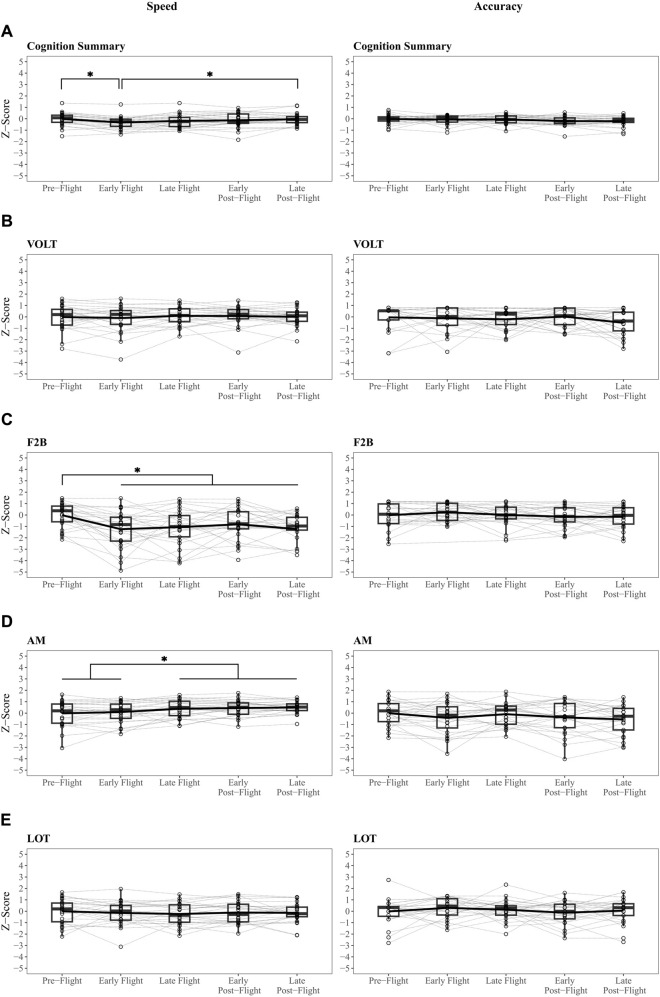
Results: Cognitive performance was generally stable over time with some differences observed across mission phases for specific subtests. There was slowed performance observed in early flight on tasks of processing speed, visual working memory, and sustained attention. We observed a decrease in risk-taking propensity during late flight and post-flight mission phases. Beyond examining group differences, we inspected scores that represented a significant shift from the sample's mean baseline score, revealing that 11.8% of all flight and post-flight scores were at or below 1.5 standard deviations below the sample's baseline mean. Finally, exploratory analyses yielded no clear pattern of associations between cognitive performance and either sleep or ratings of alertness.
Conclusion: There was no evidence for a systematic decline in cognitive performance for astronauts on a 6-month missions to the ISS. Some differences were observed for specific subtests at specific mission phases, suggesting that processing speed, visual working memory, sustained attention, and risk-taking propensity may be the cognitive domains most susceptible to change in Low Earth Orbit for high performing, professional astronauts. We provide descriptive statistics of pre-flight cognitive performance from 25 astronauts, the largest published preliminary normative database of its kind to date, to help identify significant performance decrements in future samples.
期刊介绍:
Frontiers in Physiology is a leading journal in its field, publishing rigorously peer-reviewed research on the physiology of living systems, from the subcellular and molecular domains to the intact organism, and its interaction with the environment. Field Chief Editor George E. Billman at the Ohio State University Columbus is supported by an outstanding Editorial Board of international researchers. This multidisciplinary open-access journal is at the forefront of disseminating and communicating scientific knowledge and impactful discoveries to researchers, academics, clinicians and the public worldwide.







 京公网安备 11010802042870号
京ICP备2023020795号-1
京公网安备 11010802042870号
京ICP备2023020795号-1

 分享
分享
 求助内容:
求助内容: 应助结果提醒方式:
 扫码关注我们
