{"title":"胃肠道:肝动脉瘤引起的胆道阻塞:治疗选择的意义。","authors":"Derek Ngan-Wa Wong, Rex Wan-Hin Hui, Lung-Yi Mak, Wai-Kay Seto, Man-Fung Yuen","doi":"10.1111/jgh.16841","DOIUrl":null,"url":null,"abstract":"<p>A 58-year-old man presented in March 2021 with obstructive jaundice (bilirubin 65 μmol/L, ALP 578 U/L, ALT 529 U/L, AST 263 U/L, GGT 1283 U/L). Contrast CT revealed common and bilateral hepatic artery aneurysms with mass effect on the distal common bile duct (CBD). Endoscopic retrograde cholangiopancreatography (ERCP) identified a CBD stricture from extrinsic compression, and a 7 Fr–7 cm CBD stent was inserted.</p><p>Vascular reconstruction was planned, and ERCP was repeated in May 2021 for stent exchange while pending surgery. The patient developed hemobilia after ERCP, and CT noted active contrast extravasation into the duodenum (Figure 1), suggesting vascular injury with aneurysmal bleeding. Urgent coiling of the common hepatic artery aneurysm was performed with satisfactory hemostasis achieved. The patient had no further bleeding or biliary obstruction after vascular coiling and was managed as an outpatient up till April 2024.</p><p>The patient was admitted again in April 2024 with cholangitis, and CT showed hepatic artery coils adjacent to a dilated CBD. Due to history of vascular injury from ERCP, external–internal percutaneous transhepatic biliary-drainage (PTBD) was first performed, which was successful with no post-procedural bleeding (Figure 2). ERCP was performed 3 weeks later with an 11.5 Fr–7 cm straight-stent inserted, enabling subsequent removal of the PTBD catheter. The patient has since remained asymptomatic with normalized liver enzymes.</p><p>Hepatic artery aneurysms account for 20% of visceral artery aneurysms. Most patients either present with incidental finding of aneurysms on imaging or with ruptured aneurysms [<span>1</span>]. While uncommon, hepatic artery aneurysms can cause biliary obstruction. Multiple treatment approaches including endovascular, endoscopic, and open surgical techniques can be adopted [<span>2</span>]; hence, multidisciplinary care and careful treatment selection is essential to achieve biliary drainage while avoiding iatrogenic vascular injury.</p>","PeriodicalId":15877,"journal":{"name":"Journal of Gastroenterology and Hepatology","volume":"40 3","pages":"557-558"},"PeriodicalIF":3.4000,"publicationDate":"2024-12-04","publicationTypes":"Journal Article","fieldsOfStudy":null,"isOpenAccess":false,"openAccessPdf":"https://onlinelibrary.wiley.com/doi/epdf/10.1111/jgh.16841","citationCount":"0","resultStr":"{\"title\":\"Gastrointestinal: Biliary Obstruction From Hepatic Artery Aneurysms: Implications for Treatment Selection\",\"authors\":\"Derek Ngan-Wa Wong, Rex Wan-Hin Hui, Lung-Yi Mak, Wai-Kay Seto, Man-Fung Yuen\",\"doi\":\"10.1111/jgh.16841\",\"DOIUrl\":null,\"url\":null,\"abstract\":\"<p>A 58-year-old man presented in March 2021 with obstructive jaundice (bilirubin 65 μmol/L, ALP 578 U/L, ALT 529 U/L, AST 263 U/L, GGT 1283 U/L). Contrast CT revealed common and bilateral hepatic artery aneurysms with mass effect on the distal common bile duct (CBD). Endoscopic retrograde cholangiopancreatography (ERCP) identified a CBD stricture from extrinsic compression, and a 7 Fr–7 cm CBD stent was inserted.</p><p>Vascular reconstruction was planned, and ERCP was repeated in May 2021 for stent exchange while pending surgery. The patient developed hemobilia after ERCP, and CT noted active contrast extravasation into the duodenum (Figure 1), suggesting vascular injury with aneurysmal bleeding. Urgent coiling of the common hepatic artery aneurysm was performed with satisfactory hemostasis achieved. The patient had no further bleeding or biliary obstruction after vascular coiling and was managed as an outpatient up till April 2024.</p><p>The patient was admitted again in April 2024 with cholangitis, and CT showed hepatic artery coils adjacent to a dilated CBD. Due to history of vascular injury from ERCP, external–internal percutaneous transhepatic biliary-drainage (PTBD) was first performed, which was successful with no post-procedural bleeding (Figure 2). ERCP was performed 3 weeks later with an 11.5 Fr–7 cm straight-stent inserted, enabling subsequent removal of the PTBD catheter. The patient has since remained asymptomatic with normalized liver enzymes.</p><p>Hepatic artery aneurysms account for 20% of visceral artery aneurysms. Most patients either present with incidental finding of aneurysms on imaging or with ruptured aneurysms [<span>1</span>]. While uncommon, hepatic artery aneurysms can cause biliary obstruction. Multiple treatment approaches including endovascular, endoscopic, and open surgical techniques can be adopted [<span>2</span>]; hence, multidisciplinary care and careful treatment selection is essential to achieve biliary drainage while avoiding iatrogenic vascular injury.</p>\",\"PeriodicalId\":15877,\"journal\":{\"name\":\"Journal of Gastroenterology and Hepatology\",\"volume\":\"40 3\",\"pages\":\"557-558\"},\"PeriodicalIF\":3.4000,\"publicationDate\":\"2024-12-04\",\"publicationTypes\":\"Journal Article\",\"fieldsOfStudy\":null,\"isOpenAccess\":false,\"openAccessPdf\":\"https://onlinelibrary.wiley.com/doi/epdf/10.1111/jgh.16841\",\"citationCount\":\"0\",\"resultStr\":null,\"platform\":\"Semanticscholar\",\"paperid\":null,\"PeriodicalName\":\"Journal of Gastroenterology and Hepatology\",\"FirstCategoryId\":\"3\",\"ListUrlMain\":\"https://onlinelibrary.wiley.com/doi/10.1111/jgh.16841\",\"RegionNum\":3,\"RegionCategory\":\"医学\",\"ArticlePicture\":[],\"TitleCN\":null,\"AbstractTextCN\":null,\"PMCID\":null,\"EPubDate\":\"\",\"PubModel\":\"\",\"JCR\":\"Q2\",\"JCRName\":\"GASTROENTEROLOGY & HEPATOLOGY\",\"Score\":null,\"Total\":0}","platform":"Semanticscholar","paperid":null,"PeriodicalName":"Journal of Gastroenterology and Hepatology","FirstCategoryId":"3","ListUrlMain":"https://onlinelibrary.wiley.com/doi/10.1111/jgh.16841","RegionNum":3,"RegionCategory":"医学","ArticlePicture":[],"TitleCN":null,"AbstractTextCN":null,"PMCID":null,"EPubDate":"","PubModel":"","JCR":"Q2","JCRName":"GASTROENTEROLOGY & HEPATOLOGY","Score":null,"Total":0}
引用次数: 0
摘要
1例58岁男性,于2021年3月出现梗阻性黄疸(胆红素65 μmol/L, ALP 578 U/L, ALT 529 U/L, AST 263 U/L, GGT 1283 U/L)。对比CT显示肝总动脉和双侧肝动脉瘤,在胆总管远端有肿块效应。内窥镜逆行胆管造影(ERCP)发现外源性压迫导致CBD狭窄,并植入7fr - 7cm CBD支架。计划进行血管重建,并于2021年5月在等待手术期间重复ERCP进行支架更换。ERCP后患者出现胆血,CT显示造影剂积极外渗至十二指肠(图1),提示血管损伤伴动脉瘤性出血。紧急盘绕肝总动脉瘤,取得满意的止血效果。该患者在血管盘绕后无进一步出血或胆道梗阻,一直到2024年4月作为门诊治疗。患者于2024年4月因胆管炎再次入院,CT显示肝动脉线圈邻近扩张的CBD。由于ERCP的血管损伤史,首先进行了外-内经皮经肝胆道引流术(PTBD),手术成功,无术后出血(图2)。3周后进行ERCP,置入11.5 Fr-7 cm直支架,随后取出PTBD导管。此后患者无症状,肝酶恢复正常。肝动脉瘤占内脏动脉瘤的20%。大多数患者要么是在影像学上偶然发现动脉瘤,要么是动脉瘤破裂。虽然不常见,但肝动脉动脉瘤可引起胆道阻塞。可采用多种治疗方法,包括血管内、内镜下和开放手术技术;因此,多学科的护理和谨慎的治疗选择是必要的,以实现胆道引流,同时避免医源性血管损伤。
Gastrointestinal: Biliary Obstruction From Hepatic Artery Aneurysms: Implications for Treatment Selection
A 58-year-old man presented in March 2021 with obstructive jaundice (bilirubin 65 μmol/L, ALP 578 U/L, ALT 529 U/L, AST 263 U/L, GGT 1283 U/L). Contrast CT revealed common and bilateral hepatic artery aneurysms with mass effect on the distal common bile duct (CBD). Endoscopic retrograde cholangiopancreatography (ERCP) identified a CBD stricture from extrinsic compression, and a 7 Fr–7 cm CBD stent was inserted.
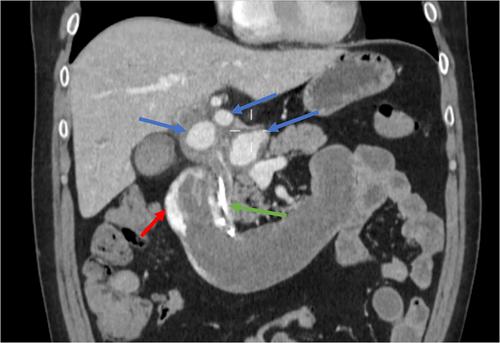
Vascular reconstruction was planned, and ERCP was repeated in May 2021 for stent exchange while pending surgery. The patient developed hemobilia after ERCP, and CT noted active contrast extravasation into the duodenum (Figure 1), suggesting vascular injury with aneurysmal bleeding. Urgent coiling of the common hepatic artery aneurysm was performed with satisfactory hemostasis achieved. The patient had no further bleeding or biliary obstruction after vascular coiling and was managed as an outpatient up till April 2024.
The patient was admitted again in April 2024 with cholangitis, and CT showed hepatic artery coils adjacent to a dilated CBD. Due to history of vascular injury from ERCP, external–internal percutaneous transhepatic biliary-drainage (PTBD) was first performed, which was successful with no post-procedural bleeding (Figure 2). ERCP was performed 3 weeks later with an 11.5 Fr–7 cm straight-stent inserted, enabling subsequent removal of the PTBD catheter. The patient has since remained asymptomatic with normalized liver enzymes.
Hepatic artery aneurysms account for 20% of visceral artery aneurysms. Most patients either present with incidental finding of aneurysms on imaging or with ruptured aneurysms [1]. While uncommon, hepatic artery aneurysms can cause biliary obstruction. Multiple treatment approaches including endovascular, endoscopic, and open surgical techniques can be adopted [2]; hence, multidisciplinary care and careful treatment selection is essential to achieve biliary drainage while avoiding iatrogenic vascular injury.
期刊介绍:
Journal of Gastroenterology and Hepatology is produced 12 times per year and publishes peer-reviewed original papers, reviews and editorials concerned with clinical practice and research in the fields of hepatology, gastroenterology and endoscopy. Papers cover the medical, radiological, pathological, biochemical, physiological and historical aspects of the subject areas. All submitted papers are reviewed by at least two referees expert in the field of the submitted paper.




 京公网安备 11010802042870号
京ICP备2023020795号-1
京公网安备 11010802042870号
京ICP备2023020795号-1

 分享
分享
 求助内容:
求助内容: 应助结果提醒方式:
 扫码关注我们
