{"title":"在穿透性腹部血管损伤中,复苏性血管内球囊阻断主动脉(REBOA)与较差的预后相关。","authors":"Negar Nekooei , Wei Huang , Delbrynth Mitchao , Subarna Biswas , Anaar Siletz , Demetrios Demetriades","doi":"10.1016/j.amjsurg.2024.116122","DOIUrl":null,"url":null,"abstract":"<div><h3>Background</h3><div>Resuscitative endovascular balloon occlusion of the aorta (REBOA) may benefit patients with severe subdiaphragmatic traumatic hemorrhage. This study compares outcomes in patients with penetrating abdominal vascular injury treated with REBOA versus those managed without REBOA.</div></div><div><h3>Methods</h3><div>Using the Trauma Quality Improvement Program (TQIP) database, we identified adult patients with penetrating abdominal vascular injury from 2017 to 2022. Propensity scores matched REBOA patients 1:3 with non-REBOA patients. The primary outcome was in-hospital mortality, with secondary outcomes including 24-h mortality, transfusion needs, and complications such as acute kidney injury (AKI), deep vein thrombosis (DVT), pulmonary embolism (PE), lower extremity compartment syndrome, fasciotomy, amputation, and femoral artery repair.</div></div><div><h3>Results</h3><div>Two hundred ninety-three REBOA patients were matched with 879 non-REBOA patients. REBOA patients had higher in-hospital mortality (46.8 % vs 36.3 %, p = 0.002), packed-red blood cell (PRBC) transfusion requirements within 4 h (median 15.3 vs 8.2, p < 0.001), AKI (8.5 % vs 4.7 %, p = 0.013), fasciotomy (6.5 % vs 3.6 %, p = 0.039), amputation (3.4 % vs 1.4 %, p = 0.025), and femoral artery repair (3.4 % vs 0.6 %, p < 0.001). In a subgroup analysis of patients without severe extra-abdominal injuries, REBOA was associated with higher in-hospital mortality (49.7 % vs. 38.2 %, p = 0.013) and increased packed red blood cell (PRBC) transfusion requirements (median 14.1 vs. 8.3 units, p < 0.001).</div></div><div><h3>Conclusions</h3><div>In penetrating abdominal vascular injuries, REBOA was associated with worse outcomes.</div></div>","PeriodicalId":7771,"journal":{"name":"American journal of surgery","volume":"240 ","pages":"Article 116122"},"PeriodicalIF":2.7000,"publicationDate":"2025-02-01","publicationTypes":"Journal Article","fieldsOfStudy":null,"isOpenAccess":false,"openAccessPdf":"","citationCount":"0","resultStr":"{\"title\":\"Resuscitative endovascular balloon occlusion of the aorta (REBOA) in penetrating abdominal vascular injuries is associated with worse outcomes\",\"authors\":\"Negar Nekooei , Wei Huang , Delbrynth Mitchao , Subarna Biswas , Anaar Siletz , Demetrios Demetriades\",\"doi\":\"10.1016/j.amjsurg.2024.116122\",\"DOIUrl\":null,\"url\":null,\"abstract\":\"<div><h3>Background</h3><div>Resuscitative endovascular balloon occlusion of the aorta (REBOA) may benefit patients with severe subdiaphragmatic traumatic hemorrhage. This study compares outcomes in patients with penetrating abdominal vascular injury treated with REBOA versus those managed without REBOA.</div></div><div><h3>Methods</h3><div>Using the Trauma Quality Improvement Program (TQIP) database, we identified adult patients with penetrating abdominal vascular injury from 2017 to 2022. Propensity scores matched REBOA patients 1:3 with non-REBOA patients. The primary outcome was in-hospital mortality, with secondary outcomes including 24-h mortality, transfusion needs, and complications such as acute kidney injury (AKI), deep vein thrombosis (DVT), pulmonary embolism (PE), lower extremity compartment syndrome, fasciotomy, amputation, and femoral artery repair.</div></div><div><h3>Results</h3><div>Two hundred ninety-three REBOA patients were matched with 879 non-REBOA patients. REBOA patients had higher in-hospital mortality (46.8 % vs 36.3 %, p = 0.002), packed-red blood cell (PRBC) transfusion requirements within 4 h (median 15.3 vs 8.2, p < 0.001), AKI (8.5 % vs 4.7 %, p = 0.013), fasciotomy (6.5 % vs 3.6 %, p = 0.039), amputation (3.4 % vs 1.4 %, p = 0.025), and femoral artery repair (3.4 % vs 0.6 %, p < 0.001). In a subgroup analysis of patients without severe extra-abdominal injuries, REBOA was associated with higher in-hospital mortality (49.7 % vs. 38.2 %, p = 0.013) and increased packed red blood cell (PRBC) transfusion requirements (median 14.1 vs. 8.3 units, p < 0.001).</div></div><div><h3>Conclusions</h3><div>In penetrating abdominal vascular injuries, REBOA was associated with worse outcomes.</div></div>\",\"PeriodicalId\":7771,\"journal\":{\"name\":\"American journal of surgery\",\"volume\":\"240 \",\"pages\":\"Article 116122\"},\"PeriodicalIF\":2.7000,\"publicationDate\":\"2025-02-01\",\"publicationTypes\":\"Journal Article\",\"fieldsOfStudy\":null,\"isOpenAccess\":false,\"openAccessPdf\":\"\",\"citationCount\":\"0\",\"resultStr\":null,\"platform\":\"Semanticscholar\",\"paperid\":null,\"PeriodicalName\":\"American journal of surgery\",\"FirstCategoryId\":\"3\",\"ListUrlMain\":\"https://www.sciencedirect.com/science/article/pii/S0002961024006743\",\"RegionNum\":3,\"RegionCategory\":\"医学\",\"ArticlePicture\":[],\"TitleCN\":null,\"AbstractTextCN\":null,\"PMCID\":null,\"EPubDate\":\"2024/11/28 0:00:00\",\"PubModel\":\"Epub\",\"JCR\":\"Q1\",\"JCRName\":\"SURGERY\",\"Score\":null,\"Total\":0}","platform":"Semanticscholar","paperid":null,"PeriodicalName":"American journal of surgery","FirstCategoryId":"3","ListUrlMain":"https://www.sciencedirect.com/science/article/pii/S0002961024006743","RegionNum":3,"RegionCategory":"医学","ArticlePicture":[],"TitleCN":null,"AbstractTextCN":null,"PMCID":null,"EPubDate":"2024/11/28 0:00:00","PubModel":"Epub","JCR":"Q1","JCRName":"SURGERY","Score":null,"Total":0}
引用次数: 0
摘要
背景:复苏血管内球囊阻塞主动脉(REBOA)可能有利于严重膈下创伤性出血患者。本研究比较了经REBOA治疗的穿透性腹腔血管损伤患者与未经REBOA治疗的患者的预后。方法:使用创伤质量改进计划(TQIP)数据库,对2017年至2022年发生穿透性腹部血管损伤的成年患者进行分析。REBOA患者与非REBOA患者的倾向评分为1:3。主要结局是住院死亡率,次要结局包括24小时死亡率、输血需求和并发症,如急性肾损伤(AKI)、深静脉血栓形成(DVT)、肺栓塞(PE)、下肢筋膜室综合征、筋膜切开术、截肢和股动脉修复。结果:293例REBOA患者与879例非REBOA患者配对。REBOA患者有更高的住院死亡率(46.8% vs 36.3%, p = 0.002), 4小时内填充红细胞(PRBC)输血需求(中位数15.3 vs 8.2, p)。结论:在穿透性腹部血管损伤中,REBOA与较差的预后相关。
Resuscitative endovascular balloon occlusion of the aorta (REBOA) in penetrating abdominal vascular injuries is associated with worse outcomes
Background
Resuscitative endovascular balloon occlusion of the aorta (REBOA) may benefit patients with severe subdiaphragmatic traumatic hemorrhage. This study compares outcomes in patients with penetrating abdominal vascular injury treated with REBOA versus those managed without REBOA.
Methods
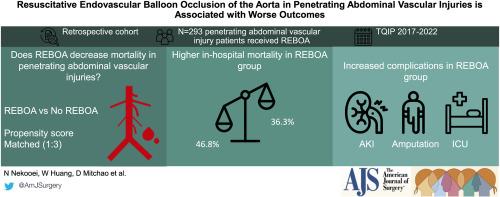
Using the Trauma Quality Improvement Program (TQIP) database, we identified adult patients with penetrating abdominal vascular injury from 2017 to 2022. Propensity scores matched REBOA patients 1:3 with non-REBOA patients. The primary outcome was in-hospital mortality, with secondary outcomes including 24-h mortality, transfusion needs, and complications such as acute kidney injury (AKI), deep vein thrombosis (DVT), pulmonary embolism (PE), lower extremity compartment syndrome, fasciotomy, amputation, and femoral artery repair.
Results
Two hundred ninety-three REBOA patients were matched with 879 non-REBOA patients. REBOA patients had higher in-hospital mortality (46.8 % vs 36.3 %, p = 0.002), packed-red blood cell (PRBC) transfusion requirements within 4 h (median 15.3 vs 8.2, p < 0.001), AKI (8.5 % vs 4.7 %, p = 0.013), fasciotomy (6.5 % vs 3.6 %, p = 0.039), amputation (3.4 % vs 1.4 %, p = 0.025), and femoral artery repair (3.4 % vs 0.6 %, p < 0.001). In a subgroup analysis of patients without severe extra-abdominal injuries, REBOA was associated with higher in-hospital mortality (49.7 % vs. 38.2 %, p = 0.013) and increased packed red blood cell (PRBC) transfusion requirements (median 14.1 vs. 8.3 units, p < 0.001).
Conclusions
In penetrating abdominal vascular injuries, REBOA was associated with worse outcomes.
期刊介绍:
The American Journal of Surgery® is a peer-reviewed journal designed for the general surgeon who performs abdominal, cancer, vascular, head and neck, breast, colorectal, and other forms of surgery. AJS is the official journal of 7 major surgical societies* and publishes their official papers as well as independently submitted clinical studies, editorials, reviews, brief reports, correspondence and book reviews.




 京公网安备 11010802042870号
京ICP备2023020795号-1
京公网安备 11010802042870号
京ICP备2023020795号-1

 分享
分享
 求助内容:
求助内容: 应助结果提醒方式:
 扫码关注我们
