Mohammed Monsoor Shaik, Samuel Pasco, Alessio Romerio, Carlo Pifferi, Silvia Sesana, Francesca Re, Charl Xavier Bezuidenhout, Silvia Bracco, Alberto Fernandez-Tejada, Juan Anguita, Francesco Peri
{"title":"基于合成TLR4激动剂FP20和合成QS-21变体的新型疫苗佐剂体系的研制","authors":"Mohammed Monsoor Shaik, Samuel Pasco, Alessio Romerio, Carlo Pifferi, Silvia Sesana, Francesca Re, Charl Xavier Bezuidenhout, Silvia Bracco, Alberto Fernandez-Tejada, Juan Anguita, Francesco Peri","doi":"10.1021/acs.jmedchem.4c02392","DOIUrl":null,"url":null,"abstract":"In this study, we formulated an alternative to AS01b by combining FP20, a synthetic TLR4 agonist, and QS21v, a minimal saponin adjuvant, aiming to improve the vaccine efficacy and stability. The phase transition temperature of FP20 was determined by using differential scanning calorimetry to be 43.9 °C, providing a foundation for the formulation process. The coformulation was prepared using a dry film method for even adjuvant distribution. Characterization by dynamic light scattering and nanoparticle tracking analysis revealed a uniform particle size distribution of ∼120 nm. Cryogenic electron microscopy (CryoEM) revealed nanosized interactions between FP20 and QS21v, forming stable structures that likely enhanced the antigen presentation and immune activation. These physicochemical properties contributed to a robust <i>in vivo</i> synergy, where the coformulation elicited significantly higher antigen-specific antibody titers compared to individual adjuvants. These findings suggest that the FP20+QS21v coformulation provides a potent, stable, and safer alternative to traditional adjuvants, enhancing both vaccine efficacy and immunogenicity.","PeriodicalId":46,"journal":{"name":"Journal of Medicinal Chemistry","volume":"9 1","pages":""},"PeriodicalIF":7.3000,"publicationDate":"2024-12-08","publicationTypes":"Journal Article","fieldsOfStudy":null,"isOpenAccess":false,"openAccessPdf":"","citationCount":"0","resultStr":"{\"title\":\"Development of a New Vaccine Adjuvant System Based on the Combination of the Synthetic TLR4 Agonist FP20 and a Synthetic QS-21 Variant\",\"authors\":\"Mohammed Monsoor Shaik, Samuel Pasco, Alessio Romerio, Carlo Pifferi, Silvia Sesana, Francesca Re, Charl Xavier Bezuidenhout, Silvia Bracco, Alberto Fernandez-Tejada, Juan Anguita, Francesco Peri\",\"doi\":\"10.1021/acs.jmedchem.4c02392\",\"DOIUrl\":null,\"url\":null,\"abstract\":\"In this study, we formulated an alternative to AS01b by combining FP20, a synthetic TLR4 agonist, and QS21v, a minimal saponin adjuvant, aiming to improve the vaccine efficacy and stability. The phase transition temperature of FP20 was determined by using differential scanning calorimetry to be 43.9 °C, providing a foundation for the formulation process. The coformulation was prepared using a dry film method for even adjuvant distribution. Characterization by dynamic light scattering and nanoparticle tracking analysis revealed a uniform particle size distribution of ∼120 nm. Cryogenic electron microscopy (CryoEM) revealed nanosized interactions between FP20 and QS21v, forming stable structures that likely enhanced the antigen presentation and immune activation. These physicochemical properties contributed to a robust <i>in vivo</i> synergy, where the coformulation elicited significantly higher antigen-specific antibody titers compared to individual adjuvants. These findings suggest that the FP20+QS21v coformulation provides a potent, stable, and safer alternative to traditional adjuvants, enhancing both vaccine efficacy and immunogenicity.\",\"PeriodicalId\":46,\"journal\":{\"name\":\"Journal of Medicinal Chemistry\",\"volume\":\"9 1\",\"pages\":\"\"},\"PeriodicalIF\":7.3000,\"publicationDate\":\"2024-12-08\",\"publicationTypes\":\"Journal Article\",\"fieldsOfStudy\":null,\"isOpenAccess\":false,\"openAccessPdf\":\"\",\"citationCount\":\"0\",\"resultStr\":null,\"platform\":\"Semanticscholar\",\"paperid\":null,\"PeriodicalName\":\"Journal of Medicinal Chemistry\",\"FirstCategoryId\":\"3\",\"ListUrlMain\":\"https://doi.org/10.1021/acs.jmedchem.4c02392\",\"RegionNum\":1,\"RegionCategory\":\"医学\",\"ArticlePicture\":[],\"TitleCN\":null,\"AbstractTextCN\":null,\"PMCID\":null,\"EPubDate\":\"\",\"PubModel\":\"\",\"JCR\":\"Q1\",\"JCRName\":\"CHEMISTRY, MEDICINAL\",\"Score\":null,\"Total\":0}","platform":"Semanticscholar","paperid":null,"PeriodicalName":"Journal of Medicinal Chemistry","FirstCategoryId":"3","ListUrlMain":"https://doi.org/10.1021/acs.jmedchem.4c02392","RegionNum":1,"RegionCategory":"医学","ArticlePicture":[],"TitleCN":null,"AbstractTextCN":null,"PMCID":null,"EPubDate":"","PubModel":"","JCR":"Q1","JCRName":"CHEMISTRY, MEDICINAL","Score":null,"Total":0}
Development of a New Vaccine Adjuvant System Based on the Combination of the Synthetic TLR4 Agonist FP20 and a Synthetic QS-21 Variant
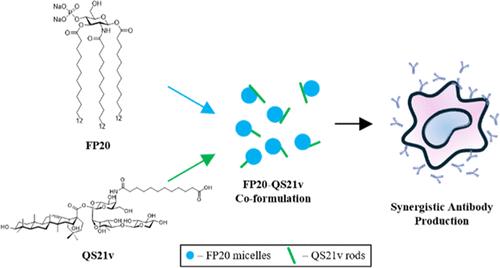
In this study, we formulated an alternative to AS01b by combining FP20, a synthetic TLR4 agonist, and QS21v, a minimal saponin adjuvant, aiming to improve the vaccine efficacy and stability. The phase transition temperature of FP20 was determined by using differential scanning calorimetry to be 43.9 °C, providing a foundation for the formulation process. The coformulation was prepared using a dry film method for even adjuvant distribution. Characterization by dynamic light scattering and nanoparticle tracking analysis revealed a uniform particle size distribution of ∼120 nm. Cryogenic electron microscopy (CryoEM) revealed nanosized interactions between FP20 and QS21v, forming stable structures that likely enhanced the antigen presentation and immune activation. These physicochemical properties contributed to a robust in vivo synergy, where the coformulation elicited significantly higher antigen-specific antibody titers compared to individual adjuvants. These findings suggest that the FP20+QS21v coformulation provides a potent, stable, and safer alternative to traditional adjuvants, enhancing both vaccine efficacy and immunogenicity.
期刊介绍:
The Journal of Medicinal Chemistry is a prestigious biweekly peer-reviewed publication that focuses on the multifaceted field of medicinal chemistry. Since its inception in 1959 as the Journal of Medicinal and Pharmaceutical Chemistry, it has evolved to become a cornerstone in the dissemination of research findings related to the design, synthesis, and development of therapeutic agents.
The Journal of Medicinal Chemistry is recognized for its significant impact in the scientific community, as evidenced by its 2022 impact factor of 7.3. This metric reflects the journal's influence and the importance of its content in shaping the future of drug discovery and development. The journal serves as a vital resource for chemists, pharmacologists, and other researchers interested in the molecular mechanisms of drug action and the optimization of therapeutic compounds.




 京公网安备 11010802042870号
京ICP备2023020795号-1
京公网安备 11010802042870号
京ICP备2023020795号-1

 分享
分享
 求助内容:
求助内容: 应助结果提醒方式:
 扫码关注我们
