Ke Li, Xing Hu, Xin-Yi Tu, Mao-Ying Xian, Lei-Lei Huang, Ting Huang, Rui Luo, Hui Jin, Zheng Liu
{"title":"增强COVID-19疫苗效力:TLR7/8激动剂和糖脂的双重佐剂策略","authors":"Ke Li, Xing Hu, Xin-Yi Tu, Mao-Ying Xian, Lei-Lei Huang, Ting Huang, Rui Luo, Hui Jin, Zheng Liu","doi":"10.1021/acs.jmedchem.4c01801","DOIUrl":null,"url":null,"abstract":"The controlled release of immunostimulatory agents represents a promising strategy to enhance vaccine efficacy while minimizing side effects. This study aimed to improve the efficacy of the RBD-Fc-based COVID-19 vaccine through combining of an iNKT cell agonist and a TLR7/8 agonist using covalent conjugation and temporal delivery. We hypothesized that these combinations would yield a more balanced Th1/Th2 immune response. For covalent conjugation, we employed an uncleavable linker and a self-immolative disulfide linker to conjugate α-galactosylceramide (αGC) to imidazoquinoline (IMDQ). The αGC-SS-IMDQ-Ac conjugate, designed with a prodrug strategy for controlled TLR7/8 agonist release, elicited a higher IFN-γ/IL-4 T cell response ratio than individual adjuvants or their admixture. In the temporal delivery approach, administering IMDQ followed by αGC after 2 h resulted in the highest IgG2a/IgG1 ratio, significantly surpassing other groups. A 6 h delay between glycolipid and IMDQ injections yielded balanced IgG responses, enhancing IgG, IgG1, and IgG2a levels synergistically.","PeriodicalId":46,"journal":{"name":"Journal of Medicinal Chemistry","volume":"200 1","pages":""},"PeriodicalIF":6.8000,"publicationDate":"2024-12-09","publicationTypes":"Journal Article","fieldsOfStudy":null,"isOpenAccess":false,"openAccessPdf":"","citationCount":"0","resultStr":"{\"title\":\"Enhancing COVID-19 Vaccine Efficacy: Dual Adjuvant Strategies with TLR7/8 Agonists and Glycolipids\",\"authors\":\"Ke Li, Xing Hu, Xin-Yi Tu, Mao-Ying Xian, Lei-Lei Huang, Ting Huang, Rui Luo, Hui Jin, Zheng Liu\",\"doi\":\"10.1021/acs.jmedchem.4c01801\",\"DOIUrl\":null,\"url\":null,\"abstract\":\"The controlled release of immunostimulatory agents represents a promising strategy to enhance vaccine efficacy while minimizing side effects. This study aimed to improve the efficacy of the RBD-Fc-based COVID-19 vaccine through combining of an iNKT cell agonist and a TLR7/8 agonist using covalent conjugation and temporal delivery. We hypothesized that these combinations would yield a more balanced Th1/Th2 immune response. For covalent conjugation, we employed an uncleavable linker and a self-immolative disulfide linker to conjugate α-galactosylceramide (αGC) to imidazoquinoline (IMDQ). The αGC-SS-IMDQ-Ac conjugate, designed with a prodrug strategy for controlled TLR7/8 agonist release, elicited a higher IFN-γ/IL-4 T cell response ratio than individual adjuvants or their admixture. In the temporal delivery approach, administering IMDQ followed by αGC after 2 h resulted in the highest IgG2a/IgG1 ratio, significantly surpassing other groups. A 6 h delay between glycolipid and IMDQ injections yielded balanced IgG responses, enhancing IgG, IgG1, and IgG2a levels synergistically.\",\"PeriodicalId\":46,\"journal\":{\"name\":\"Journal of Medicinal Chemistry\",\"volume\":\"200 1\",\"pages\":\"\"},\"PeriodicalIF\":6.8000,\"publicationDate\":\"2024-12-09\",\"publicationTypes\":\"Journal Article\",\"fieldsOfStudy\":null,\"isOpenAccess\":false,\"openAccessPdf\":\"\",\"citationCount\":\"0\",\"resultStr\":null,\"platform\":\"Semanticscholar\",\"paperid\":null,\"PeriodicalName\":\"Journal of Medicinal Chemistry\",\"FirstCategoryId\":\"3\",\"ListUrlMain\":\"https://doi.org/10.1021/acs.jmedchem.4c01801\",\"RegionNum\":1,\"RegionCategory\":\"医学\",\"ArticlePicture\":[],\"TitleCN\":null,\"AbstractTextCN\":null,\"PMCID\":null,\"EPubDate\":\"\",\"PubModel\":\"\",\"JCR\":\"Q1\",\"JCRName\":\"CHEMISTRY, MEDICINAL\",\"Score\":null,\"Total\":0}","platform":"Semanticscholar","paperid":null,"PeriodicalName":"Journal of Medicinal Chemistry","FirstCategoryId":"3","ListUrlMain":"https://doi.org/10.1021/acs.jmedchem.4c01801","RegionNum":1,"RegionCategory":"医学","ArticlePicture":[],"TitleCN":null,"AbstractTextCN":null,"PMCID":null,"EPubDate":"","PubModel":"","JCR":"Q1","JCRName":"CHEMISTRY, MEDICINAL","Score":null,"Total":0}
引用次数: 0
摘要
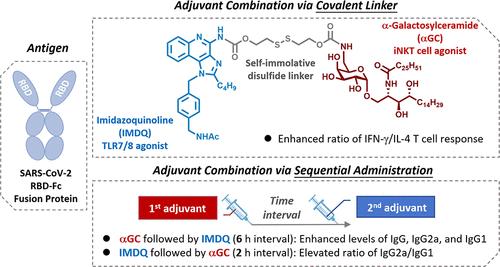
免疫刺激剂的控制释放是一种很有前途的策略,以提高疫苗效力,同时尽量减少副作用。本研究旨在通过共价偶联和时间递送,将一种iNKT细胞激动剂和一种TLR7/8激动剂联合使用,提高基于rbd - fc的COVID-19疫苗的疗效。我们假设这些组合将产生更平衡的Th1/Th2免疫反应。在共价偶联方面,我们采用一种不可切割的连接剂和一种自毁的二硫连接剂将α-半乳糖神经酰胺(αGC)与咪唑喹啉(IMDQ)偶联。αGC-SS-IMDQ-Ac缀合物采用药物前策略设计,可控制TLR7/8激动剂的释放,与单个佐剂或其混合物相比,可诱导更高的IFN-γ/IL-4 T细胞应答率。在时间给药方法中,IMDQ加αGC后2 h IgG2a/IgG1比值最高,显著高于其他各组。糖脂和IMDQ注射之间的6小时延迟产生了平衡的IgG反应,协同提高了IgG, IgG1和IgG2a水平。
Enhancing COVID-19 Vaccine Efficacy: Dual Adjuvant Strategies with TLR7/8 Agonists and Glycolipids
The controlled release of immunostimulatory agents represents a promising strategy to enhance vaccine efficacy while minimizing side effects. This study aimed to improve the efficacy of the RBD-Fc-based COVID-19 vaccine through combining of an iNKT cell agonist and a TLR7/8 agonist using covalent conjugation and temporal delivery. We hypothesized that these combinations would yield a more balanced Th1/Th2 immune response. For covalent conjugation, we employed an uncleavable linker and a self-immolative disulfide linker to conjugate α-galactosylceramide (αGC) to imidazoquinoline (IMDQ). The αGC-SS-IMDQ-Ac conjugate, designed with a prodrug strategy for controlled TLR7/8 agonist release, elicited a higher IFN-γ/IL-4 T cell response ratio than individual adjuvants or their admixture. In the temporal delivery approach, administering IMDQ followed by αGC after 2 h resulted in the highest IgG2a/IgG1 ratio, significantly surpassing other groups. A 6 h delay between glycolipid and IMDQ injections yielded balanced IgG responses, enhancing IgG, IgG1, and IgG2a levels synergistically.
期刊介绍:
The Journal of Medicinal Chemistry is a prestigious biweekly peer-reviewed publication that focuses on the multifaceted field of medicinal chemistry. Since its inception in 1959 as the Journal of Medicinal and Pharmaceutical Chemistry, it has evolved to become a cornerstone in the dissemination of research findings related to the design, synthesis, and development of therapeutic agents.
The Journal of Medicinal Chemistry is recognized for its significant impact in the scientific community, as evidenced by its 2022 impact factor of 7.3. This metric reflects the journal's influence and the importance of its content in shaping the future of drug discovery and development. The journal serves as a vital resource for chemists, pharmacologists, and other researchers interested in the molecular mechanisms of drug action and the optimization of therapeutic compounds.




 京公网安备 11010802042870号
京ICP备2023020795号-1
京公网安备 11010802042870号
京ICP备2023020795号-1

 分享
分享
 求助内容:
求助内容: 应助结果提醒方式:
 扫码关注我们
