Donald R. Inns, Megan Carr, Mounib Bahri, Ajay Tomer, Troy D. Manning, Nigel Browning, Simon A. Kondrat, John B. Claridge, Alexandros P. Katsoulidis and Matthew J. Rosseinsky
{"title":"阐明纳米立方载体形态对Ni/CeO2催化剂上聚丙烯氢解反应的影响","authors":"Donald R. Inns, Megan Carr, Mounib Bahri, Ajay Tomer, Troy D. Manning, Nigel Browning, Simon A. Kondrat, John B. Claridge, Alexandros P. Katsoulidis and Matthew J. Rosseinsky","doi":"10.1039/D4TA08111K","DOIUrl":null,"url":null,"abstract":"<p >The catalytic hydrogenolysis process offers the selective production of high-value liquid alkanes from waste polymers. Herein, through normalisation of Ni structure, Ni mass and density, and CeO<small><sub>2</sub></small> crystallite size, the importance of CeO<small><sub>2</sub></small> nanocube morphology in the hydrogenolysis of polypropylene (<em>M</em><small><sub>w</sub></small> = 12 000 g mol<small><sup>−1</sup></small>; <em>M</em><small><sub>n</sub></small> = 5000 g mol<small><sup>−1</sup></small>) over Ni/CeO<small><sub>2</sub></small> catalysts was determined. High liquid productivities (65.9–70.9 g<small><sub>liquid</sub></small> g<small><sub>Ni</sub></small><small><sup>−1</sup></small> h<small><sup>−1</sup></small>) and low methane yields (10%) were achieved over two different Ni/CeO<small><sub>2</sub></small> catalysts after 16 h reaction due to the high activity and internal scission selectivity of the supported ultrafine Ni particles (<1.3 nm). However, the Ni/CeO<small><sub>2</sub></small> nanocube catalyst exhibited higher C–C scission rates (838.1 mmol g<small><sub>Ni</sub></small><small><sup>−1</sup></small> h<small><sup>−1</sup></small>) than a standard benchmark mixed shape Ni/CeO<small><sub>2</sub></small> catalyst (480.3 mmol g<small><sub>Ni</sub></small><small><sup>−1</sup></small> h<small><sup>−1</sup></small>) and represents a 75% increase in depolymerisation activity. This led to shorter hydrocarbon chains achieved by the nanocube catalyst (<em>M</em><small><sub>w</sub></small> = 2786 g mol<small><sup>−1</sup></small>; <em>M</em><small><sub>n</sub></small> = 1442 g mol<small><sup>−1</sup></small>) when compared to the mixed shape catalyst (<em>M</em><small><sub>w</sub></small> = 4599 g mol<small><sup>−1</sup></small>; <em>M</em><small><sub>n</sub></small> = 2530 g mol<small><sup>−1</sup></small>). The enhanced C–C scission rate of the nanocube catalyst was determined to arise from a combination of improved H-storage and favourable basic properties, with higher weak basic site density key to facilitate a greater degree of hydrocarbon chain adsorption.</p>","PeriodicalId":82,"journal":{"name":"Journal of Materials Chemistry A","volume":" 3","pages":" 2032-2046"},"PeriodicalIF":9.2000,"publicationDate":"2024-12-10","publicationTypes":"Journal Article","fieldsOfStudy":null,"isOpenAccess":false,"openAccessPdf":"https://pubs.rsc.org/en/content/articlepdf/2025/ta/d4ta08111k?page=search","citationCount":"0","resultStr":"{\"title\":\"Elucidating the effect of nanocube support morphology on the hydrogenolysis of polypropylene over Ni/CeO2 catalysts†\",\"authors\":\"Donald R. Inns, Megan Carr, Mounib Bahri, Ajay Tomer, Troy D. Manning, Nigel Browning, Simon A. Kondrat, John B. Claridge, Alexandros P. Katsoulidis and Matthew J. Rosseinsky\",\"doi\":\"10.1039/D4TA08111K\",\"DOIUrl\":null,\"url\":null,\"abstract\":\"<p >The catalytic hydrogenolysis process offers the selective production of high-value liquid alkanes from waste polymers. Herein, through normalisation of Ni structure, Ni mass and density, and CeO<small><sub>2</sub></small> crystallite size, the importance of CeO<small><sub>2</sub></small> nanocube morphology in the hydrogenolysis of polypropylene (<em>M</em><small><sub>w</sub></small> = 12 000 g mol<small><sup>−1</sup></small>; <em>M</em><small><sub>n</sub></small> = 5000 g mol<small><sup>−1</sup></small>) over Ni/CeO<small><sub>2</sub></small> catalysts was determined. High liquid productivities (65.9–70.9 g<small><sub>liquid</sub></small> g<small><sub>Ni</sub></small><small><sup>−1</sup></small> h<small><sup>−1</sup></small>) and low methane yields (10%) were achieved over two different Ni/CeO<small><sub>2</sub></small> catalysts after 16 h reaction due to the high activity and internal scission selectivity of the supported ultrafine Ni particles (<1.3 nm). However, the Ni/CeO<small><sub>2</sub></small> nanocube catalyst exhibited higher C–C scission rates (838.1 mmol g<small><sub>Ni</sub></small><small><sup>−1</sup></small> h<small><sup>−1</sup></small>) than a standard benchmark mixed shape Ni/CeO<small><sub>2</sub></small> catalyst (480.3 mmol g<small><sub>Ni</sub></small><small><sup>−1</sup></small> h<small><sup>−1</sup></small>) and represents a 75% increase in depolymerisation activity. This led to shorter hydrocarbon chains achieved by the nanocube catalyst (<em>M</em><small><sub>w</sub></small> = 2786 g mol<small><sup>−1</sup></small>; <em>M</em><small><sub>n</sub></small> = 1442 g mol<small><sup>−1</sup></small>) when compared to the mixed shape catalyst (<em>M</em><small><sub>w</sub></small> = 4599 g mol<small><sup>−1</sup></small>; <em>M</em><small><sub>n</sub></small> = 2530 g mol<small><sup>−1</sup></small>). The enhanced C–C scission rate of the nanocube catalyst was determined to arise from a combination of improved H-storage and favourable basic properties, with higher weak basic site density key to facilitate a greater degree of hydrocarbon chain adsorption.</p>\",\"PeriodicalId\":82,\"journal\":{\"name\":\"Journal of Materials Chemistry A\",\"volume\":\" 3\",\"pages\":\" 2032-2046\"},\"PeriodicalIF\":9.2000,\"publicationDate\":\"2024-12-10\",\"publicationTypes\":\"Journal Article\",\"fieldsOfStudy\":null,\"isOpenAccess\":false,\"openAccessPdf\":\"https://pubs.rsc.org/en/content/articlepdf/2025/ta/d4ta08111k?page=search\",\"citationCount\":\"0\",\"resultStr\":null,\"platform\":\"Semanticscholar\",\"paperid\":null,\"PeriodicalName\":\"Journal of Materials Chemistry A\",\"FirstCategoryId\":\"88\",\"ListUrlMain\":\"https://pubs.rsc.org/en/content/articlelanding/2025/ta/d4ta08111k\",\"RegionNum\":2,\"RegionCategory\":\"材料科学\",\"ArticlePicture\":[],\"TitleCN\":null,\"AbstractTextCN\":null,\"PMCID\":null,\"EPubDate\":\"\",\"PubModel\":\"\",\"JCR\":\"Q1\",\"JCRName\":\"CHEMISTRY, PHYSICAL\",\"Score\":null,\"Total\":0}","platform":"Semanticscholar","paperid":null,"PeriodicalName":"Journal of Materials Chemistry A","FirstCategoryId":"88","ListUrlMain":"https://pubs.rsc.org/en/content/articlelanding/2025/ta/d4ta08111k","RegionNum":2,"RegionCategory":"材料科学","ArticlePicture":[],"TitleCN":null,"AbstractTextCN":null,"PMCID":null,"EPubDate":"","PubModel":"","JCR":"Q1","JCRName":"CHEMISTRY, PHYSICAL","Score":null,"Total":0}
引用次数: 0
摘要
催化氢解工艺提供了从废聚合物中选择性生产高价值液态烷烃的方法。本文通过对Ni结构、Ni质量和密度以及CeO2晶粒尺寸的正规化,揭示了CeO2纳米立方形貌在聚丙烯氢解过程中的重要性(Mw = 12 000 g mol−1;在Ni/CeO2催化剂上测定了Mn = 5000g mol−1。由于负载的超细Ni颗粒(<1.3 nm)具有较高的活性和内部裂解选择性,两种不同的Ni/CeO2催化剂在反应16 h后获得了较高的液相产率(65.9-70.9 gliquid gNi−1 h−1)和较低的甲烷产率(10%)。然而,Ni/CeO2纳米立方催化剂表现出更高的C-C裂解率(838.1 mmol gNi−1 h−1),比标准基准混合形状Ni/CeO2催化剂(480.3 mmol gNi−1 h−1)和75%的解聚合活性提高。这导致纳米立方催化剂得到的烃链较短(Mw = 2786 g mol−1;Mn = 1442 g mol−1),而混合形状催化剂(Mw = 4599 g mol−1;Mn = 2530g mol−1)。纳米立方催化剂的C-C裂解速率的提高是由于改善了h存储和良好的碱性特性的结合,较高的弱碱性位点密度有利于更大程度的烃链吸附。
Elucidating the effect of nanocube support morphology on the hydrogenolysis of polypropylene over Ni/CeO2 catalysts†
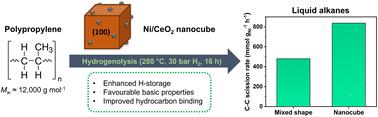
The catalytic hydrogenolysis process offers the selective production of high-value liquid alkanes from waste polymers. Herein, through normalisation of Ni structure, Ni mass and density, and CeO2 crystallite size, the importance of CeO2 nanocube morphology in the hydrogenolysis of polypropylene (Mw = 12 000 g mol−1; Mn = 5000 g mol−1) over Ni/CeO2 catalysts was determined. High liquid productivities (65.9–70.9 gliquid gNi−1 h−1) and low methane yields (10%) were achieved over two different Ni/CeO2 catalysts after 16 h reaction due to the high activity and internal scission selectivity of the supported ultrafine Ni particles (<1.3 nm). However, the Ni/CeO2 nanocube catalyst exhibited higher C–C scission rates (838.1 mmol gNi−1 h−1) than a standard benchmark mixed shape Ni/CeO2 catalyst (480.3 mmol gNi−1 h−1) and represents a 75% increase in depolymerisation activity. This led to shorter hydrocarbon chains achieved by the nanocube catalyst (Mw = 2786 g mol−1; Mn = 1442 g mol−1) when compared to the mixed shape catalyst (Mw = 4599 g mol−1; Mn = 2530 g mol−1). The enhanced C–C scission rate of the nanocube catalyst was determined to arise from a combination of improved H-storage and favourable basic properties, with higher weak basic site density key to facilitate a greater degree of hydrocarbon chain adsorption.
期刊介绍:
The Journal of Materials Chemistry A, B & C covers a wide range of high-quality studies in the field of materials chemistry, with each section focusing on specific applications of the materials studied. Journal of Materials Chemistry A emphasizes applications in energy and sustainability, including topics such as artificial photosynthesis, batteries, and fuel cells. Journal of Materials Chemistry B focuses on applications in biology and medicine, while Journal of Materials Chemistry C covers applications in optical, magnetic, and electronic devices. Example topic areas within the scope of Journal of Materials Chemistry A include catalysis, green/sustainable materials, sensors, and water treatment, among others.





 京公网安备 11010802042870号
京ICP备2023020795号-1
京公网安备 11010802042870号
京ICP备2023020795号-1

 分享
分享
 求助内容:
求助内容: 应助结果提醒方式:
 扫码关注我们
