Daria Budzikur-Maciąg, Vasyl Kinzhybalo and Katarzyna Ślepokura
{"title":"次二磷酸氨基吡啶的结构景观研究:4-氨基吡啶盐的脱水和多态性","authors":"Daria Budzikur-Maciąg, Vasyl Kinzhybalo and Katarzyna Ślepokura","doi":"10.1039/D4CE01048E","DOIUrl":null,"url":null,"abstract":"<p >A series of 4-aminopyridinium (4ap) hypodiphosphates has been synthesized and characterized by variable temperature (VT) optical microscopy, thermogravimetry (TGA-DSC) and X-ray diffraction techniques (SC-XRD, PXRD, VT μ-PXRD). Anhydrous salts (4apH)(H<small><sub>3</sub></small>P<small><sub>2</sub></small>O<small><sub>6</sub></small>) (<strong>2</strong>) and (4apH)<small><sub>2</sub></small>(H<small><sub>2</sub></small>P<small><sub>2</sub></small>O<small><sub>6</sub></small>) in monoclinic (<em>C</em>2/<em>c</em>) (<strong>4</strong>), orthorhombic (<em>P</em>2<small><sub>1</sub></small>2<small><sub>1</sub></small>2<small><sub>1</sub></small>) (<strong>5</strong>) and another monoclinic (<em>Cc</em>) (<strong>6</strong>) polymorphic modifications were obtained by single crystal-to-powder dehydrations of the hydrates: ionic co-crystal (4apH)<small><sub>2</sub></small>(H<small><sub>2</sub></small>P<small><sub>2</sub></small>O<small><sub>6</sub></small>)·H<small><sub>4</sub></small>P<small><sub>2</sub></small>O<small><sub>6</sub></small>·2H<small><sub>2</sub></small>O (<strong>1</strong>) and salt (4apH)<small><sub>2</sub></small>(H<small><sub>2</sub></small>P<small><sub>2</sub></small>O<small><sub>6</sub></small>)·2H<small><sub>2</sub></small>O (<strong>3</strong>), respectively. Compound (<strong>2</strong>) was the only anhydrous form which was also obtained by a typical solution-crystallization. Destructive dehydrations strongly affected hypodiphosphate substructures, generating new structural motifs (both in PP–PP and ap–PP interactions) and new crystal architectures, thus revealing the structural diversity in organic hypodiphosphates. Dehydration gave rise to new properties, as non-centrosymmetric and polar anhydrous structures, (<strong>5</strong>) and (<strong>6</strong>) respectively, were obtained from centrosymmetric hydrate (<strong>3</strong>).</p>","PeriodicalId":70,"journal":{"name":"CrystEngComm","volume":" 48","pages":" 6861-6872"},"PeriodicalIF":2.4000,"publicationDate":"2024-11-19","publicationTypes":"Journal Article","fieldsOfStudy":null,"isOpenAccess":false,"openAccessPdf":"","citationCount":"0","resultStr":"{\"title\":\"Structural landscape studies of aminopyridinium hypodiphosphates: dehydration and polymorphism in 4-aminopyridinium salts†\",\"authors\":\"Daria Budzikur-Maciąg, Vasyl Kinzhybalo and Katarzyna Ślepokura\",\"doi\":\"10.1039/D4CE01048E\",\"DOIUrl\":null,\"url\":null,\"abstract\":\"<p >A series of 4-aminopyridinium (4ap) hypodiphosphates has been synthesized and characterized by variable temperature (VT) optical microscopy, thermogravimetry (TGA-DSC) and X-ray diffraction techniques (SC-XRD, PXRD, VT μ-PXRD). Anhydrous salts (4apH)(H<small><sub>3</sub></small>P<small><sub>2</sub></small>O<small><sub>6</sub></small>) (<strong>2</strong>) and (4apH)<small><sub>2</sub></small>(H<small><sub>2</sub></small>P<small><sub>2</sub></small>O<small><sub>6</sub></small>) in monoclinic (<em>C</em>2/<em>c</em>) (<strong>4</strong>), orthorhombic (<em>P</em>2<small><sub>1</sub></small>2<small><sub>1</sub></small>2<small><sub>1</sub></small>) (<strong>5</strong>) and another monoclinic (<em>Cc</em>) (<strong>6</strong>) polymorphic modifications were obtained by single crystal-to-powder dehydrations of the hydrates: ionic co-crystal (4apH)<small><sub>2</sub></small>(H<small><sub>2</sub></small>P<small><sub>2</sub></small>O<small><sub>6</sub></small>)·H<small><sub>4</sub></small>P<small><sub>2</sub></small>O<small><sub>6</sub></small>·2H<small><sub>2</sub></small>O (<strong>1</strong>) and salt (4apH)<small><sub>2</sub></small>(H<small><sub>2</sub></small>P<small><sub>2</sub></small>O<small><sub>6</sub></small>)·2H<small><sub>2</sub></small>O (<strong>3</strong>), respectively. Compound (<strong>2</strong>) was the only anhydrous form which was also obtained by a typical solution-crystallization. Destructive dehydrations strongly affected hypodiphosphate substructures, generating new structural motifs (both in PP–PP and ap–PP interactions) and new crystal architectures, thus revealing the structural diversity in organic hypodiphosphates. Dehydration gave rise to new properties, as non-centrosymmetric and polar anhydrous structures, (<strong>5</strong>) and (<strong>6</strong>) respectively, were obtained from centrosymmetric hydrate (<strong>3</strong>).</p>\",\"PeriodicalId\":70,\"journal\":{\"name\":\"CrystEngComm\",\"volume\":\" 48\",\"pages\":\" 6861-6872\"},\"PeriodicalIF\":2.4000,\"publicationDate\":\"2024-11-19\",\"publicationTypes\":\"Journal Article\",\"fieldsOfStudy\":null,\"isOpenAccess\":false,\"openAccessPdf\":\"\",\"citationCount\":\"0\",\"resultStr\":null,\"platform\":\"Semanticscholar\",\"paperid\":null,\"PeriodicalName\":\"CrystEngComm\",\"FirstCategoryId\":\"92\",\"ListUrlMain\":\"https://pubs.rsc.org/en/content/articlelanding/2024/ce/d4ce01048e\",\"RegionNum\":3,\"RegionCategory\":\"化学\",\"ArticlePicture\":[],\"TitleCN\":null,\"AbstractTextCN\":null,\"PMCID\":null,\"EPubDate\":\"\",\"PubModel\":\"\",\"JCR\":\"Q2\",\"JCRName\":\"CHEMISTRY, MULTIDISCIPLINARY\",\"Score\":null,\"Total\":0}","platform":"Semanticscholar","paperid":null,"PeriodicalName":"CrystEngComm","FirstCategoryId":"92","ListUrlMain":"https://pubs.rsc.org/en/content/articlelanding/2024/ce/d4ce01048e","RegionNum":3,"RegionCategory":"化学","ArticlePicture":[],"TitleCN":null,"AbstractTextCN":null,"PMCID":null,"EPubDate":"","PubModel":"","JCR":"Q2","JCRName":"CHEMISTRY, MULTIDISCIPLINARY","Score":null,"Total":0}
Structural landscape studies of aminopyridinium hypodiphosphates: dehydration and polymorphism in 4-aminopyridinium salts†
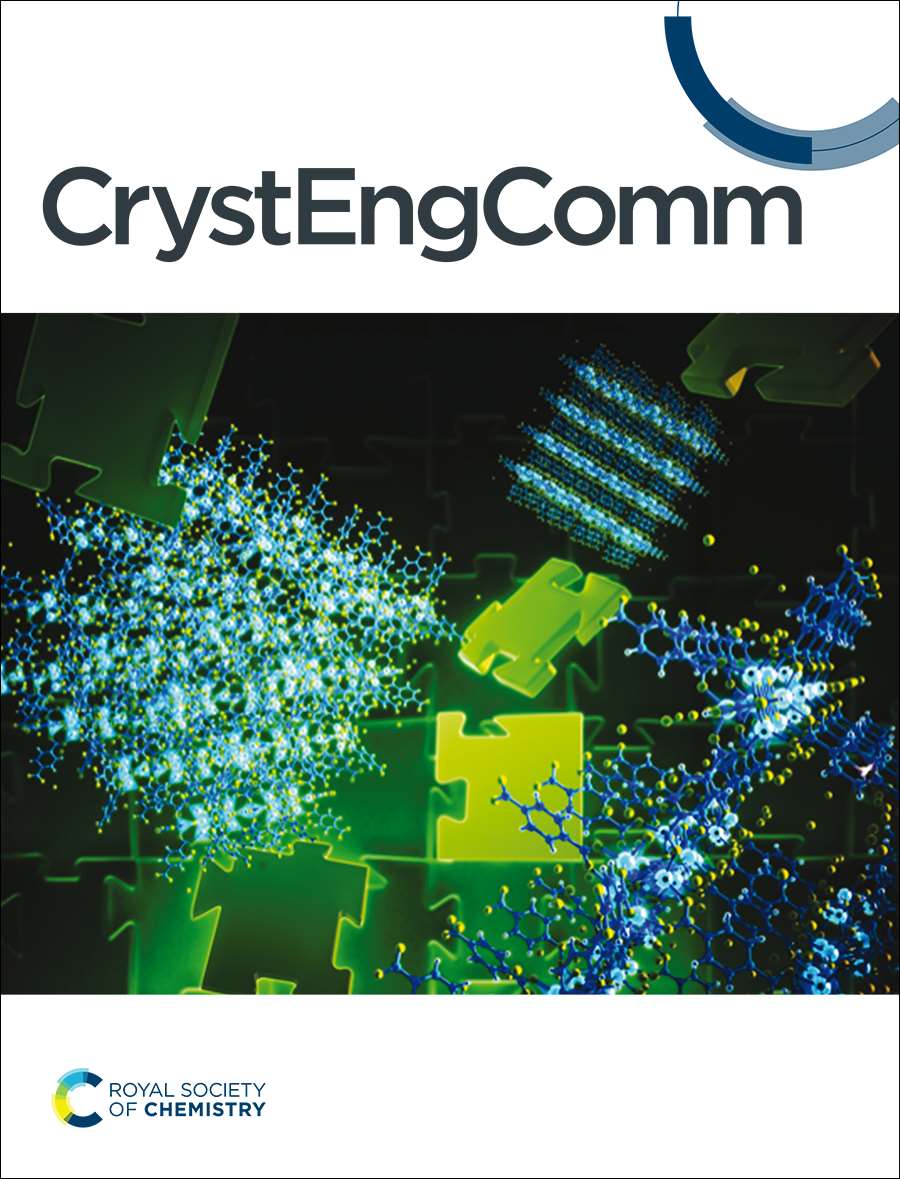
A series of 4-aminopyridinium (4ap) hypodiphosphates has been synthesized and characterized by variable temperature (VT) optical microscopy, thermogravimetry (TGA-DSC) and X-ray diffraction techniques (SC-XRD, PXRD, VT μ-PXRD). Anhydrous salts (4apH)(H3P2O6) (2) and (4apH)2(H2P2O6) in monoclinic (C2/c) (4), orthorhombic (P212121) (5) and another monoclinic (Cc) (6) polymorphic modifications were obtained by single crystal-to-powder dehydrations of the hydrates: ionic co-crystal (4apH)2(H2P2O6)·H4P2O6·2H2O (1) and salt (4apH)2(H2P2O6)·2H2O (3), respectively. Compound (2) was the only anhydrous form which was also obtained by a typical solution-crystallization. Destructive dehydrations strongly affected hypodiphosphate substructures, generating new structural motifs (both in PP–PP and ap–PP interactions) and new crystal architectures, thus revealing the structural diversity in organic hypodiphosphates. Dehydration gave rise to new properties, as non-centrosymmetric and polar anhydrous structures, (5) and (6) respectively, were obtained from centrosymmetric hydrate (3).





 京公网安备 11010802042870号
京ICP备2023020795号-1
京公网安备 11010802042870号
京ICP备2023020795号-1

 分享
分享
 求助内容:
求助内容: 应助结果提醒方式:
 扫码关注我们
