{"title":"以可溶性环氧化物水解酶为靶点重新设计小檗碱和血根碱以增强抗炎功效","authors":"Xing-Zhou Liu, Xiao-Yu Du, Wei-Song Xie, Jing Ding, Min-Zhen Zhu, Zi-Qiang Feng, Hao Wang, Yue Feng, Ming-Jia Yu, Si-Meng Liu, Wen-Tian Liu, Xin-Hong Zhu, Jian-Hua Liang","doi":"10.1021/acs.jmedchem.4c02202","DOIUrl":null,"url":null,"abstract":"Amino-berberine has remained underexplored due to limited biological evaluation and total synthesis approaches. In inflammation therapy, soluble Epoxide Hydrolase (sEH) is a promising target, yet natural scaffolds remain underutilized. Our study advances the field by redesigning natural compounds─berberine and sanguinarine─with strategic urea modifications and hydrogenated frameworks, creating novel sEH inhibitors with enhanced <i>in vivo</i> efficacy. Through total synthesis and structure–activity relationship studies of amino-berberine derivatives, chiral tetrahydroberberine <b>(<i>R</i>)-14i</b> (coded <b>LXZ-42</b>) emerged as the most potent lead, with an IC<sub>50</sub> value of 1.20 nM. <b>(<i>R</i>)-14i</b> showed reduced CYP enzyme impact, potent therapeutic effects on acute pancreatitis, no acute <i>in vivo</i> toxicity, and superior pharmacokinetic properties, with an oral bioavailability of 89.3%. Structural insights from crystallography of <b>(<i>R</i>)-14i</b> bound to sEH revealed key interactions: three with the tetrahydroberberine framework and three hydrogen bonds with the urea group, highlighting <b>(<i>R</i>)-14i</b> as a novel lead for sEH-targeted therapies in inflammation.","PeriodicalId":46,"journal":{"name":"Journal of Medicinal Chemistry","volume":"132 41 1","pages":""},"PeriodicalIF":6.8000,"publicationDate":"2024-12-10","publicationTypes":"Journal Article","fieldsOfStudy":null,"isOpenAccess":false,"openAccessPdf":"","citationCount":"0","resultStr":"{\"title\":\"Redesigning Berberines and Sanguinarines to Target Soluble Epoxide Hydrolase for Enhanced Anti-Inflammatory Efficacy\",\"authors\":\"Xing-Zhou Liu, Xiao-Yu Du, Wei-Song Xie, Jing Ding, Min-Zhen Zhu, Zi-Qiang Feng, Hao Wang, Yue Feng, Ming-Jia Yu, Si-Meng Liu, Wen-Tian Liu, Xin-Hong Zhu, Jian-Hua Liang\",\"doi\":\"10.1021/acs.jmedchem.4c02202\",\"DOIUrl\":null,\"url\":null,\"abstract\":\"Amino-berberine has remained underexplored due to limited biological evaluation and total synthesis approaches. In inflammation therapy, soluble Epoxide Hydrolase (sEH) is a promising target, yet natural scaffolds remain underutilized. Our study advances the field by redesigning natural compounds─berberine and sanguinarine─with strategic urea modifications and hydrogenated frameworks, creating novel sEH inhibitors with enhanced <i>in vivo</i> efficacy. Through total synthesis and structure–activity relationship studies of amino-berberine derivatives, chiral tetrahydroberberine <b>(<i>R</i>)-14i</b> (coded <b>LXZ-42</b>) emerged as the most potent lead, with an IC<sub>50</sub> value of 1.20 nM. <b>(<i>R</i>)-14i</b> showed reduced CYP enzyme impact, potent therapeutic effects on acute pancreatitis, no acute <i>in vivo</i> toxicity, and superior pharmacokinetic properties, with an oral bioavailability of 89.3%. Structural insights from crystallography of <b>(<i>R</i>)-14i</b> bound to sEH revealed key interactions: three with the tetrahydroberberine framework and three hydrogen bonds with the urea group, highlighting <b>(<i>R</i>)-14i</b> as a novel lead for sEH-targeted therapies in inflammation.\",\"PeriodicalId\":46,\"journal\":{\"name\":\"Journal of Medicinal Chemistry\",\"volume\":\"132 41 1\",\"pages\":\"\"},\"PeriodicalIF\":6.8000,\"publicationDate\":\"2024-12-10\",\"publicationTypes\":\"Journal Article\",\"fieldsOfStudy\":null,\"isOpenAccess\":false,\"openAccessPdf\":\"\",\"citationCount\":\"0\",\"resultStr\":null,\"platform\":\"Semanticscholar\",\"paperid\":null,\"PeriodicalName\":\"Journal of Medicinal Chemistry\",\"FirstCategoryId\":\"3\",\"ListUrlMain\":\"https://doi.org/10.1021/acs.jmedchem.4c02202\",\"RegionNum\":1,\"RegionCategory\":\"医学\",\"ArticlePicture\":[],\"TitleCN\":null,\"AbstractTextCN\":null,\"PMCID\":null,\"EPubDate\":\"\",\"PubModel\":\"\",\"JCR\":\"Q1\",\"JCRName\":\"CHEMISTRY, MEDICINAL\",\"Score\":null,\"Total\":0}","platform":"Semanticscholar","paperid":null,"PeriodicalName":"Journal of Medicinal Chemistry","FirstCategoryId":"3","ListUrlMain":"https://doi.org/10.1021/acs.jmedchem.4c02202","RegionNum":1,"RegionCategory":"医学","ArticlePicture":[],"TitleCN":null,"AbstractTextCN":null,"PMCID":null,"EPubDate":"","PubModel":"","JCR":"Q1","JCRName":"CHEMISTRY, MEDICINAL","Score":null,"Total":0}
Redesigning Berberines and Sanguinarines to Target Soluble Epoxide Hydrolase for Enhanced Anti-Inflammatory Efficacy
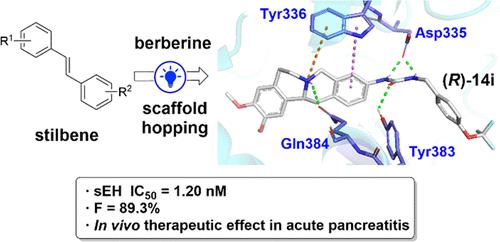
Amino-berberine has remained underexplored due to limited biological evaluation and total synthesis approaches. In inflammation therapy, soluble Epoxide Hydrolase (sEH) is a promising target, yet natural scaffolds remain underutilized. Our study advances the field by redesigning natural compounds─berberine and sanguinarine─with strategic urea modifications and hydrogenated frameworks, creating novel sEH inhibitors with enhanced in vivo efficacy. Through total synthesis and structure–activity relationship studies of amino-berberine derivatives, chiral tetrahydroberberine (R)-14i (coded LXZ-42) emerged as the most potent lead, with an IC50 value of 1.20 nM. (R)-14i showed reduced CYP enzyme impact, potent therapeutic effects on acute pancreatitis, no acute in vivo toxicity, and superior pharmacokinetic properties, with an oral bioavailability of 89.3%. Structural insights from crystallography of (R)-14i bound to sEH revealed key interactions: three with the tetrahydroberberine framework and three hydrogen bonds with the urea group, highlighting (R)-14i as a novel lead for sEH-targeted therapies in inflammation.
期刊介绍:
The Journal of Medicinal Chemistry is a prestigious biweekly peer-reviewed publication that focuses on the multifaceted field of medicinal chemistry. Since its inception in 1959 as the Journal of Medicinal and Pharmaceutical Chemistry, it has evolved to become a cornerstone in the dissemination of research findings related to the design, synthesis, and development of therapeutic agents.
The Journal of Medicinal Chemistry is recognized for its significant impact in the scientific community, as evidenced by its 2022 impact factor of 7.3. This metric reflects the journal's influence and the importance of its content in shaping the future of drug discovery and development. The journal serves as a vital resource for chemists, pharmacologists, and other researchers interested in the molecular mechanisms of drug action and the optimization of therapeutic compounds.



 京公网安备 11010802042870号
京ICP备2023020795号-1
京公网安备 11010802042870号
京ICP备2023020795号-1

 分享
分享
 求助内容:
求助内容: 应助结果提醒方式:
 扫码关注我们
