Henri Kesti, Kalle Mattila, Samuli Jaakkola, Joonas Lehto, Nea Söderblom, Kalle Kalliovalkama, Pekka Porela
{"title":"ARC-HBR标准在ST段抬高型心肌梗死中的应用。吸烟作为额外出血风险因素的意义。","authors":"Henri Kesti, Kalle Mattila, Samuli Jaakkola, Joonas Lehto, Nea Söderblom, Kalle Kalliovalkama, Pekka Porela","doi":"10.1093/ehjqcco/qcae104","DOIUrl":null,"url":null,"abstract":"<p><strong>Background and aims: </strong>The Academic Research Consortium for High Bleeding Risk criteria (ARC-HBR) are recommended by guidelines for bleeding risk assessment in ST-elevation myocardial infarction (STEMI). The aim of this study was to identify possible other risk factors and adjust the original ARC-HBR criteria for confounders.</p><p><strong>Methods and results: </strong>All consecutive STEMI patients managed in a Finnish tertiary hospital between 2016 and 2022 were identified using a database search. Data collection was done by reviewing electronic patient records. Bleeding risk was assessed according to the ARC-HBR criteria. The primary endpoint was non-access site bleeding academic research consortium (BARC) type 3 or 5 bleeding during 1-year follow-up. A total of 1548 STEMI patients were analysed. HBR criteria was fulfilled in 661 (42.7%). Multivariable competing risk analysis identified only 4 individual ARC-HBR criteria as independent risk factors for bleeding. Smoking status was identified as a novel bleeding risk factor. Current and former smokers had increased bleeding risk compared with never smokers [hazard ratio (HR) 3.01, 95% confidence interval (CI) 1.62-5.61 and HR 1.99, CI 1.19-3.34]. In those not meeting any ARC-HBR criteria, cumulative BARC 3 or 5 incidence of current smoking was 3.40% and intracranial haemorrhage (ICH) 1.36%. Thus, exceeding ARC-HBR definition for a major criterion. In the non-HBR group the prevalence of current smoking was 40.4% (n = 358).</p><p><strong>Conclusion: </strong>Current and former smoking predicts major bleeding complications after STEMI. Current smoking is highly prevalent among those classified as non-HBR according to the ARC-HBR criteria.</p>","PeriodicalId":11869,"journal":{"name":"European Heart Journal - Quality of Care and Clinical Outcomes","volume":" ","pages":"756-765"},"PeriodicalIF":4.6000,"publicationDate":"2025-09-12","publicationTypes":"Journal Article","fieldsOfStudy":null,"isOpenAccess":false,"openAccessPdf":"https://www.ncbi.nlm.nih.gov/pmc/articles/PMC12445688/pdf/","citationCount":"0","resultStr":"{\"title\":\"Performance of the ARC-HBR criteria in ST-elevation myocardial infarction. Significance of smoking as an additional bleeding risk factor.\",\"authors\":\"Henri Kesti, Kalle Mattila, Samuli Jaakkola, Joonas Lehto, Nea Söderblom, Kalle Kalliovalkama, Pekka Porela\",\"doi\":\"10.1093/ehjqcco/qcae104\",\"DOIUrl\":null,\"url\":null,\"abstract\":\"<p><strong>Background and aims: </strong>The Academic Research Consortium for High Bleeding Risk criteria (ARC-HBR) are recommended by guidelines for bleeding risk assessment in ST-elevation myocardial infarction (STEMI). The aim of this study was to identify possible other risk factors and adjust the original ARC-HBR criteria for confounders.</p><p><strong>Methods and results: </strong>All consecutive STEMI patients managed in a Finnish tertiary hospital between 2016 and 2022 were identified using a database search. Data collection was done by reviewing electronic patient records. Bleeding risk was assessed according to the ARC-HBR criteria. The primary endpoint was non-access site bleeding academic research consortium (BARC) type 3 or 5 bleeding during 1-year follow-up. A total of 1548 STEMI patients were analysed. HBR criteria was fulfilled in 661 (42.7%). Multivariable competing risk analysis identified only 4 individual ARC-HBR criteria as independent risk factors for bleeding. Smoking status was identified as a novel bleeding risk factor. Current and former smokers had increased bleeding risk compared with never smokers [hazard ratio (HR) 3.01, 95% confidence interval (CI) 1.62-5.61 and HR 1.99, CI 1.19-3.34]. In those not meeting any ARC-HBR criteria, cumulative BARC 3 or 5 incidence of current smoking was 3.40% and intracranial haemorrhage (ICH) 1.36%. Thus, exceeding ARC-HBR definition for a major criterion. In the non-HBR group the prevalence of current smoking was 40.4% (n = 358).</p><p><strong>Conclusion: </strong>Current and former smoking predicts major bleeding complications after STEMI. Current smoking is highly prevalent among those classified as non-HBR according to the ARC-HBR criteria.</p>\",\"PeriodicalId\":11869,\"journal\":{\"name\":\"European Heart Journal - Quality of Care and Clinical Outcomes\",\"volume\":\" \",\"pages\":\"756-765\"},\"PeriodicalIF\":4.6000,\"publicationDate\":\"2025-09-12\",\"publicationTypes\":\"Journal Article\",\"fieldsOfStudy\":null,\"isOpenAccess\":false,\"openAccessPdf\":\"https://www.ncbi.nlm.nih.gov/pmc/articles/PMC12445688/pdf/\",\"citationCount\":\"0\",\"resultStr\":null,\"platform\":\"Semanticscholar\",\"paperid\":null,\"PeriodicalName\":\"European Heart Journal - Quality of Care and Clinical Outcomes\",\"FirstCategoryId\":\"3\",\"ListUrlMain\":\"https://doi.org/10.1093/ehjqcco/qcae104\",\"RegionNum\":2,\"RegionCategory\":\"医学\",\"ArticlePicture\":[],\"TitleCN\":null,\"AbstractTextCN\":null,\"PMCID\":null,\"EPubDate\":\"\",\"PubModel\":\"\",\"JCR\":\"Q1\",\"JCRName\":\"CARDIAC & CARDIOVASCULAR SYSTEMS\",\"Score\":null,\"Total\":0}","platform":"Semanticscholar","paperid":null,"PeriodicalName":"European Heart Journal - Quality of Care and Clinical Outcomes","FirstCategoryId":"3","ListUrlMain":"https://doi.org/10.1093/ehjqcco/qcae104","RegionNum":2,"RegionCategory":"医学","ArticlePicture":[],"TitleCN":null,"AbstractTextCN":null,"PMCID":null,"EPubDate":"","PubModel":"","JCR":"Q1","JCRName":"CARDIAC & CARDIOVASCULAR SYSTEMS","Score":null,"Total":0}
Performance of the ARC-HBR criteria in ST-elevation myocardial infarction. Significance of smoking as an additional bleeding risk factor.
Background and aims: The Academic Research Consortium for High Bleeding Risk criteria (ARC-HBR) are recommended by guidelines for bleeding risk assessment in ST-elevation myocardial infarction (STEMI). The aim of this study was to identify possible other risk factors and adjust the original ARC-HBR criteria for confounders.
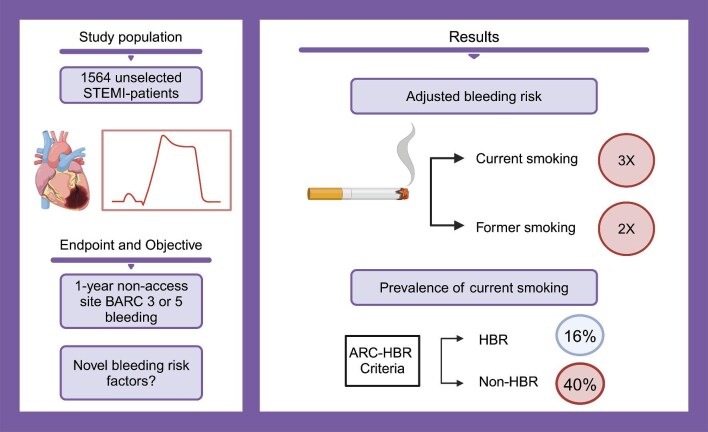
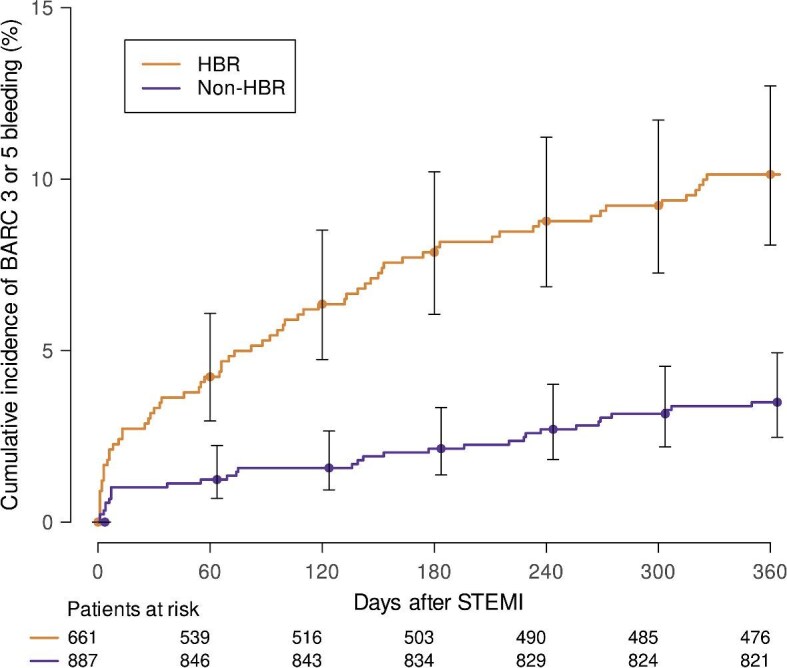
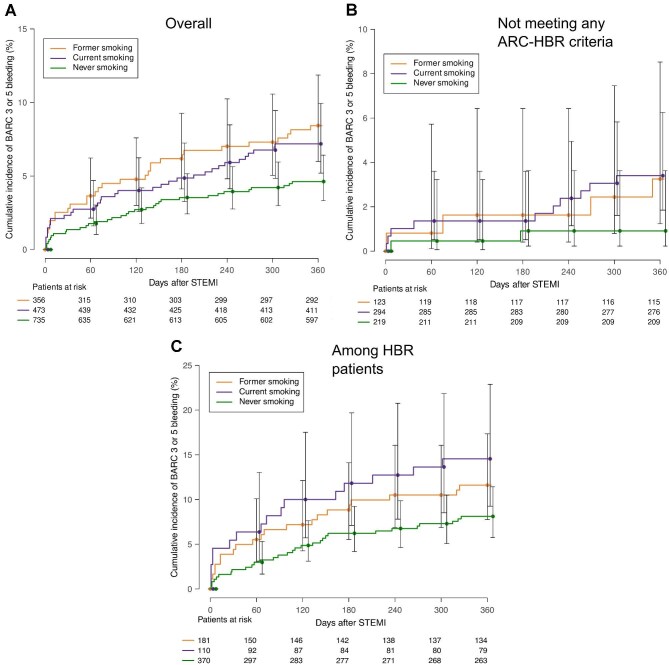
Methods and results: All consecutive STEMI patients managed in a Finnish tertiary hospital between 2016 and 2022 were identified using a database search. Data collection was done by reviewing electronic patient records. Bleeding risk was assessed according to the ARC-HBR criteria. The primary endpoint was non-access site bleeding academic research consortium (BARC) type 3 or 5 bleeding during 1-year follow-up. A total of 1548 STEMI patients were analysed. HBR criteria was fulfilled in 661 (42.7%). Multivariable competing risk analysis identified only 4 individual ARC-HBR criteria as independent risk factors for bleeding. Smoking status was identified as a novel bleeding risk factor. Current and former smokers had increased bleeding risk compared with never smokers [hazard ratio (HR) 3.01, 95% confidence interval (CI) 1.62-5.61 and HR 1.99, CI 1.19-3.34]. In those not meeting any ARC-HBR criteria, cumulative BARC 3 or 5 incidence of current smoking was 3.40% and intracranial haemorrhage (ICH) 1.36%. Thus, exceeding ARC-HBR definition for a major criterion. In the non-HBR group the prevalence of current smoking was 40.4% (n = 358).
Conclusion: Current and former smoking predicts major bleeding complications after STEMI. Current smoking is highly prevalent among those classified as non-HBR according to the ARC-HBR criteria.
期刊介绍:
European Heart Journal - Quality of Care & Clinical Outcomes is an English language, peer-reviewed journal dedicated to publishing cardiovascular outcomes research. It serves as an official journal of the European Society of Cardiology and maintains a close alliance with the European Heart Health Institute. The journal disseminates original research and topical reviews contributed by health scientists globally, with a focus on the quality of care and its impact on cardiovascular outcomes at the hospital, national, and international levels. It provides a platform for presenting the most outstanding cardiovascular outcomes research to influence cardiovascular public health policy on a global scale. Additionally, the journal aims to motivate young investigators and foster the growth of the outcomes research community.




 京公网安备 11010802042870号
京ICP备2023020795号-1
京公网安备 11010802042870号
京ICP备2023020795号-1

 分享
分享
 求助内容:
求助内容: 应助结果提醒方式:
 扫码关注我们
