{"title":"既往和妊娠期糖尿病与母体静脉血栓栓塞的风险:观察性研究的系统回顾和荟萃分析","authors":"Molly Orrin, Emilia Barber, Matthew J. Grainge","doi":"10.1111/1471-0528.18043","DOIUrl":null,"url":null,"abstract":"<div>\n \n \n <section>\n \n <h3> Background</h3>\n \n <p>Women who are pregnant are at increased risk of venous thromboembolism (VTE), which persists for up to 3 months following childbirth. Diabetes is known to increase the risk of serious cardiovascular outcomes.</p>\n </section>\n \n <section>\n \n <h3> Objective</h3>\n \n <p>To comprehensively review literature on the extent to which pre-existing or gestational diabetes influences the risk of VTE in both pregnancy and postpartum.</p>\n </section>\n \n <section>\n \n <h3> Search Strategy</h3>\n \n <p>We used Medline, Embase and Google Scholar to identify observational studies published up to 2 November 2023.</p>\n </section>\n \n <section>\n \n <h3> Selection Criteria</h3>\n \n <p>Studies which quantified the relationship between diabetes on antepartum and/or postpartum VTE, and which provide separate data for pre-existing and gestational diabetes.</p>\n </section>\n \n <section>\n \n <h3> Data Collection and Analysis</h3>\n \n <p>Results were pooled, where appropriate, using random-effects meta-analysis.</p>\n </section>\n \n <section>\n \n <h3> Main Results</h3>\n \n <p>Twenty one studies from Europe, the United States and Asia were included. There was an increased risk of antepartum VTE in women with gestational diabetes (RR = 2.48, 95% CI 1.47 – 4.16, <i>I</i><sup>2</sup>= 45%, 4 studies) but not pre-existing diabetes (RR = 1.71, 0.43 – 6.77, <i>I</i><sup>2</sup>= 68%, 2 studies). For postpartum VTE, there was no clear association with either pre-existing (RR = 1.28, 0.73 – 2.24, <i>I</i><sup>2</sup>= 73%, 6 studies) or gestational (RR = 1.39, 0.77 – 2.51, <i>I</i><sup>2</sup>= 70%, 10 studies) diabetes.</p>\n </section>\n \n <section>\n \n <h3> Conclusions</h3>\n \n <p>Our results will provide some reassurance for pregnant women with pre-existing or gestational diabetes, owing to no clear evidence of an increased risk of maternal VTE. While some studies report a raised risk of VTE during antepartum specifically, results must be interpreted in light of high levels of heterogeneity.</p>\n </section>\n </div>","PeriodicalId":50729,"journal":{"name":"Bjog-An International Journal of Obstetrics and Gynaecology","volume":"132 8","pages":"1076-1085"},"PeriodicalIF":4.3000,"publicationDate":"2024-12-17","publicationTypes":"Journal Article","fieldsOfStudy":null,"isOpenAccess":false,"openAccessPdf":"https://onlinelibrary.wiley.com/doi/epdf/10.1111/1471-0528.18043","citationCount":"0","resultStr":"{\"title\":\"Pre-Existing and Gestational Diabetes and Risk of Maternal Venous Thromboembolism: A Systematic Review and Meta-Analysis of Observational Studies\",\"authors\":\"Molly Orrin, Emilia Barber, Matthew J. Grainge\",\"doi\":\"10.1111/1471-0528.18043\",\"DOIUrl\":null,\"url\":null,\"abstract\":\"<div>\\n \\n \\n <section>\\n \\n <h3> Background</h3>\\n \\n <p>Women who are pregnant are at increased risk of venous thromboembolism (VTE), which persists for up to 3 months following childbirth. Diabetes is known to increase the risk of serious cardiovascular outcomes.</p>\\n </section>\\n \\n <section>\\n \\n <h3> Objective</h3>\\n \\n <p>To comprehensively review literature on the extent to which pre-existing or gestational diabetes influences the risk of VTE in both pregnancy and postpartum.</p>\\n </section>\\n \\n <section>\\n \\n <h3> Search Strategy</h3>\\n \\n <p>We used Medline, Embase and Google Scholar to identify observational studies published up to 2 November 2023.</p>\\n </section>\\n \\n <section>\\n \\n <h3> Selection Criteria</h3>\\n \\n <p>Studies which quantified the relationship between diabetes on antepartum and/or postpartum VTE, and which provide separate data for pre-existing and gestational diabetes.</p>\\n </section>\\n \\n <section>\\n \\n <h3> Data Collection and Analysis</h3>\\n \\n <p>Results were pooled, where appropriate, using random-effects meta-analysis.</p>\\n </section>\\n \\n <section>\\n \\n <h3> Main Results</h3>\\n \\n <p>Twenty one studies from Europe, the United States and Asia were included. There was an increased risk of antepartum VTE in women with gestational diabetes (RR = 2.48, 95% CI 1.47 – 4.16, <i>I</i><sup>2</sup>= 45%, 4 studies) but not pre-existing diabetes (RR = 1.71, 0.43 – 6.77, <i>I</i><sup>2</sup>= 68%, 2 studies). For postpartum VTE, there was no clear association with either pre-existing (RR = 1.28, 0.73 – 2.24, <i>I</i><sup>2</sup>= 73%, 6 studies) or gestational (RR = 1.39, 0.77 – 2.51, <i>I</i><sup>2</sup>= 70%, 10 studies) diabetes.</p>\\n </section>\\n \\n <section>\\n \\n <h3> Conclusions</h3>\\n \\n <p>Our results will provide some reassurance for pregnant women with pre-existing or gestational diabetes, owing to no clear evidence of an increased risk of maternal VTE. While some studies report a raised risk of VTE during antepartum specifically, results must be interpreted in light of high levels of heterogeneity.</p>\\n </section>\\n </div>\",\"PeriodicalId\":50729,\"journal\":{\"name\":\"Bjog-An International Journal of Obstetrics and Gynaecology\",\"volume\":\"132 8\",\"pages\":\"1076-1085\"},\"PeriodicalIF\":4.3000,\"publicationDate\":\"2024-12-17\",\"publicationTypes\":\"Journal Article\",\"fieldsOfStudy\":null,\"isOpenAccess\":false,\"openAccessPdf\":\"https://onlinelibrary.wiley.com/doi/epdf/10.1111/1471-0528.18043\",\"citationCount\":\"0\",\"resultStr\":null,\"platform\":\"Semanticscholar\",\"paperid\":null,\"PeriodicalName\":\"Bjog-An International Journal of Obstetrics and Gynaecology\",\"FirstCategoryId\":\"3\",\"ListUrlMain\":\"https://obgyn.onlinelibrary.wiley.com/doi/10.1111/1471-0528.18043\",\"RegionNum\":1,\"RegionCategory\":\"医学\",\"ArticlePicture\":[],\"TitleCN\":null,\"AbstractTextCN\":null,\"PMCID\":null,\"EPubDate\":\"\",\"PubModel\":\"\",\"JCR\":\"Q1\",\"JCRName\":\"OBSTETRICS & GYNECOLOGY\",\"Score\":null,\"Total\":0}","platform":"Semanticscholar","paperid":null,"PeriodicalName":"Bjog-An International Journal of Obstetrics and Gynaecology","FirstCategoryId":"3","ListUrlMain":"https://obgyn.onlinelibrary.wiley.com/doi/10.1111/1471-0528.18043","RegionNum":1,"RegionCategory":"医学","ArticlePicture":[],"TitleCN":null,"AbstractTextCN":null,"PMCID":null,"EPubDate":"","PubModel":"","JCR":"Q1","JCRName":"OBSTETRICS & GYNECOLOGY","Score":null,"Total":0}
Pre-Existing and Gestational Diabetes and Risk of Maternal Venous Thromboembolism: A Systematic Review and Meta-Analysis of Observational Studies
Background
Women who are pregnant are at increased risk of venous thromboembolism (VTE), which persists for up to 3 months following childbirth. Diabetes is known to increase the risk of serious cardiovascular outcomes.
Objective
To comprehensively review literature on the extent to which pre-existing or gestational diabetes influences the risk of VTE in both pregnancy and postpartum.
Search Strategy
We used Medline, Embase and Google Scholar to identify observational studies published up to 2 November 2023.
Selection Criteria
Studies which quantified the relationship between diabetes on antepartum and/or postpartum VTE, and which provide separate data for pre-existing and gestational diabetes.
Data Collection and Analysis
Results were pooled, where appropriate, using random-effects meta-analysis.
Main Results
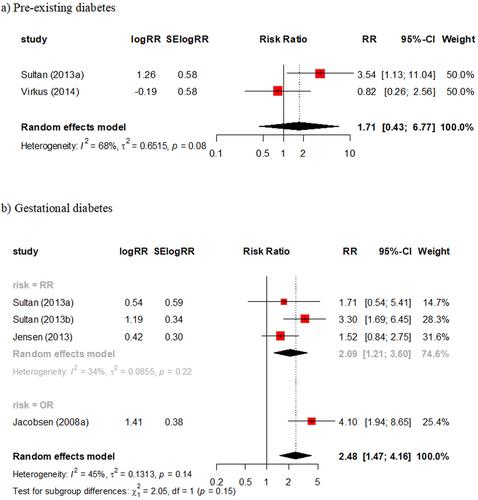
Twenty one studies from Europe, the United States and Asia were included. There was an increased risk of antepartum VTE in women with gestational diabetes (RR = 2.48, 95% CI 1.47 – 4.16, I2= 45%, 4 studies) but not pre-existing diabetes (RR = 1.71, 0.43 – 6.77, I2= 68%, 2 studies). For postpartum VTE, there was no clear association with either pre-existing (RR = 1.28, 0.73 – 2.24, I2= 73%, 6 studies) or gestational (RR = 1.39, 0.77 – 2.51, I2= 70%, 10 studies) diabetes.
Conclusions
Our results will provide some reassurance for pregnant women with pre-existing or gestational diabetes, owing to no clear evidence of an increased risk of maternal VTE. While some studies report a raised risk of VTE during antepartum specifically, results must be interpreted in light of high levels of heterogeneity.
期刊介绍:
BJOG is an editorially independent publication owned by the Royal College of Obstetricians and Gynaecologists (RCOG). The Journal publishes original, peer-reviewed work in all areas of obstetrics and gynaecology, including contraception, urogynaecology, fertility, oncology and clinical practice. Its aim is to publish the highest quality medical research in women''s health, worldwide.






 京公网安备 11010802042870号
京ICP备2023020795号-1
京公网安备 11010802042870号
京ICP备2023020795号-1

 分享
分享
 求助内容:
求助内容: 应助结果提醒方式:
 扫码关注我们
