Georgina Rai, Lee J. Edwards, Rebecca L. Greenaway, Philip W. Miller, Katherine M. P. Wheelhouse, Mark R. Crimmin
{"title":"钯催化芳基溴甲酰化反应的动力学与计算分析","authors":"Georgina Rai, Lee J. Edwards, Rebecca L. Greenaway, Philip W. Miller, Katherine M. P. Wheelhouse, Mark R. Crimmin","doi":"10.1021/acscatal.4c05324","DOIUrl":null,"url":null,"abstract":"Aryl aldehydes are key synthetic intermediates in the manufacturing of active pharmaceutical ingredients. They are generated on scale (>1000 kg) through the palladium-catalyzed formylation of aryl bromides using syngas (CO/H<sub>2</sub>). The best-in-class catalyst system for this reaction employs di-1-adamantyl-<i>n</i>-butylphosphine (cata<i>CX</i>ium A), palladium(II) acetate, and tetramethylethylenediamine. Despite nearly 20 years since its initial report, a mechanistic understanding of this system remains incomplete. Here, we use automation, kinetic analysis, and DFT calculations to develop a mechanistic model for this best-in-class catalyst. We suggest that a combination of the migratory insertion step and dihydrogen activation step is likely involved in the turnover-limiting sequence. The reaction kinetics are responsive to the nature of the substrate, with electron-rich aryl bromides reacting faster and more selectively than their electron-poor counterparts due to the influence of electronics in the migratory insertion step. Our findings add additional insight into the proposed mechanism of palladium-catalyzed formylation of aryl bromides.","PeriodicalId":9,"journal":{"name":"ACS Catalysis ","volume":"37 1","pages":""},"PeriodicalIF":13.6000,"publicationDate":"2024-12-18","publicationTypes":"Journal Article","fieldsOfStudy":null,"isOpenAccess":false,"openAccessPdf":"","citationCount":"0","resultStr":"{\"title\":\"Combined Kinetic and Computational Analysis of the Palladium-Catalyzed Formylation of Aryl Bromides\",\"authors\":\"Georgina Rai, Lee J. Edwards, Rebecca L. Greenaway, Philip W. Miller, Katherine M. P. Wheelhouse, Mark R. Crimmin\",\"doi\":\"10.1021/acscatal.4c05324\",\"DOIUrl\":null,\"url\":null,\"abstract\":\"Aryl aldehydes are key synthetic intermediates in the manufacturing of active pharmaceutical ingredients. They are generated on scale (>1000 kg) through the palladium-catalyzed formylation of aryl bromides using syngas (CO/H<sub>2</sub>). The best-in-class catalyst system for this reaction employs di-1-adamantyl-<i>n</i>-butylphosphine (cata<i>CX</i>ium A), palladium(II) acetate, and tetramethylethylenediamine. Despite nearly 20 years since its initial report, a mechanistic understanding of this system remains incomplete. Here, we use automation, kinetic analysis, and DFT calculations to develop a mechanistic model for this best-in-class catalyst. We suggest that a combination of the migratory insertion step and dihydrogen activation step is likely involved in the turnover-limiting sequence. The reaction kinetics are responsive to the nature of the substrate, with electron-rich aryl bromides reacting faster and more selectively than their electron-poor counterparts due to the influence of electronics in the migratory insertion step. Our findings add additional insight into the proposed mechanism of palladium-catalyzed formylation of aryl bromides.\",\"PeriodicalId\":9,\"journal\":{\"name\":\"ACS Catalysis \",\"volume\":\"37 1\",\"pages\":\"\"},\"PeriodicalIF\":13.6000,\"publicationDate\":\"2024-12-18\",\"publicationTypes\":\"Journal Article\",\"fieldsOfStudy\":null,\"isOpenAccess\":false,\"openAccessPdf\":\"\",\"citationCount\":\"0\",\"resultStr\":null,\"platform\":\"Semanticscholar\",\"paperid\":null,\"PeriodicalName\":\"ACS Catalysis \",\"FirstCategoryId\":\"92\",\"ListUrlMain\":\"https://doi.org/10.1021/acscatal.4c05324\",\"RegionNum\":1,\"RegionCategory\":\"化学\",\"ArticlePicture\":[],\"TitleCN\":null,\"AbstractTextCN\":null,\"PMCID\":null,\"EPubDate\":\"\",\"PubModel\":\"\",\"JCR\":\"Q1\",\"JCRName\":\"CHEMISTRY, PHYSICAL\",\"Score\":null,\"Total\":0}","platform":"Semanticscholar","paperid":null,"PeriodicalName":"ACS Catalysis ","FirstCategoryId":"92","ListUrlMain":"https://doi.org/10.1021/acscatal.4c05324","RegionNum":1,"RegionCategory":"化学","ArticlePicture":[],"TitleCN":null,"AbstractTextCN":null,"PMCID":null,"EPubDate":"","PubModel":"","JCR":"Q1","JCRName":"CHEMISTRY, PHYSICAL","Score":null,"Total":0}
Combined Kinetic and Computational Analysis of the Palladium-Catalyzed Formylation of Aryl Bromides
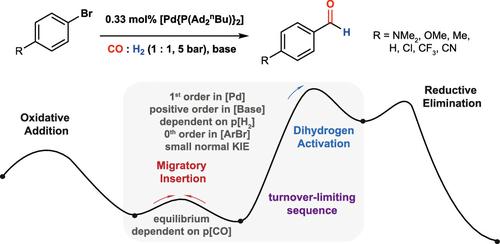
Aryl aldehydes are key synthetic intermediates in the manufacturing of active pharmaceutical ingredients. They are generated on scale (>1000 kg) through the palladium-catalyzed formylation of aryl bromides using syngas (CO/H2). The best-in-class catalyst system for this reaction employs di-1-adamantyl-n-butylphosphine (cataCXium A), palladium(II) acetate, and tetramethylethylenediamine. Despite nearly 20 years since its initial report, a mechanistic understanding of this system remains incomplete. Here, we use automation, kinetic analysis, and DFT calculations to develop a mechanistic model for this best-in-class catalyst. We suggest that a combination of the migratory insertion step and dihydrogen activation step is likely involved in the turnover-limiting sequence. The reaction kinetics are responsive to the nature of the substrate, with electron-rich aryl bromides reacting faster and more selectively than their electron-poor counterparts due to the influence of electronics in the migratory insertion step. Our findings add additional insight into the proposed mechanism of palladium-catalyzed formylation of aryl bromides.
期刊介绍:
ACS Catalysis is an esteemed journal that publishes original research in the fields of heterogeneous catalysis, molecular catalysis, and biocatalysis. It offers broad coverage across diverse areas such as life sciences, organometallics and synthesis, photochemistry and electrochemistry, drug discovery and synthesis, materials science, environmental protection, polymer discovery and synthesis, and energy and fuels.
The scope of the journal is to showcase innovative work in various aspects of catalysis. This includes new reactions and novel synthetic approaches utilizing known catalysts, the discovery or modification of new catalysts, elucidation of catalytic mechanisms through cutting-edge investigations, practical enhancements of existing processes, as well as conceptual advances in the field. Contributions to ACS Catalysis can encompass both experimental and theoretical research focused on catalytic molecules, macromolecules, and materials that exhibit catalytic turnover.




 京公网安备 11010802042870号
京ICP备2023020795号-1
京公网安备 11010802042870号
京ICP备2023020795号-1

 分享
分享
 求助内容:
求助内容: 应助结果提醒方式:
 扫码关注我们
