Jesse E. Matthews, Jaime E. Avilés Acosta, Sang-Won Lee, Dongrak Oh, Tiras Y. Lin, Kyra M. K. Yap, Junjie Chen, Ji-Wook Jang, Dong Un Lee, Adam C. Nielander, Thomas F. Jaramillo
{"title":"Operando表面增强红外光谱将电化学CO2还原铜过程中的界面动力学与反应动力学联系起来","authors":"Jesse E. Matthews, Jaime E. Avilés Acosta, Sang-Won Lee, Dongrak Oh, Tiras Y. Lin, Kyra M. K. Yap, Junjie Chen, Ji-Wook Jang, Dong Un Lee, Adam C. Nielander, Thomas F. Jaramillo","doi":"10.1021/acscatal.4c05532","DOIUrl":null,"url":null,"abstract":"The reaction microenvironment plays a key role in dictating the selectivity of electrochemical CO<sub>2</sub> reduction. However, understanding the chemical nature of this microenvironment under operating conditions remains a substantial challenge. We employed attenuated total reflectance surface-enhanced infrared absorption spectroscopy (ATR-SEIRAS) <i>in operando</i> for simultaneous measurements of reaction kinetics and concentrations of reactants and intermediates at the reaction interface, all under controlled mass transport conditions. These <i>operando</i> measurements enable direct correlations between the reaction microenvironment, mass transport, and kinetics for a Cu electrocatalyst, such as higher local concentrations of CO<sub>2</sub> under faster mass transport corresponding to higher rates of CO<sub>2</sub> reduction. We observed that faster mass transport decreased the *CO coverage at less negative potentials (−0.6 V<sub>RHE</sub>) and increased the *CO coverage at more negative potentials (−1.1 V<sub>RHE</sub>). We developed a transport-coupled kinetic model that captures these spectroscopic observations and provides insight into the processes controlling interfacial concentrations of reactants and intermediates, aiding future efforts toward tailoring reaction microenvironments.","PeriodicalId":9,"journal":{"name":"ACS Catalysis ","volume":"1 1","pages":""},"PeriodicalIF":13.1000,"publicationDate":"2024-12-18","publicationTypes":"Journal Article","fieldsOfStudy":null,"isOpenAccess":false,"openAccessPdf":"","citationCount":"0","resultStr":"{\"title\":\"Operando Surface-Enhanced Infrared Spectroscopy Connects Interfacial Dynamics with Reaction Kinetics During Electrochemical CO2 Reduction on Copper\",\"authors\":\"Jesse E. Matthews, Jaime E. Avilés Acosta, Sang-Won Lee, Dongrak Oh, Tiras Y. Lin, Kyra M. K. Yap, Junjie Chen, Ji-Wook Jang, Dong Un Lee, Adam C. Nielander, Thomas F. Jaramillo\",\"doi\":\"10.1021/acscatal.4c05532\",\"DOIUrl\":null,\"url\":null,\"abstract\":\"The reaction microenvironment plays a key role in dictating the selectivity of electrochemical CO<sub>2</sub> reduction. However, understanding the chemical nature of this microenvironment under operating conditions remains a substantial challenge. We employed attenuated total reflectance surface-enhanced infrared absorption spectroscopy (ATR-SEIRAS) <i>in operando</i> for simultaneous measurements of reaction kinetics and concentrations of reactants and intermediates at the reaction interface, all under controlled mass transport conditions. These <i>operando</i> measurements enable direct correlations between the reaction microenvironment, mass transport, and kinetics for a Cu electrocatalyst, such as higher local concentrations of CO<sub>2</sub> under faster mass transport corresponding to higher rates of CO<sub>2</sub> reduction. We observed that faster mass transport decreased the *CO coverage at less negative potentials (−0.6 V<sub>RHE</sub>) and increased the *CO coverage at more negative potentials (−1.1 V<sub>RHE</sub>). We developed a transport-coupled kinetic model that captures these spectroscopic observations and provides insight into the processes controlling interfacial concentrations of reactants and intermediates, aiding future efforts toward tailoring reaction microenvironments.\",\"PeriodicalId\":9,\"journal\":{\"name\":\"ACS Catalysis \",\"volume\":\"1 1\",\"pages\":\"\"},\"PeriodicalIF\":13.1000,\"publicationDate\":\"2024-12-18\",\"publicationTypes\":\"Journal Article\",\"fieldsOfStudy\":null,\"isOpenAccess\":false,\"openAccessPdf\":\"\",\"citationCount\":\"0\",\"resultStr\":null,\"platform\":\"Semanticscholar\",\"paperid\":null,\"PeriodicalName\":\"ACS Catalysis \",\"FirstCategoryId\":\"92\",\"ListUrlMain\":\"https://doi.org/10.1021/acscatal.4c05532\",\"RegionNum\":1,\"RegionCategory\":\"化学\",\"ArticlePicture\":[],\"TitleCN\":null,\"AbstractTextCN\":null,\"PMCID\":null,\"EPubDate\":\"\",\"PubModel\":\"\",\"JCR\":\"Q1\",\"JCRName\":\"CHEMISTRY, PHYSICAL\",\"Score\":null,\"Total\":0}","platform":"Semanticscholar","paperid":null,"PeriodicalName":"ACS Catalysis ","FirstCategoryId":"92","ListUrlMain":"https://doi.org/10.1021/acscatal.4c05532","RegionNum":1,"RegionCategory":"化学","ArticlePicture":[],"TitleCN":null,"AbstractTextCN":null,"PMCID":null,"EPubDate":"","PubModel":"","JCR":"Q1","JCRName":"CHEMISTRY, PHYSICAL","Score":null,"Total":0}
Operando Surface-Enhanced Infrared Spectroscopy Connects Interfacial Dynamics with Reaction Kinetics During Electrochemical CO2 Reduction on Copper
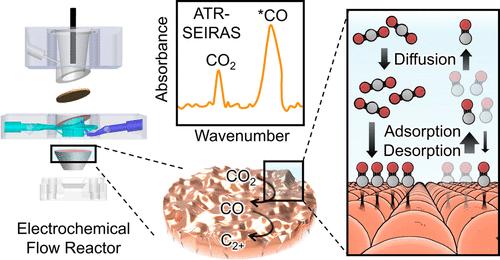
The reaction microenvironment plays a key role in dictating the selectivity of electrochemical CO2 reduction. However, understanding the chemical nature of this microenvironment under operating conditions remains a substantial challenge. We employed attenuated total reflectance surface-enhanced infrared absorption spectroscopy (ATR-SEIRAS) in operando for simultaneous measurements of reaction kinetics and concentrations of reactants and intermediates at the reaction interface, all under controlled mass transport conditions. These operando measurements enable direct correlations between the reaction microenvironment, mass transport, and kinetics for a Cu electrocatalyst, such as higher local concentrations of CO2 under faster mass transport corresponding to higher rates of CO2 reduction. We observed that faster mass transport decreased the *CO coverage at less negative potentials (−0.6 VRHE) and increased the *CO coverage at more negative potentials (−1.1 VRHE). We developed a transport-coupled kinetic model that captures these spectroscopic observations and provides insight into the processes controlling interfacial concentrations of reactants and intermediates, aiding future efforts toward tailoring reaction microenvironments.
期刊介绍:
ACS Catalysis is an esteemed journal that publishes original research in the fields of heterogeneous catalysis, molecular catalysis, and biocatalysis. It offers broad coverage across diverse areas such as life sciences, organometallics and synthesis, photochemistry and electrochemistry, drug discovery and synthesis, materials science, environmental protection, polymer discovery and synthesis, and energy and fuels.
The scope of the journal is to showcase innovative work in various aspects of catalysis. This includes new reactions and novel synthetic approaches utilizing known catalysts, the discovery or modification of new catalysts, elucidation of catalytic mechanisms through cutting-edge investigations, practical enhancements of existing processes, as well as conceptual advances in the field. Contributions to ACS Catalysis can encompass both experimental and theoretical research focused on catalytic molecules, macromolecules, and materials that exhibit catalytic turnover.




 京公网安备 11010802042870号
京ICP备2023020795号-1
京公网安备 11010802042870号
京ICP备2023020795号-1

 分享
分享
 求助内容:
求助内容: 应助结果提醒方式:
 扫码关注我们
