{"title":"DeepMoIC:基于深度图卷积网络的多组学数据集成,用于癌症亚型分类。","authors":"Jiecheng Wu, Zhaoliang Chen, Shunxin Xiao, Genggeng Liu, Wenjie Wu, Shiping Wang","doi":"10.1186/s12864-024-11112-5","DOIUrl":null,"url":null,"abstract":"<p><strong>Background: </strong>Achieving precise cancer subtype classification is imperative for effective prognosis and treatment. Multi-omics studies, encompassing diverse data modalities, have emerged as powerful tools for unraveling the complexities of cancer. However, owing to the intricacies of biological data, multi-omics datasets generally show variations in data types, scales, and distributions. These intractable problems lead to challenges in exploring intact representations from heterogeneous data, which often result in inaccuracies in multi-omics information analysis.</p><p><strong>Results: </strong>To address the challenges of multi-omics research, our approach DeepMoIC presents a novel framework derived from deep Graph Convolutional Network (GCN). Leveraging autoencoder modules, DeepMoIC extracts compact representations from omics data and incorporates a patient similarity network through the similarity network fusion algorithm. To handle non-Euclidean data and explore high-order omics information effectively, we design a Deep GCN module with two strategies: residual connection and identity mapping. With extracted higher-order representations, our approach consistently outperforms state-of-the-art models on a pan-cancer dataset and 3 cancer subtype datasets.</p><p><strong>Conclusion: </strong>The introduction of Deep GCN shows encouraging performance in terms of supervised multi-omics feature learning, offering promising insights for precision medicine in cancer research. DeepMoIC can potentially be an important tool in the field of cancer subtype classification because of its capacity to handle complex multi-omics data and produce reliable classification findings.</p>","PeriodicalId":9030,"journal":{"name":"BMC Genomics","volume":"25 1","pages":"1209"},"PeriodicalIF":3.9000,"publicationDate":"2024-12-18","publicationTypes":"Journal Article","fieldsOfStudy":null,"isOpenAccess":false,"openAccessPdf":"https://www.ncbi.nlm.nih.gov/pmc/articles/PMC11658304/pdf/","citationCount":"0","resultStr":"{\"title\":\"DeepMoIC: multi-omics data integration via deep graph convolutional networks for cancer subtype classification.\",\"authors\":\"Jiecheng Wu, Zhaoliang Chen, Shunxin Xiao, Genggeng Liu, Wenjie Wu, Shiping Wang\",\"doi\":\"10.1186/s12864-024-11112-5\",\"DOIUrl\":null,\"url\":null,\"abstract\":\"<p><strong>Background: </strong>Achieving precise cancer subtype classification is imperative for effective prognosis and treatment. Multi-omics studies, encompassing diverse data modalities, have emerged as powerful tools for unraveling the complexities of cancer. However, owing to the intricacies of biological data, multi-omics datasets generally show variations in data types, scales, and distributions. These intractable problems lead to challenges in exploring intact representations from heterogeneous data, which often result in inaccuracies in multi-omics information analysis.</p><p><strong>Results: </strong>To address the challenges of multi-omics research, our approach DeepMoIC presents a novel framework derived from deep Graph Convolutional Network (GCN). Leveraging autoencoder modules, DeepMoIC extracts compact representations from omics data and incorporates a patient similarity network through the similarity network fusion algorithm. To handle non-Euclidean data and explore high-order omics information effectively, we design a Deep GCN module with two strategies: residual connection and identity mapping. With extracted higher-order representations, our approach consistently outperforms state-of-the-art models on a pan-cancer dataset and 3 cancer subtype datasets.</p><p><strong>Conclusion: </strong>The introduction of Deep GCN shows encouraging performance in terms of supervised multi-omics feature learning, offering promising insights for precision medicine in cancer research. DeepMoIC can potentially be an important tool in the field of cancer subtype classification because of its capacity to handle complex multi-omics data and produce reliable classification findings.</p>\",\"PeriodicalId\":9030,\"journal\":{\"name\":\"BMC Genomics\",\"volume\":\"25 1\",\"pages\":\"1209\"},\"PeriodicalIF\":3.9000,\"publicationDate\":\"2024-12-18\",\"publicationTypes\":\"Journal Article\",\"fieldsOfStudy\":null,\"isOpenAccess\":false,\"openAccessPdf\":\"https://www.ncbi.nlm.nih.gov/pmc/articles/PMC11658304/pdf/\",\"citationCount\":\"0\",\"resultStr\":null,\"platform\":\"Semanticscholar\",\"paperid\":null,\"PeriodicalName\":\"BMC Genomics\",\"FirstCategoryId\":\"99\",\"ListUrlMain\":\"https://doi.org/10.1186/s12864-024-11112-5\",\"RegionNum\":2,\"RegionCategory\":\"生物学\",\"ArticlePicture\":[],\"TitleCN\":null,\"AbstractTextCN\":null,\"PMCID\":null,\"EPubDate\":\"\",\"PubModel\":\"\",\"JCR\":\"Q2\",\"JCRName\":\"BIOTECHNOLOGY & APPLIED MICROBIOLOGY\",\"Score\":null,\"Total\":0}","platform":"Semanticscholar","paperid":null,"PeriodicalName":"BMC Genomics","FirstCategoryId":"99","ListUrlMain":"https://doi.org/10.1186/s12864-024-11112-5","RegionNum":2,"RegionCategory":"生物学","ArticlePicture":[],"TitleCN":null,"AbstractTextCN":null,"PMCID":null,"EPubDate":"","PubModel":"","JCR":"Q2","JCRName":"BIOTECHNOLOGY & APPLIED MICROBIOLOGY","Score":null,"Total":0}
DeepMoIC: multi-omics data integration via deep graph convolutional networks for cancer subtype classification.
Background: Achieving precise cancer subtype classification is imperative for effective prognosis and treatment. Multi-omics studies, encompassing diverse data modalities, have emerged as powerful tools for unraveling the complexities of cancer. However, owing to the intricacies of biological data, multi-omics datasets generally show variations in data types, scales, and distributions. These intractable problems lead to challenges in exploring intact representations from heterogeneous data, which often result in inaccuracies in multi-omics information analysis.
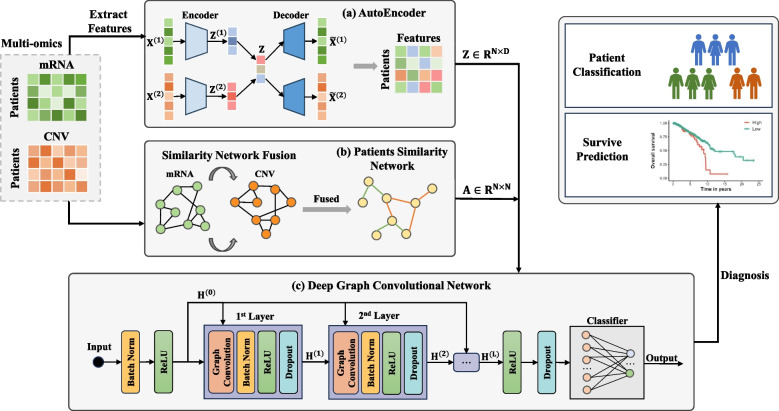
Results: To address the challenges of multi-omics research, our approach DeepMoIC presents a novel framework derived from deep Graph Convolutional Network (GCN). Leveraging autoencoder modules, DeepMoIC extracts compact representations from omics data and incorporates a patient similarity network through the similarity network fusion algorithm. To handle non-Euclidean data and explore high-order omics information effectively, we design a Deep GCN module with two strategies: residual connection and identity mapping. With extracted higher-order representations, our approach consistently outperforms state-of-the-art models on a pan-cancer dataset and 3 cancer subtype datasets.
Conclusion: The introduction of Deep GCN shows encouraging performance in terms of supervised multi-omics feature learning, offering promising insights for precision medicine in cancer research. DeepMoIC can potentially be an important tool in the field of cancer subtype classification because of its capacity to handle complex multi-omics data and produce reliable classification findings.
期刊介绍:
BMC Genomics is an open access, peer-reviewed journal that considers articles on all aspects of genome-scale analysis, functional genomics, and proteomics.
BMC Genomics is part of the BMC series which publishes subject-specific journals focused on the needs of individual research communities across all areas of biology and medicine. We offer an efficient, fair and friendly peer review service, and are committed to publishing all sound science, provided that there is some advance in knowledge presented by the work.





 京公网安备 11010802042870号
京ICP备2023020795号-1
京公网安备 11010802042870号
京ICP备2023020795号-1

 分享
分享
 求助内容:
求助内容: 应助结果提醒方式:
 扫码关注我们
