{"title":"成年母猪的免疫转录组谱:优势地位比环境富集的影响更大。","authors":"Mariana Mescouto Lopes, Caroline Clouard, Annie Vincent, Françoise Thomas, Frédéric Hérault, Isabelle Louveau, Rémi Resmond, Hélène Jammes, Elodie Merlot","doi":"10.1186/s12864-024-11116-1","DOIUrl":null,"url":null,"abstract":"<p><strong>Background: </strong>Assessing farm animals' welfare is crucial, yet practical physiological tools are still lacking. In this study, we tested whether the peripheral blood mononuclear cell (PBMC) transcriptome shows variations in association with sows' welfare. To do this, we compared animals whose welfare states were assumed to differ due to their lives in more or less enriched environments and to their different dominance statuses. Sows were housed in a conventional (C, n = 36) or enriched (E, n = 35) environments from gestation day 0 (G0) until three weeks before farrowing (G105), after which they were transferred to individual farrowing crates. From G99 to G103, behavioral analyses were conducted, and sows' dominance status was evaluated. A subset of 28 multiparous sows (C, n = 14 and E, n = 14) was selected for the collection of saliva on G35 and G98 and hair on G98 for cortisol measurement, and of blood samples for PBMC transcriptome analysis on G98 and on lactation day 12 (L12).</p><p><strong>Results: </strong>Both environmental enrichment (EE) and dominance status influenced cortisol and variables related to social and exploratory behavior, indicating an influence on sows' welfare. In the transcriptomic analysis, among the 12,260 genes submitted to differential analysis on G98, EE impacted 31 genes, while dominance status impacted 449 genes. Compared with subordinate sows (SUB), dominant (DOM) sows exhibited an upregulation of genes related to inflammatory process and plasma cell function, and downregulation of genes related to B-cell activation. In groups of sows, dominance status is partly related to sows' parity; therefore, we compared the effect of dominance with that of parity. Some common genes emerged when comparing high-parity (HP) vs. low-parity (LP) sows (542 differentially expressed genes (DEGs), including 180 in common with dominance-related genes), indicating that some effects of dominance on the transcriptome during gestation were in fact more due to age or reproductive cycles than to dominance itself. EE and dominance effects appeared relatively short-term, as DEG numbers decreased on L12 (four DEGs for E vs. C, 25 for DOM vs. SUB).</p><p><strong>Conclusions: </strong>Dominance status exerted a more pronounced influence on sows' PBMC transcriptome than did environmental enrichment. In particular, dominance status modulated genes associated with B cells and plasma cell functions. Some of the genes identified in this study could be tested in the future as potential molecular markers of well-being.</p>","PeriodicalId":9030,"journal":{"name":"BMC Genomics","volume":"25 1","pages":"1211"},"PeriodicalIF":3.7000,"publicationDate":"2024-12-18","publicationTypes":"Journal Article","fieldsOfStudy":null,"isOpenAccess":false,"openAccessPdf":"https://www.ncbi.nlm.nih.gov/pmc/articles/PMC11657968/pdf/","citationCount":"0","resultStr":"{\"title\":\"Immune transcriptomic profile in adult female pigs: dominance status has more influence than environmental enrichment.\",\"authors\":\"Mariana Mescouto Lopes, Caroline Clouard, Annie Vincent, Françoise Thomas, Frédéric Hérault, Isabelle Louveau, Rémi Resmond, Hélène Jammes, Elodie Merlot\",\"doi\":\"10.1186/s12864-024-11116-1\",\"DOIUrl\":null,\"url\":null,\"abstract\":\"<p><strong>Background: </strong>Assessing farm animals' welfare is crucial, yet practical physiological tools are still lacking. In this study, we tested whether the peripheral blood mononuclear cell (PBMC) transcriptome shows variations in association with sows' welfare. To do this, we compared animals whose welfare states were assumed to differ due to their lives in more or less enriched environments and to their different dominance statuses. Sows were housed in a conventional (C, n = 36) or enriched (E, n = 35) environments from gestation day 0 (G0) until three weeks before farrowing (G105), after which they were transferred to individual farrowing crates. From G99 to G103, behavioral analyses were conducted, and sows' dominance status was evaluated. A subset of 28 multiparous sows (C, n = 14 and E, n = 14) was selected for the collection of saliva on G35 and G98 and hair on G98 for cortisol measurement, and of blood samples for PBMC transcriptome analysis on G98 and on lactation day 12 (L12).</p><p><strong>Results: </strong>Both environmental enrichment (EE) and dominance status influenced cortisol and variables related to social and exploratory behavior, indicating an influence on sows' welfare. In the transcriptomic analysis, among the 12,260 genes submitted to differential analysis on G98, EE impacted 31 genes, while dominance status impacted 449 genes. Compared with subordinate sows (SUB), dominant (DOM) sows exhibited an upregulation of genes related to inflammatory process and plasma cell function, and downregulation of genes related to B-cell activation. In groups of sows, dominance status is partly related to sows' parity; therefore, we compared the effect of dominance with that of parity. Some common genes emerged when comparing high-parity (HP) vs. low-parity (LP) sows (542 differentially expressed genes (DEGs), including 180 in common with dominance-related genes), indicating that some effects of dominance on the transcriptome during gestation were in fact more due to age or reproductive cycles than to dominance itself. EE and dominance effects appeared relatively short-term, as DEG numbers decreased on L12 (four DEGs for E vs. C, 25 for DOM vs. SUB).</p><p><strong>Conclusions: </strong>Dominance status exerted a more pronounced influence on sows' PBMC transcriptome than did environmental enrichment. In particular, dominance status modulated genes associated with B cells and plasma cell functions. Some of the genes identified in this study could be tested in the future as potential molecular markers of well-being.</p>\",\"PeriodicalId\":9030,\"journal\":{\"name\":\"BMC Genomics\",\"volume\":\"25 1\",\"pages\":\"1211\"},\"PeriodicalIF\":3.7000,\"publicationDate\":\"2024-12-18\",\"publicationTypes\":\"Journal Article\",\"fieldsOfStudy\":null,\"isOpenAccess\":false,\"openAccessPdf\":\"https://www.ncbi.nlm.nih.gov/pmc/articles/PMC11657968/pdf/\",\"citationCount\":\"0\",\"resultStr\":null,\"platform\":\"Semanticscholar\",\"paperid\":null,\"PeriodicalName\":\"BMC Genomics\",\"FirstCategoryId\":\"99\",\"ListUrlMain\":\"https://doi.org/10.1186/s12864-024-11116-1\",\"RegionNum\":2,\"RegionCategory\":\"生物学\",\"ArticlePicture\":[],\"TitleCN\":null,\"AbstractTextCN\":null,\"PMCID\":null,\"EPubDate\":\"\",\"PubModel\":\"\",\"JCR\":\"Q2\",\"JCRName\":\"BIOTECHNOLOGY & APPLIED MICROBIOLOGY\",\"Score\":null,\"Total\":0}","platform":"Semanticscholar","paperid":null,"PeriodicalName":"BMC Genomics","FirstCategoryId":"99","ListUrlMain":"https://doi.org/10.1186/s12864-024-11116-1","RegionNum":2,"RegionCategory":"生物学","ArticlePicture":[],"TitleCN":null,"AbstractTextCN":null,"PMCID":null,"EPubDate":"","PubModel":"","JCR":"Q2","JCRName":"BIOTECHNOLOGY & APPLIED MICROBIOLOGY","Score":null,"Total":0}
引用次数: 0
摘要
背景:评估农场动物的福利是至关重要的,但实用的生理工具仍然缺乏。在这项研究中,我们测试了外周血单核细胞(PBMC)转录组是否显示与母猪福利相关的变异。为了做到这一点,我们比较了一些动物,这些动物的福利状态被认为是不同的,因为它们生活在或多或少富裕的环境中,以及它们不同的统治地位。从妊娠第0天(G0)开始,将母猪饲养在常规(C, n = 36)或强化(E, n = 35)环境中,直到分娩前3周(G105),之后将它们转移到单独的分娩栏。在G99 ~ G103阶段进行行为分析,评价母猪的优势地位。选取28头产母母猪(C, n = 14, E, n = 14)采集G35和G98的唾液和G98的毛发用于皮质醇测量,血样用于G98和哺乳第12天(L12)的PBMC转录组分析。结果:环境富集(EE)和优势地位(dominance status)都会影响皮质醇以及与社会和探索行为相关的变量,表明对母猪福利的影响。在转录组学分析中,在G98进行差异分析的12260个基因中,EE影响了31个基因,而显性状态影响了449个基因。与从属母猪(SUB)相比,优势母猪(DOM)表现出与炎症过程和浆细胞功能相关的基因上调,与b细胞活化相关的基因下调。在母猪群体中,优势地位部分与母猪胎次有关;因此,我们比较了优势效应和平价效应。在比较高胎次(HP)和低胎次(LP)母猪时,出现了一些共同基因(542个差异表达基因(deg),包括180个与显性相关的基因),表明显性在妊娠期间对转录组的一些影响实际上更多地是由于年龄或生殖周期而不是显性本身。EE和优势效应出现的时间相对较短,因为L12的DEG数量减少(E对C为4个,DOM对SUB为25个)。结论:优势地位比环境富集对母猪PBMC转录组的影响更为显著。特别是,显性状态调节与B细胞和浆细胞功能相关的基因。在这项研究中发现的一些基因可以在未来作为健康的潜在分子标记进行测试。
Immune transcriptomic profile in adult female pigs: dominance status has more influence than environmental enrichment.
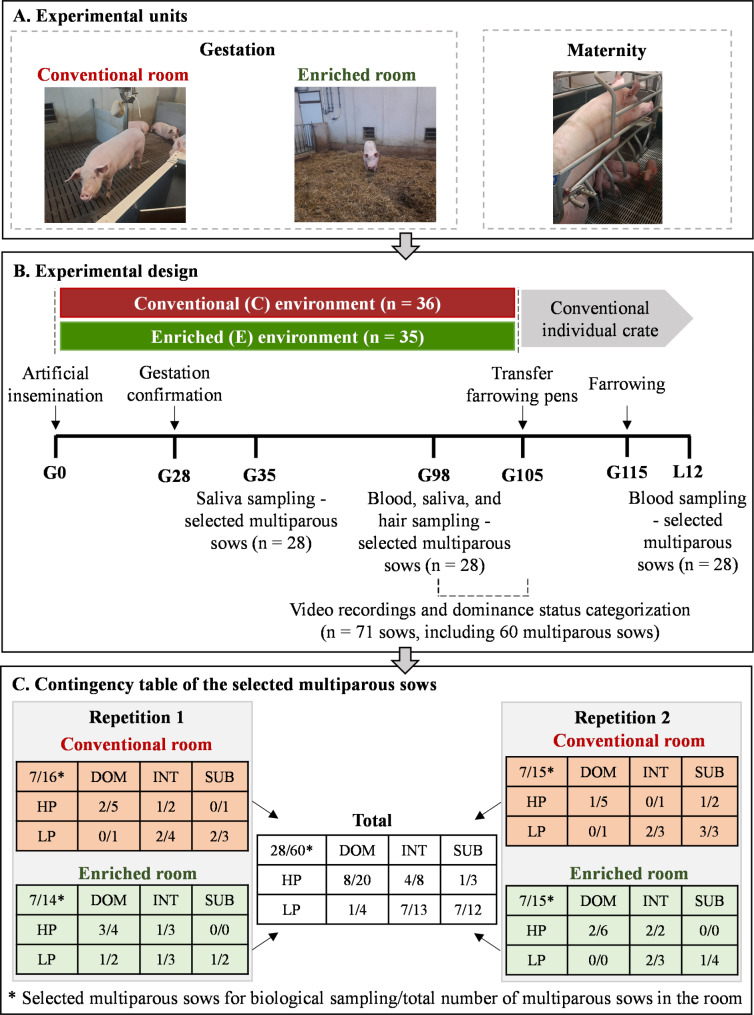
Background: Assessing farm animals' welfare is crucial, yet practical physiological tools are still lacking. In this study, we tested whether the peripheral blood mononuclear cell (PBMC) transcriptome shows variations in association with sows' welfare. To do this, we compared animals whose welfare states were assumed to differ due to their lives in more or less enriched environments and to their different dominance statuses. Sows were housed in a conventional (C, n = 36) or enriched (E, n = 35) environments from gestation day 0 (G0) until three weeks before farrowing (G105), after which they were transferred to individual farrowing crates. From G99 to G103, behavioral analyses were conducted, and sows' dominance status was evaluated. A subset of 28 multiparous sows (C, n = 14 and E, n = 14) was selected for the collection of saliva on G35 and G98 and hair on G98 for cortisol measurement, and of blood samples for PBMC transcriptome analysis on G98 and on lactation day 12 (L12).
Results: Both environmental enrichment (EE) and dominance status influenced cortisol and variables related to social and exploratory behavior, indicating an influence on sows' welfare. In the transcriptomic analysis, among the 12,260 genes submitted to differential analysis on G98, EE impacted 31 genes, while dominance status impacted 449 genes. Compared with subordinate sows (SUB), dominant (DOM) sows exhibited an upregulation of genes related to inflammatory process and plasma cell function, and downregulation of genes related to B-cell activation. In groups of sows, dominance status is partly related to sows' parity; therefore, we compared the effect of dominance with that of parity. Some common genes emerged when comparing high-parity (HP) vs. low-parity (LP) sows (542 differentially expressed genes (DEGs), including 180 in common with dominance-related genes), indicating that some effects of dominance on the transcriptome during gestation were in fact more due to age or reproductive cycles than to dominance itself. EE and dominance effects appeared relatively short-term, as DEG numbers decreased on L12 (four DEGs for E vs. C, 25 for DOM vs. SUB).
Conclusions: Dominance status exerted a more pronounced influence on sows' PBMC transcriptome than did environmental enrichment. In particular, dominance status modulated genes associated with B cells and plasma cell functions. Some of the genes identified in this study could be tested in the future as potential molecular markers of well-being.
期刊介绍:
BMC Genomics is an open access, peer-reviewed journal that considers articles on all aspects of genome-scale analysis, functional genomics, and proteomics.
BMC Genomics is part of the BMC series which publishes subject-specific journals focused on the needs of individual research communities across all areas of biology and medicine. We offer an efficient, fair and friendly peer review service, and are committed to publishing all sound science, provided that there is some advance in knowledge presented by the work.






 京公网安备 11010802042870号
京ICP备2023020795号-1
京公网安备 11010802042870号
京ICP备2023020795号-1

 分享
分享
 求助内容:
求助内容: 应助结果提醒方式:
 扫码关注我们
