Xianglin Ye, Hao Liu, Haixia Yang, Hongyang Zhang, Meiting Gong, Zhen Duan, Yan Fu, Shiqiang Xiong, Xiaoping Dan, Haifeng Pei
{"title":"一项健康成人亚平台心率变异性的前瞻性、自我对照研究。","authors":"Xianglin Ye, Hao Liu, Haixia Yang, Hongyang Zhang, Meiting Gong, Zhen Duan, Yan Fu, Shiqiang Xiong, Xiaoping Dan, Haifeng Pei","doi":"10.3389/fphys.2024.1464144","DOIUrl":null,"url":null,"abstract":"<p><strong>Background: </strong>The low-pressure, hypoxic environment characteristic of high-altitude regions significantly affects the cardiovascular and autonomic nervous system functions of individuals, consequently impairing their sleep quality. Heart rate variability, a non-invasive indicator of autonomic nervous system activity and balance within the cardiovascular system, has not been thoroughly investigated in terms of its patterns during acclimatization and de-acclimatization phases for individuals traveling to and residing in high-altitude areas and its relationship with sleep stability.</p><p><strong>Methods: </strong>Data was collected from 22 medical staff members who traveled from Chengdu to Yecheng, with measurements taken before leaving Chengdu, 1 week in Yecheng, 3 months in Yecheng, and 1 week after returning to Chengdu. The study analyzed changes in heart rate variability during acclimatization and de-acclimatization at 1,400 m above sea level. It also examined arrhythmia and sleep disorders based on circadian groups.</p><p><strong>Results: </strong>1. Following 1 week of acclimatization to the sub-plateau environment of Yecheng, significant decreases were observed in SDANN, SDNN and SD2 indices compared to departure from Chengdu (<i>P</i> < 0.05). After 3 months of sub-plateau acclimatization, these indices significantly increased (<i>P</i> < 0.05). Upon returning to Chengdu and undergoing de-acclimatization for 1 week, these indices further significantly increased (<i>P</i> < 0.05). 2. During the period of sub-plateau acclimatization and de-acclimatization, significant changes were noted in average heart rate and minimum heart rate (<i>P</i> < 0.05), with the average heart rate showing a continuous decrease and the minimum heart rate exhibiting an initial increase followed by a decrease. No significant changes were observed in maximum heart rate or the incidence of arrhythmias (<i>P</i> > 0.05). 3. When stratified by day and night, the trends for SDANN, RMSSD, and TP were consistent with the overall trend at night (<i>P</i> < 0.05), but opposite during the day (<i>P</i> < 0.05). 4. During the sub-plateau acclimatization period, stable sleep duration was significantly reduced, and increased markedly after de-acclimatization, although it did not return to pre-acclimatization levels (<i>P</i> < 0.05).</p><p><strong>Conclusion: </strong>Acclimatization to the sub-plateau environment of Yecheng affects the autonomic nervous system, heart rate, and sleep in healthy adults. De-acclimatization can ameliorate these effects. Furthermore, the impact of sub-plateau acclimatization on the autonomic nervous system exhibits a distinct circadian rhythmicity.</p>","PeriodicalId":12477,"journal":{"name":"Frontiers in Physiology","volume":"15 ","pages":"1464144"},"PeriodicalIF":3.2000,"publicationDate":"2024-12-09","publicationTypes":"Journal Article","fieldsOfStudy":null,"isOpenAccess":false,"openAccessPdf":"https://www.ncbi.nlm.nih.gov/pmc/articles/PMC11663842/pdf/","citationCount":"0","resultStr":"{\"title\":\"A prospective, self-controlled study of sub-plateau heart rate variability in healthy adults.\",\"authors\":\"Xianglin Ye, Hao Liu, Haixia Yang, Hongyang Zhang, Meiting Gong, Zhen Duan, Yan Fu, Shiqiang Xiong, Xiaoping Dan, Haifeng Pei\",\"doi\":\"10.3389/fphys.2024.1464144\",\"DOIUrl\":null,\"url\":null,\"abstract\":\"<p><strong>Background: </strong>The low-pressure, hypoxic environment characteristic of high-altitude regions significantly affects the cardiovascular and autonomic nervous system functions of individuals, consequently impairing their sleep quality. Heart rate variability, a non-invasive indicator of autonomic nervous system activity and balance within the cardiovascular system, has not been thoroughly investigated in terms of its patterns during acclimatization and de-acclimatization phases for individuals traveling to and residing in high-altitude areas and its relationship with sleep stability.</p><p><strong>Methods: </strong>Data was collected from 22 medical staff members who traveled from Chengdu to Yecheng, with measurements taken before leaving Chengdu, 1 week in Yecheng, 3 months in Yecheng, and 1 week after returning to Chengdu. The study analyzed changes in heart rate variability during acclimatization and de-acclimatization at 1,400 m above sea level. It also examined arrhythmia and sleep disorders based on circadian groups.</p><p><strong>Results: </strong>1. Following 1 week of acclimatization to the sub-plateau environment of Yecheng, significant decreases were observed in SDANN, SDNN and SD2 indices compared to departure from Chengdu (<i>P</i> < 0.05). After 3 months of sub-plateau acclimatization, these indices significantly increased (<i>P</i> < 0.05). Upon returning to Chengdu and undergoing de-acclimatization for 1 week, these indices further significantly increased (<i>P</i> < 0.05). 2. During the period of sub-plateau acclimatization and de-acclimatization, significant changes were noted in average heart rate and minimum heart rate (<i>P</i> < 0.05), with the average heart rate showing a continuous decrease and the minimum heart rate exhibiting an initial increase followed by a decrease. No significant changes were observed in maximum heart rate or the incidence of arrhythmias (<i>P</i> > 0.05). 3. When stratified by day and night, the trends for SDANN, RMSSD, and TP were consistent with the overall trend at night (<i>P</i> < 0.05), but opposite during the day (<i>P</i> < 0.05). 4. During the sub-plateau acclimatization period, stable sleep duration was significantly reduced, and increased markedly after de-acclimatization, although it did not return to pre-acclimatization levels (<i>P</i> < 0.05).</p><p><strong>Conclusion: </strong>Acclimatization to the sub-plateau environment of Yecheng affects the autonomic nervous system, heart rate, and sleep in healthy adults. De-acclimatization can ameliorate these effects. Furthermore, the impact of sub-plateau acclimatization on the autonomic nervous system exhibits a distinct circadian rhythmicity.</p>\",\"PeriodicalId\":12477,\"journal\":{\"name\":\"Frontiers in Physiology\",\"volume\":\"15 \",\"pages\":\"1464144\"},\"PeriodicalIF\":3.2000,\"publicationDate\":\"2024-12-09\",\"publicationTypes\":\"Journal Article\",\"fieldsOfStudy\":null,\"isOpenAccess\":false,\"openAccessPdf\":\"https://www.ncbi.nlm.nih.gov/pmc/articles/PMC11663842/pdf/\",\"citationCount\":\"0\",\"resultStr\":null,\"platform\":\"Semanticscholar\",\"paperid\":null,\"PeriodicalName\":\"Frontiers in Physiology\",\"FirstCategoryId\":\"3\",\"ListUrlMain\":\"https://doi.org/10.3389/fphys.2024.1464144\",\"RegionNum\":3,\"RegionCategory\":\"医学\",\"ArticlePicture\":[],\"TitleCN\":null,\"AbstractTextCN\":null,\"PMCID\":null,\"EPubDate\":\"2024/1/1 0:00:00\",\"PubModel\":\"eCollection\",\"JCR\":\"Q2\",\"JCRName\":\"PHYSIOLOGY\",\"Score\":null,\"Total\":0}","platform":"Semanticscholar","paperid":null,"PeriodicalName":"Frontiers in Physiology","FirstCategoryId":"3","ListUrlMain":"https://doi.org/10.3389/fphys.2024.1464144","RegionNum":3,"RegionCategory":"医学","ArticlePicture":[],"TitleCN":null,"AbstractTextCN":null,"PMCID":null,"EPubDate":"2024/1/1 0:00:00","PubModel":"eCollection","JCR":"Q2","JCRName":"PHYSIOLOGY","Score":null,"Total":0}
A prospective, self-controlled study of sub-plateau heart rate variability in healthy adults.
Background: The low-pressure, hypoxic environment characteristic of high-altitude regions significantly affects the cardiovascular and autonomic nervous system functions of individuals, consequently impairing their sleep quality. Heart rate variability, a non-invasive indicator of autonomic nervous system activity and balance within the cardiovascular system, has not been thoroughly investigated in terms of its patterns during acclimatization and de-acclimatization phases for individuals traveling to and residing in high-altitude areas and its relationship with sleep stability.
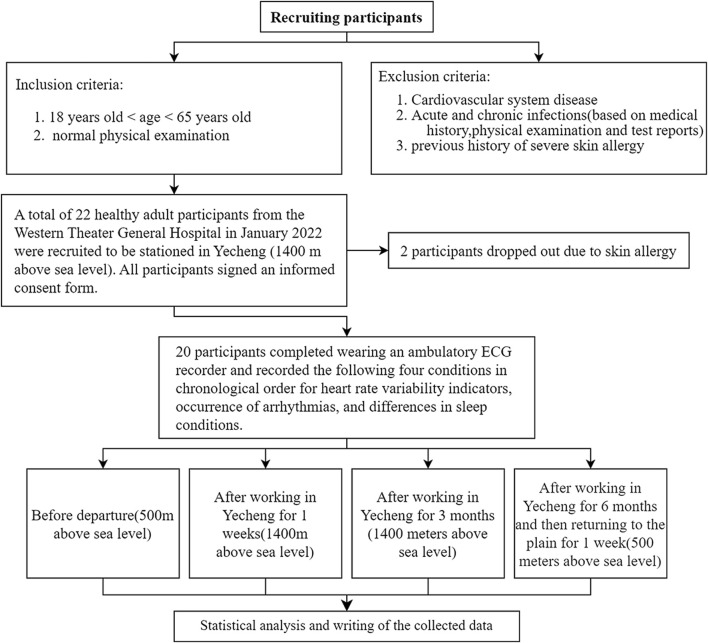
Methods: Data was collected from 22 medical staff members who traveled from Chengdu to Yecheng, with measurements taken before leaving Chengdu, 1 week in Yecheng, 3 months in Yecheng, and 1 week after returning to Chengdu. The study analyzed changes in heart rate variability during acclimatization and de-acclimatization at 1,400 m above sea level. It also examined arrhythmia and sleep disorders based on circadian groups.
Results: 1. Following 1 week of acclimatization to the sub-plateau environment of Yecheng, significant decreases were observed in SDANN, SDNN and SD2 indices compared to departure from Chengdu (P < 0.05). After 3 months of sub-plateau acclimatization, these indices significantly increased (P < 0.05). Upon returning to Chengdu and undergoing de-acclimatization for 1 week, these indices further significantly increased (P < 0.05). 2. During the period of sub-plateau acclimatization and de-acclimatization, significant changes were noted in average heart rate and minimum heart rate (P < 0.05), with the average heart rate showing a continuous decrease and the minimum heart rate exhibiting an initial increase followed by a decrease. No significant changes were observed in maximum heart rate or the incidence of arrhythmias (P > 0.05). 3. When stratified by day and night, the trends for SDANN, RMSSD, and TP were consistent with the overall trend at night (P < 0.05), but opposite during the day (P < 0.05). 4. During the sub-plateau acclimatization period, stable sleep duration was significantly reduced, and increased markedly after de-acclimatization, although it did not return to pre-acclimatization levels (P < 0.05).
Conclusion: Acclimatization to the sub-plateau environment of Yecheng affects the autonomic nervous system, heart rate, and sleep in healthy adults. De-acclimatization can ameliorate these effects. Furthermore, the impact of sub-plateau acclimatization on the autonomic nervous system exhibits a distinct circadian rhythmicity.
期刊介绍:
Frontiers in Physiology is a leading journal in its field, publishing rigorously peer-reviewed research on the physiology of living systems, from the subcellular and molecular domains to the intact organism, and its interaction with the environment. Field Chief Editor George E. Billman at the Ohio State University Columbus is supported by an outstanding Editorial Board of international researchers. This multidisciplinary open-access journal is at the forefront of disseminating and communicating scientific knowledge and impactful discoveries to researchers, academics, clinicians and the public worldwide.





 京公网安备 11010802042870号
京ICP备2023020795号-1
京公网安备 11010802042870号
京ICP备2023020795号-1

 分享
分享
 求助内容:
求助内容: 应助结果提醒方式:
 扫码关注我们
