Shufeng Zhao , Hongyu Guo , Norbert Klitzsch , Xiao Liu , Guofu Li , Xiaokai Xu
{"title":"生物降解塑料在褐煤厌氧消化中的作用:有机物转化和代谢途径的变化。","authors":"Shufeng Zhao , Hongyu Guo , Norbert Klitzsch , Xiao Liu , Guofu Li , Xiaokai Xu","doi":"10.1016/j.biortech.2024.132021","DOIUrl":null,"url":null,"abstract":"<div><div>Biodegradable plastics (BPs) and lignite, both rich in organic matter, present significant challenges for efficient conversion into clean energy. This study examined the anaerobic co-digestion of BPs and lignite under controlled laboratory conditions. The results demonstrated that the co-digestion of polylactic acid (PLA) and lignite (at a 1:2 mass ratio, with 5 g PLA and 10 g lignite as the model system) rapidly acclimated to the anaerobic environment, enhancing cumulative biogas production by 57 % compared to the mono-digestion of lignite alone. Synergistic fermentation significantly increased the production of organic small molecules while effectively degrading recalcitrant substances, including hydroxyl, aromatic, and methylene groups. <em>Euryarchaeota</em> emerged as the dominant phylum, with its abundance increasing by 118.4 %. Gene abundance for the carbon dioxide-to-methane conversion pathway increased by 60.1 %, confirming it as the primary methane metabolic pathway. These findings provide a novel method for the conversion and utilization of BPs and lignite.</div></div>","PeriodicalId":258,"journal":{"name":"Bioresource Technology","volume":"419 ","pages":"Article 132021"},"PeriodicalIF":9.0000,"publicationDate":"2025-03-01","publicationTypes":"Journal Article","fieldsOfStudy":null,"isOpenAccess":false,"openAccessPdf":"","citationCount":"0","resultStr":"{\"title\":\"The role of biodegradable plastics in lignite anaerobic digestion: Changes of organics transformation and metabolic pathway\",\"authors\":\"Shufeng Zhao , Hongyu Guo , Norbert Klitzsch , Xiao Liu , Guofu Li , Xiaokai Xu\",\"doi\":\"10.1016/j.biortech.2024.132021\",\"DOIUrl\":null,\"url\":null,\"abstract\":\"<div><div>Biodegradable plastics (BPs) and lignite, both rich in organic matter, present significant challenges for efficient conversion into clean energy. This study examined the anaerobic co-digestion of BPs and lignite under controlled laboratory conditions. The results demonstrated that the co-digestion of polylactic acid (PLA) and lignite (at a 1:2 mass ratio, with 5 g PLA and 10 g lignite as the model system) rapidly acclimated to the anaerobic environment, enhancing cumulative biogas production by 57 % compared to the mono-digestion of lignite alone. Synergistic fermentation significantly increased the production of organic small molecules while effectively degrading recalcitrant substances, including hydroxyl, aromatic, and methylene groups. <em>Euryarchaeota</em> emerged as the dominant phylum, with its abundance increasing by 118.4 %. Gene abundance for the carbon dioxide-to-methane conversion pathway increased by 60.1 %, confirming it as the primary methane metabolic pathway. These findings provide a novel method for the conversion and utilization of BPs and lignite.</div></div>\",\"PeriodicalId\":258,\"journal\":{\"name\":\"Bioresource Technology\",\"volume\":\"419 \",\"pages\":\"Article 132021\"},\"PeriodicalIF\":9.0000,\"publicationDate\":\"2025-03-01\",\"publicationTypes\":\"Journal Article\",\"fieldsOfStudy\":null,\"isOpenAccess\":false,\"openAccessPdf\":\"\",\"citationCount\":\"0\",\"resultStr\":null,\"platform\":\"Semanticscholar\",\"paperid\":null,\"PeriodicalName\":\"Bioresource Technology\",\"FirstCategoryId\":\"5\",\"ListUrlMain\":\"https://www.sciencedirect.com/science/article/pii/S0960852424017255\",\"RegionNum\":1,\"RegionCategory\":\"环境科学与生态学\",\"ArticlePicture\":[],\"TitleCN\":null,\"AbstractTextCN\":null,\"PMCID\":null,\"EPubDate\":\"2024/12/26 0:00:00\",\"PubModel\":\"Epub\",\"JCR\":\"Q1\",\"JCRName\":\"AGRICULTURAL ENGINEERING\",\"Score\":null,\"Total\":0}","platform":"Semanticscholar","paperid":null,"PeriodicalName":"Bioresource Technology","FirstCategoryId":"5","ListUrlMain":"https://www.sciencedirect.com/science/article/pii/S0960852424017255","RegionNum":1,"RegionCategory":"环境科学与生态学","ArticlePicture":[],"TitleCN":null,"AbstractTextCN":null,"PMCID":null,"EPubDate":"2024/12/26 0:00:00","PubModel":"Epub","JCR":"Q1","JCRName":"AGRICULTURAL ENGINEERING","Score":null,"Total":0}
引用次数: 0
摘要
可生物降解塑料(bp)和褐煤都富含有机物,对有效转化为清洁能源提出了重大挑战。本研究在受控的实验室条件下考察了bp和褐煤的厌氧共消化。结果表明,聚乳酸(PLA)与褐煤共消化(质量比为1:2,以5 g PLA和10 g褐煤为模型系统)快速适应厌氧环境,与单独消化褐煤相比,累计沼气产量提高了57 %。协同发酵显著增加了有机小分子的产量,同时有效地降解了顽固性物质,包括羟基、芳香族和亚甲基。Euryarchaeota成为优势门,其丰度增加118.4 %。二氧化碳-甲烷转化途径的基因丰度增加了60.1 %,确认其为主要的甲烷代谢途径。这些发现为bp和褐煤的转化利用提供了一种新的方法。
The role of biodegradable plastics in lignite anaerobic digestion: Changes of organics transformation and metabolic pathway
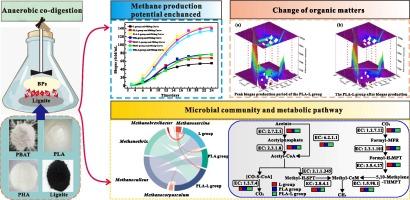
Biodegradable plastics (BPs) and lignite, both rich in organic matter, present significant challenges for efficient conversion into clean energy. This study examined the anaerobic co-digestion of BPs and lignite under controlled laboratory conditions. The results demonstrated that the co-digestion of polylactic acid (PLA) and lignite (at a 1:2 mass ratio, with 5 g PLA and 10 g lignite as the model system) rapidly acclimated to the anaerobic environment, enhancing cumulative biogas production by 57 % compared to the mono-digestion of lignite alone. Synergistic fermentation significantly increased the production of organic small molecules while effectively degrading recalcitrant substances, including hydroxyl, aromatic, and methylene groups. Euryarchaeota emerged as the dominant phylum, with its abundance increasing by 118.4 %. Gene abundance for the carbon dioxide-to-methane conversion pathway increased by 60.1 %, confirming it as the primary methane metabolic pathway. These findings provide a novel method for the conversion and utilization of BPs and lignite.
期刊介绍:
Bioresource Technology publishes original articles, review articles, case studies, and short communications covering the fundamentals, applications, and management of bioresource technology. The journal seeks to advance and disseminate knowledge across various areas related to biomass, biological waste treatment, bioenergy, biotransformations, bioresource systems analysis, and associated conversion or production technologies.
Topics include:
• Biofuels: liquid and gaseous biofuels production, modeling and economics
• Bioprocesses and bioproducts: biocatalysis and fermentations
• Biomass and feedstocks utilization: bioconversion of agro-industrial residues
• Environmental protection: biological waste treatment
• Thermochemical conversion of biomass: combustion, pyrolysis, gasification, catalysis.




 京公网安备 11010802042870号
京ICP备2023020795号-1
京公网安备 11010802042870号
京ICP备2023020795号-1

 分享
分享
 求助内容:
求助内容: 应助结果提醒方式:
 扫码关注我们
