Hea Lim Choi, Su Min Jeong, Keun Hye Jeon, Bongseong Kim, Wonyoung Jung, Ansuk Jeong, Kyungdo Han, Dong Wook Shin
{"title":"乳腺癌幸存者的抑郁风险:韩国一项全国性队列研究。","authors":"Hea Lim Choi, Su Min Jeong, Keun Hye Jeon, Bongseong Kim, Wonyoung Jung, Ansuk Jeong, Kyungdo Han, Dong Wook Shin","doi":"10.1186/s13058-024-01948-w","DOIUrl":null,"url":null,"abstract":"<p><strong>Background: </strong>Depression among breast cancer survivors is a significant concern affecting their long-term survivorship and quality of life. This study investigates the incidence of depression among breast cancer survivors and identifies associated risk factors.</p><p><strong>Methods: </strong>This retrospective cohort study used data from the Korean National Health Insurance Service database and included 59,340 breast cancer patients without a history of depression who underwent surgery between January 1, 2010, and December 31, 2016. They were individually matched 1:2 by age with a general population without cancer (n = 99,834). The mean follow-up period was 6.4 ± 2.6 years. Sub-distribution hazard ratios (sHRs) and 95% confidence intervals (CIs) were calculated considering death as a competing risk and adjusting for sociodemographic factors and comorbidities.</p><p><strong>Results: </strong>Breast cancer survivors with a mean (standard deviation) age of 51.5 (9.2) years had a 39% increased risk of depression compared to non-cancer controls (sHR 1.39, 95% CI 1.36-1.42). During the first year post-diagnosis, breast cancer survivors across all ages exhibited a significantly elevated risk of depression, with a sHR of 3.23 (95% CI 3.08-3.37). Notably, younger survivors had a sHR of 4.51 (95% CI 4.19-4.85), and older survivors had a sHR of 2.56 (95% CI 2.42-2.71). One year post-surgery, younger survivors (age ≤ 50 years) showed a 1.16-fold increase in depression risk (sHR 1.16, 95% CI 1.11-1.20), while older survivors (age > 50 years) showed no significant change in risk, which decreased over time. Use of anthracycline, taxane, or endocrine therapy was associated with an increased depression risk (sHR 1.17, 95% CI 1.13-1.22; sHR 1.12, 95% CI 1.07-1.16; and sHR 1.27, 95% CI 1.14-1.41, respectively), with endocrine therapy showing a 41% increased depression risk in older survivors (sHR 1.41, 95% CI 1.23-1.61).</p><p><strong>Conclusion: </strong>This study demonstrates a significant association between breast cancer and depression, with a particularly heightened risk in younger survivors within the first year post-diagnosis. Special attention is needed to meticulously screen for depressive symptoms during the early follow-up years for breast cancer survivors who are premenopausal or have undergone chemotherapy and endocrine therapy.</p>","PeriodicalId":49227,"journal":{"name":"Breast Cancer Research","volume":"26 1","pages":"188"},"PeriodicalIF":5.6000,"publicationDate":"2024-12-27","publicationTypes":"Journal Article","fieldsOfStudy":null,"isOpenAccess":false,"openAccessPdf":"https://www.ncbi.nlm.nih.gov/pmc/articles/PMC11674164/pdf/","citationCount":"0","resultStr":"{\"title\":\"Depression risk among breast cancer survivors: a nationwide cohort study in South Korea.\",\"authors\":\"Hea Lim Choi, Su Min Jeong, Keun Hye Jeon, Bongseong Kim, Wonyoung Jung, Ansuk Jeong, Kyungdo Han, Dong Wook Shin\",\"doi\":\"10.1186/s13058-024-01948-w\",\"DOIUrl\":null,\"url\":null,\"abstract\":\"<p><strong>Background: </strong>Depression among breast cancer survivors is a significant concern affecting their long-term survivorship and quality of life. This study investigates the incidence of depression among breast cancer survivors and identifies associated risk factors.</p><p><strong>Methods: </strong>This retrospective cohort study used data from the Korean National Health Insurance Service database and included 59,340 breast cancer patients without a history of depression who underwent surgery between January 1, 2010, and December 31, 2016. They were individually matched 1:2 by age with a general population without cancer (n = 99,834). The mean follow-up period was 6.4 ± 2.6 years. Sub-distribution hazard ratios (sHRs) and 95% confidence intervals (CIs) were calculated considering death as a competing risk and adjusting for sociodemographic factors and comorbidities.</p><p><strong>Results: </strong>Breast cancer survivors with a mean (standard deviation) age of 51.5 (9.2) years had a 39% increased risk of depression compared to non-cancer controls (sHR 1.39, 95% CI 1.36-1.42). During the first year post-diagnosis, breast cancer survivors across all ages exhibited a significantly elevated risk of depression, with a sHR of 3.23 (95% CI 3.08-3.37). Notably, younger survivors had a sHR of 4.51 (95% CI 4.19-4.85), and older survivors had a sHR of 2.56 (95% CI 2.42-2.71). One year post-surgery, younger survivors (age ≤ 50 years) showed a 1.16-fold increase in depression risk (sHR 1.16, 95% CI 1.11-1.20), while older survivors (age > 50 years) showed no significant change in risk, which decreased over time. Use of anthracycline, taxane, or endocrine therapy was associated with an increased depression risk (sHR 1.17, 95% CI 1.13-1.22; sHR 1.12, 95% CI 1.07-1.16; and sHR 1.27, 95% CI 1.14-1.41, respectively), with endocrine therapy showing a 41% increased depression risk in older survivors (sHR 1.41, 95% CI 1.23-1.61).</p><p><strong>Conclusion: </strong>This study demonstrates a significant association between breast cancer and depression, with a particularly heightened risk in younger survivors within the first year post-diagnosis. Special attention is needed to meticulously screen for depressive symptoms during the early follow-up years for breast cancer survivors who are premenopausal or have undergone chemotherapy and endocrine therapy.</p>\",\"PeriodicalId\":49227,\"journal\":{\"name\":\"Breast Cancer Research\",\"volume\":\"26 1\",\"pages\":\"188\"},\"PeriodicalIF\":5.6000,\"publicationDate\":\"2024-12-27\",\"publicationTypes\":\"Journal Article\",\"fieldsOfStudy\":null,\"isOpenAccess\":false,\"openAccessPdf\":\"https://www.ncbi.nlm.nih.gov/pmc/articles/PMC11674164/pdf/\",\"citationCount\":\"0\",\"resultStr\":null,\"platform\":\"Semanticscholar\",\"paperid\":null,\"PeriodicalName\":\"Breast Cancer Research\",\"FirstCategoryId\":\"3\",\"ListUrlMain\":\"https://doi.org/10.1186/s13058-024-01948-w\",\"RegionNum\":1,\"RegionCategory\":\"医学\",\"ArticlePicture\":[],\"TitleCN\":null,\"AbstractTextCN\":null,\"PMCID\":null,\"EPubDate\":\"\",\"PubModel\":\"\",\"JCR\":\"Q1\",\"JCRName\":\"Medicine\",\"Score\":null,\"Total\":0}","platform":"Semanticscholar","paperid":null,"PeriodicalName":"Breast Cancer Research","FirstCategoryId":"3","ListUrlMain":"https://doi.org/10.1186/s13058-024-01948-w","RegionNum":1,"RegionCategory":"医学","ArticlePicture":[],"TitleCN":null,"AbstractTextCN":null,"PMCID":null,"EPubDate":"","PubModel":"","JCR":"Q1","JCRName":"Medicine","Score":null,"Total":0}
引用次数: 0
摘要
背景:乳腺癌幸存者的抑郁是影响其长期生存和生活质量的重要因素。本研究调查了乳腺癌幸存者中抑郁症的发生率,并确定了相关的危险因素。方法:本回顾性队列研究使用韩国国民健康保险服务数据库的数据,纳入了2010年1月1日至2016年12月31日期间接受手术的59340名无抑郁史的乳腺癌患者。他们与一般人群按年龄1:2匹配(n = 99,834)。平均随访时间6.4±2.6年。计算亚分布风险比(sHRs)和95%置信区间(ci),将死亡作为一种竞争风险,并对社会人口因素和合并症进行调整。结果:平均(标准差)年龄为51.5(9.2)岁的乳腺癌幸存者与非癌症对照组相比,患抑郁症的风险增加39% (sHR 1.39, 95% CI 1.36-1.42)。在诊断后的第一年,所有年龄段的乳腺癌幸存者表现出明显升高的抑郁风险,sHR为3.23 (95% CI 3.08-3.37)。值得注意的是,年轻幸存者的sHR为4.51 (95% CI 4.19-4.85),老年幸存者的sHR为2.56 (95% CI 2.42-2.71)。术后1年,年轻幸存者(年龄≤50岁)的抑郁风险增加1.16倍(sHR 1.16, 95% CI 1.11-1.20),而年龄较大的幸存者(年龄50岁)的风险没有显著变化,随着时间的推移而降低。使用蒽环类药物、紫杉烷或内分泌治疗与抑郁症风险增加相关(sHR 1.17, 95% CI 1.13-1.22;sHR 1.12, 95% CI 1.07-1.16;和sHR 1.27, 95% CI分别为1.14-1.41),而内分泌治疗显示老年幸存者抑郁风险增加41% (sHR 1.41, 95% CI 1.23-1.61)。结论:这项研究证明了乳腺癌和抑郁症之间的显著关联,尤其是在诊断后第一年的年轻幸存者中风险更高。在绝经前或接受过化疗和内分泌治疗的乳腺癌幸存者的早期随访中,需要特别注意仔细筛查抑郁症状。
Depression risk among breast cancer survivors: a nationwide cohort study in South Korea.
Background: Depression among breast cancer survivors is a significant concern affecting their long-term survivorship and quality of life. This study investigates the incidence of depression among breast cancer survivors and identifies associated risk factors.
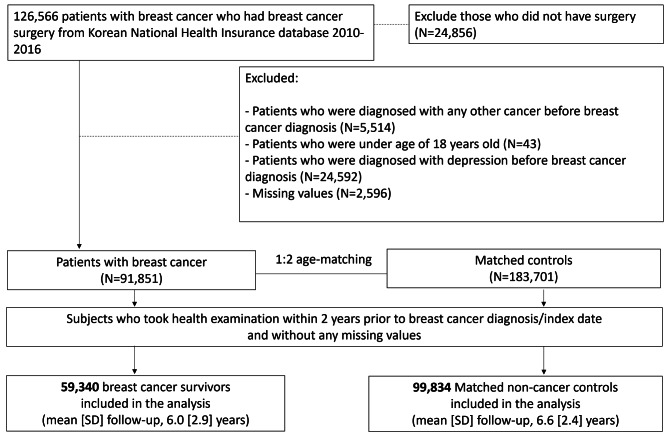
Methods: This retrospective cohort study used data from the Korean National Health Insurance Service database and included 59,340 breast cancer patients without a history of depression who underwent surgery between January 1, 2010, and December 31, 2016. They were individually matched 1:2 by age with a general population without cancer (n = 99,834). The mean follow-up period was 6.4 ± 2.6 years. Sub-distribution hazard ratios (sHRs) and 95% confidence intervals (CIs) were calculated considering death as a competing risk and adjusting for sociodemographic factors and comorbidities.
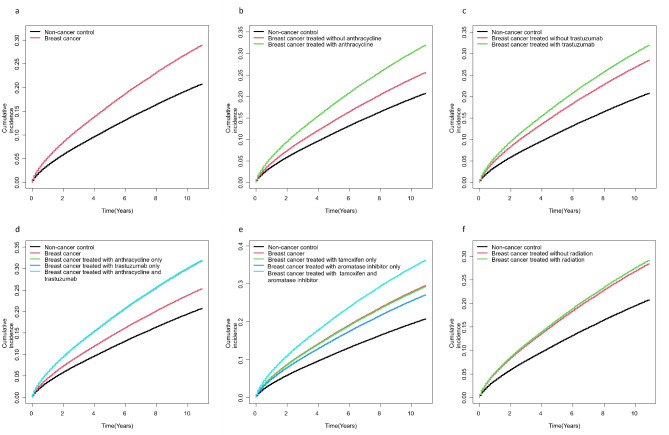
Results: Breast cancer survivors with a mean (standard deviation) age of 51.5 (9.2) years had a 39% increased risk of depression compared to non-cancer controls (sHR 1.39, 95% CI 1.36-1.42). During the first year post-diagnosis, breast cancer survivors across all ages exhibited a significantly elevated risk of depression, with a sHR of 3.23 (95% CI 3.08-3.37). Notably, younger survivors had a sHR of 4.51 (95% CI 4.19-4.85), and older survivors had a sHR of 2.56 (95% CI 2.42-2.71). One year post-surgery, younger survivors (age ≤ 50 years) showed a 1.16-fold increase in depression risk (sHR 1.16, 95% CI 1.11-1.20), while older survivors (age > 50 years) showed no significant change in risk, which decreased over time. Use of anthracycline, taxane, or endocrine therapy was associated with an increased depression risk (sHR 1.17, 95% CI 1.13-1.22; sHR 1.12, 95% CI 1.07-1.16; and sHR 1.27, 95% CI 1.14-1.41, respectively), with endocrine therapy showing a 41% increased depression risk in older survivors (sHR 1.41, 95% CI 1.23-1.61).
Conclusion: This study demonstrates a significant association between breast cancer and depression, with a particularly heightened risk in younger survivors within the first year post-diagnosis. Special attention is needed to meticulously screen for depressive symptoms during the early follow-up years for breast cancer survivors who are premenopausal or have undergone chemotherapy and endocrine therapy.
期刊介绍:
Breast Cancer Research, an international, peer-reviewed online journal, publishes original research, reviews, editorials, and reports. It features open-access research articles of exceptional interest across all areas of biology and medicine relevant to breast cancer. This includes normal mammary gland biology, with a special emphasis on the genetic, biochemical, and cellular basis of breast cancer. In addition to basic research, the journal covers preclinical, translational, and clinical studies with a biological basis, including Phase I and Phase II trials.




 京公网安备 11010802042870号
京ICP备2023020795号-1
京公网安备 11010802042870号
京ICP备2023020795号-1

 分享
分享
 求助内容:
求助内容: 应助结果提醒方式:
 扫码关注我们
