Jie Wang, Na Jin, Zheyu Xie, Qichao Cheng, Bo Jiang, Yajun Shuai, Zongpu Xu, Quan Wan, Yuyin Chen, Chuanbin Mao and Mingying Yang
{"title":"自组装丝素蛋白包覆金纳米棒改善其生物相容性及促进靶向光热-光动力癌症治疗","authors":"Jie Wang, Na Jin, Zheyu Xie, Qichao Cheng, Bo Jiang, Yajun Shuai, Zongpu Xu, Quan Wan, Yuyin Chen, Chuanbin Mao and Mingying Yang","doi":"10.1039/D4NR03641G","DOIUrl":null,"url":null,"abstract":"<p >Gold nanorods (AuNRs) have shown great potential as photothermal agents for cancer therapy. However, the biosafety of AuNRs ordinarily synthesized using a cationic ligand assistance procedure has always been a subject of controversy, which limits their application in tumor therapy. In this study, we propose a novel strategy to enhance the biocompatibility of AuNRs by constructing a biological coating derived from silk fibroin (SF) on their surface. The SF coating could be easily and precisely manipulated using a layer-by-layer (LBL) assembly method. The resulting SF-coated gold nanorods (AuNRs@SF) exhibited reduced cytotoxicity and improved hemocompatibility compared to untreated AuNRs. Moreover, the treated nanorods were easily modified with a tumor-targeting peptide (AuNRs@MTSF) and efficiently loaded indocyanine green (ICG). Both <em>in vitro</em> and <em>in vivo</em> analyses demonstrated that AuNRs@MTSF could more effectively reach tumor tissue and enter MCF-7 cells. Furthermore, after loading ICG, AuNRs@MTSF exhibited superior antitumor efficacy compared to other groups by combining photodynamic therapy (PDT) with photothermal therapy (PTT) under near-infrared (NIR) irradiation without inducing any side effects. This work suggests that SF coating of gold nanorods is a potential approach for improving their biocompatibility, and that function-modified AuNRs@SF are effective nanoplatforms for targeted and multimodal tumor therapy.</p>","PeriodicalId":92,"journal":{"name":"Nanoscale","volume":" 8","pages":" 4624-4635"},"PeriodicalIF":5.1000,"publicationDate":"2024-12-31","publicationTypes":"Journal Article","fieldsOfStudy":null,"isOpenAccess":false,"openAccessPdf":"","citationCount":"0","resultStr":"{\"title\":\"Gold nanorods coated with self-assembled silk fibroin for improving their biocompatibility and facilitating targeted photothermal–photodynamic cancer therapy†\",\"authors\":\"Jie Wang, Na Jin, Zheyu Xie, Qichao Cheng, Bo Jiang, Yajun Shuai, Zongpu Xu, Quan Wan, Yuyin Chen, Chuanbin Mao and Mingying Yang\",\"doi\":\"10.1039/D4NR03641G\",\"DOIUrl\":null,\"url\":null,\"abstract\":\"<p >Gold nanorods (AuNRs) have shown great potential as photothermal agents for cancer therapy. However, the biosafety of AuNRs ordinarily synthesized using a cationic ligand assistance procedure has always been a subject of controversy, which limits their application in tumor therapy. In this study, we propose a novel strategy to enhance the biocompatibility of AuNRs by constructing a biological coating derived from silk fibroin (SF) on their surface. The SF coating could be easily and precisely manipulated using a layer-by-layer (LBL) assembly method. The resulting SF-coated gold nanorods (AuNRs@SF) exhibited reduced cytotoxicity and improved hemocompatibility compared to untreated AuNRs. Moreover, the treated nanorods were easily modified with a tumor-targeting peptide (AuNRs@MTSF) and efficiently loaded indocyanine green (ICG). Both <em>in vitro</em> and <em>in vivo</em> analyses demonstrated that AuNRs@MTSF could more effectively reach tumor tissue and enter MCF-7 cells. Furthermore, after loading ICG, AuNRs@MTSF exhibited superior antitumor efficacy compared to other groups by combining photodynamic therapy (PDT) with photothermal therapy (PTT) under near-infrared (NIR) irradiation without inducing any side effects. This work suggests that SF coating of gold nanorods is a potential approach for improving their biocompatibility, and that function-modified AuNRs@SF are effective nanoplatforms for targeted and multimodal tumor therapy.</p>\",\"PeriodicalId\":92,\"journal\":{\"name\":\"Nanoscale\",\"volume\":\" 8\",\"pages\":\" 4624-4635\"},\"PeriodicalIF\":5.1000,\"publicationDate\":\"2024-12-31\",\"publicationTypes\":\"Journal Article\",\"fieldsOfStudy\":null,\"isOpenAccess\":false,\"openAccessPdf\":\"\",\"citationCount\":\"0\",\"resultStr\":null,\"platform\":\"Semanticscholar\",\"paperid\":null,\"PeriodicalName\":\"Nanoscale\",\"FirstCategoryId\":\"88\",\"ListUrlMain\":\"https://pubs.rsc.org/en/content/articlelanding/2025/nr/d4nr03641g\",\"RegionNum\":3,\"RegionCategory\":\"材料科学\",\"ArticlePicture\":[],\"TitleCN\":null,\"AbstractTextCN\":null,\"PMCID\":null,\"EPubDate\":\"\",\"PubModel\":\"\",\"JCR\":\"Q1\",\"JCRName\":\"CHEMISTRY, MULTIDISCIPLINARY\",\"Score\":null,\"Total\":0}","platform":"Semanticscholar","paperid":null,"PeriodicalName":"Nanoscale","FirstCategoryId":"88","ListUrlMain":"https://pubs.rsc.org/en/content/articlelanding/2025/nr/d4nr03641g","RegionNum":3,"RegionCategory":"材料科学","ArticlePicture":[],"TitleCN":null,"AbstractTextCN":null,"PMCID":null,"EPubDate":"","PubModel":"","JCR":"Q1","JCRName":"CHEMISTRY, MULTIDISCIPLINARY","Score":null,"Total":0}
Gold nanorods coated with self-assembled silk fibroin for improving their biocompatibility and facilitating targeted photothermal–photodynamic cancer therapy†
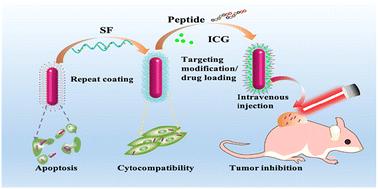
Gold nanorods (AuNRs) have shown great potential as photothermal agents for cancer therapy. However, the biosafety of AuNRs ordinarily synthesized using a cationic ligand assistance procedure has always been a subject of controversy, which limits their application in tumor therapy. In this study, we propose a novel strategy to enhance the biocompatibility of AuNRs by constructing a biological coating derived from silk fibroin (SF) on their surface. The SF coating could be easily and precisely manipulated using a layer-by-layer (LBL) assembly method. The resulting SF-coated gold nanorods (AuNRs@SF) exhibited reduced cytotoxicity and improved hemocompatibility compared to untreated AuNRs. Moreover, the treated nanorods were easily modified with a tumor-targeting peptide (AuNRs@MTSF) and efficiently loaded indocyanine green (ICG). Both in vitro and in vivo analyses demonstrated that AuNRs@MTSF could more effectively reach tumor tissue and enter MCF-7 cells. Furthermore, after loading ICG, AuNRs@MTSF exhibited superior antitumor efficacy compared to other groups by combining photodynamic therapy (PDT) with photothermal therapy (PTT) under near-infrared (NIR) irradiation without inducing any side effects. This work suggests that SF coating of gold nanorods is a potential approach for improving their biocompatibility, and that function-modified AuNRs@SF are effective nanoplatforms for targeted and multimodal tumor therapy.
期刊介绍:
Nanoscale is a high-impact international journal, publishing high-quality research across nanoscience and nanotechnology. Nanoscale publishes a full mix of research articles on experimental and theoretical work, including reviews, communications, and full papers.Highly interdisciplinary, this journal appeals to scientists, researchers and professionals interested in nanoscience and nanotechnology, quantum materials and quantum technology, including the areas of physics, chemistry, biology, medicine, materials, energy/environment, information technology, detection science, healthcare and drug discovery, and electronics.




 京公网安备 11010802042870号
京ICP备2023020795号-1
京公网安备 11010802042870号
京ICP备2023020795号-1

 分享
分享
 求助内容:
求助内容: 应助结果提醒方式:
 扫码关注我们
