{"title":"金属PtC单层作为一种很有前途的析氢电催化剂","authors":"Huan Lou and Chi Ma","doi":"10.1039/D4CP04355C","DOIUrl":null,"url":null,"abstract":"<p >Reasonable design of hydrogen evolution reaction (HER) electrocatalysts with low Pt loading and excellent catalytic performance is a key challenge in finding efficient and cost attractive catalysts. Pt with its unique d-electrons provides new opportunities for the development of HER catalysts when it forms compounds with highly earth-abundant C. Herein, we focused on designing highly efficient catalysts composed of Pt and C elements using first-principles structure search simulations, identifying four stability PtC<small><sub><em>x</em></sub></small> monolayers. The novel PtC monolayer with a zigzag C chain not only possesses lower Pt loading but also shows inherent metallicity. Meanwhile, its H<small><sub>2</sub></small>O adsorption and dissociation abilities are efficient and facile. The HER activity of the PtC monolayer is comparable to that of commercial Pt, with desirable Δ<em>G</em><small><sub>H*</sub></small> values and larger exchange current density, which are mainly attributed to lower charge donation of Pt, larger occupation of Pt PDOS at the Fermi level, and paired electrons of the zigzag C chain. Moreover, its excellent HER activity can be maintained even at high H coverage under strain and solvent effect. All these attractive properties render the PtC monolayer an appropriate HER catalyst.</p>","PeriodicalId":99,"journal":{"name":"Physical Chemistry Chemical Physics","volume":" 5","pages":" 2749-2757"},"PeriodicalIF":2.9000,"publicationDate":"2025-01-02","publicationTypes":"Journal Article","fieldsOfStudy":null,"isOpenAccess":false,"openAccessPdf":"","citationCount":"0","resultStr":"{\"title\":\"Metallic PtC monolayer as a promising hydrogen evolution electrocatalyst†\",\"authors\":\"Huan Lou and Chi Ma\",\"doi\":\"10.1039/D4CP04355C\",\"DOIUrl\":null,\"url\":null,\"abstract\":\"<p >Reasonable design of hydrogen evolution reaction (HER) electrocatalysts with low Pt loading and excellent catalytic performance is a key challenge in finding efficient and cost attractive catalysts. Pt with its unique d-electrons provides new opportunities for the development of HER catalysts when it forms compounds with highly earth-abundant C. Herein, we focused on designing highly efficient catalysts composed of Pt and C elements using first-principles structure search simulations, identifying four stability PtC<small><sub><em>x</em></sub></small> monolayers. The novel PtC monolayer with a zigzag C chain not only possesses lower Pt loading but also shows inherent metallicity. Meanwhile, its H<small><sub>2</sub></small>O adsorption and dissociation abilities are efficient and facile. The HER activity of the PtC monolayer is comparable to that of commercial Pt, with desirable Δ<em>G</em><small><sub>H*</sub></small> values and larger exchange current density, which are mainly attributed to lower charge donation of Pt, larger occupation of Pt PDOS at the Fermi level, and paired electrons of the zigzag C chain. Moreover, its excellent HER activity can be maintained even at high H coverage under strain and solvent effect. All these attractive properties render the PtC monolayer an appropriate HER catalyst.</p>\",\"PeriodicalId\":99,\"journal\":{\"name\":\"Physical Chemistry Chemical Physics\",\"volume\":\" 5\",\"pages\":\" 2749-2757\"},\"PeriodicalIF\":2.9000,\"publicationDate\":\"2025-01-02\",\"publicationTypes\":\"Journal Article\",\"fieldsOfStudy\":null,\"isOpenAccess\":false,\"openAccessPdf\":\"\",\"citationCount\":\"0\",\"resultStr\":null,\"platform\":\"Semanticscholar\",\"paperid\":null,\"PeriodicalName\":\"Physical Chemistry Chemical Physics\",\"FirstCategoryId\":\"92\",\"ListUrlMain\":\"https://pubs.rsc.org/en/content/articlelanding/2025/cp/d4cp04355c\",\"RegionNum\":3,\"RegionCategory\":\"化学\",\"ArticlePicture\":[],\"TitleCN\":null,\"AbstractTextCN\":null,\"PMCID\":null,\"EPubDate\":\"\",\"PubModel\":\"\",\"JCR\":\"Q3\",\"JCRName\":\"CHEMISTRY, PHYSICAL\",\"Score\":null,\"Total\":0}","platform":"Semanticscholar","paperid":null,"PeriodicalName":"Physical Chemistry Chemical Physics","FirstCategoryId":"92","ListUrlMain":"https://pubs.rsc.org/en/content/articlelanding/2025/cp/d4cp04355c","RegionNum":3,"RegionCategory":"化学","ArticlePicture":[],"TitleCN":null,"AbstractTextCN":null,"PMCID":null,"EPubDate":"","PubModel":"","JCR":"Q3","JCRName":"CHEMISTRY, PHYSICAL","Score":null,"Total":0}
Metallic PtC monolayer as a promising hydrogen evolution electrocatalyst†
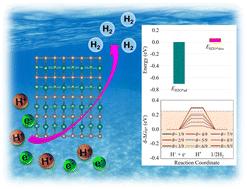
Reasonable design of hydrogen evolution reaction (HER) electrocatalysts with low Pt loading and excellent catalytic performance is a key challenge in finding efficient and cost attractive catalysts. Pt with its unique d-electrons provides new opportunities for the development of HER catalysts when it forms compounds with highly earth-abundant C. Herein, we focused on designing highly efficient catalysts composed of Pt and C elements using first-principles structure search simulations, identifying four stability PtCx monolayers. The novel PtC monolayer with a zigzag C chain not only possesses lower Pt loading but also shows inherent metallicity. Meanwhile, its H2O adsorption and dissociation abilities are efficient and facile. The HER activity of the PtC monolayer is comparable to that of commercial Pt, with desirable ΔGH* values and larger exchange current density, which are mainly attributed to lower charge donation of Pt, larger occupation of Pt PDOS at the Fermi level, and paired electrons of the zigzag C chain. Moreover, its excellent HER activity can be maintained even at high H coverage under strain and solvent effect. All these attractive properties render the PtC monolayer an appropriate HER catalyst.
期刊介绍:
Physical Chemistry Chemical Physics (PCCP) is an international journal co-owned by 19 physical chemistry and physics societies from around the world. This journal publishes original, cutting-edge research in physical chemistry, chemical physics and biophysical chemistry. To be suitable for publication in PCCP, articles must include significant innovation and/or insight into physical chemistry; this is the most important criterion that reviewers and Editors will judge against when evaluating submissions.
The journal has a broad scope and welcomes contributions spanning experiment, theory, computation and data science. Topical coverage includes spectroscopy, dynamics, kinetics, statistical mechanics, thermodynamics, electrochemistry, catalysis, surface science, quantum mechanics, quantum computing and machine learning. Interdisciplinary research areas such as polymers and soft matter, materials, nanoscience, energy, surfaces/interfaces, and biophysical chemistry are welcomed if they demonstrate significant innovation and/or insight into physical chemistry. Joined experimental/theoretical studies are particularly appreciated when complementary and based on up-to-date approaches.





 京公网安备 11010802042870号
京ICP备2023020795号-1
京公网安备 11010802042870号
京ICP备2023020795号-1

 分享
分享
 求助内容:
求助内容: 应助结果提醒方式:
 扫码关注我们
