Min Ying Liow, Eng-Seng Chan, Wei Zhe Ng, Cher Pin Song
{"title":"利用低成本二氧化碳基氨基甲酸烷离子液体和超声辅助强化技术促进酶促生物柴油生产","authors":"Min Ying Liow, Eng-Seng Chan, Wei Zhe Ng, Cher Pin Song","doi":"10.1021/acssuschemeng.4c05352","DOIUrl":null,"url":null,"abstract":"Enzymatic biodiesel production often faces challenges such as mass transfer limitations and enzyme sensitivity, resulting in low reaction efficiency. This study aimed to address these issues by integrating ultrasound technology with low-cost CO<sub>2</sub>-based alkyl carbamate ionic liquids (ILs) as additives. Among the investigated carbamate ILs, <i>N</i>,<i>N</i>-diallylammonium <i>N</i>′,<i>N</i>′-diallylcarbamate (DACARB) demonstrated the highest fatty acid methyl ester (FAME) content in ultrasound-assisted biodiesel production catalyzed by Eversa Transform 2.0 at an optimal temperature of 50 °C. The addition of DACARB improved the solubility of immiscible reactants and enhanced lipase stability, maintaining high FAME yields even under ultrasound amplitudes of up to 100% and duty cycles of 20%. Enzyme hydrolytic activity assays revealed that DACARB activated the lipase, increasing enzyme activity by 33% through favorable alterations in the enzyme tertiary structure, as confirmed by fluorescence spectroscopy. Furthermore, employing a stepwise methanol dosing strategy with ultrasound at 40% amplitude and 5% duty cycle in the presence of 2 wt % DACARB achieved a FAME content of 91.3 wt % within 12 h, using only 0.2 wt % enzyme concentration. This study highlights the potential of DACARB as a promising additive to enhance the efficiency of ultrasound-assisted enzymatic biodiesel production, offering a promising solution to overcome current limitations in the process.","PeriodicalId":25,"journal":{"name":"ACS Sustainable Chemistry & Engineering","volume":"72 1","pages":""},"PeriodicalIF":7.6000,"publicationDate":"2025-01-03","publicationTypes":"Journal Article","fieldsOfStudy":null,"isOpenAccess":false,"openAccessPdf":"","citationCount":"0","resultStr":"{\"title\":\"Enhancing Enzymatic Biodiesel Production Using Low-Cost CO2-Based Alkyl Carbamate Ionic Liquid and Ultrasound-Assisted Intensification\",\"authors\":\"Min Ying Liow, Eng-Seng Chan, Wei Zhe Ng, Cher Pin Song\",\"doi\":\"10.1021/acssuschemeng.4c05352\",\"DOIUrl\":null,\"url\":null,\"abstract\":\"Enzymatic biodiesel production often faces challenges such as mass transfer limitations and enzyme sensitivity, resulting in low reaction efficiency. This study aimed to address these issues by integrating ultrasound technology with low-cost CO<sub>2</sub>-based alkyl carbamate ionic liquids (ILs) as additives. Among the investigated carbamate ILs, <i>N</i>,<i>N</i>-diallylammonium <i>N</i>′,<i>N</i>′-diallylcarbamate (DACARB) demonstrated the highest fatty acid methyl ester (FAME) content in ultrasound-assisted biodiesel production catalyzed by Eversa Transform 2.0 at an optimal temperature of 50 °C. The addition of DACARB improved the solubility of immiscible reactants and enhanced lipase stability, maintaining high FAME yields even under ultrasound amplitudes of up to 100% and duty cycles of 20%. Enzyme hydrolytic activity assays revealed that DACARB activated the lipase, increasing enzyme activity by 33% through favorable alterations in the enzyme tertiary structure, as confirmed by fluorescence spectroscopy. Furthermore, employing a stepwise methanol dosing strategy with ultrasound at 40% amplitude and 5% duty cycle in the presence of 2 wt % DACARB achieved a FAME content of 91.3 wt % within 12 h, using only 0.2 wt % enzyme concentration. This study highlights the potential of DACARB as a promising additive to enhance the efficiency of ultrasound-assisted enzymatic biodiesel production, offering a promising solution to overcome current limitations in the process.\",\"PeriodicalId\":25,\"journal\":{\"name\":\"ACS Sustainable Chemistry & Engineering\",\"volume\":\"72 1\",\"pages\":\"\"},\"PeriodicalIF\":7.6000,\"publicationDate\":\"2025-01-03\",\"publicationTypes\":\"Journal Article\",\"fieldsOfStudy\":null,\"isOpenAccess\":false,\"openAccessPdf\":\"\",\"citationCount\":\"0\",\"resultStr\":null,\"platform\":\"Semanticscholar\",\"paperid\":null,\"PeriodicalName\":\"ACS Sustainable Chemistry & Engineering\",\"FirstCategoryId\":\"92\",\"ListUrlMain\":\"https://doi.org/10.1021/acssuschemeng.4c05352\",\"RegionNum\":1,\"RegionCategory\":\"化学\",\"ArticlePicture\":[],\"TitleCN\":null,\"AbstractTextCN\":null,\"PMCID\":null,\"EPubDate\":\"\",\"PubModel\":\"\",\"JCR\":\"Q1\",\"JCRName\":\"CHEMISTRY, MULTIDISCIPLINARY\",\"Score\":null,\"Total\":0}","platform":"Semanticscholar","paperid":null,"PeriodicalName":"ACS Sustainable Chemistry & Engineering","FirstCategoryId":"92","ListUrlMain":"https://doi.org/10.1021/acssuschemeng.4c05352","RegionNum":1,"RegionCategory":"化学","ArticlePicture":[],"TitleCN":null,"AbstractTextCN":null,"PMCID":null,"EPubDate":"","PubModel":"","JCR":"Q1","JCRName":"CHEMISTRY, MULTIDISCIPLINARY","Score":null,"Total":0}
Enhancing Enzymatic Biodiesel Production Using Low-Cost CO2-Based Alkyl Carbamate Ionic Liquid and Ultrasound-Assisted Intensification
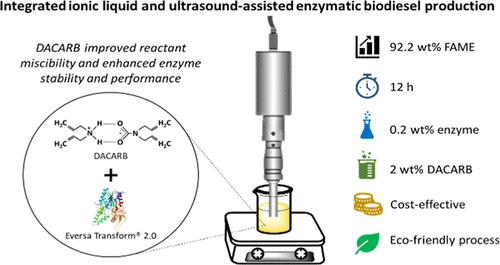
Enzymatic biodiesel production often faces challenges such as mass transfer limitations and enzyme sensitivity, resulting in low reaction efficiency. This study aimed to address these issues by integrating ultrasound technology with low-cost CO2-based alkyl carbamate ionic liquids (ILs) as additives. Among the investigated carbamate ILs, N,N-diallylammonium N′,N′-diallylcarbamate (DACARB) demonstrated the highest fatty acid methyl ester (FAME) content in ultrasound-assisted biodiesel production catalyzed by Eversa Transform 2.0 at an optimal temperature of 50 °C. The addition of DACARB improved the solubility of immiscible reactants and enhanced lipase stability, maintaining high FAME yields even under ultrasound amplitudes of up to 100% and duty cycles of 20%. Enzyme hydrolytic activity assays revealed that DACARB activated the lipase, increasing enzyme activity by 33% through favorable alterations in the enzyme tertiary structure, as confirmed by fluorescence spectroscopy. Furthermore, employing a stepwise methanol dosing strategy with ultrasound at 40% amplitude and 5% duty cycle in the presence of 2 wt % DACARB achieved a FAME content of 91.3 wt % within 12 h, using only 0.2 wt % enzyme concentration. This study highlights the potential of DACARB as a promising additive to enhance the efficiency of ultrasound-assisted enzymatic biodiesel production, offering a promising solution to overcome current limitations in the process.
期刊介绍:
ACS Sustainable Chemistry & Engineering is a prestigious weekly peer-reviewed scientific journal published by the American Chemical Society. Dedicated to advancing the principles of green chemistry and green engineering, it covers a wide array of research topics including green chemistry, green engineering, biomass, alternative energy, and life cycle assessment.
The journal welcomes submissions in various formats, including Letters, Articles, Features, and Perspectives (Reviews), that address the challenges of sustainability in the chemical enterprise and contribute to the advancement of sustainable practices. Join us in shaping the future of sustainable chemistry and engineering.




 京公网安备 11010802042870号
京ICP备2023020795号-1
京公网安备 11010802042870号
京ICP备2023020795号-1

 分享
分享
 求助内容:
求助内容: 应助结果提醒方式:
 扫码关注我们
