{"title":"靶向尿酸:在神经退行性疾病中抗氧化应激和神经炎症的有希望的干预措施。","authors":"Lin Xu, Chengwei Li, Tiantian Wan, Xinyi Sun, Xiaojie Lin, Dong Yan, Jianjun Li, Penghui Wei","doi":"10.1186/s12964-024-01965-4","DOIUrl":null,"url":null,"abstract":"<p><p>Oxidative stress and neuroinflammation are recognized as key factors in the development of neurodegenerative diseases, yet effective interventions and biomarkers to address oxidative stress and neuroinflammation in these conditions are limited. Uric acid (UA), traditionally associated with gout, is now gaining prominence as a potential target in neurodegenerative diseases. Soluble UA stands out as one of the most vital antioxidant compounds produced by the human body, accounting for up to 55% of the extracellular capacity to neutralize free radicals. While there is increasing evidence supporting the neuroprotective properties of UA in Parkinson's disease and Alzheimer's disease, gaps in knowledge still exist regarding the underlying mechanisms and how to effectively translate these benefits into clinical practice. Moreover, the current UA elevation therapy exhibits unstable antioxidant properties, individual variability, and even adverse effects, limiting its potential clinical applications. This review consolidates recent advancements in understanding how UA exerts neuroprotective effects on neurodegenerative diseases and emphasizes the dual roles of UA in managing oxidative stress and neuroinflammation. Additionally, the review elucidates the mechanisms through which UA confers neuroprotection. Based on this, the review underscores the significance of UA as a potential biomarker and aims to provide a comprehensive understanding of its potential as a therapeutic target, while also addressing possible challenges to clinical implementation.</p>","PeriodicalId":55268,"journal":{"name":"Cell Communication and Signaling","volume":"23 1","pages":"4"},"PeriodicalIF":8.2000,"publicationDate":"2025-01-03","publicationTypes":"Journal Article","fieldsOfStudy":null,"isOpenAccess":false,"openAccessPdf":"https://www.ncbi.nlm.nih.gov/pmc/articles/PMC11699683/pdf/","citationCount":"0","resultStr":"{\"title\":\"Targeting uric acid: a promising intervention against oxidative stress and neuroinflammation in neurodegenerative diseases.\",\"authors\":\"Lin Xu, Chengwei Li, Tiantian Wan, Xinyi Sun, Xiaojie Lin, Dong Yan, Jianjun Li, Penghui Wei\",\"doi\":\"10.1186/s12964-024-01965-4\",\"DOIUrl\":null,\"url\":null,\"abstract\":\"<p><p>Oxidative stress and neuroinflammation are recognized as key factors in the development of neurodegenerative diseases, yet effective interventions and biomarkers to address oxidative stress and neuroinflammation in these conditions are limited. Uric acid (UA), traditionally associated with gout, is now gaining prominence as a potential target in neurodegenerative diseases. Soluble UA stands out as one of the most vital antioxidant compounds produced by the human body, accounting for up to 55% of the extracellular capacity to neutralize free radicals. While there is increasing evidence supporting the neuroprotective properties of UA in Parkinson's disease and Alzheimer's disease, gaps in knowledge still exist regarding the underlying mechanisms and how to effectively translate these benefits into clinical practice. Moreover, the current UA elevation therapy exhibits unstable antioxidant properties, individual variability, and even adverse effects, limiting its potential clinical applications. This review consolidates recent advancements in understanding how UA exerts neuroprotective effects on neurodegenerative diseases and emphasizes the dual roles of UA in managing oxidative stress and neuroinflammation. Additionally, the review elucidates the mechanisms through which UA confers neuroprotection. Based on this, the review underscores the significance of UA as a potential biomarker and aims to provide a comprehensive understanding of its potential as a therapeutic target, while also addressing possible challenges to clinical implementation.</p>\",\"PeriodicalId\":55268,\"journal\":{\"name\":\"Cell Communication and Signaling\",\"volume\":\"23 1\",\"pages\":\"4\"},\"PeriodicalIF\":8.2000,\"publicationDate\":\"2025-01-03\",\"publicationTypes\":\"Journal Article\",\"fieldsOfStudy\":null,\"isOpenAccess\":false,\"openAccessPdf\":\"https://www.ncbi.nlm.nih.gov/pmc/articles/PMC11699683/pdf/\",\"citationCount\":\"0\",\"resultStr\":null,\"platform\":\"Semanticscholar\",\"paperid\":null,\"PeriodicalName\":\"Cell Communication and Signaling\",\"FirstCategoryId\":\"99\",\"ListUrlMain\":\"https://doi.org/10.1186/s12964-024-01965-4\",\"RegionNum\":2,\"RegionCategory\":\"生物学\",\"ArticlePicture\":[],\"TitleCN\":null,\"AbstractTextCN\":null,\"PMCID\":null,\"EPubDate\":\"\",\"PubModel\":\"\",\"JCR\":\"Q1\",\"JCRName\":\"CELL BIOLOGY\",\"Score\":null,\"Total\":0}","platform":"Semanticscholar","paperid":null,"PeriodicalName":"Cell Communication and Signaling","FirstCategoryId":"99","ListUrlMain":"https://doi.org/10.1186/s12964-024-01965-4","RegionNum":2,"RegionCategory":"生物学","ArticlePicture":[],"TitleCN":null,"AbstractTextCN":null,"PMCID":null,"EPubDate":"","PubModel":"","JCR":"Q1","JCRName":"CELL BIOLOGY","Score":null,"Total":0}
Targeting uric acid: a promising intervention against oxidative stress and neuroinflammation in neurodegenerative diseases.
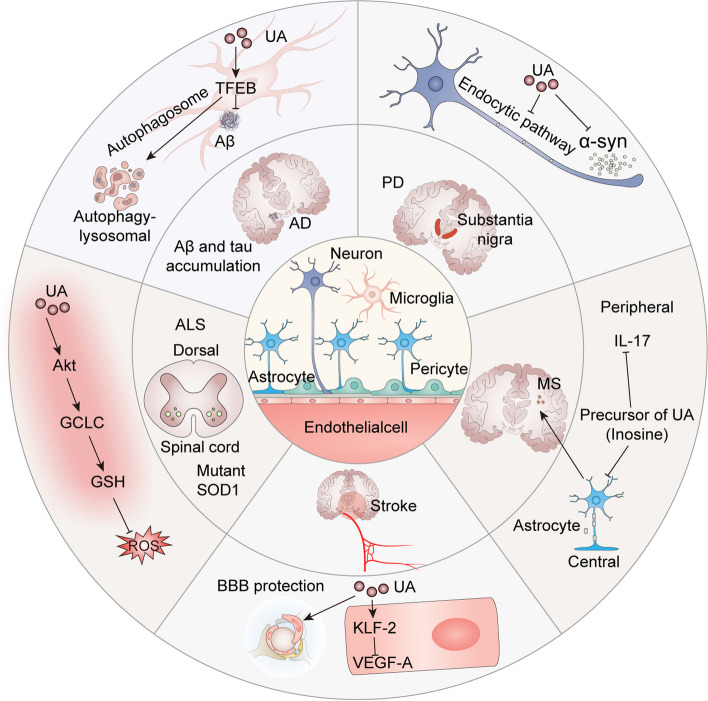
Oxidative stress and neuroinflammation are recognized as key factors in the development of neurodegenerative diseases, yet effective interventions and biomarkers to address oxidative stress and neuroinflammation in these conditions are limited. Uric acid (UA), traditionally associated with gout, is now gaining prominence as a potential target in neurodegenerative diseases. Soluble UA stands out as one of the most vital antioxidant compounds produced by the human body, accounting for up to 55% of the extracellular capacity to neutralize free radicals. While there is increasing evidence supporting the neuroprotective properties of UA in Parkinson's disease and Alzheimer's disease, gaps in knowledge still exist regarding the underlying mechanisms and how to effectively translate these benefits into clinical practice. Moreover, the current UA elevation therapy exhibits unstable antioxidant properties, individual variability, and even adverse effects, limiting its potential clinical applications. This review consolidates recent advancements in understanding how UA exerts neuroprotective effects on neurodegenerative diseases and emphasizes the dual roles of UA in managing oxidative stress and neuroinflammation. Additionally, the review elucidates the mechanisms through which UA confers neuroprotection. Based on this, the review underscores the significance of UA as a potential biomarker and aims to provide a comprehensive understanding of its potential as a therapeutic target, while also addressing possible challenges to clinical implementation.
期刊介绍:
Cell Communication and Signaling (CCS) is a peer-reviewed, open-access scientific journal that focuses on cellular signaling pathways in both normal and pathological conditions. It publishes original research, reviews, and commentaries, welcoming studies that utilize molecular, morphological, biochemical, structural, and cell biology approaches. CCS also encourages interdisciplinary work and innovative models, including in silico, in vitro, and in vivo approaches, to facilitate investigations of cell signaling pathways, networks, and behavior.
Starting from January 2019, CCS is proud to announce its affiliation with the International Cell Death Society. The journal now encourages submissions covering all aspects of cell death, including apoptotic and non-apoptotic mechanisms, cell death in model systems, autophagy, clearance of dying cells, and the immunological and pathological consequences of dying cells in the tissue microenvironment.






 京公网安备 11010802042870号
京ICP备2023020795号-1
京公网安备 11010802042870号
京ICP备2023020795号-1

 分享
分享
 求助内容:
求助内容: 应助结果提醒方式:
 扫码关注我们
