Phu Pham;Quang-Thinh Bui;Ngoc Thanh Nguyen;Robert Kozma;Philip S. Yu;Bay Vo
{"title":"图神经网络中的拓扑数据分析:调查与展望","authors":"Phu Pham;Quang-Thinh Bui;Ngoc Thanh Nguyen;Robert Kozma;Philip S. Yu;Bay Vo","doi":"10.1109/TNNLS.2024.3520147","DOIUrl":null,"url":null,"abstract":"For many years, topological data analysis (TDA) and deep learning (DL) have been considered separate data analysis and representation learning approaches, which have nothing in common. The root cause of this challenge comes from the difficulties in building, extracting, and integrating TDA constructs, such as barcodes or persistent diagrams, within deep neural network architectures. Therefore, the powers of these two approaches are still on their islands and have not yet combined to form more powerful tools for dealing with multiple complex data analysis tasks. Fortunately, we have witnessed several remarkable attempts to integrate DL-based architectures with topological learning paradigms in recent years. These topology-driven DL techniques have notably improved data-driven analysis and mining problems, especially within graph datasets. Recently, graph neural networks (GNNs) have emerged as a popular deep neural architecture, demonstrating significant performance in various graph-based analysis and learning problems. Explicitly, within the manifold paradigm, the graph is naturally considered as a topological object (e.g., the topological properties of the given graph can be represented by the edge weights). Therefore, integrating TDA and GNN is considered an excellent combination. Many well-known studies have recently presented the effectiveness of TDA-assisted GNN-based architectures in dealing with complex graph-based data representation analysis and learning problems. Motivated by the successes of recent research, we present systematic literature about this nascent and promising research direction in this article, which includes general taxonomy, preliminaries, and recently proposed state-of-the-art topology-driven GNN models and perspectives.","PeriodicalId":13303,"journal":{"name":"IEEE transactions on neural networks and learning systems","volume":"36 6","pages":"9758-9776"},"PeriodicalIF":9.7000,"publicationDate":"2025-01-06","publicationTypes":"Journal Article","fieldsOfStudy":null,"isOpenAccess":false,"openAccessPdf":"","citationCount":"0","resultStr":"{\"title\":\"Topological Data Analysis in Graph Neural Networks: Surveys and Perspectives\",\"authors\":\"Phu Pham;Quang-Thinh Bui;Ngoc Thanh Nguyen;Robert Kozma;Philip S. Yu;Bay Vo\",\"doi\":\"10.1109/TNNLS.2024.3520147\",\"DOIUrl\":null,\"url\":null,\"abstract\":\"For many years, topological data analysis (TDA) and deep learning (DL) have been considered separate data analysis and representation learning approaches, which have nothing in common. The root cause of this challenge comes from the difficulties in building, extracting, and integrating TDA constructs, such as barcodes or persistent diagrams, within deep neural network architectures. Therefore, the powers of these two approaches are still on their islands and have not yet combined to form more powerful tools for dealing with multiple complex data analysis tasks. Fortunately, we have witnessed several remarkable attempts to integrate DL-based architectures with topological learning paradigms in recent years. These topology-driven DL techniques have notably improved data-driven analysis and mining problems, especially within graph datasets. Recently, graph neural networks (GNNs) have emerged as a popular deep neural architecture, demonstrating significant performance in various graph-based analysis and learning problems. Explicitly, within the manifold paradigm, the graph is naturally considered as a topological object (e.g., the topological properties of the given graph can be represented by the edge weights). Therefore, integrating TDA and GNN is considered an excellent combination. Many well-known studies have recently presented the effectiveness of TDA-assisted GNN-based architectures in dealing with complex graph-based data representation analysis and learning problems. Motivated by the successes of recent research, we present systematic literature about this nascent and promising research direction in this article, which includes general taxonomy, preliminaries, and recently proposed state-of-the-art topology-driven GNN models and perspectives.\",\"PeriodicalId\":13303,\"journal\":{\"name\":\"IEEE transactions on neural networks and learning systems\",\"volume\":\"36 6\",\"pages\":\"9758-9776\"},\"PeriodicalIF\":9.7000,\"publicationDate\":\"2025-01-06\",\"publicationTypes\":\"Journal Article\",\"fieldsOfStudy\":null,\"isOpenAccess\":false,\"openAccessPdf\":\"\",\"citationCount\":\"0\",\"resultStr\":null,\"platform\":\"Semanticscholar\",\"paperid\":null,\"PeriodicalName\":\"IEEE transactions on neural networks and learning systems\",\"FirstCategoryId\":\"94\",\"ListUrlMain\":\"https://ieeexplore.ieee.org/document/10826583/\",\"RegionNum\":1,\"RegionCategory\":\"计算机科学\",\"ArticlePicture\":[],\"TitleCN\":null,\"AbstractTextCN\":null,\"PMCID\":null,\"EPubDate\":\"\",\"PubModel\":\"\",\"JCR\":\"Q1\",\"JCRName\":\"COMPUTER SCIENCE, ARTIFICIAL INTELLIGENCE\",\"Score\":null,\"Total\":0}","platform":"Semanticscholar","paperid":null,"PeriodicalName":"IEEE transactions on neural networks and learning systems","FirstCategoryId":"94","ListUrlMain":"https://ieeexplore.ieee.org/document/10826583/","RegionNum":1,"RegionCategory":"计算机科学","ArticlePicture":[],"TitleCN":null,"AbstractTextCN":null,"PMCID":null,"EPubDate":"","PubModel":"","JCR":"Q1","JCRName":"COMPUTER SCIENCE, ARTIFICIAL INTELLIGENCE","Score":null,"Total":0}
Topological Data Analysis in Graph Neural Networks: Surveys and Perspectives
For many years, topological data analysis (TDA) and deep learning (DL) have been considered separate data analysis and representation learning approaches, which have nothing in common. The root cause of this challenge comes from the difficulties in building, extracting, and integrating TDA constructs, such as barcodes or persistent diagrams, within deep neural network architectures. Therefore, the powers of these two approaches are still on their islands and have not yet combined to form more powerful tools for dealing with multiple complex data analysis tasks. Fortunately, we have witnessed several remarkable attempts to integrate DL-based architectures with topological learning paradigms in recent years. These topology-driven DL techniques have notably improved data-driven analysis and mining problems, especially within graph datasets. Recently, graph neural networks (GNNs) have emerged as a popular deep neural architecture, demonstrating significant performance in various graph-based analysis and learning problems. Explicitly, within the manifold paradigm, the graph is naturally considered as a topological object (e.g., the topological properties of the given graph can be represented by the edge weights). Therefore, integrating TDA and GNN is considered an excellent combination. Many well-known studies have recently presented the effectiveness of TDA-assisted GNN-based architectures in dealing with complex graph-based data representation analysis and learning problems. Motivated by the successes of recent research, we present systematic literature about this nascent and promising research direction in this article, which includes general taxonomy, preliminaries, and recently proposed state-of-the-art topology-driven GNN models and perspectives.
期刊介绍:
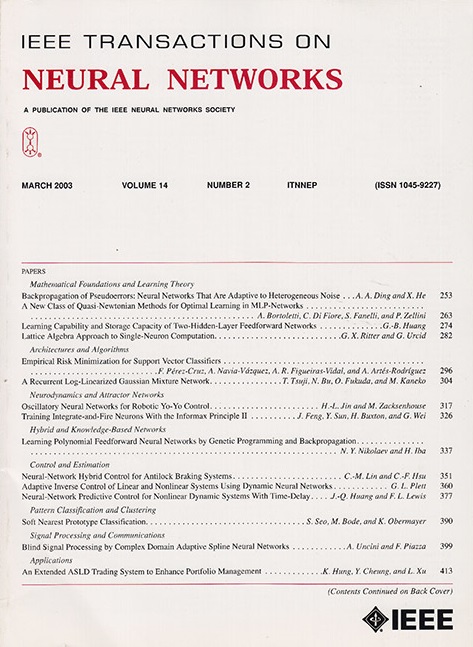
The focus of IEEE Transactions on Neural Networks and Learning Systems is to present scholarly articles discussing the theory, design, and applications of neural networks as well as other learning systems. The journal primarily highlights technical and scientific research in this domain.




 京公网安备 11010802042870号
京ICP备2023020795号-1
京公网安备 11010802042870号
京ICP备2023020795号-1

 分享
分享
 求助内容:
求助内容: 应助结果提醒方式:
 扫码关注我们
