Hua Pan, Shelby M. Klein, Akalanka Gunaratne, Martin F. Jarrold, David E. Clemmer
{"title":"激光加热液滴中大分子解离的CD-MS监测","authors":"Hua Pan, Shelby M. Klein, Akalanka Gunaratne, Martin F. Jarrold, David E. Clemmer","doi":"10.1021/acs.analchem.4c06038","DOIUrl":null,"url":null,"abstract":"Charge detection mass spectrometry (CD-MS) is used to monitor the dissociation of large (300 kDa to 20 MDa) protein complexes in droplets heated with a 10.6 μm CO<sub>2</sub> laser. In this approach, electrospray ionization (ESI) is used to produce charged droplets containing macromolecular complexes. As the droplets travel from the ESI capillary tip to the entrance of the CD-MS instrument, they pass through a variable-power laser field, where they are rapidly heated and dissociate to produce fragments. The approach is illustrated for three model systems: glutamate dehydrogenase (GDH), a 334 kDa hexameric protein complex, which dissociates into protein monomers, dimers, and tetramers; the ∼3 MDa <i>T</i> = 3, and ∼4 MDa <i>T</i> = 4 hepatitis B virus VLPs (virus-like particles) that produce a distribution of protein dimer clusters; and the ∼20 MDa <i>T</i> = 7 human papillomavirus VLP, which dissociates primarily into small capsid protein clusters that are not well-resolved by CD-MS. The fragments produced by in-droplet activation provide information that is useful for characterizing the structures of the intact antecedent complexes. A discussion of the advantages and current limitations of this approach is presented.","PeriodicalId":27,"journal":{"name":"Analytical Chemistry","volume":"22 1","pages":""},"PeriodicalIF":6.7000,"publicationDate":"2025-01-07","publicationTypes":"Journal Article","fieldsOfStudy":null,"isOpenAccess":false,"openAccessPdf":"","citationCount":"0","resultStr":"{\"title\":\"Dissociation of Macromolecules in Laser-Heated Droplets Monitored by CD-MS\",\"authors\":\"Hua Pan, Shelby M. Klein, Akalanka Gunaratne, Martin F. Jarrold, David E. Clemmer\",\"doi\":\"10.1021/acs.analchem.4c06038\",\"DOIUrl\":null,\"url\":null,\"abstract\":\"Charge detection mass spectrometry (CD-MS) is used to monitor the dissociation of large (300 kDa to 20 MDa) protein complexes in droplets heated with a 10.6 μm CO<sub>2</sub> laser. In this approach, electrospray ionization (ESI) is used to produce charged droplets containing macromolecular complexes. As the droplets travel from the ESI capillary tip to the entrance of the CD-MS instrument, they pass through a variable-power laser field, where they are rapidly heated and dissociate to produce fragments. The approach is illustrated for three model systems: glutamate dehydrogenase (GDH), a 334 kDa hexameric protein complex, which dissociates into protein monomers, dimers, and tetramers; the ∼3 MDa <i>T</i> = 3, and ∼4 MDa <i>T</i> = 4 hepatitis B virus VLPs (virus-like particles) that produce a distribution of protein dimer clusters; and the ∼20 MDa <i>T</i> = 7 human papillomavirus VLP, which dissociates primarily into small capsid protein clusters that are not well-resolved by CD-MS. The fragments produced by in-droplet activation provide information that is useful for characterizing the structures of the intact antecedent complexes. A discussion of the advantages and current limitations of this approach is presented.\",\"PeriodicalId\":27,\"journal\":{\"name\":\"Analytical Chemistry\",\"volume\":\"22 1\",\"pages\":\"\"},\"PeriodicalIF\":6.7000,\"publicationDate\":\"2025-01-07\",\"publicationTypes\":\"Journal Article\",\"fieldsOfStudy\":null,\"isOpenAccess\":false,\"openAccessPdf\":\"\",\"citationCount\":\"0\",\"resultStr\":null,\"platform\":\"Semanticscholar\",\"paperid\":null,\"PeriodicalName\":\"Analytical Chemistry\",\"FirstCategoryId\":\"92\",\"ListUrlMain\":\"https://doi.org/10.1021/acs.analchem.4c06038\",\"RegionNum\":1,\"RegionCategory\":\"化学\",\"ArticlePicture\":[],\"TitleCN\":null,\"AbstractTextCN\":null,\"PMCID\":null,\"EPubDate\":\"\",\"PubModel\":\"\",\"JCR\":\"Q1\",\"JCRName\":\"CHEMISTRY, ANALYTICAL\",\"Score\":null,\"Total\":0}","platform":"Semanticscholar","paperid":null,"PeriodicalName":"Analytical Chemistry","FirstCategoryId":"92","ListUrlMain":"https://doi.org/10.1021/acs.analchem.4c06038","RegionNum":1,"RegionCategory":"化学","ArticlePicture":[],"TitleCN":null,"AbstractTextCN":null,"PMCID":null,"EPubDate":"","PubModel":"","JCR":"Q1","JCRName":"CHEMISTRY, ANALYTICAL","Score":null,"Total":0}
引用次数: 0
摘要
电荷检测质谱(CD-MS)用于监测在10.6 μm CO2激光加热的液滴中大型(300 kDa至20 MDa)蛋白复合物的解离。在这种方法中,电喷雾电离(ESI)用于产生含有大分子复合物的带电液滴。当液滴从ESI毛细管尖端移动到CD-MS仪器的入口时,它们通过一个变功率激光场,在那里它们被快速加热并解离产生碎片。该方法用于三种模型系统:谷氨酸脱氢酶(GDH),一种334 kDa的六聚体蛋白质复合物,可解离成蛋白质单体、二聚体和四聚体;产生蛋白质二聚体簇分布的~ 3 MDa T = 3和~ 4 MDa T = 4乙型肝炎病毒vlp(病毒样颗粒);和~ 20 MDa T = 7人乳头瘤病毒VLP,其主要解离成小的衣壳蛋白簇,不能被CD-MS很好地分解。由液滴内活化产生的碎片提供了对表征完整前位复合物结构有用的信息。讨论了这种方法的优点和目前的局限性。
Dissociation of Macromolecules in Laser-Heated Droplets Monitored by CD-MS
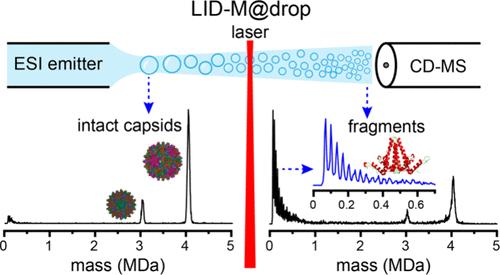
Charge detection mass spectrometry (CD-MS) is used to monitor the dissociation of large (300 kDa to 20 MDa) protein complexes in droplets heated with a 10.6 μm CO2 laser. In this approach, electrospray ionization (ESI) is used to produce charged droplets containing macromolecular complexes. As the droplets travel from the ESI capillary tip to the entrance of the CD-MS instrument, they pass through a variable-power laser field, where they are rapidly heated and dissociate to produce fragments. The approach is illustrated for three model systems: glutamate dehydrogenase (GDH), a 334 kDa hexameric protein complex, which dissociates into protein monomers, dimers, and tetramers; the ∼3 MDa T = 3, and ∼4 MDa T = 4 hepatitis B virus VLPs (virus-like particles) that produce a distribution of protein dimer clusters; and the ∼20 MDa T = 7 human papillomavirus VLP, which dissociates primarily into small capsid protein clusters that are not well-resolved by CD-MS. The fragments produced by in-droplet activation provide information that is useful for characterizing the structures of the intact antecedent complexes. A discussion of the advantages and current limitations of this approach is presented.
期刊介绍:
Analytical Chemistry, a peer-reviewed research journal, focuses on disseminating new and original knowledge across all branches of analytical chemistry. Fundamental articles may explore general principles of chemical measurement science and need not directly address existing or potential analytical methodology. They can be entirely theoretical or report experimental results. Contributions may cover various phases of analytical operations, including sampling, bioanalysis, electrochemistry, mass spectrometry, microscale and nanoscale systems, environmental analysis, separations, spectroscopy, chemical reactions and selectivity, instrumentation, imaging, surface analysis, and data processing. Papers discussing known analytical methods should present a significant, original application of the method, a notable improvement, or results on an important analyte.




 京公网安备 11010802042870号
京ICP备2023020795号-1
京公网安备 11010802042870号
京ICP备2023020795号-1

 分享
分享
 求助内容:
求助内容: 应助结果提醒方式:
 扫码关注我们
