E. I. Marchenko, V. V. Korolev, E. A. Kobeleva, N. A. Belich, N. N. Udalova, N. N. Eremin, E. A. Goodilin and A. B. Tarasov
{"title":"混合卤化铅钙钛矿和钙钛矿相关结构的x射线衍射图的机器学习识别","authors":"E. I. Marchenko, V. V. Korolev, E. A. Kobeleva, N. A. Belich, N. N. Udalova, N. N. Eremin, E. A. Goodilin and A. B. Tarasov","doi":"10.1039/D4NR04531A","DOIUrl":null,"url":null,"abstract":"<p >Identification of crystal structures is a crucial stage in the exploration of novel functional materials. This procedure is usually time-consuming and can be false-positive or false-negative. This necessitates a significant level of expert proficiency in the field of crystallography and, especially, requires deep experience in perovskite-related structures of hybrid perovskites. Our work is devoted to the machine learning classification of structure types of hybrid lead halides based on available X-ray diffraction data. Here, we proposed a simple approach for quickly identifying the dimensionality of inorganic substructures, types of connections of lead halide polyhedra and structure types using common powder XRD data and a ML-decision tree classification model. The average accuracy of our ML algorithm in predicting the dimensionality of inorganic substructures, the type of connection of lead halide and inorganic substructure topology based on theoretically calculated XRD patterns among 14 most common structure types reached 0.76 ± 0.07, 0.827 ± 0.028 and 0.71 ± 0.05, respectively. To test the transferability of the developed ML model, we expanded our dataset to 30 structure types. The average accuracy of our ML algorithm in predicting the dimensionality of inorganic substructures, the type of connection of lead halide and inorganic substructure topology based on theoretically calculated XRD patterns among 30 structure types reached 0.820 ± 0.022, 0.74 ± 0.05 and 0.633 ± 0.018, respectively. The validation of our decision tree classification ML model on experimental XRD data shows accuracies of 1.0 and 0.82 for dimension and structure type prediction. Thus, our approach can significantly simplify and accelerate the interpretation of highly complicated XRD data for hybrid lead halides.</p>","PeriodicalId":92,"journal":{"name":"Nanoscale","volume":" 5","pages":" 2742-2752"},"PeriodicalIF":5.1000,"publicationDate":"2025-01-08","publicationTypes":"Journal Article","fieldsOfStudy":null,"isOpenAccess":false,"openAccessPdf":"","citationCount":"0","resultStr":"{\"title\":\"Machine learning recognition of hybrid lead halide perovskites and perovskite-related structures from X-ray diffraction patterns†\",\"authors\":\"E. I. Marchenko, V. V. Korolev, E. A. Kobeleva, N. A. Belich, N. N. Udalova, N. N. Eremin, E. A. Goodilin and A. B. Tarasov\",\"doi\":\"10.1039/D4NR04531A\",\"DOIUrl\":null,\"url\":null,\"abstract\":\"<p >Identification of crystal structures is a crucial stage in the exploration of novel functional materials. This procedure is usually time-consuming and can be false-positive or false-negative. This necessitates a significant level of expert proficiency in the field of crystallography and, especially, requires deep experience in perovskite-related structures of hybrid perovskites. Our work is devoted to the machine learning classification of structure types of hybrid lead halides based on available X-ray diffraction data. Here, we proposed a simple approach for quickly identifying the dimensionality of inorganic substructures, types of connections of lead halide polyhedra and structure types using common powder XRD data and a ML-decision tree classification model. The average accuracy of our ML algorithm in predicting the dimensionality of inorganic substructures, the type of connection of lead halide and inorganic substructure topology based on theoretically calculated XRD patterns among 14 most common structure types reached 0.76 ± 0.07, 0.827 ± 0.028 and 0.71 ± 0.05, respectively. To test the transferability of the developed ML model, we expanded our dataset to 30 structure types. The average accuracy of our ML algorithm in predicting the dimensionality of inorganic substructures, the type of connection of lead halide and inorganic substructure topology based on theoretically calculated XRD patterns among 30 structure types reached 0.820 ± 0.022, 0.74 ± 0.05 and 0.633 ± 0.018, respectively. The validation of our decision tree classification ML model on experimental XRD data shows accuracies of 1.0 and 0.82 for dimension and structure type prediction. Thus, our approach can significantly simplify and accelerate the interpretation of highly complicated XRD data for hybrid lead halides.</p>\",\"PeriodicalId\":92,\"journal\":{\"name\":\"Nanoscale\",\"volume\":\" 5\",\"pages\":\" 2742-2752\"},\"PeriodicalIF\":5.1000,\"publicationDate\":\"2025-01-08\",\"publicationTypes\":\"Journal Article\",\"fieldsOfStudy\":null,\"isOpenAccess\":false,\"openAccessPdf\":\"\",\"citationCount\":\"0\",\"resultStr\":null,\"platform\":\"Semanticscholar\",\"paperid\":null,\"PeriodicalName\":\"Nanoscale\",\"FirstCategoryId\":\"88\",\"ListUrlMain\":\"https://pubs.rsc.org/en/content/articlelanding/2025/nr/d4nr04531a\",\"RegionNum\":3,\"RegionCategory\":\"材料科学\",\"ArticlePicture\":[],\"TitleCN\":null,\"AbstractTextCN\":null,\"PMCID\":null,\"EPubDate\":\"\",\"PubModel\":\"\",\"JCR\":\"Q1\",\"JCRName\":\"CHEMISTRY, MULTIDISCIPLINARY\",\"Score\":null,\"Total\":0}","platform":"Semanticscholar","paperid":null,"PeriodicalName":"Nanoscale","FirstCategoryId":"88","ListUrlMain":"https://pubs.rsc.org/en/content/articlelanding/2025/nr/d4nr04531a","RegionNum":3,"RegionCategory":"材料科学","ArticlePicture":[],"TitleCN":null,"AbstractTextCN":null,"PMCID":null,"EPubDate":"","PubModel":"","JCR":"Q1","JCRName":"CHEMISTRY, MULTIDISCIPLINARY","Score":null,"Total":0}
Machine learning recognition of hybrid lead halide perovskites and perovskite-related structures from X-ray diffraction patterns†
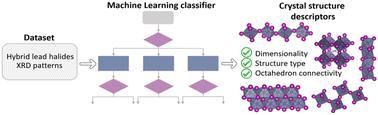
Identification of crystal structures is a crucial stage in the exploration of novel functional materials. This procedure is usually time-consuming and can be false-positive or false-negative. This necessitates a significant level of expert proficiency in the field of crystallography and, especially, requires deep experience in perovskite-related structures of hybrid perovskites. Our work is devoted to the machine learning classification of structure types of hybrid lead halides based on available X-ray diffraction data. Here, we proposed a simple approach for quickly identifying the dimensionality of inorganic substructures, types of connections of lead halide polyhedra and structure types using common powder XRD data and a ML-decision tree classification model. The average accuracy of our ML algorithm in predicting the dimensionality of inorganic substructures, the type of connection of lead halide and inorganic substructure topology based on theoretically calculated XRD patterns among 14 most common structure types reached 0.76 ± 0.07, 0.827 ± 0.028 and 0.71 ± 0.05, respectively. To test the transferability of the developed ML model, we expanded our dataset to 30 structure types. The average accuracy of our ML algorithm in predicting the dimensionality of inorganic substructures, the type of connection of lead halide and inorganic substructure topology based on theoretically calculated XRD patterns among 30 structure types reached 0.820 ± 0.022, 0.74 ± 0.05 and 0.633 ± 0.018, respectively. The validation of our decision tree classification ML model on experimental XRD data shows accuracies of 1.0 and 0.82 for dimension and structure type prediction. Thus, our approach can significantly simplify and accelerate the interpretation of highly complicated XRD data for hybrid lead halides.
期刊介绍:
Nanoscale is a high-impact international journal, publishing high-quality research across nanoscience and nanotechnology. Nanoscale publishes a full mix of research articles on experimental and theoretical work, including reviews, communications, and full papers.Highly interdisciplinary, this journal appeals to scientists, researchers and professionals interested in nanoscience and nanotechnology, quantum materials and quantum technology, including the areas of physics, chemistry, biology, medicine, materials, energy/environment, information technology, detection science, healthcare and drug discovery, and electronics.




 京公网安备 11010802042870号
京ICP备2023020795号-1
京公网安备 11010802042870号
京ICP备2023020795号-1

 分享
分享
 求助内容:
求助内容: 应助结果提醒方式:
 扫码关注我们
