Yaroslav A. Nikiforov, Victoria A. Danilovsky and Natalya I. Baklanova
{"title":"晶粒结构演变如何影响固态反应动力学:铱和碳化锆相互作用的一个例子","authors":"Yaroslav A. Nikiforov, Victoria A. Danilovsky and Natalya I. Baklanova","doi":"10.1039/D4CP04302B","DOIUrl":null,"url":null,"abstract":"<p >This work investigates the solid-state reaction between iridium and zirconium carbide, resulting in the formation of carbon and ZrIr<small><sub>3</sub></small>—an intermetallic compound of great interest for modern high-temperature materials science. We have found a transition of kinetic regimes in this reaction: from linear kinetics (when the chemical reaction is a limiting stage) at 1500 and 1550 °C to ‘non-parabolic kinetics’ at 1600 °C. Non-parabolic kinetics is characterized by the thickness of the product layer being proportional to a power of time less than 1/2. The nature of non-parabolic kinetics is still an open question, which motivated us to develop a model of this kinetic regime. The proposed model accounts for the grain growth in the product phase and how it leads to the time dependence of the interdiffusion coefficient. We have obtained a complete analytical solution for this model and an equation that connects the grain-growth exponent and the power-law exponent of non-parabolic kinetics. The measurements of the thickness of the product layer and the average grain size of the intermetallic phase confirm the results of the theoretical solution.</p>","PeriodicalId":99,"journal":{"name":"Physical Chemistry Chemical Physics","volume":" 6","pages":" 3363-3374"},"PeriodicalIF":2.9000,"publicationDate":"2025-01-09","publicationTypes":"Journal Article","fieldsOfStudy":null,"isOpenAccess":false,"openAccessPdf":"","citationCount":"0","resultStr":"{\"title\":\"How grain structure evolution affects the kinetics of a solid-state reaction: a case of interaction between iridium and zirconium carbide†\",\"authors\":\"Yaroslav A. Nikiforov, Victoria A. Danilovsky and Natalya I. Baklanova\",\"doi\":\"10.1039/D4CP04302B\",\"DOIUrl\":null,\"url\":null,\"abstract\":\"<p >This work investigates the solid-state reaction between iridium and zirconium carbide, resulting in the formation of carbon and ZrIr<small><sub>3</sub></small>—an intermetallic compound of great interest for modern high-temperature materials science. We have found a transition of kinetic regimes in this reaction: from linear kinetics (when the chemical reaction is a limiting stage) at 1500 and 1550 °C to ‘non-parabolic kinetics’ at 1600 °C. Non-parabolic kinetics is characterized by the thickness of the product layer being proportional to a power of time less than 1/2. The nature of non-parabolic kinetics is still an open question, which motivated us to develop a model of this kinetic regime. The proposed model accounts for the grain growth in the product phase and how it leads to the time dependence of the interdiffusion coefficient. We have obtained a complete analytical solution for this model and an equation that connects the grain-growth exponent and the power-law exponent of non-parabolic kinetics. The measurements of the thickness of the product layer and the average grain size of the intermetallic phase confirm the results of the theoretical solution.</p>\",\"PeriodicalId\":99,\"journal\":{\"name\":\"Physical Chemistry Chemical Physics\",\"volume\":\" 6\",\"pages\":\" 3363-3374\"},\"PeriodicalIF\":2.9000,\"publicationDate\":\"2025-01-09\",\"publicationTypes\":\"Journal Article\",\"fieldsOfStudy\":null,\"isOpenAccess\":false,\"openAccessPdf\":\"\",\"citationCount\":\"0\",\"resultStr\":null,\"platform\":\"Semanticscholar\",\"paperid\":null,\"PeriodicalName\":\"Physical Chemistry Chemical Physics\",\"FirstCategoryId\":\"92\",\"ListUrlMain\":\"https://pubs.rsc.org/en/content/articlelanding/2025/cp/d4cp04302b\",\"RegionNum\":3,\"RegionCategory\":\"化学\",\"ArticlePicture\":[],\"TitleCN\":null,\"AbstractTextCN\":null,\"PMCID\":null,\"EPubDate\":\"\",\"PubModel\":\"\",\"JCR\":\"Q3\",\"JCRName\":\"CHEMISTRY, PHYSICAL\",\"Score\":null,\"Total\":0}","platform":"Semanticscholar","paperid":null,"PeriodicalName":"Physical Chemistry Chemical Physics","FirstCategoryId":"92","ListUrlMain":"https://pubs.rsc.org/en/content/articlelanding/2025/cp/d4cp04302b","RegionNum":3,"RegionCategory":"化学","ArticlePicture":[],"TitleCN":null,"AbstractTextCN":null,"PMCID":null,"EPubDate":"","PubModel":"","JCR":"Q3","JCRName":"CHEMISTRY, PHYSICAL","Score":null,"Total":0}
How grain structure evolution affects the kinetics of a solid-state reaction: a case of interaction between iridium and zirconium carbide†
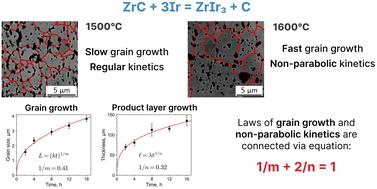
This work investigates the solid-state reaction between iridium and zirconium carbide, resulting in the formation of carbon and ZrIr3—an intermetallic compound of great interest for modern high-temperature materials science. We have found a transition of kinetic regimes in this reaction: from linear kinetics (when the chemical reaction is a limiting stage) at 1500 and 1550 °C to ‘non-parabolic kinetics’ at 1600 °C. Non-parabolic kinetics is characterized by the thickness of the product layer being proportional to a power of time less than 1/2. The nature of non-parabolic kinetics is still an open question, which motivated us to develop a model of this kinetic regime. The proposed model accounts for the grain growth in the product phase and how it leads to the time dependence of the interdiffusion coefficient. We have obtained a complete analytical solution for this model and an equation that connects the grain-growth exponent and the power-law exponent of non-parabolic kinetics. The measurements of the thickness of the product layer and the average grain size of the intermetallic phase confirm the results of the theoretical solution.
期刊介绍:
Physical Chemistry Chemical Physics (PCCP) is an international journal co-owned by 19 physical chemistry and physics societies from around the world. This journal publishes original, cutting-edge research in physical chemistry, chemical physics and biophysical chemistry. To be suitable for publication in PCCP, articles must include significant innovation and/or insight into physical chemistry; this is the most important criterion that reviewers and Editors will judge against when evaluating submissions.
The journal has a broad scope and welcomes contributions spanning experiment, theory, computation and data science. Topical coverage includes spectroscopy, dynamics, kinetics, statistical mechanics, thermodynamics, electrochemistry, catalysis, surface science, quantum mechanics, quantum computing and machine learning. Interdisciplinary research areas such as polymers and soft matter, materials, nanoscience, energy, surfaces/interfaces, and biophysical chemistry are welcomed if they demonstrate significant innovation and/or insight into physical chemistry. Joined experimental/theoretical studies are particularly appreciated when complementary and based on up-to-date approaches.





 京公网安备 11010802042870号
京ICP备2023020795号-1
京公网安备 11010802042870号
京ICP备2023020795号-1

 分享
分享
 求助内容:
求助内容: 应助结果提醒方式:
 扫码关注我们
