Wenzhuo Wang, Yanlin Zhu, Lili Feng, Ruoxi Zhao, Chenghao Yu, Yaoyu Hu, Zhen Hu, Bin Liu, Lei Zhong and Piaoping Yang
{"title":"在MXene上锚定Ru单原子实现轻度光热增强纳米催化治疗的双酶活性","authors":"Wenzhuo Wang, Yanlin Zhu, Lili Feng, Ruoxi Zhao, Chenghao Yu, Yaoyu Hu, Zhen Hu, Bin Liu, Lei Zhong and Piaoping Yang","doi":"10.1039/D4NR04609A","DOIUrl":null,"url":null,"abstract":"<p >Single-atom catalysts with abnormally high catalytic activity have garnered extensive attention and interest for their application in tumor therapy. Despite the advancements made with current nanotherapeutic agents, developing efficient systems for cancer treatment remains challenging due to low activity, uncontrollable behavior, and nonselective interactions. Herein, we have constructed Ru single-atom-anchored MXene nanozymes (Ru-Ti<small><sub>3</sub></small>C<small><sub>2</sub></small>T<small><sub><em>x</em></sub></small>-PEG) with a mild photothermal effect and multi-enzyme catalytic activity for synergistic tumor therapy. Ru single atoms anchored on the surface of MXene nanosheets not only facilitate multi-enzyme catalytic activity but also amplify the photothermal performance owing to the localized surface plasmon resonance effect. The Ru single atoms could decompose H<small><sub>2</sub></small>O<small><sub>2</sub></small> into toxic hydroxyl radicals (•OH) in response to the tumor microenvironment (TME) for enzyme catalytic therapy, and the heat produced by the nanozyme under near-infrared laser excitation enhanced the •OH generation yield. Moreover, the nanozyme exhibited oxygen formation and glutathione depletion capability in cancer cells, thereby regulating the TME and accelerating the •OH levels. The <em>in vitro</em> and <em>in vivo</em> studies in this work confirm that the two-dimensional Ru single-atom-anchored MXene nanozyme has an extraordinary tumor growth inhibition effect, thus presenting a rational therapeutic strategy for tumor ablation through the synergistic effect of photothermal activity and heat-promoted enzymatic catalysis.</p>","PeriodicalId":92,"journal":{"name":"Nanoscale","volume":" 9","pages":" 5191-5203"},"PeriodicalIF":5.2000,"publicationDate":"2025-01-10","publicationTypes":"Journal Article","fieldsOfStudy":null,"isOpenAccess":false,"openAccessPdf":"","citationCount":"0","resultStr":"{\"title\":\"Anchoring Ru single-atoms on MXene achieves dual-enzyme activities for mild photothermal augmented nanocatalytic therapy†\",\"authors\":\"Wenzhuo Wang, Yanlin Zhu, Lili Feng, Ruoxi Zhao, Chenghao Yu, Yaoyu Hu, Zhen Hu, Bin Liu, Lei Zhong and Piaoping Yang\",\"doi\":\"10.1039/D4NR04609A\",\"DOIUrl\":null,\"url\":null,\"abstract\":\"<p >Single-atom catalysts with abnormally high catalytic activity have garnered extensive attention and interest for their application in tumor therapy. Despite the advancements made with current nanotherapeutic agents, developing efficient systems for cancer treatment remains challenging due to low activity, uncontrollable behavior, and nonselective interactions. Herein, we have constructed Ru single-atom-anchored MXene nanozymes (Ru-Ti<small><sub>3</sub></small>C<small><sub>2</sub></small>T<small><sub><em>x</em></sub></small>-PEG) with a mild photothermal effect and multi-enzyme catalytic activity for synergistic tumor therapy. Ru single atoms anchored on the surface of MXene nanosheets not only facilitate multi-enzyme catalytic activity but also amplify the photothermal performance owing to the localized surface plasmon resonance effect. The Ru single atoms could decompose H<small><sub>2</sub></small>O<small><sub>2</sub></small> into toxic hydroxyl radicals (•OH) in response to the tumor microenvironment (TME) for enzyme catalytic therapy, and the heat produced by the nanozyme under near-infrared laser excitation enhanced the •OH generation yield. Moreover, the nanozyme exhibited oxygen formation and glutathione depletion capability in cancer cells, thereby regulating the TME and accelerating the •OH levels. The <em>in vitro</em> and <em>in vivo</em> studies in this work confirm that the two-dimensional Ru single-atom-anchored MXene nanozyme has an extraordinary tumor growth inhibition effect, thus presenting a rational therapeutic strategy for tumor ablation through the synergistic effect of photothermal activity and heat-promoted enzymatic catalysis.</p>\",\"PeriodicalId\":92,\"journal\":{\"name\":\"Nanoscale\",\"volume\":\" 9\",\"pages\":\" 5191-5203\"},\"PeriodicalIF\":5.2000,\"publicationDate\":\"2025-01-10\",\"publicationTypes\":\"Journal Article\",\"fieldsOfStudy\":null,\"isOpenAccess\":false,\"openAccessPdf\":\"\",\"citationCount\":\"0\",\"resultStr\":null,\"platform\":\"Semanticscholar\",\"paperid\":null,\"PeriodicalName\":\"Nanoscale\",\"FirstCategoryId\":\"88\",\"ListUrlMain\":\"https://pubs.rsc.org/en/content/articlelanding/2025/nr/d4nr04609a\",\"RegionNum\":3,\"RegionCategory\":\"材料科学\",\"ArticlePicture\":[],\"TitleCN\":null,\"AbstractTextCN\":null,\"PMCID\":null,\"EPubDate\":\"\",\"PubModel\":\"\",\"JCR\":\"Q1\",\"JCRName\":\"CHEMISTRY, MULTIDISCIPLINARY\",\"Score\":null,\"Total\":0}","platform":"Semanticscholar","paperid":null,"PeriodicalName":"Nanoscale","FirstCategoryId":"88","ListUrlMain":"https://pubs.rsc.org/en/content/articlelanding/2025/nr/d4nr04609a","RegionNum":3,"RegionCategory":"材料科学","ArticlePicture":[],"TitleCN":null,"AbstractTextCN":null,"PMCID":null,"EPubDate":"","PubModel":"","JCR":"Q1","JCRName":"CHEMISTRY, MULTIDISCIPLINARY","Score":null,"Total":0}
Anchoring Ru single-atoms on MXene achieves dual-enzyme activities for mild photothermal augmented nanocatalytic therapy†
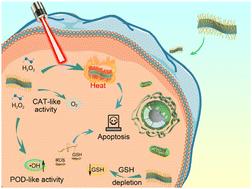
Single-atom catalysts with abnormally high catalytic activity have garnered extensive attention and interest for their application in tumor therapy. Despite the advancements made with current nanotherapeutic agents, developing efficient systems for cancer treatment remains challenging due to low activity, uncontrollable behavior, and nonselective interactions. Herein, we have constructed Ru single-atom-anchored MXene nanozymes (Ru-Ti3C2Tx-PEG) with a mild photothermal effect and multi-enzyme catalytic activity for synergistic tumor therapy. Ru single atoms anchored on the surface of MXene nanosheets not only facilitate multi-enzyme catalytic activity but also amplify the photothermal performance owing to the localized surface plasmon resonance effect. The Ru single atoms could decompose H2O2 into toxic hydroxyl radicals (•OH) in response to the tumor microenvironment (TME) for enzyme catalytic therapy, and the heat produced by the nanozyme under near-infrared laser excitation enhanced the •OH generation yield. Moreover, the nanozyme exhibited oxygen formation and glutathione depletion capability in cancer cells, thereby regulating the TME and accelerating the •OH levels. The in vitro and in vivo studies in this work confirm that the two-dimensional Ru single-atom-anchored MXene nanozyme has an extraordinary tumor growth inhibition effect, thus presenting a rational therapeutic strategy for tumor ablation through the synergistic effect of photothermal activity and heat-promoted enzymatic catalysis.
期刊介绍:
Nanoscale is a high-impact international journal, publishing high-quality research across nanoscience and nanotechnology. Nanoscale publishes a full mix of research articles on experimental and theoretical work, including reviews, communications, and full papers.Highly interdisciplinary, this journal appeals to scientists, researchers and professionals interested in nanoscience and nanotechnology, quantum materials and quantum technology, including the areas of physics, chemistry, biology, medicine, materials, energy/environment, information technology, detection science, healthcare and drug discovery, and electronics.




 京公网安备 11010802042870号
京ICP备2023020795号-1
京公网安备 11010802042870号
京ICP备2023020795号-1

 分享
分享
 求助内容:
求助内容: 应助结果提醒方式:
 扫码关注我们
