Phelan Glenn, Katelyn Elizabeth Mooney, Ose Kadiri, Talia L Robinson, Rebecca E Amariglio, Reisa A Sperling, Kacie Deters
{"title":"白人、黑人、西班牙裔/拉丁裔、认知正常个体的家族史和淀粉样蛋白PET","authors":"Phelan Glenn, Katelyn Elizabeth Mooney, Ose Kadiri, Talia L Robinson, Rebecca E Amariglio, Reisa A Sperling, Kacie Deters","doi":"10.1002/alz.091146","DOIUrl":null,"url":null,"abstract":"<div>\n \n \n <section>\n \n <h3> Background</h3>\n \n <p>Family history (FH) of AD increases risk for sporadic AD, and has been associated with increased amyloid accumulation. Most of these studies were done in non-Hispanic white groups, limiting the generalizability of these findings. The goal of this study was to determine if FH was associated with levels of amyloid in White, Black, and Hispanic/Latino participants.</p>\n </section>\n \n <section>\n \n <h3> Methods</h3>\n \n <p>This study included cognitively normal individuals screening for the Anti-Amyloid Treatment in Asymptomatic Alzheimer’s (A4) cohort whom self-identified as Non-Hispanic/Latino Black (NHB; N=145), Non-Hispanic white (NHW; N=3766), or Hispanic/Latino white (HL; N=107). The effect of FH (father, mother or both, vs none) on amyloid PET SUVr was assessed using linear regression analysis within each ethnic and racialized group. Age and sex were used as covariates. This analysis was repeated adding APOE e4 allele as a moderator.</p>\n </section>\n \n <section>\n \n <h3> Results</h3>\n \n <p>NHB participants were more likely to be female (71.7%), had the lowest FH rate (56.6%), and were less likely to be amyloid positive (20%) compared to HL participants (female=64.5%; FH=62.6%; amyloid+=27.1%) and NHW participants (female=59.7%; FH=66.2%; amyloid+=30.2%). Having a FH of AD was associated with higher levels of amyloid SUVr (β=0.028, p=2e-05) in NHW participants only (Table). This effect became non-significant when APOE e4 was included in the model.</p>\n </section>\n \n <section>\n \n <h3> Conclusions</h3>\n \n <p>FH was associated with higher levels of amyloid SUVr in White participants only, but not in the presence of APOE e4. For Black and Hispanic participants, FH was not associated with levels of amyloid. These findings support previous findings in which risk factors for AD are not shared equally across different ethnic and racialized groups.</p>\n </section>\n </div>","PeriodicalId":7471,"journal":{"name":"Alzheimer's & Dementia","volume":"20 S2","pages":""},"PeriodicalIF":11.1000,"publicationDate":"2025-01-09","publicationTypes":"Journal Article","fieldsOfStudy":null,"isOpenAccess":false,"openAccessPdf":"https://onlinelibrary.wiley.com/doi/epdf/10.1002/alz.091146","citationCount":"0","resultStr":"{\"title\":\"Family history and amyloid PET in white, Black, and Hispanic/Latino, cognitively normal individuals\",\"authors\":\"Phelan Glenn, Katelyn Elizabeth Mooney, Ose Kadiri, Talia L Robinson, Rebecca E Amariglio, Reisa A Sperling, Kacie Deters\",\"doi\":\"10.1002/alz.091146\",\"DOIUrl\":null,\"url\":null,\"abstract\":\"<div>\\n \\n \\n <section>\\n \\n <h3> Background</h3>\\n \\n <p>Family history (FH) of AD increases risk for sporadic AD, and has been associated with increased amyloid accumulation. Most of these studies were done in non-Hispanic white groups, limiting the generalizability of these findings. The goal of this study was to determine if FH was associated with levels of amyloid in White, Black, and Hispanic/Latino participants.</p>\\n </section>\\n \\n <section>\\n \\n <h3> Methods</h3>\\n \\n <p>This study included cognitively normal individuals screening for the Anti-Amyloid Treatment in Asymptomatic Alzheimer’s (A4) cohort whom self-identified as Non-Hispanic/Latino Black (NHB; N=145), Non-Hispanic white (NHW; N=3766), or Hispanic/Latino white (HL; N=107). The effect of FH (father, mother or both, vs none) on amyloid PET SUVr was assessed using linear regression analysis within each ethnic and racialized group. Age and sex were used as covariates. This analysis was repeated adding APOE e4 allele as a moderator.</p>\\n </section>\\n \\n <section>\\n \\n <h3> Results</h3>\\n \\n <p>NHB participants were more likely to be female (71.7%), had the lowest FH rate (56.6%), and were less likely to be amyloid positive (20%) compared to HL participants (female=64.5%; FH=62.6%; amyloid+=27.1%) and NHW participants (female=59.7%; FH=66.2%; amyloid+=30.2%). Having a FH of AD was associated with higher levels of amyloid SUVr (β=0.028, p=2e-05) in NHW participants only (Table). This effect became non-significant when APOE e4 was included in the model.</p>\\n </section>\\n \\n <section>\\n \\n <h3> Conclusions</h3>\\n \\n <p>FH was associated with higher levels of amyloid SUVr in White participants only, but not in the presence of APOE e4. For Black and Hispanic participants, FH was not associated with levels of amyloid. These findings support previous findings in which risk factors for AD are not shared equally across different ethnic and racialized groups.</p>\\n </section>\\n </div>\",\"PeriodicalId\":7471,\"journal\":{\"name\":\"Alzheimer's & Dementia\",\"volume\":\"20 S2\",\"pages\":\"\"},\"PeriodicalIF\":11.1000,\"publicationDate\":\"2025-01-09\",\"publicationTypes\":\"Journal Article\",\"fieldsOfStudy\":null,\"isOpenAccess\":false,\"openAccessPdf\":\"https://onlinelibrary.wiley.com/doi/epdf/10.1002/alz.091146\",\"citationCount\":\"0\",\"resultStr\":null,\"platform\":\"Semanticscholar\",\"paperid\":null,\"PeriodicalName\":\"Alzheimer's & Dementia\",\"FirstCategoryId\":\"3\",\"ListUrlMain\":\"https://alz-journals.onlinelibrary.wiley.com/doi/10.1002/alz.091146\",\"RegionNum\":1,\"RegionCategory\":\"医学\",\"ArticlePicture\":[],\"TitleCN\":null,\"AbstractTextCN\":null,\"PMCID\":null,\"EPubDate\":\"\",\"PubModel\":\"\",\"JCR\":\"Q1\",\"JCRName\":\"CLINICAL NEUROLOGY\",\"Score\":null,\"Total\":0}","platform":"Semanticscholar","paperid":null,"PeriodicalName":"Alzheimer's & Dementia","FirstCategoryId":"3","ListUrlMain":"https://alz-journals.onlinelibrary.wiley.com/doi/10.1002/alz.091146","RegionNum":1,"RegionCategory":"医学","ArticlePicture":[],"TitleCN":null,"AbstractTextCN":null,"PMCID":null,"EPubDate":"","PubModel":"","JCR":"Q1","JCRName":"CLINICAL NEUROLOGY","Score":null,"Total":0}
Family history and amyloid PET in white, Black, and Hispanic/Latino, cognitively normal individuals
Background
Family history (FH) of AD increases risk for sporadic AD, and has been associated with increased amyloid accumulation. Most of these studies were done in non-Hispanic white groups, limiting the generalizability of these findings. The goal of this study was to determine if FH was associated with levels of amyloid in White, Black, and Hispanic/Latino participants.
Methods
This study included cognitively normal individuals screening for the Anti-Amyloid Treatment in Asymptomatic Alzheimer’s (A4) cohort whom self-identified as Non-Hispanic/Latino Black (NHB; N=145), Non-Hispanic white (NHW; N=3766), or Hispanic/Latino white (HL; N=107). The effect of FH (father, mother or both, vs none) on amyloid PET SUVr was assessed using linear regression analysis within each ethnic and racialized group. Age and sex were used as covariates. This analysis was repeated adding APOE e4 allele as a moderator.
Results
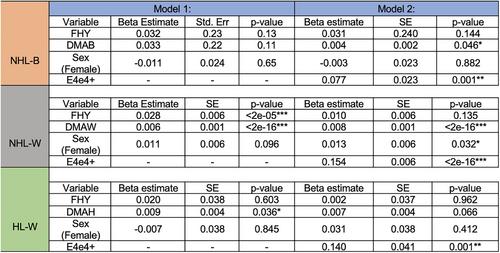
NHB participants were more likely to be female (71.7%), had the lowest FH rate (56.6%), and were less likely to be amyloid positive (20%) compared to HL participants (female=64.5%; FH=62.6%; amyloid+=27.1%) and NHW participants (female=59.7%; FH=66.2%; amyloid+=30.2%). Having a FH of AD was associated with higher levels of amyloid SUVr (β=0.028, p=2e-05) in NHW participants only (Table). This effect became non-significant when APOE e4 was included in the model.
Conclusions
FH was associated with higher levels of amyloid SUVr in White participants only, but not in the presence of APOE e4. For Black and Hispanic participants, FH was not associated with levels of amyloid. These findings support previous findings in which risk factors for AD are not shared equally across different ethnic and racialized groups.
期刊介绍:
Alzheimer's & Dementia is a peer-reviewed journal that aims to bridge knowledge gaps in dementia research by covering the entire spectrum, from basic science to clinical trials to social and behavioral investigations. It provides a platform for rapid communication of new findings and ideas, optimal translation of research into practical applications, increasing knowledge across diverse disciplines for early detection, diagnosis, and intervention, and identifying promising new research directions. In July 2008, Alzheimer's & Dementia was accepted for indexing by MEDLINE, recognizing its scientific merit and contribution to Alzheimer's research.





 京公网安备 11010802042870号
京ICP备2023020795号-1
京公网安备 11010802042870号
京ICP备2023020795号-1

 分享
分享
 求助内容:
求助内容: 应助结果提醒方式:
 扫码关注我们
