Xiang Zhang , Yue Wang , Yumen Ru , Xiaoju Zhang , Fan Luo , Xiangdong Chen , Xiaoguang Zhao , Chang Wang
{"title":"金纳米粒子修饰的单壁碳纳米管太赫兹超表面用于微量蛋白质的超灵敏传感。","authors":"Xiang Zhang , Yue Wang , Yumen Ru , Xiaoju Zhang , Fan Luo , Xiangdong Chen , Xiaoguang Zhao , Chang Wang","doi":"10.1016/j.talanta.2025.127549","DOIUrl":null,"url":null,"abstract":"<div><div>Research on metasurface sensors with high sensitivity, strong specificity, good biocompatibility and strong integration is the key to promote the application of terahertz waves in the field of biomedical detection. However, traditional metallic terahertz metasurfaces have shortcomings such as poor biocompatibility and large ohmic loss in the terahertz frequency band, impeding their further application and integration in the field of biosensing detection. Here, we overcome this challenge by proposing a high-performance terahertz metasurface based on gold nanoparticles and single-walled carbon nanotubes composite film. Compared with metal materials, carbon nanotubes not only have better biocompatibility, which can reduce the potential adverse reactions between metasurfaces and biological samples, but also have strong tunability in electrical and optical properties. Experimentally, we reveal a method to adjust the dielectric properties of single-walled carbon nanotube films by doping with gold nanoparticles. Leveraging this mechanism, we designed and prepared a single-walled carbon nanotube terahertz metasurface composed of periodically arranged asymmetric open resonant rings. Compared with pure single-walled carbon nanotube films, this device based on a composite single-walled carbon nanotube films have better localized electromagnetic field enhancement characteristics. Through integration with microfluidic channels, this metasurface sensor can achieve direct detection of SAA proteins in solution environments at the fM level. In addition, the device also exhibits a detection sensitivity of 41 GHz/fM. This work has not only made significant progress in the design and function of new high-sensitivity carbon-based terahertz metasurfaces, but also laid the foundation for its application in liquid environment detection of trace biological samples.</div></div>","PeriodicalId":435,"journal":{"name":"Talanta","volume":"286 ","pages":"Article 127549"},"PeriodicalIF":6.1000,"publicationDate":"2025-05-01","publicationTypes":"Journal Article","fieldsOfStudy":null,"isOpenAccess":false,"openAccessPdf":"","citationCount":"0","resultStr":"{\"title\":\"Gold nanoparticle-modified single-walled carbon nanotube terahertz metasurface for ultrasensitive sensing of trace proteins\",\"authors\":\"Xiang Zhang , Yue Wang , Yumen Ru , Xiaoju Zhang , Fan Luo , Xiangdong Chen , Xiaoguang Zhao , Chang Wang\",\"doi\":\"10.1016/j.talanta.2025.127549\",\"DOIUrl\":null,\"url\":null,\"abstract\":\"<div><div>Research on metasurface sensors with high sensitivity, strong specificity, good biocompatibility and strong integration is the key to promote the application of terahertz waves in the field of biomedical detection. However, traditional metallic terahertz metasurfaces have shortcomings such as poor biocompatibility and large ohmic loss in the terahertz frequency band, impeding their further application and integration in the field of biosensing detection. Here, we overcome this challenge by proposing a high-performance terahertz metasurface based on gold nanoparticles and single-walled carbon nanotubes composite film. Compared with metal materials, carbon nanotubes not only have better biocompatibility, which can reduce the potential adverse reactions between metasurfaces and biological samples, but also have strong tunability in electrical and optical properties. Experimentally, we reveal a method to adjust the dielectric properties of single-walled carbon nanotube films by doping with gold nanoparticles. Leveraging this mechanism, we designed and prepared a single-walled carbon nanotube terahertz metasurface composed of periodically arranged asymmetric open resonant rings. Compared with pure single-walled carbon nanotube films, this device based on a composite single-walled carbon nanotube films have better localized electromagnetic field enhancement characteristics. Through integration with microfluidic channels, this metasurface sensor can achieve direct detection of SAA proteins in solution environments at the fM level. In addition, the device also exhibits a detection sensitivity of 41 GHz/fM. This work has not only made significant progress in the design and function of new high-sensitivity carbon-based terahertz metasurfaces, but also laid the foundation for its application in liquid environment detection of trace biological samples.</div></div>\",\"PeriodicalId\":435,\"journal\":{\"name\":\"Talanta\",\"volume\":\"286 \",\"pages\":\"Article 127549\"},\"PeriodicalIF\":6.1000,\"publicationDate\":\"2025-05-01\",\"publicationTypes\":\"Journal Article\",\"fieldsOfStudy\":null,\"isOpenAccess\":false,\"openAccessPdf\":\"\",\"citationCount\":\"0\",\"resultStr\":null,\"platform\":\"Semanticscholar\",\"paperid\":null,\"PeriodicalName\":\"Talanta\",\"FirstCategoryId\":\"92\",\"ListUrlMain\":\"https://www.sciencedirect.com/science/article/pii/S0039914025000359\",\"RegionNum\":1,\"RegionCategory\":\"化学\",\"ArticlePicture\":[],\"TitleCN\":null,\"AbstractTextCN\":null,\"PMCID\":null,\"EPubDate\":\"2025/1/6 0:00:00\",\"PubModel\":\"Epub\",\"JCR\":\"Q1\",\"JCRName\":\"CHEMISTRY, ANALYTICAL\",\"Score\":null,\"Total\":0}","platform":"Semanticscholar","paperid":null,"PeriodicalName":"Talanta","FirstCategoryId":"92","ListUrlMain":"https://www.sciencedirect.com/science/article/pii/S0039914025000359","RegionNum":1,"RegionCategory":"化学","ArticlePicture":[],"TitleCN":null,"AbstractTextCN":null,"PMCID":null,"EPubDate":"2025/1/6 0:00:00","PubModel":"Epub","JCR":"Q1","JCRName":"CHEMISTRY, ANALYTICAL","Score":null,"Total":0}
Gold nanoparticle-modified single-walled carbon nanotube terahertz metasurface for ultrasensitive sensing of trace proteins
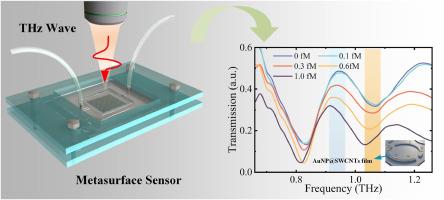
Research on metasurface sensors with high sensitivity, strong specificity, good biocompatibility and strong integration is the key to promote the application of terahertz waves in the field of biomedical detection. However, traditional metallic terahertz metasurfaces have shortcomings such as poor biocompatibility and large ohmic loss in the terahertz frequency band, impeding their further application and integration in the field of biosensing detection. Here, we overcome this challenge by proposing a high-performance terahertz metasurface based on gold nanoparticles and single-walled carbon nanotubes composite film. Compared with metal materials, carbon nanotubes not only have better biocompatibility, which can reduce the potential adverse reactions between metasurfaces and biological samples, but also have strong tunability in electrical and optical properties. Experimentally, we reveal a method to adjust the dielectric properties of single-walled carbon nanotube films by doping with gold nanoparticles. Leveraging this mechanism, we designed and prepared a single-walled carbon nanotube terahertz metasurface composed of periodically arranged asymmetric open resonant rings. Compared with pure single-walled carbon nanotube films, this device based on a composite single-walled carbon nanotube films have better localized electromagnetic field enhancement characteristics. Through integration with microfluidic channels, this metasurface sensor can achieve direct detection of SAA proteins in solution environments at the fM level. In addition, the device also exhibits a detection sensitivity of 41 GHz/fM. This work has not only made significant progress in the design and function of new high-sensitivity carbon-based terahertz metasurfaces, but also laid the foundation for its application in liquid environment detection of trace biological samples.
期刊介绍:
Talanta provides a forum for the publication of original research papers, short communications, and critical reviews in all branches of pure and applied analytical chemistry. Papers are evaluated based on established guidelines, including the fundamental nature of the study, scientific novelty, substantial improvement or advantage over existing technology or methods, and demonstrated analytical applicability. Original research papers on fundamental studies, and on novel sensor and instrumentation developments, are encouraged. Novel or improved applications in areas such as clinical and biological chemistry, environmental analysis, geochemistry, materials science and engineering, and analytical platforms for omics development are welcome.
Analytical performance of methods should be determined, including interference and matrix effects, and methods should be validated by comparison with a standard method, or analysis of a certified reference material. Simple spiking recoveries may not be sufficient. The developed method should especially comprise information on selectivity, sensitivity, detection limits, accuracy, and reliability. However, applying official validation or robustness studies to a routine method or technique does not necessarily constitute novelty. Proper statistical treatment of the data should be provided. Relevant literature should be cited, including related publications by the authors, and authors should discuss how their proposed methodology compares with previously reported methods.




 京公网安备 11010802042870号
京ICP备2023020795号-1
京公网安备 11010802042870号
京ICP备2023020795号-1

 分享
分享
 求助内容:
求助内容: 应助结果提醒方式:
 扫码关注我们
