{"title":"Ti3C2Tx MXene/海藻酸衍生介孔碳纳米复合材料作为硬币电池不对称超级电容器的电极材料","authors":"Sanjay D. Sutar and Anita Swami","doi":"10.1039/D4NR04584J","DOIUrl":null,"url":null,"abstract":"<p >In this study, we demonstrate MXene (Ti<small><sub>3</sub></small>C<small><sub>2</sub></small>T<small><sub><em>x</em></sub></small>)-based coin-cell asymmetric supercapacitor (coin-cell ASC) exhibiting high energy density and high power density along with good capacitance. We synthesized mesoporous carbon (MC) by annealing alginic acid at varying temperatures (900 °C, 1000 °C and 1100 °C). Among the prepared samples, MC-1000 exhibited a highly porous structure and a higher surface area. We then developed a Ti<small><sub>3</sub></small>C<small><sub>2</sub></small>T<small><sub><em>x</em></sub></small>/MC (MC-1000) nanocomposite using a simple and efficient solvothermal method. The synthesized nanocomposite displayed the layered morphology of MXene alongside the amorphous characteristics of carbon, indicating a strong interaction between the two materials. Notably, the Ti<small><sub>3</sub></small>C<small><sub>2</sub></small>T<small><sub><em>x</em></sub></small>/MC-9 nanocomposite features a higher number of pores and a larger surface area than either MXene or MC-1000, significantly enhancing its capacitive performance. We evaluated the performance using a three-electrode system, revealing an impressive specific capacitance (<em>C</em><small><sub>sp</sub></small>) of 1629 F g<small><sup>−1</sup></small> at 1 A g<small><sup>−1</sup></small>, with a retention of 99.9% even after 35 000 cycles. Furthermore, the fabricated coin-cell ASC using (MC-1000//Ti<small><sub>3</sub></small>C<small><sub>2</sub></small>T<small><sub><em>x</em></sub></small>/MC-9) electrodes demonstrated a <em>C</em><small><sub>sp</sub></small> of 80.3 F g<small><sup>−1</sup></small> at 1 A g<small><sup>−1</sup></small> and a high energy density of 56 W h kg<small><sup>−1</sup></small>, corresponding to a maximum power density of 10 423 W kg<small><sup>−1</sup></small> at 5 A g<small><sup>−1</sup></small>. The key factors contributing to the enhanced electrochemical performance include the strong connection between MXene and MC-1000, along with the large specific surface area and high porosity of the electrode materials.</p>","PeriodicalId":92,"journal":{"name":"Nanoscale","volume":" 8","pages":" 4750-4764"},"PeriodicalIF":5.2000,"publicationDate":"2025-01-13","publicationTypes":"Journal Article","fieldsOfStudy":null,"isOpenAccess":false,"openAccessPdf":"","citationCount":"0","resultStr":"{\"title\":\"A Ti3C2Tx MXene/alginic acid-derived mesoporous carbon nanocomposite as a potential electrode material for coin-cell asymmetric supercapacitors†\",\"authors\":\"Sanjay D. Sutar and Anita Swami\",\"doi\":\"10.1039/D4NR04584J\",\"DOIUrl\":null,\"url\":null,\"abstract\":\"<p >In this study, we demonstrate MXene (Ti<small><sub>3</sub></small>C<small><sub>2</sub></small>T<small><sub><em>x</em></sub></small>)-based coin-cell asymmetric supercapacitor (coin-cell ASC) exhibiting high energy density and high power density along with good capacitance. We synthesized mesoporous carbon (MC) by annealing alginic acid at varying temperatures (900 °C, 1000 °C and 1100 °C). Among the prepared samples, MC-1000 exhibited a highly porous structure and a higher surface area. We then developed a Ti<small><sub>3</sub></small>C<small><sub>2</sub></small>T<small><sub><em>x</em></sub></small>/MC (MC-1000) nanocomposite using a simple and efficient solvothermal method. The synthesized nanocomposite displayed the layered morphology of MXene alongside the amorphous characteristics of carbon, indicating a strong interaction between the two materials. Notably, the Ti<small><sub>3</sub></small>C<small><sub>2</sub></small>T<small><sub><em>x</em></sub></small>/MC-9 nanocomposite features a higher number of pores and a larger surface area than either MXene or MC-1000, significantly enhancing its capacitive performance. We evaluated the performance using a three-electrode system, revealing an impressive specific capacitance (<em>C</em><small><sub>sp</sub></small>) of 1629 F g<small><sup>−1</sup></small> at 1 A g<small><sup>−1</sup></small>, with a retention of 99.9% even after 35 000 cycles. Furthermore, the fabricated coin-cell ASC using (MC-1000//Ti<small><sub>3</sub></small>C<small><sub>2</sub></small>T<small><sub><em>x</em></sub></small>/MC-9) electrodes demonstrated a <em>C</em><small><sub>sp</sub></small> of 80.3 F g<small><sup>−1</sup></small> at 1 A g<small><sup>−1</sup></small> and a high energy density of 56 W h kg<small><sup>−1</sup></small>, corresponding to a maximum power density of 10 423 W kg<small><sup>−1</sup></small> at 5 A g<small><sup>−1</sup></small>. The key factors contributing to the enhanced electrochemical performance include the strong connection between MXene and MC-1000, along with the large specific surface area and high porosity of the electrode materials.</p>\",\"PeriodicalId\":92,\"journal\":{\"name\":\"Nanoscale\",\"volume\":\" 8\",\"pages\":\" 4750-4764\"},\"PeriodicalIF\":5.2000,\"publicationDate\":\"2025-01-13\",\"publicationTypes\":\"Journal Article\",\"fieldsOfStudy\":null,\"isOpenAccess\":false,\"openAccessPdf\":\"\",\"citationCount\":\"0\",\"resultStr\":null,\"platform\":\"Semanticscholar\",\"paperid\":null,\"PeriodicalName\":\"Nanoscale\",\"FirstCategoryId\":\"88\",\"ListUrlMain\":\"https://pubs.rsc.org/en/content/articlelanding/2025/nr/d4nr04584j\",\"RegionNum\":3,\"RegionCategory\":\"材料科学\",\"ArticlePicture\":[],\"TitleCN\":null,\"AbstractTextCN\":null,\"PMCID\":null,\"EPubDate\":\"\",\"PubModel\":\"\",\"JCR\":\"Q1\",\"JCRName\":\"CHEMISTRY, MULTIDISCIPLINARY\",\"Score\":null,\"Total\":0}","platform":"Semanticscholar","paperid":null,"PeriodicalName":"Nanoscale","FirstCategoryId":"88","ListUrlMain":"https://pubs.rsc.org/en/content/articlelanding/2025/nr/d4nr04584j","RegionNum":3,"RegionCategory":"材料科学","ArticlePicture":[],"TitleCN":null,"AbstractTextCN":null,"PMCID":null,"EPubDate":"","PubModel":"","JCR":"Q1","JCRName":"CHEMISTRY, MULTIDISCIPLINARY","Score":null,"Total":0}
A Ti3C2Tx MXene/alginic acid-derived mesoporous carbon nanocomposite as a potential electrode material for coin-cell asymmetric supercapacitors†
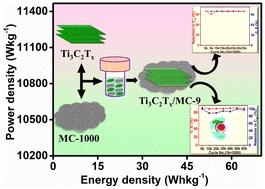
In this study, we demonstrate MXene (Ti3C2Tx)-based coin-cell asymmetric supercapacitor (coin-cell ASC) exhibiting high energy density and high power density along with good capacitance. We synthesized mesoporous carbon (MC) by annealing alginic acid at varying temperatures (900 °C, 1000 °C and 1100 °C). Among the prepared samples, MC-1000 exhibited a highly porous structure and a higher surface area. We then developed a Ti3C2Tx/MC (MC-1000) nanocomposite using a simple and efficient solvothermal method. The synthesized nanocomposite displayed the layered morphology of MXene alongside the amorphous characteristics of carbon, indicating a strong interaction between the two materials. Notably, the Ti3C2Tx/MC-9 nanocomposite features a higher number of pores and a larger surface area than either MXene or MC-1000, significantly enhancing its capacitive performance. We evaluated the performance using a three-electrode system, revealing an impressive specific capacitance (Csp) of 1629 F g−1 at 1 A g−1, with a retention of 99.9% even after 35 000 cycles. Furthermore, the fabricated coin-cell ASC using (MC-1000//Ti3C2Tx/MC-9) electrodes demonstrated a Csp of 80.3 F g−1 at 1 A g−1 and a high energy density of 56 W h kg−1, corresponding to a maximum power density of 10 423 W kg−1 at 5 A g−1. The key factors contributing to the enhanced electrochemical performance include the strong connection between MXene and MC-1000, along with the large specific surface area and high porosity of the electrode materials.
期刊介绍:
Nanoscale is a high-impact international journal, publishing high-quality research across nanoscience and nanotechnology. Nanoscale publishes a full mix of research articles on experimental and theoretical work, including reviews, communications, and full papers.Highly interdisciplinary, this journal appeals to scientists, researchers and professionals interested in nanoscience and nanotechnology, quantum materials and quantum technology, including the areas of physics, chemistry, biology, medicine, materials, energy/environment, information technology, detection science, healthcare and drug discovery, and electronics.




 京公网安备 11010802042870号
京ICP备2023020795号-1
京公网安备 11010802042870号
京ICP备2023020795号-1

 分享
分享
 求助内容:
求助内容: 应助结果提醒方式:
 扫码关注我们
