Jacob A Linker, Abhishek Ganta, Kenneth A Egol, Sanjit R Konda
{"title":"一名99岁患者股骨远端骨折钉钢板联合固定的疗效。","authors":"Jacob A Linker, Abhishek Ganta, Kenneth A Egol, Sanjit R Konda","doi":"10.13107/jocr.2025.v15.i01.5120","DOIUrl":null,"url":null,"abstract":"<p><strong>Introduction: </strong>This report describes the use of a combination of a retrograde femoral nail and distal femur locking plate for the treatment of an open intra-articular distal femur fracture in a 99-year-old female. The purpose of this report is to highlight that nail-plate fixation constructs can be performed percutaneously and expeditiously even in extremely old patients; therefore, patient age should not be a limiting factor in choosing this construct to allow for immediate weight-bearing.</p><p><strong>Case report: </strong>The patient was a 99-year-old female who presented to the emergency room after a fall. Plain radiographs demonstrated a comminuted supracondylar distal femur fracture with a sagittal intercondylar split (OTA classification 33A3.3). She was indicated for operative repair and was fixed with a combination of a retrograde Stryker T2 alpha nail and Stryker distal femur locking plate. This method was chosen to allow the patient to be weight-bearing as tolerated after surgery so she could immediately start work with physical therapy to work towards getting back to her pre-injury ambulatory status. At 3 months post-operatively, she had minimal pain, no difficulties with activities of daily living, and was ambulating with the assistance of a cane. At 9 months post-operatively, she was ambulating with a cane (pre-injury status). She did not report any pain, and her radiographs illustrated fracture site consolidation. Furthermore, her short musculoskeletal functional assessment score was the same as it was pre-injury (81).</p><p><strong>Conclusion: </strong>This case supports the idea of using a nail-plate combination for repair of intra-articular distal femur fractures, even in the very elderly as the patient's functional outcome data reached pre-injury levels. In addition, it allows even elderly patients to begin early weight-bearing and decreases complications related to lack of extremity use.</p>","PeriodicalId":16647,"journal":{"name":"Journal of Orthopaedic Case Reports","volume":"15 1","pages":"46-50"},"PeriodicalIF":0.0000,"publicationDate":"2025-01-01","publicationTypes":"Journal Article","fieldsOfStudy":null,"isOpenAccess":false,"openAccessPdf":"https://www.ncbi.nlm.nih.gov/pmc/articles/PMC11723753/pdf/","citationCount":"0","resultStr":"{\"title\":\"Outcome of a Nail-plate Fixation Combination for a Distal Femur Fracture in a 99-year-old Patient.\",\"authors\":\"Jacob A Linker, Abhishek Ganta, Kenneth A Egol, Sanjit R Konda\",\"doi\":\"10.13107/jocr.2025.v15.i01.5120\",\"DOIUrl\":null,\"url\":null,\"abstract\":\"<p><strong>Introduction: </strong>This report describes the use of a combination of a retrograde femoral nail and distal femur locking plate for the treatment of an open intra-articular distal femur fracture in a 99-year-old female. The purpose of this report is to highlight that nail-plate fixation constructs can be performed percutaneously and expeditiously even in extremely old patients; therefore, patient age should not be a limiting factor in choosing this construct to allow for immediate weight-bearing.</p><p><strong>Case report: </strong>The patient was a 99-year-old female who presented to the emergency room after a fall. Plain radiographs demonstrated a comminuted supracondylar distal femur fracture with a sagittal intercondylar split (OTA classification 33A3.3). She was indicated for operative repair and was fixed with a combination of a retrograde Stryker T2 alpha nail and Stryker distal femur locking plate. This method was chosen to allow the patient to be weight-bearing as tolerated after surgery so she could immediately start work with physical therapy to work towards getting back to her pre-injury ambulatory status. At 3 months post-operatively, she had minimal pain, no difficulties with activities of daily living, and was ambulating with the assistance of a cane. At 9 months post-operatively, she was ambulating with a cane (pre-injury status). She did not report any pain, and her radiographs illustrated fracture site consolidation. Furthermore, her short musculoskeletal functional assessment score was the same as it was pre-injury (81).</p><p><strong>Conclusion: </strong>This case supports the idea of using a nail-plate combination for repair of intra-articular distal femur fractures, even in the very elderly as the patient's functional outcome data reached pre-injury levels. In addition, it allows even elderly patients to begin early weight-bearing and decreases complications related to lack of extremity use.</p>\",\"PeriodicalId\":16647,\"journal\":{\"name\":\"Journal of Orthopaedic Case Reports\",\"volume\":\"15 1\",\"pages\":\"46-50\"},\"PeriodicalIF\":0.0000,\"publicationDate\":\"2025-01-01\",\"publicationTypes\":\"Journal Article\",\"fieldsOfStudy\":null,\"isOpenAccess\":false,\"openAccessPdf\":\"https://www.ncbi.nlm.nih.gov/pmc/articles/PMC11723753/pdf/\",\"citationCount\":\"0\",\"resultStr\":null,\"platform\":\"Semanticscholar\",\"paperid\":null,\"PeriodicalName\":\"Journal of Orthopaedic Case Reports\",\"FirstCategoryId\":\"1085\",\"ListUrlMain\":\"https://doi.org/10.13107/jocr.2025.v15.i01.5120\",\"RegionNum\":0,\"RegionCategory\":null,\"ArticlePicture\":[],\"TitleCN\":null,\"AbstractTextCN\":null,\"PMCID\":null,\"EPubDate\":\"\",\"PubModel\":\"\",\"JCR\":\"\",\"JCRName\":\"\",\"Score\":null,\"Total\":0}","platform":"Semanticscholar","paperid":null,"PeriodicalName":"Journal of Orthopaedic Case Reports","FirstCategoryId":"1085","ListUrlMain":"https://doi.org/10.13107/jocr.2025.v15.i01.5120","RegionNum":0,"RegionCategory":null,"ArticlePicture":[],"TitleCN":null,"AbstractTextCN":null,"PMCID":null,"EPubDate":"","PubModel":"","JCR":"","JCRName":"","Score":null,"Total":0}
Outcome of a Nail-plate Fixation Combination for a Distal Femur Fracture in a 99-year-old Patient.
Introduction: This report describes the use of a combination of a retrograde femoral nail and distal femur locking plate for the treatment of an open intra-articular distal femur fracture in a 99-year-old female. The purpose of this report is to highlight that nail-plate fixation constructs can be performed percutaneously and expeditiously even in extremely old patients; therefore, patient age should not be a limiting factor in choosing this construct to allow for immediate weight-bearing.
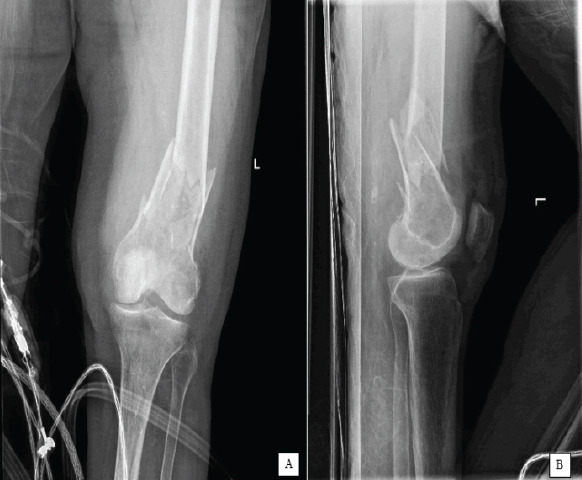
Case report: The patient was a 99-year-old female who presented to the emergency room after a fall. Plain radiographs demonstrated a comminuted supracondylar distal femur fracture with a sagittal intercondylar split (OTA classification 33A3.3). She was indicated for operative repair and was fixed with a combination of a retrograde Stryker T2 alpha nail and Stryker distal femur locking plate. This method was chosen to allow the patient to be weight-bearing as tolerated after surgery so she could immediately start work with physical therapy to work towards getting back to her pre-injury ambulatory status. At 3 months post-operatively, she had minimal pain, no difficulties with activities of daily living, and was ambulating with the assistance of a cane. At 9 months post-operatively, she was ambulating with a cane (pre-injury status). She did not report any pain, and her radiographs illustrated fracture site consolidation. Furthermore, her short musculoskeletal functional assessment score was the same as it was pre-injury (81).
Conclusion: This case supports the idea of using a nail-plate combination for repair of intra-articular distal femur fractures, even in the very elderly as the patient's functional outcome data reached pre-injury levels. In addition, it allows even elderly patients to begin early weight-bearing and decreases complications related to lack of extremity use.






 京公网安备 11010802042870号
京ICP备2023020795号-1
京公网安备 11010802042870号
京ICP备2023020795号-1

 分享
分享

 求助内容:
求助内容: 应助结果提醒方式:
 扫码关注我们
