Aishwarya Prakash, Suma Basappa, Rajashri R. Urkude, Ravindra Jangir, Rajendra S. Dhayal, Shubhankar Kumar Bose
{"title":"零价铜催化实现炔的区域和立体选择性双官能化","authors":"Aishwarya Prakash, Suma Basappa, Rajashri R. Urkude, Ravindra Jangir, Rajendra S. Dhayal, Shubhankar Kumar Bose","doi":"10.1002/anie.202418901","DOIUrl":null,"url":null,"abstract":"<p>The development of a metallic copper-based catalyst system remains a significant challenge. Herein, we report the synthesis of highly stable, active, and reusable Cu<sup>0</sup> catalyst for the carboboration of alkynes using carbon electrophiles and <i>bis</i>(pinacolato)diboron (B<sub>2</sub>pin<sub>2</sub>) as chemical feedstocks to afford di- and trisubstituted vinylboronate esters in a regio- and stereoselective manner with appreciable turnover number (TON) of up to 2535 under mild reaction conditions. This three-component coupling reaction works well with a variety of substituted electrophiles and alkynes with broad functional group tolerance. In addition, a wide range of terminal and challenging internal alkynes were efficiently converted into hydroborated products in up to >99 % yield with excellent regioselectivity in the absence of carbon electrophiles. X-ray photoelectron spectroscopy and X-ray absorption near-edge spectroscopy (XANES) analysis confirm that the oxidation state of the copper in the catalyst is zero. The broad range of organic transformations, effectiveness, and recyclability of this Cu<sup>0</sup> catalyst are the major achievements that provide an environmentally friendly route for the efficient production of tri- and tetrasubstituted olefins, key intermediates in organic synthesis. The gram-scale reaction and synthetic transformations further highlights the usefulness of these methods.</p>","PeriodicalId":125,"journal":{"name":"Angewandte Chemie International Edition","volume":"64 8","pages":""},"PeriodicalIF":17.6000,"publicationDate":"2025-01-13","publicationTypes":"Journal Article","fieldsOfStudy":null,"isOpenAccess":false,"openAccessPdf":"","citationCount":"0","resultStr":"{\"title\":\"Zero-Valent Copper Catalysis Enables Regio- and Stereoselective Difunctionalization of Alkynes\",\"authors\":\"Aishwarya Prakash, Suma Basappa, Rajashri R. Urkude, Ravindra Jangir, Rajendra S. Dhayal, Shubhankar Kumar Bose\",\"doi\":\"10.1002/anie.202418901\",\"DOIUrl\":null,\"url\":null,\"abstract\":\"<p>The development of a metallic copper-based catalyst system remains a significant challenge. Herein, we report the synthesis of highly stable, active, and reusable Cu<sup>0</sup> catalyst for the carboboration of alkynes using carbon electrophiles and <i>bis</i>(pinacolato)diboron (B<sub>2</sub>pin<sub>2</sub>) as chemical feedstocks to afford di- and trisubstituted vinylboronate esters in a regio- and stereoselective manner with appreciable turnover number (TON) of up to 2535 under mild reaction conditions. This three-component coupling reaction works well with a variety of substituted electrophiles and alkynes with broad functional group tolerance. In addition, a wide range of terminal and challenging internal alkynes were efficiently converted into hydroborated products in up to >99 % yield with excellent regioselectivity in the absence of carbon electrophiles. X-ray photoelectron spectroscopy and X-ray absorption near-edge spectroscopy (XANES) analysis confirm that the oxidation state of the copper in the catalyst is zero. The broad range of organic transformations, effectiveness, and recyclability of this Cu<sup>0</sup> catalyst are the major achievements that provide an environmentally friendly route for the efficient production of tri- and tetrasubstituted olefins, key intermediates in organic synthesis. The gram-scale reaction and synthetic transformations further highlights the usefulness of these methods.</p>\",\"PeriodicalId\":125,\"journal\":{\"name\":\"Angewandte Chemie International Edition\",\"volume\":\"64 8\",\"pages\":\"\"},\"PeriodicalIF\":17.6000,\"publicationDate\":\"2025-01-13\",\"publicationTypes\":\"Journal Article\",\"fieldsOfStudy\":null,\"isOpenAccess\":false,\"openAccessPdf\":\"\",\"citationCount\":\"0\",\"resultStr\":null,\"platform\":\"Semanticscholar\",\"paperid\":null,\"PeriodicalName\":\"Angewandte Chemie International Edition\",\"FirstCategoryId\":\"92\",\"ListUrlMain\":\"https://onlinelibrary.wiley.com/doi/10.1002/anie.202418901\",\"RegionNum\":1,\"RegionCategory\":\"化学\",\"ArticlePicture\":[],\"TitleCN\":null,\"AbstractTextCN\":null,\"PMCID\":null,\"EPubDate\":\"\",\"PubModel\":\"\",\"JCR\":\"Q1\",\"JCRName\":\"CHEMISTRY, MULTIDISCIPLINARY\",\"Score\":null,\"Total\":0}","platform":"Semanticscholar","paperid":null,"PeriodicalName":"Angewandte Chemie International Edition","FirstCategoryId":"92","ListUrlMain":"https://onlinelibrary.wiley.com/doi/10.1002/anie.202418901","RegionNum":1,"RegionCategory":"化学","ArticlePicture":[],"TitleCN":null,"AbstractTextCN":null,"PMCID":null,"EPubDate":"","PubModel":"","JCR":"Q1","JCRName":"CHEMISTRY, MULTIDISCIPLINARY","Score":null,"Total":0}
Zero-Valent Copper Catalysis Enables Regio- and Stereoselective Difunctionalization of Alkynes
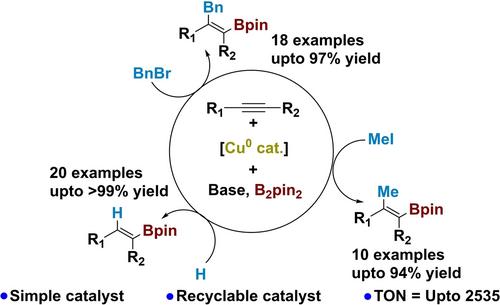
The development of a metallic copper-based catalyst system remains a significant challenge. Herein, we report the synthesis of highly stable, active, and reusable Cu0 catalyst for the carboboration of alkynes using carbon electrophiles and bis(pinacolato)diboron (B2pin2) as chemical feedstocks to afford di- and trisubstituted vinylboronate esters in a regio- and stereoselective manner with appreciable turnover number (TON) of up to 2535 under mild reaction conditions. This three-component coupling reaction works well with a variety of substituted electrophiles and alkynes with broad functional group tolerance. In addition, a wide range of terminal and challenging internal alkynes were efficiently converted into hydroborated products in up to >99 % yield with excellent regioselectivity in the absence of carbon electrophiles. X-ray photoelectron spectroscopy and X-ray absorption near-edge spectroscopy (XANES) analysis confirm that the oxidation state of the copper in the catalyst is zero. The broad range of organic transformations, effectiveness, and recyclability of this Cu0 catalyst are the major achievements that provide an environmentally friendly route for the efficient production of tri- and tetrasubstituted olefins, key intermediates in organic synthesis. The gram-scale reaction and synthetic transformations further highlights the usefulness of these methods.
期刊介绍:
Angewandte Chemie, a journal of the German Chemical Society (GDCh), maintains a leading position among scholarly journals in general chemistry with an impressive Impact Factor of 16.6 (2022 Journal Citation Reports, Clarivate, 2023). Published weekly in a reader-friendly format, it features new articles almost every day. Established in 1887, Angewandte Chemie is a prominent chemistry journal, offering a dynamic blend of Review-type articles, Highlights, Communications, and Research Articles on a weekly basis, making it unique in the field.




 京公网安备 11010802042870号
京ICP备2023020795号-1
京公网安备 11010802042870号
京ICP备2023020795号-1

 分享
分享
 求助内容:
求助内容: 应助结果提醒方式:
 扫码关注我们
