{"title":"抑制脑血管内皮中IFITM3可减轻阿尔茨海默病相关表型","authors":"Yijia Feng, Shengya Wang, Danlu Yang, Wu Zheng, Huwei Xia, Qinxin Zhu, Zhipeng Wang, Bolang Hu, Xinyi Jiang, Xuemei Qin, Chenkang Ni, Wenhao Pan, Yifan Zhao, Sipei Pan, Yun Zhang, Weihong Song","doi":"10.1002/alz.14543","DOIUrl":null,"url":null,"abstract":"<div>\n \n \n <section>\n \n <h3> INTRODUCTION</h3>\n \n <p>Interferon-induced transmembrane protein 3 (IFITM3) modulates γ-secretase in Alzheimer's Disease (AD). Although IFITM3 knockout reduces amyloid β protein (Aβ) production, its cell-specific effect on AD remains unclear.</p>\n </section>\n \n <section>\n \n <h3> METHODS</h3>\n \n <p>Single nucleus RNA sequencing (snRNA-seq) was used to assess IFITM3 expression. Adeno-associated virus-BI30 (AAV-BI30) was injected to reduce IFITM3 expression in the cerebrovascular endothelial cells (CVECs). The effects on AD phenotypes in cells and AD mice were examined through behavioral tests, two-photon imaging, flow cytometry, Western blot, immunohistochemistry, and quantitative polymerase chain reaction assay (qPCR).</p>\n </section>\n \n <section>\n \n <h3> RESULTS</h3>\n \n <p>IFITM3 expression was increased in the CVECs of patients with AD. Overexpression of <i>IFITM3</i> in primary endothelial cells enhanced Aβ generation through regulating beta-site APP cleaving enzyme 1 (BACE1) and γ-secretase. Aβ further increased IFITM3 expression, creating a vicious cycle. Knockdown of IFITM3 in CVECs decreased Aβ accumulation within cerebrovascular walls, reduced Alzheimer's-related pathology, and improved cognitive performance in AD transgenic mice.</p>\n </section>\n \n <section>\n \n <h3> DISCUSSION</h3>\n \n <p>Knockdown of IFITM3 in CVECs alleviates AD pathology and cognitive impairment. Targeting cerebrovascular endothelial IFITM3 holds promise for AD treatment.</p>\n </section>\n \n <section>\n \n <h3> Highlights</h3>\n \n <div>\n <ul>\n \n <li>Interferon-induced transmembrane protein 3 (<i>IFITM3</i>) expression was increased in the cerebrovascular endothelial cells (CVECs) of patients with Alzheimer's Disease (AD).</li>\n \n <li>Cerebrovascular endothelial IFITM3 regulates amyloid β protein (Aβ) generation through regulating beta-site APP cleaving enzyme 1 (BACE1) and γ-secretase.</li>\n \n <li>Knockdown of IFITM3 in CVECs reduces Aβ deposits and improves cognitive impairments in AD transgenic mice.</li>\n \n <li>Cerebrovascular endothelial IFITM3 could be a potential target for the treatment of AD.</li>\n </ul>\n </div>\n </section>\n </div>","PeriodicalId":7471,"journal":{"name":"Alzheimer's & Dementia","volume":"21 2","pages":""},"PeriodicalIF":12.8000,"publicationDate":"2025-01-14","publicationTypes":"Journal Article","fieldsOfStudy":null,"isOpenAccess":false,"openAccessPdf":"https://onlinelibrary.wiley.com/doi/epdf/10.1002/alz.14543","citationCount":"0","resultStr":"{\"title\":\"Inhibition of IFITM3 in cerebrovascular endothelium alleviates Alzheimer's-related phenotypes\",\"authors\":\"Yijia Feng, Shengya Wang, Danlu Yang, Wu Zheng, Huwei Xia, Qinxin Zhu, Zhipeng Wang, Bolang Hu, Xinyi Jiang, Xuemei Qin, Chenkang Ni, Wenhao Pan, Yifan Zhao, Sipei Pan, Yun Zhang, Weihong Song\",\"doi\":\"10.1002/alz.14543\",\"DOIUrl\":null,\"url\":null,\"abstract\":\"<div>\\n \\n \\n <section>\\n \\n <h3> INTRODUCTION</h3>\\n \\n <p>Interferon-induced transmembrane protein 3 (IFITM3) modulates γ-secretase in Alzheimer's Disease (AD). Although IFITM3 knockout reduces amyloid β protein (Aβ) production, its cell-specific effect on AD remains unclear.</p>\\n </section>\\n \\n <section>\\n \\n <h3> METHODS</h3>\\n \\n <p>Single nucleus RNA sequencing (snRNA-seq) was used to assess IFITM3 expression. Adeno-associated virus-BI30 (AAV-BI30) was injected to reduce IFITM3 expression in the cerebrovascular endothelial cells (CVECs). The effects on AD phenotypes in cells and AD mice were examined through behavioral tests, two-photon imaging, flow cytometry, Western blot, immunohistochemistry, and quantitative polymerase chain reaction assay (qPCR).</p>\\n </section>\\n \\n <section>\\n \\n <h3> RESULTS</h3>\\n \\n <p>IFITM3 expression was increased in the CVECs of patients with AD. Overexpression of <i>IFITM3</i> in primary endothelial cells enhanced Aβ generation through regulating beta-site APP cleaving enzyme 1 (BACE1) and γ-secretase. Aβ further increased IFITM3 expression, creating a vicious cycle. Knockdown of IFITM3 in CVECs decreased Aβ accumulation within cerebrovascular walls, reduced Alzheimer's-related pathology, and improved cognitive performance in AD transgenic mice.</p>\\n </section>\\n \\n <section>\\n \\n <h3> DISCUSSION</h3>\\n \\n <p>Knockdown of IFITM3 in CVECs alleviates AD pathology and cognitive impairment. Targeting cerebrovascular endothelial IFITM3 holds promise for AD treatment.</p>\\n </section>\\n \\n <section>\\n \\n <h3> Highlights</h3>\\n \\n <div>\\n <ul>\\n \\n <li>Interferon-induced transmembrane protein 3 (<i>IFITM3</i>) expression was increased in the cerebrovascular endothelial cells (CVECs) of patients with Alzheimer's Disease (AD).</li>\\n \\n <li>Cerebrovascular endothelial IFITM3 regulates amyloid β protein (Aβ) generation through regulating beta-site APP cleaving enzyme 1 (BACE1) and γ-secretase.</li>\\n \\n <li>Knockdown of IFITM3 in CVECs reduces Aβ deposits and improves cognitive impairments in AD transgenic mice.</li>\\n \\n <li>Cerebrovascular endothelial IFITM3 could be a potential target for the treatment of AD.</li>\\n </ul>\\n </div>\\n </section>\\n </div>\",\"PeriodicalId\":7471,\"journal\":{\"name\":\"Alzheimer's & Dementia\",\"volume\":\"21 2\",\"pages\":\"\"},\"PeriodicalIF\":12.8000,\"publicationDate\":\"2025-01-14\",\"publicationTypes\":\"Journal Article\",\"fieldsOfStudy\":null,\"isOpenAccess\":false,\"openAccessPdf\":\"https://onlinelibrary.wiley.com/doi/epdf/10.1002/alz.14543\",\"citationCount\":\"0\",\"resultStr\":null,\"platform\":\"Semanticscholar\",\"paperid\":null,\"PeriodicalName\":\"Alzheimer's & Dementia\",\"FirstCategoryId\":\"3\",\"ListUrlMain\":\"https://alz-journals.onlinelibrary.wiley.com/doi/10.1002/alz.14543\",\"RegionNum\":1,\"RegionCategory\":\"医学\",\"ArticlePicture\":[],\"TitleCN\":null,\"AbstractTextCN\":null,\"PMCID\":null,\"EPubDate\":\"\",\"PubModel\":\"\",\"JCR\":\"Q1\",\"JCRName\":\"CLINICAL NEUROLOGY\",\"Score\":null,\"Total\":0}","platform":"Semanticscholar","paperid":null,"PeriodicalName":"Alzheimer's & Dementia","FirstCategoryId":"3","ListUrlMain":"https://alz-journals.onlinelibrary.wiley.com/doi/10.1002/alz.14543","RegionNum":1,"RegionCategory":"医学","ArticlePicture":[],"TitleCN":null,"AbstractTextCN":null,"PMCID":null,"EPubDate":"","PubModel":"","JCR":"Q1","JCRName":"CLINICAL NEUROLOGY","Score":null,"Total":0}
Inhibition of IFITM3 in cerebrovascular endothelium alleviates Alzheimer's-related phenotypes
INTRODUCTION
Interferon-induced transmembrane protein 3 (IFITM3) modulates γ-secretase in Alzheimer's Disease (AD). Although IFITM3 knockout reduces amyloid β protein (Aβ) production, its cell-specific effect on AD remains unclear.
METHODS
Single nucleus RNA sequencing (snRNA-seq) was used to assess IFITM3 expression. Adeno-associated virus-BI30 (AAV-BI30) was injected to reduce IFITM3 expression in the cerebrovascular endothelial cells (CVECs). The effects on AD phenotypes in cells and AD mice were examined through behavioral tests, two-photon imaging, flow cytometry, Western blot, immunohistochemistry, and quantitative polymerase chain reaction assay (qPCR).
RESULTS
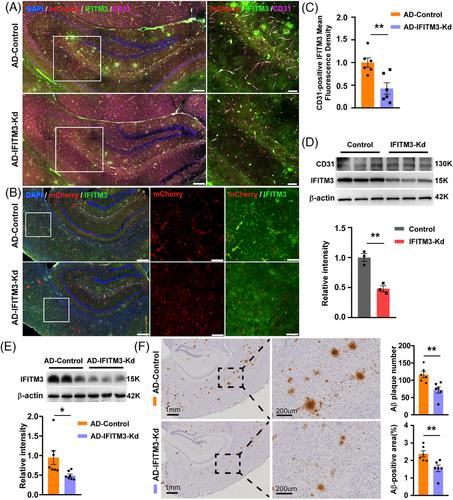
IFITM3 expression was increased in the CVECs of patients with AD. Overexpression of IFITM3 in primary endothelial cells enhanced Aβ generation through regulating beta-site APP cleaving enzyme 1 (BACE1) and γ-secretase. Aβ further increased IFITM3 expression, creating a vicious cycle. Knockdown of IFITM3 in CVECs decreased Aβ accumulation within cerebrovascular walls, reduced Alzheimer's-related pathology, and improved cognitive performance in AD transgenic mice.
DISCUSSION
Knockdown of IFITM3 in CVECs alleviates AD pathology and cognitive impairment. Targeting cerebrovascular endothelial IFITM3 holds promise for AD treatment.
Highlights
Interferon-induced transmembrane protein 3 (IFITM3) expression was increased in the cerebrovascular endothelial cells (CVECs) of patients with Alzheimer's Disease (AD).
Cerebrovascular endothelial IFITM3 regulates amyloid β protein (Aβ) generation through regulating beta-site APP cleaving enzyme 1 (BACE1) and γ-secretase.
Knockdown of IFITM3 in CVECs reduces Aβ deposits and improves cognitive impairments in AD transgenic mice.
Cerebrovascular endothelial IFITM3 could be a potential target for the treatment of AD.
期刊介绍:
Alzheimer's & Dementia is a peer-reviewed journal that aims to bridge knowledge gaps in dementia research by covering the entire spectrum, from basic science to clinical trials to social and behavioral investigations. It provides a platform for rapid communication of new findings and ideas, optimal translation of research into practical applications, increasing knowledge across diverse disciplines for early detection, diagnosis, and intervention, and identifying promising new research directions. In July 2008, Alzheimer's & Dementia was accepted for indexing by MEDLINE, recognizing its scientific merit and contribution to Alzheimer's research.






 京公网安备 11010802042870号
京ICP备2023020795号-1
京公网安备 11010802042870号
京ICP备2023020795号-1

 分享
分享
 求助内容:
求助内容: 应助结果提醒方式:
 扫码关注我们
