{"title":"用grna敏感的半导体聚合物点定量分析丁型肝炎病毒","authors":"Ze Zhang, Yuyang Wu, Jinglun Xu, Zihui Meng, Qingmin Chen, Shengyan Yin","doi":"10.1021/acs.analchem.4c04147","DOIUrl":null,"url":null,"abstract":"Hepatitis D virus (HDV) significantly influences the progression of liver diseases. Through clinical observations and database analyses, it has been established that patients coinfected with HDV and hepatitis B virus (HBV) experience accelerated progression toward cirrhosis, hepatocellular carcinoma (HCC), and liver failure compared to those infected solely with HBV. A higher viral load correlates with increased replicative activity, enhanced infectivity, and more severe disease manifestations. In this study, we use HDV gRNA-sensitive semiconducting polymer dots (Pdots) as the nanoprobes for the quantitative analysis of HDV copy number variations. The surface of the Pdots is engineered with a clamp design that includes a pair of reporter sequences, protection sequences, and capture sequences tailored to the conserved sequence length of the HDV genome. The capture sequence, comprising leading and trailing chains, specifically binds to the gRNA of the target virus. The protection sequence shields the Pdots from external interference, while the reporter sequence detects the presence of target gRNA through the degradation of fluorescent dye Cy5.5dt. We demonstrate the effectiveness of this assay in a stably transfected cell line derived from HepG2-HDV cells and its translational application in clinical samples from patients. Additionally, this nanobiosensor can accurately detect gRNA at femtomolar (fM) levels, a sensitivity unachievable by previously reported methods. This novel virus quantification system offers significant potential for clinical and virological applications, enhancing screening, early diagnosis, and personalized treatment strategies.","PeriodicalId":27,"journal":{"name":"Analytical Chemistry","volume":"22 1","pages":""},"PeriodicalIF":7.3000,"publicationDate":"2025-01-14","publicationTypes":"Journal Article","fieldsOfStudy":null,"isOpenAccess":false,"openAccessPdf":"","citationCount":"0","resultStr":"{\"title\":\"Quantitative Analysis of Hepatitis D Virus Using gRNA-Sensitive Semiconducting Polymer Dots\",\"authors\":\"Ze Zhang, Yuyang Wu, Jinglun Xu, Zihui Meng, Qingmin Chen, Shengyan Yin\",\"doi\":\"10.1021/acs.analchem.4c04147\",\"DOIUrl\":null,\"url\":null,\"abstract\":\"Hepatitis D virus (HDV) significantly influences the progression of liver diseases. Through clinical observations and database analyses, it has been established that patients coinfected with HDV and hepatitis B virus (HBV) experience accelerated progression toward cirrhosis, hepatocellular carcinoma (HCC), and liver failure compared to those infected solely with HBV. A higher viral load correlates with increased replicative activity, enhanced infectivity, and more severe disease manifestations. In this study, we use HDV gRNA-sensitive semiconducting polymer dots (Pdots) as the nanoprobes for the quantitative analysis of HDV copy number variations. The surface of the Pdots is engineered with a clamp design that includes a pair of reporter sequences, protection sequences, and capture sequences tailored to the conserved sequence length of the HDV genome. The capture sequence, comprising leading and trailing chains, specifically binds to the gRNA of the target virus. The protection sequence shields the Pdots from external interference, while the reporter sequence detects the presence of target gRNA through the degradation of fluorescent dye Cy5.5dt. We demonstrate the effectiveness of this assay in a stably transfected cell line derived from HepG2-HDV cells and its translational application in clinical samples from patients. Additionally, this nanobiosensor can accurately detect gRNA at femtomolar (fM) levels, a sensitivity unachievable by previously reported methods. This novel virus quantification system offers significant potential for clinical and virological applications, enhancing screening, early diagnosis, and personalized treatment strategies.\",\"PeriodicalId\":27,\"journal\":{\"name\":\"Analytical Chemistry\",\"volume\":\"22 1\",\"pages\":\"\"},\"PeriodicalIF\":7.3000,\"publicationDate\":\"2025-01-14\",\"publicationTypes\":\"Journal Article\",\"fieldsOfStudy\":null,\"isOpenAccess\":false,\"openAccessPdf\":\"\",\"citationCount\":\"0\",\"resultStr\":null,\"platform\":\"Semanticscholar\",\"paperid\":null,\"PeriodicalName\":\"Analytical Chemistry\",\"FirstCategoryId\":\"92\",\"ListUrlMain\":\"https://doi.org/10.1021/acs.analchem.4c04147\",\"RegionNum\":1,\"RegionCategory\":\"化学\",\"ArticlePicture\":[],\"TitleCN\":null,\"AbstractTextCN\":null,\"PMCID\":null,\"EPubDate\":\"\",\"PubModel\":\"\",\"JCR\":\"Q1\",\"JCRName\":\"CHEMISTRY, ANALYTICAL\",\"Score\":null,\"Total\":0}","platform":"Semanticscholar","paperid":null,"PeriodicalName":"Analytical Chemistry","FirstCategoryId":"92","ListUrlMain":"https://doi.org/10.1021/acs.analchem.4c04147","RegionNum":1,"RegionCategory":"化学","ArticlePicture":[],"TitleCN":null,"AbstractTextCN":null,"PMCID":null,"EPubDate":"","PubModel":"","JCR":"Q1","JCRName":"CHEMISTRY, ANALYTICAL","Score":null,"Total":0}
Quantitative Analysis of Hepatitis D Virus Using gRNA-Sensitive Semiconducting Polymer Dots
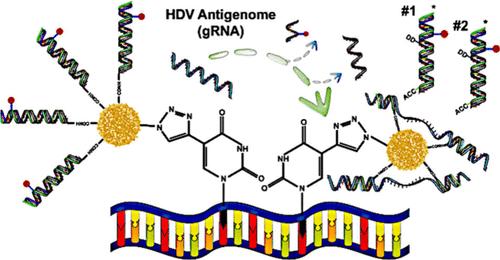
Hepatitis D virus (HDV) significantly influences the progression of liver diseases. Through clinical observations and database analyses, it has been established that patients coinfected with HDV and hepatitis B virus (HBV) experience accelerated progression toward cirrhosis, hepatocellular carcinoma (HCC), and liver failure compared to those infected solely with HBV. A higher viral load correlates with increased replicative activity, enhanced infectivity, and more severe disease manifestations. In this study, we use HDV gRNA-sensitive semiconducting polymer dots (Pdots) as the nanoprobes for the quantitative analysis of HDV copy number variations. The surface of the Pdots is engineered with a clamp design that includes a pair of reporter sequences, protection sequences, and capture sequences tailored to the conserved sequence length of the HDV genome. The capture sequence, comprising leading and trailing chains, specifically binds to the gRNA of the target virus. The protection sequence shields the Pdots from external interference, while the reporter sequence detects the presence of target gRNA through the degradation of fluorescent dye Cy5.5dt. We demonstrate the effectiveness of this assay in a stably transfected cell line derived from HepG2-HDV cells and its translational application in clinical samples from patients. Additionally, this nanobiosensor can accurately detect gRNA at femtomolar (fM) levels, a sensitivity unachievable by previously reported methods. This novel virus quantification system offers significant potential for clinical and virological applications, enhancing screening, early diagnosis, and personalized treatment strategies.
期刊介绍:
Analytical Chemistry, a peer-reviewed research journal, focuses on disseminating new and original knowledge across all branches of analytical chemistry. Fundamental articles may explore general principles of chemical measurement science and need not directly address existing or potential analytical methodology. They can be entirely theoretical or report experimental results. Contributions may cover various phases of analytical operations, including sampling, bioanalysis, electrochemistry, mass spectrometry, microscale and nanoscale systems, environmental analysis, separations, spectroscopy, chemical reactions and selectivity, instrumentation, imaging, surface analysis, and data processing. Papers discussing known analytical methods should present a significant, original application of the method, a notable improvement, or results on an important analyte.





 京公网安备 11010802042870号
京ICP备2023020795号-1
京公网安备 11010802042870号
京ICP备2023020795号-1

 分享
分享
 求助内容:
求助内容: 应助结果提醒方式:
 扫码关注我们
